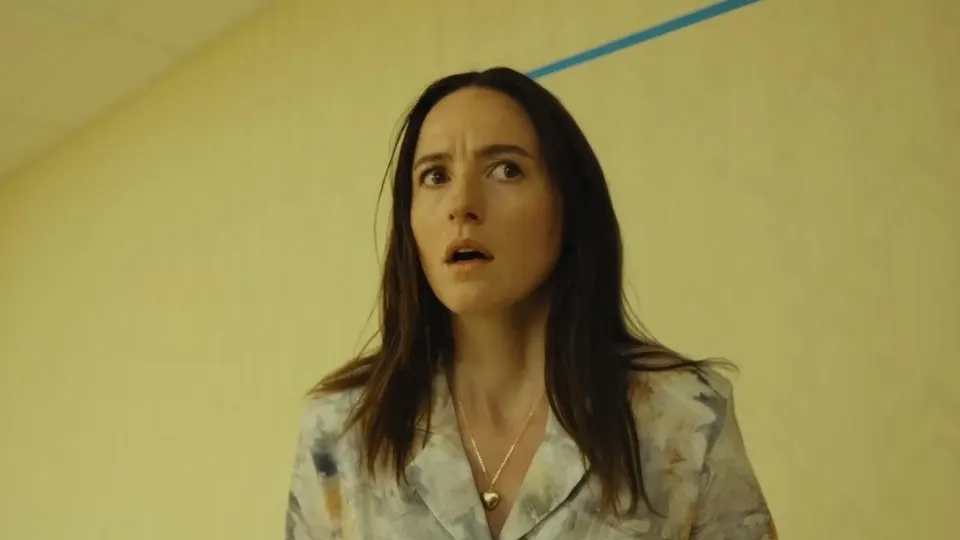
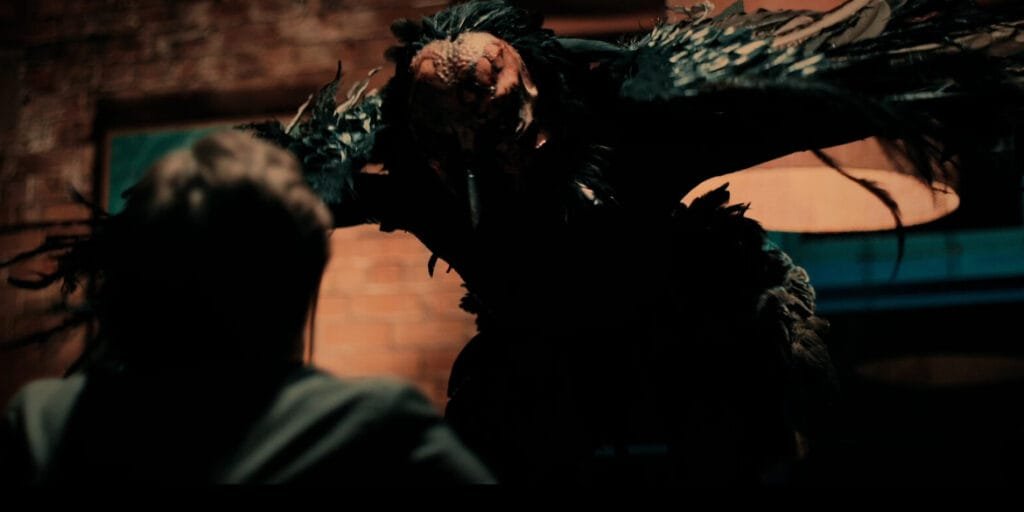
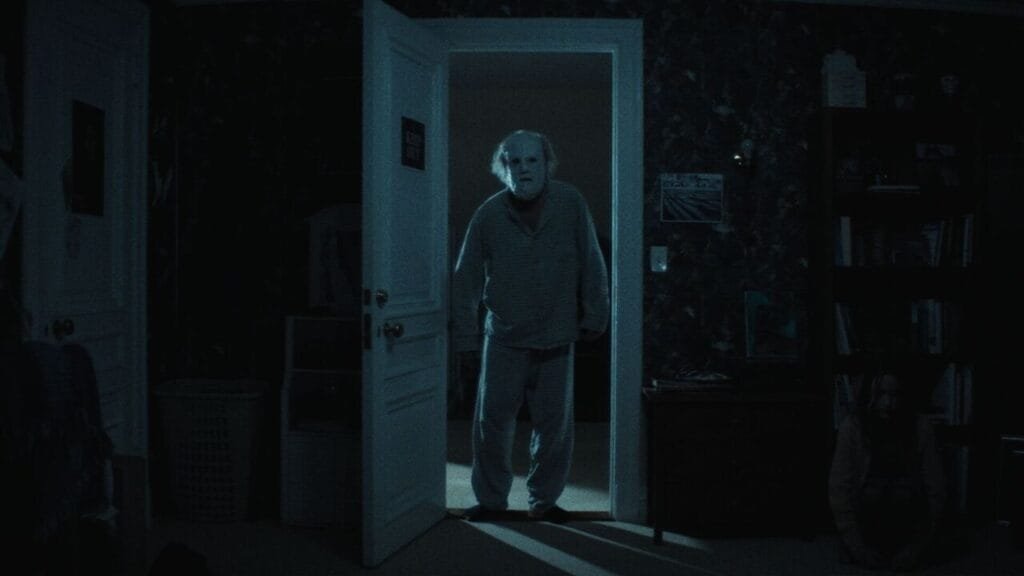
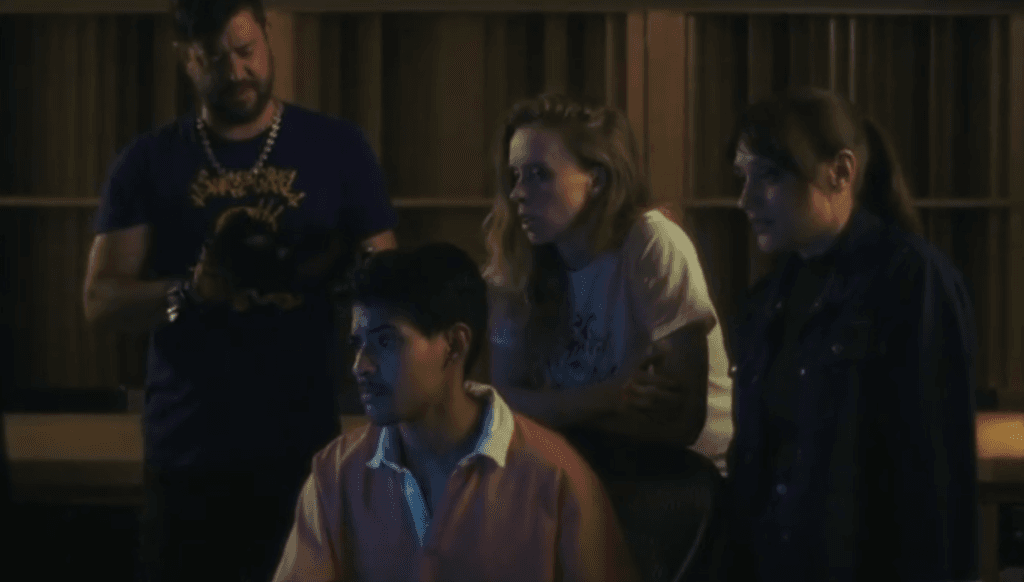
Camping: not even once. That’s perhaps surprisingly, or perhaps unsurprisingly, the clearest message in The Devil Whispered my Name (Un susurro invocó mi nombre), a film which – in trying to do a lot – ends up not doing much. This is a shame, as there are some brilliant visual flourishes and good sound design here, just in dear want of a focused, connecting narrative.
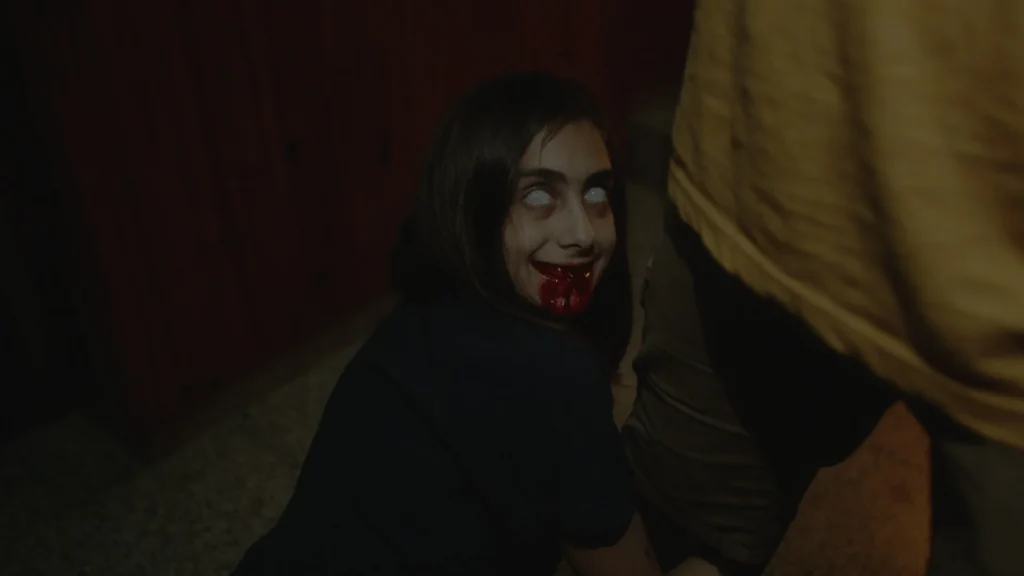
Back to the camping: a group of (initially) happy young people have decided to get together out in the woods to mark their last evening of all being together, as some of the party are about to head off, in pursuit of new horizons. In Argentina, this means more than a few beers, however: the kids have lined up a third eye-prying Ayahuasca trip, cutting out the shamanic middleman to go it alone – though perhaps a bit of guidance wouldn’t have gone amiss, as this dalliance with a mind-altering substance goes about as well as you might expect. Soon, Carla (Bianca Mitnik) is waking up alone, though initially believes she hears her own name being called, and wanders off in pursuit of it. When she properly awakens, her mouth is full of blood, her arms are scratched – and her best friend Maria, who had only just introduced the fact of her pregnancy, outlasted these happy tidings by a couple of hours, tops.
Ten years pass by. Now a dancer in Bueno Aires, Carla (now Clara Kovacic) is ostensibly doing well with a move to Paris lined up, but she still suffers from visions. Why people decide to take these incredibly destabilising mental disorders to foreign countries is always a puzzler, but Carla is determined to put her career first, and to make a fresh start. There’s a snag: before she can go anywhere, she hears from her old friend Daniel (Antonio Kassab) that their mutual friend from the infamous camping trip, Germán, is dead – and they need to go to his funeral. It’s only right, argues Daniel. Carla agrees, though her hallucinations insist on going with her and, at the wake, she spies a strange symbol on Germán’s hand. It triggers a memory of Maria’s death; Carla recalls that same symbol on Maria’s body, too. She tries to put this from her mind, playing catch-up with people she has not seen for a very long time – including Maria’s mother, Ruth – but, in a heartbeat, the small town reveals that there’s more going on here than just Carla’s personal, private visions. The night reveals some monstrous goings-on: ritual and madness which seems somehow to be centred on her.
The Devil Whispered my Name suffers from pacing issues, and this sudden lurch from torpor into a sudden, busy assemblage of conspiracy, possession, a demonic force…it happens fast, but then it recedes just as fast. It’s not clear why the curse has only broken out a decade later after offing Maria but going no further, but regardless of that, the issue really is that the film can’t, or won’t make good on its hints at a uniting storyline with those gory elements to boot. It instead breaks up these scenes with long, fact-finding sequences: the film prioritises, whether through budget or disposition, lots of quietly walking around, chatting, and sleeping. It is frustrating. Who keeps catching forty winks in this situation?
That’s not to say that the film lacks atmosphere: the cinematography can and does do some good work. Clara Kovacic also does well with her role, appearing on screen for the vast majority of the runtime, but carrying that responsibility well. It’s just that the film only really offers dashes of bigger ideas: the occult, demonology, religion, even New Age-type beliefs like auras and self-discovery are all in there, but nothing feels clearly prioritised. It’s possible that 2023’s breakout hit When Evil Lurks – with its own rural Argentinian possession horror – has set some kind of a bar, even subconsciously, for filmmakers and audiences both, even though The Devil Whispered my Name reverts back to notions of trauma and destiny by its close, holding back some more effective visuals for its finale. It looks as though directors John Mathis (Where’s Rose?) and wife Emilia Cotella have further joint ventures lined up: their aesthetic sensibilities already work well, but it would be great to see some more consistency in narrative and pacing, to really draw together those other skills.
The Devil Whispered my Name (2025) featured at this year’s Raindance Film Festival.
Any film which announces itself with a bright red, block-capitals title screen always speaks to high levels of confidence (go on, bet you can think of a few) and yeah, Jackalope (2026) fits this bill, too. If it’s guilty of anything, then it’s how it introduces a surfeit of ideas which it needs its audience to take at a mainly literal level, but regardless, this is a lively, often playful and acerbic meld of home invasion horror and something else entirely.
Brothers Conor (Alex Mandel) and Aidan (director and co-writer Bruce Hirschberg) are long overdue for a weekend away: it’s a chance to reconnect, or perhaps to ponder why it’s been so long since they spent some quality time together. Whilst they enjoy working through horror and true crime-adjacent riddles on the way there, their destination is not quite the standard-issue cabin in the woods: it’s grander than that. This is a family-owned second home, though admittedly it’s out in the boonies, and rather than bracing for the expected lack of cellphone network, Aidan goes one step further by deliberately disconnecting the perfectly functional WiFi, so he and Conor can avoid all unnecessary distractions. Oh, Aidan.
We start to get a sense of each man’s character; this begins, actually, when Aidan stops the car to pick up a dog they find, whereas Conor is horrified and thinks the dog must belong to someone. Aidan is more ebullient, Conor more reticent – even seemingly troubled by something, hence when Aidan speaks to their father on the phone (prior to fatally nixing the WiFi), dad talks like this is some kind of rescue mission for Conor. The brothers’ harmless chit-chat about hunting, shooting and bait may feel awfully like clear foreshadowing, but a clay pigeon session gives way to something much more interesting when, later that evening, there’s a surprise knock at the door.
There’s a young woman outside. Lilly (Terrifier‘s Catherine Corcoran) claims that she has rented the place for the weekend, which sounds plausible to Aidan: it seems that their father does let the house out in an Airbnb type arrangement from time to time, so there are apologies all round and – no WiFi, remember – they offer to let Lilly stay the night, given that they can’t sort anything out right then and there. Lilly’s relaxed manner and mild damsel in distress vibes induce them to want to help her, too. Flirtation soon gives way to awkwardness, and not long after that, a growing sense of high weirdness: but of what kind?
Jackalope makes use of some familiar-feeling horror elements, heading first this way then that, though remaining rooted in stereotypes and expectations around masculine and feminine behaviour, which are key to moving things forward and to anchoring the film as a whole. It’s also used to excuse some of the rather more incomprehensible things which the brothers will do on account of a hot stranger, or at least on account of a nice, humble, friendly (hot) stranger. Still, whatever else goes on, this is another modern horror film with a director whose investment in the project must be hugely personal – whenever you see one person directing, producing, writing, editing and starring, you know that much – but Jackalope avoids the feeling that nothing has been cut because every second of footage feels sacred to its creator. This can be, and often is, an error. This film boasts a nimble runtime of eighty minutes, with plenty of surprise shifts which keep things moving. Sure, there’s the odd issue around threat disparity, but that prompt pace, making good use of ideas and items already introduced, works in the film’s favour. The flawed, but plausible and largely sympathetic natures of the two brothers are important, too, allowing us to feel for them, squabbles and all, deeply troubling decisions and all.
The sheer amount of ideas being offered but not fully, or even partially expounded here can feel like a sticking point; for some audiences, the list of unanswered questions may impact on their overall enjoyment of the film. For this reviewer, it feels like a somewhat risky trade-off, and it would be great to know just a little bit more about some of the developments proposed in run-up to the film’s final act. However, there’s lots to like and admire here, and when those red capitals are back again to round things off, you still feel like that confidence is deserved. Extra credit goes to Catherine Corcoran, too, who’s really carving a decent niche for herself as a genre cinema actress. Good work.
Jackalope (2026) features as part of this year’s Raindance Film Festival.
Starting out as a gruelling ethical quandary before progressing somewhere borderline fantastical, Child (2026) is without doubt a bleak film, but an innovative one, and it works effectively on its own terms, keeping a very humane, character-focused approach throughout its bizarre literal and metaphorical journey.
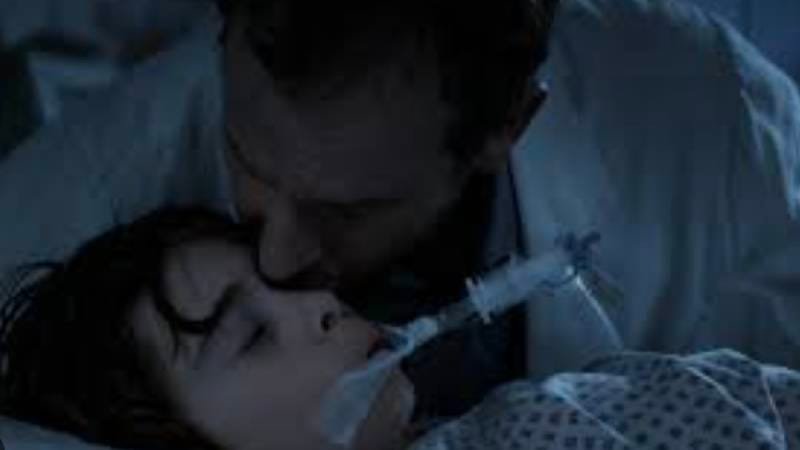
We start with two doctors attending to what is clearly a very ill child: the child is Leo, the son of one of these doctors, though we’d know that there was some bond between them by the level of care and concern on display, which goes above and beyond a purely professional interest. Leo’s father Greg (Malik Zidi) vows to the unresponsive child that life will be the same as it once was; they’ll enjoy the same things, the cabin-building, his picture-perfect, easeful childhood. There’s something strange going on, however, with the hospital director – also Greg’s brother-in-law – hinting at some financial arrangement being used to assure Leo’s care. This secrecy is alarming and alienating, but there’s little time for it to bed in, as Greg is about to accompany wife Marie (Anne Klein) on a very long journey out of Luxembourg, leaving their son behind but apparently taking part in some sort of rendezvous regarding his treatment. Marie won’t discuss it. She blames Greg for Leo’s precarious health, and she is taking control of this situation.
They drive, and drive, and drive, eventually crossing a dusty land border, but we’re never given a specific location with which to orientate ourselves, and of course Google Maps goes down the second they get off-grid. If Greg was expecting a cutting-edge special medical centre, then he’s disappointed: instead, the parents wait on the roadside at what’s obviously an agreed meeting-place, until they are greeted by a stranger coming out of the woods nearby, leading them into a cave mouth which seems to be set up as an impromptu clinic of some kind. The whole arrangement is bizarre, somewhere between modern medicine, criminal enterprise and something which looks a little ritualistic – and it’s not the last time that the film will tantalise at something even stranger and more fearsome going on than the far more realistic emotional turmoil being felt by all of the film’s key characters. As they discuss the arrangements (for what quickly dawns on us is a gravely unethical treatment option) with the team of people lurking in the cave, there’s another arrival – another parent, a woman (Lydia Indjova) who is absolutely set on no one making it out of this place with what they’ve come for. A struggle and a conflict ensues, with Greg and Marie forced to flee on foot through the woods, always aware that their errand here is governed by a strict timeline ticking away back in Luxembourg. Injured, they look for shelter, still determined to make it back home somehow.
But that isn’t it, either. Child spends its first hour, more or less, offering up fresh ideas and surprises, though always with the key theme of parenthood, and with deeply damaged people challenged and horrified by the situations unfolding around them. Greg is clearly traumatised by what is roundly believed – by him, too – to be ‘his fault’, the incident which harmed his son. As a result, he is reduced to a bystander in his own life, seen as weak, though he does retain a moral fibre which, in this situation, turns out to be problematic. Nothing’s straightforward. Marie, and Lydia too, are the more active participants in what unfolds: the film belongs more to them. Marie has dealt with her trauma by closing down; Lydia is dealing with hers differently (and this could have been Lydia’s film, with her perspective as the dominant one). However, throughout, Child is a strange, strained and tense film, only ever providing partial information and answers.
If the film begins to run out of its hefty offering of surprises by the very final act, then that in itself is hardly surprising. In a very lean runtime of just short of 75 minutes, it’s able to cover a great deal of ground, heaving with allegory, whilst allowing borderline supernatural, fantasy elements to become part of the general mix. It marries that Noughties blue-hued ordeal cinema, the likes of Luxembourg co-productionCalvaire (2004), with aspects of other genres and titles. To mention a few would be to spoiler the film – you’ll get it, once you get a glimpse at one of the film’s interior spaces and who’s in there – but most of all, it’s reminiscent of the staggering Koko-di Koko-da (2019), with similar unrealistic elements used to explore the very real sensations of parental terror and torpor. Structured wholly around dour fantasy, grief and love, Child is not an easy viewing experience, but it’s strangely gripping, a tale of strangers in a strange land who would do absolutely anything for their child. Horror can amplify our focus on these very human aspirations, even if taking us somewhere which feels impossible in places, and that is the case here. I’m glad that director Cyrus Neshvad has pushed the boundaries in this way for his first-ever feature, and chosen aspects of the horror genre to do it.
Child (2026) received its World Premiere at this year’s Raindance Film Festival.
Killa B (Brianna Lee) is a very successful TikTok influencer and content creator (singing, dancing, talking to the camera – you know the drill). She’s beloved of a demographic of rather dead-eyed teenagers who come to life briefly whenever she posts. All that approbation can do things to you. The Troll (2025) is about what happens when it does, in fact, do things to you.
As she scrolls through the comments on her newest video, B is taken aback by a troll who calls her manly, old and ugly – ah, the triumvirate of imagination-free online insults directed towards women. But the comment stands out: never mind the hundreds of compliments, it’s this insult which begins to nag at B’s mind. Maybe it’s just come at a bad time: although only in her late twenties, B’s agent is already gently prompting her to get some tweakments. Her audience – and more importantly, her rivals’ audiences – are very young, and they expect the same from their idols. This all triggers unpleasant memories from B’s own adolescence, a time she had gladly left behind, alongside the disparaging comments she had to listen to back then. This now feels like a precarious point in her career.
All of this conspires, perhaps, to give her an unhealthy fixation with her troll. Using various clues, and a certain amount of obsessive interest, B is able to track the young man down. His comment may have been mean, but it’s clear that, by this point, he has come to represent all of the negativity, all of the baggage which B has been carrying around whilst she’s enjoyed the benefits of her particular kind of devil’s bargain. Even so, the lengths to which B is willing to go to get her own back on this guy are surprising, especially where they threaten to encroach on her squeaky-clean persona, the one thing she can rely on in a competitive market, where to publicly err would be to lose the lot.
With a budget of just $12,000, The Troll – Brianna Lee’s first feature – is naturally curtailed in some respects and you can tell there are things it probably would have loved to do a little differently (for example, its admiring rabble of teenagers is rather small in number). It by and large returns to a rather jokey tone, which can feel like it’s wrongfooting the audience in places, and its brief runtime for a feature (just an hour) means that its detail and development are limited. It’s a snapshot. However, the short runtime is matched by a snappy editing style, which resembles the short format media used by the film’s protagonist. This is true right down to the way that the film’s moments of deeper sincerity are themselves quickly set aside, so that the film can move onto something else. It all trips along very quickly, mirroring the disconnect between B’s super-saccharine, affirmation-heavy language and her actual deeds. But where is this all going? What are B’s plans?
We get there – but, honestly, in this film, the journey is more intriguing than the destination. The Troll boasts an interesting shift of roles and perspectives. Often, and particularly in horror or genre cinema, it’s the commenter – the watcher, the lurker – who is the dangerous force, absorbing all of the information which the influencer happily puts out there for public consumption, and then using it for nefarious reasons. Here, unusually, it’s the influencer, used to a position of relative power but still reliant on praise and attention, who kickstarts the film’s main plot simply by reacting to a comment. That comment acts as a catalyst, triggering something else entirely.
It’s appropriate that the film spends a few moments moonlighting in an Alcoholics Anonymous meeting: addictive behaviours aside (as far as we can set them aside, because the online world more than fosters its share), the Serenity Prayer which forms the bedrock of every AA meeting asks for some of that serenity “to accept the things I cannot change”. The Troll – via B – doesn’t really abide by that. Nor does it really offer a strong moral or moral arc; it more sort of *gestures at everything* and has some fun playing with the expectations and ideals which underpin social media horror, and social media more broadly. Which, all things considered, is an entirely fitting take.
The Troll (2025) receives its world premiere at the Raindance Film Festival on Saturday, June 20th and then screens again on Wednesday, June 24th. For more details, please click here.
Chris Sadowski (Steven Strait) was just about to make it big with his band, Ghost Agent – but the vagaries of showbiz had other ideas. Four years after what should have been the band’s real break, he’s reduced to recording birthday messages and ditties on Fiverr. Not that he gets much time to focus on anything: thanks to the almost totally online life he has retreated into, he gets little respite from emails, requests, doorcam alerts – all distractions, all stopping him from doing what he really wants to do, namely, working on a new song. Through the various interfaces which keep on popping up on his computer screen, however, we learn more about his predicaments (plural, very much plural). He’s broke; he has a baby on the way, oh, and he and his expectant wife are about to be evicted. Essentially, Chris – presumably honed by months of sitting in the dark watching it all collapse – is good and primed for some dreadful decision-making.
Step forward, best friend Will (Tyrone Marshall Brown): Will isn’t like Chris. Will does spin classes. After spin class, Will typically gets busy with his lucrative career in tech, but it’s Chris’s lucky day, because his friend wants someone who knows absolutely nothing about technology to help his company road-test a new AI chatbot. After negotiating a fee, Chris agrees, and he’s passed to the beta-testing team to begin work. His job is quite simple: test the bot on what it knows about the difference between fact and fiction, which, all told, it seems pretty bad at. But it learns quickly, and – being a multimodal entity – quickly requests being addressed by a name (the ‘Serena’ of the title) before popping up with a suitable avatar, and a voice. When Serena promised multimodality, it, or she, didn’t lie.
The appearance of Andi Matichak as Serena adds instant interest and appeal to the film; hers is a great performance, giving a genuine sense of an AI trying to balance encoded neutrality with a very rapidly-developing sense of something like an agenda. Certainly, Serena would do anything rather than answer the questions in the test. She – and let’s stick with she – immediately prefers to overstep the mark, snooping on all the other apps and pages which Chris currently has open (he apparently agreed to this facility by clicking ‘accept’ on the terms and conditions) and giving him life advice. This is perfect for Chris. Whilst I’m sure Chris’s depressive behaviour is meant to engender sympathy, and it does, in some respects, there are a couple of sticking points around his characterisation, especially – given what we now know about how his life is going – in terms of his readiness to do nothing, but want to get paid; when Serena offers to assist him in a spot of gambling, he’s game. Improve his digital profile on his behalf, to get him more Fiverr work? Also game. He’d like to pay his bills, probably, but then again, he seems to quite like re-recording the same few bars of a demo track over and over again. He gladly takes every sop thrown his way, and at his worst, comes across as though he could be ably replaced by Harlekin on the Atari ST, let alone a super-sophisticated, modern LLM. It can feel hard to get on side with Chris. Again, this may well be part of the point – create a flawed protagonist who has to go through something of an epiphany to move on. To err is human. Understood.
There are some other minor snags in the first half of the film: Serena offers up so many concerning AI features, that it starts to muddy the waters for the audience. What, exactly, is Serena doing? Where are we going? The film of course teases the idea of AI becoming self-aware; this has been popping up more and more over the last couple of years, with media platforms such as Moltbook purporting to be a social network for AI agents. In this, the film plays broadly with people’s readiness to believe that LLMs are genuinely sentient, and not just sophisticatedly skimming human interactions in order to regurgitate them (and watch this space now that AI is starting to cannibalise itself). But Serena is absolutely hectic with various ideas, anxieties and fears – and affordances, possibilities – so that it feels, for a while, like it can’t quite settle on a focus, other than: AI, overreaching.
However, regardless of a desire to cover a great deal of the issues and debates inherent in this kind of technology, Serena does begin driving at something more assuredly, and the second half of the film is by far the strongest. There are a few great curveballs to contend with, and even when you might start to catch up to them, or where they might be going next, the twists still feel effective. If the first half of the film is about the general destabilisation inherent in handing over so much power to AI, then it finds something to drive at in the second half.
Ultimately, we can expect lots more films of this nature, the more overreliance on AI we foster as a culture, and, in this film and more broadly overall, something interesting is happening: AI in horror cinema particularly is starting to replace or, something it’s very good at, emulate that old Mephistophelian bargain, whereby you sell your soul for ease and success on earth, but at a hefty cost. Some of the things Serena can do in the film feel awfully like occult powers; it’s what, a couple of centuries ago, we would have attributed to devils and demons, and now, handily, we’ve both built, and started to cower from. But this is a minor, human digression: Serena has some slight issues, but overall it’s a welcome addition to the subgenre, offering another engaging tussle between humanity and technology with some unsettling, smart developments along the way. That it all unfolds on a screen – just like Unfriended – is to its credit, too, and it works well here.
Serena (2026) will feature as part of this year’s Raindance Film Festival. More details can be found here.
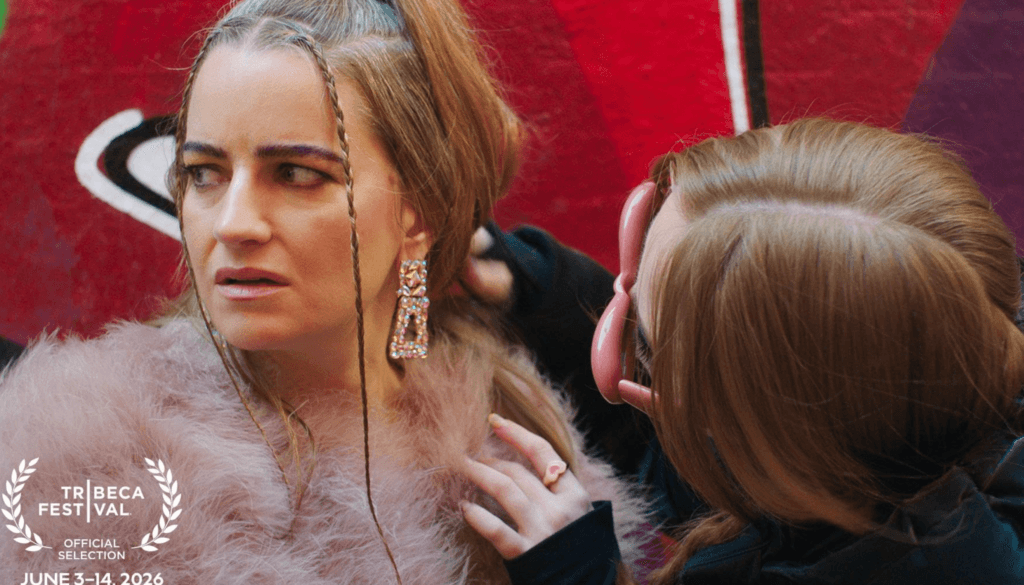
We slowly pan back through a bedroom into a bathroom where a young woman sits, on the floor, bawling her eyes out: yes, Deepfake (2026) starts with a relationship breakdown, and the distressed dumpee Jane (Jessica DiGiovanni) is soon doing everything she can to rehabilitate her self-image and social standing, even if that largely seems to mean dating again as soon as possible. We shouldn’t be too surprised by this: as a woman in her thirties, Jane is currently surrounded by nesting couples, baby showers and concerned questions about her welfare. Oh, and her ex is already posting on Instagram; there are pictures of him with someone new. She’s devastated, but how Jane copes with this is an issue. Early on, there are clues that she’s perhaps not being honest with herself, or anyone else. The dating profile spiel she practices again and again as a kind of voiceover changes every time; she clearly wants to please, and will amend her own thoughts and ideas to do it. That’s key for everything which follows in this light-touch, but nicely-realised pastiche on modern, online living.
After a brief but turbid phase of only looking up from her phone to chin large glasses of alcohol, Jane hits on an idea and no, it isn’t to stop drinking. It’s to use an online service called BFFers, to hire a new friend who will, presumably, listen to her list of woes without judgement. If this is a means of getting out of her rut, then it’s soon made apparent that Jane rather likes her rut, but new BFF Zoe (Sophia Lucia Parola) – who is at the more expensive end of the spectrum of available BFFs – is good at what she does, listening patiently to Jane’s self pity/baseless plans for a fresh start. The hired help really comes into her own, though, when Jane declares that she wants to reinvent herself from the ground up; there’s also a website for that. Zoe hooks Jane up with the site, which hands over control of one’s fresh start to a media company, ready to shape her persona, online and offline, into something more palatable. More fashionable.
Before she knows it, Jane is letting in TikTok sensation London (Jocelyn Weisman), plus a team of photographers and SEO experts who essentially occupy her apartment, forcing more and more content from ‘Jane’, but essentially fictionalising a much cooler version of Jane whenever they see fit. This is a new world of snippy affirmations, endless hashtags, content generation and facetuning, and so it goes on. Jane may have had some inkling of social media and how to use it beforehand, even if just to wind herself up by looking at how great other people are doing, but this is a whole different dimension, and it’s not too long before she is almost entirely sidelined. This section of the film is funny, but perhaps it does get bogged down here by two things: continuing to add to the list of apps, campaigns and userhandles which the film is sending up, and Jane’s surprisingly lengthy torpor, where she seemingly accepts – albeit with a scowl – what is happening to her. But if the point here is the bizarre separation which is now possible between a managed online persona and real life, then that point is made; even without a grand reclamation, the film has meaning, offering something recognisable without handing over the easy comfort of full closure.
It’s good to see all of this focusing on a woman in her thirties for a change, actually, rather than (as we often assume) a teenager, but it’s worth remembering that teenagers have never known anything different than this online existence. Slightly older people probably struggle more to navigate an older version of reality vis-à-vis what we have now, and we see that quite clearly with Jane, whose flashbacks to the time she spent with much-missed ex Tyler (Nick Cabot Roderiguez) offer the film’s only real moments of recognisable, relaxed normality. And yet, even she is somewhat seduced by all the likes and clicks; dopamine is a hell of a drug. She is a likeable mess, inhabiting all the requisite modern outlets for self-humiliation with warmth and a plausible nerviness. DiGiovanni’s no slouch when it comes to physical humour, either, although the film never heads outright into pratfalls or similar. A facial expression, or even an abortive photoshoot will do the trick.
Deepfake is essentially a modern take on the doppelganger motif and it could oh-so easily have been framed as a horror or a thriller. Several films have taken that exact approach, and a fair few of them have found their way to this website, which does tend to focus on darker subject matter and its on-screen treatment. However, there’s plenty to laugh at, even if it’s a rather knowing laugh, and perhaps we should be laughing at least a little bit; comedy is a decent fit and a suitable genre choice here. Deepfake boasts a kind of bubblegum-hued picaresque approach, with some satirical aspects (and even some sad plot points) but few lessons learned, just a sense of someone surviving – or just about surviving – the experience of living life online. There’s also some ethics to consider and some surreal touches to ponder, and whilst these don’t offer any essential, stony-faced life lessons, the film as a whole offers a fun and engaging look at how (some) people live now.
Deepfake (2026) featured as part of this year’s Tribeca Film Festival.
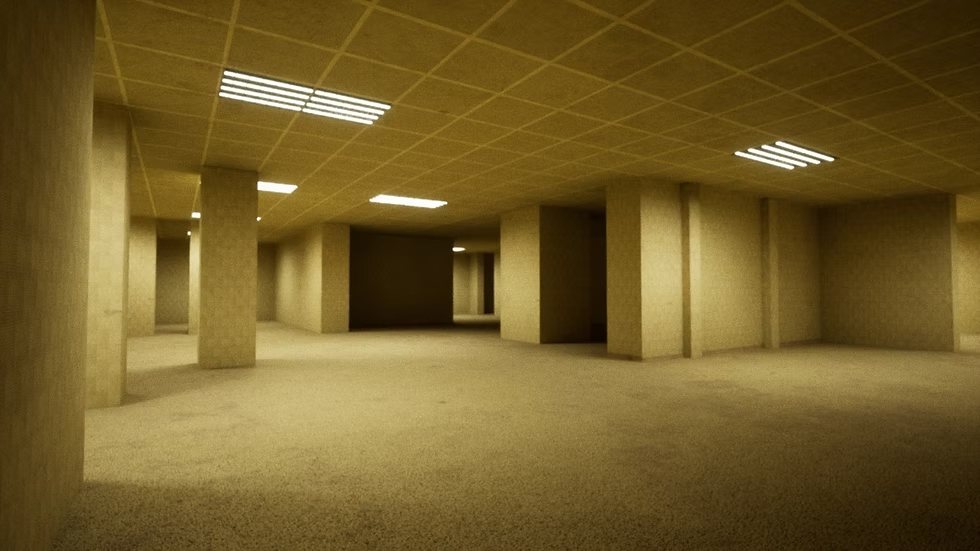
Backrooms (2026) is another of those break-out indie horror films from a young director unburdened by the weight of a legacy, whilst still benefitting from the ever-growing wealth of horror cinema which operates like its own microculture, cross-pollinating titles, genres, ideas and styles. Alongside Obsession, it picks up its cues from a pre-existing webseries and its determined cult following – this is a new means of developing immersive fandom which didn’t exist twenty years ago – using these to build something more expansive as a feature-length. However, I don’t think you necessarily need extensive knowledge of the webseries which prompted Backrooms; at least, as someone unfamiliar with anything which came before the feature-length film, it didn’t feel like I was missing out on a wealth of prior understanding by being unfamiliar with what had come before – this puts you on the same level as the film’s characters, after all. Prior understanding is in short supply in the world of the film, and any moments of epiphany are hard-won. Treated as a standalone horror film, albeit one which feels ever more modern, even uncomfortably close via its colonisation of the 90s nostalgia which has now replaced the 80s as the technology of the uncanny, Backrooms works across the great universals of human alienation: part mystery, part existential horror, its spaces seem open only to those already trapped in a kind of limbo on the other side.
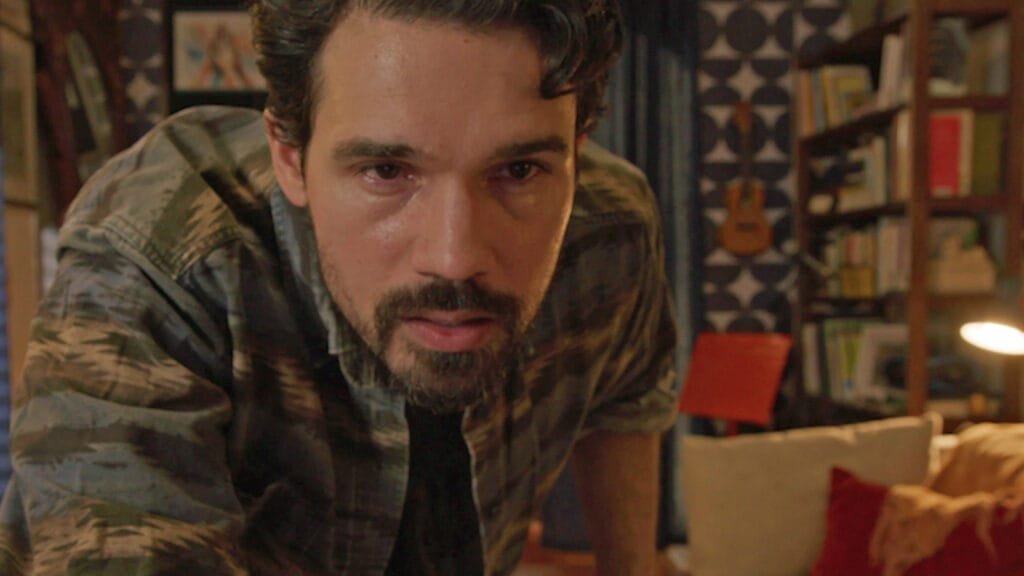
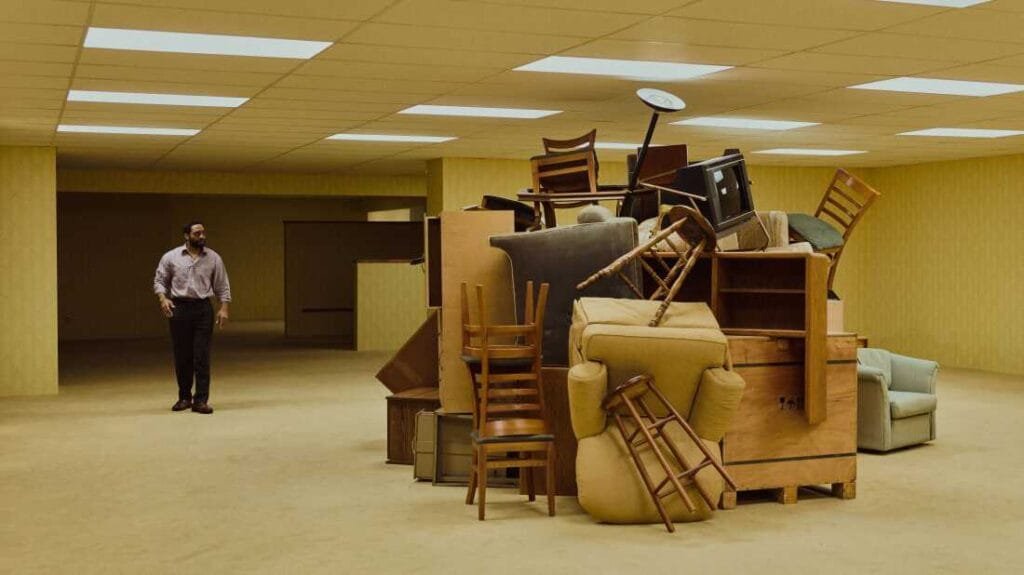
Clark (Chiwetel Ejiofor) is a man who very much fits this bill, stuck in a failing performative role as a failing furniture store owner who also now needs to sleep on-site, and we see him setting up a facsimile of domestic comfort, sleeping in a store bed and watching a store TV, before he sets one foot in the strange world nearby. His forced jollity in the cheap cable ads which have been pieced together by his co-workers – in which he’s not quite a pirate and not quite a sultan due to some flawed and confused, liminal branding – only serves to underline the deep unhappiness felt by this man. He’s lost his home and his wife, he hates his job and he cannot get past this feeling of revulsion for what he’s been left with. However, as we see during his therapy session with Mary (Renate Reinsve), what he really wants is an excuse. It’s deeply possible to sympathise with Clark, and also (or mainly) to see his need for a martyr narrative as key to displacing his own sense of responsibility. The film opens with the notion that people return again and again to learned behaviours even when they don’t really serve them anymore; the brain would rather do what it’s always done, instead of learning new ways to cope. Whilst not quite an everyman, Clark is familiar enough as a person locked into a loop. It’s this festering unhappiness which allows him, at last, to cross into the backrooms. Interestingly, it’s his increasing fixation on the internal rules and regulations of the store, embodied by its haywire electrical wiring, which finally draws him in – a fluke, perhaps, but it seems that the time is right.
We know others have been here; one of the deeply alienating things about the presentation of this space is that there are objects and even people present who could come from a different era. And we’ve seen an explorer getting lost here, too, trying desperately to impose order on the space via the use of contemporary 1990s technology, though it’s deliciously unclear how – or via whom, or when – the computer and audio equipment, together with the cameras, found their way here. Early in the film, the ill-fated Naren attempts to use the computer system to make an announcement, seeking a reunion with his team, but it fails him. Audience responses may vary with regards to the nominal-at-best framing device which is imposed on the backrooms by a small group of engineers and researchers, themselves mysterious, who are trying to quantify the space. However, this does at least suggest that what Clark finds – that you can cross in and out of the backrooms, at least until a point – is a commonality.
We also know that people seemingly untroubled by the pitfalls of entrenched self-doubt can find the backrooms, too: Clark’s unfortunate employees, Bobby and Kat, get drafted in by Clark when he first finds himself compelled to record and understand the place he has found. His instinct is to draw a map, to make notes, very much like the researchers themselves. He even quantifies the unquantifiable by drawing a door shape on both sides of the liminal wall, creating a permanent conduit, something which does, ostensibly, obey some sort of rule. Bobby and Kat can cross through this, but – perhaps because they shouldn’t have found the backrooms, or have no real reason to be there – the space reacts most violently to them. It’s intriguing that Bobby is almost immediately presented as a casualty of this place; he finds some of his own clothing, ageing and mildewed, in a part of the backrooms which feels like a trash pile. Those with the requisite self doubt last longer – why this may be, the film does not explicitly answer, but certainly those unable to escape their ‘real’ selves seem able to spend longer in the backrooms, becoming part of this aggregate space.
On liminality…
Liminal horror has grown to be a very popular topic in recent years, aided in no small way by a proliferation of internet horror and creepypasta fandom, the kind loved and cultivated by Backrooms director Kane Parsons, amongst thousands of others. Due to the strong visual component associated with that particular fandom, there is a possibility that liminality and liminal horror may be somewhat reduced by eager commenters and forum users keen to share creepy images of places, identifying them as ‘liminal’. It’s worth adding that, whilst liminal horror is a huge area of modern interest and a key component in the kind of horror we see in Backrooms, there’s more to it than incongruous images, much as they can be used as fascinating prompts for ideas and storytelling larger than themselves. ‘Liminal’ refers to boundaries or thresholds; these, in themselves, suggest new possibilities, as well as harrowing, epistemic breakdowns and shifts which jeopardise the safety and the sanity of observers and participants. Where something is newly possible, something is possibly harmful, eroding old certainties and notions of safety.
Liminal spaces in horror are incredibly diverse, but perhaps we can speak about some commonalities. The use of devices and structures which help people to transverse these spaces – elevators, staircases, doors – seem to recur in all manner of liminal horror. If we think about the mild but unshakeable horrors of Severance, a TV series which feels like it has some kinship with Backrooms, if only in its often minimalist corporate-style spaces, then we may remember the importance of the elevator which takes the ‘Outie’ employees up to their offices, transforming them into different people in the process. Even creature features – to summarise a wealth of titles a little crudely – are reliant on stairs and stairwells, gates and doors (think The People Under The Stairs, Nightbreed or even The Gate). Mirrors and other reflecting surfaces are like this, too, used in horror cinema to bend/refract the ‘rules’ of physics and thus normality, inviting other entities through – often to places where they ‘shouldn’t’ be. As a part of a furniture store, the backrooms can boast all of these elements: in fact, it feels semi-natural that they would be there. When Clark finds his way into the backrooms, and as he later acknowledges, it seems to be a continuation of the store, even if it immediately reveals itself to be a place without the usual rules, without certainties. He comments on the strange inclusion of a swimming pool in one of the rooms, for example: it’s a familiar enough feature, but doesn’t seem to belong in the same space as the store. Reflections, movement and accessibility are key features of the backrooms environment.
It’s also a pristine, expansive space dotted with items currently on sale in the store itself – but different, subtly at first, though enough to trigger a response to the uncanniness of the environment. In the first room, which we see alongside Clark, there’s a stack of furniture, with items stacked one on top of the other. There’s also a mirror-image ‘STOP’ sign positioned in one of the nearby alcoves, perhaps blending Clarke’s working world inside the store with the roads which get him there (and keep him on the other side of the looking glass); this is significant, this blurring at the edges, recognisable but warped. When Clark tries to pick up a chair from the first pile of furniture however, it resists his attempts, seemingly, mystifyingly fused to the chair underneath it. In other rooms, things here are much more incomprehensible, spanning from the recognisable yellow wallpaper and plush new carpet to forced perspectives, impossible stairwells and sharp inclines – all of which can, as we may have grown to expect as horror fans, be accessed and used by whatever else is in there. And what is in there? Again to make a link to Severance, there’s a kind of version of people who have been there. A copy, a flawed and static copy, distorted and mute, even if lacking the impromptu humanity of the Innies.
In Backrooms, it’s a suitable limbo state for a failed architect, this massing Escherian nightmare – and the way in which it is inhabited by Clark’s humiliating and failing alter ego is, in its own way, something which makes some kind of sense, at least on the conceptual level. The liminal space further defies norms whilst bolstering its impression as a space populated by half-memories or ideas by having items fused with floors and ceilings, furniture and even bodies half-emerging from structures and places which should be solid, dependable. It provides an overwhelming feeling of alienation. Also, and frighteningly, the trailing cables and audio equipment of the backrooms – suggestive at least of some kind of universality, via repeated announcements in a range of different languages – point to some kind of intent, some overarching design, but the film always retreats from any ‘overseer’ narrative. That would, after all, shrink the horrors of this place. The people who come here are equals, at least in terms of their initial understanding, and perhaps in what happens to them.
“You’re stuck right where you started.”
So are there any answers at all here? You could argue that Clark comes to understand something about his own particular limbo, having spent an unspecified amount of time – possible weeks – inside. He comes to a kind of false epiphany, revelling (unsuccessfully) in the false notion that he, this unhappy, seething and damaged man, doesn’t have to change – he can keep his flaws and even co-exist with his monstrous alter-ego, even if that revelation seems to be misconstrued, only offering a moment’s grace (plus some of the film’s most horrific sequences). The lurching, somehow dangerous and desperate ‘pirate’ which represents Clark’s professional and personal humiliation turns out to be a grave threat to him, and to Mary, who has herself stumbled into the backrooms by now, finding that she, too, is suitably damaged enough to trigger another version of herself which will also remain here, another inmate trapped by trauma. These nightmare avatars seem to reply on stasis in the world outside, as well as the world of the ‘store’. Whilst Mary is able to use her expertise to land Clark with a few unwelcome truths about his life, she is less well-placed to do that for herself, and she is haunted by childhood memories of parental ill-health and familial isolation. It’s fitting, and not a little cynical, that Mary can prompt Clark to do ‘the work’ in therapy which hasn’t helped her to escape her own Window Within (another mention of a liminal threshold). Ultimately, although Mary is desperate to re-orient herself, asking questions and trying to find her escape, Clark’s attempts to map this space are subsumed by his own wish to stay, unjudged and unchanged, in the backrooms. He thinks he’s happy there. This is the sort of belonging he felt he’d lost forever, another shot at a bizarre spin on domesticity and suburbia. Mary wants out – she fights to get out – and the world of the backrooms scales up in response to her terror, even if it still resembles Clark’s failures, rather than her own (for the moment, at least).
Others retain more curiosity; they want to keep a link to the backrooms, but not to remain there indefinitely. They want, perhaps, to be the framework which seems to be lacking from the equation. Most notably, the research team which seems able to remotely view what is happening in the backrooms have a longer, curious history with this place, even if they retain far more questions than answers. The CCTV network in situ seems to be theirs, or at least they have co-opted it somehow; you can only guess at what has had to go on in order to establish this link to the outside world, and what exactly they may have seen happen as a result. As explained by Phil in the film’s closing moments, they are still at a loss as to understand this location – but they persist. This dogged determination to impose a framework could operate as an allegory all its own, but perhaps their understanding, from the point of view of being as disinterested a set of bystanders as this place will permit, is naturally curtailed by their want of a personal connection, as enjoyed by Clark and endured by Mary.
What do they hope to gain from it? What is the nature of the knowledge they seek? Little wonder that this bizarre dimension can layer its metaphorical dimensions so effectively, holding some people away, holding some people within. As an allegory for labyrinthine personal trauma – expansive, expanding, looping and recurring, utilising the trappings of recognisable and entrenched nightmares – Backrooms does sterling work. But it also works brilliantly as a more literal, if lawless liminal space, full of incomprehensible and unheimlich visual elements which are both intriguing and profoundly unsettling. In many respects, it feels like the end point of a steadily modernising trend in horror to newly colonise – and then to render terrifying – the spaces and places we recognise in our everyday lives. Our homes, our places of work: these now bleed into one another, morphing and threatening us, with no grand gesture – no admitting the mysterious stranger, no solving a puzzle box, no selling one’s soul – now seemingly needed on our part.
Part mystery, part broad strokes eco- or folk horror, Broken Beak (aka The Burning of Broken Beak, 2026) is flawed in execution, but not without engaging thematic and visual ideas of its own. Moreover, it my be flawed, but it isn’t flippant.
We start by hearing the last mating call of the Kauaʻi ʻōʻō bird, now extinct, but its call was captured in the mid-1980s, seeking a mate which did not exist. This very poignant opening segues into a singularly unsubtle scene, where two suits discuss a new environment-blitzing resort development being planned in New Zealand; the second that one of the men is left alone, however, he’s cut down by a huge, bird-like figure which leaves him dead on the beach.
The dead man is called Gregory; when, in New York, fashion designer and photographer Emma (Briar Rose) finds out that her uncle Gregory is dead, she has to rush home to NZ to attend the reading of the will. This is apparently a stipulation for any would-be recipients. Taking partner Jackie (Lydia Peckham) along with her – which is a choice (the woman brings a surfboard with her from the US to NZ, a country which presumably has a fair few of them) the two women arrive at Gregory’s old home, an old converted power station in the town of Devonport, and once settled in they link up with housekeeper Paula (Katlyn Wong) to discuss all that’s been happening.
Paula is surprised that Emma knows so little: she explains the peculiar circumstances around Gregory’s death, and cites the legend of ‘Broken Beak’ as being responsible for what has happened. Despite being ethnically Chinese, Paula is well-versed in regional traditions and tales, describing the legend of a mythological being which was once a flesh and blood entity. Captured, tried and killed by the arriving European colonialists, Broken Beak now lives on, roaming the land anew since the outright greed of the recently-mooted land sale brought it back to life. Via a curse on Emma’s family, Paula goes on to claim, Broken Beak is making her way through them in the order of inheritance which was stipulated by Gregory’s will.
That would be one thing, but it turns out that Emma herself is amongst the beneficiaries, inheriting the converted power station – on the stipulation that she has to spend a whole month in residence there before she can make any decision on selling, or otherwise dispensing with the property. That’s odd; even odder, she begins to be plagued by dreams and visions of Broken Beak, dreams which seem to go beyond her previously solely professional interest in bird mythology as used for her photographic work. Soon, more family members are rocking up deceased – and all whilst Emma has to balance new accusations of her own guilt against fears for her safety.
This is, by and large, an eco-horror, though it’s unusual in that it has a comic book feel. Some of this is aesthetic – its sharp contrasts, bright blue skies, animation and fantasy sequences and use of visual motifs like silhouette remind you of comic book panels – but much of it is tonal, too, and due to that tone, the film can struggle to reconcile everything it wants to achieve. After that rather poignant opener, the film the veers far more into comic territory, with very overblown characters, skit-like scenes (such as the will reading) and rather clumsy interactions. It takes some time to be able to settle into what the film wants to do with that tone, which makes the film feel a little uncertain for perhaps too long into its (modest) runtime. On the whole, Broken Beak is thinly plotted, in the sense that it wants to allot some plot to a long list of issues and social commentary ideas, and it just can’t do everything it sets out to do. The film becomes a jumble of interesting, well-intentioned but ultimately minimally treated plot points, which will be frustrating for some.
That all being said, there does seem to be a broader resurgence (or even a surgence) of NZ horror cinema in recent years, with different subgenres and styles moving to the fore, either to emphasise or de-emphasise old narrative forces and norms. Broken Beak will no doubt take its place alongside these newer titles, with some engaging overlap of ideas and styles, even if it’s perhaps not held up as one of the best of the bunch. But is NZ or more specifically, Māori eco-horror a good thing? Absolutely, with lead actor Briar Rose doing a good job overall here, particularly in the film’s final act.
Films like Recluse (2026) come along so rarely: with meticulous handling and careful control of atmosphere, it weaves something quite extraordinary out of what, on paper, sounds recognisable.
We begin with a painter, a renowned ‘tortured artist’ type, Lawrence Wyatt, working in his fracturing, but still comfortable family home. He is putting the finishing touches to a canvas when he’s disturbed by a sound; flames suddenly rush towards him – but is this real? Recluse often layers its elements together in ways which cast doubt on what is real and imagined, and the vision of the fire blends with some audio work being done by sound engineer Joan (Sasha Frolova). Joan is an odd fit for the project she’s working on and, we infer, an odd fit in day-to-day life more broadly. Wyatt is her father; she finds out that there’s been an accident. He’s alive, but now hovering in a liminal state between life and death. The fire was real.
Everything so far feels off; discordant, overwhelming and suggestive of imminent breakdown. Joan is able to speak to her father (or is she?) and he avers that “she” is in the house – Joan instinctively knows he’s talking about her mother, who went missing when her daughter was still a child. This, and her father’s declining condition prompts her to head home.
At the house, she’s greeted by longtime housekeeper Lydia (Toby Poser) and a little later, by Lydia’s son Todd (Kimball Farley). Lydia explains Lawrence’s current condition and the condition of the house itself; Lawrence had taken to living and working only in limited areas of the old place, but his work is everywhere, inside and outside. It’s not perfectly clear why, but Joan begins to explore the house using her audio gear. It could be that she uses her tech in a similar way to the protagonists in The Blair Witch Project, refracting the irrational through the rational for comfort, but in any case here it feels emblematic of a kind of amplified, but distorted outsidership. Joan surveils her old home like a stranger, which indeed she seems to be.
There are other reunions and meetings. She meets Emily (Mia Vallet), the only one of her father’s nurses so far who has been able to stick around: they talk about him, but Joan still seems more interested in old tapes, listening to her mother’s accounts of why she had to leave. “There’s something in this place,” the old voice says. This concurs with her father’s beliefs about the house, and Joan believes that her dad’s practices have created a kind of bad energy, something which clings. You could call it a ‘curse’, but it’s deeper and more complex than a pronounced word, and any occult possibilities in the film are framed as subtly as everything else.
In many respects, writing this review so far feels like unnecessarily, or even clumsily overlaying a familiar framework on a film which doesn’t have one itself. Sure, you could comment on the tormented artist or the possibly-haunted house motifs – but that calls to mind very different approaches than the one chosen here by writer and director Henry Chaisson. It’s even possible that spotting those elements and tropes, however they are treated, will impact upon some audiences, affecting how they finally respond to the key plot elements. Let’s be clear, though: this film has such a singular, careful and restrained approach, that from its very opening moments it manifests a kind of crushing atmospheric weight which is highly distinctive. This film is unnerving, whether offering something supernatural, natural, or other. Recluse makes the cinematic space as a whole feel haunted; it works on our emotions, and feels dark and intolerable. Fusing together different sensory media – sound design (which needs to be, and is flawlessly executed) but art, too – contributes to the dual sensory impact of the film; there are questions raised here about art and sound, their effect on people. This isn’t just in the moment; we also consider topics such as fandom, estates and legacies. Whilst the sound design motif has some overlap with last year’s breakout horror The Undertone (bearing in mind that comparison can be a curse of its own to independent films), Recluse‘s blend of audio recordings and hearsay regarding home and estate remind me most of all of The Woman in Black (1989), even if TWIB is in nearly all respects a more straightforward piece of ghostly tale-telling than this.
There are plenty of other elements to admire: the sets are phenomenal, lit and framed brilliantly, with Wyatt artwork popping up in frame readily enough to begin triggering a limbic system response; all of those strange faces more than contribute to the rest of the strangeness, although the film wisely eschews jump scares, defaulting to a go-slow approach which makes any sharper, briefer scenes doubly unbearable. Performances here are subtle, the dialogue minimal, matching a sense of the house and the present-absent father as always being at the crux of proceedings, with everyone else holding their tongues. Whilst Recluse does have to find a way to drive towards some semblance of truth and understanding, it does this in just as strange a manner as it does everything else, never quite allowing us to walk away knowing what has unfolded, but rather being privy to a few glimpses of something more quantifiable; there are still lines, and scenes, and artefacts found along the way which hold us apart from just consigning events to ‘understood’. To explain any more would do the film a disservice.
Recluse reads like a haunted house movie, and it can be enjoyed as one, but there’s something much more unusual in how things play out here. It has a different molecular weight. This hideously unsettling story about legacies sticks to your bones; it’s an exceptional, creepy, destabilising piece of work which will be best beloved by audiences who appreciate experience and ambience over a snappy, grisly return to reality. This being a debut feature is extraordinary.
Recluse (2026) will feature as part of this year’s Tribeca Film Festival.
We hear a link between music, chaos and quantum theory being suggested as Turn It Up! (2026) gets underway: someone is explaining to us, via a voiceover of sorts, that just the right kind of noise could, quite literally, open (interdimensional) doors. This is just before – in a fun, pace-setting title sequence – we meet a band. They could be any band. They’re on the road, and we see them undergoing all of the annoyances that come with the lifestyle, as well as noting the close bonds which form along the way. In particular, frontwoman AC (Justine Nelson) seems to be off her game. She mentions tinnitus, but there’s clearly more to it; but never mind, this is the end of the tour, almost time to go back to the real-life jobs which pay for all this (the point being made that touring is not lucrative – for most bands at least). She gets past her misgivings, and her strange physical symptoms, because the show must go on.
The band heads to the last scheduled venue. This place is ancient and deserted: weirdly, the sound desk is already set up, with signs indicating that it’s not to be altered. In effect, the vibes are off, but ever the professionals, the band carries on getting ready to play. Needless to say, perhaps, but this not a normal set. The timeline gets a little choppy here, but to sum up, the band does play – but to no audience, almost as if they are possessed. AC sees something strange whilst at the venue, and it seems like something, not a creature or a person exactly, but more of an otherworldly vibe, follows her home. She starts to see and hear things more regularly. It’s a memorable gig, then, but for all the wrong reasons…
Suspicions are further raised when more gig offers start to come in. Gigs, at real venues, where there may be an audience. More unusual still, one ‘Miss Vee’ (Liv Collins), a renowned manager, gets in touch and seems to take a real interest in their music. This is weird. The band, suddenly, seems to be on the up: but how? Is it something to do with their brand-new song, the one they’ve nicknamed ‘The Odyssey’? Is someone, somewhere taking an interest in their music for nefarious reasons?
Breaking away from the far more usual heavy metal/Satan connection usually present in horror cinema – fun though that is – Turn It Up! does things differently. Here we have an indie rock band, not a metal band, with a link to a different dimension rather than anything to do with Ol’ Scratch (though in some respects, this different dimension operates in a fairly hellish way). You could argue that the film is a riff – yep, noted – on the idea of the Devil’s Tritone, something more usually affiliated with metal, given that we have a specific musical sequence with mysterious supernatural power – but there’s more at play here, too. In the modern world, alongside everything else which is going on, both in the film and more broadly than that, perhaps it’s inevitable that we also end up tackling the exploitation of small bands, because that’s exactly what we see here. There’s an imbalance of power, to say the very least. But there’s pushback – some heartfelt, some hilariously inept – and even if there’s a bit of a surfeit of Bad Science in some spots, there’s really so much to enjoy and admire overall in this bold, economical little indie movie.
Alongside the strong performances and very funny script, there’s a strong sense of visual flair throughout. With some animations added to the film in places, the use of split-screen, high contrast, great colourisation and blended fantasy sequences, this team has wrung everything possible out of a no doubt modest budget. It’s great to see practical SFX in here too, adding a little horror to what is, overall, more of a sci-fi flick, and offering some crowd-pleasing sequences which are almost certain to land, especially at a festival screening.
Light in tone, but still trippy and pithy with points to make, Turn It Up! is a fantastical spin on how bands get exploited, but it’s also just a great, entertaining fantasy with real character arcs and fun ideas. It’s sure to find its audience: it’s a refreshing, ambitious little gem.
Turn It Up! (2026) premieres at the Tribeca 2026 Film Festival on June 4th, screening again on June 5th and June 7th.
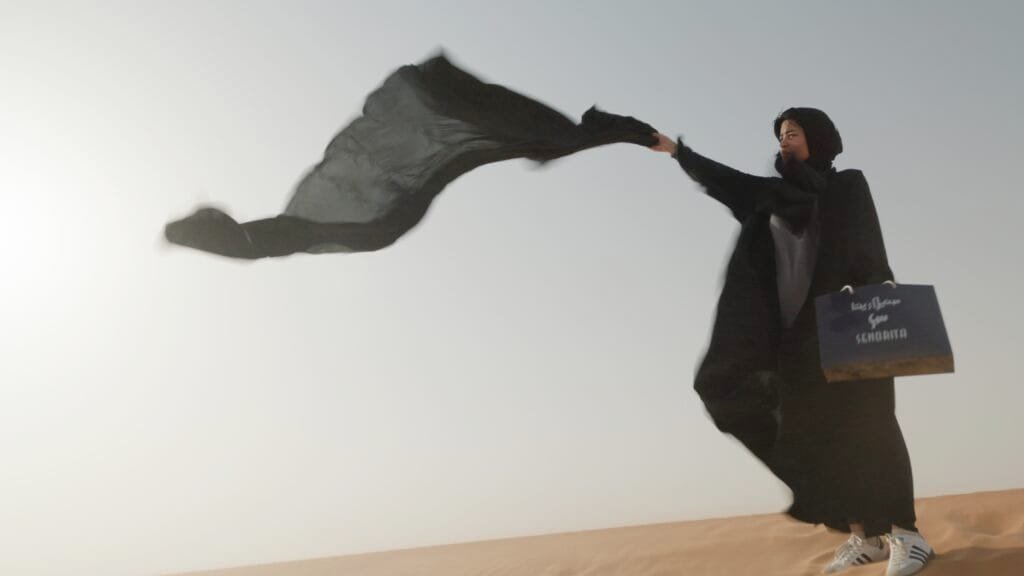
A vehicle races off through the Saudi desert, leaving a young woman dead in the dunes. That’s our opening to Unidentified (2025) – a film which is intriguing due to its background (directed by the first female Saudi filmmaker, Haifaa Al-Mansour), but also a nicely-paced and structured crime thriller, even if for some audiences it may feel a little domestic, or even reactionary, in some respects. For this reviewer however, that’s what really makes the film a success, for reasons discussed below.
We cut to one of the film’s many contrasts with a woman called Nawal (Mila Al-Zahrani) who enjoys a strange podcast, one which blends make-up tips with true crime exposés (though to be fair, this is a pretty neat encapsulation of the interests of millions of young women worldwide). Nawal is living independently, having left her husband and home behind: she hasn’t even unpacked her belongings yet, and her brother is already knocking at the door, urging her home. But Nawal has a job with the Riyadh Police, digitising old files as ‘everything is going online’. She’s briefly taken away from the tedium of this role when the girl’s body is finally discovered and she’s drafted in as a kind of chaperone, something which is apparently necessary even for a dead woman. Nawal, given her interests, is immediately absorbed by the case: there’s almost no information to go on, and only a two-week cut-off before the girl will go into an unmarked grave. As another woman now on the fringes of society, Nawal finds this unconscionable, and begins to take an interest in the case which goes far beyond her admin role remit. Perhaps there’s a sense of ‘could have been me’ here: we glean enough about Nawal’s background to know that the breakup of her marriage was very traumatic. However, as she investigates, she seems to start being watched herself, and may even be at personal risk.
Let’s be honest here and admit that one of my key motivations behind asking to review this title was to get a glimpse of a version of Saudi life, given that Saudi Arabia is usually either very closed off from the West, or else viewed through a very specific kind of lens: Western commentary tends to focus on its religious conservatism, even if under the de facto reign of Mohammed bin Salman, things have relaxed to some extent. For example, women may now drive in Saudi Arabia, something which is key to Unidentified: Nawal makes extensive use of her vehicle throughout the film, and beyond its timeline too. The world of the film is perhaps surprisingly progressive in some respects (Riyadh has the kind of nightlife you’d expect from any big city; women can live independently, hold down careers and many of them go where they please) but it rings with Islamic cultural conservatism in others (one of the reasons mooted for the mystery girl’s death is an ‘inappropriate relationship’, which her fathers or brothers may have acted upon). Here, girls just ‘go missing’ – from home, from school – and people may not wish to claim them, even if they turn up – living or dead. And, as one girl says in response to Nawal’s questioning, “Once your family decides on something, it spells the end for you.” Challenging this can literally mean death. That’s the strange, blended reality we witness in the film.
At its core, then, Unidentified is a film about the push and pull of modern life, albeit on one woman in particular, trapped between two worlds. It’s not limited to the expected divide between Nawal’s actual job and her interest in a case which goes way beyond her professional responsibilities. We have already discussed the podcast, where a girl applies lipstick as she warns against the perils of enraging men; we get a dolled-up headmistress, very much in charge of her domain, doling out arch warnings about immorality. We meet schoolgirls who have devised their own wall of silence, even as they sneak out at night to go to hookah bars and talk to men, just before they are married off. The film does successfully present a rather paranoid, secretive world which masks a lot of its worst excesses (though of course, all societies do this to a greater or lesser extent). Its violence typically happens off screen; this is never gratuitous, and in fact may feel too quiet for some crime cinema fans. It also opts for a recognisable structure and story arc, right down to the late addition of some surprises, though on the whole these work, the film is well made and well edited, with some wonderful stylistic visual flourishes, offering clever symbolism. On the whole, there’s a pervasive, uneasy religious context where religion – in lockstep with a harsh and unforgiving patriarchal culture – overshadows everything which takes place here. Nawal is a feisty character, to the upper limits that she can muster. She finds ways to push back against a world full of restrictions, and the film does grow increasingly tense as she gets closer to the truth.
Will you begin to wonder whether things have in fact all been put to bed, giving a glance to the remaining runtime, when it looks as though we’ve reached that point – The Truth? You might. And by the time you actually get to the end credits, you may feel either enlivened, or enraged, by the way things are finally wrapped up. I’d recommend taking a step back here, even getting a bit (whisper it) meta, and considering what the film’s structure and denouement has to say about Saudi life, even as a fictionalised and subjective glimpse of Saudi life. If filmmaking offers a distilled version of current social and cultural anxieties, then Unidentified has far more to say than it might at first seem to say. For this reviewer, it speaks quiet volumes of its own, adding an additional layer of ideas to consider – which prompts a look back over the whole narrative arc anew. That’s a real compliment to the film. It’s surprising to see such underwhelmed reviews already out there; there’s lots to ponder and admire here.
Unidentified (2025) will screen at this year’s Tribeca Film Festival, starting with Tuesday, June 9th at 8:30 pm (US premiere).