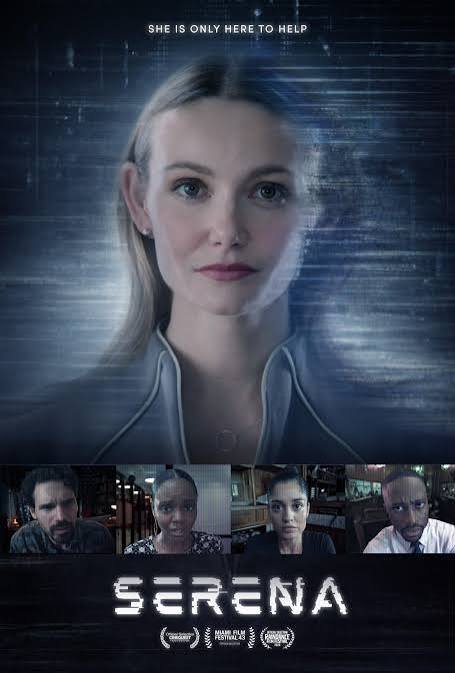
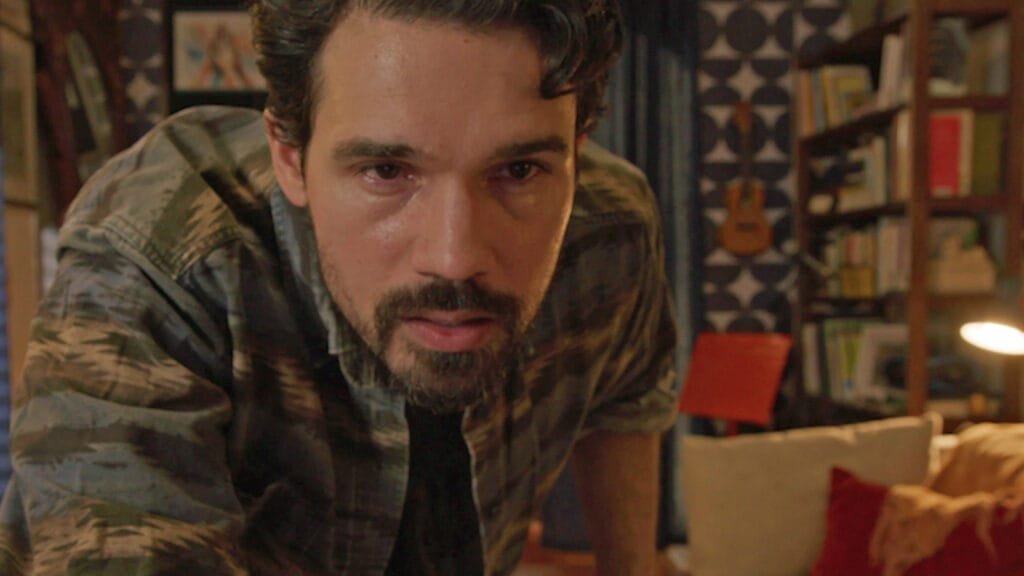
Chris Sadowski (Steven Strait) was just about to make it big with his band, Ghost Agent – but the vagaries of showbiz had other ideas. Four years after what should have been the band’s real break, he’s reduced to recording birthday messages and ditties on Fiverr. Not that he gets much time to focus on anything: thanks to the almost totally online life he has retreated into, he gets little respite from emails, requests, doorcam alerts – all distractions, all stopping him from doing what he really wants to do, namely, working on a new song. Through the various interfaces which keep on popping up on his computer screen, however, we learn more about his predicaments (plural, very much plural). He’s broke; he has a baby on the way, oh, and he and his expectant wife are about to be evicted. Essentially, Chris – presumably honed by months of sitting in the dark watching it all collapse – is good and primed for some dreadful decision-making.
Step forward, best friend Will (Tyrone Marshall Brown): Will isn’t like Chris. Will does spin classes. After spin class, Will typically gets busy with his lucrative career in tech, but it’s Chris’s lucky day, because his friend wants someone who knows absolutely nothing about technology to help his company road-test a new AI chatbot. After negotiating a fee, Chris agrees, and he’s passed to the beta-testing team to begin work. His job is quite simple: test the bot on what it knows about the difference between fact and fiction, which, all told, it seems pretty bad at. But it learns quickly, and – being a multimodal entity – quickly requests being addressed by a name (the ‘Serena’ of the title) before popping up with a suitable avatar, and a voice. When Serena promised multimodality, it, or she, didn’t lie.
The appearance of Andi Matichak as Serena adds instant interest and appeal to the film; hers is a great performance, giving a genuine sense of an AI trying to balance encoded neutrality with a very rapidly-developing sense of something like an agenda. Certainly, Serena would do anything rather than answer the questions in the test. She – and let’s stick with she – immediately prefers to overstep the mark, snooping on all the other apps and pages which Chris currently has open (he apparently agreed to this facility by clicking ‘accept’ on the terms and conditions) and giving him life advice. This is perfect for Chris. Whilst I’m sure Chris’s depressive behaviour is meant to engender sympathy, and it does, in some respects, there are a couple of sticking points around his characterisation, especially – given what we now know about how his life is going – in terms of his readiness to do nothing, but want to get paid; when Serena offers to assist him in a spot of gambling, he’s game. Improve his digital profile on his behalf, to get him more Fiverr work? Also game. He’d like to pay his bills, probably, but then again, he seems to quite like re-recording the same few bars of a demo track over and over again. He gladly takes every sop thrown his way, and at his worst, comes across as though he could be ably replaced by Harlekin on the Atari ST, let alone a super-sophisticated, modern LLM. It can feel hard to get on side with Chris. Again, this may well be part of the point – create a flawed protagonist who has to go through something of an epiphany to move on. To err is human. Understood.
There are some other minor snags in the first half of the film: Serena offers up so many concerning AI features, that it starts to muddy the waters for the audience. What, exactly, is Serena doing? Where are we going? The film of course teases the idea of AI becoming self-aware; this has been popping up more and more over the last couple of years, with media platforms such as Moltbook purporting to be a social network for AI agents. In this, the film plays broadly with people’s readiness to believe that LLMs are genuinely sentient, and not just sophisticatedly skimming human interactions in order to regurgitate them (and watch this space now that AI is starting to cannibalise itself). But Serena is absolutely hectic with various ideas, anxieties and fears – and affordances, possibilities – so that it feels, for a while, like it can’t quite settle on a focus, other than: AI, overreaching.
However, regardless of a desire to cover a great deal of the issues and debates inherent in this kind of technology, Serena does begin driving at something more assuredly, and the second half of the film is by far the strongest. There are a few great curveballs to contend with, and even when you might start to catch up to them, or where they might be going next, the twists still feel effective. If the first half of the film is about the general destabilisation inherent in handing over so much power to AI, then it finds something to drive at in the second half.
Ultimately, we can expect lots more films of this nature, the more overreliance on AI we foster as a culture, and, in this film and more broadly overall, something interesting is happening: AI in horror cinema particularly is starting to replace or, something it’s very good at, emulate that old Mephistophelian bargain, whereby you sell your soul for ease and success on earth, but at a hefty cost. Some of the things Serena can do in the film feel awfully like occult powers; it’s what, a couple of centuries ago, we would have attributed to devils and demons, and now, handily, we’ve both built, and started to cower from. But this is a minor, human digression: Serena has some slight issues, but overall it’s a welcome addition to the subgenre, offering another engaging tussle between humanity and technology with some unsettling, smart developments along the way. That it all unfolds on a screen – just like Unfriended – is to its credit, too, and it works well here.
Serena (2026) will feature as part of this year’s Raindance Film Festival. More details can be found here.