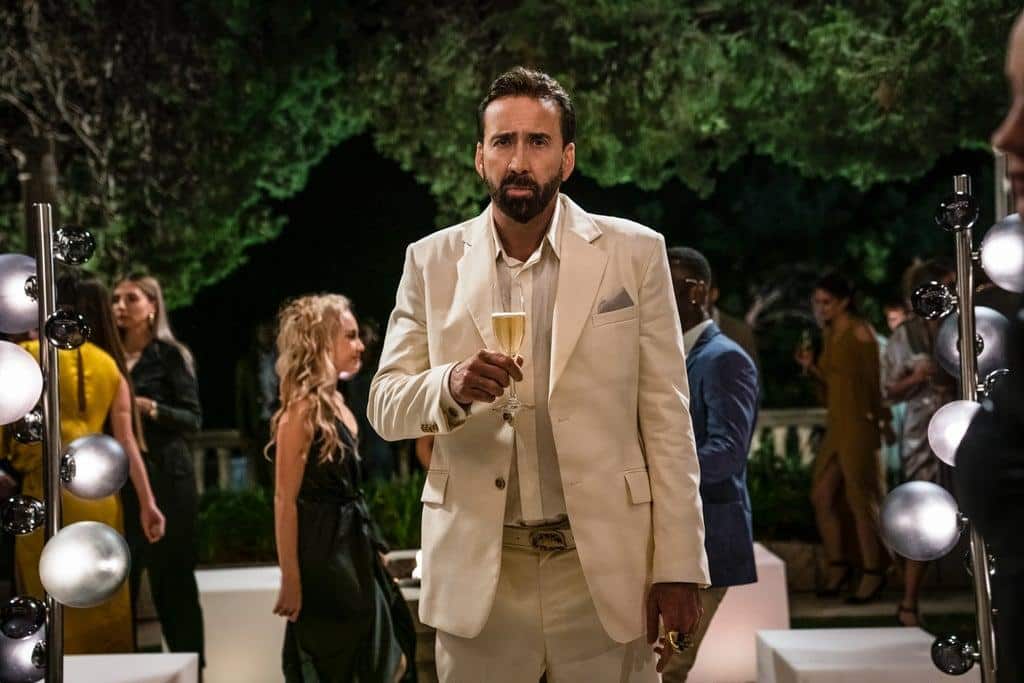
There’s a small, but noteworthy number of films in which actors appear as themselves – that is, as actors reflecting in some way on the fact that they’re actors. It’s a risky thing in some ways: ego has to be balanced against just enough self-deprecation to make it all hang together, else it could all become more of a puff piece than a genuinely entertaining narrative. But it can be done very well. Some of the best examples of this, to my mind, include Being John Malkovich (1999), with all of its strange, highly original fantasy elements; there’s also My Name is Bruce (2007), again with the kinds of fantasy and horror material you might associate with star Bruce Campbell, who is undoubtedly best known as a horror movie guy, here sending himself and his fans up with good-natured humour. Really, The Unbearable Weight of Massive Talent (2022) could quite easily rest somewhere between the two titles mentioned above, at least in terms of the career of its leading man. Whilst Nicolas Cage, its star, has appeared in many successful, mainstream Hollywood films like Captain Corelli’s Mandolin (2001) – akin to John Malkovich – he has also happily put his name to numerous underground, deliberately culty projects like Mandy (2018), a film with quite a few things in common with Evil Dead, chainsaw included. You also get the distinct impression that Nicolas Cage is no stranger to self-deprecation; nor can he possibly be oblivious to his fandom, whether those people who watch him simply to see him have a Full Cage meltdown or those who see him in more serious terms.
Happily, The Unbearable Weight of Massive Talent is incredibly good fun, encompasses the Full Cage and the more…well, normal man behind it all, and draws upon Cage fandom in an affectionate and engaging way. Its best quality, though, is in its writing: it’s warmly self-referential, and also manages to weave from one genre of film to entirely another, picking up on all of the little clues which it has lined up neatly along the way.
It starts with a young Spanish couple enjoying a Nicolas Cage movie (but of course) before a host of thugs wreck the vibe, breaking in and grabbing them. What does this have to do with the man himself? We soon find out. Our first glimpse of NC is speaking to…or at… his casting agent back in LA: clearly Cage is after a new role to get his teeth into, rocking out a few scenery-chewing lines to show he deserves one. He’s especially keen to work because the old trilogy of marital breakdown, estranged teenage daughter and vast hotel room bill have him at crisis point. Luckily, something has come up just in time: a trip to Mallorca, at the behest of rich guy Javi (Pedro Pascal) who has a screenplay to show him…
It’s a bad time to show up. It seems that Javi – who soon becomes a kindred spirit to Cage, as not just a rich guy but a superfan and a diehard film-as-art advocate – is being investigated by the CIA. They collar Cage and insist that he helps them in their rather urgent enquiries into Javi: there’s not much Cage can do but agree, so he starts bodging his way through the tasks they set him, seeing it all as just another new kind of role. Errors, twists and skits ensue: however, the main question is, is the CIA correct in their suspicions?
Whilst the film moves smoothly from a character-led drama to something far more action-led (commenting wittily on the shifts as they happen), all in all this is a caper: the jump from ‘unknown secret agents’ commanding Cage what to do, to people who seem almost like buddies who eyeroll at his mistakes is perhaps a bit of a leap, but it’s more than forgivable in the grand scheme of things. The comedy of errors material is great, but as well as that, there is great dialogue and rapport between the two leads; Pascal (Oberyn Martell from Game of Thrones!) is deeply funny, but also plausible, with Javi genuinely appearing to love Nick Cage and to want nothing more than his good opinion. Dare I say it, but it’s quite moving in places, again because it’s all so well-written and acted.
The balance of just enough emotional weight to laugh-out-loud idiocy is spot on. As for Nicolas Cage and the self-deprecation angle so necessary in films like this, well he’s clearly good with it, even though the actual distance between man and actor remains somewhat oblique, even taking into account that the Nick Cage in the film is still a role: you get the impression that some part of him has been doing the overblown stuff so long that it’s become a sort of tic, albeit one played out with aplomb in the appearances of ‘young Nicky’, visions of Cage’s younger, more egotistical self who rocks up to insist that “Nick FUCKINNNNNG Cage!” should call all the shots. And of course, it’s a glorious war cry which is as absolutely OTT as you’d hope and expect.
With lots of nods to his past roles, celebrating acting and film whilst teasing it at the same time, this is a great piece of entertainment, really, and to describe more of the plot twists and turns would be to ruin it. ‘Meta’ style scripts can be very tiresome, but that’s not the case here. To end this review, let’s just reflect on the fact that Cage gifted everyone in the cast a pillow with his face on it, and be done.
The Unbearable Weight of Massive Talent (2022) is available on digital 8th July and Steelbook, 4K UHD, Blu-ray and DVD 11th July.
Good Madam (2021) is a very quiet film. There are no explosive moments; the vast majority of the story unfolds in a limited domestic space; there is a tiny cast. Opting for a restricted setting and a limited number of characters like this either speaks to a filmmaker’s make-a-film-any-film bravado, or genuine confidence that this is the right way for the story to carry across. Happily, director and co-writer Jenna Cato Bass knows exactly what she’s doing – her decisions are sound. It’s very difficult not to fall back on calling the film ‘slow burn’ here, as this is often the description of choice for something which so deliberately eschews realism, sharply-drawn and ordered plot points, and clear denouement. Good Madam is slow-burn though; perhaps to balance things out, the adjective should be taken away from another film which is less abundantly slow-burn than this one. Rich in symbolism, subtly underpinned by anxiety and careful in its use of moral messages, the story simmers away nicely – with only a handful of moments which in any way disrupt this. Overall, it’s very successful.
The film’s domestic setting – and its positioning of this as a weird, alienating thing – are flagged up very early. It happens before the titles roll, in fact, with an array of macro shots of household chores and trappings in a stiffly genteel, if dated home which show the big contrast between owner and worker. The woman cleaning this space is at first only seen from the back, or partially – hands scrubbing, but face omitted. Perhaps it’s to read too much into it – yeah, a film writer just said that – but the ways in which the camera limits what we see seems to mirror the film as a whole, where were are almost never certain, never in a position of complete understanding.
Finally, though, we see some faces: Tsidi (Chumisa Cosa) and her young daughter Winnie (Kamvalethu Jonas Raziya) are first seen as Tsidi tries to contact someone by phone: her estranged mother, Mavis – the domestic worker from the house, (partly) seen earlier. She has no luck, but decides to head to Mavis’s live-in place of work anyway, driving way out into the ‘burbs. Mavis (Nosipho Mtebe) is understandably surprised by the visit – to the point of not even recognising her daughter’s name when she announces it via the intercom – but she lets them both in, begrudgingly allowing them to stay for a while. It turns out that Tsidi, in the wake of her grandmother’s death, has ended up in a family feud, leaving her with nowhere to live. This has cut short her mourning period, so she’s already in a tense state when Mavis lays down the law. She is housekeeper for a wealthy, but largely catatonic white ‘madam’ called Diane, and Diane is not to be disturbed: the house needs to stay virtually silent, Diane’s things must not be used and certain rooms are no-go areas. It’s apartheid in microcosm, surviving long past its official timespan. But Mavis – who is quietly formidable – defends Diane, saying that her boss has done a great deal for her. It’s yet another sticking point between mother and daughter.
The house, with its insular feel, is not a welcoming place, even without the long list of house rules to abide by. Tsidi acknowledges this, saying that the place ‘weighs heavily’ on her. Now, whether this is because of her own unexplored grief and her initially frosty relationship with her mother or something else, forms the bedrock of this tale, developing in an interesting direction. Where all of this eventually goes is somewhat less successful: the journey is more compelling than the destination, if you like.
The immaculate, if faded interiors are used effectively, providing a claustrophobic and potentially frightening place out of time. Within it, jarring, unsettling phenomena begin to assail Tsidi; interestingly, lots of these relate directly to domesticity and domestic chores, which are every bit as inescapable as whatever else is going on here – make of that what you will. Key to all of this is Diane herself: she’s both an absence and a presence, but she looms over the film, even in her incapacitated state. She’s not exactly a madwoman in the attic, though some aspects of that seem to fit; she retains more agency than that, a shut-in who happens to own the property and the grounds, and seems also to own the staff. As the plot begins to move in a certain direction, it’s unclear what Tsidi does or doesn’t hear regarding Diane, too, which adds a level of additional foreboding: are we, as the audience, being privileged with extra information?
There’s always a nagging worry about how a film which clearly has a social/political ‘Message’ is going to go about it, some of which is dependent on how the film promo has already gone about it, but thankfully Good Madam trusts in its audience enough not to hit them repeatedly with something chidingly simplistic until they want to pull away. The story and the subtext here work together well, with the latter filtering through via excellent, naturalistic dialogue and good performances across the board. Chumisa Cosa really is excellent as a woman fighting against family estrangement and her own demons, and she frequently, sensitively ponders where the dividing line is. True, the film subtly explores race and apartheid, but class, language, wealth and gender are bound up in this too: there are some similarities to Get Out (2017) in there in terms of how the fantastical shines a light on uneasy topics, but Good Madam is its own beast.
Good Madam (2021) will be released on Shudder on Thursday, July 14th 2022.
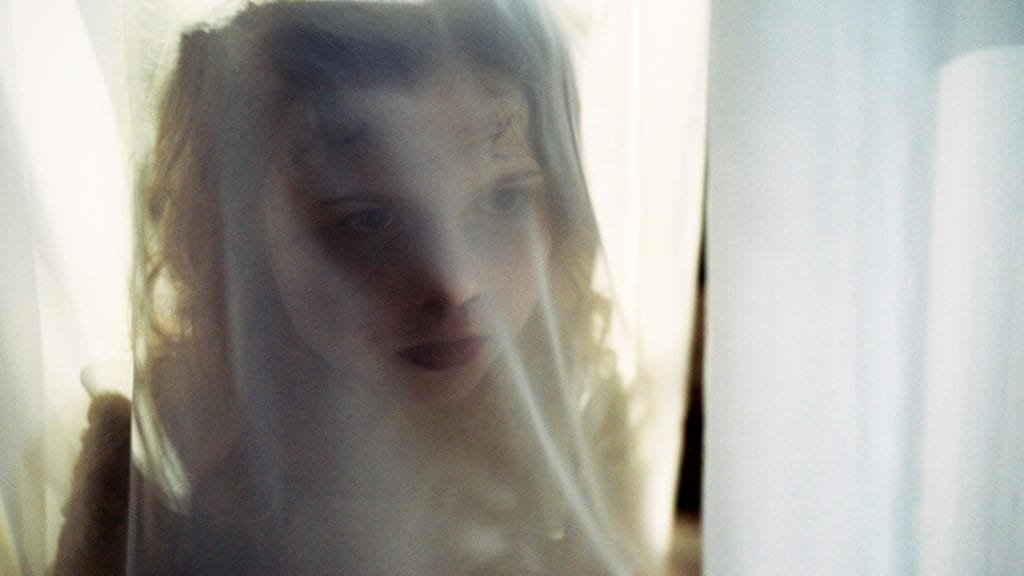
Martyrs Lane was one of my favourite films of 2021: an intricate, domestic ghost story, it exercises a deft hand in characterisation and storytelling. If you missed it, then please check out the Warped Perspective review; as of 4th July 2022 the film is now available to buy, and thanks to Aim Publicity have a copy of the film on DVD for you to win.
All you need to do to be in with a chance is to email the site, using Martyrs Lane as your title. Please provide your name and address (all personal data is stored securely and deleted as soon as the competition ends. UK residents only, sorry!)
The competition will end on Wednesday 13th July at 12:00 GMT and the winning disc will be sent out shortly after that. Get entering, and good luck.
Fantasia International Film Festival usually winds up giving me a large share of my films of the year: it’s second to none in sourcing and selecting a frankly daunting array of fantastic new features. Now about to launch its 26th edition, and after bearing up under a couple of years of Covid restrictions, it will take place in and around the film theatres of Montreal from from July 14 to August 3. As usual, it will run a number of new and exclusive genre entries, many of which look like a suitable blend of thought-provoking, unsettling, entertaining, disorientating and disturbing. In terms of titles to look out for – and fingers crossed, Warped Perspective will be running coverage on as many of these as we can! – here are a few for your edification. Don’t stop here, though: you can take a look at the full program at the festival website.
Polaris
Many post-apocalyptic visions take place in an urban, or post-urban sprawl, but this isn’t so with K.C. Carthew’s vision of a snowy, bleak and post-technological world inhabited by a girl and her polar-bear mother: the two are following the North Star to its zenith, but – journeys of this kind are seldom uncomplicated, and the girl must use her wits and to escape from the events which overtake her. Action meets magical fantasy meets eco-drama in this festival opener.
House of Darkness
American director Neil LaBute is back after a run of short films and TV work: his newest feature, House of Darkness, is described as a darkly-comic battle of the sexes. Hap (Justin Long) has met a beautiful woman (Kate Bosworth) who seems to be very much interested in him; heading back to her fairy-tale home, the chemistry between them seems to develop further – but is it all too good to be true? Hap begins to suspect that the house is not what it seems, as the film examines the power-play between these two people. Who is leading whom?
Glorious
Rebekah McKendry has made the bold, if not completely unprecedented decision to set her new horror in a toilet stall: but, even if horror has proven itself to be a little scatological in the past, then it’s not quite been done like this where protagonist Wes (True Blood‘s Ryan Kwanten) winds up embroiled in a bizarre question-and-answer session with whoever is in the cubicle next door…it transpires that to get out of that stall at all is going to require quite a lot from this already suffering (and badly hungover) guy. ‘Weird’, ‘twisted’ and ‘Lovecraftian’ are words which have already been used to describe Glorious, and that’ll do nicely.
Speak No Evil
It’s great to see Denmark – and The Netherlands – represented in this year’s horror releases – and it sounds as though Speak No Evil is going to pack a real punch, doing what good horror does: fusing a relatable, real-life scenario with such an escalation in tension that it has been described as “profoundly uncomfortable”. In the film, a Danish couple agrees to go and stay with a Dutch family they met whilst on vacation, going against their better judgement in order to remain polite. Most people would follow suit, no doubt, but the film explores what happens as boundary after boundary gets crossed, with misunderstandings soon escalating into something incredibly ferocious.
Next Exit
Death as a destination? In Next Exit, set in a very, very close futurescape, the technology now exists to track the dead into the afterlife – which, it turns out, is real after all. The pioneer of this research, Dr. Stevenson (Karen Gillan) needs volunteers to help her with her work: step forward two strangers, Rose and Teddy, who agree to take the plunge, helping Dr. Stevenson to chart this new frontier whilst escaping from their own personal issues along the way. Described as “equal parts ghost story, misfit road movie, speculative science-fiction and heart-rending tragicomedy,”Next Exit promises to be an affecting, engaging, multi-layered experience by first-time director (but experienced producer) Mali Elfman.
This is, of course, just a handful of the films to come. Watch this space for coverage of the festival, coming very soon.
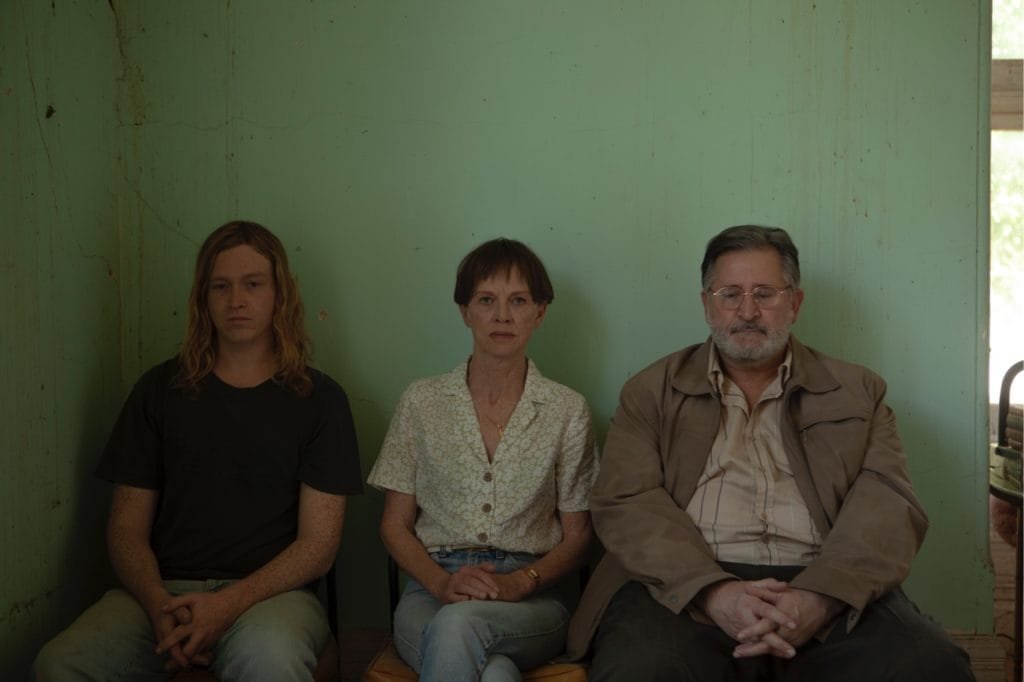
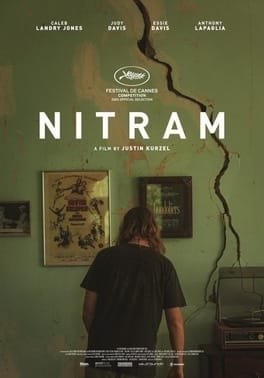
Nitram (2022) is an immensely uncomfortable film. Even with no idea of the real-life events on which it is based, you can still sense a disaster in the offing, right from the opening credits; we are privy to a close character study of someone lacking in the most basic signifiers of humanity. If you do know what is coming here – the film is based around the events of the Port Arthur shooting of 1996 – then you will still feel just as rootless and powerless as we veer ever closer to it. Director Justin Kruzel has been judicious in what he has left in and what he has kept out of his film: there is no sensationalism here, no danger of portraying events worthy of being emulated (a responsible decision for reasons addressed in the film, as well as a structurally intriguing one). But the unfolding chaos all still feels like it’s heading, irrevocably, in one direction.
The film opens with hospital footage of a little boy – the real Martin Bryant – who had burned himself with firecrackers; the interviewer asks him if he’s learned his lesson. Nope: I’ll do it again, retorts the child, completely missing the cue to join in on the moral. It sets us up neatly to meet the same person in adulthood (Caleb Landry Jones), still living at home and still setting off firecrackers to entertain himself, seemingly unable to understand his neighbour’s yelling or the frustrations of a nearby school headmaster, when he rocks up to hand out fireworks to boys ten years his junior: it’s a half-baked attempt to ‘make friends’, but like all of his attempts, it fails. It’s clear that something is up with this young man, but what? Physically, he seems normal, is even quite attractive – if unkempt – but he’s erratic, aimless, childish, and given to tantrums. Whilst his father (Anthony LaPaglia) makes excuses for him – grateful for any brief moments of normal family life – it’s clear that his mother can barely withhold her anger, and in trying to hide it, spits every line she speaks.
One day, going door-to-door in the neighbourhood to try and make money from mowing lawns, ‘Nitram’ -Martin spelled backwards – encounters a woman called Helen (Essie Davis) who seems unusually amenable to his efforts. They form a friendship – she’s lonely enough to see his lunging efforts at kindness as coming from a person genuinely capable of it – and he soon moves in. Helen is an heiress, so she’s wealthy, buying him a car and almost-everything he asks for. Money and the spectre of money runs through and thought this film: Nitram wants the means to fulfil his preoccupations, whilst his parents are stuck trying to manage him on their limited means, though his father has a pipe dream of buying a B&B out in the sticks: getting the cash together would mean easier lives for them all, he reasons. His parents are nothing but confused at their son’s sudden setting up home with an eccentric older woman, and his mother questions it: do you see him as a husband, or a son, she seethes – seeing as you have neither?
This odd set-up is short-lived in any case: Helen dies in an accident, in which Nitram is badly hurt too but, true to form, he learns very little, simply going through the motions of the time they had spent together back at the house – which, it transpires, she left in its entirety to him. He’s a rich man now, and he can buy the lot: the surfboard, the clothes, the plane tickets – and the guns. To come back to money again, we’re shown how people are blinded to all of this young man’s jaw-dropping personal failings by the kitbag full of dollars he starts lugging around with him.
These are people with plenty of lived experience, too. The film is noteworthy for the fact that the vast majority of its cast are middle-aged. Nitram’s parents, Helen, his psychiatrist, his nurse, even the travel agent. The subtext here is that these are people with professional and familial responsibilities who can’t evade contact, though they are still mightily flawed in their dealings with him. People of Nitram’s own age reject him outright; his mother is aware of this, and her half-baked suggestions that he could go and ‘meet a girl’ come couched in an awareness that no girl really deserves that. But she’s aware of his isolation, and still clings to this occasional, ill-conceived idea that he could find a way to be normal somehow – with a job, wife, kids. A life away from her. There’s the barest sense that she, too, knows that this will come to naught; Judy Davis’s performance is extraordinary, her eyes shining briefly with tears she stops herself from shedding, before she retreats behind a detached defiance she has learned the hard way.
Caleb Landry Jones already has a strong track record of playing outsiders, and he brings this experience to bear on his latest role. He manages to be magnetic and repellent here – a thoroughly dislikeable person who fascinates nonetheless. Reflecting the difficult line walked by filmmakers tackling emotive real-life cases of this kind, he manages to present Bryant as realistic and human, but not exactly humane: it’s as impossible to empathise with him as it is for him to empathise with others. He never reacts to events in expected ways, and he always seems on the verge of ruining the moment he’s in; if his lack of social skills is in some broader sense painted sympathetically, we are too up-close with Nitram’s jagged, uncomfortable traits to pity him. We don’t need to see the crescendo of his actions to know that someone as broken as this will lash out somehow. The film never grandstands on the social issues which facilitate this, but the devil is in the detail and it’s handled with sober, unflinching focus.
Lucky McKee’s directorial debut May (2002) was not a huge box office success. It initially made far less money than it cost to make, and it baffled many of the audiences who initially got to see it, including the New York Times reviewer Stephen Holden, although he took for his point of reference the slasher genre: he felt that May was a little better than your average slasher. This is less damning with faint praise and more a case of fundamentally misunderstanding what the film intended to do, but thankfully, the film’s reputation amongst more receptive potential fans steadily grew, with its release on home video (I rented this from Blockbuster!) allowing a far broader and more appreciative audience access to this strange, touching and surprisingly intimate horror story of loneliness. The internet as a source of community, though still in its relative infancy in the early Noughties, also helped to promote the film: far from misrepresenting it as an almost-slasher, those more ready to attune to its message saw it as anything but that.
This is preaching to the choir I’m sure, but, look: slashers tend to focus on the victims of an omnipotent, faceless, vengeance- or grudge-driven killer. May is certainly not faceless, and she’s not omnipotent either; she doesn’t bear grudges, she craves care; in fact, it’s her fallibility which continually hurts her. She’s not our antagonist but our flawed protagonist, whose vulnerability prompts her to do horrific things which we are ready to forgive and – by nature of how the film is put together – we share her perspective throughout the film, as closed off from regular human contact and affection as she is. It’s a hard film to watch and it’s hard not be affected by what happens to May, whatever her horrific faults may be. The film is a challenging test of empathy – of how you weigh empathy and why you feel it, despite everything else which happens.
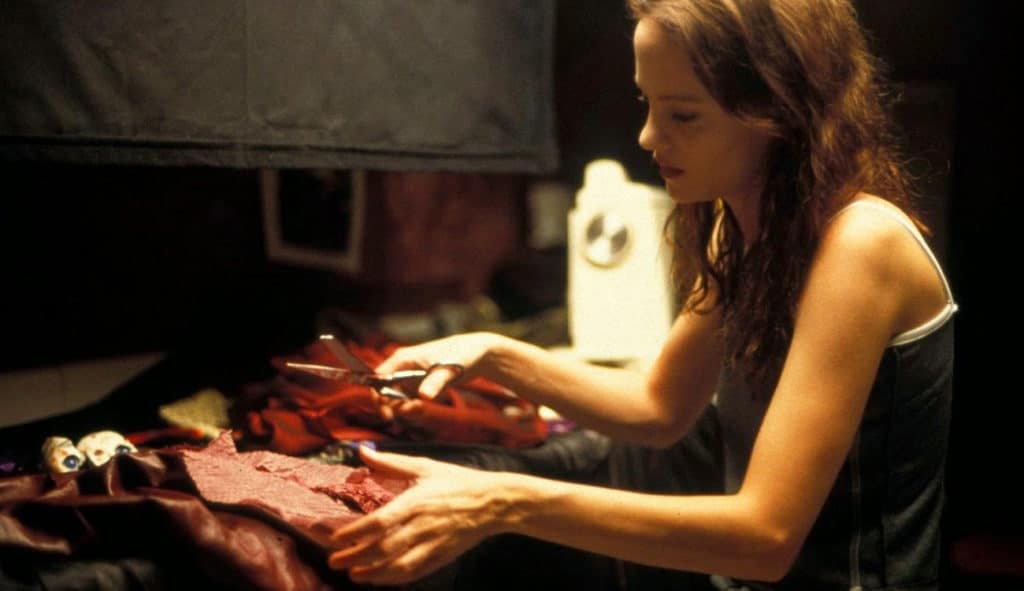
A central element in the film’s success is the casting of Angela Bettis as May herself. Bettis, by now a well-known, frequent collaborator with McKee, was early in her career when she got this leading role, and few genre film fans would have known her – but May made her instantly recognisable, and in turn she makes May a coherent, if jagged and troubled character on screen. It’s impossible to imagine anyone else in this role now. A petite actor, she seems close to being frail in this film, and seems authentically nervy – but there’s something palpably frantic beneath the surface, making its way out from underneath her pathological, crippling shyness. In short, the incoming crisis is signposted early by Bettis’s demeanour, even without the clearer moments of foreshadowing which follow. I always felt that the cover artwork for this film was an odd choice in some ways, with Bettis very starkly lit, looking almost greenish, crowned with sharp-edge items (like dressmaking scissors) and looking coldly at the camera; the film itself is much gentler and more character-driven exercise than the poster suggests, with nothing starkly lit in this way. Even the bloodshed looks suitably autumnal somehow, in keeping with the film’s Halloween time period and October colour palette.
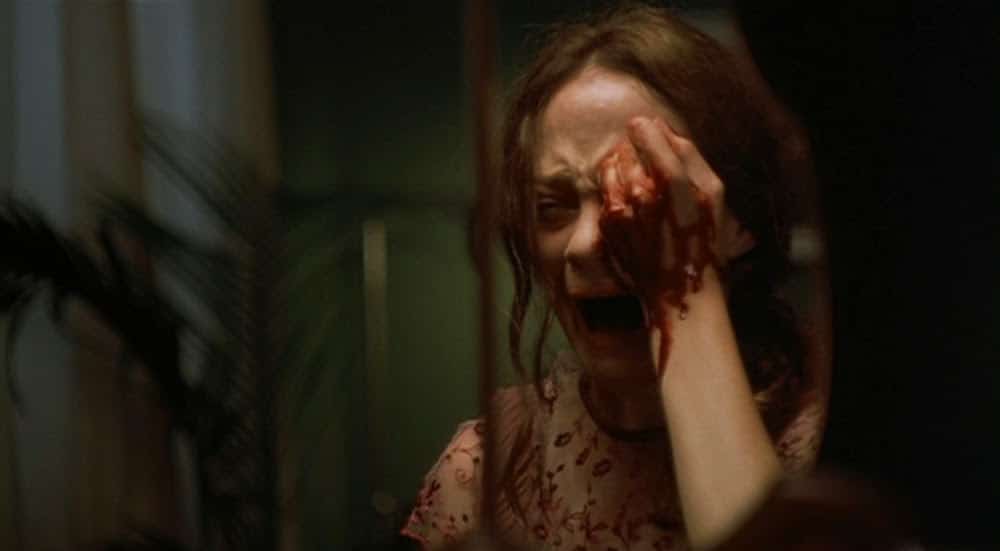
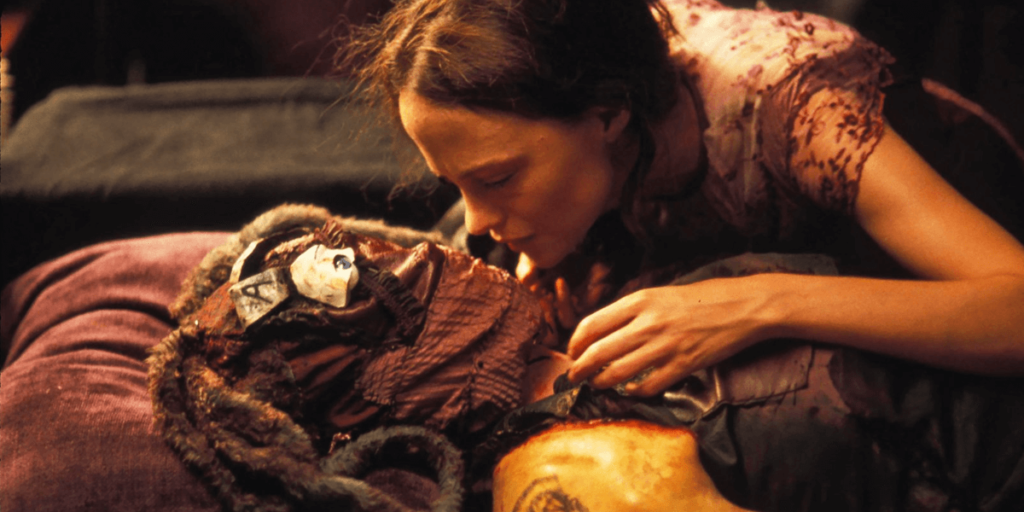
Interestingly though, the film opts to open with one of the last moments in the story – May, screaming as her eye socket pours with blood. So there are no surprises here, at least in one key respect – we know trauma occurs, and therefore there’s a sense of inescapability, that we as the audience are going to find our way back to this grisly, upsetting point by some means – and, after all, there’s no good journey that ends with an eye out. Ocular trauma is a continual theme, as is the relationship between seeing/not being seen. We’re soon whirled through a quick-fire array of moments from May’s childhood, showing that she had a lazy eye as a child and had to wear a corrective patch – which ostracised an already shy girl from her peers, who thought she was odd and disappointingly unpiractical. Her mother’s insistence that wearing the patch will eventually make her ‘perfect’ is another big warning sign: an overbearing parent, an emphasis on physical perfection, and, oh – mom’s gift of a doll, Susie, who would act as May’s de facto best friend, even if May wasn’t allowed to actually get the doll out of its child-unfriendly glass case (more anon) and play with it. Mom’s infamous edict – “if you can’t find a friend, make one” – is tragically short of the mark, but these are words which the grown-up May still chooses to live by. Any port in a storm, maybe.
Tellingly, the interim between childhood and adulthood is not explored at all: we can only infer that May’s parents are dead or otherwise absent, as they are never again mentioned in the story. It’s an absence which clearly weighs heavily. After filling her daughter’s head with life lessons, May’s mother is gone: only the doll survives from that time period, acting as a locus for all of the anxieties and cravings for company which May feels. Through May’s tendency to confide in the doll, and also to ask for advice from the doll, Susie is a quasi-character in its (her?) own right. The slowly cracking glass case links the film’s kooky moments of realism to its more symbolism-heavy, horror content; ironically, the closer May gets to actually holding her “best friend” Susie for the first time, the more her life finally spirals out of control, albeit this is driven by her sudden recent efforts to get into the trappings of adult life, particularly by securing a boyfriend. This is all precipitated by May finally getting her lazy eye fixed; she gets to embody the ‘perfection’ she was raised to look for, as if this was a fairy tale and she needs to look the part in order to play the part. This is also her way, as she understands it, to participate in the world as an equal.
“So many pretty parts…”
To get there, or to make the attempt at least, May has to suspend her tendency to see people not as coherent wholes, but as assemblages of body parts – which she has grown used to evaluating on attractiveness, forgetting the person almost entirely. Again, this comes from her overfamiliarity with doll parts, which can be easily detached from the main body and swapped around; moments of particular crisis see her retreating to her collection of dolls, sitting amongst their scattered limbs and clothes. Doll parts rain down through the opening credits; her final retreat from normality sees her return to dollmaking, her brief attempt to engage with whole people now over as she selects limbs and a body for a ‘friend’. Like Victor Frankenstein, she selects parts based on their beauty (the film knowingly references Frankenstein with street kid Blank’s tattoo) but unlike him, May doesn’t want to make a creature to have them worship her as its creator and she certainly doesn’t recoil in horror at what she’s made; she just wants some compassion.
Up until that point – and because we are always kept on a level with May herself – the camera shows us her unique perspective by focusing closely on parts. Mirroring this, May’s style of dressmaking is to hack things down into parts and then stitch them together again. But as far as bodies go, we see the world via an array of hands, necks, legs: when May whispers to Susie that she likes Adam because she likes him in his entirety, we could find it hard to believe that, because she still fixates on his ‘beautiful’ hands – and so do we, because we can’t do any differently. In a similar way, the frame is often filled with May’s hands: this looks almost choreographed in places, but it’s relevant to how the story plays out because her skills as a seamstress and her craving for touch are so vital to the story here. They are also key to her job: she’s a veterinary nurse by day, which explains how she knows her way around a variety of sutures (with a few dreadful anecdotes about errors) and also how she can sit and cut her hand with a scalpel as a way of “relaxing”.
In her continual nervous hand gestures, we also see May as a woman in a kind of arrested development, lacking the smarts to get through adult situations. Lots of this is almost physically painful to watch – though it goes beyond fidgeting and staring at her hands. It’s writ louder than that. In one of the first scenes shared by May and prospective date Adam (Jeremy Sisto) May’s hair is gathered into pigtails and she’s sucking her thumb. Their initial vibe is more like an older kid guiding a younger; for instance, Adam offers her a cigarette, and has to tell her how to smoke it; her embarrassed responses to these interactions have her embodying a typically shy response, bowing her head and fighting between wanting to be there, and anywhere else.
Whilst Adam is confused by May’s non-sequiturs and lack of social graces, it’s still obvious that he has the upper hand here, able to navigate the situation and to an extent, control it. The same goes for May’s co-worker Polly (Anna Faris) who, like Adam, is often baffled by May’s weirdness, but still feels able to call the shots, even turning it around so it’s her that tries to seduce May, rather than May desperately misreading the cues and attempting to seduce Adam. Both of these supporting characters remain very ambiguous and it’s never fully clear if they genuinely have good intentions towards May, or simply slot into a dominant role with so clearly awkward and confused a person; again, as an audience member kept on May’s own wavelength, we perhaps share May’s uncertainty. And, even when she seems certain – for instance, after fully accepting Dario Argento fan Adam’s assertion that he ‘likes weird’ and emulating a moment in his (Italian language credits!) student horror film – we’re shown in no uncertain terms that she’s wrong.
“I need a real friend – someone to hold.”
The way in which she escalates social errors and misconceptions is painful to watch; although she goes further than most people, you can’t help but feel for her when she makes these soul-shattering mistakes. Seeing May break down in tears when she overhears Adam’s roommates describing her as a freak is a truly horrible thing. And, even when she turns to violence to complete her withdrawal from a world which, even though it only extends over a few blocks, has chewed her up and spat her out in a few short days, we can hate the actions, but never the person who takes them. Even when May’s childish refusal to take Susie out of the box for the children she volunteers with results in a final, bloody piece of foreshadowing as the glass finally shatters and injures them all. Instead of helping the children, May chooses the doll.
It’s a clear indicator that May is done with people, and the final scenes of the film make very clear that May has passed from unfeeling reality into a more fulfilling fantasy. May’s new doll ‘Amy’ (spelled out of broken pottery fragments of what had spelled ‘May’) finally gives her what she wants, extending an arm to hold her and to gently touch her bloodstained face. It’s a moment of pathos which takes us away from the grotesque body horror elements which precede it. Where fantasy and reality begin and end here is unclear; it also feels like the wrong emphasis. After everything, perhaps May deserves her moment of gratification.
This blend of ambiguity and sympathy for a woman retreating from an unfeeling world would crop up again in Dans Ma Peau that same year, and ten years later in divisive indie movies like American Mary (2012) and the underrated Excision (also 2012). There are, of course, other films with some thematic or stylistic overlap, but in the above examples alone we see a fight for feminine agency which reads similarly to May, with some nods to the role of surgery and the search for ‘perfection’ too. Perhaps May crept in there as an influence on the later films. Perhaps it also reminds us that the ugly and the painful aspects of suffering and desire can be subtly handled, a lesson set aside by the time McKee came to direct that exercise in sadism, The Woman (2011). The suffering on display in May is far more adroit, and it certainly doesn’t feel two decades old.
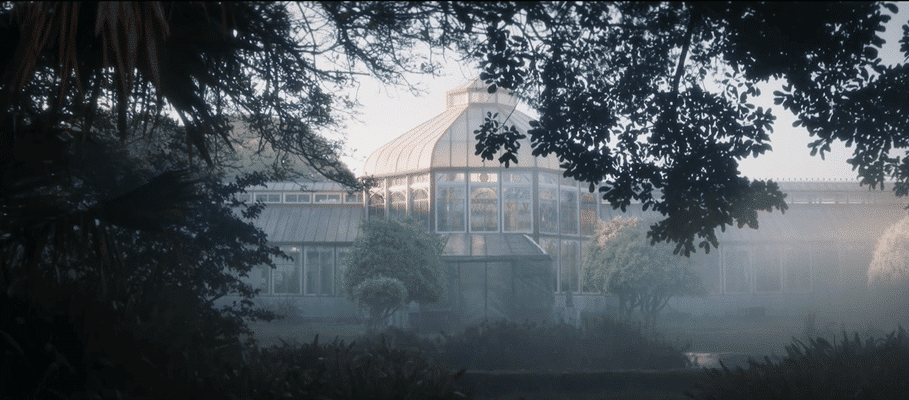
In dystopian worlds, there’s a fascination with the possibility of closed environments. These small bastions of normality in the face of threats from beyond appeal to us, the more so when it ever becomes clear that – where humanity is concerned – nothing can ever be truly hermetically sealed: against hostile outsiders, environmental catastrophe, or the outbreak of disorder from within. Films like Dawn of the Dead (1978) with its shopping mall, or Snowpiercer (2013) with its class-divided train carriages each showcase a different aspect of this idea; Glasshouse (2021) goes a step further and has aspects of all those potential sources of breakdown. However, its handling of themes is very different, almost languid, and it’s a masterclass in slow-burn cinema – taking a very different approach to this kind of subject matter.
In what at first seems to be an idyll, a group of young siblings live in a large Victorian greenhouse: here, they are presided over by their mother, a formidable matriarch (Adrienne Pearce) whose prim, coiffed appearance is broadly in keeping with the fin de siècle vibes of their home. Clearly, all is not as it first seems: when going out into the grounds, the family needs to don protective clothing, and they fiercely guard their space with armed sentry duty, shooting anyone who gets too near (then making full use of the human remains, to feed their crops). Prim and proper these people may appear, but they have no qualms about carving up and using any biological material at their disposal.
This usually-genteel looking set-up has, we soon come to understand, endured a run of pandemics, culminating in something called ‘The Shred’, which destroys aspects of a person’s cognitive function. It doesn’t render them mindless zombies exactly, but it erodes their memory and rationality, leaving them shells of their former selves. It’s an unpleasant condition, and it makes perfect sense that this family would do everything they can to avoid it. To maintain order, they closely follow a number of what Mother calls their ‘laws and litanies’, at the heart of which is the need to reject all outsiders. But even at its most orderly, the hairline fractures within the family unit are already beginning to show. Gabe (Brent Vermeulen), the only male in the group, is largely unable to participate in rituals along with the others, as much as he tries; brutal nightmares necessitate that he be restrained at night. In a house populated with young, elderly or simply physically weaker females, his volatility is a cause of watchful, sad concern for the others.
And then, of course, a moment of weakness sees the two oldest girls, Bee and Evie (Jessica Alexander and Anja Taljaard) let their guard down when a desperate man approaches the house’s perimeter. They shoot at him, but only wound him, then pleading with Mother to allow them to nurse him back to health. As they’ve already brought him into the outermost part of the property, Mother begrudgingly agrees. The hairline fractures spread rapidly, not least because the presence of this man (the distracting Hilton Pelser) highlights the absence of another member of the family, Luca – a brother who left, but apparently disappeared without trace.
This series of developments may look very familiar as written, but it’s the way Glasshouse handles all of this which marks it out as an unusual piece of filmmaking. It opts for a sober, scaled-down approach throughout, weaving an atmosphere and aesthetics which call to mind Picnic at Hanging Rock (1975) and Angels and Insects (1995), amongst others. There’s none of the usual grime and distress of post-apocalyptic cinema here. Plot-wise, at least initially, it’s hard not to think of The Beguiled (1971): there’s so much here about the presence of a mysterious male outsider, who soon feels confident and superior enough to game his way through his interactions with the women, though he fails to realise his part to play in this drama. There’s a dash of Gilead in here too, on occasion. And, ultimately, why not prioritise cleanliness and order, when faced with such turmoil elsewhere? If you can do laundry, then why not do laundry? In a post-pandemic wipe-out, god knows there isn’t much else to do. There’s only so many people to shoot.
With its minimal, but carefully-written dialogue, the film does just enough to balance exposition against atmosphere; it hints at a bigger picture, both in terms of the world at the gates and the emotional lives of the characters. This is, after all, a very restricted location with only a small number of players to inhabit it. The very deliberate slow pace allows plenty of time to enjoy the way the film looks, and additionally it is dotted with significant symbolism (let’s add here that some of the possibly accidental double entendres in the script give the game away slightly, even before the sexual symbolism becomes clearer). However, the most poignant aspect of the film is in its dealings with the topic of memory – what is is to forget, and be forgotten. In this, the film manages some surprises, too – surprises which really hooked this reviewer. Glasshouse is a clever, beautiful and often verdant film, carefully realised and – for those with the patience – very rewarding. It only remains to add that this is a first feature by director and co-writer Kelsey Egan, which is pretty extraordinary.
Glasshouse (2021) is available on digital/On Demand on July 12th 2022.
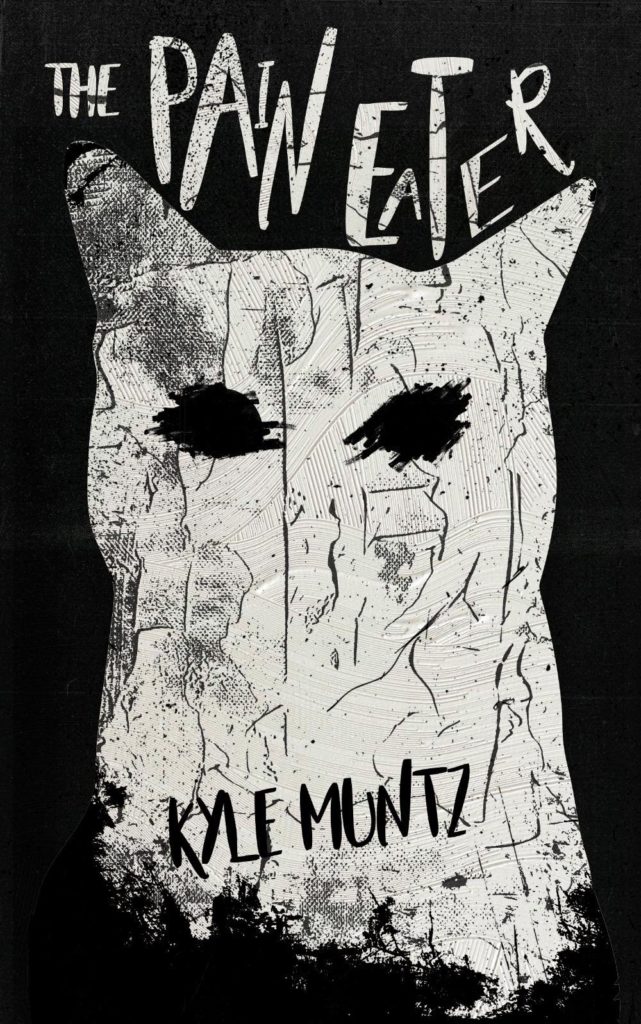
The Pain Eater is one of those stories which feels familiar in some aspects, but yet weaves a new potential mythology of its own, one which it launches into a world rendered very recognisable. As such, it’s a convincing and engaging blend of unpolished, everyday family drama, and something else entirely – which comes down to the reader through a far more literary, though never excessively literary written style.
We start with the aftermath of a death in the family. Steven and Michael, brothers, are just in the process of dealing with their father’s death and funeral. One of the first issues is this: Michael, who’s in his late teens, is not quite a child and not quite a man, either. He had been living with his father before his sudden death, and this raises an issue for the remaining family members of what to do with him now. Whilst he’d be happy sitting in his room for however long he can get away with it, there’s an initial plan for their estranged mother to move back in to the old family home before older brother Steven, wisely, offers to do so instead. Now that he has graduated college, he reasons that he can do it in the short-term. Michael reacts as he usually reacts: indifferently. But his brother moves in anyway.
This could all have been a domestic drama in its own right and a very different kind of story, of course, but there’s more at hand here, and there are early hints of something not quite right about the set-up, about what Michael has been up to. He’s clearly struggling with his emotions – perhaps this isn’t unexpected – but Steven finds out that he’s been attempting to look after a clearly suffering, dying cat in the yard. Whilst the older brother is repulsed, it seems like Michael sees nothing wrong; it’s as if, in his state of grieving, he’s just glad of anything at all to nurture. But this creature is not all that it seems. In fact, when the cat finally expires, there’s a…something which emerges from its body, and seems to recognise Michael (who, again, seems to take this all strangely well, but there’s that teenage nonchalance again). The weirdly symbiotic set-up between creature-human which ensues soon begins to affect other members of the household, too: but what is this creature, and what does it really want?
The Pain Eater is has a third person, omniscient narrator, though it chiefly moves between the two brothers and their internal monologues; other characters are more closed book situations, though you do come to understand them via their interactions with Steven and Michael, the key characters navigating their way through this strange tale. Characterisation unfolds at a decent pace, humanising the brothers very plausibly with relatable touches many readers will recognise. Many elements they will hopefully not recognise at all: there are elements of body horror throughout, as unpleasant to read as, no doubt, the author understood and intended. The novel also presents a kind of curious realism, debunking ideas around death, family, emotion and other heavy topics. There’s an edge of dark humour here: as an example, look out for quite a lot of vomit at a funeral…
Whilst a lot of the cultural references around Michael and his best friend, Halie, are a little lost on me, and so don’t illuminate them much (theirs is a world of anime and gaming) and the quick acceptance of the ‘new normal’ by the characters involved is a little odd, all considered, the narrative wisely chooses not to get bogged down by that; it moves on quickly. All in all, this is as much a cautionary tale as a body horror-tinged story, and there are aspects of allegory too – there’s a big element of ‘be careful what you wish for’ here. Not to give too much away, The Pain Eater is an effective piece of storytelling written in an effective style, as much about the horrors of failed communication as it is addiction, grief or any of the other themes which could overlay the darkly imaginative, almost cinematic events that unfold here.
In recent years, no doubt as a result of changing social attitudes and debates, there’s been a steadily-increasing number of films which – subtly or less subtly – interrogate the relationships between men and women. This is their specific modus operandi, rather than incidental to the story. Men (2022) makes no secret of its modus operandi; it’s overt from the opening scenes. It also opts very much for a horror lens, distorting and refracting its key ideas through heavily symbolic content. The issue with this, for all its strengths along the way, is that the film struggles to justify, or to explore that symbolism; if you were to be uncharitable, you could even suggest that there simply isn’t enough depth here to bring everything together at the end, and it’s thus left to the audience to do it for themselves.
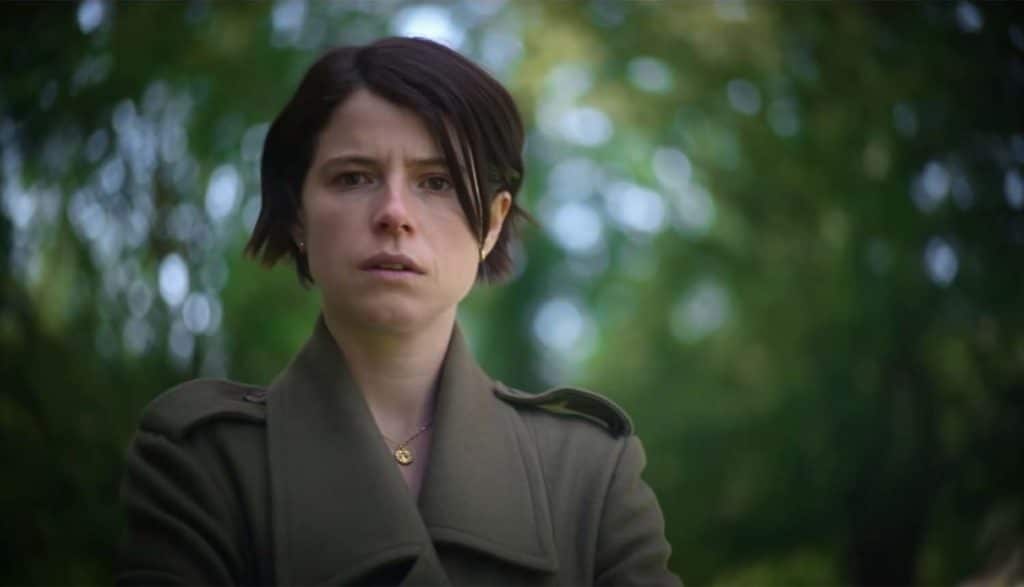
That’s not to say that the film doesn’t start strongly: it absolutely does, weaving an intense sense of dread and vulnerability. This is cemented by the performance of Jessie Buckley as Harper, who immediately comes across as a woman raw with grief after the unexpected death of her husband, James. But grief is seldom uncomplicated; James’s death came after a number of problems for the couple, culminating in Harper’s decision to ask for a divorce. To help get over this ordeal, Harper has rented a house in the remote English countryside. When she arrives, she’s greeted by the owner, Geoffrey (Rory Kinnear) – what we’d tend to call an ‘eccentric’, an old country boy who has lived very much within the village bounds, though he seems harmless, and Harper’s plan to get away from it all seems, initially, to be working. She heads out to explore the area, and the greenery and the silence seem to be working their magic. (Incidentally, let’s assume seeing apples on the trees at the same time as bluebells in the woods is all part of the strange otherworldliness of this place, rather than a daft oversight.)
As mentioned above, Men explores its themes through a horror lens, and there’s always a storm after a moment of calm such as this. As Harper playfully tests out the echo of her voice under an old, disused railway arch, she seems to disturb someone: a man at the other end of the tunnel stands up, and then begins to make his way towards her. She responds as anyone would – or at least, as any lone woman socialised from early childhood to steer clear of strange men in lonely locations would. She retreats, but the nude (!) male figure follows her.
Thus begins the unravelling of whatever binds Harper, even nominally, to reality; this means, in terms of plot coherence, a series of diminishing returns. Not only does this strange, mute man follow her back to the comparative safety of the house, but all of the men she encounters thereafter (all played by Kinnear) display a range of threatening or degrading behaviours towards her. She behaves at first as you may expect, which is to run through the gamut of: attempted politeness, bemusement, anger and fear – pretty much in that order. However, the stranger things get, the less Harper’s reactions resonate with what’s expected, and the looser the relationship between narrative and exposition becomes. The film also introduces some very loaded symbolism and imagery which it values enough to come back to several times, though never quite to the point of unpacking that symbolism. In fact, in its initial setup, Men did remind me a little of Robin Redbreast (1970), story, folk horror symbolism and all.
The difference is that, neither in its dialogue nor its denouement, do these images and motifs get explored in any depth; even if they are aesthetically appealing and shot beautifully, they tantalise at a meaningful conclusion which, sadly, never comes. After becoming engrossed in the ratcheting isolation of a profoundly likeable and sympathetic female lead – and equally impressed by the acting chops of Rory Kinnear, who is an absolute asset to everything he’s ever in – the film withers and dithers away to an ending, which feels disappointing. It feels unfair to everyone concerned in establishing and carrying the film to that point, too; adding in a quick hodgepodge of grotesque surrealism feels like a cop out, not a bold artistic decision. It’s also difficult to determine whether the film is critiquing sexist attitudes, or glorying in regurgitating them somehow; much of this remains unchallenged, or gets blurred by the strong new focus on the ick factor.
Men does many things very well, particularly in its first hour: it’s artistically made, well shot, with a haunting choral soundtrack which perfectly suits the escalating tension on-screen. Its initial confidence is also clear in its early use of playful notes, giving us some moments of dark humour to offset the sense of a true existential crisis in the offing. Sadly, the rather sudden spasm into all-out metaphor (after rather clumsily lining up a few obvious symbolic nods) dispenses with many of the finer points which the film had built. It’s fitting that Kinnear spends a lot of time wandering around in the altogether, as The Emperor’s New Clothes comes to mind at this point. It’s a shame, and though no detriment to the excellent performances, it’s at great detriment to the film as a cogent whole. As I left the cinema, I overheard another attendee say to his friend, ‘I guess I’ll have to Google what that all meant’. That isn’t really the hallmark of a fulfilling trip to the cinema or an effective story, I’d argue.
Following on from our recent review of the ‘creature feature road trip’ movie The Passenger, we were pleased to get the opportunity for a quick chat with leading man Ramiro Blas, who plays the inimitable (and potentially divisive) leading man Blasco in the film. Blas has a long pedigree as an actor – over twenty years – and a wide range of experience in TV and film. But it’s in The Passenger that many of the readers of the site may be encountering his work for the first time. We talked about his experiences playing Blasco and of appearing in The Passenger (which hits some theatres on June 3rd and VOD at the end of this month).
WP: Firstly, thank you very much for talking to Warped Perspective! You are an experienced actor who also has some experience in genre cinema – including a role in [REC] 4. What attracted you to The Passenger?
RB: What attracted me to The Passenger, obviously when I finished reading the script, was the arc that occurs with this kind of retrograde, homophobic and even sexist antihero, but throughout the filming that changes radically and you realise that he is a character from the deep Spain with an old-fashioned education like the one that exists to this day in many villages. I was interested in how he ends up becoming almost a lovable and admirable character. The way he goes from antihero to hero.
WP: Where did you find the inspiration for Blasco? In your opinion, is he a sympathetic character? Does he have good attributes?
RB: I consider that he is a character full of kind attributes that make him a gentle being; he even goes so far as to risk it all for a creature that has nothing to do with him and ends up almost adopting her with a paternal kind of love, beyond anything the first indications of the film suggest.
WP: How do you expect audiences to react to Blasco?
RB: We talked a lot during the filming and during the creation of the character about how we originally expected people to be a little freaked out by the kind of retrograde character that he was. However, I always bet that he was a character who was going to stay with the audience and that he would end up being loved. In fact, I learned to love the character. It is a character that allowed me to change a lot the image that I have as an actor, because here in Spain (because of the series that I have done before) I was always stuck in the role of the bad guy. However, this character is tinged with a goodness and a sincerity that filled my soul.
WP: The Passenger gets quite…messy in places. Did you enjoy working on this kind of ‘body horror’ project? What was fun, and what was not so fun?
RB: The characteristics of the filming attracted me a lot, especially because I know the directors and I knew what they were looking for. I had already worked on short films with them, especially with Fernando [González Gómez], and I know his cinematographic point of view. The project caught me from the start, because as I read it I was imagining what the images were going to be like, especially because of that continuous tribute that the film pays the cinema of the 80s where horror became entertainment as well. There are many analogies to great directors and great films of the 70s and 80s.
The good things about the project were really everything: travelling through the character and their moments, discovering within myself what were the real fears that this character could feel. The only bad thing was the weather conditions, because it was filmed at night in the middle of the mountain forest and the cold was enormous! That’s the only bad thing I could say.
WP: In terms of your own likes and influences – are you a genre film fan? If so, what kinds of films do you love?
RB: Well, I don’t know if I could say that I’m a fan of the genre. But it’s a genre that amuses me above all things, and in which I always try to find a fear that goes beyond the pre-established, beyond the stereotyped. I do like horror movies with lots of reality. I like psychological horror films, especially where the fears of any human being are manifested in the film and where the actors who play the characters in the film transmit and transmute, going through those fears in an absolutely real way.
WP: And finally, now that The Passenger is getting a release – what is next for you?
RB: At the moment I am shooting a rather dark series, a psychological thriller for the Netflix platform and then there are a couple more film projects to shoot in Italy that we are waiting for. The actor’s life is like that, we are always waiting sweetly…
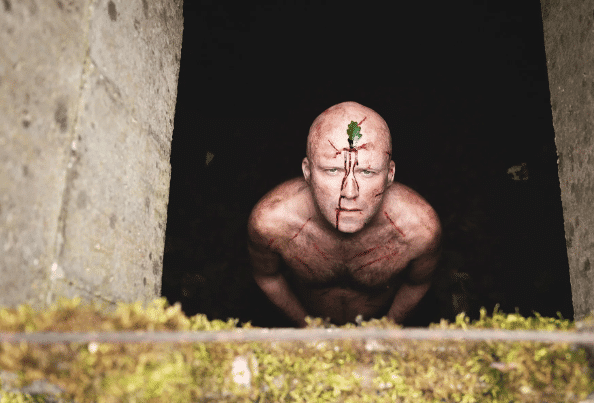
The blurb for The Passenger – or La pasajera, to give it its original title – doesn’t give too much away; going from this to an opening scene which seems to point to a different genre of horror altogether, the film we actually get turns out to be quite a pleasant, unpleasant surprise. The Passenger could be best described as a creature feature road trip, darkly funny and overblown, and tailor-made to be a diverting Saturday night film – which is of course intended to be a compliment.
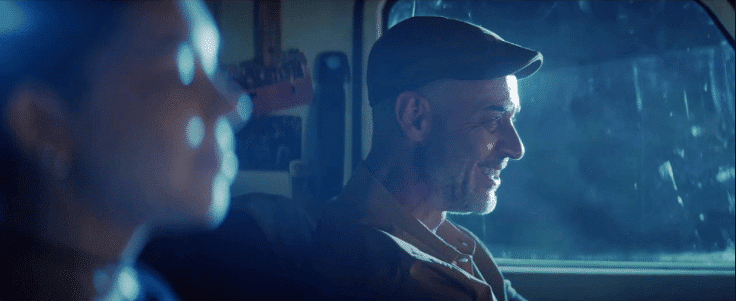
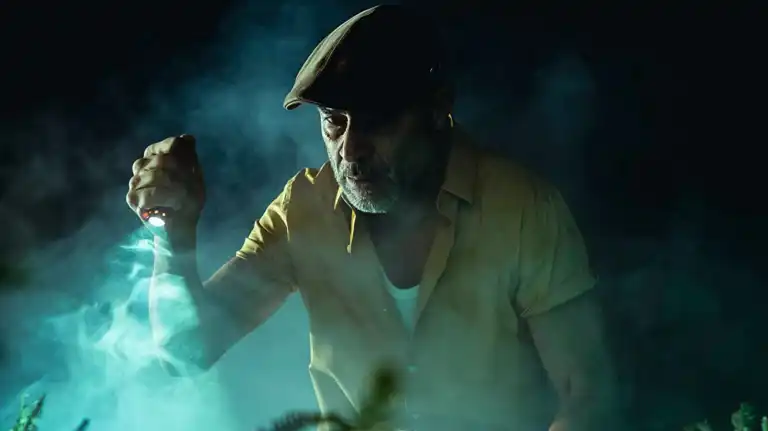
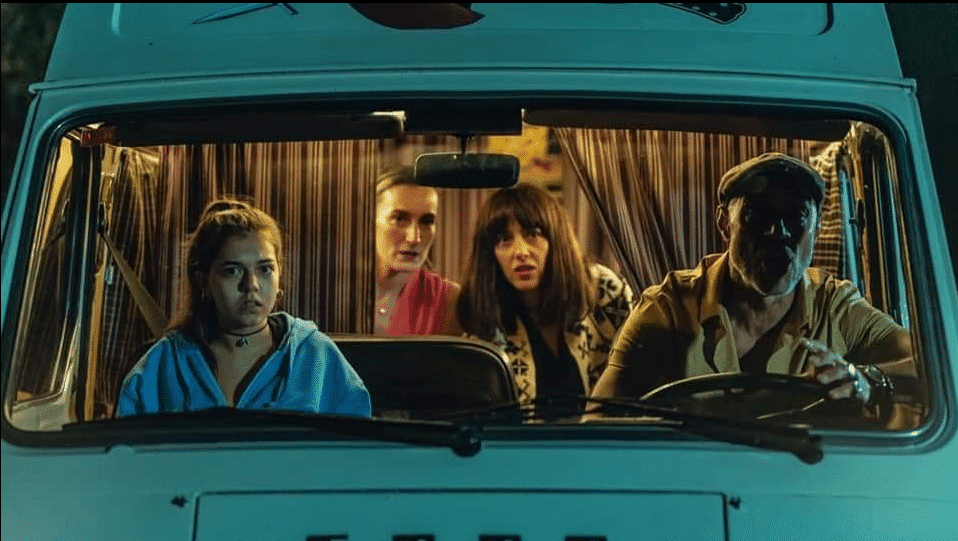
Although we start by picking through some potentially offputting genre staples – lost hitchhikers in the woods, creepy mist, creepy ghostly (?) woman hightailing it out of said mist – this is brief, and we’re quickly whisked off elsewhere, with more than a few signals that none of this it to be taken too seriously. Somewhere in rural Spain, we meet Carlos Blasco (Ramiro Blas), a driver who ekes out a living by hiring out his ‘vintage’ van – it’s not quite a taxi, and it’s not quite an independent hire, as he’s along for the ride.
On this occasion, he’s due to drive three women – a religious type, and a career woman dropping off her unimpressed teenage daughter at her father’s – and it’s soon clear that Blasco is clearly a comedy of errors kind of a guy, a fact which doesn’t really endear him to his right-minded passengers. He seems well meaning, but he tends to say the wrong things, particularly where women are concerned: for all that, he’s warm and likeable: this could be the wrong impression, but it doesn’t feel like we’re intended to oppose him or dislike him. He quickly forms an odd friendship with the teenager, Marta (Paula Gallego), too, which draws her away from being the surly teenager she first appears to be.
The awkward journey continues, but when it goes from bad to worse, it really goes from bad to worse.
Noticing something at the roadside, they pull over and Marta finds herself investigating what looks clearly like the kind of space debris which can only lead to dreadful, splattery consequences for the people that discover it. They get back into the bus and a squabble soon ensues, but there’s more: the bus then seems to hit someone, a woman stood out in the darkness of the road. The women on the bus insist that they go back and help this person, but there’s something …not quite right about them, even before they’re dragged onto the bus. The set-up is complete then, and things are about to get very weird (this also casts a different light on what seemed to be a ghostly figure in the early reels; oh no, it ain’t).
That’s enough with the plot summary: the important thing is that what ensues is a fairly ambitious, rather enjoyable mash-up of different genre elements. There is a lot if accompanying dialogue, sure, but no justifiable way to say that things get boring. It has the fun, OTT feel of something like Night of the Creeps, but the road trip element is an engaging development, as it’s usually associated with Hitcher-style threats – very definitely human, even if oddly powerful or knowledgeable to the point of seeming a bit supernatural. Well, whatever is involved here, it pays dividends in terms of horrible ‘ick’ body horror. One slight issue is that not all of the Spanish cultural references fully land; some expressions go untranslated, for example, which might not be hugely significant, but it’s a shame to feel like you’re potentially missing something. But hey. Along the way, we also get decent characters and good performances which really hold things together. The unlikely due of Marta and Blasco is genuinely charming, and – come what may – Blasco is great, so it would be great to see him on screen again. Perhaps we will. Perhaps we will.
The Passenger will be released in cinemas on June 3rd 2022and on VOD/DVD on June 28th.