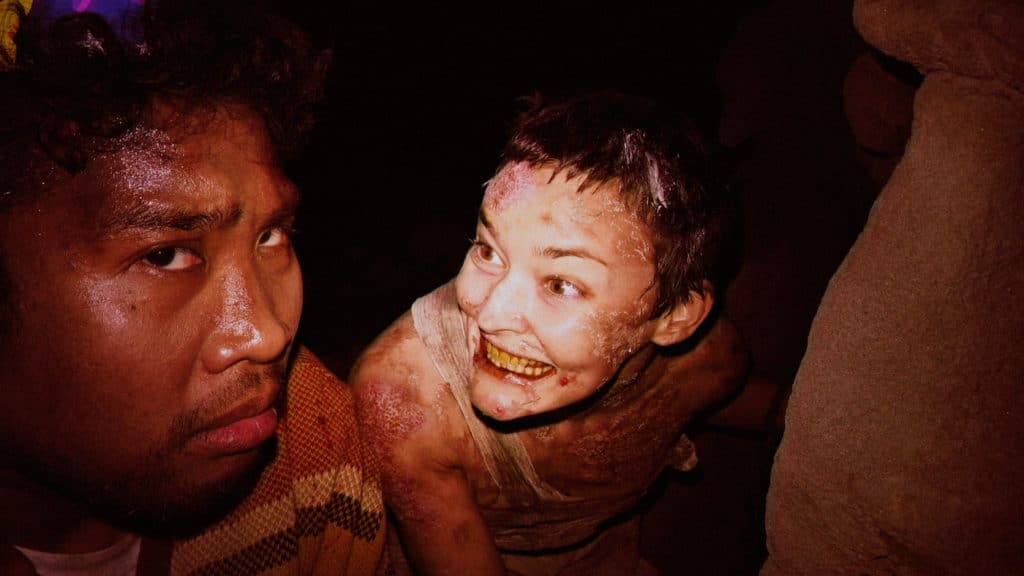
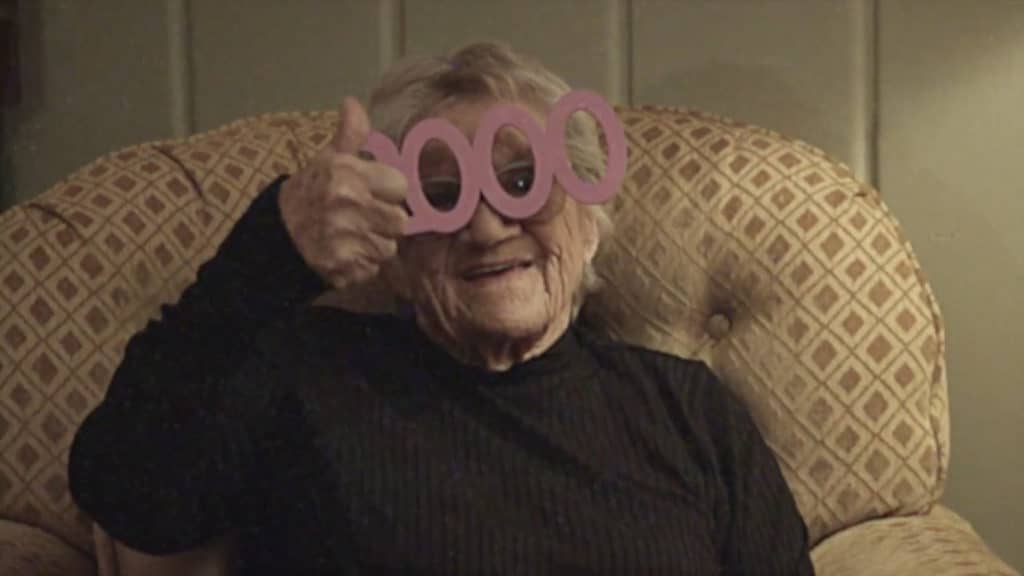
Even those people for whom nostalgia seems to be a kind of tragic full-time job would likely struggle with V/H/S/99 (2022). Okay it’s better than V/H/S/94, but surely that’s damning with faint praise. It clings onto the same silly tics in any case, with the same religious devotion to all those shitty elements of analogue technology which were annoying the first time around. Second, third, fifth, seventh time around, seeing ‘TRACKING’ or watching a frame dissolve into snow as part of the chosen framing device of a brand-new film – well, you can only admire the singlemindedness. Use it to pad out five individual films of wildly varying quality, come what may, and that is some fighting spirit.
The annoying thing here (or one of the annoying things) is that one of the segments turns out to be rather good; one more is passable; the rest are dreadful. But they alternate, so although we get some much-needed variety and quality in the mix, the overarching film feels uneven: it goes bad-good-bad-okay-indifferent. It’s a big fat curate’s egg, essentially, and it takes nearly two hours to chow through. Then the individual films – despite having different directors, as usual – all share plot similarities, as they’re almost all about: pranks, teenage peer pressure, being the butt of the joke and finally, the supernatural, which rides in at the end like the cavalry. And although the dreaded wraparound feature looks to have been left out, we still get a silly conceit about a game of toy soldiers (evidently made to look as though a kid has made an animated film of his own) which feels like a wraparound, as it pops up – as if it’s been taped over, natch – again and again. Light relief? Or padding? Let’s go with padding. It felt like padding. A film which is one hour, fifty minutes long does not need padding.
The first segment, Shredding, is another group of young ‘uns trying to make their own film, which largely consists of pranking one of their number in particular as they enjoy the usual pastimes of skateboarding, being in a band, Hot Topic goth fashion and bursting in on one another on the toilet. When not doing that they share a tale of an urban legend, about a band called Bitch Cat (or Kat – should really be Kat) who died, alongside a number of their fans, in a club fire. Cool, let’s go see! So they go see, and it’s everything you might expect. Because this film is so weak and it’s the first one people will see, it operates as a kind of litmus test: it’d be interesting to know who turns the film off at this point. That’s an issue with this framework: as a Shudder original anthology, it seems to trust that the constant jibber-jabber and people talking over one another won’t be minded at all by its audience, who may well be doing the same. But you still need some surprises or some big scenes, and there aren’t any here, aside from the enthusiasm with which people setting films way back in time seem to relish the opportunity to throw in language which wouldn’t fly in 2022. There’s more like that in other segments, too.
The next film, thankfully, is mean-spirited and SFX-laden enough to distinguish itself from all of the other segments here, and it’s nice that the director in question is Johannes Roberts, who clearly understands how to fit a lot of horror into a short amount of time without the endless dialogue. Suicide Bid satirises the bizarre American tradition of putting those hoping to join a fraternity/sorority through hazing rituals; people have genuinely died as a result of these, and they have a reputation for being anything from spectacularly stupid to incredibly dangerous. Pulling this existing phenomenon into a horrific fantasy universe, we have the story of Lily (Ally Ioannides), who’s is told by her would-be sisters that she has to spend the night in a coffin: she can ask for help, but if she does, she can’t join, so the pressure’s on to go the distance. Oh, and just before time, the girls tell her all about a local urban legend about a girl who tried it and didn’t make it… It looks like there are a few nods to Fulci here – spiders, in-coffin camera shots – but even if this is a mere coincidence, then it certainly prevents a lot of the static shots in the film becoming turgid, and kudos for the very good SFX work which brings things to a decent conclusion.
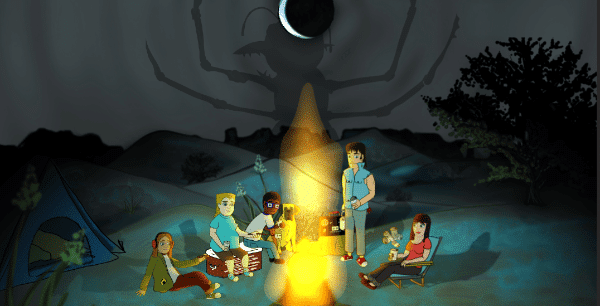
Segment three is Ozzy’s Dungeon, and it looks like something between The Running Man and Pat Sharp’s Funhouse – being a cable TV gameshow where kids compete in increasingly grisly and ill-advised games to have their ‘dreams come true’. When a game goes badly wrong, a disgruntled parent decides to get their own back on the host. There’s some potential subtext here in the form of Ozzy’s blatant exploitation of his participants, but most of that gets parked so that the film can focus on what seems a lot like proto-ordeal horror, then not much more than a glint in James Wan’s eye of course. It’s all so shouty, though, and suffers a lot by essentially repeating the cable show sequence twice, before segueing into a plot twist which felt like a bridge too far – shifting the tension away from the initial key players, fine, but diluting the sense of involvement and interest in the initial story arc.
The Gawkers is interesting in the way it splices two key things together: permission for a group of deadbeat boys to spy on their ‘hot piece of ass’ neighbour – because ‘it’s 1999’ – with what feels like a completely obvious about-face where they get their comeuppance – because it’s 2022. The cast all fall asleep at one point, which isn’t a good sign in a short film, even if director Tyler MacIntyre does this in a knowing way. But there’s some modest fun to be had with this, if you suspend your critical eye for the effects used – effects even a VHS palimpsest can’t quite obscure.
Finally, there was hope when it turned out that Joseph and Vanessa Winter directed To Hell and Back, as their film Deadstream is an updated, improved descendant of this kind of found-footage style, which shows how far we’ve come, in real time. It starts off on the eve of Y2K, with a group of people preparing for an occult ritual in suburbia; fair enough, it was expensive to get tickets for things. It starts with a reasonably light touch and some humour, though it moves the action elsewhere (you may guess where) in what looks like another nod to Fulci; the problem is that the humour and characterisation begin to feel rather opaque against this rather samey, but all-encompassing background. That all being said, you wouldn’t envy any film being placed at the end of this anthology. By this point, after five with significant thematic overlap, minutes devoted to a frame which contributes nothing much, and irritating inclusions around the films themselves, the conceit has worn very thin.
Everything about the Y2K setting feels overdone, but equally, a waste: only one film even touches upon what was an interesting point in history, with real anxieties about the possibilities of missiles falling out of the sky. With the exception of a nod and a wink from the Winters – although little else substantive – the 1999 thing is only used as a last-chance opportunity to use the VHS framework before DVD comes in properly and wrecks the game. Beyond that, we get some gleeful word choices ‘from back then’ and some black lipstick (and, by the by, if you’re going to fixate on getting the jewellery and make-up right, remember that girls at the time plucked their eyebrows into incredibly tiny arches; all of the massive 2020s eyebrows can only give the game away. It’s a minor point, but it’s still noticeable). Of course, you can make the argument that the VHS thing is all meant to be part of the charm. You could even say it’s the point; it does feel like that in places. Fine. But if you take these stories for what they are, trying to forget the VHS frippery draped everywhere, then they are for the most part dilute and unremarkable. A few high points aside, V/H/S/99 is a hot mess, and it should be the last of its line.
V/H/S/99 (2021) will be released on Shudder on Thursday, October 20th 2022.
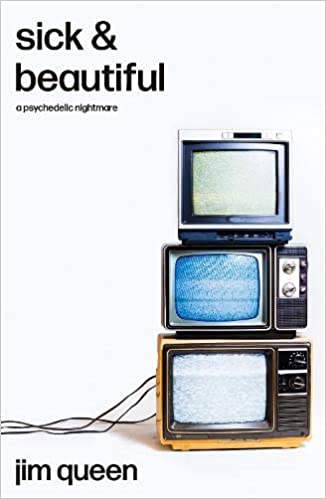
Having recently read and reviewed Jim Queen’s debut novel, I was also keen to run an interview: it’s such a heady, hedonistic book, for starters, that it begs many questions. But more than that, I was interested in its back story, so to speak: it’s a book which feels both very alienating and yet very personal, so I knew that hearing about the process behind it would be intriguing. Jim was kind enough to oblige, and so without further ado…
WP: Before writing Sick & Beautiful – your debut novel – you’ve worked as a non-fiction writer, a journalist and copywriter. Talk to us about making that leap from one kind of writing to another: is fiction something that you’ve always wanted to do? And how challenging has it been to move from one into another?
Writing (and re-writing) such a beefy piece of work between the gaps of daily life is undeniably the biggest challenge. But I’d say the leap between each discipline isn’t a huge one. Journalists are never truly objective. They’ve also utilised fictional techniques since the 1960s New Journalism movement. Copywriting for brands and advertisers follows the same rules: you’re aiming to evoke an emotional response with a toolbox of verbal and visual tricks, just like a hack or a novelist. And the best fiction always reflects reality. This is what enables your readers to connect with the characters, even when your narrative tailspins into the surreal and fantastical. In that sense, I’ve always wanted to write a novel, but I’ve never wanted to write fiction.
WP: Your protagonist, David, is also a journalist who finds his way into a dreamlike world, where truth and fiction overlap. It’s an often dizzying sensory experience, written in such a way that David often comes across as quite vulnerable to what overtakes him. Was this your intention? And how hard was it to balance David’s very real traumas and feelings against the fantastical events which occur?
From blurring past, present and future, to overlapping reality with nightmares and drug-induced hallucinations, I wanted David’s first-person view to be capricious and disorientating. I don’t think there’s anything more powerful in storytelling than an unreliable narrator. But my desire to muddy these boundaries isn’t just to make the reader draw their own interpretations: it’s to make them question the borders of their own reality.
This intent was inspired by a quote from JG Ballard, speaking about his experience living in a civilian prison camp in Shanghai: “The realities that you took for granted – your comfortable day-to-day life, school, the home where one lives, familiar streets, the trips to the swimming pool and the cinema – were just a stage set. They could be dismantled overnight.”
The notion that everyday reality might not be what we assume, that it can all be altered or taken away, is fascinating and frightening. This possibility crushes David. It heaves him between fearless hope and hopeless dread. Ultimately, David’s vulnerability (and his growing awareness of it) is his biggest strength. Even as he transforms into a monster, his vulnerability makes him more human.
WP: Rachel Garland, who precipitates (or seems to precipitate) a lot of the novel’s developments, is an interesting character: what inspired this muse-like woman – if that’s a fair way to describe her? How do you think you intend your readers to think about her, or the relationship between her and David?
There’s a wonderful line from Lisa Taddeo’s Animal: “There is nothing in the world better than the past.” This is how we can understand Rachel. We never truly know who she is – instead, Rachel is an effigy of David’s hopes, fears, aspirations and memories. She implores us to question the muses and vocations in our own lives. Are the people and ideologies we latch ourselves onto what we assume? Or are they a mirror of our obsession, a symptom of a culture that renders individuals into objects? Like David, Rachel reflects those uncomfortable (and sometimes unbearable) truths.
WP: Sick & Beautiful, wherever else it takes us, is rooted in London – it suggests a deep knowledge, and a fondness for London. Please tell us more about this – why was it important to you as a key setting?
London isn’t just a location: it’s a character. And the architecture and personality of that character drives the narrative. It warps and informs David’s emotional state – an endless tug-of-war between infatuation and repulsion. It also facilitates an environment where atrocities can occur every minute, every hour, every day. This setting illustrates how humanity is a carousel of death and violence. The city, as well as the events of Sick & Beautiful, are just a snapshot of this grotesque merry-go-round. We can watch our senseless destruction with disgust and horror, but we can’t reverse or escape it.
WP: Your love of the horror genre is clear in the book, and you have included some horrific set pieces which would not be amiss in horror cinema. The book as a whole seems to idolise cinema, writing cinematic knowledge into your characters’ back stories and using locations which would be known to film fans – to name just a few of the connections. Why was this important to you?
I’ve been a horror fanatic since childhood (and, admittedly, I spent more time watching Blockbuster rentals than reading books). I don’t believe there is a genre more qualified to exhume darkness and beauty than horror. The role of horror cinema in Sick & Beautiful, and David’s fetishisation of it, is a device to cloud the peripheries of reality. But it’s also a love letter to an artform I idolise. This novel is my way of giving something back, and hopefully something unique, to the horror canon.
WP:What was the most challenging part of this writing journey? And where do you hope to go next, in terms of your writing?
Something Chuck Palahniuk underscores in Consider This: “I’ve known fantastic writers who never finished a project. And writers who launched incredible ideas, then never fully executed them.” In short, the biggest challenge is finding the time to write your first draft, shredding it to pieces, and then re-rewriting and proofing it more times than you can count.
That writing process, at least in my experience, is chaotic, unromantic and spiritually draining. But it can be absolving too. Nothing is more cathartic than killing characters you loved, writing without fear or shame, and allowing people to critique what works in your story (and, most vitally, what doesn’t).
I’ve taken these lessons onboard for the next book and, so far, the journey has been less painful. But the story itself? It’s weird. And it’s frightening. Really frightening. I just want to get it out of my brain so the nightmares will go away again.
Clues that we are seeing the aftermath of violence are what introduce us to Repulse (2021): shattered glass, a trashed vehicle, a discarded hammer. But no sooner has this eerie calm unfolded, than it’s being disrupted by an angry scream; then we’re elsewhere entirely, now actually witnessing violence taking place. This episodic, fitful structure is here to stay and it’s unsettling, though its consistent handling weaves together a genuinely gripping narrative. It doles out the facts in this narrative very carefully.
The facts are these: firstly, we are made privy to a bitterly broken marriage. You can’t quite call this wealthy, modern home a gilded cage – it’s too minimalist for that – but what we do glean is the deep unhappiness of wife Katerina (PavlaGajdosíková), so it’s a cage nonetheless. Husband Robert has found evidence that she’s been having an affair; as he alternates between cruelty and sifting through the house in a pair of black latex gloves, you can’t blame her for seeking any outlet other than this peculiar, cruel man. Meanwhile, elsewhere, we meet a man named Viktor (Stepán Kozub), living not only in a diametrically-opposed kind of poverty, but evidently dealing with the death of an as-yet nameless, faceless woman. That she matters to him in some way is clear; everything else is murky, but he does not appear to be the archetypal maniac in the dilapidated house; it seems that, as the timeline gradually comes together, he has been victimised, too.
It’s clear that these two worlds could quite easily have continued in their separate ways, each as miserable as the other, but an accident occurs after Robert leaves the marital home with daughter Sara – which brings them both into contact. The clash itself, and how events then unfold, comprises the rest of the film. That we are expected to piece all of this together, like a puzzle, adds an additional layer of cruelty to proceedings, perhaps. It is an engrossing device, however, and it successfully draws the audience into two very different, though equally alienated, unpleasant situations.
Horror tropes are openly, consciously selected throughout the film, but you can never depend on them. They can be teased apart, repurposed. Aesthetically, elements of Repulse look more than a little familiar; this would be a weakness perhaps, were the plot to just mirror these. But it doesn’t; it goes further than the sum of its parts, leading to a profound moral cold which hangs over the film throughout. Aside from the usual horror movie motifs – the masks, the cuffs, the general degradation – the film introduces other symbols. Cars mirror cars; broken glass peppers both the poor house and the rich one. Dead and damaged flowers often seem to be on the periphery. What’s being routinely trampled underfoot seems to be as important as what we see elsewhere, it appears. Overarching all of this, it also seems clear that the collision between these two families happens via momentary adaptations, sudden changes in direction, rather than via longer-held plans (such as in the similarly family-orientated horror, See No Evil). This works to Repulse‘s favour; tenuous connections become seemingly inescapable, and chance is key. This is, in itself, a fearsome idea. If it’s been done elsewhere, then it has rarely matched this level of detail.
The writing, directing and editing of this film must have meant an incredibly meticulous process, so its status as a first-time feature by Emil Krizka is all the more impressive. He has balanced intricacy against genuinely unsettling, frightening scenes, letting events and images slowly come together. Dialogue is minimal throughout, but boy, can you see every thought process going on in Gajdosíková’s head; Kozub, too, rarely explains himself, but you can envision a world of pain and trauma behind his own cruelty. He’s no two-dimensional monster. Nothing in this film is two-dimensional. Repulse is, in short, a massive achievement: it feels like a new, clever, confident kind of dark modern horror.
Repulse (2021) is part of the Brooklyn Horror Film Festival: for more details, please click here.
The opening scenes of Mother Superior (2022) do a couple of things: not only do they establish the film’s esoteric subject matter via the newspaper clippings, photos, art and symbols shown to us, but they also forge links to a German horror tradition which has, in effect, shaped horror cinema itself since its inception a century ago. Take away the colour (and the quick segue into a sequence showing us 70s-era analogue tech) and this feels like a clear and recognisable nod to early horror cinema; it captures something specific from the early-to-mid 20th Century which contextualises our story. As such, the film sets out its stall as an occult horror period piece, but it also has enough modern tricks and a sense of the cinema which has appeared in the interim between then and now to distinguish itself.
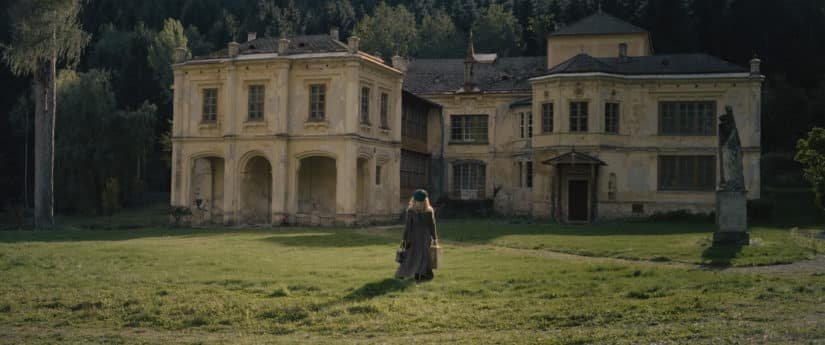
We get to the story itself via different forms of media; after the clippings, we next witness a police interview. A young woman, Sigrun (Isabella Händler) is having her interview recorded. Yes, this pushes the technological likelihood to breaking point given the 1975 setting is made abundantly clear, but it does allow an engaging narrative framework to come into being. Sigrun explains the events of recent months: she details a recent job she took at a dilapidated manor house called Rosenkreutz Manor. (Rosenkreutz – now, if ever there was a significant German name, that’s one.) Sigrun took a job there as a nurse, assisting the elderly Baroness Heidenreich (again with the symbolic names) who suffers from Parkinson’s Disease. We then switch perspectives, arriving at the pile alongside Sigrun, and thereafter, by and large, seeing the story unfold in a more conventional way.
The Baroness is exacting, with a long list of house rules and requirements, including an edict that Sigrun must stay out of the abandoned wings of the house – for safety, of course. Groundskeeper Otto (Jochen Nickel) helps to enforce all of these rules, apparently regarding the young nurse with suspicion. But, slowly, relationships begin to build, and the Baroness reveals that she herself was involved in medicine once. It transpires that she means her past role as head of a Lebensborn (‘spring of life’) hospital during the War, an SS project to both support and, to an extent, enable Aryan births. This is of particular interest to Sigrun: she never knew her own parents, having been born in a Lebensborn unit herself.
Her interest and investment are piqued enough to lead her to begin searching the old house for information, particularly on the identity of her mother. This, it seems, was always her goal in going to the house, though there are no sudden or easy answers for her. The weeks and months pass, and there’s more: whatever the Baroness’s old interests in the occult, it seems that they are not over, and much about the house corroborates this. Sigurd becomes increasingly drawn into the house, the household and what it potentially has to offer to her: this leads her to leave behind her old life, which was, after all, an alienated kind of existence, if a conventional one: ideas of destiny, belonging and magic begin to swirl.
There’s such a wide-ranging blend of horror elements and influences brought to bear on this economical, rather beautiful and purposeful film (albeit that it means things are rounded up quite abruptly; the film is a mere 1 hour, 11 minutes long, after all). Aside from the crumbling, remote house, the mysterious characters and the tantalising allusions to magic, there’s an even more interesting aspect; the solid horror tradition of younger women taking care of older, ailing women. Dolores Claiborne (1995) and Saint Maud (2019) spring to mind; there are of course many more. This motif is so interesting because the power balance is never straightforward; youth and beauty can be derailed by money, knowledge or power, and you can never suppose that an older or an infirm person is ever a spent force; they usually retain some peculiar means.
The story thereafter opens up to take on a fantastical direction, one which feels very familiar in some ways, but it’s bold enough to explore the historical Nazi preoccupation with völkisch magic – though it also departs quite radically from this, too. There may be some viewers who find these links unpalatable in any case; it would be a mistake to dismiss the film on these grounds, however, even though the film also humanises Baroness Heidenreich, with Inge Maux getting her performance tonally just right. It’s worth remembering that cinema has long utilised, explored and disrupted aspects of Nazi lore in a range of genres, from stony drama to lurid exploitation. Mother Superior is neither of these, though it is heady in some respects, surprisingly compassionate in others: beyond this it is also a fairly familiar-seeming search for belonging, with folk horror vibes which just happen to be quasi-Germanic – with some perhaps surprising feminist messaging, too, before we’re done.
Mother Superior will screen on 14th October at the Brooklyn Horror Film Festival. For more details on the fest, please click here.
Ah, short horror films. Let’s assume that people are still making films about what they’re most afraid of these days; if so, then the Brooklyn Horror Film Festival’s Creeping Terror package brings us remote families, spirit incursions, bodily breakdowns, wicked imposters and a healthy dose of paranoia along the way. All of the titles achieve a great deal in their 15-20 minute running times: this is, and will remain, a formidable format when it comes to focused, innovative storytelling.
First up, Listen to Mother starts out with a brief introduction to trepanning, the procedure by which – from ancient times until relatively recently – people plagued with melancholy would drill holes into their brains. Now, this isn’t some preamble to a piece of pure gore; trepanning was believed to offer a spiritual dimension, literally ‘letting the angels in’. Take what you will from this; we are next introduced to a grieving mother and son, reflecting on the loss of a younger child. Leaving the room, it seems that the mother makes a significant decision about the grief she is suffering. But grief isn’t confined to this family; elsewhere, nearby, a social worker reflects on her own loss. Perhaps it is this which spurs her on, as she investigates the wellbeing of our first family.
Listen to Mother
Earnest performances underpin this story. It has also balanced its scares with palpable sadness, and this is what brings its story to life; you can genuinely empathise with all of its characters, however flawed or warped their decision-making. My only complaint here would be with some of the dialogue: it was unclear if we were meant to be able to hear all of it or not, but I couldn’t. All in all, though, this is a successful use of the format, with careful pacing and a very humane touch.
Shut, a Dutch film, joins the ranks of the excellent, thought-provoking horrors which have of late explored anxieties around ageing. And, like many of the best of these, it adds the potential for something monstrous, calling into question whether the horrors which unfold are linked purely to ageing, or indicative of more.
Shut
Jonas (Sanne den Hartogh) is heading to visit his father Arend (Jack Wouterse). Arend is getting on in years, but he isn’t frail: nonetheless, when Jonas arrives to an empty, dark house, he fears the worst. His sister Liese has been begging her father lately to move somewhere less remote; this disappearance seems to chime with her fears. But Jonas finds Arend out back – hammering a door tightly shut. He’s completely preoccupied with this task, and seems to be afraid; when he finally properly sees that Jonas is there, he seems scared of him, too. But why? Ultimately, Shut manages to sustain its powerful sense of ambivalence, though its tension ebbs and flows nicely, shifting our sympathies around.
OST has some things in common with other, reasonably well-known films. In its central plot focus, it shares some common ground with Berberian Sound System; in its female protagonist who gets drawn into a film – a world within a world – it is a little like Censor. However, all of that being said, OST does more than enough to distinguish itself, messing with horror norms by giving us not a damsel in distress, but a film professional, tasked with composing a score for an upcoming horror film. Jay (Prapamonton Eiamchan) is a perfectionist: she composes, and ditches, several versions of her work, to the despair of the film’s director. However, when she realises that the film itself is playing with aspects of Thai folklore, the project takes on a whole new significance. She has been raised on this lore; she knows that the spirits themselves have exacting standards when it comes to how their stories are told. This is an interesting idea which could be called meta – or, just enjoyed for the ways OST proves able to layer its different elements so successfully.
Tistlebu has a beautiful, if stark Norwegian setting and uses Norwegian actors; it also adds in elements of folkloric beliefs, though whether these have any pedigree beyond the film has not been easy to discover. But in any case, many of the elements explored will feel familiar; this is at heart an eco-horror which uses aspects of folk horror. A young couple, Sanna (Sacha Slengesol Balgobin) and Karl (Sjur Vatne Brean) arrive on a remote sheep farm to help stake out a new pasture for the recently-widowed Anne (Oda Schjøll). They are also tasked with tending something hidden in one of the farm’s outbuildings: it’s called a Tursemorkel, and it’s believed to protect the farm.
Anne shows them what to do; they seem to take these duties on quite readily, though the audience may well start working on their list of questions at this point. Work on the farm goes reasonably happily, at first. The Morkel has a strange influence on both Sanna and on Karl, though, each of whom deal with it independently. There are notable, if dysfunctional sexual overtones attached to the Morkel, but more than that, it begins to change, and to change them. Tistlebu conveys lessons about nature and belonging before it is done, albeit that these lessons end on a slightly odd beat; whilst it still works fine as a short film, here there did feel like there was at least some more still to tell.
Tistelbu
Finally, Miltown brings along some familiar faces: if you saw Hellbender a couple of years ago, then you might recognise some members of the Adams Family – its directors and stars. Here, they also play a family, but it’s a move away from the more conventional(ish) occult themes of Hellbender, under the direction of Chris Beyrooty and Connor Martin (who also wrote the Miltown screenplay).
This is a great little excursion into a hell/handcart situation, with engaging twists and turns, flashbacks, and moments of corroborative doubt which cast a shadow over eldest son, Bobby (Henry Lynch). Bobby rushes into the family home one evening, certain that his father cannot be his father; he swears to the rest of the family that this is the case, explaining his reasoning in seemingly convincing detail. But is he right? Miltown throws some sci-fi and good old-fashioned monster film elements into its modest runtime, adds in some humour and even some action sequences, and really does achieve a great deal along the way. It’s fun, but it’s also smart, keeping the audience as confused as scared as our key player, right until the end – when the conclusions we can draw deliver one final blow.
October is a busy month for genre film fans, and for folks on the East Coast it’s happily no exception as the Brooklyn Horror Film Festival prepares to launch this year’s event. Running from the 13th October to the 20th, it promises both a run of classic cinema and brand new titles. (Warped Perspective is covering a few of them, so please do watch this space.) For those of you who will be in attendance, or for those of you on the look-out for titles which are hopefully coming your way at a later point, check out the following five…
Nocebo
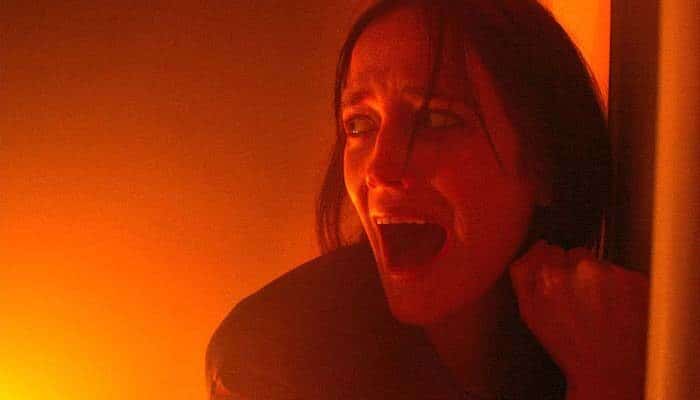
Eva Green, via her work on the wonderful Penny Dreadful series, is already known to many viewers as a magnetic and talented actor who seems rather comfortable around darker themes. So far, so good. Put her in a film directed by Lorcan Finnegan, whose film Vivarium has become a long-term source of anxiety and fascination for this reviewer, and the festival opener Nocebo looks to be a folk horror which throws up some important talking points too. Blending themes such as illness, hypochondria, folklore, class and power, it’s no doubt a title to seek out.
Mother Superior
A film whose story spans the decades between the 1940s and 1970s, Mother Superior is the story of a young nurse, Sigrun, whose origins are a mystery to her; she never knew her parents. When she takes a job caring for an ageing Baroness in a sprawling and dilapidated manor house, she becomes aware that the older lady may be able to cast some light on her story – but it is not without its price. Warped Perspective will be running a special review of this title during the festival.
The Weird Kidz
There are labours of love in film, and then there are hand-drawn animated features which take eight years to complete; The Weird Kidz fits into that last category, by the way. It’s a coming-of-age story, which in some respects overlaps with those other popular franchises and standalone projects made by people who also want to creatively explore the trials and tribulations of growing up in the 80s and 90s. But aside from its long and heartfelt development time, The Weird Kidz also stands ready to tell a heartfelt and creative horror-comedy tale all of its own.
Repulse
I have a feeling that Repulse is going to pack a punch. Boasting family dysfunction, minimal dialogue, unsettled chronology and a whole raft of weighty horror tropes, this debut film by filmmaker Emil Křižka explores what happens when two unconnected, but troubled families have their worlds collide in ways which are inescapable. All it takes is a chance event…
Warped Perspective will be running a feature on Repulse very soon.
V/H/S 99
Oh my, has the world of horror nostalgia got as far as 1999 and Y2K? You know what this means, folks. Soon the 2000s will be old enough to mythologise, and then it’s really time to look forward to the glue factory. Anyway, the V/H/S anthology movies have been popular and divisive enough to leave an indelible mark on horror cinema and its fandom; this latest instalment will likely do the same thing. Boasting a roster of directors from Johannes Roberts to Tyler MacIntyre (Tragedy Girls) to the team behind Deadstream, there is a real range of approaches and styles which should keep things interesting. It’ll be out on Shudder soon, and a review should also be forthcoming for this one.
Other highlights: the festival will be running a tribute to Lucio Fulci with screenings of some of his classic horror titles: A Cat in the Brain, Manhattan Baby, Zombie, The Beyond, City of the Living Dead and The New York Ripper are all screening, alongside a 50 year anniversary showing of Don’t Torture a Duckling. There are some excellent short film packages too – Creeping Terror will be receiving coverage here – and a few titles which we were lucky enough to see via the Fantasia International Film Festival: check out the grim and haunting Megalomaniac and also The Harbinger, a film born very much of a certain world-altering pandemic…
The Hellraiser franchise is the thing that won’t die. Decades after its inception in the 80s, and since one excellent sequel in the form of Hellbound (1988), it has morphed and been sold on and changed and spoiled and (partly) redeemed down through the subsequent years. The original story’s Cenobites have walked the city streets, orbited the planet, even rocked up rather awkwardly to offer a rather banal plot explanation, hither and yon. But Hellraiser fans are loyal, and the speed with which they have historically thrown in their lot with the likes of Hellraiser: Inferno (2000) and Hellraiser: Deader (2005) speaks to their resilience as much as their passion. Even when you hate where it goes and what it does, you find yourself lining up to see it. Completely appropriately, the Cenobites inspire their own jaded brand of faith.
Rumours of a full ‘reimagining’ have been drifting around for years, though in more recent years we haven’t got much further than Hellraiser: Judgment (2018), as notable for swapping Doug Bradley for Paul T. Taylor in the role of Pinhead as for its own plot path. As for a true remake, or a ‘reconfiguration’, as Clive Barker referred to it? Rumours of directors have been attached to a potential project for years – Bustillo and Maury, Laughier – but nothing has ever come to fruition. So when Hulu, via Disney+ of all things, began mooting a new film, the general response was of muted excitement with some justifiable background levels of cynicism. The trailer was late to appear, given the looming release date – which caused some commentators to doubt it was coming at all – and then there were some murmurings regarding the casting of actress Jamie Clayton as Pinhead (I keep the gendered noun ‘actress’ here quite deliberately, as it was Clayton’s gender which contributed much to these murmurings). But then – bam – it was out, it was real and it was…not too bad at all, actually, albeit with a few key reservations.
The following feature is less a conventional review and more of a set of reactions to key elements in Hellraiser (2022) – as suggested above, the good and the bad – as felt by a lifelong Hellraiser fan who, yes, has sat through every single sequel, occasionally boring my co-viewers with unrequested comparisons to the novella, observations about Easter eggs and a general ruckus of heartfelt opinions. As such, the following article contains spoilers, so please don’t delve until you’ve actually seen the new film (which, by the way, I’d misread as being a TV series on first encounter, and can’t help but think that this would have been a great way to dole out the scares and the plot reveals in a more digestible format: a different approach to slow-burn tension, character development and general satiety. But enough about that thing which turns out not to exist; we have an actual film to discuss.)
The Good: Euclidean Architecture
The film wastes no time establishing that a key player here is jaded rich collector Voigt (Goran Visnjic), whose obsession with the…well, what we’d have known until now as the Lament Configuration box (more anon) has induced him to devote his entire home to the structure. This echoes initial ideas – and some, limited exploration – of the possibilities of the box as a blueprint for a building or buildings; previous films have hinted this, though it has not turned out to be integral to their stories (as you’d perhaps expect it to be). There were also some ideas about forging a link between the Cenobites and a bordello; these did not reach the point of filming, though the imaginative possibilities are quite something.
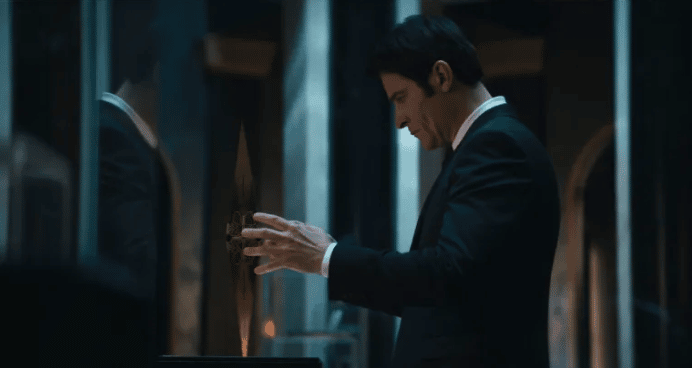
But back to the present: occultist Voigt understands a significant amount about the Cenobites and what they can offer; he has refigured his expansive home along these lines, with the aim of controlling and subduing them to his will. Bold. God grant us the singlemindedness of a rich, white man; one tried to solve war in Europe with a Twitter poll this week. Whilst comparisons to the Thirteen Ghosts (2011) remake come thick and fast here, there’s no denying that the aesthetics of this place are strikingly effective: the shifting panes of glass, the cages rattling down on polished marble, the overall use of space and lineation. This recurs elsewhere in the film though, so it isn’t simply down to Voigt’s money and (limited) abilities to control his fate. Straight lines and forced perspectives pop up throughout; even the kids’ playground where poor dupe Riley passes out early in the film turns into an intermeshed array of lines and angles. This might suggest that hidden agencies of order are at play in a disparate and alienated modern world or, you know, it might just look really, really good on camera, but the background design work in the film is a treat: it recalls aspects of Hellraiser (1987) but expands them, filling the screen, dragging angles and lines into impossible points in the distance and disrupting everything with geometric shapes filled with absolute black, with absolutely no light within. Beautiful.
Of course, this geometric obsession transfers onto the flesh, too – both of the Cenobites, and of those unfortunate enough to encounter them.
The Good (-ish) – 21st Century Cenobites
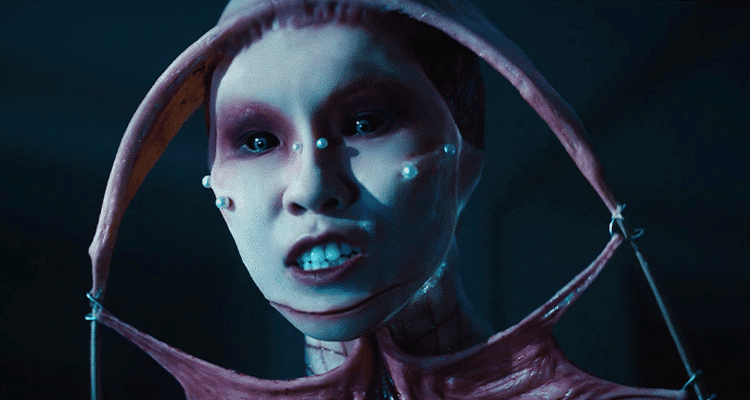
Speaking purely in terms of appearances here, this new array of Cenobites are good – or in parts, at least, they’re good. We have finally reached a point now, after riding out more than a few wilderness years – where CGI seemed to actively hinder illusion rather than permit it – where computer graphics genuinely augment certain scenes, blending more or less flawlessly with practical FX. These new Cenobites are rather dapper, by extension. Their pins and scars glitter with pearl and precious stones. Their heavy drapery has been replaced by quite scanty garments; you could go for a light walk in these (which they do, kinda). All in all, these Cenobites probably shop on Etsy.
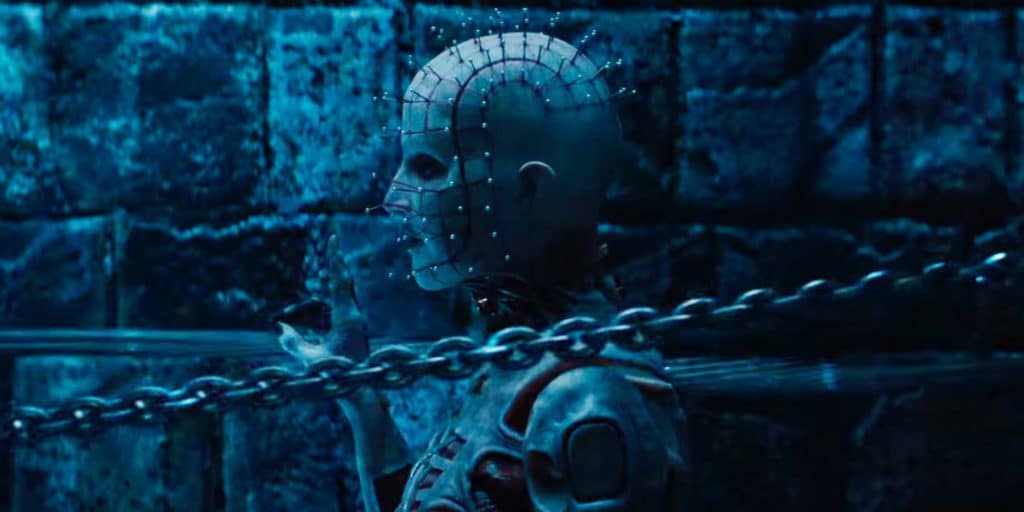
As for Clayton as Pinhead, she is a real highlight of the film (any concerns that, being a woman, she was going to speak her lines with an overtly feminine pitch turn out to be ill-founded: she does not). Hers is the only Cenobite role which has some soul, however. Perhaps this is to be expected, as Pinhead has always been regarded as the de facto spokesperson for the Order, and Clayton gets to deliver some of the film’s most memorable, even poignant lines by the end. She looks marvellous, too: director David Bruckner has understood the old lesson that less is more, not allowing us more than a peek until the film is around an hour in, so she comes as a real surprise – familiar enough, but new enough to pique interest. It’s also nice that the original Pinhead, Doug Bradley – who has on occasion said that he feels strangely protective of the character – sent Clayton his wholehearted support.
So far, so good. But in amongst all of these aesthetically-pleasing decisions and carefully-controlled reveals, sadly the rest of the Cenobite gang are rather forgettable. Yes, they’re dressed to the nines, but there is little sense of them as characters, or even as formidable entities at all. They just pop up on the periphery, walk around slowly and get quickly, threat-disparagingly outpaced; there are more of them than there are in the 1987 film, which is fine, but as such, they desperately need to feel more momentous when they are there. Another issue, for me, is that they seem to all act quite autonomously; there’s little sense that the Cenobites are an Order, working together. In the 1987 film, one key strength was in how it felt like The Gang’s All Here when all four of the Cenobites were in shot. But even separately, they felt more to me like they were operating as part of a cohesive group – which was somehow more frightening. They had both vivid personal characteristics, and shared goals. That is significantly eroded in the 2022 retelling. Their flayed flesh is oddly bloodless, too (albeit said from the perspective of someone who has absolutely no idea how bloody flayed flesh actually is). The first Cenobites looked mortifyingly injured, dank and dark; the new Cenobites have clean, clear bones and neat wounds all visible. They have been cleaned up. Who’s cleaned them up? Surely a formidable bunch in their own right.
The Good: New Configurations
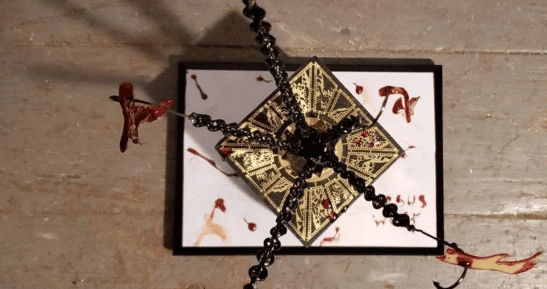
One of the most successful changes in the film comes in the form of the new, remodelled puzzle box, a new spin on that key to a new dimension with its own horrific codes and rules. It was always a fearsome proposition, honestly – a true testament to Clive Barker’s skills as an imaginative writer, and also to what he achieved on a limited budget with essentially no filmmaking experience in 1987. The Lament Configuration box took on a life of its own in films thereafter, but it retained one essential quality: namely, that by solving the puzzle, the Cenobites would be summoned. That was it. Beauty is truth, truth beauty; that is all ye know on Earth, and all ye need to know. The box itself didn’t have too many different modes though. By finding the right combination of pressure points on its surface, it could be made to shift into a couple of different shapes, opening a door in the process. Similarly, by doing the same thing again, it could send the Cenobites back. Horribly simple.
Skip to 2022, and the lore of the Lament Configuration has been overhauled: this adds a genuinely interesting and creative layer to this storyline. The box, by the by, looks fantastic: there’s a real sense of its having carved elements, more possible modes to contend with and more potential for direct threat (now that it operates as a malign presence in its own right, rather than an inert puzzle box which really needs human interaction in order to do anything at all). It switches through an array of different shapes now, and more than that, its configurations each have their own associated mythology. The configurations are intricately linked to the fates of those who get to grips with them, who unlock them.
Voigt knew this much, and had focused his research on them, running through the usual horror trope of recording his findings in sinister monochrome in a sequence of bound notebooks (no one ever writes this shit down on dayglo Post-Its). This information is eventually gleaned by the film’s key protagonist, Riley (Odessa A’Zion) when she tracks down Voigt and his legacy, though hers is a hard-won series of lessons, fractured and confusing at first. The practical lessons are more memorable, but cost her far more: nonetheless, she finally avails herself of configuration lore, understanding enough to play the Cenobites at their own game, come the end: she can’t simply solve the box again, however. Her bargain with them strikes a balance between learning and self-sacrifice. It is only via this that we even hear the phrase ‘lament configuration’; it’s only one of the potential outcomes. This is a rich and clever idea which builds purposefully on the pre-existing mythos, doing something meaningful with it. The puzzle box is a character in its own right now.
The Bad: chance, rather than choice?
That all being said, it’s as an offshoot of the whole new configuration idea that the film, for me, stumbles badly. That the puzzle box has new potential tricks, sequences and powers is fine; this allows for some truly expansive elements, with some engaging scenes. However, the fact that it operates as if it has aspects of sentience – that creates some issues.
The overarching idea behind encountering the Cenobites has always placed the character flaw with the human who is stupid, or bold enough (depending on your outlook) to mess about with the puzzle box. Some of those did so because they were jaded decadents seeking the next sensory adventure; Frank Cotton may not have known exactly what he was letting himself in for, but he knew something, and he tried to solve the box anyway. Kirsty, Tiffany – their cases were more tragic, but the uniting factor was that they did try to solve the box, and this was enough, at least at first. Kirsty only initially avoids being torn to pieces because she has can bargain with a strange and glaring omission on the Cenobites’ part – the fact that Frank escaped them. Others are not so lucky. A whole wardful of unwitting guinea pigs are given boxes to solve in Hellbound; by definition, these people haven’t given their consent because there’s no way they usefully could. But we only ever get hints that the box is somehow in on all of this. Like your standard Devil’s bargain, it requires people to make the first move.
Not so the new puzzle box, which has some qualities in common with the device in Cronos (1993), right down to the eccentric millionaire who eventually tells its story. It’s far more overtly involved in Cenobitic machinations here. Essentially, the new puzzle box can send out a blade and ‘mark’ someone by drawing their blood; somewhat like a zombie bite, something akin to a pyramid scheme, the only way to escape the subsequent appointment with the Cenobites is to procure a number of other victims at their behest. Quantity over quality? Maybe, but the whole idea of the box catching people by injuring them feels so different to the old mythos that it simply doesn’t work that well. It all feels a bit It Follows, only it’s the Cenobites who are following, even though they’ve never really needed to drum up numbers, because the whole point is that people are fallible enough to offer themselves up to them.
That whole initial set-up (which worked a charm, by the by) where pretty boy Trevor (Drew Starkey) tricks Riley into nabbing the still-mysterious unclaimed artefact: wouldn’t that have worked just as well, on many levels, by luring her in on its own terms as a mystery object, especially given her own relative poverty, and addiction issues which could at the very least have clouded her objectivity? The whole addiction motif is otherwise an odd thing to centre, as its only other purpose seems to give us a reason to believe Riley’s brother wants to look out for her (which of course he could have done anyway) and to drum up one scene where she has a minor relapse, although we all know that the Cenobites don’t particularly require people to be in altered states beforehand; it’s kind of their job to alter states. Sure, there has been an element of Lament Configuration as bait in the past, but never quite like this; a number of the main protagonists in the 2022 story get picked off largely as a result of a moment’s bad luck. Mercenary, sure, but less well-rounded, the richly-layered world of the Configurations could have come to fruition in this film by means other than pure chance.
Another unwelcome aspect of the new film which also relates to how the horror has always been centred on human error: the Cenobites are liars now. They never lied in the original film. They never lied in the sequel. There were rules. Even in Hellraiser III: Hell on Earth (1992), a film which has long divided fans of the franchise, Pinhead’s deal with poor, desperate Terri is on own terms, legitimate: she gets what he promised. She can dream. What he requires in exchange is service; job done. Move forward thirty years, and the Cenobites are far less averse to telling fibs to get what they want, which seems to be – victims. More victims. The selection process has been dramatically opened up, and the recruitment process has been relaxed accordingly.
Perhaps this goes hand in hand with this new world order, where they ensnare the unwitting through the sudden spasmodic movements of the puzzle box. But it feels off; it may be more in keeping with a more Biblical take on demons and bargains, you could say, though this is a big shift away from the more recognisable mythos which many of us love. It also leads to rather a lot of muddying where the plot is concerned: the Cenobites’ motivations are less acute, the level of threat which they can drum up is less consistent, and it takes a lot of rather jagged plot reveals in the final act to come to a meaningful conclusion (which it does, however, muster).
Conclusions
At least some of these issues, I’d argue, come from ambitious, but at times inconsistent changes to the story’s fundamentals. Funnily enough, whilst they have cleaned up the overall look of this film – clean, delicate, often light – they’ve balanced it out with a few markedly opaque, even murky plot sequences. Perhaps the Hellraiser series still has a quota of murk to fulfil. On balance, I’d rather it was aesthetic, but on the whole, I did quite enjoy Hellraiser (2022). Sure, it’s not perfect, but it has a decent array of imaginative developments and ambition, and the fact that it exists before us is in itself a blessing, given its long lifespan as little more than a rumour. Will it recruit a new generation of fans, given its Disney+ streaming release? Perhaps, perhaps not, but let us hope at least that it will come as an almighty shock to a few people clicking ‘play’ on this unknown quantity. For the rest of us, it’s a largely welcome addition to a beloved mythos which, because of our fondness for it, makes us very discretionary. It’s a brave team that even takes this on but – overall, I’m glad they did.
There’s no time wasted in Two Witches: it lays out its approach straight away, making it clear that this is going to be a quick-paced, overblown brand of occult horror, in places almost more of a montage of witchy scenes quite nominally linked together, rather than a film with much of a complex overarching story or structure (though presumably the ‘Two Witches’ of the title refers to the two separate chapters which make up the film). That’s all well and good; there’s room in the world for these kinds of immoderate horrors. If you crave slow-burn and atmosphere, then you may – on balance – be disappointed. If you’re good with a big melting pot of scenes and influences from Sam Raimi, Dario Argento, Rob Zombie and even a dollop of Anna Biller (yeah, you heard), then you’ll be more than happy. After all, a lot of the best films by those directors are more blood and gore than War and Peace.
So we’re soon acquainted with Sarah (Belle Adams) and her boyfriend Simon (Ian Michaels), who are out at a restaurant for the evening. Sarah can’t help but notice a distinctly unfriendly woman sitting at a nearby table, who stares at her continually: Simon puts her feelings of distress down to her pregnancy, a pregnancy he’d completely forgotten about a few moments earlier when asking Sarah what wine she wanted with her meal, but which serves as a great catch-all excuse for anything outlandish she goes on to say or feel. It’s an excuse he’s soon turning to, again and again: after the restaurant experience, Sarah’s convinced that the strange woman has given her the ‘evil eye’ somehow, and claims that she is being stalked by her. Could her pregnancy be a factor, though? The audience is already clear that this scary woman has designs on newborns – we’ve seen it. In fact, we saw it before the opening credits ran. Perhaps Sarah is being targeted by someone, or something, after her baby.
Luckily – or sort of luckily – Sarah and Simon go to visit some friends of theirs, and find Dustin (Tim Fox) and his partner Melissa (Dina Silva, who looks rather uncomfortable in the gothy makeup she wears for the role) far more amenable to the idea that something paranormal could be going on. That being said, their attempts to help her seem to exacerbate the phenomena, as always happens: seances, even unsuccessful seances, just wind spirits up. It moves things along even more quickly, though: soon it’s all going down, with the power going on and off, eyes rolling, spasmodic physical movements, aural hallucinations, jerking jump scares – you name it, and it’s in there. This ordeal is only one part of the film, however, as events shift elsewhere, picking up with a different story arc and ideas of witchcraft as hereditary.
The film’s speed-dating approach doesn’t leave a lot of time to get into characters, particularly in the second chapter (yes, chapters still prevail) and plot is always rather thin, but all in all, the film seems to do what it sets out to do. Its love of the malign feminine has shades of Suspiria, Lords of Salem and Drag Me To Hell throughout. Speaking of the gender divide: yes, it’s blown up to fairly large proportions here with no need for more subtle inference, but in that, it matches up to the rest of the film and fits perfectly well. Any points about female sexuality and the occult are more aesthetic than anything else; that’s okay. There’s plenty to enjoy, even if you start to miss neutral facial expressions by the end of the film. It also enjoinders the audience to expect another film at some point, which could be interesting, though would probably necessitate some of the answers we can fairly happily do without for now.
Director and co-writer, Pierre Tsigaridis, is something of an unknown quantity; with only one short film under his belt as director prior to this, his has been a pretty sharp career arc; he clearly loves horror, though, and this is a promising first feature which shows off that affection. It’s also a big plus point that another of the writers here, Kristina Klebe, not only acts in Two Witches but has a long and detailed horror filmography in her own right. There’s a lot of fun to be had here, and a second instalment would definitely be appealing.
Two Witches (2021) is available now on Arrow Player in the US, Canada, UK and Ireland.
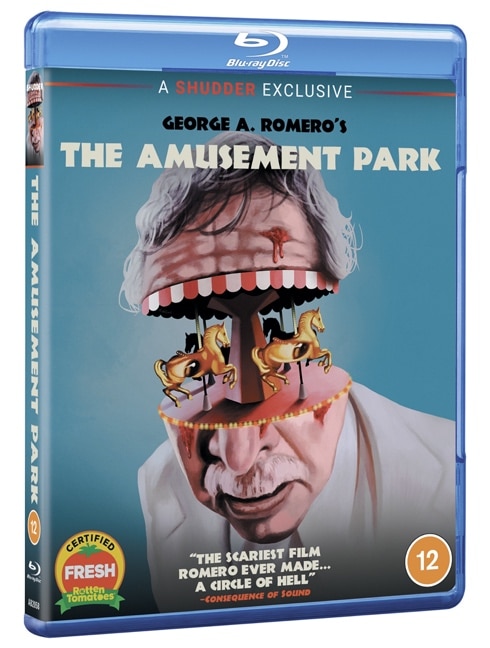
We all know the late George A. Romero as the pioneer of the zombie in horror cinema – a cinematic monster which has sustained appropriate levels of longevity in modern culture. But there was far more to his career than that and he found far more ways to critique the society he lived in than just through zombie horror. One of his lesser-known titles is The Amusement Park (1975), a suitably sad and surreal exploration of ageing.
In the film, an elderly man (Lincoln Maazel – Martin) goes for what he assumes will be an ordinary day at the amusement park, only to find himself in the middle of a hellish nightmare. Amid the rollercoasters and chaotic crowds, he becomes increasingly disoriented and isolated; as the pain, tragedies and humiliations of ageing in America are played out before him…
Of all Romero’s films, The Amusement Park is one of the least well-known, by even his most ardent fans. However, via the Shudder Exclusive roster and Acorn Media International, it’s now up for release on 17th October 2022. If you missed its short stint on cinema release in 2019, or even if you made it, you can now purchase this special Blu-ray with a wealth of extra features including: a Michael Gornick audio commentary, a special feature – ‘Re-opening the Park’ – with Suzanne Desrocher-Romero, panel interviews, a special brochure and the film’s script. Better still, Warped Perspective has a Blu-ray to give away.
UK readers: if you would like to be in with a chance of winning, please email the site (keri[at]warped-perspective.com) with The Amusement Park as your email title. Include your name and postal address. The competition will be drawn on Friday 14th October at 18:00 GMT. (All personal information will be stored securely until the competition is over and then deleted.)
Investigations of haunted houses or places have been a horror staple since the inception of cinema. And, whilst in many cases (with some notable exceptions) the allegedly haunted house/place itself has remained unchanged, the means of investigation themselves have changed and developed as the years have passed. You could even argue that technological developments have revolutionised our ways of seeing altogether. In The Blair Witch Project (1999), a herald of this new kind of experience, ghostly phenomena are refracted through Heather’s video camera, which she is using for the purposes of making a student film; the camera offers some welcome distance, somehow, from the unreal horrors which she witnesses. We see what she sees, as she sees it: we are reliant on her as the intermediary, and we are limited by her experiences. It was a sign of things to come.
Well, step forward Deadstream (2022), which shows us, first and foremost, that things have come a long way since The Blair Witch Project. Deadstream recognises this line of progression, as its protagonist – livestreaming sensation Shawn Ruddy – is shown trying to hawk some merch which references Blair Witch’s own publicity slogan. But now, with smartphones, streaming platforms, editing software, multiple cameras, infrared settings, custom music and of course a live feed, the relationship between filmmaker and audience has been thoroughly revolutionised. This immediacy is very energising, bringing the film bang up to date as well as offering us a lively, multi-layered take on a classic horror movie trope.
Shawn (played by director and co-writer Joseph Winter) is an internet personality who’s been on an involuntary six-month hiatus after an unspecified fall from grace. It must have been bad: he lost all of his monetisation in the process, and so is determined to reclaim it with a comeback special. This entails a special livestream on his platform of choice, LivVid.TV, as he visits a haunted house, location as-yet secret. This place, not-at-all ominously known as Death Manor, comes with a suitably excessive back story: here, at the end of the 19th Century, a woman called Mildred took her own life in mysterious circumstances. Perfect! Shawn heads into the house to explore and monitor any paranormal activity. He vows to investigate any mysterious goings-on he hears, sees, or picks up on his pretty extensive array of kit: this is part of his shtick, something best described as competitive stupidity – which aims to keep his attention-span deprived followers on his stream for as long as possible. It’s his followers who, in-between keeping up an insulting stream of comments or declaring themselves bored, double-dare him to ‘provoke the spirits’.
Of course this all goes to hell in a film which is by turns creepy, grisly and Raimi-nasty, but it’s in how it gets there that Deadstream really shines. It gets the right things right: good location, effective twists, humour which is knowing but not eye-rolling, and a central performance which could conceivably all be part of an act, so used to performing for the camera does Shawn appear to be. Winter really captures something here; even if you don’t personally engage with livestreamers and Influencers yourself, you’re likely by now to have some idea what makes them successful, and high on that list is a kind of jovial artifice, amplified even beyond the artifice we’ve seen on TV for decades because self-made media personalities have to crow that little bit louder to get noticed. Shawn Ruddy is a very plausible figure for our cynical times, ‘working on himself’ but motivated by hard cash, apologising multiple times for his misdeeds but only believably so on a handful of those occasions. It’s very difficult to see a real person underneath that rock-solid veneer – until circumstances prevail, of course. This is like something Goffman could have come up with on the presentation of self, had he lived long enough to see what a good smartphone could do. For all that, Shawn isn’t wholly unlikeable, though. Even at his worst, he probably doesn’t deserve what he gets – he’s an idiot, but an idiot partly formed out of his ongoing interactions with millions of other idiots.
This dialogue with his followers is a genuinely interesting feature of the film, one which places it in the here-and-now and which will one day be as interesting a time capsule as Blair Witch is now, because surely we can’t be far away from a horror film made entirely in the Metaverse. Shawn’s ability to reflect on his film as it’s being made, and on the impact it might be having, is a very new phenomenon in its own right: he keeps in mind that he is crafting a piece of media, and he makes the most of the means at his disposal to make it as good a film as it can be; his preoccupation with different angles, cameras and of course custom soundtracks shows that. The ways in which he fights to keep control of his film reminds us that he is aware, at all times, that his relationship with his followers is an ongoing negotiation, and his struggle is as much to retain creative control as it is the rather more pressing need to stay alive. It’s also worth saying that Deadstream is able to dispense with some of the so-quickly hackneyed issues of the ‘found footage’ subgenre, the main one being ‘who edited this, and when?’ Here, we know. We are also done with grainy, unclear footage: this film is surprisingly bright, colourful and sharp throughout. Oh, to be a ghost hunter in the 2020s…
Whilst some of the in-script revelations towards the end of the film spell things out more than really necessary, on the whole, Deadstream is an engaging, richly-textured and often self-deprecating film which provides a sense of progression in horror, as well as paying tribute to films which have brought us to this point. It’s a lot of fun, and Shudder have done well to nab it.
Deadstream (2022) will be released on Shudder on 6th October, 2022.
With a title like Pig Killer, you know you’d be mad to expect a philosophical work, some light moral lessons or charming whimsy. That much is perfectly clear. What you may be less prepared for, though, is just how deliberately low the film aims. Wherever the ‘acceptable level’ is, it elects to nosedive past that, landing in a morass of body parts and blaring incidental music some distance further down.
Now, depending on your outlook, you may feel that this is a stirring recommendation; if so, have at it. Lots of people love their horror splattery and a certain kind of provocative; director and writer Chad Ferrin has you covered. For others, living through a period in time where dramatic explorations of the serial killer phenomenon have grown increasingly sensitive, well-written and (mostly) respectful, Pig Killer may well feel like a bizarre throwback. It is, after all, based loosely on the real story of Canadian serial killer, Willy Pickton: this marks it out as something other than a straight-up fantasy about a bad man who kills women. When the inspiration is perfectly real, when victims’ families may well be still alive, it will make it far more difficult to nod this stuff through – for many viewers, at least.
We start as we mean to go on, with a long sequence running through the opening credits of pigs tucking into human body parts, as an as-yet faceless man oversees. This is pig farmer Willy (Jake Busey) who later unwinds from all of this with a visit to a local bar. It seems he’s planning a big party, or a ‘piggy pow-wow’ and has printed out flyers for the occasion; it’s a last hurrah before he completes the sale on his land, it seems. After that, it’s off to the red light district to pick up an Asian stereotype and to murder her – then to have sex with her, with one of the film’s prosthetic penises appearing on camera for the occasion. (Or perhaps it’s the same prosthetic penis, passed around between several actors.) Anyway, as he does this, he stops seeing his victim and starts to see his mother in her place (played by Ginger Lynn). This use of flashback recurs regularly, filling in the back story of an unhappy childhood and its key events. It’s also a stock way of reaffirming Willy’s disturbed mental state; the notion, though, is a tried-and-tested one: abnormal experiences of sexuality have made him the man he is today.
It’s also made clear to us, via dialogue and cut scenes, that one of the other punters at the bar, a troubled young woman called Wendy (Kate Patel) and our pig farmer are going to cross paths. We know she’s already asked after the farmer; a friend fills her in on his dark reputation. We also know about the rumours that ‘women go free’ to these parties, and don’t all come out again. A lot hinges on the planned pow-wow then, which will go ahead come what may – despite the fact that talk of selling the farm kicks up a lot of dirt between Willy and his slightly more functional brother David (Lew Temple), who are reminded of their unhappy memories of the place.
It starts gratuitously, and so it can never be said that the film lulls its audience into a false sense of security, or indicates that it will be one thing and not another. It seems to be channelling a lot of those slightly mysterious VHS films you could stumble upon, back in the day, and only wonder at how in the hell anyone had managed to make something so apparently organically disturbing; there was a genuine sense of curiosity then, back when films could surface and disappear and there was no IMDb to lend context to what you had just watched. Things are different now, and even homage has to work carefully. To take this approach today suggests intent: it suggests that all of the film’s key elements – script, performances, scene selections, plot – have been chosen here in full knowledge of a few things, not least that the relationship between the real case and this film may raise eyebrows.
‘Cartoonish’ is a bold stylistic decision to go for then, given all of this, but this is a nonetheless a bizarrely cartoonish film, but one which feels neither genuinely challenging nor compelling, certainly not across two hours – which is far, far too long to sustain interest. The blaring background and incidental music drown out the dialogue a lot of the time, which doesn’t help. There are issues here, then. That’s not to say that Busey doesn’t give it his all, or that he isn’t supported well by the rest of the cast, who no doubt do exactly what they were directed to do. This isn’t a bad looking film, either, with a range of shots and some ingenious uses of practical SFX on a clear budget. It’s just that, overall, these kinds of two-dimensional rape and murder-fests feel dated; if ‘dated’ is the aim, then fine, but they still need more than this because even shock value is a far trickier customer today.
Pig Killer (2022) premiered at the Sydney Underground Festival and will continue its festival run through October.