Cyclic Law, based in France, occupies an important space as a purveyor of dark ambient and experimental music. And this label’s releases are genuinely experimental, too, rather than simply sounding eclectic in ways which themselves soon become pretty predictable. There’s often a sense of mystery to what CL releases, if that’s not overstating it. And so we come to øjeRum – actually the solo work of artist Paw Grabowski, who lives in Copenhagen. As so often with Cyclic Law releases, there’s an interesting story behind Reversed Cathedral, his newest album.
The album is based completely around a Mannborg Harmonium, an instrument which became very popular around the turn of the twentieth century, and was manufactured for many years at Leipzig. John Lennon played one on We Can Work It Out in 1965; this instrument was very popular throughout the century, made light work of its American counterparts in terms of competition, and became widely-known for its surprisingly resonant depth of sound. But tastes change; as such, many of these old Mannborgs became old fashioned, left to time.
This happened to the instrument eventually used by Grabowski, as it was closed up in a largely unused room in a house out in the Danish countryside. Denmark being a country of rainy autumns and bitterly cold winters, this benign abandonment had a subtle, but noticeable effect on the harmonium; it began to deteriorate, rattled by the damp and plunging temperatures. What better a condition, at the outset, for an album themed around it and it alone?
Yes, the harmonium itself is the only sound source used on Reversed Cathedral; all things considered, this is a very fitting title for the resulting music, which, if we accept that cathedral music is meant to be uplifting as much as it’s also often solemn, things here are rather more introspective and downcast. Each song is really a kind of chapter, with titles which call to mind a series of ghost stories, because the music has an ethereal, ghostly, liminal atmosphere throughout. Each track works together as part of this whole and fits together perfectly; it is all introspective, subtle and evocative, and as such it is an ideal immersive experience which happily hovers on the periphery of your senses, rather than demanding an intent listen. It simply isn’t that sort of music. It immerses you in something else entirely.
Fans of the left-field, not to mention audiophiles – I know some of you still pop by – you should check out this project, if you have any love in your hearts for this kind of layered, contemplative, genuinely experimental music. It would make a great soundtrack to other ventures, too – to paint, draw or write to.
Reversed Cathedral is available now and you can check it out on Bandcamp, a site which gives a fair deal to bands and labels.
Somewhere, in a very dour-looking Yorkshire, a group of young people are being taken on a bus trip to a place called ‘Wonderland’ (which, again, looks pretty dour – but that’s not beyond the realms of the imagination in Britain). They seem happy enough; however, there’s something not quite right about this whole set-up. They’re all wearing identical jumpsuits, QR-coded, and their mood darkens considerably once they actually get inside. What is this? A prison? Some sort of ‘reward’ which turns out to be something completely unexpected? Well, almost…but not quite. This excursion is also unusual for the fact that one of the people on this trip seems to be a lot older than the others, and yet she’s referred to as ‘Kiddo’. Has she been coming on trips like these since she was a teenager herself? What’s her story?
Answers to these sorts of questions are not clearly forthcoming in Kiddo (2022). This is not a failing of the film, however, but rather a testament to the ways in which writers Brett Chapman and Scott Milligan have left interesting spaces within a highly symbolic and surprisingly complex mini-universe.
Kiddo (Lisa Howard) seems to know the bus driver; in fact, it looks as though he’s not a driver as such, but a Jack-of-all-trades whose main job is as a farmer – okay, as some kind of agriculturalist, but he certainly looks the part, and as we see a celebratory dinner welcoming his young son Jasper (Paddy Stafford) as a full partner in the family business, it seems all the more like a long-standing relationship with the environment as a resource. Now, whether or not you guess the twist in this set-up is by the by; there are so many deft touches here which demand attention. Why does this family of farmers have such an overweening, but dismissive attitude to Kiddo? Why is she kept around in the way she is? What is so special about her?
There’s a slightly dystopian vibe here, or more accurately a speculative fiction vibe perhaps, but the way in which Kiddo works is that everything seems so normal – with one or two thought-provoking exceptions, so the contrasts work very well, one thing against the other. Kiddo herself is both humanised and dehumanised during the course of the narrative, and as dialogue is relatively minimal, we mainly glean her thoughts and feelings through her facial expressions. Dawning realisation is a key feature of the film, and it comes together against an aesthetically appealing, if perplexing, curious backdrop: the baby pink jumpsuits against the stark landscape, the homely farmhouse dotted with visual clues of a shared, and a sinister history.
It’s difficult to discuss the film’s overarching impact and success without discussing it in terms which give the game away, so let’s just say this: if Kiddo aims to question how we engage with our environment, and the hypocrisy in how we behave towards those in our care, then it does so incredibly successfully. It’s only really when the credits roll that you can really piece things together, and appreciate that this is a surprisingly rich, emotive narrative for its fifteen-minute run time. There’s plenty to think about after the credits, too. Kiddo is a worthwhile short film which makes light work of a particularly punishing perspective.
Kiddo will be available to watch on Alter from 29th December 2022. For more information on Alter, please click here.
It must be tough to be a priest in the modern age, preaching changeless values against a backdrop of falling church attendance and endemic levels of scepticism – but such is the lot of Father David (Joe Begos frequent flyer, Graham Skipper). He delivers worthy sermons to all-but empty pews, and knows that even a spiritual institution needs cash to prevail – which his church does not have – but he retains hope and works hard, doing his best to reach out to new people, and embracing his faith-based obligations towards the less well-off. You have to question the old edict that ‘you do unto others as you would have them do unto you, particularly because it could be an angel – or even Jesus himself‘, as this sounds suspiciously like a Secret Shopper scenario, but David preaches it: he even intends – he tries – to live by it.
As such, as he’s about to lock up the building one day, he finds a down-and-out trying to sleep there; he asks the man to leave (and really, it would have headed off a lot of stuff if he’d let him stay put), and the man, Terry (Jeremy Gardner) agrees to go, but – when David emerges from the church and overhears him on the phone, waiting for a ride which never seem to be coming, he offers to drive him to his destination. He asks to be taken to his girlfriend’s house, which gets ten minutes further away every time Terry describes where it is, but David drives him nonetheless. But there’s more. His girlfriend isn’t home, the streets are thick with snow, and Terry’s protestations that he’ll go and ‘sleep under a bridge somewhere’ just don’t sit well with David, who offers him a room for the night.
You know the drill. One night inevitably turns into several nights; soon, girlfriend Lexi (Taylor Zaudtke) arrives too, newly-homeless after being kicked out of her house; that this woman seems oddly familiar to David doesn’t ring alarm bells loud enough for him to ask these strangers to leave. Part of this is down to the rather obtuse hope that these two could constitute part of the new congregation he’s been after; after all, he rescued Rigo (Rigo Garay) from poverty and homelessness, and now he’s a kind of unofficial church curate. But if this is all part of some test by God, David can’t help but think he’s moving in ways even more mysterious than usual; the presence of these people is triggering more, far more, than just a mild schism between David’s charitable duties and his more worldly concerns.
In some respects, Terry and Lexi call to mind the man and woman who rock up at the door in Darren Aronofsky’s Mother! (2017) – there to generate rising levels of vaguely theological chaos, with some rather more, shall we say, earthy punctuation points. Also akin to that earlier film, there are some minor elements of brash comedy here, which mostly land well. Terry’s foibles seem very familiar, incorporating ‘bad guest’ tropes we’ll recognise – smoking indoors, blasting heavy metal (it’s never jazz, is it?) – but thanks to Gardner’s strong track record as a kind of ‘people’s deadbeat’, it’s funnier than it is overfamiliar, and he gets some good lines – which he delivers in his by-now well established deadpan style.
But things move beyond this kind of testing farce, and get consistently more intriguing. The plot doesn’t simply step up to a wholly spiritual level – were it to do so, it would be pretty easy to guess at an incoming twist – but it does weave aspects of carnal and spiritual together – including with regards gender roles, in some unsettling ways. As the film hinges almost entirely on its characterisation and dialogue, we are encouraged to focus on the very human impacts of this series of unfortunate events, and Skipper is more than equal to it; he’s a sympathetic character when it counts, and a bewildering, complex character with unexplained subtext in turn. It’s being presented as a Christmas horror, and it – sort of – is, but mainly for the fact that Christmas drives things to a certain end point, and hovers in the background as context, something there to push people to even more faith, hope and charity, if they are so inclined. It also adds some visual elements into the mix. The Leech is a surprisingly complex, deeply mean-spirited and often surreal character study, albeit with a few moments of black comedy to lighten the overall mood.
The Arrow release of The Leech (2022) is available now on all major VOD platforms.
A run of cable TV-style advertisements opens Christmas Bloody Christmas (2022), and amongst them is an ad for something called a RoboSanta+, a kind of seasonal cross between a decorative item – and a top-level piece of mall security. And why not?! It’s no detriment to the film that it’s completely clear this bit of kit is going to feature heavily in what happens from here; in fact, the way that the film continually wears its heart on its sleeve and so readily flags up its intentions is a big part of what makes this film work so well. It’s a delight.
We don’t stay in this retro setting for long: we skip forward to the present day, our world of Tinder and Reddit and social media (mentioned in the script for clarity) and meet record store owner Tori (Riley Dandy), who is about to close up on Christmas Eve, though agrees to have a few drinks with her clearly hot-for-boss employee Robbie (Sam Delich) on the way home. They head off, stopping by the nearby toy store to see their friends and clocking the store’s very own RoboSanta while they’re there; it’s a now-obsolete system, and all remaining models are about to get recalled (a kind of twist on the ‘detective’s last day’ trope perhaps, only flipped, so it’s the antagonist who’s about to have an eventful evening). As anticipated, RoboSanta is soon up and about, and he sees everyone as a potential threat; he starts with the toy store, but he has picked up on Tori and Robbie’s recent presence there and tracks them back to Tori’s, where they now are.
And so we’re off, in a film which has some similarities to Hardware (1990) in terms of its uncomplicated story, killer robot home invasion aspects and aesthetic detail – but the newer film is far more grisly and heady, incorporating more horror genres: we get slasher, a dash of splatter, and a little sci-fi of course, which moves more and more into the foreground as the film progresses. All of this is framed by an incredibly lurid, colour-saturated presentation – Begos has refined this approach more and more with each film he’s done – and so it looks great, glaring with festive red and green, but also rich with shifting palettes and an effective use of light. It looks 80s retro in places throughout, despite the contemporary timeframe, but it’s effective here, as the film itself is an homage to any number of horror films from that era (and just before, and just after).
Speaking of which, the Venn diagram of rock, horror and hard liquor – which surely we can all agree exists – is played for fun in the first half of the film, with horror and music fandom exerting an influence over many of Christmas Bloody Christmas‘s key elements – characterisation, settings, props, and dialogue. The script itself also works well: these are plausible, likeable, funny people, and relationships hang together just as they should, throwing in some overblown dialogue in places, but lines which are perfectly in keeping with the vibe of the film. In very little time, the film establishes its key characters as well-rounded enough and likeable enough to make us care about the outcomes. That all being said, the film feels primed from its first seconds for ultraviolence, and when it comes, it’s welcome.
The film’s occasional use of a ‘Santa’s eye view’ gave this reviewer some small concern that this was going to turn into a means of avoiding the kinds of unflinching, gory scenes which the film had so clearly set up. And, in RoboSanta’s first few moments as a killing machine, this did seem to be the case – the camera swings, veers and ultimately blurs what’s going on, at first. Happily, things don’t stay this way; they really don’t stay this way; there are lots of fan-pleasing set pieces throughout, which get more and more OTT as the film moves, with very few lulls, towards its close. It seems churlish to complain that RoboSanta (Abraham Benrubi) isn’t a massively convincing robot, as you’ll likely soon be ready to just go with it. Suspending your disbelief here is both a genre fan’s dream and the best course of action. The film also sets up later scenes of panic and disaster which only a horror fan, as opposed to simply a horror director, ever could (and, by the by, that is how you do a director cameo).
The film may have started off as a different kind of Christmas horror entirely, but its progression into a bloody, entertaining, unrestrained genre mash-up makes for a really fun film. Essentially, you’d have to be very easily bored or very hard to please in order to dislike Christmas Bloody Christmas: it’s a film which may just edge onto that hallowed list of Christmas cult horrors, given some time. Final note: somehow, and I’m not sure how it really finds the time, it even manages to feel really festive…
Christmas Bloody Christmas (2022) hits Shudder on December 9th 2022.
‘How long do you think we’ve been here?’ This early line in Dawn Breaks Behind the Eyes (2021) perhaps puts us in mind of a classic haunted house story: like The Haunting of Hill House, with its dreaming walls and watchful ghosts, the film is centred on a beautiful, if tumbledown castle, and the people who find themselves there. But the film has other ideas, and refuses to stick with one mode or trope. An avowedly experimental piece of work, it weaves familiar-feeling horror elements with something more meta; essentially, it’s asking what storytelling actually is, positioning filmmaking somewhere on its axis. It begins looking like something from a 60s Gothic pulp cover, segues into avant-garde Eurohorror and winds up dabbling with 60s counterculture. It’s a period piece, but not as we may know or recognise it. And it may attempt a little too much in its modest running time, but its strong aesthetics and genuine ambition prevent it from sinking into tedium, self-congratulation or insincerity. Here’s a film which would not only withstand a second watch, but seems to demand one.
We begin with Margot and Dieter, an unhappily-married couple taking the long drive to the same castle – which Margot (Luisa Taraz) has just inherited. This boon is seen as little more than a liability by Dieter (Frederik von Lüttichau), who envisions month upon month of renovations – which will need to be done so they can sell it, take the money, move on. When they arrive, he sets to, looking over every inch of the castle. Margot is a bit more considered, taking her time as she explores. When they each encounter something otherworldly in the castle, it seems attuned to their mental states; the uptight Dieter is terrified, Margot rather more entranced.
They stay the night. The next morning, the vision of the roseate dawn makes even Dieter see the place differently, but still very much with a view to sell; not so Margot, who now wants to stay. The more time she stays at the castle, the deeper her antipathy towards her husband, whose discovery of some mysterious items in the castle cellar does nothing whatsoever to level him out. But wait: if you were enjoying this tale, too bad. The story of Margot and Dieter gives way suddenly to a different story, and what appears to be a framing narrative: this new device also places Dawn Breaks Behind the Eyes in the category of metafilm, joining a fairly popular and established subgenre, particularly in horror: here, Berberian Sound Studio (2012) and to some degree, Censor (2021) come to mind, for reasons of mood, tone and visuals, to varying degrees. We are now – we might think – at the end of a shoot, watching the filmmaker and his team deliberate on the quality of their film, and the success of its ending. We’ll be invited to follow some of the same thought processes before the framing film also comes to an end. There’s something of a lull at this point – the pace drops, so that we can get to know these people – but look carefully, and there are a few key points and ideas which underpin the film – the one we’re watching – as a whole.
It would take some doing to make a location like this look dreadful; here, Herrenhaus Vogelsang (in Lalendorf, Germany) looks very beautiful, and the film-within-a-film also has a somewhat faded look which is consistent, embellishing the visuals selected and revealed to the audience. I could watch a candle burn in this film for ten minutes and still be charmed by it. Even the cracks in this marriage look gorgeous. The shift in the narrative is accompanied by a somewhat different visual and shooting style, though the castle itself retains its strange influence over people, eventually proving to be the real linking device. There’s arguably some homage, or at least some inspiration from the likes of Jean Rollin’s rustic-Gothic set pieces here, with a couple of dashes of 70s exploitation cinema, not least in the film’s queasy, peripheral treatment of sexuality, which is always thwarted, interrupted or otherwise made to feel unsettling, like it shouldn’t really be there. Eventually, it forms part of the circular structure of the film, keeping people together, keeping people apart.
Being such an experimental piece of work, particularly around narrative structure, means that this won’t be a film for every viewer, even though this film takes some of its cues from older films which themselves are not exactly neat, linear progressions (the same films many horror fans often rate amongst their favourites). But Dawn Breaks Behind the Eyes has ideas, it looks fantastic and it’s surprisingly economical, with some ambitious decision-making.
Dawn Breaks Behind the Eyes will receive a limited theatrical release on December 2nd 2022. It will be released on home media in February 2023.
On The Edge sees filmmakers Jen and Sylvia Soska back at the helm: here, writing, directing and producing an original feature once again. You may, if you look around, see it being vaunted as a ‘psychosexual’ piece of work, a film targeted at an 18+ audience and, through its use of nudity, BDSM and kink, simplyguaranteed to agitate the censors. Hmmm. Here’s what will agitate most viewers far more: the student film quality, the shaky performances, and most of all the chippy, naive belief that all of this nudity is somehow edgy, somehow enough – if you add in a dash of dick torture, that is. On The Edge is a bizarre regression in quality, if not quantity; it’s all crass self-indulgence, flimsy moral message and nylon knickers. It’s absolutely astonishing.
As an American politician pontificates about ‘family values’ on the TV, a woman serves breakfast to her twin daughters, wink wink (the Soskas are way more interested in twins than most people are). Shame that dad (Aramis Sartorio/Tommy Pistol) arrives and possibly symbolically disrupts the meal by spilling it all over the floor – where it stays, by the by. But he’s out the door on a business trip, so it’ll be for mom (Sylvia Soska) to clean up: no mean feat in a bodycon dress. Anyway, we follow dad Peter to his hotel and see him checking in: the clerk specifies that he’ll be with them for specifically ‘thirty-six hours’. Noted, though an odd thing for anyone to say, and perhaps a clue on the calibre of the script, as much as what is to follow. For when he reaches his room, he’s greeted by a dominatrix, Mistress Satana (Jen Soska) who immediately holds forth on what a dreadful man he is, as well as getting started on the whole whips and chains stuff. Strangely, Peter seems genuinely bewildered by at least the beginnings of this ordeal; fair enough, we all sometimes pay for things we forget about.
Next: the film unleashes what I’m sure is meant to be deeply shocking footage of genital torture and the prone male body, albeit that you may have seen something very similar in, say, the godawful Neighbor (2009) – before the most graphic scenes were cut for UK audiences, anyway. In fact, if you survived the torture porn years, there’s little in this particular torture porn which will unsettle you. So, assuming shock value is out; what’s in? Not much, not much. There are long, long lulls throughout; lines of dialogue and scenes which repeat (“Let me out! Let me out!” etc) and – about an hour or so in – some theological/mythological plot additions, there to insinuate that there is far more to this than merkins, verbal abuse and various things being shoved up Peter’s jacksie. Yes, this is Peter’s dark night of the soul in more ways than one, and so across nearly two hours things cross into more surreal fare, with the whole ‘demons of conscience’ shtick taking over for the rest of the film’s duration.
And yet, just as the whole tied-to-chair thing had its day some time ago, so the whole surreal introspective nightmare has been done better elsewhere, too. But that aside, segueing from physical torment to existential drama offers zero excuse for the production values here: roughly edited, poorly lit and lacking impetus, the whole film comes overlaid with All The Musical Genres as a loud, clumsy accompanying soundtrack, easily drowning out most of the dialogue, as the audio here is atrocious – echoey, unclear and uneven. But when you can hear what’s being said, it contributes little of meaning anyway. The nagging suspicion here is that the whole idea behind the film started loosely with how subversive it would be to have a ‘strong female character’ reclaiming her sexuality by being in a position of power – something like that. Miss that memo, and what you have here is a film where you are mostly getting an ass-eye view, with little script, muddy audio, jarring music and a lacklustre plot. It’s as fragmentary as you’d expect.
An additional challenge here is this: it feels impossible to critique any Soska film without – to a greater or lesser extent – critiquing the Soskas themselves. But the particular way in which they, as people, blur into their projects is what makes this so tricky. Where they write, direct and inevitably appear (rarely deviating from ‘the badass’ or ‘the sexpot’) then creative priorities must come into question; is straightforward vanity at play here? In On The Edge, they also have a hand in the production design, the sets, the casting, some of the sound design. Where a film is flawed, this deeply flawed, these flaws keep on finding their ways back to them and how they chose to make that film. And it’s hard not to ponder the trajectory their careers have taken, as the sizeable momentum generated by American Mary (2012) largely dissipated and has instead found outlet in a number of smaller, and/or fewer original projects. Rabid (2019) was, for this reviewer, a rather hopeful sign of better to come. I’ve been watching their films for well over a decade; I’d genuinely like to like a new one.
Of course, it’s tough to get films made out there, particularly post-pandemic. Times are tough and getting a project off the ground, let alone completed, takes some determination. But it seems that the best outcomes for the Soskas are where there are other people involved to say ‘No,’ ‘What for?’ and ‘Are you insane?’ from time to time. Clearly, no one uttered those golden words on the set of On The Edge; the results are there to see. Maybe next time?
On The Edge (2022) received its world premiere at FrightFest Halloween 2022 and recently featured at Monster Fest in Melbourne.
When a couple has been together for a “stupid amount of time”, as in the case of Dan (Max Woertendyke) and Jen (Dana Berger), then breaking up is a difficult thing: years of shared history blur into bad feelings, anger obscures rational solutions and it can feel as if you’re going around in circles. In Brightwood (2022), this deeply unpleasant phenomenon is not only at the heart of the film, but it’s placed under bizarre kinds of pressure. ‘Going around in circles’ gets both a literal, and fantastical spin here.
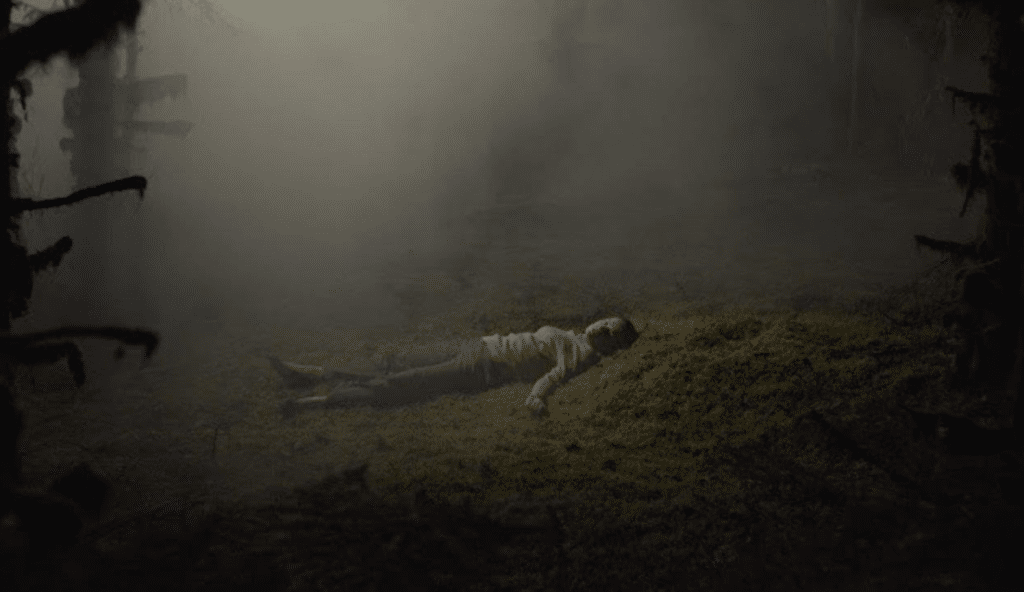
We meet this troubled couple on a morning run: well, Jen is on a run, trying to clear her head of the embarrassment her husband caused at a works event the night before, whereas Dan is attempting an apology in motion. She makes her feelings clear by running harder than he can run; she deliberately chooses a trail he doesn’t want to do, but, doggedly, he follows her anyway. When the run lulls for even a moment, squabbles break to the surface. Clearly Jen is beginning to envision a future without this man in her life, and takes the opportunity afforded by this remote, people-free space out in the woods to make this extra clear to him. But quickly, Brightwood flips this moment’s opportunity into a distinct problem: this same remote, people-free space out in the woods soon begins to seem oddly unfamiliar, despite the fact that Jen knows this trail well. In fact, where is the trail? They can’t find their way back; they keep running into the same minor landmarks, even when they change their direction. And it gets worse: they each begin to hear strange sounds, and soon they each see a mysterious figure, blocking their way even as they try the same path they can see, again and again.
You can probably easily glean from all that there’s a metaphor at play here: the link between the same, inescapable route bringing two people back to the same point, over and over, isn’t a tough code to crack considering we already know how Jen – in particular – feels. But there are good elements here, particularly in how the film gets going: it wastes no time giving us a sense of this fraught relationship, and it achieves it simply, not opting for reams of opening dialogue and exposition to establish this. Jen’s podcast of choice – a show all about life after divorce – is more than equal to it, even though the audience only hears a few seconds. Similarly, the whole ‘going for a run’ idea is plausible enough, and offers a good reason for these two to head away from the trappings of their everyday lives – probably urban, middle class and comfortably uncomfortable, at a guess.
Director and writer Dane Elcar also takes the many opportunities afforded for bitter black humour, without sacrificing the realistic moments of pathos, cruelty and relatable mortification. It’s here that the film is at its best – in its quieter interactions. Where it segues into a few repetitions of the ‘accidentally bump into other character/SCREAM’ motif, and on those occasions where Berger in particular throws in some comedically-overblown facial expressions, the film’s at its weakest, but thankfully it moves on from that, or at least allows its humour to settle into being more verbal before it shifts away from the humour altogether. The increasing elements of strangeness and nightmarishness are welcome, adding extra layers to the film’s low-key plot and taking the film far more in the direction of straight-up horror. These kinds of symbolic horrors often run out of steam to an extent – it’s true here too – but the decision to do without explication in order to prioritise the escalating desperation of these characters is often effective.
It’s a simple enough idea, in essence; in fact, Brightwood is based on a short film, which can lead to trouble – short films don’t always step up to a full-length format very readily – but there’s just about enough here for a feature-length film and, despite a few minor issues, Brightwood does successfully hold up a carnival mirror to the horrors of relationship breakdown, with all of its deja-vu and inescapable dread reflecting back at us. You can interpret the ending as you see fit, but it seems like a deeply grim conclusion to me.
Brightwood (2022) premiered at Cine Excess in October 2022 and will be receiving its US premiere at the Other Worlds Film Festival on December 4th 2022. For more information, please click here.
It’s the longest day of the year in the small hamlet of Pangnirtung, part of the Canadian Nunavut territory – close to the Arctic Circle. The adults of the village are excited for the special yearly barn dance, but there’s not a hell of a lot for the teens and pre-teens of Pang to do. Still, they spend a lot of time taking care of their own, and have a sense of camaraderie that, at a guess, will come in handy, especially given there’s some strange lights on the outskirts of town. We the audience have seen evidence of what this could be already, as something strange dispatches a Sacrificial White Guy doing surveying in the area.
Still, the kids make their own fun, stealing (‘borrowing’) a boat and heading out to what they refer to as ‘the land’, an area just off the coast, where they encounter what can only be described as a singularly messed-up polar bear. It lurches on its elbows in a really odd way, though to be fair, a polar bear in any sort of nick would be a terrifying prospect – but it sees them and chases them. The girls manage to escape, pondering whether this may be a shapeshifter as-described in Inuit folklore – but interest in this as an explanation is pretty short-lived. They now have a very, very tame party to sneak off to, after all. Would the proverbial have hit the fan even without the girls’ tinkering? Probably, yes, as the strange presence seems to have made its way closer to town under its own steam, but certainly, the kids are now of interest to whatever-it-is, and wouldn’t you know, they are primed to fight back?
Slash/Back (2022) feels like it’s crying out for an added blast of bombast: it’s all a little low-key, with acres of chit-chat from the girls which punctuates the action, not in a way which contributes a great deal to their characters or back-stories, but in a way which feels a little like necessary padding, because the budget didn’t extend to too many big scenes. Mobile phones are frequently referenced. There are odd lapses in reaction to peril. This is a bunch of first-time actors for the most part, too, which sees them a little understated on screen, though the performances are certainly not terrible: I always feel that if you can get to the end of a film which has child protagonists without hating them, it’s something of a win. Clearly director Nyla Innuksuk is writing two simultaneous love-letters here – one to The Thing (1982) (with an open reference to it in the script) and one to, well, pick any kiddie hero horror from the mid-eighties to Attack The Block (2011). This gives them the tough job of not only balancing aims against available funds, but also blood-curdling body horror against a far more kid-friendly tone, including the levels of violence; even the blood splatter here is black, not red, which is one of those odd loopholes which can impact on age ratings. The film is trying to be too many things, perhaps, so it feels as if it’s all been spread rather thinly.
That said, it’s hard to imagine how you could film the hostile beauty of this part of the world and make it look anything other than stunning; the hamlet itself is an effective setting, too, because it’s not exactly a fortified, well-equipped urban fortress or anything of the kind. It’s a vulnerable and isolated spot where people have long lived on their wits, passing down survival skills from one generation to another. Maika’s too-frequent disavowals of ‘boring Inuit stuff’ make it almost certain that she’ll have to rely on what her father taught her; hopefully that isn’t a spoiler, because, yep. And, when the film can focus on the alien invaders themselves, some of the sequences are genuinely rather good: the practical SFX work is better than the CGI, as some of the contorted, slack-faced creatures are genuinely very unpleasant. We learn but little of the aliens’ motivations, on balance, but this is true of a lot of films, and perhaps their single-minded advance is enough in a lot of respects. There are some good ideas here and some fun sequences, even if the film is held back by a few factors. It’s a decent, if not outstanding offering.
As The Retaliators opens, a voiceover speaking about justice in an unfair world sets out some of the film’s themes. It also, by the by, introduces us to the film’s approach to its themes: things move around from one thing to another, first a dour drama, then a glimpse at organised crime and finally an exploitation movie, with elements of torture porn along the way. As such, we don’t return to the voiceover; it’s there, box ticked, and onwards.
We start with two teenage girls from out of town (town being somewhere in rural New Jersey) and, if you are straight away thinking, ‘oh no, I bet there’s no phone signal’, think again: they’re reading an actual paper map, but a tyre blows and needs a change. By the way, the blaring music and clear indications that at least one of these girls might be into metal (green hair and piercings) is just one of the ways the film frontloads its metal credentials, as for reasons which have little to do with the finer points of the plot, The Retaliators boasts several metal musicians in its cast, and the obligatory metal OST. Anyway, God alone knows why this girl tries to change a tyre with her friend still sat in the vehicle, but she has little time to ponder this, and nor do we: someone drags her off into the trees; there seem to be some…zombie assailants, but a guy appears with just enough time to say nope, they’re not zombies. They sure look like it, and act like it, but we can only assume that we will find out what’s going on here later. Onwards.
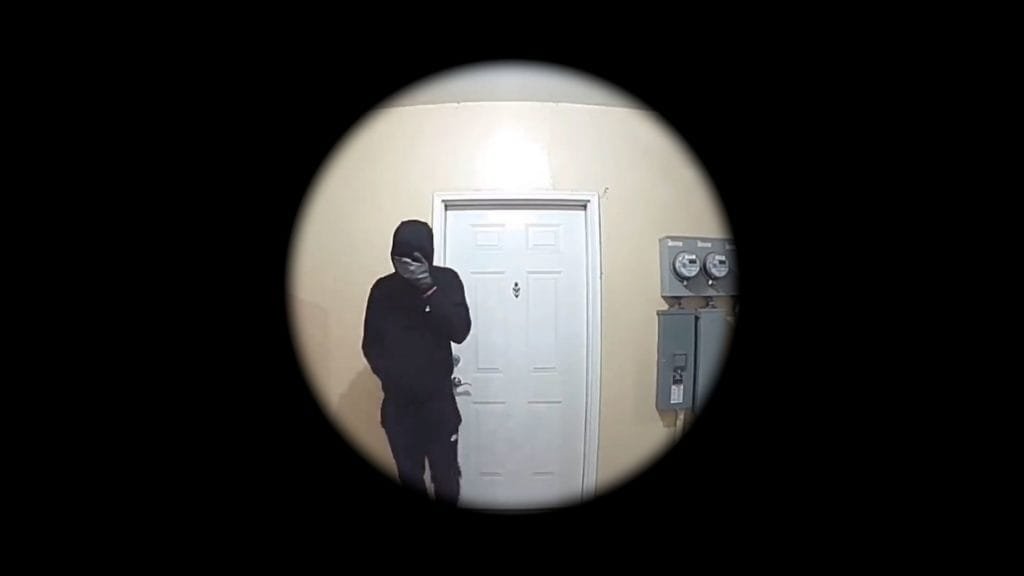
We then meet what is bound to be our chief protagonist, a pastor (Michael Lombardi) raising his two daughters elsewhere in NJ. Since losing his wife, he has thrown his all into giving them a good upbringing, even if this means retreating from conflict to set a good example for them. This is a horror film, folks: it’s clear that his ‘turn the other cheek’ ethos is going to be tested, and so it is. This all happens soon after he allows his eldest, Sarah (Katie Kelly) to drive herself to a Christmas party, and she encounters a Bad Man (we have just been shown enough to know he is one of those). The consequent fall-out from this horrible encounter sees some soul-searching and some very unorthodox detective work – taking the lead from the disillusioned detective assigned to his case (Marc Menchaca). Meanwhile, Bad Man’s criminal fraternity are doing some unorthodox detective work of their own to find him; the issue here will be, how far is our pastor willing to go for revenge, and what will become of him?
Does that sound garbled? That may well be down to my limitations as a writer, but it feels tricky (or even somehow dishonest) to structure things in such a way that reads any clearer than the above. The Retaliators is an immensely uneven film, but not just ‘uneven’ within one genre; it ducks and dives between different horror genres altogether, and still varies the pace along the way. It feels as though there are a dozen different films in here all vying for their fifteen minutes, when they could each have had ninety and made perfect sense. This race to do All The Things means that much of the characterisation is curtailed; it’s hard to feel invested in cardboard characters, even when they get messily pulped. But Lombardi is very good in his role, and whilst it is frustrating when his story gets subsumed beneath Detective Jed’s own story arc, both of these men do lend some much-needed gravitas to the goings-on. The presence of metal musicians in the extras is neither here nor there, unless you happen to know who you’re looking at; I largely didn’t, with the exception of Tommy Lee, but churlishly, you’ll probably work it out by assessing how well various people can or can’t act. You could also be churlish and suggest that spending plenty on these guys, but cutting corners by including freebie clips from the public domain go-to Night of the Living Dead, speaks to questionable filmmaking priorities. That was a film intended to turn a profit, too.
But here’s the thing. As the film switches modes yet again, settling to some degree on a kind of overblown exploitation revenge horror, it gains focus and yes, becomes a lot more fun. In fact, it manages to drag things together for a grand finale, although it’s a hell of a climb to get there. Had it been the film it is at the end, from the start, then it would be a minor masterpiece of OTT exploitation horror; as things stand, it just about redeems itself in ways which are engaging, gory and imaginative enough. True, it is in some bizarre race with itself to cram in as many elements as it can, but in amongst those, The Retaliators has some interesting ones. This may be more luck than judgement, but thank god for it, as it just about makes things feel worthwhile.
Editor’s note: this discussion of Guillermo del Toro’s Cabinet of Curiosities contains some spoilers.
Anthology TV series always feel like a tantalising prospect: the same goes for feature films which use the same frame. Even if one, or a couple of the stories aren’t to your tastes, you can usually bet that there’ll be something there to enjoy. A few of the best-known anthology horrors made for television have also incorporated a narrator into the format; in one of the best of these series, Night Gallery (1970-73) host Rod Serling brought his Twilight Zone experience to bear and became a part of the appeal, not to mention a key writer; his sardonic introductions set the tone and lent a consistency to each episode. In many ways, Guillermo Del Toro’s Cabinet of Curiosities most resembles Night Gallery, right down to the objet d’art as a linking device (and including a new version of Pickman’s Model, see below) – though, it has to be said, Del Toro himself doesn’t have Serling’s ease in front of the camera, and probably feels far more comfortable behind it. Still, now’s the time for this kind of thing; the swing back towards television in these days of HBO, Netflix and Amazon amply rewards this kind of format. It’s also worth noting that the series didn’t land all at once, evading binge-watchers to some extent at least. I prefer that. It is, in its way, a tribute to how TV series used to work; you had to wait. Anticipation’s half the charm.
As with any series of this kind however, some of the Cabinet of Curiosities episodes work better than others; so, without further ado, here’s the Warped Perspective list of worst to best (delivered with the proviso that every single episode has plenty of positives; there are no out-and-out duds, and despite playing favourites for the purposes of this article, I’m very glad to have seen all eight)
8: Pickman’s Model (directed by Keith Thomas)
Knowing del Toro’s love for Lovecraft (he’s in many ways as famous for the film version of Mountains of Madness he didn’t make, as he is for films he’s completed) it was inevitable that the originator of cosmic horror would turn up in this anthology. The thing is, Lovecraft is damn near impossible to bring to the screen in ways which feel akin to his stories. So much of his horror depends on the fractured recollections of his unreliable, mentally-broken narrators that the immediate problem is: how do you render that into something visual, and was it ever really visual at all – or a delusion? Some of the best on-screen Lovecraft adaptations have found their own way through the madness – the much-missed Stuart Gordon blended HPL’s stories with a lurid, darkly-comedic tone which worked in its own right – but Keith Thomas here (using a screenplay by Lee Patterson) deviates too far from the original story in my opinion, making it all about a family man whose family predictably become the sacrificial lambs; it feels rather simplistic, and the end result a little obvious, eye-gouging and all. That all being said, Crispin Glover is an inspired choice as Pickman; the artwork is excellent, too, even if the teleplay loses some of the dark, uncertain horrors of the story.
7: Dreams in the Witch House (directed by Catherine Hardwicke)
Dreams in the Witch House is another Lovecraft adaptation in the same series which labours under the exact same issues as the take on Pickman’s Model: isn’t that strange? Again, we have a much-expanded premise (which borders on the sentimental, something Lovecraft himself would have studiously avoided) whereby a young boy, Walter, loses his sister in childhood; he spends the rest of his life trying to ‘find’ her, dedicating himself hopelessly to Spiritualism – until a chance encounter sees him using mind-altering substances, which in turn pitch him into a rather gentle limbo, where he finally finds sister Epperley. Unfortunately, his interloping in a realm where he shouldn’t be attracts the attention of Salem witch Keziah Mason and her likeable-rogue familiar Brown Jenkin, whose old house he has rented; they were bound to bump into one another, you could say. One of the least-fantastical elements of this episode is in the state of the house, and the fact that the landlord is taking Walter’s money anyway; the most successful fantasy element comes with Keziah Mason herself, and it is she who grants the episode its only true moment of cosmic horror, her dead eyes glittering in the dark of the Witch House. Excellent creature design, too. But, ultimately, it’s the misty-eyed stuff which dampens any protracted sense of being out of one’s depth, which you must retain for a Lovecraft adaptation (or, of course, do something else entirely and save yourself the criticism).
6: The Outside (directed by Ana Lily Amirpour)
The Outside is in many ways a familiar parable about the perils of vanity. Added to that, it holds aloft the questionable boon of dead-end, cruel friendship, and invites us to wonder why these things are so appealing. Stacey (Kate Miccuci) is a plain and withdrawn woman with a soul-sucking job at a bank: this might be why she’s drawn to the chattering friendship of her co-workers, who – whilst not mean to her exactly – make it clear that they don’t have a lot to say to her. Still, they invite her to a Secret Santa party, where everyone gets a tube of Alo Glo lotion, which all the women say is the best. Stacey’s homemade taxidermy gift is politely received, and immediately put away; to be fair, a pot of lotion is more conventional. Feeling every inch the outsider post-party, Stacey begins to apply the Alo Glo, but it brings her out in a horrendous rash; this is the start of a process where not only her body, but her mind gets consumed by the lotion and all it promises.
Pretty much all of the stories in Cabinet of Curiosities are either period (turn of the twentieth century, or not too long after) or living-memory retro, usually set in the 70s or 80s. The Outside plumps for the 80s, with a house which looks like it could be next-door to Red and Mandy’s. It looks good, and there’s neat characterisation (though jaded horror fans might soon spot that a man written to be this awesome may well be for the chop). The Outside also adds just the right amount of surreal elements, poking fun at the claims made by telemarketers whilst also segueing into creature feature – all in a fairly understated way, give or a take a few more violent moments. It also works fully well in the time allowed, delivering a complete narrative where any remaining questions feel deliberate, rather than oversights.
5: Lot 36 (directed by Guillermo Navarro)
Lot 36 was the first episode made available and, to give it every credit, it does a good job at setting out the stall for all episodes to come. Encompassing occult horror, mystery and something more visceral, it is busy busy busy with perhaps a slightly abrupt ending, but via its plausible but deliberately unlikeable lead character, Nick (Tim Blake Nelson), it provides the punishment in some fun, florid ways. And, it doesn’t set all of this up just to bang out some jump scares, although there are a few which work rather well. Does it lean a little heavily on the ‘bad man by all modern measures of decency’? Perhaps a little. As del Toro wrote the (as-yet unpublished) story behind this screenplay, we’d have to take that up with him, but of course these people do exist and they are out there, even if they seemingly have problems of their own; it’s not an excuse, but it’s enough to give them some motivation for their most desperate actions. The first two lead characters in this series, through coincidence or otherwise, are plagued by poverty, and we see what horrors they are willing to turn to as a means to get out of it. Lot 36 uses the tantalising idea of the mysterious storage lot, brings in brilliant set and prop design, and sees things through to a fantastical conclusion. It does a lot in its timeframe, and what it does is largely very successful.
4: The Viewing (directed by Panos Cosmatos)
Honestly, deciding where to place The Viewing in this list was very tough-going. Thinking back to some scenes or lines, it feels criminal not to place it higher. Ultimately, its biggest sticking point comes from its biggest success, as it crafts an engaging, body-horror-sci-fi so compelling that its end scenes feel positively frustrating. It has a great cast too, with Robocop actor Peter Weller popping up as a mysterious wealthy recluse, who has selected a number of strangers, each very successful in their field, to come to his house – for reasons which, later, become horribly apparent. Were the possibilities for how this could play out known to Lassiter (Weller)? Maybe, maybe not; it doesn’t detract from the episode, and nor does it harm the film’s grotesque developments any. If you watched and liked Mandy, then you’ll know that one of director Panos Cosmatos’s great strengths is in depicting the strange, the trippy, the altered states. That is key here, as each of the assembled group are urged to partake of fine whisky and weapons-grade cocaine. After they are suitably hammered and on the right wavelength, they’re taken to see something very strange belonging to Lassiter.
With some of the finest face-melting you could ever hope to see, a sardonic and effective script, and some gutsy SFX, The Viewing hangs onto some ambiguities, and whilst it all rolls to a stop just when you feel you could stick with this narrative a while longer, its lurid, late 70s vibe, embellished with trippy colours, light and angles, is a joy to watch. It channels the OTT nature of late 70s/early 80s video horrors, but it very much as its own beast too.
3: Graveyard Rats (directed by Vincenzo Natali)
It feels like quite the surprise to be declaring Graveyard Rats only the second most disgusting entrant in this list – let’s start there. It’s based on a short story by Henry Kuttner, contemporary and friend of Lovecraft and fellow Weird Tales author; whilst this particular tale doesn’t include the Cthulhu Mythos elements which Kuttner often wrote about, perhaps as a nod to this, the screenplay expands the story somewhat in this direction. Again, it makes for a busy episode, but what’s one more element in a claustrophobic take of grave-robbing and subterranean horror? This is also another tale about poverty, too, something often rather well known to the original twentieth century authors. Masson (David Hewlett) has delusions of greater grandeur, but this cemetery keeper is also a grave robber with significant debts, determined therefore to take whatever he needs from the recently-interred. He is thwarted by a network of oddly sentient rats, who nab the cadavers before he can get to them. One night, desperate for a big haul, he himself burrows into the ground in pursuit of an already-disappearing body – where he encounters far more than the rats themselves. Beware, anyone whose stomach turns at visions of decaying flesh, impossibly-airless furloughs in the soil, and the horrible darkness: most of this episode takes place amongst them. Bringing together these very real fears with something more eldritch, via a shabby, hideous but plausible-enough lead, Graveyard Rats is a rotten, cautionary tale and an advert for cremation.
2: The Murmuring (directed by Jennifer Kent)
Tonally very different to every other episode in this series, The Murmuring is a ghost story, and in many respects, a familiar-feeling one. Consider the elements: a pair of outsiders spend time in a mysterious old house, where before too long, strange phenomena begin to afflict one of their number. To understand and perhaps to get rid of the frightening phenomena necessitates getting to the bottom of a mystery – finding out what happened to the old inhabitants, via clues and problem-solving. But if that sounds dismissive, it really isn’t intended as such. The Murmuring is a subtle, oh-so clever, humane story about grief, as well as the only episode in Cabinet of Curiosities which has the power to move you to tears. It also ends on a rare moment of hope, without ever sacrificing the very effective, hair-raising moments which it carefully offers up.
Ornithologists Nancy and Edgar Bradley have thrown themselves into their work with modest success; they study the specific phenomenon of murmuration, seeking to explain its processes through further research. This research takes them to a remote house and waterside, where Nancy begins to first hear, and then see a crying child; later, the child can be heard to cry that his mother is angry with him. Then the mother herself begins to manifest, both terrifying and further isolating Nancy. Frustrated, Edgar tries to tell Nancy that this is all a result of her own, unexplored grief and exhaustion over their lost baby daughter. But she feels she must find out more about the house and what she is seeing, driving a painful wedge between them both (seeing this sweet, believable couple begin to splinter and turn away from one another is genuinely affecting). With as-ever superb performances from Essie Davies and Andrew Lincoln, this really is something special – it’s not a ghost story where the past comes back to punish the present, but rather, it becomes a means for the living to go on living. Jennifer Kent has created something very special here.
1: The Autopsy (directed by David Prior)
The Autopsy is seriously, seriously, horribly impressive. It is tough to do it justice in a brief write-up, but here goes: firstly, it’s absolutely repellent. If Graveyard Rats goes a long way in its relentless presentation of the horrors of death, then The Autopsy (clue’s in the name) goes even further, lingering with an unseemly delight on the bits and pieces of organic matter which inexplicably make us living, breathing, sentient things. But it doesn’t stop there; oh, no. It interrogates the meaning of human life further, by threatening it with something which is not only outside it but superior to it, able to essentially drive us around like big stupid meat machines. And yet, the hostile superior force which would do this can’t anticipate every aspect of human behaviour; as such, this disgusting hacking, cutting, weighing, flesh-disturbing tale has a strange, brief moment of hope for mankind in it, too.
Dr Carl Winters (F. Murray Abraham) agrees to investigate the deaths of several miners in a small American town, killed when one of their number, one Joe Allen, reappears in the mine following a disappearance, with what seems to be an explosive device, which he hurls amongst the men. It’s a local tragedy and a mystery which needs investigation, so local sheriff Nate Craven (Glynn Turman) calls in a favour from an old friend. In a makeshift, deserted morgue, Winters begins the autopsies, but the story expands when Allen’s battered corpse reanimates with a tale to tell.
In its short amount of allotted time, The Autopsy blends body horror, science fiction and a kind of existential nightmare, questioning what we are and how vulnerable we are. It doesn’t miss a beat either, offering a kind of (mitigated) redemption without discarding anything which came before, whilst keeping up the pace until the very last moments – in a perfectly formed narrative which fits the episode length exactly. You don’t want or need anything more than this screenplay offers; it is complete. A harrowing, unpleasant, fascinating story which reminds you of what the best horror and sci-fi can do, The Autopsy is both riveting and revolting.
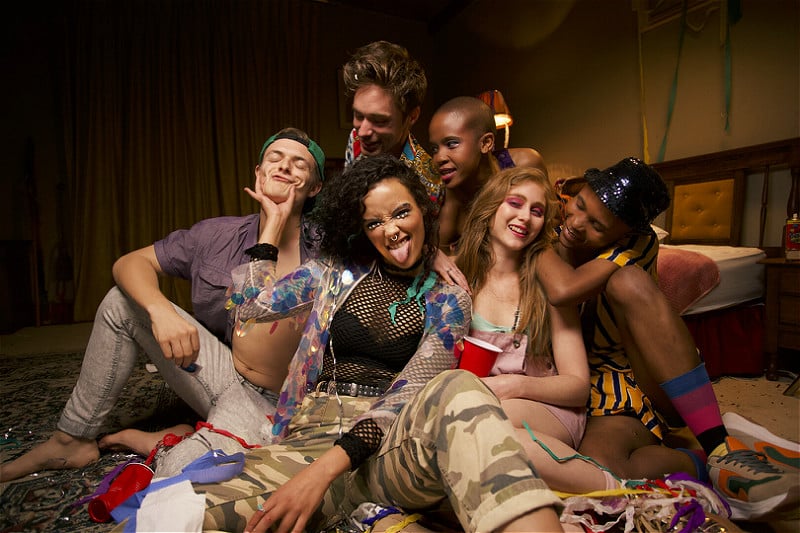
Most Horrible Things starts at the end, or thereabouts. Here is a grand house party gone wrong, all blood splatter, discarded underwear and – body bags. We also hear a 911 call, alongside seeing police and scenes of crime moving through the property. Clearly, this party has ended… interestingly. Starting a film like this, well, it’s a risk: by a couple of minutes in we know, broadly, that bad things have happened, and now we have to hope against hope that the narrative which gets us to this point (and, as usual, just beyond it) justifies the reveal. Sadly, you’d be hard pressed to say that it does.
Having established than a lot of people are already goners, we are taken back to the beginning of the evening – where you can, if you fancy, play a game of Guess Who’s Dead – where a group of six bright young things are arriving at the house in their finery. Things kick off with a chap in drag miming to a disco track, and though the simpletons at the gate are delighted with this performance, we see a different side of it: the performer, when the song is over, retreats to another room, seemingly distressed. The film sticks with this distress for rather too long, by the by, which is the first clue that plot-building might be a tad dilute. But anyway, the until-now strangers get to know one another, share a selfie (hip and happening film klaxon, number one) and ponder what’s about to happen. It seems that they have been invited to attend a special Valentine’s Day dinner here: at the behest of a surprisingly hirsute butler (Simon Phillips) they then sign waivers and hand over their phones. This being done, they await their host, and wouldn’t you know it, it’s the drag performer from earlier on. How to define him…He’s handsy, he’s given to cod philosophising and he wants to set personal challenges for each guest. If they pass, they each receive the hefty sum of money agreed. What could go wrong?
An early issue here – not quite as early as revealing that most of the cast are already dead, but not long after – relates to the ‘romance’ aspect of the plot. In fairness, it seems fairly unclear to the characters, so it’s no great surprise that it feels a little thinly plotted for the audience. It’s Valentine’s Day, a day which, as we know, has somehow turned into an oddball celebration (or commiseration) on love. The guests seem to think that their evening is going to be romance-themed; indeed, this film, under its first title Love Hurts, had its first release on 14th February, and I’d imagine a few dates ended angrily as a result. But love doesn’t quite take root as a theme; there’s too much script, too little plausible chemistry, and a tendency to dip in and out of two timelines, present, and future – where the police are interviewing the survivors. Whilst this is probably intended as a means of backfilling the plot, it really just takes us out of the moment and then lobs us back in again. It jerks forward at different rates, like the handrail on an escalator. As a result, ‘love’ never really feels relevant, despite the attempts to keep it so.
The film devotes far too much time to chit-chat, in any case. Some of this comes from our host (Sean Sprawling), a strangely glassy-eyed fellow, like someone who badly needs glasses, but has taken them off for a special occasion for reasons of vanity. He is meant to seem like a person presiding over events, albeit not quite confidently, and not just because of the eyes thing: as a master of ceremonies, he’s just a little too self-involved. To be fair, though, his guests won’t shut up and develop as characters, which can’t help. They regurgitate buzzwords and unconvincing discourse about veganism, racism, sustainability, carbs, and so on. No wonder they’re single. Possibly intended as a shortcut to making us care about them and see them as a modern bunch, this clanking banter fails because it instead makes them look like fairly obnoxious, two-dimensional representatives of recognisable, sure, but tedious conversations. Again, it takes us out of the here-and-now as we wait for it to end. This lot badly needs some more plausible pressure, and we need to see it steadily unfold. Without it, we’re just killing time waiting for the killings.
These kinds of social experiments can make for good cinema – consider Panic Button (2011) – but here, it unfortunately lacks in the right kind of writing, and flounders early. Most Horrible Things lacks the psychological weight to see it through, ultimately, and instead dandles some bit-part players in a regrettable situation.
Most Horrible Things (2022) will be released on 14th November 2022.