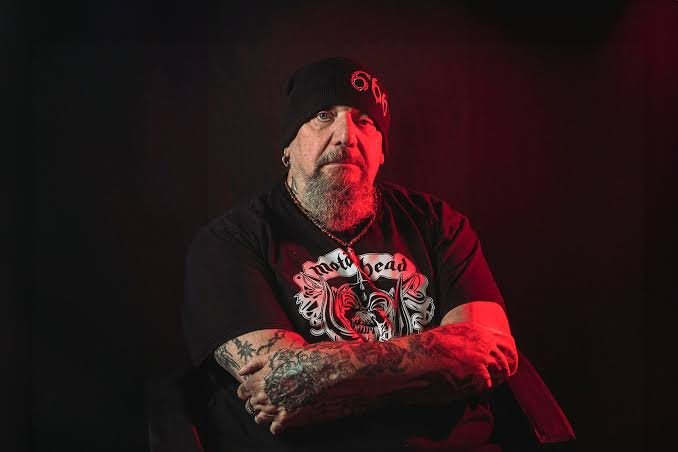
Di’Anno: Iron Maiden’s Lost Singer


By guest contributor Chris Ward

Don’t be misled – the word ‘Lost’ in the title does not mean everyone has forgotten about him, because if he never did anything else in his career, Paul Di’Anno will always be remembered as the voice of heavy metal behemoths Iron Maiden on their first two albums, those being 1980’s self-titled debut and 1981’s sophomore effort ‘Killers’, before he was replaced by Bruce Dickinson.

No, in this instance it means that Di’Anno himself was a lost soul, a victim of the rock n’ roll lifestyle that took so many talented musicians before their time, and a man who never quite found his place outside of that bubble. That Maiden went on to globe-straddling success with Dickinson at the microphone whilst Di’Anno forged ahead with various solo and band collaborations is neither here nor there, as there is no doubt in anyone’s mind that Maiden would never have reached such stratospheric heights if he had remained in the fold. What this documentary aims to highlight is the street-level integrity that he brought to those first two Maiden albums, and that without him, Maiden would never have had that stepping stone between the spit-‘n’-sawdust pubs of London’s East End and becoming a world-class arena-headlining act.

However, this is not just a look at Di’Anno’s stint with the metal legends as, with a bit of help from a few friends and observers, his post-Maiden career is also given a glance-over; not in any great detail, albeit enough to form a picture of a man with talent and passion, but no direction or discipline to keep it all in check. The central narrative device, though, is the man’s various health battles that plagued him in his final years, most notably the surgery that he required after contracting sepsis in 2015 to reduce the swelling in his legs, and the mental issues that came because of his inability to walk and perform.

If you’ve only ever known Paul Di’Anno through his vocal contributions to two of metal’s greatest albums, this warts (literally) and all look at his final couple of years shows a different figure to the strapping young buck who prowled the stage at both The Ruskin Arms and London’s Rainbow Theatre in 1980, which is, in itself, quite impressive. Here we see Di’Anno suffering with agonising pain as his legs swell up to disproportionate sizes as he smokes endless cigarettes, complains that the NHS won’t operate on him because of his general bad health and contemplates suicide, as he doesn’t want to be in a wheelchair any longer.

The answer to his situation came from Iron Maiden superfan Stjepan Juras, who organised a crowdfunder with various fans and friends to raise enough money for Paul to have the necessary treatment in Croatia, where a doctor there came up with a recovery plan on how to heal his legs. However, getting him to Croatia proved to be problematic and the movie doesn’t hold back in showing Di’Anno losing his temper with everyone who tries to help him, which makes him come across as a bad-tempered and ungrateful old sod, helping to enforce Maiden founder Steve Harris’s version of events about how Di’Anno left the band, as Di’Anno’s story has changed a bit over the years, depending on who was asking. Either way you look at it, throughout his life and career, people have gone out of their way to give the talented singer chances at bettering himself and he threw it back in their faces. Anyway, if you’ve ever fancied seeing knee replacement surgery up close, then this movie gives it to you in glorious close-up as Di’Anno’s elephantine legs are cut open, bits are pulled apart and removed, and given how disfigured and discoloured his legs are it doesn’t look quite real, except it is and you can’t really blame the volatile frontman for complaining, as it does look agonising.

We also get to meet Paul’s fiancé, who was also one of his nurses; well, she was his fiancé at the beginning of the documentary, but not by the end, so that tells you something else. It is a sad journey that we go on, because every time Paul seems to have some good news and something to celebrate, he slips back into his old ways, doesn’t keep up with his medical treatments and sinks into depression, which in turn makes him into an angry and unlikeable person who pushes away everyone who tries to help him, including Stjepan Juras.

If you are not an Iron Maiden fan or have no interest in who Paul Di’Anno is then Di’Anno: Iron Maiden’s Lost Singer won’t hold a lot of value, unless you like watching grumpy old men shouting at people who are trying to help them. However, for the Maiden connoisseur there is a wealth of footage from Di’Anno’s glory days with Maiden, his ill-fated eponymous AOR synth band and some clips from his underappreciated Killers project, as well as talking heads interviews with the likes of James Hetfield (Metallica), David Ellefson (ex-Megadeth), Bobby ‘Blitz’ Ellsworth (Overkill), Gary Holt (Exodus/Slayer), Cliff Evans (Killers), Andreas Kisser (Sepultura), notable former Iron Maiden members Blaze Bayley, Dennis Stratton and Doug Sampson plus many other personalities who were there along the journey. You also get to see footage of Paul Di’Anno reconnecting with Steve Harris backstage at a Maiden gig after many years of not seeing each other, which may bring a tear to the eye if you are of a certain vintage. Di’Anno himself starts to cry when he is told that Iron Maiden will foot the bill for the operation on his leg, and it is those moments when he reveals the vulnerable side of him that you see why people were drawn to him.

Paul Di’Anno died in 2024 aged 66 after years of health issues, and this movie works as both a look into how difficult he could be and at how much he was loved by fans and colleagues alike. Yes, if he hadn’t appeared on those first two Iron Maiden albums and they didn’t subsequently go stratospheric (after he left, important to note) then it is very unlikely that any of this would matter to anyone outside of Di’Anno’s own inner circle, but he did sing on them and by way of a send-off this film ends with his replacement in Iron Maiden (who also met Paul for the first time during his health issues, despite a so-called ‘war of words’ between the two in the press over the years) paying tribute to him from the stage of a Maiden gig in the US when the news of his death broke, and the outpouring of love from the crowd says it all. Yes, Iron Maiden without Paul Di’Anno may have the fame, the money and the big gigs, but with him they had a certain something – an X Factor, if you will – that none of the later line-ups had, and that is something that none of his fans have forgotten.

The Doll That Ate the Anthology: “Amelia,” Memory, and the Killer Image

By contributing writer Adam Page

Would you like to try a party trick? Say “Trilogy of Terror” to anybody over, let’s say 50, who grew up with a television in the house and an aerial bent and twisted into some superstitious angle, and watch their face. It’s not exactly recognition, it’s more like a full-body flinch, or a muscle memory. Nine times out of ten, they probably won’t be able to tell you what the movie is actually called. They won’t remember Karen Black playing four different women across three different stories all basically sprung from the mind of Richard Matheson, who also gave us Steven Spielberg’s Duel and maybe half of The Twilight Zone’s best hours. But they will remember, with all the clarity of a scar, a small wooden man with a spear and a lot of filed, pointed teeth chasing a woman around a Los Angeles apartment.

That’s the Zuni fetish doll. That’s “Amelia.” That’s the segment which, in all of 20 minutes and with some shift of pure feral kinetic terror, ate its own movie alive and then, just for good measure, ate the cultural memory of all around it as well.

That’s what I want to talk about. Not because the doll isn’t worth talking about; it totally is, it’s one of the best jolts of practical-effects horror ever beamed onto network television at 9pm on a Tuesday. But I want to talk about what happened to Trilogy of Terror as a whole, how it was reduced and distilled, boiled down to one burning image while its other two-thirds disappeared into the footnotes, and how it tells us something ugly and true about how horror really gets remembered. And I mean: not democratically. Not exactly by merit, or merit alone. Horror, I think, gets canonised the way a shark gets identified: with the fin breaking through the water and not the twelve foot animal underneath which is doing the actual killing.

Let me set the table first, because it’s hard to understand what got erased without knowing what was there in the first place.

Trilogy of Terror first aired in March, 1975 on ABC, a Dan Curtis production. He has already given the world Dark Shadows, a man who understood on a cellular level that American living rooms wanted dread delivered in neat, advertiser-friendly parcels. The movie itself is an anthology, three stories, with Karen Black playing the lead in all of them. This is a structural gimmick that in lesser hands would be read as budget-consciousness dressed as a concept.

The first segment, “Julie”, is a morality tale about a nasty little professor who thinks he’s seducing a student by spiking drinks until it turns out, surprise (this genre runs on the surprise that the quiet woman was never as quiet as you thought), that she’s the one running the whole show, and running it towards something way darker than a bad grade. It’s a pretty good slow burn. And it seems nobody remembers it.

The second, “Millicent and Therese” is a Jekyll and Hyde show, with twin sisters: one prim and proper, the other a lot less prim and proper. There’s a twist that anybody who’s seen more than two horror movies will clock in about three minutes. And it’s fine; it’s TV that does what it needs to do, then moves on down the road. Nobody really remembers this one either, although speaking personally, it seems to have the odd honour of being the one people misremember as being about the doll, and that tells us something about how completely “Amelia” has taken over the whole show’s mythology. People seem to project that doll backwards into stories it never touched, because in the cultural memory, it isn’t three stories anymore, it’s one story wearing a three-story coat.

So, then: “Amelia.”

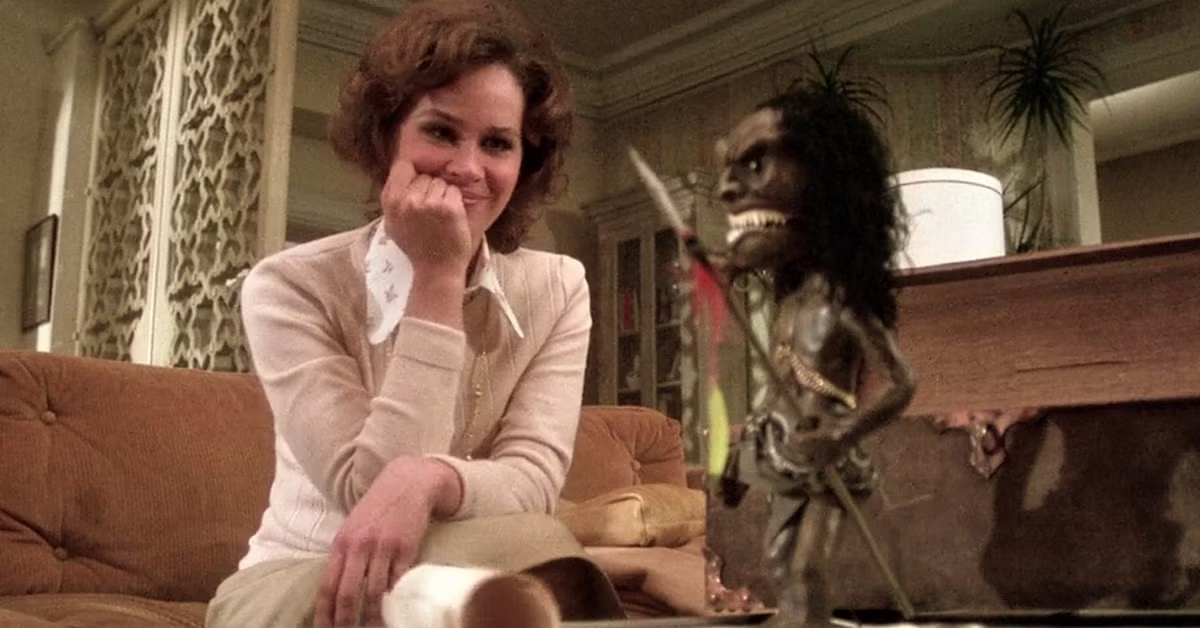
A woman is alone in her apartment. There’s a gift for an anthropologist boyfriend she’s trying to work up the nerve to introduce to her mother. And that’s its own quiet horror, if you’ve ever had that phone call, trying to rehearse your sentences like a hostage negotiator. The present is a Zuni fetish doll, a hunter spirit, with a little card (there is always a little card, horror loves an instruction manual nobody reads properly) that explains the doll is held by a golden chain wrapped around its body, and that chain must never come off as its the only thing keeping the spirit of He Who Kills dormant inside the doll.

Yes, you know where this is going. The chain comes off, as it was always going to. That’s not a spoiler; it’s practically a law of physics in these stories, a Chekhov’s gun, if it were a fifty year old strangulation totem with a spear the size of a toothpick and a continent sized homicidal intent.

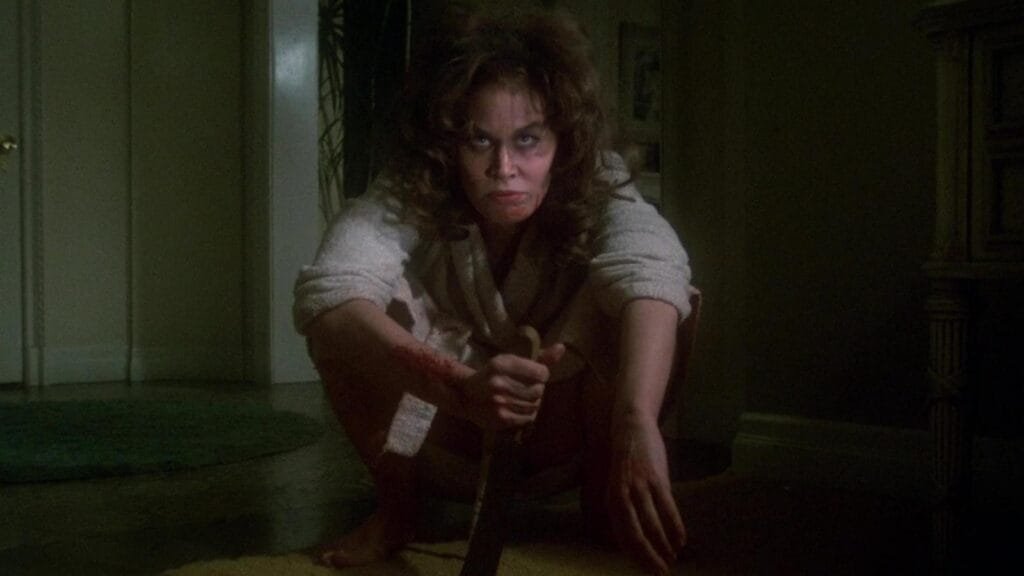
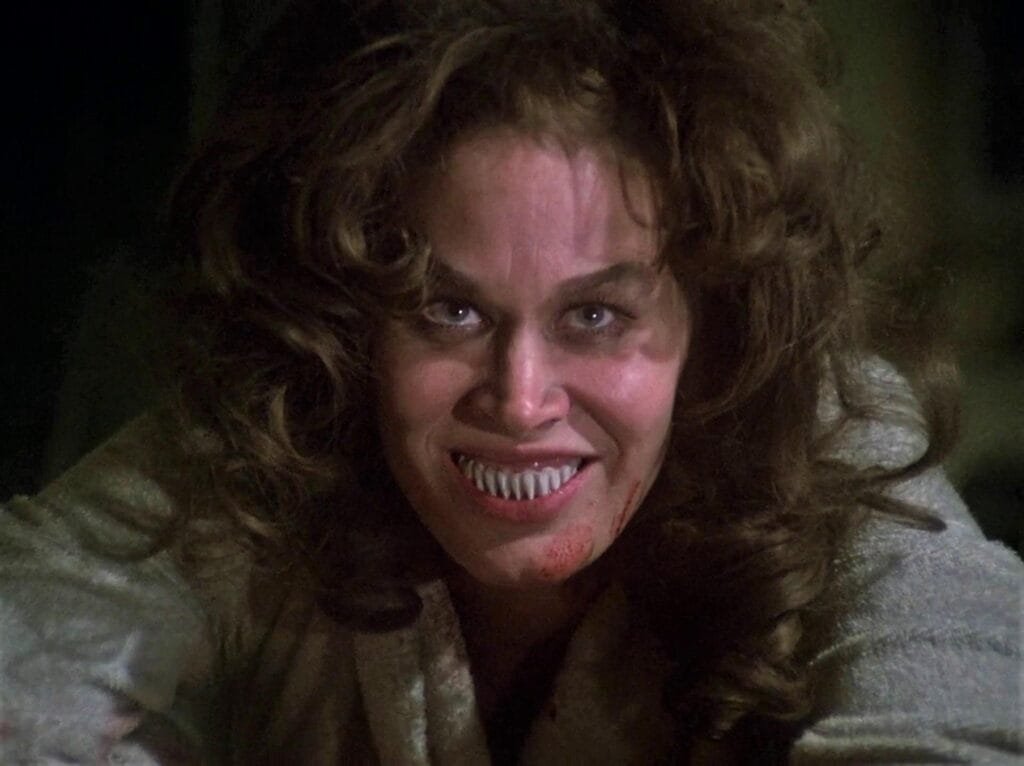
And what comes next, in just 20 minutes, is Karen Black, alone and magnificent, battling a foot-tall wooden doll that really should be laughable, but is honestly one of the most viscerally frightening things ever broadcast onto the small screen. That doll skitters and hides. It appears in doorways with the patience of something that is basically already dead and already killing. It stabs her in the ankle with its spear, and it’s a wound so small and devastating that it makes you think about every childhood scrape you ever shrugged off. And Karen Black sells every second of this. She wrestles this thing into the bathtub, traps it in a suitcase, tries to burn it in the oven, and then, the gut-punch, and the reason this 20 minute segment outlived disco: she turns to the camera at the very end, with the doll’s face, filed down teeth and all, grafted onto her own features. Then we understand, with all the horror of an ending that refuses us the mercy of a resolution, that whatever was in that doll didn’t die. It just changed address.

That’s the entire thing, and that’s what people remember. That’s the thing which got quoted and referenced, name-checked in everything from The Simpsons to a hundred internet compilations of “Scariest TV Moments”. It earned the doll its own line of collectible figures a few decades later, and that’s an honestly strange fate for a piece of set dressing that spent most of its screentime being hurled across a room by Karen Black.

And the thing I keep circling, something which interests me more than the doll itself, though admittedly it is a great doll but: the other two-thirds of this movie didn’t fail. They aren’t embarrassing, they’re sometimes better than competent, minor-key Matheson with real teeth of their own. Metaphorically speaking, at least. But they didn’t have an image. They didn’t have that single, decontextualisable 20 minutes that could be clipped and shared, turned into gifs before gifs were a thing, and described breathlessly by kids at sleepovers who saw it on late-night syndication and had to warn their friends. “Julie” and “Millicent and Terese” needed you to sit through setup and character, through the slow build-up of dread which actually constitutes most of what horror structurally is. “Amelia” was like a machine gun. A cold open, almost-immediate threat and building physical peril, plus a jump scare that reframes the preceding hour. It was built, maybe accidentally but probably not (Matheson was too intelligent a writer for total accident) to be the part that people talked about at school the next day, completely stripped of the hour of table-setting around it.

I would argue that this is how most horror really survives in culture. As image, rather than text. As the one transmissible unit of dread that can travel without its context, like a folk song outliving the specific historical grievance that produced it. If we think of The Exorcist, we don’t play the whole movie in our heads; we think of the spider walk, the spinning head, the crucifix, those few images that do the work of two hours of Jesuit doubt and Georgetown atmosphere. That atmosphere seemingly couldn’t do the work on its own, even though it’s exactly what makes those images land. Think about Jaws, and nobody really focuses on the cowardice of the mayor or civic corruption, something the movie cares about a great deal. No, it’s a fin, a bitten-off leg sinking underwater and John Williams doing more emotional work than the whole town council combined. The full text does the work and the image gets the credit. This isn’t fair, but it’s also not new, or even specific to horror. It’s just that horror, more than most other genres, lives or dies by whether it can create one of those condensed little nuggets of real sensation. Horror’s whole business model is the transmission of fear, and it turns out, fear travels light. Fear doesn’t want your subplot, it wants the doll standing in the doorway.

And it’s almost cruel, if we sit with it long enough, when we realise that “Amelia” is the most text-dependent of the three segments, in a way; it needs the card explaining the chain, it needs Karen Black’s specific loneliness and the dread of her mother’s judgement to make the stakes more than just a novelty doll come to life, and that slow ratchet of “is this actually happening?” before the doll even moves an inch. It isn’t an image that exists free of narrative; it just became one through repetition and cultural erosion, like a coastline becoming a different shape after enough time has passed with the same wave hitting the same rock. The context got worn away and the image is all that’s left standing.

There’s something a little mournful in that, if you squint. Every piece of art that gets remembered like this is, in a sense, a story about erosion; about what a culture decides is load-bearing and what it lets get washed away. It isn’t that “Julie” and “Millicent and Terese” are bad art, it’s just that they aren’t quotable, and quotability, sadly, has become one of the main currencies we use to decide what survives. It’s the same thing which turns a two-hour movie into a fifteen-second meme, or a three-thousand word essay into a pull-quote or two, and turns a person’s whole life into “the guy who did the thing one time.” We are all at risk of becoming our own killer image, our own doll in the doorway, just remembered for the twenty minutes that travelled, instead of the two hours that built them.

It’s this that crosses my mind when somebody references the Zuni doll like it’s the whole movie, because in the culture’s memory, functionally – it is. Ask someone to name the anthology it came from and you’ll probably get a shrug, a guess, or (my personal favourite) total confidence in the wrong answer. That doll has achieved a kind of immortality, famous in the way some photographs are famous, completely divorced from the photographer, the assignment, and the darkroom. It doesn’t need Trilogy of Terror anymore. It escaped its own movie in the same way it escaped its chain. And that’s either a delicious irony or the entire point, depending on how generous you’re feeling towards the universe’s sense of humour.

That might be fitting, actually, and maybe the only honest ending here, and the segment’s own text is about exactly this; something small and seemingly containable which turns out to have appetites you didn’t budget for, eats its own restraints and keeps eating, way past the boundary you thought was the edge of the story. The story did more than kill Amelia; it killed the concept of “Amelia” as just one segment of an anthology broadcast. It killed the very idea of Trilogy of Terror as a trilogy, and leaves behind a monolith with a spear, standing in the doorway of culture’s memory, pointed teeth bared, and totally unwilling to be put back on the shelf.

That’s not particularly a tragedy. Matheson got his hit, and Karen Black got her legend. Even the doll got its own toy line, and that’s a lot more than most character actors from 1975 can say. But it’s worth noting, as I wrap up, that the way we remember horror isn’t the way horror is actually made. It’s made in full; scene by scene, with dread built up in careful and unglamorous increments. It’s just remembered in fragments: the doorway, the grinning teeth, the face at the end which isn’t the face we started with. We tell ourselves we’re honouring the work when we quote the image.

But mostly we’re doing what the doll did. We take the part that moves, and let the rest go still.

Small Screen, Big Dread: What Hooper’s Salem’s Lot Understood that King’s Novel Didn’t

By Adam Page

There is something about Stephen King that, I think, he himself would probably concede after a few coffees and the right provocation: he can’t always see the wood for the trees. There is no question that he is one of the most instinctive and devastating horror writers of the twentieth century, an author whose best work operates like a scalpel and sledgehammer at the same time. But his great strength; a compulsive and almost evangelical need to tell us everything, with every room furnished, every street populated and every secret excavated, is at times his greatest liability. ‘Salem’s Lot, published in 1975, is an incredible achievement in atmospheric dread, taking the creaky Dracula mythology and firmly planting it in the rocky and resentful soil of small-town Maine with real conviction.

But, and there is always a but…

Tobe Hooper’s 1979 CBS miniseries adaptation, working in the smaller space of network television and constrained by budget and broadcast standards, arrived in living rooms instead of cinema screens. And this version doesn’t just translate King; in several crucial, structural, and philosophically interesting ways, it surpasses him. I know, this sounds like sacrilege, but stay with me.

The first and most important argument is the one that sounds a little trite until you stop and think about it. Barlow’s muteness is more frightening than his eloquence. In King’s novel, Kurt Barlow speaks. At considerable length. He is theatrical and articulate, almost Miltonic in his grandiosity. But that’s where the problem lies; as a consequence, he becomes explicable. When you give your monster a vocabulary, you also give it a psychology, and when you do that, you’ve given the reader a handhold, something to grab onto. You’ve given them a way of situating the horror in a comprehensible system of desire and motivation. King’s Barlow is eloquent in the same manner as some other literary vampires; he belongs in the same tradition as Bram Stoker’s Count, Anne Rice’s Lestat, those monsters who speak because speaking itself is an assertion of power and civilisation over the mere animal. And in those terms, it works. On the page, his long speeches and declarations carry a certain grandeur. But it turns out that grandeur is exactly the wrong register for what Salem’s Lot is actually about.

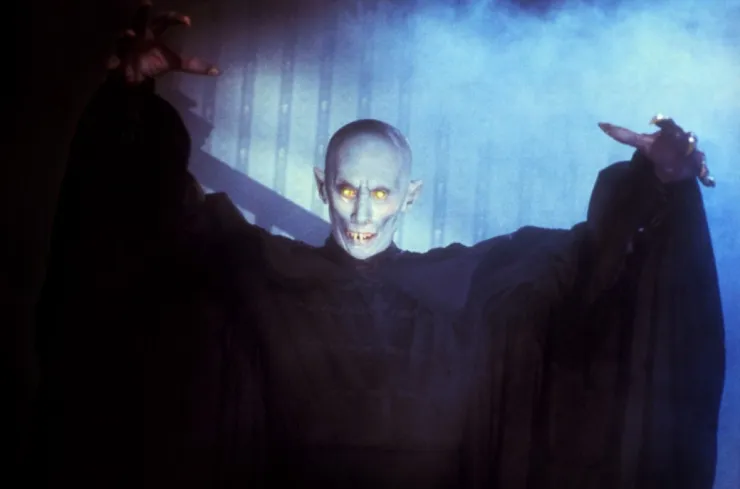
What it’s really about, and what the story is concerned with at its core, is the collapse of the ordinary, the contamination of the banal, and the discovery that your teacher or child, or your wife, has been changed into something wearing their face but no longer them. It’s a story about the uncanny valley in its most literal and frightening sense: the home becomes unhomely, and the familiar reveals itself as deeply alien. To tell that story, you don’t need eloquence at the centre, you need its absence. You need something that looks at you and doesn’t explain itself, doesn’t engage with you on equal terms or grant you the consolation of rhetoric. In other words, you need exactly what Hooper and makeup artist Jack H. Young gave us in Reggie Nalder: a white-faced, rat-eared, yellow-eyed thing floating across the screen like a remembered nightmare and saying exactly nothing.

Nalder’s Barlow, and this is a position I will continue to defend, is one of the most honestly frightening creations in horror cinema. He isn’t frightening despite his limitations, but because of them. He’s frightening because he isn’t a character; instead he’s a condition. He’s what happens when humanity is entirely ripped away. He doesn’t want to engage with you, or explain his philosophy or contempt for the merely mortal. He wants to feed. That blankness, the terrible vacancy behind those yellow eyes is more disturbing than any grand speech King could have written. Hooper knew something that horror moviemakers occasionally forget, then rediscover: the void is scarier than the explicable. Jaws frightens us because for the longest time, we don’t see the shark. Halloween’s Michael Myers is frightening because he is a silent shape behind a blank mask. In Hooper’s rendering, Barlow belongs in that lineage and he elevates it.

Now, I want to make a case that may seem counterintuitive given that we’re talking about a horror series and horror, culturally speaking, is generally understood to be interested in not actually dying: the episodic structure of the series lets the town’s population breathe, and then be mourned. This is really quite a big thing.

It’s an irony of King’s novel that despite its meticulous and near sociological mapping of Jerusalem’s Lot: all the backstories and grudges, the secret shames and adulteries, the parking lot fights that nobody has forgotten; the sheer density of that information can work against emotional investment. We get so much that processing any loss becomes difficult. The deaths build, but they build as data points in an overwhelmed system. By the time the town is being ravaged in earnest, the novel has worked up something closer to a tally than a tragedy.

In contrast, the miniseries works in time differently. There are two substantial episodes, with nearly three hours of television, and in that structure, Hooper and screenwriter Paul Monash make choices that may seem like compromises, but on reflection are acts of intelligent creative selection. Yes, characters are consolidated and some subplots are trimmed, but what the episodic structure adds – and this is crucial – is the rhythm of serialised television, which is the rhythm of ordinary life. You meet people and spend time with them across an episode. You go away and come back. And when they’re gone, you feel their absence in the same way you feel the absence of people you’ve spent time with, not just learned information about.

Think about the Glick brothers: lost, kidnapped and eventually both turned into vampires. Or Mike Ryerson, just working in a cemetery and falling victim to the newly turned Danny Glick. Constable Parkins Gillespie, watching his town fall while being powerless to stop it. Or Mark Petrie, watching his parents murdered. In a literary sense, these aren’t complicated characters, but Hooper gives them space. Actual screen time, and the texture of existing in a world before the horror arrives. It’s that space which creates the conditions for real grief. The genuine horror of Salem’s Lot isn’t Barlow gliding through the night, it’s that the town of Jerusalem’s Lot is depopulated. A community, maybe flawed and squabbling but alive, is systematically destroyed. For horror like that to work properly, we need to have known the community. We need to have spent time in the diners and shops, the schools and motels. The miniseries gives us that time while, paradoxically, the novel gives us more information about the town while giving us less sense of it.

But there is something else I need to talk about, because it seems to me essential to any real account of what Hooper’s Salem’s Lot actually is and what it actually does. There is an argument, and it’s a serious, considered one, that this miniseries worked better on the small screen than on any other medium. And I think this is inseparable from the amazing, generationally definitive trauma it inflicted on the children who first encountered it.

Horror on television in 1979 was operating under constraints that seemed to be purely limiting: no explicit violence, no blood, no real transgression of broadcast standards. Hooper found in these constraints something like discipline. Without being able to show explicit gore, unable to overwhelm the audience with spectacle, he had to generate dread through suggestion and atmosphere, through the slow accumulation of wrongness. And in that discipline, he found a register that is uniquely suited to domestic horror. And let’s not forget, that’s what Salem’s Lot fundamentally is.

Because you watched it at home. In your living room, or if you were one of the countless children who probably shouldn’t have been watching it but did anyway, in your bedroom, or sneaking downstairs after you’d been told to go to bed. You watched it in the same house you lived and slept in, the same town where you lived, and the patient insistence of the camera on the ordinary architecture of domestic life wasn’t just atmospheric, it was accusatory. It was the screen telling you to look at your window and look at what might be on the other side of it. The TV set, the warm and familiar communal domestic object became the delivery mechanism for a horror that was specifically about domestic vulnerability. The message and the medium were perfectly and terrifyingly aligned.

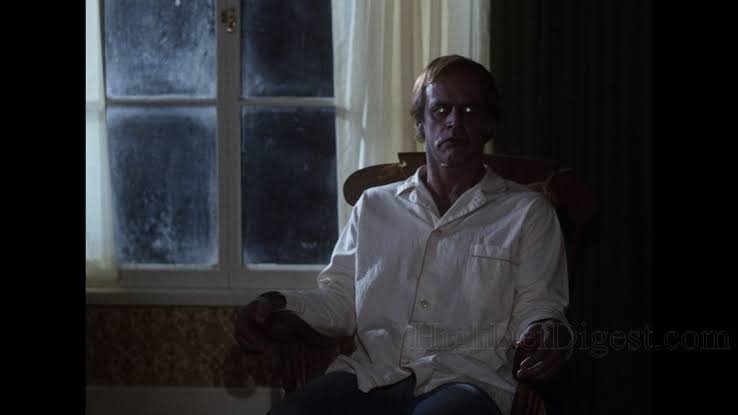
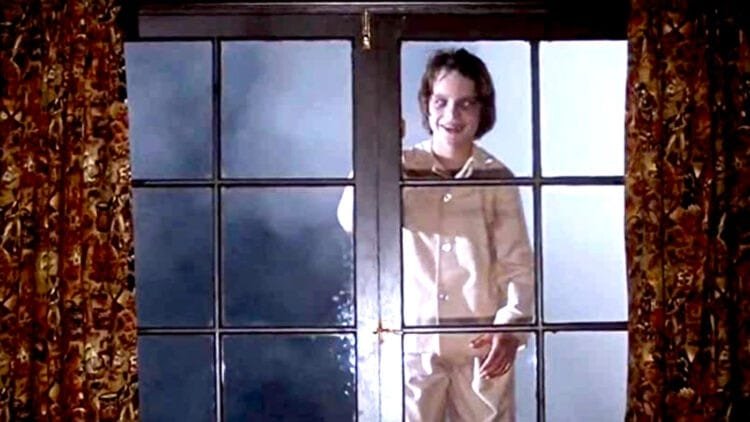
And then, of course, there is the Glick boy at the window. Danny Glick, poor, dead Danny Glick, pale and floating in the misty night air, scratching at the glass. If you know, you know. If you came across this image at the age of 9 or 10, like I did after seeing it on VHS, you know with absolute physiological certainty what I’m talking about, because your body still remembers. This isn’t hyperbole or the warm exaggeration of nostalgic horror fandom. This is a real, measurable and multigenerational phenomenon; an entire group of people for whom the words Salem’s Lot will produce an immediate, involuntary recollection of a floating dead boy at the bedroom window, and a bodily response that no amount of adult rationalism has completely dissolved. The image works because it takes the window, your window, the one you can see right now, and turns it into a threshold between the living and the dead. And it works because that dead boy isn’t snarling or roaring, he’s drifting and scratching. He’s looking, with those terrible eyes, at his former friend, and something about the mix of the familiar face and the totally alien presence behind it is nearly unbearable. Hooper understood with real clarity that the horror of vampirism isn’t mainly the violence; it’s the persistence of the face, after the person has gone.

And that brings me to what I think is the most intellectually generative frame for understanding what Hooper achieved: Salem’s Lot is a case study in productive fidelity; the art of honouring the spirit of a source text while transforming its letter with confidence and creative intelligence. This is rarer and much more difficult than it sounds. The history of horror adaptations is cluttered with versions that chose between two equally unsatisfying options. Either they were slavish reproductions, capturing everything on the surface and missing what made the original vital, or they’re wholesale departures that use the source material just as a brand. Hooper and Monash did something genuinely harder; they read King’s novel, understood what it was actually for, and made decisions – some quite radical – in service of those underlying purposes, rather than in spite of them.

The decision to relocate Barlow’s power and antiquity into a visual and not verbal register is the best example of this, but it isn’t the only one. The decision to let James Mason’s sinister and beautifully mannered Richard Straker carry the burden of the villain’s eloquence and menace is a piece of adaption thinking that needs more recognition than it usually receives. In his role, Mason gives us everything King gives us in Barlow’s speeches; that sense of ancient, cultivated malevolence which has watched centuries pass with contemptuous amusement. Splitting the novel’s vampiric force across the silent ambiguity of Barlow and Straker’s verbose and courtly manipulation, Hooper creates something that’s arguably more complex than the version in the novel: a vampiric operation with a face and a voice, a bestial centre and civilised interface, and this maps pretty exactly onto the way corruption tends to work in small communities. The charming newcomer arrives, opening the right business in the right building, with the darker thing he’s invited in behind him.

How Hooper treats the Marsten House is also instructive. King’s novel gives us the house as a sustained presence, a dark accumulation of local mythology and menace. Hooper uses it more sparingly, sitting on that hill and watching, with Hooper returning to it the way the town does in its imagination, as an inescapable fact. Less, here, is clearly more. The restraint creates something which King’s comprehensive treatment can’t quite achieve: real mystery. In the miniseries, the house stays strange because it’s never fully explained. It has the quality of a recurring dream, in that you return to it, but you can’t quite resolve it.

Writing all this, I don’t mean to say that King’s novel is without its extraordinary qualities; saying that would be dishonest and wrong. Its treatment of Ben Mears’s psychology, and the specifically American mythology of the failed return and corrupted pastoral, of small-town denial and complicity, are things the miniseries can’t quite capture – and doesn’t try to. King’s gift, his radar for the moral weather of a community and his ability to make you feel the weight of decades of local resentment and compromise is there in the novel in ways that a three-hour miniseries could never fully replicate.

But in exchange for what the format required him to leave behind, Hooper gave us something rarer in the history of horror on screen: a version that knew the emotional and thematic centre of its source well enough to serve it more faithfully than the source itself sometimes did. He kept its soul and found new forms for it. He tore away the eloquence and discovered the silence that eloquence had been covering, and gave the town enough room to exist so that its loss would mean something. And he brought all this into the living rooms of an audience that was utterly and brilliantly unprepared for it. An audience now in its fifties and sixties and still, still, checks the window before turning off the light at night.


That is what great horror adaptation does, and that is what Tobe Hooper did. Four and a half decades later, it remains one of the most intelligent, most frightening, and most underrated achievements in horror history.

The Wall Within: Divided Selves, Divided Cities in Possession (1981)

By guest contributor Adam Page

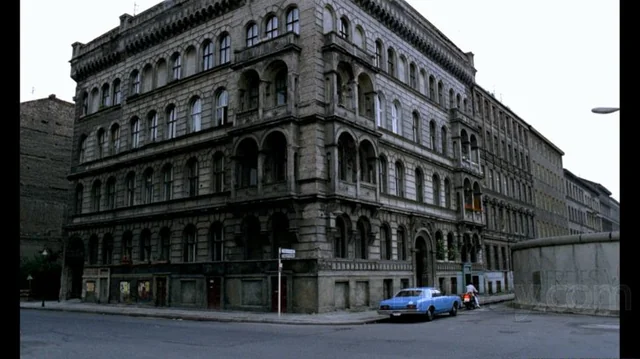
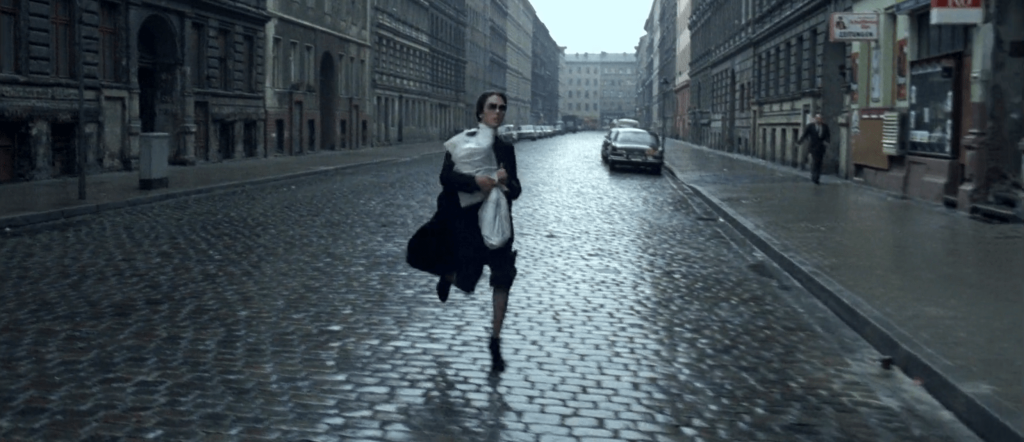
There are some cities in the world that get inside you. I don’t mean in the tourist-brochure sense, like Rome seducing you with its golden light and self-satisfied beauty, but in the way a wound gets inside you. Berlin in 1981 was that type of city. You didn’t visit Berlin, you survived it. It sat there in the middle of East Germany like a philosophical argument turned violent, a city split down the middle, literally, by concrete and ideology and the polite fiction that it was a permanent solution to anything. Andrzej Żuławski completely understood this. He had been thrown out of Poland by communist censors, watching as his own country built its own invisible barriers and when he got to West Berlin to make Possession, he brought the certain sensitivity of a man who knows what it feels like to be divided by forces bigger than himself.

What he made wasn’t a horror movie, although it’s still filed that way by people who need their monsters visible and their categories neat. Possession is something far more uncomfortable than a horror movie. It’s a movie about the end of a marriage, and by that, I mean a movie about the end of a shared reality. And it uses Berlin, a wounded but impossibly alive city pressed against its concrete negation, not as a backdrop but as an argument. The Wall isn’t scenery in this movie, it’s the whole thesis.

Let’s talk about what Berlin really was back in 1981, because I think we need to feel it to understand what Żuławski was working with. West Berlin was an island. I don’t mean that metaphorically, it was a literal enclave of Western capitalism floating in the middle of the Soviet-controlled East Germany. It was accessible by three narrow air corridors and a number of checkpoints, where men with uniforms and guns checked your papers with that specific dead-eyed contempt of people who had been given a little power and knew how to use it. The city seemed to have a strange psychic atmosphere, drawing artists, draft dodgers, people running from something or looking for something they couldn’t name yet. It was heavily subsidised by West Germany, which had to function as a showcase, a real-life advertisement for the Western model. This built an odd economy of creativity and desperation; cheap rent, government money pouring in and the subliminal awareness that you were living in a place existing by political will alone, and in theory could cease to exist if that will failed.

David Bowie recorded his Berlin Trilogy there. Iggy Pop was wandering the streets. Nick Cave would go later. They were not people drawn to cheerful places. They were drawn to a city wearing its damage openly. To a city bombed into powder and rebuilt with all the grace of a society working under existential threat and sat in the shadow of a wall telling them: This far and no further. Here is where freedom ends.

It was into this city that Żuławski put Mark and Anna and a marriage that was already, in the opening frames, indistinguishable from a war zone.

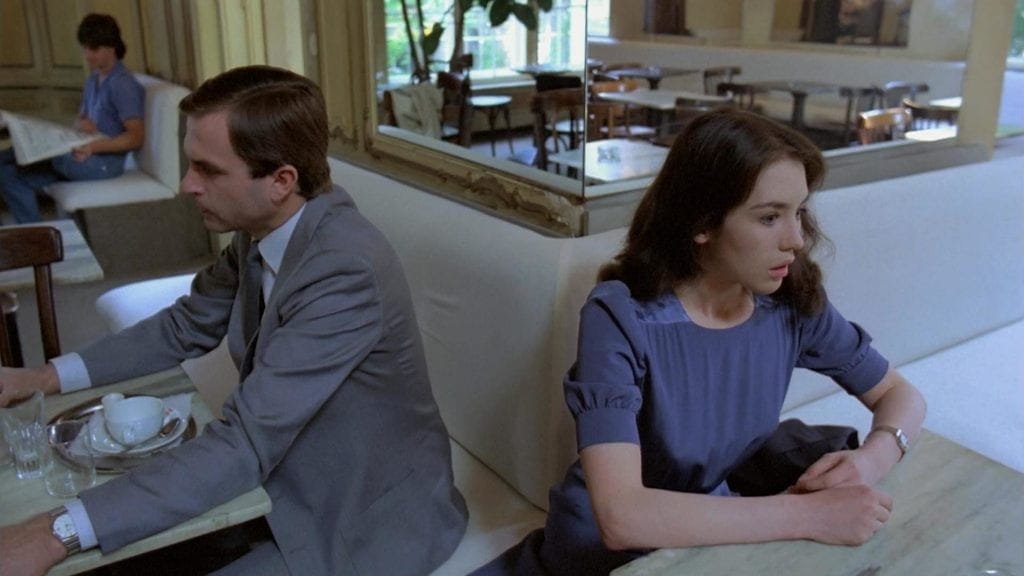
Mark comes home from an unnamed assignment; he is a spy or something spy-adjacent, the movie deliberately vague in the way intelligence work is all deniability and implication, and discovers Anna wants to leave him. She can’t really explain why. She tries, in an early scene with Isabelle Adjani’s face doing things a face doesn’t normally do, cycling through fury, and anguish, and what seems like cosmic exhaustion. She can’t give him a reason, as the reason isn’t ideological. It isn’t that she’s chosen a side, but more that she has discovered she contains multitudes that can’t co-exist. Her marriage has been the container that was forcing them to try.

It’s here where the Berlin Wall becomes something more than a choice of location. Żuławski, himself surveilled by the Polish secret police and intimately knowing the texture of living in a watched state, frames Mark and Anna’s apartment like a border zone. The apartment isn’t a refuge, it’s a checkpoint. Characters move through it with the wariness of people moving into contested territory. There are no shots that make it feel like a home; instead the camera, operated by Bruno Nuytten with an aggressive mobility, makes every room potentially hostile, and every doorway a possible confrontation.

It’s surveillance aesthetics applied to intimacy. The husband is watching the wife. The wife knows she’s being watched and performs, not deception but a kind of hyper-awareness that happens when you know your movements are being monitored. Bob, their son, moves through the apartment like a small animal navigating around territorial adults, dealing with the tension with that eerie adaptability children have when they have no choice but to adapt. The family apartment should be the most private place in the world, but here it operates like a no-man’s-land between checkpoints, where the normal rules don’t apply and violence is always near.

Think of the geography Żuławski establishes. Mark occupies the apartment; he’s returned to it and his life is organised around it. More and more, Anna’s life does not. She has another apartment, across the city, where her lover Heinrich is and eventually the thing she is creating, or the thing she has summoned or the thing she has become; that tentacled horror that the movie’s more literal-minded critics focus on as the genre element. But let’s not get distracted by the monster, it isn’t the point. The monster is what happens when a person refuses to keep their interior life walled off from the outside world, and when the suppressed self stops accepting its containment.

Anna’s other apartment is the East to Mark’s West. Not literally of course, as both are in West Berlin, but structurally. It’s the other side, a place that can’t be visited without a sort of border crossing or without confrontation. When Mark follows Anna, when he hires the private detective to watch her, he’s doing what states do: treating the unknown as a threat and responding to a mystery by gathering intelligence. He just can’t accept that he doesn’t know what’s happening. He needs a report, a file. He has to know where his asset is located.

And that word, asset, is deliberate. After all, Mark is something like a spy, and the movie suggests he has brought his professional terminology into his marriage. He treats Anna as a handler treats intelligence; a resource to be tracked, a variable to be considered and a potential defector who has to be monitored for signs of ideological drift. The tragedy is that this isn’t malice, exactly. Mark loves Anna in the only way he knows how to love, like a state loves its citizens. With possession, and the real belief that this constitutes protection.

Sam Neill, and this might be the movie’s most underappreciated achievement, plays Mark not like a villain, but as someone so colonised by the logic of his world, he can’t perceive its violence. He is earnest and in his own way, devoted. He’s also totally unable to understand that his presence is itself a kind of occupation. There is a scene where he beats Anna, and afterwards, he sits there with the specific bewildered look of a man who honestly can’t understand how he got here. He followed the rules, he came home. He wanted to be a husband. So why has this become a war?

The answer lies in that city outside his window. In 1981, West Berlin was a city that had learned to live with division, with its entire identity organised around it. For West Berliners, the Wall wasn’t an emergency. It had been there for 20 years. It was part of the infrastructure, and you arranged your life around it, incorporating it. The cold fact that this meant building your life around an obscenity, around literal concrete proof of human cruelty and political failure, well, you adapted. You had to, as the alternative was a kind of ongoing existential crisis that nobody could maintain.

Mark and Anna have done the same thing with their marriage, learning to live with the Wall between them. They have incorporated that division and made it functional. They have built their routines around areas that still communicate and the areas that are sealed off. Then Anna does the unthinkable: she stops pretending the Wall is acceptable. She starts acting as though the division is catastrophic. And this refusal to accommodate, the insistence on feeling the full weight of what’s been walled off, is experienced by all those around her as madness.

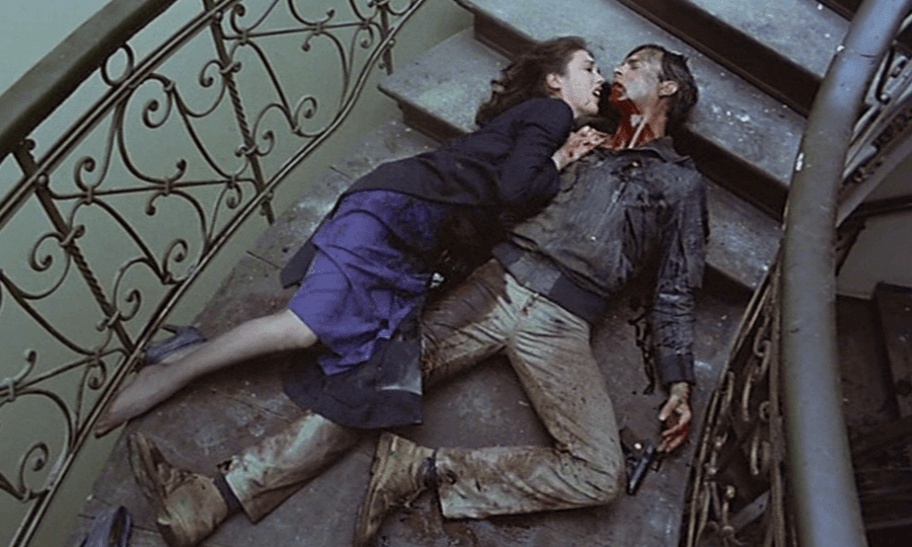
Isabelle Adjani won the César Award for her performance in the film. She also reportedly suffered a breakdown during filming. Both things are credible. What she does in Possession isn’t acting in any conventional sense; it’s more like a controlled demolition of the self, a performance enacting the very disintegration it’s depicting. The subway scene has been written about so often that I’m reluctant to add to the pile, but it remains inexhaustible. Anna in a subway corridor, her body moving between rage and grief, and then something beyond both, her body becoming the argument the movie has been making with words, architecture and geography. The body as a border zone, and a place where two incompatible selves finally stop negotiating and start destroying.

Watch where Żuławski has his camera during this scene. There’s no cutaway, no relief of reaction shots or distance. He stays close with it, in the same way surveillance cameras stay with things. Without mercy, without interpretation, and just recording. Here, the camera isn’t empathetic, it’s gathering intelligence. And here, I think, is the movies most devastating formal choice. At the exact moment of maximum human vulnerability, Żuławski copies the aesthetic of the surveillance state.

That’s what love has become in this movie. Monitoring and watching. Gathering evidence of other people’s interiority and trying to predict their next move. Contain the damage and maintain the border.

Heinrich, Anna’s lover (played by Heinz Bennett), represents the third option which the movie’s Cold War geometry demands. He isn’t East or West. In his nauseating way, he is beyond ideology. A man so committed to his own spiritual projects, that geopolitics slide off him. He meditates. He has achieved a serenity that the movie treats with the contempt it deserves, because that serenity is built on not being in the world in any real sense, and on having walled himself off from history so totally, he can float above it in his beatific self-satisfaction.

When Mark confronts Heinrich and kills him in that bar’s toilet, it’s ugly and disproportionate. But it’s also, by the movie’s logic, totally coherent. Heinrich represents an escape from division, a man who claims to have transcended the Wall by just not acknowledging it. Mark, for all his horrific flaws, at least knows he’s on a side. He knows the Wall is there and there is something almost honourable in his refusal to pretend otherwise.

The double ending of the movie, the arrival of what seems to be the ideologically normalised version of Mark, mirrored by the destruction of Anna and the approach of what is suggested to be an apocalypse, has been read as an anti-Cold War allegory, and as Żuławski’s prediction of some final confrontation. As Marxist critique and as pure surrealism. I think it’s all of these things and resists final explanations in the way that great movies often do. But what strikes me about it is the implication about what division costs. The “good” version of Mark who arrives at that apartment is functional and clean. He has done something with himself, made some peace or reached some accommodation. In the most important sense, he is no longer divided. And this is not presented as triumph, but horror. Anna’s proxy, the creature grown from her own divided self, her doppelganger, is looking after Bob, and he recognises what the two doubles are, drowning himself in the bathtub. The price of integration, the movie seems to say, is the death of something real.

Berlin would come to understand this. The Wall would come down eight years later and the reunification of Germany would be celebrated as unambiguously good – and it was. But also, gradually, it would be revealed that the East had brought its own scars, and its own way of being in the world. The West also had its condescension and pathologies. Walls don’t just disappear when you knock them down, they become interior architecture. Ostalgie is the name given to the nostalgia you may feel for a way of life organised around oppression that was, at least, your oppression. You knew it and had learned to navigate it.

Mark and Anna’s Wall can’t be pulled down, and that’s the tragedy. It has become structural to them. Remove it and the whole thing, the selves, the marriage, the shared reality, comes crashing down.

Żuławski made Possession while exiled, in a city which was defined by exile, about a marriage in the process of internal exile. He was drawing on his own divorce, his experience of the Polish state, his readings of theology and a deep suspicion that the modern West had organised its emotional life around the exact same principals of surveillance and containment it claimed to politically oppose. And he was right. We are all, in our most intimate spaces, Cold War architectures. We have controlled zones, buffer states and our mutually assured destructions. We all have our Walls.

The thing about Berlin, and it’s something that the tourists who go now with cameras and Instagram posts about the East Side Gallery don’t always feel, is that the Wall wasn’t imposed on the city from the outside. It grew from the division of the city, which grew from the division of the country, which grew from the catastrophe of a people losing its mind, and the further catastrophe of other people arriving to administer the aftermath. The Wall was already there, the concrete just made it visible.

That’s what Żuławski understood, and what he put on screen with brilliant and monstrous clarity. The Wall within. The division there long before the marriage, expressed by the marriage and outlasting the marriage.

What he is telling us is that love is not the opposite of ideology. Love is just ideology with better lighting and more convincing special effects. We’re all divided cities and we all have our checkpoints. We all, at 3am in the apartment we share with someone we can no longer reach, put our hands against the concrete of our own interior Wall, wondering when we built if and whether we still have the key to any of its gates.

Some questions, West Berlin knew, don’t have comfortable answers.

Some walls, it turns out, are load-bearing.

The “Sam Neill Goes Batshit” Trilogy: Why Omen III, In the Mouth of Madness and Event Horizon Define 90s Horror

By guest contributor Adam Page

I want to start by addressing something that may seem like a ludicrous claim on its surface. I want to argue that Sam Neill, the charming New Zealander who played Alan Grant in Jurassic Park and whose default facial expression is a sort of warm, self-deprecating amusement, is arguably the most important horror actor of the 1990s (I know one of these movies is from the 80s, but just go with it). Not the most bankable or prolific, but the most important. And I will make this argument by what I have termed the Sam Neill Goes Batshit Trilogy. Three movies spanning roughly sixteen years, if we’re generous with our bookends, and in which Neill plots a trajectory from diabolical composure, through psychological collapse and finally arrives at a destination that could only be described as beyond all human reckoning.

Of course, I’m talking about The Omen III: The Final Conflict, the wildly underrated In the Mouth of Madness (which I recently discussed at length), and Paul W.S. Anderson’s cosmic horror Event Horizon. What unites them, beyond the existential dread and some impressive eyebrow acting, is Neill himself. The through-line isn’t directorial or thematic. It is, brilliantly, the performance of an actor who understood something about horror that a lot of his contemporaries just didn’t: the monster is most frightening when it starts as the most reasonable person in the room.

“I was conceived of a jackal…”

To begin at the beginning, and the most elegant performance Neill ever gave in a horror movie which is also, and I say this with real affection, the most openly camp. The Final Conflict, third in the Omen franchise, had a near impossible task. Lee Remick and Gregory Peck had died in the first movie in what is still one of cinema’s best marriage portraits gone horrifically wrong. Damien, played by Harvey Stephens, had been truly unsettling. And so how do you make the adult version of the Antichrist compelling and not just ridiculous?

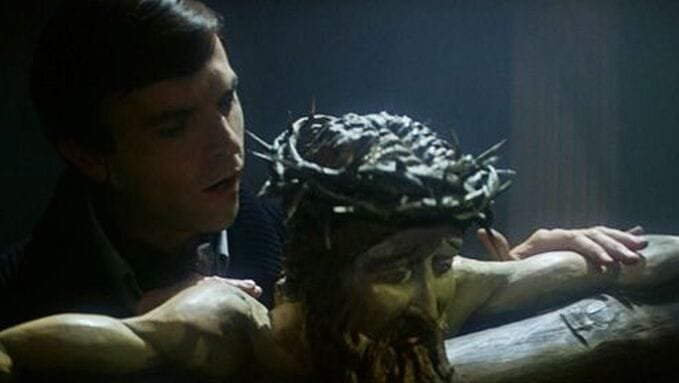
It turns out, the answer is Sam Neill. And more specifically, him standing in front of a large crucifix, delivering a monologue to Jesus Christ that begins as theological argument, and ends up somewhere close to romantic rivalry. It’s one of the greater unhinged set pieces in 80s horror and it works because Neill plays it with total and unwavering sincerity. There isn’t a single wink to the camera or flicker of self-awareness. Damien Thorn believes what he is saying, because Neill believes it, and so we believe it too. That is a genuinely remarkable achievement, given that what he is saying basically is: I’m going to murder all the baby boys born in this specific twelve-hour window, and I’m quite looking forward to it.

What Neill brings to Damien is a quality that I don’t think a lot of other actors could have, which I can only describe as a boardroom malevolence. Here, Damien isn’t the sneering villain of lesser horror movies. At any gathering he attends, he is the most impressive man there. He is charming and witty. Genuinely erudite about his own mythology in a way that suggests he’s done quite a lot of reading about himself, which is, frankly, fair enough. Neill plays him with that kind of confidence which only comes from people who have never, not once in their lives, experienced a moment of self-doubt.

The sexuality of his performance is also worth talking about, because it does work that the movie’s critical reputation always undersold. Damien’s relationship with the journalist Kate Reynolds, played by an excellent Lisa Harrow, is more than a villain chasing a victim. Neill plays it as real desire complicated by destiny, almost as though Damien is really annoyed that he finds this woman so compelling, when he has some urgent apocalyptic business to attend to. There is a scene, you know the one, that is still genuinely shocking not because of what happens, but what Neill communicates in the aftermath. The look on his face isn’t triumph. More interestingly and disturbingly, it’s regret. Neill seems to be saying that the Antichrist is capable of feeling the wrong thing at the wrong time. And I think that small crack of humanity in the demonic is what makes him the most monstrous.

The movie isn’t perfect by any means. The director, Graham Baker, is more capable than visionary, and the third act plotting is, shall we say, theologically convenient. Neill’s performance, though, rises above the material with a cheerful contempt for the limitations put upon it. He seems to be acting in a better movie than the one he’s been given, and in doing that, he creates a character who stays in the memory long after the movies slightly anticlimactic conclusion. At the end of The Final Conflict, Damien Thorn doesn’t feel defeated, he feels temporarily inconvenienced.

“Every species can smell its own extinction…”

Okay. In the Mouth of Madness. Now we’re cooking. Into territory where I need you to sit down because this movie, and I will defend this until I’m blue in the face, is John Carpenter’s most formally daring movie, one that understands Lovecraftian horror at a primal level and does something incredible with it. It takes the idea that reality is a construct and fiction can become fact, that the simple act of reading can rewire the world, and builds those ideas into a narrative structure that enacts its own themes. The movie doesn’t just describe madness; it performs madness. Standing in the centre of it all, a fixed point in a universe which is actively dissolving, is Sam Neill as John Trent.

The genius of this casting is apparent straight away. Trent is an insurance investigator, and professionally speaking, a man whose entire career is built on the premise that most things that appear extraordinary will have a mundane explanation. He is sceptical by vocation and cynical by disposition. In the early sequences, Neill plays him with coiled energy, all rapid-fire dialogue delivery and physical confidence. He is a man moving through the world like it owes him a clearly itemised invoice, and he is genuinely funny in a way that disarms the audience. We like John Trent, and trust him. We accept his version of reality because he seems so utterly certain of it.

And then Carpenter starts to pull it all apart.

John Trent’s unravelling across the movie’s runtime is one of the great acts of sustained psychological deterioration in American genre cinema. What separates it from so many similar trajectories in lesser horror movies is how granular Neill’s work is. He doesn’t snap all of a sudden. Instead, he erodes. Each time he encounters something genuinely inexplicable, it takes a specific toll and Neill follows that toll with brilliant precision. About halfway through the movie, there is a moment where Trent explains to Linda Styles, Julie Carmen doing fantastic work basically as an audience surrogate, why none of what they’re going through can be real: “God’s not supposed to be a hack horror writer!” Neill plays that explanation with desperation barely hidden by the apparent reasonableness of the argument. On a level that he refuses to acknowledge, Trent knows he’s already lost. His rationalising is all performative. That of a man talking himself out of a truth he’s already understood.

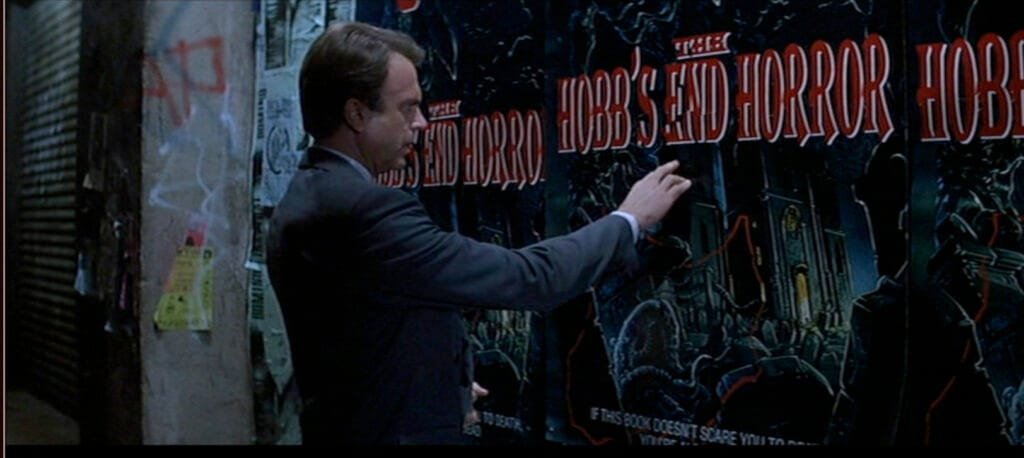
The physicality in the later sequences is something else completely. By then, Trent is fully immersed in Hobb’s End and Neill has thrown off all the confident, coiled energy, replacing it with something raw and exposed. He walks differently and holds his body differently. There’s a very particular quality of wrongness in how Neill carries Trent through the final act; that of a man who no longer fits in his own skin. It’s technical acting of the highest order, and invisible enough that we don’t consciously notice it, but powerful enough that it builds a deep unease.

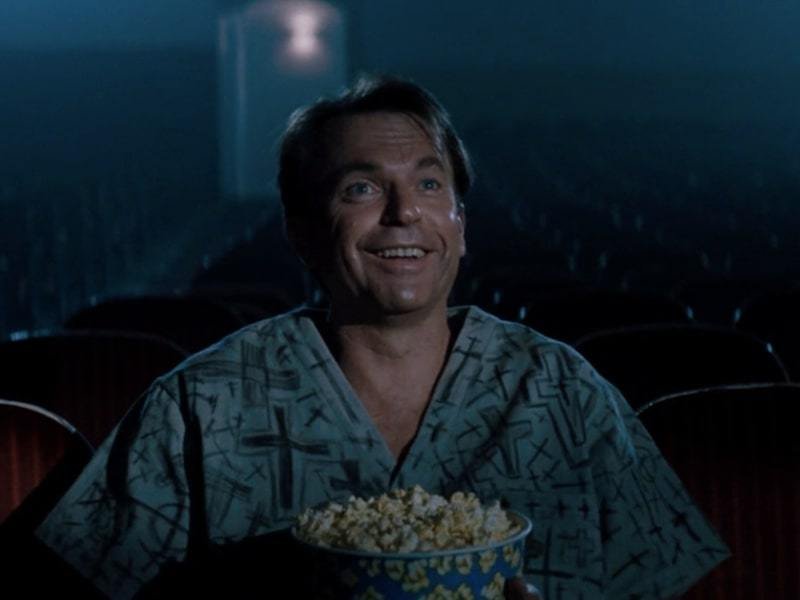
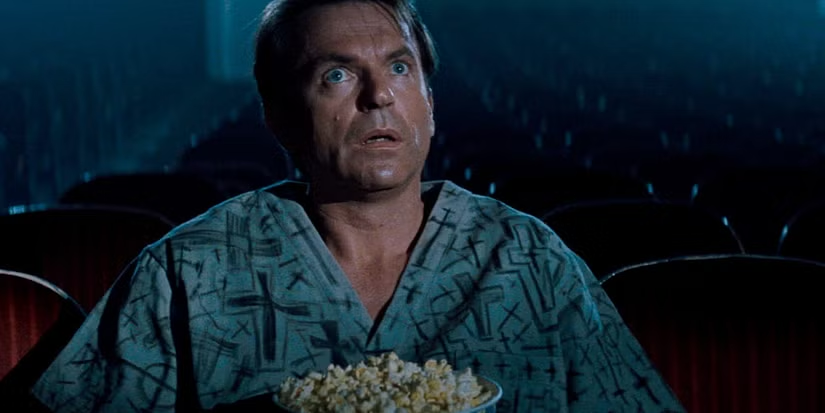
The framing device of the movie, Trent in a padded cell explaining his story to Dr. Wrenn and finally walking the deserted streets, is where Neill gives what might be the single most quietly devastating moment in the trilogy. The laughing in the cinema. It starts as a regular movie-crazy laugh but keeps going, changing character and becoming more genuine and more terrible. It’s the laugh of a man who has finally understood the cosmic joke and found it honestly hilarious. The laugh of someone for whom sanity is no longer an option. Neill holds it for a little longer than is comfortable and in doing that, changes what could have been a cliché into something which feels like a real emotional truth. It looks like when someone totally comprehends their own irrelevance in the face of cosmic indifference. It looks like that laugh.

“You can’t leave: she won’t let you…”

Event Horizon, then, is a movie which has been vindicated by time in spectacular fashion. When it was released in 1997, it received reviews ranging from merely dismissive to openly hostile. Critics called it derivative; a haunted house movie in space – as though that was an insult. And at the time, Paul W.S. Anderson wasn’t yet a director whose name commanded real attention. Around thirty minutes were cut by the studio prior to the movie’s release, and the damage that caused to the narrative coherence of several key sequences is still plain to see, scar tissue on an otherwise excellent body of work.

And yet. Here we are, twenty-nine years later, and Event Horizon is regularly described as one of the defining horror movies of the decade. Why? Certainly because of the ideas; the notion that a dimension of pure evil could exist alongside our own, accessible with some advanced mathematics is one of the best unsettling conceits in modern sci-fi horror. Absolutely because of the production design too, the interior of the ship full of Gothic overtones and a central gravity drive that looks like a medieval torture device remain one of cinema’s greatest sets. But mainly and definitively because of Sam Neill.

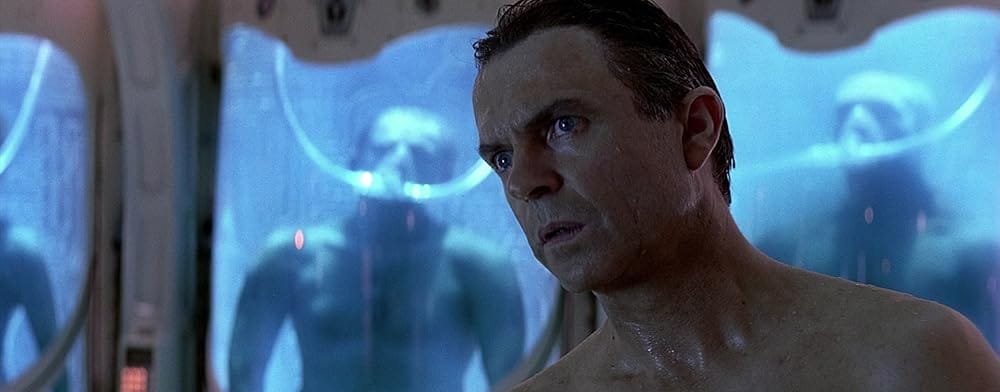
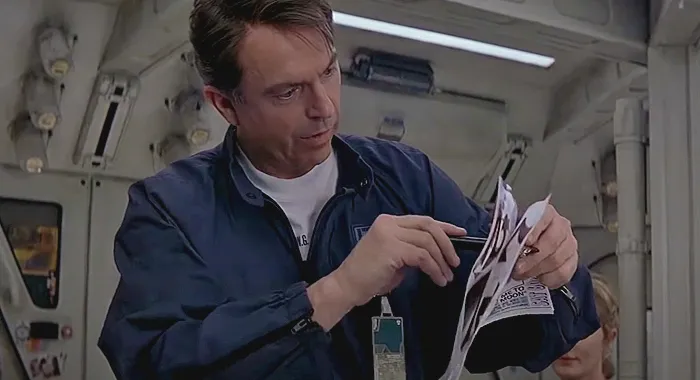
His Dr. William Weir is the most complex character in these three movies, and Neill’s performance here is the most technically demanding. Essentially, what he has to do is play three versions of the same man across the movie’s runtime and has to make each one feel like the natural and terrible consequence of the one before. His first Weir is a man totally hollowed out by grief; his wife’s suicide haunts his every interaction; every quiet moment and every time Neill lets the professional surface slip just a little, we see how enormous the absence beneath is. Neill doesn’t play the grief as distraction, but foundation. Weir can’t separate his obsession with the Event Horizon from his loss, as the ship represents something more than scientific achievement. On some level, it represents the doorway back to the person who is no longer there.

The second Weir, beginning to hear and be influenced by the ship and slowly being unwound by whatever is inhabiting it, is where Neill’s physical work becomes extraordinary. He uses a quality of listening that is seriously unnerving. He starts to become attuned to sounds and suggestions nobody else can hear and Neill plays this not as an obvious distraction, but more like a terrible attentiveness. He becomes more present as the ship starts to take hold of him. More alert and focused. The wrongness of this is near impossible to articulate, but impossible to miss.

Then we have the third Weir. The sequence where Weir reveals himself, eyes ripped out, covered in gore and speaking with an awful calm about what he’s seen and where he’s going, is truly one of the best horror performances of the decade. By this point, Neill is operating on a totally different register than anyone else on screen. Laurence Fishburne is genuinely excellent in this movie, but following Weir’s transformation Neill acts him off the screen every time they share it. Neill has found something in Weir’s corruption that Fishburn’s Captain Miller can’t access: a kind of ecstatic peace. The most frightening thing about this third Weir isn’t the violence or supernatural wrongness. It’s his serenity. He is a man who has found, in a dimension of pure evil, the answers to all the questions grief raised in him. It’s a horrible kind of love story. The ship gave Weir his wife back, and he has decided that the terms were acceptable.

“Where we’re going, we won’t need eyes to see.” Neill delivers this perfect, horrible line with the gentle tone of a man offering directions. It’s the line that haunts the trilogy, and afterwards, us. And I think it works exactly because of the three movies in this unofficial trilogy: because we watch Neill play control, then watch him lose it, and now we understand what it looks like when control is gone so completely that even its absence becomes unfamiliar.

What the Sam Neill Goes Batshit Trilogy traces, and yes I’m aware I’ve named it a little flippantly, but I hope all those preceding words have shown that its affectionate and not dismissive, is a meditation on the relationship between intelligence, control, and horror. Damien Thorn is the most powerful being on Earth, and Neill plays his ruin as a natural consequence of the hubris of his certainty. John Trent is the most rational man in any room, and Neill plays his breakdown as the unchangeable fate of anyone who invests too completely in their ability to understand the universe. And William Weir is the most educated man on that ship, but his corruption is played as the horrifying fulfilment of a mind that was simply too large for the reality it had been given.

These performances, I think, are about the limits of the human. They’re performances about what is waiting beyond those limits. And taken together, considered as a body of work and examined with the seriousness they deserve, they are among the most important contributions any single actor has made to the horror genre in the last fifty years.

Sam Neill went batshit three times in three different registers and with three different instruments. The end result is a triptych that tells us a lot about what we fear, about our intelligence failing, or reality shattering, or love becoming the crack through which the darkness enters, than almost any other sequence of performances in the genre. He deserves all of these words.

And probably an apology for the title.

In The Mouth of Madness: Where Fiction Bleeds

By guest contributor Adam Page

Let’s talk about dread. That particular kind which doesn’t make a fuss slamming doors or leaping out from closets. This one seeps. A feeling you get rereading the fine print on a contract you’ve already signed. That sense, creeping up your spine at 2am when you realise the map you’re using is, and always has been, wrong, and the thing that really is out there has been watching you follow it with something like amusement.

In 1994, John Carpenter managed to bottle this feeling. In The Mouth of Madness (1994), on its surface, is a horror movie about a missing novelist. But beneath that surface, and Carpenter is very interested in surfaces and what lies beneath them, in whether the concept of “beneath” even means anything by the end, is one of the most faithful adaptions of H.P. Lovecraft ever committed to celluloid. And that really is incredible, because this movie doesn’t adapt a single Lovecraft story. Not one. It adapts all of them. And adapts the idea of them. It manages to adapt what Lovecraft was actually trying to do, which most moviemakers who’ve tried to put Cthulhu on the screen have completely missed.

H.P. Lovecraft was born in Rhode Island in 1890 and spent the majority of his life in economically straitened anxiety, writing for pulp magazines that paid next to nothing. But at his best, what he did was totally reframe horror. Before Lovecraft, horror was mostly about evil. About things that wanted to hurt you and were opposed to you. Even if you couldn’t defeat them, you could understand them. Dracula wanted your blood, the ghost usually wanted revenge. They are comprehensible desires that can be mapped.

The great innovation of Lovecraft, and it is genuinely great, was to propose that the most terrifying possibility wasn’t that the universe was filled with things that wanted to hurt us. Instead, it was filled with things that had no opinion of us at all. That in the vast cosmic scale, we exist as bacteria in the gut of something unaware and vast. That all our concepts of good and evil, reality and fiction weren’t basic properties of our existence, they were coping mechanisms. Nothing but thin shells of meaning we had built over an abyss that had no interest in those shells and would eventually dissolve them.

His creations: Cthulhu, Yog-Sothoth, the entire squirming collection of Outer Gods, weren’t evil. Evil implies a relationship. They were just other. Just their existence was enough to shatter a human mind, not because they were hostile, but because our fragile human minds weren’t designed to process what they actually were.

This is a real philosophical position. It’s also the most purely terrifying idea in horror literature’s history. And it is almost impossible to put this on screen, because screens need images, images need comprehension, and comprehension is exactly what these creatures preclude.

It’s for this reason most Lovecraft adaptions fail. They show the monster. They give it a shape and teeth and motivation. Doing this, they domesticate it and make it legible. But this betrays the entire project. They make a movie about a big ugly creature and not the dissolution of meaning. John Carpenter understood this.

In the film, Sam Neill plays John Trent, an insurance fraud investigator hired by a publishing company to find their most valuable asset; Sutter Cane, the world’s best-selling horror novelist, has gone missing, right before delivering his final manuscript. We are told that his novels are so viscerally disturbing that readers have been institutionalised, and violence is increasing around those who’ve read them. Early in the movie, a word is used almost casually that you should hold onto: reality. It keeps coming back and meaning less.

Trent is played by Neill with the confident swagger of a man who has never once considered that his mind could be someone else’s real estate, and is a dedicated sceptic. He doesn’t believe in monsters; he believes in insurance fraud. Things that can be quantified. In other words, he is exactly the sort of person Lovecraft spent his written career slowly and gleefully destroying.

Neill is brilliant here; totally underrated in the canon of horror performances. He gives Trent a very specific kind of doomed competence. He’s the sort of guy who figures out angles for a living and has never come across an angle he couldn’t work out. We watch that certainty erode and it’s the central pleasure of the movie.

Trent and Linda Styles, a Cane editor played by Julie Carmen with just the right amount of fraying composure, drive to locate the fictional town where Cane sets his novels, Hobb’s End. It’s a town that, logically, can’t exist as it was dreamt up by Cane. And yet.

Carpenter films Hobb’s End like a memory of New England that has been just slightly corrupted. The streets are too quiet and the angles of the building are subtly and persistently wrong. There’s a scene featuring a cycling child/old man that is one of the most effectively creepy moments in 90s horror. Not because of what it’s showing us, but what it’s suggesting about time and loops and the paper-thin quality of cause and effect.

When we finally encounter him, Cane is played by Jürgen Prochnow in a performance of barely-contained ecstatic horror and he is not a villain in a conventional sense. Instead, he’s something which is more unsettling: a conduit. A man who has discovered, or was shown, or maybe always half-knew that his fiction was transmission. He wasn’t making up the Old Ones, he was writing them into existence. And the act of enough people reading his work was literally reshaping reality.

This is a key Lovecraftian insight that Carpenter and writer Michael De Luca seized on: it isn’t enough to have monsters. You need to attack the framework of knowledge and go after the truth itself.

The central horror of the movie, which Carpenter delivers with almost academic precision, is that the distinction between the novels of Cane and the world Trent lives in has been eroding for the whole runtime, and possibly before it began. Reality is a consensus and belief is a structural material. So when enough people believe in the world of Sutter Cane, Sutter Cane’s world becomes the only one.

This is Lovecraft at full distillation. Not the tentacles or ancient underwater cities, but the epistemology. The idea that what we call sanity is just the brand name on a popular shared hallucination.

In 1994, John Carpenter was in a strange middle period. He was post his imperial phase; Halloween, The Thing, Big Trouble in Little China, etc, and not yet fully in the late career which is still being assessed by critics. In the Mouth of Madness landed between Body Bags and Village of the Damned with a reception so lukewarm, it was almost criminal. Audiences weren’t sure how to deal with it, and critics filed it away with a vague shrug.

They were wrong.

Watch it today and what we notice is the control. Carpenter is a director who knows exactly what he’s doing. The movie uses colour temperature as a psychological indicator. The “real world” of Trent’s frame narrative has the familial desaturated blue-grey of institute florescence, and Hobb’s End slides into a warm, nostalgic palette which makes it more inviting and therefore more dangerous. When they come, the scares are exactly timed. Carpenter has always been a metronome disguised as a moviemaker. And the score which he composed himself (he often does, a gift to cinema that isn’t celebrated enough) is a dread engine that oscillates, melodically simple but complex in its deployment and knowing when to push and when to let silence do the work.

The famous final scene of Trent in the theatre watching his own story on the screen and laughing with the specific hilarity of a man whose last defence against despair has been breached, is one of the finest endings in American horror. Neill plays it not as a breakdown, but more as an arrival. It’s the laugh of a man who has finally understood the joke, and it is everything. The joke is on him, and it started long before he was born. It will continue long after every idea of him has been dissolved.

Roll credits.

What I find honestly moving about In the Mouth of Madness, more than thirty years on is that it was made by people who took Lovecraft’s ideas seriously as ideas. Not as Intellectual Property, or as an aesthetic surface to be raided for tentacle imagery, but as philosophical propositions about the nature of reality and consciousness, and the granite-solid human need to believe we are in the story and not the other way around.

The movie asks a question which it refuses to answer. And that is, if fiction and reality are the same thing, which one do you want to live in? Trent spends the entire movie trying to determine whether he’s a character or an investigator. The formal trick of the movie, with nested realities, stories within stories and the frame which reveals itself as also framed, isn’t cleverness for its own sake. It’s the whole argument. The medium is the message. We’re watching a movie about a man in a movie about a man in a movie. At some point, we have to realise we’re in a theatre, itself a kind of Hobb’s End.

Lovecraft knew that the scariest thing he could tell us about wasn’t a monster, but the size of the darkness outside our circle of firelight, and the possibility, remote but unavoidable if considered, that the firelight was never ours to begin with. Something else has been tending it. And it stays lit for its own reasons.

In the Mouth of Madness is one of the rare horror movies that actually went there, and looked over the edge. Not just at those monsters waiting in the dark, but at the dark itself. How it has shape without form, intention without mind and always the patience of something that has never needed to hurry.

Sam Neill laughs in that theatre. We laugh along with him, because we’re already inside.

Why The Wicker Man was Christopher Lee’s Greatest Role

By guest contributor Adam Page

There is a very particular type of genius which gets buried alive by success, and Christopher Lee probably knew this better than most. For decades, if we thought of Christopher Lee, we thought of a cape, a set of fangs, and two puncture wounds on a trembling ingenue’s neck. Dracula. The role which made him and, if you were to ask Lee in one of his more candid moments, almost unmade him.

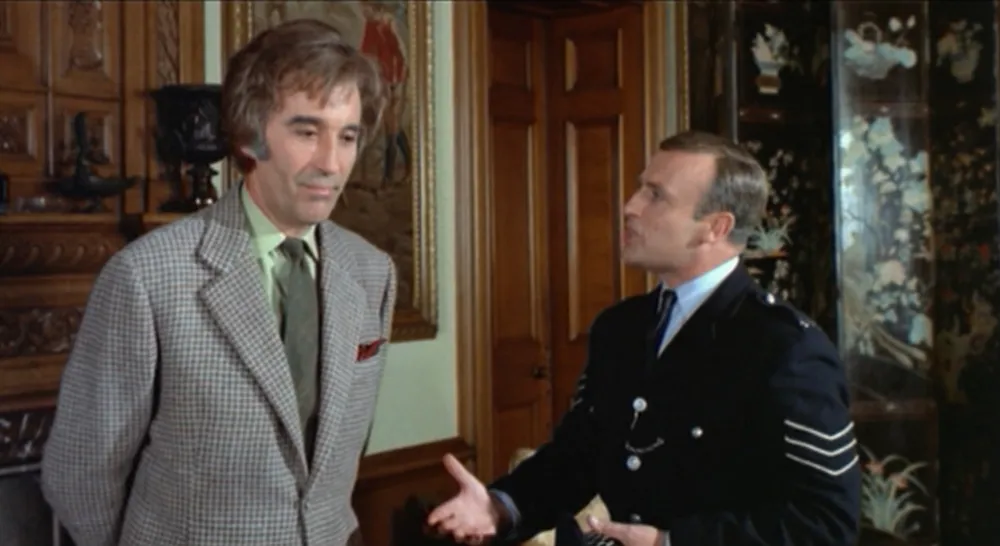
But somewhere in the mists of 1973, on wind-ravaged islands north of Scotland, something happened. Something Lee himself would spend the rest of his long life pointing to and saying: that one. That’s the one. Not the Count, or Saruman the White. Or The Man with the Golden Gun. The Wicker Man. Lord Summerisle. A man who never raises his voice, never bares any teeth, and never threatens you with anything more than a smile and a perfectly poured glass of wine.

And yet.

Let’s set the scene, because context is everything.

In the early 1970s, Britain is embroiled in an identity crisis that would make your head spin. Its fabled Empire is a ghost of itself. The counterculture revolution has soured into something a lot murkier. And British horror, specifically Hammer Horror, has spent almost two decades selling fear as something Gothic, reassuring and very nearly comfortable. With Hammer, you knew where you stood. The monster was the monster. The hero was the hero. Christopher Lee had made a handsome living playing the former and was very, very good at it. But Lee was bored. If you know where to look, you can see it in the later Hammer movies. The weariness behind the red contact lenses. The feeling of a man just reciting lines from a contract he would have loved to shred.

Then along comes Robin Hardy and Anthony Shaffer with a script which was, and I say this with the full weight of a man who has been a horror fan for three decades, truly strange. It wasn’t horror-strange. Or monster-strange. It was strange in the way a folk song is strange. Or in the way the British Isles themselves are strange, if we scratch deep enough beneath the surface of orderly queues and church fêtes.

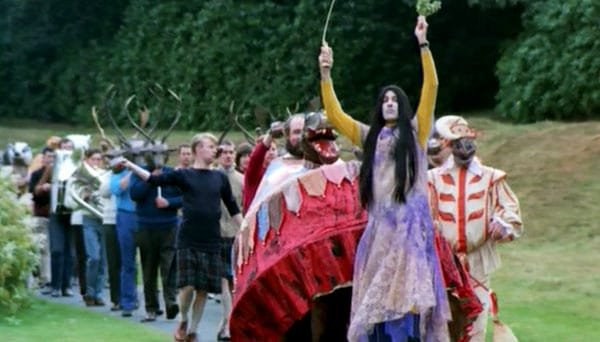
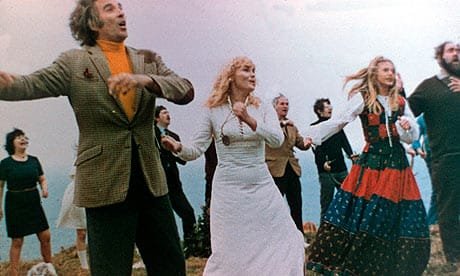
The Wicker Man follows Sgt. Neil Howie, played with Protestant rigidity by Edward Woodward, who is a deeply devout police officer. He arrives on the fictional island of Summerisle to investigate the disappearance of a young girl. He instead finds a community that has completely rejected Christianity in favour of something much older. Something pagan. And something which involves naked women dancing round fires and schoolchildren learning about the phallic symbolism of the maypole with the cheerful attitude of children learning long division.

And there presiding over all of it, with the ease of a man who truly can’t understand why he’s making such a fuss, is Lord Summerisle. Lee plays him as, in a stroke of brilliance, totally reasonable. That’s it. That’s his whole performance. It shouldn’t work, yet it is extraordinary.

Summerisle doesn’t leer or scheme, at least not visibly. He is welcoming, and he is educated. He quotes his grandfather, a Victorian scientist who brought back the island’s agricultural productivity by reviving the old gods as a kind of motivational framework, with real filial warmth. He shows off the harbour to Howie with the pride a landowner has when they are genuinely doing good by their tenants. I would imagine he serves excellent tea. By every surface measurement, he is a perfectly delightful man.

And because Lee plays him like this, resisting every temptation to wink at the audience, or signal his villainy, refusing to give Howie or the audience any purchase on what he really is, Lord Summerisle becomes one of the most quietly frightening villains in British cinema history.

Something I think Lee understood about performance that a lot of actors never quite grasp is, restraint is not the same as doing less. Restraint is doing exactly what the scene calls for and not one thing more. It’s an act of real precision.

Consider Dracula. That role requires projection. He is a supernatural force, and Lee played him as one, with physicality and presence. With those incredible eyes that could go from blank to murderous in half a second. Within its parameters, it’s a great performance. You are supposed to feel the threat. The makeup, the sound, the camera, they all conspire to tell us: this is the danger.

In The Wicker Man, there is nothing to tell you that. You have to figure it out for yourself.

Lord Summerisle’s danger is totally architectural. It lives in that structure he has created on the island, in a belief system he has either cultivated or cynically maintained. And, brilliantly, the movie never completely resolves which one it is. Is Lord Summerisle a true believer? Or is he just a pragmatist who discovered the old gods are good for the apple crop and goes along with it? Does he feel anything when the fire climbs towards Howie?

Lee keeps all these questions genuinely open. Every scene is played as though Summerisle himself considers them the wrong questions, or at the very least, unanswerable ones. There is a scene towards the film’s end where Summerisle tells Howie the crops will be good next year, and he says it with the confidence that is either serenity of faith, or the denial of a man who has maybe made a huge mistake and can’t afford to examine it too closely. Lee gives us nothing to resolve that ambiguity. He just inhabits the certainty and lets us decide what its made of.

That is not Dracula. That is not Saruman the White, who is basically Dracula with a staff and better dialogue. It’s something rarer and harder: a performance which trusts the audience to do some of the work.

Lee was hugely vocal on his feelings about The Wicker Man. In countless interviews across the decades, he went back to it, calling it the finest British horror movie ever made. He called Lord Summerisle his best role. And coming from a man with his filmography; close to 300 movies and 61 screen deaths (both Guinness World Records) that is more than a simple throwaway comment. That is a deeply considered position.

And so, why? What did he see in Lord Summerisle that he didn’t see in the Count?

Part of it, I think, is authorship. By the time Lee was done with it, Dracula had become a franchise. The character had existed before him, and would exist long after. Contractual obligations were involved, along with the commercial needs of Hammer and the slow, grinding machinery of sequels. It was work. It may have been skilled and often genuinely inspired work, but it still seemed like work nonetheless.

Lord Summerisle he created. There was no template. The screenplay from Anthony Shaffer may have given him the scaffolding, but the man living inside that role, the flavour of his conviction, his specific charm, and the warmth that seems to make everything a little worse, that was all Lee.

There is also the question of intelligence. There is no doubt that Lee was a genuinely erudite man. He spoke multiple languages, and was a serious student of history. He had served in military intelligence during the Second World War. He was not, it can be safe to say, a man who found deep satisfaction frightening people just for the sake of a production company’s quarterly returns. He was clearly interested in ideas, and Lord Summerisle is a role created entirely from ideas. Ideas about reason and faith and the nature of belief. What it means to build a community around a mythology you might or might not personally endorse, and the violence that is found in even the most pastoral-looking systems of thought.

At its core, The Wicker Man is a movie about two types of certainty colliding. Howie’s particular brand of Christianity is judgemental and rigid, seemingly uncomfortable in its own skin. It makes him cruel in small ways, despite the fact it gives him genuine moral courage. The paganism of Summerisle is joyful and fluid, seemingly inclusive. But he doesn’t hesitate to burn a man alive when the harvest calls for it. Neither of these worldviews comes out clean, and both are shown to contain their own forms of terror. Lee clearly understood this. He plays Summerisle as a man who has really thought about these things, not as a bland antagonist, but as someone with a philosophy, no matter how monstrous that philosophy eventually proves to be.

There’s a moment towards the very end that always lingered with me. The Wicker Man is about to burn, and Howie is trapped inside, praying and singing and dying. The islanders are about to sing too, Sumer is icumen in, a middle-English song so old it pre-dates the Black Death. Their folk hymn will rise to meet his, two strands of devotion colliding in a cold Scottish sky. Summerisle stands apart, watching, his hair whipping in the wind.

Lee plays the scene almost completely internally. There is a fleeting look across his face which the camera catches. It isn’t triumph exactly. It’s more complicated than that. Doubt perhaps, or reverence. Or maybe just the expression of a man who has just set something irreversible in motion and it watching it complete itself. It lasts for maybe three seconds. It tells us almost nothing conclusively. It stuck with me for years.

Dracula certainly never gave Lee a moment like that. At the end, Dracula is always defeated; he is comprehensible and containable. Summerisle stands singing on that cliff edge in the wind, and the movie ends, and we still don’t know exactly what he is.

Famously, The Wicker Man was butchered on its release. It was dumped as a B-movie. Director Alex Cox joked (?) that the original negatives had “ended up in the pylons that support the M4 motorway.” It took many years for the movie to find its deserved audience. The Wicker Man is genuinely and uncommonly good. And at its centre is a performance by Christopher Lee that gets better on every viewing.

Christopher Lee played Dracula nine times. He was the villain in a Bond movie, a Star Wars movie, and in a fantasy trilogy that made more money than some nations’ GDPs. By any metric imaginable, he was one of the greatest monsters of 20th century cinema. But the role he pointed to, over and over, until the end of his life, the role he wanted on the record as his finest hour, was a man who warmly hosts you, pours you a nice drink and shows you the apple orchards. Then, when the calendar calls for it, burns you alive.

I think there is something poetically appropriate about that. A man who spent decades frightening people found his greatest performance in a man who never frightens anyone. Right up until the moment when it’s too late to matter.

That is craft. That is the difference between a career and an art form.

I have a feeling the gods of Summerisle would approve.

The Last Thing He Saw Was Everything: X: The Man with the X-Ray Eyes and the Lovecraftian Abyss


By guest contributor Adam Page

There is a certain kind of dread, and it’s one that has nothing to do with jump scares or monsters or chainsaws. It doesn’t announce itself; it quietly seeps in, until suddenly things are very wrong. Roger Corman knew this in 1963, probably by accident, the way most great things are understood, when making X: The Man with the X-Ray Eyes. He was working on a low-budget science fiction movie with Ray Milland and an AIP budget that wouldn’t cover the craft services on one of today’s studio movies. Instead of the modest exploitation thriller he had intended, what he created was one of the most quietly frightening movies of the 20th Century. It’s a Lovecraftian nightmare wearing a lab coat, blinking at us through the carnival sideshow lights and asking that question serious people have always been too comfortable to ask: What if you could see everything? Would you survive?

The answer, of course, is no. Obviously no. What were you thinking?

“I’m curious, intensely curious…”

Dr. James Xavier, played by Milland with the quiet dignity of a man who is aware he’s being nibbled to death by the universe, is a research scientist with the belief that human vision is unnecessarily limited. He develops eye drops with enzymes and hormones, allowing him to expand the visual spectrum. Because this is a Roger Corman movie, and also how tragedy works, he tests the drops on himself.

At first, it’s incredible. He can see through buildings. He can see through clothes, which the movie handles with all the leering restraint of a Times Square peep show but also, somehow, with a real philosophical unease. He wins at cards, and becomes a faith healer at a carnival, able to guess illnesses with unnerving accuracy as he can literally see through the skin to the rot beneath. But if you wait long enough, every gift reveals its invoice.

The drops keep working and the spectrum keeps expanding. And we discover what lies beyond the limits of our ordinary human perception isn’t more of what we already know, enhanced and filtered. What lies beyond is something else completely.
Something which shouldn’t be looked at.

Something which is looking right back.

H.P. Lovecraft spent the majority of his writing life articulating a very specific theological concept, which is: the universe isn’t hostile to human life. Hostility has an implication of awareness. The universe is indifferent to human life, and what is lurking in its deeper geometries operates on scales and with motivations so totally incomprehensible that upon genuine contact with them, the human mind simply shatters. Goes dark, and folds in on itself like a collapsing star.

Lovecraft called this cosmic horror, and it’s a very precise term. It isn’t the horror of the monster under the bed. It’s the horror of the realisation that there is no bed. Or room, or house, or planet. Just an infinite black void, with something incredibly huge moving in it that hasn’t noticed you yet. But when it does, your noticing will have been the worst thing that’s ever happened to you.

Whilst Corman was a Lovecraft reader and did adapt some of his work for the screen, X: The Man with the X-Ray Eyes isn’t one amongst those projects. However, X: The Man with the X-Ray Eyes is Lovecraftian to its bones, in the very specific shape of its horror. Because it knows that the really unbearable thing isn’t the monster. The unbearable thing is the knowing.

Xavier doesn’t get devoured and his discovery doesn’t kill him. He is destroyed by the simple, unfiltered fact of what the universe really looks like when the merciful limitations of our ordinary human perceptions are removed. His experimental eyedrops don’t give him power. They rip away his protection. They take away the necessary and beautiful lie that our world ends at the edge of what we can see.

In terms of an ending, which is either the greatest or most disturbing ending to a B-movie ever committed to celluloid, depending on your tolerance for the abyss, Corman’s instincts here are truly brilliant. After Xavier’s experiments go wrong, after he accidentality kills a colleague and flees into a sort of hunted, half-insane existence, he shows up working in a carnival. He has become a mentalist. Mentalo, he calls himself. It’s a name which should be funny but somehow isn’t.

He sits hidden behind a curtain, telling people what’s wrong with them. He spots a young girls broken ribs, he tells an old woman that the lump in her back is nothing, but he knows she is beyond his help. The audience claps, delighted. They think it’s all a trick.

This is the part of the movie I find the most devastating, and also the most true to the Lovecraftian tradition. Because reading Lovecraft, knowledge is never empowering. It becomes contaminating. His scientists, scholars and explorers who discover the truth about the universe don’t become gods. They become patients or corpses. Or they become the sort of person who can no longer share a room with others without frightening them. On his carnival stage, Xavier is Lovecraft’s archetypal knower; possessed of knowledge that can’t be communicated, which separates him entirely from the safe ignorance of all those around him, knowledge he would give anything to un-know and can’t.

He can see everything. He can see through the tent, and through the whole town. We now understand, he can see further than any human eye was ever meant to reach. He is completely and utterly alone.

“There are great darknesses. Farther than time itself…”

Ray Milland is brilliant in this movie. He had won an Academy Award for 1945’s The Lost Weekend, playing a different sort of man destroyed by a substance he couldn’t stop using. That movie dealt with alcoholism. This movie is about something stranger, and it could be argued more honest. The alcoholism of pure perception and the addiction of seeing more than is good for you, that inability to close your eyes even if closing your eyes would save your life.

Milland plays the disintegration of Xavier with a restraint which becomes its own sort of terror. He doesn’t chew on the scenery. Instead, he stands very still, watching things we can’t see and let’s his face do the work. There are scenes where his eyes, fitted with hideous gold and black contact lenses, lock onto something off-camera and we feel, really feel, that whatever he’s seeing would kill us to see. That’s acting. That’s craft from a man who understood the assignment even if nobody told him.

By the final act of the movie, Xavier is barely there in any human sense. He moves and speaks, pleading for help. But already he’s gone to where the rest of us can’t follow. He’s seen too far and the co-ordinates of his mind are no longer any we can share.

Xavier is at his absolute nadir. He is haunted, hunted, half-mad and seeing through everything. He can no longer stop. He stumbles into a revival tent, where a preacher is working the crowd. Xavier yells out in the voice of a man who has been watching the universe slowly kill him for the whole runtime: I can see! He means it as both confession and curse. He’s seen too much and can’t stop. Someone has to make it stop.

The preacher is a man of God, and therefore intimately aware of the Biblical solution to this sort of problem. He quotes from the Book of Matthew: if thine eye offend thee, pluck it out.

Xavier rips out his own eyes.

End of movie.

In various Q&As, Corman has claimed there was a brief discussion about adding another shot after this: a shot of Xavier, eyeless and screaming I can still see! Still seeing something, without his eyes, because what he’s perceiving now has nothing to do with physical eyes. It was cut for time, or budget, or maybe the fact it would have been too much for a 1963 audience. A little too much, even now. But the implication is hanging in the frame like smoke. The eyes were never the point; they were just the door. And that door is now open. It won’t close.

That is pure Lovecraft. The protagonist won’t survive the revelation. He can’t integrate it or become stronger from it. The knowledge wins, because it always does. The universe is under absolutely no obligation to be compatible with human sanity.

What I always found interesting about cosmic horror as a genre, and I think Lovecraft and Corman both understood it in their different ways, is that it isn’t really about the cosmos. It’s more about the limits of what we can endure knowing.

The story of Xavier is the story of anyone who has seen something they can’t un-see. The doctor who knows what the diagnosis is, but can’t explain it to the patient in a way they will accept. The person who knows, on a basic level, that the structure of their life is hollow, scaffolding over nothing and has to keep on getting up and making the coffee and going to work because what’s the alternative? Or the addict who can see with horrible clarity both the destruction and path back but goes for the bottle anyway because unmediated clarity is its own kind of unbearable.

We have perceptual limitations and we wear them like insulation. As Lovecraft himself wrote, ‘The most merciful thing in the world, I think, is the inability of the human mind to correlate all its contents’. We can see only a thin band of the electromagnetic spectrum, and thank God for that, because the rest of it would give us madness and cancer in pretty much equal measure. We perceive time only in one direction, and can only hold a certain amount if things in our consciousness at once. These aren’t deficiencies, they’re load-bearing walls.

Xavier takes away those load-bearing walls, but seems amazed when the house falls down.

X: The Man with the X-Ray Eyes is sixty-three years old now. It looks cheap because, like the majority of Corman’s work, it is cheap. The special effects are dated and the psychedelic light show that is Xavier’s expanded vision has the lo-fi quality of a high school laser show. But none of that matters. What Corman made and Milland acted, and what writers Ray Russell and Robert Dillon put down in a script that shouldn’t have been that smart, is a movie that still earns its dread.

It does so because it asks the right questions. Not what’s out there in the dark, which is what horror movies usually ask, but what does it cost to know, and that’s the question that will keep you up at night. At its core, the Lovecraftian tradition is a meditation on epistemology; the relationship between knowing and surviving. On the distinct possibility that when reality is undiluted, it’s incompatible with human life.

Xavier stands in that carnival tent with his destroyed eyes, having seen the centre of the universe and what is nesting there. Something, Corman implies without actually showing, that is looking back, and the only thing left for him to do is the only thing he can’t do. Stop looking.

Huesera: The Bone Woman (2022)

By contributing writer Chris Ward

Valeria (Natalia Solián) is a young woman trying to start a family with her husband Raúl (Alfonso Dosal). After visiting Monumental de la Virgen De Guadalupe – a large statue in Chalma, Mexico, sculpted in 2017 by artist Víctor Gutiérrez – with her mother and her aunt, Valeria discovers that she is pregnant, so the happy parents-to-be begin to plan for the arrival of the new baby.

However, after witnessing one of her neighbours jumping from their balcony and smashing their bones on the road below, Valeria starts to see various faceless people with distorted limbs in and around her apartment. Initially putting it down to stress and malnutrition, she begins to experience various disruptions during the pregnancy, including a sordid lesbian affair with an old flame, a babysitting incident involving her sister’s children and a fire in the baby’s new cot, but as her visions start to get more real, Valeria discovers that motherhood may not be the joyous event she thought it would be.

Huesera: The Bone Woman is one of those psychological horror movies where everything is a metaphor, probably with several interpretations, and is not to be taken literally. So far, so very modern horror, but for her debut director Michelle Garza Cervera has crafted a movie so meticulously put together that every shot is an important part of the story, with not a frame wasted, and we, the audience, are going to get more out of it than just jump scares and one or two gratuitous body horror shots.

Essentially, the movie is exploring the darker side of motherhood – the bits they don’t tell you about in antenatal classes – where not only is your body going to change but so are your perceptions, your feelings and, in extreme cases such as this, your whole persona. Natalia Solián gives an incredibly strong performance as Valeria, a character caught between wanting a certain future, until she is given it, and then trying to relive the past to escape it. In her youth she was a punk, and through flashback we see her with her girlfriend Octavia, living a carefree life as young, anti-authoritarian youths do, only to come back to the present where her grown-up self is doing the things expected of young adults once they’ve supposedly gotten through their rebellious phase.

We get to hear stories of Valeria’s past, mostly from her sister who delights in putting Valeria down in front of their family, and this simmering hostility is manifested when Valeria offers to babysit her young niece and nephew. Valeria is already having problems disciplining the children, and when she has a vision of a deformed intruder in the house she goes into panic mode, grabbing the already distraught children and acting maniacally, thinking she is doing the right thing by protecting them. You can see where this particular plot thread is heading whilst it is happening, because Huesera: The Bone Woman is not a movie that breaks any new ground with its metaphors, but it plants little seeds along the way to make the whole more effective.

The heart of Huesera: The Bone Woman is a psychological profile of a woman going through physical and emotional changes that don’t always connect to her needs, and Michelle Garza Cervera frames this with a body horror approach where we get to see bones breaking and protruding from the skin, but curiously we don’t get to see much of Valeria’s swollen belly or the birth itself – no doubt if this had been made by, say, David Cronenberg we would have seen all sorts of bodily fluids accompanying deformed flesh – and whilst these images are unsettling in themselves, the sound of cracking bones accompanying them is just as – or even more – disgusting. But there is also the suggestion of possession, and by the final act we get to experience the folk/occult angle that had been present throughout – and represented by Valeria’s childless aunt (and that detail is important) – making the climax of the movie more potent than most movies of this ilk, throwing a disturbing red herring into the mix before Valeria’s ultimate – and inevitable – fate is revealed.

This limited edition Blu-ray comes with an audio commentary by film critic Kat Ellinger and video essay by critic Anton Bitel, both of which are worth absorbing to heighten your enjoyment, although it is recommended to watch the movie on its own first. Arrow have also included a collector’s booklet featuring essays by Kat Hughes and there is exclusive artwork by Colin Murdoch, so it isn’t a loaded package, but what is included is definitely valuable to the viewing experience.

Overall, Huesera: The Bone Woman is a very interesting movie in that it isn’t particularly original – anyone who has kept up with the psychological/folk/body horror-for-metaphors movies that mainstream Hollywood and the streaming services have been consistently knocking out for the past few years will be very familiar with its narrative structure and uses of horrific imagery – but it is put together in a way that subsequent viewings will bring more and more out of it. Yes, the metaphors are obvious and do hit you over the head a bit, but the movie looks fantastic, features committed and daring performances and is so obviously a labour of love from the director that it never feels like a chore to sit through, because there are no cynical cash grabs at work here. This is art, and how joyous it is to watch it work as well as it does here.

Huesera: The Bone Woman is available to pre-order from Arrow now.

Double Feature: Pearl (2022) and Maxxxine (2025)

By guest contributor Chris Ward

So here we have two parts of a trilogy originally released during the past three-or-four years getting a boutique 4K UHD re-release by Second Sight Films, and why not, because Second Sight have also put out the bulk of the director’s back-catalogue in a similarly lavish fashion over the past year.

That director is Ti West and the trilogy has affectionately come to be known as the X trilogy, because the first movie in the trilogy is called X. However, that movie is not part of this release cycle, because region licensing and rights issues dictate that the Blu-ray release from 2022 is all we are allowed to have here in the UK, so if you are a fan/collector with OCD about having all the movies in a series on the same format with similar packaging so it looks neat and ordered on your shelf – as is this writer – then you are just going to have to be patient and hope that a 4K UHD upgrade will be forthcoming somewhere down the line.

However, this predicament is not quite so triggering for me, as I found X to be something of a disappointment, for not only was the plodding pace completely at odds with the (obvious) Texas Chain Saw Massacre aesthetic, but for a movie about porn stars making a porno in a secluded farm setting, the movie was remarkably sexless; yes, there were sex scenes and nudity, but they were just sort of there, filmed blandly and without any excitement, as if Ti West just filmed a few topless shots of the female actors because the movie was set around the porn industry.

But the word ‘sexless’ doesn’t just apply to the sex, because the kills were shot in the same perfunctory manner, the thin plot trying to evoke 1970s grindhouse but the modern retro production not giving the movie enough grime, enough grit, enough… well, sex, in all its colloquial meanings. And don’t get me started on the old-person make-up on the younger actors – worth mentioning here because Mia Goth plays the young porn star Maxine Minx and also the elderly Pearl, who would so dearly love to be young again, but the lighting isn’t friendly to the prosthetics and it looks comical.

But X proved popular with audiences, and Ti West wasted no time in getting another movie in that universe released, that movie being Pearl (2022), but instead of a sequel – because, considering how X ended, what would be the point? Hold that thought… – we got a prequel, concentrating on Pearl, the deranged octogenarian who still wanted to be adored, despite her age-ravaged body in X.

In this movie it is 1918, and Pearl (Goth) lives on the same secluded farm we saw in X, only here it isn’t run-down and old. She lives on the farm with her strict German mother Ruth (Tandi Wright) and her wheelchair user father (Matthew Sunderland), who is suffering from an undisclosed disease that means he is unable to move or communicate, and as Ruth takes care of the farm, she leaves most of her husband’s care to her daughter.

However, Pearl is not quite in full control of her emotions, and while she waits for her husband Howard to come back from service in World War I she dreams of becoming a star, singing and dancing on a stage to be adored by the whole world. While she has fantasies of stardom, she takes out her frustrations on her helpless father, abusing him when she thinks her mother is not watching, and after a sneaky visit to the cinema whilst collecting her father’s medicine, she befriends the projectionist (David Corenswet) who shows her the stag film A Free Ride, fuelling her passion and encouraging her to chase her dreams. A falling out with her mother and an impending audition trigger Pearl’s descent into madness, as she chases her dreams with violent anger and murderous rage.

Right from the off you can see that Pearl is a different movie to X, because here the titular character is young and fresh-faced, and so the setting matches it, drawing visual inspiration from the Technicolor stylings of The Wizard of Oz and Mary Poppins. It is a very bright and breezy movie whose look reflects the innocence of Pearl before the gradual unwinding of her mind, although straightaway we can see that Ruth does not like her daughter, for not only is she cold and emotionless – which is understandable, given her husband’s illness and what she must do on a daily basis to keep the farm going – but she is aggressive and unpleasant towards Pearl, hinting that the events of this movie are not the first displays of odd behaviour she has witnessed.

But unlike X, Pearl is a character study, a glimpse into what made the elderly crone into the sexually frustrated and murderous old hag she became, and the seeds are all sown here in a script co-written by Ti West and Mia Goth, which is the biggest strength of the movie as Goth truly inhabits the character on the screen, reflecting her input. Had Pearl been written solely by West, or by him with an outside collaborator, the nuances that Goth brings would likely not be so obvious; the furrowing of the brow during certain dialogues, the glint in her eye whenever she starts daydreaming about being a star, and the realisation that a genre icon is being created on the screen in both looks, personality and execution of the script. You can see Mia Goth’s ascent to stardom through the character of Pearl and her gleeful demeanour, and it gives this movie a soul.

Which is what blunts the edge a little, as we know where this character ends up, and rewatching X in preparation for this review meant I went from what is really a very silly homage to the 1970s with a bit of off-kilter weirdness to mask the lack of tension, to an origin story that, like the titular character, has a few issues but by the end of it made me want to see what happened to her next, except I already knew and didn’t really like it. The curse of the prequel strikes again.

No matter, though, because there was one more outing to be had within this universe and in 2024 we got Maxxxine, a direct sequel to X (told you) which starts out with a problem – this movie is set in the 1980s and does not feature Pearl, the most interesting character in the series. Mia Goth returns to the role of Maxine Minx, the young porn star from X, and we are now in 1985 where Maxine is 33 years-old and very aware that her career in adult movies only has a limited time left, so she is desperate to break into mainstream movies and become a star.

However, the jump from porn to Hollywood is not an easy one to make and so Maxine is cutting corners slightly by auditioning for a horror movie, which may not get her many awards but it is a ‘legitimate’ movie. While this is happening, there is a serial killer operating in Hollywood killing off young starlets, and when the trail begins to lead to Maxine, it threatens to expose her sordid past.

There is a lot to unpack in Maxxxine, with it being a movie about making movies made by people who make a lot of movies, and so there is always a commentary underpinning every action and character decision, with the overall message being ‘Be careful what you wish for’, a message that has, ironically, been made hundreds of times over by other filmmakers who make movies within that system. That said, as an audience, we are viewing this in more enlightened times, when we know what the Hollywood stardom dream costs and, thanks to many scandals that have come to light in recent years, we can watch it knowing that no good will come of it.

And essentially, that is what makes Maxxxine a less successful movie than Pearl, because we can see how it is all going to play out – Ti West drops plenty of hints throughout, none more obvious than the opening scene of a young Maxine being filmed dancing by her very creepy preacher father – with an ending that is very telegraphed and, like X, lacks any suspense or tension.

Unlike X, however, what Maxxxine does do brilliantly is replicate the period setting, from music cues that include ZZ Top, John Parr, Judas Priest (kudos to Ti West for not using one of the ‘hits’, but instead going for a lesser-known bonus track) and Kim Carnes to the fashion choices – not characters wearing fluorescent socks, listening to Sony Walkmans and skating around on roller boots, which is usually the quick movie language to let us know what decade we are in – and it doesn’t feel like a parody or contemporary actors cosplaying. Okay, the cameras are better and the image sharper, but for all intents and purposes, this is 1985 and it does feel wonderful to be back (some of us remember it well).

Being set in the 1980s, there is also the all-important slasher movie vibe and it is there, although black-gloved killers are more 1970s Italy, but this killer is more brutal and the gore effects are superb. Speaking of Italy, there is also a heavy Dario Argento vibe throughout, as the neon of the 1980s pops out against the run-down strip clubs that would have been thriving in the 1970s but were in need of some TLC come 1985. Argento’s visual heyday may have been a few years before this movie is set, but you cannot mistake that influence and the image of new, colourful lights over old, rotten brown wooden doors and windows is a definite nod.

But it isn’t just the strip clubs in need of TLC, because Maxine Minx herself is a woman with issues. The trouble I had with this movie, though, was that I didn’t really care enough about her. Pearl worked because it focused on the one character from X who had a story to tell, and after going back to 1918 to see how that character came about, jumping forward to focus on someone who was very one-dimensional and not particularly likeable didn’t feel like it was warranted.

The character of Maxine Minx was obviously going to be a bit different in this movie, when you consider what she went through in X and where she is now, but Mia Goth just doesn’t seem to inhabit Maxine like she did with Pearl. Yes, the actor was cast to play both roles so we could see a throughline not only in their lives but also with their features, allowing some sort of twisted continuity – they are not the same person but they have the same motives – and whilst she does have plenty of 1980s strong female attitude, something just doesn’t quite work as well as it did in the previous movie. Ti West gets a sole writing credit for this movie, as he did with X, so that should tell you something.

Whatever the merits of each movie, one thing that shines through is Second Sight’s consistent quality, as both of these movies come loaded with plenty of supplementary material, most of which consists of cast and crew interviews and video essays that delve further into what each movie represents. Pearl comes with an audio commentary by Alexandra Heller-Nicholas and Maxxxine with one by Bill Ackerman and Amanda Reyes, both of which are worth your time for fresh perspectives, and if you are lucky enough to get the limited editions, then both movies come housed in gorgeous rigid slipcases boasting new artworks, art cards and 120-page books containing essays from various academics. Presented in Dolby Vision with Dolby Atmos audio, these movies do look fantastic, with Pearl looking especially vibrant with its Technicolor-inspired colour grading, and it is very difficult to pick fault in either movie based on visuals. If you are a child of the 1980s and have a decent soundbar/surround sound system, then Maxxxine is best viewed with the volume cranked up, if nothing else because the soundtrack is ace.

So that was my revisiting of this trilogy, and it is a trilogy from which I did not particularly like any of the movies when I saw them upon initial release. On this viewing, X is still a mystery to me – and I say that as a lifelong fan of 1970s grindhouse – but that movie is not the focus of this review. However, Pearl shot up in my estimations as I finally ‘got’ Mia Goth as that character, I finally linked the troubled young woman onscreen to the old hag from X and despite a few pacing issues, the movie worked as an origin story for a character that has more stories to tell.

As for Maxxxine, the 4K UHD presentation helped in making the movie look and sound amazing – the best it will likely ever be – and when the violence is happening it is a nasty movie, but trying to make a character piece about a character that isn’t really that interesting when the actor is not as invested as they were previously means the movie drags to a conclusion that is fairly underwhelming and obvious.

Still, I liked it more on a second watch, so maybe future viewings will unearth more treasures. Maybe I should view them in chronological order next time, but going in knowing the best movie is first means diminishing returns by the time I get to Maxxxine. These movies are clearly a labour of love for Ti West, and hopefully one day we will get a 4K UHD release of X to complete the trilogy in that format. By that point, I may be able to grasp that certain ‘X factor’ that isn’t quite working for me, but until then, Pearl remains the gem of the trilogy and this stunning edition may just be the best looking 4K UHD disc we have seen from Second Sight thus far.

You can find out more about the Second Sight release of these titles, including ways to purchase, here.

You can also find out about Chris’s published work here.

The Man in the White Van (2023)

By guest contributor Anna Pease

I began watching The Man in the White Van (2023) with high hopes that it might be a grimy 70s exploitation style ode to true crime – specifically something akin to Chuck Parello’s 2004 film The Hillside Strangler, which faithfully portrayed the crimes of cousins Angelo Buono and Kenneth Bianchi with a seedy gruesomeness that left the viewer feeling in need of a shower. Lawrence Bittaker aka the Toolbox Murderer drove a van; maybe it’s about him? I wondered; nope; try again. The Man in the White Van, despite its claim to be based on true events, has absolutely nothing to do with true crime in the 70s. How disappointing!

What it is about – and I use this term loosely since the plot is rather threadbare – is a girl in her late teens called Annie, who lives in an impossibly massive house in the countryside and rides around on her pony, Rebel. Get it? Rebel, because she’s a rebel! Although, presumably not in a confederate Dixieland racist way, because she vibes with socially progressive southern rockers like Neil Young and Creedence. Annie’s conservative family have had enough of her tomboyish behaviour and are absolutely over her stinking of horse. This is particularly irksome to her older sister, a debutante who is obsessed with having a private phone extension in her room, but slightly more tolerable to her gun crazy little brother who yearns to “protect the homestead” and thinks his sister Annie is a rootin’ tootin’ modern day Davy Crockett. Amid this homage to The Sullivans – where god-fearing folk go to church on Sunday (even Annie, and she has to wear a dress like a girl! Yuck!) there is an ominous white van around, which appears to be following and kidnapping young women to fulfil nefarious means.

The van is particularly innocuous: it’s basically a shagged old white van that a painter and decorator or window cleaner might use, not the ominous black van which features in the similarly 70s true crime inspired flick Black Phone (2021), or the terrifying, clattering monstrosity driven by the Creeper in Jeepers Creepers (2001) – nope, its just a white van which turns up every now and then and… revs its engine and….flashes its lights. It’s important to point out that when it does this, the soundtrack absolutely shits the bed and plays obscenely loud and jarring, crunching white noise, presumably to insinuate that this is an extremely scary and harrowing occurrence. Understandably, after a few rounds of revving and flashing, Annie is absolutely crippled by fear and confides to her family that she believes that the man in the white van is following her.

For some strange reason, because Annie is a tomboy and rides a horse, this makes her a liar and her entire family disbelieve her because apparently perverts and murderers didn’t exist in the 1970s. This was the first thing that really didn’t track for me and without going into detail and therefore spoilers, there seems to be a bizarre insinuation that somehow being pursued by a pervert in a ropey old van can act as the glue that can ultimately bring a dysfunctional family together again. Who knew?

There are several issues with this film, which make it both arduous and extremely irritating to watch – firstly, it really does feel like a television dramatisation with a focus on high school relationships and coming of age themes. I had to remind myself throughout that it was meant to be a horror/thriller, since, although there are very few violent scenes, they are introduced very poorly and make very little sense. Secondly, there is a rolling year counter which accompanies these violent incidents and I honestly had absolutely no idea that this was supposed to represent the years this kidnapper, killer, window cleaner – white van dude was active. I only worked out its purpose when I was three quarters of the way through the movie. Thirdly, the film has a penchant for what I call ‘fake’ or ‘false’ jump scares – Annie has seen the van and she’s on edge etc., and a hand reaches out and grabs her but… oh it’s just her mum telling her that dinner’s ready. This was grating by the third jump scare, but by the fifteenth you really are sick of it: it actually made me angry. It’s an incredibly lazy and cheap mechanism to employ in any film and this film really rinses it ad nauseum.

Nice things to say: it’s shot quite well, the acting is acceptable, but genuinely, that’s all I’ve got. This film is a confusing mess with a variety of deadends and plot holes which seem to suggest it was a basic idea that had a rushed and poorly structured plot cobbled together last minute before going into production. It’s both dull and teen-movie-esque and at the same time, so lacking in depth and nuance that it’s actually laughable. Oh dear, I hope they don’t make a sequel.

The Man in the White Van is available on digital download, DVD and Blu-ray from 29th September 2025.