
By Contributing Writer Adam Page
A lot of spoilers ahead, so tread carefully…
I’ll start by being completely honest and telling you that the first time I watched Don’t Look Now, I thought I’d worked it out.
I was young and very pleased with myself; the sort of viewer who sits through a movie with arms folded, waiting to spot the twist before it arrives. It was around the hour mark I figured I had it sussed. The sisters were up to something. The bishop was shifty. The police inspector was definitely hiding something behind his little cigarette. And the little figure in the red coat? Well, that was obviously the dead daughter, a ghostly manifestation of grief that John would chase into the dark and in a moment of tearful catharsis, finally let go.
I was wrong about all of it. Cheerfully and comprehensively wrong. And the most humiliating part is that the movie had told me. Repeatedly. In pictures, sounds, cuts, in the colour red splashed across nearly every frame like a road sign the size of a cathedral. Nicolas Roeg spent 110 minutes waving his arms at me and I sat there, nodding wisely about the bishop.
That’s the thing about Don’t Look Now. You don’t watch it twice, you watch two different movies. The first is a mystery. A moody and fractured, creepy ghost story set in an off-season Venice that smells of damp stone and dead fish. The second is a tragedy so carefully engineered that every scene becomes an alarm bell. And I’d argue, with all the hyperbolic enthusiasm I can muster at one in the morning, that this isn’t a happy accident or some smart by-product of a twist ending. No, it’s the whole point. Roeg built a movie that can only be fully seen in retrospect, and that’s exactly the gift John Baxter refuses to believe he has.
Shall we start a tally? Every warning John fails to heed. I’ll keep count. You’ll be amazed.
The first five minutes of Don’t Look Now are among the finest in British cinema, and I’ll fight anyone on this. Well, not fight them. I’ll write a stiffly worded paragraph and then feel bad about it for a week. But I’ll mean it.
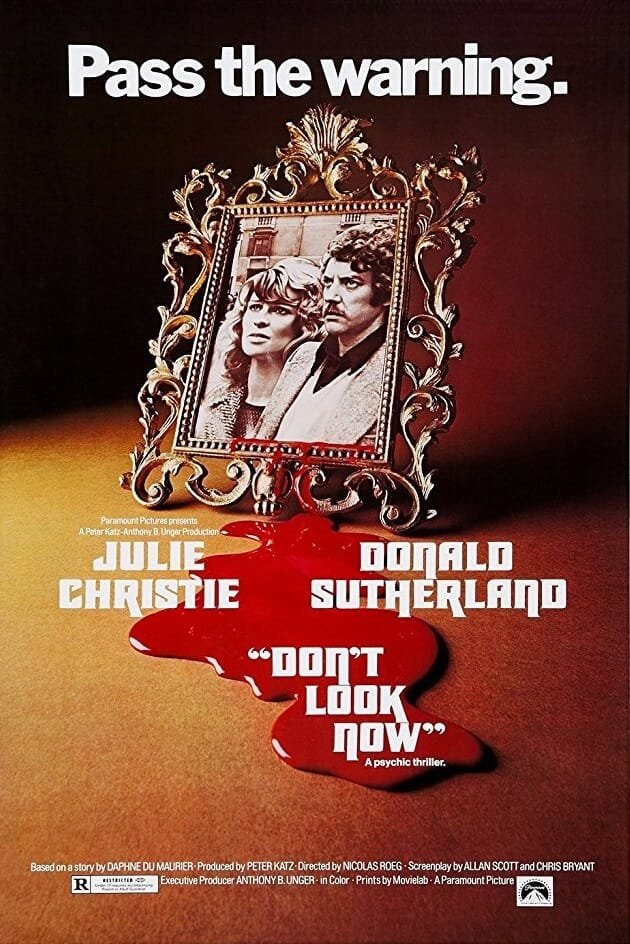
An English country house. The sun is out, but it’s clearly freezing cold. Christine, the Baxters’ daughter, plays by the pond in her bright red mac. Her brother Johnny cycles around and runs over a pane of glass, which shatters. Inside, Laura (Julie Christie, never better) reads, while John (Donald Sutherland, all curls and corduroy) examines slides of a Venetian church he’s been hired to restore. In one slide, a small hooded figure in red sits in a pew. John knocks over a glass of water. The water spills across the slide, and the red starts to bleed outward, spreading in a shape like something terrible and liquid, and John is suddenly on his feet, running and knowing before he could possibly know, out to the pond where Christine has drowned.
Here’s the bit everyone remembers from the first viewing: that he knew. That something flickered across his mind and sent him running. It plays out like an uncanny moment, a parental premonition and the sort of thing people swear happens in real life.
On second viewing, you realise Roeg has just given you the instruction manual. John has the sight. It’s right there in scene one, with no ambiguity, in the most dramatic way imaginable. The red figure in the slide isn’t Christine at all; it’s the thing waiting for him in Venice. He has, right in the opening, glimpsed his own death and mistaken it for his daughter’s, and it’s exactly the mistake he’ll make for the rest of the movie, right up until the cleaver comes down.
Warning count: one. And we’re only at the opening credits.

Oh, and the line. Earlier in that sequence, Laura is reading, looking for an answer to Christine’s question about why a frozen pond is flat if the world is round. John’s response is, “Nothing is what it seems.” First time round, it sounds like the sort of thing a dad says when he can’t be bothered with geometry. Second time round, it’s Roeg leaning out of the screen with a megaphone. Nothing. Is. What. It. Seems. Including this movie. Including the bit you think you’ve worked out. Including you, the arms-folded viewer, nodding at the bishop.
I’m going to get a bit academic here, so bear with me. I promise there’s a joke at the end of it. Maybe.
Roeg started out as a cinematographer, and his movies as a director are obsessed with the idea that time in cinema doesn’t have to run in a straight line. Walkabout, Performance, Bad Timing, The Man Who Fell to Earth – all of them cut across time, folding the past and future into the present. But Don’t Look Now is the one where that technique becomes the subject instead of the style. The editing by Graeme Clifford, who deserves much more credit than he usually gets, is a lot more than decoration. It’s diegetic, what’s happening inside John’s head, whether he likes it or not.
Take the famous love scene that got everyone so hot under the collar in 1973, and is intercut with John and Laura dressing for dinner afterwards. On first watch, it reads like a bit of daring structural playfulness: tenderness and the aftermath woven together, with intimacy shot through with the mundane, and it’s lovely and very European. Very Seventies.
On the second watch, it’s something else completely. It’s the movie demonstrating, in the safest possible register, just how John’s perception works. Past and future are bleeding into the present. Moments slip their moorings. A man pulling on his trousers is, at the same time, a man in bed with his wife. This is what second sight looks like, Roeg is telling us, and he shows it to us when it’s warm and loving so we’ll accept it as cinematic grammar and not recognise it as a symptom. By the time that same technique starts showing John his own funeral, we’ve been trained to read it as style.
That’s the trick of the whole movie, really. Roeg teaches you to dismiss the very thing you should be paying attention to. Which is, you’ll notice, exactly what John does.
And because I promised: I once tried to explain this to a friend when we were talking, and she said, “So it’s a movie about a man who should’ve gone home.” Which, irritatingly, is the most accurate one-line review of Don’t Look Now I’ve ever heard. Of course, it takes a woman to cut right through all the intellectualising.
In Venice, the warnings stop being subtle and start arriving in human form.

Laura meets two elderly sisters in a restaurant: Wendy, who is practical and fussy, and Heather, blind and claims to see. Heather tells Laura that Christine is with them, happy and laughing. Laura, broken by grief at this point, is overjoyed. John, though, is having none of it. He’s a rational man, a restorer; he deals in plaster and mosaic and structural integrity. He thinks the sisters are cranks, preying on a grieving mother, and on first watch, honestly so do we. They’re played with just enough eccentricity that we suspect them of something, and Roeg holds the camera on Heather’s milky gaze and strange laughter so we start building theories. Are they con artists? Kidnappers? Something worse?
On second viewing, we see that the sisters are the only honest people in Venice. Heather says quite clearly that John has the gift as well. She says he’s in danger and must leave. These aren’t cryptic hints. This is the closest thing a horror movie has to a printed leaflet.
Warning count: into double figures, if you include the seance, in which Heather goes into a trance and delivers the message again, more urgently.
And then there’s the scaffolding. John, high up in the church, is nearly killed when a plank falls and the platform gives way, leaving him dangling over the nave. On first viewing, it’s a brilliant set piece, genuinely vertiginous, a blast of physical peril in a movie that’s mostly been about atmosphere. Second time around, it’s almost comic in how explicit it is. Your life is in danger in this city. Literally in danger. Here is a large piece of wood. Look how close it came.
And what does John do? He carries on. He goes back to work. He treats a brush with death as an occupational hazard, shoddy workmanship, because that’s the framework he understands. He’s a man restoring the surfaces of a crumbling church while refusing to look at the cracks in himself. I’d call that heavy-handed symbolism, if it weren’t done with such a light touch that most of us miss it the first time.
Now, then. The big one.
Laura gets a call: Johnny has had a minor accident at his boarding school. She flies back to England, and shortly after that, John is crossing the Grand Canal and sees a funeral barge drift past. On it, dressed in black, are Laura and the two sisters.
On first viewing, this is the mystery’s great hinge. Why is Laura in Venice when she should be in England? Have the sisters taken her? Is she being held against her will? John panics and goes to the police, setting the whole investigation in motion and we go with him, totally convinced that something sinister has happened to his wife. Then he phones England and she’s there, totally fine, at Johnny’s bedside. Cue the bafflement. What on earth did he see?
Second viewing: oh. Oh. Oh, you poor man.
He saw his own funeral. Laura in black, returning to Venice. The sisters with her, because they’ve been proven right. It’s the future, arriving early, delivered with total clarity in broad daylight in the middle of the Grand Canal. It’s the single most important warning in the whole movie, and John’s response is to file a missing persons report.

This is where the structure of Don’t Look Now reveals itself as truly brilliant instead of just clever. The barge sequence is at the centre of the movie, and it works perfectly as a mystery on first viewing. It raises questions and drives plot, it propels John into his frantic search through Venice’s alleys. It does everything a good thriller midpoint should do, and all the while, it’s also the answer to every question the movie poses. Roeg hides the solution in plain sight by making it look like the problem.
Warning count: I’ve lost count, to be honest, and the movie hasn’t even finished.
I’ll be quick here, partly because it’s the bit everyone knows and partly because writing about it still makes the back of my neck prickle.
Throughout the movie, John glimpses a small figure in a red coat moving through the Venice alleys. He associates it with Christine, consciously or not, because of the red mac she was wearing when she died. First viewing, we do the same. The figure becomes a kind of ghost, an embodiment of his grief.
At the climax, he finally chases it down, follows it into a building, corners it and reaches out with tenderness to what he believes is a frightened child. It turns around. Oh, it is not a child. It’s the killer who has been dumping bodies in the canals throughout the movie, and there’s a sharp cleaver, and that’s that.
On second viewing, that red figure isn’t a ghost. It’s just death, waiting with nearly bureaucratic patience. Every glimpse is a reminder. The red bleeding across the slide in the opening was this exact figure. John has been warned about this exact moment since minute four and he spends the whole movie reading the warning as a memory.
And that brings me to my main argument, and I’ll put it as plainly as I can.
We are Heather.
Think about what Heather is; a blind woman who sees. Someone with real access to the truth and can clearly perceive what’s coming, who tells people around her as directly as she can, and who is completely powerless to change a single thing. Her knowledge doesn’t save anyone, she can only watch it happen. Her final appearance, on that funeral barge, is a kind of cold vindication: she was right, and it counted for nothing.
That’s the position of the second-time viewer. We know. We see every warning, every flash-forward, every splash or red, every barge. We sit there watching John make the same choices, ignore the same signals, walk into the same building, and we can do nothing about it. We’re blind in the sense that it matters most: our sight can’t touch the world we’re watching. We see too late to help.
This is where the movie’s structure goes from clever into genuinely profound. Roeg has given us the exact experience John refuses to accept. John has second sight and dismisses it as coincidence, or imagination, or grief. The first time view does the same thing, dismissing the flash-forwards as style and the warnings as red herrings. When the movie ends, the editing does something brilliant: as John dies, it flashes through images from earlier in the movie, now recontextualised, now legible, a last montage where everything snaps into place. That montage is the second viewing, compressed into a few seconds. It’s the movie showing John (and us) what he should have seen all along.
So when you watch Don’t Look Now for the second time, you aren’t just rewatching a movie. You’re being granted the gift John rejected. You literally have second sight, and Roeg’s cruellest and most brilliant joke is that it’s no use to you whatsoever.
I have seen this movie more times than I care to admit, and the tally of warnings never stops growing. Even rewatching it for this essay, I notice something new; a flicker of red in a corner I’d missed before. But it could be a reflection, or a sound cue in Pino Donaggio’s score. It’s a movie that rewards obsession, which is either a compliment to the movie, or a diagnosis of me. It’s probably both.
But I’ve also come to think that the first viewing, the one where I nodded smugly about the bishop, isn’t a failure at all. It’s a necessary part of the design. You have to get it wrong the first time. You have to be John, and refuse the evidence, chase the wrong figure, misread the barge. Otherwise the second viewing has no weight. The tragedy needs the mystery to have been real.
So if you’ve never seen it, go in blind, if you’ll excuse the pun. Get it wrong. Be as arrogant as I was.
And then watch it again, sit there like Heather, seeing everything and unable to say a word while a good man in a sheepskin coat walks towards the red.
Nothing is what it seems. Including, it turns out, your first impression.