
By contributor Adam Page
This was the first time I understood that a movie could get inside you. Not just frighten you, as any hack with a violin section and a cat in the cupboard can make you jump. The Exorcist gets in, sets up camp, and starts rearranging the furniture of your soul without asking.
Mark Kermode has spent the better part of his adult life telling anyone who’ll listen, and a great many who won’t, that William Friedkin’s 1973 movie is the greatest movie ever made. Not the greatest horror movie, the greatest movie. Full stop, no asterisk, no hedging. He wrote the BFI Modern Classics book on it, which I have in front of me now. He made a documentary, The Fear of God, for the BBC. He has watched it hundreds of times and defended it with all the zeal of a convert and the stamina of a man who plays upright bass in a skiffle band.
But the thing is, he’s right.
I know, I know. Nobody likes the guy at the dinner party who says his favourite movie is Citizen Kane, and the man who says his favourite movie is The Exorcist is often suspected of being a different kind of problem completely. A pub bore with a laminated opinion, or a lapsed Catholic, working something out on the wrong sofa. But Kermode’s argument isn’t that of a gorehound or a contrarian; it’s the argument of a believer, and I mean that in both senses. He takes the movie seriously as a work of art and seriously as a work about faith, and it’s that second part that most people miss, because they’re too busy remembering the crucifix and the pea soup and the head spinning.
Let’s get the obvious out of the way. The Exorcist is disgusting. Magnificently and unapologetically disgusting. It’s a movie about fluids; urine, vomit, blood, spit, that thin grey sweat on a dying man’s lip. It understands something that a lot of good chefs understand, and that is the body is a machine for making mess, and most of our civilisation is a desperate effort to pretend otherwise. We invent cutlery and napkins and the fish knife and under the linen tablecloth our gut is working away like a cement mixer, grinding up a perfectly nice piece of turbot.
Regan MacNeil, twelve years old and urinating on the carpet in front of her mother’s dinner guests while an astronaut stands there holding a drink, has to be one of the most honest moments in American cinema of the seventies. Forget the Watergate movies and paranoid thrillers. That’s the rot. The polite dinner party, the money and the Georgetown house with good wallpaper, and a little girl letting go of her bladder while telling a man he’s going to die up there. You want Julia Kristeva, the vomit and the corpse and the border between self and not-self breaking down? It’s all right there on the shag pile, smelling of warm wine and ammonia.
But the disgust isn’t really the point. Any director can throw bodily fluids at a camera, and plenty of them have made careers out of it: I’ve watched most of their movies at two in the morning with a bag of crisps and a vague sense of shame. What Friedkin does, and what William Peter Blatty wrote, is to use the disgust as almost a pressure test. How much faith survives contact with the filth. When your child is tied to a bed screaming obscenities in a voice like gravel in a blender, do you still believe there’s a God, or do you just believe there’s something?
That’s the question. The vomit is just the question with its coat off.

The movie that most people remember is maybe forty minutes long. It’s the stuff in the bedroom, the stuff on the posters, the stuff in clip shows on Channel 4 at Halloween with some comedian you half recognise saying he couldn’t sleep for a week. But the movie Friedkin actually made is something stranger, slower, and a lot more patient. It opens in northern Iraq, in heat so thick you can taste it, dust and tea and sweat and the grind of pickaxes on old stone. An old priest, Max von Sydow looking like he’s been carved out of a church door, finds an amulet, finds a statue, stands in front of the huge thing with its wings and its snarl in the ruins of Nineveh, and two dogs fight in the background like the world is already ending and nobody’s bothered to tell the dogs.
This goes on for a long time. There’s no music, there’s the forge, the hammer, a clock that stops. A lesser moviemaker would have cut it to around ninety seconds and put a sting on the end. Friedkin lets it breathe. He is telling you, before a single American has appeared on screen: this is old. It’s older than you, older than your country, older than your church. You aren’t the first to meet it and you won’t be the last.
Then, Georgetown. Autumn leaves, the steps and the cold, students and priests walking in pairs. And the long, domestic, almost boring middle stretch and the one people usually fast forward through, the one that Kermode rightly treats as the spine of the whole thing. Chris MacNeil, played by Ellen Burstyn with a raw nerve under every line, is an actress, a woman with money and fame and a very nice house and she has no idea what to do. So, she does what many people with money do; she goes to the doctors.
And for my money, with a background working in hospitals and the health service, this is the most frightening sequence in the movie, and it has nothing to do with the devil.
The medical scenes. The arteriogram. The needle in the neck, blood pumping out in rhythm with the heartbeat, the machines clanking like a factory press, the girl strapped down and the technicians behind the glass talking to each other in that flat and bored way professionals talk when they’ve done it a thousand times and you’re just the thousand and first. Friedkin shoots it like an industrial process, because that’s exactly what it is. Your child as a product on a line. Tests, scans, pills, Librium, Ritalin, lesions on the temporal lobe, and every expert in their good suit with their good degree comes back and basically says: we have no idea. Here’s another test. Here’s the bill.
That’s horror. Not in the supernatural, but in the dawning, awful realisation that the whole shining apparatus of modern knowledge, the thing we were promised would save us, has absolutely nothing to say. It’s the moment every parent who has sat in a hospital corridor at three in the morning knows. That fluorescent hum, the vending machine coffee that tastes of burnt coins. The sense that the adults in charge are also just guessing.

It’s only when science has thrown its hands up, when a psychiatrist half-jokingly suggests that maybe, you know, an exorcism might work as a sort of shock therapy, a placebo in a cassock, that the movie pivots to the priests. And even then, it’s done as a last resort, a tired shrug and a to hell with it, what have we got to lose? And that seems to be how most people come back to faith. Not with trumpets, but with nothing left.
And that brings us to Karras, and to the heart of the thing, and to the reason Kermode is right.
Father Damien Karras is the most interesting man in the movie, and it can be argued the most interesting man in American horror. Jason Miller was a playwright who had barely acted on screen, and plays him with a face like a closed fist. He’s a priest and a psychiatrist, a Jesuit with a boxer’s build who runs laps around the Georgetown track at night trying to sweat out whatever it is that’s eating him. And what’s eating him is guilt, class, and his mother.
His mother lives alone in a cruddy New York walk-up, the radio playing Greek songs, the stairs too steep for her legs. Karras has been educated up and out by the institution, as the smart working-class boys always are, and he’s left her behind. He knows it. The scene where his uncle tells him, in effect, that if he hadn’t been a priest he would have been a famous psychiatrist with money, and his mother wouldn’t have ended up where she is, is one of the cruellest moments in the movie, and there isn’t a single special effect in it. Just a tired man in a hospital corridor, telling another tired man the truth.
She goes into the psychiatric ward, and it’s a hellhole. Grey and screaming, a place for poor people who’ve fallen through, and there’s a beautiful and awful shot of Karras walking through it past the reaching hands. She dies alone, and Karras, the man of reason and the man of God, can’t stop thinking about it. There’s a bum on the subway platform a little earlier on, a broken old man who calls out to him and asks for help. Says he’s an old altar boy. Karras keeps on walking. Of course he does; we all keep walking. And later, the demon uses that voice, that exact voice and that exact plea, and it’s the worst thing in the movie, worse than the crucifix and the spinning head, because it knows. It knows the thing you walked past.
This is what Kermode keeps coming back to, and what people who think of The Exorcist as a shock-machine never get. It isn’t a movie about evil winning, it’s a movie about a man who has lost his faith discovering, in the most horrific circumstances imaginable, that he’s still capable of an act of total love. Karras at the end, when Merrin is dead on the floor with his heart given out, grabs the girl, beats the thing inside her and screams at it to take him. Come into me. Leave her and take me. And it does. And in the half second he has before it takes the wheel, he throws himself out of the window and down those long, steep, brutal stone steps, and dies on the pavement with a friend kneeling over him, taking his last confession.

You can say what you like about God, but that’s the most Christian ending in the history of cinema. A man lays down his life for a child who isn’t his, in a house that isn’t his, after failing the one person he should have saved. Kermode, who is, as he’s never been shy about telling us, a churchgoer, sees the movie as essentially an argument for faith, and I think he’s right, although I’d probably put it slightly different as I’m a man of fewer pews. It’s an argument for faith as a thing you do rather than a thing you have. Faith as a verb, or the last move left on the board. And the movie is honest enough to make it cost everything.
And then there is the craft. Because you can have all the theology in the world and still make a bad movie and there are Christian movie distribution companies in Tennessee with warehouses full of proof.
By most accounts, Friedkin was a lunatic. A genius maybe, but a lunatic. He would fire guns on set to jolt his actors. He refrigerated the bedroom so you’d see real breath, real cold, with Linda Blair shivering in a thin nightgown. He slapped a real priest, a real Jesuit he’d cast as a real priest, to get the tremble in his hands for the final blessing. He yanked Ellen Burstyn backward on a harness so hard she injured her back, and he kept the scream. These are not the actions of a nice man. To reach for an analogy, you wouldn’t want him running your kitchen, or maybe you would, depending on how much you valued your Michelin star against your line cooks’ mental health.
But the result is a movie with no fat on it. Every scene lands, with every sound selected. The soundscape alone deserves its own book: pigs, bees, the hum of the house, scratching claws in the attic, Mercedes McCambridge’s demonic voice put together from chain-smoking and raw eggs and the kind of psychic damage you can only get from a lifetime in the business. The music, those few bars on Mike Oldfields Tubular Bells, cold and tinkling and innocent as a child’s music box left out in the rain, turned by the movie into something you’ll never quite hear straight again.
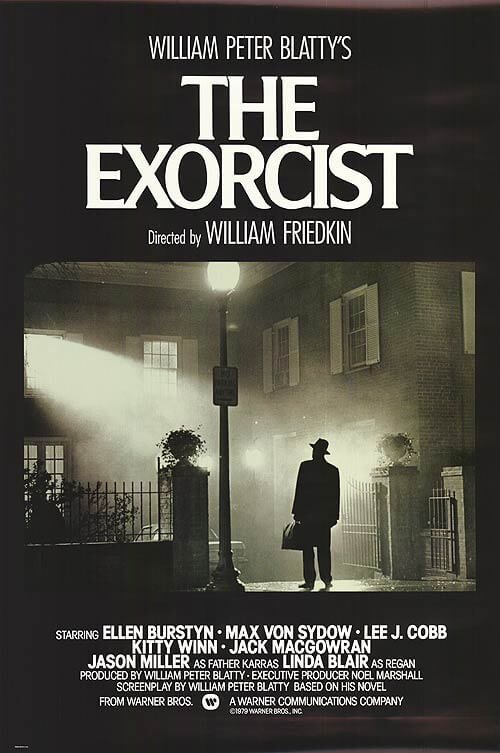
The cinematography is flat, almost documentary, and that makes it almost unbearable. Friedkin filmed The French Connection like a newsreel, and he films Georgetown the same way. No gothic atmosphere or shadowy castles, no fog machines. Just ordinary rooms, ordinary light and ordinary people, and then something that absolutely should not be there, sitting up in bed. The iconic image of Father Merrin arriving at night, silhouetted under the streetlamp in front of the house with the beam of light from the window, is so famous now it’s been ripped off a thousand times on a thousand DVD covers, and it still works. It does because it’s so simple. There’s a man, a house, a light, a job to do.
That’s Kermode’s point, really. That the movie is perfect not because it’s excessive, but because it’s controlled. Every excess is earned. The spider walk, cut from the original release and put back for the 2000 re-release, is the exception that proves the rule. The one place where the movie, I think, does too much. The rest of the time it does just enough, never more.
And since we’re talking about excess, and since I’ve already made my feelings about it abundantly and hopefully amusing clear elsewhere, let’s briefly visit the scene of the crime. Exorcist II: The Heretic.
I’ve written about this movie here before, about why John Boorman’s 1977 sequel is one of the most spectacular failures ever committed to celluloid, and I stand by every word. I’d add plenty more but don’t want to bore you. Kermode himself has never been shy about putting it right down at the bottom of the barrel, and I think the reason it’s helpful to hold the two movies side by side is that The Heretic does everything wrong in exactly the places where The Exorcist does everything right.
The original is grounded. The sequel floats, whole scenes unmoored in some kind of dream-logic mysticism where Richard Burton, a great actor albeit visibly sloshed, wanders about looking like a man who’s been told the pub is closed. The original distrusts the machines of science while the sequel invents a sort of psychic synchronising headset, a blinking gadget that lets two people share a trance, and treats it with a straight face that would embarrass a Doctor Who writer on a deadline. The original locates evil in something very specific and ancient. The sequel has locusts. So many locusts. Swarms of the things, symbolic and airborne and as subtle as being hit with a rolled-up newspaper labelled METAPHOR. But most importantly, the original takes faith seriously as a human act with a human cost. Karras dies for a child. The sequel turns the whole thing into a sort of metaphysical spaghetti western, good against evil, with Regan as some sort of spiritual superhero with healing powers. It has ideas, so many of them, more ideas than a sixth-form philosophy seminar on its third bottle of wine. What it doesn’t have is a single scene where you believe a human being is suffering. The Exorcist is about pain and The Heretic is about concepts. And nobody ever went home and couldn’t sleep because of a concept.

Every sequel, prequel, and requel since, right up to that 2023 misfire that tried to double the number of possessed kids has made some version of the same mistake. They think the franchise is about the demon. It never was; the demon’s the MacGuffin. The movie is about the people standing around the bed.
Okay, I’ll finish somewhere quieter.
Friedkin is dead now. Blatty’s dead. Jason Miller has been dead for a quarter of a century, which is its own kind of cosmic cruelty; a man who gave one of the greatest performances in horror history never quite found another role to match it. Max von Sydow is gone. Lee J. Cobb, rumpled and funny as the detective who just wants to take someone to the movies, gone for decades. The house still stands in Georgetown, and the steps are still there, a tourist attraction now, with a plaque and people taking selfies at the top, grinning and pretending to fall.
I climbed them once. Late afternoon, cold, a coffee I didn’t really want. They’re steeper than you think. A lot steeper. Narrow and old, slippery in the damp. And I stood at the top and looked down, and just for a second, it wasn’t a movie at all. It was just a very long way down. And I thought about a man who’d walked past a beggar on the subway platform and never forgiven himself, who’d let his mother die in a ward full of screams, who had stopped believing in anything but running laps in the dark. And who, when it came down to it, when the thing was in the room and there was nobody else left, opened his arms and said: me. Take me instead.
I’m not a religious man. I’ve seen too many things in my old life, in too many back alleys and too many hospitals to pretend otherwise. But I know what that is. Every decent person knows what that is. It’s the thing we hope we’d do but are afraid we wouldn’t. And a movie that can make you feel that, while also showing you a twelve-year-old girl doing something unspeakable with a crucifix, while also making you laugh at a detective’s bad jokes, while making you sit through a hospital procedure so clinically cruel you want to turn away, while also opening with twenty minutes of dust and heat and dogs in the ruin of an empire older than God, is not just a good horror movie.
Kermode’s been saying it for forty years. He’s said it so often that people have stopped listening, like you stop listening to the guy at the end of the bar with the same story. But sometimes the guy at the end of the bar is right. Sometimes the story is the story.
It’s the perfect horror movie. It just might be the perfect movie. And it’s perfect for the oldest reason in the book: because under all the blood and the bile, and the noise and the cold breath in the frozen bedroom, it knows that the most terrifying thing in the world isn’t the devil.
It’s love. The kind that costs you everything. And the fear, gnawing, three-in-the-morning fear, that when the moment comes, you won’t have enough of it.