
By contributing writer Adam Page
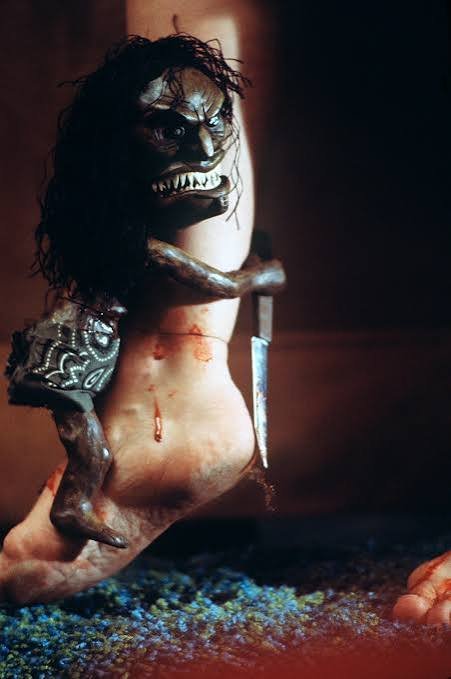
Would you like to try a party trick? Say “Trilogy of Terror” to anybody over, let’s say 50, who grew up with a television in the house and an aerial bent and twisted into some superstitious angle, and watch their face. It’s not exactly recognition, it’s more like a full-body flinch, or a muscle memory. Nine times out of ten, they probably won’t be able to tell you what the movie is actually called. They won’t remember Karen Black playing four different women across three different stories all basically sprung from the mind of Richard Matheson, who also gave us Steven Spielberg’s Duel and maybe half of The Twilight Zone’s best hours. But they will remember, with all the clarity of a scar, a small wooden man with a spear and a lot of filed, pointed teeth chasing a woman around a Los Angeles apartment.
That’s the Zuni fetish doll. That’s “Amelia.” That’s the segment which, in all of 20 minutes and with some shift of pure feral kinetic terror, ate its own movie alive and then, just for good measure, ate the cultural memory of all around it as well.
That’s what I want to talk about. Not because the doll isn’t worth talking about; it totally is, it’s one of the best jolts of practical-effects horror ever beamed onto network television at 9pm on a Tuesday. But I want to talk about what happened to Trilogy of Terror as a whole, how it was reduced and distilled, boiled down to one burning image while its other two-thirds disappeared into the footnotes, and how it tells us something ugly and true about how horror really gets remembered. And I mean: not democratically. Not exactly by merit, or merit alone. Horror, I think, gets canonised the way a shark gets identified: with the fin breaking through the water and not the twelve foot animal underneath which is doing the actual killing.
Let me set the table first, because it’s hard to understand what got erased without knowing what was there in the first place.
Trilogy of Terror first aired in March, 1975 on ABC, a Dan Curtis production. He has already given the world Dark Shadows, a man who understood on a cellular level that American living rooms wanted dread delivered in neat, advertiser-friendly parcels. The movie itself is an anthology, three stories, with Karen Black playing the lead in all of them. This is a structural gimmick that in lesser hands would be read as budget-consciousness dressed as a concept.
The first segment, “Julie”, is a morality tale about a nasty little professor who thinks he’s seducing a student by spiking drinks until it turns out, surprise (this genre runs on the surprise that the quiet woman was never as quiet as you thought), that she’s the one running the whole show, and running it towards something way darker than a bad grade. It’s a pretty good slow burn. And it seems nobody remembers it.
The second, “Millicent and Therese” is a Jekyll and Hyde show, with twin sisters: one prim and proper, the other a lot less prim and proper. There’s a twist that anybody who’s seen more than two horror movies will clock in about three minutes. And it’s fine; it’s TV that does what it needs to do, then moves on down the road. Nobody really remembers this one either, although speaking personally, it seems to have the odd honour of being the one people misremember as being about the doll, and that tells us something about how completely “Amelia” has taken over the whole show’s mythology. People seem to project that doll backwards into stories it never touched, because in the cultural memory, it isn’t three stories anymore, it’s one story wearing a three-story coat.
So, then: “Amelia.”
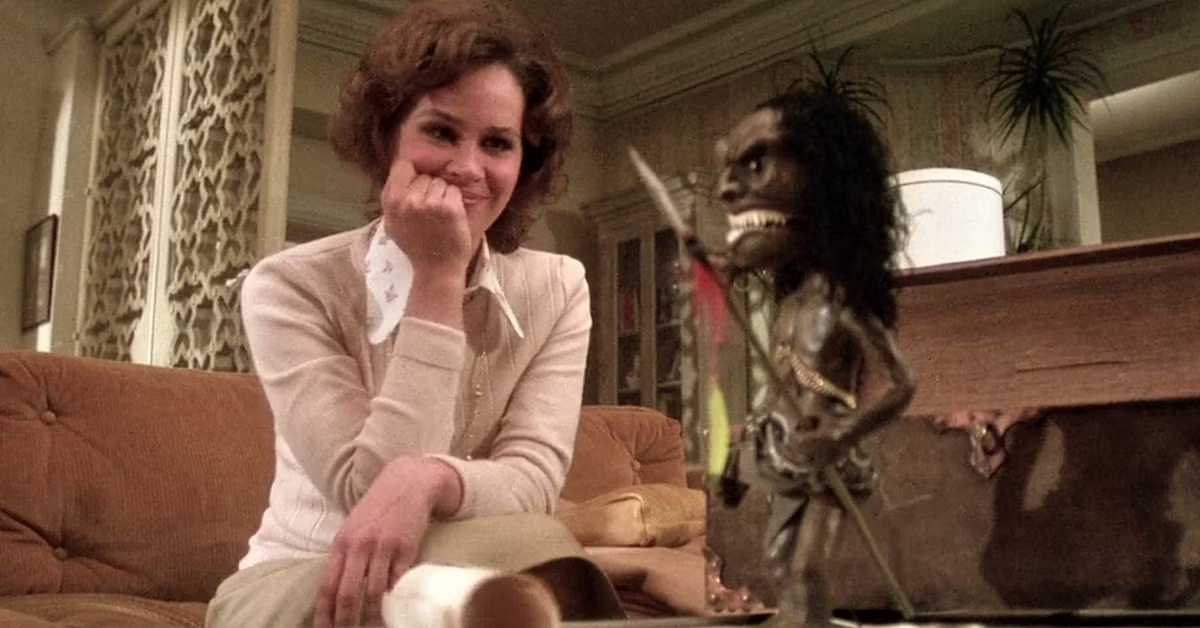
A woman is alone in her apartment. There’s a gift for an anthropologist boyfriend she’s trying to work up the nerve to introduce to her mother. And that’s its own quiet horror, if you’ve ever had that phone call, trying to rehearse your sentences like a hostage negotiator. The present is a Zuni fetish doll, a hunter spirit, with a little card (there is always a little card, horror loves an instruction manual nobody reads properly) that explains the doll is held by a golden chain wrapped around its body, and that chain must never come off as its the only thing keeping the spirit of He Who Kills dormant inside the doll.
Yes, you know where this is going. The chain comes off, as it was always going to. That’s not a spoiler; it’s practically a law of physics in these stories, a Chekhov’s gun, if it were a fifty year old strangulation totem with a spear the size of a toothpick and a continent sized homicidal intent.
And what comes next, in just 20 minutes, is Karen Black, alone and magnificent, battling a foot-tall wooden doll that really should be laughable, but is honestly one of the most viscerally frightening things ever broadcast onto the small screen. That doll skitters and hides. It appears in doorways with the patience of something that is basically already dead and already killing. It stabs her in the ankle with its spear, and it’s a wound so small and devastating that it makes you think about every childhood scrape you ever shrugged off. And Karen Black sells every second of this. She wrestles this thing into the bathtub, traps it in a suitcase, tries to burn it in the oven, and then, the gut-punch, and the reason this 20 minute segment outlived disco: she turns to the camera at the very end, with the doll’s face, filed down teeth and all, grafted onto her own features. Then we understand, with all the horror of an ending that refuses us the mercy of a resolution, that whatever was in that doll didn’t die. It just changed address.
That’s the entire thing, and that’s what people remember. That’s the thing which got quoted and referenced, name-checked in everything from The Simpsons to a hundred internet compilations of “Scariest TV Moments”. It earned the doll its own line of collectible figures a few decades later, and that’s an honestly strange fate for a piece of set dressing that spent most of its screentime being hurled across a room by Karen Black.
And the thing I keep circling, something which interests me more than the doll itself, though admittedly it is a great doll but: the other two-thirds of this movie didn’t fail. They aren’t embarrassing, they’re sometimes better than competent, minor-key Matheson with real teeth of their own. Metaphorically speaking, at least. But they didn’t have an image. They didn’t have that single, decontextualisable 20 minutes that could be clipped and shared, turned into gifs before gifs were a thing, and described breathlessly by kids at sleepovers who saw it on late-night syndication and had to warn their friends. “Julie” and “Millicent and Terese” needed you to sit through setup and character, through the slow build-up of dread which actually constitutes most of what horror structurally is. “Amelia” was like a machine gun. A cold open, almost-immediate threat and building physical peril, plus a jump scare that reframes the preceding hour. It was built, maybe accidentally but probably not (Matheson was too intelligent a writer for total accident) to be the part that people talked about at school the next day, completely stripped of the hour of table-setting around it.
I would argue that this is how most horror really survives in culture. As image, rather than text. As the one transmissible unit of dread that can travel without its context, like a folk song outliving the specific historical grievance that produced it. If we think of The Exorcist, we don’t play the whole movie in our heads; we think of the spider walk, the spinning head, the crucifix, those few images that do the work of two hours of Jesuit doubt and Georgetown atmosphere. That atmosphere seemingly couldn’t do the work on its own, even though it’s exactly what makes those images land. Think about Jaws, and nobody really focuses on the cowardice of the mayor or civic corruption, something the movie cares about a great deal. No, it’s a fin, a bitten-off leg sinking underwater and John Williams doing more emotional work than the whole town council combined. The full text does the work and the image gets the credit. This isn’t fair, but it’s also not new, or even specific to horror. It’s just that horror, more than most other genres, lives or dies by whether it can create one of those condensed little nuggets of real sensation. Horror’s whole business model is the transmission of fear, and it turns out, fear travels light. Fear doesn’t want your subplot, it wants the doll standing in the doorway.
And it’s almost cruel, if we sit with it long enough, when we realise that “Amelia” is the most text-dependent of the three segments, in a way; it needs the card explaining the chain, it needs Karen Black’s specific loneliness and the dread of her mother’s judgement to make the stakes more than just a novelty doll come to life, and that slow ratchet of “is this actually happening?” before the doll even moves an inch. It isn’t an image that exists free of narrative; it just became one through repetition and cultural erosion, like a coastline becoming a different shape after enough time has passed with the same wave hitting the same rock. The context got worn away and the image is all that’s left standing.

There’s something a little mournful in that, if you squint. Every piece of art that gets remembered like this is, in a sense, a story about erosion; about what a culture decides is load-bearing and what it lets get washed away. It isn’t that “Julie” and “Millicent and Terese” are bad art, it’s just that they aren’t quotable, and quotability, sadly, has become one of the main currencies we use to decide what survives. It’s the same thing which turns a two-hour movie into a fifteen-second meme, or a three-thousand word essay into a pull-quote or two, and turns a person’s whole life into “the guy who did the thing one time.” We are all at risk of becoming our own killer image, our own doll in the doorway, just remembered for the twenty minutes that travelled, instead of the two hours that built them.
It’s this that crosses my mind when somebody references the Zuni doll like it’s the whole movie, because in the culture’s memory, functionally – it is. Ask someone to name the anthology it came from and you’ll probably get a shrug, a guess, or (my personal favourite) total confidence in the wrong answer. That doll has achieved a kind of immortality, famous in the way some photographs are famous, completely divorced from the photographer, the assignment, and the darkroom. It doesn’t need Trilogy of Terror anymore. It escaped its own movie in the same way it escaped its chain. And that’s either a delicious irony or the entire point, depending on how generous you’re feeling towards the universe’s sense of humour.
That might be fitting, actually, and maybe the only honest ending here, and the segment’s own text is about exactly this; something small and seemingly containable which turns out to have appetites you didn’t budget for, eats its own restraints and keeps eating, way past the boundary you thought was the edge of the story. The story did more than kill Amelia; it killed the concept of “Amelia” as just one segment of an anthology broadcast. It killed the very idea of Trilogy of Terror as a trilogy, and leaves behind a monolith with a spear, standing in the doorway of culture’s memory, pointed teeth bared, and totally unwilling to be put back on the shelf.
That’s not particularly a tragedy. Matheson got his hit, and Karen Black got her legend. Even the doll got its own toy line, and that’s a lot more than most character actors from 1975 can say. But it’s worth noting, as I wrap up, that the way we remember horror isn’t the way horror is actually made. It’s made in full; scene by scene, with dread built up in careful and unglamorous increments. It’s just remembered in fragments: the doorway, the grinning teeth, the face at the end which isn’t the face we started with. We tell ourselves we’re honouring the work when we quote the image.
But mostly we’re doing what the doll did. We take the part that moves, and let the rest go still.