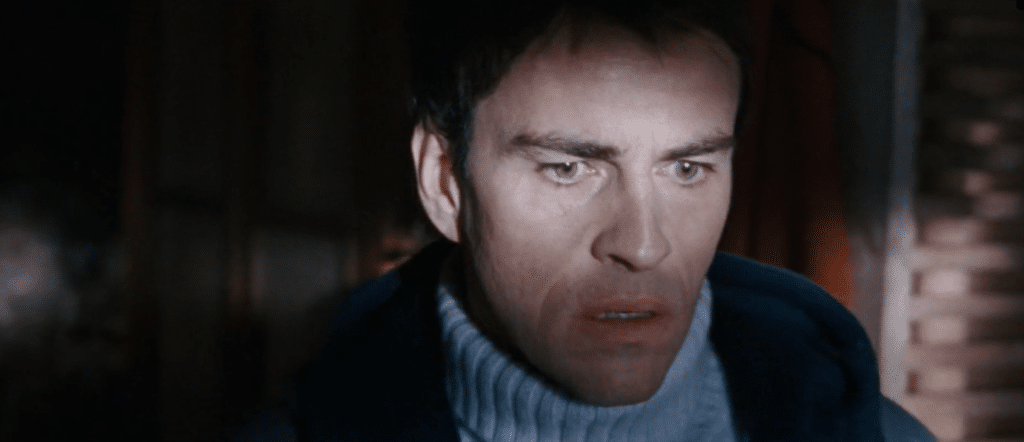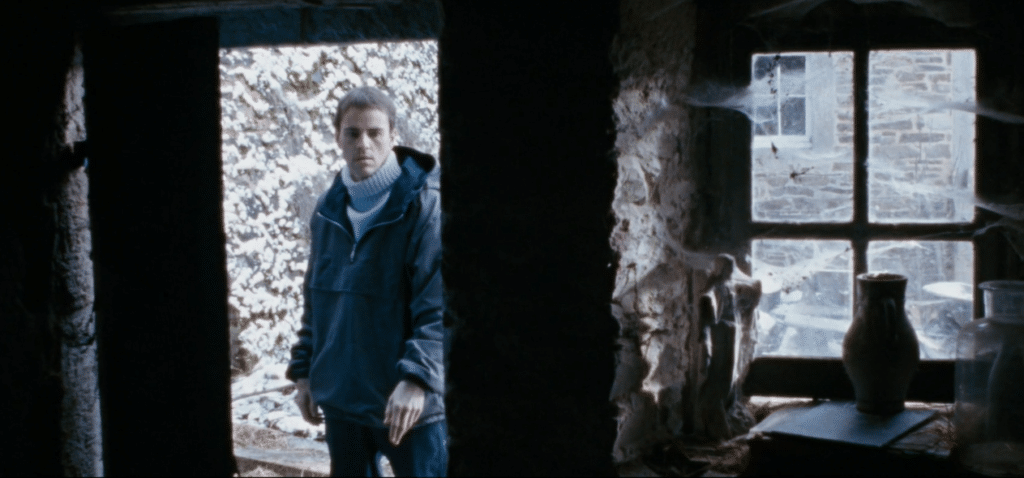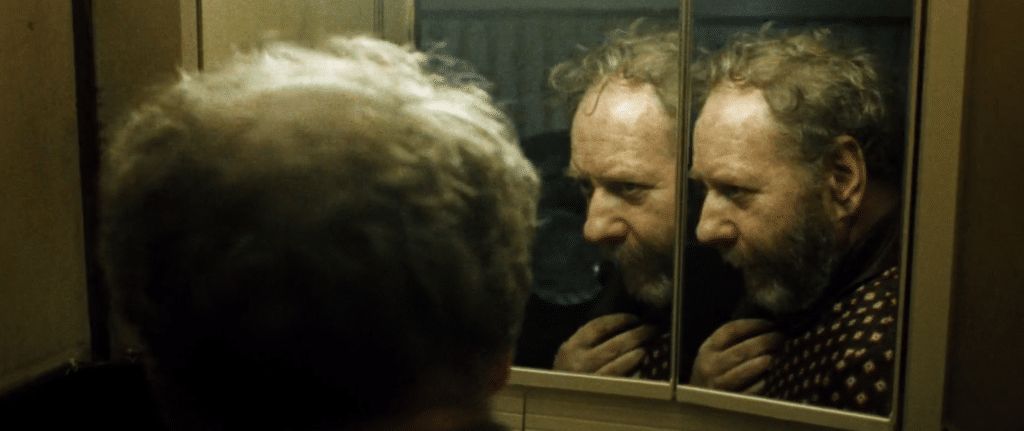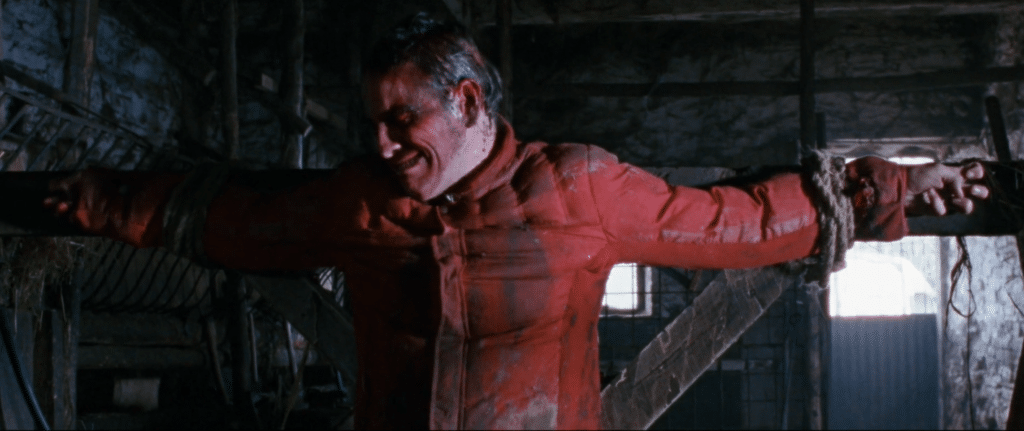
Mercy Falls (2023)

A sylvan nightmare introduces us to the world of Mercy Falls (2023) and a sylvan nightmare it remains; make of that what you will. As a film, it retains all of the standard nonsensical elements of a nightmare, alongside its tension and inescapability. The film on the whole can be perplexing, though it does do enough to remain entertaining.

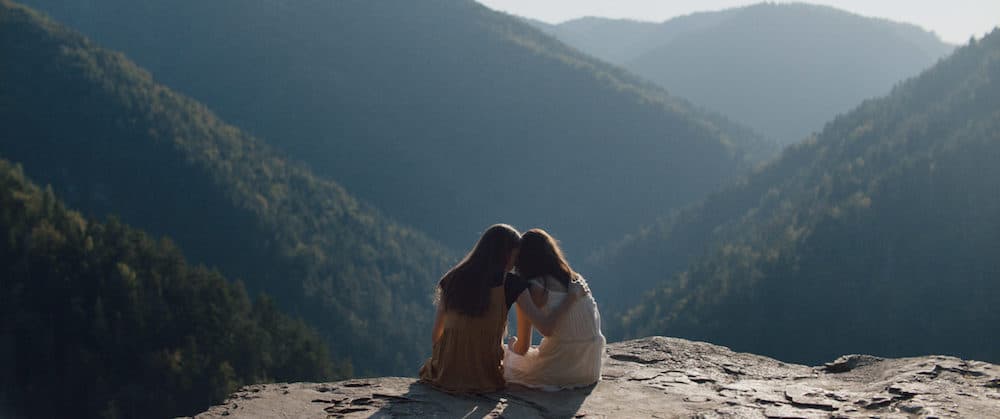
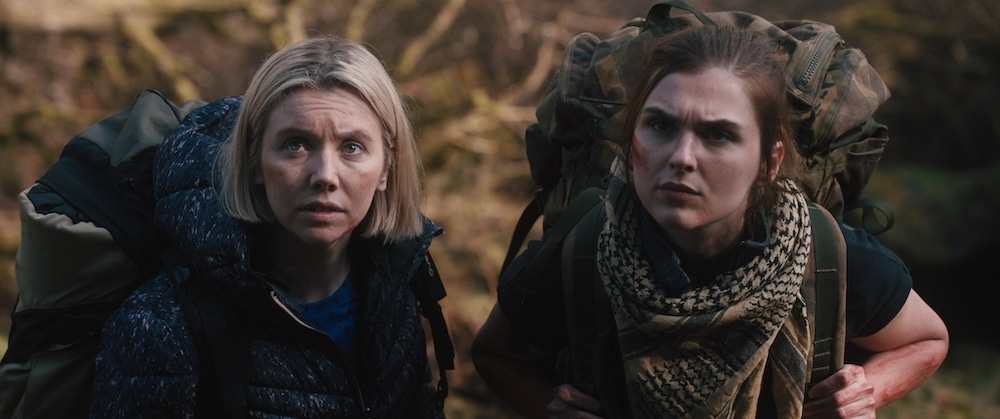
A childhood flashback wakes Rhona (Lauren Lyle), now a young woman off on a camping expedition in the Highlands with a group of friends. They evade the trope of picking up a scary hitchhiker by sensibly speeding past straight them on their way to a rendezvous point, a nearby hotel. Frankly, once I’d seen the girls’ car (emblazoned with flower and ‘peace’ stickers) then all bets were off, but: Rhona has a plan. She wants to hike out to her late father’s old cabin near a place called Mercy Falls; she has a map, a map she clearly struggles to read, but wouldn’t you know, the hitchhiker they passed earlier has also arrived at the hotel. Carla (Nicolette McKeown), aside from having a face of perfect make-up, come what may, is an experienced hiker and offers to help them in their search. Whilst this clearly disrupts the delicate friend group ecosystem as far as Rhona is concerned, the others are more enthusiastic: as such, Carla tags along/takes over, and off they all go.

Whilst the minor questions about what happens next soon conglomerate into bigger questions about people’s motivations and behaviours, at heart the tension here comes from Rhona’s past and Carla’s present, as (and it’s probably not a spoiler to say) she isn’t all she seems. But then again, Carla’s past also turns out to be a factor, and as they get deeper into the remote woodland, the issues between these two young women in particular drive the rest of the events which follow. Childhood misery, budding female antipathy, a few lines in the script which question whether this naïve lot has an emergency plan – here’s our raft of elements, then, which could be explored or exploited in a range of ways.

As we get going, it’s clear that the Scottish landscape is one of the stars of the show, and it’s filmed well; it’s also positive that these are Scottish young people in their own country, which eschews tried-and-tested tension between outsiders and place in a broader sense, something that typically comes with its own issues (although these particular hikers are themselves strangers in this environment; this could be anywhere, albeit without a family cabin somewhere off in the mysterious distance.)

As for the young people themselves, well: the script starts out by painting a picture of some plausibly daft, adrift townies on their way into a dangerous, remote place. That’s all well and good, but the undercurrent of sexual tension here is far more difficult to believe in, and leads the plot down some rather sketchy paths (such as: how on earth do you lose two of your party when there are only six of you and you’re at a tiny campsite?) It’s a bit clumsy and extraneous, even if we allow for the fact that – well – so are people. But other motivations are puzzling too, and should have been clearer, if we are to believe that all of these events unfold between our characters; certain big scenes in the film are utterly mystifying (I shall say only ‘fallen tree’ here and anyone who sees the film will get it completely). It always seems like a good, brutal script edit would iron out so many of the issues which befall low budget indie films, and cost little to no money out of the budget, in the grand scheme of things. There has to be a good answer to the ‘why?’

Still, there’s enough here to keep the film moving along. Credit goes to Lauren Lyle in particular, who is given a lot to do and a lot to carry into the final act; in fact, she offers the most nuanced performance throughout, and deserves recognition for that. If you can let your eyes glaze over at some of the rookie errors, then you just might find enough to enjoy in the often baffling melee.

Mercy Falls (2023) received a UK theatrical release on 29th August 2023. Mercy Falls is in cinemas now and on digital from 6th November.

FrightFest 2023: Vestige

The act of fossil-hunting is, for all its wholesomeness and its interesting history and fresh air, a hunt for a past which is by now utterly alien to us. It hangs somewhere between presence and absence; fossils are here, but gone; permanent, but extinct. And if all of this sounds like a rather lofty way to introduce a short film review, then I’d argue that it’s all relevant to Vestige (2023), a film which takes fossil-hunting as its starting point, albeit taking it somewhere very different. Even given its runtime of just twelve minutes, it tantalises at something significant and resonant beyond its immediate storyline.

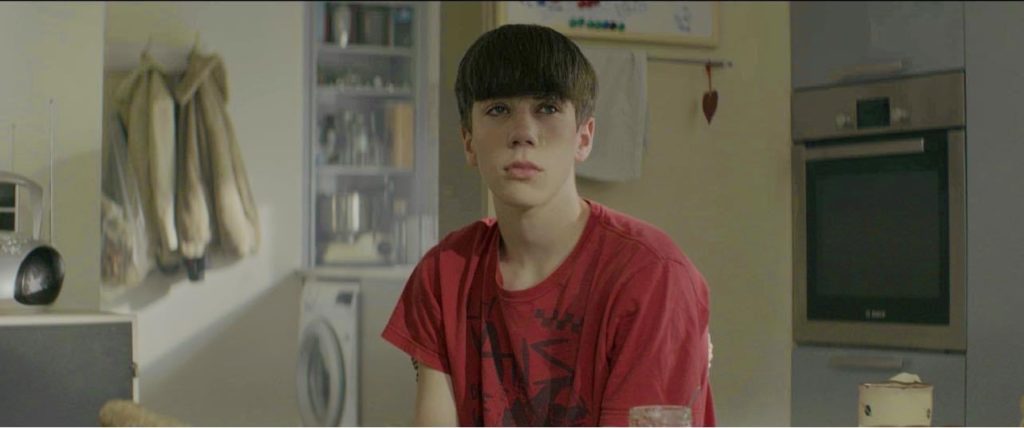
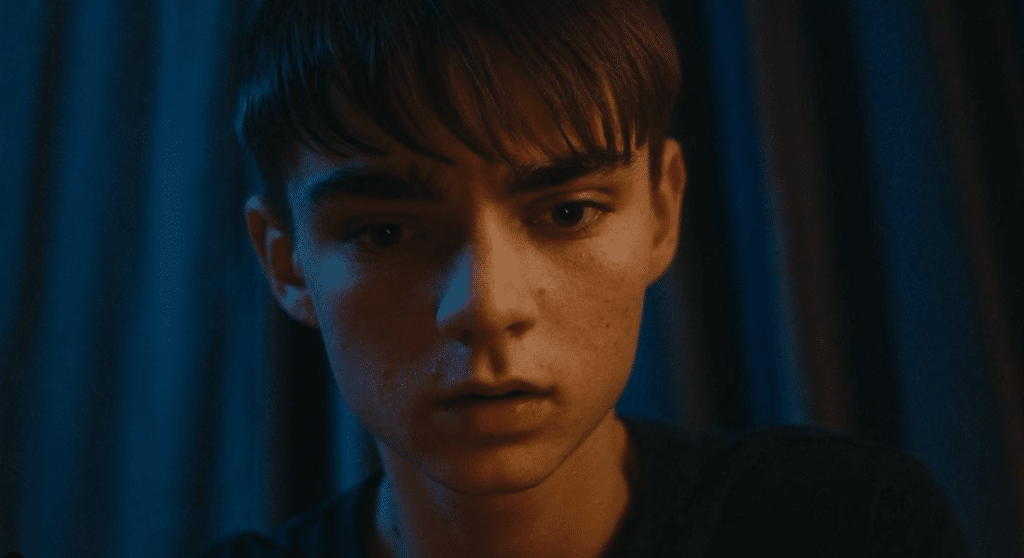
Our fossil hunter is a teenage lad called Lucas (Ben Hackett). As he listens to tape recordings of his father giving him advice (on music, and on finding fossils) he is suddenly drawn to one rock in particular: taking his hammer and chisel, he splits it open, revealing an extraordinary fossil inside. But Ben has little time to admire what he’s found: the recording of his dad’s voice (another absent-presence here) is wavering, as if something is interfering with the player. Could it be the fossil? Lucas turns sharply, calling his father’s name. It’s clear by now that dad is gone, but is he gone? Lucas comes to believe that his father is reaching out to him; if he could just decipher the message, then he could have his dad back again. For Lucas, this means finding his dad through what he has left of him – his voice, his tapes – as well as their shared love of fossils.

The fossil hunting aspect of Vestige is matched by its focus on analogue technology; there are a lot of love letters to analogue tech in cinema at this point, driven by nostalgia and a half-held memory that some of this equipment could be (and can be) quite creepy and evocative, though here it makes sense on a more practical level: Lucas’s father would probably have grown up with cassette tapes, and probably would have collected them. But tape itself forms part of the film’s puzzle; it’s also a source of anxiety, as well as a connection to the past. At heart, this is a deeply sad story, but it moves increasingly into the fantastical as it draws to its close, using Lucas’s dad’s collection as part of this (with some neat visual devices along the way). And, ultimately, is this is a sad story, come the end? You could certainly argue that it’s ambiguous; it doesn’t spill every detail, so you’re left wondering what, exactly, has unfolded. Whether you see it as a horrific trickery or something more opaque is down to you.

However you read it, Vestige does a great deal with all of its elements, offering an interesting exploration of grief and loss but looking at these from a horror-tinged, engaging and unorthodox perspective. It works well, and the striking County Durham beaches which form the film’s backdrop are the perfect environment for such a stark, but rather beautiful film.

Vestige (2023) featured at this year’s London FrightFest.

FrightFest 2023: Good Boy

Good Boy (2022) is an odd proposition, because it immediately disrupts what you may expect from its most obvious plot elements. With its clean, sumptuous interiors, pleasant and polite cast, and distinctly bloodless approach to its storytelling, it oh-so almost keeps up appearances – but it has a grim, unsettling element which runs right to its core. As such, it’s an engrossing watch, layered with discomfort. In essence, it’s a messed up story about power and privilege, and whilst it decides not to satisfy every question you might wish to ask, it nonetheless does enough to make those questions run around in your head after viewing.

We begin with an as-yet faceless young man preparing a meal, and it’s a very nice meal, too: it has ‘date night’ written all over it, except it turns out that it’s for the young man himself. He’s not totally alone, however: he has a dog, and we see him feeding it. This is the first moment of high strangeness: that isn’t a dog, it’s a man in a dog suit, seemingly remaining in this character throughout the scene. Aside from that, this is a rather beautiful house, teeming with affluence – it just happens to have a dog-man resident in it. But our young man-man, Christian (Gard Løkke) seems to crave more orthodox human company, too.

Scrolling through Tinder after dinner, he finds a young woman called Sigrid who catches his eye: he ‘super likes’ her, perhaps drawn to her tagline, ‘If you have a pulse and two legs, we’re well on our way!’ Humour, or a cavalier approach to standards? Well, one of the two seems to be appealing (and in fact, you could probably easily make a horror film based solely on the responses to an open-season line like that on Tinder). And just like that, they connect, and arrange to meet in person.

Their first date only showcases their different personalities. She’s late, for one; Christian is already sitting there, punctual, and formally dressed. Sigrid (Katrine Lovise Øpstad Fredriksen) rocks up in jogging bottoms, disregards any conventions about who buys what and how, and plays on her phone at the table. It’s not a great start but, gradually, Christian begins to warm up a little. In fact, they end up going back to his place, and the size and style of his home wows her. But the presence of a grown man in a dog suit comes as a hell of a surprise (well, it would, wouldn’t it?) This early spanner in the works disrupts their growing closeness; sadly for Sigrid, it’s her roommate’s revelation about Christian which enables her to overlook his little foibles. She hears Christian out, and their relationship continues. However, this just begs more and more questions, and their unignorable situation develops.

Well, there’s a lot going on in here. But firstly, any expectation that this is going to be either some kind of queasy sexual story, or a torture porn-adjacent affair are thwarted. True, Sigrid looks into the whole idea of ‘puppy play’ as she tries to understand what’s going on, but Christian isn’t involved in this for sexual reasons. Sex and sexuality are present in the film, but not the driving force behind the plot, even where we have a young relationship unfolding: Good Boy wrongfoots the audience in several respects, and this is one of them. Instead of fulfilling our genre expectations, it spends a good deal of time on character, beginning with Christian who, as he prepares for his first date, seems to genuinely care about how it’s going to go. Any notion of a darker side to him is slow to grow: little clues, little reveals in conversation, leave you wondering at first. Then we get a lot more on Sigrid, which not only balances the tale-telling in the film but adds to the growing tension. Yes, some conventional developments pop up, but not until we have a pair of nicely established, diverse characters who contrast with one another, even in the most straightforward of terms. (There’s also, perhaps unavoidably, some subtle, ridiculous/sublime humour in here too.)

Look, there are a few gaps or questions in the film’s plot which remain unanswered come the credits, but does that diminish Good Boy‘s Scandi-minimalist weirdness? Not a jot; it also invites us to ask ourselves when and for what reason we might fling our red flags out of the window, and what roles we might content ourselves to play. When things escalate here, they really escalate, even whilst the film retains its polite, considerate, even stylish veneer. Good pacing, good characterisation and a dialogue-rich script carry this bizarre turn of events along, leaving us with an unsettling story about social and personal control, playing out just (just!) on the right side of plausibility. Good Boy is quite a tough film to shake off, and that’s immensely to the credit of director/writer Viljar Bøe, who has fashioned a strangely engrossing corner of a recognisable universe here.

Good Boy (2022) featured at FrightFest 2023.

FrightFest 2023: Minore

Minore (2023) is a great premise on paper, but – sadly – too diffuse and poorly-paced to pass muster in practice. Along the way, there are great scenes and great ideas, but the film’s ragtag approach to building tension and developing a plotline let it down. It could have been a great film, shorn of around half an hour or more, but director and co-writer Konstantinos Koutsoliotas has decided to treat his film as a wraparound for a whole range of characters, directors and even genres; that was his decision and them’s the breaks.

‘Armageddon is coming’, reads the placard of a lone, paddling penitent as a young sailor called William (Davide Tucci) arrives at a sleepy Greek town where he plans to take some shore leave. He has a specific motive for being here: he’s looking for his absent father, a musician, and he has a notion he may be in this town somewhere. In the meantime he gets settled in, staying at a local hotel and finding his way to a local taverna, as recommended by his, umm, friendly hotelier. Hitting it off with waitress Aliki (Daphne Alexander), he soon feels fairly welcome, even though he’s haunted by dreams of his absentee dad, a man he always sees in his mind’s eye playing a mysterious little number on his bouzouki. In and around this piece of relationship-building we get a run-through of a number of local characters, all of whom we’ll see again, but: the general plot-specific point here is that something strange is happening to this place. There are earth tremors, people are having bad dreams, there are disappearances and some people have taken to wading into the sea…

Time passes, and William thinks he just might have had a breakthrough in his search for his dad: there’s a certain man they call ‘Teacher’ who instructs the musicians at the taverna – but let’s move forward to around the hour mark. At this point, and not in any significant way before mind you, some of the strange portents start to come to something – the dreams, the rattling walls, the strange behaviour. Now, alien denizens emerge from the sea and besiege the taverna, giving us a Grabbers-style segment of the film (before a tension-splurging diaspora where they all disappear off elsewhere, but you get the idea). As such, the town residents will need to face down the tentacled menace and try to restore order.

The take-your-damn-time first act of this film is all character, character, character, to an extent that breaks the rhythm of the film; character fans may like the lengthy diversions where people discuss, for example, whether certain boys or girls are ‘clean’ or ‘dirty’ (bit of a weird aside, all of that). Apart from the reputational analysis, we get slivers of comedy, dramedy, crime, history, vignettes on Greek small town life and some slightly confusing interplays on who likes/knows who; there are lots of side-plots and mysterious predilections, in a nutshell, which keep us hanging around.

As for the creatures in this creature feature, Minore leans heavily on Lovecraftian horror and it does so from the outset: we get visual clues like framed paintings of tentacled entities, a sailor’s cap emblazoned with ‘Miskatonia’, and of course the beings themselves, calling to tiny human minds from the sea. It’s strange to me, though, that a film which works so hard to ground itself in Greece doesn’t opt for more vivid elements of Greek myth and legend; even if you accept the Lovecraftian premise that these cosmic entities pre-date humanity, it seems a shame to ignore the tentacled, and also multi-headed, winged, hooved, chimeric entities of Greek stories, which have the jump on HPL by a couple of millennia. Ancient Greece gets shoehorned in at some late point, true, but given the liberal amount of time afforded to so many other elements in the film, we could have had this done far more convincingly.

When things get going, and in those scenes where there is some kind of a monster showdown, Minore does make a decided effort to layer in plenty of gore and high weirdness which works well; budgetary constraints mean a lot of slightly dicey CGI but it’s all forgivable; hey, Dagon does the same thing and it’s still great, because any concerted effort to give the audience aggressive, head-popping monsters is always appreciated. But then, we also get so much padding and weakly comic dead ends which dilute the welcome gore. Sometimes, putting so much in a single film derails it, when what it really needs is to drive at its key points and best material in a straight line. That’s the case here, meaning that Minore, for all its strengths, scuppers most of the goodwill engendered by its momentary tentacles, flying eyeballs and splatter.

Minore (2023) screened at FrightFest 2023.

FrightFest 2023: To Fire You Come At Last

There has, in recent years, been a modest resurgence in interest in the genre of folk horror, with directors such as Ari Aster and Robert Eggers putting their own spin on recognisable folk horror features such as closed communities, local belief systems and irrational devotion to the edicts of these systems. As such, the likes of Midsommar and The Witch have a direct line of descent from the likes of The Wicker Man and The Blood on Satan’s Claw. But there’s more to the genre, and if we look beyond cinema to the long traditions of oral storytelling, early print, music, drama and television, then we broaden the scope significantly. Sean Hogan’s economical short-ish film To Fire You Come At Last is firmly rooted in the kinds of supernatural tale-telling which once furnished ballads, local folklore, and then the likes of the penny dreadfuls and stage plays. It’s a simply, subtle story which, in this case, belongs to a specific time, place and cast of characters, but in its revelations and reckonings could be anyone, anywhere. It’s this balance which Hogan gets very right, using its supernatural elements elegantly and ambiguously.

At the film’s start, a wealthy local Squire (Mark Carlisle) has been bereaved of his only son: he wants his boy to receive a decent burial, which means transporting him to the nearest churchyard; for those villages which didn’t have a church, this could mean carrying the coffin manually to its final resting place, if a horse and cart couldn’t do the job (see for example some of the ‘corpse roads’ in England). Alongside his son’s best friend Holt (Harry Roebuck), manservant Pike (Richard Rowden) and an obsequious drunk named Ransley (James Swanton), paid to help, Squire Marlow is keen to get going – despite the fact that he’d hoped not to have to act as one of the bearers, but they’re a man short else. Holt, well-versed in the monstrous folklore of the Lych Way they’ll be taking, is afraid of the moor’s lonely darkness: stories of its spectres and strange circumstances have rattled him. Still, they must begin, and as night falls, the men talk.

All of these men are, to a greater or lesser extent, known to one another. They all live in the same village; they all knew the deceased, Aldis, and all have their tales to tell. What ensues is an unfolding of their quietly kept, sinister, interlocking histories; as they progress along the path, unreason rises higher and higher, forcing relationships to falter, revelations to come out. All of this is precipitated, at first, by the scraping, but conniving Ransley, who takes on a dangerous, trickster persona, prying and searching for weaknesses in his social betters, in the ways that old folklore often has Old Scratch manipulating and misleading people to their damnation. Whilst Hogan doesn’t take things quite that far, Ransley is certainly a catalyst in the film and he’s well played by Swanton; all of the actors in this small cast enact their roles very well, and it’s no disservice at all to then to say this feels like a stage play, or indeed series like Play for Today at their darkest.

Speaking of which, this black and white, beautifully lit and enhanced array of night-time scenes works brilliantly. Despite making it clear, through an opening run of well framed shots of the landscape and broader vistas, this feels like a very claustrophobic experience in the way that darkness does feel. You lose all sense of distance in the pitch dark; these men, with only candle lanterns to light their way, are at the mercy of their imaginations as they glimpse what they think they glimpse, barely there before them.

It must be incredibly hard to shoot a period feature and not fall foul of some little detail which breaks the spell; famously, one of the Big Three folk horrors, Witchfinder General, slips up by including a shot of a modern house in one of its scenes, as well as a few TV aerials here and there. To Fire You Come At Last is suggested as taking place in the 1600s, which perhaps isn’t right in a few respects (phrases like ‘she threw him over’ are awry) but overall the spell here works – the language is simplified and accessible, but it’s generally thoughtful, plausible and effective, building character and tension well. The costumes do enough to signify that there are divisions of class, wealth and power here, and best of all the film balances historical distance with familiarity: it addresses beliefs which we still practice but may have lost the basis for, such as why we carry a coffin ‘feet first’ (superstition has it that this is so the corpse can’t look back or come back). Does this explain some of the fascination with folk horror? Does it tantalise some lost language, known to our ancestors but unintelligible to us? In folk horror, it’s often the case that outsiders suffer, because they don’t know the rules of a certain place; here, it’s us. It’s so often us. Severin Films, the production company behind this film, have discussed at length our complicated relationship with folk horror. I think this film captures its feelings of distance yet closeness. But beyond all that, it’s simply an eerie, well-paced, quietly horrific tale, and a welcome addition to the modern genre which effectively bridges the gap between old and new.

To Fire You Come At Last (2023) screened at FrightFest 2023.

FrightFest 2023: Herd

At this point, a good zombie film feels like a noble tradition for many horror fans but also, given the number and the scope of zombie horrors down through the years, it’s acceptable to be a little picky. Not only did the birth of zombie cinema kickstart a new, nasty, unrelenting kind of horror, but it’s proven very versatile, standing in for myriad social anxieties as well as offering an outlet for plot-lite, but gratuitously grisly movies too. Or indeed, it’s done all of these things together. So it’s with a heavy heart that it turns out Herd (2023) neither expounds an interesting backstory nor shows us a truly horrific vision of a world gone awry. There are some good elements here; there are some interesting ideas here. But there are also issues, which either keep things feeling too derivative or just spread those decent ideas too thinly.

We start promisingly, with a strangely bucolic, rural landscape: it’s probably fair to say that a lot of zombie horror has tended to be urban, and this clearly isn’t. But the panning shots of golden fields and dotted farms end abruptly as we glimpse an older man, fleeing through this farmland, before stopping off at a barn to gather supplies before he tries to connect with others. Via him, we also encounter one of our perishingly few zombies – not a runner, and not particularly aggressive, but dangerous nonetheless.

As the man struggles with him/it, he misses a call from a young woman whom we can soon infer is his daughter, Jamie. And we then cut to Jamie (Ellen Adair), seemingly unaware (or hardly bothered) about any mysterious outbreak, and instead preparing to go on a relationship-saving canoe holiday with her partner Alex (Mitzi Akaha). You may be forgiven for thinking that few relationships, even robust ones, could survive such a thing, and you may be right: it’s tense, it’s awkward, and it’s a dreadfully confined location for a potential break-up. Perhaps the accident which cuts all of this rowing short is a blessing in disguise, but when Alex hurts her leg it makes Jamie and Alex move a lot slower, and what’s more, they now seem to be deep in enemy, i.e. Jamie’s family’s terrain.

They then get overtaken by a ragtag bunch of rural residents, trying to get back to the safety of their small community. It seems the outbreak situation has developed, and requires people to hunker down, to wait for the whole thing to blow over (a definite possibility here, as it happens). But this isn’t easy for Jamie, as it turns out some of these guys know her, and she winds up heading back to her old home town – a place she left in bad circumstances, particularly with regards to her relationship with her father.

My feelings on Herd changed after its first thirty minutes or so: its early scenes promised decent-looking, if familiar (and if somewhat declawed) zombie action, even if the whole ‘couple who must be reminded why they love each other’ is a well-used trope which is very easy to spot. Sure, it’s a strange feature of the script that it seems Jamie and Alex are perfectly aware of some strange, dangerous illness appearing around the country, but they head straight for it anyway. Still, initially, the action ramps up quite nicely, and whilst there are lots of familiar elements here (short of a military checkpoint, a band of men in fatigues or plaid carrying guns are almost obligatory) the performances are earnest enough. There’s some good, practical SFX, if conserved rather carefully, no doubt for reasons of budget. All in all, it’s made to look as though some grand crisis is coming, and it’s going to create an unbearable pressure cooker of human emotions as it unfolds. Fine, that’ll do just fine; that’s more than enough for a good film.

Sadly, at this point things grind largely to a stop. Once hunkered down, the film tries to become a character study, looking at this claustrophobic situation and what it tells us about our key players. Whilst surprisingly little happens outside, it turns out Jamie and Alex just aren’t quite up to sustaining the weight of the run time, and it also feels like making it all about hot topics like sexuality (and to an extent, class) is an attempt to hot-house engagement with these characters. There’s some attention paid to the ‘man is the real monster’ idea, but given the fact that the zombies aren’t particularly menacing, it doesn’t feel as substantial as it might have done. We have quite a problem with disparity of threat from the obviously-influenced-by-The Last Of Us zombies – who come replete with fungal-type growths – as they are fairly non-aggressive, largely avoid conflict and can be circumnavigated easily, eventually for good. As such, all of the human drama which unfolds feels a little unconvincing, even with the zombie element in its midst, and any surprises which the film rocks out in its final act only serve to diminish what precedes it.

With not quite enough horror and not enough plot development, Herd feels like rather a long lull after its initial set up. However, despite aspects which are patchy or predictable, it remains a visually appealing film, one with some sense of its heritage, but also some ideas of its own. This seems quite the departure for director Steven Pierce, whose directorial slate so far has consisted of shorts and music-oriented projects (there’s a far amount of live music present in Herd, come to think of it). There are elements of skill here, but some challenges to face too, and if Pierce is to make this kind of horror again he’d do well to consider how to balance pace against tension.

Herd (2023) had its European premiere at FrightFest 2023. The UK home entertainment release follows on 23rd October 2023 (High Fliers)

Fantasia 2023: #BOSSBABE

We know something’s up as #BOSSBABE gets underway: not only are we at a funeral, but we’re at a very glam funeral, one which could almost be a photoshoot, if not for the sales talk colouring the eulogy. This eulogy – which refers to the entrepreneurial genius of the deceased, marking her out as a ‘boss babe’; it’s being delivered by another boss babe, our most important one – Sophie, sorry, Sofi (Katelyn Doyle) and we pick up with her in the next scene, which takes us back, pre-funeral. We know a boss babe has shuffled off this mortal coil, but who, and how?

#BOSSBABE answers this question in its short run time of twelve minutes, but it builds a fun, even relatable superficial world of faux friendships and modern preoccupations, camping them up and playing them out in a grisly little comedy-drama.

Sofi is a seller for pyramid marketing scheme Bevlon (and well done to the team for getting that one past the clipboards). It is, as you may have inferred, a cosmetics brand, which pushes its sellers towards unlocking ever-higher levels of excellence by promising them a special ring – bronze, silver or gold – as well as many other, aspirational perks. Sofi’s doing alright, but she wants to do better, so she is prepping for a recruitment event, preparing a marketing video – and I mean a video cassette – to promote what she’s doing (maybe this is a trendy lo-fi thing, or perhaps on a deeper level it just adds to the kind of picturesque, soft-focus confusion which runs throughout this film.) Sofi is put out by the arrival of some of the other high-ranking sellers – her ‘team’, but judging by all the mwah-mwah passive aggression which soon starts to fly, also her greatest competition – but there’s a big plus to all of this. The other girls have brought along a potential big new seller, one who comes with a big, exploitable social media following. Score!

The focus is on Sofi’s clear but concealed discomfort here, but honestly, the new girl Dani (Selena Goosney), marked out as fresh quarry by her astonishingly cosmetics-free face as well as her tantalising follower list, is just as uncomfortable. It all feels more of a cult initiation than a party, and it’s obvious that there is a lot seething away beneath the positive vibes. The film hints at a culture of mutual ‘support’ which is anything but, one certainly associated with the brutal world of pyramid selling, but perhaps also with women more generally; there’s a lot to unpick in there about female socialisation and stereotyping which goes beyond the remit of the film, but is certainly relevant to it. And in any case, the party is about to take a bit of a turn: things get briefly more obviously violent, to match the simmering tensions at play.

The film captures that sort of acid-saccharin, bitter but sickly sweet vibe really well, boosting its theme of superficiality with acid colours, bright textiles, trippy backdrops and soft focus. It all feels like a dream gone wrong; the camera work (closing in, swinging, moving here and there) and the lively running soundtrack match this fun, but somewhat sinister tone. #BOSSBABE is overblown good fun, a big pop of colour with a moral message. It notes that the world of fashion cosmetics walks a line between cutesy and cutthroat, and it sends it up very nicely.

#BOSSBABE screened at the Fantasia International Film Festival 2023.

Fantasia 2023: New Life

New Life (2023) opens in medias res: a bloodied, panicked young woman makes her way along a street, clearly fearful of being seen or stopped. She heads home, cleans herself up – but her safety and her memories of this place soon get left behind, and she’s moving again. It’s immediately clear that an old way of life has been extinguished; that persists here as a theme, as the girl, Jess (Hayley Erin) has to head North, so far as she sees it – and as quickly as possible. Why? The film takes its time answering that question – it’s one of its key strengths – but clearly Jess is a person of some importance, whatever she may or may not have done.

We next meet a special operative called Elsa (Sonya Walger), a woman poised somewhere between motivational quotes (displayed in her home) and meds (stored and accessible at home). She receives a visitor, colleague and boss Raymond (Tony Amendola), who hands her an important new brief: tracking Jess down, finding her before she crosses the Canadian border. Clearly these people are intent on locating Jess with a team dedicated to doing it, but Elsa is a big hitter which escalates things further still; her requested involvement says as much.

But, for her, there’s more: she is newly dealing with a medical condition which will, at some point, and soon, derail this big-hitting career. It’s addressed early in the film during a very powerful scene: outside of her office hours, and just as she’s started the hunt for Jess, she has a meeting with someone offering advice on how to live with the condition of ALS. It’s a type of motor neurone disease which, in common with all variants of the condition, is progressive. It will render her relationship with her body into something new, something unsolicited; this affects everything about the challenging job she has just taken. She has limited time to find the girl, and limited time left.

New Life parcels out its story very carefully and deliberately; because it takes this time to unveil the motivation behind the pursuit, keeping us in the dark alongside its key players, somehow this absence of knowledge turns readily into dread, even very early on; if so many resources are being put into finding this young woman, and if she is that hellbent on escape, then something significant is pressing at the edges here. The ways in which Jess’s flight impacts upon other people escalates that dread, too. Even moments of calm feel ominous, as well as being rich, touching, well-observed moments, all brought to life by a sensitive, light-touch script. It’s never an overwritten film; it understands pace, silence, absence and exposition perfectly and keeps them in balance. It also sets up opposing worlds, on- and off-grid, with the latter, glimpsed via Jess, incredibly beautiful. One of our characters is hyper-connected; one has disappeared herself, or attempted it.

And these worlds have to collide; we live in a world – as reflected in the film – where everyone can be found, if only enough people are looking. The harm and destruction which set in as a result are bleak and upsetting, even when treated obliquely; oblique approaches allow certain ideas to land slowly. Elsewhere, there’s shock and brutality which edges oh-so close to the fantastical, but never fully settles there. Less is more: the film only needs to show its hand a couple of times for the truly devastating central ideas to take hold.

At the heart of all this, two women are being brought together, each with their own agonising backstories. The film asks further questions, too: it riffs on ideas of high-stakes health, wellness and illness, and by now, at this point in history, we’re more than a little primed for this kind of subject matter. Something else which really stands out for this reviewer is around the theme of ‘good people’. In many respects, New Life is at its harshest and cruellest on this subject; the escalating situation at its heart draws in more and more of these people. But what makes a good person? What does a good person do? And what happens to them as a result? The moral ties which bind people together become fragmented. As this happens, we develop a range of feelings towards our main protagonists: there’s rising pity and anger (with a few lines which continue to resonate), there’s plausible, pitiable humanity, and there’s deep sadness.

Both vast in scale and yet always intimate, New Life is a whip-smart, challenging film with something purposeful and significant on every beat. That this is a directorial debut by a former journalist, John Rosman, makes it all the more intriguing and unusual. It’s superb.

New Life (2023) featured at the Fantasia International Film Festival (and will also receive its European premiere at FrightFest, UK.)

Rage (2020)

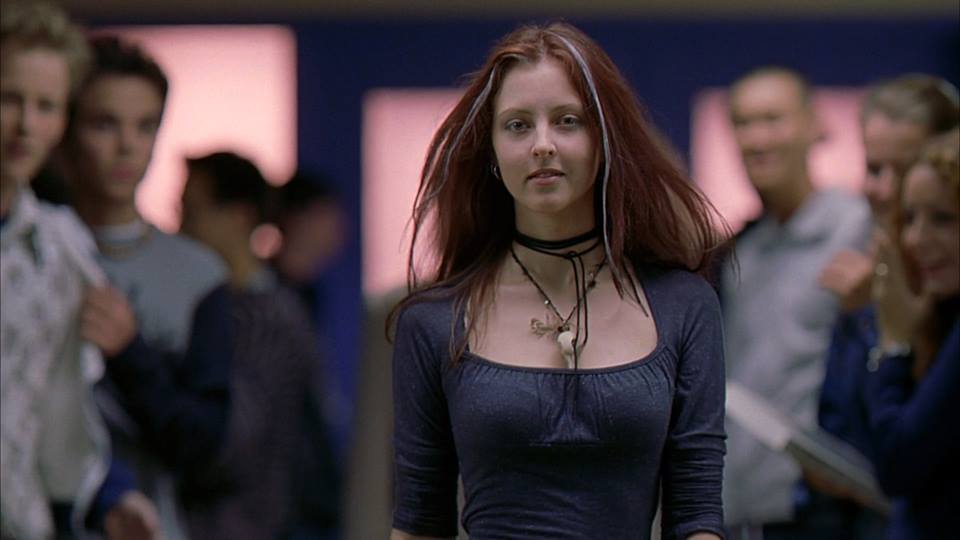
Rage (2020) contains a lot of recognisable horror elements, though it utilises some intent in how it layers these elements together. The result is a watchable, at times ambitious horror film which struggles somewhat with its later pacing, but at its best offers something visually appealing and engaging. We start with a bit of a trope: here’s a group of young South Africans, intent on partying the summer away before starting university (though that says something about how the world has changed: people now do their partying before, not during their uni courses). This block of partying is what’s known as ‘rage’, though there’s more dancing and being sick than you’d usually associate with fierce anger. Wisely introducing our key characters by name – these kinds of players can be a little samey else – we discover that the alpha of the group Kyle (Tristan De Beer) has opened up his (parents’) villa to his friends; after a few of them overdo it at the club, they head back there, and the party continues.

The next morning, in the throes of their hangovers, some of the group head out to get some supplies, enduring a Strange Cornershop Experience along the way. This rattles them a little; meeting another oddball local at the beach a little later only cements the impression that this is a strange, possibly scary neck of the woods, and that they’re vulnerable at the villa – clearly they’re from out of town, and people know they are. But what of it? Any early ideas that this is going to be a straightforward slasher, or a home invasion kind of deal are scuppered by a few visual clues: there are some unorthodox spiritual beliefs around here; small, pagan-looking offerings are seen on the beach and elsewhere. The area itself seems to be in straitened times, what with various economic issues, population shifts (significantly, there are no young people left here) and other worrying issues. So, the arrival of a bunch of usually intoxicated, naïve young people, trying to get a handle on what is unfolding around them – clearly, nothing could go wrong.

The first act of this film – let’s say the first third – is very strong. There’s a sense of awful build up as we get acquainted with our main protagonists, even if the set-up feels evocative and familiar. Actually getting a sense that these young ‘uns are flawed but essentially decent is important: nothing ever works well when we’re simply presented with fodder for the final scenes. So, it’s a little difficult to watch them missing clues, or not reacting to things which are undeniably on the periphery of their vision as they have a good time, but it’s plausible enough, and these are not unlikeable figures. The film has enough confidence to throw in a little bit of misdirection, too: that opening scream, for instance, tries to take us somewhere else.

This is also a colourful, often trippy and overblown film with lots of stylish visual appeal. It soon starts to get alarmingly reminiscent of Midsommar – sometimes looking more than simply ‘influenced by’ that film – but that is of course a modern film which set the bar for warm, summery imagery to yield something much more visceral. Speaking of similarities – though here’s another Midsommar similarity – the film’s trippy scenes also call to mind Mandy and, perhaps more so, Honeydew.

So the elements are in place: what to do with them? Some of the impetus which Rage works so hard to develop is frittered away by a drop-away in pace from the halfway point or so. Moving more into home invasion, it keeps us waiting for that but, more damagingly to the film as a whole, having set up a Midsommar-esque plot line (and no spoilers here: just look at the movie poster, as well as director Jaco Bouwer’s past projects) it struggles to answer the questions raised by all this. Ordinarily, you’d need more of a backstory for such goings-on; what is so important to the antagonists, and what do they hope to achieve exactly? Audiences will expect a main event of sorts; it’s in the eye of the beholder, but some viewers might argue that it’s not really expounded enough. It would have been so interesting to work out what was going on with the belief system here. Maybe the abandoned narrator device could have gone some way towards this?

Still, Rage knows full well not to outstay its welcome, coming in at an equally welcome, goodwill-sustaining ninety minutes (give or take). It has decent performances – if a little underwritten – it looks good, features some great, nasty scenes, and its crazy meld of genres is no bad thing. With a bit more writing and rewriting this could have been a great film but, as it stands, it’s a decent film and a perfectly enjoyable horror, which tantalises at talents yet to fully develop.

Rage is available now (on digital) from Reel 2 Reel films.

Fantasia 2023: Sometimes I Think About Dying

There’s a shot of fallen fruit rotting in a gutter as Sometimes I think About Dying (2023) opens, and not to get into a scene-by-scene analysis of the film, but this image symbolises a lot about the story to follow. In a picturesque but doubtlessly dull coastal town, we meet Fran (Daisy Ridley). Fran is a young woman with an office job (we never find out what the office does, and it doesn’t matter). When she arrives at work each day, it barely generates a flicker of recognition in her colleagues. As harmlessly inane as their workplace banter is, it excludes her – not maliciously, but she blends so colourlessly into the background that she’s barely visible. Work takes up most of her time; when she’s not in the office, she’s at home alone.

The only break from this routine which she’s selected for herself comes via moments – dreams, or fantasies – about her own demise, usually imagined as grand tableaux: towering, picturesque deaths, or dramatic, colourful deaths – death by snake is a good one. She still blends in as a dead body, mind, but it mostly makes a change from the settings she’s in on a day-to-day basis. Outside of these little moments, work continues, with one difference: a long-serving member of the team, Carol (Marcia DeBonis) retires, and her colleagues throw a little party. As is typical, Fran hovers somewhere between involved and uninvolved in these festivities. Everything here, by the way, is really well observed, right down to the workplace murmur; every character is plausible, too.

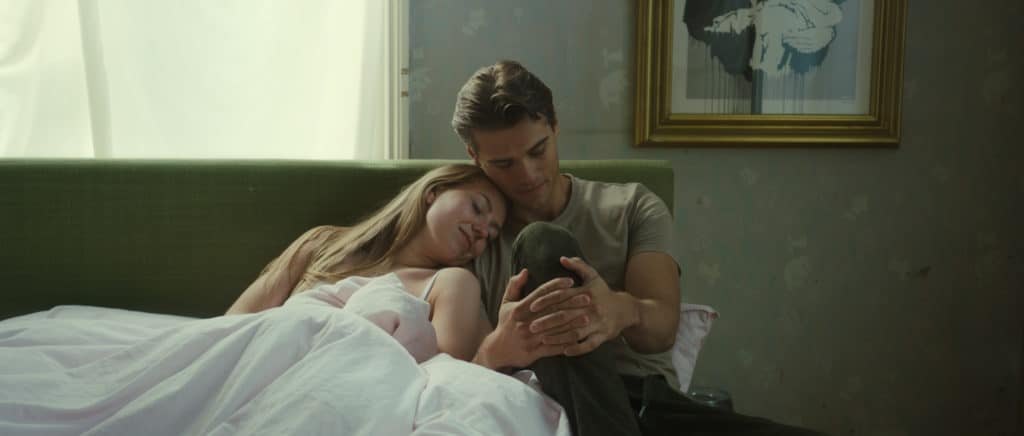
After the cake and the cards, the team gets to meet her replacement, a man named Robert (Dave Merheje). In a professional capacity, Fran and Robert begin to interact (though Fran’s more comfortable with Microsoft Chat than human conversation, as much as she’s just as perfunctory on Chat as with chat.) Perhaps it’s because Robert is a self-confessed workplace rookie, or perhaps it’s something deeper, but he takes an interest in Fran. He even asks her to go to see a film with him. Tentatively, they begin to get to know one another.

The gradual – though it’s important to say, not-uncomplicated – blossoming of Fran as a person is a joy to watch here. Seeing the same thing happening with Robert is just as important, as the film captures a naturally gregarious person being curtailed by being ‘the new boy’, and he’s the new boy for other reasons which impact upon his sense of self. It’s a situation which will be familiar to many people; watching what Merheje does with it is impressive. The film is also able to capture that golden moment in time when someone reaches out, wanting to make a new connection; this is, sadly, a rare enough thing once people get out of their twenties. But as Fran begins to change, those nagging moments remain: what do these visions of death mean now? Is she really equal to this sea-change in her life?

The film’s subtle script perfectly captures the little moments of awkwardness which have largely come to define Fran; the way in which the camera picks over her matching gestures underlines this sense of nervousness, of how it feels to be excluded. There’s no simple in-group/out-group here, however, only glimpses of some people who have learned to become that little bit more proficient in social situations. Everyone’s trying to navigate through, even if Fran’s quiet horror at being asked to do the unfamiliar is often our focus. The way in which Ridley shows us someone keen to get away, but also curious about whether or not it might turn out alright, if she stays? It’s an inspired piece of acting.

And whilst this process is tough, often unbearably so, this is never a film without hope. You might be forgiven for thinking that – with a title like Sometimes I Think About Dying – this is going to be one of those dark nights of the soul type films, where someone is unceremoniously hammered into the ground for their shortcomings. It’s never that: even the opening music sounds hopeful; the town is quiet but beautiful, and colour starts to seep into proceedings as the film progresses. Shots are composed beautifully too, right down to Fran’s death fantasies, which themselves are pieces of art. There’s no unequivocal unhappiness here. It’s also impressive that the film itself references film, providing an important hint of a message on the periphery; Robert is a huge film fan, and he likes them because they invite him to understand other people’s stories. This gentle genius of a film is careful and considerate throughout; it’s a quiet, but nuanced and engaging look at other people’s stories.

Sometimes I Think About Dying (2023) featured at the Fantasia International Film Festival.

Fantasia 2023: Home Invasion

Home Invasion (2023) is not your standard style of documentary; there’s no talking heads here, no voiceover, no familiar features as such. Instead, it all unfolds via on-screen text, which displays to viewers via what looks like an aperture, representing the film’s key subject matter (or at least, key for the first hour): the home security doorbell. Text takes us through the film’s key ideas and falls broadly into chapters, even though – for all the text used – chapters do not explicitly appear. The result of all this? A strangely trancelike experience, blending images, footage and film clips with a hypnotic, dark ambient soundtrack. Its range is expansive – perhaps too much so – but despite a few quibbles or issues, it remains an intriguing project which at the very least comprises a very interesting array of Ring doorbell footage, enough for a scary and unsettling film in its own right.

We don’t get straight to that, however. Instead, Home Invasion begins by describing the birth of home security. In 1966, a nurse, Marie Van Brittan Brown, woke up after a nightmare of home invasion, probably triggered by a burglary which she felt was not taken seriously enough by police. This led to her feeling unsafe at home, and distrustful of existing measures to tackle these feelings, so she invented new technology: a new doorbell system, with peepholes and a video camera. She became obsessed by the feed; in a sense, as the film suggests, this was a new kind of home invasion in some respects. Ironically, her ideas were picked up and used by people better off than her, in homes she’d never have lived in. But surveillance, as we understand it today, was born.

At this point, the film begins to bring in clips of doorbell footage, and takes a short breather from the on-screen text. We next learn about the creator of Ring, an at-the-time depressed and unsuccessful businessman called Jamie Siminoff who invented the live feed doorbell, at first called ‘Doorbot’, but later Ring (despite bombing on the reality TV show Shark Tank, it was later bought out by Amazon; you may know the rest.) This extends the process developed by Van Brittan Brown, affording the possibility of a security network where one can look right back at the people seeking access to your home. The power dynamics suggested by the film are interesting; it also points out that fear became an important selling point in the Ring promotional material, though to be fair, a lot of people seem to use it simply to negotiate with delivery companies (and there’s quite a lot of footage of that going on). It’s also quite interesting to come to this from the perspective of a non-user with no plans to ever use Ring; perhaps we could debate how successfully the fear agenda being proposed has actually landed, and some statistical information would be useful too. Nonetheless, there is a great range of footage here, ranging from the genuinely scary (no Ring doorbell in the world can see through a ski mask) to the diverting, to light entertainment (animals seems pretty good at triggering doorbells).

It’s clear that there is a certain political agenda at play here: as the film continues, the wording on the screen becomes more overt, after asserting that Ring may push a ‘racist and classist’ agenda, it goes further, suggesting – for example – that neighbourhood watch-style messageboards sharing Ring footage are “riddled with police”. ‘Riddled’ is clearly a loaded term; of course questions around purported falls in crime rates since Ring went into common usage deserve examination, though this is likely to fall in with older discourse around the ‘panopticon’ and what it does to human behaviour. And, these ideas are certainly citable. But, on its own merits, the clips compiled here are very interesting; this is the film’s real high point, and having to use your senses to work out what you are seeing is a strangely disconcerting experience (again, this may feel differently depending on whether you use this technology, or not).

The remaining sections spread their net very widely; the final chapter-ish feels like a chapter too far perhaps. After Ring, we move back in time to the role of the telephone (being integral to the functionality of Ring) but here, Home Invasion concentrates more on the role of the telephone in horror cinema, which it didn’t do earlier with newer technology; in fact, this is interesting as an approach, given that home invasion itself forms a horror subgenre, often encompassing CCTV, smartphones and similar. But the range of clips used during the section on the phone (which suggests that the phone once and for all revolutionised our understanding of time, place and interaction) are engaging.

From here, and maybe offering an antidote to what by now feels like an inexorable tide of tech, controlled by institutions and corporations who do not have the best interests of the common person at heart, we go back in time again to the Luddite movement. For this reviewer, this long final section sacrifices some of the film’s forward impetus; presenting the Luddites as evidence that a new way can be negotiated between people and technology isn’t fully convincing, given we know how that went; it’s tough to think of any other reason it’s in here. Two centuries later, we are pondering if AI is going to rise up and kill us. The film also needs a good proofread, given its dependence on text as a medium: there are noticeable inaccuracies, from apostrophes to the use of clunky or non-existent words like ‘logics’ and ‘violences’.

Still, despite some of these issues, as an overall project Home Invasion still has plenty to recommend it: its unorthodox, ambitious approach conveys a wealth of important, engaging information, and it’s done a superb job of assembling its footage, all packaged by a nightmarish soundscape which works really well. It’s not a horror film, but it very much could be in places.

Home Invasion featured at the Fantasia International Film Festival 2023.