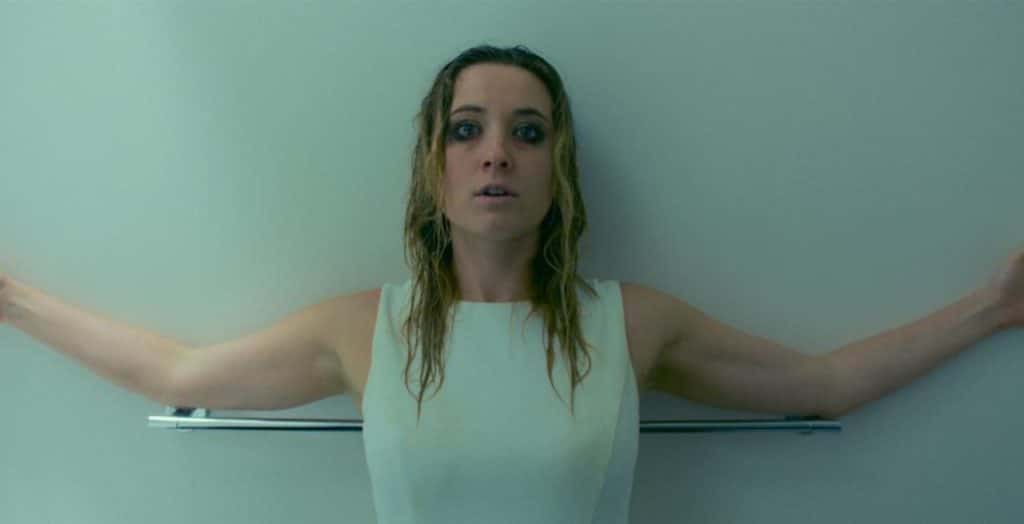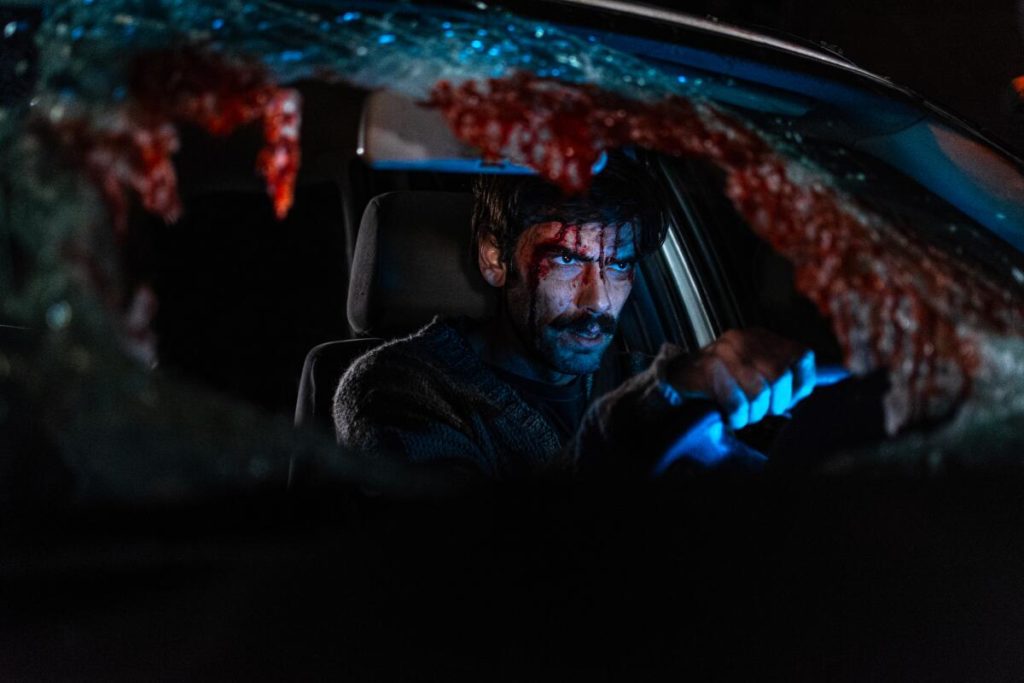
A pinballing, weaving camera which eventually ends up giving us a cadaver’s eye view, straight through the zipper of a body bag, is a pretty sizeable clue that Suitable Flesh (2023) is going to be an unashamed piece of horror, and to its credit, this turns out to abundantly be the case. Based around H P Lovecraft’s story ‘The Thing on the Doorstep’ – itself a kind of greatest hits compendium from Lovecraft’s universe – it retains the body-hopping, consciousness-blitzing high weirdness of the story, but adds a lot more colour, overt violence and – avert your eyes, Howard – sex scenes. Egad.
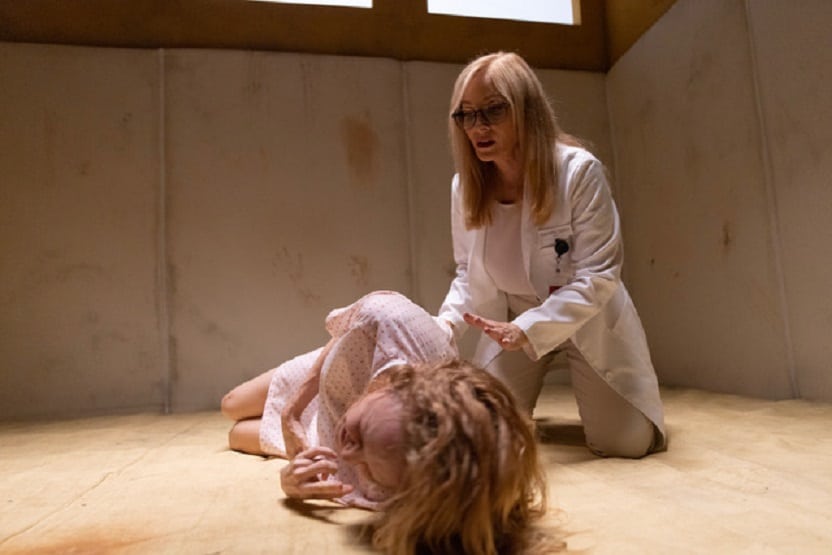
Anyway, back to the morgue: two doctors, one of whom is played by Lovecraft/Gordon alumni Barbara Crampton, are discussing the gloopy mess within and also how it relates, sadly, to a colleague and a friend, Dr Elizabeth Derby (Heather Graham), now on the psych ward for her role in the death. Soon afterwards, when Dr Danielle Upton (Crampton) attempts to speak to Elizabeth, Elizabeth acknowledges what she’s done, but she’s still afraid – afraid that ‘he’ is coming, and that she still isn’t safe.
Beth is perfectly able to recount her tale, when her friend tries to find out what has caused all of this. She explains that she’s had a good life: she’s been a successful psychiatrist, has a loving husband and a beautiful home, all until: she opened her clinic door to a young man without an appointment (without an appointment! Imagine that happening on the NHS.) This troubled Miskatonic student, Asa (Judah Lewis), begs for her help: he has read her work on OOBEs (Out of Body Experiences) and thinks she’s just the person to assist him in his plight; curious, she agrees to hear him out. Ominously, his tale of another ‘he’ who wants to take over his body already sounds familiar; Derby, though, being extremely well-versed in modern psychiatry and its tenets of repressed memory, projection and so on, is drawn into believing that Asa’s problem, with this ‘he’, who turns out to be his father, is the result of parental abuse: this draws her in. She’s troubled by the encounter, and decides to look Asa up, actually visiting his house to look for him.
What she finds at Asa’s house soon escalates the situation; neither Asa’s sick, goading, sinister father nor Asa seem able to stay themselves for very long, so that even Beth’s tenacious grasp on her diagnostic criteria are soon tested beyond their limits. Asa, in particular, undergoes personality shifts: where he was once fragile and fearful, he now seems to have morphed into creepy, inappropriate and… weirdly enticing to Beth. Professional distance would have saved her from a lot of things which happen here, but as it stands, her personal and initially, sexual interest in Asa sends her spiralling into a world of body horror, lost autonomy and good old fashioned, Stuart Gordon-esque Lovecraftian splatter – even if it never quite lets itself fully go, never quite goes that extra lunatic mile, as much as this doesn’t prevent the film from being a lot of fun throughout.
There are some minor criticisms: Suitable Flesh burns through its elements of surprise in the early part of the plot relatively quickly which leaves us, once we’re in little doubt about what is actually going on here, with some repetitiveness: person goes into spasm, person develops wry, pervy face because we-soon-know-why (the acting around this situation can be somewhat variable, too). Added to this, despite the surprise rapidly burning away, it can get a little confusing about who is who/where, at points. But there’s genuinely lots to love here, not least the reappearance of Stuart Gordon’s writer-in-chief Dennis Paoli, who brought us Re-Animator, From Beyond and – a personal favourite – Dagon! Paoli’s skill at transforming HPL’s unknowable, unnameable yet often rather staid horrors into something lurid, tangible and uproarious – without sacrificing the spiralling paranoia, loss of selfhood and insanity – is very much intact. We get enough snippets of the occult (nice grimoire!) alongside a reasonably solid backbone of cosmic, existential horror to counterbalance their expression in a fairly gory, madcap body horror love-language.
All in all, Suitable Flesh is a crowd pleaser: it rattles along at a decent pace and it gives us some good female characters – again, this is down to director Joe Lynch, writer Paoli and some solid lead performances in Crampton and Graham, one an actor with a lifetime’s worth of Lovecraft horrors under her belt and one who clearly relished the opportunity to get stuck into something a little different. If it’s not quite a dead ringer for the uproarious Lovecraftian gore of the 80s, then fine, it doesn’t have to be; it has plenty of merits, decent ideas and charm of its own. I’m glad we have it.
Suitable Flesh (2023) will be released on October 27th, 2023.
I had a strange sense of deja-vu several times when watching Robert Morgan’s first feature-length film, and the first of these is because I can never remember who anyone is or what they’ve done. So, when I first glimpsed Morgan’s very distinctive stop-motion style during the opening moments of this feature, I realised that I did know his work, and in fact that one of his short films – Bobby Yeah – has been chipping away at my subconscious ever since I saw it over a decade ago. I don’t think anyone can come away from that one without at least a few questions, questions which could (will) stretch over a good decade. However, where Bobby Yeah is madcap and disturbing but overlaid with so much absurdity that it becomes openly funny, Stopmotion is a different beast. Blending its own stop-motion animation with a disturbing, unfolding story of barely-concealed imposter syndrome and unease, Stopmotion is a lot heavier in its nature, with only a few flashes of humour as the proverbial hits the fan in waves. The basic general direction of its plot may feel overly familiar to horror fans – there’s that deja-vu again – but it does more than enough to hold the interest, even as it takes us on this familiar path.
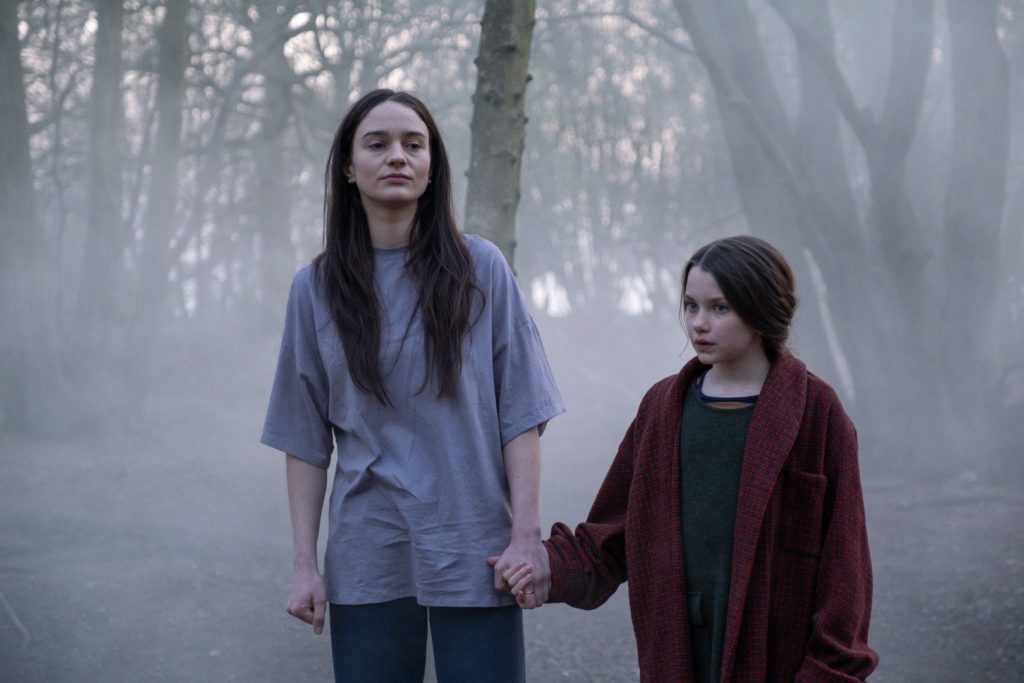
Ella (the incredible Aisling Franciosi of The Nightingale) is a young woman living an isolated life; any freedom has to be taken carefully, in sips. She lives with her mother, a brilliant animator now ravaged by arthritis and unable to do the job; instead, Ella does it for her, working under strict instructions as her mum (Stella Gonet) battles her health problems to get one final film finished. Her arthritis means she needs other care, too: she can’t so much as cut up her own food, though her rather carnivorous diet hardly helps, and hacking away at bloody steaks quickly becomes a staple theme in the film, though the reasons for this vary.
A catalyst for confrontation between mother and daughter comes when Ella mildly announces that she has some ideas for an animation, too; when pressed, she falters, and when she’s faced with her boyfriend’s sister, who is also building a successful career in animation, Ella begins to crack under the pressure. Her mother’s frustrations make her lash out at Ella, but the drama of a confrontation between them helps to cause her mother to have a catastrophic stroke; the story of the cyclops woman who bargains with the gods but sees her own death as a result, has to wait. But it can’t wait long: now left to her own devices, Ella decides she’s going to finish the film for her mother. She takes a flat in a down-at-heel part of town just for this purpose, and starts setting up there. Her work is interrupted by a very impertinent little girl who also lives in the block, and who wants to know everything about what her new neighbour is up to – but, with a child’s characteristic honesty, the little girl (Caoilinn Springall) dismisses the cyclops story as ‘boring’. She has another idea – and it’s horrifying, and yes, we get to see it when Ellie agrees to make it.
Children have that knack of presenting very simple stories as incredibly frightening and, if you’re able to remember back that far, you might be able to recall the odd flash of that straightforward, but soul-curdling strangeness in yourselves; the film does a good job of capturing some of that, because the little girl’s story is simplistic (a little girl being pursued through the woods) but something about it appeals to Ella, and to us by extension – the puppets which they fashion together, introducing horrible elements like ash, meat and carrion, certainly look authentically unpleasant. It’s pretty obvious that the girl is an embodiment of some aspect of Ella, her own Imp of the Perverse who gives voice to things that she, although still a young woman herself, has had beaten out of her by a challenging personal life and a kind of self-doubt which is reinforced by ‘loved ones’ with their own agendas.
Also clear is that the film’s overarching fascination is with the creative process, overlapping to an extent with the idea of the ‘tortured artist’, our cultural expectation that good art has to wring everything out of its maker (which to be fair, isn’t an idea which has come about entirely out of fresh air, and there are lots of examples of it really happening.) Music, painting and filmmaking have been well represented in horror films about this process, from Shadow of the Vampire to Bliss, but stop-motion animation, not so much; it’s certainly a good medium to examine, as the level of patience and focus it demands could send anyone a little scatty, so it’s good to see it so central here.
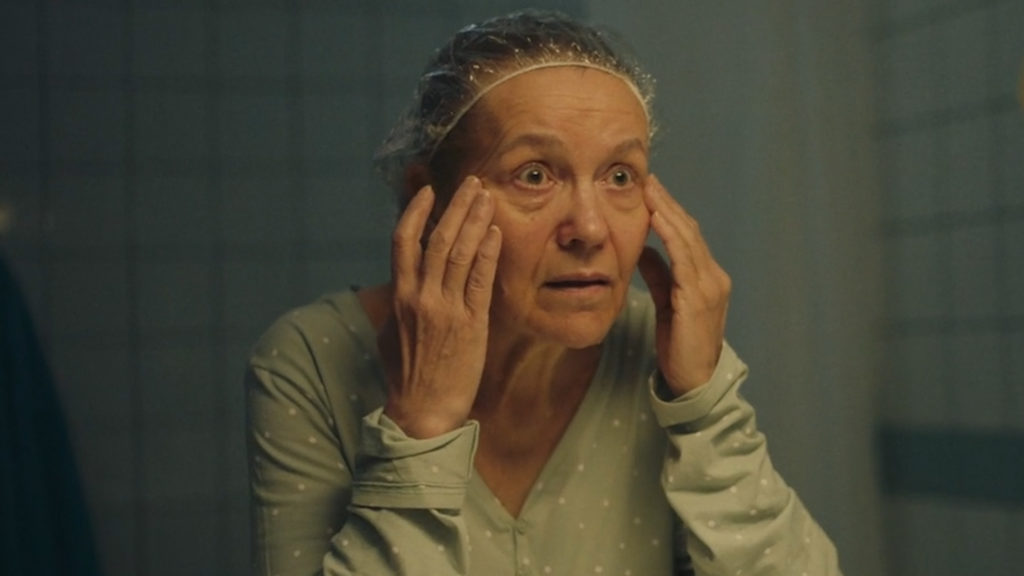
Where perhaps the film is at its weakest is simply in how the ‘descent into madness’ has been played through so similarly and recently, too, in films like May, Censor and Saint Maud – all films where a fragile female protagonist tries to make or build something to assuage her own demons (Saint Maud in particular, with the dysfunctional relationship between Maud and her employer, came to mind several times, but then so did Censor, and lead character Enid’s own plight as she descends into a mysterious film). So there’s a chance that Stopmotion may lose you through its level of overlap with other, similar projects – though its own brilliant, unsettling meld of animated footage and live footage does great things with its medium of choice, and what could be better at representing insanity than the kinds of horrid critters Morgan comes up with? It was quite pleasing that, as different morgue wax-made concoctions appeared on screen, lots of festival audience members around me let out a synchronised murmur of disapproval. There’s a lot to be said for that; shared moments of disgust at a horror film festival are the ultimate compliment.
Stopmotion is also a beautifully shot, lit and acted film, with brilliant production values and a real sense of purpose throughout- it didn’t feel laggy, even if you knew or could make an educated guess about the outcome. Like Mad God – another stop-motion movie with a very long gestation – the notion of a project like this overwhelming its maker is completely plausible, and borne out by the intricate and unwholesome creations which appear on screen. This is a fine piece of work, and an expertly-composed aesthetic (and aural! Oh god, and aural) nightmare.
Stopmotion (2023) appeared at Celluloid Screams in Sheffield, UK.
From the abundant and imaginative pages of artist Go Nagai we find today’s film, Lion-Girl. Written and directed by cult favorite Japanese director Mitsutake Kurando, this piece faced many unique challenges while telling a unique story. Filmed entirely in Los Angeles at the height of the pandemic, the film found collaboration with Toei Video and was able to have a specialty festival run amid its production challenges. While I couldn’t find much to illuminate me on Lion-Girl as a newcomer to the story and to Nagai’s manga, I was still made perfectly comfortable and never overwhelmed by the sheer amount of story and lore carefully laid out to brief the uninitiated. Telling the story of our masked, tattooed and supercharged Lion-Girl, Kurando brings a colorful comic book world to life with stunning makeup, silly but satisfying fights, and the hallmarks of old monster movies and manga mixed into live action.
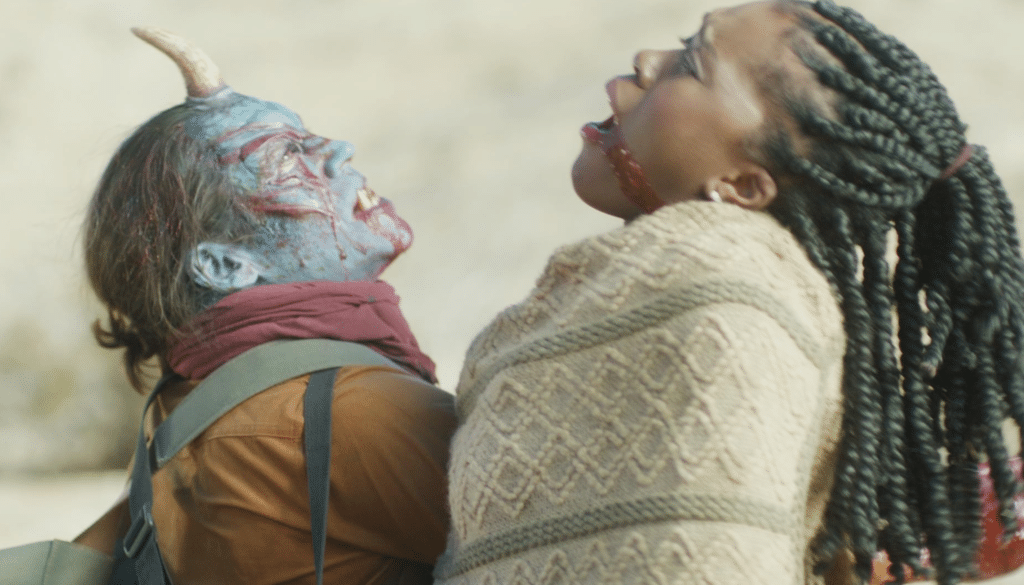
Starting in a bath house, many nude onlookers stare with hostile expressions at a young woman (Tori Griffith). A bather stands and cranks the steam level high, asking the young woman if she’d like to boil and die, or give up her life force. Unbothered, the girl says she chooses neither, sending the group that once looked human into a frenzy. Sprouting horns, fangs and donning demonic faces, the group shows their true appearance. Their target begins to glow, turning to face them, before a quick cut takes us away from the action to come.
We are given some backstory here—the year is 2045 and a tsunami of meteorites has collided with earth, killing most lifeforms. Approximately seven million survivors weathered this event, and the small group fought its way towards Tokyo, Japan, the only livable island remaining on earth. This influx of people caused thirty years of civil war until finally, a man by the name of Fuginaga and his clan snuffed out the war, making him the ruler of all that remained. Modelling his regime after a samurai totalitarian government, he establishes a new country: Neo-Nippon. But the world is not fighting against the government, for there is an enemy that threatens all humanity, the shogunate’s designated infectious disease: Anoroc Syndrome. Within the meteorites there were rays, usually causing death to humans, but those exposed who survive are turned into monstrous beasts deemed Anoroc. These beings hunt and kill humans for their lifeforce.
We shift scenes from our history lesson to an Anoroc hunting down an elderly couple, when a glowing girl jumps from behind a car, cutting off the monster. She declares herself Lion-Girl to the creature, “Stand with the weak, fight the strong.” Lion-Girl engages in a psychic duel called “Scanning” where two beings are locked in psychic connection. After winning her battle (and exploding an Anoroc head), Lion-Girl heads back to a rundown hideout in Shinjuku. A man finds her laying outside, and brings her in, putting her into a chamber to help her rehabilitate as the tattoos on her back return to blue from a dangerous red. Away from this, in a lab somewhere, a group of gothic looking samurai arrive to inspect an Anorac body, led by a hulking man referred to as “My Lord” by the coroners; this is Kaisei Kishi (Derek Mears), a dark and powerful figure with presence from the start. They determine the Anorac they’re inspecting died from a battle with the “lion masked woman,” and Kishi says he very much looks forward to meeting her, as she is now a marked fugitive due to her controversial public status, according to a later news broadcast.
Reminding me of the fantastic Shin Kamen Rider, this film, led by another charismatic masked hero, has old school effects, an evolving retro soundtrack, dramatized battles and makeup that are a tribute to the colorful pages of manga, as well as the monster movies present and past. Costumes abound and monstrous faces of the intergalactically infected shine with practical and cosmetic effects, bringing a very comic feel, especially when combined with the shining, campy special effects used to liven battles and infuse superhero energy. Lion-Girl is a feminine force to be reckoned with, but while some aspects like nudity felt overdone, the tone of the film still held on with nude shower jousting scenes and bare magic breast fire (I’m not exaggerating). Perhaps a tongue in cheek feminist way of saying women can display their bodies how they please, as we see people look down on Lion-Girl for her gender and appearance; it can sometimes be distracting, even if it’s meant to be liberating, and at a stretch, perhaps speaking to how we sexualize the women of comics and animation to a fault.
A brutal and sometimes hilarious dystopia is presented here, with just as many satirical punchlines brought in about the government, disease and crime as there are actual punches thrown. Battles are fun, sometimes a comic book like experience with powers being detailed out on the side of the screen, blood spurting like a fountain from every bullet wound, or over the top sword sounds sheathing away. Other times things feel more realistic as heads roll. Performances from the main cast are solid, with Griffith the pensive but spirited Lion-Girl and the star of the show, Derek Mears, a menacing, dark shadow cast over the story, making it all the more interesting to watch.
An epic journey, lighting, shooting and color palettes all pop to give a more vivid experience comparable to manga, with washed barren desert shots contrasted with intimate moments between characters bathed in purple. This comic book tale encapsulates a very compassionate story and moments that range from the touching and profound to the bizarre, covering all bases whilst creating a compelling watch outside of the ordinary comic book offerings. If you’re looking for an unconventional champion, a set of entertaining villains and monsters, and a peek at what Kurando has made of Nagai’s iconic illustrations, take a look at the visually stunning rise of a spectacular female hero, and take a trip with a cast of characters through a look at a bleak but fascinating future.
Lion-Girl (2023) will receive a digital/Blu-ray release on November 7th 2023.
In sitting down to put this piece together, something soon became very clear: it’s difficult to properly explain a thirty-year connection with an album – any album. If music – or film, or literature – has been a part of your life for that long, then it’s probably long since become a part of your emotional landscape somehow. The album itself becomes a longstanding feature, sometimes played often, sometimes seldom as the years pass, but always there. Still, as My Dying Bride’s Turn Loose The Swans hits its thirty year milestone, it feels only right to try and explain what it means to me.
This album – the single most influential and important album of my life, it’s no exaggeration to say – has endured for what feels like my whole life; certainly for my whole self-determined years. I was into my teens when I first took an interest in metal, then death metal, then anything which sounded suitably heavy and/or weird. I was, at this point, just picking my way through genres piecemeal with no real understanding of anything and only adverts or reviews in, say, the short-lived Xtreme Noise to guide the way, but this casual approach to picking out titles served me pretty well. I’d recently saved up and bought MDB’s EP The Thrash of Naked Limbs, because the title promised something interesting; there was no finesse to this approach, but nor should you expect that of a kid living in the middle of nowhere with nothing but curiosity to see her through. I also trusted the long-defunct Round Diamond Records not to stock anything other than music I’d not be likely to encounter anywhere else at hand.
So The Thrash of Naked Limbs arrived, proved defiantly unconventional, was just as Gothic and experimental as I’d hoped, and proved to be a very lucky find. Its (for the most part) languid pace, its use of death metal elements, and – my god – violin, something I’d never even considered could work in music like this, soon had me referring to myself as a My Dying Bride fan. I was a violinist myself at this point, though my enthusiasm was starting to wane: the concept of playing metal, rather than doing endless violence to Little Brown Jug, was a revelation. I started asking for other MDB releases, actually coming to Turn Loose… before I got hold of As The Flower Withers. I had little concept of discographies, either. I heard the Slayer albums in reverse. I had no one to ask, as such. Turn Loose The Swans ended up being a Christmas present the year it came out, and I distinctly remember unwrapping the CD – not vinyl, absolutely not vinyl, which was a couple of decades off its Instagram Renaissance (and I still own the same CD, which I’ve somehow hung onto across eleven subsequent house moves, though the cover has looked increasingly sorry for itself since some point in the Nineties).
Now, despite some experience with the violin, I’m no musician: everything I’m about to say about Turn Loose The Swans comes from my own personal impressions, so if I misspeak or misdescribe a musical term or sound otherwise clueless, it’s coming from a place of blissful ignorance. But I’m a fan nonetheless, and I do want to try to describe what I got and still get from the album – in effect, I want to try to explain what it means to me and how I feel when I listen. I can only try; whilst different impressions and whilst memories surface here and there upon re-listens, here are some of them.
For a teenager expecting something, if not avowedly death metal, then close to it, the opening track, Sear Me MCMXCIII – the second of three tracks to bear a variant of this title – was, perhaps is, a great surprise. Bookended in musical style by the album’s final track, Black God, it has none of the expected guitar or drums, and certainly no growls. Whilst not overburdened with lyrics, the song nonetheless showcases the dark Romanticism which has been a mainstay for the band throughout its lifespan; MDB lyrics can often tend to be devotional (lots of mentions of God, Heaven, faith) but married to more earthly themes, often romantic or sexual in nature. There’s clean vocals here – clean vocals dominate the album – but vocalist Aaron Stainthorpe intones more than he sings on the opener, with only a handful of lines picked out as melodies: whilst other, later songs on the album do move somewhat closer to more recognisable doom metal, Sear Me is stripped down, simple and striking; it forms a good introduction to what’s coming. It manages to be both ominous, and uplifting; perhaps that’s the band to a tee.
‘We gather thorns for flowers…’
That said, in the next track – Your River – the pared-back instrumentation continues as the track opens up. When the whole band come in, including violinist Martin Powell, it establishes the intensely atmospheric, rising-and-falling tempo which demarcates this album. Next up, The Songless Bird is perhaps one of the more accessible metal tracks on the album, but feels ferocious compared to even the two preceding tracks. The lyrics also undergo a shift, switching from reverence to scorn, even though the song pauses for some of the harmony between guitar and violin which returns throughout. This allows the song a calmer, more sombre section, before kicking back into its higher tempo.
After The Snow in My Hand – a beautiful, plaintive song in its own right – it’s into the two greatest songs on the album, which appear back-to-back. The Crown of Sympathy is an absolute force of nature, and perhaps the band thinks so too, as it was ably remixed on the compilation album Trinity in 1995. The Crown of Sympathy is brooding, heartfelt and pleading in places; is it too much to say it feels like it’s telling a story, confession, last words? It has echoes of Baudelaire in it lyrically, or maybe the Gothic world-building of Angela Carter, which definitely feels like the case in later MDB songs, coincidence or otherwise (The Blue Lotus is very similar thematically to The Lady of the House of Love, for instance). Here, there are more allusions to faith, doubt and loss, and the song shifts from mellifluous dirge into a killer hook. The whole album’s tempo shifts are epic; here they’re sweeping, staggeringly good; this song, and the next are masterclasses.
Which brings us to the title track, and for me, simply one of the greatest doom metal songs ever created – and we’re talking Yorkshire doom here, if we can call it that, which has little in common with the doom sound of the 70s and 80s, thematically or stylistically. The harmony between the opening riff and the accompanying violin is simply beautiful; how could you ever feel nothing on hearing it? It’s also a hugely ambitious song on an album full of ambitious songs – terrifically heavy, but balanced against pauses, shifts, deviations. In some respects, it shouldn’t work, but it works absolutely seamlessly. Black God ends the album on a mournful, sombre, guitar-less note, feeling like the epilogue we need after an album of this scale. Something to settle the nerves, maybe, and if elements of The Crown of Sympathy have a kind of religious, pleading quality to them, then Black God is clearly lyrically modelled on a final prayer. It’s a quiet, but no less ambitious ending to an album which, in just under an hour, has reconfigured a genre, or created one.
‘No sad adieus….’
So what can we say, finally, of Turn Loose The Swans? It’s an album which balances a certain amount of pomp and bombast against far quieter, subtler moments, and makes it work utterly brilliantly. It’s huge and ambitious (the band were only in their twenties when they wrote it) with looming, wholly original songs melding Sturm und Drang with complex melodies and piteous lyrics, then wedding orchestral sections to death metal elements in ways which still seem perfectly effortless. It’s lost nothing of its initial shock factor, either, and still feels like the most coherent, but undeniably avant-garde thing MDB have ever done. Later albums – with the exception of 34.788% Complete perhaps – haven’t played with genre and expectations so thoroughly, and MDB’s doom sound feels more…contiguous, or perhaps recognisable is a better word, after The Angel and the Dark River, which came out just a couple of years later. Turn Loose The Swans is still the boldest album MDB have ever released though, and that it’s able to do so much inside a one-hour runtime (Bell Witch take note) is still phenomenal.
For me, this was the high water-mark of this style of doom metal, even whilst establishing this style of doom metal. Let’s go further: this is the apex of music for me. It made an artform out of a kind of melancholy I’ve stuck with throughout my life, or which has stuck with me, and on an even more personal note, it’s been a bittersweet experience trying to sift through the years and put into words what I first felt then – as just a girl – now that I’m so much older, and now that any genuine affiliation with all of that vociferous, yearning emotion has been sloughed away. But the music is still there, still brilliant, still revelatory, still beautiful. It retains an immense amount of power. Nothing about that has changed.
Will I still be around in another thirty years? Touch and go, let’s be honest! Will the album? Yes it will, in some way, shape or form – maybe playing via technology we haven’t conceived yet – but it fully deserves to have a devoted audience forever, and I’m confident it’ll keep finding its audience. I’m just one of the first of them. I’m still one of them. And I’m immensely grateful.
Short film Vax (2023) is a cynical snapshot of the interplay between medical research and a profits-driven system, and one which has clearly bubbled away in the aftermath of the Covid-19 vaccine, with all of its attendant, sometimes barking mad discourse. But what Covid did was bring the subject of vaccination to the fore; whether you happen to believe that the Covid vaccine programme was a profit-driven ploy by Big Pharma to implant us with nanotechnology or a successful tool in quelling a new and often highly dangerous type of coronavirus, vaccination has been a hot topic in recent years in ways it hasn’t been for many more years than that.
But Vax doesn’t actually tackle Covid; rolling time back to 2003 (with a newsreel first reminding us of early Noughties Republican spending cuts and the run-up to the second Iraq war) it bookends its broadcast with mention of the impact of malaria, particularly in sub-Saharan Africa where the insect-borne virus typically thrives, killing tens of thousands of people per year – especially children. The search for a viable malaria vaccine has been a long and arduous one (and, somewhat gallingly for the film’s premise, has recently resulted in an effective, cheap, lifesaving vaccine which has now been rolled out worldwide). However, the film is set twenty years ago and, in its world, the hunt for a vaccine is ongoing.
It’s just that the potential success noted by scientist Geoff (Cade Carradine) is at first doubtful, because it seems to be entirely accidental. Examining one of a range of petri dishes one day to check progress on a sample, he sees that the malaria microbe is…gone. Perhaps there’s been an oversight? He looks again. The angry reaction of his colleague Eric (Ricco Ross) seems unusual, honestly, but perhaps he really is disturbed by the possibility of a professional error at this level; contamination, or human error, could (we infer) cost a lot of money to the lab. Politics begins to creep in – I say creep, but it’s a bit more overt than that, with a hefty insinuation that the lab should conceal any success in this endeavour because of market considerations. So what does a lone scientist, motivated by philanthropy, decide to do in this situation?
The interplay between public funding, private enterprise and pharmaceutical development is vast, complex and often nigh-impossible to decipher without banging your head against an alternative piece of evidence here, a different explanation there; in effect, it makes for challenging subject matter for a twelve minute film, and any conclusions must be curtailed in terms of complexity, or subtlety. Nonetheless this is a carefully-shot film, well lit, with an appealing balance of colour against lots of darkness; characters appear in shadow, discussing big ideas in barely-illuminated spaces. It gives the film a nicely theatrical quality, and its use of green-screen is just as considerate.
In terms of subject matter and politics, Vax doesn’t attempt to get much further than highlighting the decided downsides of medical breakthroughs happening in the wrong hands, but hey, this has happened out in the real world and may continue to happen, so – as a talking point, the short film does enough to raise this central idea and leave it with us. It’s a decently made calling card by director Barak Shpiez.
If you are a fan of Lucio Fulci, Florinda Bolkan, giallo cinema or all of the above, then you may be interested to know that my book on Fulci’s early film, A Lizard in a Woman’s Skin, is now available. I’ve referred to it in various blurbs as a ‘labour of love’, and it is: it’s been planned, written and put together entirely off my own back; to turn that around, you could say that absolutely no one has suggested that this is a book that needed to happen. But the idea had been nagging away at me for a while, even years; after much ado, it’s done and dusted.
A couple of things helped to get it written and done. And some of these things are fairly incidental: a few years ago, when the varied but always engaging Devil’s Advocates books started appearing and I started reviewing them, I began to be troubled by the idea that I could have a go myself, and A Lizard in a Woman’s Skin occurred to me as a great choice. You can enjoy Lizard on an entirely straightforward level, as a murder-mystery with brilliant fashion and décor and interesting performances, but it’s always seemed to me that there are so many other, intriguing things to say about it; its treatment of class; its post-Manson, reactionary spin on youth subculture; the way it films and frames London; its look at privilege and its inclusion of challenging, outlandish art, to name a few things. Sadly, when I casually mentioned the idea to the editor of Devil’s Advocates, it transpired that he hadn’t seen the film. To be fair, the films in the book series tended to be very well-known ones; maybe I was way off. The idea took a rest for a while. In-between, there were a few print projects which came to fruition, a few which did not (appearing and disappearing ideas and schemes, disappearing payments and incommunicado editors seems to be an occupational hazard) and a number of other things to keep me busy, not least of which running this site, often on my own, whilst attending to the day job and so on.
However, a couple of years ago I was asked to review Robert Simpson’s fine book on The Wicker Man; this was, for him, also one of those labour of love projects, with the main difference being that he had actually printed his. Robert had gone and done it; absolute full credit to him – hey, perhaps I should just crack on as well?
The result is a shade over 100 full-colour pages, organised into eleven chapters, fully referenced and illustrated throughout. The book definitely looks great, and would make a good limited-edition addition to your shelves if you enjoy collecting cinema writing. If you’ve ever read my other writing, then you’ll know what to expect, though I’ll admit a bit more trepidation here than I’d usually feel, given I’m writing about such a ferociously-beloved filmmaker. But I’m also rather proud of my little book, and I hope that some of you will enjoy it too.
Please head over to the Store here on the site to pick up a copy, if you so wish. We ship internationally for a reasonable fee! Thanks for reading and supporting.
Art and horror have a long and fruitful relationship, from every cinematic rendering of The Portrait of Dorian Gray through to Fulci, Barker and Begos. Regrettably, End of Term (2021) won’t be making any ‘best of’ lists for its own treatment of the art theme; neither the art nor the horror are either plausible or fully-formed.
Starting with a voiceover which addresses the hackneyed cultural idea of the ‘tortured artist’, we meanwhile meet main character Melissa (Chelsea Edge), whose job will be to talk us through a sequence of events which took place at a recent graduation party. To judge by the strategic raised cuts on her face, things turned violent; true enough, given she’s whisked into a police interview, this is now a murder enquiry, and she’s a valuable witness.
She’s an art student, living at – ulp – the Old Rectory at Borley (something which is a namecheck only and has no links to the Borley legend). Voila, our first problem: in its haste to frame the film as a horror, the police whizz us through the highlights of the fateful night in short order, which leaves Melissa the job of filling in all of the details. The jump scares are already past tense before she can get stuck into her narrative; from here on, all she can do is recount things more slowly and, it seems, in a surly monotone, which suggests that all of this is very tedious, and so it comes to feel. We are also asked to keep the perspective of two timelines: the police interview, and the erstwhile party, which is difficult to do meaningfully – especially given that the art students involved are all so difficult to like.
But, that aside, we go on: one of the student’s art pieces is, apparently, an ‘S&M torture chair’ (and yes, she’s the resident goth; why do you ask?) Frankly, whilst it becomes notionally plot-relevant, it doesn’t look like a lot to show for a £27,000 student debt, but this may stem from personal frustration about Not Understanding what art is; several asides during the film furnish us with platitudes about this topic, at the expense of pace and characterisation. Also at the expense of pace and characterisation: there are lots of attempts to encourage affiliation with the graduates themselves – their politics, their relationships, their former relationships. At the art show, we also meet some of the professors, as well as learning more about the legend of art school founder Garth Stroman, who is rumoured to haunt the very student accommodation we have already seen. This kicks the film into the next phase, where it either becomes a supernatural thing or, as seems somewhat possible, a hijacking of the legend by a disgruntled student, or critic, or someone else. You do get some denouement by the end, but until that point – who knows, or could really keep their minds on it?
Whilst the production values on this film are essentially sound, End of Term is a frankly baffling, disjointed affair where compounded errors around pace, character and narrative rapidly blow any borrowed goodwill. It’s keen to put its big-ish British TV stars front and centre (odd couple Julie Graham and David Bamber feature as the two detectives) but this is still a minimal role for them; even so, they threaten to overshadow Melissa and all of her recounted storytelling about the fates of the others (who, for all of the back story offered, fade swiftly from the memory). They’re an odd bunch; we’ve already discussed the surprising paucity of the art on show, but this weirdly pampered, repellent group of people are barely plausible as students at all: maybe student life is like this, now, for some, but it’s a big ask to make them sympathetic with their luxury housing, crap paintings, personal non-problems and inability to hold anything like a debauched party; everything here is too lacklustre to really land. Do the searching questions around art go anywhere, either? You could argue that more time spent on other aspects of the film would have meant more tension and drama to carry things through to the ninety-minute mark. There’s just no guts, no fun: everything fizzles out. The true role of art here is, arguably, to spit out a baddie to stalk the pristine corridors; everything else is just filler.
It’s interesting to note that this film – the work of a first-time director – was made seven years ago; it’s then credited as a 2021 production on IMDb, and getting a release now. No doubt Covid played a part in its delayed appearance, as it did so many titles, but you can’t help but wonder if other issues held some sway here too. As it stands, End of Term is a weak, flimsy and derivative horror which comes across as having pretensions, rather than solid ideas, which tends to feel unforgiveable for many genre fans – this one included.
End of Term (2021) is released on digital from the 2nd October 2023.
Strange goings-on are pressing in at the edges in Vincent (2023): disappearances, despair, double lives. But despite these blue-tinged, Nordic hints of horror, this turns out to be an immensely warm, often touching film about friendship which absolutely deserves to be seen. This is one of those indie cinema gems which you keep on reviewing films in order to find.
Opening with the Boris Karloff quote, “The monster was the best friend I ever had”, you could say that the film sets out its stall early on: it interrogates the whole idea of monsters, from the cinematic monsters beloved of the horror genre (and a young protagonist who adores them as much as Karloff evidently did) to more everyday monsters, or monstrous behaviour, which requires no supernaturalism whatsoever. We meet the Vincent of the title (Mikkel Vadsholt) in strange circumstances: it looks like he is drinking blood through a straw, and then, soon after, pausing to dig an animal grave in the woods, when he hits something in his ice-cream van. Yep, Vincent sells ice-cream, and if that makes you suspicious, then a police officer who pulls him on a routine stop after a local disappearance is thinking the same thing. Vincent doesn’t help himself: he stammers over his answers to questions, and he’s carrying a lot of kids’ comics for reasons he can’t really identify, except to say that he likes children, and children like comics. That’s enough for Zebastian, the cop (Joachim Knop) to decide to keep an eye on him afterwards, even though the disappearance in question concerns an elderly man. Some things just take precedence.
Meanwhile, we’re also introduced to Viggo (Herman Knop), a monster-loving teenager who, in his way, is just as isolated and prone to suspicion as the older man, alienated and bullied by his peers (the film is a masterclass in bullies you soon love to hate) and, though smart, barely able to enunciate what’s going on with him. Vincent and Viggo’s paths cross just after he is attacked by the same group of bullies who harangue him in class; Vincent sees the assault and stops to ask if Viggo is okay. He offers to drive him home; a few moments into his instilled fear of strangers, Viggo is bruised enough and sad enough to take him up on the offer.
Steadily, the film unfolds details of Viggo’s family life: his nightmares, his problems, and most of all the recent trauma he has experienced as his mother has just filed for divorce from his father, a man who perhaps means well but indulges his cruel, belligerent side in order to ‘do well’, causing more upset as he goes. If Zebastian – whom we’ve already met – really wants to do right by his son, then his prejudices and beliefs impair the process. Primarily via him, it asks us to consider our preconceptions about Vincent. Can a man of a certain age simply like children, or do we see something dark in that? This is all aside from any potential other readings of Vincent’s character, and the subtle, questionable hints that he is not ordinary in other respects: how much of what we’re seeing could be explained away? Is he a threat?
Along the way, as an unorthodox friendship develops between Viggo and Vincent, we’re privy to a range of oblivious, unrealistic, even self-obsessed adults. Vincent might have the trappings of being an odd guy, but at least he notices what’s going on around him; there’s a lot of ‘the road to hell is paved with good intentions’ in this film, a lot of which impacts upon Viggo, a kid it’s impossible not to feel for thanks to a beautiful performance by Knop, where earnest emotion can only find its way to the surface at extraordinary moments. This is ably balanced by Vadsholt, whose Vincent is an incredibly well-observed, earnest character throughout. The unorthodox friendship here is wonderful, and the film as a whole is cleverly written and edited, full of little surprises, clues and inversions.
And, despite remaining largely on the periphery of the horror genre, the film knows horror, referencing it throughout: not only can Viggo reel off the titles of his favourite escapist horror films, but you could debate a few nods to Let The Right One In (albeit without that film’s more overt generic features), some of the dark humour of the lonely ice-cream seller in Chocolate Strawberry Vanilla, and a few nods to The Shining plus (I’d argue) a reference to Kinski’s Nosferatu, only put across in a much less florid way – even if keeping the same sentiment.
There’s just the right amount of ambiguity in Vincent: this is an accomplished, charming film which is humane and heartfelt at all times, whatever other questions it holds onto. It’s a real joy, and the best of all things film-wise – a real surprise.
Vincent (2023) is looking for distribution and festival screenings now: for more details, check out @TheVincentMovie on Twitter (or X, these days) and take it from there.
Let’s not waste time discussing how great the Ginger Snaps films are. You know, we know, so let’s just get on and say that we are lucky enough to have one brand-new Second Sight limited edition Blu-Ray boxset up for grabs, thanks to the great folk at Aim Publicity. Engage copy and paste:
‘The original film is set in the suburban Canadian town of Bailey Downs, where a series of dog killings piques the interest of a pair of outcast teens; sisters Brigitte (Emily Perkins, Supernatural) and Ginger (Katharine Isabelle, Freddy v Jason) Fitzgerald. Then on the night of Ginger’s first period, she is savagely attacked by a wild creature but even though her injuries miraculously heal, she’s left with a newfound desire to devour…
Brigitte must find a way to save her sister from her werewolf ways and with only 28 days to do so, can she stop the creature her sister has become in its tracks, or will they both succumb to the animalistic instincts?
Ginger Snaps 2: Unleashed from director Brett Sullivan, sees Brigitte wrestling with her own transformation, as she is forcefully put into rehab and must identify friend from foe, all the while battling a male werewolf who’s stalking her. Tatiana Maslany, (She-Hulk: Attorney at law, Orphan Black) and Eric Johnson (Smallville, Fifty Shades) also star.
Ginger Snaps Back: The Beginning from director Grant Harvey, depicts the ancestors of Brigitte and Ginger Fitzgerald, in 19th century Canada. They must battle villagers and werewolves alike as accusations and attacks come at them from all sides. Can they make it out alive or will they succumb to a lycanthropic life?
This beautifully presented box set of the trilogy features a rigid slipcase with new artwork by Michael Dunbabin, and a 112-page book with new essays. There is also a litany of special features, including commentaries and new interviews plus a multitude of behind-the-scenes featurettes and more, making this set a must have for horror aficionados.’
This package gets a release on 30th October 2023, but if you fancy your chances at winning, please do the following:
Email the site in the usual way (please check out ‘Contact Us’ for the details)
Title your email ‘GINGER SNAPS’ (caps lock optional)
Send your name and address (UK residents only, sorry!)
Closing date: Friday 20th October at noon (GMT)
The winner will be drawn and informed on Friday 20th October. If you have not heard from Warped Perspective by midnight on this date, then please assume you have been unsuccessful on this occasion. Good luck, you goddamn forces of nature.
(GDPR: all personal details will be held only until the closure of the competition and then deleted from the server.)
More a thoughtful, often thought-provoking experience than a straightforward horror or indeed a folk horror, Nightsiren (2022) doles out its story of rural generational harm piecemeal, but generally carefully. Undoubtedly, it runs aground in places, but this sober, sombre film is always a visual treat with a formidable atmosphere and lots of interesting layering to unpick; if only, if only a few more loose ends were tied up.
We start with two little girls, Šarlota and younger sister Tamara, running from their abusive home into the forest which surrounds their village in rural Slovakia. It’s Šarlota who has most recently borne the brunt of their mother’s anger; Tamara is running away with her simply because she wants to be with her sister, but the little girl has a significant fall in the woods. Now additionally scared of the consequences for this, Šarlota daren’t return home and continues to run. Years later – after some unspecified time spent in ‘the city’ (Bratislava), Šarlota (Natalia Germani) returns to the village, summoned by a letter from the mayor. Her mother has passed away, and there’s the matter of an inheritance, if a questionable one: the old family home has already been burned to the ground. Šarlota has to stay in a neighbouring cabin, long rumoured to belong to a witch – a Roma woman whose history overlaps with Šarlota’s own. It seems that, in her absence, the village has retained its folk beliefs in magic, and mention of the ‘witch’ Otyla still strikes fear into them, so Šarlota’s reappearance triggers a lot of the same antipathies; she and her family are seen as bound up in the same fate, and the children’s disappearances, and reappearances, are seen in sinister, possibly even supernatural terms. Tantalisingly, Šarlota even finds memorabilia relating to her childhood at the ‘witch’s cabin’.
The village is a tough, friendless place, but Šarlota does at least befriend a local girl, Mira (Eva Mores) who puts up with the insular behaviour of the other villagers for the sake of its cheap lifestyle and abundant herbs (she’s a herbalist who makes her living selling what she finds). However, before Mira can fully inhabit her role as detached voice of reason, changes are underway and events from the past resurface, threatening to subsume Šarlota and anyone in her orbit. Just what – if any – are her links to witchcraft? And what really happened to her family?
To get anywhere near answering those questions, we receive a slow avalanche of names, details and relationships which don’t, honestly, always develop into the fullest of characters; people here are usually either good or bad, worldly or reactionary, though it does make for an appropriate level of what feels like a storytelling tradition to backfill the narrative. There are also interesting hints at local customs and beliefs, albeit curated to invoke supernatural beliefs and/or more than a touch of misogyny. On the other side of that coin, we have Šarlota speaking as a spokesperson for a range of feminine anxieties and agonies, sometimes quite literally, sometimes more figuratively, but more or less always about sex, pregnancy and the phantom of motherhood – in its way quite conservative, save for the rather surprising amount of incidental nudity. It can jar in places, fustian one moment and full-frontal in another (we rack up seven – seven – intertitles carving the film into arguably unnecessary chapters).
But there’s no arguing with the cinematography here: evocatively shot, fantastical night scenes, with the same use of natural light and candlelight which helps to make The Witch so easy on the eye, plus beautiful shots of the Slovakian/Czech countryside. This is no colour-laden folk horror, either, save for one sudden hallucinatory experience; the dominant colour is a workaday green; no one is wearing flowers in their hair here. Still, the village itself is nicely remote, and it feels as though this could be any point in time, despite the occasional flatscreen or glimpse of a mobile phone. If the film seems to be reaching for a way to invoke both the self-contained, rural community beliefs of Midsommar with the dour isolation and supernatural ambiguity of The Witch (as amply suggested by the press materials) then, hey, there are far, far worse influences, and Nightsiren is always a sumptuous viewing experience, drawing often on the natural world for symbol and scene-stealing eeriness.
Whilst it loses some of its goodwill towards the end – opting to dodge important exposition points which could have lent the whole film more of a completed feel – there is nonetheless style and ambition here, suggestive of the weight of generational, gendered expectations and the irrational ways these can play out.
Nightsiren (2022) will be receive a select US theatrical release on 22nd September 2023.
Appearing midway-through what might once have been the new normal of the New Extremity movement of the Nineties and early Noughties, Calvaire (2004) was, nonetheless, an odd and interesting fit for that movement. No doubt it was helped into existence by the advent of films like Irréversible, which had been released two years prior (sharing its cinematographer, Benoît Debie, some of the same wheeling, nauseating camerawork and scenes, as well as the aesthetics of the opening credits) but – for the most part – Calvaire is a much quieter, more brooding film. Yet we shouldn’t mistake its frequent lulls in sound, minimal dialogue and lack of soundtrack for an absence of horror: it may be quieter, but it’s quietly devastating, leaving many of its biggest questions to hang in the gloomy silence along with everything else. Those glaring red and black opening credits may be the last we’ll see of the colour red for the best part of the first hour, but it’s the way Calvaire unravels reality which really provides its lasting appeal, making its moments of bloodshed more a symbol of its disorder than its chief purpose.
It manages to foreshadow all of this with a certain amount of farce and grim humour, too: we meet performer Marc (Laurent Lucas) just prior to a gig; he’s applying makeup and clearly takes the whole thing seriously, but the show is a regular stint at an old people’s home and, with his cape and gaudy backdrop, it all looks more like a bad holiday camp than a big career move. But the people there love him; one of his quasi-ridiculous little numbers culminates in an elderly lady desperate to relive the passion of youth. Tellingly, she has allowed herself to believe in his singing, which is relevant – horribly relevant – later. Even the staff are inconsolable that he’s heading off to a special Christmas gala in the South of Belgium (cue one Brigitte Lahaie cameo, and her character is keen enough to tuck some intimate polaroids into his payment envelope).
Marc is faintly embarrassed by it all; he’s more than happy to get going, on a bitter midwinter drive into the heart of the Liège Province. He is also thirsting after fame; this is why he’s willing to drive cross-country in the run up to Xmas – he wants to get better-known, to ‘grow his brand’, as we might say now. It’s soon getting late and dark, however, so he’s relieved to spot a sign for a nearby inn, particularly when the ubiquitous van trouble kicks in and, one should-I-laugh sequence later, he reaches Bartel’s place. Bartel (Jackie Berroyer) claims a kind of kinship with Marc in that he’s a fellow entertainer, and offers him a room in the deserted, but fairly comfortable inn, promising to help him with his van in the morning. Marc’s stay on the premises is, however, rather longer than expected.
Calvaire and identity
Whilst many of the elements have a familiar ring – car trouble, remote rural location, isolated people – Calvaire has a surprisingly light touch which lasts right up until the moment it really, really doesn’t. Bartel is an unassuming sort of character; he’s a little socially awkward, sure, but not instantly threatening or alarming. He seems to be making some earnest, blundering attempts to help Marc, right down to towing his van back to the inn with the handbrake on, but let’s be fair, his mechanical interventions get a lot more serious than that. Local lad Boris (Jean-Luc Couchard) seems faintly harmless too, and in fact, stays that way: his monomania for finding his lost dog serves for a kind of scaled-down obsession and a disconnect with reality which he shares with all of his near neighbours. We never have any certainty about who Boris is, or how he fits into this very small, very remote community, but we believe he’s probably looking for a dog which has been gone a long time. He presents as a grown man, but behaves like a child, and gets addressed as though he were a child, too. These people have form for seeing things which aren’t really there.
But there’s more to Boris and his frustrated search for ‘Bella’ than just some quaint, if unhinged fella constantly searching the woods for something. His ability to, eventually, make do with a calf (which he enthusiastically believes is his beloved pup) stems from Bartel’s advice to be “obstinate” enough to keep looking. It seems that obstinacy is enough to completely overthrow reason in this film; having heard Bartel’s descriptions of his wife, Gloria, who left him, it seems his own obstinacy allows him to quite suddenly see Marc as Gloria. Not as a stand-in, but as the woman herself. Whilst it’s not fully clear if this was always the plan, or whether it’s a plan which emerged just as suddenly when Marc turned out to be the unwitting guest, the switch from seeing Marc as himself to someone else entirely is the film’s sharpest, queasiest moment. We simply have an echo of it in Boris; obstinacy here is extreme, replacing any and all appeals to reason. In fact, Marc barely bothers to attempt doing it. He only ever very weakly tries to dissuade Bartel from his new beliefs and behaviours; later in the film, he fully accepts his new role, offering one short, but revealing line. Some of this is fear, sure, but is it the whole picture?
It could be that Marc himself is more used to assuming a new identity than it at first seems. Whilst he makes one or two grabs for his old name – he’s ‘Marc’, not ‘Gloria’ – there isn’t a great sense of affinity with his old self, and perhaps this can be partially explained by the ID which Bartel finds in Marc’s van. Early in the film, Bartel is contenting himself by searching the van, pocketing anything which appeals to him, or could be of use to Marc. But in the glovebox, he discovers Marc’s driver’s license and an ID card – neither of which display the name of Marc Stevens, but Pavel Volganski instead. The accompanying photographs are not terribly clear, but it looks like an earlier incarnation of Marc. It could be an innocent showbiz name-change – Pavel Volganski doesn’t exactly roll off the tongue as well as Marc Stevens does, at least in North-western Europe – but on a deeper level, it shows a man who has already reinvented himself at least once, picking a new name – one which masks his origins – to match his career, as well as a new appearance. If once is acceptable, perhaps there’s something on a deeper level with him which means he doesn’t react as strongly as many would; names are already transitory, replaceable and disposable. Add shock, terror and abuse to that, and the strong reclamation of identity which many audiences might have expected, never comes to fruition. Again, Marc’s behaviour at this juncture remains one of the film’s big, strange questions.
‘That you’ll fly away one day…’ music as trigger
What exactly causes all of this, though? Bartel is chatting to Marc as Marc, amiably enough, for the first day he spends at the inn. He has also already covertly broken into the van, looking over mementos of Marc’s life – publicity posters, photographs, and of course the mysterious ID. In effect, he has a sense of Marc’s backstory, and seems to accept it, whilst (maybe significantly) not ever bothering to challenge him as Pavel. The key moment which seems to precipitate the bizarre shift in Bartel happens at dinner one evening. We, as an audience, already have a clue that music in the film invites characters to behave in out-of-the-ordinary ways; we remember how the film’s last real-life women respond to Marc’s performance at the old folk’s home. So, when Bartel pressures Marc to sing for him, and knowing that his wife Gloria was also a singer, we may already feel prepared for some kind of …event.
This and this alone seems to do it: immediately, the night takes on a significance for Bartel, a moment to be treasured, and a special memory. Uh-oh. Marc must ponder whether he just put too much into his acapella performance, because the next morning, Bartel has convinced himself that Gloria is back; he torches the van to be sure she isn’t going anywhere (not that it was going anywhere without a battery), and this is just the start of Marc’s new mistaken identity. It all seems to echo the behaviour of Madame Langhoff, the elderly lady at the start of the film who is so captivated by Marc doing the whole ‘look into their eyes’ routine during a song that she takes him entirely seriously, coming to his dressing room to clumsily try her hand at seduction. When rebuffed, she pours hatred and scorn on herself. It seems that Marc’s music – even these rather trite easy listening ballads – have had a similar effect on Mademoiselle Vicky (Lahaie), who begs him to return as soon as he can.
It’s interesting that a film without a soundtrack places so much weight on its internal music, but it clearly matters in Calvaire. We’re forewarned, and then – after Bartel’s Gloria delusion takes hold – we get the bar scene, where Stan le Pianiste successfully revs up the room with a frenetic, discordant number which puts everyone in the mood for a good ol’ home invasion, to take back what they want from Chez Bartel. Not for nothing, then, is the film’s opening line a lyric: ‘Day after day, life is merely survival.’ Music goes from livelihood, to demand, to element of violence: its lyrics pick out ideas about futility and lost love and then weave them into major themes.
The absent female
However, alongside the discourse about music and loss, reality and unreality, we have to remember that Bartel’s belief in Marc as Gloria exhibits a wide, unpalatable range of attitudes towards women which run throughout Calvaire; it’s just that, here we see it all happening to a man. Women as a group are almost entirely absent from the film, after its opening couple of scenes; you could argue that they’re made a little ridiculous even then, these older women both so mesmerised by a two-bit performance that they’d risk their marriages and jobs for a quick tumble with the cape guy, even if he has a handsome face. But it’s when Marc goes on the road, heading to the backwoods of Liège, that things kick up a gear. Just as a later entrant in the New Extremity movement – Frontière(s) (2007) – teases out tacit attitudes towards race, albeit in much bloodier ways, so it seems that the bedrock of Calvaire hinges upon tacit attitudes towards women.
Firstly, there are no women left in the village at all; it also sounds, for all the world, as though they were always scarce. Very scarce. Excepting Gloria Bartel, no one makes mention of their own wives; we don’t see them; the men at the village bar only refer to Gloria, and soon seem to be part of the same delusion about Marc (which layers uncanny on uncanny, quite frankly). It’s a bleak discourse arranged around a number of horrifying little vignettes. The only sexual scenes in the film invoke rape; there’s also the scene where a number of the men seem to be initiating one of their number into a spot of zoophilia. Of course, this showcases an isolated farming community just as strange as any in the horror tradition, but bereft of the one woman they seem to have known, it looks as though the men have to make their own entertainment. Later in the film, Bartel’s speech-destroying reluctance to go into the village seems to be linked to Gloria: he turns up at the bar to declare that none of the men are allowed anywhere near his wife now that ‘she’ is home; this implies either that they have slept with her, or that he’s afraid they have, or might, but the concepts of ownership, punishment and abuse are present any time his wife gets mentioned. They just happen to be put particularly strongly at this moment.
Assuming that Gloria is/was a real person – if she is, then no bloody wonder she left – then her husband’s proprietorial attitude towards her is appalling, and just happens to be playing out around the unwitting male who has wandered into her deserted life. Here, a man is forced into a passive and compliant role, subject to vile gendered language, held prisoner, made to participate in a domestic setting (and then mocked for crying). It is usually intimated rather than shown, but the likelihood is that Bartel is insisting on sex with Marc; we do see one scene which suggests as much will happen. And, after the home invasion, Marc’s attempts to seek help are met with more mockery, rape and violence from a group of men who are themselves perfectly happy to see what Bartel saw. Marc’s final escape is from Orton (Noé frequent collaborator Philippe Nahon) and his sons, who equally seem to see Marc as Gloria. Again, it seems they see what they want to see, right down to Orton’s pleas for ‘Gloria’ to set his mind at rest about their former relationship. Was there one? What is real here?
Whilst some commentators have felt that the film explores a homosexuality subtext, I would disagree: these people aren’t convincing themselves that Marc is a woman to justify their homosexuality, but rather are content to see anyone as a woman provided they’re wearing a sundress and occupying the prerequisite space. The little trappings of femininity here happen to be weaponised against Marc, making him into something he’s not: a dress, a song, that’s all it takes to dismiss ‘Marc’ altogether. And it isn’t much, but it’s enough to justify the often casually-accepted attitudes towards women being forced onto an unwitting male stranger. Laurent Lucas even gets to enact the female horror role of being tied to a chair (admittedly a rarer act in 2004) and having his head shaved as punishment, and to make him too ugly to sexually assault, which Bartel thinks will keep ‘Gloria’ that bit safer. The shaven head penance pops back up in Frontière(s), by the way, and plenty of other places too. Perhaps Marc can’t strive for his identity because he has immediately taken on the studied, necessary passivity of a woman aiming to survive. Even now, on the other side of that, it’s quite unusual to see a male character escaping quite so far and for quite as long: this is usually the preserve of the final girl, thrown the sop of an incredulous bloodstained survival after ninety minutes of fixated carnage. And, if you think of the big hitters of the New Extremity films, it tends to be women who suffer most; Marc is an outlier here, drawing attention to types and degrees of violence usually reserved for female characters, and his last line in the film is spoken as Gloria, either as a bizarre kindness or because he can no longer keep sight of his old self at all.
Last words
It’s interesting that the Anglicised title – The Ordeal – just never seemed to fully stick for Anglophone audiences. And yet, Calvaire – or, Calvary – has a religious resonance which itself might be lost on a fair few audience members, if they’re irreligious or indifferent. It certainly is an ‘ordeal’ – no one would dispute it – but naming the film for the place of Jesus’s crucifixion and death calls to mind additional ideas about penance and forgiveness which fit well with the film’s themes. Religion itself occupies a kind of present-absence in the film: there but not there, a cobwebbed figure of Christ on a windowsill, a grotesque partial crucifixion as punishment for misdeeds, and a towering statue of the crucified Christ at the end of the film. Marc arrives at the inn at Christmas; Bartel jokes to himself down the defunct phoneline that Marc may have to stay until Easter.
So the stage is set with religious ideas and symbols, which do more than enough to make Marc’s ordeal resonate with the idea of penance for sin. This is portrayed in no uncertain terms – Marc spends some time literally nailed to a cross – but in other respects, his suffering seems more symbolic: he is the absent wife, the heartless mistress, the indifferent performer – all at once. The result is a world where no one speaks sense, no one behaves justifiably, no one provides full closure, but the sense of expiation throughout Calvaire is impossible to mistake. As such it remains a defiantly original, unsettling, gripping film which rewards your patience with a whole host of ideas to ponder. It’s a clever, artistic, slow-burn horror which leaves behind a sense of foreboding, punctuated with both questions and statements about gender, power, selfhood and sin.
Calvaire (2004) is about to get a digital re-release from Blue Finch Film Releasing. It’s available from 19th September.