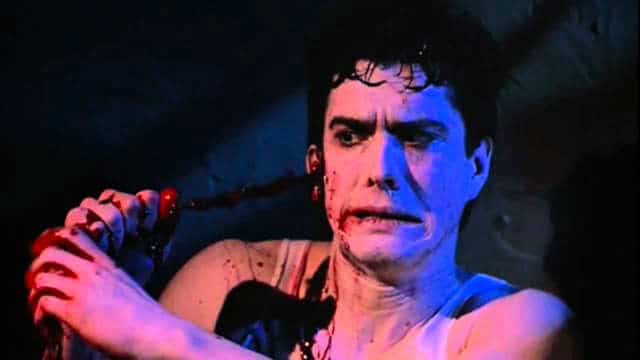
 If you didn’t already know from your experience of watching Basket Case that bad things are almost certainly around the corner, then you could be forgiven for thinking that the beginning of Brain Damage (1988) features a perfectly respectable elderly couple, in a well-decorated New York apartment, doing something perfectly reasonable. Sure they’re feeding…something, but that’s probably a lhasa apso or something. Dogs eat anything, so they’d surely eat, umm, brains… from an ornate china plate…erm…in the tub…pets, eh?
Nope, this is a Frank Henenlotter film alright, so once you see the ‘beautiful’ animal brains and the couple’s distraught reaction when it transpires that ‘Elmer’ (“you fucking named it Elmer?”) has disappeared from their bathroom, you know things are about to get nicely weird. The old couple immediately tear their apartment apart looking for whatever-Elmer-is, intruding on the neighbours and growing increasingly hysterical. Cut to a different apartment in the block, one as yet undisturbed by this pair of howling septuagenarians; here we meet a young man called Brian (credited as Rick Herbst, though actually Rick Hearst). Brian likes to sleep. Or, is it more than that? He thinks he might be falling sick, and certainly can’t go out that night as planned with his girlfriend, Barbara. Soon, he discovers he’s been bleeding from the back of the neck, then he begins hallucinating. Clearly, something is very wrong with him…
“A life of light and pleasure!”
…and it’s not just a nasty bug. It’s more of a charming, well-spoken eel-like thing with human eyes and a mouth which can inject a hallucinogenic fluid into its witting, or unwitting hosts. This is ‘Elmer’, or the Aylmer, depending on who you ask – I’m going to refer to him as Elmer though, given the film lists ‘Elmer’s Song’ on the credits and disbelief about his name also gives us one of the film’s funniest lines (see above). Anyway, Elmer explains to Brian that he’s going to have a new, exciting life thanks to him. All Brian has to do is take him out for a little ‘walk’ from time to time, and if he does, he’ll get to experience a high like no other. True enough, when Elmer injects some of his ‘juice’ into Brian’s brain via that hole in his neck, Brian does have a different kind of trip, one where a scrapyard turns into a nightclub (and, later, a nightclub turns into a diner – at least for Elmer). But the pink cloud doesn’t last long, never does: those close to Brian are concerned by his immediate personality overhaul, his new penchant for a million locks on his door and his tendency to keep pails of water in his bedroom. Meanwhile, the demands being made by Elmer are growing more and more serious.
So how can Brian get out of a situation where he’s regularly being made an accessory to murder? He’s not a bad guy, not really, and sadly the advice of his knowledgeable neighbours comes a little too late. Elmer is too strong by this point, and although he’s about 20 inches high, he’s still the one calling the shots. Brian’s desperate attempts to get clean away from his roommate at the seedy Sunshine Hotel are tragicomic, and very grisly, with deeply traumatic hallucinations. Sure, there’s a weird creature mocking him with song from the handbasin, but it’s hard not to feel sorry for Brian at this stage; creature feature or not, here’s a guy struggling on one hand to remember what he’s done when under the influence, and on the other hand, to get back his personal control. Anyone who’s been in a similar situation, or knows someone who has – hopefully minus the warbling neck parasite, but let’s not make assumptions – could sympathise with that. This fight for control is tough going, and ultimately it costs Brian and the people who try to help him more than they can afford to give.
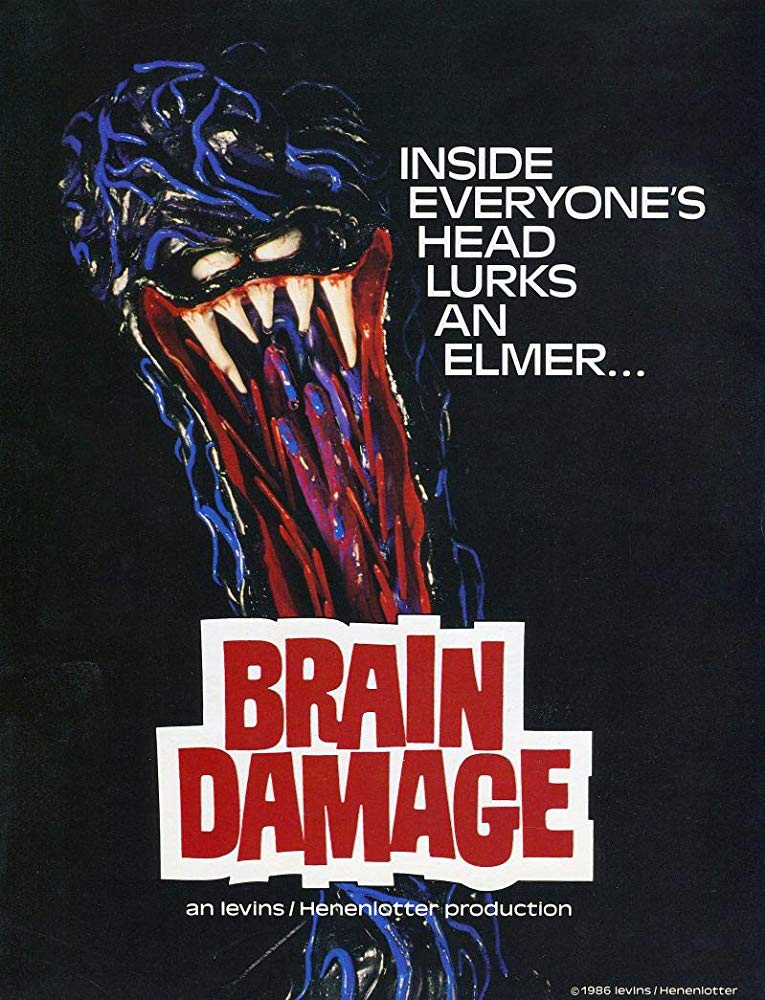 It hardly needs saying that Brain Damage could work as a hideous metaphor for addiction. The highs, the lows, the people hurt, the desperate measures – they’re all in there. In fact the film seems to invite us to see Brian in this light on several occasions: as he prepares to head into the new wave gig where he meets the unfortunate fellatio brain-munch girl, for instance, there’s a back-and-forth shot of him getting his hit with an alcoholic down-and-out standing just a little way away, drinking from a brown paper bottle. Their ages are different and the substances are different, but these are both people with their dependencies.
Still, as much as that’s all present and correct, the film is far more than just as elaborate, icky allegory. It’s also a highly original, unsettling and squirm-inducing monster movie. Sure, Elmer isn’t smashing down buildings or drinking the blood of virgins, but he’s sly, powerful, wreaking havoc and destroying people’s bodies in ways which wouldn’t be lost on many a screen monster. Under his influence, Brian’s high, his comedown and his head-shattering OD are anything but conventional. The film takes all of this just the right amount of seriously, with Brian’s curiosity gradually turning into cold acceptance that his old life is over, matched against Elmer’s jovial disdain for everyone, all voiced by (uncredited) old school horror host John ‘Zacherley’ Zacherle, which lends him an odd gravitas. The given history of the Aylmer is also nothing short of inspired, and makes this smooth-talking critter, who apparently dates back to the 4th Crusade, seem all the more oddly worldly.
Still, at least Elmer is frank about being an asshole. The New York Brian is encouraged, then made to stalk on Elmer’s behalf is not full of particularly nice people. Brian’s identikit roommate/brother Mike has clear designs on Barbara, though fraternal loyalty keeps him off her for the short term at least. This leads to another side-by-side shot where Mike and Barbara are in bed, whilst in the next room (unbeknownst to them) Brian is getting off in, ahem, his own way. Then there’s the disgruntled neighbour (a reprise for actress Beverly Bonner) who is primed to be angry before she even sees what her elderly neighbours want; the scrapyard nightwatchman who is so full of his own importance that he’s happy to pull a gun on a lone kid; the Sunshine Hotel which has people intent on having a good time before nuclear armageddon inevitably cuts their fun short. There’s a lot of folk in this film who aren’t exactly amenable to playing nice, and a lot of people happy to look the other way, a fact that Elmer exploits. Even the guy on the metro with the mysterious basket decides he’d be better off moving along (yep, that’s Kevin Van Hentenryck and his brother Belial again), which contributes to Barbara’s eventual unhappy fate.
“I’m you, Brian. I’m all you’ll ever need.”
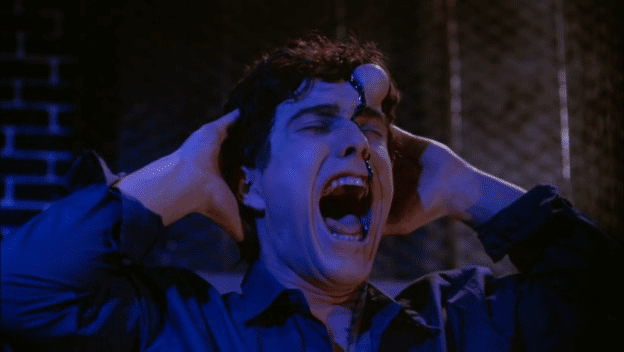 As much as I love all of Henenlotter’s films, Brain Damage is really my favourite. On a low budget, and with inexperienced actors (this was Rick Hearst’s first film) it achieves a great deal, striking a good balance between authentic horror and horror-comedy. It has a lot of the gritty, grimy nastiness of Basket Case, with the same mean streets and locations, content so graphic that it was excised from early cuts of the film, and horrible subject matter: in some respects it’s like Basket Case in reverse, with an unwitting joining-together of two sentient creatures, one ‘normal’ and one not, instead of an enforced coming-apart. So this whole symbiosis theme is pretty grim, and gives us some unpleasant scenes throughout.
But for all that, the witty script knows when to stop, when to give us a breather. Brain Damage has more than its share of funny, playful moments throughout, from Brian’s manic dinner date to Elmer’s big band style ditty and certainly to his own appearance; his part-creepy, part funny looks we can credit to SFX guys Gabe Bartalos and David Kindlon, who to give them due credit designed a creature we’ve not really seen the likes of since. Finally, this is a very creative film in several aspects, from that script to the effects and beyond. I’ve already alluded to the potted history of the Aylmer given during Brain Damage, and I noticed that there’s a credit for a historical researcher on the film, which I can only imagine was for this description of his chequered history; it certainly goes above and beyond what you might expect in a horror/exploitation style film, as do some of the effects: the hallucination of the ceiling light/unblinking eye, as a key example, is an inspired sequence in its own right.
Henenlotter wasn’t done with arguably his most famous film – Basket Case – at this juncture, going on to make two sequels in the ensuing years, as well as making Frankenhooker – one of the funniest horror comedies of the 80s (more anon). Some Basket Case fans weren’t entirely taken with Brain Damage, but I kind of hope that in the decades since, they’ve been able to revise their opinions and now see the film’s many strengths, even if ultimately they prefer asking ‘what’s in the basket?’ To me, Brain Damage is a funny, gruesome piece of work which plays around with what could have been a weird little mythos all of its own, as well as studying addiction through the lens of a creature feature whilst never losing sight of the film’s coltish, crazy aspects. It’s a film which always screams ‘weird 80s’ to me, and I think a lot of people who were weird in the 80s will, equally, always have a soft spot for Brain Damage. If nothing else, have we ever seen a mind get quite so literally blown as we see it here?
 A few years ago, at the Dead by Dawn horror festival in Edinburgh, I was invited to take part in a ‘play dead’ competition with the rest of the auditorium. Quite unusual as a pastime, you might think, even for a horror fest.
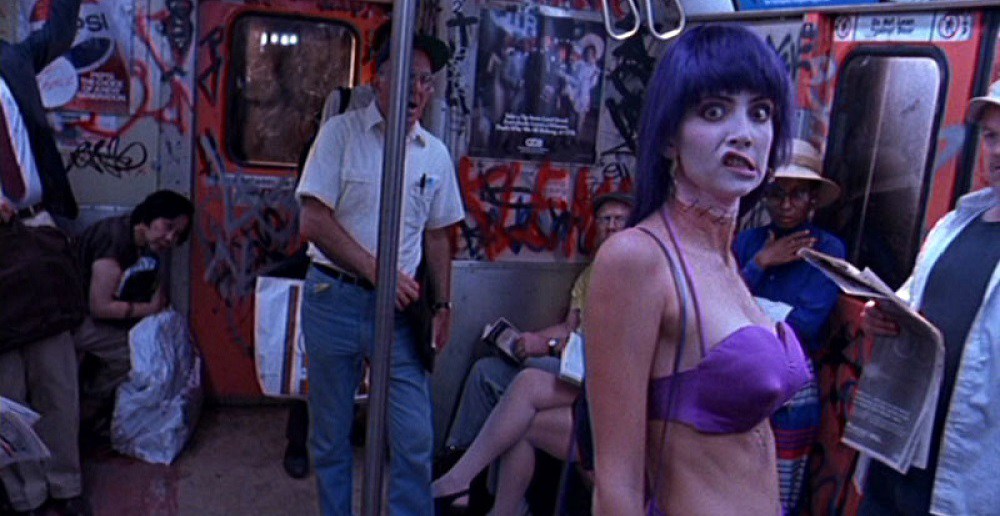 Henenlotter has not made a vast array of features during his career, though via his work with Something Weird he’s shown he’s as happy to save other people’s films from oblivion as he is to make his own. Altogether, he’s made eight original films, together with some documentary work, and at the time of writing his name is attached to a couple more shorts. Some directors crank out a film a year, but Henenlotter has never joined their ranks; there’s even been a sixteen-year hiatus between features. None of that means the impact of his work has been any less, and in a few very notable films in the 80s and 90s in particular, he’s made his name as a director of ‘body horror’, where the physical body can be invaded, mutated, updated and quite open blown apart by a whole host of bizarre phenomena. Some body horror is genuinely unsettling: close contemporary David Cronenberg, for instance, renders his compromised bodies the stuff of nightmares. It’s horrific, yes, but sublime. Henenlotter has a different approach – he opts to go straight from the sublime to the ridiculous. Sure, you can wince at some of the things he does on screen, but any deeper considerations are usually grabbed out of your hands by the next scene coming, which does something so hideously outlandish that all you can do is laugh. It is, as he suggests, pure exploitation, and it’s terrific entertainment, as well as immensely formative for many of us of a certain age, who grew up with these films on VHS and later, DVD.
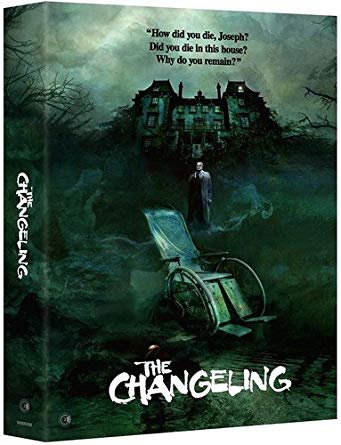 Winter, upstate New York. The Russell family are on vacation, but their vehicle has broken down in the snow. As father John (George C. Scott) crosses the road to call for help, an out-of-control truck careers towards his wife and daughter. A simple and effective cut to John, alone and back in the city, tells the audience all it needs to know; it’s the first understated moment of the film which shows that director Peter Medak trusts us to understand what’s going on without spelling everything out for us. The family home is now boxed up, with only flashbacks to show us what it once was.
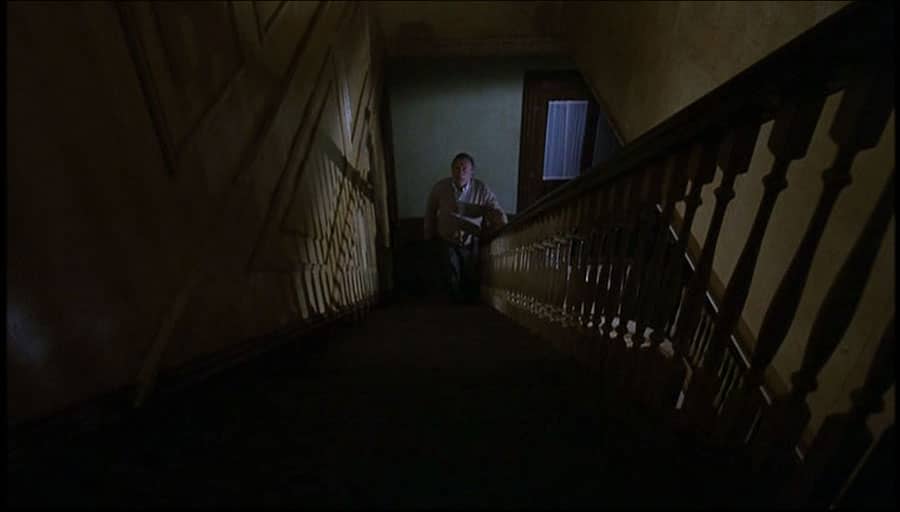 Everything is handled with a sensitive pace, allowing characterisation to blossom without having Russell say everything he’s thinking; slowly and surely, he picks his way through a story which effectively leads him/us down a few blind alleys, arriving at its surprising denouement cautiously. I’d also argue that in the best supernatural horrors, the haunted place – usually a house – seems to operate as a character in its own right. Before we can safely attribute phenomena to a specific entity, we can only interpret the strangeness of the haunted place itself. It is the source of the phenomena, so it needs to seem almost sentient, as well as striking in aesthetics and atmosphere. The house in The Changeling has all of this in abundance, too. Camera angles are shot from the house’s perspective, and it’s described by Russell himself as having wants and preferences. Again, it’s simple stuff I suppose, but done well it’s very effective. The film does more, too, by linking its supernatural to real-life events, which calls up far older ideas that ‘justice will out’ to a very modern tale of corruption.
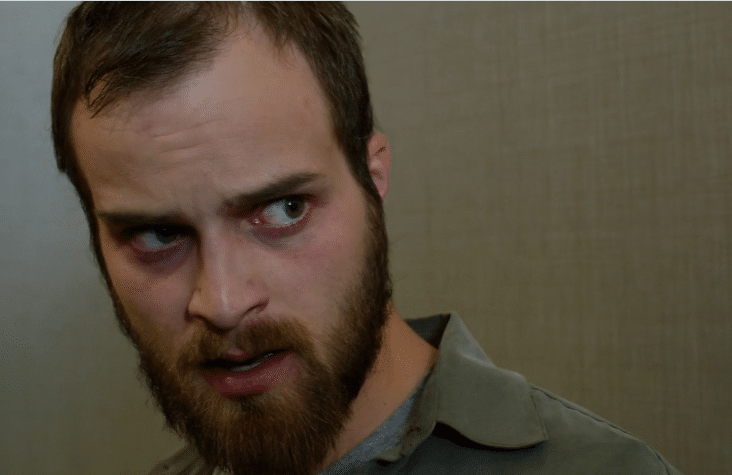 How much can one ninety-minute film reasonably do within its timeframe? Can a film successfully go from awkward laughs to gore, from femmes fatales to OTT-ultraviolence, and from slacker humour to shock? Rondo (2018) believes it’s not only possible, it’s all part and parcel of its overall appeal. Both the ethos and the resulting movie have a few little drawbacks, but overall, I’d say those behind the film manage to balance these things pretty well. Due to its content this will not be a film for everyone, but if you can laugh and squirm at the same time, you might well be okay with this one.
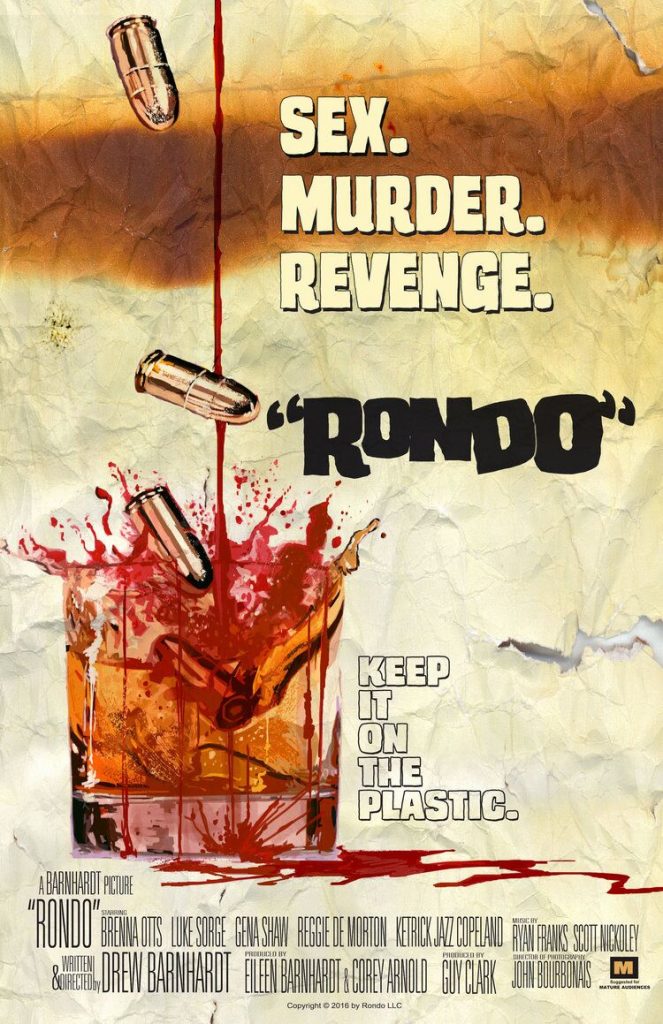 If they weren’t already on your radar, it’s at about this point that the film’s black comedy elements begin to rise. As Paul and some of the other gatherers listen to the ‘rules of the road’ for this party, the script modulates between comedic and downright sleazy; if the film showed half the things it describes, it’d have an X rating, which makes the steady delivery of certain lines by the host, Lurdell (Reggie De Morton) seem all the more uneasily funny. Paul’s suspicions about this place and this set-up are ultimately – and quickly – confirmed, so he decides to disappear. But he can’t just do that, or put this strange night behind him. It’s not as simple as that.
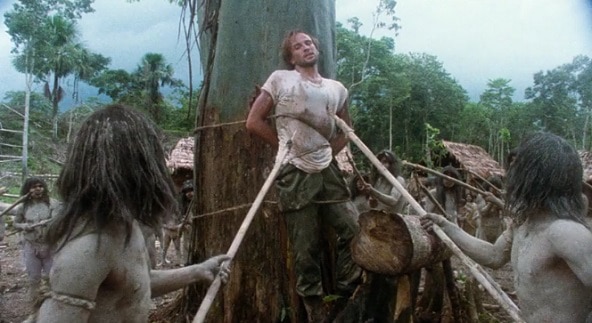 Umberto Lenzi turned his hand to many different kinds of genre film during his career, so it’s perhaps little surprise that he looked to the kind of cannibalism movies being made by his peers (such Ruggero Deodato), making two of them in very rapid succession, after almost a ten-year break between these and the first of his films to nod towards anthropophagy, The Man from the Deep River. Cannibal Ferox and Eaten Alive were made within a year of each other, though I’d suggest that Ferox is still the better-known title of the two, often for some of its more notorious scenes, and perhaps still for its association with the ‘video nasty’ debacle, which has so often led to a long legacy of different cuts and titles.
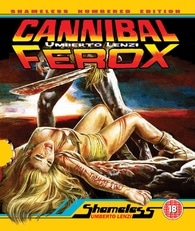 In many respects Ferox is a sort-of morality tale, whereby every white person setting foot in the Amazon basin is an irredeemable fool, nasty beyond measure, and so they get served accordingly. Even Gloria eventually fathoms this, bless. However, they don’t simply get picked off in order of awfulness, with some of the better-meaning characters dying way before the worst of them, so it’s not as straightforward as it might be. It’s also worth knowing with these cannibal horrors that a lot of the more notorious and gory scenes are often crammed into a short amount of time, usually towards the end of the ninety minutes: they certainly are here, and in common with
  Given some of the films which have showcased Eastern European locations for American audiences in recent years, you’d be forgiven for thinking that in every disused industrial building in this part of the world, there’s some sort of dodgy sex-and-torment club holding sway. Such is the case in Dark Crimes (2016), which crams quite a lot of breasts and torture into its opening scenes; this scene actually takes place outside of the timeframe of the rest of the film and as such is a little confusing, but quite possibly it seemed a shame not to add it in. These considerations aside, Dark Crimes is probably most noteworthy for its casting of Jim Carrey in the lead role – though it’s languished a while, two years in fact, waiting for a release, which seems surprising given his bankability. Well, having now watched the film in its entirety, let’s just say I’m rather less surprised that it’s been left sitting on a shelf somewhere.
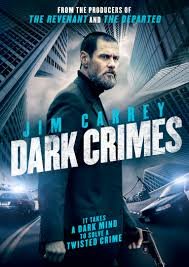 As for Carrey, I suppose you could say this is a change of pace for him – but then again, he’s already proven he can do serious acting elsewhere. Once the initial mild surprise of seeing him looking so dour wears off, you realise he’s being given very little to do here; that dour stare is the whole role. He also veers between a neutral accent (better) and an attempt at an Eastern European one (worse), which just makes it doubly silly. (It’s never really explained why the whole of Poland is conducting its affairs exclusively in English, right down to the TV news. Only the names are Polish in this version of Poland.) Charlotte Gainsbourg has a role here, too, one which grows in importance as the film moves forward, but she essentially reprises the role she’s done several times elsewhere, with a completely unsurprising nude scene/sex scene and a strung-out demeanour overall. To be fair, she isn’t permitted any characterisation for most of the film, so it’s all too little, too late when it finally comes along.
 I don’t know about you, but I always feel a moment of trepidation when I see rock stars’ names attached to film projects – perhaps particularly so when at least one of the rock stars in question has now shuffled off the mortal coil. What would they have thought of the finished product? Did it receive their blessing? What’s the story? That’s very much the case in Sunset Society, a film which boasts an appearance by the legendary, and now sadly deceased Lemmy Kilmister, as well as roles for LA Guns musician Tracii Guns and former Guns ‘n’ Roses member Dizzy Reed. The largest share of Sunset Society seems to be as a meet-up for LA-based musicians and hangers-on who peaked before the 21st century came around, although admittedly that doesn’t really apply to the Motorhead frontman. Director/actress Phoebe Dollar – veteran of a whole host of low-budget horrors in her own right – isn’t an idiot, and Lemmy is accordingly plastered all over the film’s promotional material, because he is quite simply a failsafe currency as far as rock and metal fans are concerned. He’s also mentioned frequently in the script by other characters, though it’s worth pointing out that this is, really speaking, a cameo role, with only a few minutes of screen time for him.
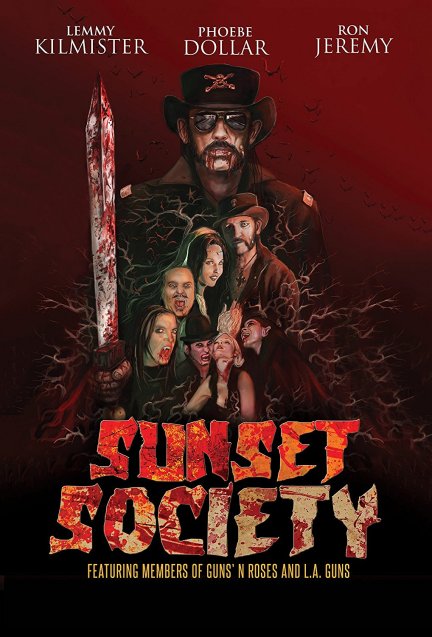 I really, really wish there was more to it than that. Lots of the screen time here seems to consist of only loosely-connected scenes, with little in the sense of a driving force behind the narrative. Sure, some of the aesthetics are pretty cool, some of the city nightscapes look effective and if you like seeing pretty goth girls on screen then you’ll find plenty to divert you, but it all feels more like a protracted music video than a coherent film. Adding to this, lots of the dialogue feels improvised (and some of it has blatantly been messed up, but left in anyway) or there are issues with the script whereby it frequently becomes thin or repetitive. Making a joke out of the repetitiveness itself is not enough to swing it, unfortunately, even if it’s stalwart Ron Jeremy making the attempt: his is another cameo role, with little screen time given. (Oh, and another, more inexplicable cameo? Steve-o from Jackass.) As for Lemmy himself, well as much as it’s good to see him again, his scenes aren’t all that great. He was never an actor by trade and towards the end of his life, he seems he’s struggling to enunciate the lines given to him. The cheap animated interludes hardly help matters.
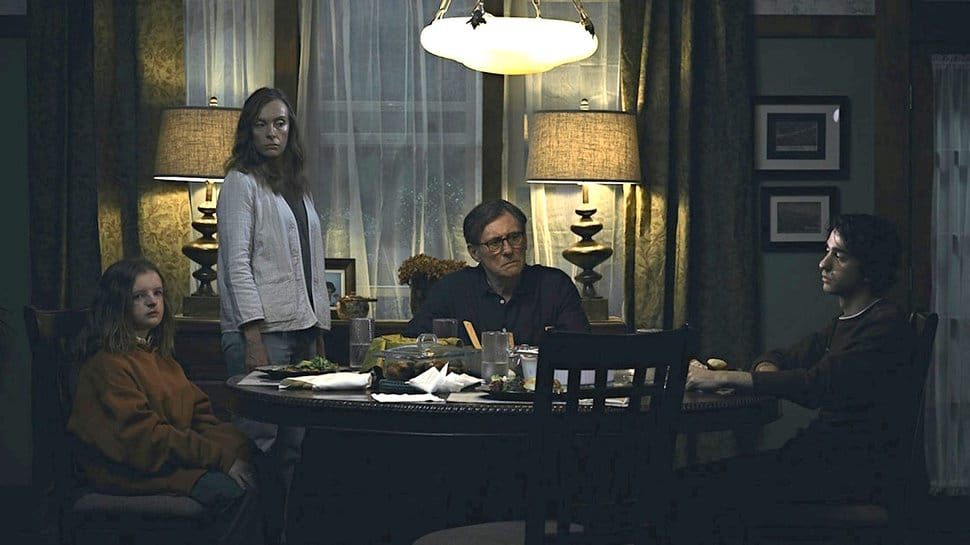 As we’ve seen countless times, the weight of expectation can be an ambiguous gift to a film, but it’s fair to say that few recent horrors have enjoyed such a steadily-building sense of anticipation as Hereditary (2018), which has been running tantalising trailers for the past few months. For one thing, the return of Toni Collette to the horror genre has been a boon – she really is a superb actress for this kind of thing – and for another, we seem to be enjoying a run of supernatural horror; it’s a welcome development for fans, some of whom may have felt somewhat starved of it in recent years. That said, the now-obligatory discussions about whether or not Hereditary is a horror film at all have proved to be a rather tedious add-on, unnecessary and bewildering for fans of the genre, who already know that it can do all of the sophisticated, multi-layered things which seem to come as such a surprise to others that they need to feel around for a new title for it every single time. I tried, as ever, to put all of this to the back of my mind ahead of seeing the film – which lo and behold, is as much of a horror film as I’ve ever seen in my life.
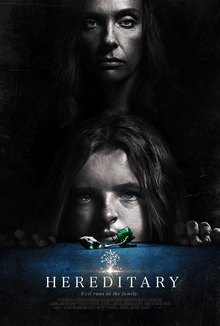 I’m deliberately keeping my plot synopsis brief and a little vague here, as the way in which Hereditary unfolds deserves to be appreciated with as open a mind as possible. It’s unlikely that I’m spoilering by relating to the supernatural elements, though, I hope; so, this is a supernatural horror through and through, where the afterlife is more of a parallel world than a one-way destination, and where its inmates can harbour very, very sinister designs on the living. I was pleasantly surprised to find myself surprised, I think. I’ve seen the film proudly described as ‘this generation’s Exorcist’, or words to that effect, but that seems an odd comparison to make, unless we’re painting in very broad strokes. It’s far closer to the malignity of The Witch, or indeed the assault-by-wicked-forces seen in Drag Me To Hell, though with less of the humour. Although, even Hereditary has its lighter moments. It lobs in a few bong jokes, and some of the family meltdowns grow so hysterical that they verge on black comedy, as do a few of the film’s shockingly graphic moments.
 The cannibal movie cycle of the late Seventies and early Eighties will forever seem like a strange beast. Splicing stock footage of animals doing their thing with often garish animal cruelty, then layering in gore effects, nudity and any number of practices which would very likely fail to get past an ethics committee today, the resultant films are nonetheless compelling – in their own way. All of that said, I’m a product of my own social climate, and as such I’m very pleased that Shameless Films have openly made the decision to ‘soften’ (their term) the animal cruelty originally present in their brand new version of Mountain of the Cannibal God (1978), making the point that this footage benefits the film’s narrative none. Instead, they’ve worked to restore other missing scenes, offering the usual proviso that this means some of the splicing is bound to be noticeable. And it is, a little, but it’s all in the pursuit of a worthwhile cut of this film, and the end results are very good.
 A haze of ulterior motives, animal scenes and great music ensue. It’s my contention that the best-known cannibal movies have such superb music for this very reason, to offset everything less palatable in a kind of cinematic karma. And as the team approach the mountain, the locals (of course) show this disapproval in all of the ways you might imagine, as well as a few which are, to be fair, very creative and ambitious. On a restricted budget, Martino achieves impressive things here; a lot of the entertainment value of these films comes from smirking at the flaws, and that’s fine, but don’t let that make you overlook the many things which Martino does rather well. The ‘mountain god’ himself looks genuinely gruesome and repellent, and some of those restored gore scenes could still make you flinch.
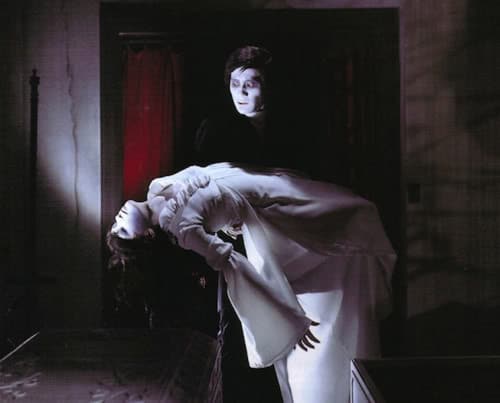 Inspired by the success of Hammer’s lurid horror cinema in the 1960s, the ever-versatile Toho Studios made a sound business decision to make some vampire films of their own. Whilst there is a modest array of films based specifically on Far Eastern vampire lore, the productions overseen by director Michio Yamamoto are rather different, blending Western tropes with a decidedly more Japanese spin on the folklore. The resulting projects, on offer here as part of one package released by Arrow Films, are an aesthetically-pleasing blend of whimsy and clever ideas, and would certainly be of interest to anyone with a fancy for seeing how world cinema does it.
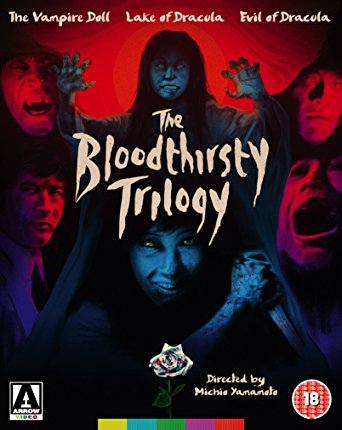 In terms of the cultural melding of East and West, there are some aspects of this to ponder, as well as interesting rationales for the emergence of vampires which are interesting, looking quite different to those in European films (but with similarities too: vampire women love a nice white gown). I rather like the golden eyes which the vampire characters have, too, even if you can’t help but wonder if they ran with that idea once they’d thought of it. However, I don’t think there are massively poignant cultural messages here, not really; there is an explanation in Evil of Dracula for how said count’s influence made its way to Japan, but the Japanese always seem rather relaxed about this kind of detail, and whilst you could ponder the presence of Western houses etc. as having more to say, equally you could just enjoy the spectacle on offer. If there’s one thing I found particularly interesting, it’s the use of hypnotism in the films’ plots; the development of this theme has a lot more in common with Poe than Mesmer himself, and it makes for some interesting denouements.
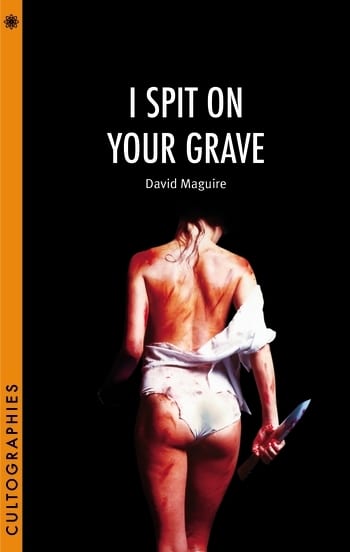 More and more these days, we’re seeing academic studies of what is often regarded as genre cinema; this ties in with the rise and rise of film studies more generally, with horror finally being regularly recognised and brought into the fold. In the past few months alone, for instance, I’ve reviewed books on
  The book follows with exhaustive research into the legacy of ISOYG. There are some genuine surprises here as Maguire identifies a number of very thematically similar films which have emerged since the ‘Ground Zero’ of the genre got its release (including a spoof?!) and then there’s a good long look at the merits and demerits of the remake/subsequent-to-the-remake films, which can be seen as a franchise. He’s very fair, offers a number of well-argued points in defence of ISOYG (2010) and goes some way to dispel what has turned into a dichotomy between original and remake: first film good, remake bad. He is, though, far less kind to the 2013 sequel, a film I cannot comment on as I avoided it like the plague…