As Dangerous Animals gets going, we first observe tourists and sightseers Greg (Liam Greinke) and Heather (Ella Newton) popping up on a Queensland quayside, hoping for a ‘marine experience’ with a local: they’ve just missed their organised tour doing something similar. The gaffer, Tucker (Jai Courtney) is straightaway signposted as a bit of a wildcard, but Greg and Heather are keen enough for said experience to ignore this; by the way, what they propose to do is go swimming with sharks. Tucker’s specialism – and business – stem from personal experience, as he survived a shark encounter (and a hell of a bite) as a kid. This hasn’t put him off; if anything, it’s triggered a strange, spiritual deference for the predators, which can only add to the red bunting which could already be flying from his boat.
Anyway, the boat heads out, Greg and Heather get in the shark cage, and down they go: to be fair, the underwater scenes in this film are very beautiful and tranquil. Sharks, of course, have two modes: serene giants of the sea, and eyes rolling, thrashing about in viscera, fearsome death machines. Come to think of it, Tucker is not too dissimilar, even if there’s a self-described method in his madness. he has a plan for his guests; he has a plan for all his guests, of which Greg and Heather only number two.
Next up, we meet a free spirit chick-with-a-van, Zephyr (Hassie Harrison). She begrudgingly agrees to give a lift to a guy whose own vehicle has broken down; after a guarded start with Moses (Josh Heuston), they do in fact hit it off. Yep, they’re quite clearly framed as a) cute enough to care about and b) Next, which is potentially a snag for the film to get past. You know full well that Tucker is about to hove into view, and that Zephyr is going to be the feisty riposte to whatever mad shit he has in store. So, it’d better be good.
Well, it is, mainly because Dangerous Animals has one killer idea at its core. This notion of shark-as-murder-weapon for a psychopath obsessed with his own brush with a shark-related death is a solid one, referencing other, older horrors and genres without feeling like a simple rehash, and do you know what else is great? The sharks here are…just sharks. They’re not genetically-modified sharks, surprise megalodons or inexplicably smart, vengeful sharks. Instead, the sharks here just do what sharks oh-so occasionally do (to humans, at least), and only then with some heavy encouragement from shark fanboy Tucker. Similarly, the character of Tucker doesn’t get (or need) an overly busy backstory. We learn a little, but he’s still kind of a closed book, a man tinged with de rigueur misogyny, but otherwise a seemingly affable, music loving, down to earth bloke. It’s hard not to see him in similar terms to Mick Taylor from 2005’s Wolf Creek: these two share the same instinct for picking off vulnerable, itinerant tourists by seeming like the salt of the earth, even if Tucker feels more like some sort of Discovery Channel-spawned monster, and Mick’s more SBS.
Once all the key pieces are in play though, Dangerous Animals essentially becomes a tense survival thriller – one with enough about it to make you shout advice at the screen, and one which feels in some respects like a Noughties horror film, back when all people seemed to do for a few years was survive (or not) various torturous situations. All in all, it works very well, although the rise and fall of adrenaline-inducing beats and subsequent lulls can feel a rather bedraggling experience for the viewer. However, this is a well shot, soundtracked and acted film, in equal parts clear on its influences and keen to do its own thing. And, although in its title and basic premise it may sound like it shares a lot of ground with the heyday of ‘animals gone rogue’ exploitation flicks, the proponent of all the horror here is very much human. As the poster suggests, you’re safer – kinda – in the water.
Director Sean Byrne earned his forever chops with his debut feature The Loved Ones, though he’s not been particularly prolific since that time, with only one interim feature-length before this newest one. Dangerous Animals does feel more akin to The Loved Ones – a realist film with some arguably fantasy touches – than The Devil’s Candy, a fantasy conceit with some aspects of realism, like its family dynamic. But is it helpful to force a comparison? Perhaps not, given that Byrne has, so far, opted for something quite different in each feature he’s made; he’s skilled and he’s confident, showing more and more knowledge each time, as well as showing willingness to play with ideas from the horror genre in a nicely self-referential way. He also knows a thing or two about how to dole out those killer scenes, and Dangerous Animals has a few beauties. All in all, even if the Australian Tourist Board might be tearing out their hair (again) over this film, the Australian Film Board ought to be throwing money and opportunities at Mr. Byrne; three features in sixteen years feels like far too few.
Dangerous Animals (2025) is available to stream now.
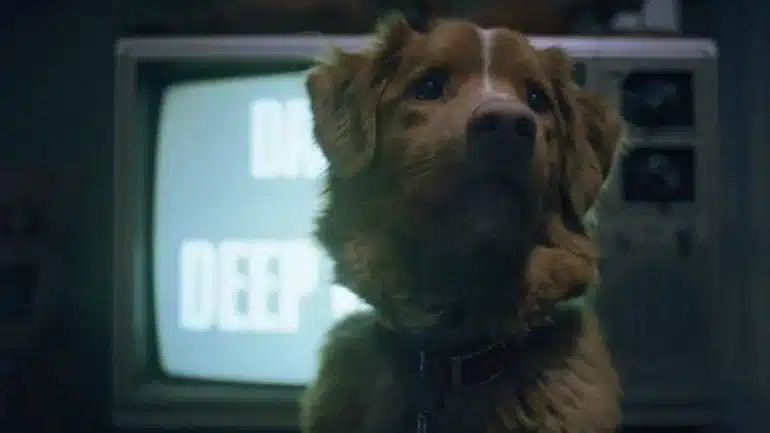
A dog lies sleeping the sleep of the righteous before being awoken by …something. It could be the mobile phone buzzing away on the arm of the chair – or it could be something far more ominous. Todd, the human at Indy’s side, is unconscious and unresponsive. The room seems odd, too – there’s weird interference with the TV, the lights flicker. Thankfully, the caller, Vera (Todd’s sister) comes in just in time to revive Todd, but as we gradually gather what’s been going on here, we discover that Todd has been, and is, seriously ill.
Next, we see man and dog travelling out in the boonies (much to Vera’s horror, given Todd’s condition), where Todd plans to take up residence in his grandfather’s old house, which has been bequeathed to him. Talk about pathetic fallacy: the gloomy skies and torrential rain don’t exactly scream good tidings, and the dismal, cluttered space they arrive into doesn’t, either. Todd has a lot going on, but all he notices about the new place is that it’s unkempt; Indy, however, whom we’ve already seen is quite a sensitive dog, is soon responding to things unperceived by his best friend. Indy wouldn’t know this, but Vera agrees with him; on the phone, we hear her declare to Todd that the house is “haunted”. So we have a familiar horror film idea – a haunted house, a potentially hexed family line (Todd walks Indy through a nearby burial ground which is choc-full of his gone-too-soon relatives) – only, here, it’s unfolding through Indy’s perspective. It’s Indy who is faced with the biggest share of supernatural phenomena, and this seems to worsen in line with Todd’s rapidly worsening condition. Can Indy protect his beloved best friend from the sinister forces encroaching on this place?
One of the biggest heart-wrenchers in Good Boy is being made to believe that this beautiful dog is afraid and at risk; coming in a close second is understanding that Todd has run out of road, and is reduced to begging to be a medical test subject, or trying folk medicine cures, things which are clearly not going to be up to the (nameless, but dreadfully guessable) condition he has. Pain and desperation makes Todd mean at times, too, which combines both of the film’s most heart-wrenching elements into one; all Indy wants to do is to protect Todd, but he’s just a dog – he can’t interpret what’s going on here, and god knows he can’t face down Todd’s diagnosis. Indy is actually director Ben Leonberg’s own dog, so he’s able to bring in his old video footage of Indy as a puppy – adorable, and genuinely moving, given the film’s storyline. It’s also probably worth saying that if you hate any kind of animal peril, even suggested animal peril, then go careful with this film. I had to watch all the way to the end of the credits to be sure I knew what had happened and could cope with it.
Good Boy‘s choice of ‘dog’s eye view’ for many of its scenes is an engaging one, though we’re never quite kept on Indy’s wavelength, given that we can read text messages, understand the dialogue and infer other elements of the plot, although some of the dialogue is slightly muffled because we always stay with the dog, who often wanders off or goes to investigate something, meaning it’s occasionally a stretch to hear what’s being said. But, steadily, the film pieces together enough of its backstory to lend weight to the ongoing action and substance to the threat at the house, through making good use of VHS video diaries (of course, it’s an indie horror) where grandpa is briefly played by Larry Fessenden (ditto). The set and location are both solid, full of impenetrable darkness which often tricks the eye, or shots cluttered with the detritus of a life passed, which also often threaten to take on human faces and forms. This effect is possibly exaggerated in Good Boy, given that this is a film almost devoid of human faces; this, again, stems from the dog’s eye view motif, so we spend most of the film at not far off ground level, seeing more of people’s feet than faces. Perhaps this brings on a touch of pareidolia. It also almost certainly calls to mind some other things. from cartoons to Skinamarink (2022), though unlike Skinamarink, Leonberg knows when to call time: Good Boy comes in at an economical seventy minutes, which works.
That this film took years to make is testament to how hard Leonberg worked to get it right, and of course to treat his canine star and buddy fairly. He does this so well that it’s hard not to commend the film for being well acted; of course what we mean is well directed. Good Boy is a quietly creepy tale with a genuinely involving and emotionally affecting central premise, and it’s that which really sets it apart from similar films, particularly by the end. Its moments of vulnerability and mystery are very well-handled indeed.
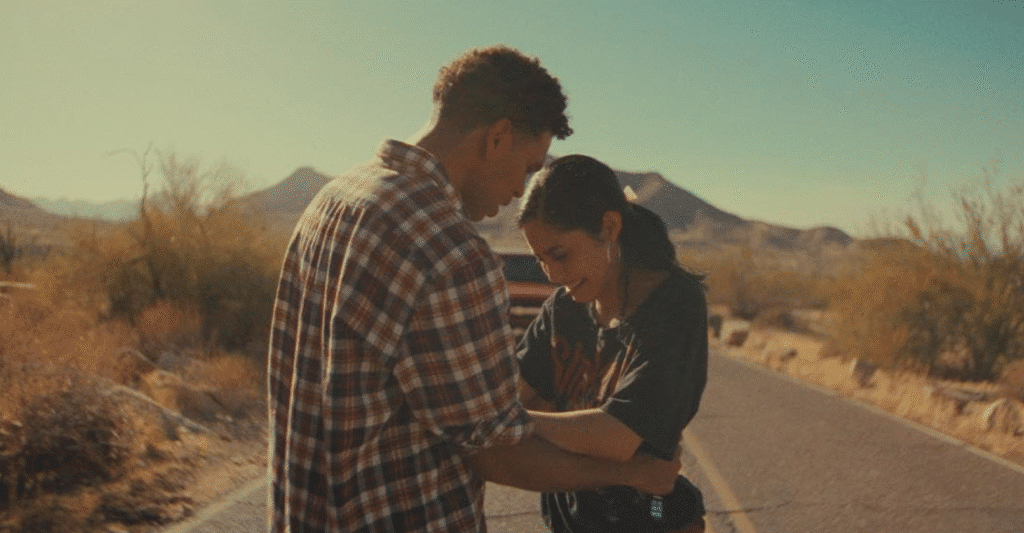
Amber (Sharlene Cruz) is woken in the early hours of the morning to an upset call from her boyfriend, Justin (Dario Vazquez), but what is he ‘so sorry’ about exactly? We don’t discover that immediately, but we can soon glean that he’s not hurt or sick or anything like that: judging from Amber’s furious response (the couple take their quarrel out into the desert the following day), he’s been playing away.
Is this all real? The stress is maybe making Amber confused, but what does seem to be real is that she catches her hand on a cactus, puncturing her skin with a splinter. Something else is real, too: this relationship is over. Done.
So Amber gets back to her life – work, friends, apartment – but that injury on her hand looks like it’s getting worse. She can’t get the splinter out, and the wound is becoming irritated. Worse, she seems to be disassociating from her surroundings: day and night is snapping by in a heartbeat, or she’s zoning in and out of what’s going on around her. Amber also starts to hyper-fixate on little things around the apartment which have clearly bugged her for a while. Most of these are linked to Justin – who seems to have been very much an Ask Aubry kind of boyfriend – a man who thought nothing of trashing the place because hey, it won’t be him cleaning it up. Amber’s memories of her last relationship all seem to hinge on Justin’s selfish bullshit around the apartment, and the physical marks he made while there.
Hand offers a wealth of great details, starting with its big shift from Amber’s dark apartment to the bright, richly coloured desert scenes (shot in Phoenix), and it’s a surprisingly auditory horror too: lots of significant moments stem from seemingly innocuous sources, revealing Amber’s heightened state as she tries to navigate normal, everyday life (I’ve never been more on edge hearing someone chop an onion). There are great macro shots, too, providing additional texture and interest. These elements all conspire with clever writing to make our key character very likeable and sympathetic from the very outset. It’s an earnest, skilled performance from Sharlene Cruz, who gels really well with the fairly low key amounts of dialogue used in the film, bringing a lot to the role.
Essentially, what we have here is a woman who is working hard to reclaim her home and her space, and by proxy, her sense of self, gradually excising the memory of a crappy partner. The issue with her hand is a symbol of how much Justin got under her skin and hung on in there: the idea is used well, creating a snappy body horror out of a miserable and recognisable situation. There’s a confidence here which does great things with the horror elements. Writer/director Jennifer Winterbotham, who recently had her feature script Birthright selected for the 2025 Sundance Producers Lab Fellowship, is a director to watch moving forwards, and it’ll be great to see what she does next.
Horror cinema teaches us many things including caution and recently, there have been more than a few lessons about the dangers of going up into the mountains – and not just for the usual reasons, such as (mainly) the risk of falling to your death from a great height. In Confession (2024) (aka Kokuhaku Confession), the regular perils of exposure and injury are all present and correct but, as is so often the case, there’s the human aspect to consider, too. Old friends Asai (Tôma Ikuta) and Jiyong (Yang Ik-joon) have been undertaking a yearly mountain trek in order to respect the memory of their friend Sayuri, who tragically died on a climb sixteen years previously. As I’ve said previously, the idea of honouring a miserable death at a great height by repeating the activity which brought about that death will never make absolute sense to me, but there we go: we meet both men on their yearly pilgrimage.
Except this year, there’s a snag. A sudden storm has come in, cutting them off and making them fear for their lives: we come in on this situation in medias res, at which point we realise that Jiyong is already seriously injured and unable to walk. Asai is devastated, but his devastation turns into horror when Jiyong, believing his death to be imminent, makes a startling confession to his friend, hoping to clear his conscience before the inevitable. This would be one thing, but when Asai is able to discern the shape of a mountain rescue cabin within reach – even if he has to carry Jiyong there – it creates a moral quandary. Does Asai pretend he never heard the confession? Or does he address it?
The problem is set aside for the very short term, as the two men struggle to the relative safety of the cabin: Asai busies himself lighting a fire and getting them both as comfortable as possible, still talking about the hope of rescue. But the fact of the confession hangs in the air between them, and before very long it begins to drive a wedge between them. Jiyong is more than remorseful for what he said; he’s actively beginning to suspect that Asai will now hand him over to the authorities. As for Asai, he’s growing steadily more concerned that his old pal is going to harm him; after all, couldn’t he just say that there was only one survivor?
It’s a decent set-up for a tense situation and Confession makes good use of its central premise: you do get a sense that these two men are genuinely cut off, left to their own devices and vulnerable not just to the elements, but to each other. Smaller plot additions – such as the loss of their only working mobile phone (or is it lost?) and the ways in which the film steadily opens up other spaces and possibilities, even within the confined environment of the cabin, all work together well. Whilst you will perhaps find yourself wondering why the men don’t get straight into it and address the confession head on, you also remember that there are some cultural and societal expectations at play here too – nationality, class, gender – which are revealed. It’s probably fair to say, however, that ‘things escalate quickly’: Jiyong, as the man with the most to potentially lose, goes from quiet and thoughtful to maniacal in what feels like a few easy moves, though he inhabits the role fully, and makes for a good, frightening presence. If the film seems to be setting up Asai as a guiltless victim, then the film has more to offer than that thankfully, revealing new information about this character in such a way that it casts doubt on his good guy persona, giving the film more of a middle act than it might otherwise have had.
However, to render the improbable probable, Confession does play fast and loose with some of its plot points – to the extent that, on occasion, and even allowing for some of the more overblown content and the film’s style overall, it’s less convincing. Jiyong’s leg injury, for example, sometimes seems to be wholly incapacitating and yet, in the midst of this, he seems able to suddenly and silently manoeuvre himself around the cabin; yes, this allows a few killer set-ups, true, but then in other instances, he struggles to get anywhere at all, and in those instances it’s plot relevant that he can’t. The film wants it both ways, perhaps. But perhaps the film’s biggest and most obvious offence is where it makes such ample use of the ‘but it was all a dream’ get-out clause, building up to a crescendo which – if you know the film’s runtime – would probably mean the film running out of ground early, except that it then backpedals on the deed, revealing that it didn’t happen like that anyway. This can make the action feel repetitive. This, most likely, is an example of where basing a film on a popular manga leads to a few potential issues. What works as drawn sometimes presents the odd problem when it’s turned into live action cinema; the issues of how you get from one panel to another, for instance, work a little differently when filmed as they require more of a clear transition between key moments, and this is probably the one most obvious sticking point in Confession.
If you can set this aside, though, then there’s lots to love here: it becomes more and more intense, offers up some ingenious scenes and ideas and never sacrifices the near-stifling claustrophobia which it’s at pains to establish from the very earliest scenes. It all gets rather bloody and nasty, too, which comes as a bit of a surprise from director Nobuhiro Yamashita, better known so far for his comedies and buddy movies (though, after a fashion, I suppose that’s what this is). Could Sayuri (Nao Honda) have been given more to do in this script? Sure. But the film’s economical runtime (just over seventy minutes) excuses some of the film’s weaker elements, keeping things taught and focused enough to shine.
Confession (2024) featured at this year’s Celluloid Screams.
God bless Netflix money. In common with the similarly vast, similarly monolithic Disney, whatever the complaints and concerns about this level of power and influence may be, there’s at least the comfort that, when they pull in one direction, they can support eminently worthwhile projects – just like Frankenstein, or in Disney’s case, like their recent, excellent Aliens TV spin-off, Aliens: Earth. Guillermo del Toro has been trying and – for various reasons – failing to make his own select version of Frankenstein for years, some of which stems from his own creative reluctance, but also from various creative obstacles to do with things like his Universal collaboration, issues around casting and around scheduling. Finally, after several issues (particularly around casting the Creature) and around eighteen years after Del Toro first expressed his interest in adapting Mary Shelley’s novel, here we are, and the finished product is very good indeed. The clear presence of Netflix money, that evident ‘no expense has been spared’ feel to each and every one of the scenes is very welcome, but more than that, there’s a clear sense of balance here between deference to pre-existing adaptations and a sharp, incisive and individual spin on the source material. Many of the changes to the original story are inspired, though never dispensing with Shelley’s original vision of a man elevated by his own arrogance to play with the forces of life and death, to the destructive detriment of his life and loves.
This review is briefly going to stop talking about Frankenstein and start talking about Dracula before going back to the film at hand. There are reasons for this, and not just that the first filmed scenes from Frankenstein (2025), which showed at a Netflix taster event in September of this year, were first scored to Wojciech Kilar’s Dracula (1992) score. Frankenstein has also been bumped ahead a few decades here too, turning it into a Victorian-era story – again, in common with several high-profile and influential adaptations of both of these seminal horror novels. The aesthetic style of this film is also in so many ways similar to the Coppola take on Dracula that the earlier film frequently pops into mind when watching. The clothes, the sets, the style of the script – all very Dracula (1992), just as painterly and just as Romantic Gothic, something which works just as well when you consider some of Del Toro’s nods to the Hammer film The Curse ofFrankenstein (1957), also here in abundance, and not just in the Creature design itself. Something else which seems to correspond not just to the Coppola Dracula, but to however many adaptations of Dracula you’d like to count, is the ways in which key characters from the novel are reshuffled and altered for the film.
Whilst retaining a fairly faithful take on the novel’s framing narrative, Del Toro does something similar to a lot of Dracula films here, shifting the dynamics in the Frankenstein family, with Victor now the alienated, unloved and bereaved elder son and William – who reaches adulthood here – held up as the model son by Frankenstein Sr (Charles Dance). Frankenstein Sr’s determination to coach his elder son into medical brilliance leads him into being a monomaniacal, arrogant and emotionally chilly rabble-rouser, barred from the Royal College of Surgeons in Edinburgh for reanimating a corpse (in a sequence, by the by, worthy of Return of the Living Dead). Victor (Oscar Isaac) threatens to slump into a self-pitying fugue state because no one wants to acknowledge the importance of his work, but luckily an interested bystander comes along in the form of Henrich Harlander, a wealthy industrialist who offers him silly money to continue fulfilling his scientific vision. A man with unending wealth, throwing money at someone to help them fulfil a seemingly impossible creative project? Imagine that.
Harlander (Christophe Waltz, who’s also in the brand new Luc Besson Dracula, another Dracula link) is an arms dealer, so he’s particularly unsqueamish about about mass casualties – in fact, his livelihood depends on it, and permits him a ceaseless supply of body parts, which he offers to Frankenstein via the current and ongoing Crimean War in Europe (as well as the more usual array of hanged criminals). He sets Frankenstein up in an abandoned water tower in the middle of nowhere, which clearly comes from an era when people cared about aesthetics in building design, because it could just as easily have been an abandoned medieval keep of some kind. Frankenstein moves in, and his work – now centred on the lymphatic system as the key to conveying energy through the proposed experimental ‘man’ – progresses. But Victor is reliant on his younger brother William (Felix Kammerer) to help him set everything up, and as thanks, he develops an obsession with William’s new fiancée – Harlander’s niece – Elizabeth (Mia Goth).
The work soon reaching its near-conclusion, Victor is horrified to learn that Harlander’s interest in his work turns out to be self-interest: he wants more involvement with the newly-designed Creature, let’s say, than he originally let on. In the chaos of Victor’s key moment, his creative relationship with Harlander gets severed – and the Creature (Jacob Elordi), at first, disappears. But Victor has not failed in his design and soon the Creature comes to find him, acting like a newborn – a newborn which unfit father Frankenstein soon grows bored with, given the Creature’s slow progress at learning language. Boredom quickly becomes cruelty; when William and Elizabeth discover Victor’s work and his mistreatment of the rather beautiful Creature, chained up in the bowels of the tower, they are horrified, the gentle Elizabeth in particular using kindness towards the Creature, not cruelty. But Victor is unassuaged, and tries to end his experiment forever with fire, assuming that his project would burn to death and he could – what? Steal his devoted brother’s wife-to-be? Start over? Not a bit of it: the Creature of course escapes, and key elements of the story then go on to unfold as per the novel, with the Creature learning language, understanding humanity – and requiring more than he’s received from his cruel, and here potentially murderous Creator.
The film’s pretty Gothic has already been mentioned; where Del Toro’s Frankenstein offers up sharp contrast to this is in the brief, but particularly grisly moments of gore it also includes. These feel like a surprise, but they work brilliantly well. Just as Kenneth Branagh’s Frankenstein (1994) added in its own uncompromising moments of gore (using amniotic fluid in a particularly lavish but unpleasant plot development) so Del Toro peppers his film with body parts; from the disciplinary hearing at the Royal College of Surgeons to the floor in the tower, which ends up literally awash in blood and limbs, there’s no scrimping on the kinds of details which must have been there lurking in Mary Shelley’s imagination, given her descriptions of a protagonist who “dabbled among the unhallowed damps of the grave”. But there’s another contrast in the Creature himself, who starts life here as a Christopher Lee-esque, shaven-headed creation, but eventually morphs into a brooding, Gothic wanderer, long flowing hair and all: in each incarnation, he is unusually beautiful, clearly envisioned as the Rousseau-era tabula rasa, an innocent newborn who just so happens to be a fully grown curious and essentially (at first) harmless boy; it’s also clear that Frankenstein looked around for just the right set of cheekbones, by the way. Frankenstein’s contemptuous treatment of this harmless being surely establishes Isaac’s Frankenstein as one of the most openly loathsome Frankensteins ever committed to film. He’s just dreadful. That mocking tone he uses as his creation struggles to grapple with vocabulary, or fails to develop at a pace which holds his interest; if anything, this Victor could have suffered a hell of a lot more, and it would have been even more satisfying.
As it stands, the film shifts into the Creature’s own account of his ordeal and the film spends a good deal of its time with him, following him through the ‘spirit of the forest’ sequence (again, grislier than in the novel but just as heart-wrenching) and providing enough of an account for the ways he becomes cruel; it’s clear how and why he understands that his only hope of happiness would come from his deadbeat dad creating another Creature for a companion, but, as in the novel, Victor grows a conscience just in time to deny the Creature this favour, though this new film uses an interesting bridge between the request, the denial and the end of the story. Throughout, Isaac’s jagged arrogance is balanced by Elordi’s sensitive portrayal, which comes across very well despite him being swathed in prosthetics. In another Dracula parallel, his Creature with his modded lymphatic system seemingly can’t die, i.e. like a vampire, despite some serious attempts on his life – by himself and by his maker. Elsewhere, the supporting cast feels much more front-and-centre than perhaps expected, with Waltz doing a great turn as a new character and an interested party, and Mia Goth offering a suitably gentle and humane spin on this film’s rendition of Elizabeth. Despite some misgivings about William Frankenstein making it in this version of the story, it works well because we need to believe that there’s at least one son in the family with his ego in check.
This is a long film – just shy of two and a half hours – but it doesn’t feel padded out and it doesn’t ever feel like it loses its way; this is a good piece of storytelling, and – with apologies for bringing up a version of Dracula one more time – it thrives where Nosferatu (2024) begins to struggle in its own second hour, under the dual burden of the weight of expectation and, worse, a sudden, unexpected shift in tone toward – arguably – camp. Frankenstein never feels like that: it allows its key elements the time and space to flourish, but it stays focused on the tale itself, offering up a sumptuous, assured piece of period Gothic, aware of its place in a long legacy, but equally clear on what it wants to achieve. It’s been a long time in the making but it’s worth the wait, and it’s a genuine pleasure to have Del Toro back at the top of his game here as a live action filmmaker, finally delivering his take on a story which still retains so much potential as a horror-tinged, cautionary tale.
Frankenstein (2025) is available in cinemas now and will release on Netflix from November 7th.
Whilst director Julia Ducournau has made just three features to date (taking roughly a decade to do so), it’s a case of quality over quantity. Any minor quibbles with her work aside, the films she’s produced so far have offered intriguing takes on what could, in other hands, be quite simplistic body horrors. But in her hands, her style of world-building has made her films into something more complex and satisfying. This is a preface to wondering what in the hell was eating the critics at Cannes this year: what exactly is it about Alpha (2025) that has triggered such a dismissive, even scathing response from so many of them? As much as the new film is less tethered to a linear narrative style than its predecessors, it’s in many other respects another rock-solid Ducournau feature: an interesting and outlandish vision, laser-focused on a physicality which links the ick to something more profound, using sensitive characterisation to explore a hyperreal version of modern(ish) France. So far, so Ducournau. But what it most certainly isn’t is Titane all over again, which seems to have aggrieved a few people. Or, perhaps its exploration of addiction and disease is too much, both a bit too close to home and a bit too much of a fantasy to hit the right notes. Whatever; calling the film ‘drab’, ‘cowardly’ or even ‘a turkey’ seem like oddly disproportionate responses to a film which unfolds so many of its ideas superbly well. Perhaps those free seats were a bit lumpy this year.
When the film starts, we encounter a much younger version of Alpha than the teenager we stick with for most of the rest of the film. As a five year old (Ambrine Trigo Ouaked), which is how she appears in the very first scene, Alpha seems to be in the care of an intravenous drug user. Innocently, she has taken a marker pen and she’s joining up his track marks like they’re a map: he, whoever he is – though we could perhaps infer he’s a relative, because how in the name of god else? – lets her do this, though struggling not to nod out as she does. When he tells her, ‘I’ve caught something,’ it’s our first hint that his physical condition could be hiding something more ominous. But in this part of the film, it’s a double meaning: he opens his fist to reveal a ladybird, traditionally symbolic of resilience. The little girl squeals with delight as she takes it from him; the ladybird motif will recur throughout the rest of the film, with a poster of a ladybird hanging on Alpha’s bedroom wall, in a room which becomes first a contested space, then a space for an unlikely reunion and the formation of a strange, formative bond.
Perhaps it’s on some level due to her early exposure to drug use, or perhaps it’s just due to the vicissitudes of being a teenager, but when we next pick up with Alpha (now played by Mélissa Boros), she’s whacked out of her mind at a house party: whatever has put her in this hole, it’s probably something more than cheap cider. She gets tattooed by someone who probably hasn’t passed an environmental health qualification: surrounded by squalor, using a needle and a punctured ink cartridge, the nameless tattooist handpicks a large letter ‘A’ into the child’s arm. Alpha lets him do his thing, ink and blood running out of her arm in rivulets. This scarlet letter is of course still there when her mother (Golshifteh Farahani) is at hand to help clean her up when she gets home. She’s horrified: as a medic, she is well aware that there’s a new, fatal bloodborne infection doing the rounds. She deals with it every day. I don’t know if anyone has mentioned the similarity to the ‘stone men’ from Game of Thrones, but in Alpha, the new disease does something similar – turning its victims into beautiful marble. It’s fatal, but along the way, it makes people into strange works of art, ‘like Apollo’, as Alpha innocently describes someone later in the film. Maman insists that her daughter gets tested for the infection right away, as well as vaccinated against tetanus and other precautions we might recognise.
Steadily, the world of the film unfolds as a nearly-France, or France’s shadow perhaps: in some respects it seems modern, but in others, either entirely timeless, or more recognisably anchored to a point in time a few decades ago. If this was France exactly, then we might be a little surprised by how dishevelled everything seems to be. Hospitals groan under the strain of a new epidemic; nurses and doctors provide all the care they can, but bafflingly, without taking adequate steps to safeguard themselves from the infection, like some sort of version of medieval healthcare, part practice and part faith-based. Elsewhere, Alpha’s school is in a state of functional disrepair, with her only lessons seeming to comprise physical education, or snippets of Edgar Allan Poe, whose ‘dream within a dream’ message is disrupted by some casual student homophobia and a failure to appreciate the poem’s chimerical message. Perhaps this is Ducournau, acknowledging how more worldly concerns may impact upon the type of world-building she’s doing here. Or, perhaps it’s simply there to establish the school’s combative environment. As soon as the other students catch a glimpse of Alpha’s suppurating, swollen arm, which with the amount of Phys Ed going on, they inevitably do, they begin to actively ostracise her, believing her to be a carrier for the new infection.
This withdrawn and already alienated girl then has a new problem. Arriving home one day, she’s horrified to find what she at first believes to be an intruder. Actually, it’s the man once tasked with looking after her. This is her mother’s brother, Uncle Amin (Tahar Ramin, who lost 20kg to play this role, close to what Christian Bale went through to star in The Machinist). Alpha had forgotten him; she’s now scared to death of him. Her mother’s love for her brother has perhaps overridden her common sense, as she’s decided Amin can sleep in Alpha’s room while he detoxes and gets his life together; as above, it’d have to be a relative to get these types of special dispensations, as most parents wouldn’t particularly want a rattling addict sweating it out on their thirteen year old daughter’s floor, but the love between brother and sister is one of the film’s most unshakeable, even if irrational threads, something which pulls the entire two-hour film together, uniting two separate timelines, a then and a now which combine to impact upon Alpha, shifting her forward into young adulthood.
But a strange thing happens; the more Alpha is made to come to terms with the possibility that she, despite her attested youth, may be carrying an infection which will kill her, the more sympathy she begins to feel for the dissolute, complex Amin, who is able to offer her the kinds of coming-of-age blowouts she seems to need as well as a new, dark, pithy respect for living and dying on one’s own terms. He’s also in many respects her guide to understanding the flawed but resolute nature of unconditional love: whatever else is in store for her, we see very clearly that the film’s journey is part of her by the time the end credits roll. If the film is offering a magical realist spin on the AIDS epidemic (with its rampant accompanying homophobia) and on the more recent global pandemic (with its own panic and unreason, as well as devastating loss), then it’s also looking in a more complex way at the nature of that loss, offering a world where people become their own memorial monuments, where junkies with their wounded veins and emaciated limbs, or ostracised queer people who are unable to kiss their partners in public, transform into something ghastly – but timeless.
You might not ultimately be able to ‘grasp/Them with a tighter clasp’, but the relationship between the living and the dead is transformed here, as is the whole coming of age saga as we might know it. On the outskirts of all of this, there are generational and cultural differences to sift: a little girl unable to speak to her Berber kin, a family riven by addiction, milestones obscured by pitfalls. It’s imaginative, provocative stuff, and if it eschews narrative conventions just too much for some audiences, then so be it: there’s more than enough here, in terms of themes, script and performances, to render Alpha one of the most immersive and provocative films of the year.
Alpha (2025) was the closing film at this year’s Celluloid Screams.
My new book, Celluloid Hex, is now available to buy!
The book takes a look at ten films about witchcraft and covens across nine detailed, illustrated chapters. Some of these films are well known and loved; some are less familiar. However, in each case, they offer up great opportunities to consider the motif of witchcraft and what it represents about the specific time and background of each film. From Häxan to The Witch, the book covers roughly a century of cinematic witchery: along the way, it covers a variety of ideas and influences, from the Malleus Maleficarum to journalistic hoaxes, from anxieties about non-European magical practices to the uses of new technologies, from music to media to true crime, feminism and social liberty.
My last book – on Lucio Fulci’s cynical masterpiece A Lizard in a Woman’s Skin – was without doubt a niche project, whereas Celluloid Hex has a more wide-ranging appeal. The witch is everywhere; arguably, any history of witchcraft on film is a history of film itself. However, the same sort of approach which I took in Opening The Cage is used here, too. There’s the same exploration of cultural and social influences, the same close focus on details and the same film fan’s love for the films in question.
Deathstalker (2025) is, by design, completely ridiculous. It’s also a film which, if it weren’t ridiculous, would be a disappointment. Both an amalgam and an homage to the original Deathstalker trilogy of the 1980s (produced by Roger Corman), it’s respectful to the original low-budget fantasy madness of the originals, whilst coming smack bang up to date by, amongst other things, adding in an immense amount of gore FX – starting with heads being chopped off and pretty much continuing along that line throughout its runtime. It doesn’t take itself too seriously, because if it did, it would dash the fairly jovial, self-deprecating atmosphere which is there in spades from the very beginning. Get ready for a diverse array of sword-swinging monsters, mercenaries, thieves, magicians and…some sort of conjured flying hag thing, which quite rightly draws the question from the Deathstalker himself: ‘how does this help?’
I’d be a liar to myself if I said I grasped all of the finer points of the film’s plot, but here’s a rough rundown: the Deathstalker (Daniel Bernhardt) is a legendary fighter who’s not above a bit of battlefield pillage: on one such occasion very early on in the film, he happens upon a very expensive-looking amulet on the body of a knight (actually a prince) who, and let’s be clear here, isn’t even dead at the time it’s taken from him. It soon transpires that the amulet is cursed; of course it’s cursed: look at it. Deathstalker tries to fling it away, but it immediately finds its way back to him. So he tries again. No dice.
This isn’t good: he will need help to get rid of what is clearly a curse, and that ‘help’ comes in the form of a diminutive wizard called Doodad (voiced by Patton Oswalt), who himself needs to be freed from a situation before he can be enlisted to help. But you don’t just shift a curse so easily; it requires a journey through devastatingly dangerous territory (Deathstalker’s map, which he is seriously planning on using to navigate the wastes, is one of the most hilarious moments in this film) all whilst armies of creatures and demons come after him wanting to steal the amulet, which is of course linked to ancient forces, world-ending prophecies and the like. Nothing’s ever easy, but I guess if this turns into a moral lesson of any kind then it’s – stop robbing dead bodies, particularly on battlefields and particularly of things which have ominous inscriptions all over them. And evil faces. Things with ominous inscriptions and evil faces. Leave those where they are.
The tone throughout is very self-aware, but that doesn’t exactly mean that the film is making fun of the genre it belongs to. It’s much more of a ‘laughing with’ vibe, with a low-key script which contains plenty of genre-speak and language (complex prophecies and ancient evils need a certain vocabulary) but also contains plenty of modern phraseology – which doesn’t feel jarring, given the overall approach being taken – and surprisingly little bombast, giving a sense of a bunch of people somewhat annoyed and surprised by the batshit crazy events which are overtaking them.
That sense of ‘oh god, what’s next?’ makes things all the funnier, actually, and in a broader sense it shows that director Steven Kostanski – who has cut his chops on a number of well-received and deeply weird genre titles in recent years, such as The Void (2016) and Psycho Goreman (2020) – knows his audience, and knows just who he is making his films for. His work has a certain look and (depending on your preferences) a charm to it, all old-school SFX and gore-soaked rubber critters, so Deathstalker provides ample opportunity for more of the same, especially as it’s a remake (of sorts) and so gets a pass to be deliberately kitschy and retro, just like the trilogy which has inspired it. It’s nailed down as a solid choice for Kostanski to deliver.
Of course, watching this one with a receptive audience certainly helps to make it, and it’s one of those films which will likely always multiply in appeal the more people are sitting down to watch it, but as a well-paced, often ingenious effects-driven romp through a fun fantasy landscape with plenty of bizarre characters and scenarios, there is absolutely more than enough here to keep the interest, even if – largely speaking – you’re not ordinarily a fan of this genre. Horror fans will find plenty of pleasing splatter and attention to detail here, with great creature design; there’s also great action throughout. In a nutshell, it’s very hard to be bored here, as this is a very entertaining project which does exactly what it has set out to do.
Deathstalker (2025) received its UK premiere at Celluloid Screams.
Asher (Steve Kasan) is having a pretty bleak time. He’s out of work, struggling to pay even his phone bill and sleeping out of his car. In many respects, the art of super innovative indie flick Head Like a Hole is in how it takes and tweaks an economic situation which will be recognisable to many people, edging it steadily into being an innovative horror-ish, sci-fi-ish ordeal. With a budget of just $13,000 in play, director and co-writer Stefan MacDonald-Labelle makes impressive use of what could otherwise have been restrictive, in fact using the restrictions to create something which starts small but ends big. Cosmic, even.
Having established that here’s a young man who is, for reasons we never fully glean, at his lowest ebb, we’re with Asher when he notices a job ad attached to a post. It’s one of those ones where you tear off a strip with a number from the bottom. He has nothing to lose, so he calls the number: it’s a vacancy for a ‘researcher’, which could mean pretty much anything, but he is surprised and pleased to get an interview almost immediately. It’s so sudden, that he has about a half hour to get there (and a car which dies on him, albeit with just enough time left for him to run there). But he’s motivated; being flat broke is a great motivator, so he gets there on time. Almost on time.
The set up, when he arrives, is very odd. Rather than being an office address, Asher finds himself at a residential address, being greeted by what would be his new boss, Emerson (Jeff McDonald). Emerson is one of those employers whose dedication to a seemingly incomprehensible professional goal always makes them seem like they are somehow not of the same mindset as everyone else; I’m sure we’ve all had at least one. Emerson is affable enough though, and he begins to describe the job role. There’s a strict dress code which must be observed at all times; there are limited opportunities for downtime, although if successful, Asher is to be given board and lodge and the use of a small, possibly thirty year old television set. Of course, timekeeping is key and being punctual is mandatory, with no exceptions. But what research is taking place here? In a domestic home?
So we come to it: Emerson explains to Asher that his job is to monitor an ‘anomaly’, or what looks awfully like… a small hole in an exterior wall in the basement of the house. That’s it. On the hour, every hour, Asher has to measure the anomaly, recording his findings. He has questions – of course he has questions – but answers come there none, and in fact he’s rebuffed when he asks. However, he’ll get paid pretty well for such an unskilled job, which puts paid to his questions for the time being. He doesn’t know why he’s doing this thing, but it’s a decent opportunity for him in financial terms, so he sets aside his misgivings and settles into his seat in the basement, staring at the wall, using a ruler as required, writing down his findings…
Well-aimed mockery of late stage capitalism has been done many times and the ritual of gainful employment – for many people, participating in the enrichment of strangers for oblique reasons in order to receive back a tiny share of money you generate for them – is sent up mercilessly and very wittily here, which feels like a strange comment to make, given how much this film is pared back. Whilst perhaps there are some connections with something like the TV series Severance, Head Like a Hole very much has its own approach. Sticking to black and white, it isn’t particularly verbose, and spends a lot of time with Asher himself as he grows into the role: he acts a great deal of this role non-verbally actually, or else overhearing snatches of conversations, doing his best to make sense of his new, bizarre situation. There’s a lot of silence here. There would be, given Asher mostly works alone, save for the odd interaction with other members of the research team, such as the friendly and helpful Sam (Eric B. Hansen). In the background, on hazy news reports, we glean evidence that something significant is going on outside these four walls, but its intrusion here – if it is an intrusion at all – is only really on the level of the deeply personal, with some profound moments from our protagonist which speak ably to modern feelings of alienation and deeper existential angst as he tries to fathom his situation. It’s clever and compelling.
At the heart of it all, Asher only begins to really grow and develop when he finally accepts the suggestions of his small staff team and really starts to engage with this ‘anomaly’. We soon find out that there have been other researchers, researchers who have perhaps not been particularly successful (and the audience have seen some pretty decisive evidence of this fact already) but things begin to change when, at his boss’s behest, Asher finally begins to treat the anomaly like a person of sorts, pouring his heart out in ways you can guess he hasn’t ever really done before. This does have an impact on events, with things in the basement finally starting to change.
Of course the world of work is being sent up here, but Head Like a Hole does more during its runtime. Relationships come in for a drubbing; then, old certainties, things like, faith, love and friendship get their share. Religion? Throw that in the mix, too. Things get steadily darker and more absurd as the film progresses, but there’s a wealth of sensitivity in amongst the madness here, offering a lowkey horror/sci-fi with a snappy existential twist and, by design or necessity, the film keeps its gore and FX at a minimum, which encourages us to ponder some of the film’s deeper meanings rather than anticipating a bigger shift into more horror fare. The result is a pleasing, oddly charming and character driven deep dive into the bizarre. And is there a happy ending to balance out all of this studied, often darkly comedic madness? See it and find out, but perhaps start taking some bets with yourself when you do…
Head Like a Hole (2024) received its UK premiere at Celluloid Screams.
Australian apocalypse cinema has turned up some excellent examples over the past decade or so; that’s even without naming a certain franchise, itself named for a certain seminal character, which re-emerged in 2015. These Final Hours (2013) – which I now realise I reviewed a decade ago at the same festival – places modern Australia under the quite literal shadow of an incoming asteroid and allows us to watch society straining and collapsing under the weight of certain annihilation. Then we’ve had films like Wyrmwood (2014) and Cargo (2017), which have each dealt in varying degrees with personal interest stories and – well, zombies, in the case of Wyrmwood: Road of the Dead. These are movie monsters which still crop up in genre cinema reasonably regularly. However, more and more, we get different spins on the zombie genre: films are more inclined to examine the emotional impact of the resurrecting dead, rather than simply pitching them against the living.
This brings us to We Bury The Dead (2024), which perhaps takes some elements from the aforementioned films and central ideas, but spins them into something rather unusual and innovative. The promo for the film seemingly can’t help itself but to represent its zombies as sinister hunters (just look at the blurb on IMDb); this is a bit of a mistake, as this is only a small part of the peril at play in the film. People expecting the Dawn of the Dead remake will be disappointed; this is something else almost entirely, and it works well on its own, far quieter merits.
The premise is this: something world-changing and significant has taken place in Tasmania. An experimental American weapon has been accidentally detonated (the sort of deadly incompetence which feels entirely plausible nowadays), leading to the instantaneous deaths of thousands of civilians. Society is endeavouring to bounce back, but to do this, it needs to deal with the hidden gruntwork intrinsic to keeping calm and carrying on. Whilst parts of Tasmania continue to burn, the military are going in to retrieve the dead – hopefully to identify them, and to dispose of them. Ava (Daisy Ridley) has enlisted as a civilian volunteer, using her medical expertise for the purpose of body retrieval. However, she has an ulterior motive, as no doubt many of the people who have also enlisted do. Why else would anyone want to do this thing otherwise? Ava has lost track of her husband Mitch (Matt Whelan), who prior to the disaster had gone to a Tasmanian resort for his work. Expecting the worst, Ava nonetheless feels she owes it both of them to find out what happened to him.
In one of the film’s perhaps less plausible moments of character development, Ava ends up buddying up with the rather intractable, gung-ho Clay (Brendon Thwaites), who seems strangely unconcerned by the work at hand. As they work, with the film spending a great deal of time showing us family photos on the walls of houses now filled with dead bodies, Clay seems to think nothing of just grabbing a corpse by its ankles and heaving it out into the street; Ava is at first repelled by this, but perhaps she admires something of his approach. Still, they bond just enough for Ava to convince Clay to help her, so they abandon their official duties to travel the 200 kilometres to the resort – on a motorbike, to get it done quickly and to evade notice.
Snag. Or, another snag. There are many snags here. Not only are large parts of the route blocked off with crashed vehicles (the weapon killed people instantaneously), and not only are parts of the island impassable due to debris, smoke and flame, but in some circumstances, the dead are getting up and walking. The military are aware of this, but are quite confidently dealing with it: they believe most of the dead to be ‘docile’, and easily dispatched. Certainly, at least at first, this seems to be the case: the dead are seemingly more interested in pondering their own condition, though become more erratic and even a little self-harming as time moves on. However, out on their own, Ava and Clay can’t rely on the military and the agreed system of dispatch. And, as their journey progresses and they begin to encounter a more varied bunch of the resurrected dead, we glean more and more about each key character’s real backstories and motivations.
Perhaps it’s inevitable that the longer certain movie monsters have been around, the more filmmakers will want to experiment with the known characteristics of that monster: just as we have had ‘vegetarian vampires’ and the like, so we now have a number of zombie flicks where the zombies (and let’s stick with that term for convenience) don’t simply hate the living, or want to infect them, or to eat their brains and so on. In We Bury the Dead, the zombies can and do choose to pursue the living, and it’s definitely alarming when they do, but it seems to be borne out of desperation and a kind of sadness, rather than a simple impulse to infect/kill/eat. This isn’t, however, as quiet a film as the likes of Handling the Undead (2024) with its almost entirely harmless undead (unless you’re a rabbit). There are the more expected, increasing moments of peril in We Bury the Dead, and some of the undead tableaux in the film are phenomenal, absolutely worthy of Romero at his best. We also get, arguably, a few tributes to other well-known canonical films, too.
But all of this would be moot without interesting living characters; thankfully Daisy Ridley, the lead, does very well with her role, and the fact that this is a film not overloaded with dialogue or exposition works to her favour. We gradually get the sense that the catastrophic event may have had a huge impact in terms of scale and impact, but far smaller stories carry equal emotional weight here, and that eventually goes for Clay, too. These are characters you care about, and flashbacks are used sparingly, but effectively to flesh them out, giving a sense of motivations which go beyond those originally stated. There are a few gaps in narrative cogency in places, and the determination of filmmakers to sacrifice some plot coherence for some identikit warm, fluffy moments will always raise an eyebrow, but all in all We Bury the Dead is a well-paced progression through personal and international disasters, carefully piecing together just a couple of the sad stories which you just know are here, against a backdrop of something still barely understood and dreadful. It’s a thoughtful, considered approach which may not suit all audiences, but has a great deal to offer to anyone who can stand something a little different.
We Bury the Dead (2024) was this year’s secret film at the Celluloid Screams Film Festival.
Hacked (or to give it its full title, Hacked: A Double Entendre of Rage Fueled [sic] Karma) has an interesting pedigree. In 2021, writer/director Shane Brady and his wife, producer Emily Zercher, were phished out of a sizable amount of money – $20,000 – intended as a down-payment on a new home. Having lost everything, they then had a nightmare of a time trying to get compensated by a strangely unconcerned bank (though actually, when you think about how banks operate, it’s not that strange). This film eventually came about as a big old ‘fuck you’, a fantasy of what they’d have liked to do to the hacker – or, as they identify at the end of the film itself, technically a phisher, though ‘hacker’ certainly fits better lexically with what they go on to do to the imagined thief in the film.
So, this is a fantasy with its feet in reality. The first ten minutes of the film are based on real events, before things head off in a more fantastical direction where ‘their’ hacker is reimagined as a powerful ubergeek called The Chameleon (Chandler Riggs). In the world of the film, his attention was drawn by the family’s two teenage sons roundly beating him in an online game but, it’s suggested, this guy has ripped off so many people in so many ways, he might even have found his way to them randomly. But the fact is, he has found them, he has cloned an email to get them to sign over a massive sum of money, and it has left them with a real hankering for revenge. That part is true. It’s what happens next which isn’t.
Here, the family, now the Rumble family, tracks him down, abducts him and begins to torture him – ostensibly to get him to give up his passwords so they can get their money back, but thanks to the surprise presence of a sympathetic Santa (!) with a magic candy cane which can undo actions which have already been done, the family gets the opportunity to torture The Chameleon to death as many times as they like and in a series of increasingly imaginative ways…
Interestingly, Hacked screened at Celluloid Screams on the same day as Pascal Laugier’s existential torture epic Martyrs, and it makes for an interesting comparison, because you really couldn’t get two films each taking torture as a central plot device which play out more differently than these two. It’s like comparing Hostelto Tom and Jerry. Hacked is very much on the side of the latter, if that needed saying, but more than just that, it comes positively drenched in the new conventions of online content creation so familiar from the likes of YouTube and TikTok. Endless, flashy edits, self-referential dialogue, music, call-backs to other media (the two boys in the film are, of course, content creators in their own right and their footage gets added in for context and backstory regularly throughout) and frequent gags, bordering on in-jokes, run throughout the film.
Online gaming…perpetual torture…a family bonding exercise…Santa…either those elements will speak to you as being pleasantly quirky and entertaining, or else make you baulk that it’s coming at you for a full length feature and honestly, once you’ve picked your camp, you’re unlikely to see anything which makes you swap your allegiances. Stylistically, it all feels very much like it could easily have been released piecemeal on a popular video sharing network, if you could show the type of comedic violence which forms up the bedrock of the film, and (whisper it) it may well have worked better in that format. As a feature – a ninety minute feature – it begins to feel repetitive and honestly, more like a family joke (or at least a project likely to speak mainly to a fairly niche audience) which can’t justify this kind of sustained runtime. That’s not to say that there aren’t good moments here, and more than a few jokes which land: it just begins to lose appeal once the novelty value of the central premise has lodged itself in your head.
Still, using film as a direct way of getting catharsis for a real world problem, one which unfortunately affects thousands of people on a daily basis, is an interesting and novel way to get over a life-changing experience like this and there are many people out there who may resonate with the message. Lots of other people will appreciate the zany, over-the-top humour. For the rest of us, aside from counting our lucky stars if we haven’t been hacked (or phished), we may find that there isn’t quite enough to go around here for a general audience feature-length film – as much as we may all wish the filmmakers and their family and friends the very best, and feel relief for how their real-life version of this situation finally resolved itself. Though it’s still not quite clear how this film is in any way a ‘double entendre’, or contains any: when someone is getting their legs destroyed with a cheese grater, where’s the veiled innuendo? A minor semantic quibble, perhaps.
Hacked: A Double Entendre of Rage Fueled Karma (2025) featured at this year’s Celluloid Screams.