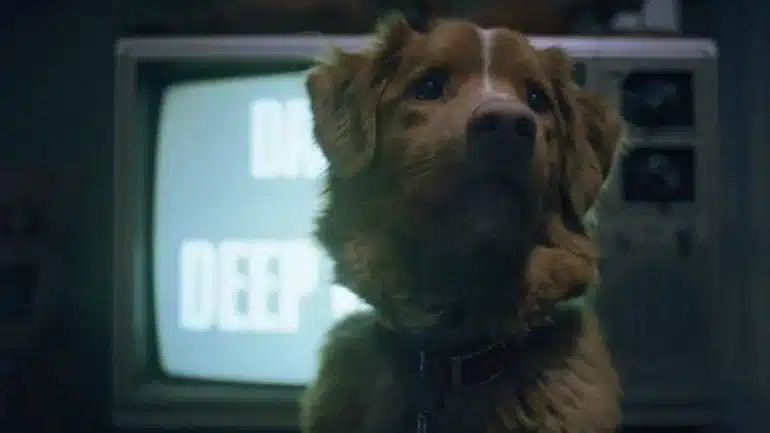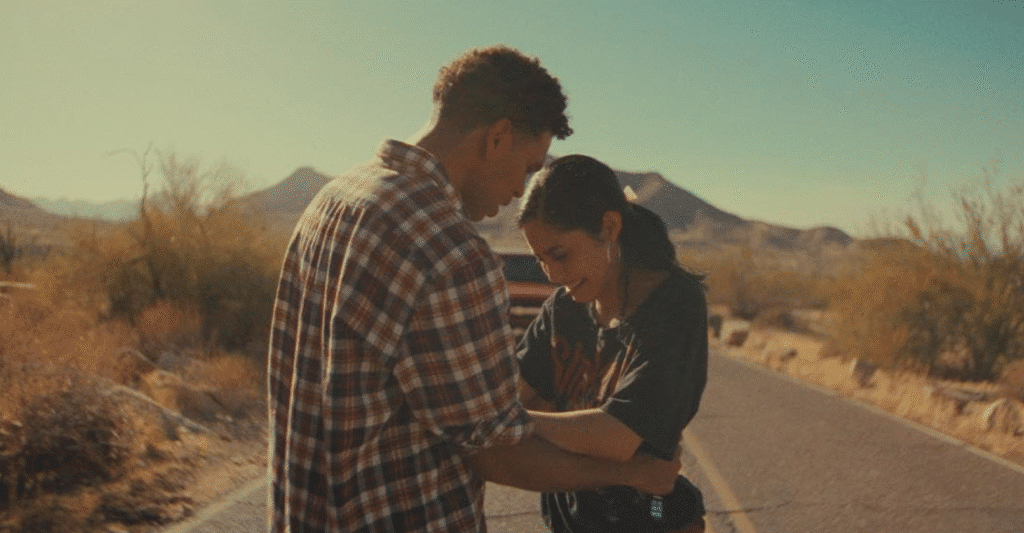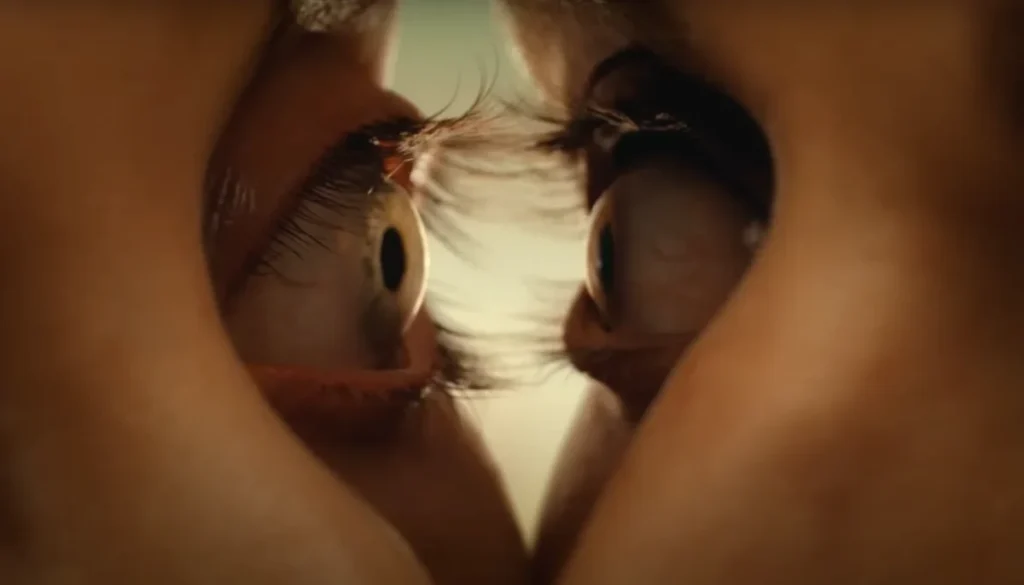
Together (2025)

Fantasy advertisement for celibacy Together (2025) starts with a search team in the woods, looking for two people – two names are being called, but two people go undiscovered. Almost immediately, we see what the search team does not, as the camera pans down below ground level, where some search dogs seem to have found something. Oddly, they don’t signal – but they drink some standing water while they’re down there, before returning to their handlers (somehow – good climbers?) with something newly odd about them. Later, from their enclosure, their terrified cries reveal that something worse than odd has happened, in a brief but punchy nod to a very well-known body horror from the Eighties which, were I to name it, would give a lot away, but the fact that I haven’t named it almost achieves exactly the same thing, because you’re very likely thinking about the right film, right now.

Let’s say just that there’s something weird out there in the woods, and we know this before we meet our protagonists, Nice but Mismatched Couple Millie (Alison Brie) and Tim (Dave Franco), who are about to set aside their misgivings to move to…the woods. More specifically, they are about to move to the country as Millie has a new teaching job. Tim is a struggling musician, something he can do anywhere and, as a struggling musician, he has hubris and self-reproach in good balance, all ready to transport to his new abode. We meet the couple at their leaving party, allowing time and scope for us to see some of their relationship issues and to know full well that they will be taking these issues with them, alongside all of their earthly goods.

Once settled in, Tim and Millie begin to familiarise themselves with the new area, heading off on a hike and in record time stumbling upon – or really, falling into – the same underground structure we’ve already seen, which is far bigger and even more ominous than we may have first gleaned. After spending the night there, heading off dehydration during their stay (uh-oh), they manage to clamber out and return to the house. But by now there’s something severely off between them, manifesting chiefly in terms of their bodily autonomy, now that its external boundary is getting mysteriously disrupted. This starts small; upon waking up underground, their skin seems strangely stuck together, but they separate without major issues. However, the new permeable layer between them extends to a new, symbiotic psychological bond which both would rather was not there, and it’s soon clear that the quick separation they managed the first time will not happen so easily again.

Whilst Together runs us through large chunks of its key plot points very quickly, it doesn’t feel like this detracts from the development of a similar thing taking place between its key players because we still take a reasonable, practical amount of time getting to know Tim and Millie – nice, mismatched, fallible, with a troubled relationship offering enough pre-existing complications to match the clearly signposted, incoming ones. Furthermore, the film has a number of interesting, compellingly unpleasant possibilities to offer – all conveyed via an easy-going, increasingly humorous and knowing script, which makes all the difference. It also shows a good sense of what’s behind modern relationship breakdown vs relationship expectations, turning the lexical field of relationships to bleakly funny effect – we get to think all about ideas like ‘splitting’, ‘completing each other’ and of course, how ‘two become one’. Sure, there are some less plausible decisions along the way, but we’re ready for things to get disgustingly literal. If this necessitates a couple of Chekov’s guns, then so be it: it’s more than forgivable. As an audience, it feels like being in on an awful incoming punchline, even before the joke has been fully unfolded. Nice incidental use of a rat king, by the way.

There are undoubtedly shades of other body horror films in Together, and writer/director Michael Shanks no doubt knows just what he’s doing with a few nods here and there, though some other, perhaps less-known titles spring to mind here too: there’s a dash of Honeymoon in the whole mental/physical relationship breakdown aspect, and a bit of Jug Face in the (largely unspoken) pseudo-religion plot point, which, by the way, holds onto a lot of its secrets, though at no great detriment to the character-focused whole. It isn’t as obviously serious as any of the titles already mentioned, however, and in fact becomes funnier and funnier as it goes along – which may or may not work for all viewers, as it feels to an extent like a tonal shift. If things feel gallingly defeatist in key aspects – the ultimate sunk cost fallacy – then regardless, Together‘s detail-heavy body horror does its best work when it focuses on the minutiae, moving deftly into a final act which, to put it bluntly, kicks up a gear. The film works well on symbolic as well as more outré terms, and it still feels like grimly good fun, too.

Together (2025) is available to watch now.
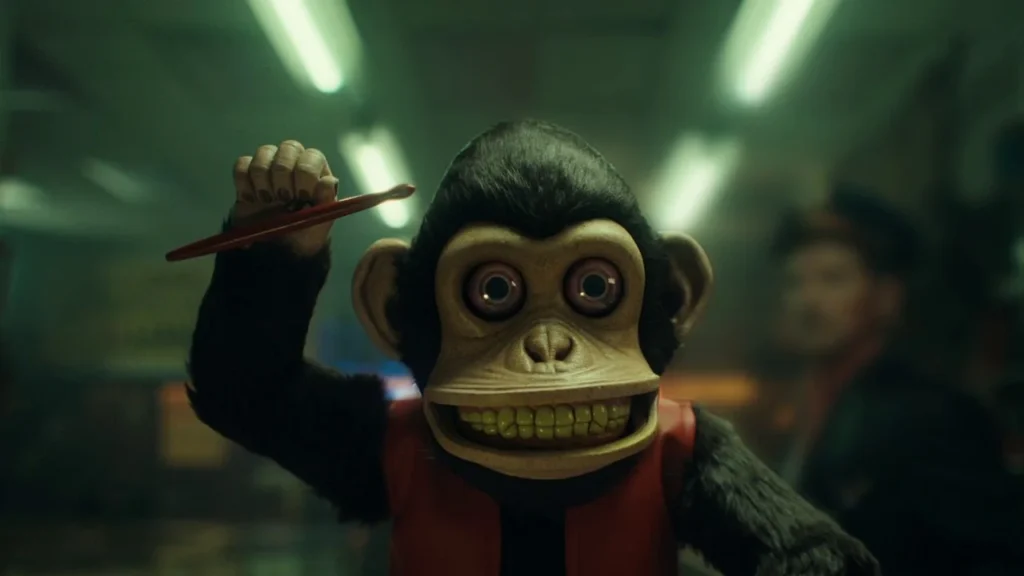
The Monkey (2025)

Osgood Perkins – to judge by the slew of promo emails which have continued to arrive at Warped Perspective this year – is a very busy bee. He’s put out three features in two years; no sooner had Longlegs (2024) garnered perhaps more than its fair share of gushing critical attention, than gleeful emails concerning The Monkey – a reimagining of the Stephen King short story – started to arrive. There’s a lot to be said for making use of any momentum you can gather in indie film, but whether Perkins’s prolific output stems from luck or judgement, slowing down a little wouldn’t have hurt. Like Longlegs, there are issues around coherence, only exacerbated here by a kind of additional, clumsy self-regard. The Monkey is far more pleased with itself than it has any business being.

We start at a pawnbrokers: one of the film’s odd peccadilloes, to mention one of them early, seems to be filling its shots with tat. Pawnshops, cluttered closets, yard sales – The Monkey is rammed full of knick-knacks, with a knick-knack at its very centre, as if Perkins is one-upping all of the other indie directors with a similar regard for old bits and pieces, though usually in their cases for reams of defunct analogue tech. Into the pawn shop walks a guy hoping to offload a creepy drumming monkey whose drumming signals ‘bad things’ are about to happen, which is a sizeable understatement, though understandable at this point. The guy, Petey (a cameo from Severance‘s Adam Scott) then offers us a framing device, as a flashback takes us to his own father’s childhood and the origins of a strange family curse.

The monkey has been in the family for a long time. Petey’s father Hal and his twin brother Bill (Christian Convery) had no father in their lives; all that was left of dad was a closet full of – you’ve guessed it – tat, though it takes the family a while to explore and find the drumming monkey, an item which is, to give it its dues, a pretty cool-looking object. All seems okay, briefly, but one evening as mom (Tatiana Maslany) heads off on a blind date as if dating were some kind of weird penance, the boys head to a restaurant with their babysitter – and the toy monkey. This commences a long line of what seem to be freak occurrences, though often focused on blameless women, it seems. Once they realise its power, the brothers try to get rid of the monkey, making sure by dismembering it and hurling it down a well, and it seems as though they’ve solved their problem. But twenty-five years later…

The story here is simple enough – cursed item plagues family – and there’s really not enough in the short story alone to pad out a feature-length film, so Perkins has made a series of decisions on how to get things over the feature-length line. It seems like a few things held sway during this process: make it gory; make it funny; extend the backstory of the monkey, so that it has a more complex presence in the story overall. Perhaps the feeling of satisfaction with these changes overshadowed the actual success at delivering them. It certainly feels that way. It’s not outré enough to be a genuine horror comedy; it’s more of a slacker comedy if it’s a comedy at all, but its theme of absent or awful parents is an odd fit and too high in the mix to really allow audiences to laugh. The script is garbled too, coining words (‘willish’?) or throwing in the odd, needless Stephen King reference, but it’s glib for too long to really land any emotional impact when it maybe wants to do that later in its runtime. Similarly, once it decides to turn into a version of The Ring, the impact is still negligible. It hasn’t convinced up until this point.

But to judge by the wealth of promotional materials inviting us to pore over the film’s goriest sequences, the gore was always intended to be this film’s biggest calling card. What a shame, then, that it’s so dreadfully handled. Sandwiched in amongst the film’s thin family plot elements, there’s a smattering – and only a smattering, really – of flimsy, obvious CGI which is so cheap-looking that it takes you out of the family plot with all of its additional characters altogether. The film seems determined to build up to set pieces which are utterly disappointing in execution, even if there’s some novel thinking behind them somewhere. The whole thing feels murky and inconsistent, ambitious without due diligence, which at best is down to the quick turnover necessary to get this film out this year, and at worst, is simply the after-effects of hype. Perkins clearly has love and regard for genre film, but the sincere hope is that when his next film appears – in 2026 – there’s more evident care and attention for the basics in the end product, and a lot more depth overall.

The Monkey (2025) is available to watch now.
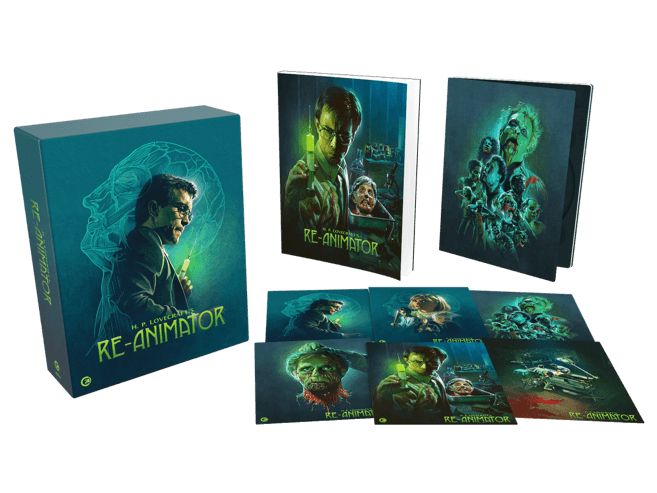
Win! The New Re-Animator Boxset

It’s one of the most seminal bad science horror movies of all time, it has some of the best lines of all time…and thanks to Second Sight, there’s a brand new version of Stuart Gordon’s Re-Animator on its way.

Releasing on 15th December (perfect for dispersing the family at Christmas) this new version will be a presented in a rigid slipcase with new artwork by Krishna Shenoi and a fascinating essay filled 120-page book. It includes a dual format three-disc edition including one UHD and two Blu-rays, with main feature and bonus features on both discs. Special features include The Integral Version in HD, a new audio commentary and a slew of archive commentaries, interviews and features.

Sound good? We have one copy of the boxset to give away, so if you’d like to be in with a chance (UK readers only, sorry) then please drop the site an email with Re-Animator as your subject title. The competition will be drawn on Sunday evening (7pm GST) on the 14th December, and the winner will be informed shortly after that. As ever, contact details will be securely stored for the duration of the competition and then deleted. Get cracking!

Dracula (2025)

Here we are again, then. The year is 1480: Wallachian marital bliss (which seems to involve assaulting lots of cushions) gets rudely interrupted by the prospect of holy war. So off goes Prince Dracula (who keeps referring to himself as ‘Dracul’), campaigning against the invading Turks. However all his thoughts remain with his beloved Elisabeta (Zoë Bleu), whom he plans to send off to a different castle for safety. Bad idea: there are Muslim soldiers waiting in the woods, and she’s pursued. Dracula (Caleb Landry-Jones) does his best to wing it there in time, but actually ends up bringing about his beloved wife’s death anyway.

You know full well where this is going if you’ve seen Francis Ford Coppola’s Dracula (1992), and this film is, strangely, more of an homage to that film than a fresh retelling of Bram Stoker’s story. The whole ‘I renounce God’ thing isn’t present in the novel, but it’s a key element in the ’92 film and it is here too; arguably, providing a reason for Dracula’s malign eternal life has always been a good call. So Dracula the undead nobleman is born, and we move on, the film tells us, 400 years, to Paris. Well, 400 years-ish: the Eiffel Tower is already up. Doctors at a local sanitorium have a quandary, so having reached the limits of their professional expertise, they’ve reached out to a priest (Christoph Waltz) who knows a thing or two about these mysterious cases.

Their issue? They have a deranged society bride on their hands, a woman who, as they work out, is rather youthful-looking for her actual age: she is also lascivious, hates holy men, and caused a bit of a scene at her wedding breakfast, which seems to be the worst crime of all. The woman, Maria (Matilda De Angelis) presents an intriguing possibility for the priest, who has spent most of his life trying to track down the original source for all of the vampires running about in fin-de-siecle Europe, of which Maria is now one. The priest, who more accurately calls Dracul ‘Dracula’ throughout, is tantalisingly close to his goal.

Meanwhile, there’s the usual irresistible name-shuffling, plot-tinkering behaviour from director and writer Luc Besson, who here joins the ranks of filmmakers who want to do Dracula, but want to change the key characters and so forth. If you want a crack at Dracula and you haven’t changed things around, have you even written a Dracula screenplay? So here we have a Maria rather than a Lucy; we have a French estate rather than Carfax Abbey; we do have a Jonathan Harker though (Ewens Abid), though he seems to rock up in Wallachia on his own errand to get Dracula to part ways with some of his French property. Eventually, when pressed, we segue into the expected Mina/Elisabeta story arc, though it never feels like part of a cogent piece of storytelling. That’s the thing. The film is over two hours long, but it all feels strangely thin.

The past is a foreign country, and filmmakers always leave themselves open to comment whenever they try to blend imagination with verisimilitude: as such, the film’s own attempt to align its Prince Dracul with Vlad Dracula, dates permitting, impressive armour and all, feels a little clunky and budget-stretching with limited impact. Where the film settles more into its own mode of high camp, it actually feels more comfortable – there are moments where you feel welcome to laugh – but unfortunately, the brilliant Caleb Landry-Jones never really settles into his role here. Camp doesn’t come very easily to him – or at least, this particular variety of camp does not. Whilst he attacks the part with his usual relish, and looks rather dapper in select scenes, he’s hamstrung by all the limits to script, costume and development. The sense that so much of this film is a do-over doesn’t help matters. Imitation may be the sincerest form of flattery, but there are better ways. There are scenes which look to be verbatim copies from Coppola’s film, meaning they provide a sense of déjà vu, rather than an impression of their own. Even the portraits on the castle walls look more like Gary Oldman than Caleb Landry Jones. And, when Besson does add his own touches, they’re just too ludicrous, even for camp: a cute gargoyle army? Perhaps Besson likes a bit of What We Do in the Shadows. Oh, and then there’s the girlbait perfume motif…

This film has its visual charms; unmistakeably, there are some beautiful visuals, and equally unmistakeably, there are some interesting ideas. It’s just such a shame that despite the film’s unnecessarily bloated runtime and determination to head off on its own tantalising side quests, none of this really benefits the film as a whole. At its worst, this Dracula feels like a school play version of Coppola’s film: it just can’t match the older movie’s innovation or grandiloquence. Or budget; consider the wigs as proof of that. It was, to be fair, originally titled Dracula: a Love Tale, and that’s all it really is, or at least aims to be: the vampirism feels tangential overall, and as such, key players and plot points feel tacked on, secondary considerations and little more. It’s all watchable enough, it has its diverting moments, but this isn’t a great entrant into the vampire genre and on the whole it’s far more Argento than Coppola, which in this case is not intended as a compliment.

Dracula (2025) is available on Digital HD on December 1st and on DVD & Blu-ray from December 22nd.

Haunters of the Silence (2025)

Haunters of the Silence (2025) is avowedly experimental; this is not a narrative piece of filmmaking in any recognisable way, so this review opens with a proviso: it will not be for everyone, and in fact it will probably appeal to a very select band of film fans. If you are interested in the experimental filmmaking process, then there is plenty here to admire, given how it’s geared towards being a sensory experience as much as anything else. It has themes but no plot, people but no characters (in a conventional sense at least). This makes it rather challenging to review, though its strong visual ideas and auditory overload provide an interesting atmosphere.

So what’s it about? If it can be summed up, then I guess Haunters of the Silence is all about searching – for lost loved ones, or family members, or a sense of personal peace. We start with a man scattering ashes at a lake; back at home, grief seems to shape the time he spends, as he strives to fill the space and the hours with light, voices and other distractions. When he tries to sleep that night he is repeatedly woken by his video doorbell; restless wildlife, perhaps, or is that something else on the periphery of the shot? Under normal circumstances, the man would probably just have switched off his phone, but something prompts him to go outside and take a look. This seems to prompt a raft of phenomena which now begin to afflict him when inside his home too, culminating in the appearance of a strange entity which seems to drain and oppress him, sending him fleeing.

The rest of the film follows the man through various dreamlike states, interspliced with external references to objects and ideas; there are some panels from what seems to be a comic-book version of the Du Maurier novel Trilby, the book which gifted the term ‘Svengali’ to the English language, and the ways these begin to utilise stopmotion animation is very skilfully done. There are also books, including a covetable edition of Arthur Machen’s The Great God Pan, with one in particular on the role of drumming in ritual magic recurring several times until it seems to be a motif of sorts. Really, this is a film which doesn’t need (or really reward) rapt attention; you can just as easily get something from it by half watching it, sort of letting it wash over you; it could oh-so easily be played as a video accompaniment for an avant-garde black metal set, by the by, and feel for all the world like it was designed for that purpose.

The film is at its weakest when it seems to threaten a bit of Skinamarink emulation, but thankfully, this is very brief – and could relate more to this reviewer’s post-Skinamarink terror of cinematic grain than any deliberate decision on the part of filmmakers/writers Tatu Heikkinen and Veleda Thorsson-Heikkinen. Elsewhere, in its blurring, segueing but often very attractively framed and lit camerawork, it occasionally resembles work by Alex Bakshaev and Grant McPhee, though each of these directors, despite their arthouse leanings, tend to start off with a narrative framework before moving more towards impressions and ideas. Haunters of the Silence never consciously offers this, and keeps up the same, exploratory approach from the very opening scenes. A slightly clunkily-worded intertitle aside, it’s a film which does what it sets out to do very smoothly and with some undeniable ingenuity. It’s more immersive than informative, and will be best admired by viewers who are okay with that.

Haunters of the Silence (2025) was awarded ‘Best Experimental Film’ at the Paris Film Awards in October.

The Running Man (2025)

Is it me, or do even the most improbable dystopian situations feel a whisker away these days? Perhaps The Running Man (2025) feels oh-so close at hand because the novel on which it’s based, with its novel-contemporary analogue tech and big budget gameshow format blends so nicely with our world, billionaire media conglomerates with their snazzy, surveilling screens included. Whatever it is, The Running Man – a new adaptation, rather than strictly a remake – feels very discomfiting in many places. Since Stephen King wrote the book in ’82 (and faster still since the 1987 movie version was made), the world of reality TV has kicked into top gear; you feel uneasily sure that if Netflix could only perfect the world’s most watertight waiver, they’d think about making a show like this. Oh, they would. They’d almost certainly make Speed the Wheel, one of the other shows we glimpse during The Running Man, except for the fact that we’ve already had The Biggest Loser and it would be a bit passé now. One of director Edgar Wright’s biggest successes here is understanding you don’t need to embellish 2025 all that much to create an engaging backdrop for your own big event. The film’s frequent refrain of, “Stop filming me!” could be spoken almost anywhere in our brave new world.

It does take a little while to feel like an Edgar Wright film, though: perhaps he was conscious of wanting or needing to do a lot with this project, given how long he’d wanted to make it. In places, the film can feel uncomfortably stretched between sci-fi, action and moments of slightly tonally odd humour, even though humour has often been an integral ingredient in his films. Or, and it would be ironic if so, perhaps he was constrained by financiers who wanted a say in some of the film’s inclusions and changes, if there are more influences at play here than Wright himself.

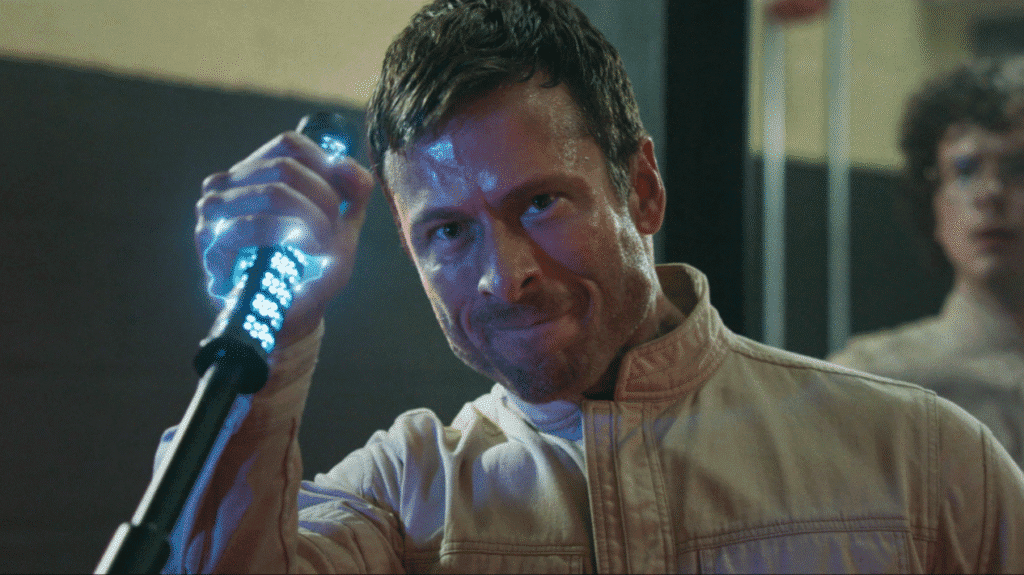
But anyway: Ben Richards (Glen Powell) lives in a world of stacked decks. Whilst he’s been fortunate enough to father a daughter with his wife despite the radioactive dust allowed to settle, consequence free, on the working poor, he’s been unfortunate in terms of his career: he’s been essentially blacklisted from gainful employment due to once ‘damaging a company harness’ (actually saving a colleague). His daughter is sickly and needs medical care; little wonder, then, that Ben is a very angry man – in fact, he’s pissed off enough for us to believe he’d take the desperate step of auditioning to take part in the new season of The Running Man, a show which relies on a steady stream of shuffling desperados to entertain the masses. By the by, that part of his screen test where he responds to trigger words in his own inimitable way? One of an already (to this reviewer’s mind) strong script’s most successful moments.

The show itself is very different here to the gameshow version dreamed up for Arnold Schwarzenegger in the Eighties, in a film which has now cemented itself as ‘one of those classics’ from the decade (although praise wasn’t immediate, or unequivocal for that one). Here, as in the book, it’s survival out in the community which is key. Run, hide, avoid, prove you’re still alive by mailing video diaries to the network, and keep going for the duration: thirty days. This is a tough call, given that every flat surface in this version of the modern world has a screen displaying Richards’ face, phoning him in carries a cash incentive, and there’s a crack team of trained hunters on his tail.

The Running Man has an illustrious history: it’s long been a huge success for the Network (hmm, that’s a prominent ‘N’ they use – where have we seen that before?). In this universe, the Network has a stake in everything, operating as a de facto system of government, policing and surveillance. Key to the show’s success is the Network’s shadowy executive, Dan Killian (Josh Brolin) – a smooth, omniscient character, 100% confident of his format and his reach. Brolin is good in this role; it always feels like a plus when he turns up in anything, so having something decently engaging for him to do here is a boon. He can and does offer Richards everything he needs; there are cash bonuses peppered throughout the game – more than enough to set the Richards family up for life – if Richards will only play the crowd-pleasing role Killian expects.

The Running Man initially comes out fighting in a way which belies its two hours plus runtime, offering up a really punchy opening act, establishing its own rigged system with plentiful, neat plot additions to suggest it. The balance between the dull, grey-washed drudgery of the downtrodden and the high-colour, high-end schmaltz of the Network itself works well, with enough characterisation along the way, and the first throes of the chase are compelling. Although in some paces the cat and mouse pursuit can feel a little repetitive, the film’s biggest slabs of action reliably come along to rev things up (if in doubt, add an explosion. It worked in the Eighties and it works now.) But perhaps The Running Man‘s best quality is its zeal for presenting TV as the final frontier of corruption, making this point by presenting only-just sharper versions of AI and surveillance technology, employed by the Network to ‘control the narrative’, another very real concept which has filtered down to us.

The film cycles through pursuit, paranoia and violence in turns, leading into a finale which feels like a good payoff even if – and this is a key criticism – it can’t quite trust itself to just tell the original tale, without some needless fourth-wall hijinks and a surprise dip in faith. It’s also odd that a film of this length still feels a little rushed at the end, with the slightly clunky addition of a new character at a point where it can’t quite bed in. But The Running Man is an exuberant and arresting spin on the source material nonetheless, made with enough lavish love and care to pull through in the end: it’s disappointing that it’s only recouped a fraction of its budget so far, but give it some time. Thirty days would be nice and neat, but realistically it may take longer than that, and some viewers will find that they halt for good at some of the film’s more challenging tonal and timing shifts. For this reviewer, though, there’s a lot to enjoy and incidentally, it’s also great to see the steps to Wembley Stadium being given new life as a setting here. This is a solid film which deserves a lot of praise.

The Running Man (2025) is on general release now.

Reflection in a Dead Diamond (2025)

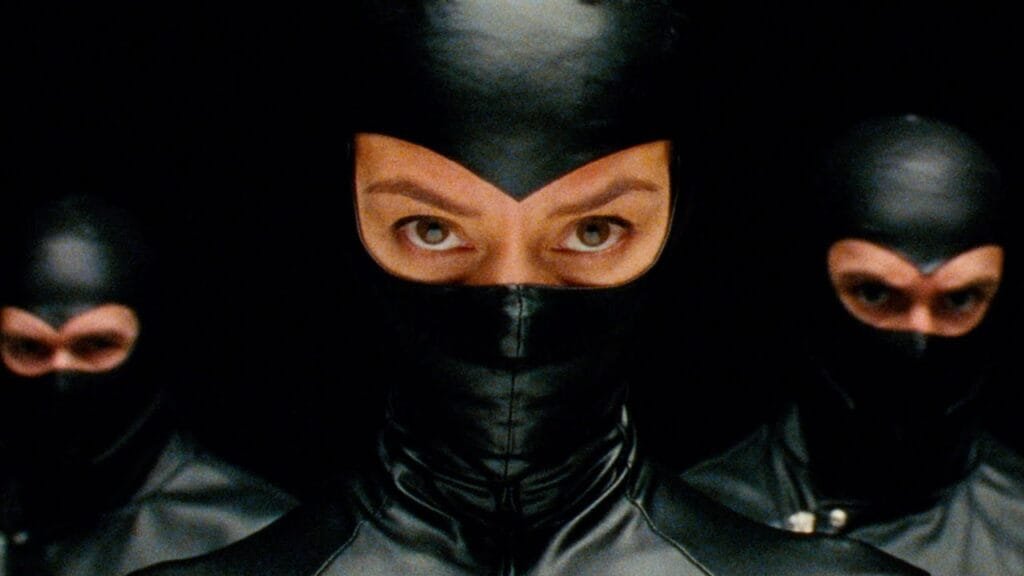
Ah, here we go then. An older man who seems to be living and bill-dodging at a hotel on the French Riviera (Fabio Testi) becomes fixated by a young woman on the beach; the diamond jewellery in her nipple (!) prompts him on a fractured and somewhat looping trip down Memory Lane, as he recollects his heyday as a secret agent. An array of improbable James Bond-style gadgets and suave villains shift Reflection in a Dead Diamond somewhat away from giallo homage, the usual visual style favoured by directors Hélène Cattet and Bruno Forzani, but arguably not all the way elsewhere; there’s still some Argento and still some Bava in here, alongside the newer spy thriller and eurocrime references. Anyway, what at first seems to be the memory of the investigation of a crime kingpin gradually turns into an array of double dealings and investigations united by the hunt for a leather-clad murderess known as Serpentik. That is, this is all in the past: it takes a while to realise it, but the other suave guy we encounter in the early part of the film is the same man we meet at the hotel in his older years – one John Diman.

I think that’s what’s going on, but I’m already reaching here: the hardest part of writing any review of these directors’ work is identifying the smattering of plot which they usually decide to provide, sifting it from the visuals and the mood pieces, which are and have always been their priority. There’s perhaps more dialogue in this film than in previous titles, echoing its cinematic influences perhaps, but also to an extent misrepresenting the film as having more meaningful narrative elements than it does. You naturally spend longer pondering what is being said if it’s in there, before you’re made to acknowledge that there’s still little meaningful to guide you. The layering of timelines in this film makes it near impossible to follow, too, which altogether feels more challenging than having no discernible plot elements at all. You feel that, if the filmmakers have put it in, then it must mean something, so you endeavour to follow it – but you wind up following it nowhere. Reflection in a Dead Diamond is another sumptuous but tedious melee of femmes fatales, funky macros and might-be symbolism. Surely not yet another metafilm made for critics to decode, rather than for audiences? Another issue: is it meant to be comedic? A table football massacre? Who’s laughing at who here, and should they be?

Look, I get it: Cattet and Forzani have spent years developing an unusually painterly cinematic style which offers tribute to their formative cinema favourites in an unorthodox way, endeavouring to blend retro genres with a very singular arthouse vibe. And as usual, Reflection in a Dead Diamond is a visual wonder, every shot seemingly composed by an artist (and here, given the film’s links to comic books, in a way which could – and does – fit specifically into comic book panels). The film has stacks of the requisite otherworldly charm, with an array of close-ups, landscapes and shots which spin, solarise, shimmer and blur. There are brilliant ideas everywhere, things like explorations of ideas about crime, duplicity and artifice through silhouettes, blasting wounds into one another which erupt into cascades of diamonds. It’s pretty. The film’s tableaux are, in their own way, totally absorbing. The multilingual approach, the ways the film largely resists being grounded in a specific time and place, the occasional (and surprising) breaking of the fourth wall and the gradual segue into film-as-comic all reveal a creative and ambitious zeal for the art of cinematography. It’s possible to acknowledge all of that, and still feel disappointed.

Despite their passionate advocacy of an impressive line-up of genre titles, Cattet and Forzani persist in emptying their favourite titles of any meaning, paying a compliment by disposing of even the fractured coherence of, say, a Schivazappa title, which feels like no compliment at all. And it has happened over and over; that continuation, in a world where people struggle to get films made, feels as engaging as anything actually contained in the films. What is it about these wholly visual paeans that keep them coming? Perhaps we can forgive the presence of an idiot at the party if they’re really, really, really good looking? The directors are clearly having fun, true, and having more fun here than they’ve had in their previous titles, arguably – but by making it so difficult for their audiences to feel the same unless they, too, give up on understanding any of it, ultimately it doesn’t feel very clever or respectful at all.

Reflection in a Dead Diamond receives a limited theatrical release on 21st November 2025.

Dangerous Animals (2025)

As Dangerous Animals gets going, we first observe tourists and sightseers Greg (Liam Greinke) and Heather (Ella Newton) popping up on a Queensland quayside, hoping for a ‘marine experience’ with a local: they’ve just missed their organised tour doing something similar. The gaffer, Tucker (Jai Courtney) is straightaway signposted as a bit of a wildcard, but Greg and Heather are keen enough for said experience to ignore this; by the way, what they propose to do is go swimming with sharks. Tucker’s specialism – and business – stem from personal experience, as he survived a shark encounter (and a hell of a bite) as a kid. This hasn’t put him off; if anything, it’s triggered a strange, spiritual deference for the predators, which can only add to the red bunting which could already be flying from his boat.

Anyway, the boat heads out, Greg and Heather get in the shark cage, and down they go: to be fair, the underwater scenes in this film are very beautiful and tranquil. Sharks, of course, have two modes: serene giants of the sea, and eyes rolling, thrashing about in viscera, fearsome death machines. Come to think of it, Tucker is not too dissimilar, even if there’s a self-described method in his madness. he has a plan for his guests; he has a plan for all his guests, of which Greg and Heather only number two.

Next up, we meet a free spirit chick-with-a-van, Zephyr (Hassie Harrison). She begrudgingly agrees to give a lift to a guy whose own vehicle has broken down; after a guarded start with Moses (Josh Heuston), they do in fact hit it off. Yep, they’re quite clearly framed as a) cute enough to care about and b) Next, which is potentially a snag for the film to get past. You know full well that Tucker is about to hove into view, and that Zephyr is going to be the feisty riposte to whatever mad shit he has in store. So, it’d better be good.

Well, it is, mainly because Dangerous Animals has one killer idea at its core. This notion of shark-as-murder-weapon for a psychopath obsessed with his own brush with a shark-related death is a solid one, referencing other, older horrors and genres without feeling like a simple rehash, and do you know what else is great? The sharks here are…just sharks. They’re not genetically-modified sharks, surprise megalodons or inexplicably smart, vengeful sharks. Instead, the sharks here just do what sharks oh-so occasionally do (to humans, at least), and only then with some heavy encouragement from shark fanboy Tucker. Similarly, the character of Tucker doesn’t get (or need) an overly busy backstory. We learn a little, but he’s still kind of a closed book, a man tinged with de rigueur misogyny, but otherwise a seemingly affable, music loving, down to earth bloke. It’s hard not to see him in similar terms to Mick Taylor from 2005’s Wolf Creek: these two share the same instinct for picking off vulnerable, itinerant tourists by seeming like the salt of the earth, even if Tucker feels more like some sort of Discovery Channel-spawned monster, and Mick’s more SBS.

Once all the key pieces are in play though, Dangerous Animals essentially becomes a tense survival thriller – one with enough about it to make you shout advice at the screen, and one which feels in some respects like a Noughties horror film, back when all people seemed to do for a few years was survive (or not) various torturous situations. All in all, it works very well, although the rise and fall of adrenaline-inducing beats and subsequent lulls can feel a rather bedraggling experience for the viewer. However, this is a well shot, soundtracked and acted film, in equal parts clear on its influences and keen to do its own thing. And, although in its title and basic premise it may sound like it shares a lot of ground with the heyday of ‘animals gone rogue’ exploitation flicks, the proponent of all the horror here is very much human. As the poster suggests, you’re safer – kinda – in the water.

Director Sean Byrne earned his forever chops with his debut feature The Loved Ones, though he’s not been particularly prolific since that time, with only one interim feature-length before this newest one. Dangerous Animals does feel more akin to The Loved Ones – a realist film with some arguably fantasy touches – than The Devil’s Candy, a fantasy conceit with some aspects of realism, like its family dynamic. But is it helpful to force a comparison? Perhaps not, given that Byrne has, so far, opted for something quite different in each feature he’s made; he’s skilled and he’s confident, showing more and more knowledge each time, as well as showing willingness to play with ideas from the horror genre in a nicely self-referential way. He also knows a thing or two about how to dole out those killer scenes, and Dangerous Animals has a few beauties. All in all, even if the Australian Tourist Board might be tearing out their hair (again) over this film, the Australian Film Board ought to be throwing money and opportunities at Mr. Byrne; three features in sixteen years feels like far too few.

Dangerous Animals (2025) is available to stream now.

Good Boy (2025)

A dog lies sleeping the sleep of the righteous before being awoken by …something. It could be the mobile phone buzzing away on the arm of the chair – or it could be something far more ominous. Todd, the human at Indy’s side, is unconscious and unresponsive. The room seems odd, too – there’s weird interference with the TV, the lights flicker. Thankfully, the caller, Vera (Todd’s sister) comes in just in time to revive Todd, but as we gradually gather what’s been going on here, we discover that Todd has been, and is, seriously ill.

Next, we see man and dog travelling out in the boonies (much to Vera’s horror, given Todd’s condition), where Todd plans to take up residence in his grandfather’s old house, which has been bequeathed to him. Talk about pathetic fallacy: the gloomy skies and torrential rain don’t exactly scream good tidings, and the dismal, cluttered space they arrive into doesn’t, either. Todd has a lot going on, but all he notices about the new place is that it’s unkempt; Indy, however, whom we’ve already seen is quite a sensitive dog, is soon responding to things unperceived by his best friend. Indy wouldn’t know this, but Vera agrees with him; on the phone, we hear her declare to Todd that the house is “haunted”. So we have a familiar horror film idea – a haunted house, a potentially hexed family line (Todd walks Indy through a nearby burial ground which is choc-full of his gone-too-soon relatives) – only, here, it’s unfolding through Indy’s perspective. It’s Indy who is faced with the biggest share of supernatural phenomena, and this seems to worsen in line with Todd’s rapidly worsening condition. Can Indy protect his beloved best friend from the sinister forces encroaching on this place?

One of the biggest heart-wrenchers in Good Boy is being made to believe that this beautiful dog is afraid and at risk; coming in a close second is understanding that Todd has run out of road, and is reduced to begging to be a medical test subject, or trying folk medicine cures, things which are clearly not going to be up to the (nameless, but dreadfully guessable) condition he has. Pain and desperation makes Todd mean at times, too, which combines both of the film’s most heart-wrenching elements into one; all Indy wants to do is to protect Todd, but he’s just a dog – he can’t interpret what’s going on here, and god knows he can’t face down Todd’s diagnosis. Indy is actually director Ben Leonberg’s own dog, so he’s able to bring in his old video footage of Indy as a puppy – adorable, and genuinely moving, given the film’s storyline. It’s also probably worth saying that if you hate any kind of animal peril, even suggested animal peril, then go careful with this film. I had to watch all the way to the end of the credits to be sure I knew what had happened and could cope with it.

Good Boy‘s choice of ‘dog’s eye view’ for many of its scenes is an engaging one, though we’re never quite kept on Indy’s wavelength, given that we can read text messages, understand the dialogue and infer other elements of the plot, although some of the dialogue is slightly muffled because we always stay with the dog, who often wanders off or goes to investigate something, meaning it’s occasionally a stretch to hear what’s being said. But, steadily, the film pieces together enough of its backstory to lend weight to the ongoing action and substance to the threat at the house, through making good use of VHS video diaries (of course, it’s an indie horror) where grandpa is briefly played by Larry Fessenden (ditto). The set and location are both solid, full of impenetrable darkness which often tricks the eye, or shots cluttered with the detritus of a life passed, which also often threaten to take on human faces and forms. This effect is possibly exaggerated in Good Boy, given that this is a film almost devoid of human faces; this, again, stems from the dog’s eye view motif, so we spend most of the film at not far off ground level, seeing more of people’s feet than faces. Perhaps this brings on a touch of pareidolia. It also almost certainly calls to mind some other things. from cartoons to Skinamarink (2022), though unlike Skinamarink, Leonberg knows when to call time: Good Boy comes in at an economical seventy minutes, which works.

That this film took years to make is testament to how hard Leonberg worked to get it right, and of course to treat his canine star and buddy fairly. He does this so well that it’s hard not to commend the film for being well acted; of course what we mean is well directed. Good Boy is a quietly creepy tale with a genuinely involving and emotionally affecting central premise, and it’s that which really sets it apart from similar films, particularly by the end. Its moments of vulnerability and mystery are very well-handled indeed.

Good Boy is available now to watch on Shudder.

Short Film Focus: Hand (2025)

Amber (Sharlene Cruz) is woken in the early hours of the morning to an upset call from her boyfriend, Justin (Dario Vazquez), but what is he ‘so sorry’ about exactly? We don’t discover that immediately, but we can soon glean that he’s not hurt or sick or anything like that: judging from Amber’s furious response (the couple take their quarrel out into the desert the following day), he’s been playing away.

Is this all real? The stress is maybe making Amber confused, but what does seem to be real is that she catches her hand on a cactus, puncturing her skin with a splinter. Something else is real, too: this relationship is over. Done.

So Amber gets back to her life – work, friends, apartment – but that injury on her hand looks like it’s getting worse. She can’t get the splinter out, and the wound is becoming irritated. Worse, she seems to be disassociating from her surroundings: day and night is snapping by in a heartbeat, or she’s zoning in and out of what’s going on around her. Amber also starts to hyper-fixate on little things around the apartment which have clearly bugged her for a while. Most of these are linked to Justin – who seems to have been very much an Ask Aubry kind of boyfriend – a man who thought nothing of trashing the place because hey, it won’t be him cleaning it up. Amber’s memories of her last relationship all seem to hinge on Justin’s selfish bullshit around the apartment, and the physical marks he made while there.

Hand offers a wealth of great details, starting with its big shift from Amber’s dark apartment to the bright, richly coloured desert scenes (shot in Phoenix), and it’s a surprisingly auditory horror too: lots of significant moments stem from seemingly innocuous sources, revealing Amber’s heightened state as she tries to navigate normal, everyday life (I’ve never been more on edge hearing someone chop an onion). There are great macro shots, too, providing additional texture and interest. These elements all conspire with clever writing to make our key character very likeable and sympathetic from the very outset. It’s an earnest, skilled performance from Sharlene Cruz, who gels really well with the fairly low key amounts of dialogue used in the film, bringing a lot to the role.

Essentially, what we have here is a woman who is working hard to reclaim her home and her space, and by proxy, her sense of self, gradually excising the memory of a crappy partner. The issue with her hand is a symbol of how much Justin got under her skin and hung on in there: the idea is used well, creating a snappy body horror out of a miserable and recognisable situation. There’s a confidence here which does great things with the horror elements. Writer/director Jennifer Winterbotham, who recently had her feature script Birthright selected for the 2025 Sundance Producers Lab Fellowship, is a director to watch moving forwards, and it’ll be great to see what she does next.

Celluloid Screams 2025: Confession

Horror cinema teaches us many things including caution and recently, there have been more than a few lessons about the dangers of going up into the mountains – and not just for the usual reasons, such as (mainly) the risk of falling to your death from a great height. In Confession (2024) (aka Kokuhaku Confession), the regular perils of exposure and injury are all present and correct but, as is so often the case, there’s the human aspect to consider, too. Old friends Asai (Tôma Ikuta) and Jiyong (Yang Ik-joon) have been undertaking a yearly mountain trek in order to respect the memory of their friend Sayuri, who tragically died on a climb sixteen years previously. As I’ve said previously, the idea of honouring a miserable death at a great height by repeating the activity which brought about that death will never make absolute sense to me, but there we go: we meet both men on their yearly pilgrimage.

Except this year, there’s a snag. A sudden storm has come in, cutting them off and making them fear for their lives: we come in on this situation in medias res, at which point we realise that Jiyong is already seriously injured and unable to walk. Asai is devastated, but his devastation turns into horror when Jiyong, believing his death to be imminent, makes a startling confession to his friend, hoping to clear his conscience before the inevitable. This would be one thing, but when Asai is able to discern the shape of a mountain rescue cabin within reach – even if he has to carry Jiyong there – it creates a moral quandary. Does Asai pretend he never heard the confession? Or does he address it?

The problem is set aside for the very short term, as the two men struggle to the relative safety of the cabin: Asai busies himself lighting a fire and getting them both as comfortable as possible, still talking about the hope of rescue. But the fact of the confession hangs in the air between them, and before very long it begins to drive a wedge between them. Jiyong is more than remorseful for what he said; he’s actively beginning to suspect that Asai will now hand him over to the authorities. As for Asai, he’s growing steadily more concerned that his old pal is going to harm him; after all, couldn’t he just say that there was only one survivor?

It’s a decent set-up for a tense situation and Confession makes good use of its central premise: you do get a sense that these two men are genuinely cut off, left to their own devices and vulnerable not just to the elements, but to each other. Smaller plot additions – such as the loss of their only working mobile phone (or is it lost?) and the ways in which the film steadily opens up other spaces and possibilities, even within the confined environment of the cabin, all work together well. Whilst you will perhaps find yourself wondering why the men don’t get straight into it and address the confession head on, you also remember that there are some cultural and societal expectations at play here too – nationality, class, gender – which are revealed. It’s probably fair to say, however, that ‘things escalate quickly’: Jiyong, as the man with the most to potentially lose, goes from quiet and thoughtful to maniacal in what feels like a few easy moves, though he inhabits the role fully, and makes for a good, frightening presence. If the film seems to be setting up Asai as a guiltless victim, then the film has more to offer than that thankfully, revealing new information about this character in such a way that it casts doubt on his good guy persona, giving the film more of a middle act than it might otherwise have had.

However, to render the improbable probable, Confession does play fast and loose with some of its plot points – to the extent that, on occasion, and even allowing for some of the more overblown content and the film’s style overall, it’s less convincing. Jiyong’s leg injury, for example, sometimes seems to be wholly incapacitating and yet, in the midst of this, he seems able to suddenly and silently manoeuvre himself around the cabin; yes, this allows a few killer set-ups, true, but then in other instances, he struggles to get anywhere at all, and in those instances it’s plot relevant that he can’t. The film wants it both ways, perhaps. But perhaps the film’s biggest and most obvious offence is where it makes such ample use of the ‘but it was all a dream’ get-out clause, building up to a crescendo which – if you know the film’s runtime – would probably mean the film running out of ground early, except that it then backpedals on the deed, revealing that it didn’t happen like that anyway. This can make the action feel repetitive. This, most likely, is an example of where basing a film on a popular manga leads to a few potential issues. What works as drawn sometimes presents the odd problem when it’s turned into live action cinema; the issues of how you get from one panel to another, for instance, work a little differently when filmed as they require more of a clear transition between key moments, and this is probably the one most obvious sticking point in Confession.

If you can set this aside, though, then there’s lots to love here: it becomes more and more intense, offers up some ingenious scenes and ideas and never sacrifices the near-stifling claustrophobia which it’s at pains to establish from the very earliest scenes. It all gets rather bloody and nasty, too, which comes as a bit of a surprise from director Nobuhiro Yamashita, better known so far for his comedies and buddy movies (though, after a fashion, I suppose that’s what this is). Could Sayuri (Nao Honda) have been given more to do in this script? Sure. But the film’s economical runtime (just over seventy minutes) excuses some of the film’s weaker elements, keeping things taught and focused enough to shine.

Confession (2024) featured at this year’s Celluloid Screams.