The best way to sum up Butcher, Baker, Nightmare Maker is to say that it’s mesmerisingly weird – both in its plot and in its origins. It was directed by William Asher, who is better known for gentle TV comedy series such as I Love Lucy and Bewitched: this film is – to say the least – a change of pace. A domestic psychosexual horror which morphs into a slasher, it has a few echoes of Pete Walker here and there, but it’s very much still its own beast. It doesn’t move from the sublime to the ridiculous, but rather holds both in balance throughout its runtime. None of its given titles – Butcher, Baker, Nightmare Maker, Night Warning nor Protégé of Evil – really make sense, but that’s okay. That’s not really the point.
We start innocuously enough, with a family trip: two young parents are leaving their toddler son Billy in the capable hands of his loving aunt Cheryl (Susan Tyrrell) while they head off to visit grandma: all perfectly normal. However, soon there’s a (horribly protracted) problem: the car’s brakes don’t work. Being in an American car, dad probably can’t change down through the gears to slow himself down, though that’s not the only reason that both parents are killed as the car weaves from one side of the steep-sided mountain road to another. The upshot is that Billy is orphaned.
Fourteen years pass by, as they have a habit of doing. It seems that Aunt Cheryl stepped in to raise basketball-mad Billy, in a fairly comfortable middle-class home stacked with Catholic iconography and – photos of Billy. Aunt Cheryl is a little overbearing: clue number one. Clues number two and three are a little harder to miss: we see her rummaging through Billy’s wallet, less than happy to see that he has a condom in there, and then waking him up by purring in his ear. But for the moment, at least, Billy is none the wiser, because this is all he’s ever known. He has a few other things going on: there’s some jealousy and conflict in his basketball team with a guy called Eddie (a young Bill Paxton, who unfortunately disappears from proceedings rather early on). Then there’s girlfriend Julie (Julie Linden) and the odd squabble.
But the biggest problem for Billy, and one which we see blown up to immense proportions, is his error of growing up. He’s delighted when he gets a chance at a college sports scholarship: Cheryl is very much opposed to the idea, and it’s from this point that the veneer of domesticity begins to crack. Disaster (well, the first disaster) strikes on Billy’s birthday: Cheryl knifes a TV repairman after making a clumsy attempt to seduce him; by chance, as he’s looking through the window at the time, Billy finds himself complicit, and initially tries to cover for his aunt’s story – that the repairman tried to rape her, so she killed him in self-defence. This brings them into contact with Detective Carlson (Bo Svenson), a deeply unpleasant man who doubles up by being profoundly useless at his job, but his unstinting attention to the case definitely ups the ante in an already tense situation.
As Cheryl tries to reassert control, and as Carlson (together with the slightly less useless, albeit Safeguarding Awareness Course drop-out Sergeant Cook) continue investigating the repairman’s murder, Billy gets hit the hardest. Poor, sympathetic Billy, well played by Jimmy McNichol, who briefly ended up in light entertainment after Butcher, Baker, Nightmare Maker – appearing in The Love Boat). He gets caught between clashing moral attitudes, both his aunt’s and Carlson’s, so whilst the film is definitely a domestic horror, it stands in for a bigger picture, too. It’s hard not to use the word ‘microcosm’, so – here it is. Something very interesting here is how the normal and the functional intrude onto the dysfunctional, not the other way round: visits from Julie, or well-meaning neighbours, are what initially complicate things. The prospect of Billy heading off to have a normal life is total anathema to Cheryl. Carlson can’t allow himself to believe that Billy is ‘normal’, either.
This brings us to how fascinatingly unreconstructed the film is. It’s not all that unusual, of course, to see and hear things in older films which wouldn’t fly today, and in a way this is all part of the time capsule effect which we get so often in films of this vintage, and older. But still, look at the way Carson interrogates Cheryl on her marital status, designating her as a lesbian when it turns out she’s neither married nor divorced. Then there’s his immense paranoia about Billy’s sexuality, reflecting casual and institutional homophobia in increasingly pig-headed, unpalatable ways. But, hey, these attitudes are still around, and Coach Landers (Steve Eastin) is one of the film’s sole decent, measured individuals, despite being threatened and outed by Carlson as a ‘fag’. It’s clear we’re meant to see Carlson as just as dangerous as Cheryl in several respects, and to understand that he has the weight of powerful institutions behind him, too. One monster facilitates the behaviour of the other, when it comes down to it.
In terms of performances, though, Svenson may be good, but Tyrrell is brilliant. Going from inappropriately flirtatious, to overwrought, to authoritarian, she dominates the screen. Sure, some of the final act exposition could use a little more work, and the film’s slasher mode shifts things quite a long way from where we started, but Cheryl is always queasily interesting to watch, giving a very physical performance. Nothing is phoned in. Representing something of the warped maternal drive which has been used to designate psychotic females for generations, she adds something else – societal expectations around marriage, and childbearing, are brought to bear here too. Carson speaks for some of these, but it runs deeper than that.
Little wonder that this title ended up on the DPP 39 Video Nasties list – it’s basically a shopping list of all the elements that the 80s censors disliked enough to prohibit. Still, Severin have stepped up and put together a phenomenal presentation here: the film looks very much of its era but colourful and crisp. There’s a wealth of extras, too: audio commentaries, interviews with stars and crew, a cinematic trailer and a TV spot. It comes highly recommended. Take a look.
Butcher, Baker, Nightmare Maker was released on 4K UHD/Blu-ray on 13th May 2024.
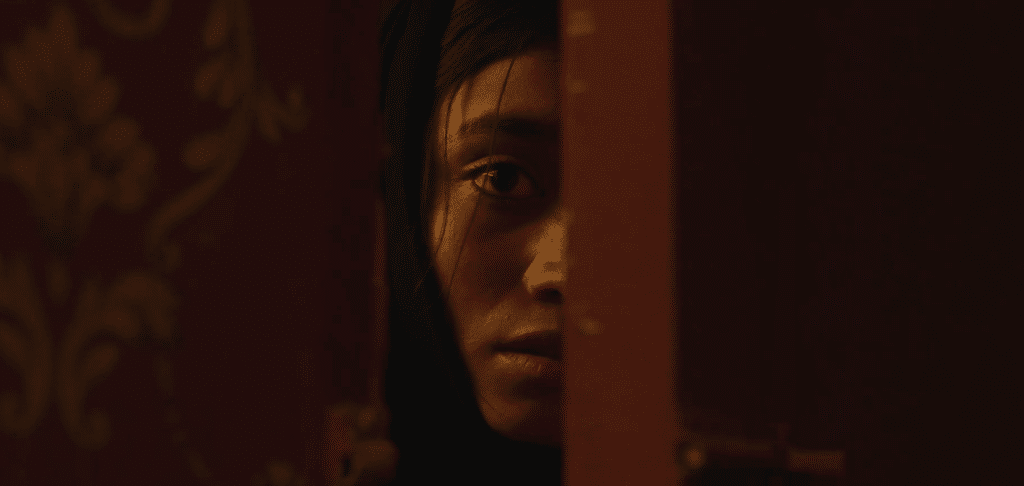
As the film begins, it seems that two different spheres – the domestic and the world outside the home – are being drawn into sharp relief here; navigating these two spheres, and the risks attendant on each, does indeed form a key part of In Flames. We are first faced with a young woman, who looks fearfully through – it’s not immediately clear where she is, but she looks alarmed, and a raised male voice is what is making her nervous. This is a family home in modern Pakistan, and by day, we see that the same household is dealing with the shock news of a recent death. The family’s patriarch has died unexpectedly; neighbours arrive to pay their respects, but the women do not attend the burial, scheduled for that day. It’s their job to prepare a special meal and to clean the house – there’s that domestic sphere again. They are less well-placed to deal with a sudden slew of financial concerns. Not knowing he was about to die, the patriarch has left debts. Uncle Nasir, arrived out of a blue sky to attend the funeral, offers to help them out: it’s the least he can do. At least funerals the world round seem to bring out the very worst in people; all he needs is a few signatures and their problems are over…
Mariam (Ramesha Nawal) is clearly, quietly troubled by it all. She attempts a spell of normality away from the house, taking her mother’s car to go and study and the nearby library, but as she waits to drive on, she is startled by an unknown man who smashes the car window and tries to take control of the vehicle. (To do what? We could hazard a guess. Festering, repressed sexuality haunts this film like a ghost throughout; you get the distinct sense that commandeering the vehicle is only step one of this new, opportunistic plan – and the man’s yells of ‘whore!’ as she gets away from him are another clue.) Mariam is shocked, but clearly no pushover: she continues to her destination, meeting up with her friend Rabiya as planned. Rabiya also has a friend with her: recently returned from Canada, Asad (Omar Javaid) has clearly brought a few more progressive values back with him, and he’s shocked by what Mariam has just gone through for simply driving down a residential street.
They soon begin to grow close, even though at first, Mariam seems honour-bound to question his motives. However, their connection is wholly innocent, loving and sweet – even if it means that this questioning eldest sibling of the household isn’t around when her mother Fariha (Bakhtawar Mazhar) finally acquiesces, providing Nasir with the paperwork he wants. It’s the perfect storm; no, scrub that. Mariam’s absence and Fariha’s trusting desperation create a sequence of storms, the navigation of which makes up the rest of this captivating, slow burn film.
It’s certainly not just the presence of brazen, grifting crooks exploiting an outdated and misogynistic legal system which grants In Flames its well-rounded sense of outrage. The whole film builds a picture of a heavily-surveilled, policed world – which impacts, in the main, upon women. ‘Good’ girls don’t walk the streets; they don’t sit inappropriately close to male acquaintances; they study indoors, privately, if they know what’s good for them. But nor are they safe at home: the whole film’s premise is how even that security can be taken away, whether by depraved men literally clambering into supposedly safe compounds, or by malingering male relatives. Open spaces are – with one notable, beautiful exception – dangerous, hostile places. Mariam’s disorientation when placed in these open spaces is palpable, not least through the cinematography itself, for example with the use of a rolling, careering camera going in and out of focus: the sense of panic passes to us, too. The whole film is perfectly engineered to engender queasy sensations of anxiety: the heat, the streets, the people. Long before any hints of supernatural story-building, the film is rife with sickly, brewing foreboding.
Rich visuals are refracted more and more through carefully-crafted fantasy elements which, as the film gets closer to its final scenes, are recognisably horror in origin. They are woven into dreams and flashbacks, but seem very real; their presence doesn’t detract from the film’s otherwise meticulous realism, however, nor from its cautious pace and superb characterisation. Ramesha Nawal as Mariam is fantastic, enigmatic but still clearly sensitive, a young woman of few words who nonetheless makes you believe in her completely. When she’s ferocious, you want her to succeed, but how quickly she has to put that fire aside – for propriety’s sake, or because she simply cannot match the bleak ferocity of the world she lives in. Likewise, when she’s adrift in that world, you want her to be safe. Such a precarious emotional investment, this. Her mother Fariha begins to blossom as a character, too. It happens under duress, dreadful duress, but regardless, even in her desperation she has a matchless, quiet reserve of energy. Together, they are quite something.
The film as a whole is quite something, even with a few unresolved questions hanging there in the dark by the end. Whether via its meticulous realism or the increasing use of supernatural content, In Flames illuminates, with clever detail, a greater kind of darkness. Challenging and complex, it is a tour de force meld of harsh reality and harsh fantasy; that this is director Zarrah Kahn’s first feature is just incredible.
In Flames (2023) will be in select cinemas from 24th May 2024.
A genre-splicing look at broken people and relationships, The Seductress From Hell has a wealth of creative visual ideas, but its rather flustered approach to storytelling (and its script issues) do unfortunately hamper the film’s overall success. In essentials, this is a revenge flick – albeit some of the targets are more collateral than anything else. Along the way, we get other narrative ideas being tantalised but not always developed more fully, leading to some issues in terms of focus, clarity and tone.
The film is set in Los Angeles, and boy, does it make that clear throughout. We start at 2am, and there’s a couple in bed – which turns out to be husband and wife Robert (Jason Faunt) and Zara (Rocio Scotto). Our first acquaintance with Zara is as she sneaks out of bed, down to the garage to get a mysterious box out of a lock-up. Inside is some occult paraphernalia, including a notebook filled with Satanic scrawls and artwork: you know exactly what these look like without laying eyes on them. Satan isn’t very often represented via Impressionism. As the opening credits roll, we see Zara flicking through the pages of the book. But, post credits, we’re at the breakfast table. It’s not long before we’re shown in no uncertain terms that Robert is not a very nice guy. He berates Zara for her lack of acting work; she vocal-fries her way through a ream of apologies. But she’s waiting on a call-back; unfortunately, when Robert the bully leaves the house to go to his soul-crushing sales job, Zara retaliates by knocking back a handful of pills, passing out and missing the all-important call.
She lies about this to Robert at dinner, but thankfully there’s an upcoming distraction: old friend Derek (Raj Jawa) and his girlfriend Maya (Kylie Rohrer) are coming to dinner the following night. (We check in with them too and they’re not exactly looking forward to it: awkward dinner date incoming!) It’s a disaster, we see more of the kinds of treatment Zara has to ensure, and it’s all enough to trigger a late night visit to the lock-up with the Satanic sketchbook; she also picks up some chloroform, a few tools and – as luck would have it – some surgical scrubs.
Zara is now set on a new phase as a torturer and enthusiastic amateur surgeon; the set-up in the impromptu surgery shifts the film from being reminiscent of the famous-at-all-costs Starry Eyes to being a little more reminiscent of the surgery-as-penance movie American Mary, but there’s also a few hints and clues regarding just how much of all of this is pure fantasy, or at least, not quite unfolding as it seems to be, which keeps the viewer questioning the ensuing events. However, it’s to Scotto’s credit that she’s able to turn in an increasingly spirited performance, going from terrified victim to easeful aggressor and back again (as the film experiments with fantasy and flashbacks in places, too).
So what’s the problem? In a nutshell, it’s this: The Seductress From Hell spells out a lot of things we could assume, glean or accept quite readily without being told, whilst dodging some of the key details which we could really do with knowing. It paints in incredibly broad strokes; its important themes (Hollywood! Capitalism! Gender!) are represented by repeated, overblown mentions in a script which really needed a solid, uncompromising edit. No one talks like this, in such long, complex, grammatically accurate sentences loaded with abstract nouns – not in informal settings, anyway. It occurred to me that this may have been a deliberate symbolic decision; the script could be some way of addressing the scripted, unreal nature of our lives – or something like that. But I’m not so sure; this script tells us in such detail who and what is ‘good’ and ‘bad’ that it loses a lot of its plausibility, something which is still needed, even in a film with fantasy elements. And yet, the Satanic content is barely mentioned; it creeps in, rather than being properly introduced, then it becomes integral to the plot, for reasons unexplained.
Perhaps a stylistic decision to either go for the arty and experimental, or full-on Satanic horror, would have focused the film more successfully; in either case, the film’s themes and ideas could have emerged without needing to be explained to the audience as they have been here. For all that, though, there are some interesting and engaging visuals, and finally we have some Euro trance music assuming its rightful place in a kill scene.
Much is made in supernatural horror of what is seen or unseen, but so much of what scares us is down to what we hear – or think we hear. Using that idea, Last Words (2023) is an effective short film which, although it tantalises several ideas regarding the source of its horror, is ultimately frightening through what it does with sound. It may have a very different location – unfolding its horror for the main part in a sunny, bright and starkly beautiful setting – but it’s reminiscent of The Signalman, with the same, ominous voice carrying uncannily across the divide.
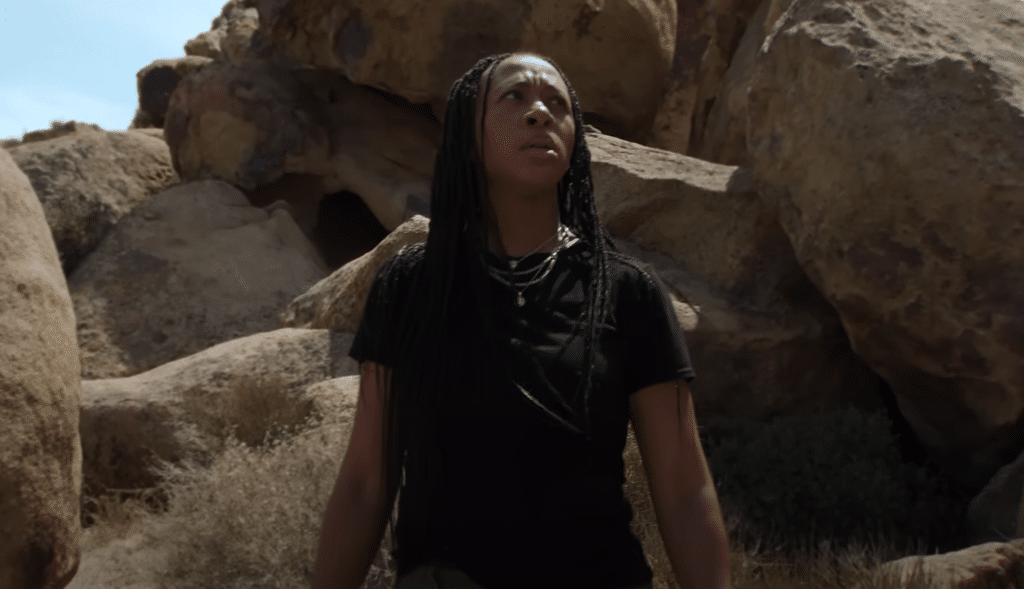
We start in medias res – never a bad idea in a short film with a limited timeframe – and we encounter Kira (Ché March), a hiker who has just fallen down a stony ravine. She’s able to stand, but she has injured her ankle. Her friend Max (Nick Luberto) thankfully manages to spot her from above, and suggests he’ll come to her. It’s not the best of ideas, given how treacherous the drop is, so Kira begins to make her way along her new path, presumably looking for the safest route back – for both of them. However, as she shuffles along, she spots someone else. There’s a young man, watching her. She instinctively calls out to him for help but he responds passively, only pressing a finger to his lips to gesture for her to be quiet. It’s a simple and strangely uncanny gesture; Kira is unsettled, but as this strange few seconds unfold, she hears Max – and now it sounds as though he is the one needing help. This is one of the ways the film subverts expectations: here, the person who has fallen is not, at least initially, the person at the most risk.
Sound has now overtaken sight as the key means of interacting with the world. As sunny and as bright as it is, Kira is dependent on Max’s voice; she may as well be in the dark. Hearing him cry out in alarm only fills her with more urgency to reach him. But none of this feels right: the sound of his voice has become uncertain, unsettling. If he cried out in pain just now, how can he now be calling out to her, semi-normally? She has no choice but to try her best to get back to her friend, but what will she find when she does?
If the odd moment in this film – a key reveal, in fact – looks a little tried-and-tested in terms of its appearance and make-up effects, then it hardly matters when looked at against the film as a whole. This is very nicely pared down, works well within the nine minute (or so) runtime and directors Teal Greyhavens and Nikolai Von Keller understand that you can get a great deal from an essentially simple idea – here, the uncanny horror of a displaced voice. This is the film’s real strength, although the end sequences suggest the presence of a myth or mythos of some kind, some barely-glimpsed orchestrator, lurking in the film’s rare dark corners. The film is genuinely creepy where it presents the audience with its voiceless watchers, and it produces some truly effective scenes along these lines. Best of all, Last Words is available to watch on Alter right now. Have at it.
There’s nothing more galling in life than a dwindling promise, and sadly, that is a real problem for Pandemonium (2023). What begins as a rather beautiful, stark and savage riff on what happens to us after we die disintegrates into a mess of clumsily-stitched parts, united for the most part only by two ideas: death is cruel, and so are families. As much as Pandemonium boasts intense sound design, some initially stunning visuals and a decent opening idea, its rapidly meandering focus cancels them out, leaving us with a tonally odd hodgepodge which just doesn’t work.
We start out with a man called Nathan (Hugo Dillon) who awakes, disorientated, on a remote mountain road. His first thoughts are, ‘I made it,’ and ‘I’m not hurt,’ which you can quickly guess are just wishful thinking; once he stands up and sees the nearby wreck of his car, we are perhaps privy to something he has yet to accept. But for exposition’s sake, he is helped to accept it by the presence of another man, Daniel (Arben Bajraktaraj). Daniel has worked it out: they are dead. He was on his motorbike, Nathan was in his car and they fatally collided.
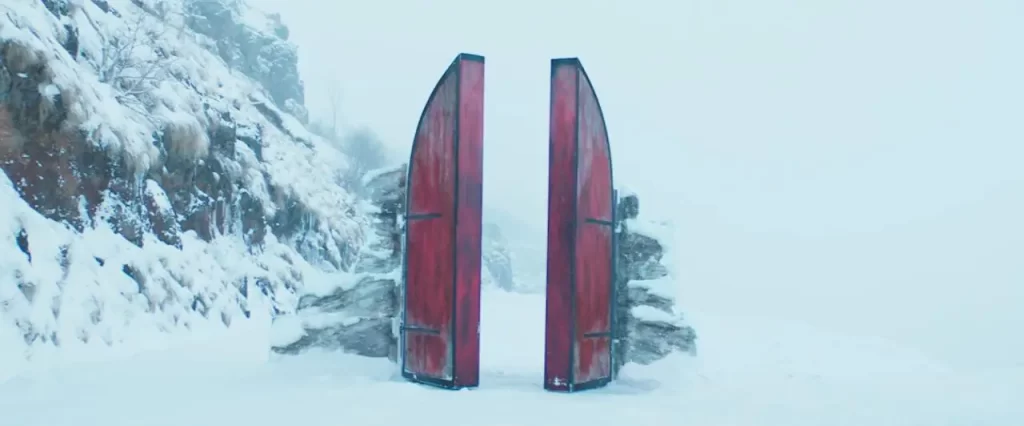
Nathan’s distress is genuinely painful to watch as he is gradually convinced of what’s happened to him. Both men grieve for their lives, but for the moment they’re unable to move. No one has come for them; no one is there to guide them. Rather like the death which occurs in the wonderful A Ghost Story (2017), they seem doomed to remain in one place – in their case, where they passed away. However, Daniel hears something, and then he sees something. Two sets of doors appear on the now impassably snowy road and, if it seems that Nathan’s past actions preclude him from following Daniel through one of the doors, then it ain’t so simple for Daniel, either. No one is getting off lightly here. If it seems, for a moment, like it’s all about to turn into a version of the idea that ‘good guys go to heaven’, then the film at least spares us that.
However, Pandemonium next opts to park this sequence, and in so doing, dispenses with the most successful part of its storyline. It broadens its scope, beginning to take in other scenarios, characters and settings. It slowly transpires that this is actually an anthology film: that could have all been fine, with a genuinely solid overarching narrative. Instead, the icy horror of the opening twenty minutes or so is first replaced with an odd, Gothic storyline about a disturbed little girl in a chateau, a blend of My Pet Monster and something altogether bleaker. Then there’s another, more worldly chapter which, again, has little to do with the two previous ones, other than how it takes death for a theme. This is horror cinema, folks, or at least it’s horror-adjacent: we’re already wall-to-wall with scintillating stories about death in horror, and audiences generally require more convincing than this. Even the presence of a clear nod to Fulci’s The Beyond (1981) – if openly lifting a scene constitutes a ‘clear nod’ – can’t cut it on its own. The nagging suspicion here is that these segments were never scripted at the same time, and have found themselves cut and shut together for reasons of expedience, rather than coherence.
At its best, Pandemonium‘s simple symbolism, stark scenery and the effective performances from Bajraktaraj and Dillon are very appealing, whilst its booming, sturm and drang music (together with a well-realised soundscape more generally) make this, initially, an engaging, sensory experience. There are some interesting ideas too: for instance, around the seeming corporeality of the newly dead: can Daniel really heave a corpse from one place to another? Or is this part of the fantasy? However, after experiencing this feeling of total engagement, the next phase feels like falling out of love: you remember what appealed to you in the first place, so you try to maintain interest, but as time passes – though you can’t pinpoint the exact moment – you find yourself moving through uncertainty and boredom to a final feeling of rather shameful hostility. There are just no convincing links between these tales; each tale feels reticent about any kind of closure or cogency. Fantasy shouldn’t mean that all narrative expectations go out of the window, after all, if you have clearly elected to start using those narrative elements. And then, when we get Dillon back again, he’s being made to guest star in an episode of Buffy.
It’s genuinely very difficult to account for what happens to this film during its runtime, and whilst there are technical aspects to applaud, it takes more than effective cinematography to make a film.
Pandemonium (2023) launches on Arrow’s streaming service in May 2024.
Following up from my recent review of Baghead (2023) – a broadly successful and often intriguing supernatural horror tale – Warped Perspective has been fortunate enough to have a chat with its director, Alberto Corredor, about his experiences working on this film, his first feature. Keri asked the questions: many thanks to Alberto, his team and all who facilitated this interview.
Keri/Warped Perspective: having initially made Baghead as a short film back in 2017, you decided to expand it into a feature-length: what inspired you to do this, and what were the challenges of this process? How pleased are you with the results?
AC: From the moment I read Lorcan’s script for the short film, I recognized that Baghead was a character with significant potential for a feature film adaptation. We approached the short film with this expansion in mind. Although the script was a complete story in itself, we always saw it as a proof of concept for a longer tale, exploring themes of grief, family, and closure. We invested considerable effort in designing Baghead, knowing that an iconic character would be crucial for the transition to a feature film.
There were numerous challenges in achieving this. The main challenge was crafting a story that retained the mood and essence of the short film without becoming redundant. Additionally, the transition from a short film, where I managed every aspect, to a studio-led project was substantial. It can be overwhelming, and feelings of insecurity—the well-known “impostor syndrome”—can surface, so it’s essential to be adaptable and rely on your team.
I am very proud of the film, especially considering the challenging circumstances we faced working during the COVID pandemic. Saying that, as a director, I now can only see all the mistakes and think about how I could have approached certain scenes differently. However, it’s important to accept these imperfections and apply the lessons learned to future projects.
WP: Where do you see Baghead in terms of its predecessors: did particular films or styles influence it?
AC: Visually, I discussed my references with Cale Finot, the director of photography. I am drawn to expressionism and J-Horror, as well as films like Mama and the works of Guillermo del Toro. We focused on the use of light and shadows, and the strategic use of negative space, as these elements significantly enhance the mood and tension necessary for genre stories. For the initial scene in the basement, where our protagonist encounters Baghead, I wanted to infuse a touch of Sam Raimi’s style. Raimi is a master at creating an uncanny yet amusing atmosphere, which was perfect for setting the tone for that scene.
WP: Reviews and articles about Baghead have so far tended to point out its (I’m sure entirely coincidental) similarities to another recent horror with a similar theme, Talk to Me. As an audience member this felt a little frustrating, given the fact that the short film came out years before Talk to Me. How do you feel about this as a filmmaker, first of all, and do you personally feel that these comparisons have had any effect, good or bad, on Baghead?
AC: I first learned about Talk to Me through an actor friend I met during the festival circuit for our short film in 2018. By 2023, we had been in post-production with Baghead for over a year when he mentioned that Talk to Me had a very similar premise and was quite impressive. Naturally, I knew the potential negative impact on our film, fearing that the novelty and shock factor of our character might be diminished. As a filmmaker, you must come to terms with the fact that people might independently conceive similar ideas, and sometimes the timing can be an issue. That’s simply part of the industry.
What is harder to accept, however, are the reviews or comments suggesting that we copied Talk to Me, especially considering our short film and its concept predates Talk to Me by five years. Honestly, I still haven’t watched Talk to Me; the thought of making comparisons is something I’m not ready for right now. Perhaps in a couple of years…
WP: Tell us about working with Freya Allan: she’s probably best-known in her career so far for playing Princess Cirilla in The Witcher: how did she enjoy working on a supernatural horror of this kind?
AC: Working with Freya was a fantastic experience. It was my first feature film, and it was also her first time leading one. We last discussed this during a promotional tour in Mexico. Initially, we faced some challenges, but we gradually found our rhythm. As Freya had never acted in a horror film before—despite her experience with fantasy elements in The Witcher—it took some time to determine the best approach for her character. Nevertheless, she was incredibly dedicated and succeeded in creating a compelling Iris, a character that audiences can understand and empathize with. Everyone on set could see her potential for a remarkable career. Freya is professional, a proper trooper, and has a natural rapport with the camera, which is something priceless for actors.
WP: It can be fun to ask directors to tell us something about making their film which audiences wouldn’t necessaily know about otherwise: some back story, some event, or anything of interest. Did anything unusual or interesting happen during the making of Baghead?
Looking back now, it was a crazy time to shoot a film. We just came out of lockdown and everyone wanted to shoot their projects, as we didn’t now if the restrictions would come back. We faced challenges in securing parts of our cast, crew, and even locations. Ultimately, we relocated the shoot to Berlin. The producers from The Picture Company were already there working on a Liam Neeson film, and they believed we could persuade some of the core crew to stay on and join our project. But the funny thing (well, funny now) was that [John Wick director] Chad Stahelski was shooting John Wick 4 at the same time. This meant that any location we were interested in was either unavailable to another film crew, or had become prohibitively expensive due to the John Wick effect!
WP: And finally, now that you’ve worked on a horror feature, do you have any new plans or projects on the horizon?
Oh, absolutely. I’m currently involved in a couple of projects, each at different stages. One is a military-horror story set against the backdrop of renewed Cold War tensions, inspired by the conflict in Ukraine. It draws from the mood of John Carpenter’s The Thing, taking place in a U.S. military barracks in the German mountains, adding an element of isolation in a frosty, hellish setting—complete with a monster. Mad Chance (Andrew Lazar’s production company) is producing this project, and we are currently in the process of casting.
Also, following my experience with Baghead, I realized I wanted a deeper involvement in story development, which meant taking on writing duties. I’ve completed the first draft of a screenplay in collaboration with Stephen Herman. This story feels very contemporary as it explores themes of human isolation and the challenges of finding compromises, all set in a dystopian, ultra-violent future. I like to describe it as A Quiet Place meets Mandy…
There are a couple of mysterious proverbs – at least they seem to be proverbs – at the beginning of All You Need is Death. ‘Love is a knife with a blade for a handle’; ‘Love goes in at the eye’. Taken together with the version of a certain Beatles track used for the title, and there we have it, one of the film’s themes: love as something toxic, love as pain. But the police interview which forms the opening scenes of the film, as a musician recounts a recent experience with a visitor, also establishes that music itself is key here. A young woman, Anna (Simone Collins) was caught recording folk songs being performed; CCTV in the pub captured a scuffle which broke out as a result, an event which is initially woven into the film itself. As the film dispenses with this framing device, becoming a more conventional narrative, we work out that Anna actually knows the disgruntled stranger – it’s her boyfriend, Aleks (Charlie Maher) and the whole scrap was just some convoluted means of getting more information on the songs.
Is folk music so desirable? So important? It would seem so, and it’s an especially difficult world to navigate without insider knowledge. Aleks is a foreigner and Anna, although Irish and conversant in Irish Gaelic, another important signifier, is from Dublin, so she’s quite unfamiliar with the rural Ireland they need to explore. Theirs is a race to capture and keep songs which are going extinct by the day: unless they are written down and preserved, then they’re gone forever, which makes them both potentially lucrative and historically important; there are others like them too, particularly folklorist Agnes (Catherine Siggins) who runs strange, secretive seminars where she gives advice, and it’s hard not to see some of the film’s occasional moments of dark humour at play here: niche coaching sessions for intrepid ethnographers. Anna and Aleks potentially get ahead of this game when they hear of an old woman living locally who can sing a vast retinue of ‘the old songs’; when they track her down, however, they find that Agnes has already acted on their information and beaten them to it. All three of them therefore arrive at the house of Rita Concannon (Olwen Fouéré), at first facing down the woman’s deep suspicion. There’s one song in particular which Rita expected to die with her, as she has no daughter to teach; so here we are, a daughterless woman and a motherless girl, seeking a song which has an ancient, tragic history. Rita finally agrees to sing it, provided that Anna agrees not to record it.
Promises are never precisely kept in films of this nature, and at its heart All You Need is Death is another rendering of a well-known cautionary tale: an outsider who reneges on vows or breaks rules, wittingly or unwittingly, and can expect to face the consequences. Perhaps ultimately All You Need is Death cannot sustain all of the elements it clearly wants to explore, and little wonder; it tries to do so much, linking magic, music, matriarchy and meaning, exploring the roles of language, knowledge and storytelling. But it raises so many interesting ideas that the film is definitely worthwhile, even though it uses a risky circular structure, starting out with a throwaway line which promises grisly horror to come, forewarning us that we will find ourselves back at this point again, police interview and all. So we know where we’re going: what comes in the meantime is nonetheless thought-provoking and engaging, even if the film crams pretty much all of its big questions and ideas into the first third of its runtime. The stage it sets is incredibly intricate.
In its use of music, All You Need is Death suggests a novel set of ideas whereby outsiders – collectors – take a strange, proprietorial attitude to folk songs, and by extension, to the culture which enfolds them. The songs themselves become saleable, desirable artefacts, even when their meaning is lost or obscured. More than that, though, music acts like a kind of portal in the film – not in an Evil Dead way, and not quite like The Shout, either. It’s not simply singing or even hearing the mysterious Concannon song which generates harm, but the more complex ways it leads to life imitating art imitating life, as it draws upon a horrific history and spreads something of this history in the meagre present. The history may be threatening – very much so – but it’s represented as the only hope for finding real meaning of any kind, which justifies at least in part the risks people are prepared to take in order to somehow own it. As Agnes puts it, ‘the future has been picked clean’; the past prevails. The word ‘alchemy’ is mentioned in the film, too, and it’s a good fit: this secretive, specialist, quasi-mystical practice promising both knowledge and wealth sums up what these people are trying to do, whilst the clobbering weight of Rita’s song embodies the great risks at play. And, at the heart of it all is language: a fascination, a hurdle, a riddle and a literal shibboleth.
If the sometimes smudgy estrangement, body horror and retribution plot points work less well than this extraordinary opening third suggests they might – with the script even resorting to explanations in the closing scenes, suggesting some lack of confidence that the audience are getting all of this – then the film still works overall. It’s an ambitious brand of folk horror in an increasingly crowded, and often now rather samey, field: it has interesting things to say, and in the dark, sparse, claustrophobic version of rural Ireland it offers, it conjures something intense, complex and provocative, with plenty to ponder.
All You Need is Death (2023) will be released on April 19th, 2024.
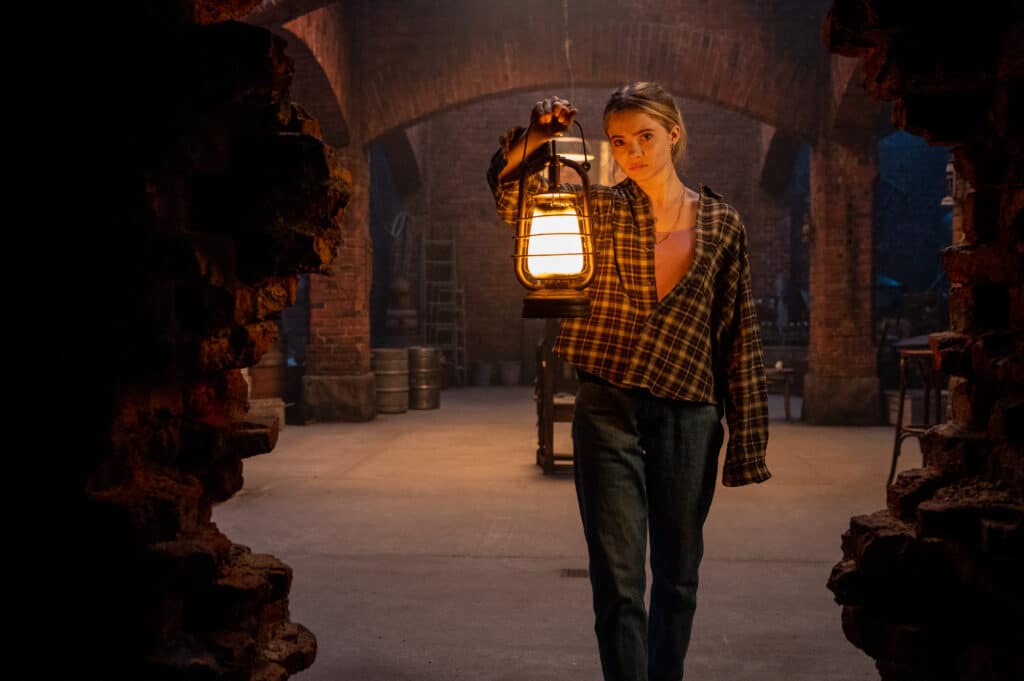
In a dusty pub, an evidently already troubled man (Peter Mullan) is disturbed by the arrival of a stranger, who enigmatically requests an audience with ‘her’. A short conversation ensues and the younger man, Neil (Jeremy Irvine) is sent away, agitated, in evident grief. It seems that this situation, and even living in this place, is coming to a head: Owen is next seen leaving a video message for the next owner of the pub, in which he describes a particular kind of sitting tenant. Whoever ends up with the pub takes the tenant: this is a warning. The ‘tenant’ has to be contained, or else only the worst can ensue. Okay, so the start of Baghead (2023) feels reminiscent of other supernatural horror tales – hints of curses with conditions attached – but scathingly critical reviews of this film seem to be missing the mark, or else they’re judging this film as lesser somehow because they happen to have seen it after they’ve seen Talk To Me (2022), a film which came out some years after the short film upon which Baghead is based; the tremendous reach which has been enjoyed by Talk To Me is hardly the fault of the team behind Baghead, even if we accept that Talk To Me is a very good horror story in its own right. But so is Baghead: some minor issues aside, this film’s deft pace and its array of intriguing ideas are genuinely worthwhile, and if there are a couple of plot puzzlers here and there, then so be it – these hardly derail Baghead‘s very strong elements, either cinematically or thematically.
The video message recorded by Owen turns out to be his last deed, and his attempts to escape The Queen’s Head – actually located in Berlin, which is curious – come to a grisly nothing. So his property now falls to his estranged daughter Iris (The Witcher‘s Freya Allan), his closest relative. Iris – and this is significant – is between jobs, places to live and programmes of study; we first meet her clambering into her old flat to retrieve a few bags of personal possessions before heading off with her friend Katie (Ruby Barker) to – who knows? Ivy is a rootless figure, so the mysterious call she takes informing her that her father is dead and she’s needed in Berlin to settle his affairs comes at a good time for her. She borrows the air fare and heads straight there, seeming perplexed, but not displeased to discover that she’s now a property owner. The mysterious Solicitor (Ned Dennehy) gets her to sign on the dotted line and that’s that (but of course, that isn’t that). Short on accommodation options, she immediately decides to stay the night.
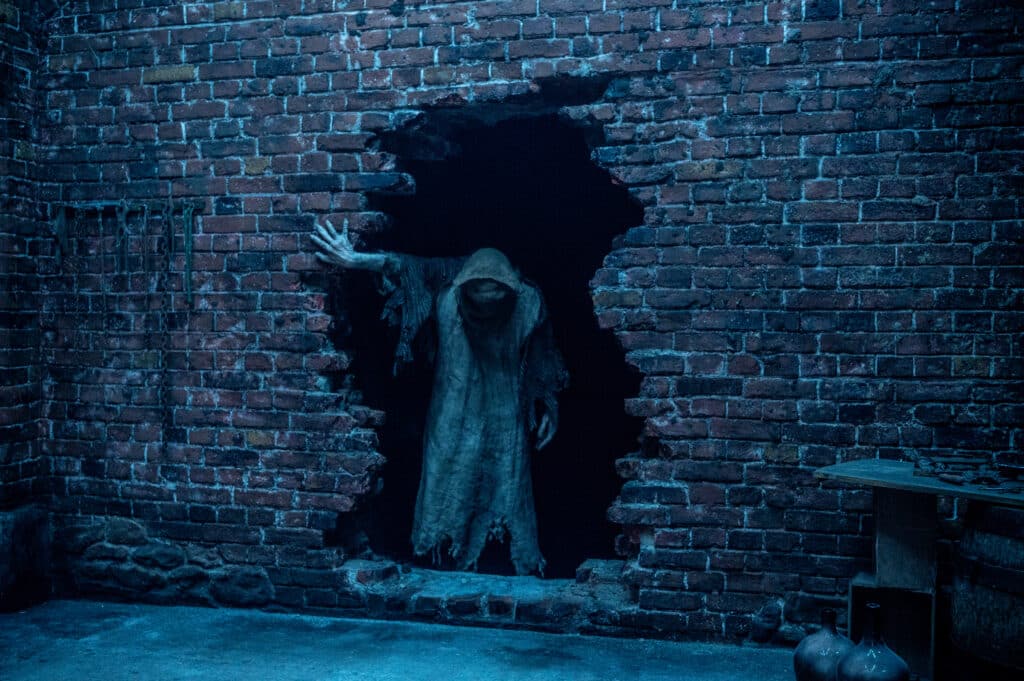
It’s not long before Iris encounters her first scare at the pub, but it’s of mortal origin, at least at first: Neil is back, still seeking an audience with the mysterious ‘her’ who resides in the basement, and he obligingly fills Iris in with what he knows. There’s a creature, a woman, in the basement who can allow the dead to speak via her: her face is concealed, but once she is given an item which belonged to the dead, she can manifest as them – but for two minutes only. Any longer that that, and this malign entity will begin to manipulate the sitter, clawing out troubling truths about old relationships and using them to gain power over the situation. This undead witch’s ultimate aim is to gain mastery, but so long as the rules are followed, then the property owner can control her. Neil wants to speak to his deceased wife; he will give anything, but initially a large sum of money, to be allowed to do it.
‘As long as the rules are followed’; ha! I don’t think the rules are ever followed in Baghead, but let’s give credit where credit’s due. This is a genuinely effective idea, and the very first basement scene packs a punch – it’s creepy, it still feels novel and there’s an element of pathos in here, too, which is gradually twisted into something far more sinister. Even the jump-scares are handled well. When short films get spun into feature-lengths like this one, then all sorts of errors can creep in, or else, errors which you may have overlooked in the shorter story become unavoidably clear; Baghead (2023) knows well enough not to clutter the plot with acres of backstory and nor does it try to stretch things out for too long. Ninety minutes often feels like an economical runtime in today’s climate; it works just fine here, with a decently rolling pace throughout. The set is fantastic, authentically sparse, dusty and unwelcoming; the cinematography is of a high standard, the film is beautifully shot, the soundscape is immersive. Whilst this is a classic ‘haunted house’ in many respects, there are nice visual touches to enjoy: the carved tallies and sigils on the basement door, the clearly ancient-looking door key. There’s something else which is done very well here, and it’s something which seems like it should be obvious in a horror film: the film knows how to shoot darkness.
Iris herself is a good blend of fiercely independent and vulnerable, a stranger in a strange land, but in a place which appears to be quintessentially English – this is disorientating enough in its own way, even without the dweller in the cellar. It’s important to note that, rumbling away in the film’s context, Iris is broke, alone: she craves some kind of connection with her estranged father, and she has nowhere to live. Necessity breeds these circumstances. Baghead isn’t busy with a large cast, but nonetheless everyone here wants or needs something significant. Kudos has to go to both the writing and the performance of the character of Neil, a man who starts off as a seemingly sympathetic, grieving husband, but morphs into something else – not as a cartoon villain, but as someone whose darker traits steadily seep through. His presence in the film raises some impressive quandaries: what if the person who wants to talk to the dead is a bad person? What if their demands to have ‘one last conversation’ are coming from a dark place? What are the power dynamics here?
Towards the film’s close, Baghead‘s seemingly motiveless malignity is briefly grounded in a given history – some critics seems to have missed that bit as I have seen complaints that it wasn’t done – but honestly, the plot works well as a blend of folk legend and urban myth in its own right, as many of these, both on screen and culturally, have very thin origins stories – but aren’t traduced for it. It loses some steam here and there, and there are a few thorny plot elements here and there too, but taken overall, I was genuinely impressed and pleasantly surprised by this competent, cautionary tale of communing with the dead.
Getting a new job is a time to celebrate, right? Well, not always: you might be coming from a dark place, and going to a darker one. That’s the central idea behind short film The Queue, as we meet IT specialist Cole (Burt Bulos) just ahead of his first shift at a new company. Things seem to be a little off when the new boss, Rick (Jeff Doba) questions why Cole seemingly went from a lucrative career to radio silence, with a long period of unemployment before coming to the new firm. Given what this company does, though, it’s little wonder that Rick doesn’t push it too far. He’s just happy to have a new member of staff.
The job is working as a content moderator. What this reminds us is that much of what appears online gets vetted by someone, and it has to be a real someone, at least at the time of writing, so that they can make a proper assessment of what they’re seeing. Cole will be working his way through a list of suspect video content for an internet provider, deciding what gets posted and what gets deleted: people don’t tend to last too long in this role, it seems. But he gets started, and it’s not long before the footage he finds himself watching goes from sexual to violent, with immediate questions raised over what he’s seeing: is this real? A real crime? Or a clever fake? Pausing the queue to clear up the desktop on the computer he’s just inherited poses a few more questions, particularly with regards to his predecessor, and the impact of this work on him too.
By necessity, given the film’s runtime of just eleven minutes, The Queue must move quickly to show us what it wants to show us, so it takes to an extreme the potential impact of this very real tech role. Its short, snappy edits work well to quickly ratchet up the tension, and the film’s close focus on our protagonist ensures that we feel the weight of this, and how all this can impact on a person. Cleverly, we don’t actually see any grisly footage; the flagged content comes to us as the written word as we just see the specific warning labels, which is a clever device, and in being suggestive actually feels darker: you risk changing all of the dynamics when you literally show the monster, after all. We also get just enough backstory to understand something about Cole, and why he might not be the best choice for this job, not right now at least. The payoffs from what the film elects to include are high.
The film has a nicely claustrophobic, strangely unsettling vibe which makes us examine a job role we might not often consider, if we consider it all, even if we do so from a decidedly horror perspective. Raising some interesting questions about the spectre of mondo, snuff and other hazy, but undeniably disturbing facets of of filmmaking and footage which have been further raised by the internet itself, this is a well made short film. Oblique little title, too, when you really think about it…
You can check out The Queue, which is now available on YouTube, here.
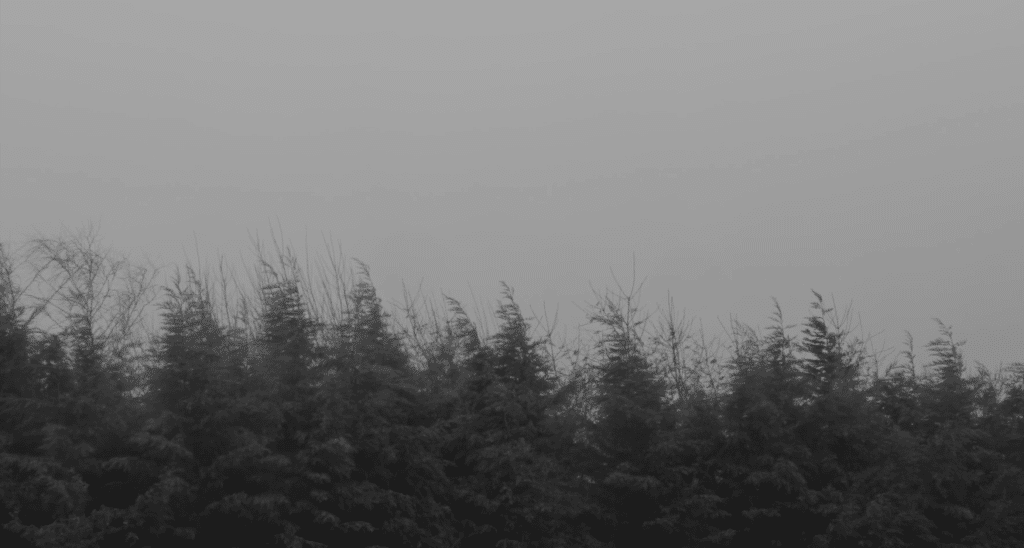
The Stoic Breeze may only be thirty or so minutes in length, but it is a film all about taking one’s time; by extension, it’s kinda all about time, and a person’s relationship with it, negotiated through the natural world. We start with a hand-held camera which very soon begins to feel like a character by the way it meanders through the film, recording and observing without intervening. So we, via it, catch up with a lone woman in the woods; soon afterwards, it seems, she heads back towards civilisation, where the soundscape changes dramatically – the constant background hum and hiss of vehicles obscures the sound of the wind through the trees which was established previously. We stay behind her: eventually the camera stops, allowing her to move off as the camera turns again to the trees running parallel to the road. Then she’s back off the path herself, back amongst the trees as if drawn there. Encounters with other people are handled politely, but kept very brief.
The female lead (Julia Bisby) could be seen as rather closed off – or self contained, depending on your perspective. What we do glean is that she’s fascinated with the nearby woods, and even when safely at home, spends her time looking at them from her window, listening. She also spends a lot of time outdoors, including as a runner. One day, as she’s out running in the same woods, she encounters a fellow runner who looks to be in some distress. So she stops to help the man, who is in enough trouble to appreciate the kindness of strangers.
Now, in a conventional film, be it a feature-length or a short, this would be the starting point for a narrative development, a new character, a new direction – but that’s not what The Stoic Breeze seems to be about. Director and cinematographer Tomas Gold has described it as ‘slow cinema’ – and it certainly is. If it’s thematically about anything, then it’s about how some people live if not contentedly as such (we don’t have enough evidence either way to say) then at least peacefully, alone. Other people here flit in and out of the female lead’s orbit, but don’t hang around; indeed, they’re not encouraged to. The film presents to us how it’s seen as quite unusual for people to be on their own, or to stand still doing ‘nothing’; our impulse is to wonder what’s going on with that person. As a frequent lone traveller, I’ve lost count of the number of horrified comments along the lines of, ‘You’re going by yourself? But what will you do?’ It stands out. But why should it?
Throughout the film, the treeline is a constant and we’re invited to just watch the ways the trees move, and of course, the way they sound. It’s a welcome constant in the The Stoic Breeze. It’s also key that the film is beautifully shot without being ‘pretty’: the frequently leaden British sky doesn’t get enough screen time, and the choice of black and white works effectively. Taken as a whole, the film is more a series of sensory moments than a piece of conventional storytelling, but there’s enough calm skill and detail here to draw audiences into its contemplative progress. It doesn’t answer questions readily, but it makes us curious, and as such, it’s an interesting and unusual, thought-provoking short film.
Late Night with the Devil is an adroit piece of work, a tribute to a time and a place but also an enjoyable and imaginative trip into fantasy, breathing new life into two tired formats – the mockumentary and the found footage phenomenon – by making them entirely engaging and, at least in terms of the film’s structure and purpose for being, entirely plausible. But this isn’t going to be a straightforward review of the film: as fun as that would be to write, this film suggests a different approach. Instead of looking at what works well, and why, this feature will look in more depth at the film’s influences – because that, in its way, explains clearly what works well, and why.
What Late Night with the Devil proves very clearly is that there’s far more to establishing a period setting than adding some analogue technology to your shots. Everything here, from the hairstyles to the house band, from the colour palettes to the props, is meticulously realised. It looks wholly natural – and yes, that goes for the much-vaunted AI content too, which blends in perfectly here (and has attracted more notice than the film’s occult themes, interestingly. I guess every era has its own particular demons). But beyond the film’s solid aesthetics, Late Night with the Devil succeeds because it has also taken great pains to establish a parallel 1970s America, both existing within our history, and outside it. It’s familiar, it’s recognisable, but it’s different: it references well-known American TV shows like the Johnny Carson Show, which anchors it to the 70s we know, the verifiable time period, but then it tweaks and changes other details, building a consistent feeling of estranged familiarity, a kind of uncanny valley of hauntology. From the title of the talk show to the named occultist who features in the footage, everything feels almost real; it’s almost a memory.
Filmmakers Cameron and Colin Cairnes have clearly researched their screenplay very carefully, but where do these details come from? On watching the film, it seemed clear that key events (even if rumoured events) and genuine historical details have been transformed for the immersive and strangely unsettling world of the film. Added to the film’s brilliant use of visual hints and cues (did you catch the decoration on the goblet?) you can find yourself lost in this world or, if you have an interest in the basis for these plot points – read on.
What follows is a rundown in places, a best guess in others, pertaining to the origins of several of the film’s main elements. This will contain some spoilers: be warned!
Ratings wars and The Tonight Show
The Tonight Show with Johnny Carson ran for thirty years (1962-1992), and so would have been in its heyday during the period in which Late Night with the Devil is set; it’s an absolutely plausible competitor for Night Owls – though it’s been suggested that the closest inspiration for Night Owls itself was The Don Lane Show. But Carson’s show established the format for the TV talk show which has been picked up and copied by several other hosts, and it also hangs onto earlier forms of entertainment, such as the house band, the compere/comic foil who introduces the host, and the magazine-style rotation of a number of guests (which seems to me to emulate music hall more than it does other television formats, but if you want to appeal to the masses, it seems you’d better give them camaraderie, variety and music). Johnny Carson also established lots of the unspoken norms of conduct for a talk show host: this kind of television offered new opportunity for a kind of negotiated identity, balancing down-to-earth and affable with a range of unspoken but stringently observed codes of conduct: no political ranting, ‘family friendly’ humour, a careful balance with regards speaking about personal life – saying enough, but not too much. We perhaps take this for granted now, but at the time it was developed, it was new. The format has been developed in different ways in the decades which followed – Jon Stewart, for example, made it political, but was then criticised for not being political enough – but the core components, still in use, owe much to Carson. And, back when the number of national television stations was greatly limited compared to today, ratings were really significant. There were just four major television networks in the mid-Seventies. Everything else was local or public access, with decidedly different budgets, purposes and approaches.
When a successful show could command multiple millions of viewers at any one time – over twenty-two million households were watching Happy Days in 1977 America – then this was of great interest to advertising, hence the frequent breaks in Night Owls to hear ‘a word from our sponsors’, a viewing model we have all been raised to expect. This led to a phenomenon, also referred to in the film, as Sweeps Week, a large data-gathering exercise pioneered by the A. C. Nielsen company, who invite households to record their viewing habits: this material is then sent off and collated, allowing greater demographic understanding of audiences and their likely spending habits. How useful this is now, in the days of Netflix and viewing on demand, is moot: in the mid decades of the twentieth century, Sweeps Week was the single biggest indicator of a show’s success, in that advertising underpins so much of the entertainment industry.
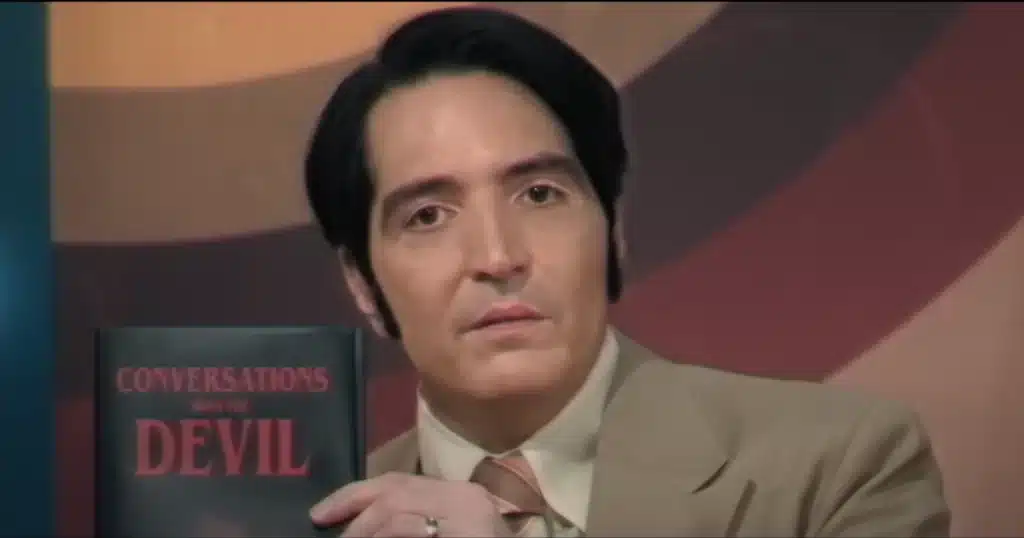
Jack Delroy (David Dastmalchian) sees success in Sweeps Week in two ways: a marker of his personal success, and an assurance of money, money, money coming his way. Securing a vast share of the viewing figures cements his comeback, means more shows, more income and more celebrity (which is often a reflection of earning power anyway). That he continually references Carson gives us a plausible competitor, at a point in history when Carson was enjoying his heyday within a TV format he’d helped pioneer; Sweeps Week, too, is a real phenomenon showing how impossibly tangled fame and fortune really are. And, even had the Halloween special gone to plan (though perhaps it went to plan for someone), it carries within it the future echoes of the sensationalist talk shows to come, offering up ever more scandalous subject matter for the increasingly interactive responses of live studio audiences.
The Age of Aquarius and the psychic revolution
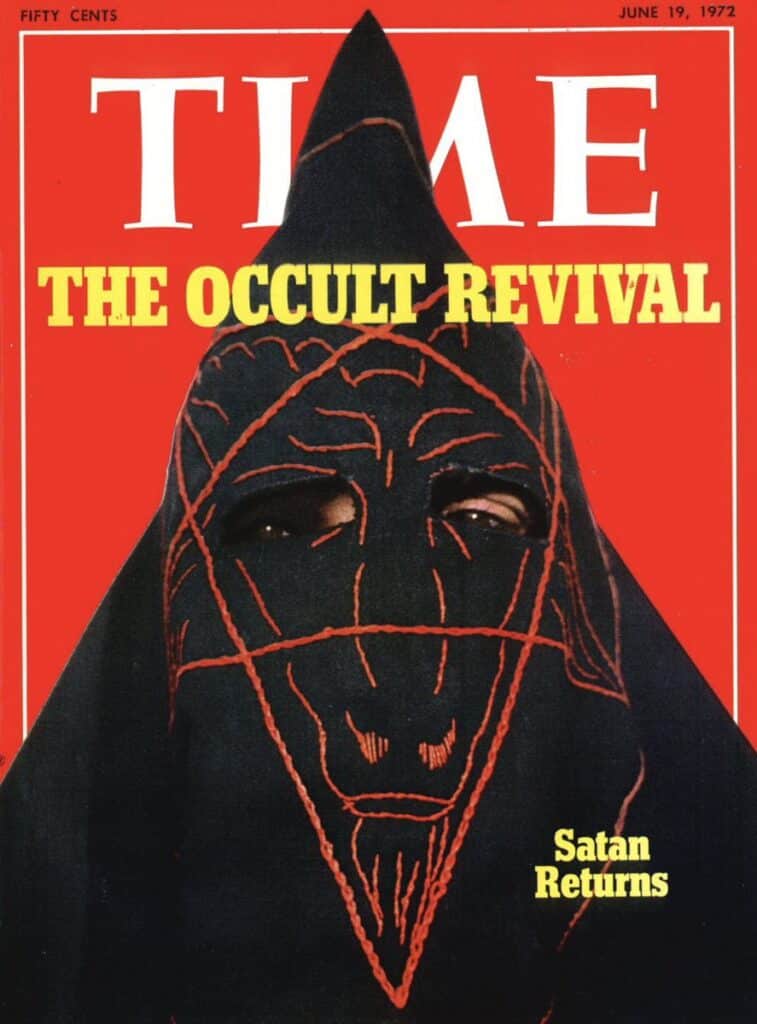
But let’s come back to the subject matter of the Night Owls Halloween Special for now. Halloween has long been an opportunity to generate some on-screen sensationalism, but coming as the show does during the mid period of the Seventies, Night Owls is well-placed to take advantage of the era’s new relationship with the occult. The hippie movement had, by 1977, already migrated into the mainstream, and post-Manson and Altamont a lot of the hopeful revolutionary shine had disappeared, but as it became established as a trope of sorts, so had many of its accompanying tastes and ideas. The hippie fascination with alternative spiritualities, particularly Eastern belief systems, had seemingly opened the door on a host of other beliefs, with a renewed interest in witchcraft and the supernatural also making its way into mainstream America. A decline in Christianity throughout the Sixties and Seventies only compounded this trend in the minds of many. In 1972, Time Magazine ran a special issue on the ‘Occult Revival’, replete with masked cultist on the cover. ‘Satan Returns’, read the caption; this came just six years after their similarly controversial cover which asked, Is God Dead? Elsewhere, less edifying publications were dabbling with the same topics – pulp fiction and lowbrow magazines went wild with covens and demons – and in cinema, too, horror explored Old Scratch’s new heyday, with The Exorcist scaring a generation back to Church in 1973 and The Omen popping up in 1976. But perhaps the film with the greatest kinship to Late Night with the Devil – at least in terms of the documentary framework – has to be Witchcraft ’70.
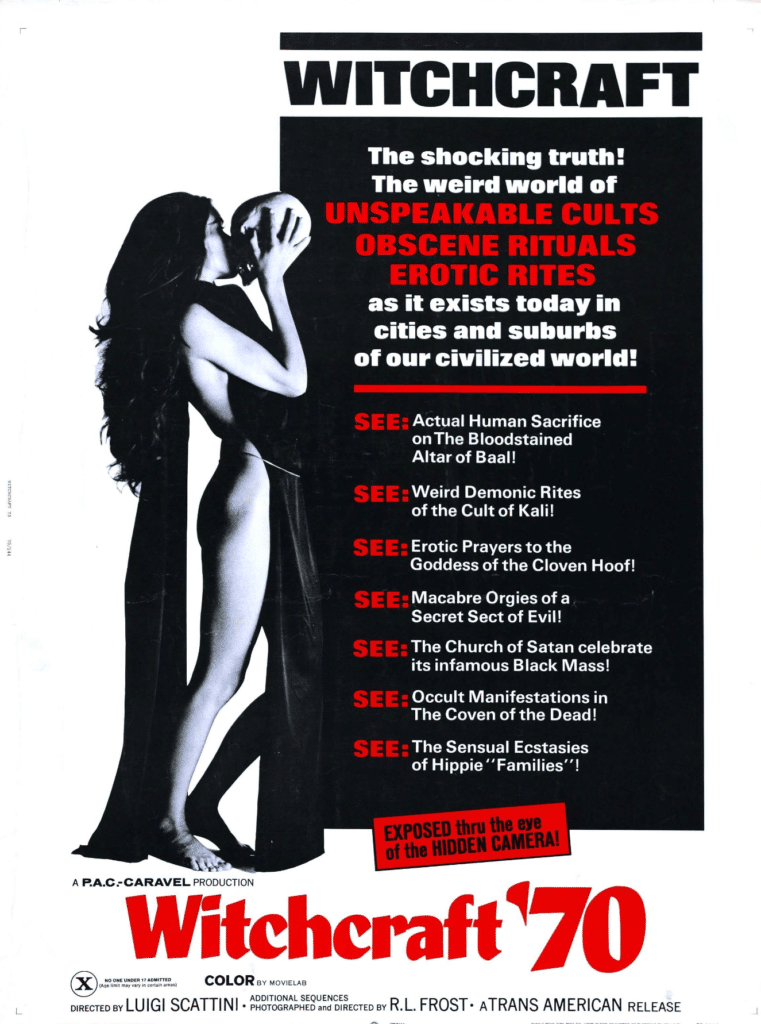
Witchcraft ’70 is not a narrative film; rather, it followed in the new and burgeoning tradition of mondo cinema, a kind of exploitation film which spliced serious documentary with often graphic, salacious or otherwise rarely-seen footage. Mondo Cane (Dog World) got the ball rolling in 1962 and provided hopeful filmmakers with a cheap and fairly easily-realised model which enabled them to pore over acts of extreme cruelty, often with a chaser of – and it’s odd when you think about it – naked flesh. By the by, Late Night with the Devil‘s opening credits reference another mondo-type film, The Killing of America, but that particular film is more appalled by serial murder and race riots than anything more magical. Well, Witchcraft ’70, or to give it its other titles, The Satanists and Angeli Bianchi, Angeli Neri, focuses quite openly on the more salacious, or ‘erotic’ rites associated with modern forms of witchcraft. This makes sense in terms of shifting tickets; along the way, it serves as a partial, but interesting and relevant kind of time capsule of occult beliefs at the end of the 1960s, incorporating hippy culture alongside various cults which apparently worshipped Baal and Kali; there’s also space for the biggest anti-hippy of them all, Anton LaVey and his Church of Satan. Whilst LaVey wasn’t a theist, he wanted Satan at the helm as a figure of strength, individuality and fear; he loathed lax and indolent hippie culture enough to ritually curse the high priest of acid, Timothy Leary. But in this film at least, we have hippies keeping company with the earliest CoS members. In many respects, then, Late Night with the Devil reflects some of the material shared in Witchcraft ’70, and in particular, the CoS footage. The ominous Abraxas cult leader shares some similarity with LaVey. The priest’s name – Szandor D’Abo – clearly reflects LaVey’s full name, Anton Szandor LaVey.
As for Satan himself, he’s conspicuously absent from a film titled Late Night with the Devil, which is curious – but, again, this seems to reflect what we see in Witchcraft ’70. Look at the poster above: given that Baal is a pre-Christian deity of fertility and Kali is a Hindu goddess, it’s clear that our cultists are prepared to play fast and loose with whom they worship and as such, it makes all kinds of sense that Late Night with the Devil opts to foreground Abraxas, the Gnostic ‘god above all gods’, an ambiguous figure co-opted here to stand in for the older idea of the deal with the Devil. If it is indeed emulating Witchcraft ’70, then it does so gods and all. But Late Night with the Devil nonetheless plays with the idea of the Faustian pact. In many respects it almost doesn’t matter what entity is selected for the purpose; the deal is the thing, and where Satan isn’t used or isn’t amenable, perhaps, other figures are available; filmmakers also seem drawn to the great variety of entities to choose from, which might explain why Hereditary plumps for Paimon, a lesser demon who had not, until that point, had his moment in the sun. For many viewers though, both in the semi-fictional universe of Late Night with the Devil and for us, too, even now, any entity under discussion, by virtue of being ‘not the Judeo-Christian god’, is prefigured as the Devil. And the Devil has such a long-established track record as a tempter, after all. Who could be better to offer one’s material and carnal desires, now so often wrapped up in ideas about career, fame and celebrity, than the world’s most famous rebel, who launched his own start-up and has stayed in healthy competition ever since?
The future of cults and the Satanic Panic…
However, once Late Night with the Devil‘s framing narrative establishes that the Abraxas cult, led by D’Abo, ends in a siege and a fiery demise for most of its adherents, it moves quite sharply away from the worship of any number of entities, Satan included, and shifts tack towards recorded instances of Christian fringe groups which have ended the same way. Satan is rather underrepresented in mass deaths, unless you believe that he does most of his dirty work underground (see below). Rather, it’s the likes of the Jonestown Massacre, still a little way ahead of the timeline of the film but now part of our cultural memory, as is what happened to the Waco complex in the early 90s: the extremist and fringe beliefs born during the 70s were about to foment into genuine violence and oppression. But back to the film’s cult of choice, and another indicator that the filmmakers are confident to play with upcoming events and obsessions, making the timeline of the film feel faintly familiar, as well as ominous.
The survival of a lone girl, Lilly (Ingrid Torelli), the only member of the cult not to be burned to a cinder, prefigures one of America’s strangest psychodramas – the Satanic Ritual Abuse phenomenon, which itself spread like wildfire throughout society, acting rather like a mondo title: passing off the most salacious, unlikely content via a respectable moral framework and the efforts of the new priesthood, psychiatrists. It’s okay to read this kind of thing if you’re coming from a place of concern; of course, many of the medical professionals who lent their names to accounts of Satanic cult activity genuinely believed that they had uncovered something awful, and that they were acting morally in helping ‘survivors’ work through their issues. Many others who found themselves involved in the Satanic Abuse claims, peripheral or otherwise (and again, talk shows played a sizeable role in establishing many of the most significant speakers and their claims) probably believed enough to give it all some credence, genuinely wanting to protect the vulnerable and to head off any further cruelties. Others will have spotted a quick buck and acted accordingly. However, the likes of Michelle Remembers kickstarted something pernicious, as well as establishing the typical double act, victim-plus-professional, wild accounts given with one hand, estimable and rational framework offered with the other.
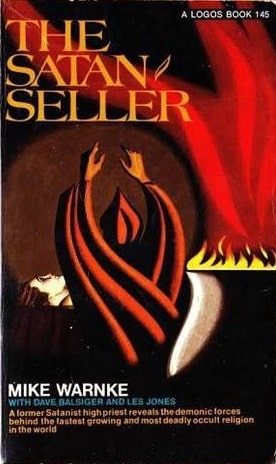
Michelle Smith may have been an adult when she gave her account in 1980, but she was always clear that the events she had been helped to recall related to her childhood. As such, Lilly’s age in Late Night with the Devil brings an immediacy to the Satanic Abuse idea at play in the film, but is wholly in keeping with many of the most influential accounts of same, many of which pre-dated Michelle Remembers and seemed to rely on the febrile atmosphere of a reactionary impulse in America, already whetted by McCarthyism and the shock of the new, then nurtured into a different form by the rise and rise of fringe religious beliefs and, let’s face it, the growth of occult horror too, with its threats of secret cabals of Satanists extolling ordinary Americans to just participate, or its Satanic incursions into normal families. A book which prefaced a lot of this came out in 1972: serial husband Mike Warnke’s book The Satan Seller purports to be a memoir by a ‘former Satanic high priest’, and garnered a lot of interest before people examined his claims too closely. But Warnke certainly helped set the seal on Satanic Ritual Abuse’s key superpower: anyone who criticises the idea too vociferously is probably in on it.
Meanwhile, more cynical authors and psychologists attempted to make sense of the phenomena by casting an ostensibly more scientific eye over accounts of ritual activity; in the film, Dr. June Ross-Mitchell plays such a role, coming from the perspective of parapsychology, another burgeoning academic field during the 70s. Parapsychology tries to negotiate a route between the supernatural and the scientific, and the 70s saw a surge in interest in the field; even the Stanford Research Institute was getting in on the act during the decade.
The Grove
Nonetheless, whatever perspective taken – true believer, traumatised survivor, detached observer – the sheer tenacity of belief in secret cult activity, one which has stuck with us, points to entrenched anxieties about power and control, often framed by sex, violence and whatever else troubles polite society at any given time. Rumours of secret cabals and Satanic allegiances continue to trouble the most unlikely people, such as Taylor Swift, whose great success must be due to the devil (though to be fair, it is a puzzler else). But that brings us back to Delroy’s own rumoured cult activity, a subject which helps to frame the film as a whole. As the documentary element of Late Night with the Devil suggests, Delroy has been out to play with the great and the good in a place called The Groves, a clear nod to the real location of Bohemian Grove, playground for some of society’s most influential men.
In fact, quite a lot is known about Bohemian Grove, even if what we do know has never exactly satisfied the genuinely curious: any such gathering of the powerful, in a secretive and remote area, protected by high security, is always going to tantalise the excluded. To make it more alluring, there’s often a waiting list of around fifteen years to become a member: little wonder the conspiracy theorists find plenty to do with this one. What are these powerful men doing out there, amongst the trees?
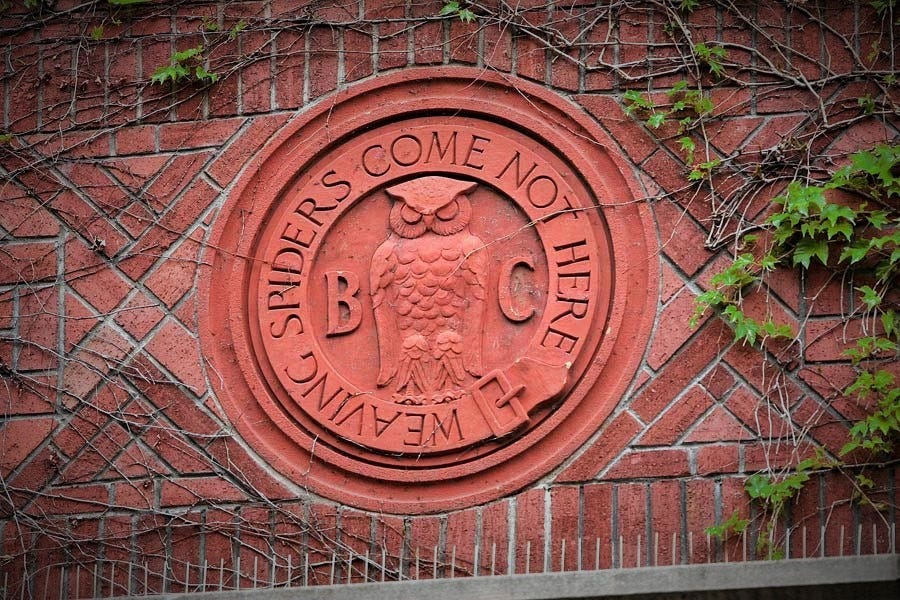
Late Night with the Devil imagines what they might be doing, melding acknowledged activities such as the Cremation of Care performances (where members symbolically celebrate the ‘salvation of the trees’ with a cathartic theatrical show) to more sinister imaginings, of which there’ve been many, given the possibilities for interpreting the group’s use of pagan imagery along decidedly sinister lines. Fun fact: the organisation’s emblem is an owl. Factor in the opportunity for networking with many of the most powerful men in society and it’s not hard to turn the whole thing on its head: they’re not there because they’re powerful, they’re powerful because they can be there. The requirement that ‘Weaving spiders come not here’ – meaning people seeking to cajole and to network should leave their ideas at the gate – seems like a big ask, and almost certainly some networking must take place in such a relaxed, intimate and private setting. So why not go further, imagining all manner of ritual activity taking place amongst the trees? If Satan can infiltrate the average American family, then of course he – or a chosen representative, as in the film – can wheedle his way into a gathering of those with serious influence. Hence the ways in which ideas about Bohemian Grove morph into The Grove during the film.
Lilly – as an unwitting messenger for the pernicious and devilish influence she brought with her from the Abraxas cult – certainly recognises Jack Delroy. In fact, she speaks to him familiarly, immediately feeling that she’s on first name terms with this man despite him being decades her senior, and reveals to him (as ‘Mr. Wriggles’) that they have already met – out amongst the trees. It’s clearly suggested that Jack has in fact been ‘weaving’, and has made unendurable sacrifices in the name of his career – a pact, one which is now coming full circle, given his grand success in the ratings. Take away all the trappings of modernity, though, and it’s the oldest trick in the book – paying the price for an ill-gotten lurch in success. The film plays it out brilliantly by melding notions of devil worship, cult activity, possession, psychical research and sacrificial magic, all against a backdrop of TV and audience figures which may not have the same hold it once did, but still means something to modern audiences. It’s old magic meets new.
James Randi and the Committee for Skeptical Enquiry
But the Seventies weren’t simply an era of blithe acceptance of magical or paranormal beliefs: as soon as a new strata of hucksters and chancers established themselves on the often lucrative fringes of mainstream belief, sceptics emerged to attempt to keep them in check. Punishing the sceptic is of course a mainstay of horror cinema, but outside of the horror genre, there were several figures very much like Carmichael Haig (Ian Bliss) who made it their business to disprove what they saw as the exploitative and heartless manipulation of often down-at-heel or grieving people, open to suggestion in ways they would never ordinarily be. Whilst there are several possible models for Carmichael Haig, however, the most likely candidate must be James Randi.
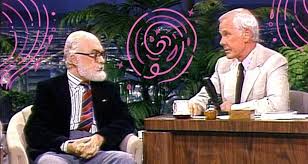
Randi – who perhaps topped his whole career by proving there’s no afterlife either, by conspicuously failing to come back to sue the Fortean Times for the scandalously unkind obituary they printed about him in 2020 – started, like Car Haig, as a magician, learning the tricks of the trade – before breaking ranks, founding the Committee for Skeptical Enquiry in 1976 and, oh, frequently appearing on The Tonight Show with Johnny Carson, in much the same capacity as Car does in Late Night with the Devil. A clever and confident man, Randi had absolutely no truck with what he saw as hokum, and so for believers in the paranormal would have come across as arrogant, but where you adjudge arrogance and confidence can be wholly subjective.
Randi (left) with Johnny Carson
Most tellingly of all, Randi’s Educational Foundation (the JREF) also kickstarted the One Million Dollar Paranormal Challenge. First offering the amount of $1000 in 1964, Randi kept on increasing the amount on offer as the decades passed, offering $1000, then $10,000 (Lexington Broadcasting added to the pot) and finally, no doubt buoyed by decades of keeping hold of the money, the final amount rose to a million. To get the money, you had to provide evidence of a supernatural ability under certain, agreed criteria; despite around a thousand people volunteering to try, the money was never won; critics of Randi have suggested that the money never existed, though considering Randi’s targeting of high-profile psychics like Sylvia Browne, it could equally suggest his certainty that no one could ever win it. Randi also had a long-running ‘challenging relationship’ with famous spoon-bender and psychic Uri Geller; a Geller-alike also features momentarily on Late Night with the Devil. To see Randi at work – often in a talk show format – click here, with the famous cheque being produced from his top pocket at 4:27. There’s also video of his appearance on The Don Lane Show, to bring things full circle. In the real world, as in the overlapping world of the film, the TV chat show is a strange place, reflecting strange times.
Of course, things never went awry for Randi as they did for Haig – to put it mildly! – but the presence of a vociferous cynic on the set of Night Owls certainly completes the time capsule, giving us the full microcosm of weird and fringe beliefs which was taking hold of the popular imagination at the time, playing them all out in a glorious and graphic series of ‘what ifs?’