Spirit Of Independence 2025: Fall To The Top

Mickey (Stephen Reilly) is a labourer who wants much more out of life. When he meets Kenny (Johnny Wilson) in a bar, he finds himself with a sideline gig of peddling drugs for gang boss Luther (Peter Hirst) but Mickey wants much more than that and, if he’s going to take risks, he’d like to be at the top of the tree rather than being thrown scraps from up on high. Does Mickey have what it takes to wipe out everyone standing in his way and fall to the top?

Once again, we’re on those mean streets of London and we’re back in gangster territory, but Fall To The Top brings a more regional flavour to the usual diet of booze, drugs, knives and shooters. It takes me right back to the shot on video stylings of Mancunian movie mogul Cliff Twemlow’s delirious 80s crime epic GBH. Yes, this one was filmed in 4K rather than VHS – affordable camera tech has moved on – but all of that decades-old grunge, grime and gumption to make something from nothing is resurrected in an all hands on deck, genuinely guerrilla filmmaking project.

Up front, I need to say this. Fall To The Top is rough around the edges and if some of its technical side happens to feel like the cast and crew were learning on the job, well, they were learning on the job. If you’re looking for the sheen and polished wisecracking of an early Guy Ritchie caper, you won’t believe your mince pies. This is scuzzy, off the cuff stuff. It also has Paul Chuckle as the fever dream version of The Terminator. You can go back and read that last sentence again to check you didn’t just have a stroke.

Given that this movie was made on a wing, a prayer, and the hope that something even vaguely coherent would be the result, the finished product does end up being more than vaguely coherent. Despite there being zero budget for elaborate action set pieces (or, indeed, zero budget for much of anything), the team behind this throw themselves into it with a great deal of heart and, although in my view the shootouts need judicious trimming, the crunchy fight sequences often land a lot better than I’d expected.

Performance wise, Reilly seems to be going for a bit of Jimmy Cagney – not a bad choice – and there’s one particular moment of violence which is a bit of an unexpected gut punch, literally. The cast is extensive and lacking in experience but hey, if you’ve got your mates involved, why not give them roles, even if the roles are to be killed off by no-nonsense criminal types? Hirst and Wilson are the standouts, the former bringing a level of quiet menace to his role as the kingpin and the latter giving a charismatic and amusing turn as the eminently practical and often exasperated Kenny.

This isn’t the kind of fare that you’d see at your local Odeon. Those brought up on a diet of studio output are going to be utterly bewildered by Fall To The Top, and that’s even before Chuckle shows up. When he does show up, as a fixer called The Jackal, it’s a delirious cameo that has to be seen to be believed. It’s his gift to you (to me, to you, to me, to you). I am never taking that line out of this review.

Lo-fi this most certainly is and the proceedings, certainly in the second half, lean less into plot diversions and more into a procession of so many folks dying that you wonder if there’ll be anyone left to sell any drugs at all by the credits. The inevitable fate of the increasingly vicious and substance addled Mickey is offset by a darkly amusing, late in the day switch which is accompanied by one act and one line of dialogue that, regardless of your thoughts on the previous carnage, ought to at least make you think that moment is nicely played.

Fall To The Top is unpolished to the point that, if you’re not into low, low budget exploitation flicks and filmmaking on the hoof, it may not chime with your idea of cinema and that’s fine. For me, there’s always something fascinating about the alchemy of just getting a movie made and screened, doubly so if it’s done with enthusiasm and not driven by the cynicism to make a quick buck out of whatever happens to be the latest trend. This could definitely benefit from another pass at the edit, but this also has more bags of coke than the final scene of Scarface, a hilariously succinct explanation of how drug trafficking works and there’s one half of Chucklevision right there, on screen, portraying an agent of chaos. If that doesn’t have you at least slightly interested, I don’t know what to tell you.

Fall To The Top featured at this year’s Spirit of Independence Film Festival in Sheffield, UK.

Spirit Of Independence 2025: Tummy Monster

Tattoo artist Tales (Lorn McDonald) is living in his place of work after being kicked out by his girlfriend. In the middle of the night, he’s awoken by a phone call from a guy called Truth (Michael Akinsulire) who represents a well-known figure who needs some new ink right now and has heard Tales is the man for the job. Having accepted the request, Tales is surprised to discover that his latest client is none other than music star of the moment Tummy (Orlando Norman) and asks for a selfie. To the chagrin of Tales, Tummy refuses, which triggers the beginning of an increasingly strange battle of wills as Tales makes it his mission to end the night with that precious selfie in his possession…

Getting to the heart of the matter in double quick time, placing the protagonists in a powder keg of a situation where both physical and mental escape turns out not to be an option, Ciaran Lyons’ film may be small in physical scale but big on ideas, interrogating masculinity itself by means of an ongoing psychological tussle between Tales and Tummy, the former taunted by the latter’s repeated, one line instruction. Tales must abide by said instruction if he has any chance of getting the coveted selfie and Tummy doesn’t appear to be budging in his commitment to challenging Tales over the course of what could be a very long day.

Initially, Tummy appears to be the laid back, softly spoken aggressor, taunting Tales with a reward he hasn’t even promised and may never actually give but as the story moves on, so does the dynamic between the pair, leaving the viewer questioning not only what the hell is going on and what may or may not transpire but also who has the genuine ego problem. Along the way, we’re introduced to the women in Tales’ complex and often disastrous love life, tellingly heard at a distance down a phone line or listened to behind a locked shutter, as is the case with recent romantic interest Shimmy (an excellent debut from Gudrun Roy) who has a lot to say about their relationship.

Tummy Monster is a film that rarely heads in obvious directions and, as such, folks waiting to see if the plot drags in violence and torture porn – which it could lazily and quite easily have done – will be thrown by the lack of claret-soaked face-offs. It’s the dialogue which does the real damage as Tales’ takes on himself and those around him are laid bare by someone at the opposite end of society’s spectrum. It’s elevated further still by a dazzling performance from McDonald, with Norman as a capable and crafty foil for the increasingly unhinged antics which unfold.

Laugh out loud funny at times, nail chewingly tense at others, Tummy Monster is an impressive, genre flipping calling card for Lyons, helming his first feature with confidence and flair. The interactions between the three leads are sharp without ever being silly, which is an achievement given the increasingly ludicrous bind Tales realises he’s in, leading to a last act which reminded me of an even better Locke and replacing concrete with someone particularly special in our (anti-)hero’s life.

Homing in on the not-exclusively – but often destructive – male drive for competition and recognition, plus the inevitable fallout which often comes with both of those, the tale hits hard when contrasting Tales and Tummy’s approaches to their creative lives and their very different views of notoriety. There’s a cautionary note of being careful what you wish for running through this, embodied by Tummy’s powerful, rueful moment of reflecting upon people not being interested in his life beyond the public persona and Tales’ griping about not being appreciated for his artistry.

Tummy Monster may initially come across as bizarre, brash and bawdy but there’s intelligence, heart and wisdom at its core. Like Tales’ cultural icon turned nemesis, there are points at which you will feel your buttons are being pushed, but that’s all part of the experience and, in my book at least, there’s nothing wrong with being tested in this way. It also winds up with a doozy of a payoff which may leave you wondering whether to spew or snort. Endlessly talky? Perhaps. Endlessly entertaining? Yes.

Tummy Monster (2024) featured at this year’s Spirit of Independence Film Festival in Sheffield, UK.

Spirit Of Independence 2025: The Quiet Ones

After the death of her father, Charlotte (Kelsey Cooke) faces a mountain of debt and the prospect of losing the fabulous holiday villa she currently resides in. Via social media, she hooks up with Danni (Sophie Ablett) who joins her in sunny Spain and the two concoct a plan to stream – and charge for – camgirl content which will hopefully generate the necessary cash to pay off the house, keep the wolves from the door and give Charlotte a happy ever after. However, they can’t do this alone and soon they’re joined by three very different online personalities in order to satiate online demand and generate a whole pile of money. What could possibly go wrong? Plenty, as you’ve probably guessed.

The tagline for The Quiet Ones is “They went viral. Then things got violent.” These two things both happen, but not in the way you might be expecting. Writer/director Nicholas Winter’s thriller, complete with an all-female cast, steers well away from the kind of material that a similarly-themed 1990s straight to video erotic thriller would have charged headlong into. If Greg Dark had taken the same story structure but focused on a bespoke VHS tape venture featuring tailored content provided by Shannon Whirry and Delia Sheppard, the BBFC would have chopped several minutes out of it before it even hit the shelves (even then, all of the rental copies would have probably been knackered after a couple of months). Here, there’s no nudity, very little bloodshed and it’s all resolutely unexploitative.

So, if you’re still with me after I’ve revealed that, does the distinct lack of sleaze make for an odd viewing experience? Actually, it doesn’t. The story is more concerned with the gradual breakdown in communication between the five women involved as the stakes are upped and an element of genuine danger comes into play. The escalating competition between Danni and first draftee Brylee (Isadora Leiva) in terms of who’s going to make the most money by the end of the month is never going to end well, with Brylee posing a serious threat to Danni’s territory and an increasingly nervous Charlotte just along for the ride.

Rounding out the five is sweet, innocent Violet (Sofia Shallai) and jet-setting Fabienne (Alina Tamara), pairing off with Danni and Brylee respectively, playing into different kinks of audience, both online and in the cinema. The fact that these archetypes are likely to annoy each other is hardly downplayed but the flashpoints don’t always lead to the expected explosion – there’s a final act for that kind of thing. That said, there’s a decent build of tension and the performances are fun, particularly Ablett and Shallai’s mismatch of a double act. Cooke is good, too, in a guarded, grounded role which means she doesn’t get to cut loose as much as her generally wilder housemates, but essays a convincing line in standing on the sidelines looking more and more concerned as things slide out of control.

The look of The Quiet Ones is impressive. The cinematography is glossy and the visual effects conjure not just the technology of this decade, but also the spirits of video games past, with fun, 8-bit style character introductions and selections. Often, there’s plenty happening on screen which mirrors the world of the influencer, but the general vibe isn’t shoved down the viewer’s throat and there’s no rush to either condone or condemn, more that this is how “reality” is now and it’s how we all deal with it.

Arguably, the payoff isn’t as strong as it could have been. The tip over into ultimately lethal behaviour is almost instant, which doesn’t allow enough time to fully take in the sudden shift. However, the final, chaotic confrontations are still fine for a few chills and the rather cold, almost throwaway ending is a nice touch. If you’re looking for unfiltered sex and violence, The Quiet Ones is going to leave you hanging, but its surprisingly chaste approach may prove a paradoxically provocative one for some. If you’re asking where all of the nudity is, it’s in those Greg Dark films. This is still an adult thriller, but not quite as we’ve previously seen the genre.

The Quiet Ones screened as part of this year’s Spirit of Independence Festival in Sheffield, UK.

Spirit Of Independence 2025: The Fog (45th Anniversary)

Having knocked it out of the park twice in a row with 1976’s Assault On Precinct 13 and 1978’s Halloween (three times if you count 1974’s Dark Star, which I do), it’s safe to say that John Carpenter had folks clamouring for his next project. For some, it was a surprise that, after the nigh on perfectly assembled shock machine which propelled Jamie Lee Curtis to S-tier scream queendom, his next project would be an atmospheric, slow burn of a ghost story.

The notices were middling, to say the least, as reviewers took aim at the plodding pace, lack of a decent villain and a piece bogged down by too many storylines. Few people hated it, but few people loved it. As the years passed, The Fog steadily garnered a cult following and, as a result, subsequent re-appraisals of the movie have been much kinder to it. It made number seventy-seven on Time Out’s 2010 list of the top one hundred horror films. Carpenter himself has a lot of affection for the film, even though it’s not his personal favourite and the desire for a redo with higher production values was one of the factors which led to the 2005 remake. So, forty-five years on, are we talking a genuine classic, or a serviceable shocker boosted by a wave of nostalgia?

Firstly, regardless of issues that could be levelled at the pacing, it’s difficult to criticise the look and feel of The Fog. The 2.35:1 format accentuates the sweep of the piece and the opportunity for the viewer to sit back and appreciate the beauty of the compositions is welcome. It may take a while for the titular, spooky weather front to hit, but its slow creep towards Antonio Bay is still good for a few jolts before the main event of the final act.

It’s possible that Carpenter is a little too in love with this world and wants you to soak up as much of the community vibe as possible rather than actually getting on with things. This doesn’t lean on the dependable tick-over of Halloween’s body count, although the occupants of a trawler are killed off early on to establish that Blake and his fellow spectral sailors on the Elizabeth Dane aren’t mucking about. The lore specifies that six must die, which admittedly puts a dampener on the proceedings for anyone expecting a climactic, no holds barred, spirits versus Antonio Bay smackdown.

Another rule governing the ghouls getting their revenge on is a restrictive murdering period of just midnight to one o’clock. This hamstrings the story in that we know there’s not going to be any additions to the roster of kills until the killing hour swings around but the script, by Carpenter and Debra Hill, mines chills and shocks from the investigations of Nick Castle (see what they did there?), played by Tom Atkins in the first of his “shag the hitchhiker and solve the mystery” double bill. Before Tom charmed the pants off Stacey Nelkin in Halloween III: Season Of The Witch, Jamie Lee Curtis – weirdly underused here as screamy, supporting object of protection that is Liz – was the one to say yes to the Atkins diet.

Perhaps the reason that some of the characters feel underwritten is that there’s so many of them fighting for space in what is generally a straightforward plot. Antonio Bay’s one hundredth anniversary celebrations are given regular focus as Kathy Williams and her capable sidekick Nancy attempt to keep the festivities on track and, to be fair, Janet Leigh and Nancy Loomis make for an engaging double act. However, switching from a nail-biting scene of a body rising from the slab and closing in on the permanently unaware Liz to the latest issue with the town’s event planning isn’t necessarily a recipe for generating tension.

It’s to Carpenter’s credit as a filmmaker that such a slim tale feels like it has far more meat on its bones and we all know that the guy can put together a suspense sequence in his sleep. This is particularly evident as Blake’s boys close in on the main players, including now iconic genre figure Stevie Wayne, the town’s DJ, played by Adrienne Barbeau. Stevie’s main crime seems to be broadcasting light jazz and big band tunes for seven hours of an evening, but the lighthouse from which she spins the platters that don’t matter is a beacon for those salty phantoms. Her scramble up to the rooftop and subsequent battle with two hook wielding attackers still cuts the mustard all these years later, as does the Night Of The Living Dead-inflected assault on the church of Hal Holbrook’s Father Malone.

Holbrook is, as always, excellent, but he’s often relegated to doling out exposition or prophesising doom for both himself and his flock. Even so, he manages to make an impact, as does the superb John Houseman, turning up in a lovely cameo to set the pre-titles table with a scary campfire story. Elsewhere, the Carpenter rep company is on below the line duty, with Charles Cyphers playing a weatherman called Dan O’Bannon (see what they did there?) and George “Buck” Flower as the seagoing Tommy Wallace (see what they did there?). Darwin Joston also shows up, relocating from Precinct 13 to play a doctor whose surname is revealed to be Phibes (!) during the end credit crawl.

Perhaps the lukewarm reception of this, both from critics and audiences, drove Carpenter to more action-heavy territory for his next movie, the peerless Escape From New York. However, there’s much to commend The Fog, most notably the visual impact of a slow moving, but nevertheless inescapable threat and a motley crew of superbly silhouetted, leprosy infected seafarers whose nightmarish visages are merely glimpsed and otherwise left to the imagination of the watcher.

In keeping with Halloween, The Fog also swerves any genuinely gory business but still manages to provide several frissons with its brief, jarring – but essentially bloodless – violence. It also lands a final, grim punchline as someone who can’t believe just how they survived the night suddenly discovers they won’t. You’ll probably see it coming just as much as the poor sod on the receiving end of something sharp doesn’t, but that doesn’t stop it from being fun.

The Fog may sometimes creak as much as the boards of the Elizabeth Dane, but there’s no denying that it still works beautifully as a compelling horror piece which refuses to wallow in blood and guts. You may not be as terrified as those early 1980s cinema goers – who themselves may have been expecting more of the unrelenting, seat grabbing tension of Halloween – but it continues to be creepy in all of the right places, backed up with another fine Carpenter synth score. To anyone reading this, look across the water, into the darkness. Look for The Fog.

The Fog (1980) screened as part of this year’s Spirit of Independence Festival in Sheffield, UK.

Spirit Of Independence 2025: Nightfall: A Paranormal Investigation

In 1988, paranormal investigators Mick Sutherland (Myles McEwen) and Archie Charlesworth (Ripley Stevens) are called to the home of one Elizabeth Blair in order to confront a series of unexplained phenomena unlike any they’ve seen in their burgeoning careers as detectives of the supernatural. Over the course of seven days, the pair will uncover the mystery surrounding this deadly force, threatening not only the bond between them but their very lives. This is Case 13.

Directed by McEwen and Stevens, who also assume various other behind the camera duties, Nightfall would initially appear to be walking in the ghostly footsteps of familiar, metaphysical thriller fare, but soon diverts into a disturbing yarn with its own offbeat style, at least for the first hour in any case. The visuals, sound design, performances and distinctive character details all work to create an eerie, sparse, unnerving world in which flamboyant jump scares are replaced by the disquieting thrum of an entity floating on the edges of reality. Although, to be fair, there’s a couple of pretty big jump scares as well.

It helps that Sutherland and Charlesworth aren’t your usual travellers into the unknown, as they awkwardly trudge around haunted locales, possessing more of a kinship with the spirit world than the flesh and blood humans they occasionally need to question. The contrast between them is stark, too. Sutherland is logical, rational, organised. Charlesworth is a clairvoyant who’s thoroughly uncommunicative in normal conversation, but possesses the gift/curse of being able to speak in a psychic language, hearing messages from the other side, few of them good. It’s a far cry from, say, the multiplex-friendly, retro glamour of the Warrens in the Conjuring movies and there’s a fascinating dynamic between our two heroes which holds the interest far beyond the creaking doors and flickering lamps.

McEwen is also on writing, cinematography and editing duties, so do those multi-hyphenate tendencies have a detrimental effect on any department? Not at all. Nightfall is crisply cut together, mixing not only various grades of footage but possessing both a cinematic and a documentary eye for detail, contrasting the beautiful and the mundane. The screenplay throws in some reliable touchstones, but the proceedings never feel as if there must be a seat-grabbing shock every ten minutes.

The introduction of a countdown, with the main thrust of the tale dropping the viewer into Case 13 a week before the confrontation which truly stamped their career cards, may immediately give rise to thoughts of wanting to get to the denouement, but the detours are strange, engagingly creepy and give the necessary depth to our occasionally dynamic duo. A deftly curated soundtrack, ranging from a sweet but, in this situation, ominous choral piece through to sampled scratches of dialogue and industrial buzzing serves to maintain the level of discomfort.

The final quarter of an hour does ditch some of the more esoteric stylings for some good old creeping around a dark house and waiting for the next noise to ring out, but even that hackneyed found footage staple seems fresher and more chilling here. Perhaps that’s down to the overriding lack of hyperbole in the piece and a pair of protagonists whose vulnerability ramps up the concern of the audience, particularly during a moment when Mick realises that they’re in genuine danger and may be hopelessly out of their depth.

If the climax leans into more recognisable genre beats, including a smash to black as all hell breaks loose, Nightfall pulls the rug again, switching to an enigmatic closer which may thwart those weaned on the “jump/scream/credits” triumvirate but fits the eldritch template of this project perfectly. The unwillingness to spell everything out – or, at some points, spell almost nothing out whatsoever – gives the film its curious power. Without the budget for huge, destructive set pieces or CGI spirits from the other side, Nightfall trusts in imagination and atmosphere to make the watcher glance anxiously behind them. For a good proportion of its eighty minutes, it succeeds and I hope that this isn’t the last we’ve seen of Mick and Archie, or indeed Myles McEwen and Ripley Stevens.

Nightfall: A Paranormal Investigation screened at this year’s Spirit of Independence Festival in Sheffield, UK. For more details, check them out on Instagram.

FrightFest 2025: Pig Hill

“Towns like Meadville haunt you.”

So goes an early voiceover by Carrie (Rainey Qualley), who is working on a book about the local legend of Pig Hill, centred around mutant, porcine creatures who are supposedly responsible for a string of young women going missing. We’ve already seen the latest of these disappearances in the cold open, in which a couple foolishly heads to the titular area for a romantic detour that turns bloody rather quickly.

Carrie is putting her life together after splitting from husband Ben, a matter which is further complicated by the fact that Carrie’s brother Chris (Shiloh Fernandez) happens to be Ben’s business partner. Chris is protective of his little sister, driving her to and from the women’s shelter at which Carrie volunteers, the latest arrival being the pregnant Paula (Isabella Brenza) who claims have escaped Pig Hill but now has a pig baby inside her…

Kevin Lewis previously helmed Willy’s Wonderland, a movie I didn’t get on with. However, none of my criticisms were anything to do with the direction and, working from a twisty Jarrod Burris script and with agreeable contributions from a solid cast, this one held my interest far more than Nic Cage versus animatronic enemies. If you were wondering, Rainey Qualley is Margaret’s sister, both the family resemblance and acting chops being present.

Starting out like a slasher film, moving into smalltown drama before launching into creepy investigation thriller, then taking a swerve towards grimy kidnapping fare and finally landing in depraved, psychological trauma, Pig Hill is nothing if not ambitious in its mixing of genre and tone.

It’s based on a novel by Nancy Williams and this may be a major reason that it’s more focused on its main protagonists than many stories of this type would be, playing out extended scenes between either Carrie and Chris or Carrie and recently returned Andy (Shane West), their initial catch-up at a bar introducing a spritz of will they/won’t they romance to the already loaded genre cocktail. Andy, surprise, has his own predictably tragic backstory, but West is more than personable enough to make the gruesome but also faintly ridiculous tale work and there’s an accurately awkward chemistry with Qualley which makes them a fun pairing.

Meadville proves to be a supporting character itself, full of folks attempting to get by but restricted by both the limitations of opportunity and, of course, the possibility that human/pig hybrids are waiting to pluck them out of the night. Jeff Monahan’s shabby, strange but well-meaning Reggie and R. A. Mihailoff’s unhinged Red offer both ends of the Meadville oddball spectrum. Mihailoff, also on producing duties, provides most of the first half’s obvious (too obvious?) suspect activity, bolstered by the fact that he also played Leatherface in the third instalment of that franchise.

For anyone expecting a sizeable body count, Pig Hill is more concerned with delving into the central mystery than just piling up corpses. However, there are a handful of moments which are startingly, unrelentingly nasty and will disturb those looking for a clue-laden crime tale and violence which is more of the suggested kind. Anyone in a queasy mood by around the seventy five minute mark is likely to get the full-blown ick, which in itself is a bold move, but leaves the viewer with an unpleasant taste, regardless of Qualley’s terrific work in that climax.

If anything, there’s too much going on Pig Hill for some of it to land properly and the tonal lurches may ultimately lose the audience, which would be a shame because, overall, this is a curious mix of storytelling styles that is worth sticking with if you have a strong constitution. At one point, there’s some skulking around accompanied with some amusing, Scooby Doo style nervy humour which leads to a bloody fight and ends up someone getting a cleaver embedded in the back of their head. If you’re good with that switch in mood, the rest of this movie should keep you gripped. For everyone else, look away immediately after the line “I told you to kill it.”

Pig Hill may veer off in too many directions to result in a piece of work that’s fully coherent, but I can’t fault the keenness of the filmmakers in their desire to confound the expectations of those watching it. It’s a mix of the sweet and the sadistic, the puzzling and the perverse. The swings taken are admirable, but they also may be the reason that you may be left wondering who it was made for.

Pig Hill (2025) featured at this year’s London FrightFest.

Séance (2024)

1892. California. It’s then and there we find novelist Emma Strand (Scottie Thompson) holidaying with artist husband Albert (Connor Paolo) and doing their best to enjoy a day on the beach when they meet George Ford (Jilon VanOver) and his wife Lillian (Vivian Kerr). After a mannered and somewhat awkward chat, the four end up at the house of the Fords for dinner, despite the fact there’s a storm brewing, both figuratively and literally.

Putting these four people under one roof is hardly the best of ideas for any number of reasons. Emma and Albert’s marriage appears to be under some strain. George just happens to be Emma’s previous husband and there’s a definite spark between them. To top off this most testing of evenings, Lillian suggests holding a séance in order to communicate with their daughter Hazel, who has recently passed away. Not wanting to agitate the fragile Lillian, the rest agree. Now, what’s going on with those creepy looking dolls and unexplained noises around the place?

Taking its inspiration from a play by August Strindberg, Séance’s limited locations, small cast and emphasis on interpersonal interaction over generic horror action could easily be adapted for that particular arena but director/writer/performer Kerr’s flair for a dimly lit, nighttime wander around a shadowy Victorian mansion or a woozy, tragic flashback plant this firmly in the realm of the cinematic experience.

For a movie which such a title, the actual séance doesn’t occur until over a half hour into the movie and it’s over in a few minutes. However, the brittle connection between the foursome and the unfailing politeness of Victorian society paves the way for the ritual, then informs the behaviour of the increasingly fraught four afterwards as the puzzle deepens. Does the spirit of Hazel still reside in the house, as Lillian believes?

The fact that Séance doesn’t behave like your average haunted house movie, nor does it even attempt to scare the audience out of its wits, may prove an issue with those who expect the level of unease generated by such titles as The Haunting. There are a couple of jump scares, but there’s a feeling they’re included just to keep the viewer on their toes and supply genre nods as a reward for sticking with the tangled relationship drama and character development.

For me, the tangled relationship drama and character development is what sets Kerr’s film apart from the pack. The pacing is deliberate, the reveals controlled, the atmosphere charged with potential peril. All four protagonists are given the time to show themselves, every one of them painted in realistic shades of grey, making decisions which will raise questions as to their motives and possible involvement in the mystery.

Make no mistake, everyone on screen is doing great work here, but special mention must go to the superb Scottie Thompson. It’s almost impossible to take your eyes off her when she’s part of a scene, her face a picture of female strength in a patriarchal society but hinting at the turmoil under that surface. In many ways, she’s the de facto heroine of the piece, but she’s also thinking about leaving husband number two for ex-husband number one.

Kerr’s Lillian is initially presented as the bereaved, psychologically damaged archetype but this, like so much of the film, is also something of a front as we discover the details of her personality and her marriage to George. Speaking of George, VanOver is emblematic of the wealthy men of that era – gregarious and willing to provide, but also unable to fully come to terms with modern, self-sufficient women such as Emma whilst still desiring them. As for Paolo, his Albert is a mess of suppressed emotion and wouldn’t hurt a fly – or would he?

The final act amplifies both the Gothic melodrama and the horror but, once again, it’s on Séance’s own terms, swerving the gore and the screaming to interrogate a matter that’s unfortunately as prevalent today as it was back then, forcing the characters and the watcher to re-evaluate their positions in this strange story. The payoff is measured but satisfying and even if the final shot introduces one last chill that’s arguably unnecessary, it did make me smile.

Séance may not play to the jump scare crowd but if you’re looking for unhurried, intriguing development of well-defined, realistically flawed characters battling both the supernatural and the stifling moral code of the time, this is a wonderful way to spend eighty five minutes. The production design is attractive, the writing is sharp, the cast is exemplary. Vivian Kerr has crafted an uncommonly absorbing horror tale with intelligence and heart.

Fantasia 2025: Hotel Acropole

Rivka (Judith Zins) checks into the titular accommodation, accompanied by an urn containing the ashes of her partner Hugo. She’s also carrying Hugo’s baby and a deep, painful wound on her back which has refused to heal in the wake of Hugo’s passing, Having been advised to isolate herself from those around her, she plans an evening of solitude until Abel (Sébastien Houbani), a face from her past, shows up unexpectedly at her window and she allows him into the room…

Written and directed by Sarah Lasry, Hotel Acropole is an often artful two hander which explores love, loss, regret and manages to walk the line between erotica and body horror all in its twenty minutes. The dialogue may occasionally sail close to being too on the nose, but there’s a shorthand at work which needs to deal with unresolved issues between our two protagonists, the fallout of a love triangle and the mystery surrounding Rivka’s lengthy lesion, a glistening, seeping marvel of FX from David Scherer.

Short on runtime doesn’t mean short on emotion and Lasry knows when to hold a look for an extra second or emphasise a pregnant (yes, apologies for the pun) pause. If the set-up of two old acquaintances skirting around an obvious elephant in the room seems familiar, it is. Knowing glances, loaded sentences. You’ve been here before. And yet, there’s a precision about Lasry’s eye for the setting and the interactions between her leads which means you haven’t.

The quality of the performances from Zins and Houbani, coupled with the uncommon intensity of the overall atmosphere, elevates this unusual relationship mini-drama further even before it unveils a sequence of Cronenberg-esque sexy/gross strangeness as the launching point for the payoff. Elsewhere, this might feel like a cheap shot to haul in some genre credibility, but Hotel Acropole has built specifically towards this and, even if you can feel your gorge rising, there’s an acceptance and an inevitability as to how this story will play out.

After the initial dose of obfuscation and with key details about all of the characters – dead or alive – shrouded in doubt, it’s a surprise that the resolution of Hotel Acropole is, in many ways, a straightforward one. The burden of Rivka’s grief and her guilt about the past is complex and murky but the potential route through is signposted along the way and isn’t there just to provide closure in this contained environment.

Could Hotel Acropole be expanded into a feature? No doubt. There’s enough of the unexplored in Rivka, Abel and the offscreen, oft mentioned Hugo’s backgrounds to flesh out these people and supply yet more intrigue. As it stands, this exquisitely presented package, gorgeously framed by cinematographer Manuel Bolaños, gets to the heart of the matter in fleet fashion and leaves you with at least one image which won’t be leaving your mind in a hurry.

Hotel Acropole (2025) received its world premiere at the Fantasia International Film Festival on 27th July.

Fantasia 2025: Lucid

Mia (Caitlin Acken Taylor) is an art student who doesn’t think much of herself as an artist and, unfortunately, this viewpoint appears to extend to not only the others in her class but also her professor, who thinks her work is full of clichés and needs to push past her many creative blocks. Given a deadline of one week to produce “something with heart” or be kicked off the course, Mia looks for a source of inspiration and potentially finds one during a visit to local psychic and witchy type Syd (Mackenzie Lemire), who provides Mia with Lucid, a special candy which, in small doses, should open Mia’s mind and pave the way for her creative expression to flourish. Just one rule: Don’t overdo it. Which, of course, the headstrong Mia ignores almost immediately…

Described as “punk rock body horror” and a “coming of monster story,” Lucid has those things but if you’re expecting a Cronenbergian take, think again as the body horror and monster elements sit reasonably far back in the mix. It’s more of a commentary on art, music, individuality and confronting the demons of the past, all wrapped in writing/directing duo Deanna Milligan and Ramsey Fendall’s experimental style.

That could be my way of saying that you might find this too self-consciously DIY, with its jumps back and forth between 35mm and 16mm formats, intrusive bursts of noise, mixes of live action and animation and frequent trips to a club to sample various musical numbers – which I loved, by the way, but that’s one of the reasons this runs to a hundred and nine minutes and there could be moments along the way where you’re tempted to jump into the screen and tell Mia she really needs to be getting on with her project.

However, it’s this refusal to rush into any sort of decisive action and leave Mia drifting for much of the time that gives Lucid its singular approach. The loose narrative and various digressions also allow space for lead performer Caitlin Acken Taylor to cut loose with a mesmerising and occasionally ferocious central performance.

Splattered with paint and dressing to impress absolutely no one for a decent chunk of the tale, she portrays both the aesthetic and the frustration of the creative type with authenticity, eschewing the manic pixie, easel cradling, dream girl of something dreadful like She’s All That (thank you for giving me a reason to air how much I detest that) and being unafraid making Mia someone who’s not always easy to like. She treats those around her like crap. She lashes out constantly. She steals from the till at work. And yet, there’s always that wish for Mia to truly find herself, despite herself.

The supporting cast might be a little overstuffed, but there are a number of players who ensure their limited screen time counts, chiefly Lemire, whose Syd is sassy, worldly and advises Mia with an unconcealed streak of irritation that’s highly amusing. The Greek chorus of Mia’s classmates is arguably underused but Lucid is a film which, similar to Mia’s artistic journey, plumbs the depths in search of a number of disparate ideas which don’t always bubble to the surface as they should.

As a debut feature, there’s often a drive to include as many concepts as possible and Lucid often has so much going on that the main plot becomes mired. However, I’d rather a movie has so many thoughts it doesn’t always know what to do with them all and, although I previously mentioned that the monster work isn’t front and centre, the creature is brilliantly realised, steering away from the usual gloopy, drooling, toothy terror to intrigue and unnerve in a very different way.

As a piece of art, Lucid has a particular vision and it’s clear that it’s in no way pandering to the crowd. Visually it’s arresting and occasionally startling; narratively you may need it to get to the point more quickly than it does, but there’s no denying that Milligan and Fendall have made this in exactly the way they wanted. It might flirt with pretension, but this is staved off by the amusing digs at the art world. The musical numbers may feel like unnecessary detours but they enrich the world building and provide a haunting undercurrent to the final act. The symbolism may feel obvious, but then swings to arcane. If you don’t know art but you know what you like, this might drive you to distraction. Even so, it’s a fascinating experience. I’m not going to say you’ll love it – there’s a decent chance you won’t – but you’ll feel that behind it all, there’s a will to create something memorable.

Lucid (2025) received its world premiere at the Fantasia Film Festival on 22nd July.

Raindance 2025: Dirty Boy

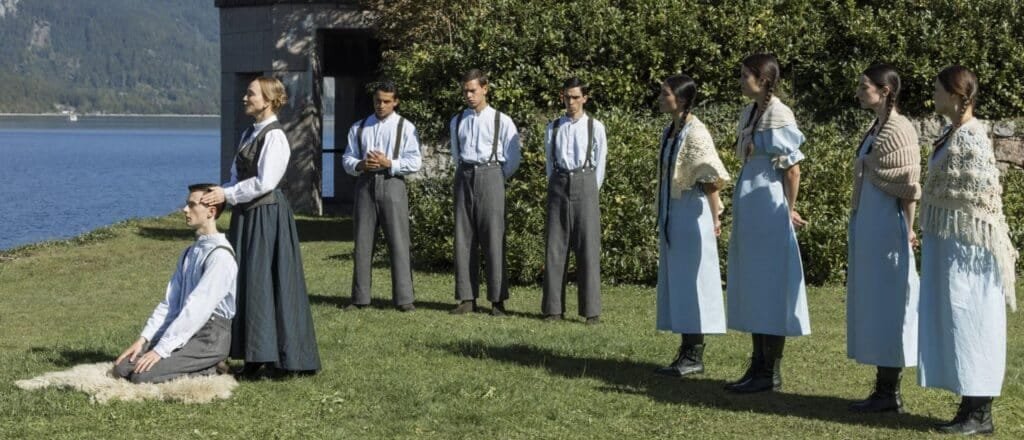
In the early moments of Dirty Boy, the voiceover of the main character of Isaac (Stan Steinbichler) informs the audience that “Your mind is a bus.” In Isaac’s case, it’s hard to tell who’s at the wheel at any one time, as he’s been raised to obey the strict teaching of a religious cult headed by the fearsome Walter Wentworth (Graham McTavish) and his wife Verity (Susie Porter). In addition, Isaac’s schizophrenia has led to him going off the range both figuratively and literally, leading to various periods of time in isolation to contemplate his actions.

Isaac believes he is becoming a burden to those around him and with frequent visits to the unorthodox Dr. Cronin (Olivia Chenery) at the First Rural Asylum For The Unfortunate doing little to help, he plots an escape. However, with a revelation that the cult may be about to frame him for a serious of ritualistic murders, is his best chance to destroy the whole thing from within and save their next potential victim?

Writer/director Doug Rao takes a familiar horror setting and immediately skews it, the unreliable narration keeping the viewer on their toes as to just what exactly is going on. Ostensibly, Isaac is the hero of the piece but we’re also fed information – sometimes by the Wentworths, sometimes by Isaac’s filter-free alter ego Frankie The Dragon – that our troubled protagonist has done some terrible things in his time, which makes it tricky for those attempting to identify a character for which to truly root.

The religious trappings also extend to the structure of the story, split into chapters with titles such as Genesis, and there are dire consequences to anyone who ignores Walter’s twisted rules as to what his flock shalt or shalt not do. It’s not a huge surprise to learn that the patriarch of the group is a wrong ‘un and his own predilections, justified by his own fervent belief that he has been chosen to grow his flock, both give the movie’s title an extra spin and push the proceedings into yet more disturbing territory. However, in those moments, Rao chooses to suggest rather than force the audience into an explicit endurance test, which is a welcome decision.

McTavish has described Dirty Boy as “the bastard offspring of The Sound Of Music” and he’s pretty much on the money, with the Wentworth clan enjoying a good old singalong in picturesque Austrian locations before forcing one of their number to drink an entire bottle of apple cider vinegar in order to cleanse their impure thoughts. As for Walter, he may not be on screen for the longest time but his deliberate delivery of dialogue and unnerving calmness is one of the film’s strongest suits.

As the lead, Steinbichler has to get to grips with an extremely complex character whose outward sweetness and awkwardness conceals a heart of darkness – or does it? It’s a bold performance and he handles both the dramatic and the queasily comedic which a surefootedness that consistently engages. Isaac may not be a role model, but there’s an empathy inherent in his plight and there’s a fascination as to how he’s going to react next, honourably or otherwise.

As a parable of how evil is allowed to run rampant under the cover of religion, Dirty Boy isn’t unique in that field, but Rao’s visual flair and a knack for the unsettling lift it above the norm. If anything, there are too many ideas struggling for space and Isaac’s one ally Hope (see what they did there?), played by an excellent but underused Honor Gillies, is almost lost in the shuffle but it’s the overarching ambition and the refusal to allow the viewer time to breathe which impresses.

The shifts into the darkest of humour may be too extreme for some and the main Chenery/Steinbichler vignette could easily be a glimpse into a totally separate movie, but the parameters of this very weird world are able to bend without breaking. This is also evident in the climax which, although opting for a more recognisable type of resolution, heads off somewhere else and casually drops in a final, amusingly disturbing kicker. Dirty Boy may not always land correctly, but it takes a number of pleasingly big jumps and Doug Rao is definitely one to keep an eye on.

Dirty Boy (2024) featured at this year’s Raindance Film Festival.

Raindance 2025: If You Should Leave Before Me

Mark (Shane P. Allen) and Joshua (John Wilcox) are a married couple whose loving relationship has come under recent stress due to a tragic event. Despite the fact that a wedge has clearly been driven between them, they choose to focus instead on their work, which is to guide recently deceased souls into the afterlife. However, at some point, the couple is going to be forced to address the elephant in the room…

Written and directed by The Andersons (Boyd and J. Markus), If You Should Leave Before Me (2025) takes its slightly outlandish and episodic premise to investigate the joy, sadness and fragility of existence itself with a warm sense of humour and a naturalistic approach to the many ways we try to cope with death. Only in this case, it’s mostly folks trying to come to terms with their own death, aided and occasionally abetted by Mark and Joshua.

Set in the home of our main characters, the introduction of their unwitting – and often unwilling – customers is innovative, as each new challenge arrives in the shape of a door which appears and then leads them to a very specific area, which is designed according to the life of the person who has passed. For instance, the initial onscreen encounter with a woman called Bonnie takes place in “budget Narnia,” which appears to be both a glimpse into Bonnie’s headspace and a sly comment on the indie constraints the movie is working within.

This fantasy drama possesses the structure of an anthology movie as our intrepid duo find themselves in different stories which require them to discover the essence of their latest subject and overcome fear and obstacles in order to steer them towards the light. As with life itself, some of these assignments are relatively straightforward, but some take far longer than expected and so the normal “there’ll be another segment in fifteen minutes” expectation of that subgenre is subverted. Those side quests overlap, particularly when it comes to an obstructive, homophobic German called Gunter who’s immediately dubbed “Nazi Man” by an annoyed Joshua. I should mention Tom Noga’s work as Gunter, a seemingly dreadful bigot at first glance, but with far more going on under the surface.

The early rifts in both the visuals and the day to day verbal sparring between Mark and Joshua hint strongly at what’s wrong between the two of them and the early reveal of that is welcome, as the resulting fallout pushes the second half of the movie into potentially devastating emotional territory while keeping the framing device intact, causing the pair to confront the issues they’ve been so politely trying to avoid.

The inclusion of a malign presence which attempts to tear our protagonists from their world and into the next gives If You Should Leave Before Me a horror-adjacent edge, but terror fans should temper their expectations accordingly. This is a romantic and comedic tale first and foremost, albeit with a sure grasp on its willingness to hop into unexpected genre territory. The martial arts action sequence is a delight, a deliberately mannered and increasingly bloody scrap that would jar in most circumstances, but fits the “anything goes” ethos of this film perfectly.

In the two central roles, Allen and Wilcox complement each other wonderfully, the former with his measured, reflective methods and the latter’s more effusive, heart on his sleeve approach to life. I began their journey with slight puzzlement at how they ended up together, but the story and performances paint in those crucial details as to what makes a union tick and as the piece moves into its last act my feeling was “Of course they’re together, they’re perfect for each other.”

If You Should Leave Before Me is something of an oddity, of that there’s little doubt, but its peculiarity won me over instantly and the sadness which always lurks in the background, ready to undercut those moments of pure joy, hits hard. This is the point of the review where I will freely admit that I had to pause the screener at just before the hour and a quarter mark to have a cry. At almost two hours on the dot, the pace may occasionally be a tad too leisurely, but The Andersons’ uncommon examination of love and loss is frequently charming, occasionally overwhelming and I loved it.

If You Should Leave Before Me (2025) featured at this year’s Raindance Film Festival on 21st June.