It’s interesting how accounts of the later years of Hammer Films can vary according to the tastes of the writer. Some will sigh in resignation at how the once great company lost its way as the times changed; others, such as myself whose early horror education largely consisted of films from that era, look back on it as a wonderful period, even if it did mark the end of Hammer as we knew it (I think it’s fair to say the recently resurrected brand is pretty far removed from what once was). Others might not even know or care much about Hammer at all: I heartily recommend these people track down The Curse of Frankenstein and Dracula (or, depending on where you live, Horror of Dracula) post-haste and work your up way from there, because you don’t know what you’re missing.
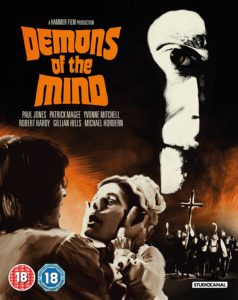 Wherever you land on the subject of Hammer, 1972’s Demons of the Mind will likely inspire at least a degree of bewilderment. It’s one of four Hammer movies that Studiocanal are releasing in dual format DVD/Blu-ray at the end of this month, along with Blood from the Mummy’s Tomb, Scars of Dracula and Fear in the Night; I was particularly drawn to Demons of the Mind as it was one I’d neither seen, nor heard a great deal about. Indeed, while it’s a Hammer production it seems to be largely the work of people who hadn’t worked with the company beforehand, and in many instances didn’t again; and while it has the standard non-specific 19th century countryside setting with Hammer’s favoured location Black Park near Uxbridge used for the bulk of the outdoor scenes, in terms of genre it’s not that easy to pin down. We might say that, rather than the standard Gothic horror that Hammer have always been known and loved for, Demons of the Mind was more of an attempt at Gothic melodrama, stripping away the supernatural elements in favour of a more warts-and-all treatment of the kind of sordid and sinister subject matter that ghosts and monsters have always been used to symbolise: in this instance, homicidal mania and incestuous desire.
We open on Elizabeth (Gillian Hills), a beautiful young blonde-haired woman in a diaphanous white nightgown, sitting in a horse-drawn carriage. So far, so Hammer. However, as a matronly older woman (Yvonne Mitchell) pulls her hand away from the window and tells her everything’s going to be alright once she’s back home, things immediately feel a bit off. The young lady seems catatonic. A wordless flashback montage ensues; we see her wandering in the woods, being taken aback by a young male stranger who she later takes as her lover (70s Hammer, after all); but then she’s back at her home, naturally a brooding Gothic mansion, with a father (Robert Hardy) who seems just a little too pleased to have her home, and a brother (Shane Briant) who seems even less emotionally stable than she is, and also displays concern for his sibling which seems more than fraternal. It transpires that the father, Baron Zorn, fears for the minds of his children, believing a curse is upon them following the suicide of his wife many years earlier. To this end, he brings a supposed specialist in the mind, Falkenberg (Patrick Magee), into his home to help cure their ailments via his somewhat experimental techniques. However, it may be too little too late, as a series of murders have occurred in the village, some of the victims being young women close to Elizabeth in appearance; and the villagers, not without reason, suspect the mad Baron and his children are to blame.
I was fascinated to learn from the newly-produced featurette on the Blu-ray that producer/story writer Frank Godwin originally pitched Demons of the Mind to Hammer as a werewolf movie, yet it was at the insistence of Hammer themselves that the monster element was removed. This I find fairly astonishing, as one would think a werewolf movie would be a considerably easier sell; and, indeed, it’s little surprise to learn that Demons of the Mind died a death at the box office, not least because distributor EMI didn’t have a clue what to do with it. Even in their grislier, skin-heavy early 70s days, there’s always been a certain homeliness to Hammer, at least in part because you tend to know what you’re getting when the lights go down; but in this instance, it’s really hard to predict where things are going from scene to scene. For some this may make for a more rewarding experience, but those with a particular fondness for the standard Hammer formula might be put off. Another interesting side note: the mansion setting was used that same year in Sergio Martino’s All the Colours of the Dark, which leads me to ponder whether, beyond Hammer’s standard Germanic period setting, Demons of the Mind might be closer to a Giallo in terms of narrative and theme. (Or maybe I’m stretching there. Anyway, John Hough later shot The Legend of Hell House there too, so however you cut it, it’s a great backdrop for people going nuts.)
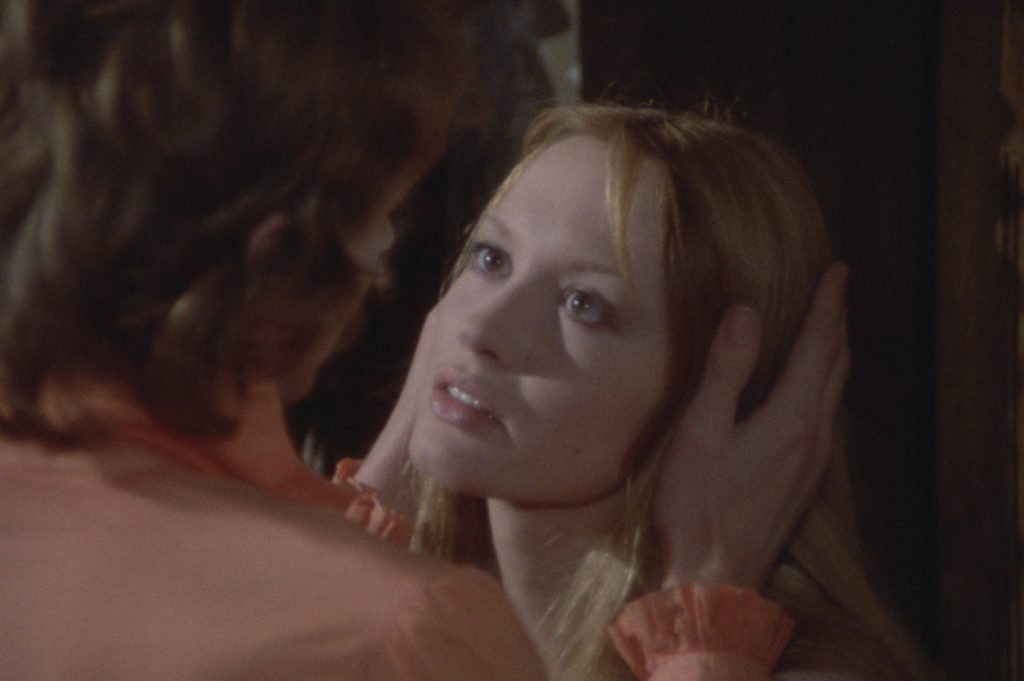 Demons of the Mind is also one of the few Hammer movies that’s genuinely quite startling even now in terms of content. While the levels of female nudity were fairly standard for the company by this point, the blend of the sexual and homicidal impulse – a touch and go area to this day, particularly when it comes to the censors – is presented in a surprisingly forthright manner, as is the incest. The portrayal of the very early methods of psychiatric ‘care’ are fairly unsettling, not least a scene of exsanguination. We also have some of the most lurid, gruesome murders ever featured in a Hammer horror, some of which wouldn’t have felt out of place in a slasher movie a decade or so down the line. This, it seems safe to say, was Hammer doing their best to move with the times, as might be reflected by the hiring of a relatively hip cast (Hills, Magee and Virginia Wetherell had come straight from A Clockwork Orange; would-be romantic hero Paul Jones was formerly of pop group Manfred Mann), and a young, largely untested director in Peter Sykes (who would later helm Hammer’s last theatrical horror movie, 1976’s To The Devil A Daughter).
Any way you cut it, Demons of the Mind clearly does a better job presenting a more modern brand of horror than the same year’s Dracula AD 1972 – and I say that as someone with an unshakeable affection for that camp and corny schlocker. If, like me, you’re a Hammer fan who’s missed this one up to now, take this opportunity to make amends. It’s not your standard Hammer, but in this instance that really isn’t a bad thing at all.
Demons of the Mind is released in dual format DVD and Blu-ray on 30th October, from Studiocanal.

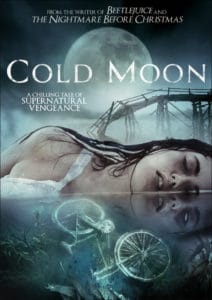 I’ll admit straight away to being completely unfamiliar with McDowell’s novel, but it’s no surprise that the film has literary beginnings, as the whole set-up screams paperback potboiler. Our setting is Babylon, a small town in Florida, and as the story takes place in the 1980s it’s naturally a place that sees the working class citizens struggle whilst the wealthy thrive. Among those hit the hardest are the Larkins, a grandmother and her two grandchildren who are struggling to keep their humble fruit farm from going under; whilst at the opposite end of the ladder, the affluent Redfields, owners of the local bank, don’t seem too concerned with helping out the little guy. However, worries about money soon fade into the background for Evelyn Larkin (Candy Clark, recently seen in Twin Peaks) and her grandson Jerry (Chester Rushing, the high school douchebag in Stranger Things), when Jerry’s younger sister doesn’t come home after school – and not long thereafter is found dead in the river. Sheriff Ted Hale (Frank ‘check out the big brain on Brett’ Whaley) is soon on the case, and a hysterical Evelyn is convinced that the sleazy Nathan Redfield (Josh Stewart) is responsible. But of course, this first death is just the tip of the iceberg.
 It’s easy to assume going in, as I did, that Berlin Syndrome is setting itself up as another breakneck survivalist thriller in which a terrified but resourceful woman fights off a psychotic predatory male, along the lines of Red Eye or P2. However, while there are certainly aspects of that here, Berlin Syndrome has something rather different in mind. First off, after a spot of Googling I think I can safely assume the title does not in any way refer to the actual condition of Berlin syndrome (apparently some kind of
 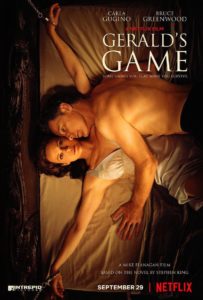 Jessie (Carla Gugino) is taken by her husband Gerald (Bruce Greenwood) up to their idyllic, remote holiday home by a lake. The plan, it seems, is for the couple to get away from the hustle and bustle of their metropolitan lives and spend some real quality time alone. Of course, this doesn’t mean they intend to walk on the beach and be one with nature or any of that nonsense; nope, this means the plan is to rekindle the flames of carnal desire between the two of them. And in his advancing years, it seems Gerald needs a little bit extra to rev his engine these days, not just in the form of Viagra (not an aspect of King’s 1992 novel, obviously as it wasn’t a thing just yet), but also by playing a bit of kinky role play and bondage with his apparently willing wife. For this special occasion, Gerald’s gone all out, advancing from the classic silk scarves to bona fide police grade handcuffs with which he restrains Jessie on the bed. However, as the game begins, it quickly becomes clear that Jessie isn’t comfortable, and the ensuing argument ends in the worst possible way: Gerald is suddenly struck down by a massive heart attack, and drops dead, leaving Jessie trapped, with seemingly no means of escape, and no neighbours for miles around – with the exception of one hungry-looking stray dog.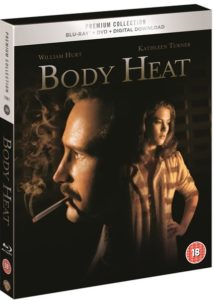
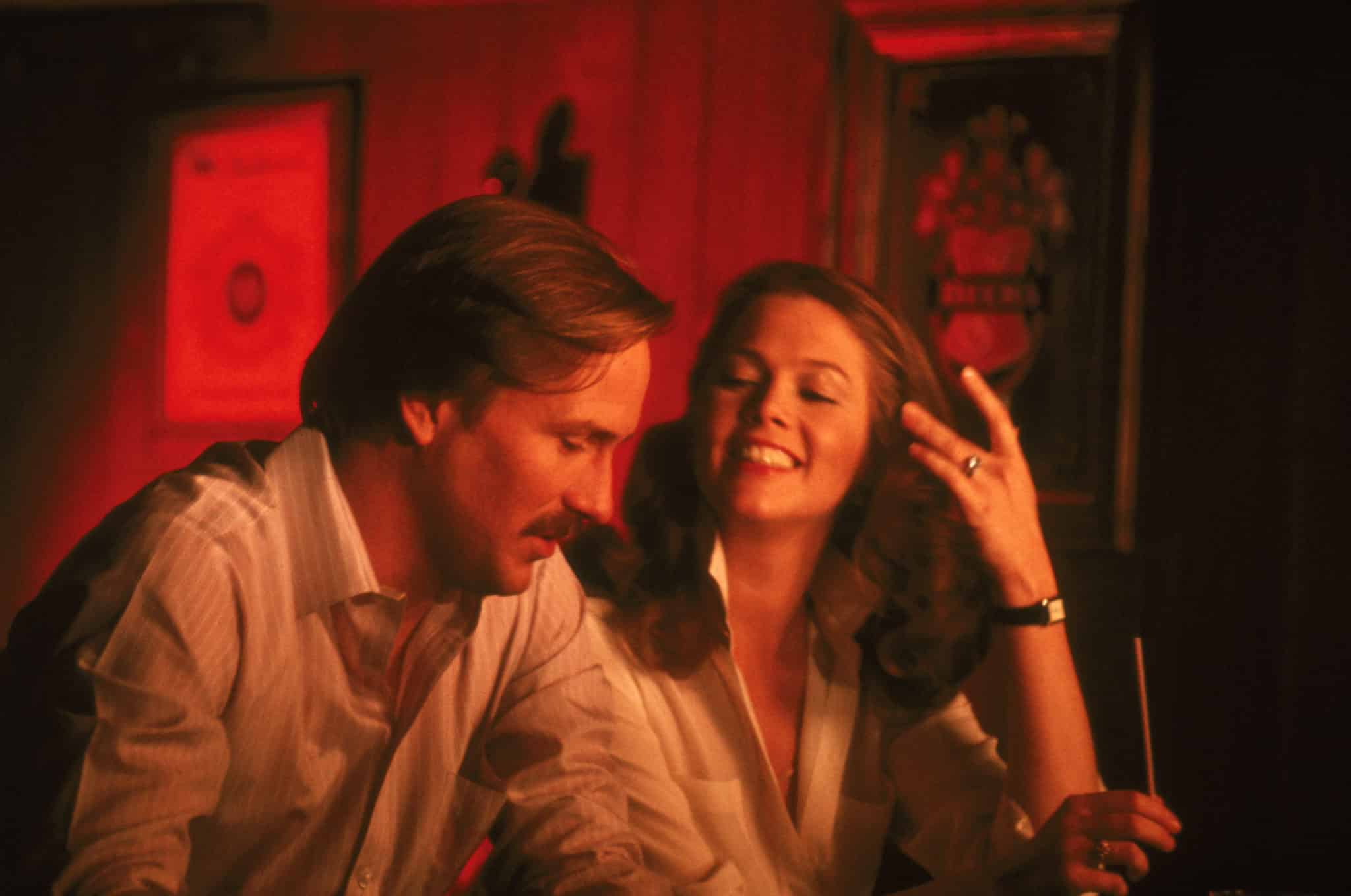 As terrific a launchpad as Body Heat proved for its director and lead actors, it doesn’t short-change its supporting cast either. It’s curious now to see Ted Danson, who I think it’s fair to say went on to become a much bigger heart-throb than Hurt off the back of Cheers, cast as a weirder, geekier guy in horn-rimmed glasses with a habit for breaking out in impromptu tap-dance routines. While very much playing third fiddle as Hurt’s fellow lawyer buddy, he gets quite the interesting journey of his own to go on, particularly as the drama builds and he and their mutual cop friend JA Preston (another great supporting turn) come to suspect their pal of foul play. I found it particularly striking that Mickey Rourke also gets a supporting role, given that actor would later play a key role in the commercial rise and artistic plummet of the erotic movie via tripe like the aforementioned
 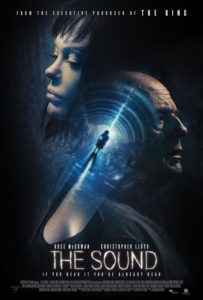 McGowan is Kelly Johansen, and when we meet her pulling up to a remote farmhouse on a dark and eerie night, it initially appears she’s some sort of parapsychologist, called in to investigate a ghost sighting reported by the homeowners. However, once she sets up her laptop and microphone and starts live tweeting the event with the use of some rather snarky hashtags (#notscared, and the like), it becomes clear that, rather than being a ghost hunter, Kelly’s a professional debunker, who goes about identifying the scientific explanation for supposed supernatural phenomena, on the strength of which she can confidently state out loud, “there is no such thing as ghosts.” Of course, Rose McGowan was in Scream, and as such she – and we – clearly understand that to make such a bold declaration is the equivalent of “I’ll be right back.” Sure enough, just as she’s publishing a blog entry on her latest triumphant debunk, she gets a message asking her to come and check out an alleged haunting in an abandoned Toronto subway station where, some years earlier, a woman committed suicide under a train. Seemingly fearless, carrying her fancy laptop but no immediately apparent forms of protection, Kelly darts over to Toronto, disregards the ‘no entry’ signs, and heads on down into the dark, dingy, spooky old tunnels. Here she’ll meet an amiable but enigmatic old janitor (Lloyd, not on screen nearly as much as his billing would imply) and a somewhat intense local cop (Michael Eklund), and – wouldn’t you know it – see her preconceptions about the paranormal put to the test.
 However, Point Blank hit screens in 1967. This, as is noted in the commentary track – a discussion between Boorman and fellow director Steven Soderbergh, who cites the film as a major influence on his own work, most pointedly on his 1999 crime thriller The Limey – was the beginning of that brief but vital period in which the director was king in Hollywood, breaking with convention was the order of the day, and the barriers on what was allowed to be shown on screen began to fall. While Point Blank isn’t necessarily quite such a groundbreaker in terms of sex and violence as other films of the era, even 50 years later it remains quite the eye-opener, given that what on paper reads as a simple tale of robbery and revenge is cut together in so abstract and disorienting a manner, it leaves the viewer questioning more or less everything they’re shown. How much of this is real? Is anything real? If it is real, is all of it or some of it just a memory? What’s actually happening right now? These are just some of the questions liable to cross your mind throughout. It’s interesting that Boorman also notes that the initial script for the film was so hated both by Marvin and himself that they binned it and started from scratch – yet, the director says, Mel Gibson’s Payback plays out as if it was using that very same script they threw out.
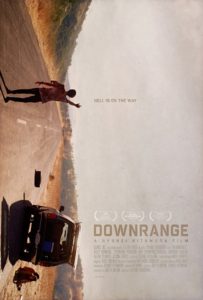 So, as you may have ascertained, Downrange is a throwback to those single location survivalist films which were all the range back around 2010: 127 Hours, Buried, Adam Green’s Frozen and the like (last year’s shark movie