“Time is an abyss.” 40 years of Werner Herzog’s Nosferatu

They’ve been regularly made since the very first film of the kind in the 1920s, but perhaps the 1970s were particularly unusual for the sheer volume of vampire horror films which emerged. Many different varieties of vampire horror appeared, too: Hammer Studios toyed with classic stories and folklore to create their own lurid, luxuriant spin, with many of their best-known vampire films getting released during the decade; other studios, contrastingly, felt the time was right to make fun of vampire tropes, delivering full-blown comedies such as Love at First Bite (1979). But perhaps the most visually-appealing, tonally-different film of its kind was Werner Herzog’s Nosferatu: Phantom der Nacht. It’s a film which can trace its lineage back to the very birth of horror cinema via its links to the Murnau original, and then to the epistolary novel which has birthed so many on-screen incarnations of Count Dracula, creating a movie culture all of its own. But, aside from its pedigree in this respect, Herzog’s Nosferatu is quite unique in its depiction of the jaded, lonely Count Dracula, a character compelled to live forever, and a man who seems to detest his own ghoulish existence. Truly one of the most existentially bleak renditions of the Dracula story, there are no grand battles or salacious details here. What we get instead is a blend of staggering beauty and pitiable loss. It’s a remarkable piece of cinema.

The story itself is quite straightforward, and quite closely follows the version of the Dracula story used by Murnau. In both, the story has been moved from England to Germany, and set largely in a small German town (Wismar). Also in both, Jonathan Harker is sent abroad to Transylvania to attend to the needs of a mysterious nobleman, though ‘Orlok’ is dispensed with in Herzog’s telling of the tale. Harker agrees to take the job, and leaves his wife Lucy in the hands of friends before beginning on his way. It’s a strange thing, but there doesn’t seem to be any story quite like Dracula for having its key characters shuffled around and reassembled; unlike Stoker’s original, here it’s Lucy (Isabelle Adjani) who is wed to Harker, and Mina appears only as a peripheral figure. Van Helsing (Walter Ledengast) and Renfield (Roland Topor) do their turns, but Van Helsing is unusually minor in this particular version, whilst it’s characters who are usually completely passive who come into their own here (more below).

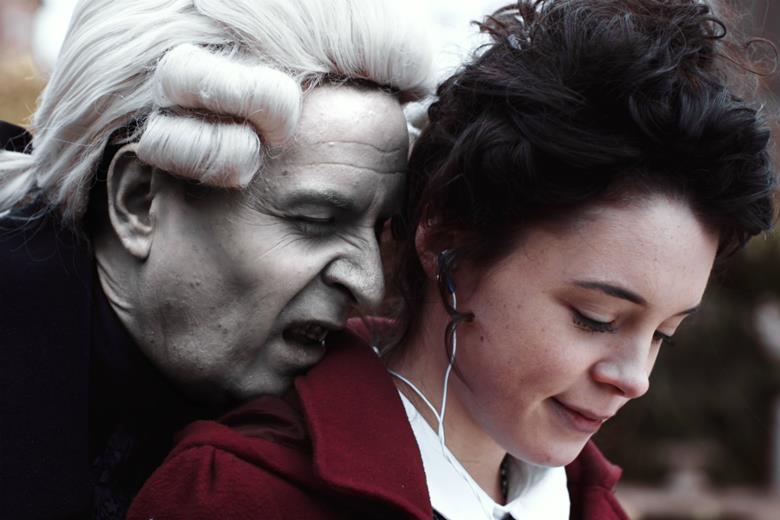
Harker is beset by risk throughout his journey to Transylvania – a journey which is itself agonisingly long, and afforded far more on-screen time than we usually see. Whilst the locations used are very beautiful, Harker’s vulnerability is brought into sharp relief by his environs – places he does not know, but must safely navigate nonetheless. He trudges over unlit grasslands, sidles his way along perilous waterfall paths and pleads with those he encounters to help him; he’s met with taciturn refusals by authentically dour rustics, and must do things for himself. He’s finally swept up by a mysterious black coach and deposited at the ramshackle castle, where the monstrous Count Dracula awaits him. Nobleman he might be, but he’s far closer to monstrous here than any number of the suave and well-dressed Draculas that we may see elsewhere. Like Orlok, Klaus Kinski’s Dracula is wraith-like, and it’s difficult to understand how Harker is able to greet him quite so calmly given his pallor, his sharp teeth and nails and his preternatural appearance more generally. Yet, Harker – at least at first – is quietly polite, if alarmed, assisting the Count with the business he has been entrusted with. It’s Dracula’s frightening response to seeing a drop of his blood which first fully repels him, and leads him to want to escape from the castle. By the time he realises what Dracula’s plans are, it’s too late: things have been set in motion, and Harker will ultimately be unable to “stop the black coffins” which are soon headed for Wismar.
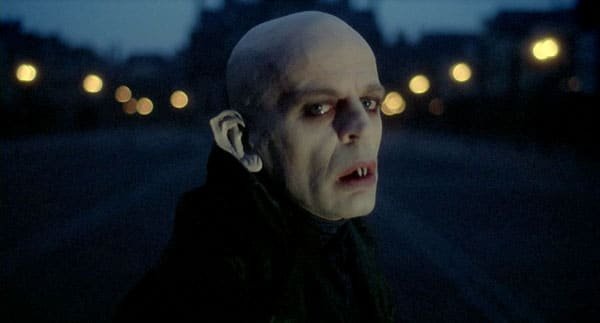
Throughout this part of the film, Herzog is a genius at making us feel some sympathy with each main character. Harker is, in all respects, a good man who took this fool’s errand because he hoped it would benefit him and his beloved Lucy; Ganz enacts a certain level of naivety and vulnerability incredibly well, and as he increasingly begins to gain a sense of his own danger, we empathise with his attempt to escape. But Kinski is a Dracula like no other. We are used – and maybe far more so in the 70s – to seeing vampires as privileged somehow, as revelling in their eternal life and feeling great anger towards anyone who would attempt to snuff it out. Whatever befell Kinski’s Dracula some centuries before, it has hardly preserved him in some perfect state, nor has it seemingly done anything other than make him suffer. He has degenerated, more animal than man, compelled to lap up blood in order to drag on his miserable existence. Why does he not electively die, we might ask? Does he not know what would do the trick? Well, perhaps he just can’t. He simply continues, going through the motions. And after everything, despite his repellent appearance, he has a human heart still. He suffers. He can remember enough of love to suffer by its absence, and he feels that death is not the worst thing that can befall a person. His gentle, introspective brooding is very affecting, and very unusual too. You find yourself sympathising with a monstrous creature; this is a rare skill, but one which the relationship between the director and the actor is able to offer. In this, Herzog has been able to embellish the character of Dracula as-written (Stoker’s Dracula is rather two-dimensional, with only one paltry mention of ‘having loved’) and Nosferatu: Phantom der Nacht therefore establishes a new kind of cinematic vampire. Even now, nothing has ever come close to that.

The character of Lucy – as played by the beautiful Isabelle Adjani – breaks further ground, and gives a new kind of life to a character who seems to be a straightforward victim in so many tellings of this story. Here, rather than taking a salacious path into living death where she needs a band of men to ‘save’ her, Lucy is unusually active. She is, throughout, in tune with her husband’s sufferings and senses his plight; when he returns to Wismar, though he is utterly catatonic (and Jonathan effectively dies on her without recognising her), she puts her efforts into investigating what has happened to her little town. It is Lucy who understands what Dracula is, and where he is; she even has the presence of mind to remonstrate with him. It is, of course, completely in keeping with the film overall that her efforts to restore order are ruined in the very final reels. Yes, she is pure of heart, and as the lore stated, she was able to sacrifice herself to destroy the vampire. It nearly, nearly works. Unfortunately, and in contrast to Murnau’s vision, the love of her life has by then become a damned creature himself. The ‘plague’ which has decimated the infrastructure of the town may have cast all people together in a kind of literal danse macabre, but so long as enough of the old social order exists for him to order a servant to sweep up the crumbled host which Lucy intended to keep him fixed in his seat, then the old social order can still be exploited.

So is anything about the ending of this film redemptive? Dracula finally opts out of time, but the decision is ultimately made for him; his death throes don’t seem to grant him peace, either. He dies, an ugly wraith on an unfamiliar floor; there’s no redemptive last sunrise here. Lucy dies too, for all her best efforts, and her husband – mobile at last – escapes, to do god knows what elsewhere. Will he become like Dracula – will he one day remember the woman who loved him, and feel something of the same abject pain? It’s a sobering thought. But then, the whole film is painted in these colours, and any happiness here is fleeting. It can perhaps be best summed up by Lucy, blindly seeking help in the town square, as a procession of pale coffins is carried past and around her. She is hemmed in by death, by forces unrecognisable, as ‘plague’ disrupts everything she’s ever valued. This isn’t, by the way, a film to watch when you’re labouring under any sort of existential angst (or is it perfect?)

Whilst, yes, the eagle-eyed may have noticed a few anachronisms along the way in Nosferatu (at last, we’ve found people with more of a dismal attitude to life than Dracula) for me, the atmosphere is perfect throughout. It’s a film which melds the picturesque and the grotesque; finery rots, grave-mould intrudes, a microcosm collapses in on itself. And for forty years now, audiences have been able to embrace this rare pestilence. It’s a film that will no doubt still being talked about in forty years more. Time is, after all, an abyss…
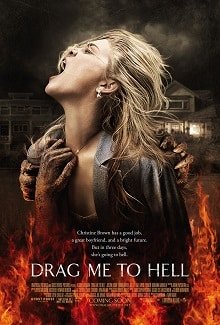
“Allow the darkness in”: Ten Years of Drag Me to Hell (2009)

When Drag Me to Hell was made, an unbelievable decade ago, it did one thing straight away: it delivered director and writer Sam Raimi back into the eager grasp of a multitude of genre film fans. An Evil Dead remake may have been floating around at the rumour stage by roughly this point in time, but Raimi himself hadn’t worked on an honest-to-goodness horror since Army of Darkness set the seal on his perfect marriage of grisly and silly. He had, to all intents and purposes, moved on: the Spider-Man movies were a different world, being big-budget, big studio affairs. Now, these films make solid commercial and career sense, and there’s nothing exactly wrong with them per se, but perhaps it all felt a little clean and tidy to the people who’d cut their teeth on The Evil Dead. Drag Me To Hell promised a welcome return to that particular form, and it was exciting, something to look forward to. Looking back and revisiting the film now, even the opening credits would do any horror fan the power of good. It’s a fun film from the very start, full of a blur of shlock horror components – a gypsy curse, together with monsters, psychics, graveyards and strange ‘should I be laughing at this?’ rituals. Even Hell itself seems somehow OTT in this film, and that’s a place which has a rich cultural history of shlock.

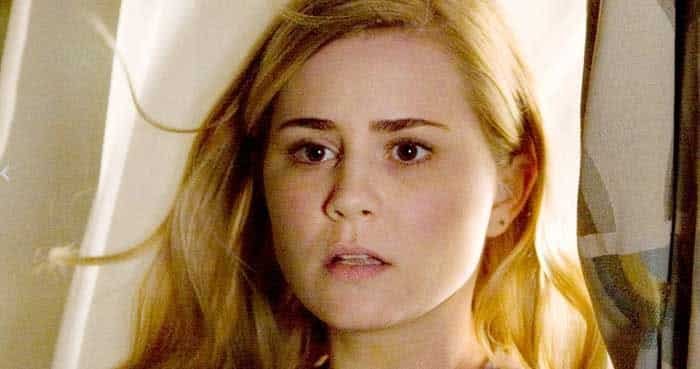
So all the prerequisite elements are clearly there, all present and correct. Drag Me To Hell is terrific fun. But it does have a nasty edge to it, for all that, when you think about it. Does Christine really deserve everything she gets, for not extending a loan? Are we not encouraged to empathise with her? – She’s clearly not a character we’re meant to hate, and the film would be a failure, in all likelihood, if we just saw a dreadful person get punished across ninety minutes. Instead, Christine (Alison Lohman) is a girl desperately trying to escape her provincial background and better herself. It’s the American Dream – get somewhere, be someone. But long before the shit hits the fan, her American Dream is clearly being knocked from all sides – her boss, her co-worker, her boyfriend’s family. None of them want her to get ahead. It’s a bad day at the office, and then Mrs. Ganush (Lorna Raver) turns up, asking for another extension on her mortgage payments. She’s already had several. Should Christine have extended her more credit? Possibly, but then she’s doing her best in a tough professional environment. Maybe Mrs Ganush should have cursed someone higher up. Come to think of it, weren’t we in the throes of a banking crisis at this time?

But hey, it is what it is: dreadful curses happen to good people, that’s the real lesson here. A vulnerable old woman turns out to be a menacing old witch (Raimi always does stellar work making old age seem more monstrous than frail) and Christine has the obligatory three days to save her soul. They’re not a nice, peaceful, relish-your-last-hours three days, either. One of the film’s strengths is in how it creates a mash-up of occult phenomena, forging a familiar-but-different mythology. The ‘lamia’ invoked by Mrs Ganush is a figure from Greek myth and legend, usually imagined as female – but our lamia walks with cloven feet, like a good old fashioned incarnation of Satan. The ‘cursed object’ idea feels like another borrowing, but altogether, it works well. It certainly lends itself to another key Raimi genre film feature: the gore. Oh the gore.

I think if I were to sum up Raimi’s style of on-screen gore, I’d call it something like ‘wonderfully nauseating’. Splatter which feels like an old friend. And there is abundant splatter here: even a straightforward nosebleed turns into a dousing; Mrs Ganush’s superpower seems to be emitting disgusting fluids, in life and in death, and she gives the film a lot of its gross-out-loud moments. Blood and vomit slosh around against a raucous soundtrack for the most part, too, lending the film a sense of sensory overload. But there’s a lot more classic Raimi here: the camera which operates from a ghoul’s-eye-view, pursuing characters along the street; the unseen presence pin-balling around any available space, destroying everything as it goes; the host of demons which have a strange joie de vivre, gurning and laughing as they go. Even the assaults on the main character feel like essential Raimi directing, and Christine is thrown around like a ragdoll just as much as Bruce Campbell was in the Evil Dead trilogy (and, yeah, it’s hard not to draw that comparison: two everyday people accidentally pitched against demonic forces which take a real pleasure in their work. It’s also not lost on me that the first trip Christine and boyfriend Clay (Justin Long) plan to take is to…a cabin in the woods!)

Now, for all of that, Drag Me To Hell isn’t a perfect film – there’s no sense pretending it is – and there are a few weak points along the way. Some of the sticking points for me would doubtlessly include the ubiquitous ‘family dinner’ which just invites you to squirm at the inevitable embarrassment to come. Christine goes through enough, without a baking disaster in front of the prospective in-laws. And I would say that the expendable psychic is one trope too many; you know damn well that if you see one, then their number’s up once they’ve passed on just enough information about the other world. The jury’s out on the seance scene, some fans were turned off by it, but I think I’m still erring towards the side of ‘hahaha, talking goat, cool’. But perhaps the thing which has aged most poorly over the past ten years is the CGI. Now, this is always a topic which divides people, but it’s clear to see how far the technology has come in the last decade, even if you’re not generally a fan of these effects. Even if the CGI in Drag Me To Hell occurs in some of the most cartoonish scenes in the film – someone gets an anvil in the back of the head, Wile E. Coyote style – it still jars somewhat, and looks a little out of place; it did then, so it really does now. But, hey, you can’t have it all…and for the film’s final scenes, you’d forgive a hell of a lot anyway. A sequence of false endings give way to a final jolt as the plot reveals its big cruel joke on Christine and then, after all hell breaks loose, there’s a cut to the final credits. Done. Lamia 1: Christine 0.

So, looking back now after ten years have gone by, Drag Me To Hell feels like a worthwhile return to form, and it may be slightly odd to say (you get slightly odd after decades of horror cinema) it’s one of those films I can always put on and enjoy. But at the time, it was perhaps more valued as it was a ‘hello again, goodbye again’ from Sam Raimi, as he went back to more mainstream fare – that is, until the glorious Evil Dead TV series gave us more of the same, and what a joy that was. But we’re bang up to date, almost, when talking about the TV incarnation. Drag Me To Hell was, in 2009, a welcome dose of demons and gore at a time when horror was saturated with found footage and torture porn: how nice it was, and is, to have a film which balanced the humorous with the gruesome, and held the camera still. What’s not to love? People fretting over whether the film is meant to be scary or funny are missing the point. This is a Sam Raimi horror. It’s both, duh.

Why Horror?

These days, the horror genre can only be rendered palatable to select members of society by suggesting that the horror they enjoy is, in some hard to define ways, ‘elevated’ beyond the confines of mere horror cinema. It’s a curious impulse, but it speaks to the way in which the horror genre still has the power to unsettle. People often want to squirm away from its hold, to suggest that it’s not horror per se that they enjoy, that it’s okay because they’re not really fans of something they can’t simply allow themselves to like.

All this said, the possibility of censorship and outright bans has never gone away, which may be a contextual reason why some people are so concerned to declare that their tastes lie elsewhere. Horror movies still fill certain sections of the population with bemusement, and sometimes outright disgust. The insinuation remains that there must be something wrong with people who want to watch this kind of thing…well, allowing for the fact that ‘horror’ is a huge genre which is growing increasingly broader, I’ve always been a passionate defender of horror films: horror should be just as permissible as any fantasy medium. And so on, ad infinitum, as a vast number of articles and reviews on this site over the years will attest.

What my defence of horror doesn’t do is to explain my own interest in and passion for horror movies, and it now strikes me as strange that I’ve never really taken the time to consider something so integral to my personal life. My usual glib response – that I was born very close to Halloween  – doesn’t quite cut it, does it?

So why horror? Why do I, or you, or we, variously enjoy sitting through depictions of torture, murder, agony, fear, unequal threat, malevolent supernatural forces, unstoppable foes, psychological trauma or insanity?

There is a good deal of academic study which suggests reasons for the enduring appeal of horror, both in literature and in film: writers like Julia Kristeva and Judith Halberstam, to name but two, are theorists on the subject. However, this ain’t an academic essay, and although I may overlap with existing theory in some places, the following thoughts are things which make sense to me, as a horror viewer. So, as far as I’m able, here’s what I’ve been able to come up with.

Firstly, I think horror is a safe arena, a place to play out dimensions of human experience which have been largely excised from everyday life, or which remain a real, unwanted danger if they haven’t. Death itself, for instance, has largely disappeared from the domestic sphere. We have industries and protocols for dealing with the dead where once the deceased would be laid out at home after being nursed at home, and would be washed and dressed by (usually female) members of the family. But even though death has been co-opted by officialdom, it’s there still – as are all the experiences and feelings surrounding the subject. There seems to be a part of the human psyche which needs to reacquaint itself with death and suffering – perhaps satisfying some manifestation of the ‘forewarned is forearmed’ idea, or at least playing with mankind’s morbid fascination for its own limitations. People will crane their necks to look at roadside accidents on account of this morbid streak; horror movies allow people to safely and harmlessly explore dangerous, tragic and unsettling events without actually gawking at real tragedy. It’s a vicarious means to explore human concerns which – especially for Westerners – we routinely repress or remove.

Death and suffering never leave our sides, but there are other pressing concerns played out via the medium of horror films which do change over time: Communist paranoia gave us the horror of soulless automata and the in-group/out-group anxiety of films like Invasion of the Body Snatchers; mindless consumerism gave us Dawn of the Dead and They Live; corporate corruption brought us Alien. Again, horror films reflect and refract current social fears, ramping up the impact with allegorical monsters, fantastical situations and an emphasis on humans attempting to make sense of their situations – and to survive. By engaging with current concerns and fears through a responsive medium, people can try to make sense of the world they live in. That ‘torture porn’ has been so prevalent in recent years suggests that modern times are difficult times indeed, and that people feel significantly disempowered and under unflinching surveillance…

But that is only part of the puzzle. As much as horror fluctuates according to what’s going on in the world at large, it would never have its enduring appeal if it didn’t also entertain us. People like stories, have done since time immemorial, and for millennia stories have made no distinction between the gruesome and the uplifting. Think of the fate of Prometheus in Ancient Greek myth – punished for stealing fire from the gods by being bound to a rock, where an eagle pecked out and ate his liver every day – only for it to grow back in time for a similar fate the following day. To return to my first point, death and suffering were part of everyday life and this was amplified in traditional storytelling. Stories have always been ambiguous, and it’s only in relatively modern times that we’ve trimmed away all the disconcerting parts of tales. To illustrate this, let’s remember that Cinderella’s ugly sisters hacked off their toes in the original story, in their efforts to wear the glass slipper.

Perhaps, then, it is horror’s detractors who are aberrant, and, in promoting a sanitised version of the world, deliberately misunderstand human nature. Like all good storytelling, horror balances the gruesome with drama, humanity, catharsis and black comedy; there is pain and suffering, and there is also redemption and solidarity in abundance. Horror works because it works with human concerns, is responsive to change, and permits vicarious experiences in a safe, entertaining format where – if it’s a good movie – a good story is married to a willing suspension of disbelief. It’s not just children who need or like tales, and as a horror fan, I still like the imaginative world woven around the genre. And, ultimately, this encapsulates why horror never needs to be described as ‘elevated’, and nor does it deserve to be denigrated as trash. The fact that it’s as old as cinema itself, as well as enmeshed in folklore and storytelling since time immemorial, makes our societal dislike for the genre more of an odd quirk at best, something which says a great deal more about our culture than the horrific tales themselves.

An earlier version of this feature once appeared on the Flowers of Flesh and Blood blog.

Devil Hunter (1980)

There’s hardly any need at this stage to say that the late Jess Franco was one of the most prolific low-brow filmmakers we’ve ever known, but the terrific plus side to his frenetic pace of work during a nearly sixty-year career is that, for most of us, there’s still a wealth of film titles out there we’ve yet to see. Well, I may have subtracted one from that still significant number with Devil Hunter, but as ever with Franco, I had an absolute blast. They’re fun films to watch, they’re fun to write about, and provided you’re happy with knowing that you are not going to be wowed with snazzy SFX or indeed slick production values, then you’ll have a blast with Devil Hunter or any number of Franco’s films too. No one has ever come along to take Franco’s place – turning out busy, entertaining exploitation films which have an odd sort of joie de vivre.

This looks at first to be your common-or-garden cannibal exploitation movie: a young woman runs, arms flailing, through an unnamed jungle, with a band of men in pursuit. Now, were you to think that only in such remote climes could a woman be travelling at speed, waving her arms around, scantily clad, then you’d be wrong. We get a cut scene to a young woman hanging over the top of a convertible, waving her arms around in a very similar way, and herself only minimally clad. That’s parity, that is. And this young blonde lady, recently arrived in the faintly unlikely movie hotbed that is Benidorm, is Laura Crawford (Ursula Buchfellner) – a massive star and pin-up.

After some ebullient dog-walking, she’s busy getting on with her languid soft-focus existence when all of a once, she’s ambushed in the bath (natch) and kidnapped. Now, here we have one of the film’s many gloriously daft moments: Ms. Crawford seems to be subdued with a bit of Silvikrin, which is being brandished by some guys in the worst disguises you could imagine. True, they have put stockings on their heads, but somehow this has had the effect of their facial features being brought into even sharper relief. Anyway, our Laura is taken off, to somewhere unnamed, but suspiciously like the jungle we saw earlier. The plan is to ransom Ms. Crawford for Silly Money, and hide her in the jungle (?!) until that ransom is paid.

But wait…could it be that the cannibal shenanigans we thought we saw earlier have a bit more about them than it first seemed? Is that some kind of…zombie on the loose? And is that bloodshot-eyed idol which the locals all hold in some kind of dread reverence the key to understanding all of this? (Yes to all.)

Anyway, Laura Crawford’s people begin working on a plan to retrieve her, sending off a Vietnam vet and…a guy with awesome boots, who isn’t above making it look like he’s climbing a vertical cliff face when in fact, they’ve put the camera on its side, and he’s actually on the floor, pretending. The tree growing bountifully at what would be a perfect ninety-degree angle to the ‘cliff’ is a dead giveaway. With regards the veteran, there’s even a PTSD-flavoured sequence in here on his account; this film really does have it all.

The ensuing melee between captors and rescuers, not to mention of course Mr Googly Eyes on the prowl, leads to a series of highly entertaining scenes, all shot through with classic mid-period Franco fare: barely-excused nudity, super-zoom shots, camp dialogue and a weird, unmistakable feeling that everything going on here must have been fun to shoot. There’s a little, only a very little, dead time before the grande finale. Sure, it’s a tree, again, which breaks the spell of the profound isolation of this ‘jungle’ by having loads of European names carved into it, but so what? This is a film designed to be baffling and gratuitous, and it achieves this from start to finish.

If it sounds like I’m knocking Franco in any respects here, then assuredly I’m not. I thoroughly enjoyed Devil Hunter. Whilst Uncle Jess may not have purposefully set out to make comedies (well, mostly), he did set out to make films that people could simply enjoy, and so here we are. In fact, this was a ‘video nasty’ at one point, though all that says is that they’d ban anything in those days. Oh, sure, it has T&A, some garish (if at least ambitious) gore and various exploitation elements, which mean this would probably be a poor choice of entry-level film for anyone who didn’t have at least a passing understanding of the genre or the director, but for the likes of us, this is bloody improbable fun. I’d go further and say that all the mugs giving this bad reviews on IMDb and similar outlets have probably missed the point and they shouldn’t be given nice things.

Devil Hunter will be released by 88 Films on April 8th 2019.

The Turk

Actor Michael Sabbaton has some impressive form portraying tortured male protagonists; his work to date enacting stories from HP Lovecraft more than prove this, and it’s something of a theme he has explored further in his newest one-man theatre show, The Turk. However, quite unlike Lovecraft, in this original piece of work Sabbaton has allowed himself to engender pathos for his character, Maelzel. There are even a few moments of levity, as he reflects on some of the most curious moments in a long career. The overarching effect is of a well-rounded tragic figure, with an unusual and engaging story which forges links to genuine history along the way.

On what will no doubt be his final voyage, the showman Johann Maelzel has holed up in a cabin with his scanty belongings and a surfeit of bottles of wine. His only companion – if such it can be called – is the head of the ‘Turk’, a chess-playing automaton which he came by some years before and which has helped to make his name in the salons of Europe. Originally made in the 18th century, ‘the Turk’ has long amazed audiences with its eerie abilities, beating the great and the good at the game and even voicing ‘échec’ (‘check’) after making a move. This idea is, strangely enough, rooted in truth: there was a real vogue for automata in the 18th century (and even earlier) as people’s understandings of life processes grew and the old mysteries of the divide between body and soul were thrown into new crisis by this additional understanding of physicality. People experimented with building these ‘thinking machines’, items which did indeed draw crowds. Nascent science always feels a lot closer to mysticism than to the dispassionate science we know today, and that’s borne out in the play, operating as it does as a kind of Gothic sci-fi. The ‘digesting duck’ mentioned in the performance was real, too; truth is usually stranger than fiction…

However, in the case of the Turk, all the renown has long come at a cost, drowning out the other achievements of its original maker at a great personal cost to him, and since coming into the possession of Maelzel, it has consumed him, too. Finally, in debt, drunk and bereft, Maelzel ruminates on his long relationship with the automaton, and what it has cost him. His own personal circumstances are revealed very gradually, in the usual masterly way Michael Sabbaton has with pace, and Maelzel is a fascinating character, very strongly delineated and utterly plausible, with the showman’s flair for words and gestures rendered down into what very much feels like his final act. He’s tragicomic through and through, which again, works very well, providing us with a man who is well aware of his shortcomings and of the sheer ridiculousness of elements of his life, as well as absorbed by his own sadness. This is a cleverly-written play, meticulously constructed and grounded.

And interestingly, given that the play interrogates the ideas of sentience and existence, I found my eye continually drawn to the head of the Turk during the performance; there just is something hardwired into us whereby we attribute personality and purpose to objects, if they are shaped in such a way that they look human, or can respond in a humane way. I can only imagine the trials and tribulations to come, as artificial intelligence continues to make great leaps. And in the play, the Turk seems to take on significance as a character in its (his?) own right, too, despite being silent and (mostly) inanimate. This only adds veritas to what Maelzel is going through, as he half-asks himself, and half-asks the Turk daunting questions about the meaning of life. Where is the soul? What is thought?

The Turk manages to sustain many things at once, and as ever it’s testament to the skill of the writer and performer that this works so effectively. Combining existentialism and personal tragedy with strands of comedy, history, self-parody and even music (definitely marking a break with the Lovecraft!) I was fully immersed by this. It’s always a pleasure to see ambition succeeding in practice, and this is a highly original and engaging piece of work.

The Turk appears at the Sheffield University Drama Studio on March 28th 2019. For any further news and performances, visit michaelsabbaton.com

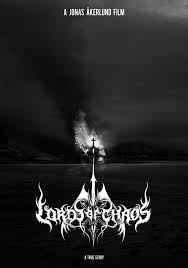
Lords of Chaos (2018)

Whatever way you look at it, Michael Moynihan and Didrik Søderlind’s book Lords of Chaos: The Bloody Rise of the Satanic Metal Underground has been responsible for some serious myth-building in metal circles, not least in the minds of many of those involved in the spate of arson and violence which enveloped the emergent underground metal scene in Scandinavia in the early nineties. I’d go so far as to say that the book has even helped to shape what black metal has become. But it’s not a history which immediately leaps to mind as a prospective film, and I was surprised when I heard that a film loosely based on these events was in the pipeline. Evidently, though, this has been a troubled project, getting passed from director to director over a period of years, before finally landing with music video director Jonas Åkerlund. (Japanese enfant terrible Sion Sono was in the frame to direct for a while; I can only guess at what he could have done with this, and with respect to Åkerlund, I can’t help but feel sorry that I’ll never find out.) The resulting film is sure to divide metal fans, as it’s an often frustrating mix of high camp and unflinching violence – in trying to encapsulate a great deal, it positions itself rather awkwardly between tragedy and farce.

I commented in another recent review that films which begin with their closing scenes – meaning we know from the start that the film will run full circle, back to this point – are risky ventures. With Lords of Chaos, there is never any question about how the story will end; even if you’re only vaguely familiar with events, you’ll know that Mayhem musician Øystein Aarseth, better known as Euronymous, was murdered at his Oslo apartment by sometime bandmate Kristian Vikernes, probably best known as Varg Vikernes. Thus culminated an escalating period of tension and aggression between the two men, their rivalry already spilling over into various criminal acts up until this point. Unusually, the film starts with, and returns to, the use of a voiceover – Euronymous (Rory Culkin) pointing out that things don’t exactly ‘end well’ for him. The film proper begins in the late eighties, with Euronymous’s first forays into playing metal, his influences, and his early years with Mayhem.

And here’s the film’s key flaw: its yawning tonal shifts. A lot of the scenes involving early band practices, these young men crafting their stage presences, and of course the ubiquitous metal! parties! are somewhere between This is Spinal Tap and Wayne’s World, all giddy excess and the standard stereotypes of metal fans as, well, a bit stupid and superficial. Which Euronymous and his band mates might indeed have been, at that age: I have no point of reference for Euronymous the man, having only really encountered him in print or in his music, so there’s little for me to go on personally, but I think Culkin does his best to try to sustain what’s pretty well documented about Euronymous – that, yes, he was self-important and interested in being as kvlt as possible, had a lot of theatre about him, but for all that, he was a key player in the development of the Norwegian black metal scene, and his record shop Helvete was a genuine hub of activity. So there’s a lot here which sends up these key players, pushing things towards comedy in places. And by the way, surely to God the director could have found some Scandinavian actors and still sold the film? The ‘bye, mom’ Americanisms really grate here. But then, in a beat, the film turns gratingly, horrifically nasty. Former Mayhem vocalist ‘Dead’ hangs cats, and one hangs from his ceiling for the duration; he slashes his arms and throat; his suicide scene is intensely graphic (he shot himself in the head) and – as with all the death scenes in this film – inescapably sad, particularly given Euronymous’s behaviour when he discovers his body (the film’s attempts to square this with him as an essentially decent guy fall flat, and don’t seem to be really rooted in reality, either). Lords of Chaos is akin to ordeal horror in places, then, and then breaks into parody in others; it’s a disorientating experience because of this, and it means that neither element really works. Even if the black metal of the day did have a bit of parody to balance its horror, it doesn’t work for creating a coherent narrative on screen.

I was, though, genuinely quite surprised at how pro-Euronymous the film is: the story is told largely from his perspective, the voiceover is his, and the story begins and ends with him. If you feel any sympathy for anybody here, then it’s engineered to be Euronymous. The book on which this is all based spends a lot more time unpicking (and let’s be honest, creating) the world views held by many of the people involved in the so-called ‘Black Circle’, giving a disproportionate amount of time and space to Varg Vikernes – who always claimed that he murdered Euronymous in self-defence, and has since served the maximum jail sentence for the crime in Norway, before relocating to France. In the film, there’s no sense of reverence for him whatsoever: Vikernes gets an absolute drubbing throughout, so for anyone who wishes to see him painted as superficial, emotionally-challenged and yeah, as thick as mince, then look no further. (He gets a disproportionate number of sex scenes too, mind you, which I could have happily done without.)

The film works its way through its key plot points with an odd blend of a keen eye for detail and a few glaring errors (for example, Euronymous had no time for life-affirming thinkers like Crowley and La Vey, yet there they are, their pictures pinned to his noticeboard). But one thing I feel the film did more or less miss out is the sense that the safe, secure, prosperous Scandinavian life enjoyed by these young men probably conspired to bore them to tears, and it always feels like a factor in the powder-keg they went on to create. But then, that’s just my take: ask twenty metal fans what they would want to see from this film, and you’ll get at least twenty different answers. I suspect at least a few of them wouldn’t want the film made at all.

I suppose my overarching sentiment, having finally caught up with Lords of Chaos, is bewilderment at how this plays out. Åkerlund has considerable prowess making music videos, but he’s struggled to make this feature work; trying to represent what’s essentially a pretty grotty history in any meaningful way over a two-hour running time would challenge anyone, not least someone who doesn’t usually work with the format. There are some well-observed scenes here, and it can’t have been easy to try and capture these ‘interesting times’ on film, but overall Lords of Chaos doesn’t work well. Maybe the tangle between truth and lies acknowledged by the film has just become too inextricable – even too unwieldy – by this point.

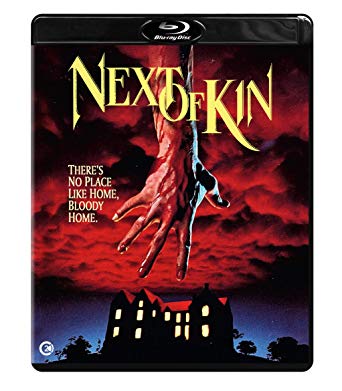
Next of Kin (1982)

It always seems to me a bold move – and a risk – to start your film with what are evidently the closing scenes, but that is just what we get with Next of Kin, a mystery mixed with a horror, and the sole foray into genre film from director Tony Williams. A young woman, smeared with blood, is about to get into her car and flee the scene of a small town diner, where things have clearly gone down. A voiceover briefly explains that this young woman, Linda (Jacki Kerin) has recently inherited all of her late mother’s estate – which includes a large residential care home, Montclare. It’s an ominous overlay, and we’re primed for things to go wrong for this woman; it only remains to be seen how this is going to happen over the course of ninety minutes.

Montclare itself is a sprawling place with a lot of sitting tenants, but Linda makes herself at home, even getting involved with some of the care duties (hey, these were innocent times – people didn’t trouble themselves with things like safeguarding). There’s a small team of staff at hand, including a doctor on call, and things seem okay to begin with. However, before long there’s a death – and as Linda gradually begins to work her way through her mother’s papers, reading about her mother’s anxieties about something strange going on at Montclare, Linda begins to experience similar things, her nostalgia now tinged with fear. She begins to investigate the history of the house, but more and more, she’s convinced that someone is keeping an eye on her.

Next of Kin is a strange one. On one hand, it holds off on the plot exposition, leaving Linda to face things on her own and keeping the audience as much in the dark as she is, wondering whether the scares she is experiencing are supernatural in origin, or not. The film is very much centred on Linda, with not that much coming from the other characters in the film really, and to be fair to Kerin, she does a decent job, although her responses to what is happening to her can be hard to relate to; things which ought to have her in bits seem not to, whereas quite ordinary things generate hysterics. But on the other hand, after keeping things on the down low for the largest share of the running time, Next of Kin motors through the denouement, more or less having Linda happen upon the very page her mother’s diaries that tells her what she needs to know before things get spelled out very rapidly in the end scenes, and so we’re suddenly back to where we started. This is odd, given that the film is such a slow burner, for the most part; very little actually happens over the first hour. This could be a challenge for modern audiences, perhaps as a symptom of our shrinking concentration spans, but then again, it is better to have a little more action as a motivation to engage with the plot before we run out of film. There are some very effective scenes here, nonetheless (the corpse in the bath made me wince) and the film allows these to settle on the audience, allowing them their impact.

The Australia of Next of Kin feels very familiar: it’s a place unusually populated by RP English speakers, not unlike Patrick (1978) actually, which had been made just a few years previously. Now that I think of it, an isolated young woman being made to face down frightening events in an isolated setting – there are other parallels. No doubt Patrick’s modest successes had an impact on subsequent genre films being made in the country. The sets here are effective, and you do get a sense of the isolation of the place, which is important in how things play out. Williams also has a keen eye when it comes to setting up some of the scenes, and this is a well-made film from a technical point of view, which will appeal to many on those grounds.

Overall, this is a film which very much has its moments, throwing in some surprising ultraviolence too, though some of the disparity in pace dents the goodwill somewhat. Also, sadly, there were a few issues with the transfer on my screener which meant I couldn’t see some of the key scenes at the end; hopefully this is a just a tic, and the rest of the discs are fine, though it was a little frustrating, having waited for things to get going. Next of Kin will reward people who like their horrors more understated – well, up until a point in time, at least.

Next of Kin will be released by Second Sight films on 25th March 2019.

Freaks (2018)

Chloe (Lexy Kolker) isn’t allowed to play outside. Her front door is barricaded and sealed; every window is covered and she is under strict instructions not to ever, ever attempt to go outside. The world is a terrifying place, her paranoid father (Emile Hirsch) keeps on telling her. But Chloe has no sense of this danger on a personal level; she’s very young, and any risk her father has incurred for her sake seems lost on her. He might be planning for someone else to maybe take care of her in the future, but Chloe just wants to be a regular kid.

However, it’s soon made apparent that this is absolutely not going to happen. What at first seems as though it’s going to be yet another zombie-style horror, where Something or Someone Bad is trying to get inside and the inhabitants of a house have to literally put up a blockade to stop this happening, is soon something else entirely. When Chloe peers out of a corner of a window, she sees birds flying – but there’s something odd about their flight; they seem to be moving out of time with everything else. Her dad is acting increasingly coyly, ramping up his warnings about the outside world, while failing to answer his daughter’s questions about whatever became of her mother. The house seems to have odd manifestations in it, too, which seem somewhere between hallucination and memory, from what it seems. And, far from there being hordes of undead or otherwise diseased/obviously dangerous people roaming around, the first other person that she sees is…a guy with an ice-cream truck (Bruce Dern), who seems to be trying to get her attention. He even posts her a neat pop-up book; is he really so bad? By this point in the film, I’d gone from having one set of expectations (oh, not another zombie flick) to another (oh, not another parental paranoia trip) but, gladly, whenever I thought I knew what I was watching, the film had to nous and ambition to change its narrative.

If you can say one thing with certainty about Freaks – wherever its plot ends up going, and it goes a long way – it’s that this is a superb family drama at heart, with believable relationships, superb performances and bags of confidence, sustaining humour against pathos. Many of these kinds of stories sink or swim on the child performances, and I’m glad to say that Lexy Kolker does an impressive job here, reminding me in some respects of Angourie Rice as Rose in Australian end-of-days drama These Final Hours (2013), with similar work to do enacting innocence and a desire for family life against everything going to hell, whilst the grown-ups do their best to make sense of it all. In many respects, because Chloe is struggling to understand what’s going on in her world, the audience is kept at the same level for a large part of the film. As she starts to understand, so do we, and I don’t feel that there was really a point in the film when I ever leapt too far ahead of her. This works really well, keeping the plot unfolding in gradual stages.

It’s also a pleasure to see Bruce Dern getting stuck into a genre film role here, working very well with all the cast, but particularly with Kolker (he said that she reminded him of his daughter Laura at that age) whilst getting a large number of the best lines. Oh, did I mention that Freaks allows itself a few jokes along the way, as well as revealing a family in unique and genre-bending jeopardy? Directors/writers Zach Lipovsky and Adam B. Stein clearly had a lot to do here, but it all works together seamlessly well. The sci-fi content here is engaging and important, but it’s how it affects the family which really matters, making for something warm, intricate and very clever, with space enough to lighten the mood in places too. However, and again thanks to a performance by a talented child actress, it all concludes with questions hanging in the air, a touch of ambiguity to take away.

I’m working hard here not to spoiler Freaks, as it’s one of those films you need to see unfold in its own way, but rest assured there is more than enough here to justify your attention. This is what genre film is all about, and it’s why, after initially eyerolling at the thought of watching yet another derivative piece of work, it’s so refreshing and rewarding to find a film like this one. Even where you can recognise some of the film’s elements, it does something new with them and makes them matter.

Freaks (2018) screened at Frightfest Glasgow on Saturday 2nd March 2019.

Automata (2019)

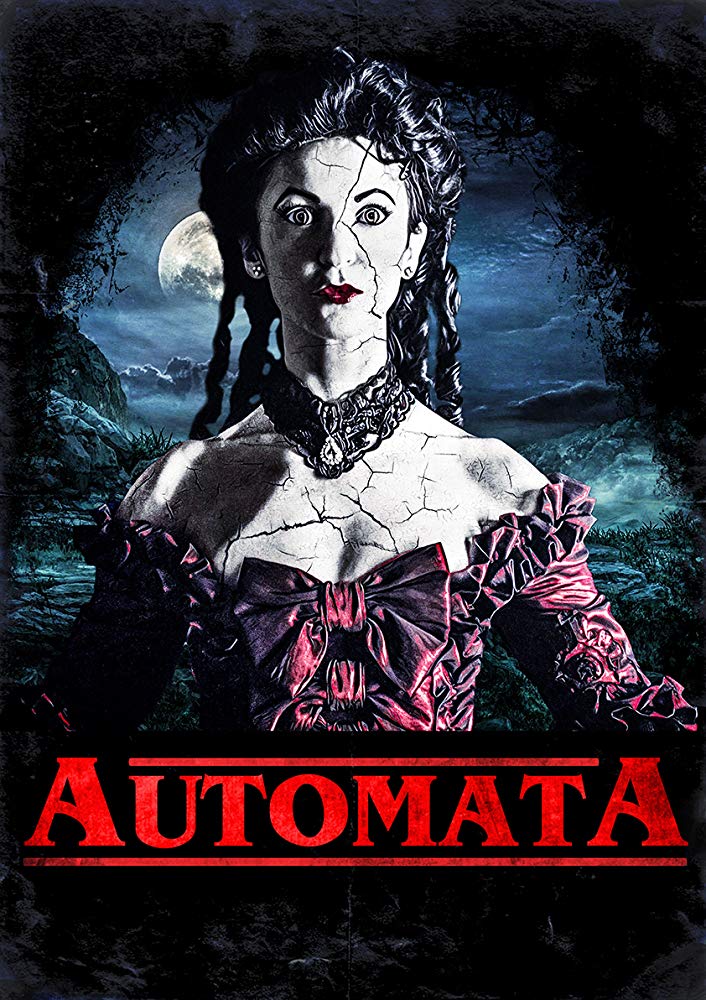
It’s been close to six years since I reviewed director Lawrie Brewster’s second feature film, the cryptozoological horror Lord of Tears; at the time, I was impressed with the film’s imagination and its sense of a reverence for classic horror fare, but found it a sometimes muddled film in which certain sequences should have been cut out completely. Having recently seen his newest film Automata (again scripted by close collaborator Sarah Daly) I have a strong sense of deja-vu. Automata is also bursting with ideas, and seems to be hearkening back to the glory days of the likes of Amicus. Its subject matter, indeed, is worthy of that studio, as well as certain others of the era, which I gather were influential on this production. However – and it’s a big however – the way in which the plot is developed and realised is nothing short of garbled, or even downright barmy.

The film begins with a period setting, which in itself is pretty bold on a budget: a band of 18th century soldiers transporting a mysterious trunk are ambushed by an army who wants whatever’s inside it. Many men soon afterwards lose their lives, but we never get to see the trunk’s contents for all that. Instead, we move to the current day. Historian Brendan Cole (Jamie Scott Gordon) is approached by a wealthy collector who wants his expertise on what’s been assumed a folk story about a clockwork doll known as ‘the Inferno Princess’. (This, we can assume, is what was in the trunk 300 years previously.) Cole has written extensively about the Princess, but he’s staggered by his would-be patron’s claim that he may have found the doll itself – intact, functional and needing only to be verified by an expert – i.e. him. Being offered a million pounds for the job, which will take a week, he can hardly refuse. He takes his grown-up stepdaughter Rose (Victoria Lucie) with him to the house in question, and begins to run his tests on the doll.

Of course, the doll has a mysterious power of its own, and begins to affect both Brendan and Rose. The Princess doesn’t really look like an automaton of the day, and it’s hard to get a sense that this is a clockwork effigy of a person without any SFX beyond cosmetics, but there are some neat aesthetics here. Gradually, Brendan and Rose are able to piece together the sad history of the doll; it’s an effigy of a noblewoman with a tragic story. Her likeness was captured at its most perfect, but it seems the relationship between the model and the automaton project was never an easy one and all sort of things went wrong along the way. As they gather the finer details, ghostly goings-on begin to overtake the house, and the influence of the doll – or Talia, the woman copied for the doll – threatens them both.

All of this would be perfectly fine, perfectly reasonable and enjoyable fodder for a horror yarn, and I always want to give credit where filmmakers come along with ideas for an original mythos of their own. Seriously, it would be very easy to make something perfectly saleable out of tried-and-tested ideas, but Brewster doesn’t do that. That’s worthy of respect. But it’s frustrating when these ideas are brought to the screen in ways which either don’t make sense, blow any sense of intrigue or mystique along the way by questionable handling, or worst of all, descend into farce. Whilst AIP etc. had elements of camp, they were more practised than they were hokey, and the dialogue tended towards melodrama. That worked perfectly for films like The Masque of the Red Death, and part of me wishes that was the approach taken here. Instead, during the screening, there was that sickly-awkward feeling whereby the audience slowly collapsed into laughter as the film progressed – all the time knowing that the cast and crew were sat in the same screening. Brewster and his team acknowledged the film’s elements of camp afterwards, and said that they were deliberate; some of them might have been, but I seriously doubt all of the lines sending people into meltdown were really meant to do so. This film is/was in desperate need of someone to say, ‘You can’t put that in, that sounds ridiculous.’ A camp classic this may well become, but I cannot believe it was all intended and – sorry – the script in places is utterly dire. It jeopardises everything else the film could have achieved and undoes the work being done elsewhere.

Sadly, there’s more. The relationship between Rose and Brendan – stepfather and stepdaughter, remember – is incredibly cringe-inducing, with flirtation, ass-slapping and even the beginnings of a sex scene, though thankfully things stop short – just. I’m not sure of the thinking behind this, and why this quite honestly couldn’t have just been an estranged couple with no deceased mother/partner thrown into the mix; the screenplay’s incestuous leanings add nothing here, except another layer of awkwardness. But I could maybe – maybe – forgive the script giving time to this, if I felt that I really understood what had happened in the plot by the end; sadly, the film feels like it ends multiple times, and scoots over key things that I felt I needed to know anyway. On the altar of atmosphere is much coherence sacrificed.

So it’s a frustrating experience, this film. Automata – is there some meaningful reason behind using the plural form in the title? I’m unsure – has ample ideas, a sense of where it comes from, great locations, clear potential and bags of ambition. Everything is set for a great, original British horror. But the performances, the stylistic decisions and most of all, how the plot tumbles out via a jaw-dropping script turns this potential into a bizarre skit, I’m sorry to say. Whilst there’s plenty of entertainment to be had in this film, I have a horrible feeling it’s through laughing at it, not with it.

Automata screened at Frightfest Glasgow on 2nd March 2019.

Black Circle (2018)

Horror films have often invoked different kinds of physical media as conduits or access points for dark forces, and given the significance of music in our culture, it’s little wonder that records have figured fairly highly over the years, particularly in decades gone past. There have been some great stories which feature records, or other kinds of music recordings; however, what you notice is that certain kinds of music typically feature, and heavy metal is usually high up on the list of culprits. Black Circle is refreshing in a number of ways, but key amongst these is how it takes that old, familiar idea of audio as a gateway to something dangerous, but flips it on its head. In this film, it’s not metal, but an old self-help recording which triggers something malevolent.

Using an array of (highly convincing) 70s TV advertisements to introduce the kind of self-help it means, the film introduces a very old idea, one ostensibly re-imagined here for Age of Aquarius thinkers. Mesmerism was one of the very earliest melds between rational, ‘scientific’ thinking and supernaturalism, and on the TV reels it’s depicted as just another facet of the mind expansion, self-knowledge and self-actualisation popular in the decade. This brings us onto a very special recording, put together by an institute of master mesmerists in Sweden in the 70s, intended to be played whilst the recipient sleeps. Listen to this record, so the spiel goes, and you will become your best self. Presumably not a huge hit at the time, the record must have then have sunk without trace, but a few copies remain – one of which finds its way into the modern day and the possession of a young woman called Isa (Erika Midfjäll).

When Isa’s younger sister Celeste (Felice Jankell) visits her after a period of estrangement, she finds Isa (Erika Midfjäll) a transformed woman. She has a new job, she’s smartly dressed and seems to have it together; Celeste, who is struggling to finish her degree and get by, is stunned. Isa tells her that it’s all because of a certain strange self-help LP she has inherited, and recommends Celeste to take it home to try herself. Doubtful, but definitely drawn to the prospect of a quick fix, Celeste agrees. And it seems to work for her, too. She wakes up having expunged all the negative traits which had been holding her back, just like the record said she would. Suddenly she can focus, she can plan and she is making great headway with her thesis. But, as we see, Isa’s own moment in the sun seems to have been short-lived. When we next encounter her, she’s not the confident young professional we saw at first. Celeste is soon to go the same way – things start to appear on the periphery of her vision, she’s troubled by strange dreams and a dreadful feeling of paranoia. Is something following her? How can she account for this strange feeling of being watched?

Once she’s able to track down her sister, who seems by now to have disappeared from her everyday routines completely, the girls decide they have to find help. They look for the mesmerist behind the record, Lena (Christina Lindberg), now an older woman no longer working for the institute, but someone who still very much believes in the power of the techniques, and in fact now recognises the troubling power behind the recording she made decades previously.

Firstly, Black Circle creates a fascinating universe out of a blend of esoterica, mysticism and new science, all ideas which were huge in the 60s and 70s; beyond this, though, it reaches back a lot further, playing with ideas about selfhood and identity which were current in 18th and 19th century literature and which have frequently gone underused in horror, at least in recent years. All of these threads are then drawn into the 21st century to yield an engrossing story. Taking a variant of hypnosis as a key plot point, it’s cohesive enough to build a very hypnotic atmosphere, with a brilliant original score pulsing through the film and underpinning the mood of the narrative. The ratcheting sense of jeopardy is nicely-handled, and the fine line between hallucination and something, shall we say, more solid is kept going; there’s an attached world of strange science-ritual which provides some heady, original scenes. The cast at the core of all this are perfectly convincing. It’s also a privilege to see 70s exploitation actress Christina Lindberg acting again here for the first time since the 1980s. Lindberg joked at the screening that she was always known as the ‘girl who never smiles’, and that’s at the heart of her role here – she’s a stern, authoritative and deeply knowledgeable character, and her inscrutability works: Lena is somewhat troubled, but focused on what she can do. The two backpackers who turn up are the only possible weak link here, as the justification for their initial appearance is rather thin, although to be fair, they do become more necessary as the plot moves on.

Financial constraints there might have been, but Black Circle is an impressive film which has made the absolute best of its key elements; the splicing of the 70s advertisements and info reels adds a great deal of atmosphere and everything is meticulously realised, whether meant to appear four decades old or contemporary. I’m unsurprised to see Pete Tombs of Mondo Macabro down as a producer, as he’s a guy who knows a thing or two about that 70s look they’ve captured here. But apart from the strengths of the story on a surface level, and even apart from its aesthetics, the film also conjures up some interesting anxieties about ‘living your best life’, something which is achingly modern and fraught, as well as a rich source for a horror story – as so well-realised in Black Circle.

Black Circle screened at FrightFest Glasgow on 1st March 2019.

Here Comes Hell (2019)

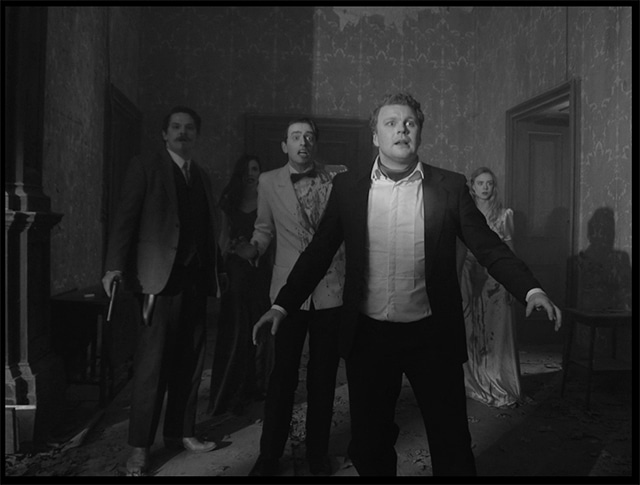
Have you ever sat through one of those Old Dark House style movies, where everyone speaks in RP and smokes continuously through ornate cigarette holders, and thought to yourself – this is fun, but wouldn’t it be glorious if the social niceties and subtly barbed comments gave way to something else entirely? We’ve had a few genre mash-ups in past years, starting with Pride and Prejudice and Zombies, and now it seems that we’ve moved out of the 19th Century and into the 20th. So we come to Here Comes Hell, an Agatha Christie-style meeting of friends and strangers in a dilapidated manor house in the back of beyond which…goes elsewhere, shall we say, and has tremendous fun as it does.

The premise is simple (and recognisable) enough: Elizabeth (Jessica Webber) is off to a gathering with her ghastly fiancé Freddy; it seems that gay bachelor Victor – in the old sense of the word – has just bought not only a manor house, but one which had previously been owned by a notorious and conveniently dead occultist, Ichabod Quinn. Victor has planned some drinks, conversation, and then, obviously, trying to contact Ichabod Quinn’s spirit, but all in good time. First, there is the difficult dinner conversation to be had: Victor’s sister Christine (Margaret Clunie) has a few withering class-based put-downs to deliver, there’s a drawling, hangdog American millionaire called George Walker Jr (Tom Bailey) who goes to show that money doesn’t buy you happiness, and then of course there’s Madame Bellrose (Maureen Bennett), who’s along as the guest-appearing spirit medium they’ll need for the more nefarious goings-on.

The funny thing is, when Madame Bellrose successfully contacts Ichabod Crane, he doesn’t just fancy a quick catch-up. He’s more interested in completing the work which he started whilst on the other side of the veil – opening a hellmouth, and damning the whole world to destruction. Isn’t it always the way?

Things are a little slow to start, as many of the best of the old dark house (or ‘shit vintage dinner party’) films of the 1920s and 30s genuinely were, but hang on in there. Here Comes Hell makes the best of its budget and once we get to the séance, things escalate pretty rapidly. The team behind the film made the conscious decision to do as much in the way of practical effects as they could muster on an admittedly miniscule budget, so – even though the film itself is in black and white – the séance opens the floodgates, in a pretty literal way. Other reviewers have mentioned The Evil Dead and it’s a shame to feel I’m parroting this, but it’s difficult to think of another film which so closely fits the bill here, from the demented ‘Deadite’ style characters we eventually get right through to the first-person camera work being used. It’s pure homage, to my mind, but this is both engaging and very smart; one classic style segues very quickly and very brutally into another, and they both happen to be pretty well beloved of genre film fans. The team here also have a fair idea of just how much silliness they can get away with, which turns out to be ‘a lot’; I won’t say too much about one of the bizarre ‘mutations’ one of the characters suffer, but look out for it. Actually, scratch that – you can hardly miss it…

Yes, there are a few lapses in suitable hairstyles and accents – with the exception of Timothy Renouf as Freddy, who both sounds and looks as if someone’s airlifted him in from 1931 – but you can see that there has been research done here and that the cast/crew have tried to embody the kind of poise and dress of the era. To be fair, I feel that Here Comes Hell have created a more plausible early 20th century world than Borley Rectory did, and I appreciated the great shooting location used, which needed very little done to it. Green screen or any sort of post-production work is kept very much to a minimum. Here Comes Hell doesn’t seek to reinvent either of the genres it splices together, and it works around its constraints to do good work in the realms of pure entertainment. Some viewers might feel that black and white isn’t the obvious choice for a splatstick, but I think it’s more important in terms of setting up the first few acts, meaning the rest follows on fittingly.

I will say that this is definitely one of those films which derives a good share of appeal from a group viewing, so see it with others if you can. You may even get to see it on the big screen, in which case, definitely go for it: many of the best SFX sequences are tailor-made for group laughs. But in any case, it’s laudable to see something quite as prim and grisly by turns as Here Comes Hell, and it’s equally good to see something which is so happy being pure entertainment. The crew looked like they were having fun making it, which makes it all the easier to have fun watching it. There are no pretensions here.

Here Comes Hell screened at Frightfest Glasgow on 1st March 2019.