It’s always a delight to find yourself surprised by a film, and The Droving – despite its use of elements which immediately call certain other films and subgenres to mind – manages to surprise throughout. Intensely character-driven, it largely keeps its horror off-screen, or represents it solely through its lead. In so doing, it weaves a very subtle and engaging story.
Martin (Daniel Oldroyd) has just left the Army after five years’ service, but his decision to try civilian life again has been shaken by the disappearance of his beloved younger sister, Megan (Amy Tyger), who appears to us only in Martin’s memories of happier times. Returning to the Penrith area of Northern England to seek clues about what happened to her precisely a year earlier, he’s quickly on the trail of what, at least at first, seems like a bunch of likely candidates. Mutual friend Tess (Suzie Frances Garton) informs him that a group of outsiders referred to as a ‘clan’ make it their business to appear in town ahead of the yearly winter Droving Festival (a genuine British tradition linked to winter agricultural markets which has hung on in there as a local event). As Megan disappeared right before the previous Droving, it certainly seems suspicious. Rumours of strange beliefs on their behalf only fuel Martin’s determination to find them; he tracks them to their last-known whereabouts – a local ruin, naturally. Also, do these people have faintly unsettling animal masks? Check.
A lesser film would have thereby pitched Martin against a closed community whose knowledge and instrumental power far exceeds his own here; this, to its great credit, it does not do. For starters, Martin is no naive wanderer; he’s a veteran, and with form as a military interrogator he is used to getting the answers he wants, as well as being more than able to look after himself. In short, no one is putting him in a wicker man (a film comparison I have read a few times, actually, but one which from my perspective isn’t a good fit). As Martin follows his trail here and there, it’s mood that prevails over massive shifts in narrative, with Martin’s barely-repressed or sometimes openly-expressed monomania for tracking down his sister expressed almost exclusively through his own words and deeds. Oldroyd does incredibly well with what he’s given. Very naturalistic, very engaging, he does the tricky thing of enacting acting throughout the film – never showing his hand, but using his military skills and ability to create characters to make people talk. There is a lot of very British black humour in the script, too, which nonetheless doesn’t detract from his plight and doesn’t confuse the tone. Sure, he finds the beginning of his trail of answers quite easily, but you could never say that the film moves from there to wholly expected terrain.
Another impressive feature of The Droving is in its new folk horror dynamic: gone is the small community who are all ‘in on it’, to mutual benefit, or at least perceived mutual benefit. Here, people who might have arcane knowledge (and it’s never ever about showy big reveals or protracted ritual practices) seem sorrowful about it – they wish they didn’t know, wish they didn’t talk, didn’t keep the old beliefs going. These novel elements help to generate and sustain the tension, because they free the film of the kind of expectation which can work against what the film is aiming to do. A subtle sense of horror unfolds. If you are willing to keep with it, filling in the blanks, then there is more than enough to reward your attention (and this is a nicely economical story, too, at just eighty minutes long).
Beautifully shot against a rugged, austere landscape, matched just as beautifully by its soundscape, The Droving is an evocative and often ambiguous horror: here you will find unexpected flashes of originality and a willingness to tease out elements of its key ideas and motifs, developing them in fascinating ways.
The Droving was released on 21st April in the UK. It is available now via Amazon Prime.
If you ever caught up with Room 237 – a documentary film about the varying levels of mania which afflict some fans of The Shining – then you will already have encountered producers P. David Ebersole and Todd Hughes. Room 237 is a very diverting film, it is true, though the chief diversion comes purely from the insane theories being propagated at length, rather than anything special being done with the framework. Ebersole and Hughes have worked on several documentaries since that time, with no real defining rationale behind any of them, but on this occasion their scattergun range of interests has brought them to the life and death of actress Jayne Mansfield, with a special emphasis on circumstances leading up to her very early demise at the age of 34. And, whilst there are entertaining and diverting moments to be had, these mostly derive from seeing and hearing Jayne herself: otherwise, there are some baffling decisions made here, which cast a pall over what could have been.
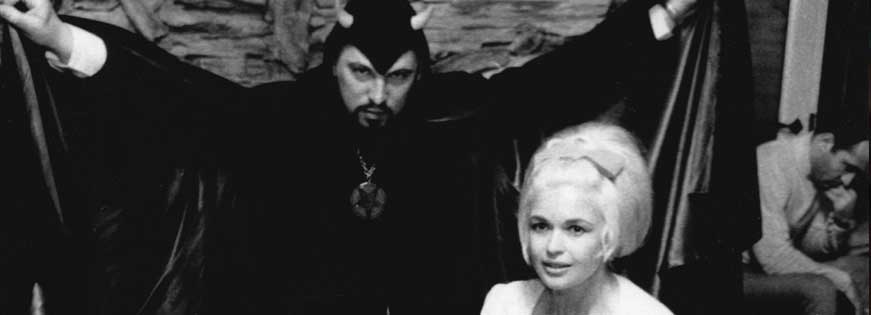
As the title suggests, after some time establishing just what propelled Jayne to stardom, the documentary focuses mainly on two years in her life – though not in a necessarily very linear way, and the film moves around its subject matter fairly loosely, digressing regularly. There is a diverse array of talking heads at hand, from contemporaries of Jayne’s to film critics and authors, none of whom were known to me. Amongst the contemporaries and fans were John Waters, Kenneth Anger and Mamie Van Doren; these were by far the most interesting contributors, with Waters in particular pitching it just right, on the right side of droll and yet clearly someone with a deep interest in Jayne Mansfield (he states that his star Divine was intended as a blend of Mansfield and Godzilla). It was a little frustrating that we didn’t hear more from him – and the same goes for Anger, a man who literally wrote the book on Hollywood decadence and personally knew Anton LaVey, whose erstwhile association with Jayne and the rumour mill surrounding it comprises a large share of this film. The selection of film academics made for an interesting choice, given that they said very little which seemed to relate to their academic backgrounds or specialisms (for instance, if someone gives their credentials as specialising in queer and feminist theory, you would anticipate they would perhaps say something about that, but they did nothing of the sort.)
I imagine that, had you no idea of Jayne Mansfield’s friendship with Church of Satan founder LaVey, then there would be material here which surprised you. Jayne did strike up a relationship with him – as the documentary fairly points out, there was a genuine link between them in that both of them enjoyed courting controversy – but as Waters calmly suggests, just ahead of the film edging towards giving credence to claims of Jayne’s occult leanings anyway, it’s hardly likely that she was ever a practitioner. Still, this doesn’t prevent the film from working through the rest of the rumours which persist; that LaVey and Jayne’s boyfriend Sam Brody disliked each other; that Brody resented LaVey’s influence on Jayne and openly sneered at their relationship; that, on a visit to LaVey’s home and Church of Satan HQ, the ‘Black House’, Brody made the mistake of lighting a skull candle, thus drawing down a Satanic curse on his head. LaVey, the film alleges, warned Jayne to stay away from Brody after this point but she stuck with him, soon thereafter dying alongside him in a car accident in New Orleans. As a raconteur, LaVey tells this story rather better in his biography; nonetheless, the film openly admits its love of ‘rumour and hearsay’, and true to its word, it devotes a great deal of time to just that.
The overall feel of this film is rather unbalanced. In its devotion to an attempt at 60s aesthetics and a kind of stab at ‘high gloss lowbrow’, it rather treats what happened to Jayne – a woman who died far too young in a horrific way after a couple of years of declining fortunes and wellbeing – as something trite, not tragic. For example, the animated sequence used to retell the events surrounding Jayne’s son getting mauled almost to death by a lion turns the whole incident into a tone-deaf interlude. But that is by far and away not the biggest crime here. The inclusion of a bunch of university students doing amateur dramatics, all in blonde wigs, singing and dancing was spectacularly ill-advised and, well, looks and sounds dreadful. I’d go so far as to say it’s insulting, the worst kind of filler possible. Had this been dropped (and I cannot fathom any editor who would leave it in) and had more footage of Jayne herself, who comes across as charming and clever, been added, then this would be a very different review. As it stands, Mansfield 66/67 is frequently wrongheaded and nailing its colours to the mast in terms of a devotion to hearsay doesn’t mean it can do anything and go anywhere. There are a few moments of promise and some enjoyable content, but overall, this is not the documentary I would have hoped for: I hope it gets made one day.
Mansfield 66/67 is available via Amazon Prime and the usual channels.
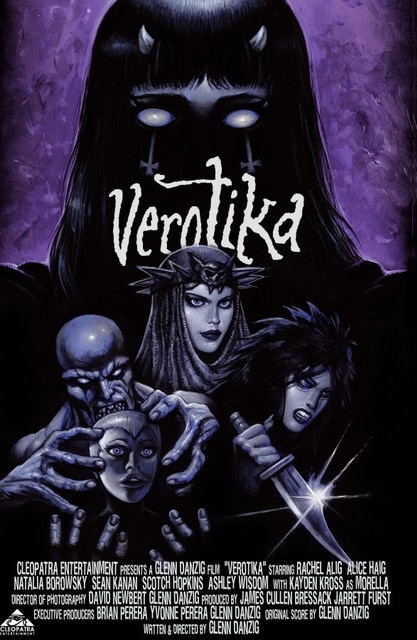
You know, pretty much every review I have read so far of Glenn Danzig’s ‘directorial debut’ Verotika has started with a disclaimer: love the Misfits, been a big Danzig fan for years, and so on and so forth. I could do the same – the handful of riffs playing in the background in some of the scenes in Verotika are the only tolerable elements available here – but this seems like needless lip service at this point. The thing is, with an estimated budget of one million dollars, Verotika has somehow managed to look like a trembling onanist snuck into a second-rate strip club with a camera phone. Perhaps this is what happened; perhaps the real Verotika has been sunk into the foundations of a bridge somewhere, to be rediscovered next century, at which point all will be forgiven. But we can’t assume that’s the case – we have to deal with what we have. So the mystery remains: how did a professed lifelong horror fan with a reasonable indie-land budget and bags of potential manage to crank out a film of such questionable standards? Why didn’t anybody say? Do boobs cause insanity?
Verotika is an anthology film. This would ordinarily mean that there are three individual stories enclosed within a framing narrative, the latter of which we – sort of get, in the form of Morella (Kayden Kross), a sort of slinky female demon who sometimes addresses the audience face on by speaking to camera, and sometimes seems to be staring into the void, or at least off to the side somewhere. Maybe the fourth wall moves, like everything else on set. Anyway, after pushing someone’s eyes out for reasons best known to herself, she introduces the first story: actually, the very first story is the only segment which most closely resembles a narrative of any kind, even though it doesn’t make a tremendous amount of sense. Is this what the Verotik comics are like? Only I seem to remember that there are a lot of horror comics with femme fatale characters, but they rather exceed this kind of caper. You’d only need one page.
Story one – The Albino Spider of Dajette – is ostensibly set in France; this means that an American cast have been tasked with speaking in ze French accents, fucking dreadfully, whilst tremendous care has been taken in other respects to ensure incredible levels of plausibility, such as banging out a photocopy of the word ‘SORTIE’ to stick above a cinema ‘EXIT’ (though sadly forgetting that the French word for Police is not ‘Police’ – oh, and we see the words LOS ANGELES too). So the Dajette of the story title has eyes for nipples for some reason, and when a would-be beau runs off into the night when Dajette’s rack begins staring back at him, her boobs cry tears of hardship, alerting a nearby CGI spider who turns into a spider-creature thing, soon thereafter going on a killing spree on Dajette’s behalf, though this doesn’t make much sense as it seems to actively make her life worse. Dajette responds to this nightmarish situation with all of the acting prowess of a woman trying to remember her multiplication tables. Wigs steal show, spider eventually gets defeated (and I’m not apologising for spoilers here, sorry, None of this is my fault.)
Story numero two: we are back in the US of A for what looks like an erstwhile Blackie Lawless-meets-80s-Nikki-Sixx, albeit a female (Rachel Alig), who runs around stealing faces from hot young women so she can wear them herself because she has some very, very mild scarring which is far less noticeable than a detached human face. I never realised you could peel off a human face intact with a small blunt knife, by the way, nor that simply draping it on your own face would work, but perhaps this factual oversight is the wrong hill to die on here. So this ‘Mystery Girl’, when she isn’t nicking off with faces, spends some time careering around on stage like a dervish at a nearby strip joint; I was less fascinated by this than I was by the amount of strippers in other parts of the club who seemed to keep dropping all their money. And the largest part of this segment consists of strippers; as at several points in Verotika, I was left with the sneaking suspicion that Danzig started with some strippers and panned back, hoping that at some point this would accidentally encompass a film. The fact that he so obviously cherishes the ‘stereotypical stripper’ aesthetic – elfin features apart from the lamprey mouth, enhanced boobs etc. – also makes it quite difficult to distinguish one woman from another, but anyway, yeah, Mystery Girl: does she get caught? Does she escape to flail another day? Does she run off into the night? (Do you remember the girl in the Sistinas promo video who can’t walk in a straight line, even – where the hell is he finding them?) Wigs steal show.
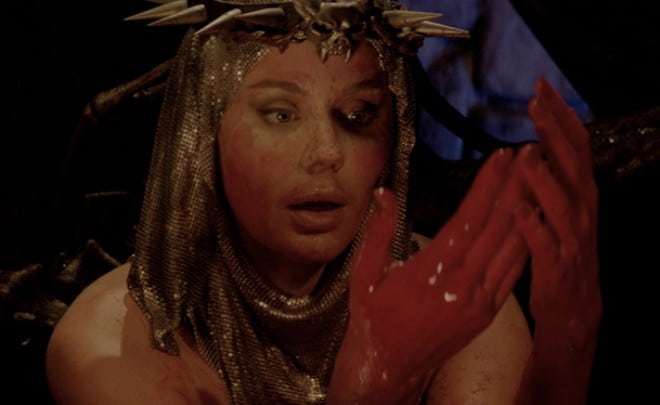
By the time we get to story three – a kind of baffling lamé big jugs Elizabeth Bathory riff – I’d lost the will to live and the fact that literally nothing happens here beyond a lass staring at the backs of her hands as if they’re news to her didn’t exactly engage me further. That’s it. A countess bathes in blood like you-know-who; there’s no story, just a few blonde ‘peasants’ bleeding out so that herself can stave off the ravages of time. That’s it. Credits roll.
If I was feeling charitable, I’d want to suggest that this is all some kind of homage to the weirdest, softcore-adjacent Euro cinema of the 70s and 80s, but I don’t think homage was ever the intention. And even the most rushed Jess Franco ‘we have three days of down time, let’s make a film’ type of project has more charm than this could ever have – better casts, better sets, better production values. Uncle Jess loved a zoom lens, but at least he could operate one. Verotika smacks of a man drunk on the possibilities of crowbarring endless boobs into a film at the expense of atmosphere, narrative or purpose; how you can chug through a cool million and come up with this is utterly beyond me, so considering the amount of nudity given precedence, the only answer is that someone got overexcited, forgetting everything else, or at least choosing to ignore it. It’s an interesting lesson in that respect – this is what happens when one’s ‘vision’ is uncompromised by guidance, objections or solid advice. Verotika is a coarse, boring array of errors which quickly stops being funny. Future cult classic? Stranger things have happened I suppose, but there are far better glorious errors out there.
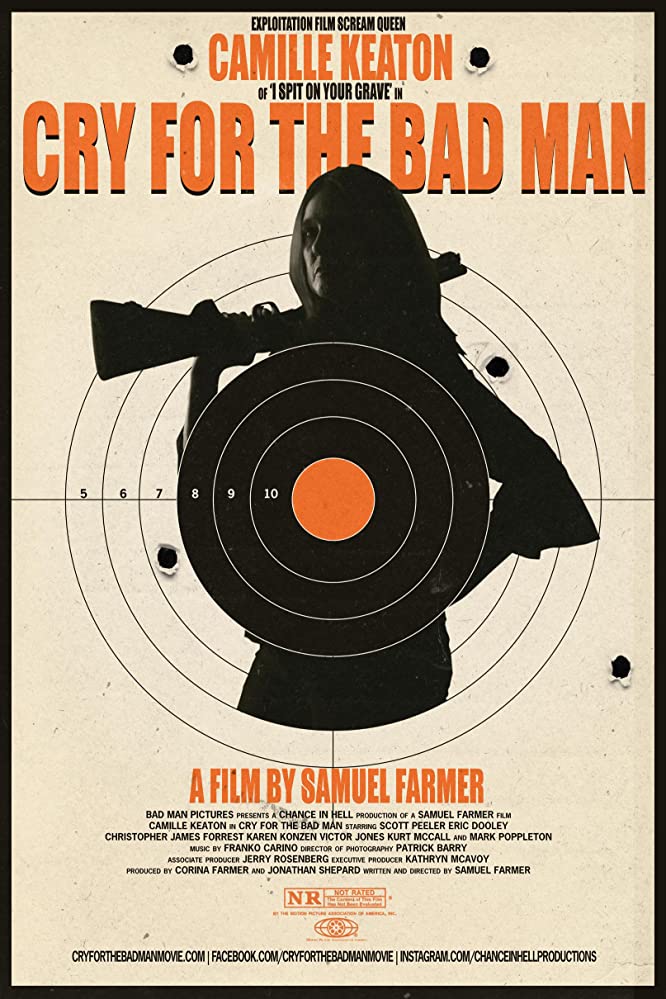
Despite I Spit on Your Grave being over forty years old, it’s probably fair to say that having lead actress Camille Keaton’s name attached to a project is always going to appeal to certain audiences. It’s a fact undoubtedly not lost on the director of Cry For The Bad Man, Sam Farmer, and nor on Meir Zarchi, the director of a direct sequel to ISOYG which, strangely, also came out last year. However, Keaton’s kudos is not enough by itself, and her presence on camera does not mean the film can dispense with all of the other going concerns.
Cry For The Bad Man shows its hand immediately, as we see Keaton’s character – Marsha Kane – cleaning up blood and gore at her home. We move forward by six months: Marsha is still at the house, living alone, but one night there’s a noise outside and the house is approached by three brothers – good old boys Wayne, Derek and Billy MacMohan, who try to intimidate Marsha into selling the house, claiming her late husband had already all but agreed a deal. Marsha refuses, so they threaten to return the following evening to collect on a signed contract. Marsha makes a faint attempt to seek help from the local police, but no dice. Only her grown daughter Helen (Karen Konzen) shows any real concern. She prepares for the worst.
We hear the brothers, over a game of cards, discussing their plans for the night ahead. It seems that Wayne (Scott Peeler) is the key mover and shaker here; the other two are less than keen on terrorising a woman for the sake of it, but Wayne claims that he’s unafraid – a sentiment clearly shared by Mrs Kane. And so, the rather simple set-up for a showdown is set: determined to get their contract signed, the three brothers head back to the estate after midnight, where they find Mrs Kane ready with a panoply of firearms.
In many respects, Cry For The Bad Man is business as usual. A lone female, an isolated location, a number of male aggressors laying siege to it because they can, uninterrupted. However, fundamental things have had to change; Marsha’s vulnerability is heavily signposted as relating to her age here, a big shift away from any intimation of vulnerability through sexuality. It’s mentioned in the script numerous times, just in case there was any doubt. Otherwise, the male aggressors are represented as your standard, fairly two-dimensional, unreconstructed types, though the overblown performances on display here do look rather jarring against a modern, crisp shooting film where the use of light and shade can’t disguise the fact that this is brand-new. It’s something which, say, Rob Zombie understands when he makes his homage-style exploitation films (though of course with a far, far bigger budget). Cry For The Bad Man in some respects seems like an exploitation homage, but against a new backdrop, where some of the aesthetics and styles clash with one another unhelpfully.
Whilst obviously not intended to be a deep and meaningful movie, there’s some slight intimation of a bigger conspiracy at play in terms of land rights in the town but, mostly, that doesn’t lead anywhere. The film largely functions simply as a vehicle for Camille Keaton, who is held in shot staring down a shotgun for what feels like a large swathe of the one hour ten minute running time. She seems to enjoy this, and so far as there’s a good way to point a shotgun on film, she looks fine. There’s little genuine sense of a threat to her though; she’s the star. She’s also in her seventies, so for all the script’s bluster about how she’ll be easy prey because of her age, little comes of this on screen. Add to this some (I assume) unintentional humour – such as a First Aid kit which can be used against shotgun blasts and one which can magically hurl itself up stairs and into shot without being asked for – and the film suffers heavily under a weight of, firstly, its stasis (with little happening) and secondly, its tonal issues, making the viewer want to laugh or disengage at moments which are probably not intended to make us feel such a way.
Cry For The Bad Man has a few components in place which are functional enough, and there are a few fun developments along for the ride, but as nice as it is to see Camille Keaton on screen, the film lacks clout. It isn’t about to break Camille Keaton’s reputation, but it’s not going to do anything to embellish it, either.
Cry For The Bad Man is available On Demand and DVD now.
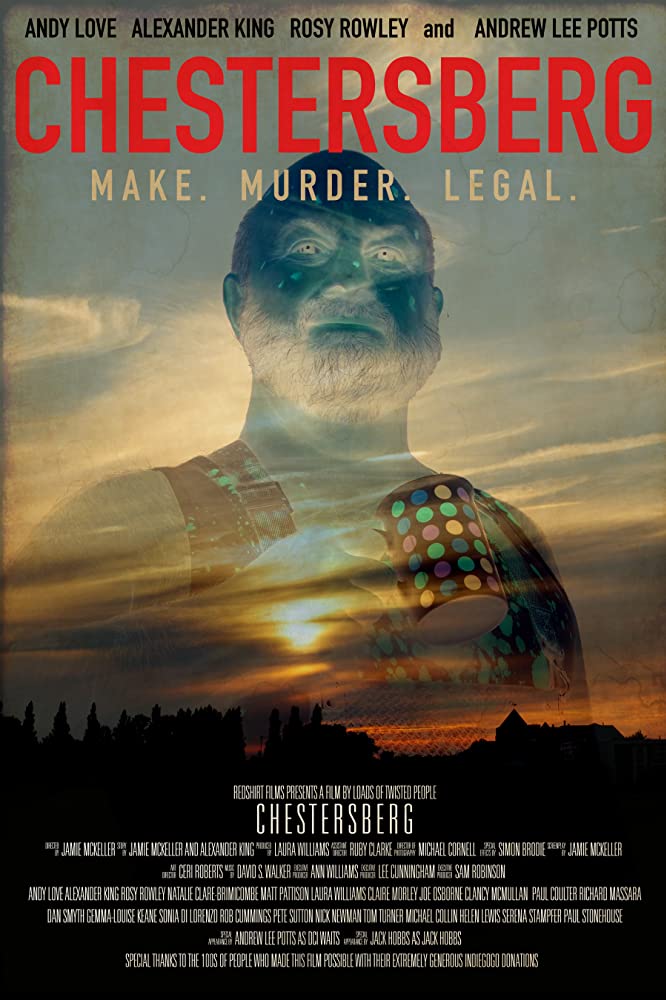
Whether or not a horror film festival takes place online in our ‘new normal’, it’s good to have a film to close the day which knows how to play for laughs and, let’s be fair, make very few demands on us as an audience. So, when the director of Chestersberg, Jamie McKeller, introduced his film as “absolutely ridiculous”, it seemed like just the ticket. I do believe the first spoken word of dialogue in the film is “Battenberg?” That actually tells you a great deal, I think…
Channelling something of Alex Chandon’s Inbred (2011) in terms of style and sense of humour, this film is framed as a mockumentary. We’re told that when Chester Mapleforth (Andy Love) came into a vast amount of money, he decided to establish the village of Chestersberg as an independent state – an idyllic corner of Yorkshire where murder is absolutely legal. A spot of light murder busts stress, avoids a life hemmed in by bureaucracy and improves quality of life. The village residents enjoy it too; in fact, the village is oversubscribed. Chester is ready to tell his story now, so he (more or less) guarantees a film crew that they won’t be murdered while they document life in the town. Various community members, and would-be community members speak to camera about their roles.
For thoroughness, the crew also speak to those that would wish to get rid of Chestersberg altogether: DI Matthews (Alexander King) and his boss DCI Waits (Andrew Lee Potts) have been keeping an eye on the village for some time now, desperate to exploit some error or oversight and get rid of the project for good. Not a bit of it, so far as Chester’s concerned: he wants to expand. But there is the small issue of a traitor in the ranks…and rival villages all vying for ownership over the idea…oh, and this year’s MurderFest, which is always an unmitigated disaster…
To describe the whole ‘murder is legal’ idea on paper, it’s tough to avoid comparisons with the basic plot of The Purge; this just goes to show how completely differently things can be done, even whilst having some basic plot points in common. Chestersberg has very much opted for the ‘splatstick’ approach, missing no opportunities for a gushing neck wound or a lopped limb. Deliberately campy and OTT, with an array of practical FX, people into gore for gore’s sake will be very much at home here. When not scattering the cornfields with limbs, Chestersberg indulges in rather a lot of puerile humour too and, to be fair, most of the jokes land – though some of the throwaway lines are actually the funniest, in my book. The presence of Martin Clapham, a would-be Chestersbergian who can never quite make the grade, made me laugh every time and put me in mind of Peter Jackson’s gross-out-fest Bad Taste in places – in style, as well as content. This is, though, archetypal Yorkshire, and North Yorkshire at that. This means a backdrop of farmland, the streets of York, village greens, and proper tea. Tea gets mentioned a lot in this film, perhaps more than in any other horror film I’ve seen so far. As a preface to a violent death, I suppose you could do worse than a brew.
Whilst there is some sense of this being a stretch as a feature-length, by which I mean the sheer number of gushing necks over the running time, there are enough laugh-out-loud moments and a strange sort of rough charm to Chestersberg to keep things entertaining; yeah, it’s deliberately daft, there’s no grand agenda and it’s overlaid with cartoonish gore throughout, so if you are happy to see all of this play out for laughs, then there’s more than enough to be entertained by in Chestersberg. There’s also someone playing a kazoo in a bin, which is something I find very difficult to argue with.
Chesterberg played as part of the Soho Horror Festival’s ‘SoHome’ virtual fest. For more information, check out @SohoHorrorFest on Twitter.
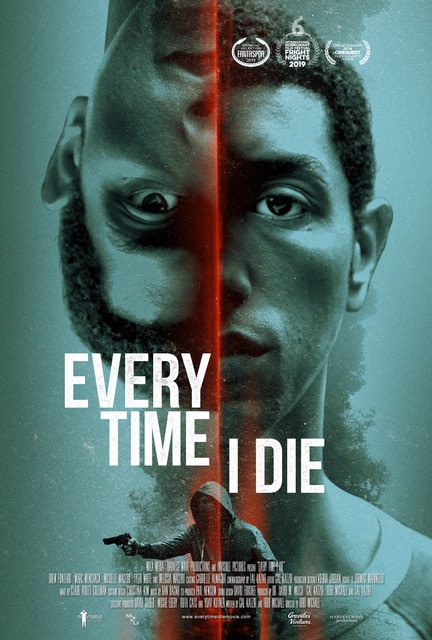
Explorations of mental illness – particularly fractured selves – are not new in horror, but as they go there’s nothing quite like Every Time I Die. It’s a discomfiting watch which splices intense depictions of mental breakdown with supernatural elements, reaching towards a new mythos of life and death. The resulting film is eerie and difficult to predict – something which is a boon, in and of itself.
Starting with a traumatic, but seemingly instantly-forgotten dream, Sam (Drew Fonteiro) is clearly a troubled young man. Waking alongside a woman called Mia (Melissa Macedo), it seems that their relationship is a non-starter; not only can she not leave quick enough, but we soon see why – she is meeting her husband, Tyler, who is returning from a tour of duty. So that’s Sam’s home life; his challenging day job as a paramedic clearly adds additional strain, though his co-worker Jay (Marc Menchaca) is there to support him. Having clearly got through a lot of problems of his own via his own blend of mordant philosophy and medication, Jay does know something of Sam’s feelings of alienation, though for Sam bouts of lost time are growing more and more frequent. Meanwhile, memories of the loss of someone close to him seem to be rising to the surface, adding to his feelings of dislocation and confusion.
What could add exponentially to all of this? Well, how about a weekend at a lakeside retreat with Jay, Jay’s wife Poppy (Michelle Macedo), and Popppy’s sister Mia, and her husband? After Jay talks him into what was only ever a very bad idea, Sam’s time at the lake reveals for everyone the intensity of his issues, so he decides to leave early; however, an altercation at the roadside leads to a sudden, shocking escalation of events. Where a story seems to end, it instead segues into something else, leading onward into a spiralling, overall effective and changeable sequence of developments. There’s a strong, often unpleasant sense of unreality here: time moves erratically, gaps and blackouts alienate the audience just as much as they do Sam, and it’s impossible not to feel for Sam, who comes across as an authentically vulnerable, haunted man, trying to piece himself together whilst also coming to terms with his past. As different characters move to the fore, their plausibility (and the plausibility of the situation suggested to us) is universally strong, which is no mean feat given the direction the plot takes.
Overall, Every Time I Die has a rather languid, sombre tone, which makes the occasional, rapid changes of pace and action genuinely unsettling, jerking the viewer into a sense of alarm. The character of Tyler is fundamental in all of this; he’s an impressively odious, self-serving character whose jealousies and issues precipitate chaos and risk for everyone else. If Sam is an easy character to empathise with, then Tyler Fleming’s performance places him as an excellent antagonist. But there is far more to this film, with its interesting handling of the notions of life and death, ideas of consciousness and personhood interwoven into the narrative (but not unquestioningly presented as a boon; in this film, knowing everything can itself be terrifying). There are some genuine moments of dread here, as well as some redemption by the time we come to the film’s ending.
Whilst the film does feel a little protracted in places, it’s largely successful at what it sets out to do. My resounding feeling having watched the film was that it’s an uncomfortable watch, overarchingly sad, but with interesting ideas, a genuine sense of unsettling mystery and a stylish way of allowing those ideas to play out.
Every Time I Die played as part of the Soho Horror Festival’s ‘SoHome’ virtual fest. For more details, check out @SohoHorrorFest on Twitter.
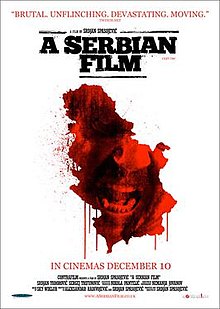
Ten years has passed very quickly in the world of independent filmmaking: in that time, there have been a lot of great films, a lot of not-so-great films, and none (to my mind) which have had so much as a fraction of the impact of A Serbian Film (Srpski film).
It was a film, like many others, made on a shoestring, one which made minimal profit, but in terms of a reputation – well. Through shockingly explicit content which was widely known about before the film’s arrival onto the festival circuit, A Serbian Film generated immense buzz, first screening at SXSW in March 2010 before becoming the common denominator in a series of panics, denunciations and cancellations, followed almost inevitably by outright bans. In many respects, for those already used to shocking content, it became the film to see; as word spread and infiltrated even the mainstream (which it did, if only a little) it built up and up until it was something of a folk tale, or a ‘double dare you’, one to get through, rather than to earnestly enjoy.
In the UK, some hesitant planned screenings, including at London’s FrightFest that summer, were pulled under increasing local and national pressure. By the time the BBFC (British Board of Film Classification) got hold of the film later in the year, it was shorn of a massive four minutes and eleven seconds before it was deemed suitable for viewing. In many respects, this is no surprise: that scene was never going to trip past the censors unchecked. Yet in other respects, the BBFC’s itchy trigger finger led to scenes being cut for things I certainly hadn’t seen in them; their vigorous pursuit of certain ideas about sexualisation got the better of them here. Meanwhile, as the BBFC were and are vigilant for the merest insinuation of impropriety, we now have a social media platform like Twitter (new and untested then; established to the point of being tawdry now) which has people openly declaring their sexual interest in minors, joining ‘communities’ and performing some agile mental gymnastics to assert that they ain’t so bad, really. Funny old world. A lot has changed in a decade, it seems.
“This whole nation is a victim…”
So what led to the creation of such a divisive film? ‘Torture porn’ had been bandied around as a term for some time by then, but never was the phrase interpreted so literally as here. Director and screenwriter Srdjan Spasojevic could easily have said quite simply that this was the film he wanted to make, and if he pushed the envelop somewhat then, so what? This was never the starting point, though. The much-vaunted rationale behind A Serbian Film was that it was a ‘political’ film. Spasojevic has said that his film was born of anger; it’s also the very antithesis of the kind of film you are supposed to make in Serbia, a country he characterises as being spoon-fed sentimentality and trope. There’s also a sense that, as Serbian cinema is so often funded from overseas, Spasojevic’s distaste for this lack of home-grown film inspired him to make a specifically Serbian film which laid waste to the norm. Well, didn’t it just. In a neat piece of parity, A Serbian Film made its own name abroad; in fact, it was months before the film actually screened in Serbia itself and even then, audiences were utterly bemused as they thought that films presented events as they should be, rather than simply as they are. If this is so, then no wonder they found A Serbian Film difficult to place…
So, okay: the film was born of rage and dissatisfaction with convention; mainstream cinema is bland, and the usual funding streams are riddled with agreed, fashionable social mores. Thing is, that could just as easily be a charge levelled at UK and US cinema, on the whole. I’m no expert on French, German or other European countries’ cinema scenes, but I wouldn’t mind betting it’s a similar picture. Imagining alternatives to the mainstream has always led viewers to more minor genres, films whose own content would very likely disqualify them from widespread approval and promotion. It’s been the benefit and the bane of horror cinema for years. All the same, though, neither US nor European cinema has ever gone as far as A Serbian Film in terms of content, despite coming from the same place, of wanting that alternative to the jaded and the saccharine. And why not?
Something else which has long been doing the rounds, again as promulgated by Spasojevic, is the idea that A Serbian Film is a ‘political allegory’, and thus it can justify its graphic narrative along those lines. Akin to another political allegory movie, GyörgyPálfi’s Taxidermia (2006), it’s perhaps telling that the political allegory on offer depends to such a large extent on gross-out moments. My initial response to arthouse-porn-film-as-allegory was sceptical; ten years on, it’s sceptical still. I just don’t think some of the justifications match up with the choices of content, like you can pass off child rape by simply saying ‘it’s symbolic’. But, in the interests of balance, there are allusions in the film to Serbia’s standing in the world after the Yugoslav wars: Maria responds to the mention of filmmaker Vukmir by saying ‘he sounds like one of our guys from the Hague [war crimes] tribunal’. Vukmir himself justifies his project by saying Serbians can live and suffer vicariously through seeing it; Spasojevic has said that he sees his film as an equivalent to American cinema post-Vietnam, a means of exploring national trauma. Perhaps. Ask any number of film fans, and they’ll have a different idea on A Serbian Film and the efficacy of its political subtext. But whether a potent allegory or simply an exercise in pure nastiness, the film thrived chiefly on its notoriety: it’s a decidedly dismal film – artistically dismal even – where a decent enough man is hammered repeatedly into the ground by circumstances beyond his control. Only he and Maria seem in any way palatable; everyone else is the film is a caricature or a monster, or both. A Serbian Film was clearly designed to press buttons and it did so, so successfully that it broke through into mainstream media coverage, with British newspaper The Independent rhetorically asking if A Serbian Film is ‘the nastiest film ever made?’
“That’s the cinema – that’s film.”
My suspicion is that, in common with Pascal Laughier after the success of Martyrs (2008), there was simply nowhere else for Spasojevic to go after A Serbian Film. When you have gone that far, in your debut film no less, then where’s left? How do you follow that up? If you attempt to push things even more, then for one, you’d struggle; it’s also likely that you’d increasingly irritate audiences who might feel that they were simply being dragged through atrocities yet again for the sake of it. But if you radically dial down your approach and your style, then you could just as easily alienate people attracted to your extremity in the first place. It’s a tough one, and this is just one facet of the trials and tribulations impacting upon filmmakers in the current climate.
Ten years on, it’s interesting that the film is still so neatly divisive: Rotten Tomatoes has it at 2.5 stars out of five, whilst IMDb currently rates it 5.1 out of ten. It’s pretty much straight down the middle. A Serbian Film evidently isn’t a film which you have mild opinions on, certainly, and including such content is always a hell of a gamble with prospective audiences, a love or hate scenario. Risk and reputation intersect in this film. However, if (as I suspected) A Serbian Film was in some ways intended to be a calling card of some kind, a name-making film which made everyone sit up and pay attention, then it turns out that I was wrong. I had thought that, even were A Serbian Film to haemorrhage money, which it apparently did, it would nonetheless get everyone talking about Spasojevic; once indie film had lit up, the filmmaker’s notoriety would assure him a glittering career. And yet, in the decade since, there’s only one directorial credit to his name – an underwhelming entry in the ABCs of Death (2012). Perhaps Serbia is an prescriptive place to make films and is completely sewn up, just like the director said. There is a project currently in pre-production however, currently linked to Unearthed Films in the US. Titled ‘Whereout’, it’s described as a horror Western: little else is out there at the time of writing, but it would be interesting to see Spasojevic back at it, as regardless of your opinions on A Serbian Film, it’s by no means a badly-made film. It is a shame that he hasn’t worked in the past eight years whilst people with far less talent go on cranking films out, year after year after year…
I suppose that, whatever your feelings about A Serbian Film and whether or not those feelings have changed over the intervening decade, the fact that it persists and is so well-remembered by the majority of people who have seen it says something for its merits, after all. Alongside films like The Human Centipede and Martyrs before it – although these films are clearly hugely different from one another – A Serbian Film represents something about horror at that time, when a desire to escalate the brutality seemed to take hold of the scene for a while. As with all things, the wave has since rolled back; there’s less emphasis on shock and ordeal now, at least to those levels, but the unremitting pursuit of the ugly did lead to some interesting, memorable cinema. I do think that A Serbian Film is both of those things, wherever it might be on the axis between style and substance, and I’m sure it will continue to be talked about for some time to come.
It was rather difficult to know what to expect from a rather unprepossessing title like The Shed; it doesn’t give a great deal away, does it? I half-wondered whether it was going to be a straight-up horror comedy, but in actual fact, this is a surprisingly sober tale of teen angst, where the horror elements are often kept on the down-low – at least, until the final act comes around. Whilst there are moments of dark humour, these are few and far between. Horror comedy, this ain’t. It’s typically rather more subtle than that.
The film starts with a man getting stalked through some woodland by a vampiric creature (and we’re talking ghoul, rather than aristocrat here). The man, terrified, struggles to defend himself, but it’s too late: he gets ‘the bite’, and we all know what that means. However, in what’s perhaps a nod to Nosferatu the Vampyre, the creature has misjudged the dawn and – when the sun hits him – burns up. The now decidedly sun-averse victim escapes and flees the forest, running for the nearest shelter: this just so happens to be a garden shed alongside a nearby house.
Inside the house, teenager Stanley (Jay Jay Warren) is just as averse to the daylight, but largely because dreams of his now-deceased parents quickly dissolve and all is apparently not well at home. Living with his somewhat deranged grandfather, who is quick to remind him that he’s the only adult standing between Stanley and a return to juvenile hall, Stan also has to contend with bullying schoolmates (supporting the great cinematic tradition of representing the American high school system as a semi-feral hellscape). Sure, Stan has a best friend – the equally put-upon Dommer (Cody Kostro) – and a somewhat estranged girlfriend called Roxy (Sofia Happonen), but Stan’s life is represented as pretty precarious.
It’s not long before Stanley notices something amiss about the shed, though. Assuming a would-be burglar is hiding out in there, he sends his dog in to check it out; this isn’t a winning move, and the predictable happens. Seeing that this is no ordinary intruder by any stretch of the imagination, he has the issue of trying to work out what to do for the best. In some respects, as Dommer points out, this creature has the potential to do them a few favours; in others, it’s a burden and such a damaged boy is not best-equipped to deal with it.
Now, there are some plot puzzlers here: you may well find yourself wondering why Stanley doesn’t do a few fairly obvious things to rid himself of the creature in the shed, given he does do other, scaled back versions of them. In other respects, there are unanswered questions and it would be interesting to know more about the particular version of vampire lore used here, as some of the things which happen don’t quite ‘fit’ with received wisdom on cinematic vampires. However, in other respects, this film gets a lot out of what is, in many respects, a very simple idea. Mainly, this hangs together because Jay Jay Warren does a good job, and it’s hard not to warm somewhat to Stanley as this all progresses; he is a sympathetic character who keeps his performance fairly low key. Overall, The Shed knows how to handle its economical idea, and doesn’t take the most obvious paths through its plot – either a gore fest, or playing for laughs. This shows that there is some consideration here for keeping things more character-driven and understated, with ‘the shed’ itself often on the periphery of the goings-on. Actually, in a few respects it reminded me of Deadgirl (2008): two disadvantaged teens, a mysterious creature and a means of escaping from their dreadful day-to-day lives via that situation.
The Shed does slow to a crawl in places, before a final act which is far more rich in horror aspects (right down to a couple of mostly harmless clichés) but all in all, these minor misgivings aside, The Shed is fairly well-pitched and executed, a largely diverting and in places rather original coming-of-age horror.
Signature Entertainment presents The Shed on Digital HD from May 11th.
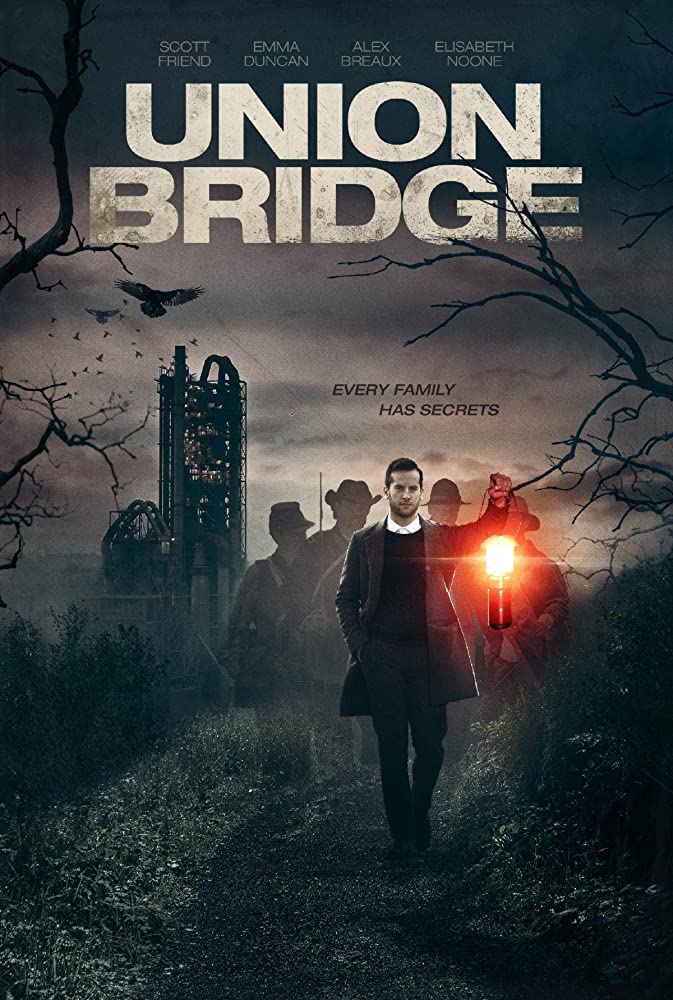
The phrase ‘Southern Gothic’ – as evoked in the press materials for Union Bridge (2019) – is both wonderfully evocative and a big promise to fulfil, for any project. With its associations with ominous, heady Southern locales, flawed individuals and sinister subtexts, it clearly offers great potential for any movie. Union Bridge certainly takes a share in some of that potential, though its emphasis on atmosphere over explication may alienate some viewers. Underpinned by mood rather than narrative, this is a minimal, oft-times perplexing but nonetheless striking film.
In an isolated Maryland town – the Union Bridge of the title – prodigal son Will (Scott Friend) has returned, after a long absence living ‘in the city’ has left him feeling burned out. He returns home to his mother’s house – a mother whose key focus is to rehabilitate her son’s belief in his family name. For whatever reason, she’s displeased with the associations his father brought to the Shipe family before his death. She expects better of Will – and indeed, it seems as though this is a prominent local family, factory owners with a hand – at least historically – in politics. Will clearly has a lot to live up to.
Being home again is, for the most part, what he would expect with friendly, if constrained reunions with people from his past. However, one family in particular seems to have a lot more going on. Will initially passes his old schoolfriend Nick Taylor as he arrives back in town: Nick (Alex Breaux) is seen carrying tools, seems distracted, and as Will finds out, he has been going to a location on the outskirts of the town to dig ‘for gold’ on a nightly basis, after having visions of buried Confederate treasure. The audience see more – that there is some sinister connection with the Civil War-era, where plans were once made between ancestors of the Taylors and Shipes to commit a crime, a crime which led to betrayal and secrets.
As the days go on, Will gets more involved with the Taylors, becoming romantically involved with cousin Mary (Emma Duncan) – a sensitive soul who has taken to some kind of Wicca-lite to help her deal with troubling visions and dreams of her own. There is clearly something lurking in the history of this place, and soon Will, too, finds himself drawn to whatever must be hidden underneath the ground, seeking closure from something he barely understands himself.
One of the unusual things about Union Bridge is that the human drama unfolding at its heart is frequently dwarfed by the natural world which surrounds it. It’s almost as if, no matter how crucial Will’s journey of self-discovery is to him, it’s only a small facet of life at large. There’s a sense of of people and their drama adrift in an impassive landscape, their stories playing out as just small fragments of much larger stories. The film is artfully shot, with lots of aerial shots and static shots, emphasised by lots of natural light – although the factory stands out like a beacon, overshadowing everything in the town, even the cemetery. As for the characters themselves, there’s very little dialogue. In fact, people’s conversations are sometimes muted altogether against the rest of the soundtrack, adding to the impression that human endeavour is very minor in the grand scheme of things. The ground beneath them seems to be a fundamentally important thing here: characters are left for dead in the soil, or carry it under their fingernails, or recline on it, or have it on their clothes. It is a fixation for several characters – Nick, and then Will, though other characters take an interest in it, too.
However, the way in which the film dwarfs its central characters’ preoccupations and strips back the amount of exposition on offer makes the film very plot-lite, and this will almost certainly divide the audience come the end of the film. Atmosphere is a tricky thing to generate in a low-budget movie: director/writer/producer Brian Levin has certainly achieved it here, but whether through intent or by happy accident, it has meant that the aesthetics overwhelm any narrative development, with the film taking a very attractive, but nonetheless convoluted route to its close. For me, some more integration of the Civil War era storyline would have brought things together in a more satisfying way. Overall, however, I did enjoy the experience of watching this film, and – particularly given the director’s previous writing credits are almost exclusively zany comedies – this is an interesting example of brooding melancholy.
Union Bridge arrives on DVD & VOD platforms on May 19th 2020.
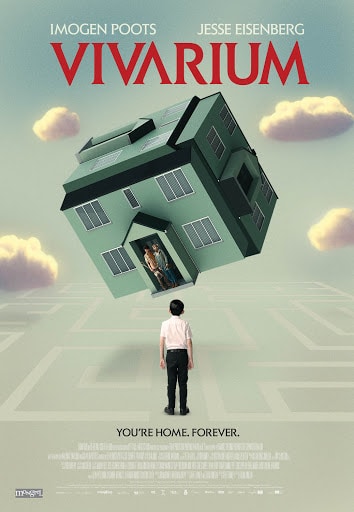
Vivarium (2019) has the kind of incessant, weighty atmosphere which sticks with you; it riffs on the horrors of anonymous suburbia, taking the idea of the family and the joys of the property ladder to a hideous extreme. To accomplish this, it opts not to give the audience all the answers, something which has apparently been a source of frustration for some viewers. I can appreciate that; a little, just a little more explication would have been welcome here. However, overall this is a very engrossing film which accomplishes a great deal.
Gemma (Imogen Poots) and boyfriend Tom (Jesse Eisenberg) are a young couple looking to buy their first place together. To this end, they pop in on an estate agent in town and meet the decidedly strange Martin (Jonathan Aris). Martin tells them about a new development, called Yonder, out on the edge of town. He offers to take them there for a look; they agree, and follow him there in their vehicle. Yet, just after showing them around Number Nine – one house among many absolutely identical ‘new builds’ – Martin disappears. Tom and Gemma try to leave themselves, but Yonder is a maze, and try as they might, they keep on rolling up outside the house they’ve been to see. They run out of fuel and have no option but to stay overnight in the house.
The next day, there’s been a delivery – food and basic toiletries. Then, another box arrives, containing a baby boy. ‘Raise the child – get released’ is the instruction printed on the box. As luck would have it, there’s already a nursery in the house – blue for a boy too – but it’s quickly clear that this nameless child is no ordinary child (or at least, he’s somewhat worse than other children). He grows at an abnormal rate. He emulates Gemma and Tom, but does not seem to understand human emotion. He screams until his basic needs, such as for food, are met. Gemma has grudgingly accepted her role in all of this, whereas Tom has retreated into himself, spending his days digging in the garden for what he thinks must be a way out. He wants to abandon care of the child, to see if this will draw out whoever it is that’s watching and controlling them, but something in Gemma makes her defend him. After all, perhaps if they successfully raise the boy, they’ll be able to go home. Life becomes a surreal routine.
The boy (Senan Jenkins) is, if I may, an effectively creepy little fucker; he disappears off on his own regularly, and seems to be in contact with whoever it is that’s behind it all. He returns one day clutching a book which is printed in some unfathomable language, and he obsessively watches the strange, monochrome patterns which pass for TV programmes in this place. Gemma tries to find out more about him, but she’s unable to; he has the mastery of the place, whereas she can’t ever keep up. Eventually, though, as the boy grows, she has to take desperate measures.
Do we discover what is going on here? Nope, not as such; the film’s key strength is in its strange, unsettling symbolism, and from the moment we see a cuckoo pushing a chick out of a nest at the beginning, that symbolism is pretty blatant: the grim anonymity of suburban life, the monotony of child-rearing and the impact on people who opt into all this. The notion that, after raising the boy there could be the opportunity for ‘release’ is an idea which is also explored, as what form this ‘release’ could take is disputed. The grinding tedium and hard work which Gemma and Tom are faced with here is also very unsettling, the environs oddly menacing. The sense of isolation here is effectively-wrought, and the fact that the child clearly knows a lot more than he’s letting on keeps the audience on the same level as Gemma (primarily), as it’s she that the child leans on most, exploiting her maternal instinct in order to thrive. It’s just as bleak when the child needs her no longer.
Some intriguing developments in the final act of the film beg far more questions than they ever answer: the film feels somewhere between Under the Skin and Paperhouse, sacrificing the expected denouement to pose one final question. However, overall the film is an effective, aesthetically-rich horror yarn, and I quite enjoyed the sensation of being dwarfed by whatever the hell is going on here. Definitely a winning choice for these days of social distancing.
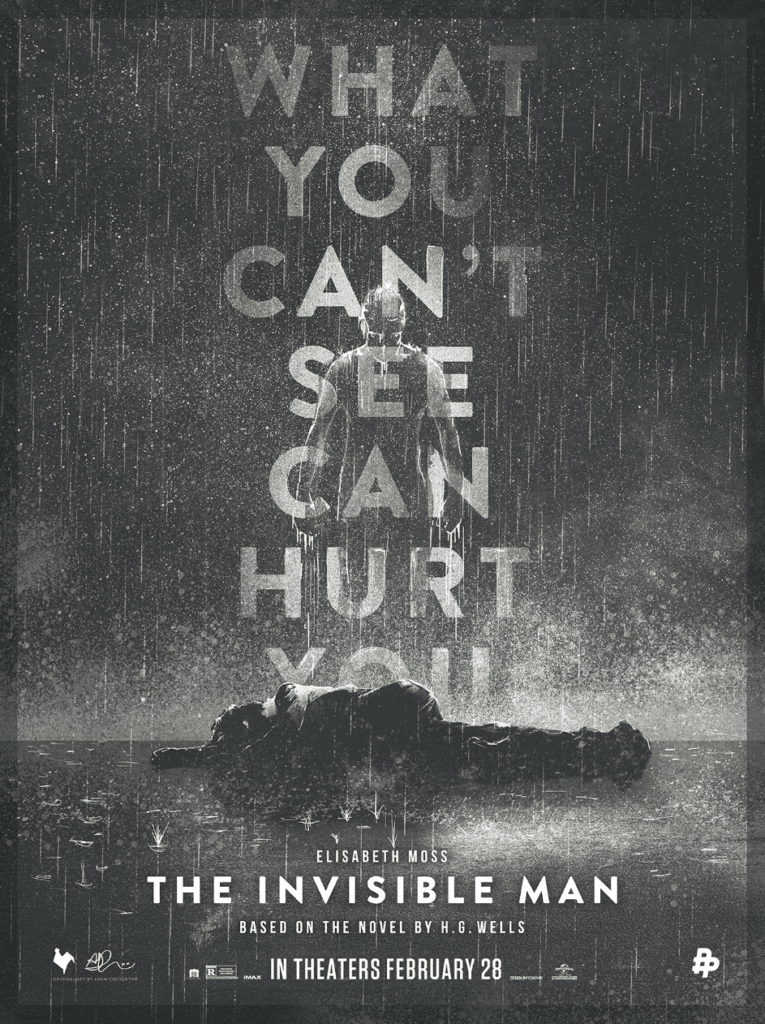
At last, we have up-to-date evidence that it’s perfectly possible to make a new version of a classic story that neither tinkers unnecessarily, nor departs entirely from the tone and content which made the story so good in the first place. Leigh Whannell’s take on the H G Wells story of The Invisible Man retains the paranoia and uncertainty which runs through the 1897 tale, and certainly keeps the spite and unreason of the invisible antagonist, but by re-positioning it in the 21st Century and exploring an all-too-real subject via its central conceit, the result is an intense, fraught and almost panic-inducing story. I’m recommending it, with the proviso that the level of stress it caused was at times quite unbearable.
Cecilia (Elisabeth Moss) has all of the outward appearance of wealth and comfort, one of many, many disruptions which the film offers up from the earliest scenes. It is quickly revealed to be a gilded cage, and she is planning to leave her partner, Adrian (Oliver Jackson-Cohen); that this needs to take place in the early hours, after drugging him, tells us neatly that he is someone to be feared. She successfully gets out after the film’s first watch-through-hands sequence, hitching a pre-arranged lift with her sister to a safe house, the home of her friend James (Aldis Lodge) but the impact of her trauma upon her has been extreme. She is damaged; she fears that Adrian will come for her, and she is too scared to leave the house.
Perversely, news of Adrian’s suicide a few days later offers Cecilia the chance to start rebuilding her life; so successfully does Moss enact being a deeply damaged abuse sufferer, that you can have no qualms about celebrating the relief she so clearly feels at the news that Adrian cannot hurt her again. Remembering her in his will, Adrian leaves her the proceeds of his lucrative specialism in optics, but there are conditions, as stipulated by his brother Tom – the nominated executor of his estate. If these things seem too good to be true, then truly, they are. Cecilia begins to hear things, see things which do not make sense. She interprets this as showing that in some as-yet inexplicable way Adrian has not left her; her loved ones interpret this as evidence that she is struggling to cope. The evidence begins to mount: just enough to make her doubt her own mind at first, the silent, mounting assaults on her strengthen and change, soon impacting upon others around her.
Cecilia’s battle to make people believe what she is telling them is, again, testament to Elisabeth Moss’s performance throughout this film; in less capable hands, a woman deliberating on or indeed struggling with an unseen assailant could be utterly flat, even laughable, but it’s not so here. Essentially acting her way through a sci-fi spin on gaslighting, she is deeply sympathetic and plausible, and the decision to frame this as a woman leaving a partner – and what that partner is willing to do to punish this ‘crime’ – is an inspired one. That said, anyone who has been in an abusive relationship, go forewarned; this is not easy viewing. The means may be extraordinary, but the behaviour (and the fallout) is disturbingly feasible.
Whannell takes other interesting decisions along the way, and another aspect of the film which worked very well was in what it doesn’t do; the audience is invited to become as uncertain as Cecilia. The camera will pan around and hold on a scene in which nothing is happening; whether or not someone is there, we cannot know. It’s also intriguing that Whannell dispenses with the original story’s garrulous invisible man, where Griffin narrates his own story, makes requests, makes threats and ultimately holds sway over his unwitting host via language. In 2020, our invisible man is almost mute. This adds a great deal to the sense of risk, of never ‘knowing’ what is there. Layered over all of this is an incredible, ominous Benjamin Wallfisch score whereby the music suggests threats which happen – or don’t. Aurally similar to some of his work on Blade Runner 2049, the heavy, atonal soundscape is absolutely integral in the design of all this tension.
The Invisible Man shows us a person being broken down into component parts, before, slowly, composing herself from scratch. Not everyone will enjoy the redemptive moments but, for my part, I thought it all worked well, a needed leveller after an almost unendurable, escalating sense of threat and powerlessness. It’s absolutely the best thing Whannell has ever done.