Hellraiser III at 30

Time flies, and it certainly doesn’t seem like three decades since I scored the poster for Hellraiser III: Hell on Earth from the local video shop, back when you could ask nicely for posters at the end of their release run and – if the member of staff took mercy on you – you could furnish yourself with a diverse array of wall art, to the detriment of the video store’s commercial waste (this was some time before widespread recycling). The poster was displayed proudly in my pre-teenage and teenage bedroom for years. Pinhead’s snarl sat tight through many of the milestones which followed – like exams. He even lasted as long as it took for me to move out – staying behind to snarl at nothing much, before finally being ousted years later.
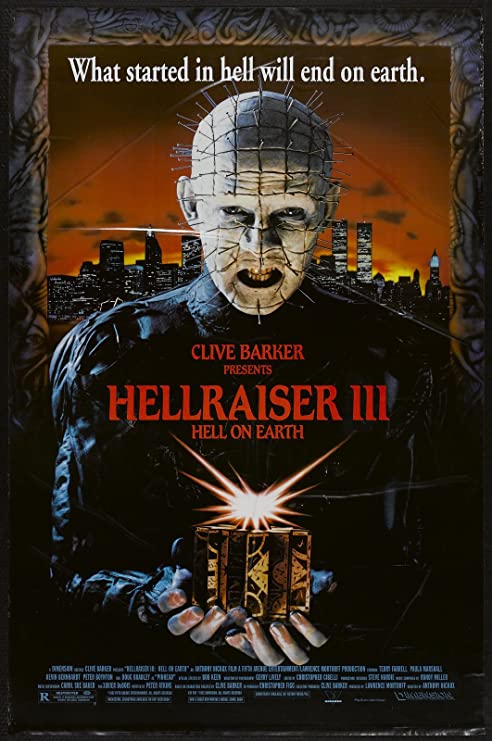
The funny thing is that I liked the aesthetics of the poster just fine, but even to a kid, it was plain to see that Hellraiser III was a significant gear shift (and I didn’t get to see the film until some time after the poster was up, if it matters). It was and is an enjoyable enough film with some great scenes and interesting plot developments. It doesn’t feel, however, like one which has much in common with either of the Hellraiser films which preceded it, and as more and more time has elapsed – as more and more sequels of varying pedigree have emerged – it seems ever clearer that this was a parting of the ways. Rather than chancing a continuation of the dour, grimy, murky and very British nightmares of Hellraiser and Hellbound, Hellraiser III instead offered a slick, savvy, modern spin on the mythos, one which sits quite uncomfortably with its forebears; all of the subsequent films, each reaching for different arenas, themes and focuses, seem to have offered a series of diminishing returns. The Hellraiser rights now pass from hopeful team to hopeful team, each of whom has presumably had utterly earnest ambitions for this now classic array of cinematic monsters, but since Hellraiser III lifted the veil on the Cenobites for good, it’s never quite worked – certainly never as well, or in the same way, as it worked in the 80s. Perhaps audiences would inevitably have reconfigured their relationship with Pinhead and friends eventually, as familiarity always develops over time. That’s simply not something we can go much further with, though; we can’t say with certainty. As it stands, Hellraiser III was the film which brought us the sea shift.

The Pillar of Souls: Pinhead as Art(efact)

Things start interestingly enough, tantalising at some back story which becomes clearer as the film progresses but, at least based on what we see at first, Pinhead is front and centre here, something which remains the case. After the cataclysm which ends the Cenobites’ attempts to establish dominion in Hellbound, their de facto leader – running with the old idea that even demons have a hierarchy, and presumably middle managers – finds himself enmeshed and alone in what can best be described as a piece of modern art. There were previously some ideas to write a sequel where blueprints for the Lament Configuration puzzle box were used to map a proposed architectural structure, so links between the Hellraiser mythos and jinxed physical structures had been there in the background for some time; a similar idea would be used again in the following film, 1996’s Bloodline. In Hellraiser III, Pinhead – and the puzzle box itself – are now part of a sculpture, a pillar which seems to channel some of the body-and-blood obsessed outsider artists who were in the ascendant at the time – performance artists like Orlan, Ron Athey, artists and photographers like Stephen De Staebler, Andres Serrano and a Modern Primitives-inspired host of consumers who now saw bodies as canvases, art as having new possibilities to provoke. Against all of this, the somewhat-caricatured bad boy club owner, J. P. Monroe (a spirited performance by Kevin Bernhardt) decides to purchase the pillar, and at a steal: there’s possibly some buried subtext here about wealthy people who have no idea about art, in much the same way Patrick Bateman in the Bret Easton Ellis novel American Psycho hangs a David Onica painting upside down, to the great amusement of one of his victims. But the sculpture now belongs to Monroe: fitting right in with the aesthetics of his nightclub, The Boiler Room, it suits him down to the ground.
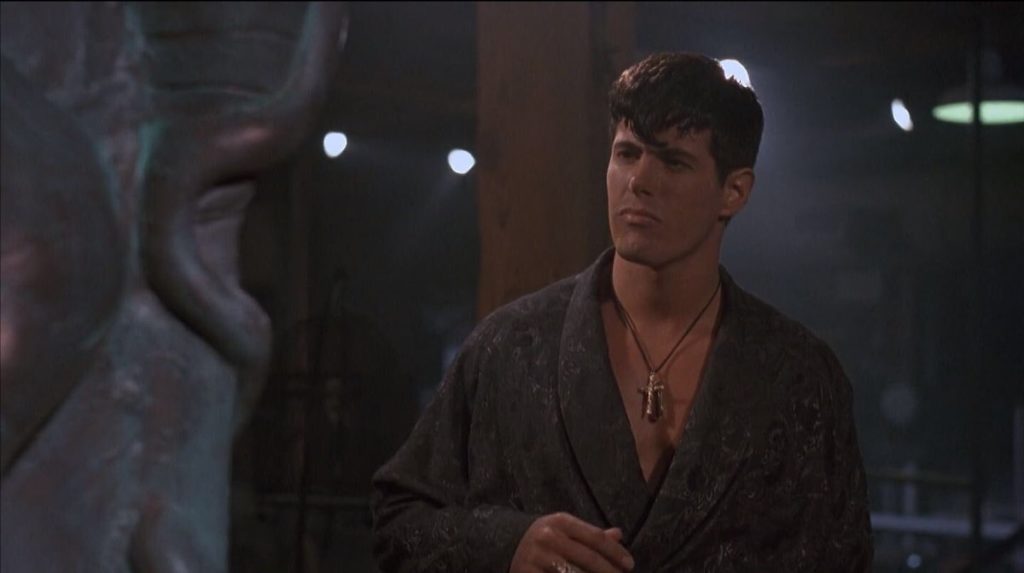
Monroe takes the sculpture home, and what’s notable here is that – through all the different forms he takes during Hellraiser III – Pinhead is actually on screen a great deal more than we’ve ever seen previously. The first two Hellraiser films are extraordinary in the way that the demons who preside over the deals humans strike with them, only occupy a couple of minutes of screen time. They are all the more menacing for that, too – lowering over what unfolds, supplying the rules and meting out the punishments: they don’t need to be there all the time. Their existence is equal to their presence. Come the event where Pinhead has got himself stuck in a pillar, separated from the other Cenobites, he can’t rely on people simply opening the puzzle box out of blind curiosity – at least, not yet. His ‘arena of influence’ is limited to a few feet around the pillar itself, making him temporarily a little more like a vampire than a soul-sapping demon, taking the chance to consume a girl who wanders too near, feeding on her to regain some of his former strength and presence. For anything further, he still needs some help. So he talks. And he talks, and he talks, and he talks. This isn’t necessarily a bad fit with the age-old idea that demons are good at tormenting humans via what they say to them; most exorcism horror films contain a sequence where a demon interrogates and/or humiliates the cleric at the bedside. It’s just strange to hear it from Pinhead here, who by the way really is a little wasted against poor old J.P., a man who doesn’t need much in the way of clever persuasion. Pinhead secures his assistance by making a few vague promises, and convincing J. P. that they are both hedonists, just of a slightly different kind. It works a treat.

This is the second encounter with the box and its tendency to fling chains into people, too: reporter Joey (Terry Farrell) is already hunting down a story after witnessing a Boiler Room clubgoer being yanked apart by these chains; she questions Terri, J. P.’s ex-girlfriend, who had accompanied the victim to the hospital. As Joey investigates, J. P. is getting drawn in to Pinhead’s bargain: bring me more girls, he says, and reap the rewards. Now reduced to something akin to Frank’s fate in Hellraiser – requiring flesh and blood to piece him back together again – Pinhead needs to feed, and his word seems good enough for J. P.

Once freed, Pinhead sees no reason to shut his yap, either, delivering line after line of dialogue about his favourite fleshly preoccupations, soon walking the streets of America with a whole new array of Cenobites (more anon). This gives us some fun scenes, if ‘fun’ isn’t an adjective you’d usually have placed too near to Pinhead in a sentence up until this point: the church scene, for example, where Pinhead flaunts his religious know-how by mocking both the Crucifixion and Communion, is very watchable – even if swapping quiet gloom for a massive stained glass window explosion. However, with hindsight, the overall impact of all this flimflam is to render Pinhead and his pals a little…overfamiliar. Once you film a conflab between timeless demons and modern cops, something of the mystery is inevitably removed – and removed for good. It’s impossible to put the genie back in the box once it’s out; Pinhead in particular becomes a household name and a very different character from this film onwards, but at the expense of his laconic best. It’s perhaps fitting that a character coming into the film as part of a hip art installation spends so much of the film in the company of equally up-to-date companions, wandering the streets and even rocking up in a nightclub. But then, this was always the plan. Hellraiser III was always about expanding the franchise, expanding the audience.

Pinhead for the Masses

After some uncertainty, Hellraiser III was directed by Anthony Hickox who, at that time, was fresh from the Waxwork movies, two films which had realised a modest profile and secured a place in the hearts of a fair few fans. A young director at the time, Hickox was tasked with what seemed to be the impossible: to make Hellraiser into a mainstream franchise, bringing Pinhead and the others more into line with sequel-friendly cinematic monsters like Freddy Kruger and Jason Voorhees, each at the time on six and eight films respectively. Although Hickox is British by birth, Hellraiser III has an American setting and a majority American cast (whilst the team which had worked on previous films was also different in some respects, though retained some continuity). As well as a new, American production company, it is interesting to note that Clive Barker was essentially paid off the project at first; then as now, it’s an incredibly strange (and some may say wrongheaded) thing to try and divorce a unique creative work so utterly from the person who created it. Eventually, the new rights owners came to agree, and then paid Barker another fee, this time to come back on board.

This lack of foresight arguably speaks to a misunderstanding of the subject matter. Another issue came with the insolvency of New World Entertainment at around this time; this created a lull and Peter Atkins’ screenplay sat on the shelf for a while before the project was up and running again. In the meantime, Barker’s attention was more fully on Candyman, a film which more successfully wedded the grimy, dour British style of Hellraiser horror – it was originally intended to be set in Liverpool, UK – with an American setting.

Lots of factors behind the scenes, then, had an impact on the filming of Hellraiser III, and it’s fair to say that the priorities of the production company led to some quite jarring changes to the subject matter along the way, too. Hellraiser III was shaping up to look and feel drastically different to the two preceding films, as an altogether glossier, louder affair, self-consciously tailored towards a young audience; even the poster was unusually colourful when held up against the cold blues and greys of the earlier promotional art. The very presence of a nightclub or a live band seems not to fit into the worlds of Hellraiser and Hellbound; you could easily believe that none of the main characters in those films (well, maybe except Frank) had even been near such a place in their lives. Hellraiser III doesn’t only show us a version of what was then an up-to-date, edgy-looking club, but also new themes: Joey Summerskill is a journalist struggling with the glass ceiling; Monroe is a representation of new, indolent money; poor old Terri is an itinerant hopeful looking to belong, and furthermore we pause to look at war trauma and psychology as well. There’s a lot more to get into here. Whilst Dr. Channard (Kevin Cranham) has a certain level of ambition in Hellbound, it’s not the plausible, relatable, wholesome ambition we see in Joey. The first two films feel much more localised somehow, and much more introspective, only offering up expansive places to explore only from within the box and its machinations. Hellraiser III definitely moves into the wider world, a world which suggests some interesting challenges and developments for the Cenobites. But it’s the new Cenobites themselves which speak most of all to this desire to modernise the franchise, broadening its appeal and speaking to the mainstream…

Hellraiser III: The New Breed

Whilst Pinhead has always been front and centre, the other Cenobites from the first two films are just as well known and beloved of fans, with their own nicknames and followings. And, perhaps part of their appeal was that nothing was really known about them. In the films, very little back story was hinted at – none at all was forthcoming in the first film – and certainly the Cenobites retained a sense of timelessness alongside Pinhead, having only the briefest of epilogues which hinted at anything more. They felt somehow like they could have been around forever, ambiguous figures who abide by certain rules in order to access their quarry for reasons we can’t quite grasp, and their lack of humanity helped emphasise the desperate situations of those who encountered them. Even Frank, himself transformed into an undead being, couldn’t escape his fate, even if he apparently took it all rather well at the end…

Well, even had the original Cenobites been a part of the new script, none of the actors had US work visas at the time Hellraiser III was about to film. And it seems that the production company had other ideas, anyway. Eschewing the rather more timeless Cenobites of the first two films – even if we accept the fact that they do seem to be wearing an extreme version of something you could have happily worn to Torture Garden at around the same time – Hellraiser III introduces several new Cenobites who, if we’re honest, seem to have been brought on board out of sheer necessity (Pinhead doesn’t seem to particularly enjoy being on his own, plus it looks like launching Hell on Earth can’t be done solo). Gone is the sense that the Cenobites have somehow ‘always been there’. Gone also is the feeling that, in order to be transformed into a being of this kind, some centuries-long process has to occur. After all, wasn’t it the Cenobites themselves who talk about things like eternity, heaven, hell, demons, angels? All of these things have a pretty long shelf life, and you’d maybe expect its operatives to have a similarly long pedigree.
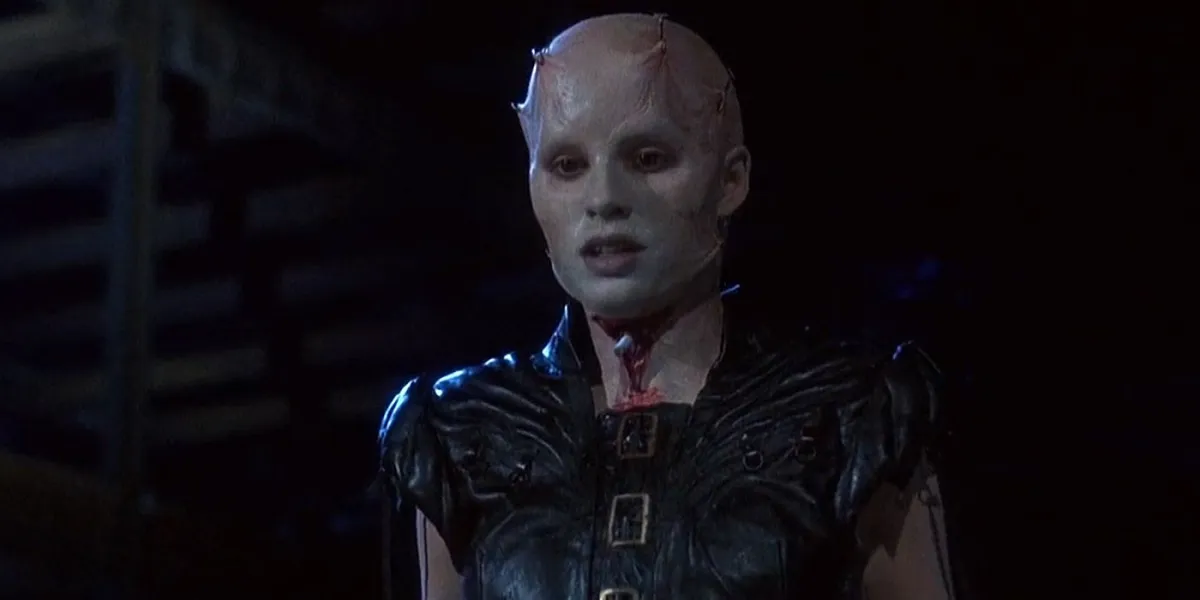
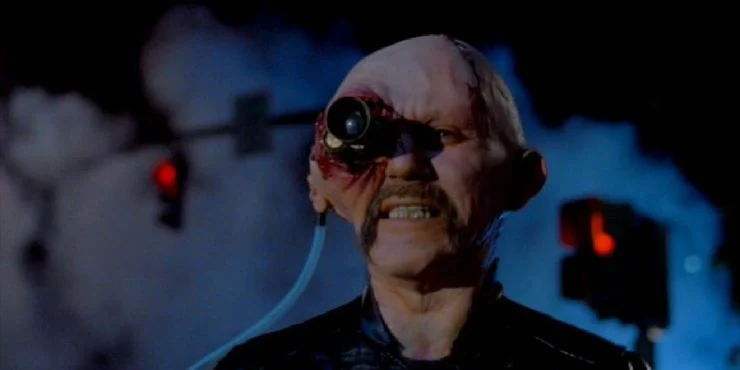
Instead, Hellraiser III makes Cenobites out of whoever happened to be standing in the wrong place at the wrong time; the recruitment process here is very much a fast-track one. Plucking a few of the film’s supporting characters from the streets, Pinhead transmogrifies a bar manager (Atkins), Joey’s media team, J.P. himself and Terri, who is sick enough of sofa-surfing to be talked into getting scalped and modified – an extreme reaction, by anyone’s standards. She also has the ignominious reputation of being history’s softest Cenobite: handed the ability to torment Joey into an exalted state of being, she opts instead to burn her a few times with a cigarette, a heinous torture indeed – which usually happened several times per night before the smoking ban. The rest of the new Cenobites are melded with the technology or other props which mattered to them in life and to be fair, there’s some potential here: it reminds me of Alien³, and how the xenomorph takes on some of the physical attributes of the dog it uses as a host.

The issue is that we always tend to imagine that whatever technology is current in a given moment will be cutting edge for a hell of a lot longer than it ever turns out to be. Equipping these Cenobites with video camera or compact disc add-ons damns them to something far worse than hell – it curses them to look a little daft after relatively few years have elapsed. Sure, they’re part of an interesting time capsule, and as certainly as filmmakers now electively fill their shots with tape players and analogue TVs, in a couple of years we’ll be watching films which ironically fixate on Discmans and first-generation Playstations. It’s going to happen. It’s inevitable. But can Cenobites go on through history terrorising the curious, when they look like they belong to a very narrow window of time? That seems more doubtful. This was, in any case, a decision taken to make the film appeal to its greatly-desired younger, hipper audience, people who bought into this kind of tech at the time. It was reasonably successful, if we go by initial reviews and box office takings; the new breed are also reasonably entertaining and the physical SFX are good (another ultra-modern calling card is the use of some digital effects, which have aged every day as hard as Mr CD has). The film also deserves some credit for getting creative in how the new crew dispatched their victims, even if we have to skip the logic that the Cenobites tended to torment those who tormented themselves, rather than any old unfortunate. In hindsight, these characters remain divisive, too much of a break from the complex mythos for some, perfectly acceptable, grisly set-piece fodder for others. As an addendum, we can only hope that the Hellraiser ‘reimagining’ which is currently in production doesn’t elect to add current technology to its own monsters, else the Cenobites might end up appearing in dog face filters, and just think how all of that is going to look in a few years. Progress is never a straight road.
The Art of War and final thoughts…

Hellraiser III‘s most surprising, and genuinely ambitious new direction was to interrogate the mental impact of modern warfare, which it does by separating Pinhead from his human originator, a WWI soldier, Elliot Spencer (also Doug Bradley) whose mind broke under the strain of the atrocities he’d witnessed. This extends the brief clues which feature at the end of the previous film. Joey, who has some kinship with all of this because she dreams of her own father’s fate in Vietnam, forms a strange bond with the pre-Pinhead Elliot, who seems to want to protect her, and helps her to fight back against Pinhead, who essentially has to fight for his own existence as a separate entity. Again, whilst this plot point could be seen to dissipate the notion of Cenobite omnipotence (or as near as damnit), it is at least an interesting idea, which also provides the film with its heftiest share of substance. Without it, the film is little more than an array of nightclub scenes and a few bad murders which would have divided fans/detractors even more unevenly.

It is, at least, some evidence that writer Atkins had more in mind than the most basic crowd-pleasing scenes, and worked to add something more complex here. That being said, the notion of a squaddie getting his hands on the Lament Configuration box is a little thinly plotted and bizarre; it scatters in some more context for the box itself (the next film would layer this on altogether more thickly) but ultimately, and not dissimilarly to the Nightmare on Elm Street sequels which usually offer a similar amount of closure, whilst not entirely ruling out that there could be more to come, it brings us back to a familiar point. The box is dispatched into some wet cement this time, and order seems to be restored, but – knowing the tenacity of that thing, it’s not beyond belief that it could make its way back out somehow, is it? The other option, of course, is to simply ignore the ending of the last film and go again in a new location with a new cast; this would be the selected way forward as the franchise moved on down through the years, each time with a shrinking budget and diminished set of ideas. It’s a shame, although it’s equally important to note that none of this takes anything away from the strongest films in the now long list of Hellraiser movies which we have.

So how do we characterise Hellraiser III: Hell on Earth now, at a distance of three decades of new films, franchises and ideas, a wave of torture porn, a slew of found footage and a steadily-growing subgenre of technological horror? I suppose, if anything, it all feels a little innocent now – despite the gory tableaux and intentionally graphic scenes which punctuate the film throughout. Clearly aimed at a new audience, and intended to diversify a ‘cult’ mythos which in the eyes of some needed to move away from its cult status, it has a surprising amount of optimism mixed in with equal amounts of cynicism. Someone – perhaps a few people – on the production company team could certainly dream, and there was a hope of a new direction, with more films and a bigger budget should Hellraiser III suffice. Some of this was rewarded when Hellraiser: Bloodline was optioned, but the Hellraiser mythos has had a very troubled run since…the fourth film? Or the third film?

Essentially, this sudden trip through American streets established too great a distance between old and new for many fans, and for these people, Hellraiser III has never quite felt like part of Clive Barker’s vision. Never will. For others, the Cenobites and their world was easily able to withstand a new setting and a few modern touches, and these people appreciate the film for what it is: an altogether more showy affair, with different levels of explication than seen previously. And, at the end of it all, it’s nice to look back and remember how damn excited I was when someone rented the film for me, and I got to finally see how the poster matched up: whilst any film should be able to withstand a fair appraisal, we can tend to be more sceptical these days, something which is worth bearing in mind as we reassess older films. All in all, Hellraiser III may be schismatic, but at least we’re still discussing it, and it does still have its place in the history of what – as the production company rightly pointed out – is now a timeless movie mythos, however we might feel about this film, and whatever followed.

Interview with Offseason director Mickey Keating

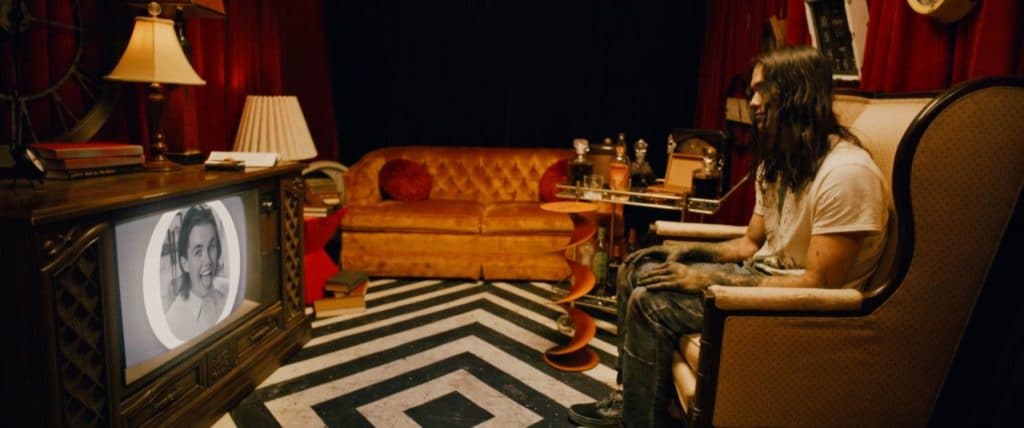
A film which the site covered after its screening at Celluloid Screams in Sheffield, UK last year, Offeason (2021) is about to land on VOD and digital release on Monday 11th, 2022 thanks to the folks at Shudder and RLJE Films. Is it worth checking out? Well, to help make up your minds, you could always check out our full review here, but in summary, this is a visually slick, creepy dose of outsider horror with a distinctly Lovecraftian spin. It comes off as a love letter to certain established filming styles and gives a couple of nods to directors you may already know and love (see below) – so if any of that sounds appealing, then congrats! You have a new film in your watch queue.

Ahead of its wider release, we were fortunate enough to grab director Mickey Keating for a quick chat about his aims and experiences with making the film. Whilst he’s remaining quiet about future plans for now, I’d definitely recommend his work to date, and we hope to be able to bring details of upcoming projects as soon as these are available. In the meantime, over to Mickey…

WP: Firstly, thank you very much for talking to Warped Perspective! It’s much appreciated. To start, I’d like to ask about your filmography to date: you made your first run of feature-length films in quite rapid succession, then you took a four-year hiatus before Offseason came along. In that time, did anything change about the kinds or styles of film you wanted to make?

MK: Nothing really changed, but I definitely had the luxury of being able to take the time and to really storyboard Offseason (and a few other films I haven’t made yet). I’ve always mapped out my films, but this was really the first time I was able to actually pre-edit an entire film with storyboards, and see it before we shot a frame. It’s very surprising how much that helped, and how much the story grew. Then, on set, we were able to be very precise about what we were shooting each day.

WP: You both wrote and directed Offseason: can you tell us how the idea for the film came about? It’s been compared visually and thematically to some great horror directors’ work, notably Carpenter and Fulci – certainly City of the Living Dead jumped out for me. Was an element of homage intentional, and if so, how tricky was it, if at all, to balance with your own style?

MK: I definitely hear a lot of Fulci references for this, but honestly that wasn’t as much of a conscious effort! I suppose when you lean into heavy fog, atmosphere and a seventies inspired production design the comparison’s inevitable. We use some of the same songs that play on the radio in The Fog, so that was a little more intentional. I’ve been very open about my influences in the past, and so I think people just assume that everything I do is an homage to this film or that film.

WP: One of the film’s greatest calling cards is in its remote location, and the contrast between ‘tourist season’ and the real lives of the full-time inhabitants lends the film a lot of its sense of foreboding. What attracted you to this as a setting, or a theme? 

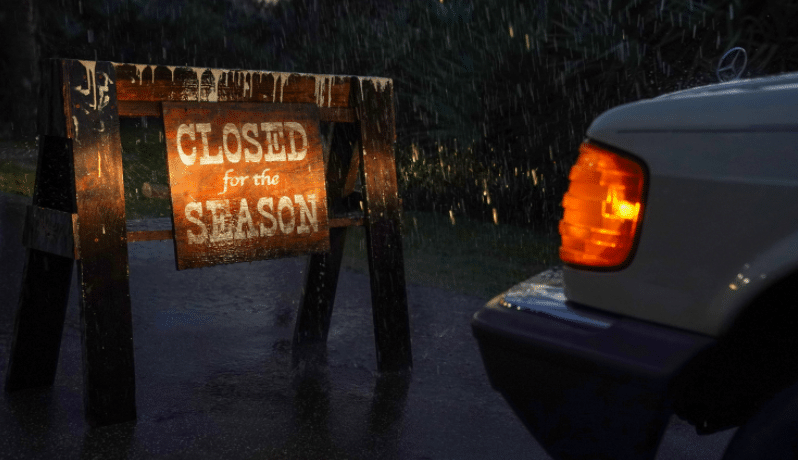
MK: I just love the idea of fading Americana, failing tourist traps, and the disconnect of a place that both relies on, but hates, outsiders. A beach town devoid of life is inherently just very uncanny and bizarre, especially when the weather is stormy and foggy!

WP: Tell us a little about how you came to cast Jeremy Gardner [Gardner has a very, shall we say, memorable role in Offseason]. Warped Perspective has been championing his work for a long time, around a decade in fact – and since before the site was even Warped Perspective, but still known by Brutal as Hell.

MK: Jeremy is a brilliant, brilliant actor. He’s just got such an incredible presence, and is so captivating to watch. I didn’t have any other options in mind for this role, because I knew he’d be so perfect for it. He was also a good sport about all the prosthetics he had to wear, which were super uncomfortable and sucked to have on. He’s a great director and writer too!

WP: Offseason seems unashamedly a horror film; on occasion, directors and writers seem to want to distance themselves from that particular genre, or at least to re-brand their work as something other than horror. What keeps you interested in the genre, and what do you make of the current state of play in horror cinema?

MK: I genuinely love horror movies and find the genre to be such a wonderful vehicle to explore endless themes and stories. Horror goes great with so many other genres too: crime, romance, whatever! I think we’re in a great time for horror movies, and that on a much larger scale, they are being recognized for their artistic value and impact on cinema history. It’s been long overdue. 

WP: Absolute agreement with that! Finally, do you have any current or future projects that you could tell us about?

MK: I have a lot of things in the works, some great surprises, so you won’t have to wait another four years for my next feature!

WP: Many, many thanks for your time!

The Long Walk (2019)

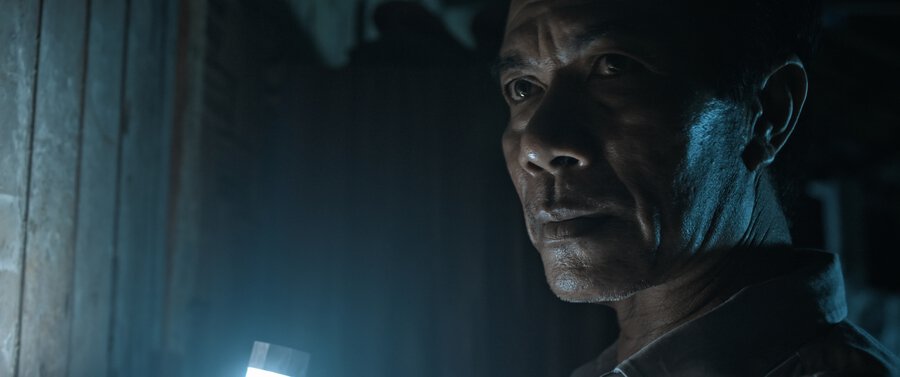
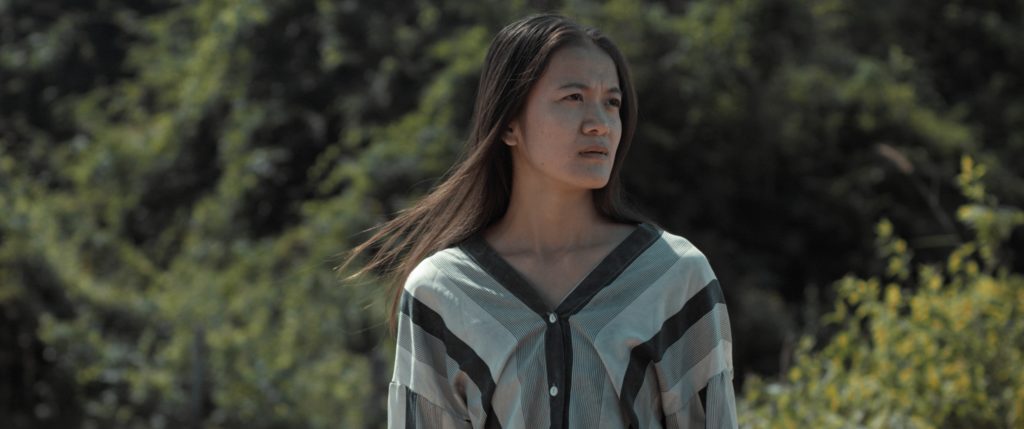
With its sunlit, rural Laotian setting, a series of enigmatic ghosts and intimations of alternate realities, The Long Walk already has a lot of elements and, dare we say, a stockpile of kudos made to draw many viewers to its flame. Add to this that it’s directed by Mattie Do, the much-feted first Laotian female horror director, and it becomes increasingly tough to call any of this into question. But – for all its quiet visual flair and consistently taciturn performances – narrative substance here is increasingly hard to glean, even debatable. If you’re happy to turn your gaze to the muzzy Laotian sun and ruminate on the film’s sadness and symbolism, then fine; this will be more than satisfactory. Other audience members will perhaps struggle, because the narrative strands intended to convey, or at least accompany the more atmospheric aspects of the film begin to knot and fray to the extent that they’re barely there at all. And, at two hours’ duration, this is a distinct problem.

Beginning on the outskirts of a Laos village, an older man – only ever referred to as such in the credits – is digging an old bicycle out of the jungle undergrowth, seemingly to break it up for parts; poverty is one of the clearest and most consistent themes here. It seems that this man is what we’d probably call a medium, but there’s a bit more to it than that; he has another calling, assisting the spirits of unhappy young women to ‘move on’ (which with different handling could have made Yannawoutthi Chanthalungsy’s character very sinister indeed). When an old woman goes missing, government officials take the unusual step of asking him directly if he can help them in their enquiries; he demurs, but when her young daughter returns from the city to keep up the search, he begrudgingly says he’ll help. Add to this that a spectral young woman has, apparently, been mutely accompanying him for the past fifty years, and it’s clear that the supernatural is a fact of life for this man.

In parallel, we meet other characters – namely a poor farming family, where one day the young son (Por Silatsa) is sent from his mother’s stall to help his father work their land. En route, the boy encounters a dying young woman – the same young woman who walks with the older man – and they strike up an equally-mute friendship. It appears that the young boy and the old man are, if not precisely one and the same, occupying a close enough set of timelines that they are soon able to interact with one another, and that their experiences significantly overlap. Observing the boy’s plight as his mother becomes progressively more ill triggers unhappy memories in the older man, these being frequently conveyed to the audience by a close focus on specific items, things which exist in both times and, by-the-by, offer information on the characters themselves. But any expectation that all the secrets will eventually bob to the surface? That isn’t a priority here. Writer and Mattie Do frequent collaborator Christopher Larsen has very deliberately set his jaw against any of that.

At its best, The Long Walk has some gently, deliberately uneasy moments. It’s beautifully shot, lit, and peopled with actors who do their very best to flesh out a careful, minimal script, often very successfully, even if this hinges heavily on multiple brooding, taciturn moments of silence. Where it is less successful, it all feels achingly protracted. As an example of this, the film has elected for an oddly disjointed style where its edits break the plot into disparate chunks. This happens from the very earliest scenes, so it isn’t far into the film before the viewing experience is a disjointed one. Where any story tries to take in aspects of folkloric belief, this is even more challenging; you are held at a double distance from events on screen, or else numbed by the almost imperceptible tread forwards, accompanied by flashbacks (maybe), ghosts and visions. It all feels both busy, and diffuse.

Bafflingly, at least to this reviewer, the film also offers that very fashionable kind of low-key sci-fi which is a) almost negligible, and b) a visual tic at best, which doesn’t seemingly offer a great deal to the plot except to signpost a deliberate loosening of conventional sense. The man has an apparently archaic ‘chip’ under his skin, which essentially means that what he’d use his mobile for, he uses his forearm for. Aside from a couple of other characters peering momentarily at a better version of this tech embedded in their own forearms, and some hints at a technological world beyond the village limits, that’s it. Interesting, vital, valid? Or another spasm-inducing nod to a fashionable visual motif? It’s everywhere these days, and so, so rarely contributes anything much. Likewise, the film’s repeated use of a ghostly ‘sigh’ to signpost that something paranormal, or heavy, or both is around the corner begins to feel awfully formulaic. And yet, even with the use of this little hook, characters, places and events meld together, with things becoming so languid that even its beloved human suffering becomes flat. This may indeed be a tantalising and heartfelt tale to some, but all in all, The Long Walk ultimately feels like just that, a long trudge somewhere, and not much more.

The Long Walk (2019) will be released on 28th February 2022.

Deadly Games (1982)

Review: Chris Ward

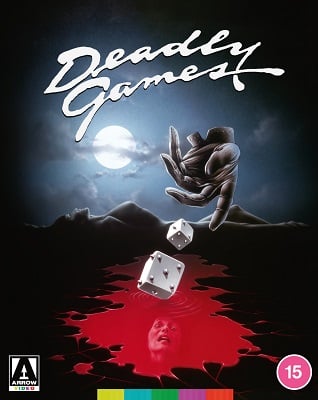
Just when you thought there couldn’t be any more early ‘80s slasher movies for Arrow Video to exhume and give their customary polish to, they bring another lesser-known title to the party, this one being 1982’s Deadly Games. A fairly generic title that doesn’t give much away, Deadly Games is a slightly different beast from your run-of-the-mill teen slashers such as Friday the 13th and The Burning as there are more ‘adult’ themes at play beyond the black-gloved/ski-masked killer creeping about.


‘Adult’ in this case means that the cast are not the usual bunch of horny teens dressing up for a school prom, a trip to summer camp or going on a road trip; oh no, the cast here are definitely of the more mature variety (i.e. in their 30s but not pretending to be in high school) though are just as horny as teens, seeing as most of them are in relationships and are either sleeping with someone else, thinking about sleeping with someone else or are at least open to the idea of sleeping with someone else, which, when you consider the morality play element of your average slasher – the virginal ‘good’ character usually survives – then that casts a different perspective on things, as we are supposed to be rooting for flawed characters.


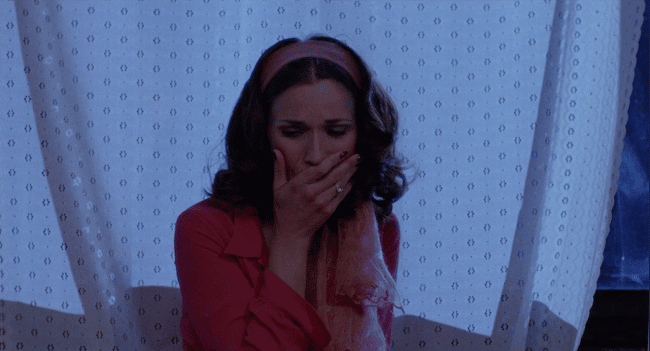
However, being flawed makes them more realistic and relatable and, in principle at least, lifts the material away from being a gory slasher and into dramatic thriller territory, which is pretty much what Deadly Games is. The movie begins in familiar territory for seasoned slasher fans by having a woman arrive home and strip naked in order to go for a moonlit walk, whilst unknowingly being watched by a masked killer wearing black gloves. The thing is, before the killer can get her, she falls to her death through a glass window next to a long drop and so the following investigation initially gets marked up as a suicide, but the victim’s sister Keegan (Jo Ann Harris) and detective Roger Lane (Sam Groom) know it isn’t suicide, as people committing suicide don’t tend to throw themselves through glass windows first; you see, it’s the little details that make this a more grown-up thriller.


Anyway, Keegan and Lane make eyes at each other and do a bit of flirting, but Lane is already married. Nevertheless, they persist and we discover that Lane is not a particularly nice man as he is nasty to his wife – who doesn’t seem to have done anything to deserve the bile aimed at her – and he does sleep around with other women. Doesn’t seem to put Keegan off, though, and as the investigation goes on it turns out that Lane has an ex-Vietnam vet friend called Billy (Steve Railsback) with whom he plays a horror movie-themed board game in an abandoned theatre, because why not? We also see via cut scenes that people seem to get killed whenever the dice in this board game is rolled, and so as Lane, Keegan and Billy become a bit of a threesome, the bodies start piling up – but who is the killer?


So yes, there is more of a focus on the relationships between the characters than you would usually get, which does mean quite a bit of nudity as people strip off and get romantic with each other so you can tick that off your ‘Is it a slasher?’ checklist, and Deadly Games does have a couple of decent kills – but it is only a couple. Jo Ann Harris is the standout here as she makes Keegan a very likeable character to follow (even if her grief for her dead sister is very short lived) and her bubbly presence makes the running time between kill/sex scenes a little more bearable, because if it was left up to just following the extremely horrible Roger Lane and his various conquests, then the sluggish pace would be a lot more problematic than it already is.


That said, the movie is very well shot and looks a lot more polished than some of the second-tier slashers of the era – Madman, Blood Rage, etc. – but at the end of it all (and the end is also a bit of a problem) Deadly Games is nothing more than a very average murder mystery with slasher leanings, elevated slightly by an older cast who seem to be taking it seriously but have been let down by clumsy writing and inconsistent pacing. For collectors, though, it will sit nicely on their shelf with other Arrow Video slasher movies as the artwork is excellent, and initial pressings come with a booklet featuring writings and perspectives on the film by author/historian Amanda Reyes, alongside extras including interviews with actor Jere Rae-Mansfield and special effects and stunt co-ordinator John Eggett, an audio commentary from The Hysteria Continues Podcast (it must be a slasher film then) and BD-ROM content of the original script. A nice package for collectors, but the film itself is just too unexciting to be put alongside the gorier, more violent post-Friday the 13th masked killer movies.

Deadly Games (1982) will be released by Arrow Video on Monday, 21st February, 2022.

WIN Sweetie, You Won’t Believe It

Psst…to mark 101 Films’ upcoming release of this outstanding Kazakh comedy (which has been reviewed in full here) we have a copy of the film to give away. All you have to do to be in with a chance of winning is to send an email to the Warped Perspective inbox [keri AT warped-perspective.com] with the title Sweetie, You Won’t Believe It – and your name and address, of course. Sound good?

[Here’s the small print: UK or Channel Islands only I’m afraid; the site is GDPR compliant and no addresses or personal data will be stored beyond the closing date of the competition, which will close at noon GMT on 18th February 2022. Any queries ahead of time, please don’t hesitate to get in touch. And good luck!]

Sweetie, You Won’t Believe It (2020)

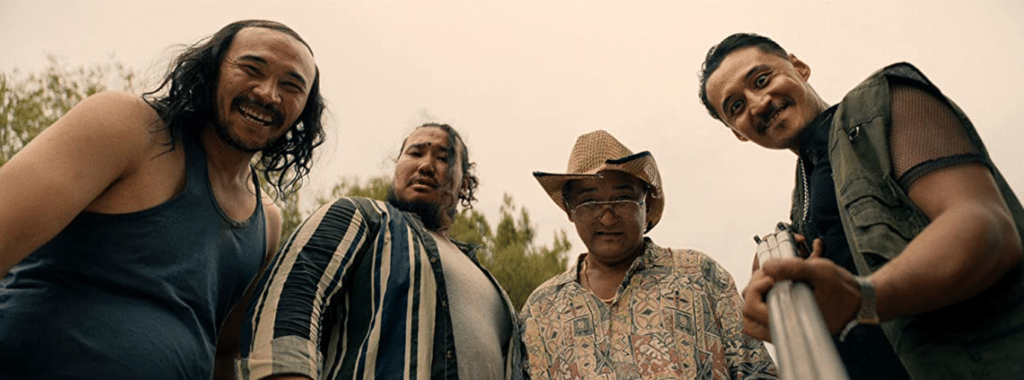
Like a lot of audience members presumably, this reviewer had no idea what to expect from a Kazakh horror-comedy. But it turns out that, however geographically far Kazakhstan might be from many of us, there are many universal features which we can all enjoy; this is an earnest, often puerile and occasionally very gory little odyssey which explores relationships and friendships, albeit through a funny, well-realised and farcical lens. It doesn’t take itself too seriously, and nor should we.

It all starts with young father-to-be Dastan (Daniar Alshinov) and his wife Zhanna (Asel Kaliyeva) who are expecting the birth of their first child – any day now, in fact. As such, they seem to be in that magical phase where they are snapping at each other about pretty much everything. For Dastan, it seems that the travails of imminent parenthood are emasculating him, or it feels like they are; everywhere he looks, he sees himself hemmed in, less of a man. Zhanna doesn’t do a lot to disabuse him of this notion, either; in fact, she chides him continuously for what looks a lot like an entire day, dawn to dusk. Ouch.

Dastan knows what will improve this situation enormously, however, so the next day he organises a nice fishing trip with the lads – a likely bunch, being a cop, and a marital aids salesman respectively. His friends are keen because they see it as an opportunity to mock Dastan for his domestic woes, and they’re actually rather surprised when he insists that yes, he does in fact want to go and fish; it wasn’t just an excuse. That being established, off they go into the countryside. This would all have been well and good, except a gang of local gangster types are engaged on certain business in the countryside too. When a …misunderstanding brings the two groups of men together, chaos kicks in. Fate, we’re told, has a way of doing that.

Sweetie, You Won’t Believe It is a lot of fun. Charming and well-paced, it’s an escapade which has something subtly fresh by nature of its country of origin, but soon feels oh-so familiar. This is by no means a philosophical work: bask in the fact that there is no subtle critique of Kazakhstan and its systems here, at least on any obvious level, and the film tends to stick with that obvious level through and through, to its credit. We have great elements for everyone: oddball local characters, toilet humour, splattery gore and a very well realised comedy of errors.

Whilst deep truths are largely set aside here in favour of gleeful, childish humour then, the film nonetheless has a heart, and it has great characterisation: you really feel for the individual plights each man goes through, even as you laugh at the outcomes. You wince and laugh with them as much as at them. It is also a film dextrous in its edits and camera work – which really helps its best sequences to land – and the direction and writing is really well-pitched at the right level too. At all times, the script and performances pick up the little nuances, the rise and fall of petty squabbles and the trials of trying to find the right words under duress. It’s all nicely done.

Sure, there’s a teeny bit of disparity of threat in some scenes towards the end of the film, but that sort of nit-picking is generally unnecessary. Plenty of laughs and a few OTT grisly moments all come together seamlessly overall in the cartoonish, feelgood vibe which this film readily sustains. It’s even all oddly life-affirming, in its way; think Sam Raimi directing a buddy comedy where he’s given free rein to add some OTT gore, and you’ll be part of the way there; this is director Yernar Nurgaliyev’s baby, however, and it would be great to get more acquainted with his work, if this is a good indication of his style and skill. Sweetie, You Won’t Believe It is a great Saturday night film, and we need plenty more of those.

Sweetie, You Won’t Believe It (2020) will be released by 101 Films on Blu-ray and digital on 21st February 2022.

Those Who Walk Away (2022)

With its very modern sensibilities and a certain level of artistic ambition, Those Who Walk Away has a few decent moments. Then again, the pitfalls of ambition over substance are written all over this (ostensibly) haunted house movie, with the main effect being that, despite some strong visuals and moments of atmosphere, it labours under being very, very underwritten overall.

As life rolls by, a young man called Max (Booboo Stewart, of Twilight fame) waits nervously for his first date with a girl he’s met online. It is, for him, a small return to normal life, having taken care of his mother for the past year. He spends a while chatting to a friend on the phone while he waits for her to arrive – more anon – but the girl, Avery (Scarlett Sperduto) soon turns up, and they begin to talk. A lot. About all that usual pillow talk stuff like enablers, incels, motivations, trauma – that kind of thing. They arrive at the venue for their date – a local cinema – and god only knows what these two bright young things would have made of their chosen screening of The Evil Dead, but sadly for them, a bomb scare (!) means the film can’t go ahead. Avery, who apparently works at said cinema, seems strangely unconcerned by this.

Never mind; they head to a bar instead, where things progress in mere minutes from a buzzword-heavy conversation to her draping herself all over him, and then Avery has a new idea: let’s head to an allegedly haunted house nearby. Incredibly, when they get there, despite it being abandoned years before, the electric’s still on; metered electric in this country is off the minute you’re through your emergency credit. Taking advantage of the improbable light, Avery tells Max the story of a spectre called ‘Rotcreep’ which is said to be attached to the house. Rotcreep requires a regular victim, or else he’ll…or else he’ll break out of the house somehow. It wasn’t too clear, but Max seems a little uncomfortable with the yarn, and he wants to leave. He’s about to feel worse, however.

Horror fans will no doubt spot where this is going, especially once some similarities to a certain other, successful indie horror from 2014 make themselves known – although the film is very loosely based on an Ursula Le Guin short story, ‘The Ones Who Walk Away From Omelas’, rather than explicitly on any film. The Le Guin story is a vague, philosophical piece of work, and at least in that, the film is little different. It begins to reach for some stylistically quirky, surreal moments once our characters are in/around the house, and you wouldn’t deny that some of these scenes are nicely lit and shot, but having filled the first act of the film with talking, talking, talking, it feels like a hell of a jolt. So the surreal elements feel rather muddled and tacked on; horror aside, though, and before we get anywhere near horror at all, the first part of the film offers an interesting glimpse into a version of college-age chit-chat and conversational priorities and, as the director was born in 1988, I can’t even assume that he’s got it wrong due to being on the wrong side of the generation gap. The issue with all this is that first impressions of the few characters on offer are not particularly compelling; the script heaves under its own weight, right from the opening chat between Max and his supportive pal. They wade through an awful lot of abstract nouns and mores, and I certainly don’t envy the actors trying to flesh out this oddball dynamic, before following it into the depths of a haunted house which comes complete with its own, new mythos.

‘Rotcreep’ is a bold attempt at creating a wholly new entity, and credit is always due for making such an attempt; sadly, having talked its way into abstraction, the film then clams up entirely and offers us nothing by way of exposition and as such, Rotcreep is rather a wasted opportunity. He figures but little in the film, and feels underused. There simply isn’t enough here to either endear us to the central players, make us understand them, or sweep us up in the story, of which several intended symbolic readings unfortunately passed me by. Those Who Walk Away is a film very much of two disparate, surprisingly lightweight parts which struggle to fit well with one another. As a piece of entertainment, it is rife with difficulties.

Those Who Walk Away (2022) is available from today, 11th February 2022 in theatres and on VOD.

The Abandon (2022)

The Abandon gives itself an immense amount of work to do; it has sci-fi elements, but it couples these with something akin to an ordeal horror in places. But then, it adds elements of human drama too – elements which become steadily more important as the film progresses. All in, it’s a challenging watch which could be seen as overly ambitious by some, but it deserves credit for pushing itself so hard to bring something quite unlike other films together in one place. Some elements of this kind of existential style have been explored elsewhere, but never quite like this, and it’s hard not to invest in seeing it through to the end.

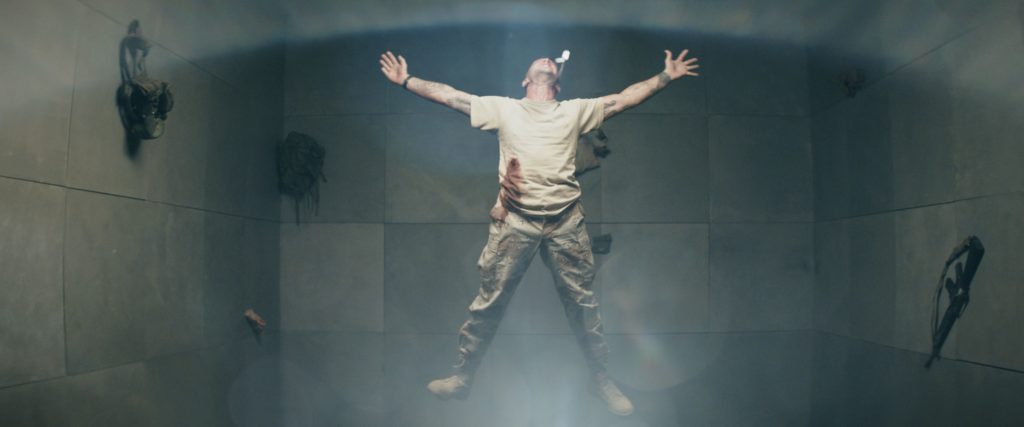
The First Gulf War – 1991. As a small contingent of American soldiers try to regroup and to survive the night during an ill-fated operation, one of them gets separated from the small number of survivors and finds himself lying, peaceful for a moment, watching the sky. It turns out that what Pt. Miles Willis is trying to focus his eyes on isn’t a US air attack, or anything recognisable. A bright light passes over him; he loses consciousness.

The next thing he knows, he awakens in a sealed cell of some kind. Pulling himself to his feet, his gunshot wound continuing to bleed out, he attempts to explore this new environment. It seems hopeless – the walls are featureless, there’s no discernible exit, or any sense of who has locked him in there. Things get stranger when he sees something etched into one of the walls; in fact, there’s more than one piece of writing here. The cell seems to be a puzzle of some sort, where the rules of physics can be broken and conventional means of communication seem to be off-limits. Or, are they? His satellite phone begins to ring. If he’s a rat in a maze, it seems he’s not completely isolated in it, and when he can answer the call, he begins to work with the woman on the line to try and deduce what is happening to them.

The Abandon could easily have been hamstrung by its chosen elements – a cast of (largely) one person, in a small, closed-off set – as these each beg extra scrutiny from an audience which has no distractions from other characters, events or vistas to draw the eye. One of the ways in which The Abandon survives all of that is via lead actor Jonathan Rosenthal’s performance here. He starts entirely plausibly as a military grunt more equipped for shooting at targets than dealing with more philosophical issues; he looks confused and ill at ease and at first, tries to overcome everything which the situation throws at him by throwing extra testosterone at it. He does change, but the initial awkwardness of watching him simply hurling his weight around is suitably awkward; it’s also worth pointing out that The Abandon is a (perhaps surprisingly) physical role, and some of the ordeals which Willis goes through are gruelling – hence the early reference to ordeal horror above. There really are similarities. So it’s brutal, but yet it seems choreographed, or at least heavily stylised whenever this kind of brutality is going on: overall, it’s an unusual style of viewing experience, and again it deserves credit for layering something like this together. It’s an attractive looking film with enough variety in camerawork to open up its confined space. Viewers may be able to guess at where one of the more scientific elements may be heading, and many may well feel that the added discussions of back stories and character motivations flesh out the more abstract aspects of the plot.

Likewise, these kinds of restricted-set films can be tough to pace appropriately. The Abandon is most of the way there, though the first half of the film is more successful at carefully doling out enough details to keep the plot moving, establishing the mystery to come. Things get a little more uneven as the film heads towards its closing act however, and some of the exposition could have been handled differently, though it keeps a few tricks up its sleeve, and it’s rewarding to finally get there: it also shows that it has no intention of answering every question we may have. This is certainly a different spin on a genre which has come to be rather predictable in some aspects: director Jason Satterlund has dodged this predictability successfully.

The Abandon (2022) has been chosen to close the Mammoth Film Festival on February 6th, 2022 (world premiere).

Slapface (2021)

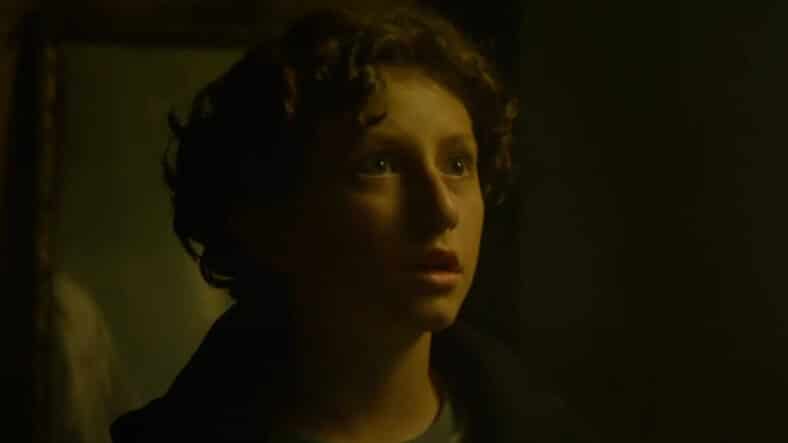
Whilst Slapface (2021) starts out with very broad strokes – literally showing us big brother Tom (Mike Manning) and Lucas (August Maturo) taking turns to slap each other as some sort of proxy household meeting – it soon becomes something if not altogether subtle, then certainly altogether more considered. Likewise, the opening credits, with their medieval woodcuts of witches and demons, show us a local legend of a ‘woman in the woods’, but Drag Me To Hell, this ain’t. Slapface works by combining a childlike fascination with these folk tales and monsters together with very real experiences of trauma which drive a troubled child towards a fantasy world. How these two spheres meld makes for an often disconcerting, sad story.

So Lucas is very much drawn towards stories of witchcraft and magic, and little wonder: who wouldn’t want this kind of escapism, and of course the hints that there’s more out there, beyond a world in which you are increasingly powerless? Lucas and Tom have recently lost their mother; Tom is doing his best to fulfil the role of parent(s) in their mother’s absence, but has a hard time understanding Lucas: the kid is socially maladroit, isolated and reticent. The closest Lucas gets to a friend group is being bullied by some local girls: one day, they dare him to enter an abandoned institution associated with the myth of the ‘Virago’ – and he sees something. The Virago – a towering female entity who would put the best of the caricature woodcut witches to shame – takes an interest in him, and even seems to want to befriend him. A friend, at last: but at what cost?

The presence of the Virago is important – it’s really key to this film sitting in the horror genre at all – but equally so, the film has a lot to offer on social context, especially in terms of masculinity and femininity. With the glaring gap in their lives left by their mother’s death, Tom (and by extension, Lucas) seem to be coping by becoming hyper-masculine, hence the physically violent ‘game’ they play to sort out their disputes and ‘blow off steam’. Tom has a good heart in there somewhere, but ploughs his energies into being a provider – admittedly, totally necessary – but then drinks his time away in a local bar, hitting on women and making a general nuisance of himself. He’s usually absent from Lucas’s life, and his young brother strays increasingly into his own world: it’s here that he’s fair game for the attentions of the ‘woman in the woods’, who takes every opportunity to get closer, lashing out at anyone else in Lucas’s immediate vicinity. As for the women in the narrative, well, this isn’t a good world for being a decent woman. If you’re not a violent bully or a legendary crone, you’re unlikely to have an easy time here. Anna (Libe Barer), who has a short relationship with Tom, tries her best to instil some sense of normality in the brothers’ household, but her attempts to slot into the ‘mom’ role act more as a catalyst for Lucas’s anger. Reasonably unperturbed when she storms out, Tom takes to driving around town in her car, neatly encompassing the way the two boys are happy to inhabit, or otherwise take an aspect of female identity without necessarily giving much credit to it.

The Virago is an interesting creature – silent, ambiguous, hostile, and focused on her new young charge – but you can always sense something else hanging in the air here. Whatever she is, she clearly fills a gap in a lonely and alienated life, and this is a film rich in alienation, with an uncomfortable, layered mood to match. Is she a symbol, Babadook-style, or a character in her own right? Honestly, the film works just fine with either reading, and though it holds off on an easy sense of closure for most of its running time, the overarching feeling is of a very heavy, unflinching film and an exploration of trauma.

Indeed, the whole film simmers with trauma, particularly with regards to families, and talking openly about family members who are now gone is forbidden by Lucas, who would rather choke on that pain than confront it. For all characters in this particular family and those who come close to it, mothers may be absent, but fathers weigh particularly heavily. Slapface is by no means a fun and entertaining watch, though it’s very good at what it does, offering a horrific, fantasy-ridden exploration of bereavement and the pitfalls of finding the wrong way through it. There’s some similarity to pre-existing films – horror has been interrogating monsters for nearly a hundred years – but this is a worthwhile exploration of monstrosity, and wherever they found August Maturo, he’s superb and fits the bill here perfectly.

Slapface (2021) will be released on SHUDDER on 3rd February 2022.

Subverting the Maternal in Raised by Wolves

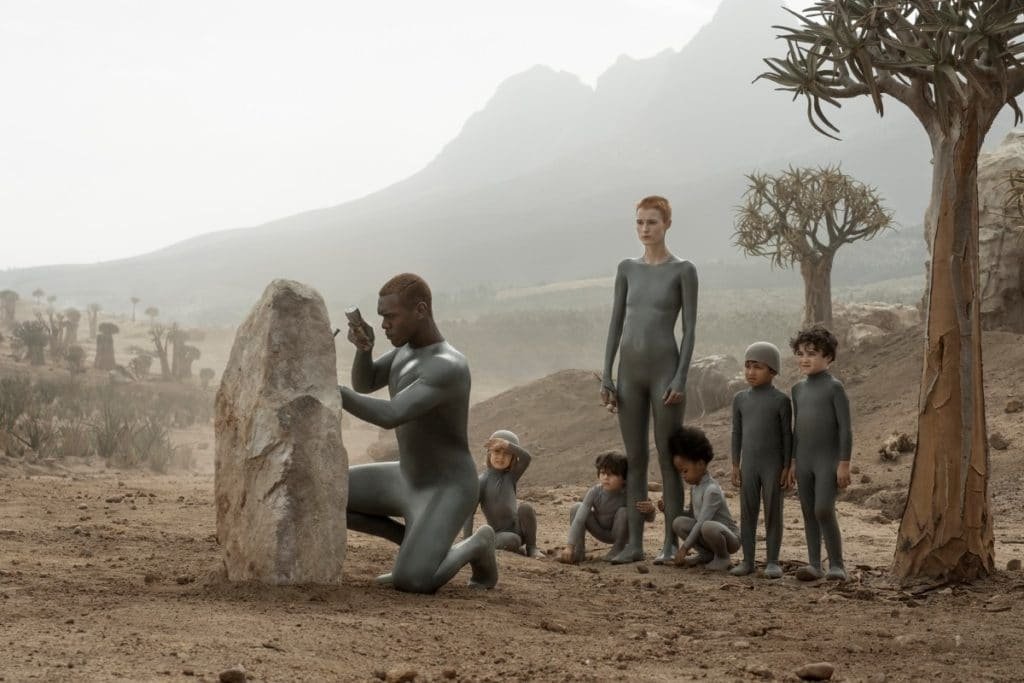
The TV series Raised By Wolves follows a battle being fought in microcosm, but the resources which are being fought over surpass the usual struggle for land, wealth and power. Having been forced to abandon Earth – now on the verge of destruction, if not already past that point – a small contingent of militant theists, the Mithraic, have created a vessel called an Ark, which they hope to take into deep space in order to settle another planet. However, their adversaries on Earth, the hardline atheists, are fighting back: a tiny lander, equipped with two androids – ‘Mother’ and ‘Father’ – and a number of viable human embryos, has beaten them to a barely-hospitable alien world, Kepler-22b. The territory itself might be contested here, but the real fight is for the future of human life; in such times as these, any notion of a traditional, nuclear family has necessarily been abandoned.

Viable life, and importantly, life which follows the appropriate ideology, takes precedence, and as these two things are hard to come by, it takes precedence by any means. In many respects Raised By Wolves keeps its focus on parenting and the survival of the young, whilst also shining an often unpleasant light on the whole childbearing and child-rearing process, here seen as fraught, duplicitous, flawed – and even circumvented altogether. It’s a pretty bold move, but one which you’d absolutely expect from a producer like Ridley Scott, who has a long history of disrupting the mother/child relationship…

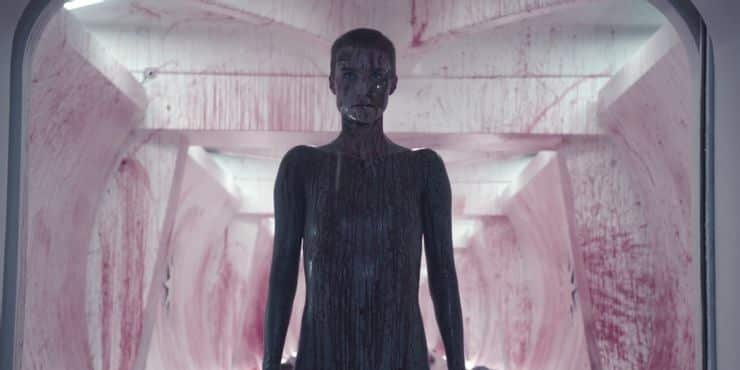
The first scenes of the show give us Mother (Amanda Collin) and Father (Abubakar Salim) busying themselves with what they have been tasked with doing: firstly they need to incubate a number of the embryos, whilst also establishing a rudimentary colony (and despite the hi-tech means which brought them to the planet, there are no ultra mod cons beyond the lander. They elect to eke out an existence which looks little beyond Neolithic.) Of course, Mother and Father themselves are not human – this is made abundantly clear given the way in which Mother incubates the embryos – but Father, at least, has been programmed to be an affable companion and not much more: he bears the children’s antics with patience, he tells jokes, and he acts as a helpmeet to Mother, who dominates proceedings. However, it is Mother who eventually breaks out of her careful programming as a nurturer (and we see evidence of how long this process took, in flashback, later in the show). The arrival of the Ark into the planet’s orbit – and the presence of a theistic landing party, which stumbles upon the settlement – triggers a glitch in Mother’s programming: she is in fact, and in one of the show’s moments of bleak irony – actually a Necromancer, a type of android designed to destroy life and one designed for use by the Mithraic against the atheists. Necromancers have the power of flight, and can use the pitch of their voices (actually a banshee-like scream) to maim and kill; faced with the old enemy, Mother shows herself to be vengeful and unpredictable. You have to wonder at why, exactly, her creator/reprogrammer felt that this model of android was the best model to mould into a cooing maternal figure, but maybe he liked a challenge.

It’s not a perfect revamp, in any case, and Mother takes it upon herself to destroy the Ark in its entirety; although she was reprogrammed not to blindly persecute the ‘wrong’ humans, old habits die hard. But, to restock her own depleted brood, she first kidnaps the Ark’s ‘children’, which seems to mean anyone under the age of eighteen. The majority of her own batch of children have already died as a result of a series of rookie errors: it hadn’t occurred to either Mother of Father to properly test the only food source they’d been able to find and cultivate, meaning a creeping dose of radioactivity (as well as the issue of huge, nearby craters) has done for all but one of them, Campion. In effect, an android purposefully rehabilitated into a matriarch has allowed her family to eat poison or fall to their deaths; when faced with other humans, she has murdered hundreds of them on principle, forgetting her new programming temporarily and terrifying her sole remaining ‘son’, as well as kidnapping a number of young Mithraic, with the aim of deprogramming them. It doesn’t seem to occur to either her or Father to plunder the remains of the Ark for any resources which would help them; Mother’s sole interest in the Ark relates to herself, as she chooses to interact with a simulator – in order to access her own, carefully-stored and hidden memory files. It’s telling that Mother, for all her maternal strengths, is so flawed: she gives her name as ‘Lamia’, a mythical monster believed to prey on human beings and drink the blood of children. Is this a moment of self-awareness, even humour on her part? Or is she aware that she is still a risk to the children, as well as everyone else? What we see here is a being redesigned to nurture, but deviating from her path in a series of ways, either by incompetence or design. This adoptive mother is usually well-intentioned, but challenged. She feels compelled to do the right thing, but often struggles.

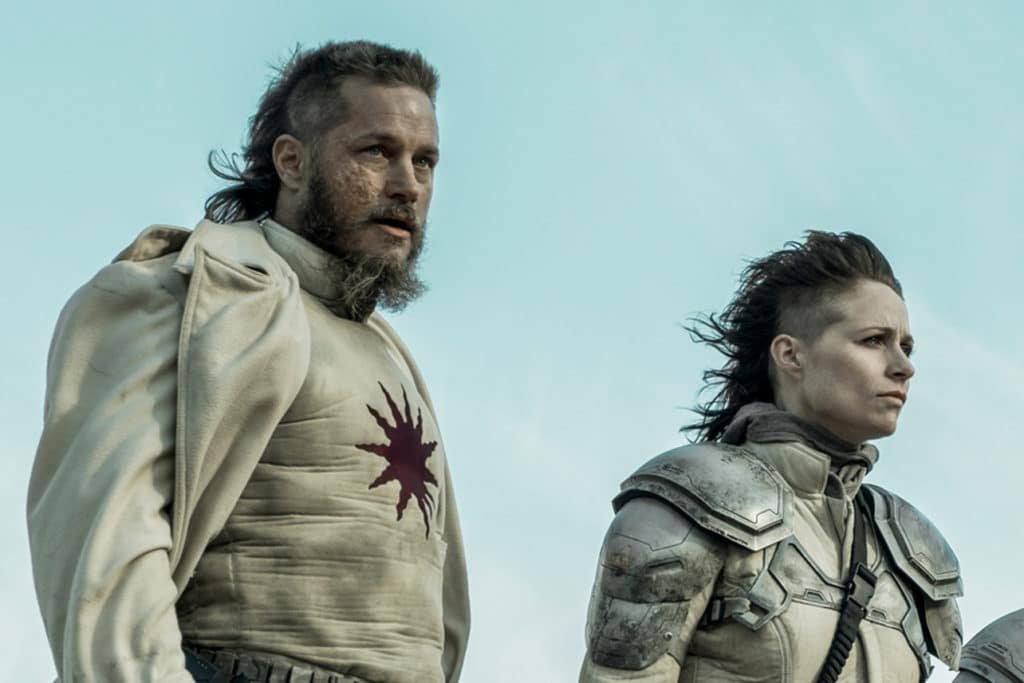
There is another adoptive mother in the show, this time human: the aptly-named Mary (Niamh Algar), who alongside husband Caleb (Travis Bickle). These two atheists killed a man and a woman whilst fleeing the Mithraic on Earth; they then realised that these two were Mithraic officials, with a place on the Ark reserved for them. Using the means at their disposal, they decide to alter their facial features to look like the two deceased, and manage to trick their way onto the vessel. But the people they have replaced, Marcus and Sue, have a young son, Paul: at this stage, he is none the wiser that his real parents have been murdered by the people tasked with looking after him. Both the adults feel a pang of responsibility for Paul, now orphaned by their hands, but it soon becomes more than that, with a sense of affection springing up – one which we are led to believe was wholly lacking from Paul’s life with his real parents. Elements of this story arc are genuinely quite touching; Paul and his ‘father’ discover how to play, and the boy gets showered with affection. But the straightened circumstances on Kepler, not to mention the hints at something seemingly supernatural at play, begins to sway Marcus, making it increasingly difficult for him to inhabit his old identity. He begins to believe that ‘Sol’, a version of the monotheistic God we’re probably all familiar with, is really speaking to him; rumours of a prophecy, which he at first thought might alight on Paul, he now begins to claim for himself. This has a dark influence on his behaviour, towards both his wife and his son, and it also leads to him becoming indiscriminately violent, killing several of the handful of Mithraic who have survived – in times when the survival of the human race is paramount, this looks as deranged as it is.

The show’s only human nuclear family unit, then, flawed as it is, quickly comes apart at the seams, with Sue/Mary fleeing her now-unpredictable husband, leaving him to his now dissatisfied, suspicious body of soldiers. As for Paul, Sol allegedly tells him the truth, leading him to attack Mary; he sees her now only as a killer, and this obliterates what has gone before. This is particularly sad, as Mother – who correctly ascertains that Mary is not Paul’s biological mother, and seems even to taunt her momentarily for it – had only just, grudgingly, told Mary that she was nonetheless a ‘good mother’. Mary had also revealed that she is infertile; the injury Paul causes to her abdomen is perhaps symbolic.

In Season One, we only see one human, biological pregnancy taking place – and, in another of the show’s uniquely dark twists of the knife, it is the result of a rape. The girl in question, Tempest (Jordan Loughran) was assaulted whilst in stasis, and so unable to fight back; she is also part of the group of stolen Ark children, so it’s assumed that she is below the age of consent as we’d understand it, but perhaps in the 22nd Century this differs. Needs must. Regardless, Tempest is very young, and extremely traumatised; Mother’s immediate, borderline obsessive interest in her pregnancy upsets her greatly, and the girl is so desperate to abort her foetus that she attempts suicide. Mother, as representative of her programming, wants to support Tempest through this pregnancy by any means and her well-meaning attempts to get the girl to put her experience behind her comes across as extremely, if unwittingly crass. Mother fails to understand, in the ways that lots of humans fail to understand. The rapist in question, a ranking Mithraic, is also still alive, having survived the Ark’s crash; he is being punished for his actions, but he still finds a way to get around this, threatening Tempest and attempting to escape. His defence, that Sol wanted him ‘to be fruitful’, is a particularly sinister touch, given that this uses religious tenets to override consent. At least the Mithraic were having none of it, though this is small comfort to Tempest, and although she gets her moment, it doesn’t rid her of the pregnancy.

There is of course one more pregnancy in Season One, and thankfully it isn’t the standard sci-fi ‘whaddya know? You CAN have a baby!’ curveball which it seemed to be at first – a plot device as old and weary as time. Mother herself – as a result of interfacing with her memory files – undergoes an experience where she seems to become pregnant; apparently, this capacity was always in-built, and she comes to understand via the interface that her human brood was only ever intended as a kind of practice run. This, though? This is the real deal. This plot development had the capacity to be a tad disappointing; one of the series’ most interesting aspects is in watching Mother navigate her maternal feelings as a ‘creation’ and not a ‘creator’, so to suddenly turn her into the thing she thinks is impossible could have been a rather obvious move. But it’s not so: Mother’s pregnancy is horrific; whatever is in there needs plasma for food, so for instance Mother has to ransack the Ark for sources of this – it’s hardly a picture-book pregnancy, and there are some graphic sequences as Mother tried to balance the foetus’s needs against her own rising sense of concern. However, the survivors of the settlement attempt to help her as her pregnancy develops; there’s a sense of wonder hanging over it, perhaps a belief that this is, in any measurable sense, a miracle.

The ways in which the show’s writers quite abruptly scupper this is a great tour de force. With some ideas clearly in keeping with the Alien franchise – perhaps particularly Alien 3 and Alien: Resurrection – Mother’s baby is no baby at all, android or human. It is instead likely to be a being which no one on the planet has yet seen, except as fossilised remains; one of the great snake creatures, presumed extinct (but never make that assumption on Kepler – there seem to be a few species lurking in the shadows). Or is it? The show gives little away. Here, a wealth of prophecy seems to have come to the fore, and there are hints that Mother, Father and the others are predestined in this; Mother’s horror at what she has created leads to her taking the initiative, attempting to kill herself and the creature. Is it successful? The show closes with a certain level of ambiguity over that, but what is certain is that Mother seems to be about to die replaying memories of Campion, not her ‘birth child’; her human brood did not seem to be some less-worthy experiment in the end, if it is the end at all…

Raised By Wolves, right down to its symbolic title, is about world-building, but key to that process is nurturing and raising children. To do this, traditional models of parenting may be present in some aspects, but they are also overthrown, at least to an extent, for a range of reasons: fate, necessity, emotion, guilt, lack, loss and in Mother’s case, as a means of exploring her sense of ‘selfhood’, her programming, and what it all means. The answers to these questions have not yet been given, and doubtless this will be explored in Season Two, but just as old ideas of marriage and family life are becoming obsolete, traditional ideas about caregiving and nurture will remain crucial.

Raised By Wolves – Season Two – will premiere on 2nd February 2022.

Below The Fold (2021)

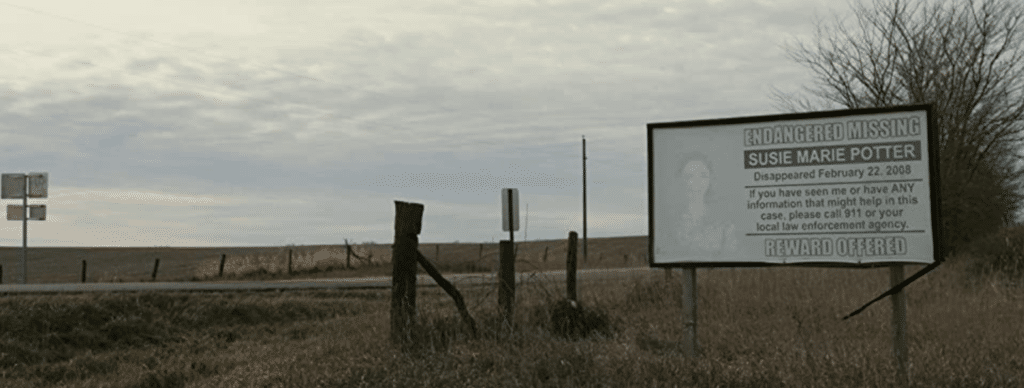
It’s a crime thriller, but Below The Fold starts with what could easily be a horror film opening. It’s an ominous take where it seems something sudden and shocking has happened: the TV is left on, showing nothing but dead air, a telephone receiver lies abandoned. What is this? We’re not told immediately – we’re not told anything immediately – but we cut to a slow news day in the press offices of Maryville, Missouri, where there’s some debate about covering a tractor pull competition. That gives us some sense of the relative peace and quiet here, but it turns out there might be a story worth covering. Turns out that, ten years previously, a young girl went missing in neighbouring Skidmore but the case went cold. Journalist David (Davis DeRock) gets the job of following it up, though it’s no tractor pull (the term ‘below the fold’ refers to stories printed in the bottom half of a newspaper page, and so automatically less visible, or deemed less interesting, to readers).

This is all complicated somewhat when a new reporter joins the team, and it is immediately apparent that David and new girl Lisa (Sarah McGuire) have some history. Nonetheless, she soon wants in on the Skidmore story, and so they go to speak to the missing girl’s sister – who explains that, age twelve, Susie went to the car to retrieve her Bible one evening and simply vanished into thin air. A later incident suggested that someone, likely the responsible party, was still watching the family: significant and annotated pages from the Bible were delivered to their home. And is someone watching the journalists, too? As they go on with their investigations, they meet a very tangled web of silence, proffered clues, red herrings and dead ends, but it seems that something sinister is at play here. Suggested links between Susie’s disappearance and the murder of another local girl complicate this picture further.

All of this unfolds slowly, and this is by no means a good choice of film for people into high action. Consider yourselves warned. The suspense here is doled out very carefully and steadily, and though some of the film’s initial drive subsides a little in the last thirty minutes or so, overall the pace is handled well; it’s in keeping with the tone and style overall. There are some genuinely unsettling scenes along the way, and the film is rich on mood. A lot of its success in this aspect stems from the strong camera work: there are no wasted or needlessly wheeling shots, and the edit is equally strong. Shots of rural decay in this neck of the woods – abandoned and tumbledown homes, beautiful but remote and barely-populated landscapes – makes some links to American Gothic with its own mysteries, isolation and secrets. The most frightening aspect of the film is in the horror of remote communities, but this comes across without resorting to caricature. It more focuses on what happens to people living this way when the threads that hold them together – Christianity, for example – begin to come apart? Linked to this is the question of when close-knit becomes constrictive; there’s certainly some class commentary in here, though, again, it’s kept on the downlow. Don’t expect acres of exposition, as that is left to the audience.

If the themes and motifs here have been seen elsewhere in other films, albeit perhaps looking a little different or playing out differently, then so be it. This is a good piece of filmmaking in any case, by a first-time feature director and writer, made on an indie budget with (I’m sure) all of the subsequent issues and hurdles to get past. Perhaps the biggest sticking point for viewers used to the kind of denouement they’re used to – even the kind that they demand – will come with the ending, and I’ll admit to a moment of real surprise myself at that point. It’ll be divisive. On reflection, I think it’s actually very brave, not to mention worldly – Below The Fold is a piece of fiction, but it comes with a reminder that life doesn’t follow any narrative rule book.