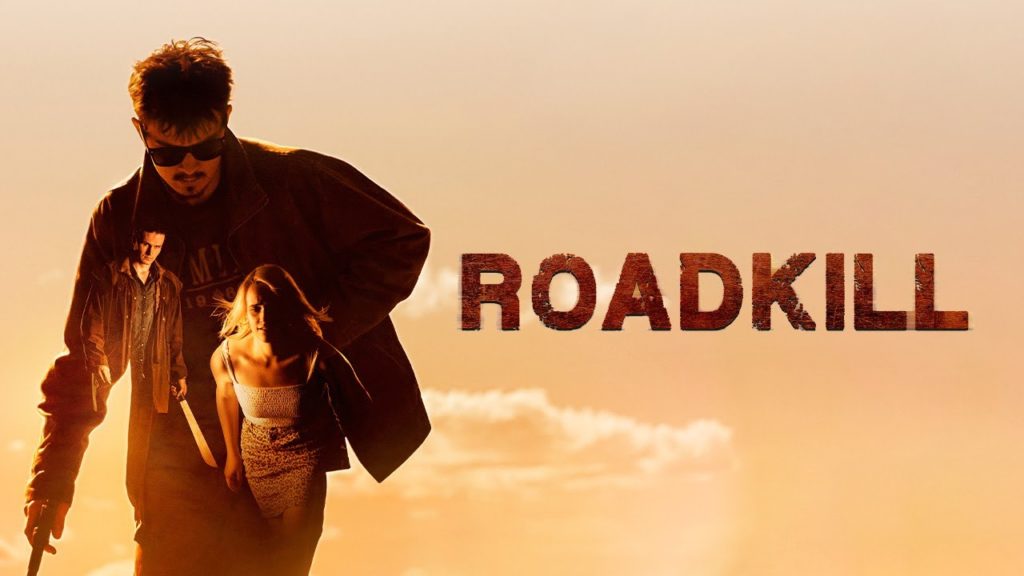
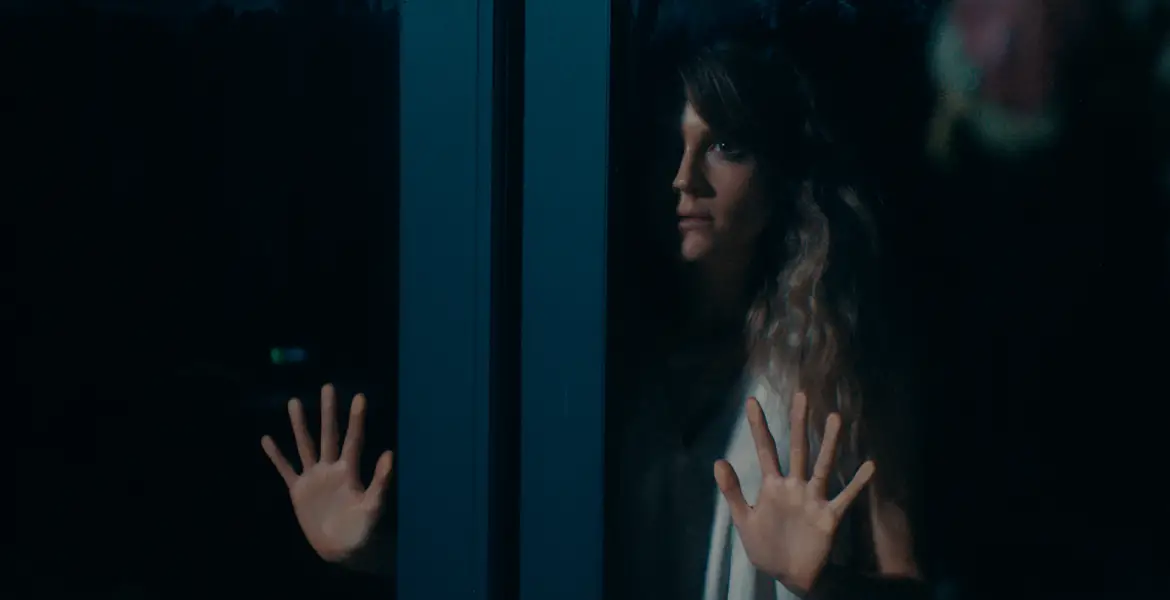
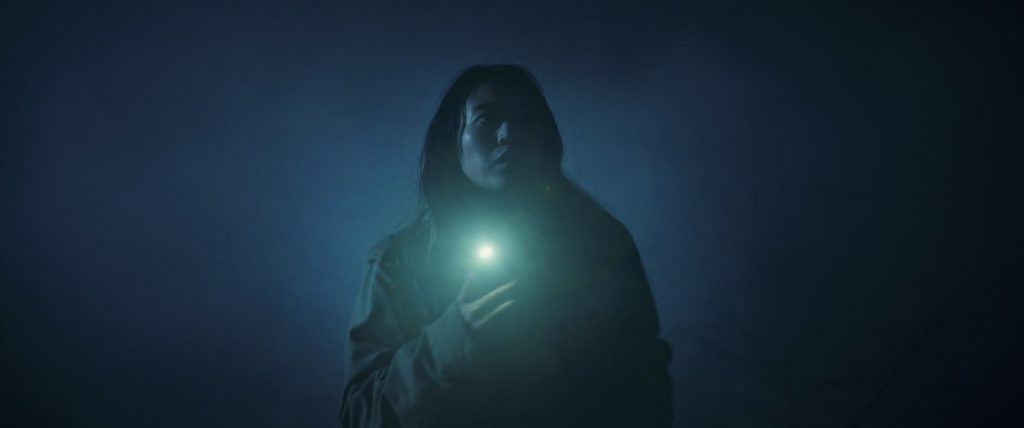
Roadkill (2022) has the good sense to let its outback shooting location figure highly throughout its running time, almost making the hostile environment one of its one of its core characters. In fact, it makes more sense as a character than some of the actual characters on offer. The film overstretches itself in its plot direction and its character development, and both suffer as a result. We open with a young man in the Outback, Connor (writer and director Alexander Whitrow), reclining on his beat-up old red sports car, on the phone to his girlfriend. He’s promising her that before long they’re ‘outta here’, which never bodes well in a ‘last day as a detective’ kind of way. After the call, we see him flagging down a passing car; ah, so he’s stuck out here? Nope – it’s a trick, and he’s about to rob this family – though why he gets the robbed couple’s baby out of the car, to hand it to them, to drive off and leave them and the car intact is a mystery. Still we’re given enough to deduce that Connor is a career thief, but not a monster.
There are monsters out there, however. We cut to a pair of detectives, thankfully neither of whom is planning a retirement that day, discussing a totally different crime scene. A young woman has been murdered, and there are indications that there’s a serial killer on the loose. As the detectives second-guess where their killer may go next, our roadside robber and his wholly unsuspecting girlfriend Lucy are reunited, discussing in more detail about how they are planning on escaping this neck of the woods. Things falter a little here – there’s a family visit and a meal to get through, and you know how those are – but wouldn’t you know, Lucy’s uncle is one of the hard-bitten detectives from the serial killer case. And there is a suggestion that the robber and the serial killer’s worlds are about to collide too – first with a visual clue, and then with a sudden escalation of events where mistaken identity, the redoubled efforts of the police and Connor’s determination to get away, the film nails its colours to the mast as a revenge-pursuit film.
That last few sentences condenses down the key set-up here, but be warned: it isn’t quite that pithy in the film itself. Roadkill‘s biggest error is in trying to do too much – the cardinal sin of so many first-time feature directors – but in so doing, it actually feels strangely diffuse, rather than overloaded. It pauses to offer us character development, and it rushes a small crowd of characters onto our screen in places, but in some respects this only underlines more questions than it ever answers. Our key cast needs to be refined down and made the sharp focus – nothing and no one else. Lucy (Sarah Milde) is a bit of a prop, sorry to say, seemingly doing nothing except hovering around her and Connor’s modest home, and then re-emerging as a kind of spiritual presence; it’s both a lot, and too little to ask. Similarly, the film really should have given us more on our antagonist (Edward Boyd), who is often peripheral, with a shifting modus operandi and just not enough to work him up into a truly menacing figure.
So, without question, there are issues in this film. But there is the germ of a great idea here, and the film wants to be great, even if it’s hamstrung by budgetary restraints which emerge as pulled punches – the ultraviolence and speeding cars which you may expect often happen off-screen, when a bit more of this would have redeemed things. The Oz location looks great in a ‘wouldn’t want to be stuck out there’ way, and there are some moments where Whitrow is clearly channelling the grand old tradition of Ozploitation: the Oz flag being used as a face covering keys into this nicely. The colouration, the music, these are better than your average indie. Plus, there’s also a variety of camerawork, some decent attempts at action and a decent attempt to bring things together for a finale. There is talent here.
Whitrow clearly has an interest in the Outback as a setting for pursuit and fightback – his first short film, Hunt in Red, renders the formula down to thirty minutes as two teens flee a cannibalistic killer. So he has form, and he has the wherewithal: the recommendation has to be, then, to kill the filler, keep it linear and go all out. The sorts of audiences who would be drawn towards a film set in the back of beyond in Australia and titled ‘Roadkill’ would be likely to want more high action than we see here, so a more streamlined, pared-back storyline would do just the job, if the director has any plans to come back this way.
Roadkill (2022) gets a UK release on 29th May 2023.
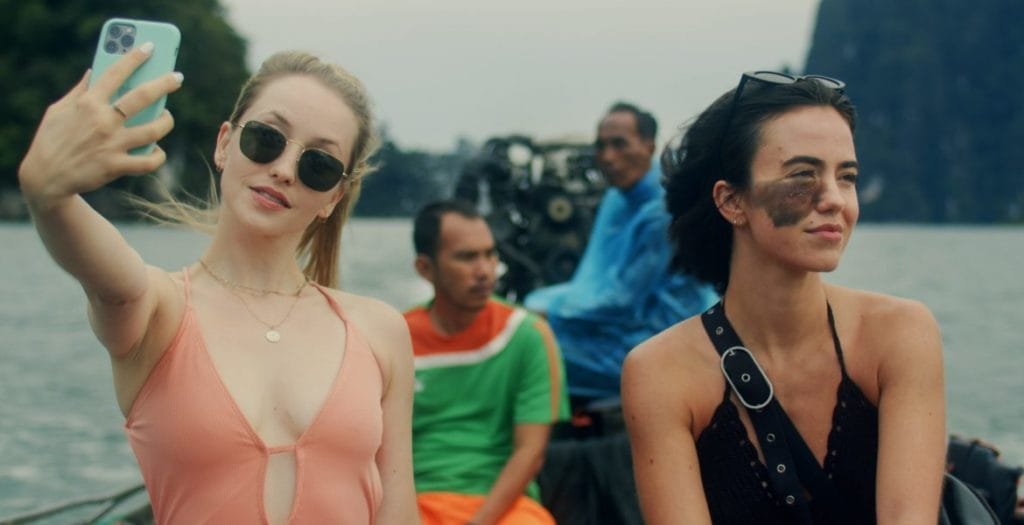
Influencer (2022) starts by showcasing its often non-linear, inventive time structure, opening on the vision of a young female body, face down on an otherwise picturesque island beach. We then zip to something else: a motivational speech from a young woman, a social media influencer called Madison (Emily Tennant). Ah, this is content for her channels; she’s travelling solo in Thailand, talking about how good travel is ‘for the soul’ and how people need to ‘surrender to the moment’. Thing is, her demeanour off-camera doesn’t quite mirror those feelgood platitudes. She seems bored, miserable even. What is the deal? In fact, you won’t be able to do anything but wonder – who was the young woman lying dead on a beach at the very beginning? Was it her? Was that Madison?
What we are clear on is that Madison is starting to have doubts about the whole online career thing. In a chat with a friend back home, she says she’s starting to rethink it, aware that it has a really short shelf life anyway – even if it does, temporarily, grant her access to aspirational products and a very receptive audience. Neither does it protect her from the usual issues of fending off the unwanted attentions of men who feel that any solo woman owes them conversation and company, as we see at her hotel bar. Luckily for her, she runs into another young woman called CW (Cassandra Naud) who helps her make her excuses; after that, they become close friends.
The trip gets instantly better; it almost matches up to the claims Madison has been making about it all along. But of course, this is the high point before the film’s first sinister turn. Madison and CW get back one evening for Madison to discover her room has been burgled; her passport is gone, meaning she has to rely more and more on the (unusually generous) kindness of strangers while she sorts out a new one. But she is not well-equipped to deal with problems like this; she’s young, naïve, and it turns out that the whereabouts of her passport is just the first big question raised by the film, in an intriguing succession of questions.
If you feel that, early on, you get a strong sense of where all of this is going – if you’ve seen enough films about what befalls a stranger in a strange land that you feel you can confidently predict the outcomes – then it’s almost certain that the film will nonetheless be able to surprise you, you jaded horror viewer you. It has an incredibly deft touch, happy to subvert audience expectations (in fact, the opening credits roll at 25 minutes in, which shows how carefully and unusually this film is constructed). That deftness also imbues the film with a feeling of queasy disorientation, especially as its twisting, shifting timeframes kick in. It’s a massive risk when a film opens with a dead body – how are we going to meaningfully link back up to that scene? – but, as it turns out, the film is able to handle it very cleverly. It’s also impressive how effectively Influencer can raise your heartbeat; at certain points, it’s almost unbearable.
The film knows its subject matter; it has captured the modern tendency to photograph first, experience later. It also debunks questions of entitlement as it picks away at the disconnect between manufactured self and ‘real’ self. Of course, there’s always been a divide there, but it’s been granted vast new levels of reach by the rise of social media, together with the deluded levels of self-importance which often accompany it. But it’s aspirational because the influencer lifestyle can, even for a short blaze of glory, grant immense power and wealth. These are interesting times indeed, ripe for filmmakers to exploit. Alongside all of this, the Thailand locations are beautifully filmed, offering wide open space and unbearable claustrophobia in turn. There are some great roles for women here too, which riff on another bunch of cultural expectations. All in all, the film’s cast of flawed, often painfully naïve but often belligerent characters works very well.
If there’s any point when the film’s premise begins to strain at all, then it’s towards the end, which is perhaps unfortunate – though, against the film as a whole, it’s pretty minor. Ultimately, when the end credits roll, you have to ask: could the film have done better? I’d say, no. This is an often ingenious, deeply unsettling, very modern horror. Influencer perfectly captures a moment in time. Ten years from this date, we’ll be vastly unsettled by something else; Kurtis David Harder’s film captures terrors which are only possible, like this, right now. It’s immensely, impressively done.
Influencer is available on Shudder from today: 26th May 2023.
Have you noticed that people are getting tied to chairs, or tormented with household tools etc. a lot less frequently in horror nowadays? You could be forgiven for assuming that gratuitous ultraviolence is dead – or at least taking a break. That’s not so in The Wrath of Becky (2023) however: whilst the tone is a long way away from the ordeal horrors of the Noughties, this film is certainly a grisly revenge story which strikes a good balance between cartoonish improbability and more plausible elements – its characters, plot and narrative. It’s a sequel to Becky (2020), but it stands on its own perfectly well, so if you haven’t seen the first film – don’t worry. You’ll get it.
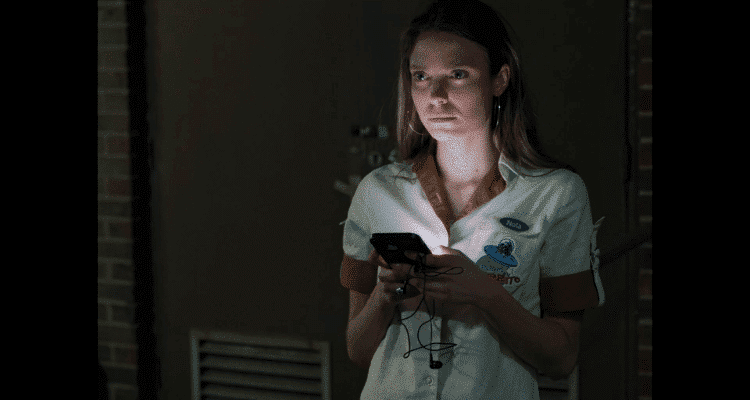
We do get some back story first of all, however: Becky is just a regular teenage girl whose family were attacked by a band of violent Neo-Nazis whilst weekending at a picturesque lake house; said Nazis were in dispute about a mysterious key, which they were searching for there. A case of mistaken identity, sure, but this didn’t stop her father losing his life in the attack – an attack which triggered something in Becky (and we see a bit of that in flashback). Post-ordeal, Becky has got into a pattern of faking saccharin repentance which gets her warmly accepted into foster homes, which she then flees. The attack has turned her into something of a worst-case scenario prepper, perhaps understandably: she spends her time not sleeping, training and setting traps. But Becky has finally found some stability living with Elena, a landlady who has become a friend. The young woman also has a job at a diner. Life certainly isn’t normal, but it’s consistent in ways it hasn’t been for a while.
Things are about to get a lot more interesting, though – if that’s the word for it. Yeah, actually it’s a pretty serviceable word for it. A group of men calling themselves The Noble Men (the thinnest pastiche of The Proud Boys you are ever likely to to encounter) are rolling into town ahead of crashing a local political event, seemingly with nefarious purposes. A small number of them choose Becky’s workplace for a preliminary meet-up and one coffee-based altercation later, they – assuming they have the whip hand in this situation – follow her home to frighten her, but here, things spiral rapidly out of control. Still, thanks to the fact that they have accidentally chosen a very damaged, very dangerous young girl, it doesn’t end with Becky getting a sizeable new dose of trauma. Putting her array of aggressive skills to the test, she tracks them down, not least because they have made off with her beloved dog Diego (credited on IMDb under the name, and this is real, Pac Williams).
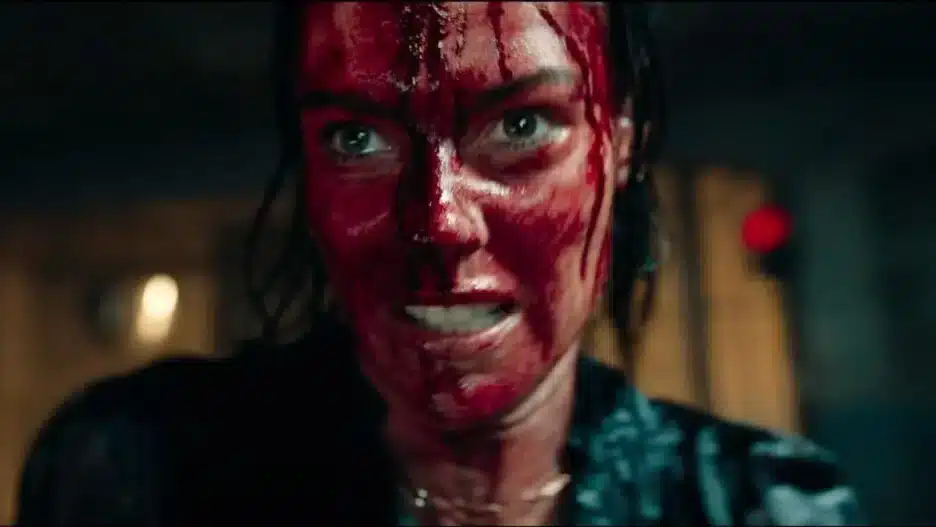
This is a bright red laugh-scream of a film, with a great raft of set-ups and set pieces. It’s graphic and bloody, with lots of practical SFX, but the whole film has a consistently knowing but lively feel which comes across via its fast edits, brash but entirely suitable music, quick-changing camera work and a highly colourised, slick overall appearance. The cartoon which accompanies the opening credits does a good job of establishing what this film is going to be, and what it’s going to be like; similarly, Becky’s voiceover, though used sparingly, invites the idea that she, and the filmmakers, are having fun with us – even occasionally at our expense, which also feels fine. Becky confides in the audience, but messes with us too, getting us on side but reminding us that she may be giving us set-ups which aren’t going to unfold the way we predict. It’s another excuse for a fast edit when it happens, and it works well, moving things along at pace. Becky is a de facto unreliable narrator, but the whole film is an array of competitive violence and one-upmanship, so it’s all good.
If it’s like anything else, then perhaps it’s You’re Next (2011): similar pace and tone, similar mash-up of home invasion, survivalism and splatter, similar hard-as-nails female protagonist. By the way, how refreshing that we’ve moved on rape/revenge, to just revenge: once upon a time women rarely became capable of such superhuman horrors without having been sexualised and abused first; aside from some charming epithets thrown her way, Becky’s revenge is an entirely desexualised thing. It’s not a totally desexualised film – the Noble Men mention Parler and 4Chan as they casually chat about their misogyny – but it’s not a central plank here, other than the script using it knowingly to flesh out these characters as bad’uns. The script on the whole is consistently funny and knowing, too, and the very minor lulls are only there to give us just enough character info to make sense of what happens next. The Noble Men are to an extent overwritten and overdrawn, sure, but this isn’t a deeply philosophical work; the point is to justify Becky’s vengeance (though, all told, the second they threaten the dog, most people will be fully on board anyway. Kill them!)
The Wrath of Becky is a crowd pleaser, full of OTT rough charm and gratuitous just desserts; it’s hard not to love its boundless energy. And yeah, there is a bit of retro tied-to-chair action going on, but it works in its place. Everything here works just fine, and it’d be great to see Becky again some time.
The Wrath of Becky (2023) arrives in cinemas on 26th May, 2023.
Thanks to the magic of crowdfunding, there’s now a breed of film made by fans, for fans which doesn’t really seem to see itself much beyond the film festival circuit. If you aren’t there with all of the other contributors to see your name on the credits, has it really happened at all? Mad Heidi (2022) is one such film, proudly championing its crowdfunder credentials right from the moment we first see its faux-grindhouse opening credits, and a film full of the kinds of schlocky gore, whoop-inducing in-jokes and ringing one-liners. Now, there’s nothing wrong with any of this, but it begs the question: how well does all of this work once the festival season is over, and you find yourself watching Mad Heidi alone, on a sofa?
The basic answer to this is that, for the first thirty minutes or so, it’s infuriating; after that point, because it lags its way to the inevitable showdown and takes a while to really drive at its conclusion, it kind of wins you over via its determination to please genre fans with its ‘throw enough mud at a wall’ ethos. However, all things considered, it can’t quite hang together as it must have been intended to do so, not for a home audience at least. The recommendation would definitely be to see it on the big screen, something which is possible as – at the time of writing – we’re a few weeks away from a limited theatrical run in the US.
Anyway, what happens is this: Switzerland, in the world of the film, has turned into a cheese-based authoritarian state where all dissent is crushed. What do we mean by a ‘cheese-based authoritarian state’, exactly? Well, it seems to be Switzerland’s chief industry, and also the source of a lot of its patriotic fervour; the country, under the sway of its dictator (Casper Van Dien!), is also working on a version of Swiss cheese which is going to dominate all the countries of Europe, because of reasons which we can’t go into here.
We’re told that twenty years go by between the opening scene and the next (why?): after a literal roll in the hay, we meet Heidi, all grown up and fraternising with one Goat Peter, a relationship which is of concern to Heidi’s grandfather/only living relative (David Schofield!), as it’s rumoured that Goat Peter has some dicey interests which risk bringing him to the attention of the regime. Any cheese-related insurgence will draw down the wrath of the state – as it does, bloodily, with Goat Peter.
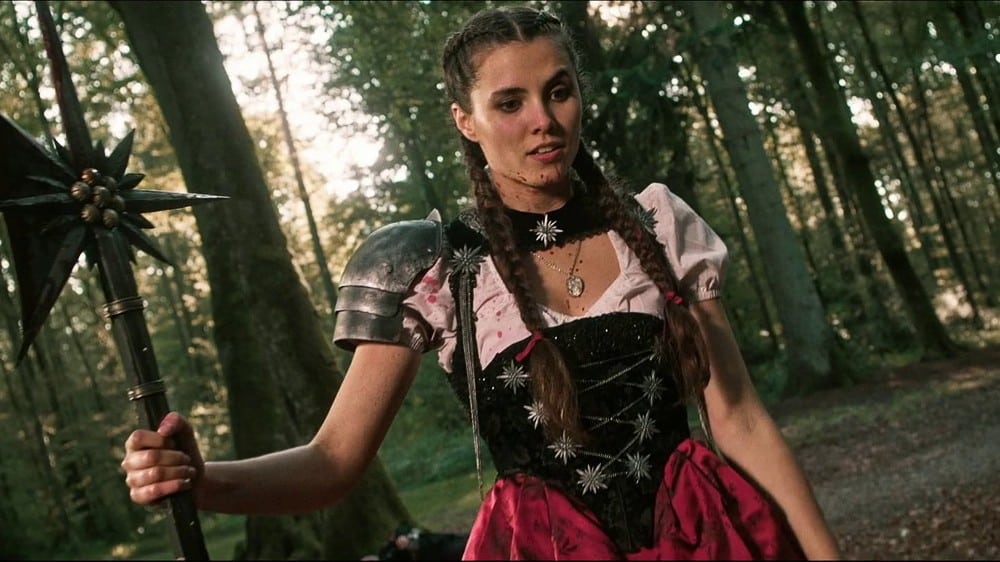
Her subsequent grief brings the bereft Heidi into the firing line, too, and she is subsequently jailed; via a bit of ‘women in prison’ homage, Heidi must turn into a kick-ass heroine to avenge those she loves: she must track down those responsible and make them pay. It takes rather too long to get to this point – directors Johannes Hartmann and Sandro Klopfstein know their fan base and linger in the girls’ cells for a little too long – but the film does have the good sense to save some of its most full-on, crowd-pleasing scenes for later on in the film.
It tries very, very hard to tick every exploitation box you can get away with ticking today. The problem with all of this is that, at this point in time, it always feels a little strained: we’re self aware about genre and film history in ways which can’t but add in a dash of cynicism to proceedings. But this doesn’t stop the film showing a certain, commendable dedication to what it’s doing, even in all of the clutter. ‘Swissploitation’ is coined and namechecked a number of times during the film; this is, by the seems of it, its first outing, and no one can deny that it takes aim at pretty much every Swiss stereotype there is, right down to giving us a death by fondue. There is love here.
Mad Heidi is clearly a low budget film, but no one can deny that it’s actually pretty technically sound, even if you can almost feel the budget straining around the edges of every scene. The lead actress – Alice Lucy – gets fairly stuck onto her role, too, which is very physical in places. She does it all in earnest, which is the only real way to do it, and she is one of the key reasons that the film – sort of – wins you over by the end. It’s probably a film which depreciates in value as the number of viewers declines, but by and large its ardent enthusiasm carries it through the ninety-minute running time enjoyably enough.
Looking at the bigger picture, now that we’ve had Winnie The Pooh: Blood and Honey (a film I personally vetoed for the site) and Mad Heidi, it’ll be fun to guess what other beloved children’s characters are out of copyright and ripe for a horror treatment. My money’s on Pippi Longstocking – I think one book’s public domain now – so watch this space, maybe. Stranger things have happened.
Mad Heidi (2022) will be available is selected US screenings from June 21st 2023.
There have been, in recent years, a number of imaginative explorations of the role of technology in our lives. It’s a diverse topic, ripe for horror: the increasing levels of control we afford to tech, as well as the importance we attach to apps and platforms, have made for some great films – some scary, some funny, and some a blend of both. Unfortunately, Motion Detected (2023) won’t be joining those ranks anytime soon. It’s too diffuse, too confused and has no pertinent social comments to make. Tech framework or not, this is thin gruel.
We start with a little girl lying in bed; she wakes up to see something static or akin to a glitching screen, almost creeping around her door. She sees ‘it’ at other times, too: when playing outside, she sees something at her window, and heads indoors to take a look. An antsy home security system chunters “Motion detected” as she heads upstairs, before – she’s gone. Literally gone. It seems that she hears her mother’s voice, and is fooled into heading into the big red cloud of electrical static accordingly.
The same house now being available to lease – not a great sign – we cut to a clearly wealthy married couple (albeit no wedding band for her), hoping to move in. The agent showing them around discloses that the last tenants ‘just vanished’, taking it oddly well, given they must have owed the company money. Here’s something else odd: the house’s owner has his own glowering portrait hanging on the wall. Heavy foreshadowing right here – and now that we’re on that subject, the fact that the overzealous home security system is called Diablo is not the best of signs either. Anyway, Eva (Natasha Esca) is enthused about the house, odd portrait and all, because of its state-of-the-art security. She recently survived a run-in with a Mexican serial killer at their old place in Mexico City, and wants the peace of mind. They sign up, just in time for husband Miguel to head back to Mexico City, and their old house, for ‘work’, which seems to be a perpetuity of client dinners. Nice work if you can get it.
This (in)conveniently leaves Eva alone in the new house, with no idea how to work the new security system. You’d think that at the very least the property people would have provided basic instructions, but then that may impede it continually going off. And go off continually, it does. Creepy, unseen triggers set it off. Boundaries are disrespected, weird, hooded figures seem to be menacing the area, and Eva is having a dreadful time of it – as often refracted through a home security eye’s view, with Motion continually Detected. Is this some kind of haunting? Is she being menaced by very earthly figures? Or is this all in her head?
There’s great scope here for a commentary on how our homes are scarily out of our control – or else, on how neighbourhood reliance on messageboards and apps can breed absurd situations, or even on how past trauma can create hallucinations which simply make tech part of their modus operandi. None of these, really, comes to the fore in this film. Eva sadly comes across as an unpleasant character: peevish, argumentative and needy. She is supposed to be deeply traumatised by her past encounter with a killer, but this gets only the sparsest of treatments, and isn’t plausible. There was space and time to do more, but unfortunately Esca’s character as-written instead has to loll about being ‘sexy’ with a disproportionate and pointless number of outfit changes and yoga sessions, not to mention another boundary-defying character (the Diablo technician, no less) who openly ogles her on two occasions, almost as much as the camera seems to peer down her top on a regular basis.
None of this contributes to the storyline. To be fair to this actor, she has to do most of the work alone, as she’s the only person around. But the exposition is clumsy, eventually handed over to one neighbour character who trots out the elements of the house’s mystery ad hoc, whilst this seems to mean Eva has ample time to get drunk and dance solo. I’m also unsure how Mexican viewers will respond to Eva, by the way, a woman who is at first outraged by the stereotyping of Mexicans, but out of nowhere becomes a hard drinking devotee to Santa Muerte. These two things are a little hard to consolidate.
Again, none of this really builds tension or suspense. Jarring edits between Eva’s nightmares and real life are clumsy; the film repeats itself, with the 6am wake-up call over and over, ‘lights out’ over and over, and only the barest, bluntest link between tech and ‘something evil’ being introduced. If this is meant to hint at the inescapability of Eva’s situation, then it doesn’t feel earnest. Even at just 1 hour and 20 minutes long, it becomes difficult to follow, and by the end it had scuppered any impetus it might have had. Unable to fully suspend disbelief, it became difficult not to yell, ‘Just go elsewhere for a while!’ Too many plot points are left dangling whilst these feelings build. Hey, it’s a shame. But as technological horror grows and grows as a genre, there are bound to be more films like this one – a swing and a miss.
Motion Detected (2023) is available from May 19th, 2023.
We know that attempted home invasions can often flip on the perpetrators; the likes of Don’t Breathe (2016) and before it, Livide (2011) serve as reminders that, once you’re in someone’s home, you are very definitely at a disadvantage. Peppergrass (2021) sounds for all the world like it could be another one of these films: the press release states that, in the film, ‘a pregnant restaurateur tries to rob a priceless truffle from a reclusive World War 2 veteran’. However, this is no expected horror-heist, not in execution. Peppergrass has a kind of strange, often calm power, which is a strange thing to think or say, given its often brutal moments. But it feels incredibly confident, lining up its little clues, cues and plot points before gliding through them – moving through different horror and thriller elements as it goes. It may be too polished, maybe too calm in what it unfolds for some viewers, but this is certainly an engaging, often quiet – if at times underplayed – kind of chaos.
“Make sure that’s locked,” says one masked person to another, when she arrives outside the bar to find this guy has been laid on the floor, bored asleep, or else an opportunistic napper. Hang on, are they robbing this establishment, or..? The man has the keys and lets the woman inside. It’s not immediately clear, but they’re clearly planning something nefarious; the film may be set during the grim heights of the Covid pandemic, but they aren’t equipped with just regular face masks.
As they talk – or as they squabble, more rightly – it turns out that these two, Morris (Charles Boyland) and Eula (co-director Chantelle Han) both work in the hospitality trade, a trade which has been decimated by the pandemic. Times are tough. In their desperation, they are planning to steal something very specific but potentially lucrative, something which they know about given Eula’s work in her restaurant. Eula’s grandfather, also the original founder of their restaurant, has recently passed away: this has triggered a memory for her of driving out into the middle of nowhere to meet with an old service buddy of his, a Captain Reuben. Reuben farms truffles, keeping pigs specially for the purpose; if they can just find his land, and get a hold of the most expensive white truffles, they can sell it, keep afloat. It’s a crazy idea, but needs must.
Finding Reuben turns into a time-consuming affair; Eula is trying to do this by memory, but as she hasn’t been to see him since she was ten, it’s not easy, and Google Maps is little to no good if you don’t know where you’re looking for. More by luck than hard judgement, the two eventually track down a roadside stall whose proprietor – barking demands that they stay two metres distant – tells them that they are close to Reuben’s land, but to go careful: he won’t let anyone in after dark. They have to park up as close as they can, anyway, and here’s where the film segues into its first horror phase, all spooky light and forest mist. Oh, and a huge, tusked Iberian pig, roaming free. Let’s take a minute here to appreciate the role of pigs in horror; from the use of pigs’ shrieks in The Exorcist (1973) via Evilspeak (1981) to Hannibal (2001), these are mean, scary, clever animals. A large pig can devour all but the largest bones in the human body in around six hours; just saying. The femurs they’ll keep to nibble on a while longer. Morris and Eula are terrified by this creature jumping up at their car, and they should be.
Still, when they find Reuben – or more accurately, when he finds them – things get stranger still. They follow him through the woods, as he seems to require them to do: Eula speaks first, mentioning their connection. But thanks to Morris and his coked-up impulse management issues, the already tense situation quickly escalates, spinning out of control.
We’re moving from classic horror tropes, to something akin to a slasher (in terms of the antagonist) but Peppergrass also adds survivalist horror to its range. What unites all of these is the precarious situation of a stranger in a strange land (Canada or not, it almost doesn’t matter if civilisation is just within your grasp, if you can’t quite get there). The film focuses hard on Eula, in a sober and often character-centred turn of events. This is often aimless, because that’s how people are in these situations; nonetheless, it’s this section of the film which will probably draw its toughest criticism. It’s often largely silent here, too, playing with stillness, quiet and open spaces. Sometimes the trees seem to hem Eula in; sometimes the sense is of a vast, ungovernable wilderness, but neither of these are places to be, at least not like this. What definitely lends itself to the final act is Eula’s growing sense of desperation; we believe she could attempt anything. We also find out more about the film’s title, which is all about the cynicism, duplicity and error which govern the film as a whole.
Peppergrass is a film set against the pandemic in a meaningful way, rather than a film made simply to triumph over its adversity, getting it made no matter what. Its closed businesses, its desperate, often paranoid people; its designation of places according to whether they ‘have the virus’ there or not – these frame the film usefully, begging the question of whose behaviour is really the most destructive here. All in all, this is a thoughtful, capable piece of film, where all of the elements are woven together meaningfully, leading finally to a harsh, darkly witty conclusion.
Peppergrass (2021) will be available on digital platforms from June 16th, 2023.
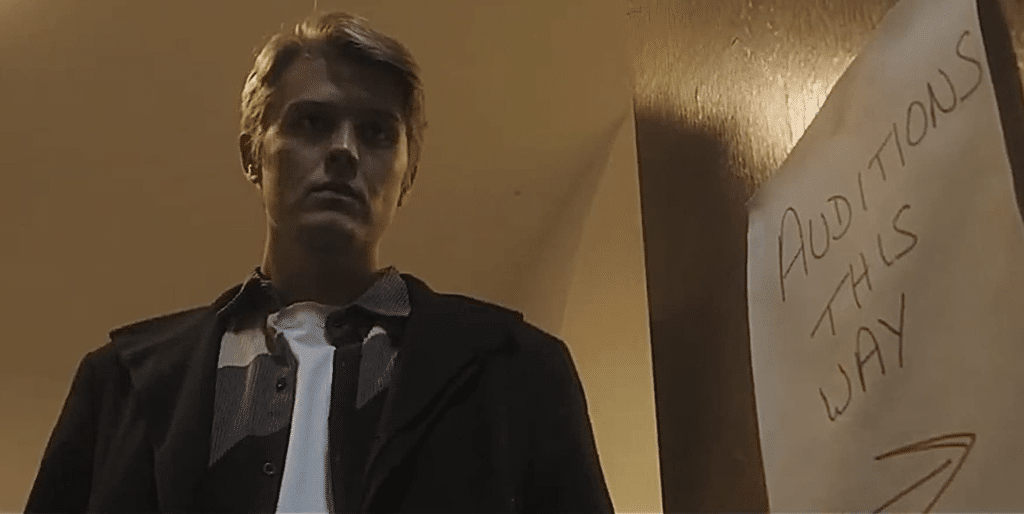
The casting call provides fertile ground for the topic of a film, particularly one looking at its pitfalls. It is, after all, a profoundly vulnerable place for actors: all that pressure, that power imbalance, and the fact that actors are often fairly itinerant, desperate to work and to get their ‘break’. From Mulholland Drive to Starry Eyes, it’s been used as an engaging setting and theme which leads us into something far, far bigger. Now there’s Casting Kill (2023), which uses that same setting to paint a picture of corruption, secret organisations and hidden identities. The casting couch is shown to be a dangerous place from almost the opening scenes; the end result is a kind of Hitchcockian vision, done on a restricted budget, but confident enough to make good use of its ideas.
We start with what seems to be a blend of know-it-all smarm and genuinely unhinged behaviour from one Arthur Capstone (Rob Laird), casting CEO of Scotsville Studios. We’ve just seen him during a rather shadowy meet-up with another man which intimates some sort of deal or arrangement, and now here we are: as he rattles through his spiel on character motivation and the process, we quickly get the idea that he isn’t all that he seems – this isn’t a regular casting situation, and he’s labouring under some very particular delusions. But then we see something a little more conventional from him, with a legit queue of people all eager to make a call-back. He treats them with a blend of hostility and disinterest, but then, when he does find someone he likes, that seems to be a distinct dose of bad luck, not a positive. There will be no call-back for his chosen actors.
The casting is not done there, however: cut to the next day, and there’s another pair of contenders: Dom (Jack Forsyth-Noble), who’s actually rather good, which seems to offend the CEO on a visceral level, and Ruby (Rachel Chima), an old friend of Dom’s. They chat outside the casting venue, and then again later, when they’ve each had their strange, discomfiting experience with Capstone – and they decide to investigate him, each in their own way.
Casting Kill loses some of its forward impetus at this point, though it is wise enough not to overstay its welcome; the running time here is a modest eighty minutes (or just shy of that). However, it is driving at something, leaving room for a decent finale and giving over some more welcome space to Xander (Ian Renshaw, who is immensely enjoyable in even this small role). Capstone himself is an interesting character too: he’s delusional and overblown, but overall, fun, even if the violence he is supposed to be capable of is largely intimated, not shown to the audience.
This fits in with the film’s deliberate channelling of Hitchcock visual tropes and, to an extent, characters: by its nature, this film is rather low key and small scale, but within its limits it has a keen eye for camerawork, very deliberately composed and framed shots and best of all, a superb score which is fully interwoven with the film, not simply overlaid. It’s a great fit and shows great attention to detail. There are some moments of cruel wit, too, which ultimately poke fun at the process of filmmaking – and all that goes along with it – from the perspective of an insider, showcasing just a little frustration with the whole thing from that point of view. Well, they do say you should talk about what you know; you have to laugh at the alleged big-time CEO of a Hollywood Studio preaching the sanctity of his profession whilst robbing cash from those auditioning, for example, but knowing how hard it is to get film projects funded, perhaps this is just a bit of verisimilitude.
There are a couple of issues – little errors, which stem from the fact that filming on this was over and done inside six days. That said, some Americanisms creeping into the very British dialect of two of the main characters is a little jarring; there’s a very noticeably breathing ‘corpse’, and do the bank notes have ‘specimen’ written on them? Things must be even tougher for actors than expected. Overall, though, despite these few rough moments, the film has enough ambition to keep things going, and even if the film doesn’t necessarily see every idea or plot device through in full, it does still come across as a wry take on the filmmaking industry which brings in some watchable, engaging ideas. It pokes fun at itself and the industry as a whole, too.
Casting Kill (2023) is available now on Amazon Prime.
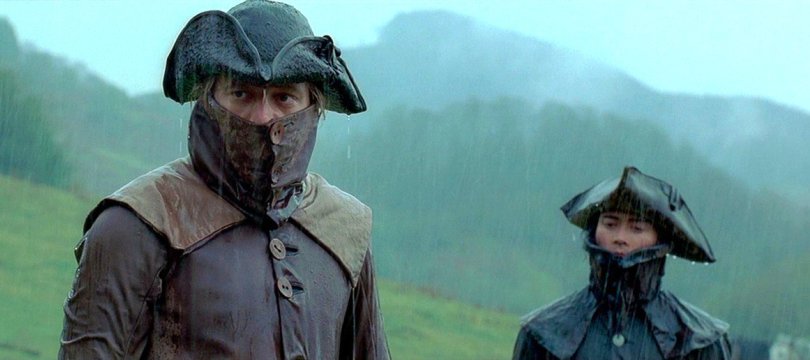
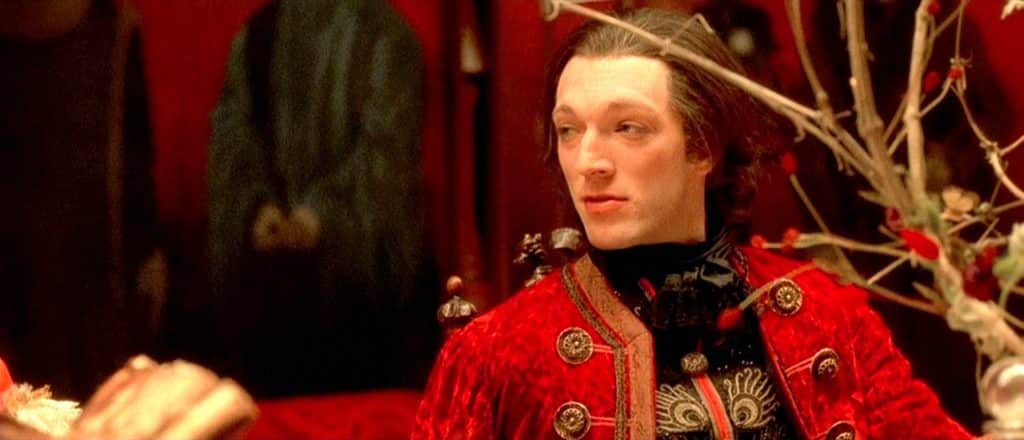
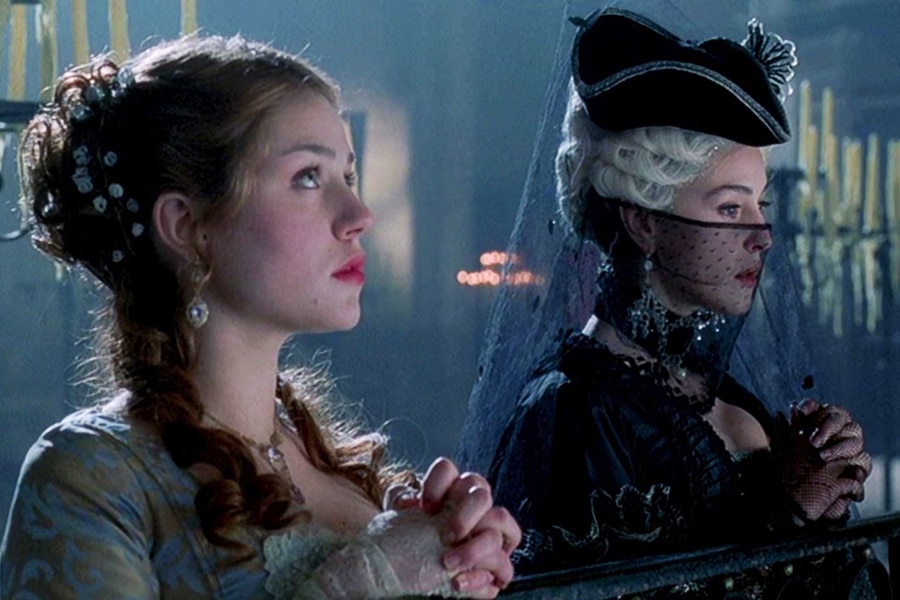
In 2001, right on the cusp of the slew of New French Extremity and ordeal horror, a peculiar, lavish period horror emerged from France. It’s many things, but above all else, Brotherhood of the Wolf (2001) is a film made during changing times, about changing times. Taking for its basis the Beast of Gévaudan panic which genuinely unfolded during the 1760s (a spate of mysterious animal attacks which prompted the time-old triumvirate of hysteria, fear and supernatural attribution), the film plays fast and loose with its range of identifiable historical elements, but uses a cast of genuine aristocratic names, as well as the verifiable fact that the king did get involved with the real case, sending dragoons to investigate the deaths. However, whilst building on elements of real history, Brotherhood of the Wolf allows its heady fantasy to run away with it; the notion of a possibly supernatural cause behind its events is certainly allowed to build, though at heart its point is a serious, worldly one, reminding us that – in the real case, as in the imagined – it is often the powerful who stand to gain from public hysteria, and they who are best-placed to exploit the already exploited. A beautiful, commanding film, its message is nonetheless as ugly as it’s recognisable.
Not that the great redress in power relations which followed hot on the heels of the Beast of Gévaudan affair is afforded so much as a lick of civility, though – and quite rightly. The film opens in late 18th Century France, at the point when the Revolution had ceded to The Terror; at this point, the revolutionary aims of liberty, equality and brotherhood had been stymied by unreason, paranoia and mass murder. Facing arrest, with a baying, cockaded mob at the door, we meet one of the film’s key players, the Marquis d’Apcher: with little time left, he sits down to write a personal testament of the events of 1764, when the notorious ‘beast’ stalked the remote Gévaudan area. As this testament becomes our embedded narrative, we see one of what we understand to have been many attacks, though there is something off-key about it: the attack on a young woman, by an as-yet unseen creature, seems vindictive rather than simply animalistic; this is a clue that this isn’t a simple wolf attack. Unsurprisingly, panic and persecution soon ensure. In this rain-lashed countryside, vengeful villagers are turning on one another, taking the generally febrile, watchful atmosphere as invitation to lash out.
However, some semblance of order arrives in the form of two riders, sent under command of the king to investigate these bloody events. Grégoire de Fronsac (Samuel Le Bihan), libertine, dilettante and gallant, and his companion Mani (Mark Dacascos), an Iroquois, bring along something of the worldly scepticism of Paris and the court, at least ostensibly: regardless, the accounts of some unnatural she-wolf stalking the land demand attention. Again, overlapping with the historical event, rumours are flying, insisting that this is no ordinary wolf. An immense hunt is subsequently called, one which draws in every aristocrat and landowner who can be called upon, but also, at points, transcends the incredibly entrenched (at least for a few more years) class system which was in place at this point in time. Unfortunately, despite this en masse effort, solutions fail, even when word comes that the deed is done, the beast is killed; Fronsac’s work is not done either, and the closer he gets to understanding what is happening around him, the greater peril he finds himself in.
The film continues less as a creature feature and more as an ornate game of politics, whereby rumours of the beast are seen to serve a purpose beholden to those already in power. The French aristocracy certainly had form when it came to backstage plotting and irrational belief: as much as the late Renaissance was in the process of ceding to the Age of Reason, stubborn and determined pockets of unreason clung steadfastly on throughout this time period, such as during the Affair of the Poisons – when key players on the court of Louis XIV decided to gamble their good graces on a frenetic period of drugging, witchcraft and murder – or, as in the film’s hallucinatory timeline – on similarly secretive cabals, poised to use terror to undermine existing bastions of power for their own ends. In the film, the beast becomes a political cipher, both to its victims and to its masters. Its masters are already powerful, of course, but secrecy, ritual and fervour will never be discounted where ‘progress’ inevitably means uncertainty, or a stripping away of power.
The role of the aristocracy in the film is key, and watching their machinations forms the largest share of the film’s running time. Even taken just on its own terms, it’s a fascinating, exasperating glimpse at a group of people clearly corrupt, self-indulgent and, yes, somewhat laughable in their little intrigues and competitions. However, we also see them in their historical role as landowners, guardians and, to a certain extent, the face of the ‘greater good’ in French society – though that may depend on who you asked. It’s also worth saying that these were the only people with the time, means and inclination to ponder events such as those in Gévaudan: everyone else, regardless of their fears, had to live, farm and work the land regardless. Even the grand hunt, the first response to the beast, feels like an extension of a noble pastime – hunting for fun, as we see in the repellent scene of the pile of dead wolves, so substantial that it obscures all else behind it (as much as it’s a lot easier to find this scene repellent when not at risk of being killed by wolves: French folklore was there to remind 18th Century France of what had allegedly happened in 15th Century France, but then even in the 18th Century, wolf attacks were a regular occurrence.)
We also see in the film that, in this period, all roads lead to Paris: the goings-on of Versailles loom large over the nobility, often crowding out all other concerns. One criticism of the film has been that it lingers too long over the intra-familial politics of these characters, hanging out in its (rather splendid) Rococo dining rooms, palaces and brothels at the expense of the horror or dramatic elements – though even its horror scenes are a bit Rococo, oddly ornate and detailed, if dreamlike. From this writer’s point of view, the time we spend with this effete bunch all adds to the immersive, heady ambience of the film, placing us amongst their number to ponder their schemes and outrages. Their social gatherings are faintly ridiculous, sure, but they matter to our key players, and even though our heroes Fronsac and Mari are often banished to the periphery of all of this, they’re still ordained by it, and still must navigate it. Feminine intrigue plays a key role here, too, both aristocratic and otherwise, with the impossibly beautiful Monica Bellucci doing a star turn as a fallen woman exercising immense, if covert power: another French historical tradition, present and correct.
Mari’s presence in the film also reminds us that this was a modernising France, flexing its muscles as an imperial power; talk of a New France – from where Mari comes – refers to France’s race for new territories and opportunities. Mari brings his culture and beliefs with him, overlaying another supernatural element onto the film’s more worldly ones, though ultimately pressing home the fact that we cannot underestimate the impact of race and empire on events in the film. New prospects bring new anxieties. Perhaps there’s a certain amount of stereotyping of Mari as the sage medicine man, but he is nonetheless a valued friend to Fronsac, if a source of baffled pantomime amusement for many of his aristocratic peers, fascinated by his talk of totem animals but dismissive of him as an equal.
The film is not just a character study of the aristocracy, though, and nor is it in any way a straightforward creature feature, not least because it hangs onto its reveal of what, or if this creature is. It’s also, unexpectedly, a martial arts film in places too, with simply loads of time given over to choreographed, often slow-mo fight scenes. It ain’t kung fu, but this is still martial arts in a wider sense, and frankly, it looks for all the world like kung fu, whatever the costumes. Mari is the chief proponent of this, seeing off the traditionally hard-to-believe number of assailants, but lots of the film’s more high-action scenes depend on improbable manoeuvres and physical abilities, too.
This is a film which lurches from languid and picturesque to sudden motion, tension and violence. As such, it blends elements from a range of different genres, and it does it in ways which don’t necessarily work on paper: martial arts, historical drama, momentary grisly violence, character study and horror may seem like a hard sell, when all bound up in one place. And yet, the film’s odd elements work, despite jarring sharply against one another from time to time. Sure, Brotherhood of the Wolf can be camp, or too loose and self-indulgent in places, but it’s a terrifically engaging historical romp which looks and sounds wonderful, with each shot set up like a piece of art. It’s hard not to be carried away in its wake; it seems to have been made to be a guilty pleasure. It tries hard to balance its horror elements – unforgiving, pre-Romantic landscapes, petrified damsels, mysterious creatures, blood and menace – against its bedrock of historical veracity, all interestingly selected, shot and acted.
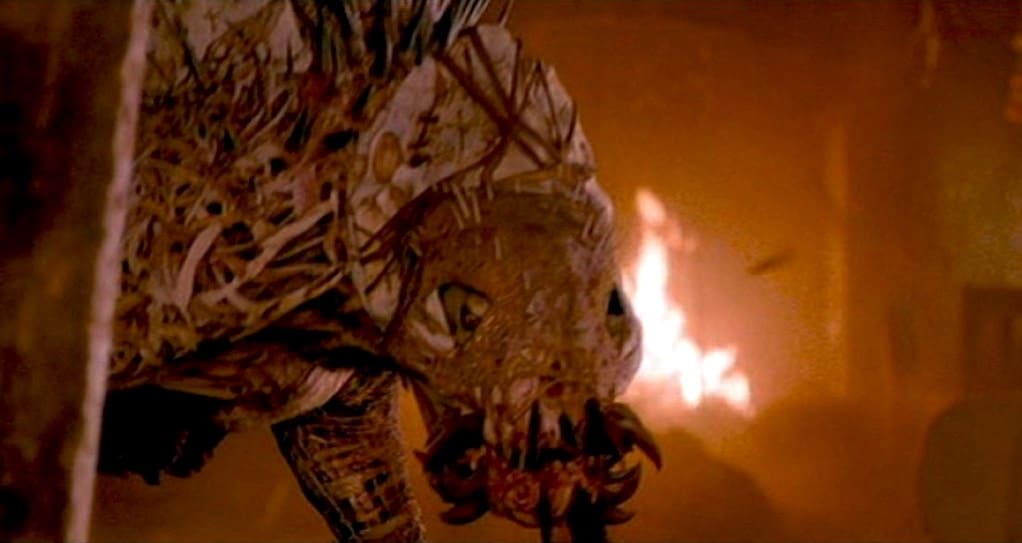
It is perhaps most interesting, though, for its choice of source material. The historical Beast of Gévaudan case, being such a shocking and to an extent an inexplicable-seeming event, inevitably drew down claims of a supernatural force at work – something otherworldly, operating beyond the abilities of even a large or particularly ferocious wolf. Even a determination to regard these attacks as the work of one creature shows the beginnings of a mythologising tendency, this being often one step away from an outright supernatural belief. As such, events at Gévaudan have steadily become enmeshed with werewolf folklore – largely through being grouped in with other, adjacent beliefs in werewolves which had little to do with Gévaudan itself, but the misapprehension was there. Brotherhood of the Wolf, similarly, is often assumed to be a werewolf film: it looks as though it’s going to be, it sounds potentially like it could be, and on first glance, there appear to be supernatural elements at work. It even plays momentarily with some of the werewolf folklore which has been created by cinema, for cinema: the discovery of a metal fang, for instance, suggests that this is no ordinary wolf, and in horror cinema, when it’s no ordinary wolf, it’s likely to be a – well, you know what.
But, although the film allows itself a few ritual gatherings, some ritual killings and a mysterious, bloodthirsty fraternity, this fantastical add-on does not take away from the fact that this is no werewolf film after all; this revelation is for us, as well as the key characters. The creature has earthly origins, and it is controlled by a human. The film has its fantasies, and it has its lavish, supernatural plot points, but ultimately it’s earthly powers which are attempting to hold sway here – the same as ever. Abnormal wolves, mysterious creatures, even werewolves themselves: where these allegedly crop up in history, it is often as a result of a particularly traumatic event or particularly straitened times, as in Gévaudan. Ultimately, though, the explicable – the just-about explicable – is traumatic enough. Brotherhood of the Wolf manages to marry its luxurious fantasies to its realities, and it does so without sacrificing its vision of a peculiarly anxious moment in history, one where the spectres of war and rebellion were there to worry away at the edges of polite, restrained society, by then poised and peering into an abyss of change and progress.
Brotherhood of the Wolf is about to get a 4K UHD remastered re-release, courtesy of Studiocanal. It will be released on May 5th, 2023. For further details, please click here.
With a beautiful double-bluff opening – and not the film’s last double-bluff, either – Evil Dead Rise (2023) takes us straight to the ubiquitous cabin in the woods for its opening scenes. Reluctant cabin-goer Theresa (Mirabai Pease) is trying to dig in to her copy of Wuthering Heights, but her friend’s boyfriend Caleb is all too ready to interrupt her closest approximation to fun. So she heads indoors to see how their sickly mutual Jessica is doing and, it turns out, she’s doing none too well. None too well at all. Cabin, woods, new tendency in a friend to go from horizontal to vertical in a second: here we are, then, here’s where Evil Dead Rise is going to play out. Right? Nope. This sequence is simply here to jar us out of our expectations, on the micro and the macro level: with no time to waste it seems, this part of the film only serves to deliver the film’s modus operandi: nasty, ugly gore. Then we’re away, faster than a Deadite hearing an invocation (a term which, by the way, we never once hear in the film, but forgive me the shorthand here.)
Downtown LA: single parent family Ellie (Alyssa Sutherland) and her three children, teenagers Bridget and Danny, and little Kassie, are doing their best to live normally ahead of an upcoming eviction from their now-condemned apartment block. They’re unexpectedly joined by Ellie’s younger sister Beth (Lily Sullivan), who lives on the road as a music tech, but has headed home under a rather predictable cloud – more on that anon. As Beth tries and largely fails to console her sister, fresh out of a break-up and with no discernible new home to offer her kids, an earthquake hits LA: newer, better-constructed buildings seem to get through this experience fairly unscathed, but the family’s Art Deco-era tower block suffers a big hit, not only losing power, but soon finding itself atop a large sinkhole which Danny, being an idiot, decides to explore.
He discovers an old vault, back from when their building used to be a bank, and emerges from the hole with a bundle of hundred-year old papers, a bunch of vinyl and – a mysteriously-bound book. By the way, it’s debatable whether anything much else would have happened here, had Danny not also been one of those new-wave vinyl guys; the world was fairly safe from the Deadites for a period of around thirty years, during the time analogue had seemingly gone into terminal decline. And now the record players are back, and essentially, the hipsters and the ‘you have to hear this on vinyl’ people have killed us all. You don’t need me to explain what happens to the mysterious vinyl recordings: they get played. Of course they get played. The book, too, starts to do its thing.
This film gives us a really unpleasant, grisly rendition of the Deadites which has far more in common with the remake-ish from a decade ago than it does with the 80s and 90s Evil Dead movies, let alone the Ash vs. Evil Dead TV series. The Deadites in this newest film – few in number, in keeping with the usual – aren’t as good-humoured as their forebears, perhaps. They smile, sure, but there’s not much laughter; everyone’s more serious about their work since the global economic downturn. This is an unrelentingly revolting vision throughout, and a key difference this time around is that the family dynamic is much more strongly centred, with a mother and her children the key target. The film troubles itself surprisingly little with modern social issues – although it threatens in that direction a couple of times – but if any one thing comes in for a serious drubbing here, it’s motherhood. Even pre-ordeal it’s represented as drudgery with a gloss of selflessness, and thereafter a source of sardonic glee for entities who mock it as a kind of parasitism. That being said, the main entity is quite Christian fundamentalist in its beliefs about who/what gets a soul and when: funny thing, there’s always unusual overlap between belief systems.
Evil Dead Rise is a grotesquely, inventively unpleasant piece of cinema which works the modern, urban setting very well, borrowing liberally from non-supernatural genres of home invasion and ordeal horror as well as riffing on the Evil Dead source material (which was always, let’s face it, a fairly simple plot which needed no embellishments). There are lots of nods to existing horror throughout, too, such as Hellraiser (particularly the new remake, actually), The Shining and even sci-fi body horror: Aliens came to mind a couple of times in certain scenes. The film also does what all films feel the need to do when they appear as a sequel or remake of some kind, and that’s to include Easter eggs which link to previous films. That’s not particularly compelling in Evil Dead Rise, as the tonal ugliness of the new film works against inclusions of scenes, symbols and lines which belong to the dark comedy content of the earlier films (and really, the whole opening scene can be seen as an Easter egg, which is a fairly large chunk of the film as a whole). But the film does work well on its own terms nonetheless, and there are definitely some openings for another one, should this film do well (it’s outstripping expectations so far). There’s one spoken line heard in the film which has set certain fans aflame with ideas about the next instalment, though it would be best to play cautious with that for now.
Would another film in this vein be a bad thing, though? Certainly not: absent the few minor issues, this is a brilliantly mean-spirited modern horror which walks a solid line between new ground and old. It’s strange, really, how watching the Deadites do what they do has become a source of enjoyment over the decades, but so it is: this film is a welcome addition to the Evil Dead universe and if it has established a tone for things to get even more visceral in future, then that can only be a positive.
Working in any kind of public-facing role is a test of one’s patience and mettle, and the food industry has to rank highly on any objective or subjective measures of tedium, ick or just downright stress – and that’s just when it comes to the customers. Let us not underestimate one’s co-workers, as it is their very own potential for weird conduct and overstepping all manner of personal boundaries which can make the job so additionally taxing. Spare a thought, then, for Nola (Verity Hayes), who opens short film All You Can Eat with a litany of complaints about her very, very odd colleague at the restaurant where she works. She’s not in the wrong: he’s been using the pantry at Planet Burrito for what seems to be some kind of weird science experiment, petri dishes and all. Environmental Health would have a field day.
Speaking to another co-worker, Nola recounts how she has recently stumbled across him poring over some kind of primordial sludge in there, but even worse, she overhears that he’s listening to some kind of diatribe about the procurement of a special sample of some kind (voiced in the film by Jello Biafra, no less). The sample is volatile, the voice solemnly proclaims, and it absolutely should not come into contact with any sort of foodstuffs. Well, that’s a bridge too far for Nolly, who feels that the only right thing to do in light of this discovery is to act as whistle-blower. But no sooner has she set herself this task, than shall we say ‘events’ conspire which take precedence over any professional complaint.
This is a simple, postcard-sized plot which serves in the main to showcase director Kieran Reed’s love of old school, 80s practical SFX and sci-fi origins which so often end in gratuitous gore and splatter (though a different explanation for events is mooted here). Think The Deadly Spawn (1983) in particular, which has a similar brand of toothsome critter with similar aspirations (the font used on the opening titles is a dead ringer as well, so in many respects All You Can Eat is as much a direct love letter to it as it is to other, albeit still similar films). There’s a touch of the eww factor of Bad Taste (1987) in here, too, and even a bit of Tokyo Gore Police (2008) – in reverse, if you will (an observation which makes more sense if you hone in one one particular scene in All You Can Eat). Interestingly, the film goes for a contemporary timeframe, as much as analogue cassette tapes appear alongside up-to-date mobile phones; it feels somehow in transit between the UK and the US, too, as the style of restaurant, the signage and some of the character voices are American, whilst the work safety notices, and of course Nola herself are clearly British. That’s not a complaint, more an observation, and further evidence that this is a British tribute to often American cinema.
At thirteen minutes running time, the film is by its nature a taster – an extracted sequence – rather than a fully-fledged narrative, and there are a couple of issues here (some of the keynote gore is hard to make out in the dark; some of the dialogue gets a little drowned by the incidental music). But there’s a clear sense of fun involved, and All You Can Eat would no doubt go down well in a festival setting where people’s enjoyment goes up in response to the levels of OTT FX on offer, particularly were the film to appear as an aperitif for a similarly-minded feature-length – which, for that matter, All You Can Eat is intended to be at some point.
All You Can Eat (2022) has been on its festival run: watch this space for more news…
Whether Dario Argento – 82 years of age – never makes another film, or has a flurry of late activity and makes another five, it is categorically impossible to watch one without the weight of expectations practically pressing you flat. Such is the case with Dark Glasses, a Shudder Original no less (how times have changed, etc.) which feels somehow like it’s all his films and none of them. It tunes into giallo conventions in places, but it feels like a moment’s deja-vu before the tone and style shifts to something else. It feels retro, but it feels modern – not fully modern, more kind of hanging in time somewhere between 2000 and now – well, the screenplay is from back in 2002, so that sort of makes sense, except you also feel like it would have had the same free-floating feel even had it been shot back then (with Asia Argento in the leading role, obviously). Yet for all its oddities, all its bizarre decision-making, it’s not by any means totally dreadful. It’s fairly entertaining, even if scatty and strained. Above all else, it’s fairly entertaining for reasons which go beyond, ‘at least it’s not Dracula‘, which isn’t the greatest claim for a likely swansong to make, but not one wholly without merit, either.
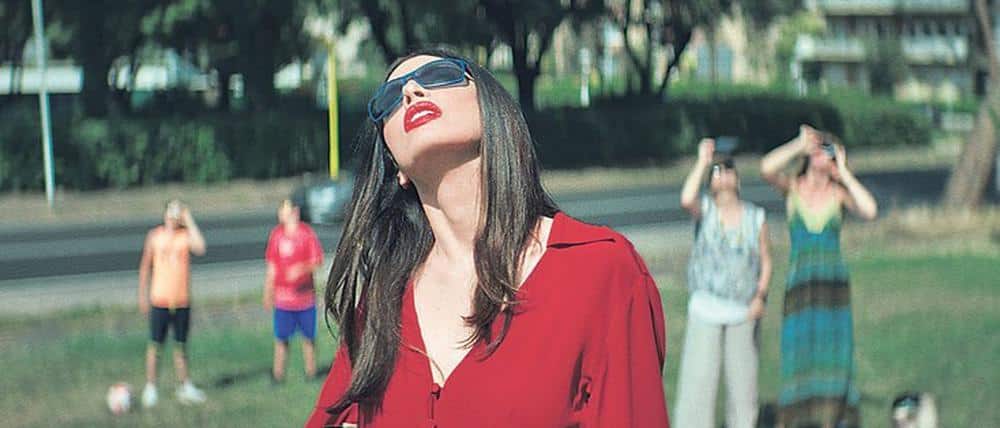
We meet Diana (Ilenia Pastorelli), a call girl driving down a residential street in Rome; neither an attentive driver nor a woman who keeps up to date with current affairs, she is distracted by the sight of many people with phones pointed to the skies, waiting for a solar eclipse – something which appears to be a surprise to Diana. It’s made clear that solar eclipses are historically regarded as portentous (especially if you look straight at the sun beforehand) but it’s not made clear whether this has anything to do with a flurry of serial killer activity in the city; in fact, now that I think of it, a detective later mentions that there have already been several victims, so that would be a no. So why is the eclipse in here? I had wondered, knowing from the blurb that Diana loses her sight, whether the eclipse would be somehow responsible; a later scene recalls Day of the Triffids, at least a little, but ultimately the event is just in here for aesthetic, symbolic reasons, if that.
We then discover that there is a man in Rome strangling prostitutes with a cello string (another inclusion which could be symbolic, but turns out not to be. That’s the extent of the false clue trail in this film). As a young woman leaves the hotel room of a client, she is attacked: a large number of people thereafter make no attempts whatsoever to perform first aid, watching her bleed to death from her injuries on the ground. Diana, being in the same line of work, is clearly in danger; we see her being attacked and assaulted in other scenes, and actually in fleeing one ogre she runs straight into another – the murderer, it appears, who rams her car with his van, sending her headlong into another car, killing two of the three occupants and blinding her.
Now with complete sight loss, Diana is given some help to navigate her new situation by a charity organisation who send an outreach worker, Rita (Asia Argento) to help her make adjustments. The guide dog, the white cane; these all follow. She also strikes up a friendship with the little boy whose car she hit, with the boy, Chin (Xinyu Zhang) coming to act as her de facto guide; let’s park the rather unbelievable safeguarding issues around that element of the plot, because Ching becomes rather important to what transpires next – as much as we have to wait for this to roll around.
Dark Glasses seems to be doing the groundwork for a classic bit of giallo ‘whodunnit’ but oddly, it doesn’t really go anywhere with this, as much as it’s heavily signposted in the opening few minutes. Come to think of it, aside from some gloriously implausible gore – heads seem to go off like ripe melons in this particular reality – there’s none of the double-bluffing, glimpsed possibilities, the clues, the trail which leads to possible and impossible culprits. There’s no leather gloves or masks, either. In fact, it’s made clear pretty early on who the culprit is, out of a perishingly small number of possible culprits. In this respect, it’s far more earthly than a lot of Argento’s other, well-loved works, particularly bearing in mind that he’s the only director ever to draw from me the comment, ‘Oh, come on, a CHIMP?’ So it’s less a giallo and more of a kind of pursuit film – more of a slasher then, I guess? – a pursuit both problematic and at times really bloody uneven on account of the lead character’s blindness, as she clambers slowly and unevenly away from the murderer, someone whom she already knows and recognises. Peculiar. The film ultimately lacks the exposition of your usual giallo, too, which usually unfolds some spurious, but imaginative reasons for it all, which brings me back to the chimp. We do get some wholly unnecessary water snakes in here, mind, though not especially wedded to the plot; I’d have loved it if Argento really sent himself up, adding a preying mantis, but no: it’s just snakes.
So it’s loaded with bizarre inclusions which eat into the run time, and it hasn’t troubled itself with the mystique and tension so fundamental to Argento’s best work, but hey: it’s all decently shot, the soundtrack is ferociously good, and I rather liked Pastorelli in the lead role, making the absolute best of the script whilst proving herself up to a pretty challenging physical and emotional performance; she does better with it than Asia Argento would have, had she inevitably been cast in this role – though Asia does turn up, looking rather better than she did in Dracula, and offering up a fairly plausible performance in an unusually dressed-down role for her. In essence, there are good things going on here, and this oddball collage of giallo and horror elements ticks along well enough. It may only have a dash of the gloss and flair of Argento at his best, but it’s by no means the crushing disappointment claimed by some critics and fans.
Dark Glasses (2022) is available to watch now through Shudder and other streaming channels.