Fantasia 2024: The Dead Thing

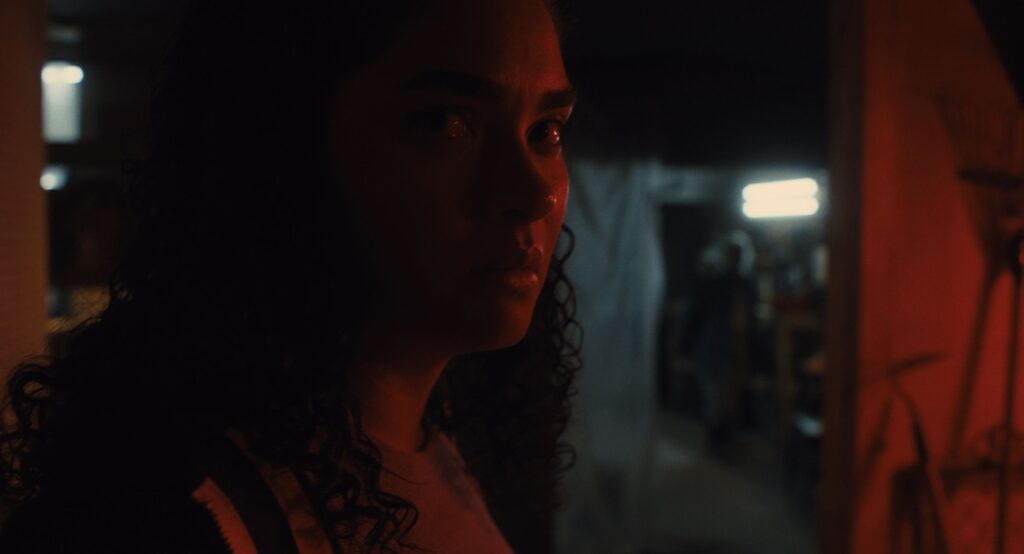
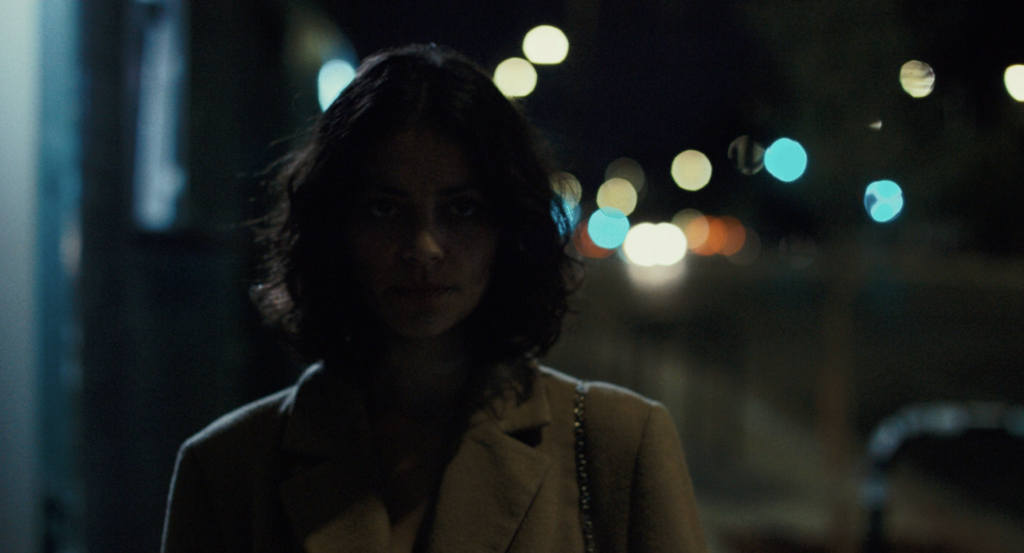
Could The Dead Thing (2024) have a simple strapline? If so, perhaps ‘this is hell we’re in’ would suffice, bearing in mind how – at least for the first couple of acts – modern technology is crucially important, and a key factor in raising a specific kind of hell. Today, there are all sorts of exciting opportunities for meaningless, short term connections and Alex (Blu Hunt) is all over them. For her, the tech-enabled gamut of swiping left or right on a dating app which isn’t Tinder, but kinda is, takes up a lot of her time. She actively avoids real-life connections, preferring to scroll, scroll, scroll, and often, to follow up the scrolling with a brief encounter. Perhaps she likes her encounters easy to manage, navigate and delete? Well, perhaps, but she doesn’t seem particularly happy in herself. She even seems to see people she engages with in real life as a sequence of body parts or attributes, each comparable with the last, so that one guy’s appearance recalls another, and another, and another. The ‘ping’ of notifications runs through all of her day-to-day. It looks like classic addictive behaviour.

If it is addictive, then this perhaps explains a dissatisfied, if brief rant about the nature of existence, including the proximity of a meaningless death – which pops out of nowhere on her next date, with a nice guy from the app called Kyle (Ben Smith-Petersen). Oh, nice to see House of Psychotic Women in the nightstand, by the way. If this conversation disrupts the norm for Alex, then so it does for Kyle, but it appears that her sudden honesty about her state of mind appeals to him. Or, in any case, they get a lot closer, enjoying the time they spend together. What we’re shown here seems very authentic, even heart-warming, given the clinical briefness of Alex’s prior dates. Sadly, it’s not that simple and after the intimate space they share, it appears that Kyle ghosts her. He doesn’t respond to her messages – he doesn’t even read them.

Hurt and surprised, she tries to track him down. When this fails, it looks for all the world as though she is just going to go back to the old, familiar business of bad dates and one night stands – except that, on her next date, she sees Kyle again. My god, he’s even turned up in the same bar where they met. Intrigued and not a little hurt, she follows him as he leaves with another woman. Or does she? When she tries to track him down again – wanting answers – someone at his old place of work hands her a funeral notice. So did she really see Kyle?

Objective reality which, let’s face it, always felt like it was going to be in short supply here, quickly begins to fracture as Alex seriously comes to doubt her senses. Perhaps doing the only thing she has any faith in, she resorts to the app again, and decides to try something. She uninstalls it, and then reinstalls: hey presto, there’s Kyle, and when she matches with him, he arrives for another date, with seemingly no recollection of meeting her before.

Whilst The Dead Thing grows increasingly thematically close to other films – it feels like somewhere between Nina Forever and Soulmate, if closer to the latter – then neither of those cover the same ground in such an eerie, meticulously detailed way. It’s an uncanny spin on a world starved of genuine connection, and more than that, it’s good at showing how the ways we understand and interpret death have been changed irrevocably by social media. People are gone, but there; they’re absent but present. At the heart of it all is Alex, and Blu Hunt does an incredible job conveying the world of barely-contained emotions she experiences, all sensitively directed by Elric Kane (and the intimacy coordination work here is very good too, responding carefully to the challenging world-building, and the absence, surrounding it). As circumstances grow weirder, we come to rely on Alex as our single point of relatability, as she is our only constant. That being said, it does feel tricky at some points, such as when she seemingly gives up on the mystery for a while, even if her willingness to go back to some sort of normality is understandable.

This is an interesting-looking film, too, which utilises an array of modern tech and its attendant preoccupations, but looks like something which could have been made decades previously. Its horror soundtrack, its framing, lighting, colour and shadow all look as though they could come from a different era. The ominous roar of traffic is 80s Fulci – as are the women in sexual peril, come to think of it, though The Dead Thing never focuses on the grisly details of bodily trauma and its supernaturalism never takes over, even as it grows to feel more familiar as we head into the final act. It’s much more about emotional ordeals, and it does deliver on those. And, as we explore these, we see that everything in The Dead Thing unfolds for us a mere version of reality. Nothing is anything more than ephemeral. Alex scans documents for a living – she literally makes copies. Her roommate hangs out in a wedding dress, when there’s no wedding. Reality is piecemeal, and something to be handled carefully, if not avoided altogether.

There’s plenty of space for horror in this kind of environment, and even as it settles into more expected tracks, the film has plenty of merit to offer in terms of its updated concepts of hauntings and bereavement. Many of its horrors may ultimately be age-old, but this parable of modern loneliness has more than enough brilliant, unsettling and resonant moments along the way. And, hey, perhaps we’re ready for this kind of limbo – the location for which almost, almost made me smile – and for the terrifying blackness pressing in on its edges, which didn’t make me smile once.

The Dead Thing (2024) featured at this year’s Fantasia International Film Festival.
Fantasia 2024: Dirty Bad Wrong

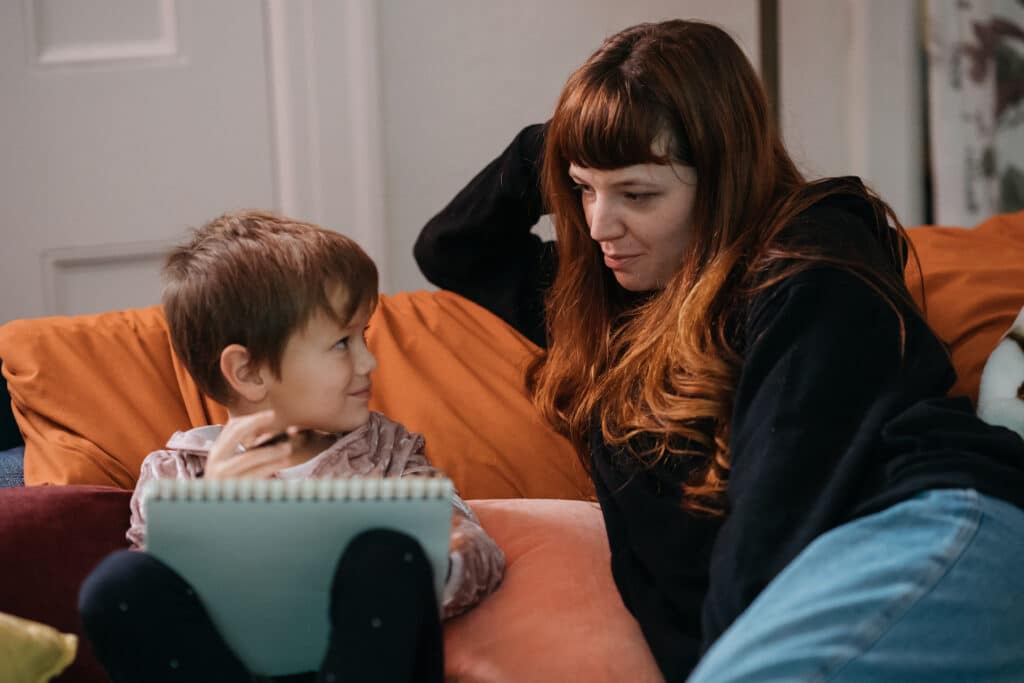
A fraught, uneasy atmosphere seems to pervade Dirty Bad Wrong (2023) from its very opening moments. There’s something about the ways in which young mother Sid (Michaela Kurimsky) sits, distracted, as her young son Jesse (Jack Greig) fidgets and investigates their surroundings in ways which quickly suggest they aren’t at home. And, as she is called out of the room by a nameless man (Cody Ray Thompson), it is quickly revealed that she is a sex worker. She puts her headphones on her young son, instructing him not to remove them; it’s all she can do, given she’s had to bring him along, to protect him from the realities of her own life during these moments. Our John Doe shows some brief consternation that Sid has brought her son along with her, but not enough to stop him doing what he wants to do. In fact, given there’s more money in the envelope than Sid expected, it seems he wants her to do more than she wishes: she rebuffs him.

As it stands, the childcare issues which brought Jesse into this house in the first place return to the fore when, as small children do, he simply can’t sit still, and starts wandering around, injuring himself in the kitchen. A distraught Sid calls the whole thing off and leaves with her son. But, with his birthday coming up and a new, sudden financial issue, she needs money. Reluctantly, she has to return to John Doe and take the work she was so adamant to avoid.

Whilst the metaphor of consumption – particularly based around the relentless selfishness of the male libido (oh, come on, yes it is) – is pretty clearly addressed here, even going so far as to touch upon body horror, Dirty Bad Wrong ensures that this is always intermeshed with a plausible normality, with a young woman who has normal concerns, needs and wants. This is carefully done in the film’s brief runtime, showing us a loving relationship between mother and son. Jesse, in only a few lines, is presented as a patient, kind but often sad little boy; his mother, who only faces the camera in full when she’s with Jesse (otherwise glimpsed from the side, or the back) is fiercely reserved when she can be, but it’s very much her and him against the world. It’s also hinted that other women are in a similar situation, juggling the deviance of others with the normality they ordinarily embody. In short, the film invites us to consider what sort of a world this is, and whom it harms.

In some respects, Dirty Bad Wrong is reminiscent of Simon Rumley’s short film, P is for Pressure, taken from the anthology film The ABCs of Death in 2010, even though Sid doesn’t harm others in her own unsavoury assignment. But the love for one’s children, and hoping that through deviant means they can have a normal life, is definitely there in both films. Dirty Bad Wrong is a quiet, clever film which only ever needs to hint at Sid’s defiance and will; in less than fifteen minutes it achieves a great deal, with well-delineated characters and their motivations displayed against a backdrop of a mean-spirited world, but one which – despite the oppressive feel at the start of this film – can clearly be overcome with love.

Dirty Bad Wrong featured at this year’s Fantasia International Film Festival.
Fantasia 2024: Berta (2024)

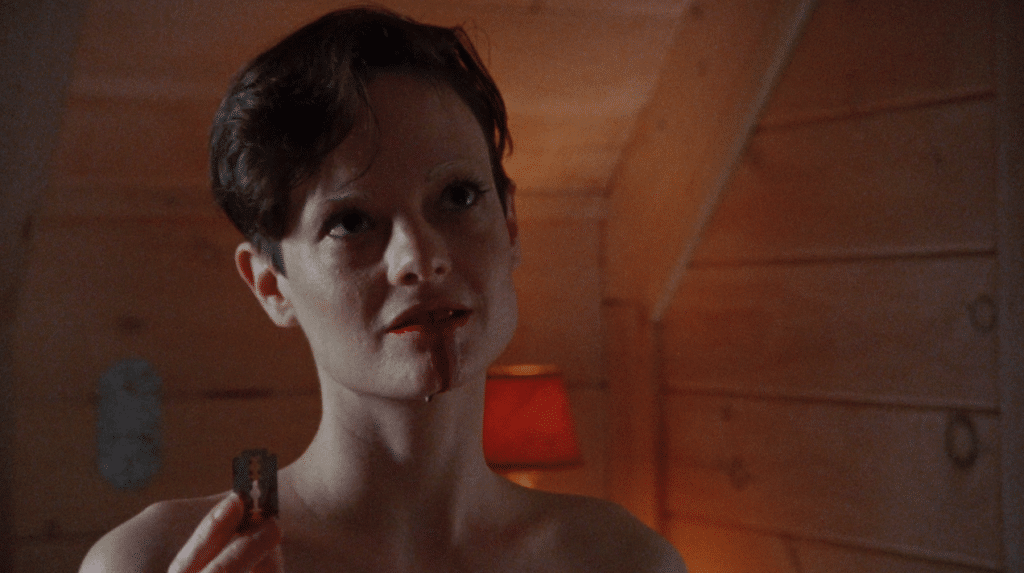
Director Lucía Forner Segarra has a run of titles under her belt which are named for their female protagonists. Marta (2018) concerns a woman who aspires to be a serial killer; Dana (2020) tackles the discomfiting subjects of rape/revenge and (lacklustre) justice; completing this trilogy, her most recent short Berta (2024) takes us once again into such unpleasant territory, blending together some aspects of the plotlines which informed Segarra’s earlier films into another, clever, timely study. If, on paper, these plotlines sound tried-and-tested, then forget all about that: with a few deft moves and the powers of a razor-sharp script, these films both utilise horror and exploitation tropes whilst reconfiguring them, repurposing them. Berta may only be around sixteen minutes long, but it wrings something significant and thought-provoking from every on-screen moment.

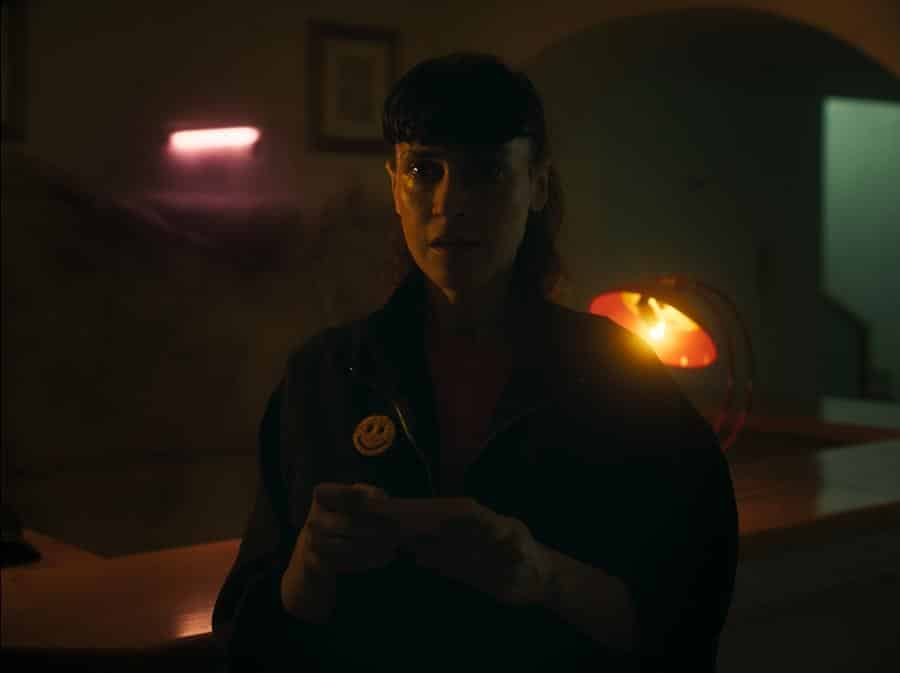
Berta (Nerea Barros) works for a car impound service: at least, we think she does. There are always tantalising doubts here. She has access to a flatbed truck at least, and when the opening credits roll, she’s busy affixing a vehicle to her own – although, by using an online tutorial. The car owner arrives back just in time to challenge her; characteristically for him, as we learn, he spends some time denying he’s done anything wrong, before hesitantly accepting his parking violation and agreeing to accompany Berta back to her depot to pay off his fine and retrieve the car. But here’s where it gets nasty.

He does accompany her, but not as expected; Berta has other ideas and a separate agenda. Later, as they talk, what is striking – and a credit to the script – is that this man (Elías González) is very plausible. Is she in fact mistaken? Unhinged, even? There’s a few moments there where this question hangs in the air – and it’s a real credit to the film that it can achieve this in next to no time spent. His righteous protestations dissolve as time ticks on, but he has clearly made an artform out of seeming so reasonable. Even his later admissions are presented, again very cleverly, as if Berta is making a fuss over nothing. Her perceptions are off, that’s all. In presenting us with this, Segarra has created a kind of warped Everyman figure which feels instantly recognisable – a cultural archetype. His words and deeds place the audience on a level with our protagonist, who is played with formidable power by Barros. Berta is nervous at first, fumbling and fussing over the vehicle ruse, but as her certainty grows, she clearly rises to the challenge she has set herself, whereas Alex steadily panics.

I’ve mentioned many times that the appearance on-screen of a very specific trope – the old tied-to-something routine – has come to leave me cold, so formulaic has it seemingly become (and overnight, too). And a few filmmakers have tried to break away from the whole ‘woman strapped to chair’ thing, with varying levels of success – but what Segarra does with it is inspired. Not only because it all comes grounded in a disturbing and engrossing framework, but because it dispenses with everything you might be expecting (momentarily shifting emphasis from Berta to Alex). There’s a killer punchline, and room for pithy, impactful points along the way.

Berta doesn’t hector its audience because it doesn’t need to: what it has done is to find a smart, savage, at times comical route through its sinister subject matter that ends by feeling valedictory, with a clear set of character arcs and lots of ideas, expertly executed. It is very, very good at what it sets out to do. Whilst part of me wishes that Segarra would translate these skills to a feature-length film in future, equally, the short film format is used so well here that it feels counterproductive to wish it all away.

Berta (2024) is part of this year’s Fantasia International Film Festival.
Fantasia 2024: Oh…Canada

Director Vincenzo Nappi has featured on Warped Perspective a few times before: in fact, I’d go so far as to say that we’ve been following his career. First, the site covered First Bite, a fairly straightforwardly horror short film about – yep – vampires; then there was Filtered, around a year later, which featured some of the very current anxieties around technology and tech horror, as much as it offers just a hint of these in its oh-so brief runtime. And now, as it gears up to screen at this year’s Fantasia, there’s something altogether different.

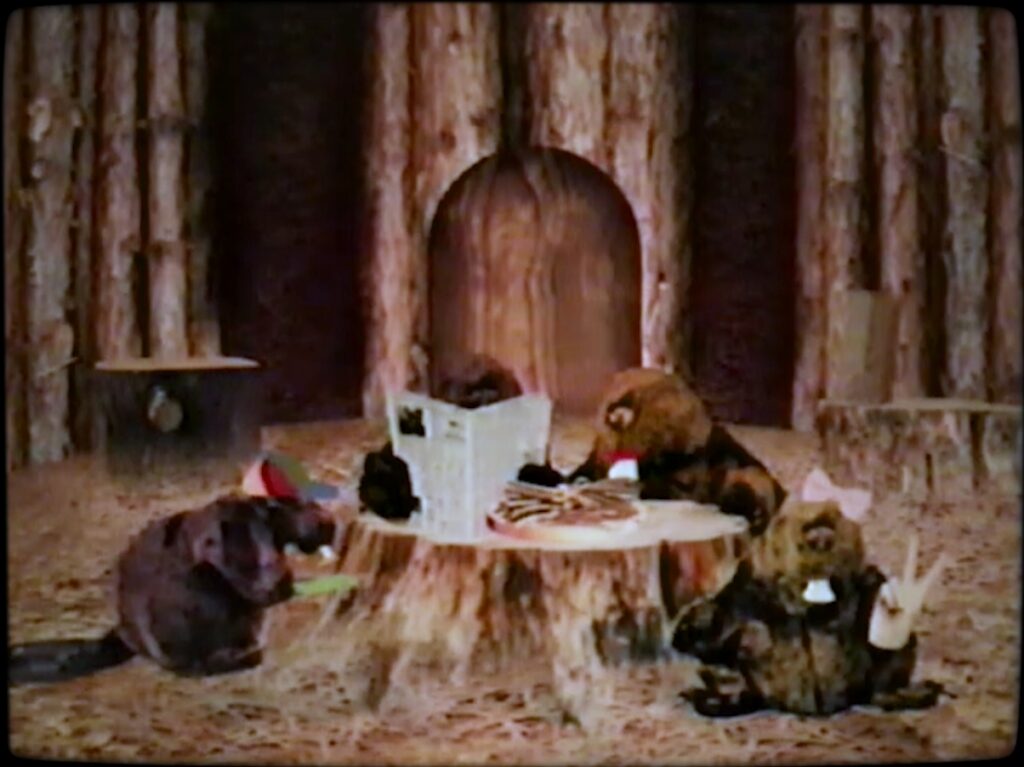
I don’t know how you’d define Oh…Canada, and that is a bit of a bind as a) a reviewer, and b) someone who has actually just seen the film from end to end. But let’s try: Oh…Canada has a few surprisingly gory moments, but it’s not a horror. In fact, it’s a narrative film either. It pops up as a kind of mock up, retro advertisement for the pleasures of living in that great nation. It’s bilingual; it’s at least at first comedic; it spends more time featuring puppets and animation than live actors. We’re shown – in a roundabout way, with a visual style refracted through different kinds of layering – the joys of the open countryside, the flora and fauna (especially the beaver, emblem of the Canadians for its homesteading and resourcefulness) and overall, what makes Canada great.

But even across a six-minute runtime, the film grows increasingly oddball and sinister: it does have a political point or two to make, even if it gets to these via puppetry and the representation of faux patriotic pride (when you hear a national anthem in a film of this genre – well, get ready). As the film rolls to a close, what we are left with is a surreptitious version of Canada as a place which isn’t, actually, in the best condition. There are hints of environmental concerns, and issues around power and policing in society – even if addressed briefly, these are the main take-away from the film. It just happens to make those points in quite a strange, inventive – if brusque – manner.

Of course, in a short film it can be tricky to land heavyweight points, even if that’s your stated aim, and what we instead have here is a creative and deliberately stagey approach, blending a nub of a political point with a film geared around its particular visual style. It is creative, even if it can feel like it’s being pulled in two different directions, and it’s a world away from the narrative snapshot of the likes of First Bite – which is where this reviewer personally feels that Nappi’s strengths lie. But full points for taking on something wholly different in tone and style, diversifying the old filmography, and working in a different way.

Oh…Canada features as part of this year’s Fantasia International Film Festival.
Fantasia 2024: AstroNots

What’s your bluff limit? You know, your bluff limit. The point to which you are willing to overextend your actual abilities. Maybe yours is pretty low – maybe you’d never want the stress of exaggerating what you can do to get somewhere which may be rather stressful. Or, maybe you like the thrill of chancing your arm, seeing where it gets you – because it could get you very far. The third possibility is that there’s no plan – just a willingness to see what might happen – if no one susses you out, that is. See what you can do, and make your excuses later, if necessary. Brilliant careers have no doubt been forged this way.

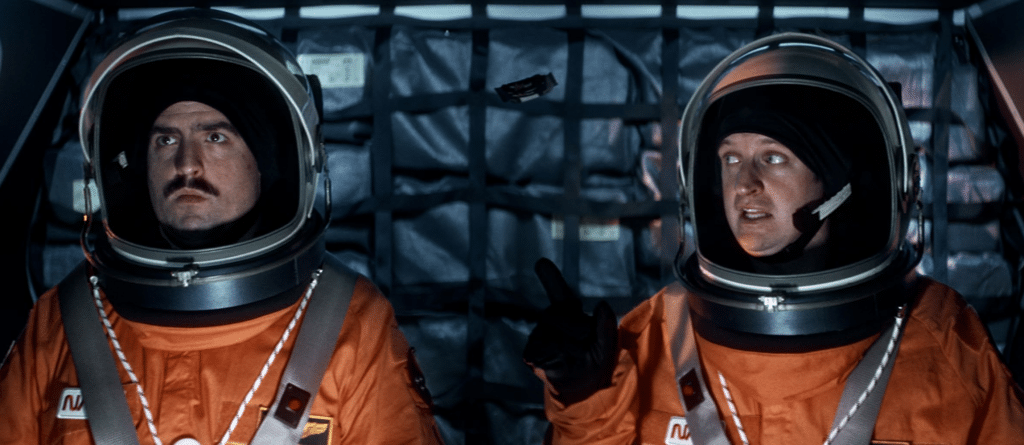
This brings us to AstroNots (2024), and the cockpit of the Ares 7. With the planet being in the state it is, the Ares is headed to Mars to scope out the possibility of terraforming the red planet: it’s a once-in-a-lifetime voyage in terms of its significance, so perhaps we can forgive Commander Thomas Collins (Adam Dunn) for running through the speech he’s hoping will go down in history. If optics were important in the Sixties, then they’re surely more important today, when everything is so dependent on public approbation – and when humanity itself depends on the mission. And yet, co-pilot Abe Adams (Aaron Glenane) doesn’t seem particularly excited. He doesn’t even have a speech prepared. Instead, he’s turning into a mess of snot and tears; he isn’t ready for this. Tom, who presumably starts out here wanting to avoid a long-term trip with someone given to panic attacks, keeps him calm. Remember your training, he reassures him. You have trained for this. You’re good.

Well, yeah – he’s trained for this in that he’s somehow got the boxes ticked and the certificates framed, but Adams is ready – with a couple of minutes to go until the launch – to confess that he is, if not the worst choice for the co-pilot seat, then certainly quite high on that list. His training has consisted of crashing things, breaking things and failing to understand the basics. Sure, he got through, but go to Mars? He’s upset because the crushing weight of realisation has hit him. He has overstepped his bluff limit by a staggering margin. So now what? What are they going to do?

As Tom talks him up and Abe talks himself back down, we get a sense of a neat script with a few nice moments of verbal trickery, but there’s more to AstroNots than just being an interesting farce. It has a gently serious punchline, but it also pokes timely fun at the fact that maybe very few of our motivations are selfless these days. Even Tom Collins, named for the drink he could probably use, is more given to ideas of his own reputation and legacy; he’s just as guilty, at a few points, of being willing to overlook more pressing concerns.

But the real joke – and the film’s heaviest moment – is saved for the end: here, the cockpit becomes a microcosm for a world where people like the ideas of things, but not so much the dedication and hard graft which go along with it. Sometimes, you just have to make do. This central conceit is nicely handled by director Andrew Seaton, alongside Dunn and Glenane, who are also the writers here. As to what happens to Collins and Adams? Well, watch this space because if plans come to pass, then there’ll be another instalment in a different format…

AstroNots will screen on 22nd July as part of the Fantasia International Film Festival.
Longlegs (2024)

Please note: this review may contain mild spoilers, so if you are hopeful of seeing Longlegs with no prior knowledge – be warned.

Neon has put together an intriguing, long-game promotional campaign for Longlegs (2024) which has been appearing in tantalising parcels for the past few months. For this, they deserve credit: this film will get seen, and it will probably make its money back. When faced with jaded audiences and a crowded market, it’s no mean feat to spread the word quite as far and as wide as this, especially considering it’s an out-and-out horror flick, with no obvious pretensions to be anything else. Longlegs also boasts an appearance (really a cameo) from the master of the OTT strange, Nicolas Cage – albeit buried under a tonne of make-up (though as it stands, he looks like one of the few actors here still in possession of buccal fat). So far, so good – but can these things, these lofty expectations, work against a film in the end?

Consider the above the world’s most hackneyed rhetorical question: of course they can work against a film, if the film ultimately fails to deliver. It’s not all that unusual for a marketing campaign to overpromise – it’s all part of the expected bluster of advertising – but it’s the way it moots a groundbreakingly scary horror that really eats away at Longlegs. In the end, Longlegs is essentially another serial killer movie. And in the end, it feels like a slightly curdled amalgam of a lot of other, better serial killer movies, turning out to be a sequence of diminishing returns which never delivers on the nightmare initially promised. Sure, it’s atmospheric, but in fits and starts: this is TikTok levels of focus and heft, there-and-you’ll-miss-it.

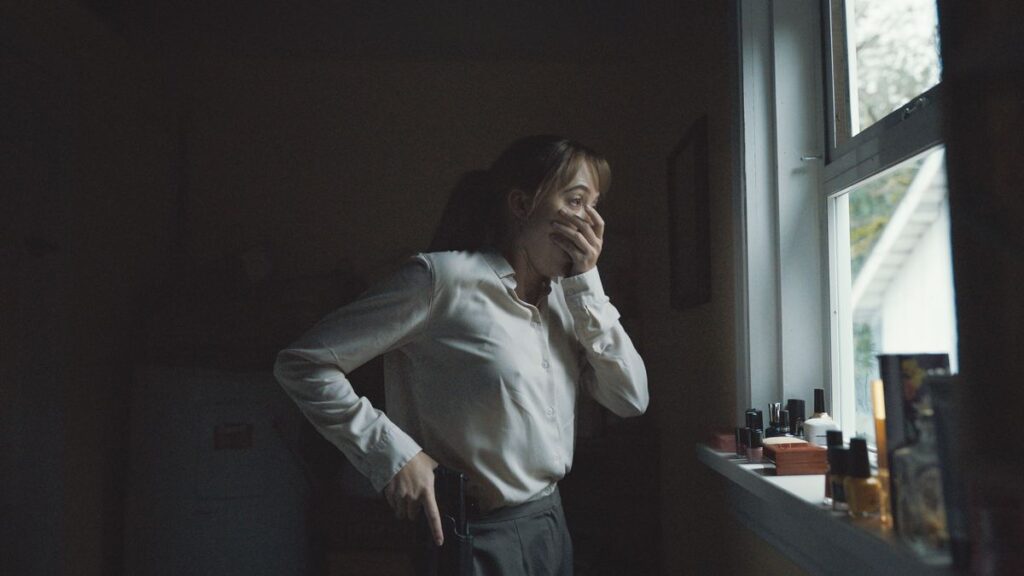
So Longlegs plonks some familiar pieces on the board, even if it then tries to play fast and loose with the gameplay. FBI rookie Lee Harker (Maika Monroe), who has rudimentary psychic abilities, is put on a long-term case, a series of unexplained family mass killings which have been happening for a few decades. Linking these, there’s a sequence of coded letters signed by someone calling themselves ‘Longlegs’. Harker is able to crack the code pretty much instantly: presumably, in twenty years, the finest minds in detective work have failed to do so or else, couldn’t be arsed. In any case, Harker’s uncanny, nervy knack for solving elements of the case make her a perfect choice to try and crack it, once and for all. However, this seems to draw her into the strangeness: visions, hearing voices, possible flashbacks, that sort of thing.

It turns out there’s a supernatural element to all this, and that ‘Longlegs’ himself is only part of what’s been happening. Well, colour us surprised, right? Brace for a very thinly-delineated Satanic element which feels both familiar and yet inferior; then there are dolls, another shorthand attempt at bulking up on the weirdness, but like much within the film it all feels perplexing, and more cynical than successful.

It’s a shame that things peter out in this way, because the film does look good: it’s beautifully and evocatively shot, with some wonderful moments providing lots of invitations to worry about what may be about to creep into view. Cage, whilst deliberately underused in a kind of ‘less is more’ approach, manages a few of his characteristically erratic, unpredictable scenes which are still worth the wait. But a film is not a painting, and even with the film’s occasional approach to storytelling (with the plot clustering around ideas, rather than a sequential narrative) atmosphere alone will not sustain it. A paucity of characterisation and backstory, with a script more given to quirky, low frequency Americana and anti-maternal blather rather than telling us anything – even things which might scare us – renders Longlegs a patchwork of piecemeal squares, rarely scary and barely sequential. Any dread soon dissipates, and a montage of non-sequiturs takes its place.

Directed by Oz Perkins and not – as this reviewer wondered for a moment – David Robert Mitchell, it’s odd, therefore, to note that Longlegs winds up having some similarities to It Follows, the film which kickstarted Maika Monroe’s career a decade ago. A horror which centres a young woman, and the supernatural buck-passing which saves her skin; an approach to time periods which both suggests a specific time period (e.g. Bill Clinton’s presidential portrait hanging on the wall) but then ignores other period detail, blending perhaps deliberately into a rootless, timeless and disorientating timeline. It all feels oddly familiar, in some quite specific ways.

However, perhaps the most obvious point of comparison for me is also the thing which finally sounds the death knell for Longlegs. It feels for all the world like someone has tried to blend a serial killer horror with Twin Peaks, and/or Lynch’s films: take that Lynch strangeness, layer it with Satanism, and Bob’s your uncle? Surely, a winning formula? Well, Bob provides wardrobe cues for Cage’s character, definitely, but there are so many other moments which feel like they’ve been basically purloined from Lynch; Lynch fans may like to count them. All this has achieved though, in the end, is to underline how hard it is to really blend fever-dream strangeness with engaging storytelling. Lynch can do it; Longlegs, on the other hand, cannot.

Coming soon: Fantasia 2024!

Párvulos

For the past few years, Warped Perspective has been fortunate enough to cover the Fantasia International Film Festival remotely and, every year, it’s a high point in the film lover’s calendar. This year looks to be no different. Whilst the availability for press coverage varies, Warped Perspective has high hopes that we may get a sneak peek at some of the following titles: we’ll certainly be looking out for them. In any case, if you’re fortunate enough to be going to the festival in person, or if you just want some pointers for the autumn festival season (Fantasia often leads the way on genre releases which surface in other fests later in the year) then here’s a few titles to look out for:

In Our Blood

Found footage is a divisive subject at the site, for writers and for readers, but – love it or hate it – In Our Blood sounds like an intriguing spin on the style, coming as the first FF film from an already renowned documentarian, the Oscar-nominated Pedro Kos. In the film, a filmmaker called Emily Wyland (Brittany O’Grady, White Lotus) teams up with a cinematographer, Danny, to make a film about reuniting with her mother after a long hiatus in their relationship: however, the original plan for the film gets disrupted when her mother suddenly goes missing: now it’s a mystery about a missing person, and Emily and Danny must piece together the clues before it’s too late.

The Silent Planet

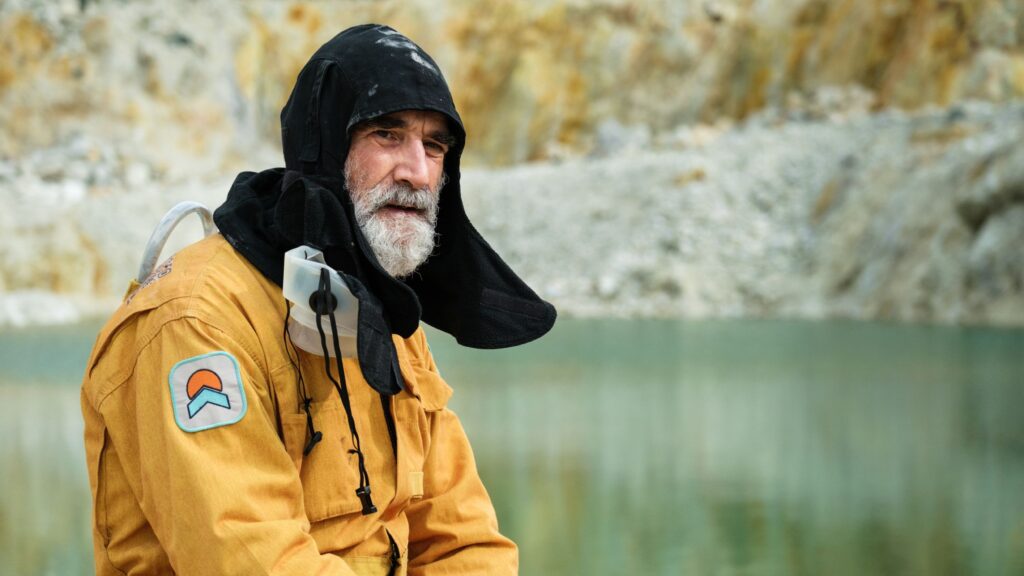
Science fiction has, overall, sacrificed some of its bombast in recent years: modern sci-fi often scales back the technology and the spacecraft and its other flashier hallmarks, electing instead to ponder deeper philosophical ideas, using the extraordinary situations and possibilities afforded by sci-fi to do so. This brings us neatly to The Silent Planet, directed by Jeffrey St. Jules. The setting here is a penal planet, and two prisoners sent there to mine the planet’s resources discover that they have a deep-seated connection – one which threatens and complicates their relationship, and their time in this faraway place. In the film, concepts of truth, meanings and responsibilities are explored via a whimsical, surrealist style.

Black Eyed Susan

AI and its increasing presence in the creative industries, not to mention in the world at large, is an ever-evolving source of anxiety these days; as such, it’s little surprise that horror and genre cinema – always ready to face and twist our deepest anxieties into new shapes and forms – has come up with the queasy, and probably five-years-hence storyline behind Black Eyed Susan. Desperate for work, Derek (Damian Maffei) accepts a role with a shady tech start-up, working intimately with ‘Susan’ (Yvonne Emilie Thälker in a powerful debut role), a BDSM sex doll which learns via sexual pain and punishment. The focus is different to The Silent Planet but again, here we have AI and sci-fi coming together to ask big questions about what it means to be human – and humane, in this film with its pitch-black, unsettling core. It’s also edifying to learn that the maestro of movie soundtracks, Fabio Frizzi, is back at work on the score to this film.

Chainsaws Were Singing

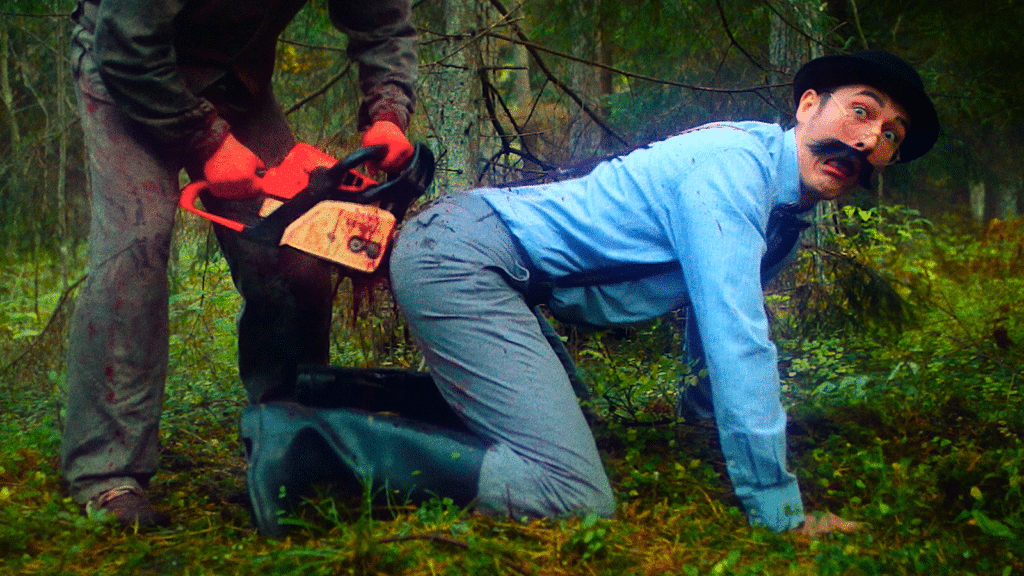
Whilst my personal experience of Estonian cinema is quite limited, the zany world-building of Kratt (which screened at the festival back in 2021) was a worthy, fun introduction, a film which showcases a bland of styles and genres to good effect. Sounding to be a similar kind of blend, Chainsaws Were Singing mixes slapstick, splatstick and – well, chainsaws, in a bizarre musical mash-up by director Sander Maran. Maran does the lot here, from direction to editing to writing the entire musical score, offering up a madcap palate-cleanser which neither takes itself too seriously, nor scrimps on the ludicrous chainsaw-based violence. If you liked Cannibal! The Musical, then this one’s for you.

Other highlights:

  • Steppenwolf: a bleak, post-Soviet Kazakh spin on the classic Hermann Hesse prayer to nihilism and self…
  • House of Sayuri: J-Horror is back (if it ever went away) but now it’s both self-referential and profoundly surprising…
  • South Korean movie The Tenants charts the course of property insecurity across the globe, with this macro storyline of a pair of lodgers whose strange behaviour escalates into a nightmare for their beleaguered landlord/housemate…
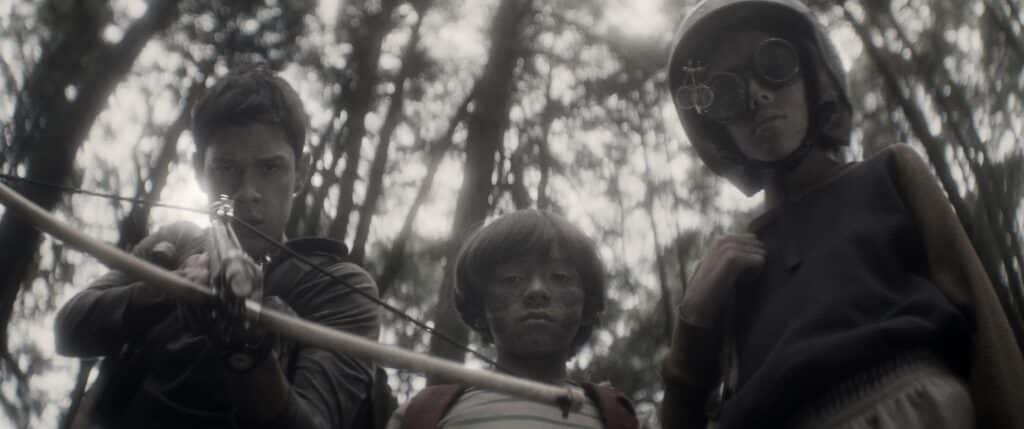
  • Párvulos -a gruelling Mexican dystopian horror about three brothers living together in a remote cabin. Hidden in the basement is a terrible secret which, as kids do, they have learned to accept but – the worst is yet to come. Seven years in the making, Isaac Ezban’s feature is likely to bring shock and awe to the festival.
  • Timestalker sees director Alice Lowe take comic aim at the heart of the romcom genre, in her new story of a woman seeking out the (presumed) love of her life across time…
Timestalker

Watch out for our coverage coming very soon, and in the meantime, head over to the festival’s official website for a look at what else is on offer.

Theatre Review: One Man Poe

For many people – many of us, anyway – a love for the works of Edgar Allan Poe is practically a rite of passage. At a certain age, young readers with – shall we say – a kind of in-built love for the darker side will almost inevitably find their way to Poe. And, once you’re a fan of Poe, it seems you’re a fan for life. No one disavows him; even if you come to appreciate some of his pitch-dark humour a little more as an adult, or if you move onto other authors and genres, it almost never seems to cancel out the initial impact that this singular author has on his audience. It’s historically been a large audience, too. His appeal has lasted for almost 200 years: at the time of writing, Poe has been in print, in some form or another, since 1827.

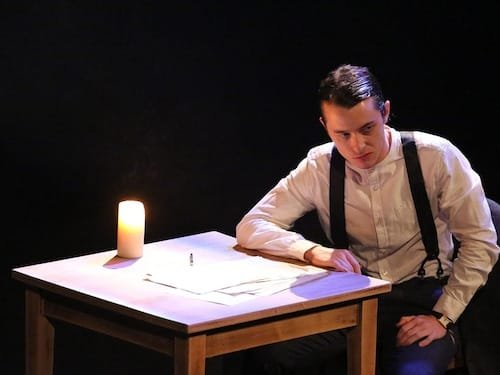
Performer and director Stephen Smith is a Poe fan for whom the lifelong appeal has recently taken a fairly unusual form. Growing up with the usual fascination with Poe’s body of work (and Poe-inspired cinema), he has made some of the author’s most seminal works into the basis for a solo dramatic performance. Perhaps ‘unusual form’ is an overstatement: whilst Poe’s work has indeed formed the basis for drama in the past, it almost feels like his introspective, first-person narratives are practically designed for the stage; in that respect, it’s strange we haven’t seen even more Poe adapted as drama. Smith’s approach to adapting Poe is both straightforward, and mind-blowingly challenging: he has learned Poe’s words across four stories verbatim – around 13,000 words in total. His staging and costumes are fairly minimal, which allows ample space for Poe’s own words to engage – and horrify – the listener.

The show took place at the tucked-away York Medical Society – a Grade II listed building which has functioned as a training and lecture hall space since it was built in 1832 (at around the time that Poe was court martialled out of West Point, spending the rest of his adult life as a struggling writer). Like many places in York, you’d walk past it a thousand times without realising its existence – but it is worth seeking out on its own terms, as it’s a beautiful place characteristically heaving with points of historical interest: portraits, medical equipment, even a tally of benefactors which pre-dates the YMS itself. Smith used one of the small lecture spaces for the show, making use of the stage and lectern as minor props; other dramatic effects come mainly from low-key costume changes and lighting, together with some use of accompanying audio (lighting and sound effects are managed by Smith’s wife and assistant, Stephanie).

The stories chosen for the show are: The Tell-Tale Heart, The Pit and the Pendulum, The Black Cat and – switching to poetry at the end – The Raven. Smith does terrific work at lending each of the stories the appropriate blend of gravitas and mania; none of Poe’s protagonists are particularly grounded, although Smith manages to lend each of them a somewhat different flavour of madness. The Tell-Tale Heart is a classic Poe monologue about a man desperately trying to prove his sanity as he proves his insanity, as he discusses his brutal murder of a neighbour (and his subsequent nagging, self-destroying guilt). This is Smith’s most unhinged character; even the victim in The Pit and the Pendulum only just about approaches these levels. Of all four individual performances, The Pit and the Pendulum was, for me, the most challenging one, as so much of the protagonist’s miseries come from external sources – however, Smith does a decent job of constructing this external world.

However, the performance of The Black Cat was my personal favourite. This was the most restrained character overall, which only serves to underline how vile this particular man truly is. As a pre-teen, I remember putting the book down in disgust when I read about what he does to Pluto the cat – I’d go so far as to say it helped shape my outrage at the kinds of people who harm animals, particularly animals which trust them, and this is something which has lasted a lifetime. Understanding that people who are cruel to animals often abuse people, too, is one of many examples of Poe displaying a prescient understanding of the darkest depths of human behaviour – including alcoholism, which is a key factor in this man’s catastrophic collapse. But, dipsomaniac or not, never has one of his characters deserved the terror they go on to feel; Smith does great work here. As the concluding element, The Raven really benefits from being read aloud, too: there’s a nice bit of circularity in Smith’s depiction of The Raven’s narrator as an old man who seems awfully similar to one of the characters already encountered…other than that, Poe’s poem about the horrible realisation that the good times are gone forever, full of its internal rhymes and cleverly-spring lines, works its magic best when appreciated this way.

Fans of Poe will obviously enthuse about this show; even those unfamiliar with Poe’s work, though, will appreciate the great feat of learning and acting which this low-key but highly effective show delivers. Smith has worked incredibly hard to bring this together and there’s so much to be proud of here. If you’re UK-based and intending to visit the Edinburgh Fringe this year, then you could catch the show there: to check out other shows, as well as Smith’s other current projects, then please check out this site for more.

Raindance 2024: Sleep

As Sleep (2023) opens, we can – appropriately enough – hear someone gently snoring: a couple is in bed. And yet, you get the distinct impression that restful sleep isn’t going to feature heavily here, or even at all beyond this point. The film almost instantly starts to toy with the hazy delineations between sleep, dreaming and night terror, as soon as husband Hyun-su (Lee Sun-kyun) sits up in bed and announces, ‘there’s someone inside’. His wife Soo-jin (Jung Yu-mi) is already restless, and heavily pregnant: she finds herself patrolling the rooms of their apartment, looking for a potential outsider. (You’ll notice Hyun-su goes straight back to sleep; troubled sleep or otherwise, he’s rather good at dropping off.)

Things are more normal by day; you could go so far as to say that they seem idyllic, right down to the motivational quote hanging on the wall which, oh god, they apparently have in Korea, too. Husband and wife are preparing for the arrival of their first child; Hyun-su is in work as an actor, or an aspiring actor at least. At night is when these two properly catch up, as their day-to-day lives are lived rather separately, what with work and other commitments. But likewise, night-time is when a certain level of oddness is starting to creep in. This primarily affects Hyun-su, who begins to rake at his skin unknowingly, to sleepwalk, and to raid the fridge. He’s unrecognisable – and unreachable – when in this state. Then the baby arrives, and exacerbates these issues.

The de rigeur search for a cause for the sleepwalking ensues: one explanation is purely physical, with a trip to a sleep specialist and a prescription for medication; the other is more spiritual, and derives almost entirely from Soo-jin’s concerned mother, who has a retinue of mantras and shamans at her disposal. However, at least initially, both of these approaches garner limited success, and Soo-jin – with a new baby to care for – is growing increasingly alarmed.

One of Sleep‘s key issues is with its characters, which may derive from the fact that this is a first feature by director and writer Jason Yu: in encompassing a number of potential plotlines, the film skips over very detailed characterisation along the way, which leaves Soo-jin – at least initially – with rather a thin role as a chiding helpmeet. South Korea has a plummeting birth rate; there are plenty of damn solid reasons behind this, but you can’t help wondering if cultural representations of pregnancy like this one have something to do with it. Alright, that’s glib, but Soo-jin is needy, peevish, and for a large share of the film, entirely secondary to the foibles of her husband. This skittish dedication is often played for laughs – the film has a somewhat odd balance of humour to horror – but nonetheless she often comes across as highly-wrought – as does her mother, who pops up only as a conduit for the film’s more supernatural content, and as a babysitter. That all being said, the film does its best work when it sets itself up as a proper guessing game, making the audience guess at how much human neuroses are to blame for what’s unfolding here. The film’s middle act, where it turns the screws on a new mother in a very uncertain situation, demanding increasingly strained, sober maturity from her, is its best.

Another key strength is in how Sleep explores ideas around home, and what can happen to this safe space when something, even something quite simple, is disrupted. So someone starts to sleepwalk; even if that’s all they do, it destroys the restful sleep of other people in the home, and that can be enough to render home a very unpleasant place to be. Of course, the film does more than that, turning this light and airy apartment into a contested, uncertain environment. Bars and locks are fitted to keep someone in, rather than keep someone out, but then, as that individual escalates their strange behaviour, you might want them out. Soo-jin’s assertion that her husband shouldn’t move out, even temporarily, as he quite sensibly suggests, seems ludicrous given her rising terror for herself and the baby. But her ingrained ideas about marriage, family and functionality keep her in harm’s way; this very earthly, very recognisable content is strong, and more engaging than the exposition we finally get (which necessitates a PowerPoint to explain!)

Once we get into the supernatural plot points, Sleep gives us a ream of recognisable elements, with sadly guessable twists and turns. It makes for a weaker, more formulaic close to proceedings. As a film, overall, it’s perhaps a little busy with different strands of storytelling and different generic elements, although it happily doesn’t indulge itself in an inflated runtime, even though it is – as so many films have been before it – chaptered, for little explicable point. There are also high production values here, and clear evidence of ambition from Yu.

Sleep (2023) screened at the recent Raindance Film Festival.

Interview: Ian Mantgani, director of Nosepicker

Ian, Leo – and you-know-what

Warped Perspective has long been promoting short films, and thanks to the ALTER channel on YouTube, it finally seems that there’s a decent outlet for them which extends beyond the enthusiastic, but limited remit of the festival scene. And so, we recently reviewed a body horror/cautionary tale called Nosepicker: if you haven’t already, then you should head over and watch the film, and then perhaps take a look at the review.

Then, you might like to take a look at this interview with the film’s director, Ian Mantgani. Ian has very obligingly answered some of my questions on Nosepicker: subject matter, snot, influences and everything in-between. Many thanks to him!

Responses below:

WP: My first question is probably the most obvious one, but let’s go for it: why did you choose nose-picking as your subject matter? And did any particular films, or anything else, influence your ideas?

IM: I’d actually intended to do another body-horror film entirely: An adaptation of the Roald Dahl story Skin, which had already been done as a terrific episode of Tales of the Unexpected starring Derek Jacobi in 1980, but which I thought would be a good vehicle for a filmmaker today to take another crack at. I was for whatever reason just desperate to do something in a horror short story form. The very week I intended to write to the Dahl estate seeking an option on the material, the deal was announced where Netflix bought the rights to Dahl’s whole catalogue.

Having Dahl in mind, I started thinking about doing something in that vein, and fairly quickly fixed on doing something morbid involving kids. What do kids like? Things that are gross, like snot, blood and guts. From there, pun intended, the rest just poured out of me.

WP: Practical effects are clearly really important to this film – no one would buy CGI snot, I don’t think – but what no-doubt interesting discussions, storyboards and perhaps even prototypes got the film where you wanted it to be?

IM: It was a surprisingly arduous journey. With friends, I’d made several backyard practical effects films before, so had some experience with creating life casts, wounds, decapitated heads, and things of this nature. And I naively figured there was nothing in this film that hadn’t been done in, say, The Blob in the late 1950s, so it must be easy to communicate some agreed upon orthodoxy on how to achieve everything. We also had detailed briefing books on everything from the various grades of bogey and snot we required to colour charts, animal comparisons and movie references for how the eventual monster should look.

So we went in armed to execute the effects efficiently, but it was a nightmare. Without dropping anyone in it, we tried to go the semi-professional route to both save money and give a young designer an opportunity to step up, but several people let us down and left us without our main effects ready in time for the main shoot. We then hired a more experienced special effects technician and arranged a split SFX unit, but his expertise didn’t really lie in creature effects, and the monster this designer created really wasn’t convincing or consistent.

As they say, buy cheap, buy twice, or in our case, buy cheap, buy three or four times, because at this point, we had to go the route we thought we couldn’t afford in the first place, which was hiring a majorly established creature effects designer. And we were also running out of time to make autumn festival deadlines, so didn’t even know if we could get one who wasn’t too busy with a more pressing project. So thank God that Dan Martin of 13 Finger FX agreed to step in; he and his team did a terrific job of building bladders that felt alive on set when they operated them. Dan and the team really saved our bacon; I love the effects in the final film.

WP: As much as it’s a body horror, there’s also a lot in the film regarding childhood and perhaps how adults relate (or don’t relate) to children. Can you tell us about that?

IM: There’s a characteristically thoughtful and perceptive review by the great critic Anton Bitel that situates Nosepicker as “the horror of abjection.” I don’t like talking too much about subtext, not wanting to ruin any viewers’ interpretations of anything, but to me the film is largely about being twisted, perverted and made violently crazy by a society that’s obtuse, or cruel, or patronising.

The ethnicity of the character wasn’t specified in the script, but I did prefer to cast a lead who was non-white, so Leo Adoteye, who is mixed-race Ghanaian-Italian, fit the bill and I think gave another unspoken dimension to the story, being non-white in a film of entirely white antagonists. The story is about the perversion of the underdog, in a society where the dominant races, the upper classes and the normative attitudes can all just make a minority misfit want to crack.

WP: Did you ever plan for Georgie to speak? Or did you always envision the character being silent?

IM: It just never occurred to me that he would speak. He doesn’t need to. He is alone on his weird little island, immovable as people talk at him and around him. I hope his silence doesn’t seem like a stunt. I hope it does make the viewer lean in. Additionally, I tend to come from the school of thought that every movie should work as a silent movie on some level, whatever sound and dialogue ends up adding to the overall melee. By the way, it’s funny that I should end up writing and directing a movie about a completely mute child, because I myself was always a motormouth smartass class clown when I was a schoolchild!

WP: I’ve enjoyed reading the responses to the film over on ALTER: lots of takers, lots of quite appalled people too! What have been some of your favourite responses to the film – either from critics, fans, or anyone else?

IM: People do seem to think the film is disgusting! Which is gratifying in a way, because a greater concern during the making of the film was that the bodily fluids would end up looking fake. Interestingly enough, child viewers more or less take the film in their stride and see the gruesomeness all in good fun. Adult viewers are more sensitive to it. Which coheres with my own experience as a film viewer – I think broadly as a very young person you respond to things completely instinctively, then as you get into adolescence you develop a sort of harder skin and then as you gain maturity you become sensitive again in a different way.

WP: How do you think your work on Nosepicker will influence you moving forwards as a filmmaker? Any important lessons learned? And while we’re on the topic, do you have any new projects or ideas for projects lined up?

IM: Hopefully Hollywood will come calling! Netflix, let me at your Roald Dahl stable! Let’s talk Tales of the Unexpected and The Twits! There’s also a film about lucid dreaming that I’ve been noodling away at for a few years and will hopefully achieve a breakthrough with before long. Right now, especially after all the uncertainty we had in completing our SFX, and after a long run of festival screenings, I’m so glad that Nosepicker is out in the world at the click of a button, and I hope people enjoy it.

The Vourdalak (2023)

When a film starts with a grand, Gothic peal of thunder, it had better mean it. It had better not be suggesting something it can’t deliver. Well, thankfully, The Vourdalak (2023) very much delivers: it’s a gloomy folktale made even gloomier by writers Adrien Beau and Hadrien Bouvier, and it’s an intimate, though always dreamlike piece of world-building.

We start – as with the novella by Leo Tolstoy, upon which this film is based – somewhere in 18th Century Eastern Europe. It’s named as Serbia in the book, and might well be Serbia in the film, although it’s not specifically addressed: what’s key is the strangeness of the setting. In the depths of a stormy night, a man hammers at a door, begging for help: his horse and his provisions have all been stolen by marauding Turks. The man inside, not unkindly but very much unhelpfully, refuses to open the door, but advises the stranger on where to go to get aid. He tells him to walk on, to find the house of a man named Gorcha, and get help from him.

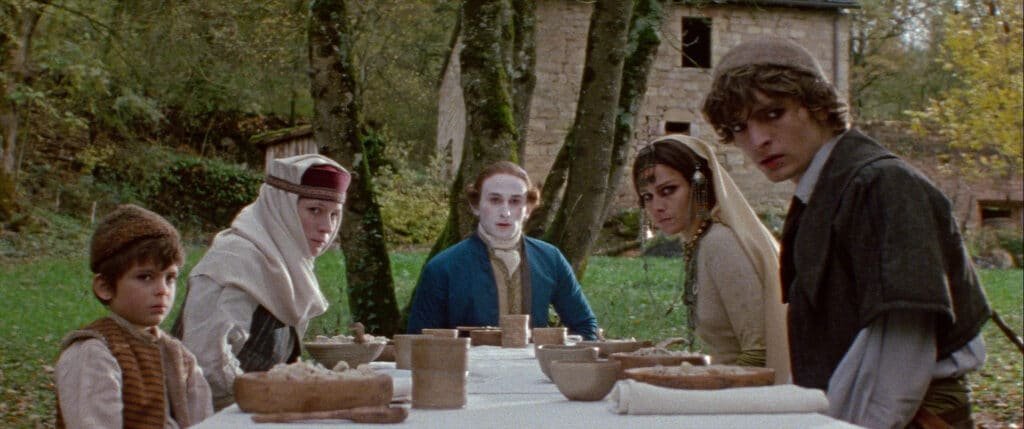
The visitor has little choice, so he continues on foot, skirting through the forest he’s been told to avoid, but what’s a man to do in such a situation? Along the way, he seems some strange things: the film sets out its stall. A beautiful young woman, dancing alone. A young man dressed in women’s clothes. Not put off by this – he is from the painted world of the French Court after all – our stranger, Marquis d’Urfé (Kacey Mottet Klein) speaks to the young man and it soon transpires that he is son to the Gorcha in question. He follows the young man, Piotr, to their house and meets the rest of the family, with the exception of old man Gorcha and his oldest son, Jegor (Grégoire Colin). They’re all appropriately surly, but they attend to d’Urfé and promise to help him: when Jegor arrives, fresh from fighting against the Turks, he says he will find a horse and help get the envoy home: he agrees to get d’Urfé a meeting with the patriarch, too.

There’s a problem. Old Gorcha, the head of the household, has also absented himself to go and fight the Turks, despite his apparent age and decrepitude. The family is shocked. As it turns out, the woman d’Urfé saw dancing in the forest is another Gorcha sibling, Sdenka, and she passes on a message from their father – that, fearful of being thought a coward, he has gone to fight, and that if he doesn’t come back, to say a prayer for him. If he comes back after a period of six days, however, don’t let him in even if he does appear: he’s no longer the man he was – he’s a vourdalak (a kind of revenant, reminiscent of a vampire).

So we wait, observing a difficult but interesting connection springing up between Sdenka (Ariane Labed) and d’Urfé during the first act. Things grow more complicated when it looks like Gorcha Sr. never left the grounds of the house at all: Jegor spots him, lying close to death nearby. Forgetting everything about Sdenka’s message, he hurries to take care of him; obeying him, as is proper, the rest of the family follows suit. They say love is blind, and bloody hell, it must be: old man Gorcha looks decidedly peaky. Whilst this increasingly heavy and tragic story isn’t exactly a laugh a minute, there is perhaps still a surprising amount of equally pitch-black humour in the film, and the way the Gorcha family accept the presence of their wraith-like father has something of The Emperor’s New Clothes about it, even accepting that gramps’s desiccated corpse is still very mannerly – and valiant, as he’s come home with the head of a notorious Turkish warlord for his pains (sound familiar?) There’s some humour in the early depiction of d’Urfé, too, as an archetypal pampered stranger in a strange land – a Lockwood, or, yes, a Harker, dropped into a culture he has little chance of understanding.

But the overriding atmosphere of the film is incredibly disconsolate, and grows more and more so. Very much a tale of a doomed family, with the script exploring ideas of fate and loss, it’s the love and respect which the family has for one another which traps them in this stifling, sickly curse. D’Urfé might have simply ridden his horse (or someone’s horse) out of there, too, were it not for the fact that he seems so rootless and remote, even from the society he champions. Finding meaning in his new connections would in a different time and place be a positive, but The Vourdalak isn’t too keen on positives, and instead makes an artform out of its irrepressible misery. It’s both more painterly, and more devastating, that Mario Bava’s adaptation of the same story.

Where Bava’s version is stark and shadowy, Beau’s is much more beautiful, an homage to Eurohorror – Hammer too, to a point – with a sensuous atmosphere and great attention to detail. Shot only using natural light, it always looks wonderful, an understated background for some very unpleasant, though sparing, horror. Dreams, rituals, tableaux – the framing and shooting of the film is multi-layered. The sound design here is superb too, adding a tremendous amount of horror which you don’t see – as such, anyway, even if you certainly see it in your mind’s eye. But perhaps the film’s real triumph is in its use of a marionette: it’s absolutely horrible. It makes you recoil, and it’s full of ghastly otherworldliness, just what you need for a Gothic tale like this one. Beau’s additions make the story even more pernicious than Tolstoy or Bava’s versions, too, and the resulting film is very successful indeed. Bravo.

The Vourdalak (2023) hits cinemas on Friday, June 28th.