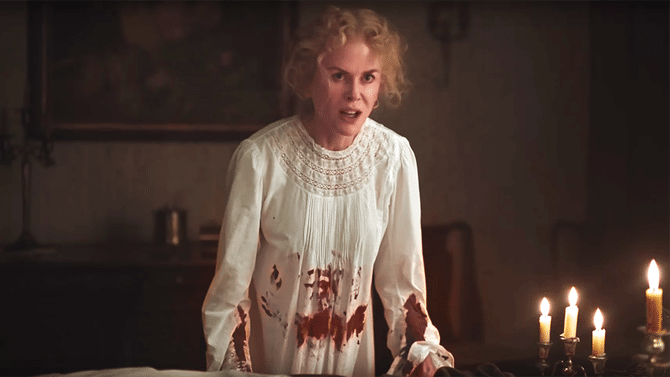
 I will say I was rather surprised to see that The Beguiled had been remade. Not frothing-at-the-mouth indignant that anyone could ever remake such a film, but more intrigued that anyone would want to do it: the 1971 original, starring Clint Eastwood, was a strange project which probably didn’t find its audience upon release and it’s struggled to get due recognition since. It’s not a romance, and it’s not a war film, it’s incredibly tense, but it’s low on action. These trope-defying films have a hard time and they’re a hard sell. So why return to the subject matter all over again?
Happily, the saving grace here is Sofia Coppola. Whilst her filmography isn’t vast, she’s shown that she has a deft hand when it comes to drawing out new subtleties from even the best-known stories. For example, most people know who Marie Antoinette was and what became of her; in her film of the same name, Coppola managed to make her story poignant again by showing her as a girlish, vulnerable figure undone by frantic political upheaval, not some staid figure or (as popular propaganda had/has it) an aloof idiot who thought the poor could eat cake if they didn’t have bread. If anyone could recast something familiar in a new set of ways, then perhaps Coppola could. Adding an intriguing cast, the stage was set. This remake could well be worthwhile.
Virginia, the 1860s. The story starts with a little girl, Amy, gathering mushrooms in the woods near the boarding school where she studies and lives. It’s a pretty, sylvan scene, but the Civil War is in its death throes just nearby and the booming of cannon keeps interrupting the birdsong (this totemic noise continues throughout the film until it becomes stiflingly silent when it finally stops.) Amy is startled to see a wounded Union soldier sheltering underneath a tree; he asks for her help, and so she supports him back to her school, where the last few inmates there with no other place else to go eventually carry him indoors to treat his wounded leg. The man is Corporal John McBurney (Colin Farrell), a recently-arrived Irishman who only signed up for the Yankee cause for money. Panicked and injured during a recent battle, he had escaped. Hence, as he’s keen to point out, he has survived. The women at Miss Martha’s Seminary ponder what to do with him, but decide to let him recuperate.
His presence in the school soon changes their lives, however. At first it’s barely perceptible, but the girls (even the very young girls) respond to there being a man around by wanting to help him, or please him, or even just talk to him. Even the two responsible adults, Miss Martha herself (Nicole Kidman) and Miss Edwina (Kirsten Dunst) forget their tight-laced Christian demeanours in his presence – even if only momentarily, before they snap back into type. All the women and girls begin to take more care over their appearances, dressing up for him, squabbling over jewellery and dresses, and all of them seem completely pliable after even a kind word or two from McBurney. It’s a situation he’s very keen to exploit.
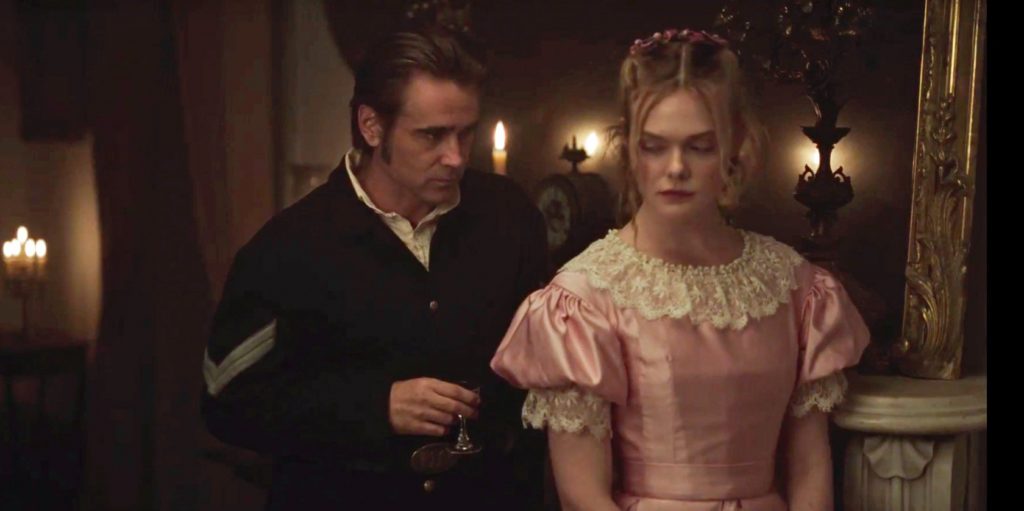 Having no great moral impetus – beyond hard cash – to get back to the battle, he sets his morals aside completely, happy to manipulate each of the women for – is it his own vanity? For sport? Or simply to secure their Southern hospitality for as long as possible? It seems that it’s any or all of those reasons in turn, but what’s certain is that the power shifts in The Beguiled move one way, then another, like a needle and thread through a tapestry (or any of the other less orthodox fabrics we see when we encounter this women’s work in the film). First McBurney is powerless – completely prone, after his injury, and the women who tend to him seem to enjoy his powerlessness: Miss Martha cleaning his (almost) naked body is turned into a queasily erotic tableau where a man potentially about to die of his injuries becomes some serious eye candy: furthermore, the enjoyment she gains from looking at him and touching him is ratcheted up by the use of microphones which pick up the rapid changes to her breathing, a trick the film employs elsewhere with the other women. Then, McBurney takes full stock of his situation, flattering and cajoling the women – particularly Miss Edwina, who Dunst effectively plays here as a living powder-keg. She’s an insular and downbeat character (teaching will do that to you) but her emotions reflexively spark into life when it transpires that she’s been lied to. Thus, the power shifts again, and again after that.
Although there’s barely a raised voice in The Beguiled, and we see trickery, rather than all-out violence, the tension simmers along unmercifully all the way through the film. This is due to the above-mentioned cannon fire which never moves off completely, the proximity of troops from both sides of the conflict, and of course the almost unbearable goings-on within the school: those old friends sexuality and envy move through the cosy, quiet rooms like a miasma, eventually giving rise to something like Misery (1990) where a man is hobbled and brought down. Hell hath no fury like a woman scorned, as the old saying goes – well, perhaps, but much of it in The Beguiled is in word and not deed, whilst the deeds themselves – when they occur – are not protracted, or even shown on screen that much. The final act – here, as in 1971 – may therefore not feel like an adequate pay-off for everyone; for me, it was completely in keeping with the manner of the story. With a man around, the women have begun to re-assume the more traditionally feminine roles and interests they’ve had to set aside, because the slaves are all gone and they must do their own digging and their their own shooting (if needs be). When that man transgresses, manipulating them and using them, the women are left with their traditional feminine pursuits, so they have no option but to use these as their weapons: the film concludes in an unholy trinity of needlework, cooking and sex. Even in times of war, even on the losing side, feminine wiles and pastimes can be lethal.
A worthwhile update to a challenging original piece of Southern Gothic, The Beguiled is in cinemas now.
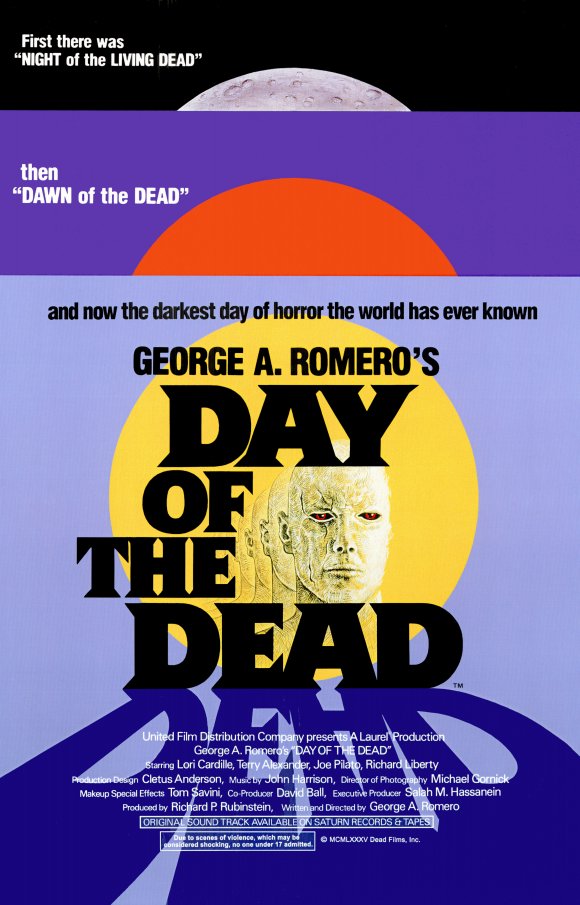 A return to the zombie genre later in his career lacked the verve and the impact of his earlier work, with his later films Land of the Dead, Diary of the Dead and Survival of the Dead never attaining the same organic sense of social commentary, but people were delighted to see him working again after such a long hiatus. Still, it’d be incorrect to see him solely as ‘the zombie guy’ anyway, and would do him a disservice. The Crazies – which pre-dates Dawn of the Dead – is a great, manic film, and the underrated (and very subtle) vampire horror of Martin is a whole world away from the zombie genre. Whilst Romero’s filmography isn’t vast, he made enough films to show that he could indeed be versatile.
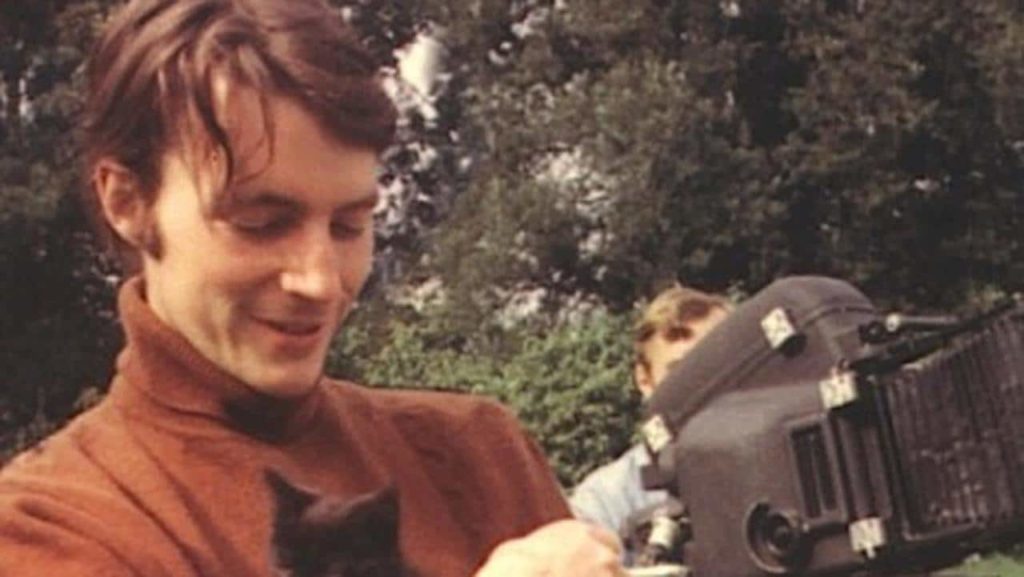 Personally, out of the entire publication, I most enjoyed Jon Towlson’s feature on British director Michael Reeves. Reeves, who directed two phenomenal films (The Sorcerers and Witchfinder General) died as a very young man following an overdose. Towlson’s feature focuses on the psychogeography of Reeves’ life, looking at the homes and pubs which were not only close to his heart, but probably integral to how he lived. These spaces were where he socialised, threw ideas around and – towards the end – grappled with what he saw as the deeply wrongheaded criticisms of his work, particularly the then much-maligned Witchfinder General, now considered a classic of its genre. It’s an interesting perspective, looking squarely at the seeming incongruity between Reeves’ films and his surroundings but always remaining sympathetic and engaged. It’s hard to disagree with the conclusion of this piece – that the death of Michael Reeves so very young was a phenomenal loss.
 Exquisite Terror doesn’t seem to have an overarching editorial policy, meaning there’s no impetus to toe a line, one way or another. This boosts the variety of features on offer – a good thing – though of course it also means that I, like anyone else, will always prefer some articles to others. God Bless America: Stephen King’s Shining by Jim Reader comes to mind here I’m afraid: there’s nothing whatsoever wrong with how this piece is written, as it flows well, but the claims it makes about Kubrick’s seminal horror film seem based on very tenuous evidence. These feel like pre-existing tenuous claims, too, as many improbable interpretations of The Shining already featured in the frankly bonkers documentary film Room 237 (2012), which at the very least made me wonder what it is in particular about The Shining that bears such strange fruit. The premise – that Kubrick’s film is a commentary on the historical treatment of Native Americans, based on two lines of dialogue and some incidental images of Native Americans – is no more convincing now that I encounter it for the second time here. On a similar note, Once Bitten: The Queerness of Becoming Other ostensibly features a ‘queering’ of a handful of werewolf films, but what’s counted as lycanthropic in nature seems a little broad. Also, to my eye, some of the interpretation seems somewhat awry (I don’t know Der Samurai, but one of the key scenes mentioned as evidence of the links between queerness/othering seems to have firm markers of hetero-, rather than homo-erotic lust.) Finally, if you say that werewolf films reflect the anxieties about the AIDS panic of the 80s, then I think we need specific examples.
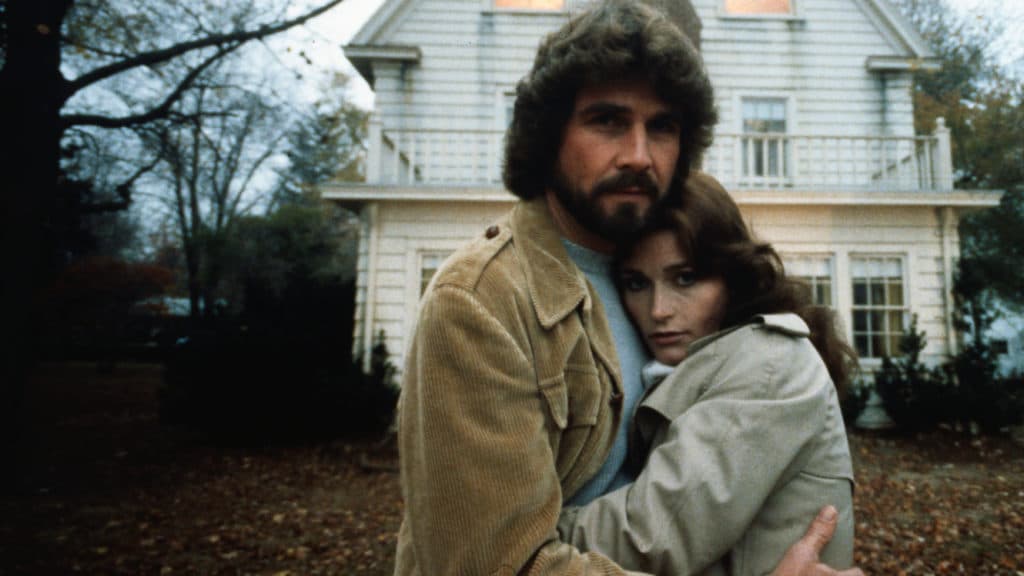 For someone not given to supernatural beliefs, I have a fascination with supernatural horror, and there are few supernatural horrors more famous than The Amityville Horror; close to forty years after it first appeared, there are still films getting made which carry the Amityville moniker. One of the key reasons for the success of the original film was the link between the screenplay and the ostensibly ‘true story’ of the Lutz family, whose experiences are dramatised in the film. The Lutz haunting is itself well known, and a fascinating, terrifying story in its own right, comprising a bizarre blend of testimony from the family themselves and a host of others who had become involved with them, such as the self-styled ‘demonologists’ Ed and Lorraine Warren, whose case films have incidentally turned up elsewhere in horror cinema – such as in The Conjuring (2013) and Annabelle (2014). Any description of a haunting as ferocious as the one recounted by the Lutz family always seems to me to be a detective story, too: people corroborate or contradict one another, recount or re-assert what they experienced. Still, the film itself doesn’t much trouble with these ambiguities, preferring to play out many of the events described by the Lutzes on screen, in as straightforward a way as you can muster when those events include inexplicable phenomena.
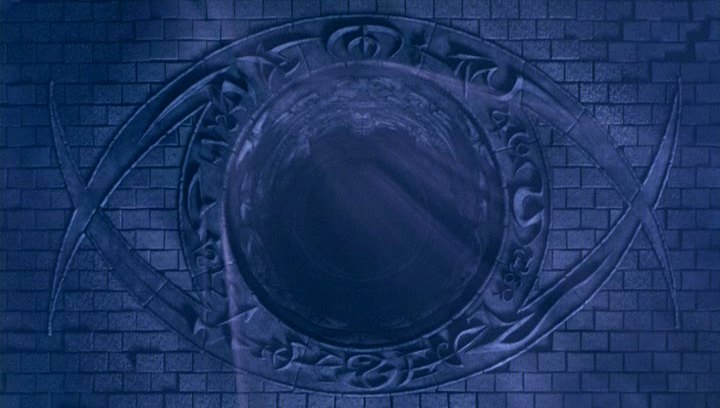
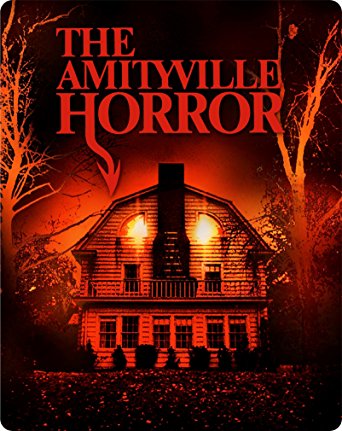 …And there are some successful elements – the ‘red eyes’ scene still works well, for instance – enough so, that the film has enjoyed great influence on other horror films which have followed in its wake. The impact of these key scenes is always increased, for me, when you remember that an adamant family was convinced that these phenomena were real – enough so that they eventually fled the house, leaving all of their belongings there, even leaving food on the table. The whole ‘based on a true story’ preamble, which we’re so used to now, owes much to the success of Stuart Rosenberg’s movie, as does the ‘real time’ unfolding of events, a technique still integral to many scare stories (it’s relevant to note that much ghostly ‘found footage’ embeds real time via its shooting style.) Sure, there’s some back-and-forth between banality and histrionics, but The Amityville Horror is an important chapter in the genre and is worth a place in your collection.
 For many people, horror films wouldn’t be the obvious choice if they wanted to feel in some ways uplifted. Horror isn’t about feeling good, after all – or at least, that’s not the usual verdict. It’s about feeling scared. Many people would perhaps be more likely to go for a period drama, a musical, a romantic comedy, or something of that kind: the type of film where, when it comes down to it, everyone eventually settles for something or someone and lives ‘happily ever after’. That’s the more normal thing to help a person relax, and probably the last thing which would pick me up.
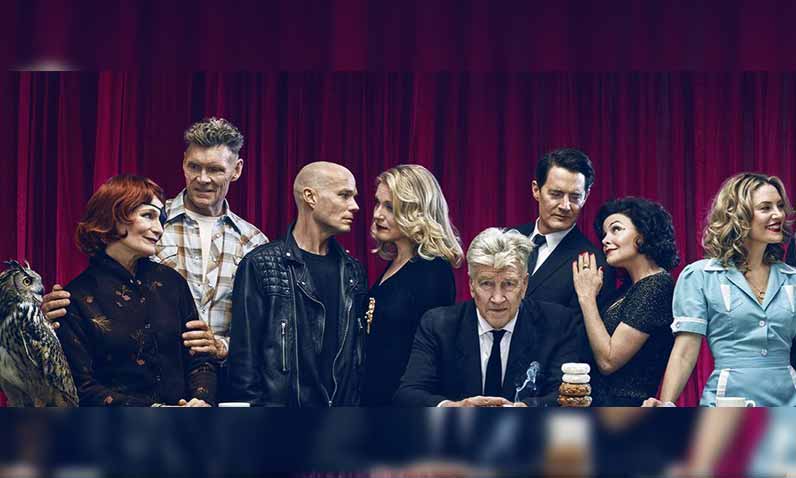 The recent return of Twin Peaks has meant a wonderful thing: David Lynch is back on our screens again, and even in the short time since my recent retrospective piece on
  The Alien franchise has been around for the same amount of time as I have, and it’s fair to say that (alongside many other people roughly the same age as me, no doubt) the alien creatures of its universe still feel as ingenious and horrifying now as they ever did, having been around in our peripheral vision for so long. I’m not one of those people who maligns Aliens 3 or indeed Alien: Resurrection, either – I think that they are each, in their way, compelling further chapters in the mythos – but, when it turned out that Ridley Scott was coming back to add a prequel to this story, it was exciting news. The resulting piece of work, Prometheus (2012) is undoubtedly an attractive film, with meticulous photography and striking visuals throughout, but its plot is sadly garbled, and it contains a series of unforgivable plot holes which are large enough to lose a ship in. After so many years of waiting and wondering about where the xenomorphs had come from, it didn’t feel as though we were any further ahead by the time the titles rolled – in fact, many viewers had more unanswered questions than ever, even taking into account the general murmur which said that this was NOT an Alien film, and shouldn’t be treated as such. So, what about all those questions then? Turns out Ridley Scott didn’t intend Prometheus to be a stand-alone prequel, and he was working on another prequel – this time a film which picks up a decade in time after the loss of the Prometheus.
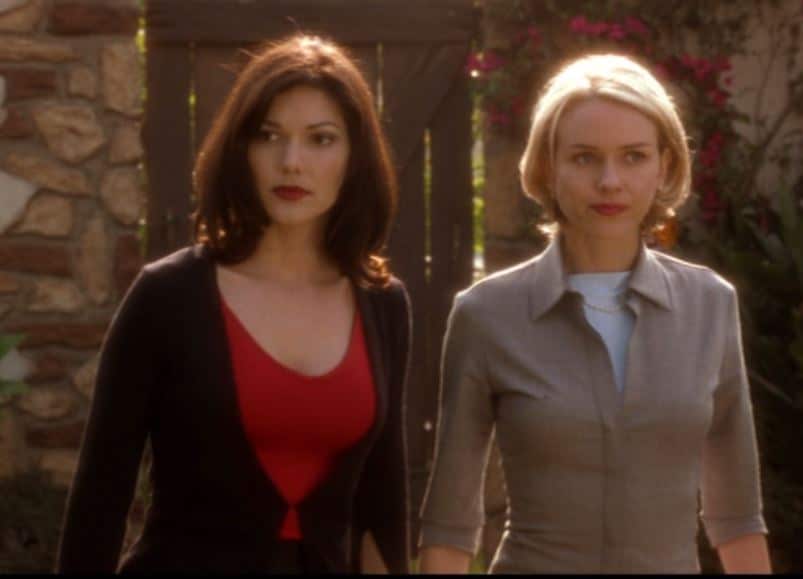 When David Lynch released Mulholland Drive in 2001, he took the unusual move of releasing a list of “ten clues to unlocking this thriller”, for audiences who may have needed guidance on how to decipher what was going on in the film. These clues direct us to pay particular attention to certain objects, places and to the behaviour of characters. This has always seemed an unusual move on Lynch’s part. In common with most of his films, Mulholland Drive has those qualities which have given us a new eponym – ‘Lynchian’, which we usually understand to mean a film which is non-linear, with emphasis on unconventional character and often bewildering, unsettling non-sequiturs. It’s never seemed as if Lynch is particularly given to expounding his own work, and handing out a road map seems an unusual move by any filmmaker, though especially him, a man more given to challenging audiences than guiding them. There are typically no easy ways through his films. The slathering of artistic imagery in his work is a key component, but chimes with Lynch’s idea that “if one looks a little closer at this beautiful world, there are always red ants underneath.”