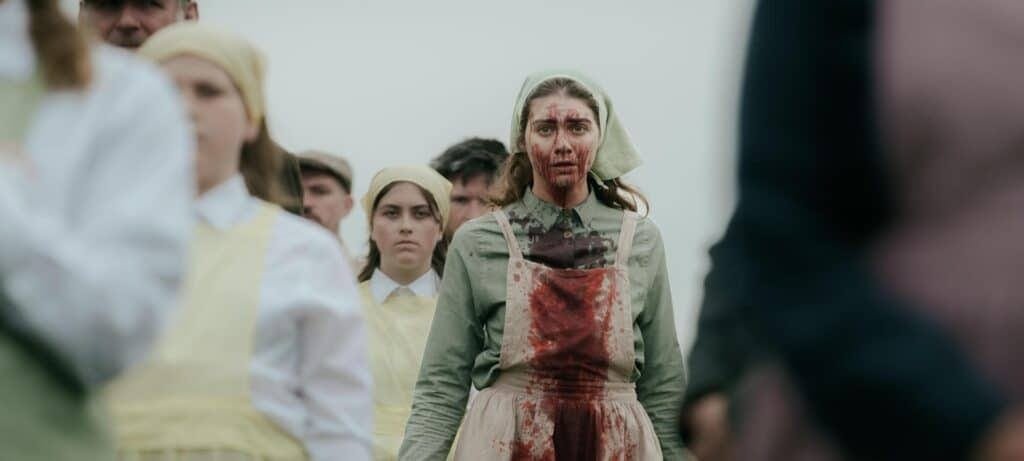
FrightFest 2025: Blood Shine

Blood Shine (2025) is an immediate barrage of contrasts – tonal and aesthetic – and it maintains its multi-layered approach throughout, using different styles of horror as it grows steadily more intense and provocative. If there are echoes of other films in here – and you may notice a few – there’s more than enough here which is original and compelling. It’s a hectic, heady piece of storytelling.

As the film begins, we see a woman dragging what appears to be a body, except upwards along the right-hand margin of the opening screen; it’s her horizon, but from our perspective, it immediately establishes that something strange and oblique is going to take place. Our first glimpse of this woman, and her strange salute to the sun as it appears behind her, segues into recorded footage of Heaven’s Gate-style footage of a cultish figure extolling the usual means of attaining ‘salvation’. These things are all important, both as clues and as part of the overarching narrative frame.

There’s another sharp contrast at this point, as we briefly meet a struggling ex-con by the name of Keith (Brendan Sexton III), scratching out a living as a dairy farmer, but by necessity about to seek employment elsewhere; he’s barely holding it together, and in pursuit of this new job he heads off down a lonely road, suffering an almost obligatory literal breakdown to match his incoming figurative one, before seeking help at a nearby house. He’s surprised to be greeted by a young woman who introduces herself as Clara (co-writer and co-director Emily Bennett). She’s understandably a little alarmed by the late night call, but agrees to help him. It takes Keith a surprisingly small amount of time to begin eyeing up his prim, porcelain host; Clara keeps up her kindly, philosophical approach for the time being, but it’s clear that this man’s main character behaviour may turn out to be ill-advised.

Here, things shift sharply; the film lurches forward in time in a brief, episodic way, showing us enough to show us that Clara is not what she at first seems to be – but then it whips us away elsewhere, where we meet someone new (though, noticeably, it’s another man with a certain sense of entitlement). Deftly, it seems for a moment as though the film’s opening titles (which finally appear) and the new character’s own film (which again blends into the main film here) are one and the same. Blood Shine has several of these moments, and keeps this firm kind of control over its narrative throughout. This new man, Brighton West (David Call) is working on a new project after enjoying some success as a horror filmmaker. Now, he’s under pressure to get working on his newest project, Craven IV, but the pressure is not bringing out the best in him, to say the least. He heads off into the sticks to try and write, but guess who he meets once he’s there?

This is not, as we know, the first time she has been involved in this kind of encounter with a recalcitrant man – but perhaps this new, complex, dysfunctional relationship could be different in key respects.

Blood Shine is, first and foremost, an aesthetic powerhouse, beautifully and diversely filmed, edited and soundtracked; it’s also self-referential in a few moments, without ever stepping away from its central premise and story or somehow making light (pun intended) of them. It offers a collision between very worldly considerations and something far more ethereal, mysterious and terrifying. In many respects it’s a grim series of moral lessons, albeit where morals are being quantified and organised on behalf of a shadowy organisation: we never get to know much about them, but we see the impact of their teachings upon Clara and, by extension, on Brighton. Whilst the film makes use of some recognisable Noughties new-extremity horror tropes as it goes, right down to the reasoning behind the torments being inflicted, it never feels derivative. It achieves much of what it does via its committed performances – particularly from the fantastic Emily Bennett – and its sharp, bitter, economical script.

This is also a film which manages its self-referential moments carefully, pausing to ground the characters in a world which the audience will recognise; it’s no accident that one of our central characters here is a horror director. By the by, when Brighton bewails the ‘inauthenticity’ of American folk horror as he tries and fails to draw inspiration from the woods where he’s ended up, it made me think of what I’d consider the origins of literary American folk horror – Charles Brockden Brown and Wieland, with its own brand of grisly, God-driven horrors. There feels like a progression here, accidental or otherwise, although the film flips several elements and offers up a wild, symbolism-rich crescendo, a kind of pre-Raphaelite Kill List and a film which more than rewards your attention. Look out for a couple of cameos by a few indie horror stalwarts along the way, too.

Blood Shine (2025) received its international premiere at London FrightFest on 23rd August 2025.

Weapons (2025)

Zach Cregger’s follow-up to Barbarian (2022) has been inspiring tentatively hopeful comment (and some controversy) ever since it was first announced; surely a director who essentially founded Airbnb horror – a genre for our times every bit as valid as social media horror – could do great things with what looked, from its initial premise, like a simple enough set-up. Here’s how it starts (and, by the way, if you haven’t yet seen the film, where your reading should end). The story opens at 2:17 in the morning, when an elementary class all rose from their beds – and ran out into the night. They haven’t been seen since, and only one child from the entire class remains.

There’s a sense fairly early on in Weapons (2025) that, just maybe, the police could have honed their detective skills a little more sharply and thought up some of the triangulation later performed by another, non-detective character, but hey – mistakes have been made and are being made, and in lieu of tracking down their children the small town has turned its hopeless anger on the class teacher, Justine (Julia Garner). It’s interesting that agency is granted to the teacher in amounts not handed down to the police themselves, although father Archer (Josh Brolin) keeps up both the enquiries at the local sheriff’s office and his desperate witch-hunt; arguably, Justine comes off worse, and starts to retreat into casual alcoholism – though she has made errors along the way, bringing down the weight of the local education authority upon herself for her past sins against safeguarding, then doing so again when her own desperation drives her to look into the disappearances too.

This is a film comprised of interlocking and overlapping narratives, with a range of characters each picking up their own trail, and as they do so, it’s clear to the audience that these are all flawed people. There are seemingly no clear-sighted adults in this film, whether the blame-hungry dad, the class teacher, the troubled cop or the local criminal (and we may notice that addiction issues loom over the film as a whole).

The film valiantly holds onto its secrets for a large swathe of its runtime without sacrificing the interest and engagement which we feel, and it’s only when we get into last classmate Alex’s story that the threads really begin to come together. Its use of supernatural and occult elements may feel overly familiar, given some of this year and last year’s biggest hitters in the horror genre, but for this reviewer it works incredibly well – using the occult as a ripe source not only of the horror itself, but as a source of misdirection. We all know the phrase ‘witch hunt’ and typically understand it to mean an unnecessary, cruel pursuit of the wrong person or persons in pursuit of some eroded sense of justice. Here it’s abundant and abundantly explored, because Weapons also understands that occult in its most literal sense, meaning ‘hidden’, is the key to why events can remain so mysterious for so long.

One character whose story we don’t get in the same way is Gladys (Amy Madigan), and Cregger’s artful use of narrative gaps and obfuscations suits her storyline perfectly, making us glean what we can from what we have.

Please be mindful of spoilers in the following sections...

Weapons makes extensive and creative use of the theme of witchcraft; it also blends the theme cleverly with a whole rack of Chekov’s guns, being as it is a film full of discourse around consumption, around parasitism, and around an exploration of different types of power in society. In Weapons, we see how an aged woman without means develops new means, magically sustaining herself by using the bodies and minds of others as sources of literal and metaphorical strength. It’s entirely possible to read this development as further evidence of women’s comparative powerlessness in society, and to think of all the women – themselves of limited means – who fell victim to other, harsher historical witch hunts in their tens of thousands. That we’re still demonising older women only points back to itself, showing our own prejudices are intact; nothing has changed.

However, and to return to the theme of power, it’s equally possible to see the fear engendered by Gladys as a kind of power – not just over her victims, but over us as the audience. Gladys is fearsome, and fearful only in rare, valedictory, shocking moments of comeuppance. Even so, it’s not possible to say her threat is ever assuaged, because normality never fully resumes here. Even literally consumed in one of the film’s clear nods to fairy tales like Hansel and Gretel, Gladys holds some kind of sway over the home and the town which took her in. It’s a fantasy about a fantasy, sure, but grant this ailing old lady her dues: she’s terrifying, and resourceful.

Hers is a particularly brutal and compelling version of old folkloric beliefs about witches, too; the locks of hair, the wands, even what look like scrying baths have been rendered down and repurposed into means to commit extreme acts, either instantaneous control, or longer-term, draining the life out of anyone coming into contact whether with Gladys herself or with the unwitting magician’s apprentice Alex, who probably suffers the longest and endures the greatest psychological harm. Whilst this isn’t a detailed character study of a film – nor does it need to be – there’s more than enough here to show real, grounded repercussions for its people.

Nonetheless, it’s one of horror cinema’s real mean-spirited joys to be able to show us what a malign witch can do, and Weapons certainly doesn’t disappoint in this respect – particularly when it performs that necessary, but no less enjoyable about-face, granting audiences a particularly hard-hitting, exhilarating final sequence. There are worthy payoffs for the film’s puzzles, offering a crowd-pleasing balance of suspense and high action. Above all else, this film is a lot of fun.

Weapons (2025) is on general cinematic release now.

Win The Conjuring on 4K UHD!

Hello! Warped Perspective has had a short summer vacation, as I’ve been lucky enough to spend some time travelling in Norway, but we’re now back with some great upcoming titles (both short films and features) and – another great competition courtesy of the good folks at Fetch.

We have one copy of the upcoming 4K release of The Conjuring, a big hit at the time of its release and a title which has since bedded in as one of the best supernatural horrors of the past couple of decades. Personally, I think it’s the Ed and Lorraine Warren connection: whether you’re a sceptic or a believer, there’s just something about their casebook and the films which have derived from it which weaves a fantastically unnerving kind of horror.

The 4K UHD contains the following special features:

Scariest of Them All (NEW)​
The cast and creators of The Conjuring take a look back at some of the greatest scares of the series, uncovering what made these films so iconic.​

Reflections on The Conjuring (NEW)​
More than a decade after the release of the original film, the cast and crew of The Conjuring reflect on their experiences creating one of the most legendary horror series in history.​

The Conjuring: Face-to-Face with Terror​
Relive the real-life horror as the Perron family comes together to reflect back on the farmhouse they shared with diabolical spirits for nearly a decade.

A Life in Demonology​
The real demonologist and paranormal experts from The Conjuring take you inside their life’s work and into their personal occult cellar, where they keep haunted and unholy relics from their many cases.

Scaring the “@$★%” Out of You​
Director James Wan (Saw, Insidious) welcomes you into his world and gives an inside look at the at the scenes that scare the “@$★%” out of moviegoers time and time again.​

This is up for grabs from August 25th for our UK-based readers and as usual, all you need to do is to email in with The Conjuring as your email title. Please enclose your name and address (the site is GDPR compliant; everything gets safely deleted after the competitions close).

To give just a little more time for prospective entrants, the competition will close at 12pm (GMT) on Wednesday 27th August – just because the turnaround is a little tight otherwise.

Good luck!

Fantasia 2025: Burning

The key event in Burning (2024) is revealed to the audience in the opening moments: a house is on fire in a small Kyrgyzstani town, and we arrive just as the fire brigade also arrives. In the aftermath of the blaze, a group of neighbours meet up with one another in a local shop, where they soon start discussing both the fire and the events which led up to it. But there is, they all concur, something odd about the house shared by husband Marat, wife Asel and, occasionally, Asel’s mother-in-law Farida.

Talk turns to the possible reasons for the house’s strange qualities, and this is the cue for the film to present different versions of the same story via different people’s experiences, ideas and memories of the couple. We move back in time, at first following Marat as he meets his mother at the local station; she’s come equipped for this visit, bringing a selection of various herbs which she says “never leave her”, and before long she’s seen praying over the property as if to ward off some evil. First impressions are not set in stone in this film, but nonetheless, our first impression of Farida is of a formidable woman, and someone rather scathing of her family’s behaviour since they suffered a bereavement. They lost their young son Amir a year previously, but, happily Asel is pregnant again, and the family should be in a position to look forward – this, however, does not seem to be the case.

The film then begins to suggest supernatural forces at play in the house, though in the first version of events, they only seem to afflict Asel. No one else experiences what she experiences. Farida begins the process of ritually cleansing both the home and, essentially, her daughter-in-law too, believing that something unholy is manifesting through her – some malign force linked to her grief, and her inability to follow cultural norms and beliefs surrounding both bereavement and childbearing. It is far from easy, seeing what this heavily-pregnant woman is soon being put through, but is it as straightforward as it seems? Is Asel simply being controlled and dismissed by turns, by people who should have her best interests at heart? Or, is there indeed something unholy here?

Burning starts very simply, even a little crudely, but it soon shows firm control of its storytelling, adding in layers of complexity. Whatever impressions you get from the first rendition of the story (and here’s an example where dividing the story into three chapters with intertitles makes thematic sense), you likely won’t retain them in their first form. Characters change, emphases shift, and the audience is given the task of sifting through these events, making sense of what is real and unreal. There are a few mentions made of things like herbs, amulets and – by extension – rituals, probably age-old cultural practices which have become enmeshed with Islam, in similar ways to how Western folklore has co-evolved with Christianity; these cultural beliefs and practices are perfectly clear, however, or where they’re less clear they’re explained in the script, perhaps with one eye on the possibility of an international audience.

What needs no explanation, sadly, is the misogyny explored in the film, because it operates as a kind of bedrock; it makes the film a tough watch in places, and the odd dash of more sentimentalised content certainly doesn’t detract from that discomfort. Of course, much of this is intended to distress and to point to very real failings in wider society, but perhaps it’s that shared language of conceptions about women that gives the film its clearest, most unequivocal horror: we’ve seen and heard all of this enough to see it clearly, and in any culture.

Refracted through different voices in the local community, Burning forges interesting connections between grief, family and the supernatural, right down to looking at the significance and purpose of supernatural belief: can it, too, be exploited? The film is able to shift audience loyalties around very successfully: it’s a surprising and affecting experience, a reminder that perspectives can differ and also that that communities may choose to see what they want to see, overlaying their own beliefs and impressions onto a place or a group of people, often in detrimental ways. This is a clever film, artfully structured and thought-provoking.

Burning (2024) appeared at the Fantasia International Film Festival on August 1st.

Fantasia 2025: Foreigner

Foreigner (2025) starts with an advertisement: if this seems trivial, be forewarned, it’s actually surprisingly central to the plot, this product called Die [sic] Blonde – a box dye, seemingly particularly popular with teens…

We don’t stick around here, though. We next meet a little girl and her mother, dreaming of a better life in Canada. Mom expresses to little Yasamin (in Farsi) that learning English will be vital to fitting in when they get there, though getting her to learn the word ‘foreigner’ off by heart isn’t how they do it on Duolingo. In any case, it seems to be a lesson Yasi (Rose Dehgan) takes to heart, though by the next time we see her, she’s a teenager – studying trashy TV sitcoms to best pick up the true intonations of Canadian English. She, her father and her grandmother – no mom, for reasons later explored – have recently relocated to Canada from Iran. Yasi is about to start school, and like any girl her age, she’s really worried about fitting in. As well she might be: the school is framed as a Gothic fortress at first, and as we continuously view Yasi from the back as she faces firstly her new school and then her new peers, it very much feels like Yasi vs. the rest.

There are some friendly-ish overtures made, though: Rachel (Chloë MacLeod) and twins, or what seem to be twins, Kristen and Emily (Talisa Mae Stewart, Victoria Wardell) take Yasi under their wing, though this largely seems to mean saying or asking stupid things about her cultural background. Yasi is flattered, but even more anxious now that she’s part of the cool girls’ social circle, so she’s keen to get it right. She begins to settle, though it won’t escape the audience that one of the things Rachel suggests may help Yasi to really fit in would be to change her hair colour to…blonde. Interesting, given none of Yasi’s friends are blonde, but it’s an idea which hangs around until Yasi can withstand the lure of the box dye no longer. Foreigner relies heavily on the symbolism of blonde hair as the epitome of vanity, shallowness and disguise. It’s a proxy for invasive white culture here, too. Her friends love her new look, but the losing struggle to fit in continues, and if anything becomes far more challenging, with strange dreams and visions competing with the daily gamut of culture clashes and culture shocks.

Foreigner is a candy-coloured social satire in some respects, though it moves more into horror territory as the runtime moves along. It’s rather daring to try to take the film in this direction, and it reads like a ‘what if?’ extended to a few notable horror-adjacent films, particularly Heathers (lots of the aesthetics resemble Heathers very strongly, too). However, there are a couple of issues with this approach. Firstly, Foreigner is all about the shallow perceptions and misunderstandings which people often retain about others, particularly people outside of their own cultural milieu. This works both ways, though, with Yasi’s family seemingly resistant to the country which has offered them a new life. Their notions of superiority towards their new home feel a touch hard to understand in places, as well as somewhat overblown in others. I know it’s not a documentary (though director Ava Maria Safai has partly based her film on her own experiences as an immigrant growing up in Canada) but it makes Rachel and the twins’ ignorance about Iran and Iranian culture feel less clearly delineated as straightforwardly bad, and more like a similar version of the same behaviour coming from Yasi’s home. Which would be fine – perhaps no one really comes off that well here – but the film’s shift into horror really relies on clear ideas of ‘good’ and ‘bad’.

If this wasn’t enough, it then moves into being bad on a new, supernatural level, which sees a hair colour doing some unprecedented heavy lifting as a plot point. Finding out more about what this could all mean – how the vanity element corresponds to the supernatural – is reserved for the last third of the film, though, so the film spends quite a lot of its time showing us simply that, before we are offered different reasons for her post-peroxide behaviour, Yasi is a different person, and not for the better. (Dare I say it all feels quite reactionary/conservative in tone? Is that permitted?)

Well, Foreigner definitely does need something else up its sleeve than just a malignant friend group, and it does strive to make a later connection to horror, though the shift into its horror content feels a little abrupt, too. Sure, there are hints along the way (Smile has really done a number on smiling) but even in a comparatively short film, Foreigner does feel like it’s spreading its narrative elements quite thinly, with just a quick dab of Persian folklore thrown into the mix in ways which only serve to showcase the film’s low budget for SFX.

Perhaps a victim of its own (still wholly admirable) ambition in key respects, then, Foreigner is still an enjoyable genre-splice of a film, well made on a technical level with good aesthetics and engaging performances, particularly from the girls themselves. Fans of bubblegum horror may find enough to respect and commend here, even if some audiences might want more complex social commentary, some more overt humour, and others might want more heft behind the eventual horror.

Foreigner (2025) featured on 31st July at the Fantasia Film Festival.

Fantasia 2025: Flush

To go by a select few recent horror and genre titles, toilet cubicles can be pretty dangerous places. In Stalled (2013), a janitor has to deal with a zombie outbreak; in Glorious (2022), a man has to contend with a Lovecraftian entity – all of which whilst trapped inside a toilet stall. There have been others, but these films in particular are supernatural flicks, where the pre-existing vulnerability of being trapped in a confined space with limited vision and space is used to increase the jeopardy. As it turns out, there’s plenty of jeopardy to be had in a toilet stall, with or without supernatural monsters outside. In Flush (2025), we’re locked in again, only this time in a French nightclub, with a middle-aged coke user called Luc (Jonathan Lambert).

Luc has arrived in this nicely grimy club in an effort to win back his ex, a bar worker there – who rebuffs the attempt, via phone, the second she’s made aware of it. His aim seems to be to arrange a supervised meeting with their young daughter, but you get a fair idea of why the little girl isn’t living with them when Luc prepares himself to talk to Val (Élodie Navarre) by… doing a line. Heading to the bathroom in a tiz after their conversation, Luc manages to get his foot stuck in the toilet (a possibility offered up by the presence of squat toilets, as used in various parts of the world – and in this charming establishment). It’s actually the lesser of the visual metaphors offered up by the film, and a reasonably plausible event when stumbling around under the influence.

However, things progress. The man who sold him his coke turns up in the same bathroom and immediately assumes Luc is here looking for a large score which has been hidden – in the toilet. Wrong time, wrong place; wrong time to be high as a kite, too. The dealer, Dindon (Rémy Adriaens) and the club’s boss, Sam (Elliot Jenicot) are certain Luc is up to no good, so they make the time-honoured decision to beat him shitless, leaving him there until closing time so they can come and very definitely retrieve their stash, which they remain certain he has (and they’re right, by the way: Luc has by now found it, and as a coke fiend can think of only one way to conceal such a large amount of cocaine). If it was bad enough having his foot stuck in the toilet, Luc is left in a far worse position, and has to do…something, anything to try and get himself out of there.

This catalogue of errors draws in more people and takes on different forms, modulating its levels of humour and horror. It’s not above playing with the ick factor – how could it be? – though it takes some time out from bobbing tampons and glory holes to spend time with a small but perfectly-formed number of larger-than-life characters, including Luc; Lambert does an impressive amount of acting for a man very much stuck in a toilet. It’s hard not to feel some sympathy for the guy, as instantly challenging as Luc’s character is; here, physically restricted, horribly wounded (this is a nasty film in places), he here gets his opportunity to play the grown man who cried ‘Wolf’. For various reasons, some obvious and some more subtle, no one really wants to take time out to help Luc. He is sort of trying to be there for his daughter, after all, even if the groundwork he prepares is not fit for purpose.

Regardless of the backstory which director Grégory Morin and writer David Neiss are able to weave, and despite the film’s very modest 70-minute runtime, there was still a danger of this film outstaying its welcome, at least from a visual perspective. Happily, the team manage to swerve this with a surprisingly diverse array of camerawork, lurid colour and lighting, a thrumming background soundtrack (which moves into the fore at key points) and a great handle on pace. By understanding Chekov’s gun and making much of all of the opportunities for further misunderstandings and crises, Flush is a taut, well-balanced film which gets the absolute best out of its key ideas.

This decidedly non-supernatural film about a guy trapped in a toilet stall could quite easily be seen as a modern allegory for the after-effects of a long run of shit choices; equally it can be enjoyed on its own terms, so long as claustrophobia doesn’t trouble you too much. All in all, however you want to view it, Flush is an entertaining film which balances its stasis with surprising amounts of action and movement; it even manages to be, dare I say it, poignant in places. Not bad going, for a film – let’s just leave on this point – where a man is wedged very firmly into a toilet.

Flush (2025) received its world premiere at the Fantasia International Film Festival on 27th July.

Fantasia 2025: The Undertone

In a way similar to Suspiria (2018), the laboured breathing of a dying woman plays across the opening moments of The Undertone (2025): this film is an aural nightmare and no mistake, starting straight away and keeping up that relentless sensory overload throughout.

In a house full of photos and other keepsakes, a young woman called Evy (Nina Kiri) is solely responsible for nursing her mother through the last stages of her end-of-life care. She divides her time between this weighty responsibility and something she can do from home: she co-runs a supernatural-themed podcast, called The Undertone. It’s ‘the only thing keeping her sane’ in a world of illness and loneliness; this is an immensely lonely film. On The Undertone, and in a nod to a recognisable choice of format for such podcasts, Evy takes the role of ‘the sceptic’ to her co-host Justin’s role as ‘the believer’. When he calls to record this week’s show, Justin (Kris Holden-Ried) takes some time out to ask after Evy’s mother, but other than that it’s down to business, which is what Evy apparently prefers. Normality. Structure.

The theme for this week’s show comes as a surprise to Evy: Justin explains that he’s received a selection of ten audio files sent to his email, and his plan is that they can play them on air. With this agreed, Justin starts playing the recordings. It all starts innocently enough: there’s a man called Mike (Jeff Yung) and his pregnant partner Jessa (Keana Lyn Bastidas) and they want to record evidence that Jessa has started talking in her sleep. This evidence is duly captured, but as the recordings go on and as Justin and Evy work through the files, things get steadily more ominous. Perhaps inevitably given his ‘believer’ role, Justin can hear all sorts of masked messages in the recordings, though Evy isn’t so sure and asks to take a second listen, particularly where Jessa begins singing or playing children’s songs; the film digs into something which only ever seems to be just beneath the surface, and that’s the dark origins behind any number of children’s songs, chants, lullabies – you name it. Rest assured, that isn’t where the film starts and ends: this is just one aspect of where it goes next as the podcasters try to piece together what happened to Mike and Jessa.

For Evy, this all seems to be a welcome distraction at first; before too long, you begin to wonder whether she may just be keen to find patterns where there are none because of the chaos of her own life at present. Both of these things could be true; however, what Evy begins to notice is that there are distinct and frightening parallels between what they are uncovering in the recordings and in Evy’s own, fractured life.

Wow, this is grim. It’s already been mentioned that this is a lonely film; more than that, it’s lonely in lots of different ways; it’s a story of compound loneliness, which prepares the ground brilliantly well for what’s to follow. Being a carer is lonely. Watching someone you love die in slow motion is lonely. Evy also has an AWOL boyfriend – we never see him – and even the podcast, her beacon of order and routine, is a remote exercise, just a sequence of voices in her headphones. Being so reliant on these voices, Evy is very vulnerable to them. Through her heightened, anguished perception, we are just as vulnerable to these horrors which are largely heard, rather than seen. There are shades of The Woman in Black (1989) here, as Evy pieces together a story by listening to it (and the house itself becomes complicit in the unfolding, and deeply unsettling story in ways which also feel distinctly similar).

The audio clips themselves are …horrible, just as they should be: there’s just something about being asked to listen for hidden words and meanings – as alluded to in the film – which makes a person suggestible, primed to be scared. Being such an aural horror, The Undertone of course needs to get that aspect right and it absolutely does: not only is it thematically able to riff on longstanding ideas around things like backwards masking, Electronic Voice Phenomena and more recently, creepypasta, but its own surrounding soundscape is suitably all-encompassing and unsettling, too. Then there’s Evy’s mother, her breathing turning more and more into a ‘death rattle’, a presence in the house, but unable to take part in life. Bookending all of that is the film’s use of silence, which is itself something terrifying. As sensory films go, this one is pitch perfect, riddled with unease throughout – and it’s no slouch on the visuals, either: there’s just enough here, with great use of darkness to further that suggestibility. The film also manages to render something like a simple image search for an urban legend into a fundamentally repulsive inclusion.

As this film made such a personal impact on this reviewer, I’m going to abandon the second and third person here: this film got under my skin. It did for me what Longlegs (2024) – which arguably has some similar aspects and visuals – failed to do; The Undertone engineered my brain into a state of primal fight-or-flight and hypervigilance, by getting the small stuff very right, offering up a fantastic performance from Nina Kiri and the supporting cast, and by allowing its bigger picture to come through in good time. There are also lots of complexities to unpick around faith, motherhood, childhood and guilt – particularly guilt, and of course there were vital choices to make on how to resolve all of this in the film’s perfectly-paced and modest runtime, but The Undertone gets that right too. See what you think, but my advice is to suspend your disbelief and go with this perfectly-curated abject terror, a film which feels very up-to-date, but also timeless. This is director and writer Ian Tuason’s first feature, let alone his first horror feature, so if this is anything to go by, then this promises a director with an instinctive understanding of what makes people tick.

The Undertone (2025) recently featured at the Fantasia International Film Festival.

Fantasia 2025: Shrimp Fried Rice

Using the short film format to its absolute best by refusing to waste a second of its economical twelve-minute runtime, Shrimp Fried Rice (2025) is a strangely life-affirming little fantasy which pulls apart the central idea behind – and yes, I mean what I’m about to say – Ratatouille – and turns it into a gloriously weird skit which, as delightfully crazy as it is, somehow also manages to fit in a very human story, too. Kudos to director and co-writer Dylan Pun for doing so much, so neatly.

We start with a plate’s eye view in a restaurant as a serving of (frankly delicious-looking) food is carried to a dining table. As this happens, a diner asks if he can send his compliments to the chef. Erm, okay, says the server – but it turns out that the chef isn’t actually Dave, the friendly guy in the chef’s hat who waves back at them. It’s the guy under the chef’s hat – in this case, a talented, if rather arrogant shrimp and yes, he talks.

Don’t waste time overthinking the presence of a smartass shrimp, because we’re moving onto a backstory. Firstly, the ‘shrimp fried rice’ served to great aplomb by this particular downtown restaurant is fried rice made by a shrimp, not containing shrimp: now there’s some semantics which will stay with you. In this particular universe, it’s not just rats who can command the humans to culinary greatness; any animal that can sit on a person’s head can potentially do it. And it’s popular enough for there to be a popular cooking show competition all about it, where the best animals compete against one another to win a title.

Our wisecracking shrimp (yep, there’s a shrimp puppet) is perhaps understandably proud of what he has achieved in his career and he wants to win that title, come what may. He’s competitive, has no time in particular for a certain (literal) ‘rat bastard’ standing in his way, and – sad to say – he’s not really motivated by his human’s wellbeing. Pride comes before a fall, Shrimpo.

Shrimp Fried Rice feels for all the world like a crazy idea which haunted Pun until he gave it an outlet, and if this is the case, I hope it has helped both him and the team to bring this crazy idea to life. What’s especially impressive, though, is that the film even manages to sneak in a few real-life issues about the exploitation of workers (#TeamDave) but never losing sight of the overall brisk, fun vibe, as any sudden shift of this kind could have derailed the whole film. No such problem here – from the self-aware censorship of the very word Ratatouille (they don’t want to bait Disney after all!) through to the script, the snappy dialogue, the edits, the soundtrack and all the fun little inclusions, everything in Shrimp Fried Rice works incredibly well. It’s bizarre, original and very funny. And just to repeat: they’ve even made the food look good.

Shrimp Fried Rice (2025) featured on 28th July at this year’s Fantasia Film Festival.

Fantasia 2025: The Fairy Moon

There’s something odd pressing in at the edges of the everyday in The Fairy Moon, the latest short film from director Craig Williams – whose last film, The Wyrm of Bwlch Pen Barras, was one of the standouts of 2024. In many respects, we’re getting something in The Fairy Moon which could seem similar to Wyrm, but tonally the newer film is very different. More of a dark comedy than a horror, it only hints at a deeper storyline, dealing instead with the sheer absurdity of a day gone very awry under the influence of something seemingly occult – a word meaning ‘hidden’, it’s worth remembering, which works very well to describe what might be going on here.

Divided into three sections by intertitles with an illustration of the god Pan on each – these intertitles are narratively important – it seems like we know a little more here than the film’s protagonist Roger (Johnny Vivash), but not by a lot. As Roger waits to cross the street, we too may feel rather disconcerted by the opening line of dialogue from a dapper young stranger (James Swanton) who appears over his shoulder, asking him to “Imagine if I just pushed you into the road…” Roger is understandably a little put out by this, and by this person’s energetic, continued presence as he gambols around next to him, full of ‘what ifs?’ Making his excuses, he heads in the opposite direction, citing a ‘busy day’ ahead (though it’s hopefully no spoiler to suggest that Roger goes on to have what seems like the precise opposite of a busy day, as he spends most of his time hanging around in town on his own, though he does bring a biro).

Hiding out in a local bookshop, he’s alarmed to run into the young man again…and again…and he seems to be set on entrapping Roger into certain acts, even basic things which assumedly have a ritual significance – though lost on Roger. The young man explains that he can’t really help his exuberance and his good mood – but it’s clear that he’s bizarrely interested in Roger, and has some sort of plans in store which feel very ominous…

Our English word ‘panic’ is etymologically linked to the pagan god Pan, and The Fairy Moon is filled with a very British sort of panic, whereby a bloke is pushed beyond the bounds of his own nervous politeness into a claustrophobic nightmare. We see lots of close shots of the lead which emphasise his growing discomfort, and because we stick with him for the most part, we don’t really glean a lot about the dapper fella giving Roger such a weird time. There’s inspired casting here, by the way, with Vivash (Cara) doing a star turn as a very normal man, moving through a gamut of reasonable emotions in the face of a very weird few hours, and Swanton as the antagonist works really well too, as here’s an actor who’s forged a decent career in recent years as – with no disrespect meant whatsoever – the archetypal strange bloke (you may have seen his work in Inside No. 9, Stopmotion or The Thing That Ate The Birds, to name just a few). One way to view this film is to see Roger as, in his way, just as strange and inexplicable in his behaviour as the Dapper Stranger, which adds to the overall absurd-funny tone.

However, the film isn’t really interested in filling in the blanks for us – or at least not to the extent in The Wyrm of Bwlch Pen Barras, which – even without a big reveal – weaves enough together to provide a more cohesive-feeling mythology. There are hints of mythology in The Fairy Moon, but hints they remain, or at least it feels this way at the time of writing (there’s certainly plenty to think about, long after viewing). We get the panic here, but not so much of the Pan. It is clear that there’s a bigger, ritual picture here, but it’s not shared with Roger, or with us. What the antagonist gains isn’t fully expounded, then, but what we do see is that Roger, with his own story in many respects just as obscured, has been forced into something inescapable by forces beyond his control. His culpability is part of a barely-understood nightmare, and whilst there’s probably not enough magic here for all audiences given the premise, The Fairy Moon is nonetheless an intriguing calling card which rewards further attention. It’s also a pleasure to again see great attention to detail, with things like the use of choral music, and the use of 16mm film coming together to create a period, or at least a more timeless atmosphere. There’s also a very funny voice cameo to listen out for…

The Fairy Moon receives its premiere on 27th July at the Fantasia International Film Festival 2025.

Fantasia 2025: The Woman

Small in scale, unusual in approach, The Woman (2025) is an intriguing one. It begins with some apparently random events, moving from a chance meeting to a sequence of increasingly alarming follow-ups – and as it goes, it gets increasingly psychologically dark. Its oblique approach may not be for everyone, but it’s in that oblique approach that the film is able to pose its biggest, toughest questions about modern life and modern identities.

Chaptered broadly into two parts, starting with ‘The Man’, we begin at a job interview where we meet the film’s lead character, Sun Kyung (Han Hye-Ji). She’s being challenged on her tendency to move jobs a lot: we don’t really want to go to the trouble of training you, her interviewer says, if you’re just going to leave. It’s one of those strange points in your life when someone sitting in a ramshackle office with a seriously unprofessional workmate is nonetheless in a position of power, so Sun Kyung is polite and positive, assuring him that she has no intentions of moving again. She gets the job, so with her new role and her new apartment, it seems she’s up for a fresh start. It feels like she’s only just moved in: she needs all the basics, and she’s pleased to find a vacuum cleaner being given away for free nearby via a marketplace app. She arranges to collect it from the owner’s address, and in a touching, if strange gesture, takes a punnet of strawberries with her to hand over as a small token of thanks.

She gets her vacuum cleaner, but it’s fair to say that the man handing it over is a little odd. He’s friendly, but very nervous and seems paranoid: this makes him behave both overbearingly and tetchily by turns. When she attempts to hand over the strawberries, he refuses on the grounds that his mother was poisoned by a contaminated vitamin drink recently; she died as a result and he feels he can’t take the risk. This isn’t a conversation which you’re likely to be prepared for. Luckily for her, an old college friend just happens to pass by as this situation is unfolding, and her friend – a man called Ui-Jin – intervenes on her behalf, getting into a brief scuffle with the man. Trying perhaps to fix the situation, or in a frenzy of good manners, the man decides he does want the strawberries after all, then he eats a number of them in front of her. She, clearly, can’t wait to get home; the bloody vacuum cleaner doesn’t work either, but it feels like the least of her worries. She texts Ui-Jin her thanks for his help, and settles in for the night.

Things take a turn the following day when Sun Kyung is contacted by the police. It seems that Ui-Jin committed suicide later than evening – by consuming a spiked vitamin drink, exactly as the man said had happened to his mother. They want to talk to her because the altercation was captured on CCTV: she’s happy to do so, but her suspicions are growing, and then when the same man turns up at her apartment block that evening (and sees the now abandoned vacuum cleaner outside in the trash), she begins to get scared. This previously normal, everyday event seems to be escalating into something quite threatening. Clearly Sun Kyung has been socialised into being calm and polite, so she engages with the man, Young-hwan, via her phone – but by the next day, her alarm prompts her to go and do something. She goes back to the police, this time armed with her belief that Young-hwan may have had something to do with Ui-Jin’s death, which perhaps wasn’t a suicide after all.

The police are surprisingly uninterested in her story, though. Partly this is because of the autopsy report, which doesn’t suggest there was any foul play. However there’s something more, and it’s at this point in the film that expectations and certainties begin to splinter; the detective in charge of Ui-Jin’s case runs through a gamut of emotions during his meeting with Sun Kyung, ranging from barely-restrained mirth to annoyance. As she leaves, he speaks to one of his colleagues about her – and it’s this moment of uncertainty which takes us into the film’s second and last chapter, ‘The Woman’.

By the time the second segment of the film starts, it’s Sun Kyung’s own wry smiles which look out of place. Invited to Ui-Jin’s funeral-not-funeral by some of their other peers, she’s not made welcome by all of the party. Drink flows, tempers rise, and talk turns to whether or not their friend really did intend to take his own life. Discussions of private loans and crippling debts are a frequent occurrence in Korean TV and cinema and it happens here, too. But it feels, at this point, that Sun Kyung’s drive to prove that Ui-Jin did not take his own life is less important to her than other people’s ideas, or more specifically their emotions, their reactions. She is very motivated by what they tell her is being said online; she looks for herself; she even goes to Ui-Jin’s apartment. So is she trying to crack this case, or something else? Behaviour previously presented to us as bizarre when coming from Young-hwan, now shifts towards Sun Kyung – she’s not wild-eyed, she’s not histrionic, but her responses, her priorities; they seem off.

The Woman is full of narrative gaps; there’s more gap than narrative in some key respects, and the film feels like a deeply uncertain, often disorientating experience. In this respect, you cling all the more to what you can glean. Without a script which expounds everything or a crystal-clear timeline which explains everything, you come to rely on a facial expression here or there, or the reaction of a minor character who seems to know Sun Kyung, somehow, from some past we are never privy to. This certainly shifts your sympathies, and the film becomes maddeningly cruel in places as those sympathies move, but again, nothing moves so far or so clearly that you can feel you have a full understanding of characters or their motives.

The wider world of the film touches on crime – sometimes horrific, brutal crime – but at a remove. We see it, again, through the facial expressions of those who see it for us, or we see it refracted through the lowest of the low gossip and true crime message-boards online, full of confirmation bias and flippant interest. As a small tragedy consumes the lives of people in this small corner of Korea, the bigger picture seems to be how people seek meaning in all of this. There are only minor hints of people’s fears or regrets; as far as Sun Kyung goes, she hangs onto nearly all of her own secrets and busies herself on the periphery of other people’s lives. This is a film about peripheral people; some of them find a way through, and some do not. She seems able to cope with her occasional flashes of past regrets, if that’s indeed what we’re seeing.

The end result here is an unusual film, to say the least, but it’s strangely compelling. Han Hye-Ji plays the ambiguous Sun Kyung very well, never giving more than the role requires. She invites you to wonder at all the house moves, the new jobs, the guarded welcome from her old friends – but never clears up all of the doubts and loose ends. It’s a tense, fraught experience, which uses a neat structural reveal at the end to show us how little we’ve really learned about anything going on here – whilst at the same time developing a new, cynical sense of the bigger picture. This is clever directing by Hwang Wook.

The Woman (2025) featured at the Fantasia International Film Festival on 26th July.

Fantasia 2025: Headcase

There have been more than a few social media-themed films in recent years, which is entirely to be expected: in modern life, there’s a widening schism between people who see the constant creep of content creation as quite normal, and those weirded out by such a seismic shift in how people conduct their lives (and make their money). To date, though, even the horror films about this phenomenon have tended more towards realism, albeit a realism which seems improbable or odd to many. Headcase (2025) is the leap forward we’ve been waiting for, blending those same recognisable pressures and concerns with something more fantastical. The result is bloodier, funnier and more provocative, without ever losing sight of the bigger picture.

As the film starts, we’re immediately presented with clear evidence of the disconnect between the groups of people identified above; there’s a girl dancing around for a livestream, her phone on a tripod, getting in the way of a fellow pedestrian just trying to use the footpath without catching a flailing arm in the eye. We also hear a voicemail, this time being left for our protagonist, asking her for a call back – if she can fit it in around her content creation, of course, which her mother, making the call, admits she doesn’t fully ‘get’. The content creator in question is Kylie (Siobhan Connors). Kylie’s real name is Karen, and the film trusts us to understand why that wouldn’t be a great name for a successful influencer. We stick with Kylie, who – taking a phone call at the wheel – accidentally strikes and kills someone.

She’s horrified, but her phone’s always ringing, and this time when she picks up, she finds out that her agent has arranged a potentially career-making meeting that evening with a potential new brand partner. Kylie has to choose between dealing with this tragic situation properly, or mining it, too, for clicks and going to the meeting anyway – a meeting which could take her earning power sky-high. Unlike the first person we see in this film, Kylie’s thing is mental health. Everyone loves a mental health journey, right? And what could be more triggering than ‘discovering’ a severed (oh – severed now?) head?

You’d be forgiven for thinking that a dead body in the road would be as low – and as grisly – as Kylie’s day could get, then you’d be forgiven for thinking she’d gone that extra bit too far but surely that would be it, but the film really kicks into a higher gear when the content itself fights back.

Headcase doesn’t play around with its central message, opting for a bold and overt approach whereby there ends up a dialogue between content creator and content. It’s grisly and comedic as well as deliberately challenging and discomfiting, but there’s solid storytelling here too, with solid twists and turns across the film’s runtime. Whilst there are some shades, in places, of Dans Ma Peau (the horrors of a workplace meeting falling apart) and even a nod to Joker in one spot, what Headcase does brilliantly is to tease apart two competing strands: the genuine experience of mental health problems, and the representation – or even exploitation – of mental health discourse on social media.

The film is well-versed in the correct parlance: the ‘mental health journey’, trauma, PTSD, and also in how you need to regularly declare your conditions to keep the clicks coming. It’s a popular, often simplistic approach to mental health management which is often at best a disservice and at worst a real source of harm to those who may prefer to handle things differently. Not for nothing does Kylie stop off to cry-act into her phone about her new trauma; it’s part of her brand, and it’s a balancing act which even she gets wrong at the dinner table, with disastrous results. But the film makes you wonder: even without this crisis, how long could she have kept up the discourse before the very real cracks started to form? Headcase combines moments of brutal horror with an often funny, grotesque but recognisable central narrative, following someone for whom the need for attention overtakes all other considerations.

Headcase featured on 26th July at this year’s Fantasia Film Festival.