The Frightened Woman (1969)

It’s a strange thing – I was prepared to write this review of The Frightened Woman as if this film is nothing more than a quirky time capsule, a pretty, picturesque piece of cinema coming from some very particular social and cultural mores. Of course, it is all of that, but its story of a wealthy philanthropist working through his frustrated misogyny on the weekends isn’t something we’ve exactly left behind us, is it? It’s too much to say that director Piero Schivazappa was some kind of seer, but he’s certainly, possibly accidentally made a film which can still resonate on some level. That, and a film which is bizarrely good fun, increasing its black comedy elements as it progresses. It’s a lurid, inventive slice of late Sixties gender paranoia, and well worth a look – if you like that kind of thing.

We are introduced to the man of the moment, thrusting executive and philanthropist Dr. Sayer (Philippe Leroy) as he’s in the process of chastising a light-fingered colleague. There’s just been a meeting to decide what to do with him; Sayer warns him that he’s lucky to only get expelled, and not given a criminal record, too. Aggrieved, our thief (who has just nicked a golden letter from a commemorative bust, just to make the point) lingers for a moment when he glimpses one of the organisation’s other employees – a young woman, Maria (Dagmar Lassander). The film is choc full of this kind of furtive watching. Maria, as it turns out, has business with Sayer too, visiting his office to ask him for some documentation which will enable her to complete a report on ‘male sterilisation in India’. How the chilly spring evenings must fly! Sayer, surprisingly and instantly hostile at the very notion of sterilising any man (I suppose if you’re philanthropically minded, this can extend to other men’s gonads) nonetheless agrees that she can have the material she needs, but she needs to collect it from his house. Safeguarding hadn’t been invented then, which is a boon for this type of cinema.

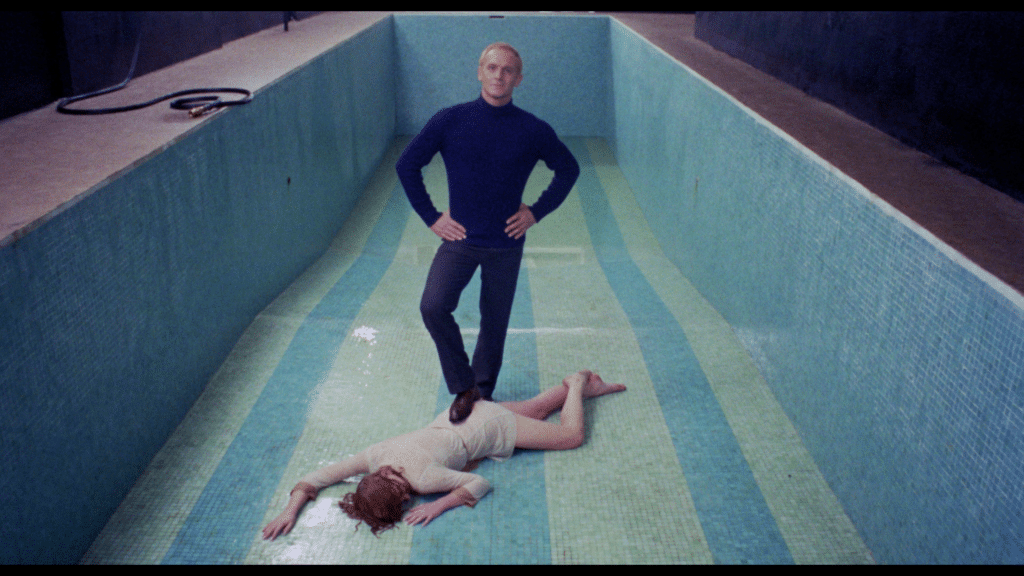
Maria goes to Sayer’s house as arranged; little does she apparently know that the working girl witnessed in the very opening scenes has a link to Sayer, too. So far as Maria goes, as they exchange a few vocal parries and as he offers her a standard-issue glass of J&B, she quickly slips out of consciousness, waking up restrained and being observed from a distance by a glowering Sayer. He begins to expound his philosophy, which seems to have been triggered by a horror of women’s desires to be self-sufficient. This cannot be; he envisages a future where males won’t be needed at all, and he’s appalled. His response is to double down on old, entrenched gender roles, resetting the clock by tormenting women, making them feel extreme fear. It just so happens that Maria is now the woman in the frame, seeing as Sayer’s original plans have come to nothing. She’s his new captive.

A series of warped domestic scenarios hereafter merge with weird and wonderful set pieces, as a rather literal battle of the sexes emerges. Sayer is clearly very practiced at this, and depends on such strictures in order to enjoy any sort of erotic interest in women; however, whatever kind of schedule he has used recently has perhaps met its match in Maria, who may make it look as though she is – begrudgingly – playing her role in Sayer’s strange set-ups, but is rather more worldly than he gives her credit. She’s watching and observing, and wants to turn things around to her favour. The film uses an often ingenious and ambitious structure where its worst, most sadistic scenes get repeated later with a different emphasis, as each key player here has a different modus operandi. It also manages to sustain a few different shifts in tone, moving from straightforwardly nasty to gently teasing and even funny, intentionally funny, even as a whole host of anxieties and nervousness are explored.

Most of all, though, The Frightened Woman is a swirling, heady study of sexual neuroses as they were on the brink of the 1970s, as the feminist movement grew and women did seem, to some, to be edging towards being sinisterly self-sufficient (another film which sprang to mind whilst watching this one was Invasion of the Bee Girls (1973), which took a similar stance towards the perils of sexually licentious women, albeit with some light-touch sci-fi at its own core). And, as much as The Frightened Woman creates a bit of a pastiche of these men who would now probably refer (to themselves, only ever to themselves) as Alphas, there’s some real-world context pressing in at the edges, and such shifts in sexual or gender roles did, and do, generate a lot of unease. The film plays quite liberally with this.

We also see other thoroughly modern predilections in the film, perhaps most notably psychoanalysis: many exploitation films of the era find time and space to include the talking cure, though perhaps Schivazappa and his design department go one better by building an entire vagina dentata sculpture to emasculate its men. The push/pull between modernising tastes and reactionary retreat leads to a fascinating interplay in this film, as in others of the same era; in terms of comparison with some of those other films, The Frightened Woman isn’t especially gratuitous, nor is it grisly, but it’s heavy on the psychological warfare, a careful and often clever film with a strong aesthetic sense (that house!) and strong production values. This Blu-ray release makes the film look incredibly fresh and surprisingly modern, too, for all of its late Sixties trappings and fashions. It makes for a good visual balance overall.

With extras including two roughly thirty-minute interviews with Schivazappa and with Dagmar Lassander, and a frankly display-worthy new cover design, Shameless Films release this Blu on January 8th 2024. This is good work from them, as always, and an unusual, weirdly inventive piece of 60s cinema for your collections.

Infinity Pool (2023)

Brandon Cronenberg may not have the most extensive filmography on the block – as of yet – but, based on the films he has brought us so far, you could suggest that selfhood and the performance of self are important themes. Infinity Pool (2023) is certainly no exception, but as Cronenberg continues to grow his own style and approaches, adding in bigger and bigger worlds for his alienated protagonists to play around in, a few issues or kinks – make of that term what you will – have perhaps crept in. But, despite a few minor glitches, it’s nonetheless a visually arresting film, with some punishing, magnetic performances and plenty to puzzle over. Whatever you may think or feel about his work, you can’t deny that it always leaves some sort of indelible mark, and Infinity Pool is no exception.

We move from bold colour, blaring opening credits (paging Gaspar Noé) into full blackout; a young couple in bed, which turns out to be Em (Cleopatra Coleman) and husband James (Alexander Skarsgård), pondering some cryptic phrase just spoken by James, though Em debates whether he was asleep or awake – it gets harder for her to tell, it seems. James also appears disenchanted, asking ‘Where am I?’ It turns out they’re in an exclusive resort, located somewhere called La Tolqa – a fictional somewhere and nowhere, albeit a place with its own alphabet and a curious, complex legal and jurisdictive culture (more anon). The way in which the opening camera shots wheel upside down, spinning and taking us queasily with them (page him again) makes the point that this place is detached from reality, and so are its inmates. It’s the end of the tourist season: only a few wealthy, nothing-to-do couples remain. James, a failing author, is reinvigorated briefly when he encounters a fan of his first, and so far only, book: the woman, Gabi (Mia Goth running at 100% Mia Goth) invites James and Em to dine with her and husband Alban (Jalil Lespert) that evening. James’ vanity holds sway: he agrees.

They do say that you should write about what you know: I’m talking about Cronenberg here. It turns out that this is a very artsy crowd, albeit with some issues. Gabi is an actor, Alban a former architect, James an author and Em springs from a moneyed publishing house (hence, she jokes, her father’s aversion to writers and by extension, to James). But all of these people are in some kind of stasis – they’ve moved on, or failed to move on, or they have found a way to make an artform of failure. Exasperatingly, they’re all still at this no doubt exclusive resort, finding ways to afford it; could there, possibly, be some needle here from the director towards the kinds of inert, inexplicably wealthy people he may have encountered? In any case, the dinner passes with only momentary discomforts, and the Fosters agree to leave the resort on the following day – an ill-advised action – for an excursion with Gabi and Alban. The barely-there flirtation between Gabi and James turns into something very much there during their time at the beach, but that’s not the key issue at this particular time.

On the way home, with James offering to drive, he accidentally hits and kills a pedestrian. A moment of panic ensues, but Gabi is adamant that they mustn’t call it in. La Tolqa, she points out, is an authoritarian state, and we’ve already seen that the locals have a clear aversion to tourists. Reluctantly, they try to re-enter the resort after their hit and run, but it turns out to be a pointless attempt to escape the consequences; early the next morning, police arrive, taking James and Em to the local station and charging James with manslaughter. Lots of crimes attract the death penalty in La Tolqa, and this is one of them. Gabi, Alban and Em, too, have already pointed the finger of blame at James. The die is cast.

Except…La Tolqa has a different means of ensuring justice is meted out, but that one of its wealthy visitors is not killed in the process. James has the option, for a fee of course, to be copied – his double, who will be fully culpable because he will have all of the same memories, will be killed by the family of the victim in his place. Part of the ritual insists that he has to bear witness to the execution – after which point, everything is sorted. James can go back to his own life, debt to society paid.

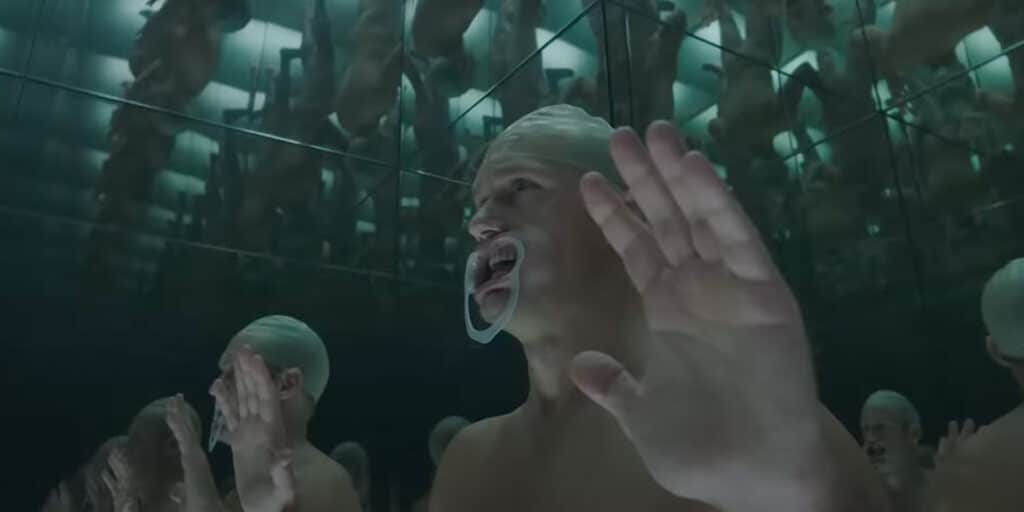
Now, for many directors, probably for most directors, this plot development would likely be the high point of the narrative, a grand culmination of the bubbling absurdity and unease which have already been established. For Brandon Cronenberg, it is instead a kind of interesting bump in the road, a means of establishing that the wealthy of this place can buy themselves out of any situation, regardless of the deed. All that is important is that justice is seen to be done, even if the mile-high loophole La Tolqa has in place is really only available to people of means. People like James for instance, although like many writers he is diligent about spending other people’s money, so that he can purchase his ‘research time’ by proxy. And, after witnessing ‘his’ execution, it seems that James has entered a closed community of seasoned holiday-goers who have themselves undergone this same process for their own misdemeanours in the past, developing a kind of devil-may-care attitude like no other now that they have seen themselves, effectively, die. This includes Gabi and Alban, but James is not an easy fit for their group, and we begin to focus closely on his burgeoning crisis of identity.

From all its charming, bizarre little touches – which start early, with its mawkish masks, the same waiter appearing in different restaurants, the invented setting altogether – Infinity Pool still feels like it has the most recognisable, even workaday beginning of any of Cronenberg’s films so far. You’re jerked out of normality very hard and very early in Antiviral (2012) and particularly in Possessor (2020), but a dreamy holiday resort, a strange couple? It feels, at least at first, more normal – a term to use under advisement here. But the film tightens its grip steadily, expanding its vision as it does: this fictional country has its own forms of policing, law and justice which soon collide with the type of body horror Cronenberg Jr favours. It tantalises interesting technology and indulges in a few neon-trippy scenes as the copying process takes place – putting Skarsgård through the wringer as it goes – but really, it uses this motif to get at its big questions about values and morals, and then moves on to look at wealth and the inexplicably wealthy, monsters with no fear of death for their deeds. It’s good, by the by, to see the doppelganger making such an engaging return to the horror/sci-fi genres here. It’s developed engagingly, too, becoming a scapegoat as much as a conventional, accusatory symbol of failure and wrongdoing.

If the film has one key issue, it’s perhaps in how it groans under the weight of all this subtext, some of which feels a little overfamiliar in places, for all the neat developments and stylistic tics along the way. It’s not fair to suggest that Infinity Pool was made to be analysed rather than enjoyed – despite the current ‘fan gap’ between critics’ reviews and audience reviews on Rotten Tomatoes – but it repetitively leans on its eat the rich vibes in places, across two hours mind you, sometimes with some clunky dialogue which loses the slick humour of a close parallel such as (and I’m ready to argue this) Society (1989). There is doubtlessly some humour to be found in here though – James’s final straw being made to hear a bad review of his book, for instance! – and the cast is great, with Mia Goth in particular revealing why she is something of a genre cinema darling these days. All in all, this is still a lush, queasy, interesting film, despite not being an unequivocal triumph like the extraordinary Possessor.

Ferrari (2023)

It’s not just a big action biopic. That’s probably the first thing to get straight about Ferrari (2023), a film which could well just be a fairly straightforward story of making fast cars, racing fast cars and occasionally filling us on on the human drama unfolding nearby – always within reason, of course. Rather, Michael Mann’s take on the history of the legendary car manufacturer at a critical point in its timeline opts for an often oblique approach, a social and personal history which gradually comes together to tell a more orthodox story. It won’t be for everyone and petrolheads will probably feel cheated, but there’s a great deal to recommend this ambitious and complex narrative. Stick with it.

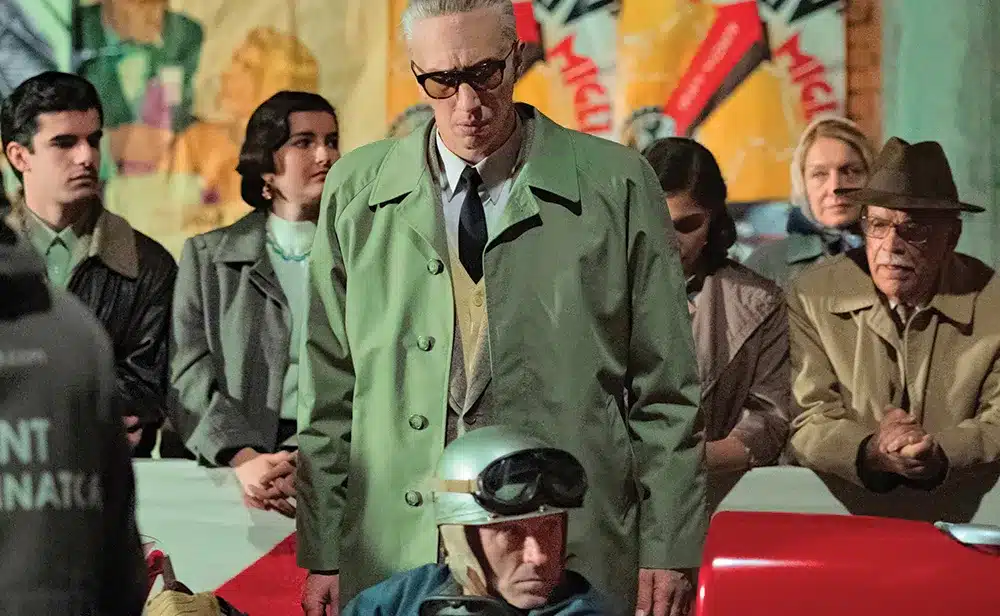
We start with a brief introduction to the legendary firm first established by Enzo and Laura Ferrari post-WWII, spliced with some newsreel-style footage – some contemporary, some edited to include lead actor Adam Driver as Enzo (one of the film’s only genuinely weak sequences, actually) racing his early vehicles. But then we skip ahead a decade; whether or not Enzo chooses to drive his respectable family car as if he’s still racing, he’s retired from the sport and his company is struggling (as were a lot of the other big names at the time). Essentially, whether or not Ferrari survives is down to its success in the racing world, which is presented to us as an oddly surreptitious pursuit, with messages being phoned in hither and yon, drivers arriving, drivers departing – there’s a lot going on. Enzo, now middle aged, is presented as a sullen, changeable soul, but gradually, we see sound reasons for this. He has been bereaved of his son, Alfredo, and he has a fractious relationship with his wife Laura (so, not the woman we see him waking up with at the start of the film. That’s his long term mistress, Lina). If the film makes one thing clear, as it gradually unfurls its various plot points and characters, it’s that we start our narrative in a place of turmoil – though maybe with some new beginnings, or else more and more irrevocable endings.

There’s certainly a new beginning on the cards for hopeful newcomer De Portago (Gabriel Leone), when an accident deprives Ferrari of one of his best vehicles and star drivers (there were no seatbelts then, which seems like one of the most bizarrely slow learning curves in human history). Ferrari needs him; he begins to see that, without racing glory, the factory will soon be finished. Laura also owns half the firm, and she’s less and less in the mood for compromise.

Whilst there are, naturally, some high-octane racing scenes as inevitably pushed forward by the trailer, and there is a bit of car lingo for car people (this reviewer is perfectly happy to drive a car with only a notional idea of how they work), this isn’t The Fast and the Furious with a period setting. Ferrari is a very careful, low key film for the most part, creating engaging characters who are clearly flawed without this being spelled out for us in simplistic terms. The way in which the film opens almost in medias res, with the audience playing catch-up to determine what is actually going on, works very well; it captures the chaotic, rather desperate state Ferrari was in at the end of the 1950s. And if Enzo himself is often unknowable – to us, and to people in his life – then his counterbalance is the mesmerising Penelope Cruz as Laura, in what must be one of her best performances. Laura is a parade of explosive or suppressed emotions by turns, alert to every slight and secret as only a deeply hurt woman could be, a fierce custodian of her own dignity. She dominates every scene she’s in, a deeply sympathetic character who can communicate just as much with a smile fading into tears as she can with her note-perfect takedowns.

There are a lot of other ways in which Ferrari creates depth and complexity, one of which is in its completely plausible frame. A film needs some serious budget to really – really – do a period setting, something which I wish even the most ambitious indie filmmakers could appreciate, as it’s fertile terrain to just trash the entire premise. Here, the post-War Italy created on film is very convincing, looks wonderful and is – aside from that opening newsreel sequence – fully consistent. Mann and writers Troy Kennedy Martin and Brock Yates play around with humour, too, which feels welcome, and often comes at the expense of religion, or at least is linked with religion (such as the men timing racing laps during Mass; the priest who avers that, had Jesus been born in 20th Century Modena, he would have made cars). But as part of a picture of a modernising, but struggling Italy, of course the Church is important. This is a country dreaming of carving its own path, of being self sufficient – hence Ferrari’s reluctance to take outsider backing, American money, to keep his factory running. It was a risky kind of pride, given Italy’s economic state at the time. Necessity is the mother of invention here, but accompanied by very human stories of loss, jealousy and desperation.

All of this elevates the races themselves, as we see how much is riding on them: Enzo develops a kind of monomania, but not out of nowhere, and the film explores this confidently. Ferrari does feature, without question, some phenomenal race scenes, though doled out carefully – thanks God, because much more of that balletic carnage would have shredded the nerves (and incidentally, the film makes good use of opera, too, either by including operatic music and performances, or by itself turning into a bit of an opera. It makes sense). Some of the accented English spoken in the film – whilst the decision is appreciable – can make the dialogue difficult to parse at times, but it’s not a continual concern. This is overall an impressive, sensitive, unorthodox exploration of the Ferrari story, and its decisions pay off.

Ferrari (2023) is in cinemas now.

Monsters, Hexes, Ultraviolence: Keri’s Top 10 Features of 2023


New Life

Every year – and I have done lists like this for quite a few years now – I wonder what I’ll say for the little preamble: before getting straight to talking about the films themselves, it always feels proper to say a little something first. Well, this year I’ll start by saying this: 2023 has been a genuinely very difficult year to call. There have been lots of important external factors (such as the Sag-Aftra strike) which have affected what has made it to our screens; lots of these big questions over creative control, ownership and intellectual copyright will continue to have a profound impact on the world of film, as well as having the more obvious impact of keeping titles off our screens which would have been completed and released by now. Also, as much as the main Covid lockdowns are now some years behind us, Covid continues to have an impact on cinema, whether because people have written films which they could feasibly only make around reduced crews and locations, or because the huge dent made in profits and possibilities is continuing to bite; still, films are staggering to market, after years of being hamstrung by the impact of the pandemic.

But even taking all of these things into account, compounded by the fact that the cost-of-living crisis ruled out a lot of in-person festivals and events this year, which has doubtlessly had a massive impact on the titles making my list, 2023 has turned out to be a very varied year for film in terms of genres, budgets and approaches. On one hand, last-minute entrants like a certain film from a certain Toho Studios have showcased impressive SFX and a sense of scale like no other; on the other, tiny indie productions have got things done, too, despite clearly needing to make tough decisions and think carefully about how to bring their narratives into being. So this list contains a little of everything, and has had to miss a few titles out of the full list for reasons of expedience rather than indifference (hence a raft of titles getting honourable mentions.)

That’s enough preamble, isn’t it? Let’s get to it then.


TO FIRE YOU COME AT LAST


Perhaps in the fittingly opaque hinterlands between feature-length and short film, To Fire You Come At Last feels familiar, taking a little from the darkest examples of A Play For Today and/or other, mid-twentieth century Gothic, which is itself a weird palimpsest of ideas stemming back to the murder ballads and penny dreadfuls of centuries before. A simple enough story in many respects – fulfilling a promise to a dead man, come what may – it really lands through its sustained, artful atmosphere. It absolutely nails its night shots, importantly, engendering a pleasing sense of foreboding which runs throughout the film. You can check out the full Warped Perspective review here.


SALTBURN


A late 2023 release, it’s nonetheless no great surprise that Emerald Fennell’s latest Saltburn has made quite an impact; had a film like this with those scenes and that conclusion just merrily rolled past audiences, then that would have been truly remarkable. So it’s a film engineered to provoke in many respects, but this doesn’t take away from its sharp British humour, assured performances, and most of all in how it captures an idyllic summer (then spends the last act almost merrily taking it to bits). Barry Keoghan has form for being a disruptive presence within a family, but he takes it to a new level here, with what you could at least agree is a committed performance (rarely have so many bodily fluids appeared so readily in a mainstream film). I am still enjoying (?) myself by pondering how much Ollie knew he was going to do, and at what point. Saltburn absolutely has a life beyond itself, an outrageous, hyperreal riot. Check out my full review here.


VINCENT MUST DIE


Imagine if your very presence seemed to trigger random acts of violence in others? And, if you tried to seek help, it seemed to trigger even more, until you could no longer live your life in any normal way? What starts out as a grim, but somewhat funny farce in Vincent Must Die soon transfigures into a sizable, society-wide nightmare which drags up interesting questions and considerations, all whilst never letting up in its mission to shock. Played with humanity and humility, Karim Leklou’s plight as Vincent is the unerring focus for the first act of the film, though gradually the film expands its viewpoint to take in someone close to him, too: as this unfolds, the film is reminiscent of any number of contagion cinema titles, perhaps most notably The Crazies, but it’s by no means a do-over, and has a real charm of its own. One of this year’s Fantasia titles, check out my full review here.


VINCENT


First things first: this is a different Vincent. Is this Vincent a monster? We certainly see …something which indicates that he might be, but the whole film gently encourages us to interrogate the idea of the ‘monster’ throughout – so, when we first meet Vincent (Mikkel Vadsholt) supping on what looks like a bag of blood, oh and working out of an ice-cream van, then it seems we’re being led to believe that this man is a straightforward threat – maybe to children, right before we encounter a deeply unhappy young man whose own love of cinematic monsters seems to be all that’s keeping him together. But the film is rather cleverer than simply offering up a victim to a standard-issue monster, and turns our suspicions back on us, asking us – how much can we really know? Enough to judge? It’s a touching, clever film about unorthodox friendships and a learning curve taking place against a potentially supernatural background, successfully spanning different genres with ease. As I said at the time, this is one of those indie films which keeps you looking for gems of a similar quality. You can read my full review of Vincent here.


PEPPERGRASS


Peppergrass is just such a thoughtful, charming homage to a range of horror genres, one which sustains all of its different notes. What’s not to love? When I initially reviewed this film back in the spring, co-director Chantelle Han commented ‘we made this film for you’; so, yes, it is very much a fan’s film, it knows its influences, but it weaves everything together into a distinctive whole. In short, it’s the sort of love letter we want: it’s saying the right things in a different way.

Starting out as a road movie, then a home invasion, then a failed heist turned survivalist horror, Peppergrass depends for its success on its close focus on key character Eula (also Chantelle Han), a pregnant restaurant owner who needs a break and decides to make it happen by attempting to steal a rare truffle from a reclusive veteran. Things move from the ridiculous to the sublime in a clever film which uses the backdrop of the pandemic in a meaningful, plausible way (and may well have been impacted by the Covid pandemic itself, given that it was actually completed in 2021. But whatever the slight delay, I’m very glad it got a release this year.)


GODZILLA MINUS ONE


First of all, Godzilla Minus One is one of those rare birds for me where I haven’t written up a full-length review; having only seen it last week is one reason for that, but also, sometimes it’s just nice to go and see something without crowding your head with mental notes. In effect, you can, on occasion, just watch the damn film. Still, we need some justification for its inclusion on this Best Of list, so here goes: it’s a Toho Studios prequel to the original Gojira title, placing it squarely back in its own origins and excising a lot of the guff which primarily US studios have felt the need to add in through more recent decades.

In Godzilla Minus One, whilst there is some justification offered for Godzilla turning up (we’re back to the WWII setting of course) no one is seeking to find a reason here for Godzilla’s behaviour. He just is, he just does. As he decimates a Japan which is already pretty decimated, GM1 manages to sustain some engaging characters in an unorthodox little family unit, which includes a three year old tot acting her little heart out; that’s charming, but it’s protagonist Shikishima (Ryonosuke Kamiki), a failed kamikaze pilot who can’t shake his personal guilt for Japan’s surrender, who really holds the film together, a central focus for proceedings – which range big. A world of failed optimism but the desire to survive, of a loss of hope in government to protect the people, but of hope in the people themselves, GM1 has interesting things to say about Japan and Japanese history, but this is a monster movie and it works fantastically, with some superb shots and sequences. It has to move its pieces around a bit quickly at the end to get things in place for the first film – its real time sequel – but it holds together, and it’s a brilliant film, in which Godzilla is unequivocally terrifying again.


WHEN EVIL LURKS


When you’re a horror fan, sometimes you just crave the obliteratingly nasty – non-horror fans may find that difficult to understand, but so it is. Well, Argentinian horror When Evil Lurks – Argentina certainly isn’t messing about when it comes to its horror cinema lately – is nasty, a supernatural horror of possession and all its attendant bodily breakdowns, one which feels kind of familiar, but also throws in a few curveballs which play with ‘the rules’ of possession horror. If you have seen the film, and many of you reading are likely to have, then I’m ready to bet that the choice of image, above, has triggered some quite clear memories of your viewing. Not that children are always victims here, though: in the universe of the film, they can get past the whole ‘bad language and self-harm’ thing to start swinging weapons around as a small rural community is beset by a body-hopping kind of entity which favours baseless, irrational violence. It’s shocking, it’s often ingenious, it knows just when to skirt near to dark comedy and it’s an enjoyable slab of very grisly entertainment. Why press in on the edges of your horror film with awkward subtext, when you can just have someone caving their own head in with a hammer – just in case?


NEW LIFE


There has been an impressive spate of sci-fi in recent years that pares back the sci-fi elements as much as it can to allow the human consequences to come to the fore. That is the case with New Life also, though it’s a film which brings plenty of horror to bear on its science fiction, via its examination of how protocol and ‘doing the right thing’ balances against humanity in an unprecedented outbreak of something as-yet unknown. Whilst the film does move around, it’s not a film which grows and grows in scale; New Life is instead a story of two ill-fated women whose paths join: whilst it tantalises what would happen if this situation grew further out of control, its focus is on the initial situation, as explored through an interesting, detailed though broken timeline. It also lands an incredibly moving sequence come the end, with a line of dialogue which speaks to a world of pain beyond itself. Impressive stuff from John Rosman. Check out a fuller review here.


INFLUENCER


Shudder has, over the years, steadily built itself up from simply being a horror streaming platform to a film development programme, commissioning and/or screening new cinema of its own. And it’s probably fair to say that Shudder Presents features often have a lot in common: slick, modern, with a sense of the need to both charm and appal a relatively young, well-versed audience. Influencer (2023) is by far and away the best of the new Shudder productions I have seen, as much as it has a lot in common with other, good titles in its sharp visuals, good production values and knowing pace. Notably, however, it dispenses with supernatural horror and plants its feet in a recognisable, if (for many) unattainable world: that of the social media influencer, those affluent young people who magically manage to get into the enviable (for many) feedback loop of spending a lot of money to have a good time, to make more money to spend on a good time. Social media has been creeping into horror for as many years as it’s been such an important component in people’s lives, but Influencer does sterling work asking a series of important questions: who is watching these feeds? What do they get out of it? And what will they do with the information?

A careful, devastating and brutal film with a knock-out, sinister antagonist and a cleverly winding plotline, I was absolutely gripped by Influencer and it’s certainly a film which could stand another viewing or two. Clever, unsettling fare. You can see a longer review of the film here.


SISU


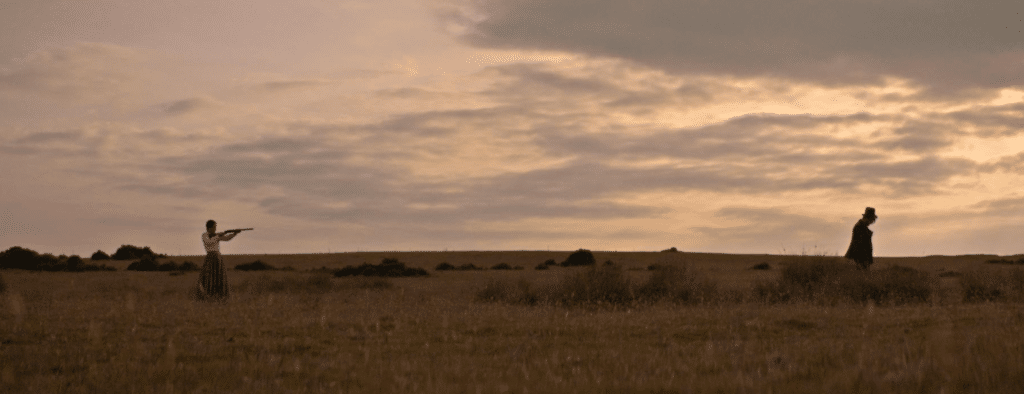
It’s absolutely only the presence of Sisu in the world that could ever knock Influencer from the top spot; that it popped up, seemingly out of nowhere, the brainchild of Rare Exports director Jalmari Helander makes it even better; a safe pair of hands for an inventive and horror historical fantasy. So – if you missed it – how do we define what it’s all about? Well, it’s a gleeful fantasy of redress and justice, a grisly superhero movie, a splatstick comedy and a version of a Wild West revenge flick – only relocated to the frozen North. When the retreating Nazis decide to rob a mute gold miner in the Finnish wilderness, they get far more than they bargained for as the man turns out to be more than adept at survival. In fact, he could turn out to be the adversary they have long feared – and their fateful engagement with him their last ordeal on Earth. Once you are happy to suspend your disbelief, and you should (or must), then every note in Sisu is a pleasure to behold. It’s one extraordinary man’s odyssey through ultraviolence, and as I suspected at the time, it hasn’t been bettered. Bravo, Jalmari Helander! Here’s a complete review of this wild ride of a film.


HONORABLE MENTIONS:


And, finally, here are some other 2023 films which deserve praise:

The low-key but visually impressive moral meanderings of RUBIKON, with its space sci-fi and environmental portents; similarly, the thoughtful sci-fi of RESTORE POINT and its idea of life as a file which can be backed up and re-run at will – unless, of course, someone deliberately eschews this process; the high weird relationship horror of GOOD BOY; INVOKING YELL, which brings more of the lo-fi atmospherics of black metal + horror to the screen than many far bigger budget projects; SPAGHETTI JUNCTION, a careful, science fiction-adjacent coming-of-age story with beautiful characterisation and character development; the quiet and thoughtful character study of SOMETIMES I THINK ABOUT DYING, and – another viewing from very late in the year – the unashamedly fun slasher THANKSGIVING, in which Eli Roth shows us once more that, whatever else, he is more than capable of a damn good, high entertainment horror.

Restore Point

Thanksgiving (2023)

Eli Roth is one of the best-known horror directors out there, which is perhaps surprising, given his relatively small body of work: some of that body of work has been pretty divisive, too. But his love of genre film has never been in question, he’s a horror guy, and his feature-length take on Thanksgiving is very much him at his best: having fun, blending comedy with horror and crafting a defiantly decent modern-day slasher with a back story which has enough depth to keep things together. It’s set in Plymouth, Massachusetts and makes good use of the city’s historical links to the Thanksgiving holiday, right down to the historical names and faces used in the film. But out of all this, it weaves something which feels very up-to-date, with plenty of ideas. You’d be hard-pressed to be bored, genuinely bored, even though the film runs to around one hour forty-five minutes.

We start with a Thanksgiving dinner, and this recurs as a theme throughout: single cop Eric (it’s only Patrick Dempsey!) joins a family group for the meal, which includes local RightMart manager Mitch (Ty Olsson) with his wife Amanda (Gina Gerschon) and the owner of the store, local bigwig Thomas Wright (elite hunter Rick Hoffman) and his new, arm candy wife Kathleen (Karen Cliche). But proceedings are broken up when Mitch gets called into work; the big Black Friday sale is, apparently, beginning on Thanksgiving evening, and the hordes are gathering (if you’re an American and you think that’s consumerism gone mad, then consider the fact that we get that in the UK and Europe now, too, despite not celebrating Thanksgiving – for obvious reasons). The group begins to peel off – pun not intended, now that it’s been noted – and call in to the store themselves, including Wright family heir Jessica (Nell Verlaque) and her high school age friends. That they jump the sizeable queue and get inside ahead of everyone else adds outrage to the already simmering, please-part-me-with-my-money crowd, not helped by how they mock the waiting shoppers through the plate glass windows. As this unfolds, we get a few glimpses of local rivalries, issues and double-crosses. Remember them: they might come in for something later. You never know. (You know.)

But for now, it’s enough to know this: things are about to get retail ugly. Collapsed entry doors, tramplings, rioting, fleeing, screaming people: the only person not terrified seems to be Jessica’s jock friend Evan (Tomaso Sanelli), who livecasts the melee on his phone. Interestingly, this sequence happens before the film’s title even appears on screen: this zombie-adjacent horde descending on a mall (okay, a mart, but there’s little difference) calls to mind Romero’s seminal Dead films, right down to the sense of fun he hung onto in Dawn, and the grisly, scalp-ripping riot that happens once the windows come down is definitely nasty, even if just a hectic prelude to the main event. Because, after this, we skip ahead by one year. In that interim, Plymouth has mourned its dead, the teen friendship group has been disrupted by the disappearance of Jessica’s boyfriend Bobby (Jalen Thomas Brooks) and some of the townspeople are protesting any return of the early Black Friday event taking place this year. Wright is keen for it to go ahead anyway – those profits! – but it seems someone might be about to take things further than a placard and a slogan. The historic Cutter house, linked to pilgrim figure John Cutter, has been trashed and graffitied. Oh, and a large display axe stolen. Oh, and someone has set up social media accounts under the name of ‘John Cutter’, threatening vengeance on a selection of the people of the town, including Jessica and her friends.

Slasher incoming! Whilst this genre is, by some margin, not one of my favourites, Thanksgiving strikes a great balance between reverence for the classic slashers (which were themselves inspiration for the faux Thanksgiving trailer directed by Roth for Grindhouse, way back in 2007) and enough fresh ideas to hook jaded modern audiences who may feel they’ve ‘seen it all’. There’s a lot of flair here for pitch black humour, right down to some ingenious splatstick, and a sense that every kill needs to be an OTT, memorable set piece. It’s fast paced and always feels fast paced somehow, despite the runtime, never taking itself terribly seriously for too long (as this would probably be the weak spot which unravelled that pace altogether). Similarly, the characters walk a decent line between archetype (jock, boss, geek) and greater depth which only develops over time, and only as much as is needed for the story at hand. So, as we see the plot move forward with a grisly plan starting to come together, it’s Jessica who becomes our common denominator, with access all areas and enough about her to hold our interest. Hey, if some of her lines are very heavily meant to foreshadow later events, it’s all good – it’s all in the spirit of the thing, character, plot, pace and all. It works.

Sure, there’s nothing super-subtle here about how Thanksgiving handles its big themes of corporate greed, consumer culture or social media, but it really doesn’t need to be: it has a lot of fun, successful set pieces, confidence in its approach and a seamless blend of comedy and tragedy. This is a colourful, gruesome horror comic which pokes fun at/holes in an array of culpable characters. What’s not to love? Add to that the fact that it doesn’t scrimp on the final act in any way, shape or form and you’ve got a winner, even for this miserable anti-slashers reviewer right here, who wound up totally on board. If this ends up being the last horror movie I watch in 2023 – as it well might – then it’s a great way to close the year.

Thanksgiving (2023) will be released on VOD January 1st 2024.

The Portrait (2023)

Horror and art: it’s a faithful, longstanding relationship which continues to turn out a few films – good and bad – every single year. And then we come to The Portrait, a film which you could be forgiven for assuming was a fairly straightforward horror story – but it isn’t. Paring back the horror to moments of intense, introspective and even doubtful personal experience, the film turns out to be more of a psychodrama centred upon the plight of an individual. But I said it turns out to be that: the film’s opening scenes are far more in keeping with traditional horror as we witness a young, screaming woman, being dragged bleeding through the woods by a blankly hostile man. As this unfolds, we see a portrait being painted, and we are clearly to infer that something about this creative process is linked to the violence. Then we must store up that information, primed to see this painting reappear at some point later.

We next cut to the modern day, and a couple heading through the hills to a beautiful, remote house – which turns out to be the old family home of the man, Alex (Ryan Kwanten, last seen negotiating with a mysterious entity in a toilet cubicle in Glorious). No rain-lashed, Gothic mansion, this: it’s a pleasant, bright place – but there’s something very wrong with Alex. As his wife Sofia tries to engage with him, he is by turns sullen and reactive; it transpires that he has received a catastrophic brain injury, hence the unpredictable behaviour. And Sofia (the superb Natalia Cordova-Buckley) is doing everything in her power to build a bridge to the man Alex once was: she hopes that spending time in his old house will trigger something, some breakthrough.

We get a few leading clues that the house contains some supernatural presence, mainly as-gleaned by the camera shots from the inside of the house, watching our married couple as they approach the property, and then as they get settled in: is something indeed watching them? Oh, and there’s the small matter of the decidedly unfriendly wall art which greets them inside: here’s our link to the pre-credits. But we spend time with our very much alive protagonists first of all. Alex, it seems, received his injury in the heat of a confrontation with Sofia, which put him in the path of an accident. Sofia, as such wracked with guilt and horror, has made it her life’s work to help him recuperate, and also to do anything within her means to assuage her own feelings (which she harbours needlessly, as the audience is almost certain to infer).

But very much like Miss Giddens in this film’s close relative, The Turn of the Screw, Sofia is bringing a great deal of her own complex emotions and neuroses to bear on her situation. As such, upon exploring the house, she is struck by her discovery of a large portrait in – where else? – the attic. It’s a self-portrait, painted, as she infers, by a previous occupant with a link to this house and – most surprisingly of all – the man in the painting looks uncannily like Alex. In her heightened state of anxiety, this simply compounds her feelings that something awful, something inescapable is heading their way; if the clues were already there, then this discovery serves as some kind of evidence: desperate people often rely on the notion of fate, and the painting feels awfully like fate.

As a few new characters begin to drift in and out of the periphery here, Sofia talks to Alex’s cousin, Mags (Virginia Madsen), who obligingly provides a large slab of backstory on who the man in the portrait is, and what his links are to Alex. It captures Sofia’s imagination: almost on cue, she begins to experience strange visions and dreams, and life in the house becomes ever less bearable. Mags’s story of a tortured, torturing artist concealed somewhere in the family history could be an explanation, of sorts, for the phenomena Sofia begins to suffer through, or else it could just be another weight for Sofia to carry.

The film is strikingly successful in presenting Sofia’s deep, fragile unhappiness and Natalia Cordova-Buckley is absolutely key to this. You really empathise with her lot; she is lonely, vulnerable, and her husband is no longer her husband (though the snippets we see of his behaviour before his accident show us that life was no walk in the park for her beforehand, either). There’s an uncomfortable atmosphere through every second of this film’s runtime, and the sense of dread conveyed is what feels very much like the conduit for the supernatural activity we witness. This happens via some highly effective scenes, doled out very carefully and deliberately – jump scares do not punctuate or define this film. Akin to lots of the very best ghost stories then, events move slowly, always casting doubt on what is happening, hinting at the contextual problems at play here: families; family legacies; the toxic effects of privilege; the lives of women.

The overall of feel of The Portrait is oppressive and claustrophobic: assuming this was the aim for director Simon Ross and writer David Griffiths (who has had a hell of a career shift, from Goldman-Sachs VP to screenwriter) then – well played, this is a hard watch, but a thought-provoking one, with an intriguing and well-developed take on an established horror idea. Whilst not one for fans of high action, for those of you who enjoy pondering the links between human psychology and supernatural phenomena, and pondering them over and over again long after you’ve watched the film, this truly is an unexpected, oblique little gem.

The Portrait (2023) is available now on VOD.

Santastein (2023)

It’s the most terrible time of the year: it’s the present day, and – Santa has mysteriously stopped delivering presents, ending winter. Writers and directors Manuel Camilion and Benjamin Edelman have created a retro-feeling homage to both Mary Shelley and Father Christmas here that sometimes finds its feet, but other times feels frail. With few comparisons to be drawn with other holiday horror films like the modern classic Krampus or A Christmas Horror Story, as the subject is so unique, I must say this leans more towards monstrous than merry, channelling Frankenstein’s Monster in all its moaning, undead glory. Given that the Monster pre-dates even Nosferatu on film (the Edison Frankenstein appeared in 1910), our directors have picked a sufficiently antique being to meld with the ancient origins of Christmas also under consideration here.

The focus in our brief introduction is that the town’s coroner has been experiencing thefts—body thefts, that is. One night, in a mix of hijinks and larceny, the bandit is caught in the act frightening a worker with a faked zombie reawakening (nice foreshadowing). When finally unmasking the culprit, however, we see it is a man called Max Causey (Jared Korotkin) who has been experimenting with corpses, and tomorrow is going to be a big day—it’s Christmas, after all. Flashing back twelve years, we see how Max created a Mouse Trap style contraption to prove the one thing all kids crave: that Santa is real and he was the one who captured the mythical figure. When Santa arrives right on schedule though, gifts in hand and well wishes for Max to return to bed, the trap is set off and works all too well; old Saint Nick is ensnared and maneuvered right into… an unfortunately placed fire poker.

Twelve years later, Max is still in possession of Santa’s brain, and, together with his corpse stealing, seems to be trying to right the holiday season and resurrect its champion. Together with his friend and lab partner Paige (Ophelia Rivera), the pair think they might have the science right this for an A+ on their science project, all while other peers are creating conspiracy theories as to where Santa might have gone (hint: think big coal). A class experiment with a handmade device resurrects a dead mouse, showing that Paige and Max have their formula dialed in, and while the class is planning a retro Christmas party to blow out the holiday, Max is wondering if he can take his experiment to greater heights – namely, a human being.

Another imaginative holiday entry, Santastein brings creativity and charm as another film trying to recreate Santa. With a nostalgic feel, deep colors and lighting that pops, and camerawork which lends itself to another time, this makes the film feel like it’s not quite in any time period at all. The star of the show, Santastein, is a monster to behold and is brought to life with a bang by actor Michael Vitovich. Santastein’s arrival to tear up the whole town down at the Christmas party is definitely the high point of the film, though, as this story unfortunately lacks a lot of compelling backstory or character development, even for its supposedly deeply damaged lead. Performances are solid enough, but some of the writing (with what I assume are classic B-movie jokes and holiday hijinks) sometimes land flat, whilst much of the introduction is a slow build towards the science experiment we all know is going to end in catastrophe, with the pace not quite picking up until the halfway mark.

That all aside, I can’t fault this indie for letting its budget show too much, as its title monster is so creatively conjured and brings about plenty of splatter. Practical effects make this a messy affair with some memorable murders and some added special effects that don’t break the bank, whilst creating the electrical flair that a Frankenstein retelling should bring. I will say I enjoyed this rendition of Christmas more than some of my previous ventures into holiday horror this season. Having a raging undead Santa tearing out innards to a classic holiday tune is sure to be enjoyable, and with plenty of gore and town terrorizing to follow, overall I think this is a simple watch that achieves its goal and doesn’t overthink anything. For some easy viewing of a newly resurrected Saint Nick, check Screambox for this film, streaming now.

The Royal Hotel (2023)

Cinema teaches us that female travellers in remote climes are not in for an easy time of it. Perhaps it’s sending a message: get straight to work. Don’t risk a gap year or a prolonged vacation; it’s just not worth it. The Royal Hotel (2023) certainly starts out along those lines, though it shifts things around almost from the start by having our protagonists Liv (Jessica Henwick) and Hanna – no extraneous ‘h’ – (Julia Garner) running out of money aboard a party boat, a place every inch the monstrosity you’d expect it to be, namely a thumping, pan-global queue of whooping party people trying and failing to ask one another the question, ‘So, where are you from?’ Come to think of it, it’s not a bad summary of the film to follow.

The girls can’t stay here; they need to earn money to see them as far as their Shangri-La, Bondi Beach, so they find an agent who promises them temporary work at a bar in a remote mining area of the country. Said agent warns them that they might be in for a certain amount of ‘male attention’ there, and Liv – we imagine, rather naively – seems good with that, though in the next breath she’s asking if there are any kangaroos. To her, unwanted male attention and roos are all part and parcel of the Australian experience. The girls make their way to the Royal Hotel, through a clearly vast expanse of land requiring travel by rail, bus, and finally a lift from sometime bar manager Carol (Ursula Yovich) who picks them up a couple of miles out.

The Royal is an emblem of faded Colonial grandeur, way out in the wilderness: the film isn’t terribly subtle with its visual cues, and the Royal is no exception. It’s the same colour inside as the sandy landscape outside. Even the tattered leather sofa upstairs is a shade of beige. The girls get settled in to their new digs, and then they’re thrown into the job itself, after some rudimentary training from landlord Billy (Hugo Weaving), which seems to mainly mean slamming things as hard as possible to ensure closure. That could be another visual clue, or else Billy has really neglected the upkeep of the bar, which could be the same thing. As for the bar, it gets lively and yes, they get a bit of pushback from the locals, but Liv clearly takes to the work a lot more readily than Hanna who – come to think of it – looks haunted and rather wan, even a bit – beige. She immediately wants to leave; amongst other things the casual Oz deployment of the ‘c’ word leaves her cold – but Liv think this is too hasty. After all, the two British girls they are about to replace – there’s a day’s overlap – seem to have done alright? They can clearly hold their own, have held their own. And when Liv and Hanna get to see a few of the sights, finding some time for more standard holiday activities like swimming and sunbathing, even Hanna warms up a bit.

So what, or who, is going to precipitate the crisis here? We know it’s coming. We can feel it. The incidental music (excepting Kylie) speaks of it. There wouldn’t be a film otherwise. Perhaps it’s when Billy begins to absent himself for days at a time, leaving two inexperienced girls to fend off the attentions of the predominantly male clientele, amongst whom the surprisingly-named Dolly (Daniel Henshall) is the figurehead, always pushing the ‘smile, darling’ and ‘it was just a joke’ banter into threatening territory. Or perhaps the crisis will stem from the girls themselves? There must be a reason Hanna is so closed-off and taciturn and, well, to remove the charming suffix Dolly gives the descriptor, a bit ‘sour’.

A lot of what makes and keeps the film engaging is in wondering about this: this process could, admittedly, be coloured a certain way if, like me, your experience of Australian film has tended to come from Ozploitation, so you may be expecting ultraviolence to break out at any moment. But this ain’t Wolf Creek, and nor is it Outback, where the threat comes from the harsh environment. And that’s fine, as, while we wait, there’s lots to enjoy. The people here are rounded enough to hold interest and the cracks running through their lives are fine and plausible, even whilst not overwritten. The two girls are perhaps a little obviously adrift and clueless at first, with some clunky lines and notions, but things improve as events begin to unfold around them; they are fleshed out more by how they respond, often quietly, to life in and around the bar And, along the way, the sheer amount of casual drunkenness in the film generates a lot of fumbling, retching unease and disorientation, with some humour and pathos too. It’s all doled out carefully. It must be building up to something pretty special.

Fans of languid, journey-not-destination cinema, which is happy to disrupt expectations, will likely remain enthused by the ways things play out in The Royal Hotel, but many viewers will feel a sense of diminishing returns here. Even those harsh visual cues, with their hard, obvious symbolism – snakes, storms, axes – surprisingly peter out, as does the seemingly smouldering, festering misogyny, pressing it at the film’s edges. So attention turns to Hanna, with the assumption that Garner’s rather staid performance must be poised to reveal something deliberate at the heart of her character. Instead, we get a rather disconcertingly janky ending which feels like a ninety-minute non-sequitur, especially after hinting at something tangible, some reveal or purpose.

Did the film know it was going to end this way? It all feels oddly unclear at the end, another shouted question in a rowdy bar, with no clear answer. So perhaps we come full circle, in a way, but the shift in pace, tone and detail at the end feels like something gone awry. Being left with questions at the end of a film is fine, but equally, we should feel able to glean something via what has come before. The Royal Hotel doesn’t give us that, which makes for a thin, rushed conclusion to an otherwise carefully-drawn and engaging preamble.

Adam Chaplin (2011)

Well, Adam Chaplin certainly doesn’t mess about. If the opening few minutes are to be taken as a calling card, then this is nothing if not an honest film: the first ‘characters’ we see are in the process of being decapitated, their faces are getting pummelled, blood is flowing – all, as of yet, inexplicably. I suppose you could say this film wears its heart on its sleeve, and at the expense of its plot, which seems to have been pencilled in around the murder set pieces.

But we get some pointers as we move on: here’s a woman, chained up and being menaced by a…let’s go with masked madman, given he doesn’t seem too interested in finding a peaceful solution to his evident disagreement with this woman. It seems this isn’t the first woman he’s menaced, and isn’t likely to be the last, unless he is stopped somehow. Luckily enough, elsewhere in this grotty, lowbrow-in-the-late-80s urban nightmare, there seems to be an avenging figure doing the rounds. This guy, the Adam Chaplin of the title (also co-director/co-writer, Emanuele De Santi) seemingly has two modes. These are: brooding, Gothic introspection, and limb ripping, eye-rolling rage and shirt-shunning six pack: think The Story of Fabi-o. And fair play to Adam, as these modes will see you a long way. To head off any doubt that he’s here for big V Vengeance, he leaves behind a calling card: a big ol’ inverted cross in blood, to match his scar, which of course he has, of course he has a big inverted cross scar. It’d be weird if he didn’t, frankly.

Okay, so are there any good guys in this particular universe, seeing as our Mr. Chaplin is obviously an ambiguous anti-hero with a back story? Well, ostensibly; we see some cops, heads still on for the time being, and momentarily there’s an embittered detective, except it turns out he’s not averse to unorthodox methods of his own. There’s soon also a small squad attempting to intercept Adam Chaplin, one of whom is a face-painted goon for hire. But the whole film is so very clearly a vehicle for Chaplin to face off with the masked madman, and for a wholehearted appreciation of gore, that everything else feels like an afterthought. And that is okay. The plot may not be intricate, but nor was it in a lot of the Eurohorror so clearly beloved of De Santi and his team. With that in mind, this is review is shorter than most of the reviews we run here, for the simple reason that I feel like I’m actually reviewing a ninety-minute run of kill scenes but trying not to spoiler them, as the kill scenes are the point.

Clearly operating on a low budget, De Santi has successfully made his film look like a kind of late 80s, or early 90s (at a push) DTV horror – with washed-out colours, grainy appearance, oddly overdubbed dialogue and a strange sense of perplexed wonder. It prioritises its practical SFX for the biggest share of the running time, and it has the ultimate excuse of ‘it’s meant to look like that’ for any naysayers, but overall, there’s enough splatter here to keep things interesting, with only a few overly talkative lulls. But otherwise, no blushes have been spared when it comes to things like sheer imagination, velocity (limbs fly fast) and volume, though I half wish the film had dispensed with the occasional CGI it adds in, as this can almost-kinda jar you out of the vibe the filmmakers have otherwise worked hard to create. That said, certain parts of this film feel like a horror comic as much as a film, and the CGI fits better in those scenes.

Adam Chaplin is like a proto-version of Malignant spliced with The Crow, and directed by…oh, take your pick, Mattei perhaps, or Lenzi later in his career, honour-bound to get through a bulk purchase of severed heads and corn syrup, or a slightly more sophisticated kind of fake blood. It genuinely does feel like one of those films you find in your video store, once, then you can never find again, but you remember a face being peeled off and the fact that it carries on chatting as it slides to the floor. That sort of thing. You talk to others; they think they might have seen it, but they can’t remember what it was called, and now neither can you. There are so many films that have been lost in this way, and it’s nice to see this kind of homage being paid to them, even if Adam Chaplin itself seemed to have almost disappeared, too: made in 2011, it’s languished, somewhere, until being recently picked up by Screambox.

Truth be told, the film’s most likely appreciative audience is probably quite a narrow one; other, younger, more pampered film fans raised on Blumhouse and the Saw franchise will probably turn up their noses at this, because without a certain point of reference, it will likely drift wide of the mark. I’m also uncertain that is is, as claimed, the “most bloody movie ever” (surely that title must still go to Braindead, aka Dead Alive?) But it’s obviously a labour of love and it has a wealth of pretension-free, hyper violent strangeness to recommend it. There’s a lot to be said for that, and for just having a bit of fun, too.

Adam Chaplin is new to Screambox.

Tropic (2022)

A mainstay of science-fiction, by this point in time, is often in how it manages the human consequences of scientific change. Risks, dilemmas, emotional impacts: what awaits mankind when it truly breaks free of the bounds which constrain it? Well, we go a step further in Tropic (2022), to the extent that it’s not exactly a sci-fi at all. Its interaction with a fantastical, sci-fi element never goes in the expected direction. There are some extraordinary circumstances in the story, true, but these don’t really go beyond exacting pressure on an already strained family group. The resulting film is engaging nonetheless, but fans of aliens and spaceships and all that might feel a little hard done by; this is a story about two brothers…

One of whom we encounter in the very opening scene, facing the camera, sitting stoically on the floor of a swimming pool. This is part of astronaut training at a very exclusive, highly competitive facility in France, and brothers Lazaro (Pablo Cobo) and Tristan (Louis Peres) are both training there, vying for a place on an upcoming, long haul space mission. The word ‘colony’ is mooted; we see little of the world beyond, but it seems there’s a great deal at stake here. What we see of the brothers’ early relationship, by the by, sets up the quite odd blend of approaches which come to characterise the film: it’s both very still, and very tense – a kind of dignified adversity. The two young men compete against one another with the usual physical scrapping and name-calling you’d expect, but they are also each quite self-contained when it comes down to it. It’s not likely that they will both make the grade; it’s not likely they will both go into space, as much as they want that.

We get a very slow build up here, following the boys as they travel home to see their mother, Mayra (Marta Nieto) who lives out in the boonies in a relatively deprived part of France; their code-switching between French and Spanish tell us that the family is Cuban by birth, which is coded to mean ‘struggling immigrants’ here, with Mayra commenting early and often on how hard she has struggled to get the boys where they need to be, working a succession of low-security, low-wage jobs. But they’re a happy unit, with a good life together: in and around the time spent at the academy, the boys discuss their first loves, their hopes and dreams; they practice, too, sinking to the bottom of a nearby lake to time how long they can stay there. Well, space travel is changing: we note that a speaker at the Academy describes voyages taking decades, so they will need younger astronauts as a consequence.

However, it seems that the brothers won’t have to wait to get into space for its issues and problems to find them: as they hang out at the lake, something bizarre crashes to earth, actually landing in the lake itself. Tristan tries to warn his brother, but whatever has landed fills the water with an ominous green glow, and before he himself can get out, he is significantly injured by whatever-it-is, which – and there’s no other way to say this – disables him, both disfiguring him and damaging his brain, so that he is effectively a different person, barely speaking, struggling to walk, prone to catastrophic rages.

However, the film moves largely away from Tristan at this point; we follow Laz, whose loss of the brother he knew is agonising, whatever the nature of its cause. He loses his edge and his purpose; continuing to strive for excellence feels wrong now. He’s not unequivocally sympathetic, though, and initially has a real horror of his brother’s new friends with disabilities (perhaps a little unbelievably, it turns out that Tristan’s new support unit is right opposite the space academy, sharing a lot of the same space). Laz can be cruel and dismissive; the brutality of his treatment of his brother is a hard watch, but it’s plausible, because people are certainly not always nice, and perhaps we should be more honest about how anger can accompany loss.

That said, all of the focus on Laz’s plight can feel ponderous, and perhaps also because it’s hard not to expect something else, some different outcomes. We’re onto Chapter IV (yes, we have chapters) before we move much beyond pure, introspective misery, which almost halts the narrative, setting aside a lot of the momentum around getting a place on the voyage. Some of the running time is eaten up with what feel like bizarre inclusions, too: it’s incredibly French that the prospective astronauts have to take a compulsory Philosophy class, even if the film itself is quite philosophical. Perhaps it’s a little anti-intellectual of me, but I can’t really see how knowing your way around Nietzschean nihilism would help you much, if you were careening towards Jupiter at some pace.

But perhaps the film’s biggest issue is how, after setting up what looks like a science fiction element (the impact of a mysterious object from space) it more or less parks this plot point. Tristan gets disfigured – becomes a monster of sorts (via his physical appearance and the loss of his old self) but then moves to the periphery. We get little from his perspective, even accepting that his perspective has been reduced by circumstance – and any expectations around the object from space are not picked up. His story looks like it might resemble I Am The Doorway, then when that’s off the cards, perhaps the brilliant Honeymoon or A Banquet, but in fact, this plot point, which seemed to be key, isn’t developed. It’s simply an element of pressure to exert upon the brothers, but upon Laz in particular, which in many respects is puzzling, a strange decision, even taking into account that Tristan’s condition reduces his capacity to tell his story.

That all being said, I enjoyed the performances by all of the Guerrero family members, and there were some effective moments in amongst the film’s elective slow-burn approach. If you like your sci-fi so experimental and oblique that you have to look for its elements from within a deeply personal story, or else if you’re happy for the sci-fi elements to suggest a tantalising frame, then this could be for you.

Tropic (2022) is coming to digital on December 19th.

40 Cult Movies by Jon Towlson

40 Cult Movies: from Alice Sweet Alice to The Zombies of Mora Tau by Jon Towlson

“Why do we like these movies so much?” It’s a question author Jon Towlson asks in the introduction to this book as he reflects on his own tastes, which – to go by his writing career to date, as much as by his avowals here – have tended towards what we call ‘cult film’: horror, sci-fi, fantasy, arthouse, or all shades thereof. It’s an interesting question, too, from the perspective of, err, Warped Perspective, which almost exclusively covers material of the same stripe. And the question’s answered here, not just in a warm, impassioned intro, but in the main body of the book – this being a series of forty essays on a wide range of films, linked together by their weird and wonderful, cult film qualities. Some of the titles included are very well-established, whilst others are scarcely known; the book gives us a chance to either reconsider them, or in some cases, to effectively introduce them. And that’s a good thing: where the titles discussed were less familiar to me, I felt as though I’d had a very interesting conversation with a fan pointing out a range of good reasons for me to seek that title out.

The films under discussion span 1932-2009, though clustering in the main around the 70s and 80s (a point in time when film had enough of a sense of itself to reflect on things like genre and audience, whilst also being able to exploit new developments and possibilities within filmmaking). The approach taken in each of the essays (arranged alphabetically) is not simply to cover the content of each film. Sometimes that is discussed, but more from the point of view of identifying interesting aspects or context. For the most part, these essays look at how a particular screenplay emerged out of a raft of successful, ground-breaking or shocking films of a similar nature, how directors and writers were shaped by social and cultural phenomena going on around them, or how the film reflected particular genre features (‘urbanoia’, body horror, Gothic). Something that’s often discussed, too, is how certain films were received at the time: that can be a real eye-opener, as we can tend to assume that certain titles have always been well-loved, but actually the route to being a fan favourite can be a bit of a rocky one…

Following on from this, there’s a wealth of research here on critical response, with extensive mention made of contemporary reviews and reviewers – there must have been a lot of time-consuming hard graft in chasing all of this research down. Critical commentary is embedded well and, by the by, not all of this critique agrees with other critique, so you get a broad range of often contrasting opinions. Towlson is not necessarily here to pull any of this critique apart, as this would make for a very different book – however, a good deal of his own thoughts and opinions are given quite obliquely rather than head-on, as the book is mainly focused on what makes these films interesting, rather than a straightforward tussle about what makes them good. Besides, a lot of his critical opinion really takes place beyond the margins of the book itself, and is in the array of titles he has chosen to include in the first place.

There are some brilliant and thought-provoking inclusions throughout the book which would fall into the ‘that’s very interesting’ category; here are some of them, but by no means all. Towlson discusses the relationship between The Blair Witch Project/found footage and the epistolary novel; the origins of the ‘Horror Western’ with Curse of the Undead in ’59 (though it goes back even further); details from the alternative script of Day of the Dead; the developments to Chinese jiangshi folklore in Mr Vampire, oh and the revelation that, after making Shivers, David Cronenberg was evicted from his apartment on a ‘morality clause’! He later got his revenge…

This is an engaging collection of film essays which don’t follow a set formula, instead picking up on whatever is particularly worthy of exploration in each case. This helps to make the book varied, and one to either devour in one or two sittings, or two dip into here or there (the inclusion of a thorough index makes it potentially very useful for research, too). It strikes a great balance between specialist knowledge and ardent fandom, and it’s a nicely-arranged, attractive book which would make a good addition for any cult film fan’s bookshelf.

You can pick up a copy of 40 Cult Movies, and any of Jon’s other books, here.