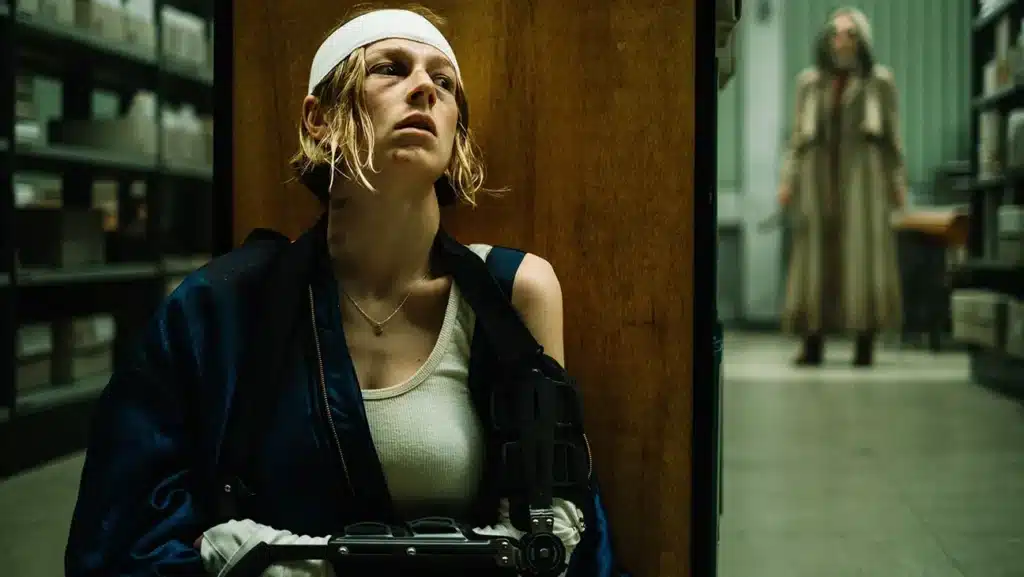
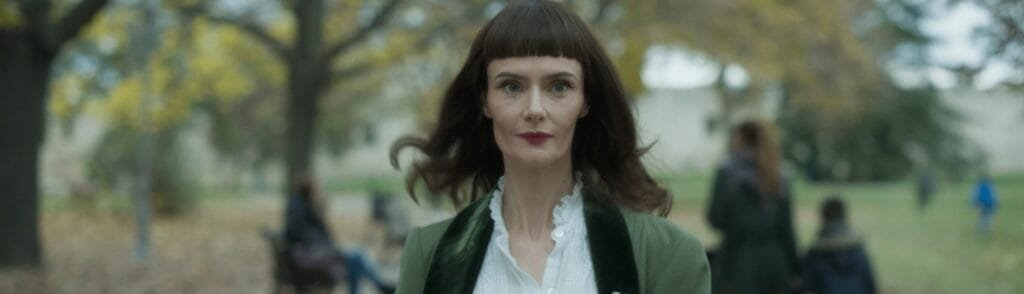
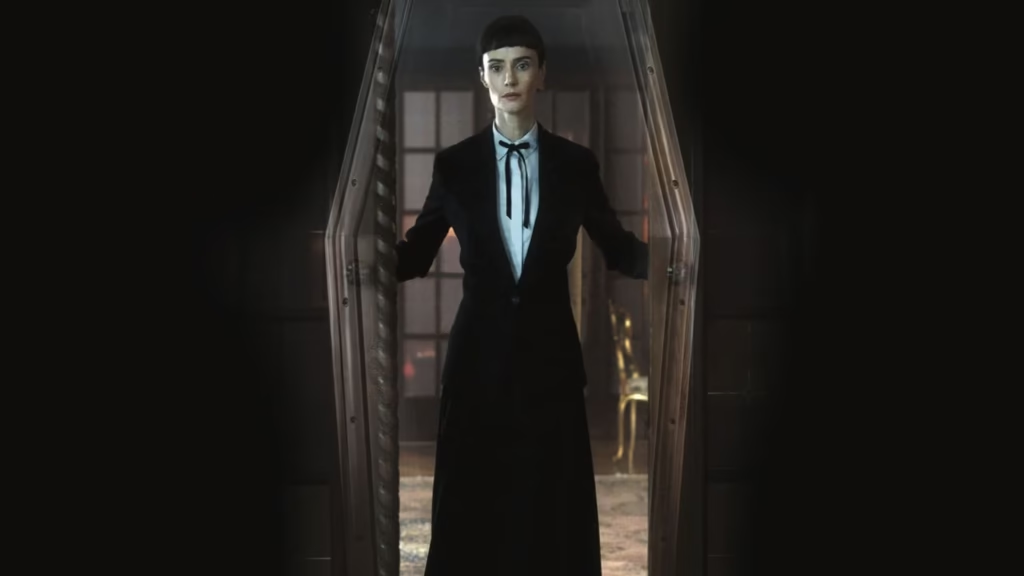
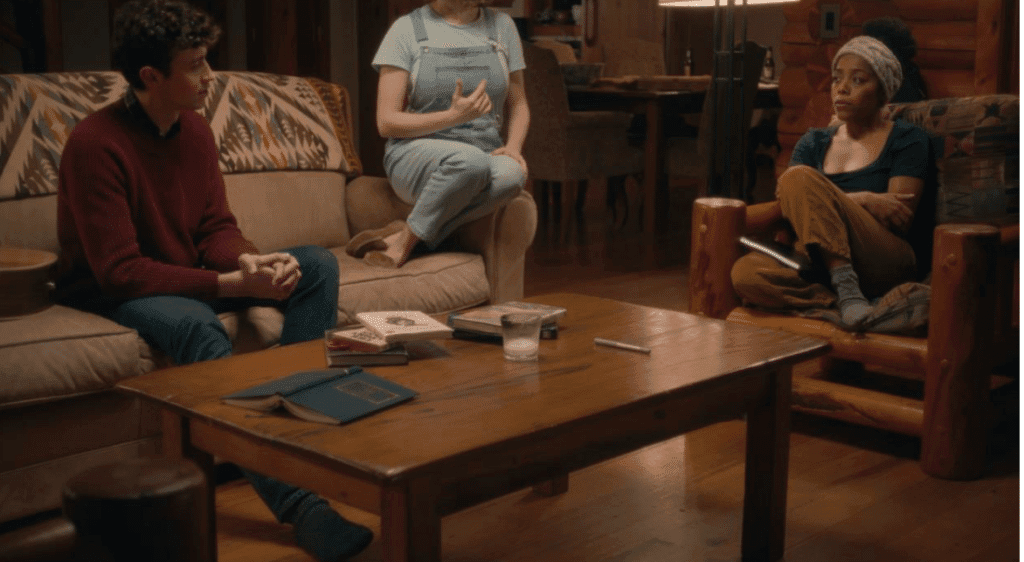
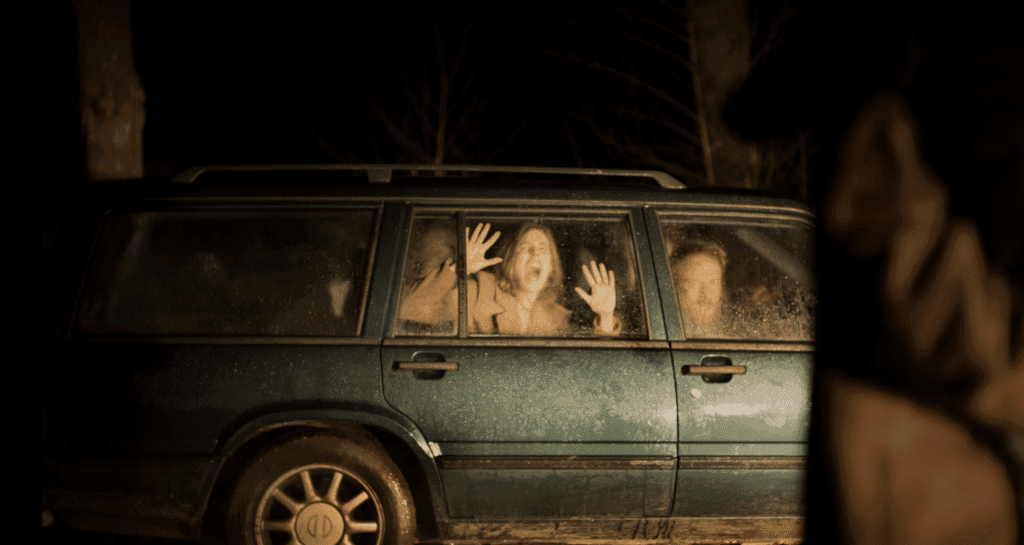
You’d better get used to the discordant screeching soundtrack to Cuckoo (2024), because it starts early and man, it keeps on going. It accompanies the opening scenes, where we witness a young woman fleeing both a family fight and, it seems, the weird noise in her head which quickly afflicts us, too. As she runs into the night, her disappearance is discussed on the telephone: apparently, the loss of this ‘adolescent’ is bad news (well, yeah) as this will make it tougher to keep the ‘mother’ around, but happily, more adolescents will follow. That’s encouraging, then. It’s fairly heavily signposted that Gretchen (Hunter Schafer) might just be one of the adolescents in question. Gretchen has just arrived at an Alpine resort, a little ahead of her father and his new family. They’re regular visitors, it seems, but this time they have come to the resort to live permanently while dad Luis works on building an extension, and Gretchen – newly arrived from the States – will be living with them. Already, everything feels ‘off’ and oddball. How so? Something about the aesthetics perhaps, or the décor, the macros, the characters – everything here is reaching for Lynchian, but perhaps landing at Osgood Perkins, which makes a lot of sense in this, the hallowed year of Longlegs (2024). Perhaps Perkinsian will one day be a thing.
In amongst all of this, we have a young woman who misses home and struggles to adjust, despite being offered a fairly cushy job by resort owner Herr König (Dan Stevens) to help her settle. It’s a quiet role, if (whilst I’m no expert in running an Alpine resort) it seems unusually beset with vomiting women. Perhaps it’s the altitude. Elsewhere, Gretchen tries to get used to living with her dad’s new wife and daughter, which is made more difficult by the fact that little Alma (Mila Lieu) is non-verbal. Trickier still, Alma’s also apparently affected by the mysterious shrieking noise which troubled the runaway girl at the start of the film. Clearly this little sanctuary in the mountains is not all it seems; even Herr König wants the whole resort locked down by 10pm every night, and distinctly forbids Gretchen from cycling home at the end of her shift, which of course she does anyway. Still, this grants us one of the standout creepy scenes in the entire film, so she was right to do it. A maniacal woman gives chase; as Gretchen starts the committed process of collecting head injuries, it seems no one wants to believe that she got these, directly or indirectly, because of the mystery woman. No one, that is, except for a down-at-heel detective who wants Gretchen’s help to crack a case, once and for all.
There’s very little objective normality here, but even that is only offered up as something to deliberately unspool, particularly when the film begins to toy around with linear time – zipping back and forth by just a few seconds, but making it clear that rules are not respected in this universe. The strong impression is that, if you told director/writer Tilman Singer that his film was bizarre, he’d say, ‘thanks’. It’s very much of that school where everything looks a bit 80s, and all the tech is analogue with the exception of a modern, slimline mobile phone to break the spell (and, oh, a plug on a tape player sent from America with a big CE mark on it). Aside from that, the abundant wood panelling, the furniture, the lighting, even the very brown wardrobe choices – all look very 80s. People didn’t, or don’t always wear bright colours – this film abundantly makes that point. Even the film’s use of code-switching contributes to the film’s ingrained oddness, with German, French and English being used in succession in ways which don’t always make a lot of sense, given who is speaking to whom. Add to this that we’re on the Italian border and have characters using ASL, and it’s a very pan-European, pan-linguistic horror film. That all adds to the film’s layering.
Yet for all that, when stripped down to its basic elements, Cuckoo‘s tale is in many respects a tale as old as time: an unfamiliar place, a remote community with its own schemes, ideas and rules, and a bunch of unwitting outsiders who get trapped there. Add in the idea of remote or absent parents, and a young woman trying to navigate early adulthood bereft of support and love, and voila – this could be any number of horrors. It goes quite heavy on the whole ‘nest’, ‘cuckoo’, ‘nesting instinct’ ideas too, but actually this all leads to a rather unsatisfying final act, and the theme of parenting doesn’t really hold up. If you love a peculiar, if carefully curated atmosphere and can suspend both your disbelief and your need for narrative closure, then it’s possible, or even likely that you’ll love Cuckoo. For this reviewer – and please skip the rest of this sentence, if you want to avoid a very minor spoiler – I couldn’t quite get past the unbelievable amounts of faff taking place, purely to wind up with some offspring. Similar faff in Rosemary’s Baby, as a counterexample, makes sense, because they were literally trying to birth Satan’s child and quite clearly needed to do that in secret. I have no idea why or how the net gain of one or two screeching children in the Alps was worth the clear effort and secrecy it took, or what you could do with them once procured. Does humanity need a tiny number of screeching, fitting children for some unknown reason? Do they need ‘conservation’? Are these better somehow? I have no idea.
That aside, the film does a great deal to craft sensory overload and atmospherics, making particularly good use of soundscape, and could be enjoyed as a purely immersive experience, even if the plot dwindles away to something rather meagre. Despite feeling a little personally underwhelmed by the end of the film’s 100 minutes, I still enjoyed this experience more than Cuckoo’s NEON cousin, Longlegs, which chronically underdelivered; Cuckoo has issues, sure, but more charm overall, and kudos to Hunter Schafer for doing nearly the whole thing with a massive bandage on her head, Basil Fawlty style; it’s nice when glamour goes out of the window for a bit.
Well, here we are again. As Warped Perspective is about to enter its tenth year – and that coming off the back of the old Brutal as Hell days, too – I’ve racked up quite a few editions of these Top Tens, and every year I search for some kind of summative comment to make about the year that’s just departing. To start with, 2024 has been a very good year for cinema. Along the way, it has seen perhaps a surprising number of sequels and prequels which seemed unlikely to ever appear; the fact that both Beetlejuice Beetlejuice and Furiosa made it to our screens this year is pleasantly surprising, and the arrival of a Gladiator sequel (arguably a kind of remake) is another generally pleasant surprise, even if only one of those films makes it onto this particular list. If we’re thinking about bigger trends and signifiers, then the Beetlejuice sequel, whilst perfectly enjoyable, didn’t really need to happen: it’s just further evidence that nostalgia is now such a key driver in bigger budget decision-making of late, something maybe amplified by the post-Covid years. Speaking of Covid – was that really five years ago? – the independent film scene has probably, finally got through its slew of titles ‘made during Covid with a skeleton crew and cast’, which nearly always relied quite heavily on some kind of space/time disruption, handily accounting for the lack of people or any measurable sense of normality. Unfortunately, this has now matured into a burgeoning subgenre of space/time-themed sci-fi and horror, much of which is very thin gruel, using the notion of quantum physics to bypass cogent screenwriting in favour of an ‘anything goes’ approach, which almost never makes for a decent film. So…no more time travel please – unless you’re Moorhead and Benson, where it is still allowed. Thanks.
Elsewhere, newer obsessions and developments have been turned to much greater effect, particularly (and inevitably) around the impact of technology and AI on our lives. Several titles taking technology as a theme are represented on this list. It’s also been great to note some fantastic examples of body horror, particularly where the female body is specifically concerned – and, just ahead of the much-anticipated Robert Eggers rendition of Nosferatu (which may well have been on this list, were it not for the fact that UK audiences have to wait until New Year’s Day 2025) that someone has made vampires good and repellent again. A title doing just this takes its place amongst an array of other monstrous projects, as well as a couple of films where concealing the dead turns out to be a pivotal plot point. In a nutshell then: AI and modern technology can be pivotal alienating factors, bodily breakdown is back, bloodsuckers are virulent parasites – and death is not the end, even if this is because someone decides it isn’t.
Let’s get on with it, then.
10: The Dead Thing
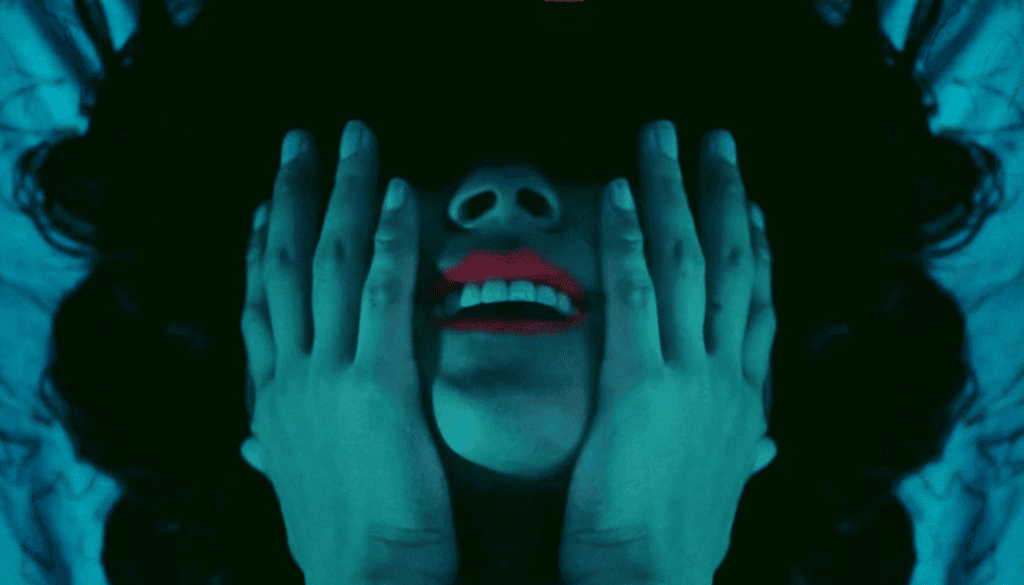
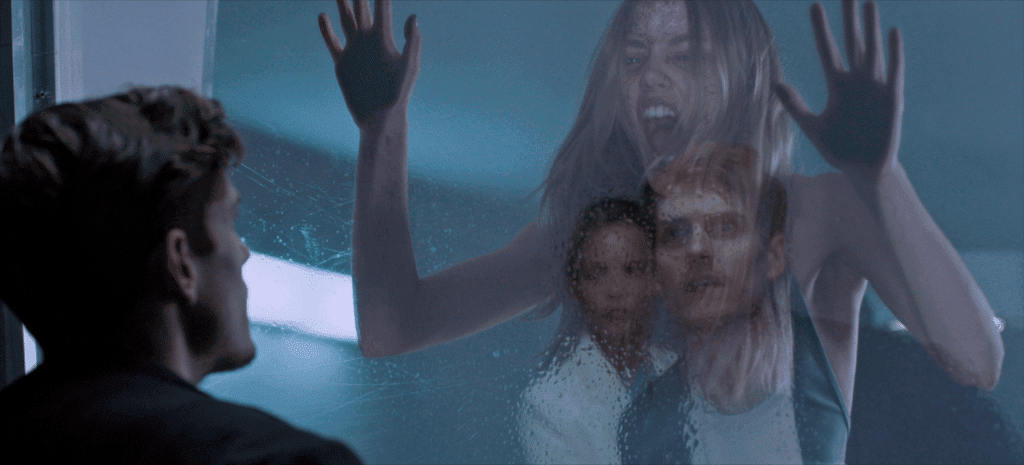
One of a number of titles I covered for the consistently great Fantasia Film Festival in Canada, The Dead Thing is an unseemly, uncomfortable blend of anxieties over modern technologies and a much more established terror of the supernatural. Hook-up addict Alex (Blu Hunt) passes her evenings on Tinder (or a mirror-image equivalent) and bed-hops to get away from a larger, recognisable existential crisis. When she’s ghosted by the one guy she actually feels a connection with, it disrupts something in her, she’s emotionally affected enough to try to track him down; after seeing him on a date with someone else, but also after being handed a funeral notice for Kyle when she tries to find him at his workplace, she is confused and intrigued enough to (shock) uninstall and reinstall the app, at which point she gets another match with Kyle. Kyle, the same nice guy, who seemingly can’t remember her at all. Is he alive and in hiding? Dead and a ghost in the machine? Playing with her? This tentative existential modern horror has plenty within it to get a hold on its audience, feeling both bang up to date and also part of a grand tradition of supernatural tales which co-opt elements of modern life to land their scares. You can check out my full review here.
9: Cara
Cara doesn’t spend much time dallying with redemption; what it does suggest is redemptive is reframed as being part of the same, sordid, exploitative puzzle we’ve seen throughout the film and as such, it is emphatically not a film for everyone. It’s unpleasant. It’s unkind. Its well-meaning characters become monsters in the imagination of the titular heroine Cara (Elle O’Hara), and/or they meet a miserable end, and/or they were never really there (perhaps). Such is the way of things when your film follows a young woman with a legacy of abuse and mistreatment, reaching adulthood only to succumb to profound mental illness, whilst trying to eke out an existence beyond the walls of the secure hospital. This existence pushes her into the fringes of the sex industry, which would be a tough break for even the most balanced person, and – well. Cara is already on a very slippery slope before we even encounter her and what we observe is her obsessive pursuit of freedom from all those who have, stood by or worse, contributed to her ordeal. Warped Perspective wrote one of the very first reviews for this title, by the by, and we even get a mention on the end credits: here’s a link to the review, and watch out for a wider release of this film in 2025.
8: Tiger Stripes
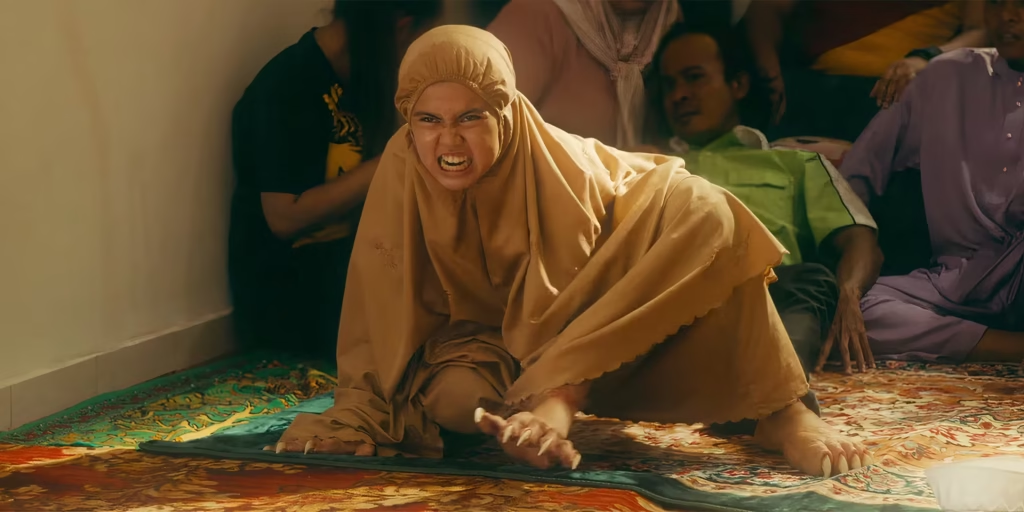
I haven’t seen very many Malay horror films, so Tiger Stripes was a pleasant surprise with its tale of a young girl reaching adolescence, with all of the attendant horrors of bodily changes, particularly menstruation – which is still seen as ‘unclean’ in Malay society, but let’s not feel too superior about this, as it’s only in 2025 that I’ve ever heard the word ‘blood’ in an advert for period products. Menstruation is only the start, however. Zaffan, the girl in question, isn’t simply getting used to blood and new issues around cleanliness: her period has arrived with other bodily changes, some of which seem to grant her… superhuman abilities. Hey, if she’s going to be excluded from old friendship groups and activities, she may as well get something out of it. But equally, if she’s now seen as ‘unclean’ simply for menstruating, then how is a small, religiously-devout community going to take to these other, rather more extreme changes? A smart, well-paced film with plausible family and friend relationships, a gleeful sense of humour and a great lens with which to examine attitudes to the female body, Tiger Stripes is well worth a watch. Here’s a link to my full review.
7: Furiosa: A Mad Max Saga
That we even got another film in the Mad Max pantheon from George Miller is a marvellous thing; hey, we may yet get more. But if he ends on Furiosa, with its stellar cast, strong visuals, fantastic high action scenes and sustained storytelling, then it’ll be a great place to part company. If some of the CGI is a little eye-twitch-inducing – to acknowledge a few minor faults – then for the most part it blends well into the film’s gritty, colourful aesthetic. Best of all, though, is getting to spend more time with the War Boys, drivers, Immortan Joe and his crew – and of course, with the brilliant Dementus (Chris Hemsworth, as an easy-on-the-eye upcoming warlord with a hinted backstory and an emotional life of his own). As I said at the time, the whole film is basically what happens when people get overpromoted and then break the fragile infrastructure which has been built up – just imagine such a thing! Anya Taylor-Joy is remarkably good, too, and if it’s a little annoying that Furiosa got recast by a much younger actor when the likes of De Niro get the whole de-ageing treatment – another minor eye-twitch – then at least Taylor-Joy takes on the role with serious panache, doing it justice. Like its predecessor Fury Road, it’s a simply enough yarn, but done very well. My full review is here.
6: Black Eyed Susan
Surprise, surprise, it’s another title which I feel I need to say is ‘not for everyone’. Given that nothing is ever ‘for everyone’, what I really mean is that Black Eyed Susan is, like Cara, an intentional and unpleasant study of humanity, frequently at its worst, but always complicated, with its moral lines placed under a microscope. But there’s more: here, notions of consent, sex, violence and modern life are refocused by the film’s use of a key plot point, a brand-new, trainable sex doll. Nicknamed Black Eyed Susan by the crew working on ‘her’, Susan is designed to act as a pressure valve for stressed, frustrated men who want to hurt the women they’re intimate with – the doll’s creator expresses this as if it’s just a truism. Writing all of this in light of the recent Dominique Pelicot case and his mass facilitation of rape, it all feels even more sordid and unpalatable even than it did, but clearly the morals being eroded in the film are all too often being eroded in the real world, out there, often just out of sight. Susan’s original trainer takes his own life – why, you might wonder? – so step up, lonely but otherwise all-too normal Derek (Damian Maffei) who agrees to the job because he is at his lowest ebb, financially, socially and emotionally. But he doesn’t want to hit and hurt the realistic doll, and doesn’t seem to care that she can develop a strikingly lifelike black eye…so, in response to his far more humane treatment, Susan begins to show revulsion at the idea of violence, too. She wants to be a different sort of companion. Great, right? That should be fine. Well… this intimate. queasy, questioning film is a challenging watch which escalates its questions and its quandaries as it goes. At the heart of all of this is the brave and unflinching performance by Yvonne Emilie Thälker as Susan: few actors could take this on, but she does it superbly. My full review can be found here, and again, be warned: this augmented reality is unpleasant, and the worse for its encroaching proximity.
5: Broken Bird
Whilst it would be nice to move onto this write-up of Broken Bird and note that we actually get some effective female agency here, that wouldn’t quite be true – or straightforwardly true, at least. It’s a tragic story about a woman unable to relate to others normally, or to form relationships in a healthy way. In many respects, the story of Sibyl (Rebecca Calder) subverts expectations: it’s not normally women we see behaving in this way, if you think of colder, more clinical true crime cases and the films about them. But Sibyl has a compelling, horrifying backstory which is only oh-so slowly parcelled out to the audience; along the way, we see her determination to craft the perfect family for herself, in a way. If it takes some time for Sibyl’s story to properly mesh with an accompanying story, that of Emma (Sacharissa Claxton), a policewoman grieving the disappearance of her young son – then it is oh-so worthwhile when it comes. This is a ghastly, richly Gothic story which matches intricate detail against shocking revelation, with a horror denouement which is both shocking and aesthetically brilliant. Tell you what, take a look at my full review to get more of a sense of all of this…
4: The Vourdalak
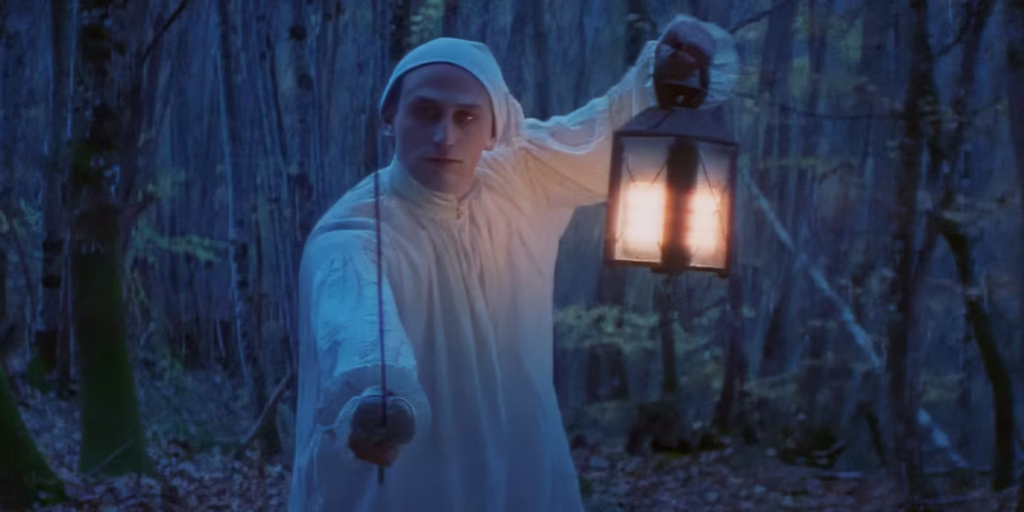
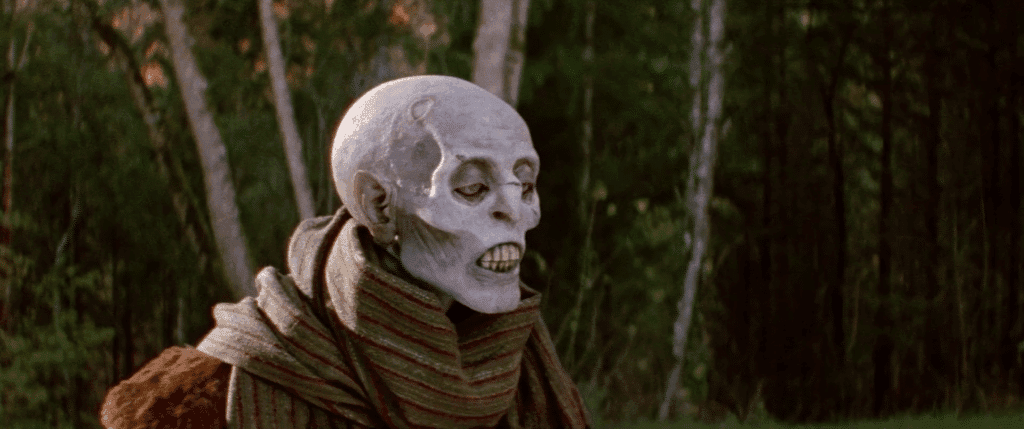
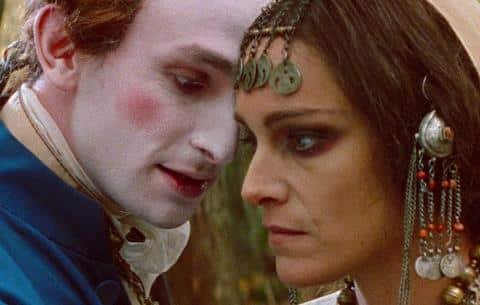
The Vourdalak was an unexpected delight, a period piece which very clearly channels the horror cinema of yesteryear with its lush colours, archetypes, setting, music and script. Then there’s the use of celluloid, of course: the film looks like an unearthed gem, a lost project found intact somewhere after a limited run in the late 70s, which in and of itself makes the film charming and interesting. Based on a 19th Century short story by Anton Chekov, director Adrien Beau (who also co-wrote the film with Hadrien Bouvier) has, however, opted for a much darker spin on this tale which was also used by Mario Bava in his portmanteau classic, Black Sabbath (1963). However, the Beau/Bouvier take on The Family of the Vourdalak renders the revenant father a true monster – realised through puppetry, a marionette which can’t but trigger some kind of visceral reaction. This is only the beginning of a far more fatalistic, gruelling vision of vampirism, too. A sensory, aesthetic triumph and a grim story of contagion and conquest, I liked The Vourdalak enough to write this special feature on it, as well as a more conventional review.
3: Late Night with the Devil
Only in a particularly strong year for film could The Vourdalak ever find itself in fourth place, but 2024 was also the year which brought us the clever, note-perfect charms of faux documentary horror, Late Night with the Devil. What a fantastic, well-researched occult horror: this was another title which had me writing a special feature, this time to explore the many clues, nods and references contained within it. It’s a smart and engaging hyperreal experience, but at its heart it’s a Faustian pact spelled out in a lurid 70s colour palette, with knock-out, entirely fitting performances and a great grasp on the hokum and trends of the era. It’s just that, here, they’re given license to move onto a great ‘what if?’, by considering what might happen if there was an occult force out there, waiting to break through and to grab its side of the bargain.
2: The Coffee Table
I’m still mulling The Coffee Table over. Months after watching it. I think it may be one of the darkest things I have ever seen. Now and again, my mind returns to some element, or some scene in particular; for someone who routinely watches a hell of a lot of films, that in itself is to the film’s credit, but the reason this is still happening is because it is such a momentous, significant, utterly grim experience – and it does it with no splatter, no torture, no ordeal – the chief ordeal here is in one man’s mind, and in how he chooses to carry it, until he can’t carry it any longer. It all starts, as some of the darkest days no doubt do, with the utterly banal – accepting, of course, the simmering discontent in the lives of new, and late-life parents Jesus and Maria. For Maria, this is her dream finally come true. For Jesus, he is miserable; he doesn’t love being a dad, he’s aggrieved by the child’s given name, even, and he feels utterly powerless in his relationship so that, when given the chance at some brief moment of agency, he puts his foot down. Where does he do this? At a furniture store, where he demands a new coffee table for their apartment – a garish, outdated, lumpen item which the shop assistant is suspiciously keen on. Maria thinks it’s hideous, but Jesus’s mind is made up. So he gets his coffee table, though it gets delivered with a part missing. Jesus is left holding the baby while he waits for the part to be dropped off, so he can finish putting it together and – well. Here we part company with the normal. Let’s just say he’s not able to do it very well. I’ll hand over to Darren here, whose review was initially going to be one single word: ‘fuck’. If you’ve see The Coffee Table, you can only nod sagely at this.
1: The Substance
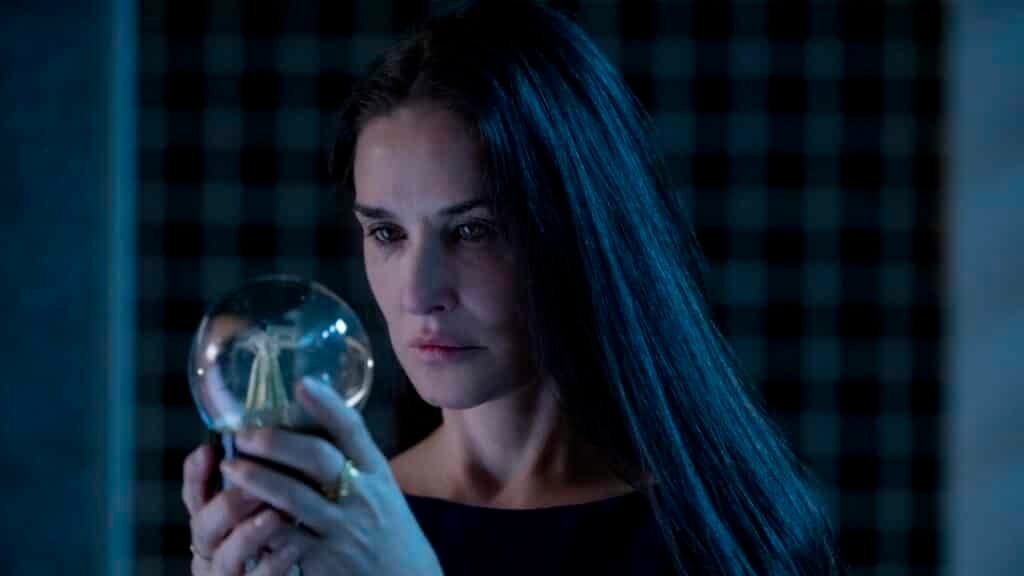
2024, without a shadow of a doubt, is the year of The Substance. There’s now a meme which says, ‘Please don’t make The Substance your entire thing’. Too late, of course; you can even buy the yellow coat, if you like. Coming out of left-field with a huge Hollywood star being given the full body horror treatment, it was always going to make a huge impact – particularly, might I add, on regular audiences, who probably just wanted to see the new Demi Moore film and got treated to something unlike anything else they had ever experienced before. For all those audiences who’d never heard of Brian Yuzna, god bless ’em and you’re welcome.
But what a fun, clever film, riffing on the horrors of ageing and a culture which derides any woman over the age of, ooh, fortysomething, which is interesting, as director Coralie Fargeat is at that age herself, as almost certainly are many of the film’s biggest fans, myself included. The film follows a relatable start point with an increasingly outrageous, fantastical conclusion which never feels entirely untethered from very real feelings and situations. It captures not just the entitled brat behaviour of an industry and of men who can never seem to turn that critical eye on their own ageing physiques, but also on how women will quite readily fuck each other over, too: Elisabeth and Sue, despite being ‘one’, never behave towards one another like there’s some inviolable sisterhood between them. Their whole relationship turns into one of ‘divide and conquer’, with increasingly grisly results. Maybe this, too, is ‘the patriarchy’, but it’s never a film of feminine passivity, at least. It’s icky, uproariously funny and well-realised, and a creative force majeure from Fargeat. You can check out my full review of this year’s film of the year here. Now, I need a new coat…
Notable mentions:
Here are some other great films which didn’t quite make the Top Ten, but definitely deserve a mention anyway:
Alien: Romulus. A decent return to a much-beloved universe, which, even if it leaned too heavy on the fan-‘pleasing’ references and toyed with what was plausible within its confines, was still an enjoyable piece of sci-fi, with a phenomenal performance from David Jonsson.
Cold Meat: a potential Xmas movie, perhaps? Sure, if you’re deranged and love human misery. But this surprising, tightly-wrought wintry ordeal horror deserves a lot of love.
Property: A thoughtful, thought-provoking tale of wealth, inequality and people fighting the good fight under extreme duress in rural Brazil. This is a political film, for sure, but one which never lectures anyone, and that in itself is to its great credit. It’s a gripping piece of tragedy.
In Our Blood: another interesting take on a certain stalwart supernatural genre, combined with a mockmentary format which is used very well, handing down surprise after surprise.
MadS: hallelujah, New French Extremity has popped back to deliver a fresh spin on contagion horror. Where have you been all these years? We’ve missed you…
Making good use of its drone shots – as many films do – Oddity (2024) opens on a remote, grand old house in rural Ireland which is being renovated by a woman named Dani (Carolyn Bracken). It’s one of those houses which no one you know ever lives in – all open plan, stone walls, natural light and minimalism (though to be fair, most houses being renovated go through a minimalist phase). Her husband Ted (Gwilym Lee) is a psychiatrist who mostly works the night shift, meaning Dani is doing a lot of this work alone. By the by, all that natural light gives way quite quickly to large expanses of darkness after sundown. So it’s by torch and by lamplight that creepy, unwieldy things start to happen.
In the dark, a man arrives, begging admittance. He tells Dani that he’s just seen someone sneak into the house while she was getting something from her car; it seems he’s ‘professionally familiar’ with her husband, Dr Timmis, which together with his shall we say, rather striking glass eye doesn’t exactly fill a person with confidence, but Dani still finds herself wondering if this stranger is in earnest. We see her open the door – and then we’re back at the psychiatric unit which is clearly so integral to the film, given that a grotesque murder takes place here shortly after we get another good look at the place. It’s not the most forward-thinking mental health facility ever seen: it’s positioned much more closely to some kind of nightmare Victorian asylum, truth be told, right down to the tumbledown cells, the use of restraints, the autopsy wall art…the Channard Institute looks positively modern compared to this.
If this is not enough of an…oddity, then witness our next stop: an antiques shop stuffed with possibly haunted curios, if we’re to believe the proprietor of the shop – Dani’s blind twin sister, Darcy. Ted pops by, to drop off a glass eye which belonged to the man who – ah – apparently murdered Dani on that fateful night, very nearly one year previously. Darcy, a psychic, wants to ‘read’ the item. Given Ted’s strictly rational mindset, it’s strange that he’s been so accommodating, but then he’s an accommodating man: less than a year after his wife’s passing, he already has a new live-in girlfriend. Did Darcy already know about his through her faculty of second sight? It’s unknown, but she certainly seems surprised. They make a loose plan for Darcy to visit the house, seeking some kind of closure for the loss of her twin – and Ted leaves her with the glass eye to ponder.
By just twenty minutes in, Oddity is so packed with Shudder-friendly plot points and elements that it feels positively busy, if not also strangely familiar, with everything filtered through that equally familiar stylish visual flair. That Darcy, who arrives essentially uninvited at the house soon after chatting with Ted, wants to perform a psychic experiment which for some reason involves a man-sized, golem-like heirloom feels unusually normal. Ted’s new girlfriend Yana (Caroline Menton), an unwitting host, has also dug out Dani’s old camera and guess what? It’s heaving with ghostly pictures. But having whisked the audience through a Generation Game-like run of supernatural plot points, the film gears up as a kind of psychic whodunnit, and – it works. Using flashback and recast, Darcy offers alternative explanations for what happened to Dani; creepy glass eye or not, she doesn’t believe that the eye-owner was guilty. She has other ideas…
There are points where you begin to guess at the involvement of other parties: Ted’s cut-glass English RP in amongst the Irish lilts, plus his remarkable ability to hurdle over the impact of his wife’s recent murder differentiate him quite markedly from the others. However, there’s still enough going on here to keep the film engaging and often unsettling. The film trips, traipses and sometimes hurtles through a melee of ideas, points and set pieces with the kind of stylish frenetic activity you’d get in a lot of classic gialli: I kept thinking of Four Flies on Grey Velvet, and Fulci’s Sette note in nero. Same vibe. There’s also a similar kind of push-pull between rationalism and supernaturalism, with cold rationalism often coming off far, far worse, in the grand scheme of things. Oddity turns out to be a pleasing, lean, mean supernatural horror which makes all of its artefacts and ideas count, and you find yourself rooting for all of its moments of bloody comeuppance, even if the camera often looks away and leaves you to it.
2073, despite initial appearances, is not a narrative film. It certainly enjoys playing up to that appearance, though, with its big, dystopian-style movie poster, its big star (Samantha Morton) and its opening scenes, which tease that it is set in 2073 – 37 years after ‘the event’. Don’t be fooled, however. There’s no key ‘event’ revealed, because that would require the kind of clarity and vision bereft this film. A few, thin minutes of this future-set storytelling aside, we’re thrust into an agitated, unfocused documentary about how current world events – pretty much all of them, it feels like – will one day lead us to such a future. It’s a hectoring, unworthy mess without nuance, clarity or focus.
Anyway, let’s gloss over the narrative frame in much the same way that director and writer Asif Kapadia does – which is strange, all told, as when on his game, he’s amazing. He can tell a story; his short film Laika is one of the best I’ve seen in years. Here, however, we meet Morton’s character, living in a sepia-tinged hellscape (actually what’s left of a shopping mall). She’s mute, but this just means she has opportunity, via a voiceover, to speak to us in platitudes. Trips outside are rare – we are shown people in a vast CCTV hub monitoring people for discussing ‘democracy’. Hmm. A little clunky, that. As for Morton’s character, she ekes out an existence by dumpster-diving, which is actually very encouraging: even in a dystopian hellscape, even in a place where we are told there are strict curfews and street militias, people are still putting things in bins. The people of the mall trade in what they can find in said bins, though what they can possibly find to actually do with things like analogue telephones is a puzzler. We’re also briefly told that one of the mall people is ‘AI’, which seems unrelated to anything whatsoever, as he – like most of the extras – is not written as a character, just someone whose eyes briefly glow red.
So far, so predictable. But I would sooner face an eternity traipsing around in the obligatory dust with Morton and her mates in this lackadaisical dystopia than what follows: now, via the simple line, “How did we get here?” we’re apparently about to be told. Well, we’re about to be told a great deal, but you won’t come away with a satisfying answer to the question. The film morphs into a fast-rolling montage of recent world events, with real journalists’ names flashing up on screen as they each take a turn at explaining why everything is wrong and bad. Some of the conflations here are absolutely dizzying. Whilst people in the UK and Europe may well still be angry over the outcome of the Brexit vote, perishingly few of those people would lump it in with Rodrigo Duterte’s desire to execute three million of his own people, but here in the film, they’re handled in the same breath. Remarkable.
Of course, the lion’s share of footage shown belongs to right-wing protests, and not to make light of these whatsoever, but it’s a tried-and-tested, even dangerously partial picture. The point has been made elsewhere that this kind of blinkered approach can be harmful in its own right, but why attempt to bring reason to this bonkers, simplistic collage? Just at the point that fatigue kicks in, we’re whizzed back into the future and back into the narrative bit, which by now is positioned as the likely outcome of the many, varied issues which will be placed before us before the credits roll.
So we’ve had Brexit; we also get through facial recognition software, the impact of the War on Terror, Mark Zuckerberg and his techbros, algorithms, Hindu atrocities against Muslims, social media, climate change, Palestine, health data ownership…these bad things will lead to people sleeping in malls, maybe, or definitely, it’s not clear. The date on-screen flings to and fro from 2073 to other, past-tense dates, hopping from past to future to past, flashing up an incessant array of dates, places, names, events, voices, maps. There is no debate. There are only monologues from people Kapadia rather likes. Even when sharing many of the concerns being aired, you will still feel demeaned by this scattergun, querulous ordeal. Add to all of this moments which, breaking through the rickety tension, will have you hollering with laughter (the Malcolm X autobiography in the bin; lines like “The news disappeared – just like grandma”) and it’s fair to say that 2073 has rather missed its mark.
There’s a lot to get angry about in this world, and well-pitched documentaries are a phenomenal tool in expressing this righteous anger; this ain’t it. Perhaps 2073 was just too big a project for Kapadia, or certainly the wrong project, given this is someone whose best-received work has tended to be on individual public figures, rather than the end of the world as we know it. Here, with only the haziest ‘it might not be too late’ sentiment to counter all the footage from the past which otherwise suggests that it is, in fact, too late, the end result only provides a dash of confusion to add to the frustration. This is thin gruel, too random to be a polemic, and too piecemeal to really feel like a successful piece of film, let alone a serviceable dystopia. This is a warning, indeed.
Starting with a lone, bloodied man tormented enough to start pulling his own fingernails out, Itch! (2024) could go in a number of ways, albeit none of them very pleasant. It seems as though the film – with its stark opening titles and heavy cinematic grain – is calling on the nastiest, grisliest of its predecessors. Actually, that turns out to only be true up to a point: this is no simple gore fest, there are no hordes of extras, no gallons upon gallons of blood. Instead, this is a surprisingly intimate horror story which relies as much on inference and clue as it does on overt violence. It’s an interesting, and successful approach.
Back to the man with the fingernail issue – this is Jay (played by director and writer Bari Kang) and even prior to his lowest ebb, life has not been kind to him lately. Bereaved of his wife, lately he divides his time between worrying about his mute, traumatised daughter Olivia and worrying about their evidently rough financial situation. The little girl is having a bad time in school too, it seems, because children’s worst impulses can rival anything the horror genre can come up with. Jay works for his father at the family business in a down-at-heel part of New York, and as much as he values his father’s help and support, he is clearly deeply damaged by life’s recent turns, too. Kang plays Jay very much as a man for whom news of a strange ‘scabies outbreak’ in the city is just another damn weight on his shoulders, and it works well that way. But the issue finds him much more forcefully when a crazed, skin-shredding woman walks into his store; the authorities are called, and they confirm to Jay that this is happening all over town. Something serious is clearly happening, albeit obscured by rumours and hearsay; people have moved straight to wondering who’s responsible instead of pausing to panic over what is actually happening. By the time Jay has been out to collect Olivia from school, things have taken a further turn. Not only is there some strange infection spreading, but the store is being threatened with robbery too; a mismatched group of people soon end up forced to hunker down and wait out whatever hell is breaking loose outside.
No film is faultless and there are a few odd, or less plausible pauses during the more high-action sequences, including around the time it takes to get infected/to reanimate, but that’s often been a bit of a puzzler for films of this kind (and hopefully, given the film’s poster, it’s no great spoiler to discuss these particular plot points). But it’s a minor quibble about a film that is, in most respects, very good indeed. Assuming that some of its elements are intended as homage, it manages a decent balance of homage and creativity, particularly in how it opts for a more psychological approach overall. With a small cast and a small location, the film feels nicely oppressive with the convenience store in a city street operating as a kind of echo of the infamous mall out in suburbia – technically it’s a good place to get trapped in terms of material needs, but you’re trapped nonetheless, and this puts all sorts of pressure on already fraught, frightened people. Likewise, people begin to rely more and more on the modern equivalent of the radio, only now refracted through a mobile phone and topped up with other, newer tech, like CCTV – used sparingly but effectively here, and of course a store in a rough neighborhood would have a camera trained on its front shutters.
Itch! has a less-is-more approach, which works sensibly with its small budget, but also allows the more gruesome moments to really land – because they’re never so frequent that they turn things into a simple us vs. them affair, another ordeal to survive. As such, every encounter with people suffering from ‘the itch’ has extra weight in the narrative, and the fallout from this is well acted by all of the cast. Something else of note here: the sound design is absolutely key in generating the sort of unease which runs throughout the film, giving an impression of all sorts of horrors and other stories unfolding largely unseen outside. It all adds to the paranoia, as does the sense of rising heat and humidity which might make your skin a little itchy at the best of times. You start to watch the characters rather hawkishly…
Itch! offers a sickly, slow burn approach to its subject matter, along the way offering a glimpse of an America which is clearly troubled, but never treated simplistically. Sure, there’s some gorier payoff in here, but really where the film excels is in how its humanity eventually leads to an unbearable and poignant conclusion. It’s a discomfiting, artfully depressing watch with much to recommend it.
Itch! (2024) received its world premiere on Saturday, 7th December 2024.
The horrors of Hollywood keep on giving: last year, this year, no doubt next year, and so on. Skincare (2024) is another film which bases its storyline in the beauty industry, and all in all, it’s an engaging horror-adjacent tale, even if on some levels it struggles to settle on a genre.
We start at almost-the-end, as many films do, taking a gamble on how successfully they can fill in the intervening plot points. A woman, Hope Goldman (Elizabeth Banks) is adjusting her make-up at a mirror as the sound of sirens wails outside; we get the distinct impression they might be there for her. Scoot back two weeks, and we meet her again, about to be interviewed on TV about her brand new beauty range. Hope Goldman Skincare is clearly a labour of love for its founder, after a long and ostensibly successful career as a beautician (she still can’t, or won’t pay her rent). But it’s time to take the next step, and things are looking good – that is, until a competitor opens shop directly opposite Hope’s salon.
Hope goes to investigate Shimmer, which belongs to a man called Angel (Luis Gerardo Méndez), but it’s a passive aggressive introduction which leads to Hope taking back the gift she initially hands over to her new neighbour. She’s rattled, and this could not have come at a worse time for her. The more we get to know about Hope, the more we see that she’s a rather mercenary woman, even if we can forgive her this in such a highly competitive business and location, one which would readily chew her up and spit her out given an opportunity. So when someone starts to try to intimidate Hope with a campaign of brand-wrecking online abuse, it’s genuinely alarming and infuriating, especially as it’s so unimaginatively all about her gender. Of course whoever-it-is is going after her by trying to paint her as a horny, frustrated woman, but doing this by creating false dating profiles for her, deepfaking her and setting her up for some frightening encounters. The obvious suspect is Angel; the timing is just so sketchy. However, honestly, lots of the people around her seem just as sketchy, and surprisingly keen to reveal new, appalling layers to their characters when she comes to them for help. Everything is transactional here.
Hope is tough and wants to fight for her brand and her good name – but she’s still open to help, looking to those around her to fight her corner. As, by this point, you will find yourself doubting everyone in her orbit, this makes the film an often uncomfortable watch, one which has paranoia written right through it. Banks is great throughout, moving from a hard-won sense of superiority to increasingly, and understandably, unhinged behaviour. Her competitive streak wants to blame Angel; there are other potential aggressors, and we see it before she does. Men are getting an intensely bad rap in cinema of late and this film is, on the whole, no different, although its men are not just simplistic monsters (even if some have pretty monstrous traits). Interestingly, the nicer and more reasonable the guy, the worse his treatment. This is, at its core, a rather dark and nasty film, albeit one which feels it can step away from its summative nastiness for a few moments of light relief. There is a dark sense of humour at play here, which not only feels like a big contrast from such a colourful film, but can also jar slightly, given some of the developments we witness. Some of the laughs are uncomfortable. However, there’s no languishing in either the horror or the comedy long enough to really begin to flounder, as the film knows well enough to march things on at a decent and suitable pace, centring Hope, but introducing a solid array of both likeable and unlikeable characters.
Skincare always feels strangely horror-adjacent, which is odd, as there’s no fantasy or supernatural elements here: perhaps part of this is because Banks last collaborated with co-star Nathan Fillion on Slither in 2006, which is much more clearly a horror movie, or perhaps it’s the unflinching close-ups, the glistening red face masks, or the 80s-neo colours. Or – much more likely – it’s because The Substance is casting such a long shadow this year, so that Skincare‘s own use of candy colours, macros and dark-edged femininity feel very familiar, especially given the focus on beauty and celebrity – in the same city, no less. Hope Goldman and Elisabeth Sparkle could be neighbours, and could each do without calling the number on business cards they find in their possession. But Skincare decides against fantasy to instead play out a much nastier, more realistic story of sexual threat and conspiracy.
Given its vivid, almost breezy forward motion at times, its more traumatic content raises some questions. Is this an ordeal? Or a satire on LA life? The net result is a sickly, disconcerting feeling, from a film which does a lot and attempts a lot before we get there, and it may feel too strained for some audiences. It’s brutal. However, for me, it ultimately does what it sets out to do with its backdrop of a weird, aspirational, cutthroat world and a great array of committed performances. There’s more than enough there to like.
The Fix (2024) starts with an advert: there’s apparently a product available which will enable people to ‘breathe the air again’. Uh-oh; so it sounds as though director Kelsey Egan’s interest in environmental sci-fi and horror is still intact, if being given a different level of reach here than in previous films, such as Glasshouse. This air remedy is being marketed by a vast global corporation (there’s always a vast, global corporation) called Aethera, and they can be assured of a market because – in the version of the planet imagined here – 86% of people now live in a ‘red zone’ where the air quality is at its worst, since being polluted by an array of toxins which make people very sick. But it comes at a price. If anyone ever saw the phenomenal short film The 3rd Letter, then the initial world-building here’s very similar, save for the fact that when Grzegorz Jonkajtys made his film, Covid and compulsory mask-wearing was a distant dream. In the world according to The Fix, mask-wearing, filters and prospective cures are the only way to go, if you can’t afford Aethera’s wares.
The girl who was selected for the advert is called Ella, and whilst she enjoys some privileges as a fairly moneyed, sheltered young woman, she’s not totally immune from day to day concerns. Not only is her social circle very limited, but her boyfriend and her best friend are more interested in each other than in her, and what’s more – they have got themselves into a dangerous situation, taking an interest in an underground drugs industry which just might have a panacea for the world’s predicament. Posing as a buyer, boyfriend Troy pockets an experimental serum and makes away with it. This is all evidence that the general population is getting tired of Aethera’s monopoly on wellness, seeking to take matters into their own hands. But as with any untrialled medicine, there are risks, so when an embittered Ella decides to glug down the entire stolen phial when she takes it from her two-timing boyfriend after a confrontation, she unwittingly becomes the test subject. This immediately seems to propel her to keep shedding her clothes, but that’s by the by.
Ella begins to undergo mutations – superhero-style mutations, mutations which strangely don’t do too much to make her look unappealing (an ear falls off, though thankfully under her hairline) but give her a fairly broad spread of new abilities: she develops super strength, can climb up walls and can spit venom (!) Perhaps most pertinently to the planet’s main problem, she also seems able to breathe the air without being reduced to a snivelling, bleeding husk like her fellow citizens, so there’s that. Hey, perhaps this new drug could equip humanity with what it needs to survive – and much more? This possibility is of course anathema to Aethera, who have little truck with the mutations per se, but more of an issue with anyone who might break their monopoly by choosing to distribute the drug for free. Suddenly, everyone wants a piece of Ella.
This isn’t a dreadful idea by any means, but The Fix struggles on several fronts. The first is the big muddle of deja-vu you experience as you watch: it feels simultaneously so similar to a raft of existing titles, but probably works less successfully than most of those, for reasons which we’ll return to. There’s Rabid(either version);MadS; The Titan; New Life; Bite; any film where a key character undergoes isolating, traumatic and barely-understood bodily changes, be these viral or structural, would fit the bill. Being derivative isn’t necessarily the end of a new film, but feeling like a scant retelling of elements which are more consistently fleshed-out in pre-existing films…kinda is.
There are a lot of issues here, but in the main this comes down to Egan’s poorer handling of bigger-picture world-building, with a larger cast, the need for different levels of exposition and issues around the scientific and technological plot points all showing the strain. In the first few minutes of the film alone, it is so crammed with exposition that it tumbles out too quickly; because so much is discussed so fast, it feels like the bigger ideas here are only ever given lip service. Once briefly addressed, these things fall by the wayside. It feels as though it wants to dispense with the clearly limited cast of Glasshouse, but does this by sending out an array of minor characters who are never established enough to matter. Or, in an attempt to give them deeper profundity/to try once again to explore those big concerns, they are given reams of dialogue which feels unconvincing. Sad to say, Aethera head honcho Eric O’Connors (Daniel Sharman) suffers the most at the hands of the script, being positioned as the mouthpiece for, essentially, a nightmare version of Big Pharma, which means parroting sinister opinions and lofty concerns about the planet’s state of play. It’s inconsistent; The Fix has underwritten characters and overwritten ones, issues with pace which sees the film go from full throttle to torpor, and then – it doesn’t know what to do, really, except to follow an increasingly fairy-like Ella around, to see what’s going to happen.
What happens is that the film is clearly gunning for a sequel, even a franchise, which seems, on balance, unlikely. I keep coming back to Glasshouse, as that played more to Egan’s strengths as a director and writer, with its defiantly slow-burn approach, a small cast to get to know, and a drip-drip-drip approach to tension. Microcosm, not macrocosm, seems to be where it’s at for her. But for all that, it’s hard not to warm to Egan’s commitment to her key theme of interest, and that includes the different approaches she’s taken so far, even where some of these are more successful than others. The Fix may be an unlikely candidate for an environmental superhero franchise, all things considered, but Egan is still an interesting and engaging director whose greatest film is probably still ahead of her.
When we think about vampires, our expectations have inevitably been shaped by popular literature, which has in turn – for the last century – also found expression in cinema. In the nineteenth century, popular reading habits created a set of cultural expectations about vampires. The birth of horror fiction, which stemmed in turn from the Gothic novels of the preceding century, came to reflect a taste for a certain, new kind of monster. The likes of Varney the Vampire (~1847), Carmilla (1872) and of course, Dracula (1897) were very popular. These stories often present vampires as effete aristocrats, occupying the highest ranks of society, and using their means and status to literally, maybe eternally, get away with murder. These archetypes also started to appear in film at the turn of the twentieth century, where they have bounced along ever since, often – if not always – displaying similar, recognisable traits.
Given that there is a wholly different branch of tale telling and folklore in Europe which relates to vampirism, the association of ‘vampire’ with ‘nobility’ is quite a rehabilitation. It says a lot, particularly about Western readers in the 1800s, that they were so happy to affiliate class, wealth and power with literal blood-draining, as the titled antagonists of these popular penny dreadfuls and railway novels survive death only to perpetuate the exploitation of the living from beyond the grave. However, this is only a partial picture of the bloodsucker. Other authors working from Eastern European, Greek or Slavic traditions were telling very different stories about what we would class as vampires, although these tales, too, had a nineteenth century print heyday – albeit taking influence from a far older set of oral traditions.
It was A. K. Tolstoy and Alexander Pushkin, two popular Russian authors, who first helped to popularise the idea of the ‘Vourdalak’. Pushkin printed a collection of poetry titled Songs of the Western Slavs in 1835: it contained a poem about a vourdalak. Tolstoy’s novella, The Family of the Vourdalak, was published shortly afterwards in 1839. The folklore behind these was however much older, with folk beliefs about these particular kinds of revenants – often blended together with other ideas of witchcraft and lycanthropy – stemming back centuries.
Vourdalak myths have little in common with our newer notions of suave, moneyed vampires. Instead, vourdalaks are complex symbols of death anxieties, as often felt by the poorest and most powerless. Beliefs about vourdalaks have also been shaped by a host of religious and social ideas, often representing some fearful kind of breakdown in social order. It is in times of struggle that these kinds of myths manifest themselves the most keenly, particularly where disease, famine and war disrupt an ordered response to death, prompting panic and grief. Mass burials, unexpected numbers of deaths and burials on unconsecrated ground all link to ideas about a ‘good death’ and a ‘bad death’, and what could happen when a good death is impossible. To die unconfessed, in Christian tradition, is historically seen as a risk to one’s mortal soul; to be tipped into the ground, any old ground, beyond the good graces of God is a calamity normally reserved only for outlaws and outcasts. What happens to someone if this fate befalls them? This fear has given rise to tales and traditions of vampires and ghouls, condemned to wander, coming back to afflict the living.
Vourdalak myths also reflect a fascinated misunderstanding of the natural decomposition process, which often equates the appearance of things like ‘growing’ nails and teeth, the secretion of bodily fluids from the mouth and the ruddy appearance caused by bloating and lividity as evidence of a recent blood – or flesh – meal. In short, naturally occurring phenomena are recast as supernatural, then given as evidence that the dead are leaving their graves, menacing the living. Extreme circumstances demand extreme solutions: the only efficient way, historically, to deal with a suspected vourdalak is through corpse defilement. Archaeology has been turning up decapitated, pinioned, mutilated bodies for as many centuries as the deeds have been done.
These measures are, to most modern sensibilities, horrific: however, for those people, often from the lowest ranks of society, dealing with shock, bereavement and fear in extraordinary circumstances, it constitutes both a response to the breakdown of order and a reasonably structured means of resetting that order. The repellent idea of a loved one returning from a bad death to spread more harm was enough to drive these practices even into the twentieth century, such as in Greece during the Great Famine of the 1940s – when families took age-old, grisly steps to prevent their unfortunate loved ones from ever returning as vourdalaks, or in Greek, vorvolakas (1).
This brings us to The Vourdalak (2023), a horror film based on the Tolstoy story mentioned above. However, the screenplay – co-written by Hadrien Bouvier and director Adrien Beau – expands on the source text, both reinforcing its singular horrors and granting them a broader, more pessimistic remit. In the film, based during the eighteenth century, an emissary of the French court, Marquis d’Urfé, finds himself stranded deep in Eastern Europe after being robbed, losing his horse. He is taken in by the family of a local man called Gorcha, but the patriarch himself is absent – gone to pursue the pillaging Turks who recently raided the village. Gorcha has however left his family strict instructions: should he return after six days, not to receive him back over the threshold. If he reappears after that time, then it will be as a vourdalak. But when the family finds the old man collapsed close to the house, weak and ailing, they can’t help themselves, although six days have – just – passed by. These dutiful relatives bring him home and try to care for him. As a result, this revenant begins to drink the blood of his family members, spreading vampirism amongst them – all whilst d’Urfé, who has fallen in love with the daughter of the family, Sdenka, tries to find them an escape.
They say that love is blind and it certainly is here. The Vourdalak has many strengths, and amongst these is the strange pleasure of seeing vampirism represented on screen in such a genuinely hideous way. Mario Bava filmed the same story as part of his 1963 film Black Sabbath, though stops short of presenting Boris Karloff in quite the same way as in the 2023 version. The Vourdalak reinvigorates the notion of the vampire as an unnatural parasite, a repellent creature which slithers out of its grave or rises after its death to inflict misery and harm. Gorcha is represented through puppetry in the film, too, which helps to entrench the uncanny impact his scenes have: gaunt, ghastly and fearsome, chewing noisily on his shroud, he’s quite the poster boy for disruption and disease. Little wonder that, alongside war, times of epidemic and plague have often prompted renewed beliefs in vampirism: they share the same ideas of symptoms and transmission. Although Gorcha more closely resembles Count Orlok from Nosferatu (1922) than he does other on-screen bloodsuckers, there’s no pan-European travel, no lording it in high castles and certainly no property acquisition. Gorcha returns to his own village, his own lowly house, and his own family: they are his chosen victims, and it is to them that he passes his infection. Even when they begin to understand that he is a vourdalak, they are afraid or unwilling to disfigure him with a stake through the heart.
Similarly, because his family is so poor, insular and isolated, they are very vulnerable. This allows the revolting creature to get close to each family member, though he starts with the weakest of them all – Vlad, his little grandson, whose ensuing symptoms are immediately described – of course – as an illness. Gorcha is a spiritual, physical, moral and most of all a domestic threat. But what of d’Urfé, an outsider, come from the genteel and modern French court – where he still hopes to return?
D’Urfé is in his own way a victim of his own cultural beliefs and practices. His chivalric impulse to court Sdenka – a young, unmarried, if ‘fallen’ woman – almost condemns him to death in the earliest part of the film, when the woman first tricks him into approaching a cliff edge as he tries to woo her. However, his romantic attraction towards her is at least partly why he remains. The trickster Gorcha certainly understands the visitor’s love for Sdenka, using it ultimately to try to bring d’Urfé into the fold by taking part in the horror cinema tradition of presenting us with a young, beautiful woman – who is in fact anything but. From the very beginning, d’Urfé must go through the uncomfortable process of unlearning some of his cultural attitudes – his rational ideals, his education, his belief in law and order – to fully understand what is happening to the family. This begins very early: when he first encounters the undead Gorcha, he must swallow his revulsion, following the lead of his hosts. Later, when he begins to realise what must be done, he has to grapple with the anger of the family. He is constantly reminded of his outsider status, right up until it is too late, and he cannot resume his old life.
But The Vourdalak does its best work in how it extends the remit of this strange story, moving it beyond the confines of one remote homestead in Eastern Europe. In effect, the usual vampire story arc goes into reverse: the film leaves us with the knowledge that here, it is the peasantry which exploits the gentry. Using what she learns from d’Urfé, Sdenka is able to travel to France, ingratiating herself with a duchess who takes pity on her, writing of her great interest in this vulnerable foreigner. To go back to the run of popular vampire stories which were being written and read in the nineteenth century, this is an interesting idea for how vampirism could first infiltrate a higher social class: rich, leisured, sheltered people would have plenty of opportunity to pass this condition on amongst themselves, once it arrived amongst them. As such, the film provides an intriguing bridging point, as well as offering us an especially gloomy, unredemptive ending. It’s also a link between the folklore and tale-telling of the East and West; to come back to Nosferatu (1922), this film was reportedly based on the experiences of producer Albin Grau, who served in Serbia during the Great War, and once met a local farmer who told him his own father had returned from the dead…
This makes The Vourdalak an engaging update of a long-established, queasy, uneasy death folklore, where revenants emerge from unhallowed ground or hastily-dug trenches to terrorize those once closest to them. It also brings us a strange clash between Western empiricism and Eastern folklore, but one where Eastern folklore breaks out and finally infiltrates an unsuspecting West. And, most of all, it is remarkable in its depiction of a blood-drinking, shroud-slurping, pallid and ungodly living corpse, a cipher for all the plagues and wars which have beset mankind through the centuries, as well as a grim reminder of the hideous aftermath as Gorcha, the vourdalak, spreads his undeath to both family and strangers.
1: Mazower, Mark (1995). Inside Hitler’s Greece: The Experience of Occupation, 1941-44. Yale University Press. p. 41
Glue Trap (2023) opens in medias res, focusing on a sparring couple – Dan (Isaac Jay) and KJ (Brittany Bradford). At first, it seems like they’re in a therapy session; actually, it’s worse. They’re at a dinner party, and the host couple seems very happy, which only underlines their own issues. But some good comes of all the awkwardness – in a film, by the by, which specialises in awkwardness. One of the hosts, Jenn (Caroline Hertz) suggests that Dan and KJ could get away from it all by taking a break at her family’s holiday cabin in the Virginia woods. Presumably not having The Evil Dead or indeed, The Cabin in the Woods as an immediate cultural reference, they agree to give it a try. Next weekend, then: it’s a date.
Vacation, or intervention? It’s hard to say at this early point, but first impressions of the cabin itself are good, even if all the space and natural light aren’t an instant fix. There’s a minor problem – the cabin has mice – and there are glue traps dotted around to try to deal with them, which puts a dent in the atmosphere. What’s the best way to dispatch a trapped animal, after all? Hey, you may also spot a certain kind of symbolism here, too, given the film’s title. The audience can ponder this as they watch two people struggling with the pressure of simply being together, with none of the usual, welcome distractions. But we’re soon ready for something else, a further complicating factor.
We get one. Someone turns up at the cabin: a girl called Eliza (Gloria Bangiola), Jenn’s sister, who had no idea that the family place was in use and has plans to stay there herself. Well, Dan and KJ can’t exactly throw her out, given that the cabin belongs to her family; she stays around, turning the cabin retreat into a distinctly uncomfortable situation, acting a good part as an exuberant stranger very much taking the reins.
Can it get worse than this? Weirder than this? Oh, yes.
There’s a switch is style and tone during Glue Trap which momentarily feels rather abrupt, particularly after the sustained and very sensitive focus on Dan and KJ up to this point, but in hindsight, the shift-around is a brave decision. Nothing detracts from the excellent performances here, in a film with a very small cast which never feels reductive or tried-and-tested. Dan comes off as an earnest, but overgrown kid; KJ, whilst more dynamic than Dan, is way more hung up on their accumulating issues. And then there’s Eliza, a woman so overexcited that it could clearly spill into something more threatening at some point. There’s lots of gentle observational humour here, pithy in places, offering an often uneasy, well-realised look at a relationship in quiet crisis. The film is well-written, and never overwritten. These are all notable positives, particularly where indie film often seems to struggle with well-rounded and soundly-edited scripts.
Glue Trapcould have used something more dynamic to conclude its story, sure, and no doubt many viewers may feel the same way, but in concluding things with the same irreverent narrative approach taken throughout its runtime, the film does maintain its focus on simply being…stuck. By the time the end credits roll, you also realise that there’s lots in here about the modern inability to disconnect, or to live without all the preoccupations which come down to us via social media. The desire for things like belonging have been superseded, to a large extent, by the desire for fame. The likes of TikTok have created a generation of people who only ever see the finished product – the high point at the end of a long process, not the hard graft it takes to get anywhere worth being. Gotta get that mini dopamine hit by any means; gotta be someone worth noticing, and that desire affects the characters here in a range of ways. There are touches of horror here, some of them brutal, but the film is at its strongest when focusing on its personal stories, and it enjoys its greatest successes during the second act, where things could go in a number of different ways. Overall, this film was a pleasant surprise, a well-written and engaging first feature which does many things very well, and has deserved confidence in its selected approach. Nice work.
Glue Trap (2023) hits digital and VOD (US) on December 17th.
Recently remade for English-speaking audiences, we should remember that the original Danish Speak No Evil (2022) – one of my favourite horror films in the year it came out – was and is good enough and ground-breaking enough to even merit a second version. Directed by Christian Tafdrup, he escalates themes which have appeared in his other work – idealism, fantasy, family relations, masked identities – allowing them to reach unparalleled heights of horror in Speak No Evil by taking an ordinary, if somewhat fragile Danish family and inflicting a death by a thousand cuts. The film examines what happens when manners and socialisation prevent people from defending themselves, much less absenting themselves from escalating, tense situations.
With the 2024 remake recently thrilling and chilling in UK cinemas, Acorn Media International is pleased to announce that the release of the original is set for its Blu-ray, DVD and digital release on 2 December. And, Warped Perspective has a copy of the Blu-ray to give away, so if you want to be in with a chance, simply email the site with an email titled ‘Speak No Evil’. Your data will be stored until the competition is drawn on November 29th at 5:30PM GMT (UK readers only, sorry) and the lucky winner will be emailed shortly after the competition closes.
And in the meantime, if you ever fall in with a gregarious couple abroad, give them a false number.
Just One Drink may have been made in 2015, but it feels like a film from 2005, not least because its star – Barbara Nedeljakova – is the star of one of the biggest horrors of 2005, namely Hostel. She’s back to her old tricks in filmmaker Andrew de Burgh’s debut short film, which is – depending on your perspective – either a boon, or a shame. If you liked life in 2005 a hell of a lot, then this short film is a love letter to the more ordeal-orientated horror which was breaking out all over the place at that time. If you want more of a nuanced conclusion, or if you feel that the whole ‘tied to things’ motif has had its day, and had probably had its day a decade ago, then this may well affect how feel about this one. In any case, feel free to check it out: it’s available to view on YouTube.
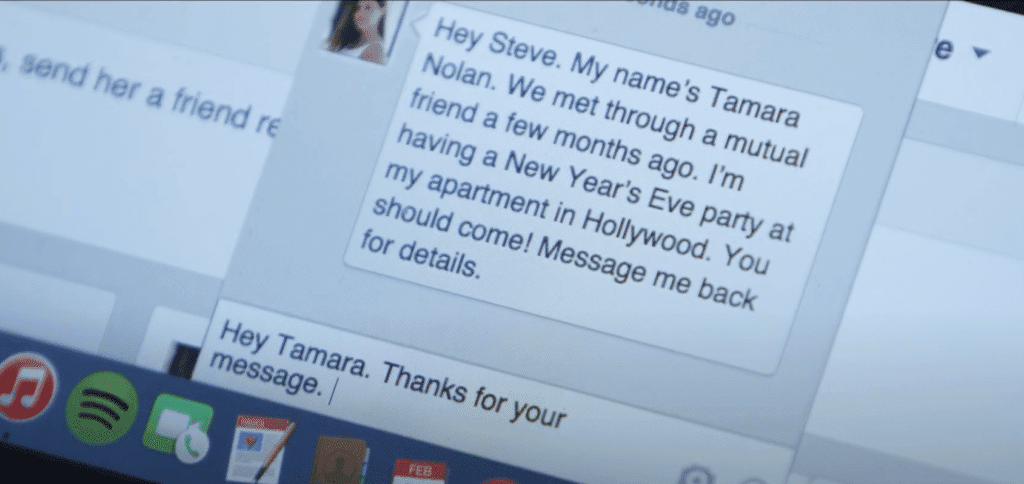
The premise is that a pair of affable stoners called Eric and Steve like to while away the hours discussing strains of cannabis and pondering the evolution of mankind. Steve, however, gets a message from a mysterious and beautiful woman (Nedeljakova) who invites him to a New Year’s Party round at hers. He shares this news with his pal, and they both decide to head over there on the big night because, despite the fact that Steve has no idea who this woman actually is, she’s hot, and that makes the whole idea worth a punt.
When they get there, they’re all alone and, having parked their common sense at the door, they glug down a glass of alcohol each which is spiked with something that causes them to instantaneously lose consciousness. Upon waking – strapped to what looks like a surgical trolley and a chair apiece – it looks like Nedeljakova has plans to dispatch them both in a series of unpleasant ways. Bit of a pity for Eric, who is, sadly, mainly collateral damage; it’s Steve Tamara knows, and Steve she wants to get. But why?
The exposition given is a bit of a big ask as (look away now) it seems that our mild-mannered stoner Steve has been a bit of a brute in the past. His reasons (and look away now if you want to see for yourselves) are that the man in question – the man which links both of our main characters – was a collaborator with Stalin, which – even if we accept that we’re going back ten years at the time of writing – is a bit of a puzzler for the timeline, and the film itself can’t possibly be set any further back, surely – the use of tech points to an early 21st Century timeframe. But the film does at least try for an abrupt volte face and tries to reframe its lead character in an interesting way, and its notion of tit for tat has some potential, even if the pieces in play are a little surprising. There are no especially complex layers here, which is to be expected in a film with a very modest seventeen minute runtime, so it just does what it does, but it’s clear to see the beginnings of a more ambitious writing approach. Really, Just One Drink is an experiment and a calling card, as so many short films are, so see for yourself what you think and, hopefully, appreciate the effort made to recast a lead character in a more ambiguous light.