Sara Paxton. Now, where the hell do I know that name? Sara Paxton, Sara Paxton, Sar…
Oh wait. Oh, BOLLOCKS.
When I realised that the actress from The Innkeepers was also in Static, and that the press release describes her role in Static as that of ‘a hysterical young woman’, I wasn’t exactly filled with joy. Y’see, being a contrary old cuss, I did not enjoy The Innkeepers one bit, and sad to say but Paxton’s nervy, quirky, high-pitched performance was a large factor in that. Frankly, I wanted to push her face in, and she was never described as ‘hysterical’ there. What were we going to get this time, I wondered? Still, I am very glad I gave Static a whirl, because all in all this is an ambitious, well-told story which proves itself capable of a few surprises. Not least of which is an understated performance by Ms. Paxton…
The opening scenes of Static set the scene for what is to follow in terms of tone: this is for the most part a low-key, morose movie, as we’re introduced to a grieving husband and wife, writer Jonathan (Milo Ventimiglia) and Addie (Sarah Shahi). Having lost their beloved son at three years old, they are slowly getting their lives together, but their feelings still all too readily spill over into anger and frustration at one another. However, now that Jonathan’s long-awaited book is complete, Addie looks forward to leaving their country house with all its dismal memories, making a fresh start back in the city.
This is the movies, though. No sooner have they talked about moving on, but in the middle of the following night, a young woman claiming to be a neighbour (Paxton) arrives at their door claiming that there is ‘somebody out there’; a group of men wearing gas-masks, no less. Thinking she must have been spooked by some local kids, Jonathan goes outside to take a look – but, when he sees her car is indeed outside with the tyres deliberately slashed, it seems like she may have been spooked by something a bit more menacing than pranksters. Who has she brought into their lives?
All of that sounds like your common-or-garden home invasion movie, and yeah, there are a lot of common elements, but the chief strength of Static is that it keeps you engaged by turning out to be something quite other than I, at least, expected. For one thing, forget optimism; Static begins with its ending, not dissimilar to 2010’s In Their Sleep (and Static resembles the earlier film aesthetically in several ways, too). You know from the earliest frames that you’ll be journeying towards this point, so all that remains is to watch this play out, knowing all the time that the conclusion exists. Another thing which builds upon this feeling is the point of view afforded to the audience. As we see Paxton’s character Rachel talking individually to Addie and then to Jonathan, we wind up knowing more than each of them, and that is that – all’s not quite right with this young woman. Why are these men after her? Does she know more than she’s saying? Is she even some kind of rabid fan? Unease comes on gradually here, but it sticks.
Static understands that in order for all of this tension to matter, you have to be able to engage with the people under siege, and also that it’s possible to humanise them with a few muted touches. Together, first-time director Todd Levin, the screenplay-writing team and good performances from the lead actors allow this; in good hands, you don’t need acres of exposition to create a couple on-screen who are believably in mourning. Just a sidelong glance at a photo of the deceased little boy or the presence of a small keepsake garners more pathos than any protracted speech; this sense of loss is important for the film throughout, taking on a different significance as the plot proceeds.
And, as things proceed, Static reveals more and more that the force invading the home is somewhere between the earthly and the unearthly. I couldn’t help but think of ‘F’ and its omnipotent hooded figures at some points, as the same sense of awe and doubt also surrounds the invaders in the newer film. The outcome here is rather different, nonetheless: although the film drops in some rather trite tropes (jump-cuts, car trouble) it is at its best when maintaining the much more quiet sense of dread it builds so well, and the conclusion proves an engaging pay-off to that dread, merging earthly/unearthly in a way I didn’t see coming. Is the ending flawless? No, and there are a few ways you could pick it apart if you so wished; personally, I thought it was bold and effective enough to override the urge to do that. When a film can look tried-and-tested, but then it carries you in a different direction altogether, then it deserves credit.
An imaginative blend of genres and visual flair, Static is a real achievement for a first film, and I advise you to go into it spoiler-free to really give it its dues. Oh, and apologies to Sara Paxton. I take it all back!
Static will be released in the UK by Second Sight on 15th July 2013.
It could all have gone so wrong. It would have been oh-so easy for Maniac (2012) to be yet another entrant in a now vast catalogue of shoddy, pointless reboots. The original is beloved of a hardcore of film fans who like their violence sleazy, but I hope it’s fair to say that it’s no world beater as movies go – it has its charms, but it’s no major classic, and upon finding it was to be remade, my only response was to roll my eyes and shrug my shoulders. What a pleasant surprise, then, that Maniac is such a superb, gritty, stylish horror movie, a film which manages to be both very simple and nicely complex.
The plot as written doesn’t seem to deviate much from the original, and it certainly doesn’t sound as if it could give way to anything complex at all, but here it is: Frank (Elijah Wood) is a loner who continues to run the mannequin business owned by his late mother in a suburb of Los Angeles. By day, that is. By night, Frank epitomises just why LA can be such a dangerous place; whether using internet dating, or just tracking down women in his car, he cannot fight his urge to hunt and kill – taking the scalps of his victims as souvenirs. One day, when an artist, Anna (Nora Arnezeder) asks to photograph his mannequins for a project she’s working on, Frank soon finds himself in what appears to be a functional friendship with her. Will Frank be able to maintain this, the only relationship he has in his life, or will his murderous self take over? The answer to that question is played out in an increasingly nightmarish, unrelentingly tense manner.
From the get-go, Maniac pulls no punches, immediately giving the impression of a practised, pathological figure operating on the fringes of the city – watching, waiting, following, not quite of the real world but a threat to it nonetheless. And, from the get-go, I felt very involved with the central character, which is what for me makes this film so successful. This is a film which is prepared to take stylistic gambles and they pay off, every time. For instance, the introduction of the first-person POV which is used for nearly all of the movie, and which is thrown in there as a curveball a few minutes in, has the potential to come off contrived, but it doesn’t. Instead, it does two things very well. Firstly, it makes us, the audience, compliant in what is happening. We’re not just watching what unfolds, we’re one and the same with the perpetrator. At times, this is a genuinely chilling sensation. I cannot say I enjoyed the experience, and no doubt nor was I meant to, but being made to see and do everything that the killer does? It’s a device well used here. Secondly, it allows a particular kind of empathy to spring up. If not filmed from Frank’s perspective, I feel that it would have been more difficult to get a sense of character beyond the killer, and yet when privy to his innermost thoughts, his anguish and his turmoil, additional shades of ambiguity are possible.
Director Franck Khalfoun does extend the perspective of the film beyond Frank’s own view however, as the narrative progresses. He seems to bring to bear on Maniac the kind of ingenuity we saw in Haute Tension; Frank is not left faceless for long, and we see him in photos and reflections – a nicely-used set of visual tricks, which isn’t laid on too heavily, but which does just what it needs to in order to begin to humanise our lead guy. Of course, this could all have come apart at the seams without a powerful lead performance from Elijah Wood. Casting him was a bold move, considering he’s so well-known for that other series of films where he very definitely doesn’t scalp anyone, and taking the part was something of a gamble, but Wood is excellent. His physicality makes him interesting, because he doesn’t come across as some belligerent meat-head but rather as someone who is believably messed up and, in a messed up way, rather frail. Wood does a lot with a little to achieve all of this, and it must have been challenging to enact the role whilst being off-screen for so much of the film. However, he works with this, making every gesture and look count, and I was especially struck by what he does with his stance. The alteration between anxiety and aggression is all in the body language, even when we aren’t hearing him speak.
Another aspect of the film which I enjoyed (and you’ll have to forgive me for all the adulation here, folks) was how the theme of the mannequins played out, and how it contributed to the visual fabric of the film. The mannequins bridge the gap between real and imagined, perfect and imperfect, encapsulating the real push/pull in Frank’s desires. Real women are desirable, but unsafe. Mannequins are perfect, but not real. Lots of scenes neatly conflate living women’s bodies with the mannequins’ own, and then of course Frank literally blends real women’s bodies with them. Towards the conclusion of the film, this becomes increasingly eerie.
Maniac is of course a violent film, but I felt that its emphasis on quality rather than quantity was what made it unnerving – and I did find it unnerving actually, sometimes very much so. The kill scenes are prolonged, for one thing, and held in unflinching focus; there’s no panning away, no allowing us to avert our gaze. It did cross my mind, as I watched, whether I found this at times so disturbing due to being a female viewer, and the jury’s still out on that one, but after all, there have for all of us been moments, I’m sure, when you find yourself having a moment of doubt about the person walking behind you, or the person who strikes up conversation with you, and knowing that, in a worst-case scenario, you’re not physically strong or fast enough to defend yourself. Essentially, you know you’re probably going to come off worse. Maniac is all about the worst-case scenario, and it’s strikingly well-wrought.
Making something sophisticated out of what is ostensibly very straightforward, Maniac is a triumph. Forget it’s a remake. I soon did. This is an accomplished, tense piece of film, and very much its own beast.
It’s always a pleasure to encounter a filmmaker who really ‘gets’ short films, and it seems like we’ve found such a fella in Colin Campbell, two of whose films we’re happy to be able to show you in our latest instalment of Horror in Short. The first, Dollface (2011), takes us a little out of the current season and to Halloween, where husband and wife Emily and Kyle are enjoying a decidedly non-spooky night in, playing a game of chess and chatting. A knock at the door heralds a trick-or-treater, so Nick gets up to go and dish out some candy…
More quirky than the next film we have to show you, Dollface is a lot of fun because it plays out like a modern, urbane fairy story – with none of the grisly or unsettling subject matter excised, of course. From the minute Emily goes in search of Kyle, she’s thrown into a mysterious and labyrinthine space which doesn’t play by the rules of the world outside, and boy does it work well. The interiors look good, are crowded with modern objects, but feel very much apart from the cosy night in which was so oddly interrupted. As for the characters we meet there, they are all ambiguous folk, whilst the neat punchline to this tale adds greater depth to that which has gone before.
Which brings us to the second short film, Girl at the Door, an altogether more visceral little film. If Dollface is a modern spin on the fairy story then Girl at the Door brings sex and drugs to the supernatural tale.
After a night of booze and illicit substances, architect Jake gets lucky, accompanying a very hot and very willing woman back to his place for a night of rough sex (and well done to Campbell for sneaking that sex scene past the Youtube police!) When he wakes in the morning, she’s already hit the road, so he gets back to his work. He’s surprised, however, when she turns up again that night, seemingly as keen as ever – but odd, somehow. What has he got himself into?
This is a film which gets a lot out of eleven minutes, but sticks with a relatively straightforward story, meaning it can balance its lascivious content with an excellent, escalating sense of unease. Absolutely key to this are the performances, especially the lovely Kristen Renton as Sofia. The lines she delivers are repeated, but she does good work at making them mean something else each time, albeit in a subtle way. This means the film feels properly sinister by the time we get our exposition, making this an interesting spin on a supernatural story, as up-to-date as Dollface.
In making everyday situations (well okay, maybe not everyday in the case of the beginning of Girl at the Door, unless you happen to lead a charmed life) become otherworldly, even ghastly, Colin Campbell shows real flair, and I hope to catch up with his other short films in the future. His films are economical, they understand pace and achieve a great deal. This promises plenty of good things.
Often times, the thing that makes or breaks a dystopian horror is its level of plausibility. Could we – honestly – foresee a scenario which at all resembles that which is depicted in our film? Is it all a little too close for comfort? It’s a fine line to walk though; too familiar, too everyday, and that note of alarm won’t be heard. Too improbable, and we won’t engage with it in the manner intended. The Purge, overall, manages to weave an effective dystopian yarn. At times, its plot is too heavily signposted – however, this isn’t enough to overpower a very interesting premise, which for the most part is explored entertainingly on-screen.
We find ourselves in an America which has, by all accounts, overcome some very dark days: economic depression, social breakdown and high levels of crime had blighted the country until the intervention of the so-called New Founding Fathers, who introduced radical social changes, the notion of ‘The Purge’ being one of them. This means that, from 7pm until 7am on one day of the year, all crime – including murder – is completely legal. The success of this policy has been widespread because now, crime is at an all-time low, the economy is strong and society is running as smoothly as a well-oiled machine. People can get all of their hatred and loathing out of their systems in one designated time-slot, and then, exorcised, they can go back to their lives. The Purge works.
The Purge also provides scope for entrepreneurship, satisfying that most fabled element of American life – the American Dream. James Sandin (Ethan Hawke) is a very successful home security system salesman; protecting others (or at least those rich enough to pay) has meant James Sandin is wealthy enough to provide his family with a lavish home in an affluent neighbourhood. We meet the Sandins on the night of The Purge, and together James, wife Mary (Lena Headey), tech-geek son Charlie (Max Burkholder) and inexplicably-Catholic-schoolgirl-uniform-clad daughter Zoey (Adelaide Kane) are preparing to go into lock-down until it’s all over. However, when Charlie, who is ‘too young to understand’ the necessity of Purging, lets a terrified, fleeing man into their home, those hunting him come to reclaim their quarry. Moral dilemmas and mayhem ensue.
I had assumed, upon reading the basic premise for this film and the idea that the whole of America was free to partake in a day of violence, that it would play out as a pursuit through lawless streets, so I was surprised to find instead a home invasion movie (although, with another Purge movie already on its way, it’s certainly possible that the different angle could happen in future.) And, as home invasion movies go, this is actually a pretty good one, despite the fact that The Purge feels the need to oh-so clearly delineate several of its plot markers at the beginning (‘What’s that, son? You’ve built a remote-controlled video camera with night vision?’) and thus comes across as a teeny bit patronising in its initial stages. Once the screenplay feels assured that the audience knows what’s going on, though, it begins to play with some more sophisticated ideas. The briefest of TV bulletins here, a snippet of radio there is enough to set up the premise; at the time of writing, it’s hardly as if we need too much help to imagine a world struggling through economic meltdown and mass social protests, so the film is free to move into its fantasy of what could be done to put things right, without feeling the urge to break down its political meta-message into monosyllables, at least once it feels it has our full attention.
Of course, the idea that human violence can be isolated and compartmentalised into society-friendly outlets is not a new one. The Purge reminds me in a few ways of a science fiction story entitled ‘The Seventh Victim’ by Robert Scheckley; in Scheckley’s imagination, society has permitted those who wish to indulge in violence to sign up to become ‘assassins’; thus murder is legal, but only for those who choose to partake – and they are only allowed to kill other, designated assassins, thus making society safe for everyone else. The Purge mirrors this in several respects, including rendering down the violence itself to something quite minor when compared to the implications of legal murder overall. Although the film has some brief, very bloody interludes, this definitely ain’t The Raid on two storeys. The Purgers who arrive at the Sandin home – part Manson family, part finishing school drop-outs – emanate threat more than they act upon it. The decision to personify one of this group and to turn him into a spokesperson is in some ways an odd idea (why wear a mask you are so happy to remove?) but you can’t deny that Rhys Wakefield in this role has a certain psychopathic charm.
The Purge does have some issues in how it opts to defuse on-screen threats, and at times it settles into a mode whereby you know exactly how we will get from a scene of peril to one of vindication, which is unfortunate, as it is also capable of some effective about-face scenes. All told though, the film may have some questionable elements, but for the way it provides political commentary without preaching and generates tension – even if sometimes by familiar means – it remains a succinct, competent home invasion movie with an intriguing contextual story. It’ll be interesting to see where we go from here, since we already know that we will be going somewhere…
The Purge is in selected UK cinemas now and will be released in the US on 7th June 2013.
Bram Stoker’s Dracula was the direct antecedent of what is arguably the first horror film ever made, and in the best part of a century which has followed, it has remained a particularly fertile source for horror movie makers. By their very nature, the films which have followed have been variable; never, however, did I expect Dracula to manifest as a giant, cuddly CGI owl and make me laugh my gin through my nose. Dario Argento, sir – are you trolling us?
As the years roll on, I find it ever more difficult to accept any version of auteur theory where Dario Argento is concerned; sure, films like Suspiria and Tenebrae are savagely beautiful, innovative pieces of film, and nothing can take them away from us, but in later years – where Argento is ostensibly still in charge of proceedings only with more cash and more freedom – the quality of his output has generally declined. That said, I liked The Stendhal Syndrome a lot more than I expected, so hope sprang eternal that, however unfortunate the teaser trailer for Dracula seemed to be, it would be worth a watch. And I tried to enter into the spirit of things, I really did. It’s not that I simply want Argento to keep making films exactly like Suspiria; I don’t, and nor do I mind when a filmmaker changes their modus operandi – as long as what they go on to do actually works as a film, be it a scary film, or a charming film, or even a ‘so bad it’s good’ film. Sadly, Dario Argento’s Dracula is part Noah’s fucking Ark and part AA meeting, a huddle of slurring or disengaged actors wending their way through a random selection of vampiric beasties, bad fangs and sudden tits.
Sigh. Anyway, here’s the plot. We are, true to the novel, somewhere in the Carpathians; village girl Tania (Miriam Giovanelli) ignores her mother’s advice about locking up for the night and sneaks out for some hot Walpurgisnacht barn action with a married man (tsk!) before suffering an ignominious death by unbelievable owl/Dracula. Cue arrival of one Jonathan Harker (Unax Ugalde) to the village, a man from foreign parts who seems unlikely to understand the quaint local customs they have here, such as a group of men digging up the recently deceased Tania preparatory to staking her, allowing her to escape because they’re crap, and then brawling with one another. Still, Mr. Harker is in town for the happy occasion of starting a new job: he hopes to settle into his role as a librarian at Castle Dracula before wife Mina arrives, and he stops off to see their mutual friend Lucy (Asia Argento) before heading off for his first day.
It is literally minutes before Harker notices that Count Dracula – played by Liam Neeson Look-a-like Competition Winner Thomas Kretschmann – has no reflection. Oh, and Dracula’s ‘niece’ Tania, now a fixture at the castle since outwitting the witless village men, is a bit effing keen. Things go from bad to worse however when he gets ‘the bite’ and by the time Mina arrives in town, Jonathan is missing altogether. Will Mina recover him? Will Mina be safe? AND WHY THE FUCK IS THERE A SIX FOOT PRAYING MANTIS IN THIS?
It’s difficult to know what Argento must have been thinking of here, but possibly this is his attempt to render something akin to a Hammer Dracula film – the location, the costumes – only adding some characteristic profondo rosso into the mix because gore is cool and it always went down well in the Seventies, and then of course adding CGI, which, ahem, brings the film smack bang up to date. In fact, let’s have everything CGI. Want a wall in your film? Sure, you could film a boring fucking actual wall, even a few houses, or you could get them done up on one of them new-fangled computers! It’s the future. I’m not some rabid anti-CGI fangirl, by the way: I think that CGI when it is well-used is fine, but it works best when it conjures up the improbable, not the everyday, or if it must depict the everyday, you should hardly know it’s there. From the opening credits of this film, with the fake village fly-over putting me in mind of Atari ST adventure games from the late Eighties, I was dubious. When I saw that Argento had used real wolves but employed CGI for said village, I began to fear the worst, and I was right to do so. Every instance of CGI used in this film was jarring, pointless and stupid. It didn’t just take me out of the film, it made me want to take the film out of the player.
The CGI was a major player in the film’s laugh-out-loud moments throughout – the spider on its web which makes the Fulci tarantulas in The Beyond look positively believable, the werewolfpire attack, the owl, the mantis…but there are other things which made me laugh just as much, like the ‘You both look so happy!’ comment regarding Jonathan and Mina’s wedding portrait, as they’re there with faces like stone, and – sad to say – nearly all of the performances. Marta Gastini as Mina is one rare flash of competence here, whereas all of the other chief players seem embarrassed or stoned, even the great Rutger Hauer as a late-entrant Van Helsing. The appearance and aesthetic of Dracula is interesting at least, but not fully-developed thanks to unequal screen time and a poor script.
However, the absolute baffler here is what the hell has happened to Asia Argento in recent years. Perhaps her father has simply demanded too much of her during her acting career – he certainly seems to have a predilection for filming his own daughter’s tits which would get him on at least one special register here in the UK, let alone what he put her through in Stendhal – but it’s as if she is slowly atrophying. Her delivery has become…somehow stymied, occasionally even slurring. When she makes efforts to break out of that to enact Serious Things, it’s impossible to believe. It’s a bit of a worry.
Whilst it at least moves at a decent pace and doesn’t add insult to injury by lasting for much more than ninety minutes, it’s seriously difficult to say kind things about this film. Whilst you could get some mileage out of it during a group-viewing (i.e. take a shot every time it looks as if Asia has) it doesn’t go quite far enough to be utterly ludicrous. It has silly creatures but you know they’re not even there, it has a cast which should have been good but they look like they wish they weren’t there, and its cut ‘n’ shut Dracula plot is somewhere in the hinterland between earnestness and aimlessness. Let us hope against hope that this is the lowest ebb; if so, and provided someone hides all the computers from the director, then the only way from here, surely, is up.
Dracula di Dario Argento is available, if you must, from international sellers on Amazon.
What is it that defines the term ‘gentleman’? Without a doubt, it is a term which remains nebulous, and one which has changed throughout its history; you could also make the case that the term itself has lost much of its meaning in the modern day, but perhaps we can still say some things about it with a degree of certainty. Gentlemanly behaviour, I would argue, connotes decency, dignity and deference. A gentleman may have humble origins (the term seems to have lost much of its association with ancestry) but a noble character and actions; a gentleman would almost certainly behave according to a profound sense of propriety, and it is sad that the notion of a man acting according to this sense of propriety is seen by some as archaic, because surely it is anything but. However, whatever one’s social mores might dictate, there is something else I feel I need to add to the definition. The concept of the gent is, in so many ways, an ineffably English phenomenon. Oh, sure, you may find gentlemen in many traditions, cultures and places, but somehow, it seems most intricately bound up with ideas of Englishness – which is yet another concept which some people find easy to castigate in these cautious times.
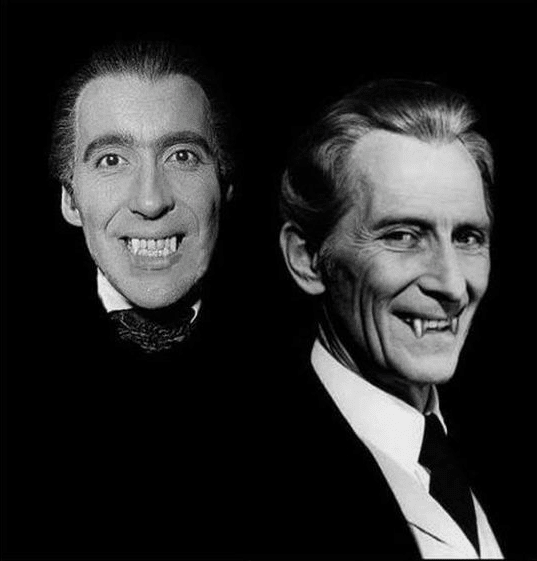
In The Image of the English Gentleman in the Twentieth Century, author Christine Berberich quotes Sir Sidney Waterloo (himself an English gentleman) and his definition of the gent as ‘he who feels himself at ease in the presence of everyone and everything, and who makes everyone and everything feel at ease in his presence’; when I read this definition, I was struck by how much this reminded me of the great Peter Cushing, the man who is for me, the quintessential English gentleman. Cushing is a man about whom I have never heard or read a bad word. Anyone, anywhere who worked with him speaks fondly of him, of his manner and his conduct; and, immediately when I think of Cushing, I think of his dearest friend Christopher Lee, with whom he made a staggering twenty-two films over a period of thirty-five years. If Cushing was the quintessential English gent, then his friendship with Lee would seem to be the quintessential friendship between gentlemen; Cushing the more pacific character to Lee’s breviloquence, but together, a brilliantly-matched, deeply-attached amity.
And it was horror which initially forged this friendship – Hammer Horror, to be precise. Peter Cushing had initially eschewed a career as a surveyor – a dependable, respectable but ultimately unsatisfying job – and had become an actor instead. At this, he enjoyed modest, steadily-building success, appearing in theatre (including Broadway) before at last moving into cinema. Cushing and Lee appeared in the same film together as early as 1948, when they each took a role in Sir Laurence Olivier’s Hamlet, and again in a version of Moulin Rouge in 1952, but they still had not yet met. This was to change in 1957, when each was cast in Hammer’s first full-colour horror film, The Curse of Frankenstein, a film which was successful enough to open the floodgates of Kensington gore and establish a strong horror presence for the Hammer studio which would last well into the 1970s. Christopher Lee, however, was not overly pleased with his first impressions of the film he was about to shoot. Lee’s ambivalence (and sometimes downright dissatisfaction) with Hammer’s modus operandi would continue for as long as he worked with them, but nonetheless, the studio united him for the first time with the actor who would become his ‘dear fellow’.
In his autobiography, Christopher Lee recounts their first meeting, which took place on the set of The Curse of Frankenstein. “Our very first encounter began with me storming into his dressing-room and announcing in petulant tones, ‘I haven’t got any lines!’ He looked up, his mouth twitched, and he said drily, ‘You’re lucky. I’ve read the script.’ It was a typical wry comment. I soon found Peter was the great perfectionist, who learned not only his own lines but everybody else’s as well, but withal had a gentle humour which made it quite impossible for anybody to be pompous in his company.” Their friendship was born. It is ironic that, as their friendship grew, they tended to play on-screen adversaries, most notably of all Van Helsing and Dracula; the end sequence of Horror of Dracula (1958) is for me the ultimate Dracula scene committed to celluloid. Cushing himself reflected upon his role as Van Helsing: “To me, Van Helsing is the essence of good pitted against the essence of evil…I believe that the Dracula films have the same appeal as the old morality plays, with the struggle of good over evil, and good always triumphing in the end.” As Van Helsing looks peaceably through the day-lit, stained-glass windows after dispatching Dracula in what must have been a very physically tough scene to play, you can see what Cushing means when he said, “I suppose in a way it is possible that I was pre-ordained to play Van Helsing. For although I am not a religious man, I do try to live by Christian ethics and I believe in the truth as set forth in the New Testament. I can see so many of the elements of good and evil in life, and this seemed to give me added strength in my screen battles with the powers of darkness.”
However, the loss of Cushing’s beloved wife Helen in 1971 was to cast a pall of sadness over the remnant twenty years of his life; although he continued to work and always performed to the best of his abilities, his heart was never again in his work in the same way, and his friends, Lee included, understood this. It is a matter of great sadness though that what is probably his best-known mainstream role – in Star Wars – was to occur in those years after his greatest enjoyment in his career had passed. Lee was also to work his way into the mainstream, and now in his ninety-first year continues to work at a frenetic pace. Both men always remained in contact; on occasions they celebrated their consecutive birthdays on the 26th and 27th May together, whilst they often exchanged letters and gifts in the interim, with Lee commenting on the “entertaining letters and satirical verses” which he received from him. Yet however much he took pleasure in his friendships, Cushing was always honest about his state of mind following Helen’s demise. “She was my whole life and without her there is no meaning. I am simply killing time, so to speak, until that wonderful day when we are together again.”
And so he waited, and he worked, to fill the time. As another irony of both Cushing’s and Lee’s respective careers, neither of them were fans of the horror genre. Cushing, whilst always characteristically charmed and humbled by the letters he received regarding his horror roles was far more glad of the opportunities which genre film afforded him than he ever was a fan of the end product. In a 1985 interview, he said, “It gives me the most wonderful feeling. These dear people love me so much and want to see me. The astonishing thing is that when I made the “Frankenstein” and “Dracula” movies almost 30 years ago the young audiences who see me now weren’t even born yet. A new generation has grown up with my films. And the original audiences are still able to see me in new pictures. So, as long as these films are made I will have a life in this business – for which I’m eternally grateful.”
As the friends’ careers diverged somewhat, Cushing was to continue working as he battled prostate cancer; it was the illness which was eventually to end his life in 1994 when he was eighty-one years old, after a ten-year battle. Christopher Lee recounts of their last meeting in that year, “There was something a little bit different about Peter, waiting for the end: for twenty-three years since his beloved wife Helen died, his friends realised that he wouldn’t mind packing up on this earth to join her. Vincent [Price] once, in a phone call to me, asked, ‘Is he still expecting Helen to be there to greet him?’ And I said, ‘Looking forward to it.’ And Vincent said, ‘And what if she’s out?’ I said, ‘I shall tell him you said that, Vincent,’ and when I did, Peter laughed fit to dispatch him immediately on his journey. When he’d recovered he said, ‘Only Vincent could say such a thing, and only you could pass it on.'”
Peter Cushing was and is one of the most well-loved and well-known actors of his own generation and of those which have followed. It is also difficult to visualise Cushing – at least for me – without also visualising Christopher Lee. Perhaps the friendship between these two men – and its loss – speaks to us so keenly because it speaks to us of something else above and beyond itself. To return to Christine Berberich, whose book on the phenomenon of the gentleman we looked at at the start of this article, she suggests that the notion of the gentleman is at least partly bound up in the idea of nostalgia, of a past we miss. By looking to men like Cushing, we are looking to the past; in his loss, we see the end of a way of life, we see the demise of a certain value system, or a manner, or simply a way of doing things. But then, of course, we are also affected by the loss of Cushing as an individual, someone whom we did not know personally, but whose evident value system, and manner, and way of doing things we respected enough to mourn. This is not to denigrate the loss of those who did know him personally, however, and it is only fitting that his greatest friend have the final word in this regard. Lee – a man known for his honour and gravitas, but perhaps less for his emotionality, nonetheless had this to say. “At some point of your lives, every one of you will notice that you have in your life one person, one friend whom you love and care for very much. That person is so close to you that you are able to share some things only with him. For example, you can call that friend, and from the very first maniacal laugh or some other joke you will know who is at the other end of that line. We used to do that with him so often. And then when that person is gone, there will be nothing like that in your life ever again”.
But perhaps I might be permitted to add one note of positivity: as much as we mourn the loss of a great actor and a man who does not seem to have an equivalent in these times, we are also celebrating the centenary of Cushing’s birth. We can say that those of us who continue to adore seeing Peter Cushing – and of course Christopher Lee – on our screens have imbued them and their friendship with a particular kind of eternal life, as their warmth, honesty and integrity continue as a pleasure to observe.
Select Bibilography:
Berberich, Christine (2007) The Image of the English Gentleman in Twentieth-Century Literature: Englishness and Nostalgia (Ashgate Books).
Haining, Peter (1987) The Dracula Scrapbook (Chancellor Press).
Lee, Christopher (1977 [1998 edn.]) Tall, Dark and Gruesome (Vista Books).
As a general rule of thumb, I tend to avoid English language versions of J-horrors. Sure, the Far East has provided rich pickings for cautious filmmakers and those who fund them, but almost as soon as Ring happened, Japanese horror became a victim of its own success; no sooner had Sadako become the impromptu ambassador for a subsequent army of creepy kids with flowing locks, but the ubiquity of it all had begun to show, and by the time Hollywood got its greasy mitts on J-horror, horror fans already knew the ropes. It only made colossal cock-ups like Gore Verbinski’s remake feel all the more pointless and jarring. Still, Ring was – is – an excellent horror movie. The Grudge is a ripping yarn too, and in each case the remakes failed to capture the creepiness of the originals. So, then, why would you elect to remake a movie which is at best part of the horde of imitators spawned by the success of those two? This is a question I soon asked myself upon sitting down to watch Apartment 1303, an American spin on the lacklustre 2007 Japanese film of same title and – by and large – plot.
The plot runs thusly, anyway: Janet Slate (Julianne Michelle) has had quite enough of living with her domineering, difficult and frequently drunk mother (Rebecca de Mornay) and her sister Lara (Mischa Barton) for that matter, so when she goes to view an apartment, she likes it so much that she immediately signs a year-long lease. Uh-oh. Immediately, things aren’t right with this place. For starters, there’s a creepy little girl in the foyer (which would surely entitle you to some sort of rebate), the Super is a perv who offers her money off her rent if she will only pay him in kind, and of course there’s a long-haired ghostie in the apartment, though bucking the usual trend by having long fair hair. Things are so bad, that she even thinks about going home to Mom – but this isn’t to be after all, so she heads back to the apartment for a second night with boyfriend Mark (Corey Sevier) for a rather coy, underwear-on sex scene, just prior to being hurled out of the window by said ghostie. Boobs or GTFO, I guess…
Right. So it’s down to Lara to find out what really happened to Janet; she picks up on the subtle clues that this wasn’t an honest-to-goodness suicide by the fact that her dead sister calls her up and invites her over, so over she goes and, with Mark’s assistance, she begins to investigate the circumstances surrounding Room 1303.
Wow, this is messy. The jigsaw puzzle of actors and plot developments just…doesn’t fit together. Whilst some scenes are compelling and nicely-shot, they all seem sandwiched between poorly-acted scenes or plot lines which aren’t fully realised. People’s emotions don’t fit with what they’re experiencing. Motivations are hinted at but not expounded; perhaps director and (re-)writer Michael Taverna assumes we all know how J-horrors play out and why ghosts do what they do, so there’s little point in delineating anything. There is, though. You still have to try. I wasn’t clear on where an entire character went during this film, and after all when someone reads out all the exposition at the fifty-minute mark, it does tend to make the next thirty minutes or so which follow completely redundant. Julianne Michelle takes events rather oddly in her stride until it’s possibly decided that she’s a little too calm, so she then becomes instantly shrill and gets her make-up is smeared all over her face, as nothing declares mental turmoil in a lady like runny mascara. Mischa Barton, one of the big names attached to this project, fares rather better in her low-key, decidedly non-glam role as Lara, but then there isn’t a great deal for her to play around with. There are hints of some grand mental instability in her background, and she acts it out at certain points with not a little flair, but again, not much is made of it. It’s just a neat way of justifying a few things later in the script. As for Rebecca de Mornay, she is oddly compelling in the short time she spends on screen, but the OTT nature of her character edges her way into comedy value on more than one occasion.
Oh, sure, this is an attractive-looking film. I’ll say that for it. In contrast to many of the blue-filtered, washed-out colour palates trendy in horror cinema these days, Apartment 1303 is a vivid, even garishly-coloured movie, with the haunted space of the apartment perhaps the most colourful of all. Many shots have evidently been put together in a considered way (cinematographer Paul M. Sommers deserves a tip of the hat) and the plentiful city vistas used here are very nicely done indeed. It’s a shame, then, that this is a film and not a painting; when not trying to maintain motivation to see this through to the end, this looked great.
Ultimately, though, Apartment 1303 is proof positive that the well, Sadako’s or otherwise, is drying up. It’s also evidence that it’s not enough to ransack Japanese cinema for ghost stories; often, Oriental ghost stories translate badly to Western settings anyway, as we lack the tradition of, say, yūrei – vengeful ghosts being kept from the afterlife – chuck one into Detroit, and it might not make much sense. (Even hanging onto the Oriental-style screens for use in the apartment was pushing it a bit, as these aren’t commonplace in the West, but I guess they are just so handy for the creepy silhouette scenes.) Apartment 1303 is visually accomplished, effective here and there, but ultimately familiarly, fatally flawed. Might be time to leave Japan alone and write some original screenplays then, eh?
Apartment 1303 will be released by Koch Media on 3rd June 2013
Daniel Gates is what you would call a fixer – a man of ways and means, someone who works to acquire rare artefacts for people whose conventional methods have turned up nothing. He does this for a steep fee, of course, but he is good at what he does. When he successfully procures an unusual mirror for a wealthy client, he is given a second assignment thanks to this initial success; he is sent to Scotland, to exchange an ancient magical text for an incredibly rare whisky, but in so doing he is capitulated into a hitherto unknown world, peopled with dangerous entities and immeasurably dark forces…
Intended as the first in an upcoming series of books based around the character of Daniel Gates, The Lucifer Glass is an engaging introduction, with Gates showing the hallmarks of a promisingly solid character. Care is taken to establish him as a fleshed-out creation with a credible inner life, although – bearing in mind that there is much more yet to come in the series – you won’t receive all the answers here. As an example of this, one of his chief motivations in this part of the story is held back until close to the end of the book, and this further builds the impression that the character is intended for the longer game. The Lucifer Glass certainly does enough to encourage a reader to want to stay with the upcoming series; the balance between what it says and what it withholds is confidently-wrought.
The novella format seems exactly right for this tale, ideal for balancing the worldly against the otherworldly. There is a lot of action in the book (perhaps partly due to author Frazer Lee’s other work as a screenwriter and horror director, lots happens which is easy to visualise and follow) but there’s an economy to the writing style which matches well with the overall march of the plot; you can be evocative without requiring hundreds of pages. There’s an abundance of very sensual descriptive language here, by which I mean that all senses are catered for, with smell, touch, taste as important as sight or sound. This can be pleasant – the importance of the feel of cool water, or the scent of whisky, for instance – or it can be hideous, invoked during some deeply visceral scenes which are difficult to forget. I particularly winced at one description of the sensation of walking over scattered teeth…
Alongside these unsettling sequences, however, The Lucifer Glass displays a playfulness, unable to restrain itself from knowing nods towards horror and occult references. For instance, the wealthy client who sends Gates up North goes by the name of Master/Roth…recognise the ol’ demonic presence lurking in that one? There’s also fun to be had with a Crowley reference or two here and there. The mirror motif, though itself only part of the puzzle, is also a familiar one for lovers of occult horror, and I couldn’t help thinking of the Hammer House of Horror ‘Guardian of the Abyss’ episode during the first chapters. Essentially, The Lucifer Glass is aware of its status as part of an occult horror tradition and is open with that, doing plenty in its own right to forge in its own direction, but also wearing its heart on its sleeve.
Confident, collected and entertaining, The Lucifer Glass is a page-turner, and it will be very interesting to see where we go from here. As the first entrant in a new series, it promises great things indeed, and lovers of occult horror should take the chance to support the series from the get-go.
The Lucifer Glass will be released by Samhain Publishing on 4th June 2013
By sheer coincidence, two of the films which I most enjoyed at this year’s Dead By Dawn festival are all about the subject of friendship, and how that friendship endures under, shall we say, a series of unfortunate events. The first of these is of course The Battery, which uses a zombie outbreak to frame its narrative and to drive hell into its two protagonists, with impressive results. There’s nothing so monstrous driving the action in the second buddy-movie-with-a-twist Mon Ami, however; what we have in this instance is the engine of pure human stupidity. We see the machinations of two best friends – Cal (Scott Wallis) and Teddy (Mike Kovac) seeking to improve their lot – and failing, in spectacular, bloody, blackly comedic style. The twist in this buddy movie is pure horror movie, and this comedy of errors wrings its laughs out of some pretty bleak subject matter; I was surprised at just what director Rob Grant was capable of rendering funny at several points during this film and I think this, in and of itself, is something to be applauded.
Mon Ami takes for its central premise the incontestable fact that although humanity is capable of the odd flourish, the odd game-changing spark of innovation, more often than not people’s great ideas are deeply fucking stupid. Cal and Teddy, lifelong friends who work a humdrum job selling hardware at the local store, are probably not best-placed to think up revolutionary ways to improve their lives tenfold, but it doesn’t stop them from having a go anyway, and therein lies their first mistake. To be fair, when not being ground into the dirt at work, Cal has very little else going for him, while his pal Teddy spends his down time being hen-pecked by his wife Liz, who keeps up her constant barrage of checking-up on him via mobile phone (and only appears in the movie during the final act, but boy, does she make up for lost time!) Still, all of Liz’s surveillance has missed its target, as it has failed to stop Cal and Teddy dreaming up the following: if they can kidnap Crystal, their boss’s lovely daughter and also their co-worker, then they can hold her to ransom. Their boss adores his daughter – of course he’ll be all too keen to pay up – and they won’t do anything to hurt her. Why has no one thought of this before? Hallelujah! They get everything ready – they know where to get her, where to keep her, and how to get their cash. They even invest in some masks. They’re good to go.
It essentially all goes wrong from that point where the abstract ‘What if we could?’ turns into a ‘What do we do now?’ – and not in the ways you might be expecting. The farce here is overblown, frequently grisly, and paced absolutely perfectly; Grant does such a good job of layering joke onto joke that, even allowing for the fact that I may have been slightly stir-crazy by this point in the festival thanks to a liquid diet/little sleep/even less daylight, I was helpless with laughter throughout. The barrage is made so effective by the genuine-seeming cluelessness of our lead guys as bad goes to worse. Cal and Teddy are completely unbelievable master-criminals and therefore brilliant as they gape, panic and bicker about their burgeoning situation, just as your average idiot would. And guess what? They’re not the only idiots at work here. As the story progresses they encounter adversaries who are just as dumb as they are. Just the right number of acts form the bedrock of this film; it knows when to move from the sublime to the ridiculous but equally, it knows when to stop.
One of my absolute bug-bears in modern horror movie-making is the over-reliance on torture porn tropes; these have established themselves rapidly and recognisably, they’ve spread like a virus through low-budget, low-brow filmmaking and boy, are they boring. All of that being said, torture tropes now have the potential to serve as a useful benchmark. Essentially, if I can watch a film which features someone being tied to a chair and I still enjoy it, then we have something rather rare to behold. Not only does Mon Ami fit this bill, but it does another thing: it derives a lot of its humour from playing with these tropes. So much of what goes wrong during Cal and Teddy’s escapades relates in some way to using the wrong hardware, shoddy appliances or the untimely arrivals of neighbours. Rather than depicting a regular domestic space which has been turned into a place of inescapable cruelty, Mon Ami has a regular domestic space which just can’t function properly as the den of iniquity Cal and Teddy need it to be, even if just for the short term. It doesn’t work, and if anything they come off worse for even daring to try. We come close to torture porn slapstick at times here – if you can forgive me for using that expression – and it’s absolutely hilarious.
Masses of action, just the right ratio of humorous to gory moments and no significant plot lines left dangling, Mon Ami is a pleasure. It’s a black comedy where one stupid decision is allowed to blossom into a catalogue of chaos, and as a crowd-pleaser it’s difficult to imagine a better movie. Again, here’s a film which will no doubt make it into my top 10 films of this year. Now, no one go getting any stupid ideas…
It isn’t so unusual in cinema which deals with post-apocalyptic scenarios – whether the world has been destroyed by war, or zombies, or war which leads to zombies, or something else entirely – to see human friendships put under extraordinary pressure. As life goes to hell, relationships crumble, lifelong bonds are torn asunder, and cinema is there to explore what this must be like. You know what’s less common, though? A scenario where the world as we know it has come to an end, and the only survivors on screen…basically exasperate each other. They’re not at each other’s throats, they make do with the situation they’re in and they stick together, but boy, is it with gritted teeth. However, in any set-up like this, there’s space for development, and this is a film which delivers that in spades. Ladies and gentlemen, welcome to The Battery – one of the most achingly-funny riffs on the zombie theme that I have ever had the pleasure to see.
Ben (director/writer Jeremy Gardner) and Mickey (Adam Cronheim) didn’t really know each other all that well before the walking dead put a dampener on things; sure, they played baseball together (hence ‘the battery’ – the pitcher and catcher – of the title) but they ‘didn’t really move in the same circles’. All of that has had to change, of course, and now they’re sorta stuck together. Just the two of them, they stay on the road, meandering their way through (refreshingly) rural spaces and never staying put for long. The funny thing is, Benny seems to be enjoying himself. Life has turned into one long summer vacation of camping, fishing and practising his catch. There’s the odd ghoul to dispatch, but out in the boonies it’s no where near as bad as you’d expect to get in a city. Yep, he can handle things as they are pretty well.
Mickey, though, isn’t taking it so well. He wants more out of life, and blocking out what’s going on around him with his headphones (including Benny’s relentless teasing) is only helping so much. So, when he picks up the voices of other survivors on a walkie-talkie he finds, he sees the chance to reach out and he can’t let it go. His wish for human contact sets the two guys on a certain path which puts an end to their long, hot summer vibe.
Let’s get one thing straight: a poorly-written version of this set-up would have sucked. No nice way to say it; it would have sucked. For the most part we have two characters doing all of the talking and occupying pretty much all of the screen time; this is no gore-fest either, with the zombies themselves usually acting as an underlying threat rather than a constant presence (and they certainly don’t fucking run). Without good writing, this would have been incredibly dull; as it stands, some of the best, funniest writing I’ve had the pleasure to experience renders this a truly engaging film. You’re instantly drawn into the world of the lead characters, feeling every atom of their frustrations and amusements as if you’re on the ground with them; this is surely helped by the fact that the two lead actors are also old friends in real life, so the chemistry is already there. This believable relationship allows the film to move into something else it does incredibly well, and that is to make the audience roar with laughter.
Humour in The Battery is sublime – the timing’s impeccable, the jokes all land, it’s subtle (well, mostly, apart from one scene so outrageous that the whole auditorium was in absolute pieces) and observational, having a lot more in common with pre-wanker Kevin Smith movies than (because the reference is always bound to come up somehow) Simon Pegg in terms of the style of the comedy here. That said, this isn’t just a straightforward comedy either, and again because it’s strongly-written, The Battery manages to do other things entirely come the time the credits roll. For one thing, the film makes some bold decisions. There’s a static sequence towards the end of the film where the cameras roll, if I’m remembering right, for eleven minutes; it reminded me of Night of the Living Dead in its claustrophobia, though of course that wasn’t a film where anyone described the groaning of the zombies as ‘soothing…like rain on a tin roof’. Still, I think it works because it adds a sense of ‘this is that people would do in a messed-up situation’, at least until they are absolutely compelled to do something else. And, after the wide open spaces of the rest of the film, this shows the guys coming full circle. I think it works.
So, it’s smart, funny and well-observed, but The Battery is also an unorthodox movie – not just an unorthodox zombie movie, but an unorthodox buddy movie too. It effectively merges the one to make the other; the zombie situation is almost contextual, but it’s the pressure cooker which creates a friendship. These two guys aren’t torn apart, they’re brought together; going from laugh out loud funny to poignant is a rare thing, but The Battery does it. On a shoestring budget ($6000) with a cast and crew of about five people, we find there’s still scope and perspective on the fringes of the zombie genre for brilliant storytelling. It’s not flashy and it’s not especially grisly, but The Battery is beautifully realised and innovative, and it will definitely be on my list of top films for 2013. If you don’t see it, I’m afraid we can’t be friends.
It’s a strange phenomenon when you think of it, but in recent years we have had such a glut of ordeal movies that we now require stronger, more numerous shocks in order that we may maintain interest in the proceedings. Otherwise, all we have is someone being tormented or tortured with very little scope for redress, or redress that, when it comes, doesn’t feel equivalent to all of the outrages perpetrated against the victim. Where is all this going, I wonder? Well, Modus Anomali goes at least part of the way towards developing an interesting overarching structure, providing a more sophisticated than usual justification for the events on screen. The only issue with this is that in some ways, that justification is a little hard to understand.
A man awakens, buried, somewhere in the Indonesian jungle. As if that wasn’t enough to ruin anyone’s day, he also finds himself amnesiac – he can’t remember who he is. Disorientated, frightened, he makes his way to the first dwelling-place he can find, and suddenly things go from bad to worse as he discovers a video camera rigged up and ready to go. The video shows him a woman being murdered, in the house where he now stands. It seems as though someone out there is playing with him, and he has to find out whom. His mobile phone contacts have all been deleted – though impressively and unlike most horror films, he can get a signal! – but he finds a wallet in his pocket and, slowly, he remembers his life. It seems that his children are out there somewhere and he has to find them before his pursuer does.
So far so familiar? We’re not short on people being terrorized in unfamiliar surroundings by apparently omnipotent aggressors, and writer/director Joko Anwar is surely aware of this, so perhaps this is why there’s no preamble and any characterisation we get is as a result of the largely non-verbal performance of Rio Dewanto, who communicates his panic and confusion well. The film kicks into high gear straight away, although in many respects it seems to be a quintessential ordeal horror (do we have quintessential ordeal horrors now? I would say we do). By that, I mean that the plot seems to exist only to maim, torment and antagonise the lead character – although it is considerably more unusual to have a lone male lead, and perhaps there’s something of a cultural difference in the way Anwar is happy to direct Dewanto running away in terror so often – it seems unlikely somehow that a male Western counterpart would be written to behave this way, although it’s the only reasonable reaction. In this, too, Modus Anomali goes that extra way towards striking out on its own and that is commendable.
However, just when you think you have settled into a comfortable viewing mode, the film turns on its head, moving into a second act which calls the first act and all of its events into question. I’ll say this for it – it’s an unexpected series of twists. Now, I do like a movie which makes me think. That is to be welcomed. It’s a fine line to walk though, this temptation to pull the rug from under the audience’s feet; in my case I still feel I want to know that the writer has a very clear and cogent idea of what the fuck just happened, even if I don’t. In Modus Anomali, it seems it all could hinge, after all, on a get out clause which is actually a rather overused trope in horror cinema (and no, thankfully I’m not talking about the ‘it was all a dream’ cop-out.) I said ‘seems’, though. I’m still not exactly sure. Do I feel that all would become clear on a second viewing? Hmm. I’m not exactly sure there either, and that breaks the spell of the achingly-tense build up to an extent.
There is much to applaud in Modus Anomali: I’ve mentioned the central performance, and that when brought into juxtaposition with some gorgeous framing and locations, it works very well. Dewanto is frequently the only thing on screen which is in clear focus, meaning that just as our lead finds his eyes start to play tricks on him, with inanimate objects momentarily looking like human figures, the audience is prey to the same thing. When this has happened to you several times in a few short moments, it goes a long way towards generating the fear and paranoia needed to fully participate in the lead character’s fate.
The lead character…Dewanto…why am I playing coy with naming our lead guy? Quite honestly, because it just doesn’t work. It’s part of the second major issue with Modus Anomali – electing to film it in bloody English. Do you know what the lead character’s name is – an Indonesian actor, mind you? John Evans. Okay, fine, so perhaps he has a Western name, you think. Yet he’s speaking in heavily-accented English, whilst other characters – all supposed to belong to the same family, mind you – variously speak very Americanised English or even seem to have been dubbed into English. It makes it very difficult to believe in the family unit on offer and it took me out of the film’s proceedings at times. I know that Anwar may have had his hand forced on this issue, finding that it’s still difficult to sell the rights to an Indonesian language movie, but frankly, this would have been so much better in the native language. People who shy away from films because of subtitles deserve to be horse-whipped for making things like this happen, seriously.
So, it’s a film with some stylistic and thematic issues, but Modus Anomali does deserve credit for trying to exceed the old torment – more torment – hidden reserves of strength – redemption formula so common to ordeal films of this kind. A movie which falls into two distinct parts, it supplies some food for thought as well as grisly violence; if you like either or both of these features, then you may well enjoy this one.

 The opening scenes of Static set the scene for what is to follow in terms of tone: this is for the most part a low-key, morose movie, as we’re introduced to a grieving husband and wife, writer Jonathan (Milo Ventimiglia) and Addie (Sarah Shahi). Having lost their beloved son at three years old, they are slowly getting their lives together, but their feelings still all too readily spill over into anger and frustration at one another. However, now that Jonathan’s long-awaited book is complete, Addie looks forward to leaving their country house with all its dismal memories, making a fresh start back in the city.