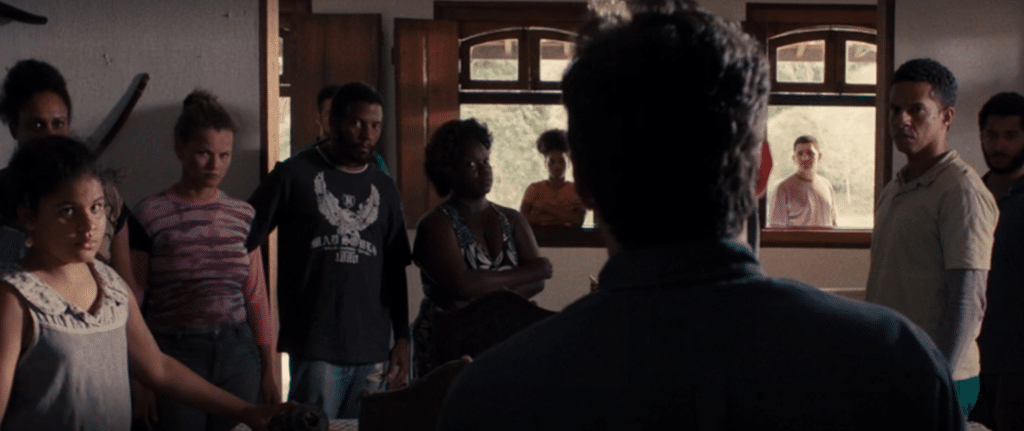
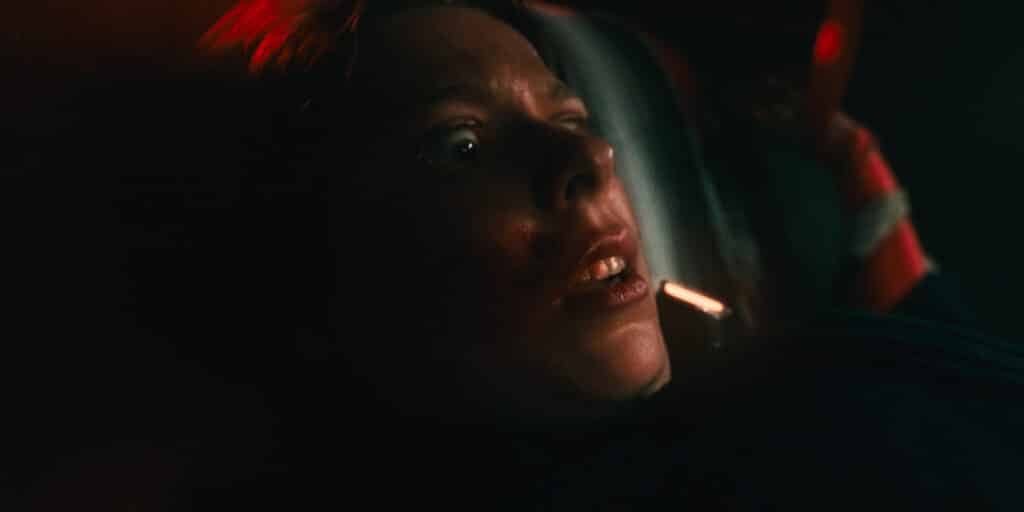
Property (2022) is a film of mighty complexities and great heart, and as such, it outstrips a whole host of films which have tried and failed to sustain a similar balance. If some of its reasoning and momentum dissipate at certain points, then it’s never at the expense of the film’s involving, invoking, grim and meaningful storytelling. It also manages a careful balance throughout, as seen from its opening moments: footage of a man, holding a woman hostage and with a gun to her head, has been demanding “a car”, and fears that the police are holding out on him. He’s correct to worry; the woman, Teresa (Malu Galli) escapes, but the ordeal is not over. So we move from loud to quiet, urban to rural, motion to stillness – a car, a means of travel, is going to unite us with threat and risk again when she is called on to head off somewhere, but at first, the film takes time to show us Teresa’s terrifying nervousness; she can’t bear to even open the door of her idyllic home, doesn’t want to go out, and even when her anxiety blends back into everyday conversation between her and her daughter and husband, we see that all is not well.
Her husband brings us back to what, to him, is a more practical concern: there’s a journey ahead, one they need to take, but he jokingly reassures his wife that she needn’t worry: the car, their new car, has been ‘armoured’. It seems that as a result of her earlier plight, she has become a known face, which can only add to her anxiety – but in any case when she finally gets into the vehicle, she doesn’t seem particularly comforted by the array of mod cons, voice activation and so on. At least, though, there seems to be good reason behind seeking a little more protection: Teresa’s haunted face attests to this. So they’re off, just as the opening credits roll. The journey and the destination (plus the car itself) are the real focus here.
After some time, and a roadside stop which neatly shows us Teresa’s hair-trigger paranoia and unreason, they arrive at a place called Cavalcanti’s Farm. It’s yet another rural idyll: the Robertos seem to have access to a number of them, as money can easily purchase such places – or can it? The farm looks like a regular residence, and given how they treat the place once they get inside, it seems to belong to them too. However, within minutes, it becomes apparent that something is badly wrong here. We quickly shift elsewhere, to moments before, back-filling the narrative: this isn’t just a house, a ‘farm’ in name only, but a real working farm – or, it was.
The resident workers have just received some devastating news: they are about to be displaced, as the land is being sold for development. Dependent upon the farm for an income and a place to live, they are scared and angry, and then lo and behold, here comes the landowner himself. The two timelines are united very cleverly, full of tension, rising questions and – importantly – never at the expense of characterisation. This is no simplistic mob; each person here gets enough delineation, at least initially, to stand apart from one another. When the situation quickly and brutally breaks down, an already tormented Teresa runs from the house and makes it as far as the car – the car which is a mixed blessing, but is at least initially a refuge, which cannot be entered by any of the by turns sad, defiant, pleading or enraged farm workers. But where do we go now?
So much of what unfolds here is multi-layered, deserving of further consideration (and it seems certain the film will get it, given adequate time and exposure). The pernicious, spreading impact of trauma is of vital importance here, starting with clues as to the behaviour of Teresa’s husband – who feels he can just throw money after it and fix it. Money, and its shadow – grave inequality – run through the entire film, with money sometimes giving great preferment and sometimes eroding away to nothing. Films, horror films in particular, have often queried the kind of invincibility which hard cash is culturally believed to confer, pulling it apart in a series of ingenious ways. Property has some overlap with the horror genre, but it’s both simpler and more profound than simply putting someone through the wringer to see what will happen. We are faced with a story of the impoverished rural poor, but not simply a grand reversal of fortune. To quote author Jim Crace in Harvest, another story of the displaced rural poor trying to fight back against circumstance, “dissent is never counted – it is weighed”. Mr Roberto’s rising sense of indignation is worth something here, because he is worth so much: it seems at first as if he is simply going to command his way out of this threatening situation, crowd of aggrieved workers or not. But instead we get a rising and falling battle of wills, more and more centred around Teresa and her unlikely counterpart, farmhand Antonia (Zuleika Ferreira), a woman probably the same age as Teresa, but broken by hard work and grief: each of these women, however, has been alienated by their husbands and their husbands’ decision-making. The result is a horrific situation which neither woman ever wanted.
Based on the film’s blurb, this could easily have been a straightforward invasion horror or a claustrophobic, endurance-style story, but despite having elements of these, it is altogether more expansive and thought-provoking, with context and development. Best of all, the film varies its levels of tension, with moments of poetic parity and gradually dawning moments of realisation throughout; cleverly written and directed by Daniel Bandeira, it is illuminating without – and this is key – lecturing anyone. You invest in these characters and this narrative without ever being cajoled or told what to think, which is a welcome act of trust in the audience. Even with a little more of a growing distance between us and the eventual decision-making which takes place, the film never lets up. Property is an impressively engaging film of extraordinary, lingering power.
Property (2022) will screen at Make Believe Seattle this March (2024). For more details, click here.
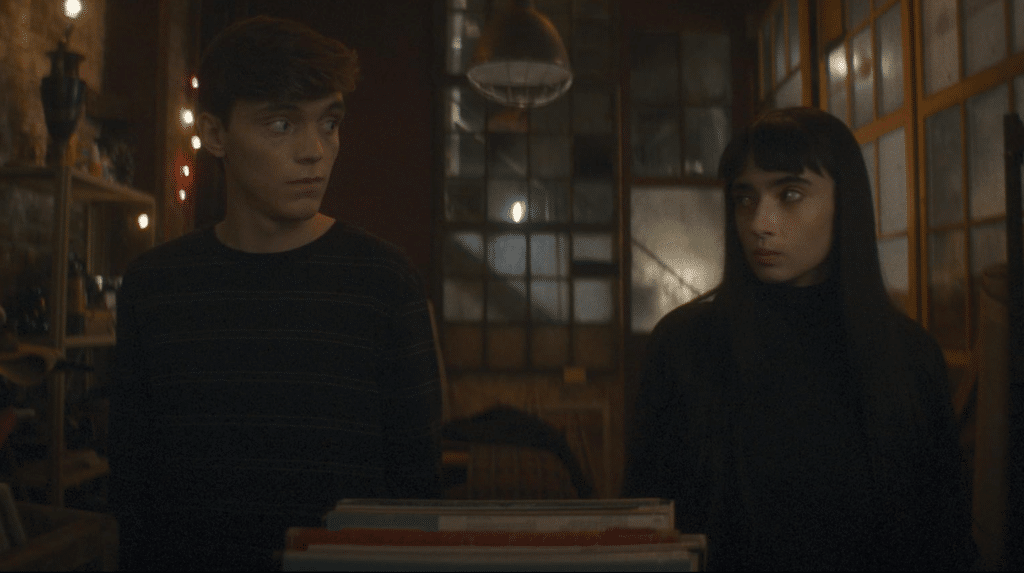
With a rather unwieldy title, Humanist Vampire Seeking Consenting Suicidal Person (Vampire humaniste cherche suicidaire consentant) starts at – a little girl’s birthday party. The little girl, Sasha, surprises her close-knit family group with her innate ability to play the keyboard she’s given as a gift – something which they puzzle over while she plays. But that’s not all: her aunt has also hired a children’s entertainer to come to the house. Come to think of it, there are no other children here, which is a little odd – and as Rico the Clown gets into his stride, the family seems to feel that his act is going on longer than they really needed. Then it becomes clearer: Rico isn’t really here to entertain, he’s here as food. The family are vampires, but little Sasha is new to the whole blood-drinking thing, and this quiet, sensitive child isn’t keen to participate in the main meal. She likes Rico. She doesn’t want to eat him.
This causes a problem for the family, who are seriously worried about what will happen to Sasha: like with any child refusing to eat, they fret about her wellbeing. A sympathetic dentist informs them that her fangs are there, but undescended; apparently her problem is compassion, which is manifesting as a kind of PTSD, stopping her from functioning as a normal vampire. Sasha’s father is all for a patient, child-led approach; the women of the family are more hard-line. Years pass: we next meet Sasha (Sara Montpetit) in what looks like her late teens – allowing for the fact that vampires don’t seem to age in a normal way – and she’s still refusing to kill, opting instead to busk-by-night with her beloved keyboard, eking out a living (and of course, still living at home, where her soft-touch dad enables her murder-free lifestyle by ensuring that there are baggies of blood available to keep her going).
Things begin to change for Sasha when, one night, she spots what looks like it’s about to be a suicide. A young man is poised on the roof of a local bowling alley, but – when he’s found by an ordinarily indifferent, overworked co-worker – agrees to climb down, resuming his dreadful part-time job. It’s enough to drive him to try to end his life again after his shift – something he messes up – and a watching, waiting Sasha finally feels a bit of bloodlust. Her fangs descend. But again, her natural empathy takes over. She’s just no killer, and instead seems drawn to this rather tragic, put-upon fellow traveller. In one last-ditch attempt to bring out the vampire in her, her parents ship her off to live with cool, calm and collected cousin Denise, hoping she’ll learn the ropes at last (they cut off her blood-bag allowance, too). But whatever is going to happen, Paul (Félix-Antoine Bénard) seems to be at the heart of it all. Their paths cross again at a suicidal ideation support group, and gradually, they form a bond, coming up with a plan.
It’s pretty clear from the outset that the film is going to be a meeting of two sensitive outsider souls and a coming-of-age story. Humanist Vampire certainly fulfils this expectation, even whilst feeling either faintly familiar, or very reminiscent of other vampire-adjacent stories. I say vampire-adjacent, because in common with a lot of modern vampire narratives, vampirism itself is two steps removed here, with only limited attention paid to either the grisly nitty-gritty of murderous bloodletting, or to how, exactly, vampirism fits into human society. The whole ‘baggies of blood’ in the fridge idea is reminiscent of bottles of True Blood in – erm – True Blood, a way for vampires to get on with things whilst mitigating the need to kill; the handling of the bullying motif is a little like Let The Right One In; there’s a little of the tragic familial and romantic dynamics of another long title, My Heart Can’t Beat Unless You Tell It To, and – although it contains a different supernatural dynamic – A Ghost Waits.
Humanist Vampire has more subtle flashes of humour than My Heart Can’t Beat, and has outsourced the bulk of even its implied violence, moving it quite literally off-screen, for example, when Denise kills, but the humane, low-key approach is similar. In its attention to characterisation, Humanist Vampire does decide to skip some of the questions it suggests about the whole vampire thing, however: it insinuates a pretty regular family, presumably having children in the normal way, living alongside human society. How it all fits together is omitted, as the film keeps its gaze closely on Sasha and Paul, but its choice to make this a story about independence and finding happiness has a lot of value: it’s engaging without growing obtuse, and sticks with being quirky and humane, rather than gloomy and heavy. Which is a weird thing to say, come to think of it. Whether or not it resembles other storytelling, it’s enjoyable on its own terms, as well as being beautifully shot, lit and colourised.
There are a couple of queries and criticisms: one is its use of snippets of Night of the Living Dead as its go-to horror film during one particular scene: given Romero lost the rights to his film, it always strikes me as a bad look when fellow indie filmmakers exploit the fact that it’s rights-free at the point of use, as surely they’d hate it if something similar happened to their own film. It’s also worth adding – and this is key – that the whole idea of treating suicide and the suicidal as potentially willing vampire fodder will emphatically not work for everyone. But if you can look past this, allowing the film’s generally lighter-touch tone to justify its style and content, then it’s an enjoyable, charming addition to the genre.
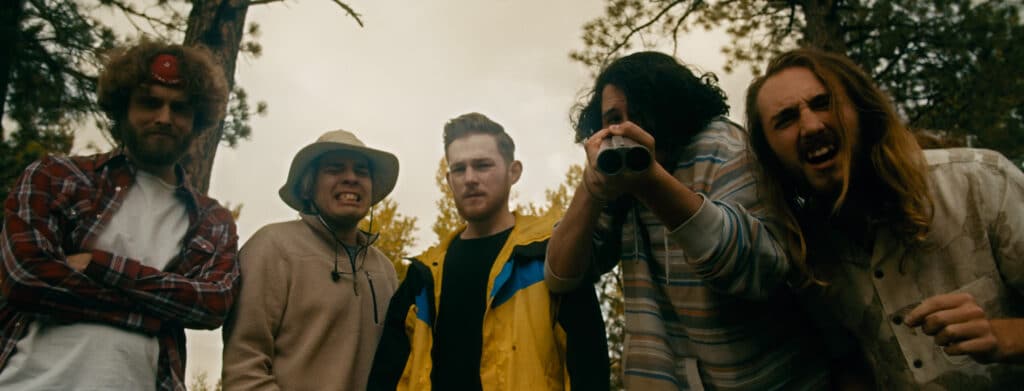
How do you signal to your audience that things are going to head south pretty fast – other than by titling your film A Most Atrocious Thing, that is? Turns out it’s by showing us almost instantly a sign reading Danger! Contaminated Water! Then a deer drinking from this water, before cutting straight to some guys out in the woods for the weekend, hunting deer. So things kick off quickly and move quickly, with the couple of guys we first meet getting separated, ambushed by a rabid-seeming local and then party to copious bloodshed – all in the first few minutes. And it turns out these aren’t even our main guys, but are there to act as a handy shorthand for the horrors which are about to go down in this charming, funny, gory and completely earnest love letter to horror cinema, shot by a group of friends for the very, very modest budget of $5,000. A Most Atrocious Thing is exactly what indie horror cinema should be all about. No pretensions here.
The main subjects of the film are a group of friends hoping for a celebratory weekend away after graduating college. After some car trouble – which only serves to suggest that these aren’t the world’s greatest problem solvers – and allowing for the fact that two of the party haven’t even left home yet, they’re on their way, arriving at the cabin somewhere in Colorado, getting settled in and perhaps getting close to resolving a friendship issue which has been bubbling away for some time, troubling Ben (Ben Oliphint) and Dylan (Dylan DeVol) in particular. We’re also familiarised with one of the film’s key themes, which is altered states: quite a few of the self-titled Homies are big stoners, and it’s hard not to wonder whether the biggest stoner, Will (Will Ammann) will come through relatively unscathed, as they often do in films: we put a lot of stock, as a culture, in the protective magic of not being fully present on this Earth. But hey, you’ll have to watch to see if it holds true here, too. Maybe, maybe not.
What else is pertinent from this initial set-up? Probably the strangely cognisant, red-eyed, crazy looking stag which seems to be watching the Homies from afar. The same stag we’ve already encountered. No reason not to head out hunting, though: the guys bag a deer, and managed to get it dressed and almost, kind-of cooked for dinner. And that’s where the trouble starts.
Not only is this a very grisly film (I guess with a budget of $5000, you’re bound to be sticking mainly with practical FX, but regardless of budget, it works) it’s very funny, poking fun at itself and its key players throughout, though never reducing them wholly to disposable stereotypes: each of the guys has a personality, and through the film’s easy, natural dialogue which clearly reflects the real-life friendships at the heart of the film, it hangs together. There are good comic timing and performances, which feel spontaneous in the sense that these same friends haven’t needed to agonise over every line; they’ve likely scripted it to entertain each other, and because it therefore lacks artificiality, it entertains us too. It’s not highbrow, but it’s solid and, for all that, there are a surprising number of layers to the script which point to a simple enough set of ideas, just done very well and with the confidence of film fans who know the drill. There’s so much else to enthuse over: the film looks great, with a surprising range of shots, all well handled, with good edits, great framing, and an impressive series of quite long takes, too. The team uses a great set with lots of interesting props, adding lots of interesting little details, and even offering up a Singing Billy Bass, something archaeologists will ponder over hundreds of years from now, as a plot point. A Most Atrocious Thing doesn’t need the on-screen chapters – most films don’t – but moments wasted here are rare, especially in a film with a lean runtime of around seventy minutes.
There are of course some nods to other films here, some overt and some less so, but you might spot a few similarities to Cabin Fever here and there, a dash of The Crazies perhaps, and knowing nods to any number of low budget but beloved zombie flicks, but unless any of those films can best this one in a psychedelic vomit montage, then it hardly matters: what’s clear is the knowledge of genre elements and the sheer enjoyment of playing around with them, in doing a film for themselves. Even while feeling familiar, it all feels strangely refreshing. The Homies are always clearly having a good time, and that feels pretty contagious. Evidence that a film can be knowing and self-referential without ever being smug, A Most Atrocious Thing is a winning combination of agreeable characters, comedy and absurd, splattery zombie horror. It’s also a testament to just getting something made, regardless of the obstacles.
A Most Atrocious Thing (2024) screened at this year’s Seattle Make Believe Film Festival.
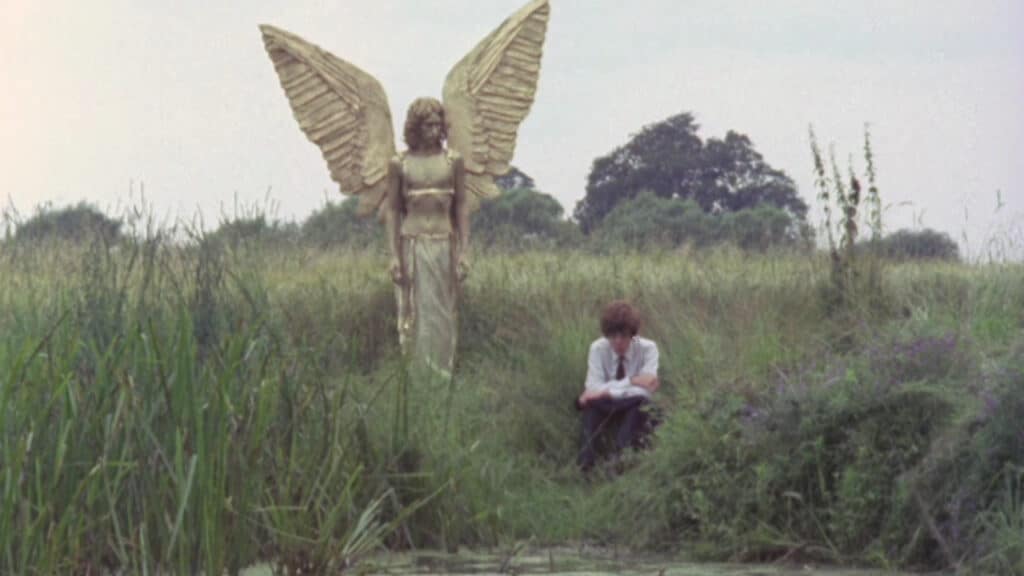
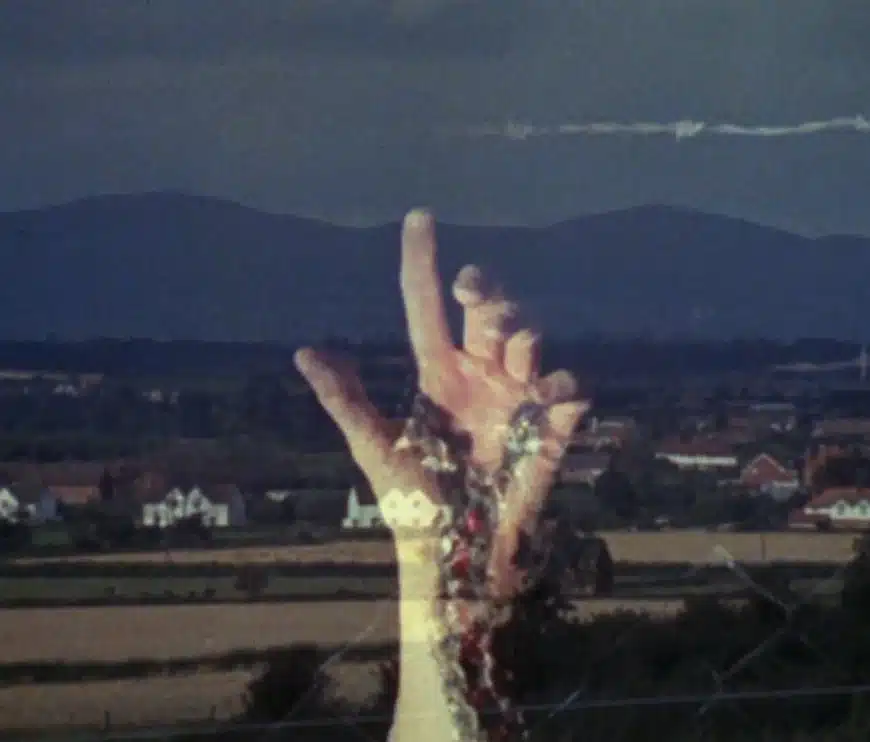
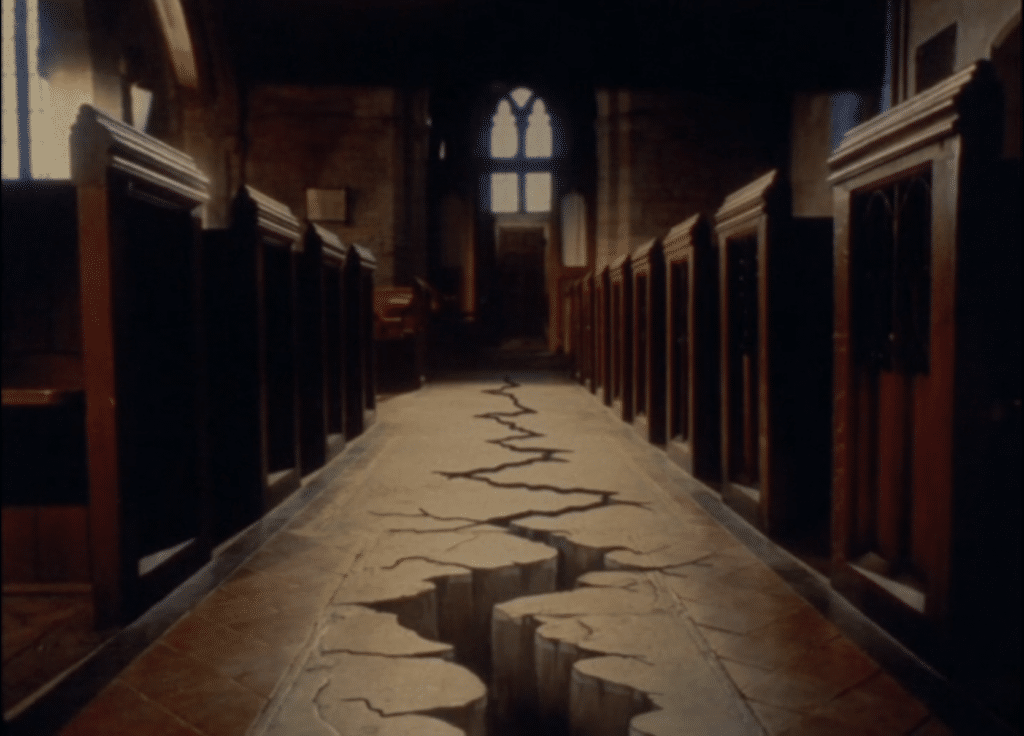
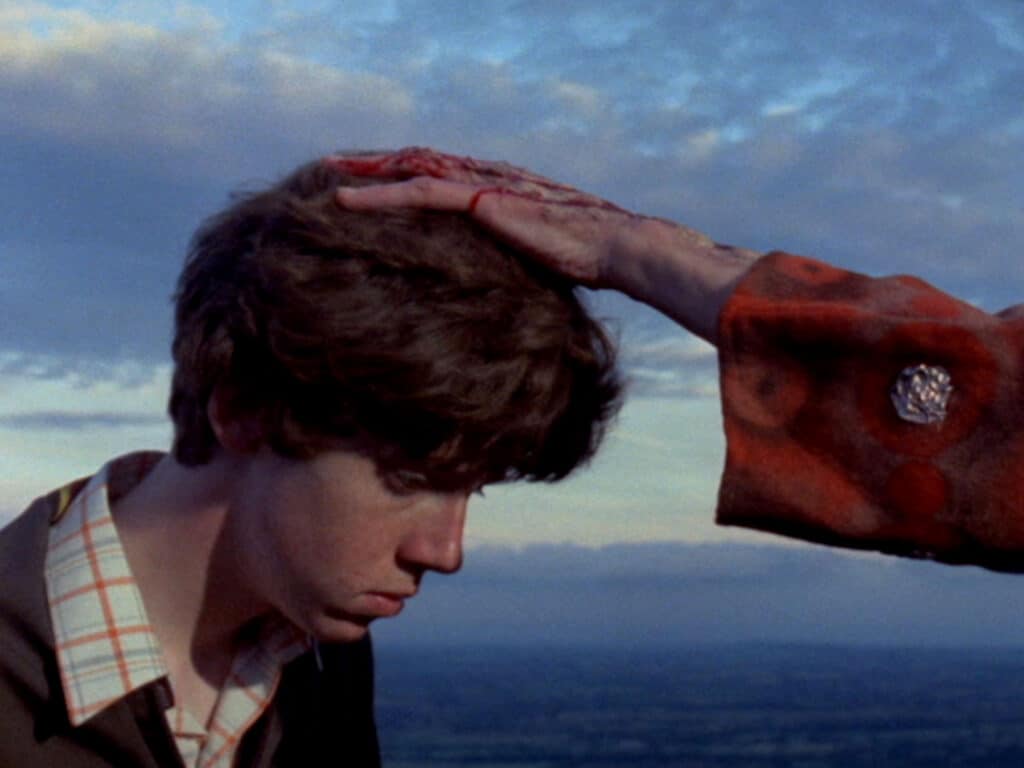
A wounded hand disappears into nothingness as a modern, chain link fence divides us, at least initially, from an idyllic English churchyard; if Penda’s Fen (1973) can be seen as fairly recusant in its treatment of themes and narrative structure, then you could equally argue that it spells out its key themes, or at least visual themes, in its opening seconds. Harm, even self-harm, injury and separation, against the backdrop of a church – now part of the beauty of the English landscape, once a new imposition – but regardless, for a thousand years, a conduit for meaning, for learning and self-knowledge. Perhaps to see and to feel kinship with England, you must both reconsider these old certainties, and see past them, to the timeless beauty and wonder which has so long housed these houses of God. This is certainly one of the ideas explored in Penda’s Fen: England, and Englishness, are a rich and vital seam running through everything here. The development of this idea throughout the film is generous, expansive and subtle, and always complex and beautiful. Nonetheless, and for all the film’s mysteries, we are shown something of what is to unfold at the opening credits: Penda’s Fen is a reckoning of selfhood, of identity, as a young man navigates through a formative period in his life which is, at the beginning of the film, disintegrating before him.
“I am mud and flame!” Stephen Franklin, child of England
Stephen Franklin, the rector’s son – and inhabitant of the rural rectory we also see in the opening seconds of the film – is seventeen, and on the brink of adulthood. His life has been carefully coded and marked out for him by an array of old, reliable, but strangulating certainties: school, exams, a military scholarship; at home, he has the comforting, rote principles of Christian belief, to which he holds fast, having been raised in a religious household, his father a prolific thinker and speaker on faith. But the Stephen we meet at the beginning of Penda’s Fen is in crisis, and this makes him sharp, churlish. He is poring over an essay he has written on Elgar’s song, The Dream of Gerontius – as he listens to the same piece of music – but his fascination with the soul of Gerontius as it arrives not into Heaven, but Purgatory, seems to trigger a range of mixed feelings in Stephen, primarily a yearning for a religious experience of his own. Also, his impatient fixation on the music denotes a fascination with such ambiguity. Purgatory, in Elgar’s story, is the destination, not – as usually held by Catholic belief – a liminal space, neither damnation nor salvation, but a place for almost interminable waiting. But something about this appeals to Stephen; if he holds fast to Christian principles for a large part of his story, then he still has a boundless imagination, and we see the unsettling beginnings of his reckoning with such unorthodoxies. It’s an often painful experience for him, and we follow him through this process, watching his journey take place.
At school, we see Stephen championing his version of Christian principles during a classroom debate, battling through his schoolmates’ indifference by fostering a kind of determination to speak a narrow version of his truth. He rejects any incursions on his chosen mindset, but there is no joy in it: Christianity, to him, seems to be a way of hanging on to endangered principles, or rejecting the unpalatable. The more his friends laugh and his masters regard him with a sort of jaded indifference, the more he clings. And he proclaims his pride in England’s free press, unarmed police, freedom of expression – before dismissing a recent documentary on the life of Jesus as ‘atheistic trash’. Stephen is prone to feeling destabilised, but fascinated – secretly, for now – with more ambiguous worldviews. The Dream of Gerontius is an important one of these but, in its way, a gateway to other, as-yet more subversive shifts. The young man we encounter at the beginning of Penda’s Fen is trying to navigate a relationship with his peers and his family, but grapples with sources of anxiety which needs must disrupt his as-yet conservative path.
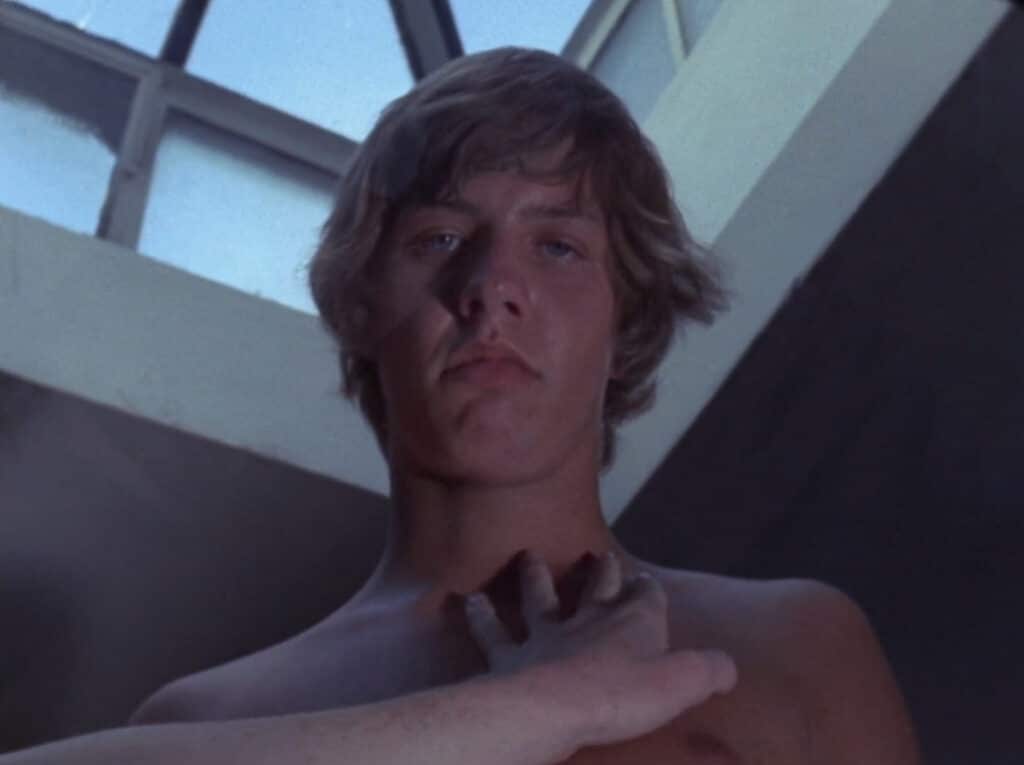
It’s telling that Stephen, as much as we may sympathise with the unpalatable options swirling ahead of him, is made into quite a snappy, socially awkward, even unpleasant young man at the beginning of the film. Returning to our first introduction to him – playing Elgar in his room – he is rude to his mother when she asks him, quite simply, to turn the music down. He’s no shrinking violet in his unhappiness, either; at school, he has a superior air to him which we learn isn’t really warranted by his academic, sporting, musical or social performances, these being the criteria which an old and established school such as the one he attends would value. He does not excel here; however he snaps at his peers, or talks over them, correcting them, or tries and fails to respond in kind to their mockery. He has an especial kind of antipathy towards one boy in particular, but as it transpires, this opens up the film to a whole new aspect of Stephen’s current difficulties. This is a bullying situation, one which hardly looks out of place in this place and at this time, but Stephen’s dreams and visions reveal sexual attraction to this boy – a kind of attraction/repulsion, no doubt, as being homosexual certainly doesn’t fit in with the first Stephen’s worldview, particularly given the film’s timeframe and setting.
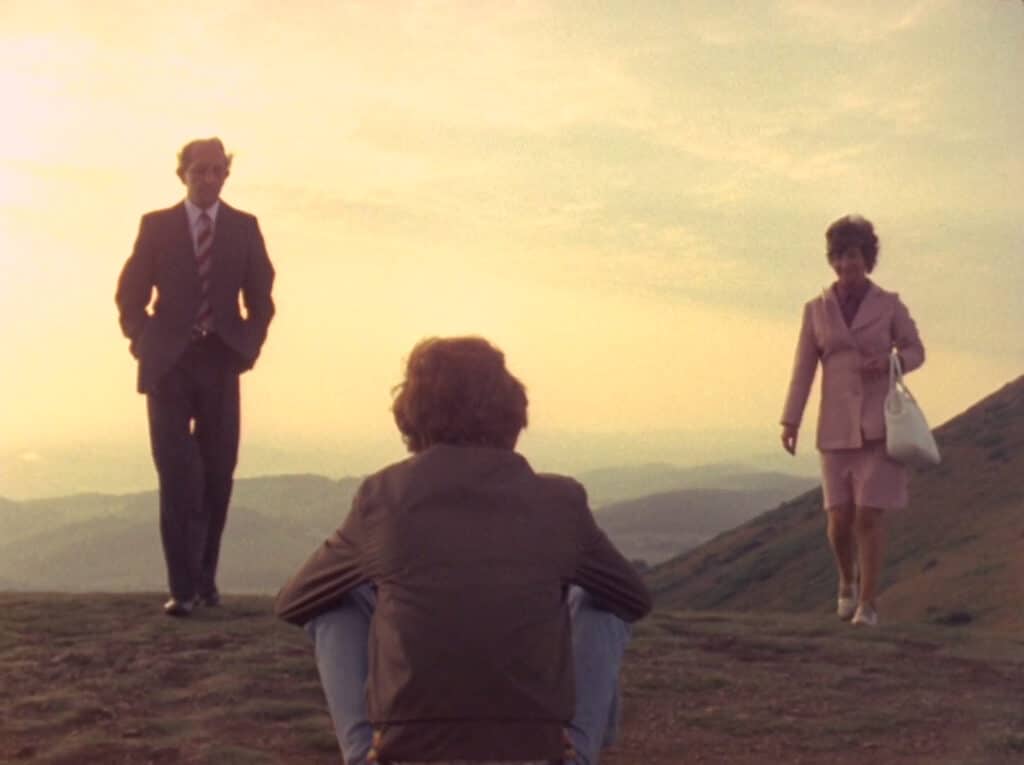
Yes, about that: it’s interesting, and one of Penda’s Fen‘s great, destabilising triumphs, that only towards the very end of the film does it reveal it’s actually set in the 1950s. The story has all the hallmarks of being contemporary with when it was made in the 1970s, from the record player Stephen is using to play his beloved Elgar at the beginning of the film, to the haircuts, to the political views we hear spoken by other characters in the drama, most explicitly by the rabble-rouser Arne. It all feels very Seventies. The sudden and unexpected arrival of a new, strange, fixed point in time, close to the end, sends a shiver through all which we have seen up until that point, disrupting it: what is real here? In that, it gifts us two things: a feeling of kinship with Stephen, who is navigating the same feelings of uncertainty, whose progression we have witnessed. We, as the audience, have to grapple with the same sensation of multiplicity throughout Penda’s Fen, a sense that nothing is as it seems. The whole film is a kind of artistic, dreamily-distant coming apart of certainties; this is also something perfectly in keeping with one of the film’s messages – that certainty can never be. The grind and flux of modern life is always threatening something new, something which must be accommodated and understood. You could argue that it’s this idea which gives the film its title, and serves as its prime mover.
“Some hideous angel”: England in the 70s
You could furthermore argue that, long before the film mentions its actual date and time, we could feel convinced that we’re actually in the 70s thanks to one of the film’s characters in particular. And, in keeping with Stephen Franklin’s early antipathy to anything outside the rather narrow trammel he has at first seemingly chosen for himself, he reacts with a mixture of confusion and hostility (mainly hostility) when he first hears local playwright Arne (Ian Hogg) speak, at a community meeting being held in response to concerns about the impact of long term strikes – striking having become, you could argue, a kind of short-hand in the UK for referring to the 70s themselves, even though high profile strikes continue to feature in the political landscape, and indeed are ongoing into the 2020s. At the meeting, it’s clear that Arne’s perspective is, at least in the small town of Pinvin, a minority view, but regardless of that, he seems to speak for a whole wave of shifting, modernising social and political sensibilities, able even to find voice here, of all places – in this superficially barely-changing place. Arne holds forth on a whole host of topics whilst he has the floor: his speech has notes of profound concern, but also anger, too. In that at least, he’s similar to Stephen Franklin. It’s also interesting that both Stephen and Arne each enjoy a debate, and we see each of them speak to a largely resentful or even hostile audience; it’s just that they are coming from markedly different standpoints, and it must be remembered that Arne does not encounter Stephen’s arguments in any detail, not being privy to the closed-off environment in which he does his own speaking. Outside of military school, the world at large is responding to current affairs – the spectre of strikes and their impact on the wider community is clearly being felt here, and seen as important enough to draw a crowd on this particular evening.
Arne’s speech is one of the high points in this film, showcasing writer David Rudkin’s tremendous lyrical skill (Rudkin also worked on Lawrence Gordon Clark’s seminal TV version of M R James’ The Ash Tree in 1975). Arne is second only to Stephen himself in terms of air time, and when he speaks, he holds forth on a whole list of contemporary concerns, stemming from the strikes, sure, but taking in far more issues too. High on this list are changes to the precious landscape; he alludes to the perils of new construction either on, or beneath the earth, being ostensibly done – as he has it – to shelter people from nuclear attack, though the whole project is presented as somewhat ludicrous, a ream of shelters inaccessible in the maximum ‘four minutes’ warning which would be given, the population probably “strategically expendable”, with all that would be left an array of desks, and pencils, ready for a needless, laughable bureaucracy buried under the earth (a little like the one in Threads, made a decade later).
There are other, very 70s-centred concerns: we hear about more general political turbulence, an increasing sense that modern politics is corrupt, with money being wasted on what Arne refer to as, “bungles, deliriums and fantasies”. Well, quelle change – you could argue. Much of what Arne says feels like strangely prescient environmentalism, too, criticising what is sometimes called ‘late stage capitalism’, though it’s wasn’t a term in common use then, and indeed environmentalism as a movement was in its infancy, or associated only with fringe thinkers and groups. But Stephen, on hearing all of this, reacts with anger: he has perhaps never heard such views, calling Arne a “terrible crank”, and even volunteering the opinion – which he later retracts – that perhaps it’s ‘God’s will’ that the Arnes haven’t been blessed with children. They would only pollute their children with their ‘unnatural’ values, after all. It’s an unpleasant thing to say, and it smacks of Stephen’s deeply-held but brittle position, which is already starting to feel under attack the more he begins to consider his own place in the coming world outside of military school.
But perhaps, on some level, Stephen agrees with some of Arne’s concerns. He, too, is thinking of his place as a kind of child of England, and he too is beginning to see England itself as an inheritance, something to cherish, to hand down. The fear of leaving “nothing but dust” for future generations is shared by both Arne and Stephen, even if Stephen’s response to this fear is wholly different at first. Significantly, having heard Arne, Stephen seems to begin the process of moving away from his incredibly closed, unmovable interpretation of faith, what his schoolmaster links to Manicheanism, a spiritual battle between dark and light – a tempting array of symbols for Stephen’s fracturing conscience, clinging to archetypes and old certainties. Perhaps, whatever else Arne says, and whatever else horrifies Stephen at the beginning of the film, it should be remembered that Arne’s concerns are age-old, because the land itself, the place is also. The whole film plays with the idea of permanence and change: were the contemporaries of this film, in the 70s which are the 50s, poised on the brink, like the barely-known figure of King Penda, the last pagan king of the Mercians, who gives the film its title? In Arne, the film has a spokesperson for a wide array of twentieth century concerns, though in keeping with the overall tone of the film, many of these feel age-old too, somehow. Surely some of his ideas could have been King Penda’s, himself poised on the brink of irredeemable change and transformation.
The land has always had its champions, and in Arne/Stephen Franklin, we have two at first very different kinds of champion, eventually reaching an accord, an ability to share their perspectives. This is, for Stephen, borne out of a painful series of experiences. Again, like Penda, knowledge is hard won, and can only be resolved through acknowledging change, reclaiming the notion of Englishness from parochial ideas and short-sightedness, even if this shift is difficult. In this, Stephen Franklin is reborn, and we leave him in a happier place at the end of the film. However, Penda’s Fen leaves its questions lingering in the air too, reminding us of the ongoing struggle between change and permanence.
Visions, dreams and the unreal
Stephen’s personal progression from recalcitrance to something else entirely comes to us not only through ‘real’ events, but imagined ones. Conversations with his parents (who crucially reveal, on his eighteenth birthday, that he is adopted) and through his admittance of respect for those who do not share his world view (the Arne family) are vitally important, but the kind of mental sorting and sifting necessary to all of this relies quite heavily on the imagined. Visions and dreams in Penda’s Fen are very revealing, often oblique – but sometimes clear enough too, shockingly so for the times perhaps, blending aesthetic and sexual longing with religious iconography and painful moments of reckoning. We see classic, Fuseli-inspired nightmares and homoerotic fantasy. Stephen’s dreams of his school tormentor, naked, create a strange, slightly feverish blend of wish fulfilment but perhaps revulsion too; Penda’s Fen is at times a story of agonised sexual repression as much as a spiritual journey, because in truth, it is in accepting certain truths about himself that Stephen begins to blossom. Beyond more conventional dreams, though, we also witness periods of what must be visions or hallucinations – all of which blend into the story as a whole. These can be more challenging, showing Stephen grappling with difficult and complex ideas.
Elgar is not only notable in Penda’s Fen for providing a musical accompaniment and a certain set of themes; he appears in the film, too, albeit not as a titan of music or creativity, but as a questioning figure, a mortal man asking for reassurance. Stephen’s dream, or vision of a meeting with his beloved Elgar starts on a strangely sour note: no straightforward, spiritual story or meeting of minds, this. Elgar seems preoccupied with his own worldly affairs, in ways which catch Stephen a little unawares. At some detail, he recounts to Stephen his surgical ’embowelling’; nothing could make him seem more human and less easily-exalted than his anecdote of watching his doctors at work: Elgar did indeed die of colorectal cancer, and believed – like the elderly couple in Penda’s Fen, discussed below – only in a grand nothingness after death.
However, the great man does move onto topics which link Stephen’s love for his music with Elgar’s own timelessness, itself an afterlife. Penda’s Fen as a pastoral is beautiful enough, but the film works hard to imbue the beauty of nature with something more profound and permanent. As Elgar moves on from his story of his illness, he speaks some of the film’s most poignant lines. In discussing a potential ‘tune’ for his Dream of Gerontius, he shares a confidence with Stephen, before telling him, “If on the hills you ever hear the sound of an old man’s whistling in the air, don’t be afraid. It’ll only be me.…come back to look at the world, you see. The lovely world.‘ Elgar’s focus for part of his conversation with Stephen is on his death, the indignity of the end of his story. Why does Stephen fixate on this? Is he reckoning with the fact that even exalted men must die? That their courses do not run smooth? Whatever these questions, there is redemption here, redemption which slowly begins to draw Stephen into a new understanding. Other dreams, themselves disturbing, begin to yield up something like hope, too.
Stephen’s spiritual journey – which sounds hackneyed, but is a significant part of the film – is no less complicated. For one, his growing interest in the idea of Manicheanism is, perhaps surprisingly, one of the notions which begins to loosen his grasp on a narrow, unmoving Christianity as the only way to light his way forward. Not that his religious faith dissolves; rather, he begins to see Jesus, his saviour, as part of a multiplicity, all of which point towards a bigger battle for spiritual salvation. Perhaps nothing is as it seems, even when rendered down into light and dark, good and evil. Stephen’s discovery that his own father has written a book on what he sees as the political exploitation of the figure of Jesus (a book which Stephen finds out about by chance) is another moment of destabilisation for him, but again, he is starting to figure out a more sensitive, exploratory means of exploring his faith.
Ultimately, what is faith for, here? The early version of Stephen uses it as a shield, deflecting any alternative world views, hiding from the parries of a world which feels increasingly hostile. But faith is more malleable than he first allows, and – as it turns out – his rector father understands this very well. The film includes a moving, thought-provoking sequence from the rector’s daily life, as he calls on an old couple, now faced with death. They have quietly rejected hope in an afterlife, preferring instead to count (and revel in) their ‘days allotted’. But the rector is there with them at the end nonetheless, and the older woman accepts this without issue: he is not sent away from the bedside, but cherished for his humanity. The rector, who feels like a remote figure at the start of the film, undergoes a journey of his own here, eventually enjoying a newfound relationship with his son – his son, regardless of the fact that Stephen is adopted, and not ‘chemically’ related to him, as Stephen puts it. The rector reveals himself as a caring, considerate and tolerant thinker, a comfort as well as part of the fabric of the community. He is a parson in a small village in 1950s (1970s) England, but he is not confined by any one worldview, and is now able to foster an equivalent, broad worldview in Stephen, a young man who has undergone a dark night of the soul, with angels and devils contesting for him. And, finally, it’s perhaps suitable and inevitable that Stephen’s last act in the film involves an extended vision, and another tussle over him: his body, his mind, his morals.
The older couple who approach him at the end of the film seem representative of establishment, a kind of timeless conservatism perhaps that, in always looking back, looks only at a tiny point of light on the receding horizon. And they argue over Stephen, in an incredible, if densely-layered scene: they offer him wealth, power, but point out that to attain all of this is to “be put to the fire” like Joan of Ark, another figure mentioned in Penda’s Fen. It speaks to purification, to ascend as a ‘child of light’ – but Stephen, as the end of the film, is able to reject their unequivocal spiritual truths, displanting them for some of his own, hard-won, even if perhaps an earlier version of himself would have wholeheartedly sought the same blanching of his sense of self. It’s a defiant speech which blurs ideas and boundaries in a way which seems unprecedented given that this film is now half a century old. He responds to the couple’s references to him as ‘a child of light’, and in some ways their inheritance too, in the following way:
‘I am nothing pure. Nothing pure! My race is mixed. My sex is mixed. I am woman and man. Light with darkness. Mixed! Mixed. I am nothing special. Nothing, nothing pure. I am mud and flame!’
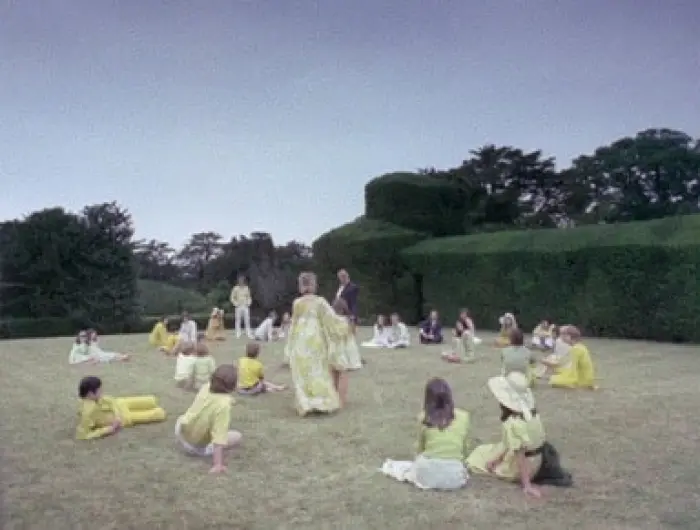
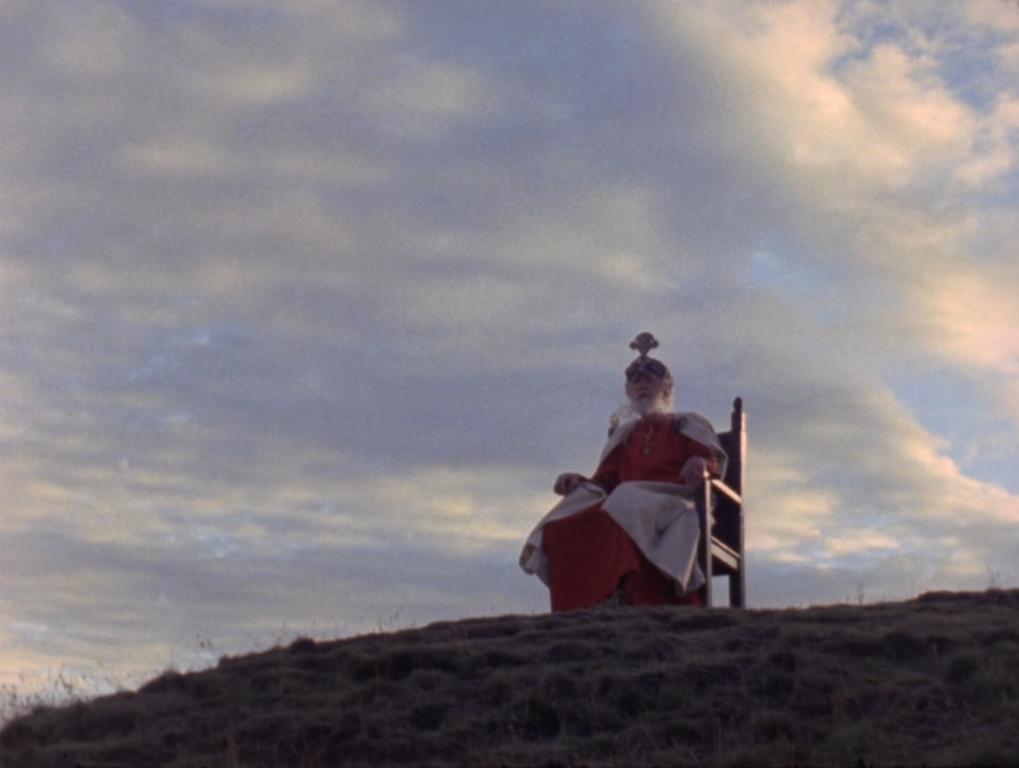
Whilst this remarkable speech brings him back to himself, it angers the couple: they would have him a child forever, they claim ownership over him, and would rather sacrifice him than lose him. There are echoes here of one of the film’s other, great strange sequences: the ‘society party’, if you can call it that, where attendees, clad in cowardice-yellow, are happily queuing up to have their hands severed: it’s the ghastliness of social mores and peer pressure writ large. But finally, Stephen is able to defend himself on his own, new terms. This suggests what the whole film has hinted, that spiritual growth requires a kind of casting off of the received wisdom that the couple, as representatives of the world Stephen tried to occupy, value. And, finally, we meet the figure who is vital to all of this – the vision of Penda himself, enthroned and overlooking his ancestral lands, his ghost permeating through time to overwrite itself on the landscape by giving it a name.
“Unbury me…”
But who is Penda? What is Penda’s Fen, exactly? Stephen’s journey towards a meaningful identity of his own draws upon history, language and literature as it goes, so that even the town he has always known takes on a new identity, the village name, Pinvin, being a corruption of the Anglo-Saxon name ‘Penda’s Fen’ or Pendafen’ – the hard edges of the place-name eroding steadily over hundreds of years. But the place is the same, and King Penda – the last pagan king of England – may himself have experienced the same harrying of his worldview, the same spiritual struggle poised between loss and understanding. This consideration grants us the greatest monologue in the film, as spoken by Stephen’s adopted father:
King Penda. What mystery of this land went down with him forever? What wisdom? When Penda fell, what dark old sun of light went out? Pinvin. Pin-fin. King Penda’s fen. Did Penda die here? Who says that he is dead?
Penda is not the only historical figure who becomes interwoven with the story here, but he gives his name to the film and he survives in the bucolic landscape which still bears something of his name. When the rector asks if he is ‘dead’, he is perhaps thinking of how the old king has become part of the fabric of England, of place, all while the world view which Penda would have fought for has disintegrated. Pagan England is long gone, but the same cruelties persist; how did Penda, at the end, resolve these contradictions?
He goes some way towards telling us personally. Penda himself appears to Stephen at the close of the film, tasking the young man with a legacy he has not understood until now. It is a beautiful, poetic episode, from a man known and unknown, and there is parity: Penda’s England sinking without trace, Stephen’s world on the brink of madness and disintegration, as clearly described by Arne. There is a kinship between them, and an appeal by the old Pagan king. Again, it is worth letting these lines of Penda’s speak for themselves:
‘Our land and mine goes down into a darkness now. And I, and all the other guardians of her flame are driven from our home, up and out into the wolf’s jaw. But the flame still flickers in the fen. You are marked down to cherish that. Cherish the flame, till we can safely wake again. The flame is in your hands; we trust it you. Our sacred demon of ungovernableness. Cherish the flame; we shall rest easy. Stephen, be secret. Child, be strange. Dark, true, impure and dissonant. Cherish our flame. Our dawn shall come.’
Conclusion: ‘And did those feet in ancient time…’
Penda’s closing speech is, I think, about hope, whatever the adversity. Penda’s Fen steps dreamily but decidedly away from cast-iron resolutions, but offers greater happiness and understanding to people willing to challenge received wisdom, to reach profound understanding of their own, often by looking again at establishment truths, arranged into hierarchies and systems which can harm. The threatening spectre of nuclear annihilation was a new ghost to contend with in the 1970s, and was by then itself entrenched, shaping the actions and unease of millions. But by scale, the new world which felled King Penda was the end of a world, too. And then, personal crises, and personal considerations of how to live one’s life; these have been a constant. Change is a given, but how to navigate it?
You could even argue that the film’s unexamined relationship with visionary writer and engraver William Blake could give us our clearest parallel to Stephen Franklin’s own journey, and it feels entirely in keeping with the tone of the film overall that this is never made explicit, other than that Jerusalem, penned by Blake and set to music by a contemporary of Elgar’s, Hubert Parry, appears in its role as unofficial English anthem, being sung by rows of boys at Stephen’s school. This song appears as one of the fixtures and fittings of repressive school life here, and may mean nothing more, but consider it further: Blake was a pioneer, a man who himself negotiated a new relationship with God and with faith, a man whose own religious sentiments broke sharply away from the commonly-held ideas of his own peers.
Blake saw visions, conversed with angels, like Stephen, and saw them often, something which he noted down as simply part and parcel of his own spiritual progression, even whilst it confused and alarmed some of those closest to him. His work, too, was deeply influenced by the changes he saw taking place around him as the Industrial Revolution took hold. His Songs of Innocence represent a dwindling but potent ideal; his Songs of Experience retrace many of the same themes but re-written, bemoaning the fates of the poor, of children, of the natural world – but through the Songs of Innocence and Songs of Experience there is a clear progression, from innocence into experience, with all that signifies. He would likely have nodded at Arne’s warnings too, and echoed his sentiments. As a spokesman for the poor and downtrodden, he would have likely supported striking workers, as he was present in the crowd which burned Newgate Prison in 1780. The established Church was, to Blake, an ineffective monolith, doing little to ease the lives of people dependent on the mercy of such institutions and unresponsive to the questions and duties being asked of it. Likewise, Blake’s ideas about the other, great certainties of his society – including sexuality and marriage – were unorthodox, too.
Perhaps the path taken by Blake, his avowal ‘not to cease from mental fight’, mirrors Stephen’s own path – or maybe there are simply countless examples of men throughout history, known and unknown, Christian and pagan, of unclear heritage or sex, whose steps are being retraced here. However, in a film rich with historical characters, there does seem to be one whose own experiences are at least half-reflected here.
Penda’s Fen is a film of contrasts: it’s gentle and yielding, a beautiful pastoral, a coming-of-age drama, but it’s also complex and at times sinister. In different hands, it could have felt whimsical at best, absurd at worst, but as directed by Alan Clarke it feels clever, ambitious and profound – testament to his great caution and skill in bringing the screenplay to life. It’s a challenging project. It frequently detaches from time, even if not place – place is a permanent feature, but it’s a palimpsest, constantly being re-written by new thinkers, or hacked apart by crises. And, just as it uses dreams and hallucinations, so it feels like one, with Stephen’s symbolic monsters and visions hazily representing something to us, too, which may feel just out of one’s grasp but still oddly vital. Penda’s Fen feels ultimately very intricate – familiar but distant, a dream of England where shifting, liminal ideas wander forward to some kind of new understanding. That it’s now half a century old is truly remarkable.
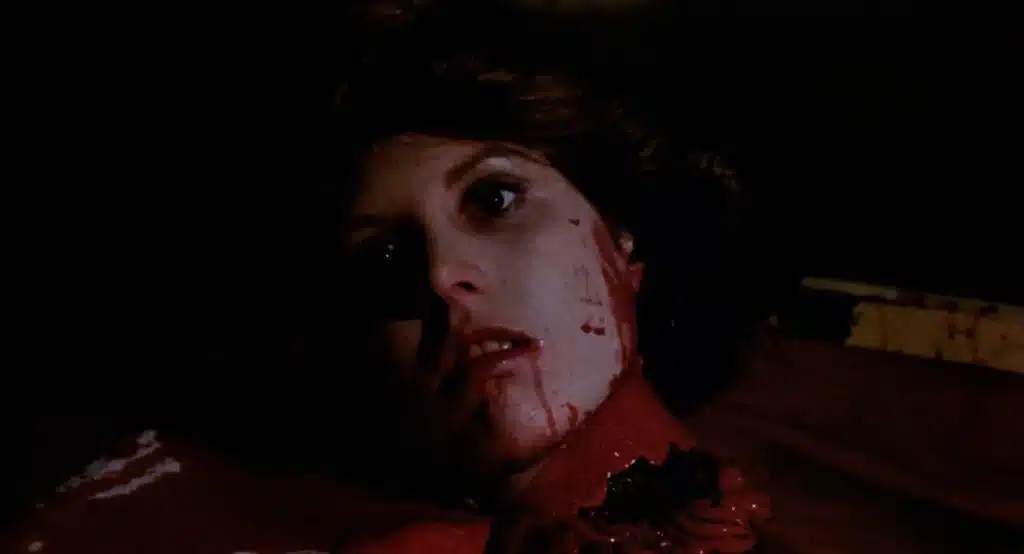
You’ve gotta love a film that straight away states its intent (and understand a film which needs to sell its merits pretty damn quickly) and Nightmare (1981) does both of these things. We’re off with a dream of a dismembered body, a shrieking nightmare, a man in a straightjacket – and the immediate need to sedate him, so powerful are his dreams. Then come the opening credits – a gloriously early 80s run of red and black, and a claim that Tom Savini did the SFX, which he categorically denies. No messing about, then. The film has established itself as a gory, feverish, bloody unpleasant film and it does not disappoint at any point during its runtime.
Director Romano Scavolini gets ahead of the trend by about thirty-five years by adding intertitles here: the film is carved up into days, and you may be surprised by how much happens on each particular day. Hence, Night One: a babysitter’s trite dismissal of kids complaining that ‘someone is looking through the window’ segues into more dreams and flashbacks, but establishes that this is, in fact, an early American slasher (albeit with an Italian director). Our guy in the straightjacket is George Tatum (Baird Stafford), and his mental plight is of great interest to a crack team of psychiatrists and other medical professionals, who, for reasons best known to themselves, see in him the prospect of a total recovery from his conditions (and it’s quite a list – worthy of a Twitter bio). Of course George isn’t successfully cured – this would be a short, and likely very dull film if he were – but, right as rain, his care team turn him out onto the streets of New York anyway, jacked up with experimental medication and operating on the promise of turning up to outpatients once in a while. George does the obvious thing and instead heads to 42nd Street to sequester himself in a peep show or two. But the flashbacks are breaking through already: ladies and gentlemen, this is only the first day of the timeline proper, and George’s mind is already fracturing.
On Day Two – Day Two! George decides to head off on a road trip. His rather woolly psychiatrist finally notices he hasn’t arrived to his session, but doesn’t really think much beyond that for now: in the meantime, George is heading out of state which, if bad news for the experimental treatment programme, is by far worse news for a number of innocent women he encounters on his way. On his way to where, though? He seems to be particularly fixated on one address and one family in particular: he keeps calling, then hanging up, but he seems to be closing in on the household, which consists of one single mother and children. Will the treatment team deign to catch up with George before he catches up with this family, with which he has certain…ties? (It’s not looking all that likely, is it?)
Nightmare, sometimes known by the rather more embellished Nightmares in a Damaged Brain, is part of horror history. The film’s role in the whole video nasties furore is well known – but is it a film which deserves to be seen today? Actually, it is. For starters, it’s a well made, shot and lit film with a superb score, already confident enough in its use of horror and plot tropes to throw a few red herrings in there from time to time. Scavolini knows what he’s doing, and it shows. It’s also an undoubtedly OTT, gory and profoundly mean-spirited vision; unlike many of its peers, swept onto the video nasties lists for still mystifying reasons, Nightmare is, at least, a genuinely nasty video. It may be over forty years old at the time of writing, but it still looks and feels ambitious, without ever compromising on its visual style and themes. Ungoverned by most of the concerns which frequently hem in today’s filmmakers, it can be gratuitous and salacious (nudity often, suddenly breaks out in Nightmare) without feeling it needs to resolve things, or dish out comeuppances in the right proportions to the ‘right’ people. None of this makes Nightmare a nice film. But it does lend it a strangely refreshing, unconcerned quality.
It doesn’t seem to have set out to change the world, then – but Nightmare does have a few features which distinguish it further, especially at a distance of forty years from now. Its cynical spin on psychiatric medicine is interesting; clearly pride comes before a fall in the world of the film, as it’s the self-congratulatory, laissez-faire attitude of George Tatum’s doctors which sets the ball rolling here. It’s not a social commentary as such, but the film does offer an interesting take on what itself is a rather voyeuristic and potentially harmful branch of medicine, as seen in the world of the film at least. I mean, if we’re looking for moral lessons here – not advised, but possible – you could even say that not leaving your children with a disinterested babysitter could be one of them. We could take it further, and say that having children at all is a risky business, as the film plays with the furthest extremes of the nature/nurture debate.
But perhaps the film’s quality as a time capsule is where its secondary charms really lie. Now, 42nd Street is, for most people reading this review or about to pick up the Severin print of this film, someone else’s nostalgia. But it feels like our nostalgia anyway, even if for most of us always refracted through oddball exploitation and horror cinema from the past. Something else which now feels like it belongs to the past is the role of the landline telephone: the terror of it ringing, the potentially unknown weirdo on the other end, its relationship to your home, where you should feel most secure. A withheld number on a smartphone is just not scary in the same way; today, horror is more interested in phones when they don’t work, rather than when they do – but I digress. The film retains its grainy, retro look, by the way, but this print looks extraordinarily good, clean enough to be fully legible, with great colour balance and blacks which really pop off the screen. Nightmare in this version feels both near and far, looking and sounding as good as you can imagine it ever could. All in all, this is a fascinating, if grotty trip down memory lane balanced against a still watchable. engaging, unapologetic horror film, and as such it comes highly recommended. You could do far, far worse than head over to Severin and pick up a copy, which comes with a clutch of excellent special features, or click here if you’re a UK reader.
A sinister opening reel turns out to be something everyday – a car engine – in snappy supernatural short Ride Baby Ride (2023), showing us straightaway that all our woes are going to be vehicular – starting with the pair of geezers hoping to sell on the car in question, though treating themselves to a bit of sexist nonsense when it turns out their female mechanic (egad! Celina Bernstein) not only knows what she’s doing, but drives a hard bargain on the resale price. Who, I ask you, in that entirely reasonable position, wouldn’t simulate intercourse with the car, or start describing the mechanic as ‘a little spicy’? She looks on, honestly seeming a little tired of the shenanigans. You get the sense this happens more often than she’d like.
But is there more to these guys? Is it the car that’s ‘a little spicy’? A few minutes later and you might be asking yourself whether the car might not have had some kind of supernatural influence on them, because it seems like the car is in fact supernatural. Once inside the garage, it starts – doing things. Oozing. Flinging open its doors. And, if this could be put down to the car’s vintage (a ’78 Camaro!) and condition – well, perhaps not the oozing – it’s soon clearer that there’s something else going on here when, as the mechanic investigates the car’s strange quirks, it seemingly deliberately mangles her leg, then traps her inside.
Cars are claustrophobic at the best of times – probably the smallest enclosed spaces we routinely occupy – but things get quickly far, far worse with our now panicked protagonist trying to free herself from seatbelts which may have taken some cues from the Deadite-infested branches in Evil Dead (in several key respects, from soundtrack to scenes to titles, this film clearly pays its dues to the great horrors of the 80s). As the car really shows its hand (!) this turns into an impressively bloody battle of wills, woman vs. machine, and this is a spirited solo performance from Celina Bernstein in a film which manages to be genuinely ominous, as well as in other moments grisly and OTT. With a runtime of seven minutes, writer and director Sofie Somoroff knows better than to get bogged down in an origins story for the supernatural presence here – it just is, it’s nasty, and it becomes an issue of survival.
Ride Baby Ride offers a simple idea nicely executed, calling on the likes of Maximum Overdrive (1986) and more recently perhaps,King Car, but keeping things in the horror vein, taking a real relish in building up to scenes of genuine peril and bloodshed – no mean feat with a just a few minutes at your disposal. It’s a stylish, well-made calling card all in all, and you can see it on horror short film channel Alter from the week of March 11th. In fact, here’s a link: have at it!
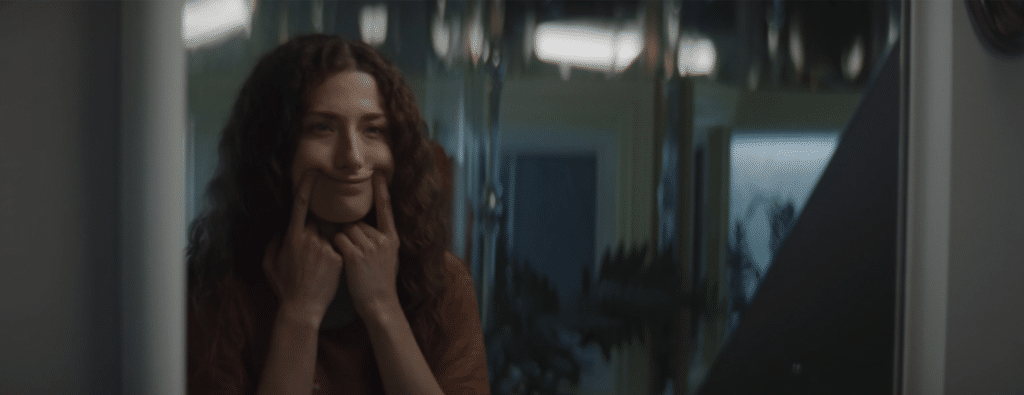
Continuing with Warped Perspective’s interviews with the directors behind ARROW Player’s recent Sharp Shorts, we asked director Joanna Tsanis about her own short film – a very brief, super-focused study of depression, grief and fear. Oh, and it’s a monster film, too. Here’s our conversation about Smile (2021).
Warped Perspective: This is a very brief short film, but it packs a powerful psychological message. How easy or hard was that to achieve, given the short film format?
Joanna Tsanis: It’s funny – the film was initially going to be even shorter. It all started with an idea I had for a horror gimmick – that gimmick being a woman smiling so hard that her face rips off. The original script was less than two pages long and I had planned to submit it to micro-short and 1-minute horror competitions. But when my screenplay was picked up by NYC-based company Zeus Pictures, they suggested I expand it to five pages. That was 100% the right call, and I really appreciated that motivation to develop the gimmick into a full story.
Though it can be a challenge to fit a story’s necessary character development in a 5-6 minute frame, the limitations force you to be more creative. Besides the quick voicemail in the opening, the film has no dialogue. I had to really focus on telling the story of Anna through her surroundings, her movements, and her expressions. It was a challenge, but an exciting one.
WP: The monster in Smile feels very much like a personification of that demand – often made of people who are suffering with depression – to ‘just smile’, whatever they might be feeling inside. Is that a fair interpretation? What did you want audiences to take away from your film?
JT: It is a dark irony. Everyone wants Anna to be happy. Her mom wants her to be happy. She wants to be happy. But the idea of her ever smiling again seems at an impossible distance. That is until her depression manifests into something truly monstrous and gives her that smile she longed for. Her fate is cruel but it is not unheard of. Anyone with a loved one that has struggled with depression understands this.
WP: Did you draw any inspiration for your creature from other films or other works, or is there someplace else that creature came from? It’s a very effective monster!
JT: Hellraiser was definitely an inspiration for the creature design. I wanted the monster to look like it was in pain simply from existing; hence it being wrapped in barbed wire, and the wire pulling its mouth into an outstretched grin.
WP: You’ve stuck very firmly with the horror genre for your films so far – can you tell us why the genre appeals to you so much?
JT: Growing up, I would visit my family in Greece every summer. Having spent most of my life in Canada, it was too hot in the afternoon for me there. So I’d stay in and watch the English-speaking channels. Anyone who is familiar with afternoon television in Southern Europe knows the kind of wild stuff that’s on there. I saw B-movies, midnight movies – all kinds of stuff. And I remember absolutely loving that feeling of ‘seeing what you’re not supposed to see’ – peeking behind the curtain. I think that’s what hooked me.
WP: What are you working on next? Do you intend on making a feature, or sticking with shorts? It certainly helps that short films are finding an audience more easily these days with Arrow, Alter etc.
JT: I recently finished my feature debut! It’s a monster movie (of course)…
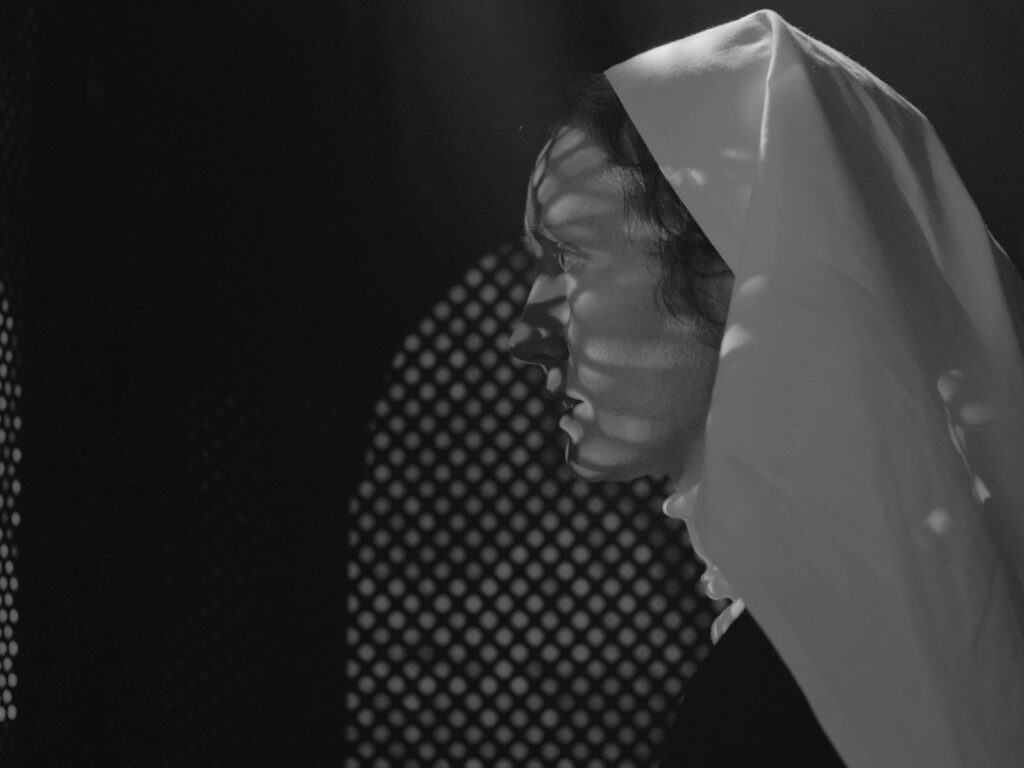
Part of the recently-reviewed ‘Sharp Shorts’ package, Itch (2021) plays with ideas around faith, mental illness and temptation, and seemed like a project we wanted to explore a little more. Having recently reviewed the title, we were fortunate to next get the opportunity to speak to the director of Itch, Susannah Farrugia, and we’re grateful to her for taking the time to answer a few questions on the film. Please remember: you can see the film for yourself right now by heading to the Arrow streaming service.
Without further ado, onto the questions:
Warped Perspective/Keri: My first question has to be – what drew you towards a convent for this story? Why a convent, why nuns?
Susannah Farrugia: I come from Malta, which is a very Roman Catholic country; that is condensed within churches and convents, so it is a subject matter I am very familiar with and have always wanted to explore in film, especially since some of my favourite films are The Sound of Music (1965) and Black Narcissus (1947). The main reason was based on practicality and budget – choose a location where it would narratively make sense for the characters never to leave – and a convent offers that. Together with this, I am inspired by nunsploitation, and wanted to invert the tropes through a feminine, queer lens.
WP: Tell us about the decision to present your film in black and white. Was this always your intention? Were you influenced by anything in particular in this respect?
SF: I always imagined the film in black-and-white, inspired by the monochromatic hues of a nun’s habit. I have my own reading that it parallels Sister Jude’s binary black-and-white thinking of good and evil, heaven and hell, purity and filth. I considered colour and tested the material in colour, yet it did not seem comparable to what it looked like, and more importantly felt like, in black-and-white. I would say another inspiration for my choice is body horror Tetsuo: The Iron Man (1989), which manages to heighten the horror by removing the colour of blood.
Another choice which interfolds with the colour is the film’s time. In some ways, I believe the film to take place inside a timeless era, where we are not exactly sure if what we are watching is in the 19th Century or modern-day, because all we know are the walls inside the convent where time moves extra slowly. Forever locked inside the life of a cloistered nun, time loses its meaning and the only way we can tell time is by how fast blood moves down her wrist.
WP: It is interesting that, in the film, Sister Jude is quite well aware of what is tormenting her: how important was that in creating her character, and her contested mindset?
SF: There is a helplessness one must surrender to when dealing with illness. Your body can externalise internal trauma and this is a theme I feel is very relevant to the film. She is aware of her desires, but her knowledge only adds to the torment. The cycle of suppression is substantiated with guilt and anger which moves the narrative, so the self-awareness is pivotal to her characterisation and the last frame of the film. The contested mindset is explored in the same vein as her black-and-white thinking.
WP: The film is more psychological than graphically violent, but still has a number of unpleasant sequences which border on body horror – did you debate about what you wanted to show and what you didn’t want to show in the film?
SF: I think the psychological narrative allows the violence to be tethered to reality, but not part of it. The unpleasantness and visceral nature of body horror never truly occurs but happens nonetheless in the dreamscape.
SF: Itch is your first short film and you both wrote and directed it: did you enjoy the experience, and is it your intent to go on and make more films? If so, do you have any plans?
I’m superstitious, so the less I say the better! However, I do plan on making more films and you can keep up to date with me across my several Instagram channels: @cinema.ink, @itch.film, @makeupincinema, @nunsinsinema, and @cakesincinema.
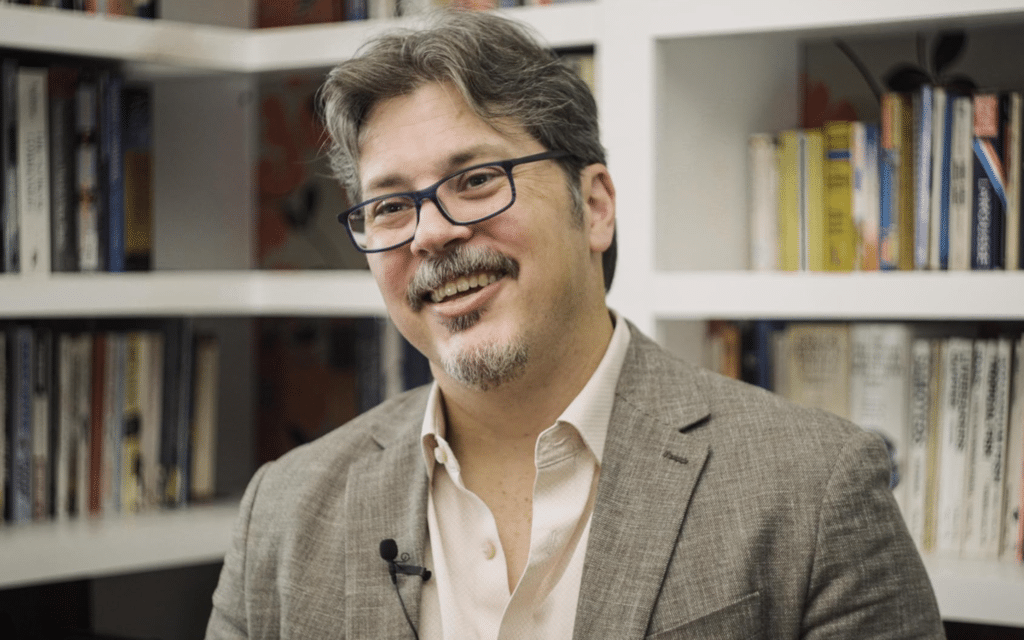
“I am happy to make bad movies – one a year until I die.” This is how documentary film Create or Die (2024) gets going, and the speaker – indie movie director David Axe (above) – is the subject of the film. However, any expectations that this film will offer something bigger and more profound about the nature of indie filmmaking – such as, perhaps, what motivates low-budget filmmakers as a group to keep doing what they do – doesn’t materialise. Rather, Create or Die keeps a very close focus on Axe himself, plus his regular crew, describing his most recent feature in some detail and at points ruminating on the reasons that he personally keeps going. Shorn of any knowledge or understanding of his own career to date (I haven’t seen anything he’s made, though I’m sure that kind of makes his point about the pitfalls of his career) the film can feel a little rootless.
After introductions, the film moves to promo for one of Axe’s projects, a film called Acorn (2023) which, although starting life as something else entirely, morphed into a film-within-a-film where the embedded film symbolically reflects the main character’s life. The main character in Acorn is a filmmaker too, who receives a terminal cancer diagnosis and decides she’s going to finish one more film in the time she has left. Having established this, Axe begins to discuss his background as a self-taught filmmaker, having at the point the documentary was filmed made seven films in seven years. This is an approach he intends to keep up until he ‘gets good at it’, though of course making a miniscule-budget feature every year isn’t the only way to get good at it; lots of indie filmmakers spend years prepping and making their films. There are different ways and means, though this method happens to be the one Axe has chosen (and he doesn’t really reflect on other options or get too far into defending his approach, which would have been interesting to hear).
The documentary, at this point, segues into a run of recollections from Axe and his crew members which are very specific to making Acorn – though could be extrapolated to many other low-budget projects, and may be of particular interest to filmmakers as a result. But there’s lots of detail about making Acorn: the length of the shoot, the length of the days, location scouting, the weather, the issues around what to prioritise when you have a list of a hundred tasks and time for ten of them; these specifics were lost on this reviewer, and from around the midway point this becomes, more or less, a documentary about Acorn, an unfamiliar film. As such, discussing excerpts from the script which are clearly intended to be very moving surely can’t do much for unfamiliar audiences. Yes, there are some deviations into the huge fail rate on indie projects, for example, and other topics which may have a broader appeal, but for the most part Create or Die is dominated almost entirely by talking heads talking about a specific film.
That’s fine, but as someone who runs a website which so often covers exactly the sorts of films being alluded to here, it feels like there are lots of questions which could have been asked and answered. An often rather po-faced Axe ponders, ‘Is it okay to be a bad filmmaker?’ before asserting that yes, yes it is. Okay, sure, but there are other complexities to explore here. As above: why exactly is churning out a film per year the best approach, given that making money is seen as largely impossible (albeit there are many baffling exceptions – rememberSkinamarink)? What about audiences? What is your relationship with them? What about the issues of reaching an audience? Should we enjoy the story you are telling or – as it often seems here, whether fairly or otherwise – is it more for the personal validation of the director and team? Let’s assume a film is low-budget, but brilliant – what makes it so? Or if it is a ‘bad movie’, of which the best are those which are so-bad-they’re-good – something that can never be artificially engineered, by the way – why is it still an enjoyable experience? There seems to be some discrepancy here between declaring ‘indie films are ridiculous’ and ‘indie films are significant, profound and symbolic’, which could perhaps have been fleshed out by more overarching discussion.
Of course, I could be doing Create or Die the extreme disservice of judging it on what it never set out to be (though its title and blurb – without the addition of The Making of Acorn being carried on Amazon Prime – arguably do suggest it will consider the vexed question of cinema and creativity). As a film fan who has never been the other side of a camera, there does still seem to be a lot to learn about the process which isn’t in the remit here. No doubt the film’s focus will cost it a broader audience, too. As it stands however, Create or Die is a decently-edited film with a modest runtime, making a modest contribution to the world of behind-the-scenes filmmaking, though more about the specific experiences of a small team than the bigger picture at play.
Create or Die (2023) is available now on Amazon Prime and Xumo.
On occasion, you see a film – whether a short film or a feature – and something about it stays with you afterwards. Something about the visuals, perhaps, or some ingenious touch to the plot, or its characters – or perhaps some of its hints of a universe existing on its periphery, not fully extrapolated, but intact and understood nonetheless. As such, I’ve been pondering some of the finer details of short film The Wyrm of Bwlch Pen Barras a lot since seeing and reviewing the film a few weeks ago; I’d go so far as to say that it meets all of the criteria above, and has successfully got under my skin. Keen to find out more, I was very happy to speak to the director and writer of Wyrm, Craig Williams, who kindly agreed to answer some of my questions.
Many thanks to Craig and the team for taking the time to speak to Warped Perspective. Much appreciated!
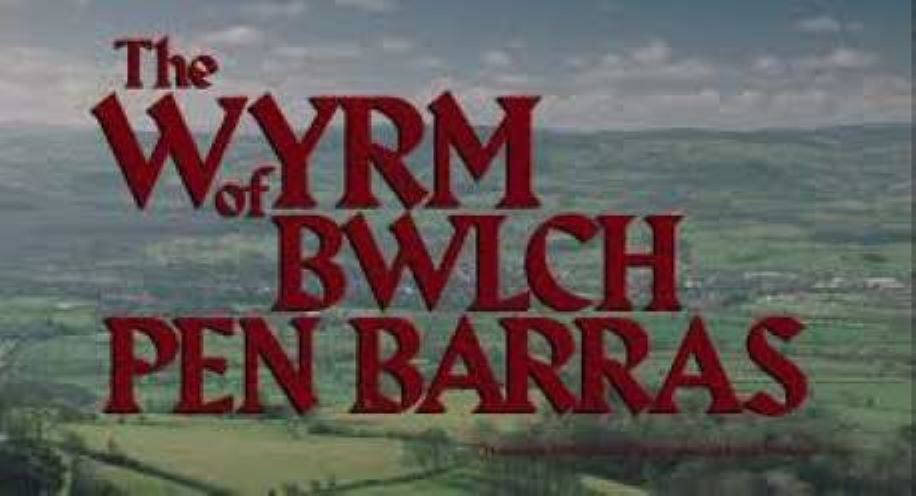
Warped Perspective/Keri: My first question is actually about your striking opening credits: they look reminiscent of other, older folk horror films (though of course that impression dissipates as soon as the characters in the film start using modern tech, like mobile phones, which has a great destabilising impact for the audience). Was getting the right tone on those opening credits important to you? And I have to ask – did any particular films inspire them?
Craig Williams: I absolutely love the genre films of the 70s; the kind of films the great film writer Michael Weldon would class as psychotronic. The work of Jess Franco, Dario Argento, Jean Rollin, etc. – that’s my aesthetic ideal. But I wanted to channel the spirit of that era in a modern genre film by juxtaposing Hammer-style credits, familiar folk horror reference points and an arcane-sounding title with a more grounded, quotidian vision of the present day in rural Wales (eg: the mobile phone, new model Range Rover and also the cable ties on Dafydd as he is marched up the hill).
The titles were designed by the artist Richard Wells, who has worked on so many films and TV programmes that I love, including Doctor Who, In the Earth and several of Mark Gatiss’s shows. I’ve been a huge fan of his work for years, so I knew from the outset that I wanted to ask him to design the posters and titles for Wyrm, and we were so thrilled that he agreed to do it. I know it’s a bit of an indulgence to have the titles appear at the beginning of a short film, but I hope they help set the tone. Given that nothing supernatural happens for the first fifteen minutes of the film, I still wanted to give a clear indication of where it was going, genre and influence-wise, and I think the titles are instrumental in that.
WP: Your film is presented in Welsh language. Whilst there have been more and more genre titles emerging over the past ten years which use Welsh, such as – quite recently – The Feast/Gwledd (2021) – was this in any way a difficult decision for you or the team? Or was using the Welsh language always the plan for The Wyrm of Bwlch Pen Barras?
CW: With Gwledd, Lee Havan-Jones has shown that Welsh-language horror can succeed on the international stage. I think we’ll start to see the impact of that playing out over the next few years. He’s done an amazing thing.
The Wyrm of Bwlch Pen Barras was originally written in English with some scenes in Welsh. The night before we were due to shoot, one of the actors asked whether I was open to shooting English and Welsh versions of the film side-by-side which, thanks to the pioneering work of Ed Thomas and Ffion Williams at Fiction Factory, has become more common with high-profile Welsh television shows. Julien Allen (my producer and creative partner on the film) and I had considered this approach from the beginning, but we were worried it was too much to ask of everyone, especially with such a tight shooting schedule. But the cast and crew were enthused by the idea and so encouraging, so that’s what we ended up doing.
We have therefore cut two completed versions of the film, one in English (with some Welsh at the end) and one purely in Welsh (with only a line from Dai in English). But it soon became evident to us during the post process that the Welsh version felt richer and more true to the material, so that’s the one we ended up submitting to festivals. I am so pleased we took this approach – Welsh is my first language, so this version of the film also feels more personal and meaningful to me.
WP: I think I’m right in saying that another working title for the film was Arswyd Bwlch Pen Barras (which I also think I’m right in saying translates to The Horror of Bwlch Pen Barras) – so if I do have that correct, and pardon my almost negligible Welsh if I’m wrong, what drove the title change to invoke something quite specific from British folklore, the idea of a ‘wyrm’?
CW: We initially thought the Welsh version of the film would need a Welsh language title but we ultimately decided that we loved “Wyrm” so much that it had be the title of both versions. I know there are many different iterations of the “wyrm” in folklore, but the version I was drawing on was the dragon from Beowulf. The dragon is the dominant symbol of Wales, and it’s a symbol of national pride, strength and unity, but in the local myths, dragons often have a more ambiguous and nefarious significance. There are still folk stories which carry symbolic weight today in which dragons protect villages – for a price, and I wanted to draw on that idea in the context of a horror film.
WP: What else influenced your storytelling here – this fairly remote, fairly traditional society, but one with a strange secret and codes of behaviour surrounding it? Some of the horror, and the beauty, reminded me a lot of a short story by L.T.C. Rolt called Cwm Garon – I don’t know if you know it – but it has the same sense of something unspeakable, something secretive linked to the Welsh landscape which lays claim to people (though outsiders, in this case).
CW: I love Cwm Garon. In fact, I first came across it in an anthology of folk horror stories edited by Richard Wells, who designed our titles and poster. It’s a wonderful story. In terms of specific Welsh influences, there’s also the work of Arthur Machen and two wonderful Welsh language folk horror films directed by Wil Aaron called Gwaed Ar Y Ser (Blood on the Stars) and O’r Ddaear Hen (From the Old Earth). In terms of British horror, stuff like Blood on Satan’s Claw and Requiem for a Village were at the forefront of my mind, as were films like The Shout, Frightmare, Straight on Till Morning, And Soon the Darkness etc..
The writer Kim Newman said that folk horror is often created from townies visiting the countryside, which I think is absolutely correct. It’s where much of the sense of isolation, paranoia and discomfort come from. It’s why films like Straw Dogs can feel like folk horror, even though they’re clearly going for something different. But we shot this film in my hometown, the place where I spent the first twenty years of my life. So I was approaching it from a different perspective – that of an insider who left and came back, which itself comes with a range of mixed feelings.
WP: The film manages, in a very subtle way, to suggest that whatever code or ritual is being passed down through the generations in this village, something is not working as it should. That adds to the horror, as it implies this ritual, if we can call it that, is no longer effective. Is that a fair interpretation?
CW: Absolutely. I didn’t want the film to show the first or last time this ritual happened – I wanted it to feel like it had become all-too familiar to the participants, almost to the point where it’s now a frustration or annoyance. But, as you noted, the wrinkle is the suggestion that the frequency of the ritual is increasing, which starts to destabilise the established dynamic between the parties and hopefully increase the sense of portent. Why is it becoming more frequent? When will it not be enough?
WP: Speaking of subtlety: did you always know you wouldn’t actually ‘show’ the horror itself? Tell us about that.
CW: The guiding principle throughout was author Ramsey Campbell’s comments about the stories of M.R. James: “[they] show just enough to suggest far worse.” Practically speaking, we couldn’t have shown anything on the budget we had so it was never an option, but I don’t think I would have wanted to anyway. The title tells us what the creature is, so there’s no ambiguity about that, but we still have room to imagine ourselves how it would actually look. I often think of the scene in Kill List where Neil Maskell’s character reacts to a horrifing video – we don’t see what’s on the video, we just see his petrified reaction. It’s such a powerful and disturbing moment.
WP: Have you been pleased with the reception of your film, and where next for The Wyrm..? Do you have plans for any new projects?
CW: I’ve wanted to make a film since I was a child, but I was always scared that it was something I wouldn’t be able to do. I’ve written scripts for years but never done anything with them. My son was born in 2021 and I didn’t want him to grow up and realise that his father gave up on his dream, so I knew I had to get out of my own way and just do it. So, given how much making the film meant to me, a part of me was nervous about putting it out in the world, but the reaction has been better than I could have ever wished for. People have been so kind about the film and I am so grateful to everyone who has taken the time to watch it and to the programmers, distributors, writers and podcasters who have supported it. I feel genuinely emotional and overwhelmed when I think of everyone who has helped make this whole thing happen.
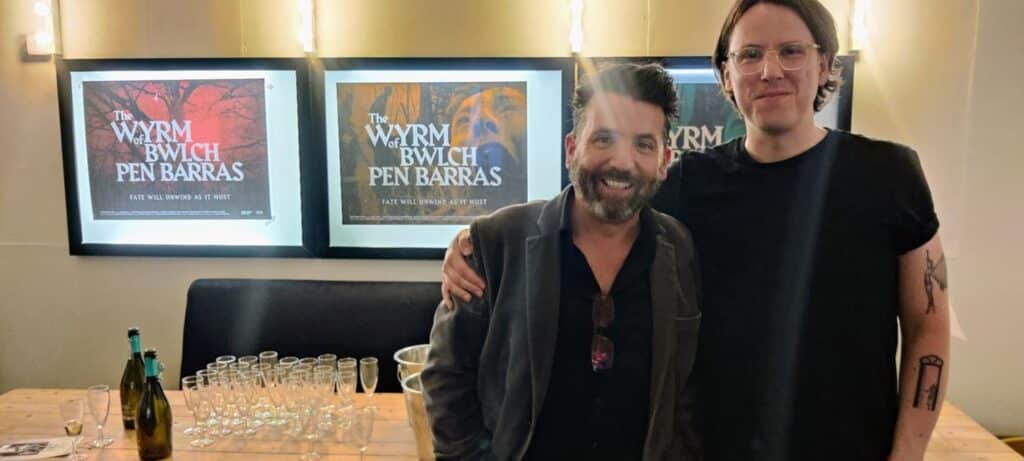
Julien (left) and Craig
As for new projects, Julien and I are working on something at the moment that we’re both dying to speak about, but we don’t want to say anything until it’s fully confirmed. We will hopefully have some news to share shortly. For now, I’ll just say it’s another Welsh-language project in a similar register to The Wyrm...
For more information on The Wyrm of Pen Bwlch Barras, you can check out the official website.
It’s the run-up to Christmas and, somewhere in a remote corner of Colorado, a lone traveller is off on a road trip, despite the treacherous conditions. He stops his car at a roadside café, but it seems that something is unfolding there: as the last customers depart for the day, leaving only our traveller – David – the waitress, Ana (Nina Bergman) has apparently been fielding a series of unhinged texts and calls from her estranged husband. She puts on a brave face, but – irrespective of the fact that David is sat there – the husband turns up, threatening, demanding, threatening, demanding.
This puts our guy David (Allen Leech) in a quandary: help her? Or recede into the background? He decides on the former, getting into a nasty conflict with Vincent (Yan Tual) as a result, but he successfully talks Vincent down in a well-acted and scripted sequence of events which feels like a genuinely tense situation. Things only lull momentarily however: after receiving Ana’s gratitude for his pains, David is back on the road again, but Vincent is soon on his tail, having presumably already jettisoned the sound moral lesson meted out back at the café.
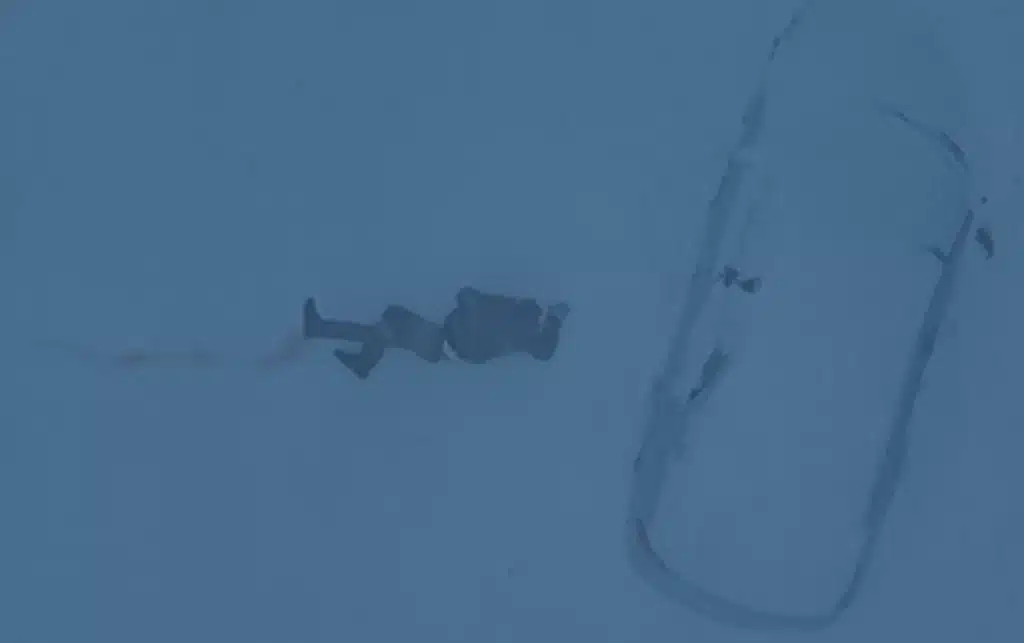
So it seems as though a game of cat-and-mouse is to ensue through this remote and hazardous stretch of the Rockies – in the dark, with a snow storm incoming. This would, by the by, serve for a great horror film on its own terms, in the right hands – a kind of Tailgate (2019) On Ice – but quickly, startlingly, Cold Meat begins to cycle through a range of different possible horror genres. We’re clearly faced with the horrors of the dark and the cold; there’s potentially a dangerous and sexually-jealous male out there; in fact, what could the film’s title actually mean? It’s a fairly workaday horror title, but still ambiguous: actually, I’d be all for scrapping the female voiceover during the opening credits, leaving things entirely to the audience to fathom, even though that would deprive the film of a neat moment of circularity later on in its runtime. But back to where we were: panicked, pursued and feeling the heat (ironically), David veers off the road, running his car into a sizeable snowdrift.
Is it bizarre that our Mr Rational is travelling by night, in the Rockies, without a snow shovel? Yes – the film does have a couple of moments where basic incredulity comes close to impeding on the film as a whole – but regardless, he can’t free his car, there’s a blizzard raging, and he decides to just hunker down for the night. So this is a survival horror now? David passes an uncomfortable night and, as planned, tries to look for help the following morning, where it’s clear just how much snow has fallen. Just as it could be a road movie, it could be an introspective nightmare of survival, but – as we soon find out – there’s more, far more than the cold to contend with here. In a dark twist, the film begins the real about-face work, disrupting, changing tack and introducing a range of ideas and threats to its audience.
It’s hopefully not to spoiler the film to point out that a lot of it takes place inside a vehicle, and as such, it needs good characters and a great script to stave off indifference. We very definitely get that here. David immediately comes across as an eminently decent, plausible man. He’s not quite an Everyman character – because most of us aren’t brave enough to tackle a potentially violent, spitting stranger – but he comes across well, which is important in a whole range of ways in how the film plays out. Kudos to Allen Leech for that, and to Yan Tual too, who does a great job of being David’s unreasonable Other: Vincent is splenetic, vindictive – and a bullying brat of a man, a danger to himself and others. Are these impressions accurate? The question seems answered, but then something else occurs. There are other characters too; they are equally valuable, and equally well-written, and the film uses the relationships between them, as well as other, external factors to perform abrupt bait-and-switch moments but also, gradual, casual, devastating reveals. Appearances are always deceptive in Cold Meat. We also get dreams and flashbacks which add texture and interest, but always more questions.
Just as interiors are of vital importance here, so are the exteriors, and the film makes great use of the landscape; it’s quick off off the mark with those intimidating, dangerous, unlit routes (there’s something so evocative about a car’s headlights picking up the next-to-nothing of a dark, mysterious road). It feels entirely plausible that someone could be buried in the snow out here and never found. It is certainly a cold-feeling film, too: the audio, as well as the visuals, make sure of that. The jeopardy is realistic. The early-stage frostbite looks convincing. All of this, and then more going on out there: a couple of very minor lulls are more than forgivable, given the devastating developments to follow.
As things progress, you see more and more that the film contains a sickly layer of misogyny, one which hits all the harder because it all stems from very commonly- and casually-held attitudes about women. These are often taken to their grimmest conclusions in horror of course, but they stem from something recognisable, and Cold Meat signals early that it knows this. The battle of wills aspect in the film hits all the harder for this early signalling, and the film is even confident enough to have its characters self-reflect on this, and other horror truisms along the way. Whilst it feels like accidental good timing that Cold Meat is releasing hot on the heels of True Detective: Night Country with its own long, dark roads and monstrous aspects, it is its own beast for sure. Filmed in just twelve days, and the first feature by director Sébastien Drouin, this is a tense and successful story which will surprise you. Recommended, and worth seeing without risking the news coverage by some of the larger horror outlets, quite honestly. It deserves to grant audiences those discomfiting surprises.
Cold Meat (2023) will be released in the UK on 26th February.