Tenet (2020)

“Does your head hurt yet?”

This is the question posed by Robert Pattinson’s character ‘Neil’ during Tenet, as he explains the concept of reverse entropy to the David John Washington’s protagonist – who helpfully goes under that name (‘Protagonist’) throughout the film. It could just as easily apply to any of us during the last six months of global chaos, economic shutdown, fluctuating travel restrictions, crushing social isolation, and various other attendant miseries caused by the reaction to a certain nasty little virus.

The release of a Christopher Nolan film has become a cinematic event. The release of Nolan’s Tenet has become a landmark event simply for being the first new film released in theatres after the aforementioned global shutdown that has thrown both film production and film release schedules into total and possibly catastrophic long-term disarray. The future of the traditional primary theatrical release has become a questionable prospect in the face of ongoing clampdowns on personal movement and restrictions on venue capacity that will throttle a film’s financial take. For those of us who value cinema as an artform, part of which is having the opportunity to see a film in its own dedicated temple, on the big screen, with an audience, as part of a communal experience, a collective cultural dreaming of sorts, Nolan’s insistence that Tenet would be a ‘in cinemas only’ for a summer 2020 release was heartening.

Anyway, returning to hurting heads, let it be said that Nolan, with Tenet, continues to bring a demanding intelligence to well-worn cinematic genres and tropes that is often missing in big budget releases nowadays, where there too frequently appears to be an inverse ratio between sky high budgets and respect for the audience’s intelligence (coughDisneyStarWarscough).  Whereas 2010’s Interception was perhaps Dreamscape with A Levels, Tenet might be classed as James Bond with a PhD in theoretical physics, or perhaps the old Terminator time travel chestnut, dusted down, and sent back to college. Nolan presents us with a relentlessly action-packed espionage-meets-science-fiction flick which flirts with philosophical questions about reality, time, and perception. Car chases, plane crashes and extended fist fights in various foreign locales are relentlessly complicated by quantum physics and an endlessly layering, inverting narrative structure, with perhaps some metatextual conceits about movie-making sprinkled in; nothing could be more Nolan, really.

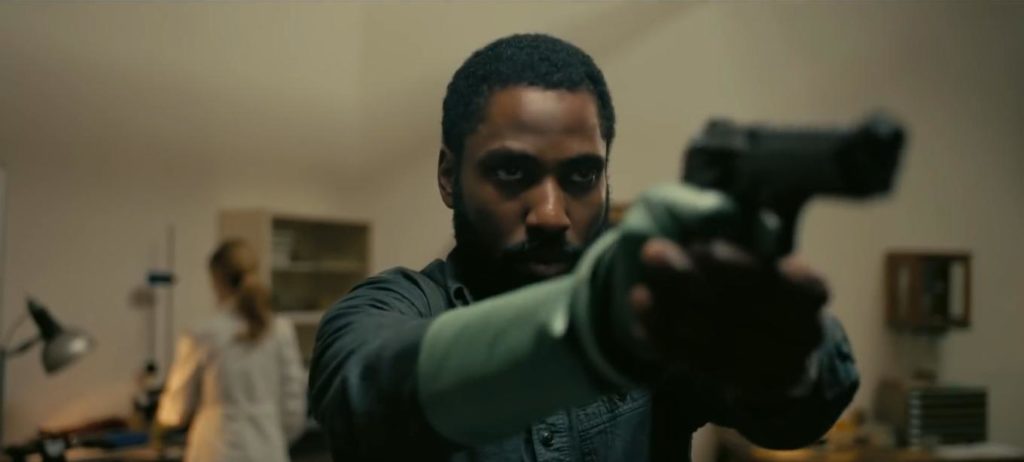
The story revolves around an CIA agent known only as Protagonist (David John Washington) who, during a mission to liberate a mysterious object from a Kiev opera house during a terrorist siege, attempts suicide to avoid betraying his colleagues. He wakes up to find himself having passed the recruitment test for entry into a shadowy intelligence-linked organisation named Tenet. Tenet’s purpose is allegedly to stop World War 3. From this point on, things start to get complicated.

Protagonist is taken to a secret laboratory and shown some strange ‘debris from a future war’. This future war is not the result of the current world politic, but a far future one that for reasons best known to itself is using an intellectually confounding future quantum technology – entropy reversal – to destroy parts of the present or rather, its own past. It’s clear nobody is really expected to understand how this tech works (even Protagonist looks bewildered at points), but simply accept that suitably ‘inversed’ objects, bullets, cars, weapons, or even people can move backwards in time, albeit with huge risks to themselves. This can be scaled up to a ‘temporal pincer movement’ for military purposes, using one team moving forwards in time and another backwards, both toward the same goal. Forwards and backwards with the same result. Like the word ‘tenet’ reads. Get it?

Protagonist recruits agent ‘Neil’ (a lively Robert Pattinson) with a convenient background in quantum physics who seems to understand this stuff better than he does, during another mission to track down the source of some mysteriously inverted bullets via an arms dealer in Mumbai. This leads him to the big bad guy of the story, a Russian billionaire and arms dealer named Andrei Sator, played with brutal relish and deliciously heavy accent by none other than Sir Kenneth Branagh. Sator’s personal malignancy, his motivations and the depth and significance of the threat he poses grow incrementally with each passing scene – to the point of actually believably establishing the kind of insane megalomania one associates with Bond villains, but devoid of cartoonishly silly quirks or quips. Protagonist’s initial access to this unpleasant oligarch depends on charming his beautiful, aristocratic, but emotionally and physically brutalised English wife, Kat (Elizabeth Debicki) who quickly establishes herself as the emotional, human and moral centre of the film, grounding the huge world-shaking threat to humanity in interpersonal relationships; between mother and son, and between Protagonist and Kat herself. She’s like an inverse Mal from Inception in this respect.
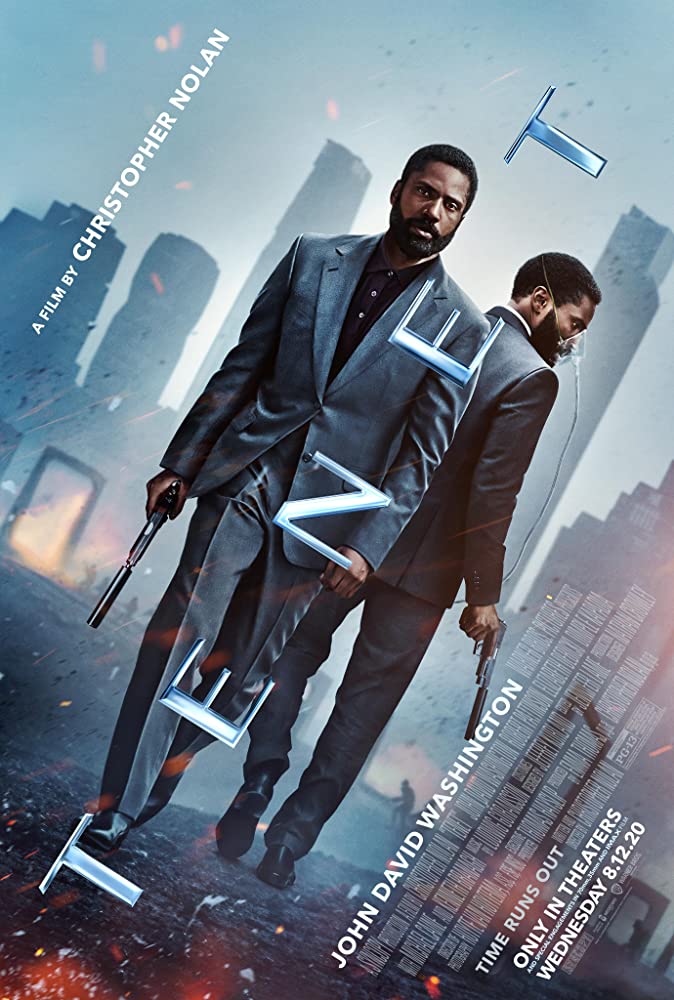
Epic set pieces action scenes abound as Protagonist, Neil and Kat work together to make sense of Sator’s significance to the mysterious far future to undermine his goals. We move in short order from India to England to Norway and Estonia to Vietnam in the travelogue style of old Bond films, and about again. There’s a scene involving a plane used as a weapon to demolish a freeport in Oslo that is pretty staggering, all the more for the fact that it was not done conventionally using CGI, but as a physical effect with a real, purchased aircraft, as it was apparently cheaper to film it that way. There’s also a by-now standard cred-establishing fight in a restaurant kitchen as the protagonist attempts to flee via the back door a la Besson’s La Femme Nikita  – which is kind of overused at this point, but there’s clearly something that appeals to directors about this one, so if you’ve ever wanted to see Russians and an American beat the crap out of each other using cheese graters and meat tenderisers, this is your moment.

The climax involves the ruins of an old Soviet secret city shattered by a nuclear accident. It’s an almost otherworldly landscape made all the more alien by the huge temporal pincer military assault upon it. But it’s the strangeness and complexity of the ideas and the abrupt plot twists and turns and shifts in perspectives they reveal that really compel. The bungeeing, brutal ass-kicking, various aquatic antics and mad car chases are just the fancy action icing on the big brain cake.

Tenet’s challenge is less the mind-boggling future quantum tech or the usual time travel paradoxes, but that it is both fast-paced and deliberately obtuse in narrative structure, leaving little to no breathing room to contemplate what has just been said or has just transpired plot-wise. Blink mentally and you could find yourself missing some vital piece of information. Another small niggle, although not a hugely significant one, is occasionally the soundtrack competes with the dialogue to ear-straining effect. It’s the kind of film where you have to accept everyone around you is probably as confused as you are at certain points and just engage as much as possible with events as they happen. It’s enjoyable even when it occasionally leaves you floored and it’s well worth hanging in there, as everything does pull together in the end in a way that suggests we’ve actually just witnessed the beginning of a possible saga, although one I’m sure we won’t see. It’s definitely the kind of film that will reward repeat viewing – I suspect the point, actually. I was left immediately wanting to rewatch the whole film given the final perspective shift that I will not spoil for you here.

Cinema chains globally have suffered huge losses during the shutdown, and studios have become skittish about when, or even if, to place planned new releases in cinemas, placing the cinema industry in some jeopardy. If you think films deserve to be seen in the environment they were designed and produced for – a proper theatre – now is the time to show your support, unless perhaps you are happy with a future consisting of paying ludicrous sums for VOD releases on top of your usual streaming service fees to watch. It’s as good a time as any to vote for the existence of cinema with your wallet. Tenet is well worth the trek back to the multiplex.

Tenet (2020) is available in cinemas now.

Joker (2019)

Remember the seventies and eighties, when regular moral panics about popular films, music, television shows and finally, videos were the thing? When the Tipper Gores and Mary Whitehouses of this world would insist, without a scrap of real evidence, that various media were responsible for acts of moral depravity and horrific violence? This argument has emerged regularly, as again with the rise of video games as a convenient scapegoat for the acts of damaged individuals, often wheeled out confidently by the gutter press and politicians as a primary cause of complex crimes before the facts of the case are even in.

In 2019, we find ourselves at another cultural moment where mainstream entertainment is accused of inciting crime and this time it seems to be the media at large, and more shockingly, film critics themselves, who are pushing this narrative. The latest film in the critics’ crosshairs for allegedly promoting violence and masculinity of the (buzzword klaxon!) ‘toxic’ variety is Todd Phillip’s Joker. The run up to the release of the film included warnings based on absolutely no evidence that it may somehow spark the new media bogeymen – the alleged ‘incels’ – to take to the streets with their personal arsenals and wreak havoc, on the grounds that such people really exist in grand droves, are inherently violent and murderous, and all they need is the correct encouragement by a mainstream picture to get busy.

As it is, a few weeks into release, Joker currently has a body count of zero, and a box office take ($600million – a massive success given its $70million budget) that suggests an awful lot of people have seen it, which perhaps should tell us all something about what world critics are currently inhabiting – an entirely separate one to paying audiences, it seems. This also seems reflected by the current vast division of opinion between audience and critics on sites like Rotten Tomatoes – a divisiveness that didn’t begin with Joker and surely will not end with it.

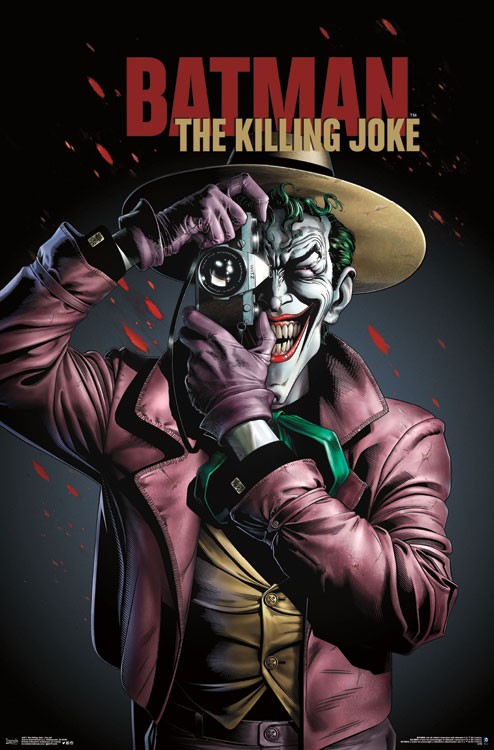
Joker is a very interesting take on the comic book; the film blends the premise of Alan Moore’s acclaimed one-shot Joker origin story The Killing Joke – the Joker as failing stand-up comedian – with a narrative and visual love letter to an era of film with which many younger filmgoers today will be sadly unfamiliar – the seventies to early eighties. This was an age of films mired in the seedy, darker side of American life, often exploring the criminal fringes of society, the put-upon working class and the travails and existential angst of the average man or woman trying to get by in a society awash with crime and corruption. Conventional heroic attributes were thin on the ground. It’s all a hell of a long way away from the colourful, PG-rated, superhero fantasy tentpole popcorn pictures that have dominated the mainstream cinema landscape for the past ten years.

The seventies to early eighties was an era of cinema that reflected the changes in modern society of the time, political upheavals as well as the sexual revolution. It centred on society’s rebels – with or without a cause – and anti-heroes; flawed, morally struggling or simply increasingly unhinged characters, played with relentless intensity and Method-style commitment by rising stars such as Robert De Niro and Al Pacino. They were unrelentingly gritty, often unsettling and dark-natured films, nothing that anybody could  ever describe as ‘feelgood’. Think Serpico, Dog Day Afternoon, Network, Silkwood, Scarface, Midnight Cowboy, The Deer Hunter, Raging Bull, and in particular the relatively little known De Niro vehicle and 1982 box office flop, The King of Comedy, which alongside 1974’s Taxi Driver, 2019’s Joker owes a huge narrative and visual debt. These were and remain films for adults, not for children, and they existed at a time when cinema attendance was at an all-time low whilst cinemas were falling into disrepair alongside ailing economies. This all started to change with the rise of the blockbuster film, the family-friendly, FX laden spectacular that drew in repeat viewers of all ages, beginning with Star Wars in 1977. Combined with clever toy merchandising, this trend financially reinvigorated and eventually came to dominate the business and redefine its target market, but the era is still cinematically defined by the gritty, adult-oriented works of Martin Scorsese and the intense performances of Robert De Niro and Al Pacino, among others.

Joker is set in the same era as all this cultural and political fracturing – and veers so far away from the safe, family-friendly, entirely self-referential ‘universe’ now associated with the comic book genre that many critics seem to forget what Joker still is, and what it is not. Despite its adult nature and feints at digging into the social upheaval of the times, Joker is primarily a comic book movie. It is an origin story of one of the most well-known comic book villains in the genre’s history. It is not an instruction manual. It is not a political manifesto. It is also something missing from the comic book genre since Christopher Nolan’s Batman trilogy – a comic book film as the particular and peculiar vision of a single filmmaker – Todd Phillips – in this case, a vision informed by the work of another singular filmmaker, Martin Scorsese. Indeed, Scorsese was involved with the production in its early stages.

Part of what allowed for such a singular vision is that fact that Joker was conceived and shot as a stand-alone film rather than the beginning of a franchise, freeing it from the pressure of setting up a sequence of films down the line, instead of just getting on with a story and telling it well. The story of the Joker as the victim of random violence, familial neglect and abuse, fatherlessness and grand systemic failures, as well as his own peculiarly odd psychology and poor decision-making, it is emphatically an adult film, just as Moore’s The Killing Joke is an adult comic book. While highly entertaining and well-paced, it asks more of the viewer than simply to sit and let the pretty colours wash all over them. It requires some attention and a little bit of thought. It relies, staggeringly in this day and age, on an emotionally and physically visceral central performance by Joaquin Phoenix rather than large-scale explosions of pixels, and that thing that seems missing from so many high budget properties these days: a  strong script. It seems as far away from filmmaking by corporate committee and green screen as the fantasy and clearly-delineated heroes/villains of Lucas’s Star Wars universe were from the mentally-ill veteran Travis Bickle and the mean, dirty streets of 1970s New York in Taxi Driver.

Joker presents an origin story, the all-important part of any comic book character’s mythos. It is not, and this is where we suddenly find ourselves in Gore/Whitehouse territory according to parts of the mainstream media who should know better, a call to arms for the disaffected to don clown masks and commit mass shootings. It is still the story of the creation of the arch villain of the Gotham mythos, the psychological terrorist named Joker – the nemesis of and inverse of Gotham’s Batman. Where both experience massive trauma, filthy rich and well-loved Bruce Wayne turns to a pathological fixation with law and order and the creation of a masked alter-ego to effect this, while Joker posits that poor, neglected from childhood Arthur Fleck becomes the ultimate nihilist whose early experiences and constant physical brutalisation lead him to the conclusion that life itself is a joke, and a black one at that. Clown make-up follows naturally, given his former profession as a party clown. Both seek empowerment as their backgrounds, psychologies and resources shape and allow them, for good or for ill. The suggestion that audiences so lack a moral compass or ability to separate art from reality they will be persuaded the Joker’s way is the best way and from thereon wreak havoc, seems implausible at best.

Phoenix’s performance is incredible throughout, an absolute tour de force ranging from a tragically vulnerable and sympathetic adult, to his final, utterly deranged moments of terror theatre. His physical performance; his tics, twitches, subtle mood shifts and swings, his physical fraility (Phoenix lost a lot of weight for the role), his odd, comical clown-shoed walk, his almost Jame Gumb-esque effeminate affect at various points to his final flowering into violence and self-assured villain with a nothing-to-lose swagger, dominates every scene. The entire film is shot from Arthur Fleck’s highly unreliable point of view, allowing him to mislead us at several points as to what has occured in reality as opposed to his fervent, demented dreamworld. Some scenes are instantly recognisable as fantasy, as when he imagines himself being pulled from the audience and hugged by his chat show hero and what appears to be the father figure of his imagination,  Murray Franklin, played by Robert De Niro. Another imagined moment, more believably, pivots on the primal relationship between fighting and sex after the Joker’s first kill.

Philips’s script draws heavily from the narrative of Martin Scorsese’s 1982 film The King of Comedy, a meditation on the obsession with fame and celebrity in American culture which centres on a mentally unstable stand-up comedian (Robert De Niro) obsessed with a TV host (Jerry Lewis)  who commits a crime in an attempt to manipulate himself into the television spotlight for just one night, come what may. His rationale for this is ‘Better to live one night as a king than a schmuck for eternity’ and this seems to function as the central motivation that the unstable Arthur Fleck finally seizes upon, after a sequence of unfortunate events lead to him killing in self-defence. Indeed, De Niro takes on the role of a very similar talk show host in Joker that his own character was fixated on in The King of Comedy and the film’s final scenes set in a TV studio echoes some of the final scenes of The King Of Comedy. Other sequences seem to draw on Scorsese’s Taxi Driver, particularly the sequences of Bickle’s breakdown. One may even spot a touch of Sidney Lumet’s classic Network in there at points, swirling around the themes of the power of television, suicide and celebrity. Mad as hell, and not going to take it anymore – the rallying cry of the maddened TV host in 1974’s Network – seems to be the mood in the 70s Gotham Arthur Fleck inhabits; it’s a tinder box of poverty, decay and corruption waiting for the fateful spark to set the whole place aflame. Fleck’s Joker is less a leader than someone whose image and criminal acts the already inflamed mob seizes upon to reflect their own discontent.

Joker is by turns bleakly comical, shockingly violent and oddly touching, and overall is an intoxicating, wild ride of a film that manages the precarious balancing act between psychological reality and comic book excess and between presenting Fleck as both vulnerable and recognisably human, a horrific accident waiting to happen. We know from the start that Fleck falling into permanent alter-ego villainy is the point, so the interesting part is how we get there: this film presents the story in such a new and refreshing way, entirely dependent on abnormal psychology in a way that seems to have struck a chord with contemporary audiences. It is one of the only films in recent times I’ve seen that had the audience stay through the credits, excitedly discussing what they had just seen.

It says a lot about how many modern critics have been trained to think, or at least about the type of copy they are urged to submit for maximum clicks, that they are unable to view a complex and nuanced piece of entertainment as well as a refreshing take on the increasingly safe and stale comic book genre without insulting our intelligence, rushing to moral condemnation over the effects it may have on us – the poor, easily-influenced audience. Mainstream film critics currently seem more and more intent on evaluating all mainstream films as overt or covert political manifestos and issuing a pass/fail not on artistic merit, but depending on which side of the political aisle the manifesto appears to fall. Meanwhile, audiences seem more and more intent on ignoring them and evaluating films on their own terms, or simply for their inherent entertainment value. In which case, long live the audience, and the film critics may be writing themselves into the history books as, well, clowns.

40 Dark Years of the Night Porter – a Retrospective


By Helen Creighton

1974’s Il Portiere di Notte, aka The Night Porter, is a film that uneasily straddles the line between art house movie and outright Nazisploitation flick. It deals with the post-war meeting and subsequent doomed relationship between a young female concentration camp survivor, Lucia (Charlotte Rampling) and the oddball, sadistic SS officer Max (Dirk Bogarde) who both sexually abused and protected her there. Post-war, Bogarde’s character hides in the shadows of Vienna as a night-shift hotel clerk, consumed by shame and consorting with a motley crew of ex-Nazis and collaborators who hold regular mock trials where they cynically rehearse their contrition and defence, whilst colluding in the destruction of evidence and the murder of any witnesses to their wartime atrocities. Lucia, haunted by her past to the point she reignites her twisted sexual relationship with Max after a chance meeting, is just such a witness. On release in 1974, the film met with almost universal critical distaste and to this day has the ability to trouble and perturb both critics and audience with its refusal to refer to straightforward Holocaust victim narratives, its incongruous display of eroticism within the confines of a death camp and its exploration of complicity as a component of survival under extreme circumstances. Too slow and serious for a standard exploitation film audience, too explicit and shocking a subject matter for the arthouse crew, it seems likely to forever remain a cult film.


Italian director and screenwriter Liliana Cavani cites a chance meeting with a female survivor of the Nazi death camps as the inspiration for the film. She noted a woman laying flowers at the site of an infamous camp. She spoke with her and learned she was a survivor of the camp, assuming the flowers were for a murdered family member or comrade. Not so. The woman spoke of her lover, a German officer. Cavani’s shock and subsequent curiosity concerning the occurrence of such seemingly bizarre relationships (that did indeed occur – in cases such as Katya Singer, who parleyed her own notorious beauty into a book-keeping position in Auschwitz-Birkenau, an SS officer lover and the ability to save many lives) informed her writing of the screenplay. The film is clearly also informed by the complex European political situation post-war, where Cold War concerns reigned supreme, but the spectre of fascism was still alive and well and living quietly in society’s closets. Italy had just suffered what are referred to as the ‘Years of Lead’, characterized by far-right terrorist activity rumoured to be sponsored by anti-communist, Nato-led Operation Gladio. Not only had many Nazi war criminals simply disappeared into the night (and over to South America and the Middle East etc.) in 1945 and beyond, remaining forever unaccountable for their crimes against humanity, many more had been officially ‘denazified’ and remained in the top tiers of society, politics and business. Hidden in plain sight, rich and successful, their pasts unspoken of, such circumstances eventually inspired far-left German terror group Red Army Faction to explode in a orgy of violence and murder of their own. The Night Porter’s gang of Nazi reprobates living in the shadows in Vienna, secretly rehearsing their own self-defenses and clearing their consciences doesn’t seem that far-fetched, in light of this.

However, beyond the endlessly discomfiting narrative, beyond the politics, beyond the ambiguities of sado-masochistic relationships, beyond Rampling’s fierce, blue-eyed, outraged gaze, Bogarde’s perfectly-pitched, fury-laced descent into obsession and and their characters’ disturbing, joint regression into their pasts, it is Cavani’s startling, iconic visuals that remain in the mind’s eye and which have subsequently infiltrated the mainstream and informed many a subculture. Lucia’s semi-nudity combined with her deconstructed SS uniform and cap remains a standard erotic fashion reference from catwalk couture to your average S&M club. Any single frame of the sequence set in the louche Nazi officers’ mess, replete with accordion-playing,Venetian-masked SS officers, where young Lucia sings for her life may as well function as a precise snapshot of influential and controversial neofolk band Death in June’s entire aesthetic. I’ve seen that outfit referenced in everything from random episodes of the 90s TV espionage series La Femme Nikita to the covers of mainstream women’s magazines. Lady Gaga’s video for the song ‘Alejandro’ owes a great unspoken debt to The Night Porter’s aesthetic sensibilities and themes, while Lucia’s eroticized SS gear pops up as one of many casual outfit changes in her video for her hit ‘Love Game’. As recently as 2011, designer Louis Vuitton’s collection clearly referenced the film. For a film which posits that the present is forever haunted and indeed deformed by the unacknowledged spectres of the past, this seems a fitting legacy.