
by Ben Bussey.
The last few years have given rise to a wave of Japanese exploitation cinema that is in many respects truly unlike anything that we have seen before: films which centre on people, more often than not pretty young women, with bizarre cybernetic limb replacements – lethally sharp, mechanised appendages that drip with ooze and protrude from the body where once there were arms, legs, and more besides – who proceed to utilise these deadly cybernetic body parts against their enemies to staggeringly gruesome effect. Sure, on a conceptual level such visions might not seem especially new and unique from the country that gave the world anime, but rarely to my knowledge have such tales been told in live action, and certainly not captured in relatively lo-fi DV with such ridiculous, excessive gore FX.
Arguably the key figure in this new wave of J-sploitation is Yoshihiro Nishimura. Scan through the credits of most of these films and certain names crop up more than once, but surely none appears more often than his, primarily because he has served as special make-up effects designer/artist or supervisor on pretty much every gory Japanese film of note from the past decade: Suicide Club, The Machine Girl, Meatball Machine, Samurai Princess and RoboGeisha to name but a few. Check out his IMDB page; there are 65 make-up credits to his name thus far, all but two from the last ten years.
This alone would be enough to pinpoint Nishimura as a major player in modern horror. But of course, the name of this column is Definitive Directors, and it so happens that he’s also responsible for directing what is surely the greatest, most influential J-sploitaion film of the 2000s; a film he also co-wrote, edited, and again designed the FX for. While his subsequent directorial work may not have quite met the same standard, his films are never less than eye-catching; and it should be emphasised that, contrary to what some might think, this is not down to the gore alone. While the abundant gloop and pus may be the key sales point, scrape all that viscera aside for a moment and you can’t fail to note the equally virulent brand of satirical humour that permeates his work. And never more so than in his masterwork…

Tokyo Gore Police (2008)
Would anyone dispute that this is the definitive modern Japanese gore film? Some might argue in favour of Noboro Iguchi’s The Machine Girl; a notable film for certain, which does predate Tokyo Gore Police (although only just, having also come out in 2008) and as such might be regarded equally vital to kickstarting this new subgenre. But as gory and darkly funny as The Machine Girl is, Iguchi’s vision does not come close to the sheer scope of Nishimura’s here. Not only is Tokyo Gore Police a considerably larger scale film on a practical level, spreading its action across way more locations and characters with a far greater number of cybernetically enhanced killers, but also the film covers a far broader canvas thematically, with many barbed comments made about 21st century Japan, most of which are equally applicable to the west.
The set-up is that in the Japan of the near future, a new breed of criminal has arisen known as Engineers: genetically modified, borderline indestructible, invariably psychotic murderers who grow back a deadly cyber-organic body part whenever they are injured. One of the few humans capable of taking them down is Ruka (Eihi Shiina), a cop on the Engineer squad of the now-privatised Tokyo Police. She slaughters her prey with efficiency and emotional detachment whilst trying to forget that her father, in whose footsteps she followed to the job, was assassinated for protesting against police privatisation. Her only release comes in self-harm, regularly cutting herself with the same detachment she brings to killing Engineers. But as she investigates deeper into the underworld of the Engineers, events force her to reassess her loyalties. (And let’s not forget that, though the core plot is similar, this was a year before District 9.)
As we might deem fitting for a film dealing with people pieced together from various machines, Nishimura lifts bits and pieces from a wide range of notable filmmakers: Cronenberg, with the core conceits of body horror and disease as metamorphosis; Verhoeven, with the emphasis on excess, anti-corporate sentiments, and the broad lampooning of mass media via the Robocop/Starship Troopers-esque TV ads (words cannot express how much I love the fact that they use the theme music from the Masters of the Universe movie); Tarantino, with the diverse, often 70s tinged soundtrack and visions of Tokyo that echo Kill Bill (or perhaps that’s just my western perspective speaking, given how influential Japanese cinema has been on Tarantino); Raimi, Gordon, Yuzna and Jackson, with the ludicrous cartoonish bloodshed; even a bit of Argento, in the scenes of a leather-gloved killer stalking women. Takashi Miike’s influence can also be felt, owing in no small part to the presence of Miss “Kiri Kiri Kiri” herself, Eihi Shiina. Casting her as Ruka was an inspired move; thanks to Audition she is established not only for being as alluring as she is terrifying, but also as a real actress to be reckoned with, which frankly cannot be said of a great many J-sploitation actresses. Despite the overwhelming absurdity of proceedings, Nishimura gets an entirely serious performance from Shiina, which helps lend the film a harder edge than many of the films that have come in its wake. Ruka’s journey is the driving force of the narrative, and as such the film does lose some momentum when she is off-screen, which unfortunately is the case too often, particularly around two thirds in.
Then there’s Shiina’s notable co-star: the gore. Yowser. I think we can safely assume there are individual scenes here with more arterial spray than all the Lone Wolf and Cub films put together. And as if that wasn’t enough, there are the physical disfigurations of the Engineers themselves. I recall before Grindhouse came out, Rose McGowan said that amputee fetishists would have a lot of fun with Planet Terror; well, from that standpoint Tokyo Gore Police is pornographic enough to make Planet Terror look like The Blue Lagoon. I could do the list of the many varied body modifications that rear their ugly-yet-strangely-attractive heads, but that would deprive the unitiated of half the pleasure of the film, whilst those who’ve seen the film will doubtless need no reminder; suffice to say the young lady in the photograph above who takes ‘vagina detante’ to a whole new level is a good indication of what to expect. If you were wondering what there was left to do with the human body on film, well; here’s some of it.
But once again, this is not the beginning and the end of the film; this is not just mindlessly excessive body horror entirely for its own sake. In-keeping with Cronenberg and Verhoeven, this is gore with purpose. These hideous creations can be seen as reflective of the society that produced them, the dehumanising effects of the system made flesh, so it is by no means accidental that the Engineers wind up more sympathetic than the cops. Yes, it’s done for comedic value, but doesn’t the best comedy usually tap into genuine concerns and issues?

Vampire Girl Vs Frankenstein Girl (2009)
Co-directed with Naoyuki Tomomatsu (subsequent director of Erotibot), this is a somewhat smaller scale film in every sense, but a charming one nonetheless. Where Tokyo Gore Police grafted its frenzied blood orgy onto the cop movie, here we have a similar approach taken to the high school romantic comedy. In a curious way, it’s a pretty standard chick flick; teenage arch rivals, the queen bee and the new girl, do battle over the affections of the same boy. Why, you could almost envisage Lindsay Lohan and Hilary Duff acting in such a movie. Only in this instance ‘do battle’ is not just a figure of speech, and the girls in question are a vampire, and a Frankenstein monster (once she’s suffered a squishy demise and been rebuilt by her mad scientist/biology teacher father). The fact that the doe-eyed boy unwittingly caught at the centre of the conflict is basically given no choice in the matter and doesn’t particularly care for either girl only makes the whole thing more amusing.
It may feature two of the greatest horror staples, but don’t go in expecting anything remotely resembling the Universal or Hammer classics here. Nishimura and Tomomatsu simply take two monsters that need no introduction and use them as a convienient access point to a ridiculously over the top spoof of teen movie conventions and teen culture. However, while the movie conventions may be pretty universal, some of the cultural references are a wee bit more specific to Japan. I don’t know if this is the case on all DVD editions of Vampire Girl Vs Frankenstein Girl, but on the UK edition from 4 Digital Media the film has a fair few explanatory subtitles: for instance, an opening panel informs us of the Japanese tradition of girls giving chocolate on Valentine’s Day, so we will understand the significance of the chocolate that vampire girl Monami (Yukie Kawamura) sneaks to her object of affection Mizushima (Takumi Saitô); and later, when soon-to-be Frankenstein girl Keiko (Eri Otoguro) tells their teacher that Monami indulges in ‘compensated dating,’ this is explained as young women going with older men in exchange for gifts.
These explanatory subtitles are never more welcome than when the film introduces… gulp… the Ganguro Girls. They may be minor players in the narrative, but they may well be the most unavoidably memorable element of the film. Why? Because on first glance, the only reaction to the Ganguro Girls is for the viewer to slap the hand directly over the mouth and gasp JESUS CHRIST. To explain: they’re Japanese girls made up to look African. But more than that, the girls here are in prosthetics that blow their faces up to grotesque proportions, caricaturing African stereotypes in a manner that is shocking to say the least. Thanks to the subtitles and a bit of subsequent reading, I am now aware that Ganguro is an actual recent trend in Japanese youth culture, and once you learn that these scenes become a little easier to take; as with Ali G, the butt of the joke is not black people, but those who try to appropriate a black identity in the absence of any identity of their own. Even so, it’s hard to watch these scenes without at least wincing a little, and without a doubt many will be truly offended. On top of which, some will undoubtedly not take kindly to the other notable outsider clique: the school wrist-cutter team, trying out for the national wrist-cutting rally.
Of course, if they have offended audiences far and wide, it seems fair to assume Nishimura and Tomamatsu will not be losing any sleep over it. In common with a lot of modern horror, this is filmmaking that seeks to get a reaction, to shock and outrage those with delicate sensibilities. The key difference, however, is the overall tone and intent. From the over-the-top characterisations, garish colour scheme, bubblegum soundtrack and overall sex appeal (all the principle females are uniformally gorgeous, and just as in RoboGeisha male lead Takumi Saitô is equally good looking), it is clear that Vampire Girl Vs Frankenstein Girl is first and foremost intended to entertain. This seems to be true of most J-sploitation, and it is far from the prevailing Raison d’être of the genre today. There’s a lot to be said for this emphasis on entertainment value, I think. As much as there is to admire about the likes of A Serbian Film, Red White and Blue and The Woman, there can be little question that these are not films intended to show you a good time; as Keri rightly said in her review of The Woman, they are films “made to be discussed first and enjoyed second.” Of course we horror fans should welcome cinema which aims to confront and challenge the audience, but really, is there anything so wrong with horror movies that are just plain fun? If we’re honest, didn’t most of us who are fans of the genre gravitate towards it because of films which are a good laugh to watch: the camp and corny creature features, the slashers and splatter movies?
It took me a while to warm to them, but I have no reservations now in celebrating Nishimura’s films, and contemporary J-sploitation overall. They serve as an agreeable reminder that horror can be plainly and simply entertaining, and that this is a perfectly acceptable goal. Yes, there is plenty of food for thought to go along with the gore if you care to look for it, but otherwise these are films in which it is no problem to just kick back and enjoy the ride. Regretably I’ve yet to see Nishimura’s more recent directorial efforts Helldriver and Mutant Girls Squad, but I gather more of the same can be expected from both, and I can’t say I have a problem with that. I’ve said it before and I’ll say it again: this is a wave of filmmaking that I truly believe stands apart, comprising a body of work as distinct as that of Hammer Horror, the Italian zombie movie or the first wave of slashers, and when history recognises them as such, it will also acknowlege Yoshihiro Nishimura as the man responsible for the best of it.
 by Ben Bussey
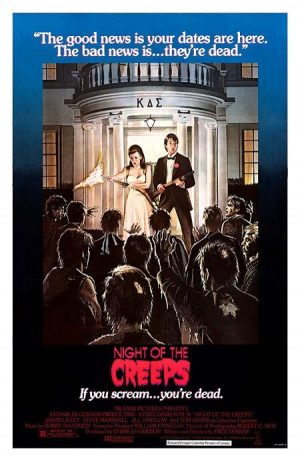 Now, obviously I don’t mean that I thought it was bad; I’m not such a masochist as to sit down to write a retrospective on a film I’m not a fan of. What I mean is I literally couldn’t figure the damn film out at first. Very little is given away by the initial title sequence, which appropriately enough simply highlights the title, in a font agreeably reminiscent of EC Comics (Dekker has likened the logo to that of Famous Monsters of Filmland). Next thing you know we’re on a spaceship, watching an amusingly dome-headed alien rushing down a corridor clutching a canister. Right, so we’re watching a sci-fi movie then. But wait… now it’s suddenly gone black and white and we’re on Sorority Row in 1959. Long-skirted, cardigan-wearing college girls beam into telephones about dreamy guys, the radio hums with the sound of crooning, and a girl goes for a drive in her boyfriend’s convertible. Okay, so it’s an homage to 50s teen movies instead. But then a comet comes down to earth, It Came From Outer Space style; ah, so we’re back to sci-fi. But hang on; now there’s an axe-wielding escaped mental patient in the mix. So what, it’s a slasher too now? And he’s raising his axe to strike, when all of a sudden we cut to the same Sorority Row in 1986, everything’s Technicolor again, some distinctly 80s soft rock fills the air, and we overhear a couple of nerdy young men ruminating on heartbreak. So where are we now, John Hughesville?
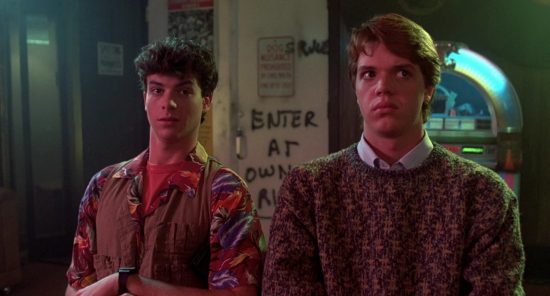 And the great thing is, in spite of the convoluted plot in which it is eventually explained that brain-eating alien organisms are zombifying much of the college campus, what really draws you in and hooks you is the cast. Dekker may have overloaded everything conceptually, but he clearly understands that the key to really drawing the audience in is protagonists they can care about and relate to. Henceforth, we have Jason Lively’s Chris, and Steve Marshall’s JC. Both young actors (Lively was only 18), and neither exactly boasting teen idol good looks, they’re the loser underdogs that so many of us feel we are. But what they lack in alpha male virility they more than make up in wit, Chris ever ready with some pithy self-deprecation and JC constantly spouting overconfident wisecracks. They could easily pass as a prototype for all the best buddy relationships that later became the staple of Kevin Smith, except Smith never threw his characters into quite so freakish a scenario as Dekker does here. (Well, aside from Dogma.)
 The point I keep returning to here is what a real film geek movie Night of the Creeps is. This much is evident immediately from the disorienting genre-hopping of the first few scenes, and it really gets hammered home as we catch the names of our principal characters: Chris Romero, JC Hooper (the initials standing for John Carpenter), Cynthia Cronenberg, Ray Cameron; there are even cops named Landis and Raimi, and a janitor named Mr Miner. (Okay, so we don’t generally hold Steve Miner in such high regard nowadays, but he did give Dekker his first Hollywood job as a writer by filming House, and also did some uncredited second unit work here, shooting the dressing up montage prior to the sorority house finale.) Then of course there’s the sure-fire signifier of any cult movie, the Dick Miller cameo. This abundance of references to genre cinema both old and (at the time) new gives the movie a knowing edge that was arguably not too common in the 80s. This was six years before Reservoir Dogs and a decade before Scream; intertextual referencing was not yet hip and groovy. Is it fair to call the movie a trailblazer in this regard? Given that it wasn’t a hit on release, and that I only saw it myself for the first time three or four years ago, I couldn’t really say with any authority. But I certainly get the feeling it might have been.
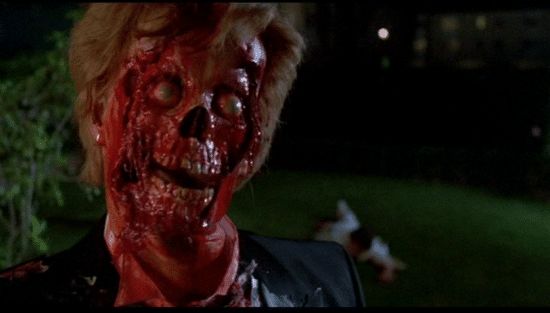
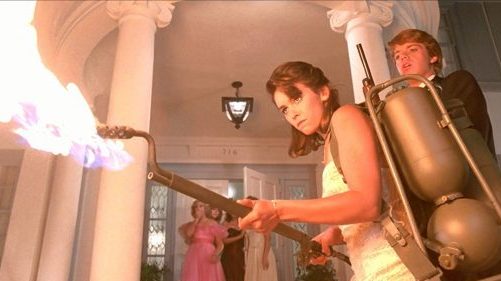
 And can you believe I’ve spent this long talking about a sci-fi horror comedy and haven’t even touched on the monsters yet? It’s as though, in Dekker’s world, the parasites of Cronenberg’s Shivers gave birth not to liberated sex fiends but the classic zombies of Night of the Living Dead. They don’t set out to redesign the wheel here, delivering simple, pale skinned, white-eyed shuffling corpses, but the real ace up the sleeve is the unique method of dispatch. It really feels like the culmination of a pub debate: “What’s cooler, blowing their brains out or burning them alive?” “Hey, I know – what if we blow their brains out, AND burn them alive?” “AWESOME!” And it really is. What a fun-filled final reel it gives us, with Chris, Cynthia and Cameron wasting creeps every which way. We also can’t fail to notice a pre-Braindead (or, for y’all Americans, Dead Alive) use of a lawnmower. It’s certainly not the goriest climax the 80s gave us, but it sure is some good, brain-blasting entertainment.
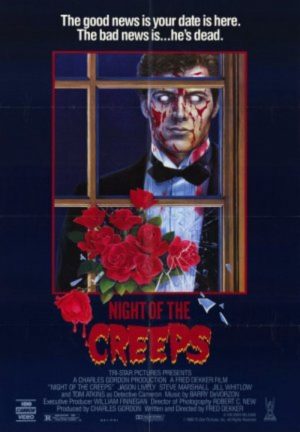 Nor does the hard edge stop there. I’ve already alluded to the tragic, tortured side of Ray Cameron; this goes beyond the melancholic and into the suicidal. Having almost thirty years earlier lost the woman he loved to an axe murdering maniac that same night a botched biological experiment from outer space fell to earth (boy, don’t shrinks get tired of hearing that one), Cameron has never come to terms with his grief, and would most likely have drunk himself to death already were it not for the job. Such characters were popular in 80s Hollywood, Rambo and Riggs being other notable examples of traumatised, suicidal men unable to adapt to normal life, whose only release comes through violence. The key difference, however, is that while those action men found redemption and a new sense of purpose, Cameron gets his wish and is allowed to kill himself. Yes, he destroys the alien parasite menace in doing so, but does that perhaps only serve to validate that which he was intent on doing regardless? Let’s not forget that before Chris shows up to seek his help on that fateful night, he was all set to blow up his own house, and himself with it. When he gets to do it in the sorority house instead, it’s a double-barrelled cathartic impact; the creeps are defeated and Cameron’s out of his misery, and it would appear we’re invited to take comfort in both. Does this make Night of the Creeps a pro-suicide/assisted death horror movie? Is there a moralist protest in waiting here…?


