By Adam Page
I want to put my position on the table before a frame of this comes up on the screen, as I think you should know where I stand before I tell you this documentary is really quite good.
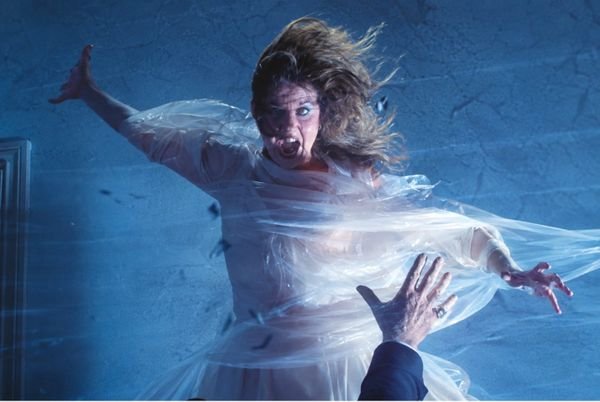
In my considered and totally unrepentant view, Exorcist II: The Heretic is a bad movie. I don’t mean bad in the cheerful so-bad-it’s-good sense that midnight-movie apologists like to reclaim after a few drinks and a lot of ironic distance. I mean it’s truly and dramatically bad. A movie that mistakes incoherence for profundity and tap-dancing for transcendence. It does not need to be rehabilitated, and I didn’t sit down to watch David Kittredge’s documentary nursing a secret candle for Richard Burton and locust swarms. But after watching, I’m here to tell you that Boorman and the Devil is one of the most purely enjoyable pieces of non-fiction filmmaking about failure I’ve seen in years. I don’t think this is a contradiction, but criticism actually working how it’s supposed to.
Something I think people get wrong about bad movies and the documentaries made about them is they assume the quality of the making-of is contingent on the quality of the made, and it just isn’t. Some of the best non-fiction cinema is about disaster; Lost in La Mancha, Best Worst Movie, Hearts of Darkness, exactly because a movie going totally and career-threateningly wrong is much richer than a movie going competently right. Failure has stakes, humiliation, hubris (pay attention to writer/assistant Rospo Pallenberg, whose utter arrogance oozes through the screen), and if you’re as lucky as Kittredge is here, a director still around several decades later who will sit in front of a camera and try, one last time, to explain himself to the world that laughed him off the screen.
That’s the movie here. Not “was Exorcist II secretly good all along?” (and thank God, because it wasn’t) but “what does it do to a moviemaker to create something this ambitious and watch it blow up in front of paying strangers who actually audibly laughed at your possessed-girl tap-dance routine?” That’s an honestly great question and Kittredge asks it here with great rigour.
What really struck me, and what elevates this quite a few notches above glorified DVD-extra material, is the documentary’s refusal to condescend to either side of the argument. Kittredge isn’t there to mock Boorman, but he’s definitely not there to rescue him either. He sits him down, giving him the space to explain that he really disliked The Exorcist, finding it vulgar and reactionary, nothing more than a nasty little shocker wearing the clothes of Catholic guilt, and deliberately sets out to make its opposite: a movie about ecstasy and faith instead of violation and possession. That’s really a fascinating authorial position for a major studio sequel to take, and the documentary lets us sit with that ambition before it lets us sit with the wreckage. Boorman was coming off Point Blank and Deliverance and genuinely believed he could smuggle a spiritual art movie through the gates of a horror franchise. He was horrifically wrong about how that would land, but the reasoning behind that wrongness is compelling, and Kittredge is intelligent enough to know that the reasoning is the film.
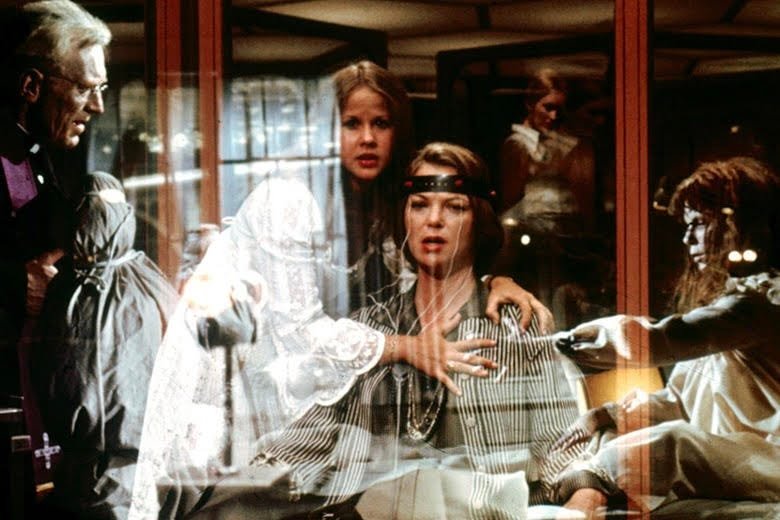
There’s a device in Exorcist II, the “synchronizer,” which is a kind of biofeedback hypnosis machine meant to let two minds share a dream state, and the documentary spends a brilliant stretch of its runtime on how thoroughly it bored and baffled 1977 audiences into a stupor while the crew seemed to believe they were building the future of cinematic subjectivity. I found myself laughing not at Boorman directly, but at the total and magnificent folly of it all, at the specific brand of late-seventies auteurist confidence that convinced grown and intelligent adults that a synchronizer and an interpretative dance routine were the right tools for depicting demonic evil. Gremlins director Joe Dante turns up to note, with a dryness that had me chuckling in the dark, that several of the movie’s techniques have never been attempted again by anyone, ever, in the history of cinema. And it’s that sort of backhanded compliment which tells you everything about how the industry actually absorbed this movie’s failure. It became folklore. It may have been cautionary-tale folklore, but it was still folklore, and that’s a sort of immortality that bad movies rarely earn.
The interview roster does a lot of heavy lifting and Kittredge has clearly assembled it with care rather than just booking whoever answered the phone. Linda Blair is generous and clear-eyed about a production that has clearly left deep scars. Louise Fletcher, interviewed shortly before her death, brings enough candour and craft-focused seriousness that it lends the whole thing gravity rather than nostalgia. There’s a feeling that the documentary is treating her contribution as something to be preserved instead of just plundered. And bringing in modern genre voices like Karyn Kusama and Mike Flanagan to contextualise the movie’s afterlife is an honestly smart structural choice; it lets the documentary implicitly argue that ambition-as-failure has a lineage and that every generation of horror moviemakers has its own Boorman moment waiting for it. Flanagan especially argues that the fear of becoming a cautionary tale is baked into the DNA of everyone who tries to do something genuinely strange with a genre that rewards the safe and punishes the reckless.
Where this documentary earns its stripes as proper criticism and not just hagiography is the willingness to let Boorman, even now, remain a little baffled by his own disaster. He knew the audience wanted the visceral and sustained horror of William Friedkin’s original and he deliberately withheld it. He says as much unflinchingly but there is still a sense, even decades on, of a man turning the wreckage over in his hands and not quite locating the seam where it all came apart. And I think that unresolved quality is a lot more honest than a tidy redemption arc would have been, and it’s to Kittredge’s huge credit that he doesn’t try to create one. This film doesn’t end with an “actually, it’s a misunderstood masterpiece that deserves reassessment.” It ends somewhere I found much more interesting: as an act of good-faith archaeology on a real disaster, and it was undertaken with enough affection that you come away understanding why it happened, but without being pressured into deciding it was worth it.
And I think it’s that distinction, between understanding a failure and forgiving it, which is the whole trick of great films-about-films. Boorman and the Devil never asks you to like Exorcist II: The Heretic, but it does ask you to appreciate the strange, doomed integrity of a moviemaker who had a truly idiosyncratic vision, the studio money to attempt it, and absolutely no ability to see how it would play to a paying audience who were expecting rotating heads and projectile vomiting. And that gap between authorial sincerity and audience expectation is still one of the most interesting fault lines in studio moviemaking, with this documentary walking it with real wit and intelligence, and an obvious love for that messy and embarrassing, slightly glorious business of people trying things that don’t work.
So, does it change my mind about the movie itself? Not a chance, and I’d be suspicious of any documentary that could do that for me. That’s not what criticism is for and it’s definitely not what this one is attempting. Exorcist II remains for me an unnecessary and incoherently bad movie that nobody asked for and one that damaged a genuinely great original just by association. But I think Boorman and the Devil is something rarer and better than a rehab project. It’s a clear-eyed and curious, occasionally very funny act of cinematic archeology, one that’s dedicated to the idea that the most interesting stories in cinema history are often the ones where very talented people tried something bold, believed in it totally, and fell flat on their face in front of everyone. Give me that story told this well, over another competent and forgettable sequel any day of the week.
Four stars. Maybe four and a half, just for Joe Dante’s face when he talks about the synchronizer.
Boorman and the Devil is in cinemas from September 25th.