
On the outskirts of a drab Australian town, we meet new boy Naim (Joe Bird). After what can be gleaned to be a period of isolation, he seems pleased to be hanging out with someone from his school, Ryan (Stacy Clausen) – Ryan seems older and tougher, although he’s a classmate, and he’s definitely got that adolescent confidence down to a fine art. The boys amuse themselves by smashing up a deserted mill, but something in their competitive scrapping and bluster turns into first love/lust. Finally, Naim feels the beginnings of belonging, but when he witnesses a similarly aggressive sexual moment taking place between Ryan and the preacher’s son Hunter (Jeremy Blewitt) it prompts him to tell the preacher about what’s been happening – carefully leaving out his own behaviour, of course. He’s hurt, and has lashed out.
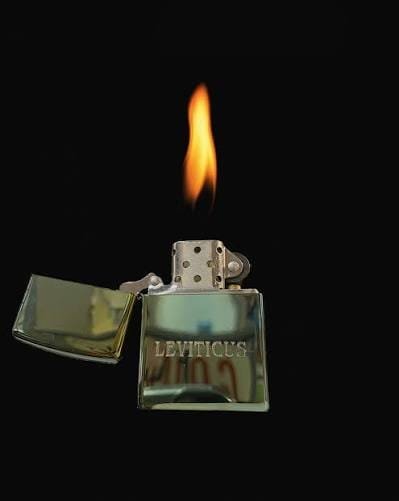
The particular flavour of Christianity being practiced here is never fully disclosed, but you could quite easily infer that they’re unlikely to go a bundle on homosexuality; it’s just that the extent of the response, and its organisation, is a surprise. The title, Leviticus, refers to a book in the Bible which sets out numerous rules on ritual purity and living in a ‘godly’ manner, ostensibly to set the Israelites apart from their tribal neighbours, but in execution, coming across as a list of paranoid minutiae there to control all aspects of a religious community’s behaviour, right down to forbidding the wearing of mixed fabrics – so it’s plain to see why it works here, given the church’s stance on its own version of purity, and how to enforce it. Contacting a self-styled ‘deliverance healer’ (Nicholas Hope), the congregation draws both Ryan and Hunter into a compulsory ritual which seeks to finally drive out their godless urges.
It’s all a big joke, right up until both boys begin to convulse on the ground right after the exorcism is completed, as the preacher simply holds up a flame – for a while, as they choke and gasp for air, it looks like they might die. Naim is horrified; this is his fault, after all. Whilst he was envious of Hunter, he seemingly has no wish to see him harmed – and he clearly feels something far more for Ryan, who is now caught up in the same rite. As it turns out, the two boys’ survival is just the first step of the next, horrifying stage in their lives whereby their urges – wholly externalised – can now take the form of the thing which they most desire, coming after them with trickery and guile before violently attacking them (and we know from the opening scenes that this kind of thing has happened before, with fatal effect). This monstrous ritual – which eventually sweeps up Naim, too, at his mother’s request – creates a murderous apparition which tirelessly seeks out its lover.
There have been a fair few films in which ‘desire’ becomes a monster, particularly for younger protagonists, and it’s clear, even from the details discussed above, that It Follows has a lot to answer for. It’s funny: at the time, I didn’t rate It Follows anywhere near as highly as a lot of my peers, though on reflection, it deserves credit for such a legacy, as it has influenced a lot of films in its wake. There are other similarities between Leviticus and It Follows: the sympathetic protagonist/s, trying to ascertain the ‘rules’ of the haunting; the odd timelessness of the setting, taking place in an unspecified ‘some time, some place’; the feeling of a late-rolling wave, carrying all the anxieties of AIDS whilst perhaps gathering aspects of other sexually paranoid ideas – purity culture, perhaps.
But Leviticus also extends and expands its ideas. The existence of the religious community, the presence of which seems to be what has promoted Naim’s mother (Mia Wasikowska) to move to this dead end town in the first place, acts both as a community and a court; it continues to hold sway throughout the events which unfold, and clearly has some answers which it chooses not to share with the afflicted, revealing it as an arena of cruelty, if with its own, skewed ‘good intentions’ (see also: aversion therapy). And, quite unlike It Follows – last mention, promise – Leviticus carefully offers up context, without ever feeling overwritten. It somehow balances a deft runtime and some big-hitting violent scenes which make the threat very real indeed, with acres of space and what feels like ample time to allow characters, motivations and narrative arcs to develop. We don’t need the script to fill us in on the impact of the death of Naim’s father; it’s right there in his silence, alongside the ring he wears around his neck. We know how much Ryan means to Naim; it’s done with a look and a touch, not with reams of dialogue. That speaks to a confidence in the audience, as much as in the film, and it’s appreciated.
If things get wrapped up a little quickly towards the end, which is ever so slightly the case, then still, the subtle but immersive acting, the genuine feeling of chemistry between the leads and ultimately, the pleasing sense of distance travelled from the strictures and structures of repression works very well. It’s a first-time feature from director and writer Adrian Chiarella, and a project which – if there’s any justice – should lead to plenty more work.
Leviticus (2026) is in UK cinemas now.