There’s a moment in Mark Jenkin’s new Cornish time-slip themed, 16mm folktale Rose of Nevada when the main character (Nick) finds a group of local fishermen in the newly invigorated fishing community he’s fallen through time into, all helping his crewmate to mend their vessel’s torn fishing net. As a traveller from a rather more self-centred future, he is instantly suspicious of this inexplicable act of kindness from strangers and demands to know what the hell is going on.
“Community!” comes the brusque reply.
Community, or rather the loss of it to over-tourism and gentrification pushing Cornish locals from their homes was a theme of Jenkin’s acclaimed 2019 film Bait, and Rose of Nevada returns to an exploration of the complexities of community building and the corrosiveness of grief, memory and guilt, in a gritty sea tale also set in a dying Cornish ex-fishing community.
The film opens with lingering shots of physical decay and disuse; rusted harbour ironwork, flaking paint, and blackened, rotting wood; everything signifying entropy and imminent collapse. Point made, the bleakness then extends to the state of the local community itself, a sad indictment of the ills of modern Britain. The pub is on its last legs, the local post office is now a food bank, and here we meet the grim-faced protagonist Nick (George MacKay), dashing through the rain and back to his wife and young daughter with his food bank bounty. His terraced cottage seems to be falling apart at the seams. Rainwater drips persistently through a visible hole in the roof. His next-door neighbours are faring little better; the elderly Mrs Richards is given to wandering wild-eyed and barefoot, her long white hair askew, muttering eerie, prophetic pronouncements – in reality she suffers from dementia and as her traumatized husband explains, the disease condemns her to be permanently mentally adrift in the past. The Richards’ house also appears to have become bogged down in time, maintaining a just-as-he-left-it bedroom shrine to their late son Luke, who threw himself from a nearby cliff after he had left the fishing vessel Rose of Nevada short-handed and all crew had been lost along with the vessel. In fact, the entire village’s fortunes appear to pivot ceaselessly around this harrowing loss, unable to escape its gravity. Yet another neighbour Tina (Rosalind Eleazar) is the financially-struggling wife of one of the lost crewmen (Alan), and mother to his adult daughter, Jess.
Nick, having no money to call in a professional, climbs on his leaking, rain-rotted roof to try to repair it. The water has made the fabric of the roofing so flimsy, he plunges through it. Later in the film, it becomes clear that this is trigger for all that follows; that water is the transitional medium which signifies the mystery, fluidity and tides of time and memory.
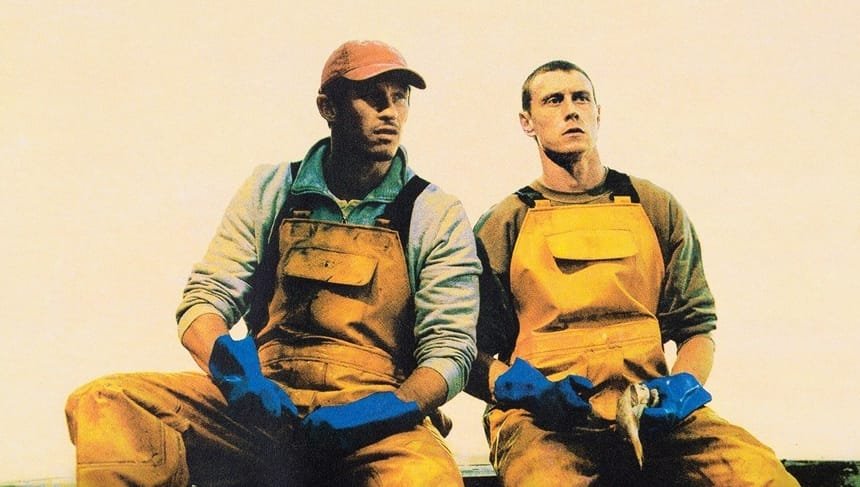
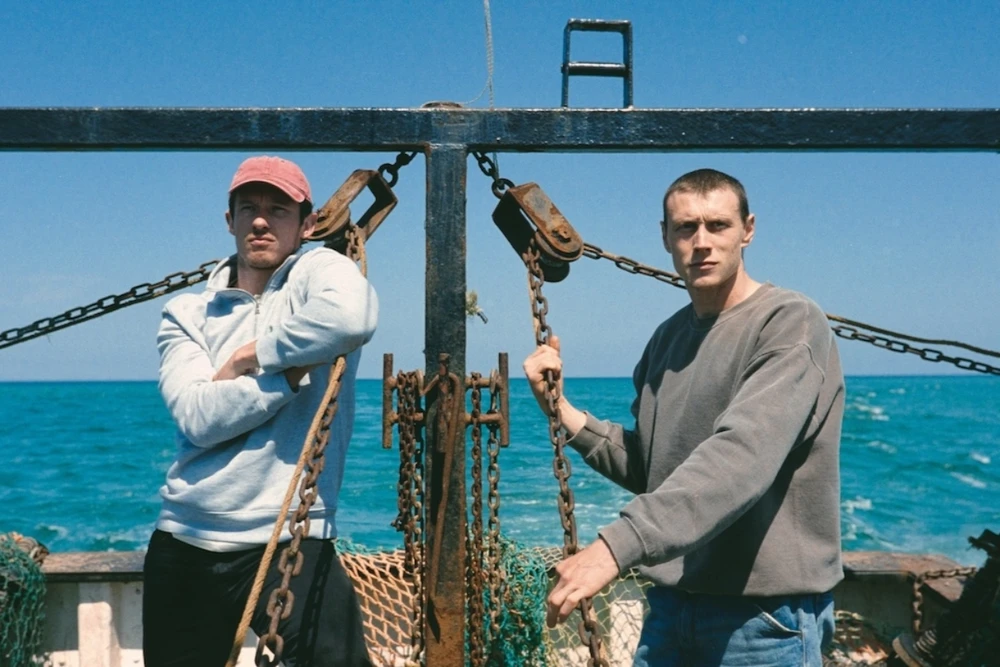
Meanwhile, the eponymous long-lost fishing trawler Rose of Nevada has somehow simply appeared – a ghost from the past – in the rotting, disused harbour. The Rose’s owner, a local businessman now on his uppers, decides to rustle up a crew and send it out again. Nick, utterly inexperienced but now also utterly desperate for money, is roped into the job, along with equally inexperienced, rough-sleeping heavy drinker Liam (Callum Turner). A slippery old seadog type named Murgey, straight out of all manner of sea stories and full of nautical wisdom magically appears from nowhere to complete the crew as skipper. It appears he has been summoned, but by what and for what purpose? Murgey isn’t his real name, but it is unclear what is; Liam isn’t Liam’s name either, as it turns out. Identity on the vessel seems to become slowly unravelled as the men transform into fishermen. Perception and reality become warped and blurred – sinister warning messages scratched into the wood of Nick’s bunk appear and disappear, while the Rose’s damaged nameplate, previously seen falling into the sea, suddenly appearing pristine and bolted back on the vessel.
Nick and Liam learn their new, gruelling trade, guided relentlessly by Murgey, and these and other scenes at sea are among the best in the film, showing the tough, exhausting and dangerous nature of the fishing industry. The cyclical work almost seems to induce a dreamlike delirium at points as the men slowly transform into an effective working unit, dependent on each other for survival. Jenkin’s home-wrought soundtrack shines here – the overpowering, purposeful industrial rhythms of the trawler’s pounding engine and the screaming of metal cable juxtaposed against the natural rhythmic lashing of waves and the howling of the wind.
When they return to harbour with their first catch, they experience another transformation. The sun shines. The old, rotted harbour is pristine again, and cheerful fellow fishermen abound. They have also – somehow – returned to new identities. Liam is Alan as far as younger Tina is concerned, and she’s ready to continue their fraught relationship. Liam slides into this role as (vaguely unreliable) family man Alan with little resistance. Nick, on the other hand, is now recognized as the doomed Luke Richards, a role which he thoroughly rejects. Mr and Mrs Richards try to draw him back to their home. A trip to the pub – now bustling with trade and smokers – is the jolt Nick needs to realise he has somehow washed up in the village of 30+ years ago. It’s 1993. Nick’s wife and daughter now exist only in his memory.
Nick and Liam (Luke and Alan) are drawn into the life of the fishing community, completing more successful, lucrative trips out to sea with Murgey. Nick starts to understand the true nature of the small fishing community – that an entire village now depends on his catch and should he find a way back to his own time, it would collapse again. It’s a burden, a pressure he despises, and a long way from the atomized social relationships and individualism of the 2020s. Meanwhile, the longer they exist as Luke and Alan, the question of whether they will finally meet the same end as the two lost men starts to loom. Will events conspire yet again to produce another loss of the Rose of Nevada with all hands, and take the fishing community’s luck with it?
Jenkin’s film doesn’t provide us with any easy answers regarding the reason or mechanism of time-shift with which the men become embroiled. While it provides a profound meditation on the necessary interdependence of small traditional communities and the ability of the human mind to dwell deep into the past via disease, nostalgia or trauma, Rose of Nevada functions primarily as an unsettling modern folk tale. Strange things happen because strange things happen in the ancient, superstitious country of Cornwall, and stranger things still happen to those who make their living on the wild, unpredictable and ever-changing sea.
Rose of Nevada (2025) is in select cinemas now.