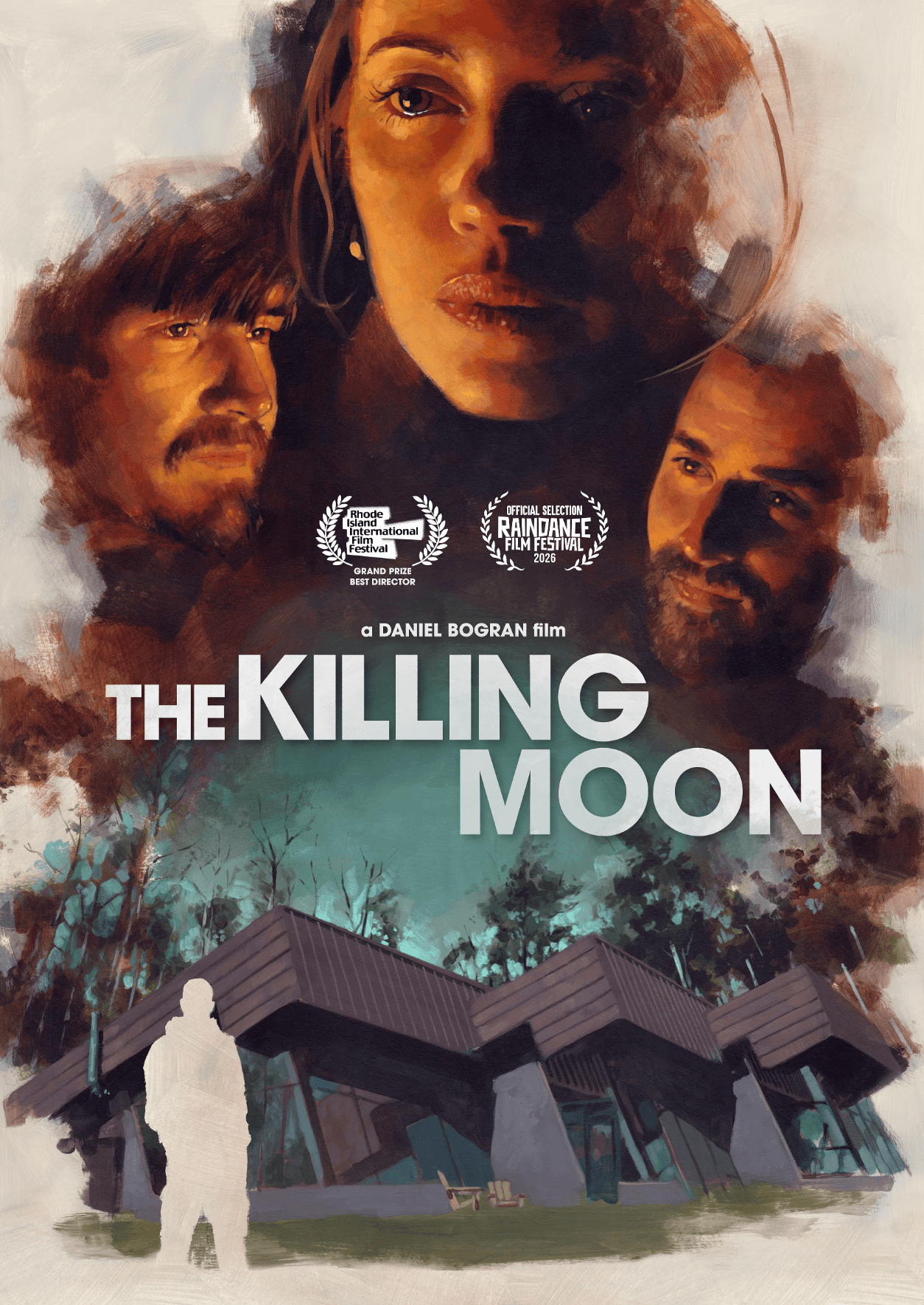
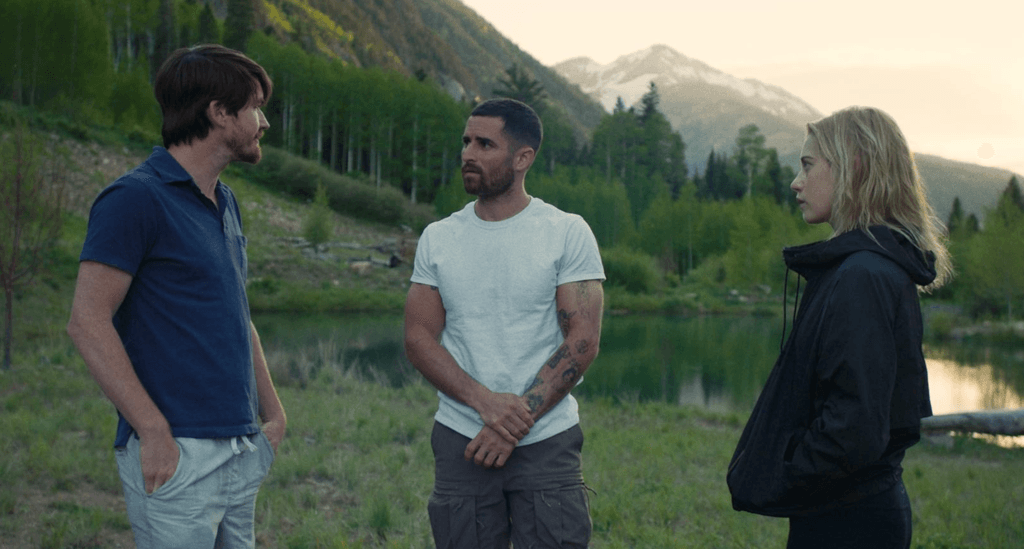
If there’s one thing to take away from The Killing Moon (2025), it’s to wonder why some married couples are married couples – and the film leans into this immediately, as we meet key protagonists Elliot (Ryan Caraway) and Olivia (Victoria Diamond), lost on their way to a swanky mountain retreat somewhere in Colorado (discoverable from the film info – we’re not given the specifics of the location). When they finally get where they’re going, they continue to squabble. Then, as they settle into their vacation, we learn two key things: Olivia is crypto-wealthy and her husband resents her wealth by presenting as at least mildly snippy at all times. Let’s just say that the dynamics here are awkward, and it’s almost a relief when there’s an unexpected caller at the door.
Ah, but we’ve seen this caller: in the film’s opening scene, we saw this guy sat at a campfire, hiding his wedding ring before building up to a horrific self-injury, slashing his leg with a knife. Now he’s here, he’s bleeding profusely and asking for help. Shocked, Elliot and Olivia bicker a little more, but agree to let in the man, Rory (Matthew Leone) – the better to disregard basic first aid, but panic can do that to a person. Rory lives to see another day, and seems happy to hang around the next day too: a trip to a local beauty spot thereby turns into a heated masculinity contest, replete with odd decisions and behaviours (just like Rory sticking around, to be honest). Whatever Rory has planned, it feels like it’ll be justified if it shuts up Elliot, who is clearly being painted as inept and bitter. Certainly, Elliot’s smug bluster paints Rory in the better light, leaving The Killing Moon with the potential problem of turning Rory into the film’s villain – if the film needs a villain. Or does it have one? What’s the film to do?
The film does implicitly acknowledge that it needs some sort of new addition or direction after more than enough chest-beating and it endeavours to deliver this, which shows both a sense of whole-film crafting and some ambition too. Frustratingly, this still can’t link up with the bigger, more significant ideas it reaches for: some of the film’s more puzzling, or less appealing aspects are by this point a little too entrenched, centring almost wholly around the script and the tone chosen for the film (although the lead actors always give their best here, doing much with what they are given).
From the start, the signposting of marital issues – vital to the film – is clumsy, with each partner moving quite arbitrarily from one set of beliefs about their partner to another. Olivia sees Elliot as hopeless, then indispensable. Elliot is racked with sexual jealousy, then isn’t, and Olivia doesn’t notice the shift, or at least responds to it in a very brief way. This want of more, nuanced characterisation, with the suggestion of backstories, has a large impact on everything that follows – this plot foundation cannot slip or it’ll take everything with it, including Rory’s much more interesting arc. There’s no question but that The Killing Moon is a very well-made film in its technical aspects: it looks and sounds great, it’s sensibly edited in terms of its runtime (pushing this past the ninety-minute mark would only have harmed it as a whole) and it creates a sense of time and place. There’s lots of skill here. Director, writer and editor Daniel Bogran is a young filmmaker and this is his very first feature. With some deeper realism and complexity in the script, it would be great to see what he could do; it would better test his evident skills. As it stands, it’s very hard not to ask, ‘But how would that even work?’, something which could potentially be weeded out by a few productive screen development meetings.
The Killing Moon has some great strengths and works hard to move things along in a timely way, though at its heart it is a broad-strokes marital breakdown, even if reaching for something bigger. It isn’t sharp enough to really innovate around its topics and there are some issues around its plausibility, although it does move closer to a broader backstory, with glimpses of the broader resonance it clearly wants to convey. There are hints of good things here, even if not fully formed, and Leone in particular is an actor to watch.
The Killing Moon (2025) will feature at this year’s Raindance Film Festival from June 21st.