“I’m very Zen these days!” An Interview With Adam Mason and Simon Boyes

By Keri O’Shea

It’s no real secret that I’m a big fan of director Adam Mason’s work, so when I was offered the chance to take a look at Adam and long-standing writing partner Simon Boyes’ latest film, Junkie, of course I said yes. I’ll be posting my review of the film very soon, but in the meantime, I nabbed Adam and Simon for a quick chat about their take on this latest film, the state of play for indie filmmakers, and what we can look forward to from them next…

BAH: Firstly, congratulations on Junkie – it’s a really innovative film and it’s bold in how it steps outside different genres, most notably moving away from pure horror. Was this move a conscious decision on your part, or did it happen organically as you and Simon wrote?

AM: After the experience Simon and I had doing Blood River and Luster, we made a very determined effort to move out of that sandpit. It wasn’t that we didn’t enjoy making those movies, ’cause we did – but the business end of it was so shady that it got to the point where we had to take an honest look in the mirror, and question what the point of it all really was. If you are working hundred-hour weeks for ten years or whatever it was by that point, to essentially live below the poverty line… you’d better REALLY enjoy what you are doing. And unfortunately the knocks started to really undermine the enjoyment I felt in the process itself. Especially when you start to see other people profiting greatly from all your hard work, and none of the people who actually deserved it getting anything.

In hindsight I can see why it happens – as soon as you have incredibly passionate people trying to achieve something, the probability of exploitation rises dramatically.

Simon and I also very much had a master plan to break into Hollywood… and it was a one step at a time type deal. Broken was so harsh ’cause we needed to bust the door down with a sledgehammer, which we certainly did… Devil’s Chair was a big step forward, as it was a much, much bigger budget, with Hollywood players involved… and getting into Toronto etc. got us signed to CAA, and made getting visas to move to LA a reality at last…

From that point on, we basically worked on impressing people within the studio world whilst still making some kind of a living making indie movies, which we did for a couple of years, until the studio-level specs we were relentlessly writing finally got us noticed. And we haven’t really looked back from there…

Junkie was a movie that we really just did for our own sanity, kind of like a hobby, to erase the sour taste Blood River and Luster left. So we just did it all for the hell of it, really. The studio stuff we write is extremely structure heavy; everything we do is outlined to the nth degree and everything is figured out, loads of character work… it’s basically what I guess you’d call the craft of writing. So with Junkie we just threw all of that out of the window and wrote it stream of consciousness style. We’d write ten page sections completely independently of one another, then flip them across and the other person would take over. We were just trying to make each other laugh, really.

And it really did prove to be very cathartic and fun. We always intended it to be the last movie we made in that world.

SB: Thanks! Glad you enjoyed it. I don’t recall us even really discussing what genre it would be. The screenplay for Junkie came together very differently from the way Adam and I normally write. Usually we outline everything before we start writing pages, but with Junkie we had a really loose idea and just ran with it.

We were pretty much writing ten pages each and flipping it, and it became a game of trying to make each other laugh with more outlandish stuff, which is probably why the movie gets progressively weirder.

All the core themes kind of grew out of it organically. It was a really liberating experience to not have to stick to any conventions of any one genre so there’s some drama, some horror, hopefully some comedy and tons of really weird shit on top for good measure…

BAH: So are you pleased with the results?

AM: Yeah, I really am. Most of the stuff I’ve done I look at with some disdain, although I’m proud of all my films for different reasons. I think Broken and Devil’s Chair are just bananas… Blood River came out pretty much as good as we hoped, then Luster was really a fuck up, and the less said about Pig the better.

Also along the way we had realized that we were kind of making a version of the same movie over and over, with the themes of duality and so on, so we just set out to make the ultimate iteration of those themes.

I was also really pleased with how the actors worked out. We shot the movie in seven days, which is at least a third of the time we usually shoot our stuff in, but it was all very liberating and freeing. It really felt like the end of an era, and not really caring what anyone else thought lent the process a beautifully anarchic energy that everyone involved dived into.

SB: Yeah definitely. We knew from pretty much the first few pages we wrote that it would be divisive. It was never going to be for everyone, but it’s fun to read the reactions and see who’s into it and who isn’t. Adam shot this whole movie in seven days on a minuscule budget and yet in my opinion the movie looks amazing, has fantastic performances, and to me is a really fun ride, so personally I couldn’t be happier.

BAH: To date, your filmography contains some pretty intense material: something which springs to mind for me is the opening scene of Broken (2006), which if I say ‘razorblade’ will no doubt be familiar to those of us who have seen it. How conscious were you that you were filming some potentially very shocking material? And have you been well-served by that material, do you think?

AM: Like I said, Broken was always reverse engineered to be a sledgehammer movie, and it certainly served that purpose well. Neither Simon nor I wanted to be making stuff like that really; it was just done from a place of impotence and anger at the UK film industry. It was really hard to ever get noticed there, as it’s pretty much an old boys’ club, and they guard the doorway with their lives. So Broken was about kicking in that door, bypassing them altogether and heading to Hollywood, where they actually make movies as a business not a charity.

I’d personally also become a very angry and bitter individual, and I think that sensibility found a mouthpiece in the movies we made. I was seething with anger for a long time at a lot of different things, mainly personal stuff from my past. But as I’ve grown older I’ve mellowed a lot, thank God, and I no longer feel bitter or resentful. I’m very Zen these days!

SB: Broken was a pretty specific case, I think, because it came about at a time when we were pretty fed up of trying to get movies made in the UK system and so we decided to go it alone and make a movie ourselves. We chose horror primarily because it’s a genre that you can work well in even when you have little to no money. Period dramas and action movies are hard to do on a ten grand budget, but in the horror world you can actually pull something off for that insanely low budget if you work hard – which we did. At that time, horror was going through a gory phase, with movies like Hostel and Saw proving popular, so I think we felt pressure to have some really nasty ideas in there, but for me, the heart of that film is actually a much quieter drama and it works best in the dramatic scenes between Hope and the Man, rather than when it’s being ultra-violent.

I think that material worked for that time, and it’s served us well in the sense that Broken’s success allowed us to do more films, which has gotten us to where we always wanted to be, living in LA and writing studio movies!

BAH: With regards to moving Stateside, and having had experience of making films on both sides of the pond, how would you say the UK and US compare?

AM: I’ve been in LA for seven years now. Its black and white; there’s no comparison…there just isn’t a film industry in England. Anyone who makes something that gets noticed in the UK ends up working over here.

SB: Short answer from my perspective…the process is the US is way better. A lot of it depends on what kind of movies you want to make, of course, but there is no doubt that Hollywood is the epicentre of the kind of movies we like to make and the kind of scripts we like to write. Trying to get anything made in England that isn’t gritty East End gangsters, period drama or lavish romantic comedies is very tricky and there are far fewer opportunities there.

The UK has a very insular industry, epitomized by the UK Film Council, whereas in LA there are literally thousands of prospective avenues through which to pursue getting something made. Of course, there is also a lot more competition but for me it’s an easy win for the US…

BAH: Since you started your careers, the online presence of film fans has increased dramatically, this site very much included; is the amount/accessibility of fan writing online a boon to independent filmmakers, or just white noise?

AM: All the online stuff, especially in the horror world – it really reminds me of being at school… and not in a good way. It’s bleakly ironic to me that alienation is usually the reason niche communities like the horror community come together in the first place. People who have been bullied and feel like outsiders find comfort and acceptance with like-minded contemporaries. Or that’s what you’d hope would be the case. The reality is that these ‘outsiders’ are often the most twisted and bitter bullying personalities you could ever meet. The venom you see daily on the internet, the trolling and spite is completely disgusting. And worse than that, it’s cowardly, because it’s anonymous. It’s given people who, fifteen years ago wouldn’t have had a voice, a way to stab people…

From my point of view – I take every good review the same way I take a bad one – with a pinch of salt. For every person who loves one of my movies, there’s another who hates it. Who do you listen to? The answer is you can’t listen to anyone really, because at the end of the day, who’s to say which opinion is the right one? In reality the internet is just a small bunch of people making a hell of a lot of noise. The rest are out in the real world.

But I will say that the internet has been a great way of connecting with like-minded people from all over the world. Some of my closest friends I have barely met, but I speak to every day. I also think it’s great that guys like Todd Brown from Twitch and Brad Miska from Bloody Disgusting have forged very successful careers for themselves in the industry. That in itself proves the power of the internet.

SB: I think it depends on the individuals, their agenda and whether they are criticizing or simply insulting. There is no doubt that the internet has massively opened up the floor to a wide and vocal group, but if it’s simply about being negative it doesn’t interest me. On the other hand, it’s fantastic that there are now forums out there, like your site, that champion independent film, and give a platform to films, like Junkie, that are not intended to operate in the mainstream. Some of the abuse people rain down on stuff is pretty weird to me because I don’t get why they care that much, but on the other hand, when you get a sense of how many people out there are supportive it’s great to see.

It’s also not just about whether someone liked our stuff or not. Bad reviews are as worthy as good reviews if the person has their reasons and can articulate them, but there’s a big difference between a bad review and a load of random abuse. That’s a lesson some ‘critics’ would do well to learn. Everyone’s entitled to a voice, but that doesn’t mean every voice should carry equal weight…

BAH: Are there any particular themes or topics you’d like to explore in film which you haven’t yet?

AM: I feel like Simon and I have done the duality thing to death now. It also lends itself to movies with anti-heroes, so we’re veering away from all that now. The studio stuff we are writing now is big action, sci-fi; the kind of movies we grew up loving. We haven’t written a horror movie in a few years now… but I’m sure we’ll get back to it sooner or later.

SB: Always, but for me the themes aren’t usually the starting point. Instead they tend to evolve out of an idea and the characters, so it’s hard to pinpoint specific themes and say this is a theme we should explore in our next movie. A lot of the movies we have done start out as ideas or concepts, and then we realize halfway through that we’re exploring themes of identity and duality and that’s clearly a theme that we are drawn to, so it comes out in the work that we have done so far.

One of the best parts of the process is that Adam and I get to take the kernel of an idea, discuss it, build characters around it and then map themes onto it which organically make sense to them and to us. A lot of this happens subconsciously I think, based on our own interpretation of the world we’re creating for that particular movie.

BAH: And lastly – what can you tell us about Not Safe For Work, your current project?

AM: That’s a movie Jason Blum produced that Joe Johnston directed for Universal. Its basically Die Hard in a legal office! It was one of the great days in our lives when we got the call telling us our script was going to be Joe’s follow up to Captain America…

We had a great time working with Joe. You couldn’t hope to meet a nicer guy.

SB: It’s a very fun thriller, kind of a throwback to the days of Die Hard, and we’re very proud of that script. As Adam says, working with Joe was a fantastic experience. This is a guy who directed The Rocketeer and Captain America so it’s hard not to be impressed, but he’s also a super cool guy and we were honoured that he loved the script and wanted to direct it!

BAH: Massive thanks to you both for taking the time to speak to us!

Read Keri’s review of Junkie here.
‘Banned In 46 Countries’: 35 Years Of Faces Of Death

By Keri O’Shea

Y’know, it’s a funny thing. For a genre which has always gone so firmly hand in hand with fantasy, there’s always been a small, but stubborn undercurrent to horror which obsesses over the antithesis of that fantasy – the portrayal of ‘real events’. Whether it’s rumours of real footage being hidden in movies, or outright bullshit projects like Snuff which seek to directly exploit this fascination, or even persistent rumours about certain Hollywood actors who were so convinced by the fantasy on their screens that they called the FBI, the threat of the real has hung on in there. Notions of crossover between the real and the imagined just refuse to go away, and maybe they never will. Well, back in the heyday of 60s and 70s exploitation cinema, when directors were up against fierce competition from one another and growing ever more determined to hit on an innovative format which would allow them to swap maximum outrage for maximum gain, a certain ‘documentary’ movie was made, and it’s one which has clung onto its reputation for savagery, come what may.

In many ways, the persistence of Faces of Death is remarkable. (Sure, the original film did well enough to spawn a small franchise, but it’s the first film in the series which people tend to remember, and scenes from this first one which people can still discuss.) And yet, compared to many contemporary shockumentaries of the day, Faces of Death is surprisingly amateurish. When Mondo Cane (literally, ‘A Dog’s World’) burst onto the underground movie scene back in 1962, it set the bar in terms of the format (and the tendency to fudge together fake footage wherever filmmakers Cavara, Prosperi and Jacopetti saw the need for it) but, say what you like, it was still a milestone in originality. So much so, that an entire tirade of similarly-styled movies followed in its wake, as well as a Mondo Cane 2 the following year; where the imitators differed from their source, however, was in their own focus. Mondo Cane achieves its slightly bewildering effect through interspersing the nasty with the silly; drunken antics take their place on-screen alongside a battery of deeply-unpleasant animal cruelty scenes, for example. Perhaps the nasty footage got people talking the most, because the films which followed tended to include more and more of it. And so, by the time we get to 1978, we’ve found a specific focus – death itself, and depictions of death (and only death) on the screen.

So why, exactly, has Faces of Death developed the lasting reputation for extremity, even when – for example – a later film like Traces of Death (1993) seems, to this writer at least, a lot nastier and a lot more unpleasantly credible? It’s something I’ve wondered about a lot as I come to write this piece. As far as it goes, personally, I’ve seen shockumentaries I find far more upsetting, and also shockumentaries I find far more interesting, if I can call it that (like Shocking Africa, for instance), but my first viewing of Faces of Death has still stuck with me like glue. It may well be that once a film’s reputation reaches critical mass, then most of its work is done, before you actually sit down to watch the thing. If you’re young and impressionable, that helps too. Add notoriety to anticipation and find a better, more far-reaching ad campaign than any money could buy, and that is still true in many cases even in our cynical, internet-savvy times. Hell, even today, people who have never been anywhere near a viewing of Faces of Death will recognise the title. But the film’s reputation can’t be completely explained away by the snowball effect.

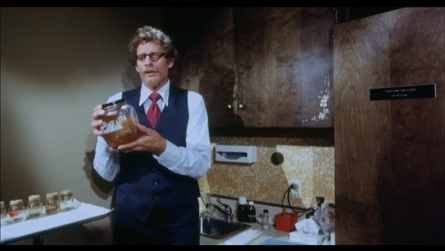
For me, Faces of Death is still so well-known for the notable and often downright bizarre way in which it skirts the facetious and the unpalatable. For example, director and writer John Alan Schwartz (who, just as bizarrely, also wrote a few episodes of Knight Rider, which starred his old college roomie David Hasselhoff) must’ve known that the footage he was going to stitch together was going to be a real rag-tag affair, so he decided that he was going to give us a credible authority figure, to help generate the impression of an overarching structure. Or, ahem, perhaps not. The inclusion of Dr Francis B. Gröss (aww, come on!) as played by actor Michael Carr bequeaths to us one of the most dubious medical experts ever, and as such the voice-over which Carr provides throughout the film adds a great deal to the often perplexing, ‘should I be laughing or not?’ tone. The film forces you to waver between belief and disbelief, wry humour and outright disgust throughout.

So, you’re watching it, you’re transfixed by the dulcet tones of Dr Gröss as he explains the relevance of each sequence to the overarching theme of death…and, then what? Next, you might feel yourself assaulted by the barrage of images thrown at you, and made to reflect on their authenticity, or otherwise. This in itself can be quite a testing experience. A number of lurid scenes follow hot on the heels of the last, so that one moment you’re ostensibly peering into a cannibalistic Satanic orgy, the next at what really does look like a suicide (clue: it ain’t – more anon) and then at live animals being presented at table. To ask yourself if what you’re seeing is real, well, you have to really get a good look at it. If you realise that you have just witnessed something real, then it’s not the nicest of sensations, and it’s important to remember that, even though Faces of Death has had its claims of being 100% real conclusively quashed in the past three decades, a reasonable amount of it is real. So, even though you might be able to work out by yourself that they’re not really killing a monkey in that scene, and that’s an actress pretending to leap to her death in that scene, all the scenes are part of a fairly sickly entirety. The conceit overall is unpleasant, and cumulatively, shot through as it is with shards of black comedy, it still has the power to spit you out the other end feeling repelled. To demonstrate this feeling of being repelled with an example of my own, it’s worth mentioning at this juncture that Faces of Death has had, believe it or not, a long-lasting impact on my life, and I’m being perfectly serious here. I saw this film when I was fifteen years of age after tracking it down – as usual – on a hokey, thrice-copied VHS tape. The moment I was through with the slaughterhouse sequence which appears early on in the film I said to myself, ‘I am never eating meat again’. Nearly twenty years on, I never have. It’s only a movie, sure, but there we go, that’s what Faces of Death can do…

Thirty-five years after this movie emerged – turning a huge profit whilst spinning a huge yarn – it has maintained its cult reputation, regardless of the quality or quantity of films which have followed in its wake. In this day and age where shock value and saturation have hit a premium in the horror movie world, you can’t help but be a little impressed by that, even whilst acknowledging, even enjoying, the film’s flaws. And yet, despite its grand old age, Faces of Death feels in a few ways like a very modern movie. There are still those amongst us who seem to want to ponder the veracity of death footage, albeit in an online format now as opposed to analogue; that unholy marriage of attraction and repulsion is still an impulse for many. Faces of Death was also one of those films – not the first, sure, but an early example – which began the process of reducing the distance between the camera and captured footage. If you cottoned on to the fact that some of that footage was fake, then you could then understand that we had a cameraman pretending to be a real figure on the ground, and you just might be able to see where we have the odd example of that in modern horror cinema. The phrase ‘Based On Real Events’ has become a huge cliché, too, a further testament to the fact that select horror audiences (and directors) give credence to this kind of set-up.

Perhaps most of all, though, Faces of Death – with its proud reputation of being banned in a record number of countries – speaks volumes to us about the law of the forbidden in film. Tell a punter they can’t see something, and they will cross hot coals to do that very thing. Hell, deliberately put footage in your film which will automatically put it on the naughty step, and watch the demand for your film grow. Faces of Death might not be the most accomplished, or charming example of this truism, but it’s certainly one of the most memorable, and it looks like its disrepute will continue to hang on in there.

DVD Review: The Darkest Day (2013)

By Keri O’Shea

When we think about the portrayal of the eponymous Vikings on screen, we tend to associate them with battle epics – simply put, hear ‘Viking’ and assume that blood, guts, rape and pillage can’t be far behind. Well, to a certain degree, the shoe fits; the first Naval superpower didn’t always make friends where it landed, and the Vikingr were responsible for a good deal of violence during the (debated) three hundred or so most active years of the Viking Age. However, this is only a part of their story, and of the peoples with whom they variously traded, settled, intermarried and fought over the centuries. And, just as there is more to the Vikings, so we now also see something of a move towards different perspectives on them and their contemporaries in cinema; the film which leaps to mind here is, of course, Nicholas Winding Refn’s slow-burn mood piece Valhalla Rising, a great film often maligned for being a terrible battle epic, when it never ever had the slightest pretension to being one. Hmm. Perhaps it’s going to take the viewing public a little while longer to get into the idea of the low-key Viking movie…but they should, as this is a terrific and as-yet mostly untapped vein of ferocious history and cultural upheaval. Which brings me to director Chris Crow’s most recent movie, The Darkest Day.

As recorded in the Anglo-Saxon Chronicle, the year of 793 was a particularly bad time for the people of Britain; illness and famine had laid the populace low enough, and many were beginning to believe that they were living in the end of days – when, as they landed on the Holy Island of Lindisfarne, it seemed that God had added a heathen horde to the problems facing his believers. The monastery of Lindisfarne was no match for the insurgent Danes; the monks had embraced simplicity, chastity and poverty, and were, in effect, unsuited in every way to repelling the invaders, even had they wished. This real historical starting-point is where writer/director Crow begins his tale. Here, the Vikings have come in search of the Holy Gospel of Lindisfarne; not because they want to convert – they hold no truck with the Whitechrist – but because they know of the book’s reputation for great power and their leader, Hadrada, seeks this power for himself and his son. Whosoever gains access to the book, he believes, will have absolute power over all Britain.

However, at first unknown to Hadrada and his men, the book has already been taken out of the monastery by two keepers whose aim is to smuggle it to the safety of Iona. Young monk Hereward is charged with completing this task, and (albeit with a Saxon protectorate) thus begins a deadly game of pursuit into the brutal heart of ancient Northumbria, where the old gods have not been extinguished and the grasp of Christianity has not overcome the urge to fight, and kill. (Well, has it ever?)

In its arduous journey of a minuscule cast through unforgiving terrain, it’s fair to say that The Darkest Day does bear some resemblance to a number of other films; it certainly reflects something of the leaden gloom of Valhalla Rising, whilst other elements in the storytelling, like the quasi-magical significance of the Gospel and the journey for it reminded me a little of Black Death and its own protagonists’ journey to the village which has power over the Plague – but, as both of these are films I love, I certainly have no problem with that. Where The Darkest Day differs from these is in the particular way it fuses story, folk tale, and a real British historical perspective which is all but invisible in film.

Whilst I started this review by talking about the Vikings, you have to remember that the Vikings didn’t exist in a vacuum, and when they started raiding England, they were frequently knocking heads with a population which, soon after settling had begun referring to themselves as the English – the Anglo-Saxons. Where are the Saxons in cinema? Hardly to be seen, which perhaps reflects that common misconception of a ‘Dark Age’ in Britain which unfairly places the Saxons in the ‘mumblemumble’ category of history between Roman and Viking. Therefore, it’s an absolute pleasure to find a film which reflects all inhabitants of the British Isles at this point in time, and even more of a pleasure to find a character like Aethulwulf (Mark Lewis Jones), an affirmedly Anglo-Saxon badass, protector of Hereward, and more than happy to cleave a few Dane skulls, given half the chance. We also have Picts who keep to their old ways (step forward, ahem, PILF Eara, played by Elen Rhys), crazed Christian sects, and godless assassins. It’s dangerous in them hills (the film was actually shot entirely on location in South Wales) and, really speaking, it’s unfair to call this film just a Viking movie, even though in this day and age it’s a tag which sells. The Vikings here are really flawed antagonists in an all-encompassing tale of a time in flux; one more thing that I liked was that these ain’t supermen and this ain’t Pathfinder. All the people represented here are believable because they make mistakes, or they’re selfish, or cowardly, or scared.

As the plot depends on an on-foot pursuit, with one set of people desperately trying to avoid being seen by the other, the story arc here is often surprisingly gentle, with a sense of real-time movement through the land. We also have a very small cast, with no huge armies or heavily-populated areas. However, when it gets nasty, this is a bloody, tense tale, which actually leads to the one scene I think should have hit the cutting-room floor, namely the rape scene, a shock which disrupted the moody atmosphere of the film for a moment. I personally preferred to immerse myself in those cold, bleak landscapes, a series of strong performances and in the sense of a tale very slowly coming together – and the conclusion, when it comes, is an absolutely brilliant moment.

If you were to come to this film expecting any fulfilment of the cover art – yes, that cover art replete with smug history student-baiting horned helmets, or people who aren’t in the film at all – then, trust me, you will be disappointed in The Darkest Day. Someone’s had one of those brainstorms which winds up utterly misrepresenting the film. Leave it alone, if it’s mass-scale blood and iron you’re after. This is a film about people, not armies, and mindsets, not massacres. If, however, you have room in your heart for a brooding, evocative historical drama set in some of early Medieval Britain’s most troubled times, then you would be hard-pressed to find a better one than this. I – perhaps predictably – loved this film.

‘The Darkest Day’ Teaser Trailer. from Chris Crow on Vimeo.

The Darkest Day (as Viking: The Darkest Day) is available to buy now.

“It Must Be Awful To Be Dead”: Twenty Years of Return Of The Living Dead III


The zombie movie phenomenon which started with Romero’s Night of the Living Dead has wound up providing us with a very-extended family tree; we have official sequels, unofficial sequels, remakes, sequels to remakes, and possible add-ons to the original Dead trilogy universe which makes the recent I Spit On Your Grave remake-sequel tangle seem positively straightforward by comparison. So, although the Brian Yuzna-directed 1993 flick, ‘Return of the Living Dead III’ (ROTLD3 from here on in, if I may) has little in the way of a direct relationship to the 1967 classic, it’s definitely a distant cousin, going to the trouble of linking back to its predecessors in its opening scenes.

But a lot happened between ’67 and ’93, and ROTLD3 is, in many ways, the original zombie movie come full circle. In Night… we wound up with an entire array of ghouls laying siege to the living – they were the soulless, mindless creatures which set the benchmark for an entire genre, and which stumbled on fairly uninterruptedly until 28 Days Later, all ‘but they’re not zombies’ squabbling aside. In ROTLD3 however, we have a movie ready to ask intriguing questions. What if someone was ‘brought back’ straight after death? Would they really be ‘monsters’ straight away? And why would they change? ROTLD3, in classic, gleefully grisly Yuzna style, plays with these ideas, and asks things which have again by and large sunk back into the background, as zombie horror has, with a few notable exceptions, plumped for en masse walking dead once more. Now when those eyes snap open again, they’re already goners – it takes a matter of mere seconds for this to occur in many films, too, such as in World War Z, to pick a recent example. But ROTLD3 opts to do things very differently. It is a zombie flick about individual relationships, not the terror of the horde. As such, it remains an unusual zombie movie even now, and it was in so many ways ahead of its time in the early Nineties. I’d also argue that ROTLD3 takes the 2-4-5 Trioxin idea – used in a fun, cartoonish way in Return… – and develops it in a much more unsettling, disturbing way, looking more closely at what happens to a small number of people, two in particular. This close focus allows the film to go places that at the time, other films had not gone, and to consider things they had not.

The underhand behaviour of the military is of course a big part of Dan O’Bannon’s 1985 classic, especially in its own shock ending, but it’s how it affects a specific family which forms the bedrock of the plot in ROTLD3. Generation X-er Curt (J. Trevor Edmond) has a troubled relationship with his dad, whose military career consists of top-secret experimentation in ‘bio-warfare’ – carrying on from Return…in that it’s based on working with the chemical agent Trioxin, a substance which has the incidental effect of bringing the dead back to life to create the “weapons system of the future”. And, hey, why not use the reanimated dead as weapons, right? The way this all plays out in ROTLD3 feels weightier than it does in Return… – there’s less of the playfulness of characters like Tar Man, less of things like zombie ambushes and the like. Here we have a regimented system of operations and a Colonel who has a very messed-up relationship with his son, a son whose momentary decision to defy him and stay with girlfriend Julie precipitates the whole course of events which follows. And, in keeping with the quality over quantity approach of the film, we only get up close to a couple of the living dead here, but we see what happens to them in detail. For me, this makes everything more effective, from Steve Johnson’s excellent make-up SFX right through to the focus on characterisation, which looks at other disaffected, vulnerable people too, not just Curt, his girlfriend Julie and his father.

In amongst all of the gore and the body horror, of course, ROTLD3 stands out because it manages to place a sweet romantic relationship at its heart. Curt and Julie are disaffected kids, each lonely, each estranged from anything which would provide them with any structure, and so they cling to one another, especially when the spectre of being reassigned threatens to take Curt away. It’s a darkly comic, and a tragic, touch that what happens to Julie, shall we say, complicates matters. Not that she was a straightforward girl before her little accident, though: Julie had a dark side, a fascination with death, which leads her to keep replaying what she and Curt witness at the military buildings even when they’re in bed together. In an obvious nod to her death-obsessed alt-girl predecessor Trash, Julie ain’t all sweetness and light before things happen to her, but this only makes the end result more interesting, whilst still adding to, not taking away from, the love affair in the film. It’s this love affair which eventually holds sway over the plot, and adds a note of grotesque, but irrefutable pathos to proceedings. Whatever comes before, you can’t deny that ROTLD3’s ending is a bold move, even a touching one too, even if it comes out of chaos which has by this point harmed the innocent, as well as getting even with the wicked.

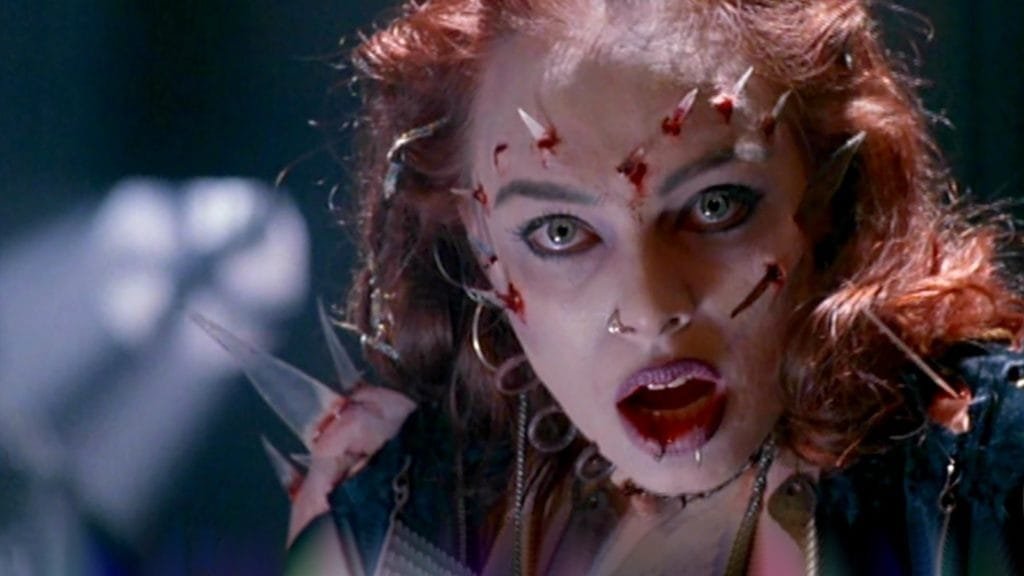
Julie (played brilliantly by Mindy Clarke) is one of the most recognisable zombies in horror cinema. She plays the split in her personality really well as she fights against the human munchies and realises that being dead isn’t actually all it’s cracked up to be, while at the same time, working an oddly aesthetically-pleasing look. There are a lot of influences to spot here. Whilst the debt of honour to Linnea Quigley is obviously there, Julie (and Curt) are kids of the Nineties, on their way to Seattle to enjoy the music scene before everything goes wrong for them. As well as grunge, though (check out the L7 poster on Curt’s bedroom wall) the S&M/goth influence is in there too, and it’s worth remembering that this film hit the stands at just the time when piercings were emerging into the mainstream from their old haunts of the fetish club and the tattoo convention. Julie takes something which would have been a tad more familiar than it was ten years before, say, and then hyper-extends it until it’s monstrous. And, hey, there’s a dash of Cenobite in there too, with the slashed fetish wear and symmetrical piercings, right? Funnily enough, Julie would look more at ease in the ranks of the Cenobites than some of those we were expected to accept in the previous year’s sequel Hellraiser III: Hell on Earth (a Cenobite whose prime torture technique was burning people with a cigarette? Bitch, please). Julie is both meaner, more engaging, alive or dead, and never loses her humanity, which stops her from ever becoming truly repellent. Brian Yuzna has done some sterling work in his time, but Julie is by far one of his best creations.

It’s hard to believe that this film is twenty years old. It’s hard to believe that I first saw this as a young teenager, and thought that Julie was one of the coolest entities I’d seen since Pinhead. How time flies. Well, I think it holds up brilliantly to this day, and it’s a movie that, as a Yuzna fan, I find myself revisiting often, and always finding something to enjoy. Yuzna knows that you can go to new places with your characters in a horror film without sacrificing on the gore, and it’s why he’s one of the masters of body horror. I’ve read a lot of reviews of ROTLD3 as preparation for writing this retrospective, and one criticism which cones up again and again is that it lacks the ‘fun’ of Return of the Living Dead. I don’t think that’s necessarily true – there are bleakly comic sequences throughout the film – but ultimately, ROTLD3 is just a different beast, and it works so well because it is. By using grim, graphic horror ‘what if?’ ideas, Yuzna is able to do here what he does so well elsewhere: body horror offers the scope for an entertaining, compelling and often blood-curdling glimpse at the human condition. It means that you don’t need to scrimp on blood and guts, but you can use their presence to throw in oddball questions about what we are and why.

When you can successfully merge love, death, noteworthy aesthetics and plenty of gore into a captivating story, then I’d say you’re doing something right, and that is precisely why we can still talk about this horror movie today, when so many of the other cousins-twice-removed of the original Dead films which wound up making ROTLD3 possible have already sunk without trace, or perhaps worse, deliberately been forgotten. ROTLD3 was unafraid to take a few risks, the risks paid off, and it deserves its place in zombie horror history accordingly.

Film Review: Lord of Tears (2013)

By Keri O’Shea

There have been a few cryptozoological horrors in recent years – that is, horror movies about mythologised species, part-legend and part hazy reports from often unreliable sources. The Sasquatch, the Mothman, even the Chupacabra…and, in new British movie Lord of Tears, we have an interesting mash-up of creature legend and pagan ritual, a film choc-ful of more ideas than it can ever truly accommodate, but worthy of credit for trying very earnestly to establish a new horror mythos in a world of lazy handycam rehashes and fan-baiting remakes.

After the death of his estranged mother, teacher James Findlay (Euan Douglas) is declared executor of her will and inherits the family estate, of which part is to be found in Baldurrock, in remotest Scotland. However, in a letter left to him, his mother advises him never to go to Baldurrock; it was the source, she said, if some great mental trauma in his early years, and the reason that she thought it better that he be brought up elsewhere. Well, this is the movies, and no one ever follows that sort of sane advice, do they? Not that he even needs to go to Scotland in order for his tenuous peace to be shattered at all, though; as soon as he’s reminded that anything ever happened to him, James begins to experience nightmares, and in particular, he dreams of a strange, owl-headed figure which scares him as much as an adult as it – apparently – ever did when he was a child. James feels that he needs closure on all of this, and so he travels to the family home in order to investigate further. There, with the help of an American woman living in the area, begins the unravelling of a mystery.

First things first; in writing for this site I encounter a lot of screeners in an average year, and it’s becoming increasing rare – as sites grow many and funds grow low – to receive anything beyond your basic blank disc in a plastic sleeve, let alone a boxed disc (and more and more, you’ll get a download code instead of a disc at all) so it was a pleasant surprise to get a very stylishly packaged DVD here; rather than a DVD-sized box, what we have is a CD-style fold out with a booklet, and the evident intention in mind that the monster of Lord of Tears ain’t out of stories yet. In fact, in its ambition the film crams in a massive amount which, in an ideal world perhaps, would have been spread out over more than one movie.

This is a film which wants to do something different, and it’s unusual for an early feature (director Lawrie Brewster’s second) to really go for it in this respect. It has classic horror at heart, name-checking the likes of The Innocents and – perhaps expectedly – The Wicker Man, but it also wants to achieve something of its own. All of this is to be admired, and certainly goes a long way with this reviewer. However, for me, this is a film which is at its best when it’s low key. Throughout the film, and from the first scenes, Lord of Tears utilises lots of flashy, cut-away scenes, adding surreal notes to the mix which detract from, rather than add to the horror on offer. It also uses masses of incidental music which felt very high in the mix and rather overpowering, especially compared to the audio in the film. A more softly-softly approach would have helped to create the atmosphere which, let’s face it, with locations as good as the ones used here, may well have sprung up organically. On those occasions where the film allows us to barely-glimpse something, the sort of motif used so well by a film like The Innocents, it works best.

Now, I’ve mentioned that the film doffs its cap to a lot of classic horror, and in one respect it does what a lot of British movies have felt they must do down through the years; namely, casting an American in a lead role. Evie Turner (Lexy Hulme) fulfils a dual purpose as a love interest and as a character involved in the film’s twist, but I have to say – with respect – that I didn’t feel she worked well here, and that some of her scenes – again, with respect – should have hit the cutting-room floor. To Euan Douglas’ quiet, even nervous performance she seems incredibly overblown and unbelievable, but then, when directed to participate in a ‘sexy’ scene which seems to consist of slow-mo modern dance which demands a lampshade as a ‘sexy’ prop, then what’s a girl to do? Perhaps this was intended as light relief or even seriously as titillation, but I couldn’t quite believe my eyes.

Still, dance-off notwithstanding, and although the film needed to itself thinly in order to get to its explication, I liked that it at least wanted to up the ante. Pulling in elements of lots of disparate mythologies, adding a little extra and then coming up with an original yarn isn’t the easy option these days. Yes, Lord of Tears is outlandish and yes, there are some issues with it, but it gets credit for its ambition. Last but not least, it’s nice to hear David Schofield’s dulcet tones in his guest role here, and who knows? Perhaps that strange owl-headed figure will be back yet…

Lord of Tears receives its première at the Bram Stoker International Film Festival on 25th October 2013.

Film Review: After Death (2012)

By Keri O’Shea

Families. They’re funny things. Think about it: with no say on your part, you may find yourself tied, for the duration of your mortal existence, to a rag-tag assembly of people with whom you have very little in common, if anything at all. And yet, for all that – they still matter hugely. They always matter, even if you’ve fallen out, even if you’ve stopped speaking altogether.

After Death takes a look at what happens to a group of grown-up siblings after the sudden demise of their estranged father; it has been seven years since they saw him. So, they all gather at the house they grew up in, as is the right thing to do, and they try to balance the customary issue of managing their grief alongside all of the hard graft which needs to be done when a person shuffles off the mortal coil – shifting the deceased’s belongings, managing their estate, and so on. In this case, it seems, their dad was something of a character; he was an amateur scientist as well as a collector, and there is one room in the house – his laboratory – which they can’t get into. Not only this, but as the initial shock of loss begins to fade, the family need to come to terms with a lot of things which have happened in that seven years, and just before they parted ways too. Oh, and time, it seems, is against them; the house is at risk of being sold…

What follows, after a lengthy preamble which establishes the characters at the heart of the story, is (contrary to what I expected) a family drama which integrates a spot of gentle sci-fi into the mix. After Death isn’t just about coming to terms with loss; it’s a sojourn into a very unusual take on the Afterlife.

The first comment I’d make here is that this is an incredibly British film. From the phraseology (“You’re such a knob” is not, to my knowledge, an expression which has crossed the Atlantic) to the elder brother’s celeb-obsessed girlfriend who desperately wants to emulate Jordan, right down to the rather grand family seat which is at stake – not to mention a cameo performance from Leslie bloody Phillips – this is an Anglophile’s dream and potentially a rather strange state of affairs for a non-Brit. But that’s okay; there’s nothing here that’s incomprehensible, only that it hinges upon a lot of British references. The success of these references depends on something which the film does very well, and that is to put into play a nicely-observed script and a keen eye for the minutiae of upset, broken-down people. Of all the siblings in this story, it’s youngest sister Eloise (the pre-Raphaelite-looking Claira Watson Parr) who stands out most, being a young woman still anchored to childhood issues and, in her vulnerability, often a bit annoying, as well as sympathetic.

However, to build up the characterisation, the film spends a lot of time dwelling on the intricacies of family dynamics and this means a plot which is very low on action. It feels well overdue for its twist when the film finally shows its hand and moves into new territory. The film stays low-key throughout however, and for many readers of this site it will be off-putting because of this. Which is in many ways a shame, as what After Death throws in there, though doesn’t quite exploit fully, is a nice little spin on the notion of life after death. To say too much here would be to spoiler, but let’s say that it has some intriguing ideas. Perhaps ultimately the film is held back by its genre-straddling style, which is something which could make it difficult for it to find a receptive audience.

There are a lot of good things to be said about After Death; it shows evidence of creativity, which is always a plus, and it has the skill to create well-rounded characters in whom you can take an interest. It’s not afraid to do things differently, either. This may be what holds it back, too, as it never quite feels like it makes the impact you anticipate from all of its elements coming together, but as the first feature by writer/director Martin Gooch it certainly shows his ability to craft kitchen sink weirdness which – who knows? – could become its own genre…

Comic Review: S.H.O.O.T. First #1

By Comix

Oh, it’s another one of these. It’s that comic that you’ve read a million times, the one with the group of secretly funded ghost hunters who travel the globe stomping out monsters. We saw it in BPRD, we saw it in Atomic Robo, and in Hoax Hunters, The Intrepids, Justice League Dark, the list goes on and on. So why am I even bothering to stuff down another review about a group of diverse people banding together to stop evil in its tracks via magic and laser guns?

Because S.H.O.O.T. First has something that none of the other comics have, or, lack thereof. They lack faith in what they see. Standing for Secular Humanist Occult Obliteration Taskforce, S.H.O.O.T. has the unique problem of just plain not believing what they are seeing, even as they are shooting a djinn in the face or talking to angels, giving this comic a unique twist on a classic team story.

The comic starts out with terrorist attack in Iran. Originally thought to be a car bomb, it’s soon revealed that a couple of djinns have got loose from their world and decided to wreak havoc on a mosque. Enter S.H.O.O.T., a team of sass-talking Americans and Brits who come down to kick-ass and get names, all while blaming the appearance of the djinn as nothing but dimension hopping assholes. Weird, right? As things get a little tight in the prayer room, a man who had recently lost his faith saves the team by the skin of his teeth before blacking out. Waking up later in an underground facility in Dubai, the team explains to the man (and us) who they are and what they do. I don’t want to ruin it for you about how they work, but this kind of thing goes all the way to the Pope! Tossing in political intrigue and a war to end all wars, S.H.O.O.T. will have you questioning everything you’ve been taught about religion.

All in all, S.H.O.O.T. First is a very good read. The writing is tight and not one to focus on pointless narratives or dead-end plot tools, a true definition of Chekov’s gun. It’s interesting to see the comic attempt to re-analyze our beliefs and whilst some parts, like the guns firing on anger and doubt, is a bit schlocky, it doesn’t overstep the boundaries of good taste. It never insults the reader, just presents things differently. My only real problem would be the characters’ originality which is to say, there is none. There’s a tough, black woman, a snarky, British guy, a short-skirted, white girl; they’re nothing you haven’t seen before. That’s not to say they might not evolve past their roles, but it’s hard to see it at this point.

The writer, Justin Aclin, is not exactly new to the scene, but it seems like the only credit I can find is some Star Wars comics and something called Hero House. Also, blogging. Despite the limited experience, if S.H.O.O.T. First is any indication of what he’s capable of, I’d be interested to see more. Nicolas Selma, his artist is, well, an artist. He’s good at what he does and is very capable at illustrating Aclin’s words, but it’s not much to write about, which is pretty good since I’m a huge stickler for art. I definitely suggest picking S.H.O.O.T. First up; it starts up solid and continues all the way to the end, leaving the reader excited for the next issue.

S.H.O.O.T. First drops Oct. 16 from Dark Horse at your friendly, neighborhood comic shops!

The Rules of Film

By Guest Contributor Nathan Sturm

Editor’s note: can we improve the state of modern cinema with a few, handy, easy-to-follow rules? Our guest writer Nathan thinks that you can, and I’d bet my last banknote that a lot of Brutal As Hell readers will agree on a few of these. Check them out here…

1) Do not treat viewers as if they were stupid.

2) Never include a flashback to an earlier scene (unless it’s to show the protagonist focusing on some detail he hadn’t noticed before and that now means something different in light of new information).

3) Do not emphasize details with dramatic close-ups followed by someone’s face as they offer obvious, redundant commentary on what they (and we) just clearly saw.

4) Do not pound into the skull of viewers how they are supposed to morally judge a character by having that character do something really obviously good or bad that has no bearing on the plot and doesn’t fit with their personality, especially if their goodness or badness is already pretty clear.

5) Do not make movies that are really dumb in the belief that the movie-going public is composed entirely of morons who will only pay money to see dumb things. Many smart movies have, in fact, been profitable.

6) Do not go to excessive lengths to create implausible situations whereby the villain dies without the hero having to actually kill him.

7) Do not humiliate actors without good reason.

8 ) Do not attempt to use rectal trauma as a source of laughs.

9) Avoid casting actors unfortunate enough to be weasely-looking in minor parts as weasely characters who are devoid of redeeming characteristics.

10) Avoid casting actresses who seem attractive but vacuous in minor parts where their only function is to show lots of skin.

11) Do not create female characters who are indistinguishable from male characters except in appearance. (This can be waived for “authority figure / professional” type roles of middling plot importance, e.g. the hero’s boss, colleague, or doctor.)

12) Do not create female characters whose only function is to act as the sole representative of femininity in an otherwise all-male cast populating a world of testosterone (unless this is one of the major points of the story and can be articulated in some sort of meaningful and intelligent way).

13) If a female character is performing a traditionally-male role, do not draw excessive attention to the fact that “Oh my god, she is female, and yet, is performing a traditionally male role (while being a woman)!”

14) Avoid situations where the only function of the sole female character is to act as a prize coveted by rival male characters.

15) Do not assume that any and all villainous people of color are secretly being controlled by evil Caucasian masterminds.

16) Do not portray all American Southerners as physically, intellectually, and morally inferior to Orcs.

17) Do not create characters whose sole purpose is to say something politically incorrect, sentimentally immoral, or otherwise unpleasant, and then have something bad happen to them, all with little or no effect on the actual plot.

18) Never include an excessively sunny morning scene in which someone is cooking breakfast and everyone in the family sits down at the table to eat and is feeling chipper on their way to school or work, as this may be the single least-realistic of all Hollywood inventions.

19) Do not expect viewers to remember who a character is if the character in question never received a formal introduction and has no major distinguishing characteristics.

20) Never end with a statue being built of the protagonist (unless it’s a historical film and such a statue was actually built in real life).

21) Use less turquoise light.

22) Do not fill every second of runtime with music. Dialogue in quiet scenes is more likely to be ignored and used to signal bathroom-break time if the music is already telling us how we’re supposed to feel here. (This can be waived for movies with very minimal dialogue and an “operatic” feel, particularly if the musical score is exceedingly good.)

23) Avoid killing off characters just for the sake of having someone die right before or during the climax. This does not apply to climaxes where the whole point seems to be to kill off most or all of the characters.

24) Do not remake older films without valid artistic reason.

25) Do not make a movie to begin with if it’s going to end up with a title that includes a colon followed by a year.

26) Do not portray teenagers as being enamoured of things that were trendy ten years ago and then include some condescending plot twist whereby they stop “rebelling” and go back to being their “true self”, i.e. exactly the way they were as little kids (only now with an income), to the relief of their long-suffering upper-middle-class parents.

27) Create a sense of impact and force when something strikes something else, even if the computer-generated pixels can’t feel anything.

28) Do not have a character turn out to be a traitor at the end for the sole purpose of having a character turn out to be a traitor at the end, especially if this does not actually serve the plot in any meaningful way and if the character in question was likeable.

29) Do not create villains who are identical to the Nazis despite having arisen under different social, political, cultural, and economic circumstances.

30) Do not create heroes who are suddenly handed the opportunity to, without having to expend much effort, become really awesome and fulfil all their dreams, etc. for no identifiable reason other than to make viewers feel good about themselves for two hours before returning to their shitty jobs and underwhelming private lives, etc.

31) Do not further sully the reputation of the horror genre with the assumption that all horror is automatically schlock and does not require standards of quality.

32) Do not make a horror film just because you heard on the Internet that it’s the quickest way to “break into” the industry (i.e. by making a profit on a minimal budget) if you have no understanding of, or appreciation for, horror.

33) Do not make a horror film just because you heard on the Internet that “horror films these days are insufficiently extreme and overly predictable” and you want to show other Internet-people that you are more extreme and/or more ironically clever than they are.

34) Put the viewer in the characters’ shoes, and then scare the characters. Avoid trying to scare the viewer directly while bypassing the characters, unless you are really good at creating an unnerving atmosphere.

35) Avoid including socio-political-type messages that amount to beating a dead horse. If the reason you’re including a message is because you heard the same message in four or five other recent films, don’t include it (unless the message was garbled in each of those cases and you actually have something new and intelligent to offer on the subject).

36) Avoid populist themes in movies about things that are only of any concern to the social elite to begin with, such as country clubs.

37) Do not steal someone else’s idea and then water it down for mainstream consumption.

38) Never greenlight a project on the sole basis of a cool-sounding premise and a decent, special-effects-laden climax if the main body of the film is going to consist of nothing but characters walking around, opening and closing doors, making cryptic and/or redundant statements to one another, and occasionally having arguments over whose lover’s desk has the biggest donut-box resting on it until the actually interesting stuff happens at the end.

39) Never, ever, never under any circumstances include a scene justifying the use of torture in stopping terrorists.

40) Do not make “inspiring stories”. Please. Please.

Book Review: The Jack in the Green by Frazer Lee

By Keri O’Shea

Threaded through what little we understand of early British pagan beliefs – and one of the reasons they continue to hold such fascination is that so much about them has been obscured by time – is the central idea that Nature is cyclical, with birth and death not only following one another, but necessary to one another. Although it is an idea which at least partly formed the basis of the rather anaemic Wicca movement in the twentieth century, perhaps its most well-known representation in horror cinema is still via the greatest ever British horror movie, The Wicker Man, with its OST song ‘The Maypole Song’ providing a succinct summation of the belief. In referencing a British folk song, ‘The Cauld Lad of Hylton’ in his prologue – one of a wealth of songs which surely influenced Paul Giovanni in his own work – author Frazer Lee seems from the outset to be calling to that set of beliefs, and to their representations. This was not the last time that The Wicker Man crept into my head as I read his latest book. However, as a horror fan himself, Frazer doesn’t just stick with psychological horror in his latest novel, The Jack in the Green. The opening of this book packs a visceral, horribly sensual punch which makes it clear that body, mind and soul are always at risk here.

Tom McCrae is a man in his mid-thirties who, outwardly at least, has signed up to the sanctioned routine of wife-home-career. However, Tom is plagued by nightmares about the murder of his parents, who were killed when he was just six years old, and these dreams continue to have a terrifying, destabilising effect on his waking life. Now living in California with his wife Julia, living day to day and seemingly deeply dissatisfied with his lot, he takes an assignment which requires him to travel to Scotland to secure important real estate for the expansion of his company’s biofuel business. Upon arrival, his nightmares begin to escalate, and worse – they now seem to have become invested with an unpleasant sense of foreboding. Predestiny? Tom certainly seems to be entering an unpleasant and inescapable chain of events which call to an existence of his beyond him.

There has been, of late, something of a pattern in Frazer Lee’s fiction: as in his recent novella The Lucifer Glass, here we have in our central character (though not our narrator) Tom McCrae another contested modern career man, one who only has the appearance of stability and contentment. For Tom, it only takes one shift in circumstances to propel him towards confronting his true self. These divided, often guilt-ridden men whose devils on their shoulders are only too ready to begin to speak louder allow for a pleasing ambiguity to develop in the narrative, and also for flawed, yet believable conduct from main characters towards others. There’s a constant note of cynicism here, too: Tom McCrae often lapses into sneering dissatisfaction with the system he has found himself part of, his internal monologue lashing out at everything which is wrong with the world even as he is carried along with it. This believable grounding permits the fantastical which creeps in to feel more weighty – as if all of these horrific things are happening to someone that for the most part you can easily believe in.

And the horror which unfolds brings with it some very neat, well-wrought ideas. One thing which Lee does very well is write about dreams, creating convincing nightmares that are integral to the plot, but not simply stopping there; the other side of the coin is to see what effect these have upon his characters as they try to make sense of the nonsensical, and try to disbelieve in what they have just experienced. As the story progresses, it becomes increasingly difficult for his characters – and for us – to make this distinction. This creates some very engaging and effective horror sequences, described in vivid detail (though at times the number of similes used in the text feels excessive). The location of the story in remote Scotland is also important to the success of these horror sequences, as Lee renders some deeply evocative descriptions of the woodland which surrounds the village of Douglass, making it fundamental to the dreams themselves, but also using it to again remind us that Nature is as pitiless as it is picturesque. Bad dreams, childhood trauma, darkest woods…The Jack in the Green knowingly shuffles the horror archetypes like a pack of cards.

I have alluded to the novel’s outward connections to The Wicker Man: certainly, the barest description of the plot – a professional man called from suburbia to an isolated Scottish community which seems to retain odd, atavistic beliefs – makes the comparison inevitable. There are other common points, too, but as the story moves along, Lee’s evident awareness of these sends things into a much different direction. In many ways this is the sequel to The Wicker Man that I wish existed instead of the abysmal Wicker Tree; The Jack in the Green takes recognisable elements, sure, but allows them to extend into the supernatural in a way which The Wicker Man never does. It takes the ‘old gods’ of Summerisle and makes them real – and terrifying – in Douglass. Not only this, but there are also graphic, bloody scenes in this novel more akin to Hellraiser than The Wicker Man. By the time we reach the finale of this book, it is a very different beast to the one I expected and which, if you are yet convinced that this is too close to The Wicker Man for comfort, you will expect either.

In order to create greater complexity, though, Lee introduces several supporting characters, one of whom in particular I felt became ever more rootless as his presence in the narrative increased. I wanted to know a lot more about him – but he was moved aside for an end sequence about-face which felt slightly frustrating. There are also other characters whom I questioned at first, but they – to a greater or lesser extent – prove their worth, eventually tying into the plot well. This is not to say that Lee’s determination to close his tale in the same dark way it begins doesn’t pay off, but it means at least one compromise is made in order to do so.

However, it is a small detail considering the many things to recommend this novel. Skillfully blending quintessential British horror with vivid interludes of bodily trauma and mental anguish, The Jack in the Green is as ambitious as it is enthusiastic. In reading this book you will vacillate between different states: terrified child, restless sleeper and horrified bystander. There is plenty here to call to each.

The Jack in the Green is available from 1st October 2013 from Samhain Publishing.

DVD Review: I Spit On Your Grave 2

By Tristan Bishop

I remember being confounded when I heard the news – I Spit On Your Grave 2 was on the way. A remake of a controversial classic is one thing, but a sequel to one which didn’t have any sequels originally? And the press release referring to it as a ‘franchise’ set more than a few teeth on edge. Granted, the 2010 I Spit On Your Grave remake is generally regarded as one of the less awful of the current batch of re-imaginings of horror classics, but this seemed perhaps a step too far.

Then came the infamous quote. A British print magazine which shall remain nameless gave up the following as a sound bite – “The best horror sequel ever made”. Right there in black and white. Let’s forget such disappointing fare as Bride Of Frankenstein, or Dr Phibes Rises Again, or Halloween 3 – this is the real deal, folks! The benchmark has been set!

But all irritating sarcasm aside, my interest was suitably piqued. After all, whoever gave that quote must have been impressed (or possibly caught short in a moment of emotional weakness), so I was curious to see what director Steven R Monroe (who also directed the original as well as various SyFy channel master works like the Katharine Isabelle-starrer Ogre) had to offer.

Our main protagonist is Katie (Jemma Dallender), who is an aspiring model. When one agency tells her that she needs better portfolio pictures, she is given a number for a free photography service. At the studio she is greeted by Ivan, the photographer, played by that Joe Absolom out of EastEnders, as well as his brothers, the friendly but creepy Georgy, and druggie scum bag Nikolai. They take her photos, but when it is suggested she ‘shows a little more skin’ she cottons onto the scam and leaves. Later Georgy appears at her apartment to give her the pictures, and is making a very good job of looking like a creepy stalker. She thanks him and asks him to leave. However, soon afterwards he turns up in her apartment in the middle of the night, binds and rapes her. Her friend arrives and tries to stop him, but is knifed and killed. Georgy calls his brothers to come and sort out the mess, and Katie is force-fed ketamine and wakes in a dirty basement. She manages to escape (after some abuse and a second, mostly off-screen rape from Nikolai, which Georgy stops), and soon discovers she has been transported from New York to Bulgaria without her knowledge whilst drugged, with no clothes, save a short nightie, no money and no idea of how to get home.

This being a sequel to I Spit On Your Grave, then I won’t be offering up any massive spoilers when I reveal that she doesn’t go straight to the US Embassy and get on a plane home – she instead wreaks violent vengeance on her abusers. There are a couple of plot twists on the way there, albeit nothing too taxing or surprising. We’ve probably all seen a rape/revenge film before and they all follow the same pattern. So is there any reason to watch this? Well, that entirely depends on your reason for wanting to see the film.

For the casual film-goer, probably not. Whilst the film-makers are competent enough, the script is fairly dire, with Katie delivering lines earlier on such as ‘I know how to catch me some vermin’ (she grew up in the country you see – this is the sole bit of characterisation our central character is afforded), and her later leaving a Bible open, causing a priest’s eye to fall on the ‘Vengeance is mine’ verse. This is not a film which deals in subtlety – and in fact that would be excusable for a rough and ready exploitation film, but the second major weak point is, unfortunately, the lead actress. Whilst entirely convincing as a model, Dallender struggles to deliver the pitch black sarcasm as she eviscerates her attackers (although to be fair she isn’t given much to work with), and as for the scenes where she manhandles the rapists, her tiny frame seems entirely incapable of such action, and we are left with a growing sense of disbelief in what was already a fairly shaky concept.

To give them their due, though, the people who made this knew who they were making this for – the indiscriminate gore hounds amongst us – those who can happily ignore any minor shortcomings like acting or knowing how to move a camera at the right time if they are given a healthy dose of gore and/or sleaze. I occasionally count myself among these people if I’m in a particularly twisted mood, in fact. So does it deliver in the requisite brutality?

Yeah it does. And then some. The version under review has been, rather astoundingly, shorn of a massive six minutes at the behest of the BBFC (although this was by prior consultation, so the film has not technically been cut by them). I believe it differs somewhat to the unfinished ‘special festival cut’ shown at Frightfest, but as I did not attend, and have not yet seen the unrated version, and cannot find any information whatsoever as to exactly what was missing, I am left to assume this was all cut from the first half of the film, and the rape and humiliation of Katie – In fact, given the excesses of the original’s near three quarter hour rape sequences, I was somewhat surprised (and somewhat relieved, truth be told) that the sexual assaults take up only a couple of minutes of screen-time, and one takes place off-screen entirely (at least in this version). It’s still plenty grim though, just not in the league that I was expecting giving the series’ pedigree. Any such fears that the revenge parts in the second half of the film might have been subject to censorial interference are dashed however, as our angel of death slices, electrocutes, beats and subjects her former attackers to even worse tortures – one scene in particular left me with my jaw resting in my lap, and the gruesome details are just the sort that dedicated gore freaks will eat up.

So can I recommend it as the best horror sequel ever made? Or even as a worthwhile film to the average viewer? Not remotely, but the UK cut serves up the expected splattery revenge, and for those among us with a taste for the twisted, that will probably be enough to warrant a viewing.

I Spit On Your Grave 2 will be released to DVD on October 8th 2013.

DVD Review: Thanatomorphose (2012)

By Keri O’Shea

When a film’s press release name-checks Cronenberg and Buttgereit, it has immediately placed itself in a risky position; any movie mentioned in the same breath as these bastions of body horror has a hell of a way to go to prove itself, and you often can’t help thinking it’d be better if a film came in quieter, kept below the parapet and let its qualities speak for themselves. It would certainly have been better in this instance, as unfortunately Thanatomorphose, despite its cool title and interesting-on-paper premise, is simply not up to the challenge. Body horror, yes, but with severe limitations.

After a night of bruise-inducing sex which is refracted through a trippy, psychedelic array of filters and colours, we meet our nameless female protagonist (played by Kayden Rose) and find her fairly nonchalant about her injuries. She seems fairly unresponsive to most things, actually – her activity partner’s attitude towards her, her shitty landlord, her friend who seems desperate to become a slightly more considerate friend-with-benefits…that is, until her injuries, rather than healing, begin to mysteriously worsen. Soon her fingernails are dropping off, her hair is shedding – in fact, she seems to be decomposing. At first, she’s terrified – but soon enough she seems to being finding it all quite liberating. The worse she looks, the better she feels, and the more able she seems to feel to put things in her life order once and for all.

See, all of that sounds original and challenging, but the challenging nature of making that storyline effective is not borne out by the way it’s handled on screen. The vivid, promising opening sequence gives way to a long series of domestic scenes which, despite the sheer amount of nudity involved (more anon), I can only describe as turgid. I tried very hard, I looked very hard, but I found myself switching off. I would say that the first twenty minutes of this movie are make-or-break time; had characterisation occurred at this point, and had I been able to feel anything at all for the lead, then what eventually happens to her might have had the sort of impact you imagine is possible when you look at the blurb. Of course, it could be that the way in which our protagonist is kept remote from the audience is actually deliberate and intended to make a point about her relationship to herself, but that doesn’t come across successfully. I never felt sure whether the flatness of the role was aim or accident, but I was definitely repelled by the barrage of ‘girl walks around apartment’ sequences and didn’t feel that these moved the film along in any expedient way. Any film which takes place in such a limited space with a small cast really needs to go some in order to achieve what it sets out to do. Editing takes place through these scenes, sure, but the jumps forward keep us within the same mundane scenes. The pace soon drops away to nothing.

And yeah, the fact that Kayden Rose is naked or at least has her ass out in most of these scenes could, I am sure, also be intentional in the sense that the director and writer, Éric Falardeau, wants to make the point that her character is only ever seen as a sex object, or something. Except I can’t quite believe that. I’m very far from being sensitive to T&A in cinema, believe me, but the way it occurs here felt skeezy and unpleasant in ways which are quite hard to quantify, though I’ll try.

It’s not that the nudity is simply plentiful; it’s not that it so frequently seems like it has been crowbarred into proceedings with little or no justification; it’s not even that it is badly shot and edited. It’s all of those things, only lethally combined with the non-entity status of the character – the only character we really get, despite a handful of small roles. If any filmmaker is trying to make a point that this woman – or even women in general – have to literally go to pieces in order to reclaim their bodies, then this grand point feels redundant when it feels like the filmmaker is part and parcel of the problem which sees women in that way in the first place. This girl is rendered down into a collage of butt shots and passive utterances; if the intention was to present the audience with more than that, then it’s not there.

And yet, this is a film which seems to aim high. The psychedelic asides, though few and far between, and the fact that the film is broken into three named chapters, seem to be giving a nod to filmmakers like Noé and Von Trier, rather than more conventional horror fare. Nothing wrong with being ambitious, of course, but perhaps getting the basics right first would be best. There are some good things going on here; the make up SFX as Rose’s character begins to putrefy are genuinely rather good considering they’ll have been done on a tight budget, and the idea itself is good, which perhaps means that more ideas may spring from the same source in future. However, in Thanatomorphose the centre cannot hold, and the finished product itself goes from lividity to rigor mortis to decomposition.

Thanatomorphose will be released in the UK on DVD and iTunes by Monster Pictures on 25th November 2013.