Happy Birthday, Brutal As Hell! 5 Years in the Horror Scene, Part 1

By Keri O’Shea

Happy birthday, Brutal As Hell!

It’s hard to believe, but this week Brutal As Hell has just reached its fifth anniversary, and it’s a real privilege for me to say that I’m still around as we celebrate that little milestone. Whilst I haven’t been with the site since the very beginning, I’ve been hacking away here for most of that time, and I’ve seen the site go from strength to strength along the way; if you’ll excuse a bout of mutual back-slapping for a moment, we have an incredibly strong team, a group of writers who certainly don’t always agree with one another (which in my opinion is one of our biggest merits) but who are all equally passionate about horror and genre film, finding time around some very busy personal schedules to demonstrate that passion in a range of regular articles covering everything from widely-released cinema to underground comics, interviews to indie movies, editorials to irreverent transatlantic conversations. It’s all good. I could just hug you all. I’m not gonna, but I could.

We were wondering, though, how to mark this occasion at the site in a way which took into consideration the sheer range of films and developments in (for want of a better phrase) the horror scene since Brutal As Hell first kicked into gear at the beginning of 2009. We have a big team feature coming, as well as some individual pieces on some of the more notable trends and themes which we have noticed during this five-year period. This got me thinking about these notable trends and themes, and what – on a personal level – I consider most important out of these. I started noting a few things down. An hour later, I had a very tattered piece of A4 paper and more ideas than I could possibly fit into one overarching article. Best laid plans, and all that…

So, for starters, here are some of what I consider the most significant themes or issues in the horror genre today. I make no claim that this is an exclusive list; but, as a fan writer of some years’ standing, these are things which I believe are particularly of note since 2009 – because a lot has happened since then…

1) There is no ‘horror audience’…there are now two horror audiences…

Straight in with a sweeping statement? I think it’s justifiable in this case, because I feel that particularly in the past five years (although there is no date set in stone and elements of this have of course begun to occur earlier and later), the horror genre has changed to accommodate a new demographic, and in many ways there seems to be little overlap between this new demographic and what I would call ‘horror fans’. A tentative term for a large and varied group of people perhaps, but when it comes down to it I’d identify people like us who regularly watch a range of films within the genre and probably relate to the genre as fans, reading about the cinema itself, knowing a little about its directors or regular stars and so on as ‘horror fans’; our engagement with the genre ordinarily seems to reach beyond the ninety-minute experience of viewing itself. That would ordinarily be the definition of fandom; but things have changed.

The massive influence of a still-burgeoning horror franchise like Paranormal Activity seems to have heralded a new type of horror fan: we now have a demographic who want something very different from their encounters with the genre. As such, the films which cater to them have developed a particular kind of horror which is all about bodily endurance. Jump scares are king; the more times you are manipulated into leaping out of your seat, the more this new demographic seems to deem the horror a success. If the film isn’t causing the viewer to yelp and jump, then it’ll relax a little and concentrate on making them squirm; the funniest thing about this is that these films often seem to appeal to, and are targeted at, ordinary cinema-goers who might, here and there, perhaps at Halloween or at other points in the year, circumvent the latest Jennifer Aniston rom-com to steel their nerves against the latest most terrifying film you will ever see because the billboard promises them they may well shit themselves. These part-time, multiplex horror-goers have certain expectations, and many of the most lucrative horror movies are very happy to cater to them.

Whilst you could make the case that The Blair Witch Project kicked off this trend for low-budget, high-profit at the end of the Nineties, setting the bar very high in the process, and that the Saw franchise really cemented the ick factor in modern cinema, upping the ante once and for all, Paranormal Activity has to be the apex (or the nadir?) of the no-idea, no-skill, little story, maximum profit venture. It plumps for the cheapest format, almost giving itself permission to look bad and make mistakes whilst dispensing with pace, again excusing this through the whole ‘found footage’ get out of jail free card. As long as there enough yelp-out-loud moments, however, people seem to still go to see these films. It’s not the dedicated horror fans that keep these films coming out year upon year; we’re more likely to be bewailing the fact than excitedly supporting them – but if they’re not for us, then it doesn’t matter.

You can tell a great deal about the target audience and how they are perceived by the way in which the Paranormal Activity films and those like them are advertised: TV stints, which cost a fortune, after all, have now more or less given up on providing anything more than the barest idea of the film’s plot. These days, budgets are blown on night-view cameras which are trained on hyperbolic audience reactions; a few convincing seconds of this is usually followed by a quick vox-pop from a grinning part-timer describing how ‘scary’ the film is. Online campaigns, such as they are, ordinarily work against the films in question, making horror fans trying to read reviews and articles grind their gears as they desperately try to close down the fucking pop-up which keeps on appearing on all the major sites. Grrr.

Of course, in so many ways horror has always been a bang-for-buck genre, a convenient stepping-stone to a decent profit and a good place to start for any budding filmmaker. However, in decades gone by – and I’m sure this isn’t simply a case of nostalgia – a certain level of ingenuity seemed to be necessary, even if things were frequently cheap and nasty. There was more breadth, more variety; people wanted monsters and stories as well as exploitation or Herschell Gordon-Lewis nascent gore SFX. These days, in successful cinema monsters seem to be the province of Pixar; we have vampires, but in their most successful incarnations of late they’re now the nervous virgins. When horror ain’t a hit unless you jump out of your chair, this reduces the scope possible, and that is a real shame, especially when the rise of the multiplex horror consumer has meant this approach has gotten its tentacles into other films, too. For instance, a decent and promising film like The Woman In Black became something of a yelpfest, and all of the still-incoming horror remakes seem to hinge on an approach of ‘same – but louder and more’. Hey, it makes money, just like found footage always promises to. In each case, the chances of high turnover are just too damn good, too tempting.

This sounds as though I am painting a very bleak picture of horror as it has come to pass over the past few years, and in many ways, sure, I am. There’s a lot I’d like to see happening differently. It’s not all doom and gloom though. Not by any stretch. Writing this piece has, in a roundabout way, reminded me just why I ever wanted to write for a site like Brutal As Hell.

Marc, our site founder, asked us recently to come up with a list of our top 20 horror films which have come out during the site’s lifetime – in other words, a list of films from January 2009 to the present. There’ll be more on this anon, but as I sat down to write this list, once I got going I realised there was an absolute wealth of brilliant horror cinema during this relatively short period. Films which are innovative, clever enough to forge their own mythologies or to present interesting, courageous developments on existing mythology. Films with writing and direction so good that you get a clearer sense of characterisation and plot within twenty minutes than you do in many films over ninety minutes. Films which have in some way or another stayed with me. All of this, and – with one possible exception from the list, as it’s a movie which has been hastily remade – I would bet good money that your average Halloween shitfest filmgoer would never have heard of any of them, much less seen them.

This is, obviously, a crying shame, and indicative of just how difficult it is for the good stuff to get out there in these testing times, but the fact remains: if I’ve seen something I love, and as part of my hobby and my passion I get to talk about it, then maybe – just maybe – this can do a little for the filmmakers behind that project. If one person reads a favourable review and sees enough in it that they feel prepared to seek that film out, to take a chance on it, and maybe to recommend it to someone else, then in some small way that does good. Even one more viewer is another audience member, and this may even reach across the divide to someone who would never normally have given something different a go. Big business horror is here to stay; the last five years have shown us this, and things seem unlikely to shift dramatically. But, sites like Brutal As Hell will always be around to honestly champion good movies (and say so when we hate them, mind you) and I can authentically say that this makes me feel proud.

There’ll be plenty more to follow, and plenty more to say about horror in the current day. But for now, I’d like to wish our readers a very happy 2014, and let’s hope that BAH will be around in another five years doing more of what I’m proud we do today. Cheers!

DVD Review: John Dies At The End

By Keri O’Shea

I’ve long been a fan of Cracked writer David Wong, and when I originally heard that his novel, John Dies At The End, was being made into a film, I was…optimistic, for sure, but cautiously optimistic. John Dies At The End was always going to be a challenge; film every element, and it would probably be four hours long at least. Miss lots out, and risk losing some of the best elements of the plot. Well, I needn’t have worried. Director Don Coscarelli – who has past form in translating batshit insane storylines to the big screen, it’s fair to say – did a sterling job here. This is a film which sticks close to the book in many ways, but one which wouldn’t necessarily alienate anyone who hadn’t read it either. More to the point, its blend of charm and innovation make it one of the strongest proto-cult classics we’ve seen in years.

So here’s the difficult bit, summarising the basic shape of the plot without giving too much away; if this is usually an issue when reviewing, then it’s doubly so here for a few reasons. Well, here goes nothing: David Wong (Chase Williamson) has a story to tell, something he really has to get out of his system, so he contacts a journalist by the name of Arnie (Paul Giamatti) and they arrange to meet up. Armed with a tape recorder, Arnie listens as Dave recounts the events of the past few months. These events start off improbable and move quickly into unbelievable, but one thing seems clear – at the hub of it all is a strange new drug nicknamed ‘soy sauce’. Dave’s best friend, John, was the first to try the sauce; Dave isn’t far behind, and it seems like this stuff ‘opens doors’. Doors to parallel dimensions, as well as to heightened awareness of certain visitors from these dimensions. And it seems that these visitors have plans…

None of that really does the film justice, and traipsing out a linear plot synopsis somehow misrepresents the film anyway. As a movie which deals with the possibilities of parallel worlds, however, rest assured that Wong really picks this up and runs with it, creating a hugely-entertaining yarn which translates really well to the screen, in a film that’s fast-paced and covers a great deal in an economical ninety minutes. The film does re-jig the structure of the novel to an extent, and misses a few things out (I was slightly sad that no wig monsters were present, but it’s a minor disappointment) but to Coscarelli’s credit, he has filmed a lot of things I assumed would never make it. Such as the meat creature…and, erm, the unorthodox door knob. I loved the book, and I had (and still have) very specific mental images of what certain characters and scenes look like, but Coscarelli seems to ‘get’ the book enough that his own take on things looks great.

Because this is a film which opts not to plough on for hours, it covers a tremendous amount of ground and because of this, I would say it’s a film which could be a challenge to follow for some viewers. It has to be, really; everything, from the source material to the screenplay, is ambitious. However the framing technique which is established early on – the interview with Arnie – does allow for a few moments of explication, and holds things together somewhat. The believable, charming bewilderment on behalf of our two chief protagonists makes you feel like you’re on their level too; everything here is deeply funny and well-observed, with a well-suited cast throughout. Essentially, John Dies At The End in either form is the perfect blend of a child’s imagination with an adult’s development, a ‘What if…’ matched by a ‘Well, if, then this…’ It really is something else, and it may present a lot to take in, but holy fuck we need this sort of originality and innovation in modern film.

It’s a crying shame that the release on this great movie has been held back for so long (it originally made it onto my Top 10 list in 2012) and Ben has already spoken for us all when he expressed surprise that, for all the things that happen in this film, the cover art has gone for something which doesn’t, but now that it’s becoming available, it’s a highly-recommended purchase. There are a host of extras on the Blu ray disc too, including a cast & crew commentary (I wouldn’t usually care about this feature to be perfectly honest, but here’s one which would be worth listening to!), deleted scenes, an interview with Paul Giamatti, featurettes on the making of the film and the SFX involved, casting sessions and the film’s trailer.

John Dies At The End will be coming to DVD and Blu-ray via Eureka Entertainment on 17th February 2014.

Horror in Short Double Bill: The Beast (2012) and Little Reaper (2013)

By Keri O’Shea

Well, I could go in for a big mea culpa about the sad lack of Horror in Short features here at Brutal as Hell lately, but I think it’d be best all round if I just got on with it, yes? Happily, today you can take a look at two very stylistically different but both engaging short films by director Peter Dukes. So far sticking to the short movie format, I understand that Dukes is currently working on his first feature-length film, also going by the same title – though not an extension of the same plot – as our first short, The Beast.

I have to say, I was genuinely very pleasantly surprised here; The Beast knows it doesn’t have the time or the space to reinvent the werewolf genre, but it is a very worthy addition to this genre nonetheless. It obviously knows where it fits in, too, with its very clear nods to the werewolf folklore created by Universal, and a set of opening credits which for all the world would fit well at the beginning of a Universal feature (and the same could be said for the film’s score, too, which works brilliantly here). The plot is straightforward enough: two men, Desmond (Peter Le Bas) and Michael (genre film regular Bill Oberst Jr) discuss the fate of Michael’s teenage son, Jacob (Alexander Le Bas), whom we understand very early on has been afflicted with lycanthropy. Initially, and in fear of the full moon, they tie the boy up but, well, a father’s preferential treatment makes Michael take pity on the boy, untying him so that he can answer a more mundane call of nature. Of course, this decision brings the situation to a close…

The film works brilliantly as a short, and again as a short on the topic of werewolves, because it wisely avoids two things. Firstly, it doesn’t feel the need to cram a feature’s worth of back-story into its twelve minutes, instead allowing the emotions and the precise situation in which these people find themselves to speak for itself. Secondly – with a few seconds’ exception which nearly derails things, but thankfully does not – it knows that werewolf creature effects are the easiest to get wrong so it dispenses with them. The budget has been far better-spent on the other elements: developing the theme of family and friendships, ensuring solid performances, finding a great location and shooting a film which looks both lavish, but subtle, with a pleasing palate and a real eye for scene-setting. Hell, it even has a punchline, albeit an equally subtle one. The Beast is a very strong short film.

Little Reaper, made earlier this year, is a very different entity, although it too teases out some ideas about family relationships in a strange, horror-styled setting. This time we get this via the medium of horror-comedy, and a style of comedy which I’d best describe as ‘quirky’.

Our premise here is that the Grim Reaper has a teenage daughter; apart from the skull face, she’s your standard stereotypical teenage girl, glued to her phone and apparently pathologically unable to do what she is asked to do. Hence, she is grounded, and the only way her dear old dad will un-ground her is if she adds a day of doing his job to her chores list.

Again, Dukes shows that he knows his genre by adding in a few horror references to the script here. There are also plenty of ideas at play, although perhaps there are rather more threads here than there need to be (I felt that the finale didn’t quite hang together, for instance). As a skit, it is however watchable and diverting, although because it lacks the economy of The Beast, accepting that these are different types of film, it felt less accomplished to me. Still, Buffy did pretty well by combining horror, folklore and high school, so there’s no reason that fans of that style wouldn’t like this one too.

Peter Dukes is evidently a hard-working filmmaker and he has a whole host of short movies in his filmography: if you have enjoyed what you’ve seen, then you could stop by his website and take a look at some of his other projects.

BAH Celebrates 2013 – Keri’s Top 5

By Keri O’Shea

It’s a funny thing: whenever people are asked, or take it upon themselves to generate a ‘Best Of’ list like this one, the default response seems to be disappointment. This year doesn’t seem as good as last year, this year’s films have been disappointing, and so on and so forth – except that this reaction seems to occur every year, and good films are of course still being made all the time. Dig a little deeper, and it seems to me that each year is indeed much like the year which came before it, in that there are a always a range of movies, some good, some bad and some indifferent. Importantly, there’s always plenty to love. My issue this year hasn’t been so much with a dearth of films to enjoy, but with severe limitations on what I’ve been able to get to see. In fact, I’m fairly confident that a few films missing from my list would have made it on there, had circumstances been different.

But still – there has been much that I have enjoyed, so here’s five of my favourites from 2013.

5) The Purge

As someone all too familiar with getting to see brilliant, innovative indies which seem to sink without trace, let alone decent distribution, I’m often slightly suspicious of horrors which arrive on the scene as loud and proud as The Purge did, and I can only grasp at the politics which render one film the smash hit of the summer whilst another gets nowhere. That said, I liked The Purge. Whilst in its execution it wasn’t perfect, it had ideas and it wasn’t afraid to run with them, painting a picture of a deeply flawed, superficial America which could boast of plummeting crime rates because of the phenomenon of ‘the purge’, a period of one day per year where any criminality is not only legal, but encouraged. It’s an idea which has been examined elsewhere, sure, but The Purge had a good balance of plausibility and violent fantasy, doing what good dystopian films do; taking an element or elements which we recognise and allowing this to flourish into something unsettling through its possible proximity.

4) The Battery

Not everyone was sold on The Battery, and it’s entirely possible that seeing the film with a very enthusiastic festival audience may have coloured my reception to an extent (hey, nothing happens in a vacuum), but to me this is a real gem. The zombie has become the most ubiquitous horror archetype of our times, and when we live in a world which has seen its first zombie blockbuster in World War Z, it’s evident that there’s no stopping the shambling (or possible sprinting) dead in their tracks. However, The battery uses zombies more or less as a contextualising factor. They provide the pressure cooker which keeps two unlikely travelling companions together under duress, creating some brilliant, naturalistic, highly funny content along the way, and yeah, there’s even a dash of pathos before the end. Real-life friends Jeremy Gardner (playing Ben) and Adam Cronheim (Mickey) created this film from the ground up, with Gardner directing and writing the project too; it’s testament to the sort of commitment which the smaller players have to show, in order to get original content made, and it’s to their credit. You can check out my full review here.

3) The Seasoning House

On paper, The Seasoning House is everything I’d typically avoid in a film. Young girls being trafficked into prostitution? Torture, torment, human misery? These aren’t plot devices I’d seek out, least of all if this necessarily includes people being tied to chairs. However, I was dead wrong about The Seasoning House. Yes, it’s the darkest entry on this list, but as well as strong performances and the distinct, decidedly welcome impression that this topic was not chosen to be played out for exploitative or shocking reasons (though shocking it undoubtedly is), The Seasoning House is ultimately redemptive without being saccharin. It also tempers its viciousness with a certain dreamlike quality, as Deaf inmate of the ‘seasoning house’, Angel (the brilliant Rosie Day) moves between the crawlspaces and walls of the eponymous house, surpassing its capabilities as a prison, and ultimately surpassing the cruelties of its keepers as the loss of a friend causes her to take redemptive action. You can check out my full review here.

2) Mon Ami

There have been some truly brilliant horror-comedies in recent years – Some Guy Who Kills People and Tucker and Dale Vs Evil, to name just two – so much so, that it’s made me reconsider my standard opinion that horror-comedies typically fail both as horrors, then again as comedies. Still, it’s nice to be proved wrong sometimes, isn’t it? Mon Ami is one of those films which is sadly lacking the attention it so richly deserves, and I hope that more people get to see it, as it is note-perfect; ostensibly a buddy movie, this comedy of grisly errors moves from the sublime to the ridiculous as friends Teddy and Cal design the world’s stupidest get-rich-quick scheme, deciding in their wisdom to kidnap their boss’s daughter for a ransom. Yep. So that goes well. As their day goes from bad to worse, Teddy and Cal’s friendship is put through the wringer in a series of excruciating, laugh-out-loud ways. You can check out my full review here.

1) Jug Face

Last but certainly not least, we have a slab of Deep Southern Gothic in the form of Jug Face; Jug Face is, for me, the finest horror movie of 2013 bar none. Here we have a film which has the nous to develop, in a series of deft moves, its own horrific mythos. Although there are some Lovecraftian hints at play, HPL doesn’t quite have the monopoly on the unfathomable, unseeable and unknowable, and the entity or entities of ‘the pit’ function in a series of interesting ways; village elder, moral compass, and executioner, ‘the pit’ protects the tiny, isolated community which lives near to it, but at a price – and when a young girl named Ada (Lauren Ashley Carter) decides to try and cheat its will, she precipitates a disaster for herself and for her people. With stellar performances from the likes of Sean Bridgers, Larry Fessenden and Sean Young (devastating as the matriarchal monster Loriss), a palpable sense of dread matched only by the sense of stifling heat emanating from the screen and – finally – the courage to go out as bleakly as it came in, Jug Face is a superb piece of work. You can read my full review here. And just remember – the pit wants what it wants…

BAH Celebrates 2013: Tristan’s Top 5 Films

By Tristan Bishop

Editor’s note: as we come to the close of the year, keep an eye on Brutal As Hell for a run-down of our favourite movies of 2013. First up is Tristan, seeing the year out with a range of movies that feature parallel universes, human trafficking and some old school creepiness along the way…


1. John Dies At The End

Well, end of year lists can be a tricky business – I first saw John Dies… back in November 2012, but it’s only now coming out in the UK, and since it’s easily the most original and entertaining film I’ve seen in a few years then it’s very much worthy of top place here. Coming on like a collaboration between HP Lovecraft, Monty Python and a bathtub of potent LSD, JDATE is psychedelic, constantly inventive, and incredibly funny. Although the plot is heavily cut down from that of David Wong’s novel, the essence is perfectly captured, and the characters look and act exactly as many a reader has pictured them. Don Coscarelli (Phantasm, Bubba Ho-Tep) has yet again pulled off miracles on a low budget. Do the film world a favour and go out and buy this – Then maybe Don can adapt the (even better) sequel, This Book Is Full Of Spiders. (See Ben’s review and Marc’s review.)

2. The Seasoning House

Paul Hyett’s film was quite the surprise – A dark, brutal fairy tale based around the trafficking of girls during the 90s Balkan conflict, The Seasoning House does sympathetic justice to the real life horrors it portrays whilst working as a thrilling ride too – a balancing act that few directors would be able to manage. That it is a first feature makes it even more impressive, although Hyett has been the go-to FX and make-up guy for pretty much every decent British genre piece from the past 15 years and has obviously been studying the directors’ craft with a keen eye. The visuals, and especially the sound design are absolutely first rate, and young British actress Rosie Day gives a revelatory performance as the deaf-mute heroine Angel. A must-see film for those who can stomach it. (See my review and Keri’s review.)

3. Kiss Of The Damned

Time for a bit of controversy – This film seems to divide horror fans something chronic, with one camp dismissive of the script and acting (many of the actors speak English as a second language), and others lapping up the old-school 70s Euro horror angle. As a fan of Jean Rollin and his ilk, I was overjoyed to find a modern vampire flick which took elements of recent vampire mythology (specifically True Blood with the themes of ‘mainstreaming’) and laced it with style and sex straight out of 1973. Xan Cassavetes (daughter of the legendary John Cassavetes and his muse Gena Rowlands) directs with an obvious love for the material, but the film is really stolen by Roxane Mesquida as a sexy, mischievous and downright dangerous vampire. If you’re into Rollin pictures you’ll dig this film’s languorous style and sexual tension. If not, you’ll likely find it a tiny bit dull. (Review soon.)

4. The Station/Blood Glacier

You may have seen the news last week that the Austrian creature feature which has been doing the festival rounds as The Station is to go under the much shlockier title of Blood Glacier. To be fair, the original title made me think of worthy Hungarian drama, but it’s preferable to the SyFy Original style of the new one, especially as the film behind it is such a delightful romp. Basically a re-imagining of The Thing, but with a wonderful creature conceit, it also gets major props for a decent script and interesting characters. It’s so rare to find a straight-up horror sci-fi film with genuine humour and human interest these days that this comes across as a real breath of fresh air. Make sure you see it. (Again, review soon.)

5. Dark Skies

I really wasn’t expecting much other than a diverting 97 minutes from this fairly mainstream sci-fi horror film. Yes, it’s highly derivative of Insidious and Poltergeist, but it’s also one of the most efficient horror films I’ve seen In recent years. Dispensing with gore and, surprisingly for the theme, laying off the CGI-overload button (even more surprising given director Scott Stewart’s previous work), it instead gives us slow-burn creepiness and a palpable sense of threat, plus one of the best endings to a film I have in recent memory. Dark Skies will probably come to be regarded as one of the best of the current haunted house cycle – even if it’s not ghosts you have to worry about…


DVD Review: Megaforce (1982)


By Tristan Bishop

Hal Needham, who sadly passed away at the age of 82 earlier this year, was quite the force in modern cinema. Starting his career as a stuntman way back in 1956, he eventually became the highest-paid professional in his field, and was responsible for countless innovations in stunt technique and technology. He quit the stunt business in the late 70s and moved into directing, becoming the man behind critically mauled but massively successful series like Smokey And The Bandit (1977) and Cannonball Run (1981) – as well as the fascinating feminist TV movie Death Car On The Freeway (1979). Megaforce is undoubtedly his strangest turn, however – a $20 million dollar (pretty big budget for 1982) US/Hong Kong sci-fi action co-production. Raymond Chow’s Golden Harvest invested heavily in Cannonball Run (hence the early Hollywood role for Jackie Chan in that film), and were so pleased with its runaway success that they stumped up the cash again here. Such was the expected success of Megaforce that there were even car toy ranges and an Atari video game developed and released. Unfortunately, what resulted was not a massive hit, hence why it seems to have vanished from popular memory. As is wont to happen, though, the cult of the film has grown over the years – for instance, Trey Parker and Matt Stone referenced it in a South Park episode, and even swiped the set-up for their Team America: World Police.

Megaforce begins in the fictional country of Sardun, which are at war with their neighbours Gamibia. General Byrne-White (Edward Mulhare) and Major Zara (Former Miss India Persis Khambatta, who died at the tragically young age of 49) are sent into the middle of the desert to enlist the help of Megaforce – an internationally funded team of mercenaries, who are armed to the teeth with cutting-edge, experimental weapons. Megaforce are headed by the wonderfully named Commander Ace Hunter (Barry Bostwick of Rocky Horror and Some Guy Who Kills People fame), who rocks the ‘Bee Gees down the space disco’ look like no other man can. Hunter is interested in the mission because his old friend Duke Guerra (the wonderful Henry Silva) is the leader of the Gamibian Bad Guys, and he’s looking to settle a score – Because that dastardly Duke once stole Hunter’s favourite lighter! Along the way we get lots of training and planning, and a love story between Zara and Hunter, before the mission itself gets under way. But even the best laid plans never run smoothly…

It’s not hard to see why Megaforce was a flop on release – the tone is utterly bizarre. All the military technology and explosive stunt work is offset with a jokey script that would have worked fine with a good-ol’-boy car chase film like Smokey And The Bandit, but here seems wildly out of place. None of the actors wink at the camera, but you can just tell they were itching to at any given moment. There’s some annoyingly lax plot development too, and a whole section which has Zara in training to join Megaforce, showing she’s just as bad-ass as any of the guys, but this is put a stop to when Hunter falls in love with her and forbids her going on the mission. Lame. Also, this was a PG movie at the time, and any violent action remains strictly on a A-Team level of explicitness.

So what’s the cult appeal of Megaforce? Well, partially that which made it such a flop in the first place. Time has certainly been kind to it – The entire production virtually reeks of 1982. The utterly bizarre script now raises smiles both intentional and otherwise, and there’s some wonderful references to the social conscience of the 1970s giving way to the rampant capitalism of the 1980s. There’s copious excellent stunt work (naturally, given Needham’s pedigree) mixed with some wonderfully hokey cereal-packet-painted-black technology that make it utterly irresistible to fans of pre-CGI sci-fi, but most of all, it’s the cast. Bostwick is perfect as the Greek-God-made-human Hunter, obviously relishing the experience. Khambatta looks stunning and mysterious, and Silva chews up the scenery a treat as the baddie Duke, snarling through his teeth and looking like a cross between a Mexican revolutionary and a rabid boy scout. There’s also great, catchy electro-rock music from Jerrold Immel. Add some rocket-firing motorcycles into the mix and you’ve got a film perfect for the eight year old child in everyone.

Megaforce is out on Region 2 DVD on 25th November, from Mediumrare.

Film Review: Junkie (2012)

By Keri O’Shea

I like to go into film screenings knowing as little as possible, which makes the internet a nightmare on many occasions – but, being familiar with director Adam Mason’s other films, I thought I had a reasonable idea of what to expect from his most recent film, Junkie. It was bound to be a horror movie, right? Stacked with disorder, grime, warped families or relationships, and warped mental states? Well, yes and no. Junkie does have all of those elements in abundance. However, it soon dawned on me that it was no horror movie. It flirts with horror on several occasions, sure, and it never settles comfortably into one genre or another, but to my complete surprise, the best description you could create for Junkie would be ‘deeply bleak black comedy’.

Whatever my initial surprise might have been – I kept expecting pure horror to break out during the first thirty minutes or so – I was engrossed from the outset by the main characters and their dismal situation. Meet Danny (Daniel Louis Rivas) and Nicky (Robert LaSardo), two friends living in what’s left of Danny’s old family home and each nursing a serious smack addiction. But although life is rolling tranquilly forward in a fug of heroin and missing hours, guess what? Danny decides that he cannot live like this any more, and he wants to quit for good. Thing is, when he breaks this news to Nicky, not only is Nicky disbelieving but he plain won’t take Danny’s ‘no’ for an answer, insisting that he procures him one last hit. For the sake of some peace and quiet Danny reluctantly agrees, but what follows initiates a day of absolute chaos for them both. Nicky is, it seems, now running this show – but he promises that everything will be okay…

Wow. This is one deranged, surreal piece of work. Having discovered through speaking to Mason and Boyes about the writing process that each of them would fling more and more bizarre scenarios back at the other, I can categorically say that I’m not surprised, as the film rapidly goes from the ridiculous to the sublime and then back again. I enjoyed being challenged in this way, and wondering what the hell was going to happen next; obviously, this sort of approach isn’t going to be for everyone, and if you want conventional storytelling then forget it, but if you like being made to reconsider what works in cinema and why, then Junkie stands apart as an ambitious, risky project – though because of its ambition, it does take a little while to get into the rhythm of the film. Of course, none of this would have worked without a deft, darkly comic script (which manages to be naturalistic in scenarios which are definitively not naturalistic) and magnetic performances from the film’s small cast. The interplay between LaSardo and Rivas is sparky and engaging, and supporting roles from Tess Panzer and Mason/Boyes regular Andrew Howard add further alternating layers of humanity and WTFery to proceedings. Rivas’ intense turn as Danny does something else pretty special, considering the situations in which his character finds himself; it makes you empathise with him. Danny is a vulnerable fuck-up, a damaged individual trying to feel his way back to normality whilst being perpetually waylaid by Nicky, the heavily-tattooed devil on his shoulder who just will not let him be.

So, just to clarify: this is a film which features blood, bodies, hallucination, hookers and heavy drug use. Its characters run the gamut of human emotions in increasingly unpleasant situations. For many, these aren’t plot devices which they’d automatically associate with comedy, I’m betting, but provided your sense of humour veers towards the bleak, then you will laugh here; sometimes your hand might be clamped to your mouth in a ‘should I be finding this funny?’ way, but that all adds to the overall charm. You may well spot a ‘plot twist’ – assuming that it’s meant to be one at all – fairly early on, but the substance of the film just makes it feel like part and parcel of the version of addiction we get here, in all its delirious detail. That detail is embellished by this being a great-looking film. Mason and Boyes have a superb eye for locations and this film is no exception, as the house (in which nearly all of the film takes place) strikes a fine balance between high kitsch and ugly deterioration, all of which looks great refracted through a razor-sharp, vibrant palate. In fact the house works perfectly with the plot itself; it too has a semblance of normality which is giving way round the edges, and then some.

Junkie is grotesque to its core, but it has humanity. It’s nasty and in many ways an unfriendly film, but it will still make you laugh, almost in spite of yourself. As such, it should be clear that this is a film which refuses to satisfy generic expectations, something which is a boon and also a curse for those who like to know what to expect from their ninety minutes. Personally, I think we should all test ourselves with film from time to time, and Junkie proves that it doesn’t necessarily have to be through watching ever more grisly fare. Junkie won’t allow you to sit comfortably, but it just might teach you the value of filmmakers unafraid to take risks whilst having some seriously warped fun with their ideas.

For further information on how you can see the movie, check out the film’s official site.

“I’m very Zen these days!” An Interview With Adam Mason and Simon Boyes

By Keri O’Shea

It’s no real secret that I’m a big fan of director Adam Mason’s work, so when I was offered the chance to take a look at Adam and long-standing writing partner Simon Boyes’ latest film, Junkie, of course I said yes. I’ll be posting my review of the film very soon, but in the meantime, I nabbed Adam and Simon for a quick chat about their take on this latest film, the state of play for indie filmmakers, and what we can look forward to from them next…

BAH: Firstly, congratulations on Junkie – it’s a really innovative film and it’s bold in how it steps outside different genres, most notably moving away from pure horror. Was this move a conscious decision on your part, or did it happen organically as you and Simon wrote?

AM: After the experience Simon and I had doing Blood River and Luster, we made a very determined effort to move out of that sandpit. It wasn’t that we didn’t enjoy making those movies, ’cause we did – but the business end of it was so shady that it got to the point where we had to take an honest look in the mirror, and question what the point of it all really was. If you are working hundred-hour weeks for ten years or whatever it was by that point, to essentially live below the poverty line… you’d better REALLY enjoy what you are doing. And unfortunately the knocks started to really undermine the enjoyment I felt in the process itself. Especially when you start to see other people profiting greatly from all your hard work, and none of the people who actually deserved it getting anything.

In hindsight I can see why it happens – as soon as you have incredibly passionate people trying to achieve something, the probability of exploitation rises dramatically.

Simon and I also very much had a master plan to break into Hollywood… and it was a one step at a time type deal. Broken was so harsh ’cause we needed to bust the door down with a sledgehammer, which we certainly did… Devil’s Chair was a big step forward, as it was a much, much bigger budget, with Hollywood players involved… and getting into Toronto etc. got us signed to CAA, and made getting visas to move to LA a reality at last…

From that point on, we basically worked on impressing people within the studio world whilst still making some kind of a living making indie movies, which we did for a couple of years, until the studio-level specs we were relentlessly writing finally got us noticed. And we haven’t really looked back from there…

Junkie was a movie that we really just did for our own sanity, kind of like a hobby, to erase the sour taste Blood River and Luster left. So we just did it all for the hell of it, really. The studio stuff we write is extremely structure heavy; everything we do is outlined to the nth degree and everything is figured out, loads of character work… it’s basically what I guess you’d call the craft of writing. So with Junkie we just threw all of that out of the window and wrote it stream of consciousness style. We’d write ten page sections completely independently of one another, then flip them across and the other person would take over. We were just trying to make each other laugh, really.

And it really did prove to be very cathartic and fun. We always intended it to be the last movie we made in that world.

SB: Thanks! Glad you enjoyed it. I don’t recall us even really discussing what genre it would be. The screenplay for Junkie came together very differently from the way Adam and I normally write. Usually we outline everything before we start writing pages, but with Junkie we had a really loose idea and just ran with it.

We were pretty much writing ten pages each and flipping it, and it became a game of trying to make each other laugh with more outlandish stuff, which is probably why the movie gets progressively weirder.

All the core themes kind of grew out of it organically. It was a really liberating experience to not have to stick to any conventions of any one genre so there’s some drama, some horror, hopefully some comedy and tons of really weird shit on top for good measure…

BAH: So are you pleased with the results?

AM: Yeah, I really am. Most of the stuff I’ve done I look at with some disdain, although I’m proud of all my films for different reasons. I think Broken and Devil’s Chair are just bananas… Blood River came out pretty much as good as we hoped, then Luster was really a fuck up, and the less said about Pig the better.

Also along the way we had realized that we were kind of making a version of the same movie over and over, with the themes of duality and so on, so we just set out to make the ultimate iteration of those themes.

I was also really pleased with how the actors worked out. We shot the movie in seven days, which is at least a third of the time we usually shoot our stuff in, but it was all very liberating and freeing. It really felt like the end of an era, and not really caring what anyone else thought lent the process a beautifully anarchic energy that everyone involved dived into.

SB: Yeah definitely. We knew from pretty much the first few pages we wrote that it would be divisive. It was never going to be for everyone, but it’s fun to read the reactions and see who’s into it and who isn’t. Adam shot this whole movie in seven days on a minuscule budget and yet in my opinion the movie looks amazing, has fantastic performances, and to me is a really fun ride, so personally I couldn’t be happier.

BAH: To date, your filmography contains some pretty intense material: something which springs to mind for me is the opening scene of Broken (2006), which if I say ‘razorblade’ will no doubt be familiar to those of us who have seen it. How conscious were you that you were filming some potentially very shocking material? And have you been well-served by that material, do you think?

AM: Like I said, Broken was always reverse engineered to be a sledgehammer movie, and it certainly served that purpose well. Neither Simon nor I wanted to be making stuff like that really; it was just done from a place of impotence and anger at the UK film industry. It was really hard to ever get noticed there, as it’s pretty much an old boys’ club, and they guard the doorway with their lives. So Broken was about kicking in that door, bypassing them altogether and heading to Hollywood, where they actually make movies as a business not a charity.

I’d personally also become a very angry and bitter individual, and I think that sensibility found a mouthpiece in the movies we made. I was seething with anger for a long time at a lot of different things, mainly personal stuff from my past. But as I’ve grown older I’ve mellowed a lot, thank God, and I no longer feel bitter or resentful. I’m very Zen these days!

SB: Broken was a pretty specific case, I think, because it came about at a time when we were pretty fed up of trying to get movies made in the UK system and so we decided to go it alone and make a movie ourselves. We chose horror primarily because it’s a genre that you can work well in even when you have little to no money. Period dramas and action movies are hard to do on a ten grand budget, but in the horror world you can actually pull something off for that insanely low budget if you work hard – which we did. At that time, horror was going through a gory phase, with movies like Hostel and Saw proving popular, so I think we felt pressure to have some really nasty ideas in there, but for me, the heart of that film is actually a much quieter drama and it works best in the dramatic scenes between Hope and the Man, rather than when it’s being ultra-violent.

I think that material worked for that time, and it’s served us well in the sense that Broken’s success allowed us to do more films, which has gotten us to where we always wanted to be, living in LA and writing studio movies!

BAH: With regards to moving Stateside, and having had experience of making films on both sides of the pond, how would you say the UK and US compare?

AM: I’ve been in LA for seven years now. Its black and white; there’s no comparison…there just isn’t a film industry in England. Anyone who makes something that gets noticed in the UK ends up working over here.

SB: Short answer from my perspective…the process is the US is way better. A lot of it depends on what kind of movies you want to make, of course, but there is no doubt that Hollywood is the epicentre of the kind of movies we like to make and the kind of scripts we like to write. Trying to get anything made in England that isn’t gritty East End gangsters, period drama or lavish romantic comedies is very tricky and there are far fewer opportunities there.

The UK has a very insular industry, epitomized by the UK Film Council, whereas in LA there are literally thousands of prospective avenues through which to pursue getting something made. Of course, there is also a lot more competition but for me it’s an easy win for the US…

BAH: Since you started your careers, the online presence of film fans has increased dramatically, this site very much included; is the amount/accessibility of fan writing online a boon to independent filmmakers, or just white noise?

AM: All the online stuff, especially in the horror world – it really reminds me of being at school… and not in a good way. It’s bleakly ironic to me that alienation is usually the reason niche communities like the horror community come together in the first place. People who have been bullied and feel like outsiders find comfort and acceptance with like-minded contemporaries. Or that’s what you’d hope would be the case. The reality is that these ‘outsiders’ are often the most twisted and bitter bullying personalities you could ever meet. The venom you see daily on the internet, the trolling and spite is completely disgusting. And worse than that, it’s cowardly, because it’s anonymous. It’s given people who, fifteen years ago wouldn’t have had a voice, a way to stab people…

From my point of view – I take every good review the same way I take a bad one – with a pinch of salt. For every person who loves one of my movies, there’s another who hates it. Who do you listen to? The answer is you can’t listen to anyone really, because at the end of the day, who’s to say which opinion is the right one? In reality the internet is just a small bunch of people making a hell of a lot of noise. The rest are out in the real world.

But I will say that the internet has been a great way of connecting with like-minded people from all over the world. Some of my closest friends I have barely met, but I speak to every day. I also think it’s great that guys like Todd Brown from Twitch and Brad Miska from Bloody Disgusting have forged very successful careers for themselves in the industry. That in itself proves the power of the internet.

SB: I think it depends on the individuals, their agenda and whether they are criticizing or simply insulting. There is no doubt that the internet has massively opened up the floor to a wide and vocal group, but if it’s simply about being negative it doesn’t interest me. On the other hand, it’s fantastic that there are now forums out there, like your site, that champion independent film, and give a platform to films, like Junkie, that are not intended to operate in the mainstream. Some of the abuse people rain down on stuff is pretty weird to me because I don’t get why they care that much, but on the other hand, when you get a sense of how many people out there are supportive it’s great to see.

It’s also not just about whether someone liked our stuff or not. Bad reviews are as worthy as good reviews if the person has their reasons and can articulate them, but there’s a big difference between a bad review and a load of random abuse. That’s a lesson some ‘critics’ would do well to learn. Everyone’s entitled to a voice, but that doesn’t mean every voice should carry equal weight…

BAH: Are there any particular themes or topics you’d like to explore in film which you haven’t yet?

AM: I feel like Simon and I have done the duality thing to death now. It also lends itself to movies with anti-heroes, so we’re veering away from all that now. The studio stuff we are writing now is big action, sci-fi; the kind of movies we grew up loving. We haven’t written a horror movie in a few years now… but I’m sure we’ll get back to it sooner or later.

SB: Always, but for me the themes aren’t usually the starting point. Instead they tend to evolve out of an idea and the characters, so it’s hard to pinpoint specific themes and say this is a theme we should explore in our next movie. A lot of the movies we have done start out as ideas or concepts, and then we realize halfway through that we’re exploring themes of identity and duality and that’s clearly a theme that we are drawn to, so it comes out in the work that we have done so far.

One of the best parts of the process is that Adam and I get to take the kernel of an idea, discuss it, build characters around it and then map themes onto it which organically make sense to them and to us. A lot of this happens subconsciously I think, based on our own interpretation of the world we’re creating for that particular movie.

BAH: And lastly – what can you tell us about Not Safe For Work, your current project?

AM: That’s a movie Jason Blum produced that Joe Johnston directed for Universal. Its basically Die Hard in a legal office! It was one of the great days in our lives when we got the call telling us our script was going to be Joe’s follow up to Captain America…

We had a great time working with Joe. You couldn’t hope to meet a nicer guy.

SB: It’s a very fun thriller, kind of a throwback to the days of Die Hard, and we’re very proud of that script. As Adam says, working with Joe was a fantastic experience. This is a guy who directed The Rocketeer and Captain America so it’s hard not to be impressed, but he’s also a super cool guy and we were honoured that he loved the script and wanted to direct it!

BAH: Massive thanks to you both for taking the time to speak to us!

Read Keri’s review of Junkie here.

‘Banned In 46 Countries’: 35 Years Of Faces Of Death

By Keri O’Shea

Y’know, it’s a funny thing. For a genre which has always gone so firmly hand in hand with fantasy, there’s always been a small, but stubborn undercurrent to horror which obsesses over the antithesis of that fantasy – the portrayal of ‘real events’. Whether it’s rumours of real footage being hidden in movies, or outright bullshit projects like Snuff which seek to directly exploit this fascination, or even persistent rumours about certain Hollywood actors who were so convinced by the fantasy on their screens that they called the FBI, the threat of the real has hung on in there. Notions of crossover between the real and the imagined just refuse to go away, and maybe they never will. Well, back in the heyday of 60s and 70s exploitation cinema, when directors were up against fierce competition from one another and growing ever more determined to hit on an innovative format which would allow them to swap maximum outrage for maximum gain, a certain ‘documentary’ movie was made, and it’s one which has clung onto its reputation for savagery, come what may.

In many ways, the persistence of Faces of Death is remarkable. (Sure, the original film did well enough to spawn a small franchise, but it’s the first film in the series which people tend to remember, and scenes from this first one which people can still discuss.) And yet, compared to many contemporary shockumentaries of the day, Faces of Death is surprisingly amateurish. When Mondo Cane (literally, ‘A Dog’s World’) burst onto the underground movie scene back in 1962, it set the bar in terms of the format (and the tendency to fudge together fake footage wherever filmmakers Cavara, Prosperi and Jacopetti saw the need for it) but, say what you like, it was still a milestone in originality. So much so, that an entire tirade of similarly-styled movies followed in its wake, as well as a Mondo Cane 2 the following year; where the imitators differed from their source, however, was in their own focus. Mondo Cane achieves its slightly bewildering effect through interspersing the nasty with the silly; drunken antics take their place on-screen alongside a battery of deeply-unpleasant animal cruelty scenes, for example. Perhaps the nasty footage got people talking the most, because the films which followed tended to include more and more of it. And so, by the time we get to 1978, we’ve found a specific focus – death itself, and depictions of death (and only death) on the screen.

So why, exactly, has Faces of Death developed the lasting reputation for extremity, even when – for example – a later film like Traces of Death (1993) seems, to this writer at least, a lot nastier and a lot more unpleasantly credible? It’s something I’ve wondered about a lot as I come to write this piece. As far as it goes, personally, I’ve seen shockumentaries I find far more upsetting, and also shockumentaries I find far more interesting, if I can call it that (like Shocking Africa, for instance), but my first viewing of Faces of Death has still stuck with me like glue. It may well be that once a film’s reputation reaches critical mass, then most of its work is done, before you actually sit down to watch the thing. If you;re young and impressionable, that helps too. Add notoriety to anticipation and find a better, more far-reaching ad campaign than any money could buy, and that is still true in many cases even in our cynical, internet-savvy times. Hell, even today, people who have never been anywhere near a viewing of Faces of Death will recognise the title. But the film’s reputation can’t be completely explained away by the snowball effect.

For me, Faces of Death is still so well-known for the notable and often downright bizarre way in which it skirts the facetious and the unpalatable. For example, director and writer John Alan Schwartz (who, just as bizarrely, also wrote a few episodes of Knight Rider, which starred his old college roomie David Hasselhoff) must’ve known that the footage he was going to stitch together was going to be a real rag-tag affair, so he decided that he was going to give us a credible authority figure, to help generate the impression of an overarching structure. Or, ahem, perhaps not. The inclusion of Dr Francis B. Gröss (aww, come on!) as played by actor Michael Carr bequeaths to us one of the most dubious medical experts ever, and as such the voice-over which Carr provides throughout the film adds a great deal to the often perplexing, ‘should I be laughing or not?’ tone. The film forces you to waver between belief and disbelief, wry humour and outright disgust throughout.

So, you’re watching it, you’re transfixed by the dulcet tones of Dr Gröss as he explains the relevance of each sequence to the overarching theme of death…and, then what? Next, you might feel yourself assaulted by the barrage of images thrown at you, and made to reflect on their authenticity, or otherwise. This in itself can be quite a testing experience. A number of lurid scenes follow hot on the heels of the last, so that one moment you’re ostensibly peering into a cannibalistic Satanic orgy, the next at what really does look like a suicide (clue: it ain’t – more anon) and then at live animals being presented at table. To ask yourself if what you’re seeing is real, well, you have to really get a good look at it. If you realise that you have just witnessed something real, then it’s not the nicest of sensations, and it’s important to remember that, even though Faces of Death has had its claims of being 100% real conclusively quashed in the past three decades, a reasonable amount of it is real. So, even though you might be able to work out by yourself that they’re not really killing a monkey in that scene, and that’s an actress pretending to leap to her death in that scene, all the scenes are part of a fairly sickly entirety. The conceit overall is unpleasant, and cumulatively, shot through as it is with shards of black comedy, it still has the power to spit you out the other end feeling repelled. To demonstrate this feeling of being repelled with an example of my own, it’s worth mentioning at this juncture that Faces of Death has had, believe it or not, a long-lasting impact on my life, and I’m being perfectly serious here. I saw this film when I was fifteen years of age after tracking it down – as usual – on a hokey, thrice-copied VHS tape. The moment I was through with the slaughterhouse sequence which appears early on in the film I said to myself, ‘I am never eating meat again’. Nearly twenty years on, I never have. It’s only a movie, sure, but there we go, that’s what Faces of Death can do…

Thirty-five years after this movie emerged – turning a huge profit whilst spinning a huge yarn – it has maintained its cult reputation, regardless of the quality or quantity of films which have followed in its wake. In this day and age where shock value and saturation have hit a premium in the horror movie world, you can’t help but be a little impressed by that, even whilst acknowledging, even enjoying, the film’s flaws. And yet, despite its grand old age, Faces of Death feels in a few ways like a very modern movie. There are still those amongst us who seem to want to ponder the veracity of death footage, albeit in an online format now as opposed to analogue; that unholy marriage of attraction and repulsion is still an impulse for many. Faces of Death was also one of those films – not the first, sure, but an early example – which began the process of reducing the distance between the camera and captured footage. If you cottoned on to the fact that some of that footage was fake, then you could then understand that we had a cameraman pretending to be a real figure on the ground, and you just might be able to see where we have the odd example of that in modern horror cinema. The phrase ‘Based On Real Events’ has become a huge cliché, too, a further testament to the fact that select horror audiences (and directors) give credence to this kind of set-up.

Perhaps most of all, though, Faces of Death – with its proud reputation of being banned in a record number of countries – speaks volumes to us about the law of the forbidden in film. Tell a punter they can’t see something, and they will cross hot coals to do that very thing. Hell, deliberately put footage in your film which will automatically put it on the naughty step, and watch the demand for your film grow. Faces of Death might not be the most accomplished, or charming example of this truism, but it’s certainly one of the most memorable, and it looks like its disrepute will continue to hang on in there.

DVD Review: The Darkest Day (2013)

By Keri O’Shea

When we think about the portrayal of the eponymous Vikings on screen, we tend to associate them with battle epics – simply put, hear ‘Viking’ and assume that blood, guts, rape and pillage can’t be far behind. Well, to a certain degree, the shoe fits; the first Naval superpower didn’t always make friends where it landed, and the Vikingr were responsible for a good deal of violence during the (debated) three hundred or so most active years of the Viking Age. However, this is only a part of their story, and of the peoples with whom they variously traded, settled, intermarried and fought over the centuries. And, just as there is more to the Vikings, so we now also see something of a move towards different perspectives on them and their contemporaries in cinema; the film which leaps to mind here is, of course, Nicholas Winding Refn’s slow-burn mood piece Valhalla Rising, a great film often maligned for being a terrible battle epic, when it never ever had the slightest pretension to being one. Hmm. Perhaps it’s going to take the viewing public a little while longer to get into the idea of the low-key Viking movie…but they should, as this is a terrific and as-yet mostly untapped vein of ferocious history and cultural upheaval. Which brings me to director Chris Crow’s most recent movie, The Darkest Day.

As recorded in the Anglo-Saxon Chronicle, the year of 793 was a particularly bad time for the people of Britain; illness and famine had laid the populace low enough, and many were beginning to believe that they were living in the end of days – when, as they landed on the Holy Island of Lindisfarne, it seemed that God had added a heathen horde to the problems facing his believers. The monastery of Lindisfarne was no match for the insurgent Danes; the monks had embraced simplicity, chastity and poverty, and were, in effect, unsuited in every way to repelling the invaders, even had they wished. This real historical starting-point is where writer/director Crow begins his tale. Here, the Vikings have come in search of the Holy Gospel of Lindisfarne; not because they want to convert – they hold no truck with the Whitechrist – but because they know of the book’s reputation for great power and their leader, Hadrada, seeks this power for himself and his son. Whosoever gains access to the book, he believes, will have absolute power over all Britain.

However, at first unknown to Hadrada and his men, the book has already been taken out of the monastery by two keepers whose aim is to smuggle it to the safety of Iona. Young monk Hereward is charged with completing this task, and (albeit with a Saxon protectorate) thus begins a deadly game of pursuit into the brutal heart of ancient Northumbria, where the old gods have not been extinguished and the grasp of Christianity has not overcome the urge to fight, and kill. (Well, has it ever?)

In its arduous journey of a minuscule cast through unforgiving terrain, it’s fair to say that The Darkest Day does bear some resemblance to a number of other films; it certainly reflects something of the leaden gloom of Valhalla Rising, whilst other elements in the storytelling, like the quasi-magical significance of the Gospel and the journey for it reminded me a little of Black Death and its own protagonists’ journey to the village which has power over the Plague – but, as both of these are films I love, I certainly have no problem with that. Where The Darkest Day differs from these is in the particular way it fuses story, folk tale, and a real British historical perspective which is all but invisible in film.

Whilst I started this review by talking about the Vikings, you have to remember that the Vikings didn’t exist in a vacuum, and when they started raiding England, they were frequently knocking heads with a population which, soon after settling had begun referring to themselves as the English – the Anglo-Saxons. Where are the Saxons in cinema? Hardly to be seen, which perhaps reflects that common misconception of a ‘Dark Age’ in Britain which unfairly places the Saxons in the ‘mumblemumble’ category of history between Roman and Viking. Therefore, it’s an absolute pleasure to find a film which reflects all inhabitants of the British Isles at this point in time, and even more of a pleasure to find a character like Aethulwulf (Mark Lewis Jones), an affirmedly Anglo-Saxon badass, protector of Hereward, and more than happy to cleave a few Dane skulls, given half the chance. We also have Picts who keep to their old ways (step forward, ahem, PILF Eara, played by Elen Rhys), crazed Christian sects, and godless assassins. It’s dangerous in them hills (the film was actually shot entirely on location in South Wales) and, really speaking, it’s unfair to call this film just a Viking movie, even though in this day and age it’s a tag which sells. The Vikings here are really flawed antagonists in an all-encompassing tale of a time in flux; one more thing that I liked was that these ain’t supermen and this ain’t Pathfinder. All the people represented here are believable because they make mistakes, or they’re selfish, or cowardly, or scared.

As the plot depends on an on-foot pursuit, with one set of people desperately trying to avoid being seen by the other, the story arc here is often surprisingly gentle, with a sense of real-time movement through the land. We also have a very small cast, with no huge armies or heavily-populated areas. However, when it gets nasty, this is a bloody, tense tale, which actually leads to the one scene I think should have hit the cutting-room floor, namely the rape scene, a shock which disrupted the moody atmosphere of the film for a moment. I personally preferred to immerse myself in those cold, bleak landscapes, a series of strong performances and in the sense of a tale very slowly coming together – and the conclusion, when it comes, is an absolutely brilliant moment.

If you were to come to this film expecting any fulfilment of the cover art – yes, that cover art replete with smug history student-baiting horned helmets, or people who aren’t in the film at all – then, trust me, you will be disappointed in The Darkest Day. Someone’s had one of those brainstorms which winds up utterly misrepresenting the film. Leave it alone, if it’s mass-scale blood and iron you’re after. This is a film about people, not armies, and mindsets, not massacres. If, however, you have room in your heart for a brooding, evocative historical drama set in some of early Medieval Britain’s most troubled times, then you would be hard-pressed to find a better one than this. I – perhaps predictably – loved this film.

‘The Darkest Day’ Teaser Trailer. from Chris Crow on Vimeo.

The Darkest Day (as Viking: The Darkest Day) is available to buy now.

“It Must Be Awful To Be Dead”: Twenty Years of Return Of The Living Dead III


The zombie movie phenomenon which started with Romero’s Night of the Living Dead has wound up providing us with a very-extended family tree; we have official sequels, unofficial sequels, remakes, sequels to remakes, and possible add-ons to the original Dead trilogy universe which makes the recent I Spit On Your Grave remake-sequel tangle seem positively straightforward by comparison. So, although the Brian Yuzna-directed 1993 flick, ‘Return of the Living Dead III’ (ROTLD3 from here on in, if I may) has little in the way of a direct relationship to the 1967 classic, it’s definitely a distant cousin, going to the trouble of linking back to its predecessors in its opening scenes.

But a lot happened between ’67 and ’93, and ROTLD3 is, in many ways, the original zombie movie come full circle. In Night… we wound up with an entire array of ghouls laying siege to the living – they were the soulless, mindless creatures which set the benchmark for an entire genre, and which stumbled on fairly uninterruptedly until 28 Days Later, all ‘but they’re not zombies’ squabbling aside. In ROTLD3 however, we have a movie ready to ask intriguing questions. What if someone was ‘brought back’ straight after death? Would they really be ‘monsters’ straight away? And why would they change? ROTLD3, in classic, gleefully grisly Yuzna style, plays with these ideas, and asks things which have again by and large sunk back into the background, as zombie horror has, with a few notable exceptions, plumped for en masse walking dead once more. Now when those eyes snap open again, they’re already goners – it takes a matter of mere seconds for this to occur in many films, too, such as in World War Z, to pick a recent example. But ROTLD3 opts to do things very differently. It is a zombie flick about individual relationships, not the terror of the horde. As such, it remains an unusual zombie movie even now, and it was in so many ways ahead of its time in the early Nineties. I’d also argue that ROTLD3 takes the 2-4-5 Trioxin idea – used in a fun, cartoonish way in Return… – and develops it in a much more unsettling, disturbing way, looking more closely at what happens to a small number of people, two in particular. This close focus allows the film to go places that at the time, other films had not gone, and to consider things they had not.

The underhand behaviour of the military is of course a big part of Dan O’Bannon’s 1985 classic, especially in its own shock ending, but it’s how it affects a specific family which forms the bedrock of the plot in ROTLD3. Generation X-er Curt (J. Trevor Edmond) has a troubled relationship with his dad, whose military career consists of top-secret experimentation in ‘bio-warfare’ – carrying on from Return…in that it’s based on working with the chemical agent Trioxin, a substance which has the incidental effect of bringing the dead back to life to create the “weapons system of the future”. And, hey, why not use the reanimated dead as weapons, right? The way this all plays out in ROTLD3 feels weightier than it does in Return… – there’s less of the playfulness of characters like Tar Man, less of things like zombie ambushes and the like. Here we have a regimented system of operations and a Colonel who has a very messed-up relationship with his son, a son whose momentary decision to defy him and stay with girlfriend Julie precipitates the whole course of events which follows. And, in keeping with the quality over quantity approach of the film, we only get up close to a couple of the living dead here, but we see what happens to them in detail. For me, this makes everything more effective, from Steve Johnson’s excellent make-up SFX right through to the focus on characterisation, which looks at other disaffected, vulnerable people too, not just Curt, his girlfriend Julie and his father.

In amongst all of the gore and the body horror, of course, ROTLD3 stands out because it manages to place a sweet romantic relationship at its heart. Curt and Julie are disaffected kids, each lonely, each estranged from anything which would provide them with any structure, and so they cling to one another, especially when the spectre of being reassigned threatens to take Curt away. It’s a darkly comic, and a tragic, touch that what happens to Julie, shall we say, complicates matters. Not that she was a straightforward girl before her little accident, though: Julie had a dark side, a fascination with death, which leads her to keep replaying what she and Curt witness at the military buildings even when they’re in bed together. In an obvious nod to her death-obsessed alt-girl predecessor Trash, Julie ain’t all sweetness and light before things happen to her, but this only makes the end result more interesting, whilst still adding to, not taking away from, the love affair in the film. It’s this love affair which eventually holds sway over the plot, and adds a note of grotesque, but irrefutable pathos to proceedings. Whatever comes before, you can’t deny that ROTLD3’s ending is a bold move, even a touching one too, even if it comes out of chaos which has by this point harmed the innocent, as well as getting even with the wicked.

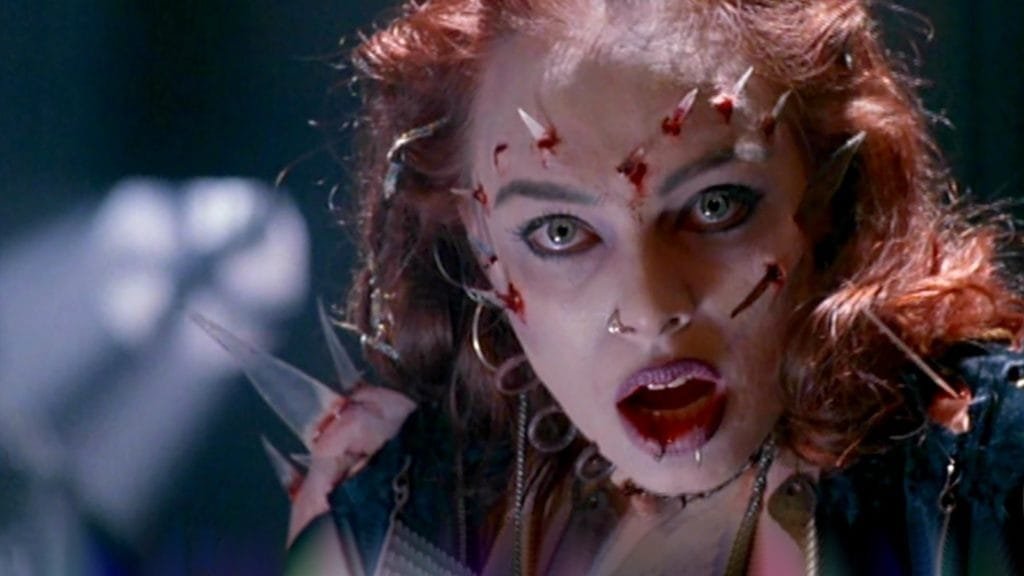
Julie (played brilliantly by Mindy Clarke) is one of the most recognisable zombies in horror cinema. She plays the split in her personality really well as she fights against the human munchies and realises that being dead isn’t actually all it’s cracked up to be, while at the same time, working an oddly aesthetically-pleasing look. There are a lot of influences to spot here. Whilst the debt of honour to Linnea Quigley is obviously there, Julie (and Curt) are kids of the Nineties, on their way to Seattle to enjoy the music scene before everything goes wrong for them. As well as grunge, though (check out the L7 poster on Curt’s bedroom wall) the S&M/goth influence is in there too, and it’s worth remembering that this film hit the stands at just the time when piercings were emerging into the mainstream from their old haunts of the fetish club and the tattoo convention. Julie takes something which would have been a tad more familiar than it was ten years before, say, and then hyper-extends it until it’s monstrous. And, hey, there’s a dash of Cenobite in there too, with the slashed fetish wear and symmetrical piercings, right? Funnily enough, Julie would look more at ease in the ranks of the Cenobites than some of those we were expected to accept in the previous year’s sequel Hellraiser III: Hell on Earth (a Cenobite whose prime torture technique was burning people with a cigarette? Bitch, please). Julie is both meaner, more engaging, alive or dead, and never loses her humanity, which stops her from ever becoming truly repellent. Brian Yuzna has done some sterling work in his time, but Julie is by far one of his best creations.

It’s hard to believe that this film is twenty years old. It’s hard to believe that I first saw this as a young teenager, and thought that Julie was one of the coolest entities I’d seen since Pinhead. How time flies. Well, I think it holds up brilliantly to this day, and it’s a movie that, as a Yuzna fan, I find myself revisiting often, and always finding something to enjoy. Yuzna knows that you can go to new places with your characters in a horror film without sacrificing on the gore, and it’s why he’s one of the masters of body horror. I’ve read a lot of reviews of ROTLD3 as preparation for writing this retrospective, and one criticism which cones up again and again is that it lacks the ‘fun’ of Return of the Living Dead. I don’t think that’s necessarily true – there are bleakly comic sequences throughout the film – but ultimately, ROTLD3 is just a different beast, and it works so well because it is. By using grim, graphic horror ‘what if?’ ideas, Yuzna is able to do here what he does so well elsewhere: body horror offers the scope for an entertaining, compelling and often blood-curdling glimpse at the human condition. It means that you don’t need to scrimp on blood and guts, but you can use their presence to throw in oddball questions about what we are and why.

When you can successfully merge love, death, noteworthy aesthetics and plenty of gore into a captivating story, then I’d say you’re doing something right, and that is precisely why we can still talk about this horror movie today, when so many of the other cousins-twice-removed of the original Dead films which wound up making ROTLD3 possible have already sunk without trace, or perhaps worse, deliberately been forgotten. ROTLD3 was unafraid to take a few risks, the risks paid off, and it deserves its place in zombie horror history accordingly.