“The Beauties of Terror” – the 50th Anniversary of The Masque of the Red Death (1964)

By Keri O’Shea

There’s been a strange sort of circularity to the career of Roger Corman. Whilst as a young man he made films about anything and everything he could (as did many directors and/or producers of his generation and longevity) he definitely seems to have had a soft spot for no-budget, turn-a-buck creature features: Crab Monsters, Blood Beasts and Wasp Women were the stuff of his early works, reflecting the 1950s ‘B’ movie predilection for nature gone awry, tainted by outsider influences and bad, bad science. Oddly fitting, then, that Mr. Corman has recently come back to the nature-gone-bad motif at this stage in his career as a producer: his work for SyFy will soon be bringing us Sharktopus vs. Mermantula, folks. Bask in that knowledge – but remember that, between these poles, he did his finest directorial work in what has come to be known as the ‘Corman Poe Cycle’.

I think that most would agree that Roger Corman’s proudest legacy as a filmmaker is his work on these Poe adaptations, a series of films undertaken for teen audience specialists American International Pictures – a company that, seeing the success of Hammer in the UK at this time (and, ahem, no doubt bearing in mind the public-domain nature of Poe’s work) decided to try their hand at a bit of High Gothic. The rest is history. In the short space of four years, Corman (usually collaborating with writer Lou Rusoff) directed a series of seven lavish Poe adaptations. All of these films, to a lesser or a greater extent, used the Poe short stories as a starting-point, adding depth and development whilst retaining the sickly, deranged protagonists and their profound isolation. Of all the Corman Poe movies, however, it’s his penultimate one which has left the most lasting impression on fans and critics alike. That film is The Masque of the Red Death: of all the adaptations, this one is probably truest to the original story, albeit with moments of great bleakness which even surpass the original tale. It is a lurid, oddly disturbing film – a film which alludes to sickness almost constantly, but keeps it outside the castle walls for the most part; a film which hints at sex but averts its eyes, or transposes it onto something which still has the power to make us uncomfortable; a film which promises violence but, even in its uncensored state, is more about psychological harm than scenes of torture.

The inmates of Prospero’s castle, in its setting in Medieval Italy, are in the throes of something which has become a cliché of the behaviour of the rich in times of trouble: from the rumour of Nero playing his fiddle as Rome burns, to the reports of Queen Marie Antoinette innocently asking why those starving in the suburbs of Paris don’t just eat cake (both stories almost certainly complete bollocks, of course), here we have a group of wealthy and indolent people partying as the poor die – here, die of a virulent plague known only as the ‘red death’. Like the Italian noblemen and noblewomen of The Decameron who flee the Black Death by removing to their country estates (telling the stories which make up the book in order to pass the time, as they go on surviving a disease which wiped out up to half of the population of Europe), Prospero’s rich, pampered allies are doing just the same. However, their behaviour is debauched, their morals lax: Corman has done a superb job of capturing an image of utter abandon on screen which has rarely, if ever, been equalled. And, despite the time period in which the story takes place, The Masque of the Red Death is a truly Decadent horror movie, in the sense that its main events focus on the utter abandonment of old moral laws and the fatalistic grab for more and more sensual satiety – a sort of deliberate rejection of the soul, with Prospero (Vincent Price in a stand-out performance) and his consort, the stunningly-beautiful Juliana (Hazel Court) moving beyond dissatisfaction with what they perceive as an anaemic, aimless Christianity, to the practice of outright Satanism. Move the film into the 1890s, and several scenes in Masque could be a rendition of the Black Mass scenes in Là-Bas, a Decadent novel about Devil-worship in Paris. The film is a 60s take on a 19th Century story, with interesting precedents elsewhere; it’s this eclectic and aesthetically-heady mix which has helped the film to maintain its impact across half a century.

In terms of linear plot, then, there is a surprisingly little amount in Masque of the Red Death. The bulk of the movie is there to establish the insular, unreal world of the castle – in which the vast majority of scenes take place. Chief amongst Prospero’s amusements throughout the film is the study of a village girl, Francesca (Jane Asher). Francesca finds herself in the castle through a series of unhappy events, but her innocence and faith in God mark her out for especial attention, with Prospero working to show to her that her beliefs are wrong and wasted. In his words, what he does is “not corrupting” but “instructing”; his interest in the girl, however, rouses the jealousy of his chief consort, and propels her to take the final rites she needs in order to ‘betroth’ herself to the Devil and, as Prospero guesses, consolidate her position in the castle.

Yet all of this might have passed as just another cycle of endless amusements, for Prospero at least: the key factor here is not God, or Satan, but Death. Death – just as seen in the Danse Macabre artistic tradition of the time period in which the story is set – doesn’t respect wealth or status. Death – “his own death” – is the only thing which Prospero fears. The deaths of others merely entertain him; when the performer Hop-Toad conspires to burn an old associate of his to death (thus referencing another Poe story, itself called Hop-Toad), Prospero wants to reward him for his efforts, not punish him. When Juliana is killed, Prospero can only smile that at last she is truly ‘married’ to Satan. But when faced with the striking, menacing red-clad figure, Prospero collapses in terror when he realises that he is not face to face with the Devil at all, but with the Great Leveller. The bleakness of this revelation is stronger than any spiritual comeuppance. It’s Prospero’s only moment of weakness, the end to his cold certainty. Death is more terrifying than Hell. Hell had a hierarchy; Prospero was sure he’d enjoy high status there. But in the end, he is struck down.

The similarities between the figure of Death in Masque of the Red Death – he who is later joined by other, similarly-cowled figures, all of whom have claimed ‘many lives’ – was originally the reason which production on the film was briefly delayed. Corman had wanted to make the film second in his Poe cycle, uncertainties over a workable screenplay notwithstanding, but it had been decided that the similarities to the recently-released Bergman movie The Seventh Seal (with its own allegorical figure of Death of course) would weaken its impact. However, in waiting before releasing Masque, it has allowed the later film to really blossom. It’s an allegorical horror story with a vivid, even garish colour palate. Much has been said about the significances of the colours used for the various rooms in the castle (which correspond to the coloured robes worn by the other plague-bearers in the closing scenes); there is a theory that as Francesca moves through the inner rooms to the ‘forbidden’ black room, that the colours represent the passing of a day, adding to the sense of time being enclosed within the castle’s walls. You could also assess the significance of the colours themselves, with certain colours being associated with various mental states – purity, love, cowardice, death. The symbolism of the ‘red’ colour of the plague and Prospero’s superstitious terror of it, and of course the black room, is more straightforward. The Masque of the Red Death is certainly unusual in the level of allegory it offers, and the aesthetics it uses to do so. The overall effect of the film can be sensually quite overwhelming accordingly. And, whilst the Poe story itself is evocative enough, Corman’s film is a piece of unsettling art.

It takes a great deal to make a film that can sustain a name for itself over a fifty-year timespan, much less one which seems to still be attracting new fans. I found myself wondering as I wrote this piece – which of the films of the last ten years will still be written about in fifty? And what, given developments in filmmaking, will be the elements which really stand the test of time? It’s hard to predict that in some ways, but by the same token, the sorts of films which we still know and love from generations back have a certain abundance of wit, vision and originality. Combine those elements with the worst excesses of human nature and behaviour, and you’ll have a successful, lasting horror story. The Masque of the Red Death is a superb example of this; it’s a beautiful tale of “pain and terror and madness” which deserves its enduring reputation.

Magic, Mischief and Mayhem: Celtic Folklore and Horror, Part 1

By Keri O’Shea

“I’m Welsh, and the Celtic twilight sometimes descends at odd moments.” Vincent Price

Horror draws its influences from a diverse range of sources, in particular borrowing from the legends and lore of the past to conjure its contemporary demons. One of the richest seams for such forgotten horrors, ripe to terrify new generations, is Celtic mythology. For all that, it hasn’t been exploited with the same enthusiasm as some traditions, but perhaps this makes the instances when modern shamans conjure ancient Celtic evil via the magic of the screen even more intriguing and strange. For this Celtic twilight is a persistent thing; rudiments of Celtic folklore continue to exert an influence on modern culture, and it isn’t simply a very human fascination with origins which has helped this folklore to survive. There is indisputably something unique about the Celtic mythos – with its mischievous pucks, kelpies, leprechauns, fairies and hobs – and in its rich seams of mysticism, which has borne it along to the present day. We recognise the names of many of its supernatural denizens. However, many of us are more familiar with Celtic entities and deities via a version of Celtic mythology found in more benign fantasy literature – most notably perhaps in the fictions of Tolkien – or on New Age bookshelves, where headhunting and human sacrifices to the gods have been displaced by Mother Goddess ideals and a sanitised version of the Celtic calendar.

Some of its darker traditions continue to haunt us, despite having been inevitably altered by the course of thousands of years – as with Halloween, a festival with decidedly pagan roots which continues to trouble some practitioners of the Christian religion. “Halloween is filled with different kinds of pagan characters and customs that Christians should avoid,” opines religious author Jenna Robertson, whilst evangelist Richard Ames adds, “Should we follow our neighbours, like proverbial lemmings, off the dangerous cliff of pagan practices?” (1) Whilst the majority of practicing Christians would happily turn a blind eye to Halloween festivities, it seems that Celtic folklore, with its spirits, its stories and its ambiguities still retains the ability to engender anxiety in some quarters. It’s no surprise that its influence can be felt in modern horror, for here we have another domain of dark storytelling where ambiguous characters, supernatural entities and the interplay of sex and death hold sway, and another area which continues to be of concern to some within mainstream cultures.

Depiction of figures found on a shrine on Hadrian's Wall

As much about the Celts has come down to us through the legacy of their folk tales and the ‘little people’ in whom they believed – particularly after the widespread Celtic Revival of the nineteenth century – as it has through conventional channels of archaeology and documentation. Much of the origins of the Celtic peoples themselves are swathed in mystery: we do know that they were a group of tribes who gradually colonised what we now know as Brittany, Britain and Ireland between roughly 500 and 100 BC, though whether they arrived from Southern Europe, or rather originated in Central Europe and were then driven north and west is controversial. Despite differences between groups – the idea of Celtic identity is a very new one, and would have made little sense to these fractious tribes – there were some overarching similarities in language, religion and culture, particularly in the importance of oral culture and storytelling.

This emphasis on story and the development of religious beliefs centred on locales and natural features, “standing stones, wells, springs, tumuli, groves, even individual trees [which] were regarded as sacred and possessing a resident spirit” may help to explain the tenacity of Celtic beliefs and perhaps how “of the Roman gods there is hardly a trace” (2) – their gods and their temples all but lost, despite the Romans arriving an organised, efficient colonising force. Indeed, much of our information about the Celts in Britain comes from the Romans themselves who were already a literate culture, although of course a culture which ultimately sought to conquer the Celts’ lands and so was not predisposed to giving unbiased descriptions. However, Roman descriptions are still invaluable. The impression given is of a warlike, powerful people with an Iron Age culture (3). More than this, the Romans found the Celts, particularly their Druid class, rather frightening. When the governor of Britain, Suetonius Paulinus, made a final push to suppress the rebellious communities of the Welsh island of Anglesey, historian Tacitus described “a serried mass of arms and men, with women flitting between the ranks. In the style of Furies, in robes of deathly black and with dishevelled hair, they brandished their torches; while a circle of Druids, lifting their hands to heaven and showering imprecations, struck the troops with such an awe at the extraordinary spectacle that, as though their limbs were paralysed, they exposed their bodies to wounds without an attempt at movement…” (4)

As the Romans gradually displaced Celtic tribes, the Celts were driven into the furthest reaches of the British Isles; Scotland, Wales, the Isle of Man and Cornwall, as well as having established presences in Ireland and Brittany, and these areas are still associated with the Celts in the modern age. When the Romans departed a now Christianised Britain around 400 AD, they left an altered, but by no means defunct Celtic culture – a culture which has sustained a reputation of being somehow different from its neighbours: there was and is “a tendency of neighbouring Anglo-Saxons to belittle the people of the Celtic fringes of the British Isles by characterising them as (amongst other things) overly superstitious, possessed of a weak-minded fascination with fairies and ghosts that compares unfavourably with their own sturdy, commonsensical beliefs in Anglican Christianity” (5).

Samhain and Halloween: “Witch and ghost make merry…”

The Romans were renowned for their assimilatory attitudes to the cultures with which they came into contact, so even whilst suppressing or displacing Celtic peoples they largely grew to accept Celtic lore, adding their own panoply of gods and beliefs to the mix. For example, Samhain became associated with the Roman festival of the dead, Feralia; the worship of Pomona, the goddess of fruit and trees, was also slowly integrated into the Celtic New Year, although the Romans always considered the human sacrifices undertaken by the Celts at this time to be aberrant (6). Christianity was less accepting – and became less so as it became more organised and doctrinal – but itself understood enough about the persistence of the old practices to superimpose the holy calendar onto them rather than trying to quell them altogether: it was a sound way of currying favour with new congregations. Hence, the Celtic New year festival of Samhain was overlaid with the Christian festival of All Saints’ Day when Pope Gregory III moved it to coincide with the heathen calendar.

However, features of the original festival were persistent; people did not easily surrender their old traditions. This was because Samhain was originally celebrated by a pastoral society which did not disappear simply with the advent of monotheism: the calendar did indeed seem to be divided into two halves, one of light and one of darkness, and “Samhain marked demonstrably the end of one year and the beginning of the next” (7). With the pre-Wiccan understanding of nature as something cruel which would freeze and starve you, rather than embrace you as ‘the earth mother’, the gods had to be propitiated, food stockpiled. This was the time when, to ensure their own survival, people slaughtered their excess livestock – hence the association of this time of the year with blazing fires as people roasted meat, perhaps offering blood sacrifices to their gods.

There must have been a sense of change afoot, and the amount of death associated both with food and with offerings linked Samhain irrevocably with the dead and spirits, something which is still true of the festival of Halloween and which, naturally, lends itself to horror. The use of costumes, of death imagery (especially the death-grimace of the Jack O’Lantern), the belief that ghosts and ghouls are abroad, and what we now call ‘trick or treat’ – the arrival of masked strangers – have all figured in modern horror, and one of the most popular slasher films, named for the modern festival, has a masked psychopath making his way home on Halloween night where he passes for just another person in spooky fancy dress. But there are also examples of modern horror films which directly reference the Celtic roots of Halloween…one of which ostensibly belongs to the Halloween franchise, despite having little to do with the other films in terms of plot.

Halloween III: Season of the Witch is a quirky sequel which plays on the self-same anxieties expressed by the Christian critics quoted above; that Halloween’s pagan roots are decidedly sinister, and could even be dangerous. The film begins with the murder of a man named Harry Grimbridge, who is killed in his hospital bed whilst clutching a Halloween mask and proclaiming that “They are going to kill us!” After his death, we see his murderer leave the hospital and commit a fiery suicide outside. One of the doctors in the hospital, Daniel Challis, is naturally disturbed and intrigued by these events so, when he learns from Harry’s daughter Ellie that her father had been investigating the company who make these sinister masks, they decide to visit the vast Silver Shamrock factory in the hope of finding clues regarding her father’s death.

There, they meet the charismatic and jovial owner of Silver Shamrock, Conal Cochran: it seems that his very successful line of Halloween masks (which are advertised with one of the most irritatingly catchy jingles in existence) have one important difference: they are each implanted with a tiny fragment of a stolen boulder from Stonehenge! Cochran wants to revolutionise Halloween, to bring it back to its decidedly bloody roots: on Halloween night, and via the use of magic, children wearing his masks will die when they receive a trigger from the Halloween jingle. “I do love a good joke,” explains Cochran to a mortified Daniel, “But there’s a better reason… you don’t really know much about Halloween… you thought no further than the strange custom of having your children wear masks and go out begging for candy…It was the start of the year in our old Celtic lands, and we’d be waiting… in our houses of wattles and clay. The barriers would be down, you see, between the real and the unreal, and the dead might be looking in…to sit by our fires of turf. Halloween… the festival of Samhain! The last great one took place three thousand years ago, when the hills ran red… with the blood of animals and children.” The film neatly conflates two sets of traditions – old and new – in showing how the grisly older traditions might, just might find a way back through the seemingly innocuous practise of dress-up, as well as exploiting the idea that those of Celtic descent might still be privy to a type of dangerous arcane knowledge…

A more recent film which actively seeks to promote (or even revive) Samhain lore is the anthology movie Trick’r Treat (2008). Director Michael Dougherty explains in The Lore and Legends of Halloween, a documentary accompanying the film’s DVD release, that he wanted not only to explore the origins of Halloween, but to restore knowledge about the source; he’s not going as far as Mr. Cochran of the Silver Shamrock company of course (!) but there is a sense of a debt of honour to far older traditions which are relevant even in the midst of modern traditions in this entertainingly self-aware film. In each of the interlinked tales, it is due observance of tradition – or not – which seals the fate of the characters.

As the film begins, a young couple are arriving home after a fancy dress Halloween parade (yet another development, at least stateside, in Halloween practices). When Emma blows out a Jack O’Lantern before midnight, her husband remonstrates with her: it’s bad luck, he explains. “It’s Halloween, not Hanukah,” she hisses, but before she can bad-temperedly remove all of the decorations from the garden she’s murdered by a mysterious assailant. Though Trick’r Treat is deliberately framed as cartoonish, this intro to the film sets the tone: those who do not understand the supernatural origins of the festival, or fail to take due care to observe the traditions designated by their ancestors for protection from harm, might just meet a grisly end. An assailant (quite literally) masquerading as a supernatural being meets a genuinely supernatural match in the lupine Laurie (Anna Paquin); a gluttonous child who sees fit to destroy pumpkin lanterns whilst gorging himself on candy is given an earnest Halloween history lesson and then treated to a fitting demise; the ghosts of the dead are abroad – even though they’re dressed in modern Halloween costume – and they’re looking for vengeance on the one night of the year when the border between our world and theirs is thinnest…

Trick’r Treat is jokily admonitory but quite earnestly uses Samhain as a source of horror; Season of the Witch also nods towards the grisly earliest days of the Celts’ October festival, and both films derive their scares from suggesting that whatever sinister source provided Halloween just might overpower us if we fail to understand it. After all, if there are wicked entities and forces afoot, we might rue the day we became ignorant of how to contain them…

Originally printed in Diabolique Magazine issue 2 (2010). Part Two of Keri’s feature on Celtic horror coming soon…

Blu-ray Review: The Abominable Dr. Phibes (1971)

By Keri O’Shea

Editor’s note: this review contains mild spoilers (though nothing more than on the website or packaging blurb).

Whilst Vincent Price is rightly revered for all of his extensive filmography, it’s often the slightly more unconventional, the more unorthodox roles in which he truly stood out. That may sound like a very silly thing to say, when you consider that so often he acted out plot-lines which were anything but orthodox, compared to more mainstream cinema at least – but if he become known for anything at all then it was a certain overblown quality, a manner of enunciating his lines, a grandiose style. When he did something other than that in his work, then it was noteworthy. His performance in Witchfinder General, three years prior to making the film under discussion here, was quite unlike anything else that he’d done; this came about by accident, as he was bitterly miserable in grey England and at loggerheads with the film’s upstart young director Michael Reeves, but the end result was phenomenal. And, whilst Cry of the Banshee, made soon thereafter, has many merits – the next role he acted which, for me, is really stand-out is somehow an unholy marriage between Price’s older style and the pared-down performance he gave in Witchfinder General. Price’s turn as Dr. Anton Phibes, is both flamboyant but mordant, ostentatious but solemn – apart from anything else, it’s a role in which he is not seen to enunciate a single word.

The plot is, in a nutshell, that something despicable is happening in 1920s London. Surgeons and doctors are dying, in a series of increasingly bizarre ways; insect attacks, animal attacks – and not native species either. The common link seems to be the earlier death of a Victoria Phibes at the hands of these medics; it is recounted that her distraught husband, a Dr. Phibes, was rushing to her side, when he too tragically died – he in an accident, her on the operating table. We are made privy in the opening reels of the film that a mysterious personage wearing a mask seems linked to these events, but the exposition which completes this story is anything but predictable. The film plays out as an ingenious revenge drama, interspersed with equally ingenious horror scenes and what can only be described as musical interludes. It’s part Grand Guignol and part vaudeville.

If that sounds disparaging then believe me, it’s not intended as such. One of the film’s chief appeals is how uniquely it marries its different elements. It never feels like a camp comedy with some horror thrown in, nor does it feel like a horror film gone awry. There are some occasions at first when you wonder if you’re meant to be laughing – the investigating officer’s name-related gags, the simply fabulous murders (death by gilded unicorn?) but soon you realise that director Robert Fuest intends you to do just that, and there’s plenty to laugh at here – the very presence of that British institution Terry Thomas will do it alone. Another factor which adds massively to the appeal – and something which largely benefits from the Blu-ray treatment – is the unique, weird aesthetic on offer. It may be set in the 1920s, and the Art Deco trappings might be there, but this film feels and looks incredibly 70s. From the colouration to the fabrics, it’s the charmingly unconvincing period setting which sets off the plot developments so well. Vulnavia (Virginia North), Phibes’s beautiful and mute assistant (whose attachment to him is never questioned nor explained) looks every inch the 70s glamour girl. It’s a style which is crazy enough to work.

And then, there’s that strangely prescient theme, considering how horror’s developed in recent-ish years – the specific revenge taken against each of the allegedly-culpable surgeons, doctors and nurses. Brutal as Hell editor-in-chief Ben noted as we watched the film that it has a lot in common with Seven; it has the biblical link, the systematic approach and the ritualised, torturous deaths. If Saw upped the ante from Seven and spawned a sub-genre, then Seven seems to owe a lot to Phibes. Add to that a twisted, but charming love story (with Caroline Munro as the uncredited, voiceless and motionless lost bride), and what you have, folks, is a classic cult movie.

So far, so good. It’s fair to say that most Vincent Price fans will have seen this movie in some incarnation anyway, and most of you will own it in some form already; I know I’m probably preaching to the converted. So should you fork out for the film on Blu-Ray? I have to say, although I’d advise it on the strength of what we saw, we didn’t see the whole package, as we didn’t receive the lot. Arrow is releasing both the first film and its sequel, Dr. Phibes Rises Again. On top of all that, you get a slew of extra features; the usual commentaries, trailers and a collector’s booklet, an interview with Victoria Price (Vincent Price’s daughter) and an interview with David Del Valle, Price’s biographer. What I did see – and rather enjoyed, thinking it an obvious choice in so many ways – is the short interview with British horror comedy team The League of Gentlemen about their love for the film. They have clearly let their love of horror bleed into their work, and it was nice to hear them chat happily about their influences. The transfer itself is impeccable – sometimes almost too much so, as high-definition picks out little flaws which would have passed us by on a less polished format, but then for every string-attached-to-bat you’d rather not see, you do get to enjoy the vivid colours as they were intended.

Essentially, Arrow have been turning out quality products for years now, and this is no exception. You could do a damn sight worse than add this release to your collection, and whether you’ve seen this film never, once or fifty times, there is more than enough here to reward your hard cash.

The Complete Dr. Phibes will be released by Arrow Video on 16th June 2014.

Comic Review: Richard Corben Draws Edgar Allan Poe


By Svetlana Fedotov

If you don’t know who Richard Corben is, you need to go back and retake Horror Comics 101. Luckily for you, I wrote the curriculum on horror comics, so I’ll fill you in. Corben is an artist who first cut his teeth on old horror rags from the sixties and seventies. With his unique art style and painful attention to detail, he quickly built a cult following, expanding further into the weird world of indy art, and became a regular contributor to Heavy Metal Magazine. As his fame grew, he began working on comic adaptations of famous authors, something he continues to this day, and between 1986 to 1994, even started his own publishing imprint and self-released his work. In short, he’s pretty damn bad-ass. Not one to retire anytime soon, he has recently hooked up with Dark Horse Comics and has been creating more fantastic famous story adaptations, this time going to back to his favorite horror writer, Edgar Allen Poe.

So, I’m not going to claim that I know all of Poe’s work and this is definitely a comic where my ignorance shines through. So while many of you have read these two stories, they are brand new to me and I’m going to describe them like they’re brand new to you too. The first story, titled Morella, is about a resentful husband who spends all his time cursing his wife, who he has grown to hate. Everyday, she spends hours playing with black magic and when her husband finally threatens to leave, she falls ill and dies. But before she goes, she warns that her daughter (his stepdaughter) will come to be his new wife. True to her word, the girl, named Orella, arrives, a spitting image of her mother. But who is she really and why is she deathly afraid of being called her mother’s name? The second, and better known, story is Murders in Rue Morgue about a grisly murder of a mother and daughter inside of a locked room. Though clues are vaguer than the lead detective when he solves the mystery, the answer leaves everyone shocked. SHOCKED!

One of the great things about this comic, especially if you’re a Corben fan, is that he really goes back to his roots. It’s been argued that some of his best work has been horror adaptations and it’s easy to see why. This is a man who understands the bizarre, underlying tones of a written horror story and manages to bring it to the forefront of his work. He’s got a passion for the Weird Tale genre that few have succeeded at with the type of precision that he has. This current title is a perfect introduction to his work as he attempts to bring another classic Poe story to life, one in a long line of Poe tales that he has done. The art is perfectly unsettling as his characters race down the filthy streets and back alleys of gaslight America, scrambling away from unnamed horrors and the creeping fingers of death and insanity. You can practically hear the crows call as the bell tolls for another victim of his sinister macabre. I know, it sounds so cheesy, but this comic is so perfectly Gothic, you’ll be popping in a tape of The Cure as you sip a glass of absinthe under the pale moonlight.

If you read this comic and are digging Corben’s style, he literally has decades of work for you to pilfer through. On top of his own work, his illustrations for Creepy, Eerie, and Vampirella are easily available. He has also done work with the more lurid characters of Marvel and DC such as the Punisher and a five issue run on Hellblazer. This is a man who has been quoted as saying that he will work until he dies and at age 73, the proof is in the blood pudding. A master of his craft and a revolutionary in his own right, this is a guy no one can afford to miss.


Horror in Short: Mass (2014)

By Keri O’Shea

A couple of years back, Horror in Short ran a double-feature by the title of The Can-Cannibals; if you missed it and you have a soft spot for neo-grindhouse, then by all means, check it out here. The director of The Can-Cannibals, Matthew Ragsdale, has been busy since that time, and the film you’re about to see here – entitled Mass – was his entry into the much-feted ABCs of Death Part 2. Unfortunately the film wasn’t selected, but as there have been so many entrants for that prestigious compilation, a lot of the entrants now have big plans of their own. Watch this space for more on that…and onto the film itself.

Mass is, according to Ragsdale, inspired by ‘mondo cinema, Church of Satan footage and the fashion of Chelsea Wolfe’. My first thoughts when I watched this were, ‘This looks uncannily like the Satanic ritual footage from Faces of Death’, so I guess that would at least kind-of tick two of those boxes from the start. I’m a big fan of Chelsea Wolfe too, and absolutely adore Krist Mort’s photography so aesthetically, this film is great for me. Its premise is that a covert female cult who worship a female Deity are interrupted by a crazed Fundamentalist. This, folks, is Mass:

Password: mass

Mass from Matthew Ragsdale on Vimeo.

Although not a Satanic cult, this group of worshippers certainly have a dark occult vibe about them, with the veils and cowls going on; Ragsdale has stuck with the grainy 70s style of film, too, and here is looks pretty convincing. I felt like Mass wouldn’t look out of place on a grindhouse trailer reel, sandwiched between Children Shouldn’t Play With Dead Things and The Devil’s Rain, maybe. There’s also more of a film structure here in terms of a storyline, whereas the earlier films we featured felt a lot more like tasters of a film would could potentially follow. That said, I wanted to see more here – it did still have that taster-reel feel, and I’d love to see what would happen if that aesthetic and the subject matter were played out more fully (and yeah, I know for the purposes of the competition that couldn’t be – I’m talking generally, for future reference here).

Mass is a neat, aesthetically-pleasing film, and underground cults give good viewing. That is a truism. Now, I’d love to see these calling cards branch out into something more, so it’ll be interesting to see where the director goes from here. As for the new compilation project – currently under the working title World of Death – we hope to have more details on that in the near future…

Film Review: Dead Girls (2014)

By Keri O’Shea

I’ve mentioned the minor anthology movie comeback on the site before; whether the genre has gone through something of a spike on the indie scene thanks to the notoriety of the recent V/H/S films (which I’ve still yet to see) or whether it’s just one of those things, a style that’s just come around again, I’m still glad that it’s happening. It’s a neat format which potentially allows different directors and writers to collaborate on at best a brilliant compendium, and even at worst a curiosity, because after all if you find a chapter you don’t like, it’s not going to last for the whole of the film. There’s a lot of room for play in how the film gets framed too: Dead Girls, a brand-new anthology movie, refracts its own three chapters through a uniquely female perspective, making all of the key protagonists women. Zero budget or not, the results are surprisingly bold and ambitious.

It’s evident from the get-go that the writers involved here know their horror and are happy to play around with things viewers might expect, because the initial set-up is a clear nod to a horror trope. We start with a screaming woman, fleeing into the middle of nowhere to escape her male, armed pursuer. So far, so familiar. Similarly she spots a house up ahead and makes her way there, finding the door unlocked – which she quickly locks behind her, taking a moment to feel safer before she begins to hear indistinct voices coming from upstairs. She goes to investigate…and from here, we leave one story and segue into the first of three chapters, this one being Over My Dead Body.

Over My Dead Body places us in an unhappy house party: girlfriend Suzy (Aubrey Joyce Tunnell) is far from pleased with her boyfriend Travis’s conduct. Seems he’s been flirting with another lady, with very few fucks given whether Suzy sees it, reacts to it, or anything of the sort. Suzy goes off on her own and wanders by a room where a tattooist is offering his services; she asks him if he can give her a tattoo which encapsulates the message, ‘Don’t fuck with me’. He says he can – though it evidently doesn’t work too well, at first at least, as it seems she hasn’t seen the last of Travis…or he of her. What follows is a Tales From The Crypt style story of wronged women and vengeance. There are of course limitations on what can be shown on screen when budget and so on is taken into account, but this segment manages a nice amount of atmosphere, whilst keeping that overblown, dark-cartoonish vibe.

Next up, we go far further into that dark cartoonish vibe, adding a dash of what feels in a few ways like 80s horror with a schlocky, grisly sideways swipe at frat/sorority culture in Theta Phi’s Never Die. Ah, the sorority house: an aspect of American culture which seems enough of a horror all on its own to this outsider, but some girls seem to want to be part of these establishments – as is the case with friends Courtney (Ali Hadley) and Avery (Mia Doran), whom we meet on their way to a pledge night at one of their campus’s most desirable houses. They get lucky – if you can call it that – and get invited to stage two, the initiation, with mousey, unworldly Avery singled out for special honours. Uh-oh. Well, she impresses the girls alright – in her own way. Theta Phi’s Never Die is very entertaining and has a few twists too; it kept me engaged throughout, and I liked how it interwove the smallest dash of disdain for this type of culture into an otherwise fairly light-touch horror yarn.

Last up is Vengeance is Mine, a story which plays with the ‘fallen woman’ idea. Maggie (Kelsey Sante) is a former Catholic ward who has wound up on the streets, turning tricks in the hope that one day she can escape her past – but one more encounter with her former benefactor turns particularly nasty one night, and she decides to take action against the people who let her down. Now, of all the stories here, I thought that some of the subject matter in this one sat a tad uncomfortably with the format. Sure, all three of the stories reference sex and violence, but I didn’t feel that some of the heavy topics (including abuse of a minor) could rightly be given an anthology treatment very easily. It also suffers a little by being the last story, but using the same modus operandi of those tales which came before. Still, I did like how the occult came gradually to play a part, albeit an ambiguous one, in the proceedings.

Through all of this, the frame – the house and its occupant – not only doesn’t go away, but plays a role in each of the tales, and I do think this is something to be commended. It shows that director/writer Neal Fischer and those who co-wrote with him here have some much-needed confidence in working with the film’s structure, adding some pause for thought and sophistication as the stories play out. It’s this sort of willingness to do a little more with a little less that can supercede budgetary restraints – and it be fair, it is clear that Dead Girls was made on very little cash. It has ideas, though, and that’s something that money alone can’t buy. That said, I think the film would be stronger without the (admittedly minor) voiceover which creeps in, because I thought that the film worked better with the mystery of the framework fully maintained.

Still, what we have here is a bold idea and a novel framework, a plot where wronged women call the shots (and hints of wicked magic move things along). I can live with a few quibbles on style for the sake of the good stuff. If you have a place in your heart for indie movies which are willing to try something new, then Dead Girls is a dark, quirky collection of horror tales with a twist.

Dead Girls via Roughcut Films will be released soon.


Magic, Mischief and Mayhem: Celtic Folklore and Horror, Part 1

By Keri O’Shea

“I’m Welsh, and the Celtic twilight sometimes descends at odd moments.” Vincent Price

Horror draws its influences from a diverse range of sources, in particular borrowing from the legends and lore of the past to conjure its contemporary demons. One of the richest seams for such forgotten horrors, ripe to terrify new generations, is Celtic mythology. For all that, it hasn’t been exploited with the same enthusiasm as some traditions, but perhaps this makes the instances when modern shamans conjure ancient Celtic evil via the magic of the screen even more intriguing and strange. For this Celtic twilight is a persistent thing; rudiments of Celtic folklore continue to exert an influence on modern culture, and it isn’t simply a very human fascination with origins which has helped this folklore to survive. There is indisputably something unique about the Celtic mythos – with its mischievous pucks, kelpies, leprechauns, fairies and hobs – and in its rich seams of mysticism, which has borne it along to the present day. We recognise the names of many of its supernatural denizens. However, many of us are more familiar with Celtic entities and deities via a version of Celtic mythology found in more benign fantasy literature – most notably perhaps in the fictions of Tolkien – or on New Age bookshelves, where headhunting and human sacrifices to the gods have been displaced by Mother Goddess ideals and a sanitised version of the Celtic calendar.

Some of its darker traditions continue to haunt us, despite having been inevitably altered by the course of thousands of years – as with Halloween, a festival with decidedly pagan roots which continues to trouble some practitioners of the Christian religion. “Halloween is filled with different kinds of pagan characters and customs that Christians should avoid,” opines religious author Jenna Robertson, whilst evangelist Richard Ames adds, “Should we follow our neighbours, like proverbial lemmings, off the dangerous cliff of pagan practices?” (1) Whilst the majority of practicing Christians would happily turn a blind eye to Halloween festivities, it seems that Celtic folklore, with its spirits, its stories and its ambiguities still retains the ability to engender anxiety in some quarters. It’s no surprise that its influence can be felt in modern horror, for here we have another domain of dark storytelling where ambiguous characters, supernatural entities and the interplay of sex and death hold sway, and another area which continues to be of concern to some within mainstream cultures.

Depiction of figures found on a shrine on Hadrian's Wall

As much about the Celts has come down to us through the legacy of their folk tales and the ‘little people’ in whom they believed – particularly after the widespread Celtic Revival of the nineteenth century – as it has through conventional channels of archaeology and documentation. Much of the origins of the Celtic peoples themselves are swathed in mystery: we do know that they were a group of tribes who gradually colonised what we now know as Brittany, Britain and Ireland between roughly 500 and 100 BC, though whether they arrived from Southern Europe, or rather originated in Central Europe and were then driven north and west is controversial. Despite differences between groups – the idea of Celtic identity is a very new one, and would have made little sense to these fractious tribes – there were some overarching similarities in language, religion and culture, particularly in the importance of oral culture and storytelling.

This emphasis on story and the development of religious beliefs centred on locales and natural features, “standing stones, wells, springs, tumuli, groves, even individual trees [which] were regarded as sacred and possessing a resident spirit” may help to explain the tenacity of Celtic beliefs and perhaps how “of the Roman gods there is hardly a trace” (2) – their gods and their temples all but lost, despite the Romans arriving an organised, efficient colonising force. Indeed, much of our information about the Celts in Britain comes from the Romans themselves who were already a literate culture, although of course a culture which ultimately sought to conquer the Celts’ lands and so was not predisposed to giving unbiased descriptions. However, Roman descriptions are still invaluable. The impression given is of a warlike, powerful people with an Iron Age culture (3). More than this, the Romans found the Celts, particularly their Druid class, rather frightening. When the governor of Britain, Suetonius Paulinus, made a final push to suppress the rebellious communities of the Welsh island of Anglesey, historian Tacitus described “a serried mass of arms and men, with women flitting between the ranks. In the style of Furies, in robes of deathly black and with dishevelled hair, they brandished their torches; while a circle of Druids, lifting their hands to heaven and showering imprecations, struck the troops with such an awe at the extraordinary spectacle that, as though their limbs were paralysed, they exposed their bodies to wounds without an attempt at movement…” (4)

As the Romans gradually displaced Celtic tribes, the Celts were driven into the furthest reaches of the British Isles; Scotland, Wales, the Isle of Man and Cornwall, as well as having established presences in Ireland and Brittany, and these areas are still associated with the Celts in the modern age. When the Romans departed a now Christianised Britain around 400 AD, they left an altered, but by no means defunct Celtic culture – a culture which has sustained a reputation of being somehow different from its neighbours: there was and is “a tendency of neighbouring Anglo-Saxons to belittle the people of the Celtic fringes of the British Isles by characterising them as (amongst other things) overly superstitious, possessed of a weak-minded fascination with fairies and ghosts that compares unfavourably with their own sturdy, commonsensical beliefs in Anglican Christianity” (5).

Samhain and Halloween: “Witch and ghost make merry…”

The Romans were renowned for their assimilatory attitudes to the cultures with which they came into contact, so even whilst suppressing or displacing Celtic peoples they largely grew to accept Celtic lore, adding their own panoply of gods and beliefs to the mix. For example, Samhain became associated with the Roman festival of the dead, Feralia; the worship of Pomona, the goddess of fruit and trees, was also slowly integrated into the Celtic New Year, although the Romans always considered the human sacrifices undertaken by the Celts at this time to be aberrant (6). Christianity was less accepting – and became less so as it became more organised and doctrinal – but itself understood enough about the persistence of the old practices to superimpose the holy calendar onto them rather than trying to quell them altogether: it was a sound way of currying favour with new congregations. Hence, the Celtic New year festival of Samhain was overlaid with the Christian festival of All Saints’ Day when Pope Gregory III moved it to coincide with the heathen calendar.

However, features of the original festival were persistent; people did not easily surrender their old traditions. This was because Samhain was originally celebrated by a pastoral society which did not disappear simply with the advent of monotheism: the calendar did indeed seem to be divided into two halves, one of light and one of darkness, and “Samhain marked demonstrably the end of one year and the beginning of the next” (7). With the pre-Wiccan understanding of nature as something cruel which would freeze and starve you, rather than embrace you as ‘the earth mother’, the gods had to be propitiated, food stockpiled. This was the time when, to ensure their own survival, people slaughtered their excess livestock – hence the association of this time of the year with blazing fires as people roasted meat, perhaps offering blood sacrifices to their gods.
There must have been a sense of change afoot, and the amount of death associated both with food and with offerings linked Samhain irrevocably with the dead and spirits, something which is still true of the festival of Halloween and which, naturally, lends itself to horror. The use of costumes, of death imagery (especially the death-grimace of the Jack O’Lantern), the belief that ghosts and ghouls are abroad, and what we now call ‘trick or treat’ – the arrival of masked strangers – have all figured in modern horror, and one of the most popular slasher films, named for the modern festival, has a masked psychopath making his way home on Halloween night where he passes for just another person in spooky fancy dress. But there are also examples of modern horror films which directly reference the Celtic roots of Halloween…one of which ostensibly belongs to the Halloween franchise, despite having little to do with the other films in terms of plot.
Halloween III: Season of the Witch is a quirky sequel which plays on the self-same anxieties expressed by the Christian critics quoted above; that Halloween’s pagan roots are decidedly sinister, and could even be dangerous. The film begins with the murder of a man named Harry Grimbridge, who is killed in his hospital bed whilst clutching a Halloween mask and proclaiming that “They are going to kill us!” After his death, we see his murderer leave the hospital and commit a fiery suicide outside. One of the doctors in the hospital, Daniel Challis, is naturally disturbed and intrigued by these events so, when he learns from Harry’s daughter Ellie that her father had been investigating the company who make these sinister masks, they decide to visit the vast Silver Shamrock factory in the hope of finding clues regarding her father’s death.

There, they meet the charismatic and jovial owner of Silver Shamrock, Conal Cochran: it seems that his very successful line of Halloween masks (which are advertised with one of the most irritatingly catchy jingles in existence) have one important difference: they are each implanted with a tiny fragment of a stolen boulder from Stonehenge! Cochran wants to revolutionise Halloween, to bring it back to its decidedly bloody roots: on Halloween night, and via the use of magic, children wearing his masks will die when they receive a trigger from the Halloween jingle. “I do love a good joke,” explains Cochran to a mortified Daniel, “But there’s a better reason… you don’t really know much about Halloween… you thought no further than the strange custom of having your children wear masks and go out begging for candy…It was the start of the year in our old Celtic lands, and we’d be waiting… in our houses of wattles and clay. The barriers would be down, you see, between the real and the unreal, and the dead might be looking in…to sit by our fires of turf. Halloween… the festival of Samhain! The last great one took place three thousand years ago, when the hills ran red… with the blood of animals and children.” The film neatly conflates two sets of traditions – old and new – in showing how the grisly older traditions might, just might find a way back through the seemingly innocuous practise of dress-up, as well as exploiting the idea that those of Celtic descent might still be privy to a type of dangerous arcane knowledge…

A more recent film which actively seeks to promote (or even revive) Samhain lore is the anthology movie Trick’r Treat (2008). Director Michael Dougherty explains in The Lore and Legends of Halloween, a documentary accompanying the film’s DVD release, that he wanted not only to explore the origins of Halloween, but to restore knowledge about the source; he’s not going as far as Mr. Cochran of the Silver Shamrock company of course (!) but there is a sense of a debt of honour to far older traditions which are relevant even in the midst of modern traditions in this entertainingly self-aware film. In each of the interlinked tales, it is due observance of tradition – or not – which seals the fate of the characters.

As the film begins, a young couple are arriving home after a fancy dress Halloween parade (yet another development, at least stateside, in Halloween practices). When Emma blows out a Jack O’Lantern before midnight, her husband remonstrates with her: it’s bad luck, he explains. “It’s Halloween, not Hanukah,” she hisses, but before she can bad-temperedly remove all of the decorations from the garden she’s murdered by a mysterious assailant. Though Trick’r Treat is deliberately framed as cartoonish, this intro to the film sets the tone: those who do not understand the supernatural origins of the festival, or fail to take due care to observe the traditions designated by their ancestors for protection from harm, might just meet a grisly end. An assailant (quite literally) masquerading as a supernatural being meets a genuinely supernatural match in the lupine Laurie (Anna Paquin); a gluttonous child who sees fit to destroy pumpkin lanterns whilst gorging himself on candy is given an earnest Halloween history lesson and then treated to a fitting demise; the ghosts of the dead are abroad – even though they’re dressed in modern Halloween costume – and they’re looking for vengeance on the one night of the year when the border between our world and theirs is thinnest…

Trick’r Treat is jokily admonitory but quite earnestly uses Samhain as a source of horror; Season of the Witch also nods towards the grisly earliest days of the Celts’ October festival, and both films derive their scares from suggesting that whatever sinister source provided Halloween just might overpower us if we fail to understand it. After all, if there are wicked entities and forces afoot, we might rue the day we became ignorant of how to contain them…

Originally printed in Diaboliue Magazine issue 2 (2010). Part Two of Keri’s feature on Celtic horror coming soon…

Review: The Sacrament (2013)

By Keri O’Shea

Here at Brutal as Hell we have a nickname for ourselves: that nickname is ‘Contrary as Fuck’, because you can bet your bottom dollar that for every film which sparks a massive positive reaction in the horror world, at least one of us will at best shrug, and at worst actively reject it. For my part, where everyone seemed to be waxing lyrical about the merits of director Ti West’s supernatural thriller The Inkeepers a couple of years back, I actively hated it. The generic-looking ghost, the whiny hipster female lead…my good god. It was a real case of ‘is it just me?’ and I still think it might have been. That said, House of the Devil – which I caught up to quite recently – was diverting enough, and I have to admit I was more than a little curious when I saw that West had put his name to a modern-day version of the story of the Jonestown Massacre, thus moving into new territory altogether. This is The Sacrament, and – you know what? It’s a pleasant surprise in many ways.

The film begins with an introduction to an organisation, based in New York, called VICE – a modern-day media outlet comprising of three young men, Jake, Sam and Patrick, who use their expertise and the internet as a medium to report unorthodox, or otherwise underrepresented news items from around the world. They refer to their approach as ‘immersionism’, which really seems to be a multimedia form of gonzo journalism. This all takes a personal twist, when Patrick receives a letter from his sister, Caroline. Caroline had been drying out in a small Christian commune after succumbing to a drug problem, and she’s written to her brother begging him to come and visit her. When he tries to do so, he finds that she and all of the other family members have in fact left the United States, and he’s told where he needs to go to find them.

This seems like too good an opportunity for VICE to miss, so Jake and Sam decide to tag along too, cameras in hand (natch) to record the event. They roll up somewhere in South America (Jonestown was Guyana, but the exact place here isn’t named), getting past a rather ominous armed guard, but eventually they find Caroline apparently happy, healthy and contented in an idyllic commune called Eden Parish, alongside a lot of other once-troubled folk – all now equally under the sway of an enigmatic figure known as ‘Father’. The small film crew are made welcome and permitted to wander around during their short stay, interviewing the residents and forming their own conclusions about life in Eden Parish. They find nothing particularly amiss, actually; there’s suspicion of them as outsiders, and they find it hard to fathom why people would sell their homes and their cash for the building of a remote project like this, but perhaps that’s just their urbane cynicism talking.

Whatever. You know damn well that it’s only a matter of time before there’s a sinister twist, and if you know even the leanest version of the history behind this film, you might wonder at how The Sacrament doesn’t colllapse beneath that weight. In truth, West accomplishes a great deal here. By bringing a version of the Jonestown tale into the modern day and giving us some largely likeable, plausible protagonists to play it out (plus some modern technological means with which to do it) he’s able to craft an effective, tense horror film. One of the ways he does this is by getting straight to the nub of the plot, by using a lot of on-screen text at the beginning of the movie. It’s a risk, but it works: we find out what’s going on and why, and then we are essentially on a par with our main guys, finding out what’s happening alongside them as they travel to the commune. Part of this is via the truly ubiquitous handheld camera shooting style with which we’re now oh-so familiar, but it’s carefully done here, for the most part. Sure, as ever there are some sections in the film where I could do without it, but in others, West manages to work the framing device neatly into the plot, even using it to give us a decent twist in one scene.

It’s remarkable really, seeing as the source material is so well-known, that this film manages to create such a sense of foreboding. Partly, this is because it is so able to take its time. There’s no need, thanks to the early exposition, to dwell on establishing who our protagonists or antagonists are or what they’re doing; we’re given plenty of footage of life in Eden Parish looking just fine, and the gradual rising tension comes on so slowly, that it’s almost painful. The superb performance by ‘Father’ (Gene Jones) has a substantial part to play in this rising tension; pitched wrongly, this part could have been laughable. As it stands, Jones manages to make his character recognisable, but crucially charismatic and plausible. Not to knock the good performances all round, but The Sacrament hinges on the role of Father, and Jones delivers. The dark, building, pulsing soundtrack acts as a signal that things are going to turn ugly, too – as does the Christian singing, which – ah come on – is creepy all on its own.

This isn’t a perfect movie; some of the signposting in the film is gargantuan and neon-lit, and as mentioned, if you have an especial aversion to tripod-less camerawork then you may grow exasperated with some sequences. However, as someone who’s been non-commital on West’s work to date, I found this film very refreshing and well-crafted; it kept me engaged and, in places, yes it did manage to shock me. Quiet and brooding it might be, up to a point, but it also (obliquely) shows things on screen which just aren’t shown at all in most movies, however grisly their reputations. Ultimately, the source material for The Sacrament is more disturbing and complex than most horror movies. West is aware of that, but has transformed it by changing it, dramatising it, and then humanising it. It all seems more disturbing when you’re made to see it that way, and by bringing it up to date, it reminds us that this shit hasn’t disappeared, twenty-first century or not.

The Sacrament is subtle and savage in equal measure. I for one didn’t see that coming.

The Sacrament will be released in UK cinemas and on VOD from June 6th 2014.

Horror in Art: Ivan the Terrible and His Son Ivan (1885) by Ilya Repin

By Keri O’Shea

Portraiture of tyrants from history is a curious thing indeed; so often, what we see in their paintings seems to belie what you might expect, given their recorded character traits. There are of course lots of reasons for this: painting techniques and styles, the ideals of the day, and of course issues relating to the sitting itself. You’d hardly be likely to paint Mehmet II warts and all if you thought your intestines would end up spilled all over the palace floor for your troubles, after all. Still, and even accepting that all historical sources have their limitations, it’s interesting to consider the distance between the reputations and the appearances of some of our better known despots. Vlad Tepes, the Romanian voivod, stares with purpose out of his best-known depiction, but the face hardly matches up to his known excesses. Erzsebet Bathory – the 16th Century noblewoman alleged to have bathed in the blood of young women to stave off her own ageing – has come down to us via a portrait which suggests petulance at worst, a child-like serenity at best. The incongruity between the faces and the deeds is vast.

Another such figure (and one with several similarities to Tepes, incidentally) is one of Russia’s most infamous, and yet still celebrated rulers – Ivan Grozny. The name itself is most commonly translated as ‘Ivan the Terrible’ in English, although Grozny is probably more accurately translated as ‘tempestuous’, as it has its origins in the word ‘stormy’ – perhaps similarly to how in English we might positively describe someone as a ‘whirlwind’. Regardless, Ivan the Terrible it has become. This 16th century ruler – famous for uniting the Kingdom of Russia and for dealing with the sprawling, corrupt power of his nobles – has, like many comparable figures, a legacy of brutality to balance his positive actions. His cruelty and paranoia have become legendary. And yet, as with the other figures mentioned here, contemporary portraiture shows him as a benign, passive figure, heavy with the vestments of the Russian Orthodox Church. He hardly looks like someone who could have been a living figure, let alone someone guilty of the worst crimes – including filicide.

The human animal is by nature more appalled by instances of individual cruelties than by cruelty on a mass scale. We can to an extent surpass it, but it seems like we are hardwired to respond to wickedness in the detail. This is perhaps why, even from a man who has been known down through the centuries for widespread acts of barbarism, it is the fate of his eldest son – also called Ivan – for which he is most infamous. Ivan Grozny, perhaps unsurprisingly known for having a vile temper, quarrelled with his son one day at court. As young Ivan remonstrated with his father, Grozny in a rage struck the young man on the head with a heavy walking cane – probably fracturing his skull. Young Ivan died of his injuries almost immediately, leaving Grozny without the heir he had deemed most suitable and meaning that he would be succeeded by his second son, a young man ‘mentally unfit’ for the task. In effect, this one moment’s deed deprived him of a son he loved and of any confidence he might have that his legacy would be passed on. Whatever we might know or indeed think of Grozny, we can imagine how devastating this would be, and the gut-wrenching regret he will instantly have felt.

It took three centuries before this scene was committed to canvas with the gravitas and horror it deserved. The man who proved himself able is arguably Russia’s best-known painter, certainly its best-known Realist painter. That man was Ilya Yefimovich Repin, who returned to historical painting in 1885 to complete ‘Ivan the Terrible and His Son Ivan’. It is to my mind one of the most haunting pieces of art ever created.

The differences between the Realist style used here and the idealised, unrepresentative portraiture of the day is exaggerated hugely by the savagery of this piece. Repin chose to paint the exact moment of Grozny’s revelation; the awful moment of stillness after the manslaughter of his heir. The two men, one living, one dead, are presented alone in a room whose fire-lit warmth gives the lie to the scene and its circumstances. That warmth, and its crimson finery is ironically juxtaposed with the blood on young Ivan’s head, which is the brightest red here, and the rich, geometric-patterned drapery in the background forms another contrast with Ivan’s curved, inanimate body, fading into nothingness before the grisly focus of the scene. There is evidence of a struggle; furniture is upended, and Ivan’s leg has disarrayed the silk rug beneath their feet – but now all is still. Horribly, terribly still.

However, for all of that, it is Grozny’s haunted expression which retains its capacity to shock. His wide eyes stare into nothing, he is lost in his thoughts; those eyes contrast utterly with the now unseeing eyes of his son. There is a lone tear on young Ivan’s cheek, as he is cradled in death by his now-penitent father, Grozny’s hands clasped ineffectually to the fatal wound. Even knowing the circumstances of this crime, I find Grozny’s expression deeply moving. To my mind, it seems like a Realist take on the Goya painting ‘Saturn Devouring His Son’ – the same blank expression, the same desperation, the same destruction of one’s young. It also creates something which often features in horror – sympathy for the monster, regardless of their deeds. This disturbing image has shocked many through the years; not least, in 1913, when Grozny’s face was badly slashed by a man called Abram Abramovich Balashov. Balashov was removed from the scene shouting, “Enough blood! Down with blood!”

Conventional portraiture has long been restrained, limited, concerned with mythologising rather than with representation. By reversing this process – turning a mythologised man into a human being – Repin has crafted one of the most arresting historical paintings ever. Here, we have a man bereft, appalled by his own immense and self-stifling cruelty just as we are appalled by it. It’s a moment of abject horror; Grozny will stare forever into the abyss, an emblem of the moment after the storm, the terrible understanding that one has to live forever with one’s actions. Repin has made a man out of an icon, then he has made his suffering iconic. The result is haunting in its poignancy and intensity.

Horror in Short Double Feature: Game (2013) and Torturous (2012)

By Keri O’Shea

People being put through their bloody paces in rural or sylvanian surroundings is certainly nothing new these days; rather, it’s a horror staple, and so to make good use of it now, you really need to do something a bit special. This is why a film like Tucker and Dale vs Evil, for instance, is such a winner – it takes a familiar premise, runs with it and makes it as funny as hell too. And even if you’re not going to go down the whole self-referential, horror comedy route, well – you probably need some sort of a twist in the tale for good measure. ‘Game’ (2013), written and directed by Josh MacDonald, goes for a little of both of those…check it out.

Game (short film directed by Josh MacDonald) from Angus Swantee on Vimeo.

I have to say, I was very glad of the twist and for the pace with which it was delivered. The opening scenes were pretty ubiquitous after all, and despite the fact that this is a lavishly-shot film with an abundance of well-handled chase scenes, coming to us via a range of shots and a real sense of distance, this film needed a punchline. Happily, it got one. I don’t know what the hell a ‘weremaid’ is, but it’s a great excuse for the OTT campery which rounds things out here. It’s not a mind-blowing twist, sure, but it works for me. Great to see that the sense of humour in this calling card movie extends right through to the end of the credits, too.

Our second film, ‘Torturous’ (2012; directed by Angus Swantee) works similarly to Game in that it starts with something well established in horror, then tweaks it into something more refreshing. For those of you who read this site often, bless you, you might have noticed how often I complain about ‘people tied to chair’ movies, so you may be able to imagine my woe when the opening scenes were of…a person tied to a chair. Before my eyeroll kicked in, however, Torturous redeemed itself – and I actually really enjoyed the results. Here, take a look for yourselves.


Torturous from Angus Swantee on Vimeo.

It’s a skit zany enough to work, isn’t it? A careers guidance guy ‘in the chair’ by mistake? Of all people, surely the army of people wielding drills against their fellow man are those most in need of re-training?

The script knows at just what pace to move along and the joke lasts the distance without being pushed too far – although, I’d say that the cock motif probably qualifies it best for a group view (don’t ask me to clarify that; it’s just the way it is). I can well appreciate why this film has done so well on the festival circuit, as it so effectively spins a torture horror yarn into a tongue-in-cheek, albeit grisly comedy.

If you like what you see here, then do follow the embedded links through to Vimeo and let the directors know. Stay tuned for more Horror in Short, too; it’s been too long!

“You are so far from home”: Re-evaluating Eli Roth’s Hostel (2005)


Editor’s note: as this is a full discussion of Hostel, it does contain plot spoilers.

Whilst people being tormented is of course really nothing new in the horror genre, the advent of the Noughties did seem to bring about a change in the types of brutality we were seeing on our screens. From the hack ‘n’ slash movies of the Eighties, the hack ‘n’ slash sequels of the early Nineties and even the post-horror stylings of Scream, those under attack could, at least, run and hide from their assailants. By the time the new millennium turned around, though, we started to see a new type of horror movie take off. Sure, films like Saw (2004) and the film I’ll be discussing here, Hostel (2005) weren’t the first to implement torture on their protagonists. Far from it. But the levels of cruelty and the unwavering focus upon it certainly felt newly aggressive and confrontational, so much so that we soon had a new descriptive term…

‘Torture porn’. The phrase has come to haunt the genre over the past decade or so with more tenacity than anything supernatural. And, when it’s attributed to a film, it’s not typically intended as a compliment. Such a description (which refers, as far as I’m concerned, to that close-up, unflinching shooting style already mentioned rather than to anything sexual) usually means anything grisly, pointless and prolonged on-screen: horror as a pissing contest, nothing more, an exercise in endurance for fans, as perpetrated by crass filmmakers who want maximum bang for buck. Fuck knows I’ve complained enough about ‘tied to chairs’ movies in the past (look at my biog page here on the site, for instance) and I’ll complain again in future – where I see no evidence of plot or thought or originality – just more of the same, people being fucked up by household tools, The End. However, for reasons I’ll explain, I absolutely do not count Hostel as ‘just another torture porn movie’. In fact, I think that disparagingly referring to Hostel as a ‘torture porn’ movie at all is either wilfully misunderstanding the film, or just not getting it. Maybe it is, to an extent, judged by its legacy, and the 1,001 bad films which have tried to copy it. If so, then people need to knock that shit off and take another look. Hostel is very modern, very timely and a damn sight smarter than a lot of people are prepared to give it credit.

None of this is true by accident, either. Whatever you think of him and his work, director and writer Eli Roth understands horror’s capacity to mirror social anxieties, and the guy deserves kudos for saying as much when he was interviewed on Fox News about the ‘mysterious’ popularity of horror, during which interview he was clear about horror’s role as a safe space, a place which grants catharsis during times of trouble. Given that belief, it’s easy to see how Hostel operates as a nexus for a variety of contemporary anxieties, most of which relate to money, status and power.

At first, our main protagonists have plenty of all three, and they’re happy to say as much. Our group of travellers in Europe – two Americans, Josh and Paxton, and an Icelandic friend they’ve made during their trails, Oli – are almost from their first seconds on-screen gloriously easy to hate, the worst stereotypes of young guys abroad. We first meet them rocking up in the capital of clichéd decadence, Amsterdam (even Josh asks, as he looks around at the Eli Roth cameo during the café scene, “Are there any Dutch people in Amsterdam?”) and they seem determined to “rail chicks” from the get-go. When not debating whether it’s ‘illegal’ to fuck women in comas, throwing their weight around or having Josh declare “I’m an American, I have rights!” as they get thrown out of a club, first impressions of these guys are not great, no doubt intentionally so, but the point is – they’re behaving as countless guys of their age and wealth do. They have nothing and no one to fear. Whilst the current economic climate has lessened the effect which a wallet-full of dollars (or to a lesser extent, pounds sterling) used to grant to travellers moving around in Europe, particularly in former Eastern Bloc countries like Slovakia, it hasn’t killed it off entirely, and you do still see people abroad flashing their cash and acting like arseholes, certain that everything is going to go their way because of who they are and where they’re from.

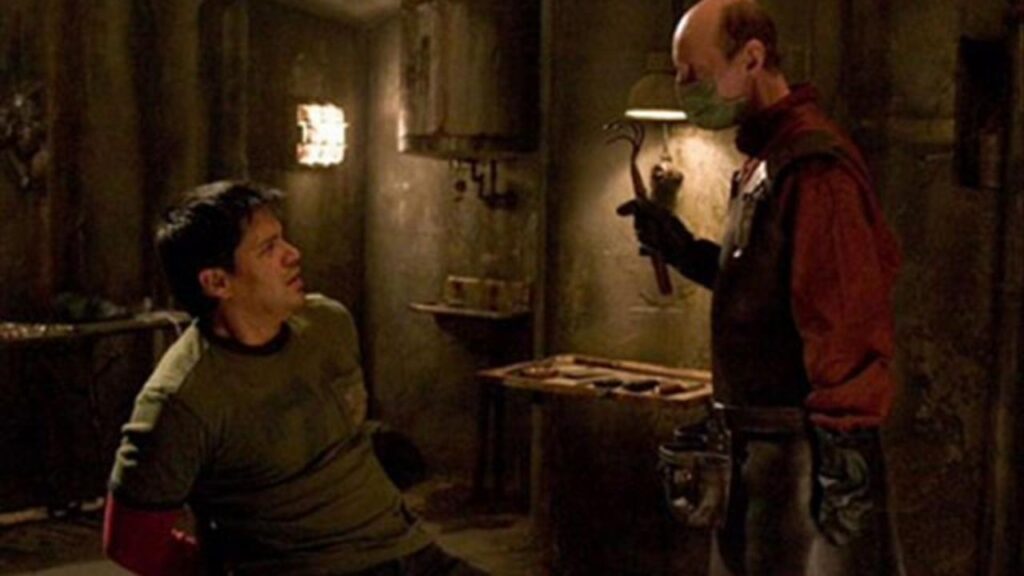
Yet, in Hostel, it’s this belief that gets toyed with, this set of assumptions which provides the basis for the horror to follow, and it’s done well, reaching a nasty, memorable conclusion. We know this from the get-go too: we always know that some sort of comeuppance is around the corner for these guys. Before we’re invited to judge them, in fact before we see them at all, the opening credits have rolled over the interior of the torture chamber…we’ve seen sluices, blood, surgical tools, and worked out that it’s so commonplace for whoever-it-is cleaning the place that they can whistle while they work. We’ve been shown this for a reason; we just have to wait to see what will happen, and know that – somehow – that bubble is going to burst.

This type of foreshadowing goes on throughout the film, and it’s used very well. As an audience, we can pick up on clues that things may not always be peachy; if you’ve seen the film more than once, then you see more and more evidence that bad things are coming. Early in the film we get Josh thinking aloud, “Paying to go into a room to do what you want to someone ain’t exactly a turn-on.” Turns out it is. Still, their new friend Alex’s assertion that Slovak girls are ready and waiting for Americans (“They hear your accent, they fuck you”) is enough to convince the boys to head there, and their sense of entitlement ensures they believe every word Alex says. Why wouldn’t they, after all? Paxton, Josh and Oli have been humanised in our view to an extent by the time they reach their new destination: we know that they are variously not as one-dimensional as they seemed. Josh has suffered heartbreak. Paxton’s bright and, significantly, bi-lingual (more on that later) and Oli’s a father. Still, it won’t save them. They’re fatefully slow to grasp any idea of risk anyway and, when they arrive at the hostel in Slovakia itself, any doubts they might have had just melt away when they see their gorgeous, female room-mates…

Make no mistake. The women from here on in own the movie. It’s just that the guys are slow to get it, believing as they do that they’re the ones still calling the shots until it’s way too late for them. And the foreshadowing continues; when they all arrive, check out the pretty girl sitting on the tomb outside the hostel for one neat symbolic nod as to what’ll follow, and then of course Roth gets his horror geek on by allotting the guys Room 237. The beautiful women in this Room 237 might not take a supernatural turn like in The Shining, but it isn’t long before we get hints as to what they’re really doing: ever notice that it’s Willow’s Song from The Wicker Man which plays over their first seduction scene? By echoing the siren song one of horror history’s most captivating, but ultimately dangerous women, we’re left in little doubt that in some way, Natalya and Svetlana are not what they seem.

The extent to which this is true is, though, shocking to the extreme. Paxton’s pep-talk to an ever-doubtful Josh just before that poor guy’s last night on earth reminding him that they can “fuck these girls for one more night” before moving on couldn’t be more wrong. In the other sense of the word, they’re the ones being fucked. And they’re being more than played; they’re being sold by women. Oli and Josh might have realised this, or they may not have – but Paxton gets it loud and clear, when he returns to the hostel room and gets treated to the exact same routine which Natalya and Svetlana gave all three of them two days before, only performed by two different girls. The moment of revelation here is superb. Suddenly, he understands that he and his friends are part of a dangerous plot, the hostel is part of it and – those beautiful girls which they came there to exploit? They’re the ones in control, always have been.

Natalya’s parting shot to Paxton, as she finally escorts him to the ‘art exhibition’ where his friends have already been killed, is simple but hugely effective. He calls her a ‘fucking bitch’, a lazy retort often thrown at women for a multitude of reasons. Her laughing response, one pithy enough to get repeated over the end credits of the movie? “I get a lot of money for you – and that make you my bitch.” It’s an idea which, whilst of course a dramatic overextension, sums up a lot of fears held by certain types of travellers, particularly those travelling in lesser-known countries and cultures. Maybe those beautiful girls drawn to their sides don’t like them at all. Maybe they detest them, even. Maybe they’re even laughing about them in their own language, or making plans about them. Who knows? It’s also worth pointing out that men are carved up on screen more in this movie than women are. For all of their fist-bumping and over-confidence, it’s men that suffer for their assumptions in Hostel, and it’s women that exploit them.

Whilst putting its protagonists through the mill, Hostel touches upon other anxieties for travellers – other ways in which their assumed high status is threatened. A significant one of these is language. As an English-speaking person, I know all too well that I’ve come to expect people everywhere to be able to understand me when I speak. To an extent, this arrogance is borne out; a lot of people worldwide are exposed to Anglophone culture for their whole lives (TV, music and movies, for instance) and many see speaking English as a prestige form, a way to get ahead, and so they will try to learn it. Those of us who have English as a first language can therefore be seriously lackadaisical about those who don’t, and conversely, feel very uncomfortable when we’re reminded that we’re the foreigners, we’re the ones lacking.

Hostel gives us a language lesson along those lines – with bloody high stakes, of course. Our three protagonists all speak English (despite the fact that Oli is Icelandic and Paxton also speaks German) so they expect everyone else to do so too, in all situations. “How the hell are we meant to understand this without subtitles? Fucking gay,” exclaims Paxton of the foreign-language movie playing in the hostel lobby. Later, “speak English!” he demands of Natalya and Svetlana, when they lock him out of their conversation by speaking in a tongue he doesn’t understand. Here, an inability to communicate goes from being someone else’s problem, to an annoyance, to something downright dangerous. And whilst being able to speak German almost saves Paxton from the man about to hack him up at the disused factory, it doesn’t save him in the end: they just gag him, so the man no longer has to listen to his appeals for his life in a language he can understand. An inability to speak the lingo doesn’t just underline the vulnerabilities of being ‘so far from home’, though: in Hostel, it’s turned on its head and being English-speaking will effectively sign your death warrant too. The guard gets Paxton to ‘speak’: when he turns out to be American, that means they can ask the biggest bounty for him. Maybe this is an inversion of the relative newsworthiness of reported deaths abroad, according to some US news outlets, or maybe it’s just another way that the film shows that being American doesn’t always guarantee you all the power – just the opposite. Throughout, Hostel picks away at accepted power norms.

Hostel isn’t a perfect film: the last half hour is a sequence of happy (?) accidents which free up Paxton to execute his gun-ho revenge, and moments like Takashi Miike’s staccato cameo or the dangling eyeball scene feel clumsily-handled. However, I think it has been done a severe disservice by people who have dismissed it out of hand. It has been even more wrongly labelled ‘torture porn’.

This film is, after all, a great conspiracy movie. Moments of revelation in the film pack a punch because every time, they destabilise something our protagonists take for granted and which, perhaps, we would have taken for granted too. In fact, although the film is known for its gore, that gore is surprisingly low on screen-time until an hour is up. The real horror here is how three regular guys are made to realise their powerlessness, and their eventual treatment, becoming “exhibits” at an “art show” simply underlines how far they have been reduced along the way.

Sure, the ‘stranger in a strange land’ motif has been explored differently and more subtly in other films and other genres. I can accept that. Hostel doesn’t attempt to take away from that, nor does it attempt to own the idea either. What it does do, and what it does well, is to merge a modern horror movie style with an array of very modern concerns and preoccupations. As a calling-card for this particular set of anxieties and the particular time in which it was made, I maintain that Hostel deserves a great deal of credit and, although it has been emulated many times in the nearly ten years since it appeared, this should definitely not be used to dispense with it. Neither gratuitous nor aimless, Hostel has plenty to say for itself and as a bloody rap across the knuckles for a generation which may have once felt itself invincible, it’s still a clever and engaging horror story.