Continuing our celebration of Frankenstein’s 80th Anniversary, Keri O’Shea looks at some of the weird and wonderful Frankenstein films that have come in its wake…
The influence of the Universal Frankenstein movies cannot be underestimated. Boris Karloff’s ‘dear old monster’ has become a horror archetype, crossing the breach into popular culture and staying there, for the best part of a century so far. Children, who probably have no concept of the original film and haven’t sat through an old black and white picture in their lives, recognise the monster; they can describe him, they wear his mask at Halloween and they rank him alongside the ghosts, witches and vampires which make up the ranks of legendary creepy figures. That all of this is due to what is now a very old movie is nothing short of incredible. Don’t forget, there’s very little about the creature’s appearance in Mary Shelley’s novel: what we recognise as the creature is all down to Universal Pictures and the vision of James Whale and his team, especially Jack Pierce who designed the creature’s make-up. With such a phenomenal hit as this, it’s unsurprising that horror cinema has been influenced by it ever since and it’s fitting, considering the story, that the 1931 movie has spawned its own hideous progeny down through the years. Here is a pick of that progeny – some serious, some decidedly silly…

1) The Curse of Frankenstein (1957)
It has been said that necessity is the mother of invention. Well, when legendary British studio Hammer decided that they wanted to produce their own version of the Frankenstein story, the end results weren’t simply designed to be original, but also original enough that they would avoid getting sued by Universal in the process – and Universal were very much on their case as The Curse of Frankenstein was brought to life, resulting in the deliberately-different make-up effects used on Lee. The first movie of several Frankenstein horrors which Hammer released, Curse of Frankenstein starred the eponymous Christopher Lee as the monster and Peter Cushing as one of the several incarnations of Victor Frankenstein he would go on to play. Frankenstein begins the film languishing in jail for his crimes against humanity; he confesses to a priest about what brought him to be there, and the rest of the film follows his story, his scientific experiments with cadavers and the subsequent creation of his creature, whom he actually uses as a stooge, encouraging it to commit crimes in his name. The moral debasement of Frankenstein is key to this movie, as is the lurid full colour in which it was shot. If Universal’s Frankenstein was considered scary in its day, then Hammer’s first, technicolour foray into the unhallowed arts was enough to send the BBFC into conniptions and the film was released with a X certificate.
Hammer’s first colour production was a sizeable hit. Not only that, but its success heralded the birth of the studio’s renowned Gothic horror cycle, and cemented the strong working relationship between Cushing and Lee. It was therefore an important film in many respects.

2) Frankenstein Conquers the World (1965)
Without pushing the significance too far, it can be observed that some Japanese ‘B’ movies from this era, even at their clumsiest, carry at their hearts some significant hang-ups from the events which ended the Second World War; Gojira is a well-known example of this. In Frankenstein Conquers the World, we get a mash-up of the Frankenstein story, the kaiju genre, and the legacy of Japan’s post-nuclear attack state; to declare the film a significant allegory would be pushing it somewhat, but nonetheless, the subtext of Hiroshima and radiation sickness feeds into the film’s plot. In the film, the immortal heart of the Frankenstein monster is being passed to the Japanese by their allies, the Nazis; they take it to Hiroshima to experiment on it, just in time to get it destroyed in the atomic blast which follows. This isn’t the end of the story, though. The legacy of the Frankenstein heart, plus the effects of radiation, gives rise to a strange, radiation-resistant little boy who has been living rough on the streets before the medical team who had been due to work on the heart take him in, and under their care he grows and grows to monstrous proportions, takes off on a rampage, and – wouldn’t you know it – actually ends up in combat with a completely different giant inhuman creature.
It’s mixed up and it’s clumsy, but it is interesting to see what an Asian film studio made of the source material and how they made it fit with the far East’s own burgeoning cult film tradition.

3) Blackenstein (1973)
Ah, blaxploitation. What a strange beast you were. Black Frankenstein made its way to screens due to the success of the preceding year’s Blacula – a stupid title, for what is in actual fact a much smarter film than expected with good performances, especially from star William Marshall. So, if Dracula can work as Blacula, then the same thing must be true of Frankenstein, right? Well, Blackenstein (a.k.a. Black Frankenstein) plain wasn’t as good a film – in fact, it’s noteworthily awful – but in the same way that even a madball flick like Frankenstein Conquers the World can reflect something interesting about the times it sprang from – even if it quickly departs from that point into lunacy – Black Frankenstein takes for its premise the idea that a man crippled during the Vietnam War can be rejuvenated by a mad scientist, name of Dr. Stein. As you might expect, Stein is not the sort of man who gives a damn about ethics committees, and even worse than that the flawed ‘DNA solution’ injected by his assistant into landmine victim Eddie renders him a part-time mindless killer. Imagine! It’s all highly silly, but very much in the ‘so bad it’s good’ camp for me, and very much of its time and style. If Blacula is a pleasant surprise, then Blackenstein…isn’t, but it’s certainly not without entertainment value. Where the hell else are you going to see a version of the creature sporting an Afro?

4) Flesh for Frankenstein (1973)
I must declare my bias here: Andy Warhol’s spin on the Frankenstein story is one of my all-time favourite films and I would very much like Udo Kier to come and live in my house as some sort of wonderfully-cheekboned houseboy. There, I’ve said it. Flesh for Frankenstein was one of two productions with the same director (Paul Morrissey) and some of the same cast, with Kier and Joe Dallesandro taking lead roles in each. The second of the films dealt in its own inimitable way with the Dracula myth, and the first of these – you’ve guessed it – cast Kier as Baron Frankenstein, here a Serbian landowner obsessed with regenerating Serbia’s greatness by piecing together his own master-race of ‘zombies’. He already has a desirable female creature, and he wants to create the perfect male so that they can mate. The thing is, in a great sequence of mistaken identity, the man he thinks has frightened the whores out of a local brothel with his sheer manliness is actually a gentle soul who is a) only there because his friend Nicholas (Dallesandro) insisted on it and b) really, really, not a ladies’ man. Heh, imagine what would happen if that brain got put into the creature? And if Nicholas got given a job at Castle Frankenstein where, during a rare moment when he isn’t tupping the Baroness, spots his erstwhile friend in his reduced condition?
This is Euro horror at its best – lurid, camp, sleazy, and outrageous, where a class-based subtext of workers rising up against their effete masters sits alongside lots of sickly sexuality and some pretty grisly ideas too. Udo Kier getting off on having sex with the female creature through a hole in her abdominal wall must rank pretty highly up there on the Beaufort Scale of Wrongness; who needed to wait until 2010 for a film set in Serbia where a man finds himself performing aberrant sexual acts, eh? We can all learn a lot from the Baron’s questioning scientific mind and vision. After all, and as tells his equally-deranged assistant, ‘To know life, Otto, you must fuck death – in ze gall bladder!’

5) Frankenhooker (1990)
If Flesh for Frankenstein was beginning to take the Frankenstein source material over into rather, shall we say droll territory, then the process was completed by the patron saint of body-horror-comedy, Mr. Frank Henenlotter, when he directed Frankenhooker in 1990. I mean, we basically start off with a woman being killed by a lawnmower; if you have any pretensions to a serious plot, then you’ve waved goodbye to it at this stage, I’d argue. When his girlfriend suffers this fate, ‘scientist’ (or more accurately, electrician) Jeffrey Franken (geddit?), who was able to save her head, decides to put her back together again. Using body parts. Using the body parts of prostitutes. Who have exploded. Who have exploded after smoking some sort of contaminated crack cocaine. The resultant creature isn’t the fiancée he knew and loved, however, and acts…well, quite a lot like a crack whore hive mind. The vision of the reconstructed Elizabeth – played brilliantly by Patty Mullen – lurching down the street asking people if they’re ‘looking for some action’ is a great schlock horror moment, and a literal schlock science moment, too.
Frankenhooker is fun because it shows just how different a film can be in tone from the Universal Frankensteins whilst still referencing a lot of the same source material. It may be as mad as mad can be, but it definitely owes something to the 1931 movie and it’s not without an awareness of the original story, either. Sure, Mary Shelley never saw a strapping prostitute in her vision, but Henenlotter knows his stuff, from the names he gives to his characters to elements of the plot, like gathering the most attractive limbs for the project at hand (which, to be fair, Mary Shelley does mention). Of course, nearly everything here is tongue-in-cheek, but you can’t fault Herr Henenlotter for sheer imagination, and Frankenhooker is a good representation of the sheer variety of Frankenmovies we have. Apart from anything else, here’s betting that the Frankenhooker would have been a more willing mate for Karloff’s Monster than the gal he ended up with!


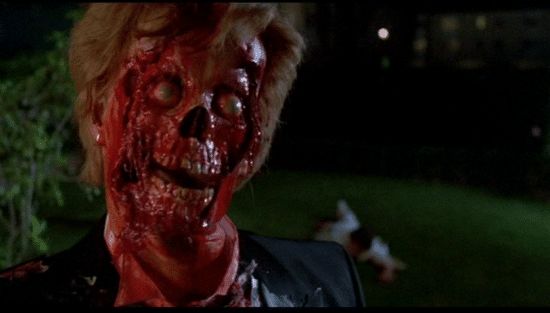 by Ben Bussey
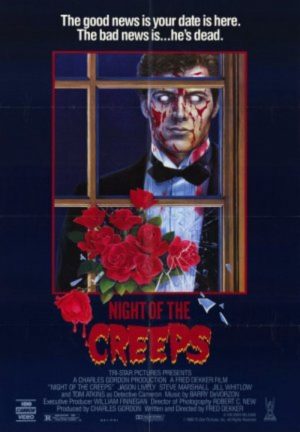
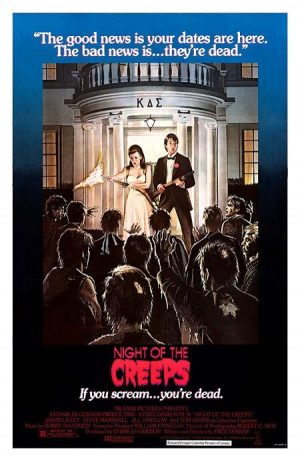 Now, obviously I don’t mean that I thought it was bad; I’m not such a masochist as to sit down to write a retrospective on a film I’m not a fan of. What I mean is I literally couldn’t figure the damn film out at first. Very little is given away by the initial title sequence, which appropriately enough simply highlights the title, in a font agreeably reminiscent of EC Comics (Dekker has likened the logo to that of Famous Monsters of Filmland). Next thing you know we’re on a spaceship, watching an amusingly dome-headed alien rushing down a corridor clutching a canister. Right, so we’re watching a sci-fi movie then. But wait… now it’s suddenly gone black and white and we’re on Sorority Row in 1959. Long-skirted, cardigan-wearing college girls beam into telephones about dreamy guys, the radio hums with the sound of crooning, and a girl goes for a drive in her boyfriend’s convertible. Okay, so it’s an homage to 50s teen movies instead. But then a comet comes down to earth, It Came From Outer Space style; ah, so we’re back to sci-fi. But hang on; now there’s an axe-wielding escaped mental patient in the mix. So what, it’s a slasher too now? And he’s raising his axe to strike, when all of a sudden we cut to the same Sorority Row in 1986, everything’s Technicolor again, some distinctly 80s soft rock fills the air, and we overhear a couple of nerdy young men ruminating on heartbreak. So where are we now, John Hughesville?
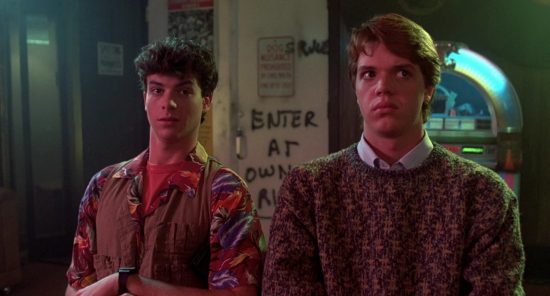 And the great thing is, in spite of the convoluted plot in which it is eventually explained that brain-eating alien organisms are zombifying much of the college campus, what really draws you in and hooks you is the cast. Dekker may have overloaded everything conceptually, but he clearly understands that the key to really drawing the audience in is protagonists they can care about and relate to. Henceforth, we have Jason Lively’s Chris, and Steve Marshall’s JC. Both young actors (Lively was only 18), and neither exactly boasting teen idol good looks, they’re the loser underdogs that so many of us feel we are. But what they lack in alpha male virility they more than make up in wit, Chris ever ready with some pithy self-deprecation and JC constantly spouting overconfident wisecracks. They could easily pass as a prototype for all the best buddy relationships that later became the staple of Kevin Smith, except Smith never threw his characters into quite so freakish a scenario as Dekker does here. (Well, aside from Dogma.)
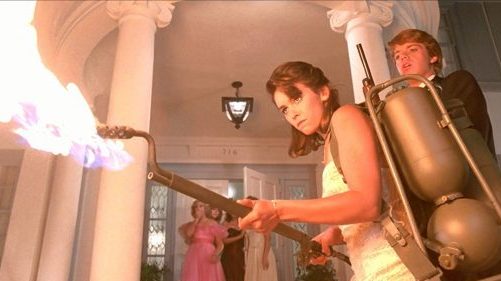 The point I keep returning to here is what a real film geek movie Night of the Creeps is. This much is evident immediately from the disorienting genre-hopping of the first few scenes, and it really gets hammered home as we catch the names of our principal characters: Chris Romero, JC Hooper (the initials standing for John Carpenter), Cynthia Cronenberg, Ray Cameron; there are even cops named Landis and Raimi, and a janitor named Mr Miner. (Okay, so we don’t generally hold Steve Miner in such high regard nowadays, but he did give Dekker his first Hollywood job as a writer by filming House, and also did some uncredited second unit work here, shooting the dressing up montage prior to the sorority house finale.) Then of course there’s the sure-fire signifier of any cult movie, the Dick Miller cameo. This abundance of references to genre cinema both old and (at the time) new gives the movie a knowing edge that was arguably not too common in the 80s. This was six years before Reservoir Dogs and a decade before Scream; intertextual referencing was not yet hip and groovy. Is it fair to call the movie a trailblazer in this regard? Given that it wasn’t a hit on release, and that I only saw it myself for the first time three or four years ago, I couldn’t really say with any authority. But I certainly get the feeling it might have been.
 And can you believe I’ve spent this long talking about a sci-fi horror comedy and haven’t even touched on the monsters yet? It’s as though, in Dekker’s world, the parasites of Cronenberg’s Shivers gave birth not to liberated sex fiends but the classic zombies of Night of the Living Dead. They don’t set out to redesign the wheel here, delivering simple, pale skinned, white-eyed shuffling corpses, but the real ace up the sleeve is the unique method of dispatch. It really feels like the culmination of a pub debate: “What’s cooler, blowing their brains out or burning them alive?” “Hey, I know – what if we blow their brains out, AND burn them alive?” “AWESOME!” And it really is. What a fun-filled final reel it gives us, with Chris, Cynthia and Cameron wasting creeps every which way. We also can’t fail to notice a pre-Braindead (or, for y’all Americans, Dead Alive) use of a lawnmower. It’s certainly not the goriest climax the 80s gave us, but it sure is some good, brain-blasting entertainment.
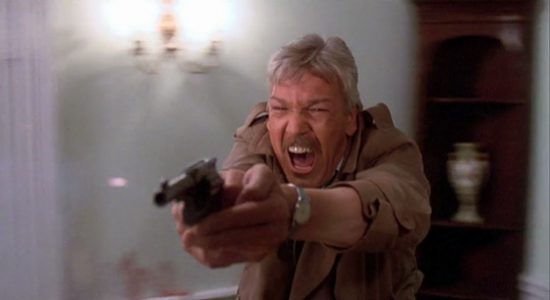
 Nor does the hard edge stop there. I’ve already alluded to the tragic, tortured side of Ray Cameron; this goes beyond the melancholic and into the suicidal. Having almost thirty years earlier lost the woman he loved to an axe murdering maniac that same night a botched biological experiment from outer space fell to earth (boy, don’t shrinks get tired of hearing that one), Cameron has never come to terms with his grief, and would most likely have drunk himself to death already were it not for the job. Such characters were popular in 80s Hollywood, Rambo and Riggs being other notable examples of traumatised, suicidal men unable to adapt to normal life, whose only release comes through violence. The key difference, however, is that while those action men found redemption and a new sense of purpose, Cameron gets his wish and is allowed to kill himself. Yes, he destroys the alien parasite menace in doing so, but does that perhaps only serve to validate that which he was intent on doing regardless? Let’s not forget that before Chris shows up to seek his help on that fateful night, he was all set to blow up his own house, and himself with it. When he gets to do it in the sorority house instead, it’s a double-barrelled cathartic impact; the creeps are defeated and Cameron’s out of his misery, and it would appear we’re invited to take comfort in both. Does this make Night of the Creeps a pro-suicide/assisted death horror movie? Is there a moralist protest in waiting here…?


