
by Ben Bussey
I should forewarn you that what follows will not be a standard retrospective. You see, today marks 25 years since The Monster Squad was first released to cinemas, and while I’ve no doubt that doesn’t mean too much to a lot of people, let me see if I can give some indication of what it means to me.
Follow me on Twitter and you won’t see a picture of me. You’ll see the victorious grin of Van Helsing, thumb held up high as he drags Dracula to Limbo. Visit my profile page, and you’ll note my backdrop is The Monster Squad’s British VHS sleeve. Likewise, friend me on Facebook and again it isn’t my face you’ll see, but that of Rudy, sunglasses on and cigarette in his lips, and for my cover photo you’ll see the scene at the top of this page: the midnight riverbank assembly of Wolfman, Gillman, Mummy and Dracula right before they resurrect the Frankenstein monster. On top of that, you may notice my FB address is facebook.com/kickhiminthenards. My first ever article published online, back at good old B Through Z? yep – it was on The Monster Squad. It was even in part the subject of my MA dissertation.
Yes, I love The Monster Squad. And not in some hipster ironic way. I truly, madly, deeply love every second of this silly little 1987 kiddie horror movie. For better or worse, it made me the person I am today. So if you need someone to blame, direct your hatemail to Fred Dekker.
So, how to adequately express this love? How to sum up just how great I think the film is, and just how great its personal impact on me has been? I don’t think I can within the confines of a single article. Why, I could write a book. In fact… I’m in the process of doing just that. A slow, faintly torturous process, but a process nonetheless.
For the time being, though, I don’t think I can sum it up much better than I did five years ago on – God, was it that long ago – my Myspace blog. What follows is an abridged version of a blog post I made in July 2007, just prior to the film’s 20th anniversary and its release on DVD from Lionsgate. Once again, I warn that this is not a basic review, so anyone with an aversion to long-winded, overly personal, syrupy, touchy-feely emotional content may want to look away now. What can I say; I’m just a sensitive, sentimental kinda guy. Hence I write for a site called Brutal As Hell.

(…) Two big things happened to me when I was nine years old. I found out there was no Father Christmas; and I saw The Monster Squad.
Okay – event number one. (I’m fuzzy on the chronology; this may have happened second. But let’s assume it didn’t, for the sake of convenience. And to support my upcoming argument. Teeheehee.)
Now, I’m curious about this. Am I right in thinking that nine is quite a late age to learn the truth about Santa? A lot of people I speak to seem to have either been aware, or figured it out on their own by then. Not me. I was a dedicated believer. I don’t know what it was, but I was adamant that Santa Claus absolutely had to be real. Now, I never harboured any delusions that there was an Easter Bunny. (Over there, that’s just a guy in a suit!) With the Tooth Fairy, initial belief gave way to a comfortable realisation that it was my parents. But Father Christmas… he was just too big, too significant to be a lie. And not just because he made a movie with Dudley Moore and John Lithgow.(…) So when the fateful day came that my mother sat me down and gently told me the truth… it was a strange moment. I didn’t cry. I didn’t get angry. I just kind of went… “Oh.”
I went “Oh” because on some level I had always known. I went “Oh” because I knew that as much as I had been deceived by my parents, and all the other grown ups in the world, I knew that I had also been deceiving myself.
 (…) Onto event number two: The Monster Squad.
As a kid, I hated horror. Tick me off on the list of people born into the eighties who hid behind the sofa during the Thriller video. Anytime one of the Jaws movies came on TV, I ran screaming. (Not such a bad thing with the sequels…) Sure, I loved Ghostbusters and Gremlins, but – like Steve – they didn’t count. (…) Why anyone would voluntarily sit down to read or watch something with the specific intention of getting scared, I could not for the life of me fathom. So sitting down one Saturday night with my brother and cousin to watch a film they’d picked out at Pharaoh’s Video that evening – a film that featured a werewolf, a mummy, the Creature from the Black Lagoon, the Frankenstein monster, and Count Dracula – it was a pretty big step for me.
And you know what? I loved it. Loved it, loved it, loved it.
The living skeleton attacking Van Helsing, in the wake of the whirlpool mouth of Limbo; Dracula dissolving to bat form, and escaping the plane (in broad daylight, mind you!); the sudden flash of Dracula’s skull in the lightning; the monsters congregating at the misty lake to resurrect Frankenstein; Wolfman’s exploded remnants whooshing back together; Dracula, electricity flickering over his shoulders, beating his way through cop after cop without breaking a sweat, taking out Scary German Guy with a thunderbolt from his palm, and picking up Phoebe by her cheeks: “Give me the amulet you bitch!” (Seriously, has Dracula ever had as much bad-ass power as he does in this film?)

All these moments and more flashed before me like a dream – and in an instant, I got it. I understood why people watched horror movies. Monsters were cool! And being scared – sure, Monster Squad isn’t all that scary, but still – I suddenly realised how alive it made me feel. How being afraid and being excited weren’t really all that far removed. Thinking about it, it was probably that same year that I plucked up the guts to go on ghost trains and rollercoasters for the first time.
Over the next couple of years, I saw The Monster Squad every opportunity I had; eventually I got my own ex-rental VHS copy, which I still own, and I watched it over and over – at least once a month, probably until I was fifteen. Watching it again a few weeks ago, for the first time in a while, I still found myself mouthing along to pretty much every line of dialogue, and every beat of music. (Though I still can’t quite make out all the lyrics of ‘Rock Until You Drop’…)
So – what, you may ask, did those two utterly commonplace childhood events have to do with one another? Why do I feel the need to go into detail on both of them in this manner? Because when I learned there was no Father Christmas, I stopped believing. And, as feeble an example as it may seem, when I stopped believing, I got my first little taste of despair. That’s where horror movies came in.
My mother didn’t encourage my new-found interest in horror movies. Sure, she and Dad would buy me books – all the Shelley, Stoker and Stevenson classics – but they wouldn’t let me rent any Nightmare On Elm Streets or Friday the 13ths. All those nasty things that Mum in particular had shielded me from in my earlier years, I was suddenly anxious to see, and I don’t think she was too happy about it. She didn’t want me having nightmares.
It was she, of course, that broke the news about Santa.
This was my revenge. This was my rebellion. This was my punk!

Maybe I couldn’t rent the tapes I wanted, but, unlike my mother, I knew how to work the timer on the video. ITV still showed Hammer movies most Saturday nights; I taped them all. Every so often I’d even get some more recent ones: Lost Boys, Fright Night. Then, most importantly, I made friends with a kid called Paul, whose parents let him watch absolutely anything… soon enough I was up to my eyeballs in Critters, Freddy Krueger, and George A. Romero.
And yeah, there were a few nightmares along the way.
Just to make it clear – I love my Mum! I’ve got a kid of my own now; I understand how powerful the instinct is to protect your child, how desperate the desire to shield them from any pain and distress. But we all know how it goes. There comes that moment when you’re growing up when the parents become the enemy. They’re trying to keep you down; they don’t want you to grow up. And, as my parents have told me since, in a way that really is true! God, when I try to imagine my little baby boy growing up, reaching puberty, going beyond my control… it’s a bloody scary thought. I don’t want him to be at risk. I don’t want him to suffer. Above all – I don’t want him to not need me anymore. But that day is going to come, whether I like it or not.
Remember that scene in The Crow? Michael Wincott’s holding his snow globe with a graveyard scene inside, remembering his father giving it to him and telling him, “Childhood’s over the moment you know you’re gonna die.”
Every once in a while, we start debating the significance of horror. The 70s, as anyone who’s seen the marvellous documentary American Nightmare can tell you, were all about ‘Nam, Watergate, and the assassinations of King, Malcolm and the Kennedys. Today? Well, it’s obviously 9-11 and the War on Terror, right? Sure, but…
Here’s what I think. Remember what I said, about how the non-existence of Santa was my first taste of despair? Horror will always be appropriate, always of popular interest, as long as there is cause for despair. And we all have cause for despair, and always will. Because we’re all going to die.
The motivational speaking of Mr Benjamin Bussey, ladies and gentlemen; coming to your town soon. Book now.
The Monster Squad started it all for me. It established my enduring love for classic supernatural horror in particular. It made me doodle spiders with human heads when I was supposed to be paying attention at school. And you know what? It holds up as a movie. It grips you from the opening scroll, and doesn’t let go. It’s funny and it’s thrilling; and today, when blockbusters seem to be getting more and more overblown, and moviemakers are so anxious about protecting the young that shotguns are digitally altered into walkie-talkies, it’s so refreshing to see a film clocking in at not even 80 minutes, where kids swear like sailors and are placed in genuine peril.
So when I got my e-mail from Amazon.com this morning, informing me that my copy of the brand-new Monster Squad DVD had been shipped… I got excited.
And, as you’ve probably guessed, more than a little reflective.
***
Five years on, my feelings haven’t changed, and rest assured, I have plenty left to say on the subject. Now, back to my place for some pie.

 by Ben Bussey


 I’m almost certain that I’ve told this story before, but way back in the late 80’s when my mum bought a VHS player the first two videos she bought were Blade Runner and The Lost Boys, and for the longest while they were the only videos that we had, resulting in them being watched ad nauseam, and for me as an adolescent The Lost Boys had a profound effect. As we’re seeing today, the allure of the teenage vampire can be very popular with young girls; I’m just glad that for my generation this included sex, violence, rock ‘n’ roll and some pretty fucking awesome 80’s hairstyles. Not sparkly, chaste, vegetarian vampires…


 By Ben Bussey
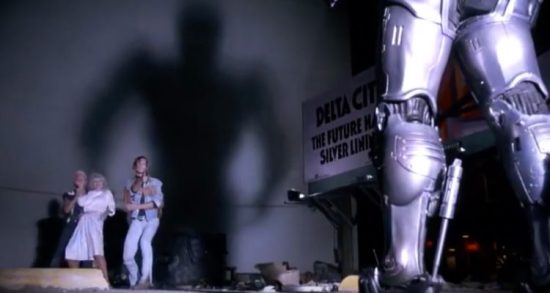
 In case any of our non-British readers need an explanation – cue the obligatory contemptuous glance down the nose at any ignorant heathen who doesn’t know our customs – the 18 certificate is second only to the R18 (which covers hardcore porn, and in any case didn’t exist back in the 80s) as the highest, most restrictive certificate a film can receive from the BBFC, making it basically equivalent to the MPAA’s X and subsequently NC-17, although it also tends to cover the more ‘Hard-R’ movies; and I think we can safely count RoboCop as one of those. Now, when I say it was my first ‘real 18,’ I should explain that I had already seen at least one 18-rated film to my recollection, which was Alex Cox’s Repo Man*; a great film for sure, but one that hardly warrants an 18 given that it received the rating based purely on the amount of swearing (a move not unheard of nowadays, but considerably less common). Of course, a pre-teen boy such as I was then isn’t going to complain about the level of profanity in a film – there’s nothing bigger, cleverer or funnier than rude words, after all, and no weapon more vital on the fledgling battlefield that is the playground – but at that age, we longed to see something more. Not boobies, necessarily; interest in those matters had not quite emerged yet, and girls were still very much the enemy. No, what we really wanted was violence. We knew there was more to it than we’d seen on TV. He-Man and Lion-O swung their swords around, but the bodies of their enemies remained intact. The A-Team fired about a million rounds an episode but nobody ever got shot. Roger Moore might unload his Walther PPK on a roomful of anonymous baddies, but all they ever did was fall to the ground clutching their chests. There had to be something we were missing…
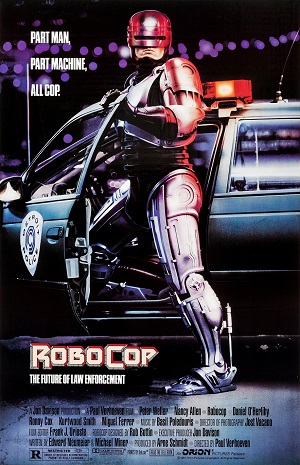 We’re presented with an alternate reality in which the corporations control everything, and as always the primary corporate interest is profit. These yuppies pull the strings from on high in their futuristic ivory towers, with the best suits on their bones and the best Bolivian export up their noses, whilst at ground level the city is in a state of extreme disrepair, with civil unrest and violent crime everywhere the eye can see. In the midst of this, one decent cop finds himself working the roughest beat in town, and winds up bullet-ridden and dismembered on his deathbed before his first day is over. But as a police officer, he sold himself over to the company as soon as he signed up. OCP own him and can do what they want with him. Indeed, they had specifically reassigned him to a high casualty precinct as he was deemed a ‘prime candidate;’ for him to meet his death was all part of the plan. Next thing you know, what little remains of him is resurrected in a high tech mechanical exo-skeleton, and the company send him out on the pretext of fighting the crime which they are in fact complicit in. His memory and personality are gone, and he exists for no other reason than to do his job, with neither the promise nor the expectation of getting anything in return; exactly what those at the top of ladder would prefer of those at the bottom. A dystopian vision of the future in the 80s, and here we are in 2012… the absence of cyborg police officers aside, none of it seems too outlandish does it?

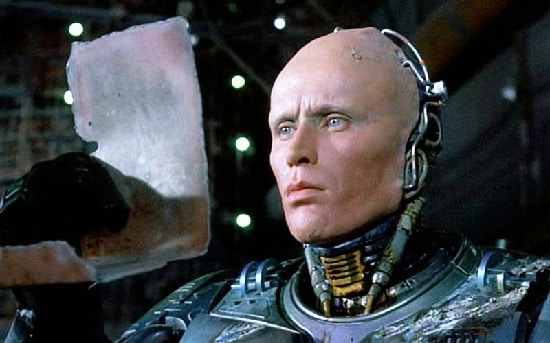 And then, of course, there’s the Future of Law Enforcement himself. Whether we buy into Verhoeven’s Christ analogy or not, from the little we see of Murphy prior to falling under the bullets of Boddicker’s gang and the gizmos of OCP’s boffins, we’re given the impression he’s an inherently decent, salt of the earth guy next door. When he’s reborn as RoboCop, our reaction is complex. On the one hand, we’re mournful for the man who has lost everything and angry at the criminals, both street and corporate level, who stole it all from him; but on the other hand, good golly gosh he’s a badass. Yes, his look and characterisation – indeed, the tone and content of the film overall – owe a sizeable debt to the comic books of the time, with Judge Dredd and The Dark Knight Returns often noted as particularly influential, but RoboCop really is his own beast; a futuristic knight in shining armour, who retains a sense of honour, nobility and – yes – humanity, in spite of the atrocities going on all around him.
 Report by Ben Bussey
 First of those old favourites – and, I won’t deny it, the key thing that drew me to the festival – was Fred Dekker’s seminal 1987 comedy horror The Monster Squad. Now, there’s a hell of a lot I could say about this one, but given that its twenty-fifth anniversary is only a month or two away I’ll save my superlatives for now. Suffice to say The Monster Squad is supremely close to my heart, being the film that got me into horror in the first place, and it remains a real source of joy to me to this day. The chance to see it on the big screen as intended, particularly in an auditorium as nice as the Pictureville, was an opportunity I couldn’t possibly pass up. That said, I must admit I was a tad disappointed that the screening was of a somewhat murky, pixelated digital copy rather than a 35mm print, though I acknowledge this was not for lack of trying on the part of the organisers. Still, given that the film is yet to receive a Region 2 DVD release (the shame!), this might be the only chance many in the audience have yet had to see it. And even in a digital format, seeing it on the big screen still throws into focus little details that might not have been noticed before, even by one who has seen the film as often as I have (and believe me, I’ve watched The Monster Squad a great many times…) I could say more on the subject – and I assure you, I will be doing so in the not-too distant future – but that’ll do for now. Moving on…
 Next up in Pictureville was a real curiosity, and a welcome one, in the form of Hammer’s Captain Clegg (1962) (which, yes, is also known as Night Creatures in some territories, hence inspiring the name of that band). We tend to forget that Hammer didn’t just make horror, but popular films of all kinds, and this film serves as a good representation of that less celebrated aspect of the company’s persona. An oddball blend of mystery, ghost story and swashbuckler, it follows the enigmatic inhabitants of a quiet small town when the king’s men arrive to investigate suspected smuggling. Peter Cushing heads up the cast as an unusual vicar with an alarming dark mop of grey-streaked hair, with an ensemble including a young Oliver Reed as a fairly dull romantic lead who gets to indulge in a bit of fisticuffs and wrestle a fair few snogs out of the delectable Yvonne Romain. It’s all typically cut-price and nonsensical – leave it to Hammer to make a pirate film that’s set almost entirely on land – but it’s teeming with the dark wit and anti-authoritarian undertones that we so often find in Hammer. The 35mm print looked great for the most part; the projection in the first few minutes had a distracting wobble which was quickly corrected, and from then on, the little scratches and occasional jumps just added to the rustic charm.
 Next up in the more intimate Cubby Broccoli screen were two early black and white TV films from Hammer (digital copies, but perfectly decent ones). Directed by Curt Siodmak, famed for writing Universal’s Wolf Man, Tales of Frankenstein (1958) is a pilot for a TV show that never happened. A fairly standard tale of the mad Baron (here played by Anton Diffring) and his experiments, it opens with Frankenstein bemoaning the lack of a decent brain to make his creation work properly; at which point, who should turn up on his doorstep but a terminally ill man and his wife, who have sought out Frankenstein in the desperate hope that he can help them. Entertaining though it is, in some ways it’s not surprising a series never came of it. I mean, what would they have done, put a different brain in the creature every week? See the monster take on a new personality in each episode, like some macabre variation on Quantum Leap…? Even so, it’s a fun little creature feature, and a pleasant window back to the days when wailing theremins, misty graveyards and flashes of lightning over Gothic rooftops had not yet become the stuff of lampoons and Scooby-Doo cartoons.
 The Man in Black (1949) makes for fairly surprising viewing today given that it provides an entirely straight role for Sid James. Though he had a long and illustrious career in straight drama, it’s almost impossible not to immediately identify him as the notorious old perv of so many Carry On films, so much so that when told that his character in The Man in Black is the country’s premier exponent of yoga, one can’t help but immediately picture him stood at the back of the class with Bernard Bresslaw, barking his signature “hyuk-hyuk” as all the girls bend over. However, that’s a far cry from what we have here. Following the efforts of James’ conniving second wife and stepdaughter to cheat his daughter out of her inheritance in the aftermath of his mysterious death, it’s a supremely twisty-turny melodrama filled with yet more of that classic dark wit, in which everyone has an ulterior motive and is out to get someone else. I’m sure they could take the same script today and make a mean episode of Midsomer Murders out of it.
 Coming up after that, whilst Keri took in the short films (which you can read about
  Wrapping up the day, and indeed the festival for me was I Drink Your Blood (1970), and I daresay that was as good a film as any to end on. A joyously absurd mix of Satan-worshipping hippies, small town hicks and sociopathic pie-poisoning pre-teens, it’s so grindhouse that if I hadn’t been told any different I might have assumed it was yet another contemporary take on the genre contrived to tick all the boxes. Cheap and cheerful to the extreme with the obligatory tacked-on overtones of morality, it’s pretty much everything you expect from a madcap midnight movie. As such, it was entirely fitting that the very rare 35mm print the festival had procured was battered to buggery, drained of colour to the point that the whole screen seemed to glow fluorescent pink, and so worn out that it actually broke about two thirds of the way in, resulting in a delay of around ten minutes. Initially I suspected this might have just been showmanship on the part of the organisers, trying to provide that same ‘real grindhouse experience’ that Rodriguez and Tarantino were so keen to mass-produce, but unless they kept the act up very well it would seem to have been genuine. And no, it didn’t detract from the experience at all. Indeed, it gave my fellow audience member Gavin Baddeley time to advise me to look out for the rabid workman who, during a chase scene, would accidentally lose his helmet, and then stop to pick it up. Many laughs were had all around.
 by Keri O’Shea
 A short but sweet review from Nia Edwards-Behi


