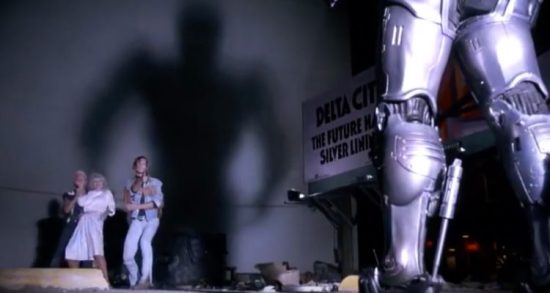
Inteview: Michael Biehn & Jennifer Blanc-Biehn on The Victim

Interview conducted by Ben Bussey

Michael Biehn’s The Victim just had its UK premiere at FrightFest, and is set to hit DVD and Blu-ray on both sides of the Atlantic in the next few weeks. Thanks to this we were able to catch a few words with Biehn and Blanc-Biehn, the husband and wife team collectively responsible for writing, directing, producing and playing the lead roles in this intimate neo-grindhouse flick. I reviewed it a few weeks back, and while it didn’t quite knock my socks off it’s certainly not a bad piece of work, demonstrating that not only does Biehn still have his chops in front of the camera, but also that he may well yet prove to be a force to be reckoned with behind the camera as well. And hey, even if I didn’t love the film, I could hardly pass up the chance to exchange a few words with a childhood hero, could I; even if it was only by e-mail?

***

Hello Michael and Jennifer, many thanks for taking the time to speak to us at Brutal as Hell. My first question is one of the first that immediately came to mind watching The Victim, which is – Michael’s playing another guy called Kyle?!

Michael: Yes! He was called Kyle in the original story but then it became a nod to Jim Cameron – that’s why we kept it.

So Michael, I understand you had previously worked in a directorial capacity on another film, The Blood Bond, in which Jennifer also acted. From what I’ve read I gather this wasn’t an especially great experience, and I wondered whether this influenced the direction taken with The Victim?

Jennifer: The Victim is totally Michael’s. The Blood Bond, we were there, we are in it but it’s not our voices and not Michael’s film, so Michael considers this his directorial debut and he made sure his contract stated his full control of this way before we began. So this could truly be his.

You have been very open in acknowledging the influence of Robert Rodriguez, even going so far as to dedicate the film to him in the end credits. Where there any other specific films or filmmakers that inspired you, in terms of tone and content?

Michael: Yes, Quentin Tarantino and then there are nods to David Fincher, Clint Eastwood, Jim Cameron and especially the look of the film is owed to a conversation with Xavier Gens. I saw his film Frontiers and the night shots were stunning. When we asked him he told me and Jen he had shot it day for night. That’s what we ended up doing.

One thing that really sets The Victim apart from most contemporary exploitation films is the visual style; you went for a more clean, natural look rather than all the grime and superimposed scratches we see in a lot of films since Grindhouse. Was this an artistic or budgetary choice?

Michael: That was an artistic choice and actually the advice early on from Robert Rodriguez after he saw an early cut.

The Victim is also one of those films in which the behind-the-scenes stories are as entertaining as the film itself, one particularly memorable anecdote being when Ryan Honey choked Michael out for real in a fight scene. From an outsider perspective that seems a fairly extreme approach! Or have worse things happened to you physically on a shoot?

Michael: I’m very passionate and intense and I thought for some reason it would be fine. Clearly I won’t make that decision again! It made for some good behind the scenes entertainment though. 

So I have to ask about the sex scene. How to put it this… it’s strange enough as a viewer watching a sex scene when the actors are a real-life couple, so I can only imagine how it must be for you as actors!

Michael: Well we are pretty proud of that scene! The lighting is beautiful. But you know what, the lights are so hot and you are concerned with making it look good so it’s not super sexual in the moment. 

The big question has to be, can we expect more Blanc-Biehn productions in the future? Any other projects in the pipeline you can tell us about?

Michael: Treachery is in post-production, written and directed by Travis Romero, and we are on post-production on The Farm directed by Xavier Gens. Also, Hidden in the Woods, the English-language remake by Patricio Valledares plus up and down on The Predictor for late next year! 

And just because I can’t let you go without one gratuitously geeky question – who would win in a fight between Kyle Reese and Dwayne Hicks? Or would The Victim’s Kyle beat them both?

Michael: Originally I might say the first Kyle, but now maybe Kyle number 2!

Michael and Jennifer, thank you so much for talking with us today.

The Victim is out on Region 1 DVD and Blu-ray on 18th September, and Region 2 on the 24th, from Anchor Bay.


The Road Leads To Nowhere: 40 Years in The Last House on The Left

By Nia Edwards-Behi

Caution – as with most retrospectives, expect strong spoilers.

The year is 1972, and the ideals of the Summer of Love already feel like a distant memory. It is three years since Woodstock; four years since the assassination of Martin Luther King. Hippies are on the wane and anarchy is on the up. Though the United States military will soon end its involvement in the Vietnam conflict, the country and its citizens have been constantly reminded of this war since the escalation of American intervention started in the 60s. 1972 is also the year that the film which began life as Sex Crime of the Century is released in the USA, beginning its decades-long journey toward becoming a cult classic that is still loved and reviled forty years later.

The film was initially envisioned as a hard-core exploitation picture, but as its production progressed it became a less explicit, though no less effective, film. Partially inspired by Ingmar Bergman’s The Virgin Spring (1960), in the film, soon-to-be 17 year old Mari and her supposedly wayward friend Phyllis head into town to attend a rock concert, while Mari’s parents prepare a surprise birthday party for her at their rural home. While looking to buy some marijuana, Mari and Phyllis are kidnapped by a gang of escaped criminals: Krug, Weasel, Sadie and Junior. The next morning they drive the girls to the woods, where they subject them to physical, psychological and sexual torture. Phyllis runs away, as a distraction, so that Mari can escape. Phyllis is eventually caught by Krug and she is killed and mutilated. Krug rapes Mari, before killing her too. Krug and company’s car breaks down as they attempt to make a getaway, and unbeknownst to them they seek shelter in the house of Mari’s parents. Mari’s mother uncovers the truth about their guests, and the dead girl’s parents exact a violent revenge on the criminals in their home. Last House on the Left is significant in a multitude of ways, but perhaps the two most notable ways are because it launched the career of one Wes Craven (as well as Sean Cunningham), and due to the intense controversy, and in some instances, hysteria, its shocking content caused.

It would be fairly easy for me to rehash these same discussions. We all know that Wes Craven went on to make The Hills Have Eyes, and Nightmare on Elm Street, amongst other films, establishing himself as one of the most notable horror auteurs of recent decades. We all know the film was central to the video nasties debacle in the UK, remaining banned until 2003 and only certified for sale in the UK as uncut in 2008. I don’t want to focus on the things we already know. There are times when the things around a film are remembered and talked about more than the film itself. I think this is the case with Last House on the Left. While indeed most of the video nasties would have sunk into obscurity if not for the controversy attached to them, Last House on the Left deserves attention, appraisal and, for me, plaudits. I think it’s too readily lumped together with pure exploitation flicks that may well be fun, but have a lot less to say and a lot less skill in their making. So, let me tell you why I love The Last House on the Left.

I won’t try to convince anyone that the film is perfect. I am probably a lot more tolerant of the film’s comedy cop duo, but even I will say that it would be a superior film if the ‘Ada’s chickens’ sequence was dropped. Regardless, even in its crudeness and its naivety, it is powerful. It’s easy to forget, I think, that this was Craven’s debut film as director. Given that this project began as a hardcore exploitation-by-numbers piece, at the request of the film’s financiers, it is all the more impressive that the resultant film is so enduringly powerful. There are undeniably tonal issues with the film – I like the contrast between the girls’ kidnap and Mari’s oblivious parents, for example, but the shifts between parallel scenes are indeed heavy-handed and at times jarring. However, I do believe that they are demonstrative of technical inexperience rather than lack of purpose. Those shifts in tone are there for a reason. The cops aren’t there to be comic relief, as such, they’re there to say something, even if inexperience muddies the message somewhat.

What is that message? It’s certainly not my place to ascribe One True Meaning to a film, but there are clear influences behind the violence of Last House, and what that violence is passing comment upon. Absolutely a product of its time, Last House is the result of counter-cultures, war and upheaval. As violence was broadcast daily into the homes of millions from the conflict in Vietnam, and as it spilled on to American streets through clashes of cultures, beliefs, and generations, its depiction in mainstream film became increasingly, obviously, sanitised, safe and unreal. As Craven has stated, Last House does not “play by the rules that had been established for handling violence” (Szulkin, 15). If films from the previous year had already rocked the boat with regard to the cinematic depiction of violence, then Last House went further. A Clockwork Orange is shocking but it is detached, abstract and stylised violence at its core. Straw Dogs portrays violence in a balletic, choreographed way, albeit more subtly than in Kubrick’s film. Utterly conversely, Last House does not offer stylisation, or choreography, or distance. Violence happens and we see it all. A single knife wound does not kill a person, and a fist fight doesn’t end after a couple of punches. Last House grabs you by the neck and rubs your face in violence, tells you it’s real, it exists, and it’s horrible.

I won’t be the first to write of the clear Vietnam commentary that exists in Last House – it suffuses David A. Szulkin’s excellent making-of book, and is fantastically theorised and reasoned by Adam Lowenstein in his book Shocking Representation. Lowenstein notes that not only does the film wear its anti-Vietnam sentiments plainly on its sleeve, but that it equally notes the failure of the flower power movement. Mari and Phyllis are hippies going to see a band called Bloodlust, after all. Most interesting of Lowenstein’s arguments, for me, is his claim that the aesthetic of Last House reflects that of war photography. In particular he notes the striking resemblance between the image of Phyllis used on the original publicity of the film and that of the famous image of Mary Vecchio taken at the Kent State Massacre. As such, Lowenstein notes the use of the frightened, teenaged female body as representative of the film’s reflection of a feminised, vulnerable nation.

Granted, Lowenstein is writing in a specific, academic way. This reflection of Vietnam trauma is clearly visible throughout the film, not only in its aesthetic. Although more direct references to the war were cut from the film in pre-production stages, for me the character of Dr. John Collingwood, the family patriarch, very clearly represents a character deeply militarised, if not directly or specifically associated with Vietnam. Early in the film, as Mari justifies her lack of bra and transparent top, he shouts at her: “Tits? What’s this tits business? It’s like I’m back in the barracks!” Though Mari’s response turns this into a figuring of her father as a dry, medical man (“Okay, mammary glands,” she mocks), Dr. Collingwood’s simple line of dialogue is revealing. He does not want to be back in the barracks. The language of the barracks does not belong in his home nor in the mouth of his daughter. However, that is the position he finds himself in and it’s a position he’s essentially helpless to do anything about. He does not want to be the ‘tits’ man, he wants to respectable, decent Dr. Collingwood. However, this military legacy returns at the film’s close. He silently rigs his home full of traps designed to incapacitate Krug. A wonderful moment occurs on the soundtrack as brief drum rolls undercut the by now familiar music. We see Dr. Collingwood become a tactician, making use of his environment to trap his enemy. He becomes both military man and guerrilla warrior, while Krug, the original guerrilla, finds himself in the position of strength. Facing Krug with fists alone and Dr. Collingwood is helpless, but given tactics and lethal weaponry, he’s unstoppable – the commands of authority, the consistently incompetent police, don’t even make him hesitate in eviscerating Krug at the film’s climax. Is this a subtle comment on military atrocities that took place in Vietnam? Not necessarily, but it certainly could be.

As I mentioned, though, it’s not only military or institutional violence that’s criticised here. The alternatives are equally as futile. In their final confrontation, Krug tells Dr. Collingwood that Mari “was a lot tougher than you, doc.” If Mari represents the flower power generation, and that she was tougher than her father, she still ultimately fails and dies. The military institution and hippy counter-culture are not the only failed ideologies in the film, though. Krug himself represents an aimless underclass of some sort, swaying from anarchist to beatnik, and is – significantly – allowed to air his views despite being the film’s primary, heinous villain.

For me, personally, Sadie represents the most interesting and complex ideological cypher in the film. At several points she attempts to express herself in feminist terms, failing miserably at getting them right – “chauvinist dog!” and “Sigmund Frood” notable examples. These moments are played for laughs in the film, and they are funny, down to some wonderful line-delivery by Jeramie Rain. These moments, though, are more than a few jokes at the expense of a would-be feminist. The character of Sadie isn’t a feminist, naturally, but for me there is significance to the fact that she tries to be – that she wants to be. Her jokes don’t work unless we already know what a ‘puh-hallus’ is, or its significance to Frood’s theories. Sadie is allowed to recognise that she needs “a couple more chicks round here” but she can’t do anything about it, as she’s not ‘her own woman’ as she claims. Sadie is significant as a misuse, or a misappropriation of feminism, either through a lack of education or a lack of support around her. It’s notable that Junior repeatedly states “she’s right, Krug,” but is so controlled by his father that his objections are useless. There’s a brief, brief moment at the film’s end when, confronted by Mari’s parents, Sadie turns on Krug. Junior has done the same, only to be so overwhelmed by his father that he shoots himself. Sadie, in essence, escapes. Although it is again, brief, she turns away from Krug’s control. Yes, she faces her punishment at the hands of Mrs. Collingwood, but for me her brief freedom is significant. It is also in this moment of betrayal that Krug looks his most distraught. Not when he’s talking his son into killing himself, not when he has just raped and murdered two girls, but rather when ‘his woman’ finally turns on him. Subtleties like this are easy to miss in the film, and I’m sure many would dismiss them as coincidental rather than intentional. However, I fully believe that moments like this are down to the talent of Craven and his cast.

Indeed, this talent underscores the film’s notability for me. I can go on about what the film’ is trying to ‘say’ until the little-cows-looking-for-some-grass come home, but film isn’t all about ideology and messages, of course. Even with its flaws, Last House boasts some superb stylistic and narrative moments. The dinner sequence, for example, where Krug and co. feign bland normality to fit in with the Collingwoods, takes place against a completely black backdrop. It’s the film’s most abstract moment, and it deftly underlines the complete artificiality of not only that particular moment, but of forced middle-class domesticity as a whole. Another wonderfully weird moment in the film comes in the form of Weasel’s dental nightmare, which is more than just an effectively cringe-inducing sequence. It provides fantastic foreshadowing for Weasel’s demise at the hands – or rather the teeth – of Mrs. Collingwood. It’s always struck me that the acting is criticised in the film, given as there are some truly fantastic performances. Yes, they’re amateur performances in many instances, but that works within the film’s style and indeed its intent. Bizarrely there are some ‘nice’ moments in the film which boast the actors’ talents – one of my favourite scenes is that between Sadie and Junior early on in the film, as Sadie takes a bath and asks Junior if he’s glad his dad is “finally out of the clink.” It’s a quiet, narratively unnecessary moment, but it’s one of my favourites due to just how bizarrely normal it is.

It’s impossible to talk about the performances in the film without paying homage to the wonderful David Hess. Terrifying throughout, Hess is at his most intense during the ‘blow your brains out’ scene as he remorselessly coaxes his son into shooting himself. Likewise, it’s impossible to talk about David Hess without paying due respect to the film’s soundtrack. A mad combination of comedic songs about criminals (Water Music), abstract sleaze (Phyllis Spills Her Guts), and gorgeous folk songs (Daddy Put Your Coat of Many Colours On) there is something quite special about Hess’ music for the film.

Unlike the film it’s inspired by, there’s no redemptive happy ending to Last House. Unlike the films it spawned, there’s no satisfaction in vengeful carnage. It doesn’t tell us that revenge is good, or forgivable, or conclusive. If there is one thing that bothers me about the film, it’s the lack of acknowledgement, sympathy or vengeance for Phyllis. Phyllis suffers at the hands of Krug and co before Mari, she comforts Mari through her ordeal, and she dies trying to help Mari escape. And yet her death is not remembered, nor avenged. Mari’s parents have already shown their disapproval of Phyllis at the very start of the film, and not once is there an indication that they spend a single second wondering what might have happened to Mari’s friend, and nor does Krug ever mention her. Given how downright heroic Phyllis has been, I find it quite upsetting, and yet, in-keeping with the film’s utterly bleak conclusion, that Phyllis is forgotten almost as soon as she dies. The Collingwoods have taken their vengeance but gained no closure, but somewhere Phyllis’ parents are wondering where is, and with such incompetent police around, will her body be found? Any witnesses to the crimes committed against her are dead – victim and criminals alike. While discussing this point, our own Keri made a wonderful observation that brings me right back to the reflections of Vietnam found in the film. The average age of an American soldier in the conflict was 19. If the deaths of Mari and Phyllis – both 17 – can be criticised as pointless or exploitative, then it’s a harsh and wonderful comment on the countless deaths of drafted teenagers in Vietnam. This view also brings meaning to the fact that the film seems to forget about Phyllis. Not all of those young soldiers were recovered, or mourned, or brought home, no matter how heroic they may have been. Surpassing the broad politics of the conflict itself, Last House on the Left ultimately takes a very human stance on the pointless slaughter of teens (abroad and at home) and the pure horror of violence.

Many might think that speculating so much about a fictional character in a film such as this is pointless or foolish. It’s only a movie…or is it? For me, there’s nothing ‘only’ about the movies, especially not ones as powerful as Last House on the Left. For a film to have started life as a cynical, money-grabbing venture to endure four decades of criticism and censure and to emerge as a powerful testament of its era, and for it to remain as impressive as it does is a huge achievement. I count Last House as not only one of my favourite horror films or genre films, but as one of my favourite films full stop. Happy fortieth, Krug and co.

What The Monster Squad Means To Me: a 25th Anniversary Tribute


by Ben Bussey

I should forewarn you that what follows will not be a standard retrospective. You see, today marks 25 years since The Monster Squad was first released to cinemas, and while I’ve no doubt that doesn’t mean too much to a lot of people, let me see if I can give some indication of what it means to me.

Follow me on Twitter and you won’t see a picture of me. You’ll see the victorious grin of Van Helsing, thumb held up high as he drags Dracula to Limbo. Visit my profile page, and you’ll note my backdrop is The Monster Squad’s British VHS sleeve. Likewise, friend me on Facebook and again it isn’t my face you’ll see, but that of Rudy, sunglasses on and cigarette in his lips, and for my cover photo you’ll see the scene at the top of this page: the midnight riverbank assembly of Wolfman, Gillman, Mummy and Dracula right before they resurrect the Frankenstein monster. On top of that, you may notice my FB address is facebook.com/kickhiminthenards. My first ever article published online, back at good old B Through Z? yep – it was on The Monster Squad. It was even in part the subject of my MA dissertation.

Yes, I love The Monster Squad. And not in some hipster ironic way. I truly, madly, deeply love every second of this silly little 1987 kiddie horror movie. For better or worse, it made me the person I am today. So if you need someone to blame, direct your hatemail to Fred Dekker.

So, how to adequately express this love? How to sum up just how great I think the film is, and just how great its personal impact on me has been? I don’t think I can within the confines of a single article. Why, I could write a book. In fact… I’m in the process of doing just that. A slow, faintly torturous process, but a process nonetheless. 

For the time being, though, I don’t think I can sum it up much better than I did five years ago on – God, was it that long ago – my Myspace blog. What follows is an abridged version of a blog post I made in July 2007, just prior to the film’s 20th anniversary and its release on DVD from Lionsgate. Once again, I warn that this is not a basic review, so anyone with an aversion to long-winded, overly personal, syrupy, touchy-feely emotional content may want to look away now. What can I say; I’m just a sensitive, sentimental kinda guy. Hence I write for a site called Brutal As Hell.

(…) Two big things happened to me when I was nine years old. I found out there was no Father Christmas; and I saw The Monster Squad.

Okay – event number one. (I’m fuzzy on the chronology; this may have happened second. But let’s assume it didn’t, for the sake of convenience. And to support my upcoming argument. Teeheehee.)

Now, I’m curious about this. Am I right in thinking that nine is quite a late age to learn the truth about Santa? A lot of people I speak to seem to have either been aware, or figured it out on their own by then. Not me. I was a dedicated believer. I don’t know what it was, but I was adamant that Santa Claus absolutely had to be real. Now, I never harboured any delusions that there was an Easter Bunny. (Over there, that’s just a guy in a suit!) With the Tooth Fairy, initial belief gave way to a comfortable realisation that it was my parents. But Father Christmas… he was just too big, too significant to be a lie. And not just because he made a movie with Dudley Moore and John Lithgow.(…) So when the fateful day came that my mother sat me down and gently told me the truth… it was a strange moment. I didn’t cry. I didn’t get angry. I just kind of went… “Oh.”

I went “Oh” because on some level I had always known. I went “Oh” because I knew that as much as I had been deceived by my parents, and all the other grown ups in the world, I knew that I had also been deceiving myself.

(…) Onto event number two: The Monster Squad.

As a kid, I hated horror. Tick me off on the list of people born into the eighties who hid behind the sofa during the Thriller video. Anytime one of the Jaws movies came on TV, I ran screaming. (Not such a bad thing with the sequels…) Sure, I loved Ghostbusters and Gremlins, but – like Steve – they didn’t count. (…) Why anyone would voluntarily sit down to read or watch something with the specific intention of getting scared, I could not for the life of me fathom. So sitting down one Saturday night with my brother and cousin to watch a film they’d picked out at Pharaoh’s Video that evening – a film that featured a werewolf, a mummy, the Creature from the Black Lagoon, the Frankenstein monster, and Count Dracula – it was a pretty big step for me.

And you know what? I loved it. Loved it, loved it, loved it.

The living skeleton attacking Van Helsing, in the wake of the whirlpool mouth of Limbo; Dracula dissolving to bat form, and escaping the plane (in broad daylight, mind you!); the sudden flash of Dracula’s skull in the lightning; the monsters congregating at the misty lake to resurrect Frankenstein; Wolfman’s exploded remnants whooshing back together; Dracula, electricity flickering over his shoulders, beating his way through cop after cop without breaking a sweat, taking out Scary German Guy with a thunderbolt from his palm, and picking up Phoebe by her cheeks: “Give me the amulet you bitch!” (Seriously, has Dracula ever had as much bad-ass power as he does in this film?)

All these moments and more flashed before me like a dream – and in an instant, I got it. I understood why people watched horror movies. Monsters were cool! And being scared – sure, Monster Squad isn’t all that scary, but still – I suddenly realised how alive it made me feel. How being afraid and being excited weren’t really all that far removed. Thinking about it, it was probably that same year that I plucked up the guts to go on ghost trains and rollercoasters for the first time.

Over the next couple of years, I saw The Monster Squad every opportunity I had; eventually I got my own ex-rental VHS copy, which I still own, and I watched it over and over – at least once a month, probably until I was fifteen. Watching it again a few weeks ago, for the first time in a while, I still found myself mouthing along to pretty much every line of dialogue, and every beat of music. (Though I still can’t quite make out all the lyrics of ‘Rock Until You Drop’…)

So – what, you may ask, did those two utterly commonplace childhood events have to do with one another? Why do I feel the need to go into detail on both of them in this manner? Because when I learned there was no Father Christmas, I stopped believing. And, as feeble an example as it may seem, when I stopped believing, I got my first little taste of despair. That’s where horror movies came in.

My mother didn’t encourage my new-found interest in horror movies. Sure, she and Dad would buy me books – all the Shelley, Stoker and Stevenson classics – but they wouldn’t let me rent any Nightmare On Elm Streets or Friday the 13ths. All those nasty things that Mum in particular had shielded me from in my earlier years, I was suddenly anxious to see, and I don’t think she was too happy about it. She didn’t want me having nightmares.

It was she, of course, that broke the news about Santa.

This was my revenge. This was my rebellion. This was my punk!

Maybe I couldn’t rent the tapes I wanted, but, unlike my mother, I knew how to work the timer on the video. ITV still showed Hammer movies most Saturday nights; I taped them all. Every so often I’d even get some more recent ones: Lost Boys, Fright Night. Then, most importantly, I made friends with a kid called Paul, whose parents let him watch absolutely anything… soon enough I was up to my eyeballs in Critters, Freddy Krueger, and George A. Romero.

And yeah, there were a few nightmares along the way.

Just to make it clear – I love my Mum! I’ve got a kid of my own now; I understand how powerful the instinct is to protect your child, how desperate the desire to shield them from any pain and distress. But we all know how it goes. There comes that moment when you’re growing up when the parents become the enemy. They’re trying to keep you down; they don’t want you to grow up. And, as my parents have told me since, in a way that really is true! God, when I try to imagine my little baby boy growing up, reaching puberty, going beyond my control… it’s a bloody scary thought. I don’t want him to be at risk. I don’t want him to suffer. Above all – I don’t want him to not need me anymore. But that day is going to come, whether I like it or not.

Remember that scene in The Crow? Michael Wincott’s holding his snow globe with a graveyard scene inside, remembering his father giving it to him and telling him, “Childhood’s over the moment you know you’re gonna die.”

Every once in a while, we start debating the significance of horror. The 70s, as anyone who’s seen the marvellous documentary American Nightmare can tell you, were all about ‘Nam, Watergate, and the assassinations of King, Malcolm and the Kennedys. Today? Well, it’s obviously 9-11 and the War on Terror, right? Sure, but…

Here’s what I think. Remember what I said, about how the non-existence of Santa was my first taste of despair? Horror will always be appropriate, always of popular interest, as long as there is cause for despair. And we all have cause for despair, and always will. Because we’re all going to die.

The motivational speaking of Mr Benjamin Bussey, ladies and gentlemen; coming to your town soon. Book now.

The Monster Squad started it all for me. It established my enduring love for classic supernatural horror in particular. It made me doodle spiders with human heads when I was supposed to be paying attention at school. And you know what? It holds up as a movie. It grips you from the opening scroll, and doesn’t let go. It’s funny and it’s thrilling; and today, when blockbusters seem to be getting more and more overblown, and moviemakers are so anxious about protecting the young that shotguns are digitally altered into walkie-talkies, it’s so refreshing to see a film clocking in at not even 80 minutes, where kids swear like sailors and are placed in genuine peril.

So when I got my e-mail from Amazon.com this morning, informing me that my copy of the brand-new Monster Squad DVD had been shipped… I got excited.

And, as you’ve probably guessed, more than a little reflective.

***

Five years on, my feelings haven’t changed, and rest assured, I have plenty left to say on the subject. Now, back to my place for some pie.

Editorial: Cult versus Canon

by Ben Bussey

Have you heard the good news? Vertigo is now officially the single greatest film ever made in the history of the world. The cultural elite have knocked their heads together and decided that Citizen Kane just ain’t the slam-dunk it used to be, and have dethroned it in favour of Hitchcock’s dizzying, blonde-bothering classic. So now you know. This, at least, is the conclusion of the BFI’s Sight & Sound magazine based on their poll conducted once every ten years, taking in the opinions of film industry professionals, critics and scholars. Satisfied? Fine. Move on.

Okay, perhaps I’m getting a smidgen too defensive. Sight & Sound are not outright declaring their poll to be definitive, nor are we obliged to consider it such. But clearly that’s the underlying idea. Clearly the implication is that this assembly of strangers in some kind of position of authority have rigourously considered the length and breadth of their film knowledge, which is indubitably far greater than that of the average filmgoer, and have decided which films are of the highest value, and by further implication which are of the least. To disagree, or to be ignorant of the films that make the cut, is to acknowledge that you are deficient as a film fan.

Cards on the table, then: of the 2012 Sight & Sound poll top 20, I have seen a grand total of 6: Vertigo, Kane, 2001, 8½, Apocalypse Now and Singin’ In The Rain. Yep, I said it. Now, without a doubt there are a few there I’m disappointed in myself for not having seen, The Searchers and The Seven Samurai in particular. But there are also plenty that I frankly know nothing of, and wouldn’t be the least bit surprised to learn if that was true of many other readers.

Now, in no way am I declaring these films I don’t know to be insignificant. Nor, in spite of the rather bitter tone I may be striking, do I think polls of this manner are without their importance. In a time when the top ten box office hits of all time include Avatar, Transformers 3 and the last two Pirates of the Caribbean films, it absolutely pays to be reminded that there is a great deal more to cinema than the kind of half-baked, overpriced tripe that Hollywood regularly dishes out to us. But when we start to make claims that one set of opinions is more valid than the other; that, for me, is when alarm bells start ringing.

Which brings me to the title subject of this editorial: cult versus canon. Just so we’re on the same page, by canon I mean those films which are accepted as indisputable, untouchable classics by the high brow elite; and by cult I mean… well, we all know what I mean by cult. Or do we? As self-evident as it may seem, it’s actually surprisingly difficult to define what specifically constitutes a cult film. And I should know, I’ve got a master’s degree in the subject. (And with that one statement, I’ve elevated myself to the status of cultural intelligentsia who know so much more than everybody else, as if I had not already done so through simple act of writing for a film site… damn, this shit’s harder to navigate than I thought…)

Example: a key piece of writing which popularised the notion of cult film was an essay by Umberto Eco, entitled ‘Casablanca: Cult Movies and Intertextual Collage.’ Now, if you’re anything like me you may have done a double-take at that title. Casablanca? How the hell does that count as a cult film? It’s a widely acknowledged classic that everybody and their mother has seen. To this day Warner Bros use the coda of ‘As Time Goes By’ as their signature music. And yet we’re to afford it the same status as, say, the films of Roger Corman, Russ Meyer, John Waters or Troma? Here at Brutal as Hell we regard ourselves broadly a cult film site, yet Casablanca is not a film we’d be likely to publish anything about; partly because it doesn’t fit into our preference for the horror-oriented and/or extreme, but more because, generally speaking, it’s just not a film we would expect our readership to be interested in. But does this mean it can’t be considered a cult film? No. Of course not.

Take these points in Casablanca’s favour: it was neither a critical nor commercial success on release, and only built its reputation with time, much as can be said of innumerable other cult properties. Further, a key part of Eco’s definition of a cult movie, which in my opinion holds up, is that it “must provide a completely furnished world, so that its fans can quote characters and episodes as if they were part of the beliefs of a sect, a private world of their own (…) whose adepts recognise each other through a common competence.” This sentiment should without doubt ring true with gorehounds, as well as comic book geeks, Star Wars fans, steampunks, Browncoats, Trekkies (or Trekkers if you prefer), and – yes – even Twi-hards. Feel free to add as many more titles to that list as you see fit. Simply put, any and all of these properties can be classed as cult, even though we wouldn’t necessarily cover them on this website.

In other words: although we may sometimes use the term as such, cult is not a genre. It is not genre-specific. It does not so much describe the text as it does the audience’s reaction to it.

So why do I feel the need to bombard you with these lofty postulations now, I hear you cry? Well, because things like this Sight & Sound poll beg the question – where does cult end and canon begin? Can a film exist in both imaginary arenas at the same time? If a film’s cult appeal is strong enough, will it inevitably result in canonisation, as may well have been the case with Casablanca (which, incidentally, didn’t make the Sight & Sound Top 50 this year) – and Vertigo, for that matter? Is it generational: does that which was disregarded in its own time invariably attain credibility as the years roll on? Does this mean that in another few decades the Sight & Sound number one could be, I dunno, John Carpenter’s The Thing?

Here’s what I would say differentiates a cult film from the rest: it is a film whose audience have embraced it on their own terms. Critical and/or popular opinion may have helped them on their way, or not; but what really matters is the viewer’s own response. The viewer has decided on his/her own that this film is important. The film has value, because it has value to the viewer.

To cite the opinion of a critic who I know is not held in an especially high regard today – Harry Knowles has argued that it’s far more interesting to hear what someone’s favourite films of all time are, rather than what they consider the best films ever made. The two lists may well be wildly disparate; perhaps they may overlap, or not; but one list will surely be easier to predict than the other. In declaring the best ever made, we’re so much more likely to fall back on the pre-existing definitions of great filmmaking, ensuring that the requisite directors get a look in: Hitchcock, Welles, Kurosawa, Goddard, Fellini and so forth. Your personal favourites, meanwhile; they mean whatever they mean to you. They’re the films that captured your attention on their own, the ones that opened your eyes to the joys of the medium. Chances are, they’re films which you love knowing full well they are flawed, and in a way those imperfections are the very reason you hold them so dear.

Regular BaH readers will have surely noticed how many commemorative retrospectives we’ve been doing of late, most recently Steph’s 25th anniversary tribute to The Lost Boys. This may well beg the question – are we not simply another form of cultural intelligentsia enforcing another canon? Is there not also elitism at play within cult; the demand for that ‘common competence’ Eco spoke of? Well, I won’t deny that’s a difficult accusation for us to dodge. What I will say in our defence is, if you go back and look at these retrospectives, you will hopefully find that the greatest emphasis is placed on how much the film in question means to the writer on a personal level. We’ll argue its technical and artistic merits, for certain, but we won’t deny its failings either. If you don’t agree with what we have to say, that’s cool and the gang. Of course, those involved in the Sight & Sound poll may very well say likewise; or so I would hope, at least.

To wrap this up, Springer’s Final Thought style: it bothers me deeply when anyone attempts to blanketly declare that which is of the greatest cultural importance. We can, and should, and do decide on an individual basis that which is most important to ourselves, and this is as it should be. Yes, it is very important indeed to hear a wide variety of opinions and allow your eyes to be opened to things which you may otherwise have missed; I wouldn’t be writing for a site like this if I didn’t feel that way. When all is said and done, though, we should embrace that with which we feel the greatest affinity, whatever that may be, without fear of scorn or ridicule from those who might consider themselves our cultural superior. If that means preferring instant coffee to fresh, or burger and fries to filet mignon, or Jim Wynorski to Jean Renoir – so be it. Yes, the opinions of those who voted in the Sight & Sound poll are valid, and well worth taking into consideration; but so too is your own, and you should never be intimidated into thinking otherwise.


25 Years of The Lost Boys: "Sleep all day. Party all night. Never grow old. Never die."

by Stephanie Scaife

Caution: spoilers ahead…

1987. Regan is President, the Cold War continues, Thatcher is re-elected Prime Minister, the first ever episode of Star Trek: The Next Generation airs on television… and on 31st July Joel Schumacher’s teen vampire flick The Lost Boys was unleashed on US audiences. 25 years later and it has found mass cult appeal, thanks in part to being one of Warners’ best selling VHS tapes ever released and that for my generation it offered something new – vampires as young, beautiful, immortal rock stars, not pasty old loners holed up in castles or creeping around foggy cemeteries.

I’m almost certain that I’ve told this story before, but way back in the late 80’s when my mum bought a VHS player the first two videos she bought were Blade Runner and The Lost Boys, and for the longest while they were the only videos that we had, resulting in them being watched ad nauseam, and for me as an adolescent The Lost Boys had a profound effect. As we’re seeing today, the allure of the teenage vampire can be very popular with young girls; I’m just glad that for my generation this included sex, violence, rock ‘n’ roll and some pretty fucking awesome 80’s hairstyles. Not sparkly, chaste, vegetarian vampires…

I really wish that I could say it was the rather awesome Kiefer Sutherland as David, the leader of the vamp gang, that piqued my interest, but sadly no; I was 8 years old and I was in love with the two Coreys. This was in the days before the internet, and it’s not like I could start an appreciation Tumblr or write slash fiction; instead I had scrap books, and I’d spend hours cutting out pictures from teen heart-throb magazines and hand-writing fan letters whilst listening to the soundtrack on vinyl. Not to mention sitting though such gems as License to Drive and Dream a Little Dream as a consequence of my obsession, in-between repeat viewings of The Lost Boys, which I think I must’ve seen over 50 times in my life and could probably recite the entire script backwards. To me this almost seems rather quaint now in a world where you can gather every piece of information about your idol online and millions can be made from publishing your poorly written fan fiction.

As it happens The Lost Boys wasn’t intended to resemble anything like the finished product. Instead it was originally about 8-9 year old vampires in a more literal rift on the Peter Pan reference of the title. What Schumacher did was envision the film with teenagers with the aim of making it cool and sexy, and certainly not the kids film that the studio had wanted. He took a massive risk making such an of-the-moment-film, full of unknown actors that blended the near impossible to pull off combination of horror and comedy. But against all odds he managed to succeed, not least because of the fantastic cast, a great soundtrack and cinematography by the legendary Michael Chapman (Taxi Driver, Raging Bull). The Lost Boys is knowingly kitsch and it almost takes itself too seriously, but I think it pulls it off by being scary enough, sexy enough and cool enough to appeal to a vast audience, and I think that it still stands up today, although that may just be my nostalgia talking. It may also be my poor taste that thinks although it’s very certainly the 80’s it still looks great and any hipster on the streets of Williamsburg would probably kill for Sam’s wardrobe.

Following on from The Hunger (1983) and Fright Night (1985), The Lost Boys continued to up the ante in making vampires contemporary. Vampires have never been the stereotypical movie monster, although they are traditionally male they are often times handsome and alluring, not like Frankenstein’s Monster, The Mummy or The Wolfman. But whereas Dracula or other similar gothic incantations saw themselves holed up in faraway castles, these contemporary vampires were far more sociable, not to mention oozing in sex. In The Lost Boys, David (Kiefer Sutherland) and the rest of his family are portrayed as mysterious, a thing apart from normal life and so hip and cool that everyone around them yearns to be like them; including Michael (Jason Patric) who is immediately taken with the only female member, Star (Jami Gertz).

Michael is part of another, altogether more typical dysfunctional family consisting of his teenage brother Sam (Corey Feldman), his recently divorced mom (Dianne Wiest) and his eccentric taxidermist Grandpa (Barnard Hughes). They have recently relocated to Santa Carla, CA – or “the murder capital of the world” as it’s known in the film – from Phoenix, AZ. Santa Carla is a Boardwalk town full of misfits, transients and punk rockers – a world away from the landlocked Phoenix, enabling for classic fish-out-of-water narrative devices, especially in regards to Sam who is portrayed as a sort of fashion victim more comfortable hanging out at the mall than on the beach, and Michael who tries desperately to impress Star by saying he wants to get his ear pierced. However, each brother goes in a distinctly different direction in their bid to become accepted in their new surroundings.

Sam meets up with the Frog brothers, Edgar (Corey Feldman) and Alan (Jamison Newlander), two kids who run a comic store on the Boardwalk, that are self-proclaimed vampire hunters. Schumacher had asked Feldman and Newlander to study Stallone and Chuck Norris movies and to become that kind of 80’s action commando-type character and to also take themselves very seriously indeed, which effectively adds a great amount of humour to their roles. The Frog brothers give Sam horror comics to read, which they seem to take as gospel and use as self defence manuals, and although initially humouring them Sam quickly gets sucked in, especially as he starts to see vampiric traits from the comics appear in his brother Michael.

Michael on the other hand is quick to ingratiate himself with David and the others, initially due to his attraction to Star, and later as he is seduced by the danger and mystery of this gang of teenagers seemingly unhindered by responsibility and any sort of adult supervision. In one of the most infamous scenes in the film David tricks Michael into believing that he’s eating maggots and worms instead of Chinese take-out so as to easily coax him into drinking blood, hence turning Michael into a half-vampire, only to become a fully fledged vampire upon committing his first kill.

During the 1980’s with the increased press coverage and growing fear surrounding the official recognition of HIV and AIDS, the vampire story started to take on a whole new meaning. Vampires after all are all about sex and blood and the popularity of certain film genres, horror in particular, has a tendency over the years to reflect the socio-economic climate of the time – from the cold war politics and racism of the 1960’s in Night of the Living Dead, to the 1970’s backlash against the Vietnam war in Last House on the Left, to the vampire films of the 1980’s like The Lost Boys and Kathryn Bigelow’s Near Dark where we see young, sexually active people being afflicted with vampirism transmitted through penetration both sexual and as a means to consume blood. So after being tricked into consuming David’s blood and consummating his relationship with Star, things start to go all sorts of weird for Michael. He sleeps all day, wears sunglasses indoors, he smells bad, so wait… is he a creature of the night or is he just a teenage boy?

Meanwhile, oblivious to all of this, their mom Lucy has found herself a job at a local video store and is dating the manager Max, who just so happens to be the mild mannered middle-aged head vampire! In another of my favourite scenes (that also offers somewhat of a plot hole) Max comes over for dinner and Sam along with the Frog brothers try and catch him out by spiking his food with garlic and seeing if he glows in the dark, however we learn that by inviting a vampire into your home it renders you powerless against them. Although, as we’d seen earlier in the film Michael fails to cast a reflection in his own home but Max on the other hand clearly has a reflection in the mirror Sam plants in front of him. Perhaps being the head vampire gives you extra inexplicable powers, or perhaps by now I should’ve learned to stop questioning horror films.

Once the cat is out of the bag the final third of the film turns to fairly standard genre fare as our protagonists battle against the vampires, and although the events that transpire are more than a little predictable there are a few memorable death scenes that remain unparalleled even today – my little 8 year-old mind was pretty much blown as we see “death by stereo,” toilets exploding with blood and Kiefer Sutherland impaled on a mound of taxidermy deer antlers. Even today you’d struggle to find such imaginative ways of vampire disposal and I think that is one of the many reasons why The Lost Boys still stands up today. Yes it’s cheesy and yes it’s very clearly set in the 80’s but it’s still a funny, scary, sexy movie that will continue to inspire both fascination and nostalgia, depending on your age, for years to come. Something that not many recent vampire films could lay claims to. Let’s just not mention the 2 straight to video sequels.

It takes a certain kind of film to inspire the sort of following that The Lost Boys has, and even now all of its primary cast are associated with this above anything else that they’ve done in their careers. Perhaps that’s not too much of a stretch with Jami Gertz, but when you look at actors like Kiefer Sutherland it definitely says something about the power of the film; that this is the one he continuously gets quoted back to him and is constantly flagged as a favourite amongst his fans. I think ultimately The Lost Boys was a combination of being in the right place at the right time to capture the imaginations of a disenfranchised generation looking for some escapism and its longevity is proof that although it’s hardly Citizen Kane (and in fact it’s not even as good as the lesser known Near Dark which came out later that year), there is something very special about The Lost Boys. In another 25 years time I’m sure I’ll still be watching it at least once a year and quoting lines back with my friends, so just remember: “They’re only noodles, Michael.”

RoboCop – 25 Years of The Future of Law Enforcement

By Ben Bussey

Beware of spoilers ahead – but come on, if you haven’t seen RoboCop what the hell have you been doing?

We’ve seen a fair few landmark films celebrate major anniversaries so far this year: 25 years of Nightmare on Elm Street 3 and Evil Dead 2, as well as 30 years of New York Ripper, Cat People, Basket Case, Conan the Barbarian and The Thing. But for me personally, the film celebrating its silver jubilee today, having opened in US cinemas on July 17th 1987, is more of a landmark than any of those. It gives me great pride to say that Paul Verhoeven’s sci-fi/action/black comedy masterpiece RoboCop was my first real 18.

In case any of our non-British readers need an explanation – cue the obligatory contemptuous glance down the nose at any ignorant heathen who doesn’t know our customs – the 18 certificate is second only to the R18 (which covers hardcore porn, and in any case didn’t exist back in the 80s) as the highest, most restrictive certificate a film can receive from the BBFC, making it basically equivalent to the MPAA’s X and subsequently NC-17, although it also tends to cover the more ‘Hard-R’ movies; and I think we can safely count RoboCop as one of those. Now, when I say it was my first ‘real 18,’ I should explain that I had already seen at least one 18-rated film to my recollection, which was Alex Cox’s Repo Man*; a great film for sure, but one that hardly warrants an 18 given that it received the rating based purely on the amount of swearing (a move not unheard of nowadays, but considerably less common). Of course, a pre-teen boy such as I was then isn’t going to complain about the level of profanity in a film – there’s nothing bigger, cleverer or funnier than rude words, after all, and no weapon more vital on the fledgling battlefield that is the playground – but at that age, we longed to see something more. Not boobies, necessarily; interest in those matters had not quite emerged yet, and girls were still very much the enemy. No, what we really wanted was violence. We knew there was more to it than we’d seen on TV. He-Man and Lion-O swung their swords around, but the bodies of their enemies remained intact. The A-Team fired about a million rounds an episode but nobody ever got shot. Roger Moore might unload his Walther PPK on a roomful of anonymous baddies, but all they ever did was fall to the ground clutching their chests. There had to be something we were missing…
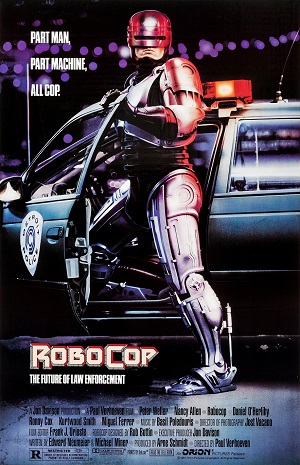
And I found out just what that missing something was the afternoon I sat down in the front room of a school friend whose gloriously lax parents, very much unlike mine, let him watch whatever he wanted (which rapidly made him the most popular boy in school). I still remember the trepidation I felt the moment ED-209 came clunking dinosaur-like into the OCP boardroom. That aggressive visage, the ominous motorised hum, and of course those gargantuan guns; such an incongruous sight in the enclosed, clean, ostensibly civilised corporate setting. I vividly recall my own panic and sense of impending doom as that nitwit exec, having unwittingly ‘volunteered,’ half-heartedly threatens ED-209 with the .45 Desert Eagle; an imposing handgun under most circumstances, but wielding about as much defensive power as a pea-shooter under the circumstances. That 20 second countdown may well have been the longest 20 seconds of my life, knowing full well they were going to end badly. My heart thumped, adrenaline surged – and I struggled not to giggle. And then…

Yep. Granted, the above clip is from the director’s cut, and it wasn’t quite so drawn out and excessive in the theatrical/VHS version I saw that day, but still… it was never like that on The A-Team. Truly this was the stuff a ten year old boy’s dreams were made of.

RoboCop is one of those films that could only be a product of the 80s. In many ways it really isn’t too hard to see why so many people were uptight about what constituted family entertainment back then, when you consider that there were, amongst other things, action figures and cartoons of Rambo, Chuck Norris, and of course RoboCop himself. Obviously the concept of a half-robot crime fighter was always going to appeal to kids, and only in the 80s would such a concept be blatantly marketed toward them, despite the source material being so flagrantly inappropriate for that age group. As such, it’s not really so surprising as some would claim that further down the line in the series the producers opted to tone things down for a family audience… but the less said about that the better. We’re not here to mourn RoboCop’s decline; we’re here to celebrate his glory, in his first and (by a very great margin) best film.

Of course, while it was the guns, gore and F-bombs that had my younger self spellbound, it wasn’t until I was a little older that I came to realise just how much more is going on in RoboCop. The true gift of Paul Verhoeven (insofar as his American work is concerned, at least) is how he can put together a film with mass appeal which may at a glance appear to be the most intellectually redundant schlock imaginable, but on closer inspection proves to be a biting satire on most of that which is held dear by mainstream western society, and above all the US. From an outsider perspective RoboCop could easily seem the ultimate Reaganite dream, boasting as it does a hard- bodied gun-toting alpha male hero with a zero tolerance attitude to lawbreakers. However, it doesn’t take a doctorate in media studies to recognise what an assault on Reagan’s America the film really is.

We’re presented with an alternate reality in which the corporations control everything, and as always the primary corporate interest is profit. These yuppies pull the strings from on high in their futuristic ivory towers, with the best suits on their bones and the best Bolivian export up their noses, whilst at ground level the city is in a state of extreme disrepair, with civil unrest and violent crime everywhere the eye can see. In the midst of this, one decent cop finds himself working the roughest beat in town, and winds up bullet-ridden and dismembered on his deathbed before his first day is over. But as a police officer, he sold himself over to the company as soon as he signed up. OCP own him and can do what they want with him. Indeed, they had specifically reassigned him to a high casualty precinct as he was deemed a ‘prime candidate;’ for him to meet his death was all part of the plan. Next thing you know, what little remains of him is resurrected in a high tech mechanical exo-skeleton, and the company send him out on the pretext of fighting the crime which they are in fact complicit in. His memory and personality are gone, and he exists for no other reason than to do his job, with neither the promise nor the expectation of getting anything in return; exactly what those at the top of ladder would prefer of those at the bottom. A dystopian vision of the future in the 80s, and here we are in 2012… the absence of cyborg police officers aside, none of it seems too outlandish does it?

But let’s not make RoboCop out to be something it isn’t. We can go on about these serious themes and more besides – Verhoeven’s well-documented take on the material as a Jesus allegory, for instance – and make the film out to be some harrowing work of hard-hitting social commentary. But the real power of satire is that it takes all the forces of oppression and reduces them to nothing by making fun of them. The underlying absurdist humour of RoboCop is what really makes the film work; it’s a very, very funny film indeed, from the ridiculous yet eerily plausible TV commercials advertising designer heart replacements and family board games about nuclear war, to the councilman who takes city hall hostage with an Uzi, his demands including a bigger office and fancier car. Then there are the shady goings-on at OCP. Co-writer Ed Neumeier has said that half the fun was to take the archetypal 80s yuppies, who were perpetually adopting a military vernacular – insisting they were going to kill, destroy or blow away their competitors – and then show them literally trying to murder one another (not a million miles from American Psycho, then). Hence the wonderful conflict between Ronny Cox’s big bad Dick Jones and Miguel Ferrer’s up-and-comer Bob Morton, neither of whom is ultimately any less despicable than the other. Speaking of underlying humour, one thing I never picked up on until recently is that, as their confrontation occurs in the executive bathroom right after Jones leaves a cubicle – i.e. presumably straight after he’s taken a dump – Jones proceeds to grab Morton by the hair without having washed his hands first. He’s essentially stink-scalping him.

And boy, as gripping and amusing as that scene plays in the theatrical cut, for me it’s never been funnier than in the edited for TV version shown by ITV back in the 80s and 90s. To bring up Repo Man again, one of the great selling points of that film’s recent Blu-ray edition was the option to view the TV version, which is possibly even funnier than the original given that most of the “fucks” become “flips” and the “motherfuckers” become “melon farmers.” I truly wish there was a DVD of RoboCop that did likewise, as some of the replacement words were just hilarious. In the previously mentioned scene, Jones says of the Old Man, “once I even called him AIRHEAD!” Earlier, Morton exclaims to RoboCop, “you are gonna be one bad mother CRUSHER!” When the guy who holds up the convenience store opens fire on RoboCop, he repeatedly cries “WHY me!” And at other times, the film’s other notable big bad Clarence Boddicker yells “shut YOUR FACE up!” as well as “your company built the FREAKY thing… I don’t have time for this BALONEY!” And perhaps most notably of all, arguably the most celebrated line in the film becomes – “LADIES, LEAVE!”

Just what is it about “bitches leave”? How did it become the most frequently quoted line in such a heavily quotable film? It’s just one tiny morsel among the veritable salad bar of trash talk that makes up most of RoboCop’s dialogue. Clarence Boddicker alone has many other great lines, a couple of my personal favourites being “can you fly, Bobby?” and “ooh, guns guns guns!” So how did “bitches leave” became the iconic line? I suppose there are a number of key factors. In common with “I’ll be back” and “GORDON’S ALIVE?” it’s one of those lines that I don’t believe was ever consciously intended to become a catchphrase; the fact that, within the context of the film, it is kind of a throwaway remark adds to its perceived coolness. It also stands out that bit more as it’s the one line of dialogue uttered by the usually motormouthed villain in that particular scene. And of course, there’s the actor himself. The gleefully maniacal Boddicker is such an uncharacteristic role for Kurtwood Smith, generally cast as the straight-laced intellectual authority figure. (I used to make-believe as a younger man that Boddicker actually was the dad from Dead Poet’s Society, who turned to a sadistic life of crime having been unable to process the guilt of driving his theatrically-inclined son to suicide. Ah, youth.) In a curious way, though, the scene may actually demonstrate a hint of humanity in Boddicker; after all, he could easily have just gone ahead and murdered the models along with Morton. Does he have any real reason to let two witnesses live? Is it so they can go on to tell the tale, keeping his legend alive in the time-honoured fashion – or is it a display of mercy? Well, even if Boddicker is being merciful to the women, he’s doing it with a dash of his signature cruelty, dismissing them in such an unnecessarily rude and mean-spirited fashion. “Bitches leave,” honestly – does he kiss his mother with that mouth?

But enough about the baddies – sure, no great action movie is complete without them, but so too are they incomplete without great goodies. Nancy Allen’s Lewis, though surely the least developed of the core ensemble, is one of the best female characters in genre film of the time. Never overtly sexualised yet not de-feminised either, her gender is never made out to be a hindrance; as such, those who would accuse Verhoeven’s work of being misogynistic should take Lewis into consideration (not that the portrayal of women in Total Recall, Basic Instinct or Showgirls is quite so easy to defend). Indeed, the cops overall are the most sympathetic, relatable characters in the whole film, with a particularly endearing turn from the late Robert DoQui as the take-no-shit Sgt Reed. Neumeier has recounted his trepidation attending an advance screening for the LAPD, fearing the cops would be offended at how their profession was portrayed, but ultimately it went down gangbusters. And no wonder; in a story world riddled with corruption, the police are portrayed as the only people of real honour and principle. Would we be so ready to accept that representation today, I wonder…

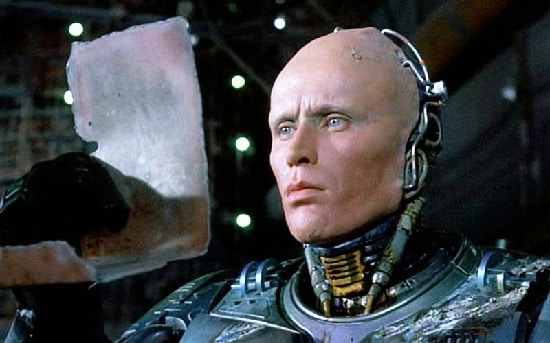
And then, of course, there’s the Future of Law Enforcement himself. Whether we buy into Verhoeven’s Christ analogy or not, from the little we see of Murphy prior to falling under the bullets of Boddicker’s gang and the gizmos of OCP’s boffins, we’re given the impression he’s an inherently decent, salt of the earth guy next door. When he’s reborn as RoboCop, our reaction is complex. On the one hand, we’re mournful for the man who has lost everything and angry at the criminals, both street and corporate level, who stole it all from him; but on the other hand, good golly gosh he’s a badass. Yes, his look and characterisation – indeed, the tone and content of the film overall – owe a sizeable debt to the comic books of the time, with Judge Dredd and The Dark Knight Returns often noted as particularly influential, but RoboCop really is his own beast; a futuristic knight in shining armour, who retains a sense of honour, nobility and – yes – humanity, in spite of the atrocities going on all around him.

So much of that soul is down to Peter Weller. It’s hard now to imagine that Rutger Hauer, Michael Ironside and even Arnold Schwarzenegger were considered for the part, as – questions of physical suitability aside (the guy in the suit had to be skinny) – surely none of them could have brought that sense of purity and vulnerability that Weller brings to it. Look at his quiet self-satisfaction as he practices his cowboy quick-draw moves while Lewis buys coffee; even though he soon proves to be an efficient marksman and ruthless killer when necessary, there’s something so un-macho, even nerdy about him. When Boddicker’s gang blow him away, it really does hurt to watch, and when he removes his helmet in the final scenes it’s still quite a shocking and upsetting sight. Crucially, we are on his side from beginning to end. Every inch the blue collar everyman, Murphy is what we might now regard – if you’ll excuse me using the topical buzzword of the day – the embodiment of the 99%. The suits have fucked him over for all he’s worth to benefit themselves; we feel his pain and loss, and long to see him get his payback. And when he does, boy is it rewarding. When Murphy finally pumps Dick Jones full of lead and sends him out the skyscraper window, he’s hitting the 1% where it hurts for all of us.

Verhoeven and Neumeier both tell heart-warming stories on the DVD commentary of attending public screenings and hearing the audience reactions at the end; as the Old Man asks RoboCop his name, audiences roared “Murphy” in unison then burst into applause. A quarter of a century later, the film still has that power. All genre considerations aside, RoboCop is truly one of the best American movies of – and about – the 1980s, and there’s almost nothing about it that is not still relevant today. This being so, I won’t deny a cautious curiosity in how things develop with the upcoming remake. Of course it’s pretty much inconceivable that José Padilha’s film will in any way improve on Verhoeven’s, but given how heavily the themes still resonate there is at the very least scope for an interesting new take on the material. As to whether it’ll be anywhere near as fearless, hilarious, intricate and electrifying as the original; well, I wouldn’t buy that for a dollar…

And one last thing that’s amazing about RoboCop: the anthemic score by Basil Poledouris. What a shame the trailer for the original theatrical release didn’t see fit to include it.

*As a footnote, it was only whilst researching this article that I learned Alex Cox had at one point been in line to direct RoboCop, as well as later being offered the sequel. To think the man I grew up knowing as the host of Moviedrome might have been responsible for two of my watershed films. Perhaps Jones and Boddicker were right: good business is where you find it.


Horror In Short: 'Dirty Laundry'

by Ben Bussey

Okay. There’s a distinct possibility you already know what this is. This short film starring Tom Jane premiered this past weekend at San Diego Comic Con and has been popping up on many sites and blogs today, most of which have not been shy about giving the game away. For the benefit of those fortunate enough to still be in the dark, I’m saying nothing but this: here comes a savage ten minutes. And fingers crossed, it might lead to something bigger and better.

Oh, and – no, it’s not strictly speaking horror. Even so, it’s most definitely NSFW, as you might have guessed.

Festival Report: Bradford Fantastic Films Weekend 2012

Report by Ben Bussey

By way of an opening disclaimer, I must profess to feeling a little disingenuous classing this as a report on the Fantastic Films Weekend given I was only there for one day of it, Saturday the 16th of June. But a jolly nice day it was, which I’ve no doubt vouches for the two days either side of it having been equally enjoyable. This was the eleventh year of the event, which takes over the Pictureville and Cubby Broccoli cinema screens of Bradford’s famed National Media Museum. With a mouth-watering selection of old favourites and rare jewels from the last fifty-odd years of genre cinema and television, the festival was a veritable fan smorgasbord from which I was more than happy to take a few hearty bites. 

With the action split over two screens and the choice between the familiar and the hitherto unseen, we naturally took the road less travelled in most cases. Henceforth, Henry Selick’s endearing stop-motion adaptation of Neil Gaiman’s Coraline, 80s undead stripper flick Vamp and the inimitable Halloween III: Season of the Witch were all passed up in favour of a trio of under-seen Hammer productions, and a genuine grindhouse original. Even so, I still found time to catch a couple of lifelong favourites on the big screen for the first time.

First of those old favourites – and, I won’t deny it, the key thing that drew me to the festival – was Fred Dekker’s seminal 1987 comedy horror The Monster Squad. Now, there’s a hell of a lot I could say about this one, but given that its twenty-fifth anniversary is only a month or two away I’ll save my superlatives for now. Suffice to say The Monster Squad is supremely close to my heart, being the film that got me into horror in the first place, and it remains a real source of joy to me to this day. The chance to see it on the big screen as intended, particularly in an auditorium as nice as the Pictureville, was an opportunity I couldn’t possibly pass up. That said, I must admit I was a tad disappointed that the screening was of a somewhat murky, pixelated digital copy rather than a 35mm print, though I acknowledge this was not for lack of trying on the part of the organisers. Still, given that the film is yet to receive a Region 2 DVD release (the shame!), this might be the only chance many in the audience have yet had to see it. And even in a digital format, seeing it on the big screen still throws into focus little details that might not have been noticed before, even by one who has seen the film as often as I have (and believe me, I’ve watched The Monster Squad a great many times…) I could say more on the subject – and I assure you, I will be doing so in the not-too distant future – but that’ll do for now. Moving on…

Next up in Pictureville was a real curiosity, and a welcome one, in the form of Hammer’s Captain Clegg (1962) (which, yes, is also known as Night Creatures in some territories, hence inspiring the name of that band). We tend to forget that Hammer didn’t just make horror, but popular films of all kinds, and this film serves as a good representation of that less celebrated aspect of the company’s persona. An oddball blend of mystery, ghost story and swashbuckler, it follows the enigmatic inhabitants of a quiet small town when the king’s men arrive to investigate suspected smuggling. Peter Cushing heads up the cast as an unusual vicar with an alarming dark mop of grey-streaked hair, with an ensemble including a young Oliver Reed as a fairly dull romantic lead who gets to indulge in a bit of fisticuffs and wrestle a fair few snogs out of the delectable Yvonne Romain. It’s all typically cut-price and nonsensical – leave it to Hammer to make a pirate film that’s set almost entirely on land – but it’s teeming with the dark wit and anti-authoritarian undertones that we so often find in Hammer. The 35mm print looked great for the most part; the projection in the first few minutes had a distracting wobble which was quickly corrected, and from then on, the little scratches and occasional jumps just added to the rustic charm.

Next up in the more intimate Cubby Broccoli screen were two early black and white TV films from Hammer (digital copies, but perfectly decent ones). Directed by Curt Siodmak, famed for writing Universal’s Wolf Man, Tales of Frankenstein (1958) is a pilot for a TV show that never happened. A fairly standard tale of the mad Baron (here played by Anton Diffring) and his experiments, it opens with Frankenstein bemoaning the lack of a decent brain to make his creation work properly; at which point, who should turn up on his doorstep but a terminally ill man and his wife, who have sought out Frankenstein in the desperate hope that he can help them. Entertaining though it is, in some ways it’s not surprising a series never came of it. I mean, what would they have done, put a different brain in the creature every week? See the monster take on a new personality in each episode, like some macabre variation on Quantum Leap…? Even so, it’s a fun little creature feature, and a pleasant window back to the days when wailing theremins, misty graveyards and flashes of lightning over Gothic rooftops had not yet become the stuff of lampoons and Scooby-Doo cartoons.

The Man in Black (1949) makes for fairly surprising viewing today given that it provides an entirely straight role for Sid James. Though he had a long and illustrious career in straight drama, it’s almost impossible not to immediately identify him as the notorious old perv of so many Carry On films, so much so that when told that his character in The Man in Black is the country’s premier exponent of yoga, one can’t help but immediately picture him stood at the back of the class with Bernard Bresslaw, barking his signature “hyuk-hyuk” as all the girls bend over. However, that’s a far cry from what we have here. Following the efforts of James’ conniving second wife and stepdaughter to cheat his daughter out of her inheritance in the aftermath of his mysterious death, it’s a supremely twisty-turny melodrama filled with yet more of that classic dark wit, in which everyone has an ulterior motive and is out to get someone else. I’m sure they could take the same script today and make a mean episode of Midsomer Murders out of it.

Coming up after that, whilst Keri took in the short films (which you can read about here) I headed back over to Pictureville for my other old favourite of the day, the 1968 sci-fi camp classic Barbarella.  Much as The Monster Squad instilled in me a love for horror, this film instilled in me a love for films in which gorgeous women in outer space take their clothes off and have sex a lot… I jest of course. That instinct was already in me long before I saw this film; it’s genetic, I think. Anyway, for a film that I have in years gone by seen erroneously stocked in the adult DVD section in stores, Barbarella is actually considerably tamer than the uninitiated might anticipate; but at the same time, it may also be somewhat darker than expected (the very rumination that inspired this article the other day). There isn’t actually much nudity and the sex all occurs off-screen, but we do have an abundance of weird and wonderful glittering sets and costumes which make no attempt to pass themselves off as realistic. The result is somewhere between a Carry On film and Flash Gordon, filtered through a very 60s flower power sensibility, yet the film is also quite unflinching in its portrayal of cruelty and suffering. To fully embrace peace and love necessitates confronting the horrors of war and hate, I suppose. Another one projected in good old fashioned 35mm, there were again jumps and scratches aplenty, but certainly nothing to detract from the pleasure of this old gem, at least not for one as susceptible to its charms as myself.

Wrapping up the day, and indeed the festival for me was I Drink Your Blood (1970), and I daresay that was as good a film as any to end on. A joyously absurd mix of Satan-worshipping hippies, small town hicks and sociopathic pie-poisoning pre-teens, it’s so grindhouse that if I hadn’t been told any different I might have assumed it was yet another contemporary take on the genre contrived to tick all the boxes. Cheap and cheerful to the extreme with the obligatory tacked-on overtones of morality, it’s pretty much everything you expect from a madcap midnight movie. As such, it was entirely fitting that the very rare 35mm print the festival had procured was battered to buggery, drained of colour to the point that the whole screen seemed to glow fluorescent pink, and so worn out that it actually broke about two thirds of the way in, resulting in a delay of around ten minutes. Initially I suspected this might have just been showmanship on the part of the organisers, trying to provide that same ‘real grindhouse experience’ that Rodriguez and Tarantino were so keen to mass-produce, but unless they kept the act up very well it would seem to have been genuine. And no, it didn’t detract from the experience at all. Indeed, it gave my fellow audience member Gavin Baddeley time to advise me to look out for the rabid workman who, during a chase scene, would accidentally lose his helmet, and then stop to pick it up. Many laughs were had all around.

All things considered, I’m sorry I wasn’t able to attend all three days of the Fantastic Films Weekend. The National Media Museum is a lovely place to visit any time, home to Britain’s first IMAX screen and innumerable treasures from the history of photography, film, TV and computing; festival attendees were given the chance to take a look at some rare artefacts from the Hammer archive including design sketches, sculptures and props including – gasp – Christopher Lee’s original fangs. There were also – double gasp – a few original Ray Harryhausen models nearby. Add to that a friendly team, and of course a great selection of films and reasonably priced passes, and everyone’s a winner. I sigh to survey the list of films I missed: Big Trouble in Little China in 70mm, The Quatermass Xperiment, Pieces, Fright Night, and more besides. Of course film festivals that showcase the new are very important, but there’s also a lot to be said for venerating the old; taking greats of yesteryear which we’ve only ever seen on DVD or VHS or perhaps have never seen at all, slapping them up there on a full-size cinema screen as their makers intended, and then enjoying those films side by side with similarly inclined film lovers. More of it, I say. Once details of the twelfth Fantastic Films Weekend are announced, my ears will certainly prick up.


Festival Report: Bradford Fantastic Films Weekend – The Short Films

Part 1 of Brutal As Hell’s coverage of the 11th Fantastic Films Weekend at Bradford’s National Media Museum, Fri 15th- Sun 17th June 2012:

Report on Saturday’s Short Films Compendium by Keri O’Shea

I’m a huge fan of the short film medium. Some of my favourite festival discoveries over the years have been short films, so I was excited to see what Bradford Fantastic Films had to offer in this department. Well, the strongest of the bunch were absolutely superb, and the weakest were rather weak – though this may be overkill speaking on my part, as the first film we saw was Perished (2011), which despite competent handling and being nicely shot, suffered for being ‘another zombie short film’, and I feel like I’ve seen more than my share of those. The set-up is rather a simple one: the dead are walking in contemporary Australia, a living man is holed up in a shed on his property and has to decide what to do to escape. Now, I don’t think the zombie genre has been completely wrung of possibilities, but on occasion, and with respect to director Stefan Radanovich, it feels as though it very nearly has when the same tropes crop up over and over. Radanovich has an impressive short-filmography to his name, though, and obviously has talent as a director, so I’d love to check out some of his other work sometime.

There was another zombie short during the set, too – this was Chomp! (2011) by British directors Adam and Joe Horton; a comic skit on boy zombie meets girl zombie, where two undead’s lips meet during a jolly bit of gut-munching and they fall for each other – referencing the spaghetti scene from Lady and the Tramp (no, really!) along the way. At just four minutes, it’s a comic fragment as much as anything else and can hardly be said to overstay its welcome, but I did have to struggle against wondering why we needed more zombies…or indeed, and this is a general observation, why the end of the world always happens when people are wearing quite so much white. Still, Chomp! had a punchline, and wasn’t badly-executed.

A short film which started with an intriguing premise was Once It Started It Could Not End Otherwise (2011): director Kelly Sears has developed a haunting visual effect here, superimposing old yearbook photographs onto a school building background, and having them move just slightly – the overall effect is quite unsettling. The story told within the film – of a strange air of apathy descending over the year-group of an American high school during the seventies (communicated via on-screen text, not dialogue) generated some nice feelings of creep, though appearance and idea badly needed some more exposition. As I’ve said elsewhere, a very little will suffice in these cases – but I felt too much as though I’d been left out of some big secret, made to feel engaged with wondering what the fuck was going on and then cut loose.

Striking the balance between tantalising the audience and tying things up must be a hard thing for any director to decide upon and accomplish, however long a time-frame they have. The sins of Once It Started It Could Not End Otherwise are duplicated in Finnish short The Hunting Ground (2011). Though The Hunting Ground is more linear and more conventional, it sets up an interesting story but leaves it rather rootless, though it manages to get a few naked women in there for good measure. Two men heading into the middle of nowhere encounter a young woman lying in the road. She’s unconscious, but largely uninjured. They pick her up, and take her with them. She has very little to say for herself, but seems happy and grateful for their help. That is, until one of the men makes a pass at her, and she takes flight into the woods. How does this situation resolve itself? Well, it doesn’t really, although it hints in a few directions. Again, I felt engaged enough by the premise that I wanted a little more, just a little more, to tell me what I’d just seen. In its favour, this film has some superb long shots, the Finnish countryside in which the action takes place is beautiful on-screen, and the performances from all of the limited cast certainly generate interest.

The Little Mermaid (2011) is another fragmentary affair, a sliver of mood rather than a tale, but one which boasts attractive sets, setting and costumes: we are taken to an old-time freak show, and a man who makes his dollars exhibiting a real life mermaid. So, he’s exploiting her – but is he safe from being exploited? That would be a no, then. Being unable to stand or attack him conventionally, she goes for a siren song to lure him near…from a director with an extensive short film retinue, I really wanted to like this little period piece more than I did, but I found it hard to feel invested in what I was seeing. Still, the idea of mermaids as malign entities is a good theme for horror, and mythical creatures on the screen are always welcome. (Editor’s note – we’ve previously featured The Little Mermaid in our Horror In Short thread; you can read Marc’s thoughts on the film here.)

Moving on to my three favourite short films of the selection, Decapoda Shock (2011) managed to tell a complete story in its ten minutes – like a sci-fi movie in microcosm, and an ambitious mix of media, splicing animation with live action in a way which really worked. The whole thing felt like an old-school comic strip – economical, but telling a hell of a lot in a matter-of-fact way. When an astronaut is sent to investigate a mysterious planet and gets attacked by a lobster-like alien creature, he mutates –  but survives to return to Earth, and do something about the conspiracy which got him feeling so crabby (sorry). He takes revenge against the Evil Corporation who set him up, and as this necessitates a part-man, part-crustacean in a spacesuit riding a horse through a desert, I’d say we can be truly thankful for that. The pace and style of this short are both very well-realised and the humour worked. This film was a lot of fun, and it was great to see the city of Madrid on the screen too…on the screen, as a man with mandibles and pincers rows through Retiro Park. Magnificent.

And now for something completely different, to anything, ever. Stop-motion animation is the medium of choice for the weird world of Bobby Yeah (2011), and boy, does it work well. Now though, I’m faced with the difficult job of explaining what happens in this gem. Right – a mischievous little fella has nicked off with a limbless, blue-eyed pet. He gets it back to his digs, and is in the process of looking it over when – ooh – he spots a big red button on its body. Buttons are meant to be pressed, yeah? He tries to resist, but he hits the button. Cue a very stressful afternoon for our Bobby as he’s beset by weird cycles of transformation, birth and…well, shall I just say that I liked the bit where Bobby beats the formerly-crow-headed golliwog monster with its detached penis which is now a skull-headed club? That’ll suffice. The essential lesson in all of this, if there is such a thing, is to not steal, but even if you must, resist pressing those tantalising fucking buttons (though I am very glad Bobby did). This is a unique piece of filmmaking. Bravo, Robert Morgan, you decidedly deserve your BAFTA nomination for this one.

Last, but not least, another cautionary tale, but one which might be a little bit more familiar to most of us, at least in the possibility of something like it happening. Bear (2011) made me laugh out loud with its impeccable sense of comic timing, and the deft way it linked this humour to an escalatingly grim situation. It’s no mean feat. When a man forgets his girlfriend’s birthday, it seems he’s in the doghouse for the duration. He plonks himself down in front of the TV. She gets dressed, in a huff, and goes out on her mountain bike. But he hasn’t forgotten her birthday at all – he’s planned a special birthday picnic, and he swings into action to intercept her out in the countryside, getting into his car to get there in time. How romantic! Except that – well, you know that whole ‘best laid plans’ thing? The pace here is just brilliant, and the story gives the audience just enough detail and development. It has a snappy punchline, too, which short films benefit hugely by. This is a great piece of work by director Nash Edgerton – tragic and comic by turns.

Read part 2 of our Fantastic Films Weekend report here.

Interview: Johannes Roberts on 'Storage 24,' 'F' and Working in Genre

Interview conducted by Keri O’Shea

British director Johannes Roberts has been making movies for over ten years now: these have ranged from the Tom Savini-dispatching Forest of the Damned (2005) to the first made-for-mobile series When Evil Calls (2006) – but to date, Johannes is probably best-known for the urban nightmare ‘F’ (2010), a film I loved. This year is promising to be a busy one: Storage 24, Johannes’ newest film, is due for its UK release on June 29th. Brutal as Hell were lucky enough to catch up with Johannes for a quick chat about S24, as well as his career to date…

BAH: Your new movie, Storage 24, is just about to get released. Firstly – what attracted you to this project? And are you happy with the result?

Johannes Roberts: I got the script while I was filming Roadkill over in Ireland. I’m really attracted to sterile locations – schools, hospitals, airports and so on – so it felt like an extension of ‘F’, really. On top of that, it meant I got to do my own alien movie. Working with Noel Clarke and Universal were obviously big factors, too.

I love the finished movie: it’s worked out really well. I remember seeing Noel after he’d watched the completed film for the first time and he was beaming. That’s a great thing to see.

BAH: Before you started on S24 – with one exception – you’ve written as well as directed your films. How different is directing a film you haven’t also written?

JR: I think, as a director, you have to take total ownership over the material. I treated it as if it were my script, lived and breathed it as if they were my characters. I think that’s really important – otherwise you’re just the guy organising where the camera should go.

BAH: You’re taking S24 to the Sitges Film Festival in Spain this year, where it’ll be entered into competition – considering the calibre of the festival, this is a big thing indeed. As well as this, Sitges will be showing a retrospective screening of ‘F’: now that it’s a couple of years since you made ‘F’ and the dust has settled a bit, how do you feel about the film and how it was received?

JR: I am still in love with that film. It was such a big thing for me to get a theatrical release on such a tiny film, and to get such a major response from the major critics was just incredible. It’s funny though – a lot of people hated ‘F’, and it died at the cinema. It just totally missed its audience, and I hope one day it will find it. Whether it will is a maybe, maybe not. But for me? That movie changed my career. Since then, I haven’t stopped working. And I still love the ending. I wouldn’t change a thing about that movie.

BAH: You’ve touched on this a little already in terms of how some people received ‘F’: how important are your reviews to you?

JR: Hmm. That’s tricky. Less than they used to be, maybe, but you always ignore the good ones and feel the bad ones. I still take it all quite personally, but I don’t hunt out reviews like I used to. When it comes to Storage 24, I’d love it to find an audience much more than I’m worried about how many stars it gets in a magazine.

BAH: As a director who has stuck with genre cinema throughout his career to date, specifically horror & sci-fi, what do you think of the horror movie scene these days? What, if anything, would you change?

JR: I really like this ‘found footage’ thing that’s happening: I don’t think I’ve yet seen the definitive version of that, and I think it’s a really interesting new route for films. I think sci-fi will become a bigger and bigger thing too, because you can do so much more for less money now. That said, I think there is still a lot of shit out there. I’d just love to be scared again. I think the genre is such a great opportunity to explore really interesting, dark themes that you just can’t explore anywhere else.

BAH: And finally – what has been your proudest achievement so far in your career?

JR: Ha, that I’m still working. Don’t think many people ever saw that one coming! Also, I think by the time you put this interview out, the billboards and phone-box posters will be up for Storage 24. Now that’s pretty fucking cool.

Universal will release Storage 24 to British cinemas from 29th June – watch out for our review. Meanwhile, you can read Ben’s review of F from FrightFest 2010 HERE.

Editorial: When DVD Goes On The Rocks?

by Keri O’Shea

At the time of writing, one of the things which really distinguishes horror fans from everyone else, regardless of how they look, where they are and what else they do, is the fact that they’re collectors. Often, they’re serious collectors. Come to our houses, and you’ll likely see shelves weighed down with stacks and stacks of movies. Fellow fans will be impressed; non-fans will look at you ever after as if you’re insane, but the fact is that having these personal movie libraries matters a hell of a lot to many of us.

The format of these collections has, of course, changed through the years. Some people are still full-on aficionados of VHS, and reserve pride-of-place for the rarest and best which they can get their hands on. There’s a rare pleasure to be had from VHS, to be sure. Nostalgia for the days when many of us discovered the joys of film for the first time not only makes it easier to forget that there were a lot of problems with this format, but in fact, there are folk out there for whom the frustrations of banding, fogging, and dodgy tracking are now fondly regarded to the point where there’s a film festival here in the UK which will be showing some of its horror films on video cassettes. The US has some similar events going on this year too. Say ‘video nasty’ to anyone visiting this site and they’ll be able to talk to you about the phenomenon. Fact is, however ‘obsolete’ a medium becomes, there are people who will always love it regardless. Having these things, these artefacts – finding them, buying them, swapping them – is all part of the fun. Not everyone has enough literal and metaphorical space in their lives for all the different formats, though…

When DVD was born in 1995, some committed collectors put their cassettes safely aside, but many abandoned their VHS libraries as enthusiastically as they’d built them up, and over the next few years moved over to the new format. But, whether people ditched video or not, DVD certainly meant interesting things for cult film. The word ‘revolutionary’ gets overused, but this new format really was something; for starters, it was a triumph of collaboration, a compromise between interested companies which headed off another format war similar to the Betamax vs. VHS débâcle of the 1970s and 1980s. And, for those of us with, shall we say, more ‘niche tastes’, DVD offered a new wave of optimism: suddenly, it looked like we could expect unprecedented quality, and the accessibility of films which we thought were lost, or at least, which we thought would only ever be available to us on cassette.

The new scope for smaller labels and specialisms meant that new generations of fandom could emerge, and we suddenly stood a chance at seeing films which had hitherto been known to us only by reputation, or via tantalising stills in horror tomes. Companies like Mondo Macabro, for example, could let us glimpse into filmmaking scenes in parts of the world where we had no idea they existed; Tartan Films really swung into action on the DVD front, giving many of us our first experience of what they termed ‘Asia Extreme’ cinema, and I believe you could make an argument that their efforts to bring the films of the Far East to such wide audiences in the West actually helped to change the face of horror in our times. Whether you were enthusiastic or more dubious about the new-fangled DVD technology, you have to admit, it opened up a brave new world of cult cinema.

Nothing stands still, though. Sad evidence of this is that the aforementioned Tartan Films closed their doors back in 2008. No sooner had DVD established itself as the medium of choice, than a new format was around the corner – which turned out to be Blu-ray, after a format war did take place this time. To date, the uptake of Blu-ray hasn’t been as sharp as DVD, but it’s certainly a medium which is growing in popularity (just look at some of the recent glowing reviews here at Brutal as Hell) and, whilst DVDs are still being made, the market is being pulled in several different directions these days, with Blu-ray surely one of the factors behind it. Whilst I haven’t made the leap to the new format, many of you have, and have become as passionate about building your Blu-ray collections as you formerly were your DVD collections. However, many of you whom I have spoken to have begun to jettison your DVDs now, just as you did your videos before that. As there still exists something of a divide between what gets a DVD, and what gets a Blu-ray release, it may be that some of the DVDs you have now passed on will never get a release to the newer, currently more exclusive format. In scaling down horror collections by opting only for Blu-ray releases, it’s possible that a lot of movies which benefited by the initial enthusiasm which saw a lot of obscurities get a DVD release will just… disappear again.

Of course, the sheer scale of competition in DVD-land is unprecedented. It’s never been harder for genre films which couldn’t hope to get a Blu-ray release to find their audience, and for a variety of reasons, great films seem to miss out on a release whilst derivative fare makes it out there, again and again. This is frustrating, but it’s only part of our changing picture…because these days, we have the possibility of streaming and downloading too…

The growth of broadband, the rise and rise of consoles which can handle multi-tasking between games and movies and the increase in means for accessing films via the internet – illegally or otherwise – is surely another kick in the guts for the ever-depreciating DVD market (and isn’t necessarily good news for Blu-ray, come to that). Speaking of downloading, I’m always surprised at the prevalence of illegal downloading amongst people who consider themselves film fans, or the outrage that anyone would seek to limit this type of theft by legal means. Of course filmmakers deserve protection. Information sharing is one thing, but illegally downloading movies means that the author of that particular film is circumvented, any financial returns for them all but wiped out. Will it ‘raise their profile’? Possibly, but it won’t generate enough capital to allow them to make another film and might make it next to impossible that they even get to add their release to the already-swarming market – and the market matters. You need cash to make movies. If you’re not able to make movies, then what use is a profile, anyway? From my point of view, there’s nothing more heartbreaking than seeing a hard-up director or writer tweet that their movie – the movie they re-mortgaged their house and lost their wife over – has hit the torrent sites before its release.

This bullshit hurts fans and filmmakers alike, and inevitably exerts an extra pressure on the already-stretched movie scene we purport to love. Sure, legit streaming options such as Netflix – which at present accounts for 20%-30% of US internet traffic at peak times – at least give something back to filmmakers, but you’d better believe they can be punitive, and we can expect a lot of upheaval in this corner of the market over the next few years. Already things are shifting again. Netflix will flounder, then something else more profitable will take its place, and so on. And, if we’re seeing the Wars of the Roses over there, what do you think it might mean for horror and genre fans? The best case scenario is that a committed group of fans within these upcoming companies enshrine a dynamic group of new and classic horror/genre films within their books and preserve this mentality. Or, they might not. It might be the last thing on their minds. And if they don’t – if market pressures steer them towards more big-budget fare – you will need your own collections, else you will get very little say in what you see.

Of course streaming movies has its place, but what I would say to those of you out there is this: take your time. To me, the flux we’re seeing currently means it’s even more important that we keep a hold of our own libraries, both for expediency as well as out of a love for it; there’s always been something of the risk that guys in suits who have nothing in common with us get to choose what we see, but the increased downward pressure of our current situation could mean that a lot of the rarities disappear again. Keep them on your shelves, folks, and keep adding to your collections, because if movies ever start to move over to streaming releases only, we’ll have nothing to collect, and nothing to show for our passion. Make the most of the options we have, because we are living – as the saying goes – in ‘interesting times’.