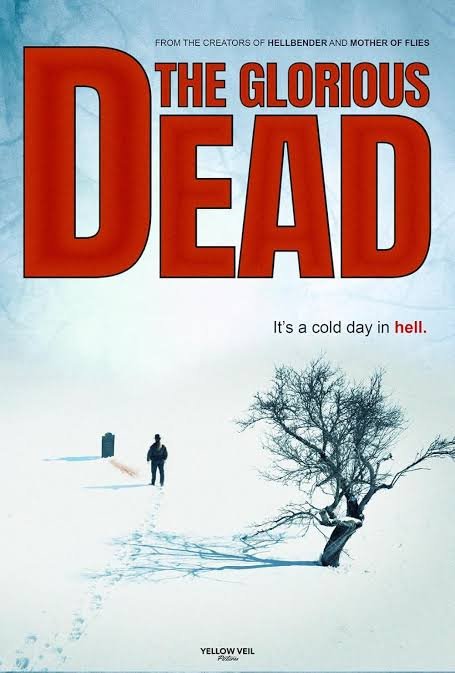

What if the end of the world came not with a bang, but a whimper? We’re primed for bombs, or zombies, or plagues – or maybe all three – but maybe, just maybe, it won’t be like that. That’s the opening premise of the Adams Family’s most recent feature film, The Glorious Dead: in many ways it feels like a departure from their previous titles, given a suddenly much larger cast, a series of locations (albeit in one geographical area) and a new focus on action, rather than (purely) mood. But in other respects, this is the epitome of an Adams Family movie. There’s the same overarching sense of atmosphere; there are the carefully drawn characters, and there’s the focus on family connections which can, or could, surpass any array of incursions from the hard-to-know outside world.
Town sheriff Deb (Toby Poser) takes a kindly and personal approach to her work; perhaps it’s that fact which gets her up and out of bed on her day off, when her Deputy, Mikey (Zelda Adams) arrives at her door with an out-of-the-ordinary job they need to do. One of the locals seems to have gone incommunicado; they have been tasked with a welfare check, so – braving a cold which seems to jump right off the screen and into your bones – the two women head off. There’s no sign of the gentleman in question, but his neighbour informs Deb that he’d taken to selling all of his stuff, right down to his furniture, in the past few days. That’s weird – but still potentially explicable – and so the women head off, a little perturbed. But the strange, if currently low-key array of phenomena keeps on growing. People keep flagging Deb down to draw her attention to something odd. It varies, but it’s all certainly concerning. A whole herd of cattle has gone. Domestic pets have gone. And people have gone, too. Did they all know something the rest of town didn’t know?
Things are soon far worse even that this when, in a vague echo of the world’s slowest zombie movie, Handling the Undead (2024), some of the town’s ex-residents start to resurrect. They’re not ‘zombies’ in any recognisable sense of the word, but by the same token, they’re most certainly dead. The preacher who calls in one of these cases was there at the funeral in question; these resurrected townsfolk are mute, probably very confused, and as such can’t provide any information as to what brought them to this state. Oh, and then there’s the sudden eruption of gaping bloody holes around town which seem to act as portals for…things. Hungry things. Think Elder Scrolls: Oblivion only a lot more gory. And described by the people who find them with memorably different similes.
Confused? Deb and Mikey certainly are, and so are the remaining locals, some of whom quickly pin the whole thing on Covid 2.0 and begin operating roadblocks to stop the ‘plague’ encroaching any further. As much as the events in the film are bizarre and fantastical, people’s reactions are depressingly plausible, but that’s the point – when faced with the unknown, everything people go on to do is depressingly known, long-documented and predictable. But there is no simple moralising here; clearly, and from the film’s earliest moments, it’s clear that Deb is an unequivocally good person. Mikey is a good person, too. As their day collapses into a maelstrom of violence and nonsense, they keep trying to do their work; they listen to people; they try to console them. They’re never off the clock, even on a day off. I have never in my life wished someone could get the hot cup of coffee they keep saying they want. The fantastical universe of the film is operating on rules, but those rules seem agonisingly unfair, and at its heart, the film is pointing that out: one of its last monologues makes it crystal clear that yeah, this is all agonisingly unfair, but it was all set down as such. Things are happening just as expected. That’s the kicker.
But beyond this more philosophical reading of The Glorious Dead and this version of hell on Earth which is cold, confusing and inescapable – this is the first Adams Family film which balances both high action, which well-handled scenes which work really well, and – humour. It’s funny. Perhaps it would be harder to push back on the ludicrous events which unfold and trying to prevent them from making the audience laugh, but instead it’s embraced, with a lot of very funny lines from people whose reactions feel entirely organic. The contrast between real people, talking like real people, in real homes in a real place, faced with the absurd and the grotesque works well – but dialogue never starts to overwhelm the film, either. Its weirdness is allowed to settle on you, like snow.
Speaking of which, the wintry backdrop for the film works fantastically and looks great on camera; the filmmaking team have grown and grown in terms of what they can do on their tiny budgets, and making the best of whatever environment they have available to work with is one of their real strengths. Whilst, appreciably, not every film fan is going to go for this slow-burn, sometimes dreamlike take on the end of the world as we know it, it will delight audiences who like a balance of the profound and the acerbic, not to mention the hilarious, in their indie horror. It’s an immersive and thought-provoking piece of film.
The Glorious Dead (2026) featured at this year’s Celluloid Screams Horror Film Festival.