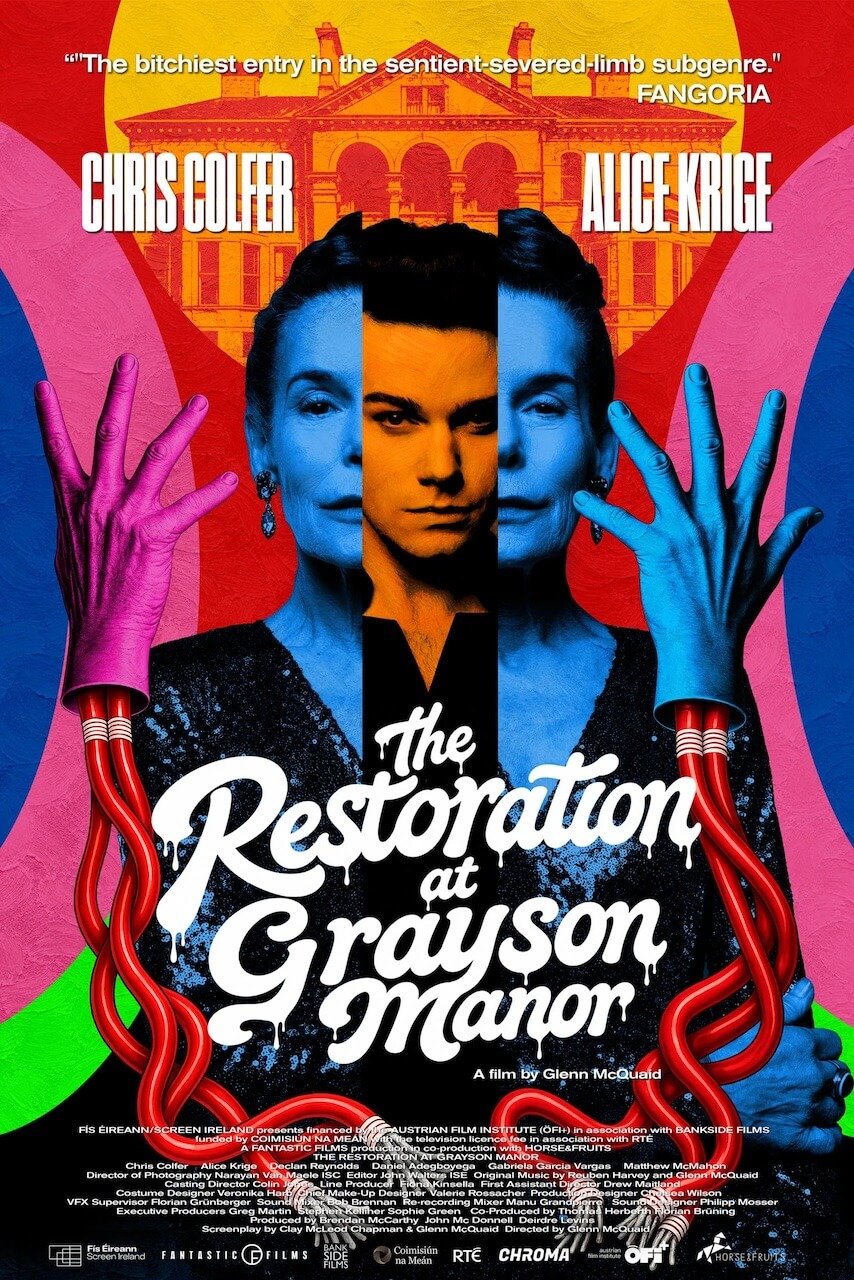

Boyd Grayson (Chris Colfer) is the sole heir of the ancient ancestral pile of Grayson Manor: it’s a splendid, if largely deserted old house which (unfortunately for him) comes pre-installed with a domineering matriarch (Alice Krige) who is by this time more than ready for her son to beget a grandson, securing the family line. This doesn’t really seem to be Boyd’s priority. A talented pianist, he divides his time between music and casual encounters with the young men he finds in his audiences. He’s openly gay, and has clearly built up some years of resentment based on his mother’s own resentment of that fact – a double whammy of recriminations and petty quarrels. And this, you get the distinct impression, would just have carried on and on unhindered, save for a chance turn of events.
One morning, after bringing a man home for what’s likely to be some pretty standard levels of debauchery (and God bless Matthew McMahon for agreeing to that, erm, memorable tableau), there’s an early squabble with mother Jacqueline about this kind of thing, when she arrives and finds them. John, the evening’s beau, is probably most surprised of all because Boyd had told him his mother was dead – but she’s very much alive, and midway through the heated debate, there’s a horrific accident which grants John a second or two or even greater surprise before – no more. Startled by events downstairs, the workmen carrying a large and no doubt antique mirror drop it over the bannister. It banjaxes John and severs Boyd’s hands at the wrist.
Boyd regains consciousness some time later; he’s bandaged up, but alive. However, events seem to have escalated rather quickly while he was out cold: his mother, frankly encouraged by this sudden cessation of his autonomy, has taken it upon herself to hire Boyd a team of private medical experts who will apparently perform wonders on her errant son’s behalf. These are: mad scientist, sorry, experimental surgeon Dr. Jeffrey Tannock (Daniel Adegboyega); nurse Claudia, whose bedside manner leaves a lot to be desired (Gabriela Garcia Vargas), and finally – Lee (Declan Reynolds), who wears scrubs, but to be completely honest, doesn’t (yet) seem to have a fixed role in these proceedings. Dr. Tannock, as it turns out, has been disgraced and ejected from the medical establishment, but when has that ever stopped a conniving aristocrat from coming along, presenting a lucrative offer and insisting that the work goes on?
Jacqueline has hired Tannock to design a set of prosthetic hands for her son; this technology is, no apologies for the pun, cutting edge.They are designed to work via an experimental neural connection: this takes an agonising amount of time to properly harness, and takes a number of training sessions with an uncooperative Boyd, but the doctor assures Mrs. Grayson that, once in place, the new hands will be better than the real thing. The problem – that is to say, the most significant problem – seems to be that the hands begin to pick up on Boyd’s subconscious impulses. They begin to take off under their own impetus, to do the things which Boyd wishes he could do, but either cannot, or dare not.
If that synopsis doesn’t immediately call to mind any number of beloved horror films from the era of ‘finding great stuff on terrestrial TV’, then I don’t know what to say to you: indeed, director Glenn McQuaid mentioned as much during the Q&A after the film screened, alluding to a number of titles, but naming The Beast with Five Fingers (1946). This film is very much a love letter to those classic ‘rogue body part’ movies (I suspect the special effects of the time period made crawling, disembodied hands particularly available and impressive, because it seemed to happen a lot for a while there). However, more broadly, it’s a love letter to a whole host of other horror films and movements, and you could have a good time just picking them out. For me, there’s a dash of The House of Usher (1960) and a firm nod to The Invisible Man (1933) in one particular scene. There’s even a little Boxing Helena, if you narrow your eyes a bit.
So it wears its heart on its sleeve in terms of influences – that is fine, and engaging on its own terms, but The Restoration at Grayson Manor is still its own beast. Whilst it never stops being a solid, entertaining ‘mad scientist’ movie, there’s more at play. It has an undercurrent of hostility with regards to the kinds of homophobia which underpin the film, though it often chooses to tackle this through dialogue, reaching for and regurgitating particularly unpleasant terms and phrases in order that Boyd can expel these attitudes. But you can still see, through all the madness which unfolds during this film, that his mother’s violent antipathy towards him has harmed Boyd: he often behaves in a snarling, petulant way, determined to repel anyone who gets too close (and later events could be seen to justify this approach). In a lot of ways the film covers Boyd’s progression back towards being his own person, uncovering a lot of the events which have been unfolding behind his back, then allowing him to get back to being who he was. That all being said, the film has a few comments to make on the burden of family, and just how far you can really go to get away from family responsibilities. It’s fun, it’s inventive, its often gory, but it also has some far more solid sensibilities at its core.
The Restoration at Grayson Manor appeared at this year’s Celluloid Screams Horror Film Festival.