
By contributor Adam Page
I’ll start at the service station, as that’s where everything starts and everything ends, and because there’s no more honest place in the Western world than a motorway rest stop in high summer.
You know the kind; somewhere in the south of France, which sounds romantic until you’re there: a big slab of concrete baking under a sun that feels personal, a forecourt smelling of hot diesel and somebody’s burnt clutch, a shop selling crisps in flavours nobody asked for, coffee that tastes faintly of its machine. Families leaking out of overheated hatchbacks, kids screaming, dads stretching their backs with the grim heroism of men who’ve driven six hours without stopping because stopping is for the weak. Everybody just passing through. Nobody belongs or looks at anybody. That’s the deal you make on the road: we’re all strangers here, briefly, then we’re gone.
It’s the perfect place to disappear. Director George Sluizer knew it. Tim Krabbé, who wrote the novella Het Gouden Ei that the movie is built on, knew it. Anybody who’s ever lost sight of a kid in a supermarket for fifteen seconds knows it in their spine, in that cold drop in the gut, the moment when the world tilts and every face in the crowd becomes a possible monster.
Saskia goes in to buy drinks. She doesn’t come back.
That’s it. That’s the entire premise. No masked killer or chainsaw, no ancient curse or shrieking strings telling you when to be scared. A young woman walks into a service station on a bright afternoon and doesn’t come out, and her boyfriend waits by the car, and then he stops waiting, and then he spends the rest of his life waiting in a different way.
Before she vanishes though, there’s the tunnel, and we have to talk about the tunnel.
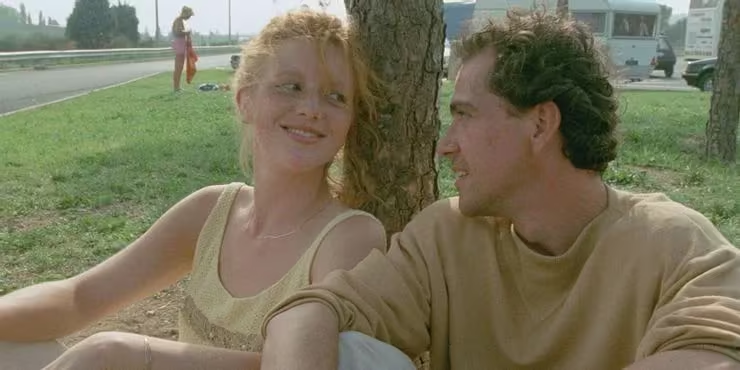
Rex and Saskia are Dutch, young, in love in that sticky, irritable, half-bored way couples are on long drives. The car runs out of petrol in a tunnel. Rex, being a man, and by that I mean an idiot, decides to walk off for fuel and leave her there in the dark. She’s terrified, begs him not to go. He goes anyway. When he comes back with the petrol can she’s gone from the car, and he finds her standing out past the tunnel mouth in the light, and there’s a fight, then there’s forgiveness, and they make the kind of promise young lovers make, the kind that’s really a prayer: we won’t leave each other. Not like that. Not alone.
Then, at the service station, she tells him about a dream. She was inside a golden egg, drifting through space, alone. And there was another golden egg out there, and if the two ever met it would be the end of something.
Now. A lesser movie would lean on this. Shove a violin under it and push your face into the symbolism. Sluizer just lets it sit there, light, nearly throwaway, a pretty bit of girlfriend whimsy on a hot afternoon and moves on. She buries two coins at the foot of a tree. Lovers’ nonsense, a little ritual. Then she walks into the shop.

And the thing about a dream like that, offered up so casually is: you don’t forget it. You can’t forget it. The movie has planted something in you, like she planted those coins, and you spend the next ninety minutes waiting for it to come up out of the ground. You’ll want to know what the eggs mean. You’ll want the eggs to meet. You’ll want, God help you, the end of something.
Remember that. The movie counts on it.
The easy reading of The Vanishing (or Spoorloos in the original title) the lazy, Sunday-supplement reading, is that Rex is a victim, a grieving boyfriend undone by a monster. And okay, maybe technically. But that’s not what makes the movie so vicious.
Three years on, Rex is still looking. Television appeals and posters. A new girlfriend, Lieneke, who is patient in that way people are patient when they’re slowly realising they’re in a relationship with three people, one of whom is invisible. Rex isn’t falling apart, exactly. He’s functional and even lucid about it. What he can’t do is stop. He more or less tells Lieneke that he could live with knowing Saskia is dead, but what he can’t live with is not knowing. The not-knowing is the wound that won’t close, and he keeps picking at it because the picking is the only proof it was ever there.
I think that’s something worse than weakness. That’s appetite.
I’ve known people like Rex. I’ve been, in my lesser moments, a little like Rex. Anybody who’s ever stared at a phone at three in the morning waiting for an answer that isn’t coming, anyone who has reread the last message from somebody who left, combing it for clues like a cop at a crime scene, knows that specific sickness. It isn’t grief, as grief at least has a shape. It has a funeral, the food people bring, a black suit that doesn’t quite fit. This is something else, something hungrier. The need to close the loop, and have the story make sense.
Gene Bervoets plays him brilliantly, which is to say without much charm at all. Rex is a bit stiff, a bit closed, a man who’s turned his life into a filing system with one drawer that won’t shut. He’s neither a hero or a wreck, he’s just a man with a single unscratchable itch, and the movie watches him scratch until he hits bone.
And then there’s Raymond Lemorne, and wow, what a creation.
This is where Sluizer does the thing that separates The Vanishing from every grubby little abduction thriller ever squeezed out of a studio. He doesn’t hide the killer. Fairly early on, the movie just…shows you. Breaks its own chronology, slides sideways in time, and introduces you to a chemistry teacher with a neat beard, a wife and two daughters and a country house. A nice man. A slightly prissy, slightly pompous, bourgeois French paterfamilias who would bore you stiff at a dinner party talking about the renovations.
Bernard-Pierre Donnadieu plays him like a man explaining the rules of a board game. There’s no drooling or twitching, no wet-eyed madness. That’s what’s so obscene about him. He’s reasonable. He’s methodical. We see him rehearse the abduction like he’s practising a recipe he’s never cooked before: timing how long the chloroform takes with a stopwatch, checking his own pulse, running through his patter, trying it out on women who, by blind luck, aren’t interested, don’t speak French or just walk off. He fumbles, and is comically bad at it some of the time. He drives home, eats dinner, sits in the garden. Then tries again.
And the reason he’s doing it? This is the bit that gets under my fingernails. When he was younger, Raymond did something heroic. Saved a girl from drowning. Got the praise and the adoration. And instead of feeling good about it like a normal human animal, he started wondering. If he was capable of the purest good, was he capable of its opposite? Not out of rage. Not out of lust, or some childhood trauma the screenwriter can wave around in the third act. Out of curiosity. Philosophical curiosity. He wants to know.
Sit with that. The monster and the victim want exactly the same thing.

Raymond needs to know what he’s capable of. Rex needs to know what happened. Both men are driven by the itch, the same itch, the same unbearable gap between question and answer. They’re two golden eggs drifting through the dark, and you already know what happens when they meet.
Raymond comes to Rex. Of course he does, he’s been watching Rex’s TV appeals, his posters and his flailing three-year campaign, and something about it appeals to him. Flattery, maybe. Raymond sends postcards, arranges meetings and doesn’t turn up, playing with him. Then finally he just appears, and makes Rex an offer.
There’s a moment when Rex beats the hell out of him, and Raymond takes it, almost serenely, like you’d take bad weather. Because he knows. He knows violence doesn’t matter, he knows the only thing that matters is the thing he’s holding: the answer. And Rex can punch him all day long and he’ll still be standing there holding it.
So they drive. Back to France and the service station. The road trip again, rhymed and rotten. And this is where the movie becomes almost unbearable, because these two men sit together in a car and talk, with Raymond laying out his life story with the pedantic self-satisfaction of a man who’s finally found the audience he deserves. He explains himself, the drowning girl, the logic of it all. Rex listens. So do we. We are dying to listen.
Here’s the deal Raymond offers, and it’s the most perfectly evil bargain in horror cinema: he won’t tell Rex what happened to Saskia. He’ll show him. The only way to know is to go through exactly what she went through. Drink the coffee. Go to sleep. Wake up and find out.
And here’s the question the movie puts to you, straight up with no chaser: would you drink it?
You know what? You’d drink it. Don’t lie to me or yourself. You’ve been sitting on the sofa for an hour and a half, popcorn going stale and bladder full because you’re afraid you might miss something, because you need to know what happened to that girl in the white shirt who walked into that shop. You’ve been leaning forward the whole time. You’ve been Rex the whole time. You’ve been gnawing on the same bone.
The movie knows you’d drink it. That’s why it’s so cruel.
Let’s talk about the coffee, because nobody does, and they should.
Of all the instruments of doom Sluizer could have chosen, he goes with a cup of coffee at a roadside stop. Not a syringe to the neck or a cosh to head, not a gun. A drink. Maybe the most banal, most universal, most trusting act of the road: someone offers you a coffee and you take it, because it’s a long drive and you’re tired, and that’s what people do. The communion of the forecourt or the tiny shared kindness of the motorway, if you’ll allow me a slightly pretentious aside.
Saskia went in to get drinks. Rex ends his story by accepting one.
I’ve drunk coffee on the sides of roads in a few different countries, and I’ll tell you, there’s something a little holy about it, in a degraded way. Bad coffee, scalding, in a paper cup that sweats through to your fingers, drunk standing next to your motorbike while trucks scream past, is one of the great small pleasures in life. It says: I’m still moving. I’m going somewhere. I haven’t arrived yet.
Rex drinks it knowing full well what’s in it. That’s the big gut-punch; he isn’t tricked. Raymond isn’t even being particularly clever. He sets the cup down and lets the itch do the work. Rex drinks that poison voluntarily, in full knowledge, because the desire to know has become stronger than the desire to live. The coffee is the last drink of a condemned man who chose his own sentence.
There’s a lesson there about appetite, and it isn’t one the self-help aisle wants you to hear. Some hungers are bottomless. Some meals eat you.
And then he wakes up.
Darkness. Total. The same dark from the tunnel, the dark Saskia was so afraid of, the dark he left her in. Then the scratch and flare of his lighter and the light is worse than the dark, because now he can see. Wood, inches from his face. Splinters. A box. He’s in a box. He’s under the ground.
He screams. He claws. He calls her name.

Rex finds out exactly what happened to Saskia. He finally gets his answer. He gets total, perfect, absolute narrative closure. The mystery is solved, the loop is closed, the golden eggs have met. And the answer is the most horrifying thing a human being can imagine, delivered not as information but as experience, which is the only way some knowledge can ever be had. He now knows everything, and he’ll know it for the rest of his life, which will be in around an hour when the air runs out.
There’s no rescue. No last-second shovel ripping through the earth or cop who followed the car. No Lieneke, bless her, turning up with the cavalry.
Sluizer cuts to Raymond. Sitting in his garden, a pleasant afternoon, his family around him and the country house basking in the sun. Totally at peace. A newspaper carries the story of the missing pair: Rex and Sakia, together at last in a headline, side by side in grainy photographs. Two eggs, drifting. Raymond has had his experiment confirmed. He is capable of the opposite. He knows now, too.
The monster sleeps fine. The man who wanted to know is in a box in the dirt.
Roll credits. Good night. F**k you.
Because here is where the movie stops being a horror and becomes something nastier, almost an accusation.
Because what did you want? Be honest. You wanted the ending. You wanted to know where she went. You get hooked by a dream about a golden egg and two coins under a tree and a girl who didn’t come back with the drinks, and you followed it all the way to the end, not because you cared about Rex, not really, but because you couldn’t stand an open question.
And Sluizer gave you what you wanted. He gave you the answer, he just made you pay for it with the same coin Rex paid with. Your reward for your curiosity is to be put in the box with him. The final reveal isn’t satisfying or cathartic. There’s no relief in it. It’s the narrative closure you wanted, served up with the lid nailed shut.
The genius of the structure is that it trains you to want it. By showing you Raymond early, by giving away the who, Sluizer shifts all the tension onto the what. Usually a thriller dangles the killers identity; the solution arrives with a click and a sigh, and you go home. Here, the killer is in plain view, having dinner with his wife and daughters, and the hunger has nowhere to go but towards the one thing still hidden: what happened inside that car. What happened to her. What it was like. The movie strips away every other mystery so that the only one left is the unbearable one.
And it’s a trap. A beautifully engineered one. Built from your own appetite.
There’s a story that Stanley Kubrick told Sluizer it was the most terrifying movie he’d ever seen, and I believe it. Not because of what’s on screen, which is surprisingly restrained, nearly polite, but because of what it does to the person watching. Kubrick, of all people, a man who controlled his movies down to the last speck of dust, would have recognised a machine built to grind the viewer up in its gears.
You want to know how dangerous that ending is? Check out what happened next.
Five years later, Sluizer remade his own movie in America. Jeff Bridges as the killer, Kiefer Sutherland as the boyfriend in a hideous yellow sweater that, frankly, deserves to be buried, Sandra Bullock as the girl in the shop. Same director. And they changed the ending. The new girlfriend, the patient one who had been sidelined in the original, gets to dig him up. Rescue and revenge. The bad guy gets his comeuppance. The audience gets to stand up, stretch, and walk out into the car park feeling just fine and dandy.
Which is to say, the remake did exactly what Rex did. It couldn’t live with the open wound. It needed that comfortable closure, the shape that makes sense, the story where wanting things doesn’t get you killed. It reached into the box and pulled the poor sod out, and in doing so it gutted the entire point.
I don’t even blame anyone, not really. I understand the impulse; test screenings, studio notes, the eternal American conviction that a story is a contract and the customer is owed a happy ending like a free refill. It’s the same impulse that drives Rex: the refusal to accept that some questions only get answered in ways you’d wish you’d never asked. But it’s a betrayal, the kind of betrayal that teaches you more about the original than any essay could. The Dutch movie is unbearable because it refuses to lie to you. The American one is utterly forgettable because it does.
Nobody remembers the remake. Everybody remembers the box.
So what’s the moral, if there is one? Don’t be curious? Don’t ask questions? Go home, shut up, accept the void?
Nah, I don’t buy it, and I don’t think Sluizer does either. Curiosity is the best thing about us. It’s why we leave home, why we eat the weird thing off the street cart, why we get on the bus to the town nobody’s heard of, why we sit in the back of some smoky bar at two in the morning listening to a stranger’s awful life story because we need to know how it ends. Without it, we’re just meat in a chair.
But the movie knows something about curiosity that most of us spend our lives trying not to think about. There’s a version of it that isn’t hunger for the world, but hunger for closure. For the neat ending and the story that resolves. And that version, the wanting-to-be-finished, the inability to live with an open door, is a kind of death wish dressed up as love.
Rex said he wanted Saskia back. What he really wanted was to stop wondering. And the only person on earth who could give him that was the man who killed her, and the only way to get it was to die the way she did.
There’s a lyric turn buried somewhere in this, and I’ll give it to you, as the movie earns it. Somewhere in the south of France, under a tree near a service station, there are two coins in the first. Nobody dug them up and nobody ever will. They’re down there in the dark with the rest of it, a little lovers’ wager that nobody won, a promise that held in the worst way imaginable: they didn’t leave each other alone in the end. Not like that.
The eggs met. Something ended.
And the next time you pull into some sunbaked forecourt and stand there, sweating, with a paper cup of terrible coffee in your hand, watching the families come and go through the sliding doors, you might find yourself counting heads. Waiting for someone to come back out. Wondering, just for a second, what happens to the ones who don’t.
Don’t. Seriously. Drink your coffee and get back on the road.
Some things you’re better off not knowing.