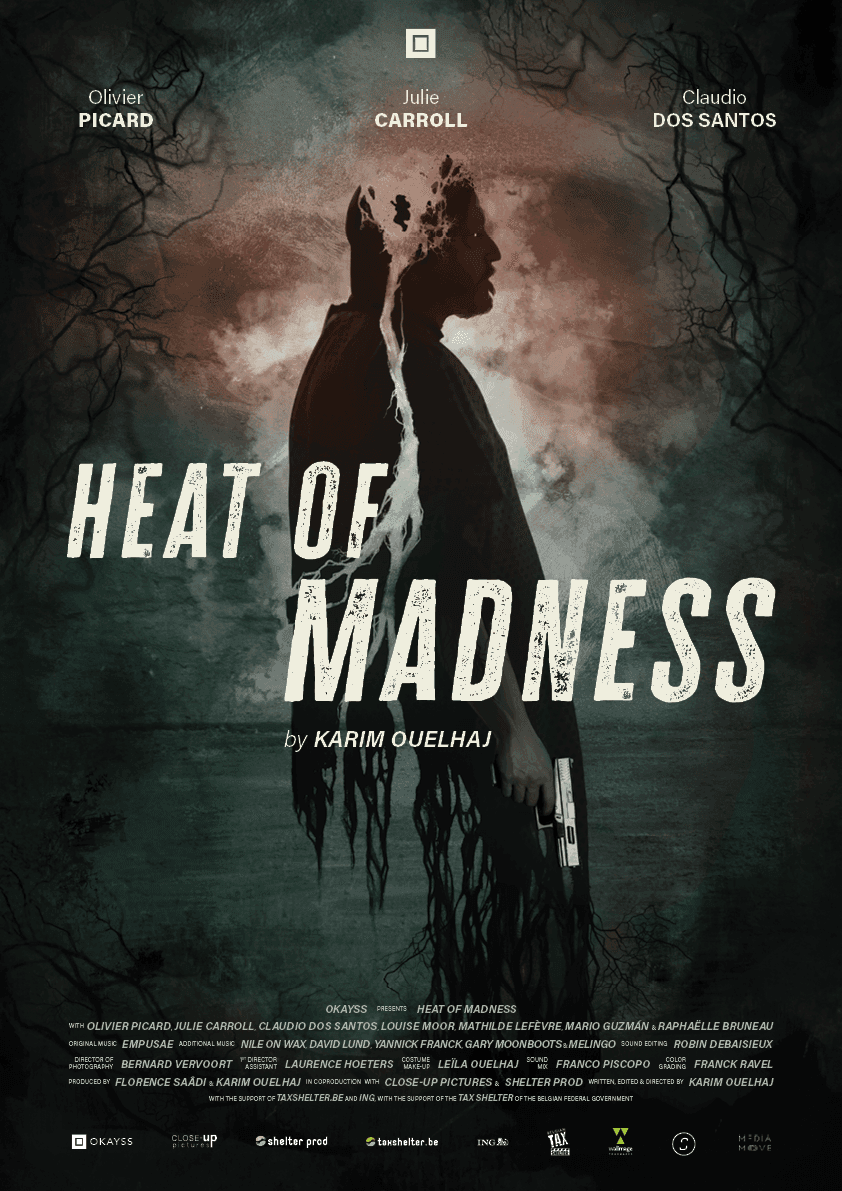

For many film fans, director Karim Ouelhaj probably established his style and vision with the staggering, stark Megalomaniac (2022) – and Heat of Madness (2026) is his first feature since that break-out title, which perhaps invites a certain level of comparison. The first thing to note is – despite some similarities in aesthetics and a similar unflinching approach to violence – these two films are very different beasts. Megalomaniac, despite the comforting rarity of its narrative elements, felt undeniably grounded in something real; Heat of Madness does not follow this same arc, preferring instead to unfold a bizarre, if very dark fantasy. It starts with recognisable roots, but elects to go somewhere very different indeed. The effectiveness of this choice is in the eye of the beholder, but its singular sense of ambition is beyond question.
We start with a taster of the film’s very deliberate placement of images and ideas and the camera’s slo-mo approach to these, with a series of as-yet mysterious images: a man visits a huge, deserted industrial structure; a man digs; a man passes what we may assume is a grave marker; something else looks like an assemblage of characters from a far earlier point in time, wearing medieval armour. What this means is not yet for us to understand – but we have a recognisable face, now appearing in what’s clearly a modern timeline – at an airport in Belgium. Scola (Olivier Picard) seems to be carrying only one piece of luggage, a briefcase, and whatever’s inside gets past customs with no real issues, so he’s permitted to go on his way. The briefcase is clearly valuable, so little wonder that people seem desperate to get their hands on it. A group of masked men (are they accomplices?) intercept Scola and his new companion; we can infer that the whereabouts of the briefcase will hereafter be an issue, and so it turns out to be.
We change pace here, picking up with Scola in a decidedly different, domestic setting (with time spare for a bit of the almost-casual observational misogyny which Ouelhaj elects to thread through this feature for our consideration, though less fixedly than in Megalomaniac). His wife is pregnant and wants to plan a proper future with him; this means no more criminal enterprises, but it turns out that the lost item is actually a number of valuable diamonds and what’s more, he has his doubts about his old partner Pedro (Claudio Dos Santos), who has his own domestic issues, and a similarly aggrieved wife. With items as costly as missing diamonds, however, it’s just not that easy to decide to detach oneself from that world. Scola feels he must go and attempt to fix this now dangerous situation – the diamonds were intended for sale to another criminal group, who very much still want them – and to find the stones, before the threats of the murder of his wife and other threats of retribution come true.
However, it’s at around this point that the film detaches its moorings from this symbolism-laden, but ostensibly ‘real’ narrative frame, heading into altogether more experimental terrain. Scola sets off to look for his diamonds, but begins to travel through peculiarly-remote places, a kind of Dante’s Inferno for a diamond crook, where the places he visits and the people he meets take on a supernatural significance. Ouelhaj’s recognisable, washed-out colour palette and its sharp, sharp contrasts accompany us once more through a long and at-times perplexing series of locations; Scola also picks up with a mysterious female companion (Julie Carroll) who declares her interest in ‘helping’ him, and as such, she becomes more and more necessary to him – this man who occasionally still seems to dip in and out of his old life, sometimes via flashbacks or black and white dreamlike interludes and sometimes by finding his way back to the places or people who matter most. Ouelhaj also intersperses all of this with some somewhat jarring moments of ‘should I laugh?’ or ‘do I really want to laugh?’ comedy, though maybe hanging onto some symbolic content all the same. Yes, I’m talking about the apples, that most symbolic of fruits, entering the frame here in a unique way, to say the least.
So what are we to make of all this? Heat of Madness is a metaphysical thriller, not a horror – albeit still punctuated by moments of intense violence, moments which immediately bleed into the film’s supporting world of flashback and dream. It’s bizarre, to put it mildly, to the point of potentially alienating fans of more conventional horror, many of whom were likely won over by Megalomaniac. Heat of Madness also potentially tests its audience by the way in which it dispenses with some of the initial forward impetus established by the opening scenes and set-up. It’s a risky business, and it lost this reviewer in places, despite Olivier Picard’s intense and consistent watchability throughout the film.
However, there is much to commend: the cinematography is superb, with a common sense of people being utterly dwarfed by their surroundings, as if to say that we are so much smaller than the world, and its great manmade edifices will be here long after our brief dramas are over. A kind of death knell for the Anthropocene, maybe, if we can extrapolate that far. There are some intriguing Jungian ideas here too, even if these are really allowed to percolate without explanation. But then, arguably, the film does wind up offering a more familiar-feeling explanation for its events: does this bring us back gratefully to our lead character/s and plot, or does it invalidate some of the strangeness which eventually gets us there? Again, it’s likely to be a divisive one, and overall it’s not really a film which lends itself well to a conventional review, either. Nonetheless, Ouelhaj has crafted something singular and – in the truest sense of the word – debatable here, even if it lacks the singular gut-punch he landed with Megalomaniac.
Heat of Madness (2026) received its world premiere at the Sitges Film Festival.