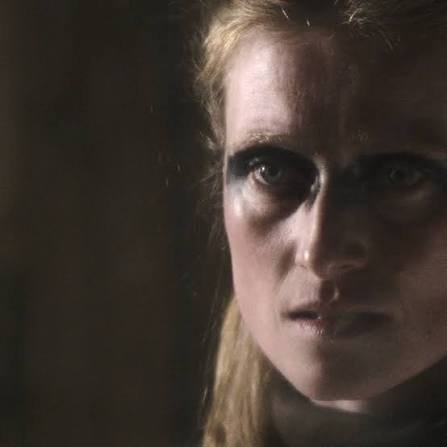
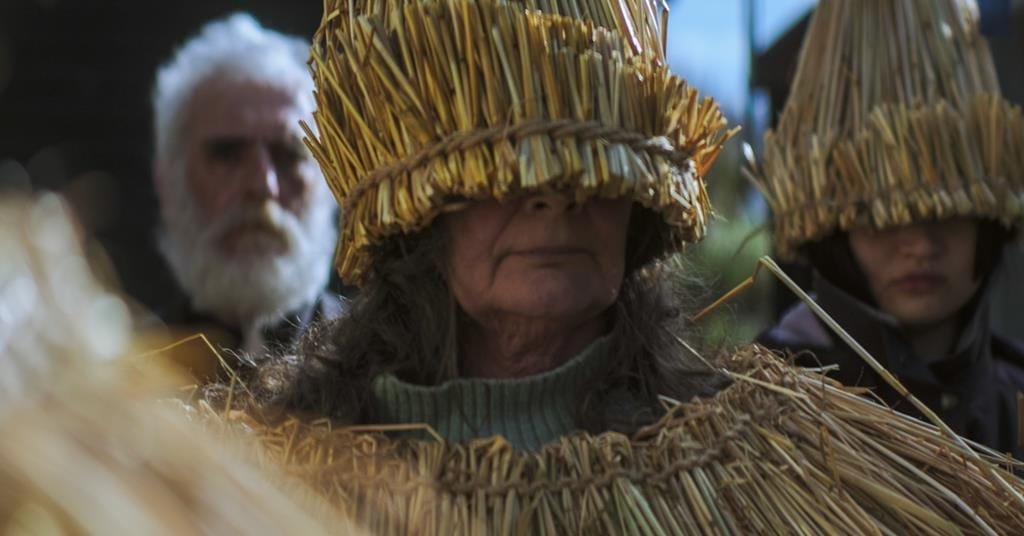
In a remote Shetland cottage – one where you’d think there’d be a vested interest in repairing gaping holes to the wilds outside – a couple in bed are being spied on through said gaping hole by a blue-eyed Peeping Tom, something which gives way to a montage of pagan-ish nightmares and images before we reconvene years later with the same couple – only now at the funeral of the man, who was a fisherman called Ingram, being buried out in the wilds on the island of Hel. For his final journey, he’s attended by his wife Anna (Christiane Schaldemose) and her daughter Gudrun (Martha Robertson), alongside a handful of other islanders.
Some post-funeral awkwardness ensures: Anna being present in Ingram’s old community isn’t popular, and staying with her in-laws, the gruff Tulloch (Francis Magee) and wife Maeve (Lynsey Rendall), isn’t exactly a hoot, either. More pertinently, Anna is blamed when a little girl from the island goes missing; add in a few notional links to Norse mythology, as-characterised by a couple of inclusions from the Up Helly Aa festival and a few exhibits in the island’s museum, and it seems like we’re being guided towards a Norse folk horror. However, this turns out to largely begin and end with a note Anna later discovers, left by Ingram, seemingly written in runes (actually spiky English, and despite the film’s avowal that it’s scripted in an indigenous language, the ‘language of the North Sea’, this does – a few dialect words aside – turn out to be English, too. Here’s one of the film’s first big issues: it promises much, perhaps a little grandly, before abandoning the promise). But the note says that there is an ‘ill man’, or an evil man, in their midst. Is that who has taken the little girl? And is that the same ‘ill man’ who then also takes Anna’s daughter?
From this point forwards, Wrath of the Gods (2026) divides its time between drizzly crime drama and some sudden, unexpected plot lurches forward, where suddenly, and without warning, a course of action is suddenly decided to be best, so things head off in that particular direction. There’s a strangely broken feel to all this: a somewhat jerky pace, a not-quite-right amount of time spent with every scenario, difficulties in assessing what exactly links people to each other, or to place, with an overweening soundtrack, and dialogue which cuts through everything else so sharply that it feels uncomfortable. Speaking of plot lurches forward: the film relies incredibly heavily on partial or repressed memories, things which come flooding back right at the point where it would help the film move on for people to suddenly remember things. Coming back, just as fast, to Norse mythology before the film comes to an end just can’t cut it. It’s a shame, but the film’s greatest moments of potential come too little, too late to give compelling shape to these proceedings. Yes, it’s great to see some of the film’s location shots, and the late Justin Hardy has captured something of the wild Northern Scottish landscapes, as well as effectively flipping the script on The Wicker Man in at least one way, by making this film all about repressed, sickly or otherwise covert sex/sexuality; in this, at least, it feels decidedly different from a film which emblazoned its sexuality across every frame, to the chagrin of Sergeant Howie, that film’s own choice of outsider.
So why keep mentioning The Wicker Man? If you have any pre-knowledge about the Hardy legacy and the family connection to The Wicker Man – which goes far beyond the late Robin Hardy being the film’s director – then you can almost lay your hands on the places where this project goes on the rocks. Based on a script found by his sons after their father’s death, this was never a complete deal, instead credited here as being ‘based on a concept by’ Robin Hardy. Robin Hardy was haunted by The Wicker Man in his own way, as were his sons – something which was made starkly clear in their recent documentary Children of The Wicker Man (2024) The less said, the better about Robin Hardy’s sequel, The Wicker Tree, an odd hodgepodge of elements which, in the 1973 film, were assembled in an order and with a skill which made them brilliant – which makes its success feel all the more precarious, somehow, as with a few different decisions and inclusions it could have all gone badly wrong.
But there’s more to it than that: Wrath of the Gods is dedicated to the memory of Caroline Hardy, the wife abandoned by Robin Hardy, though after she sank all of her own money into his film. We know, from watching Children of The Wicker Man, how contested Justin and Dominic Hardy felt about all this – but it didn’t get rid of that seemingly irresistible pull towards this post-Wicker Man project. One more throw of the dice, perhaps, or at attempt at reclamation. The fact of Justin Hardy’s recent demise only makes it feel more and more like The Wicker Man has one again expanded on the great misery it caused to the people closest to it; it doesn’t just overshadow every folk horror made in its wake, but it continues to cast its shadow over the people who spent their lives, in some cases their whole lives, living with its impact. Then, finally, The Wicker Man both makes this final film possible, whilst amplifying all of the errors or issues in its coming to fruition. Any advice to simply put it out of your head whilst watching Wrath of the Gods seems doomed to failure. You can’t.
Despite the presence of some great performers – Francis Magee is one of the best character actors working today – Wrath of the Gods is a drab and enervated piece of storytelling, only ever able to hint at better ideas and directions. And then, ultimately, it retreats into the shadow of The Wicker Man, emulating it one final time – something which feels genuinely very sad now. Children of the Wicker Man remains a much more fitting, nuanced tribute to Justin Hardy.
Wrath of the Gods (2026) appeared at this year’s Dead Northern Film Festival.