
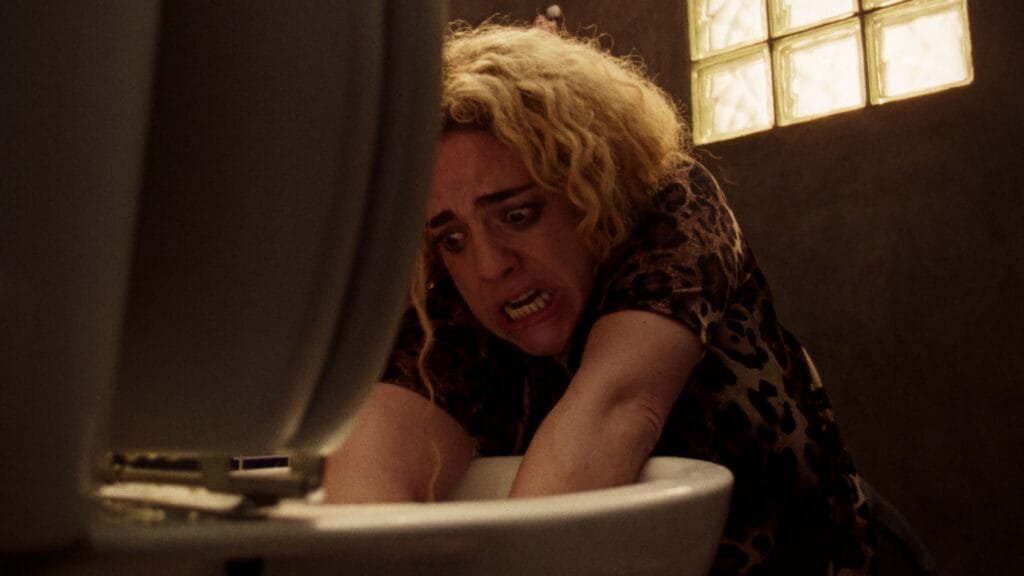
São Paulo party planner Malu (Martha Nowill) has a lot to do, toilet breaks notwithstanding. She has a cake to worry about, there are last-minute arrangements to make, and her twins’ father hasn’t come to pick them up as arranged, which is unhelpful, so she optimises a spare moment by helping to yank out her son Luan’s loose milk tooth. He’s unfazed, so much so that he takes himself back into the toilets for another look and, by jumping up and down on one to see himself in the mirror, ends up impaled to death on shards of porcelain. It’s a lively start, but Bowels of Hell (aka Privadas de Suas Vidas) doesn’t quite turn out to be the horror film which this opening sequence suggests. It’s not quite a comedy, either, and suffers as a whole for its genre-hopping, oddly lax approach to pace and narrative. It’s a shame, though it does have some gloriously OTT scenes along the way – scenes you’d fairly expect from the title, premise and opener.
Years pass: we see Malu answering nature’s call again, but rather more unsuccessfully; after losing her son, it seems that her trauma has manifested itself in chronic constipation, to the point that she appears to be pregnant and suffers from a lot of the secondary symptoms: she’s often nauseous and faint. Her daughter Luana now identifies as non-binary and goes by a new name – Genesis – but there have been complaints at school about them dedicating more time to gender ideology than their other studies, and they risk expulsion as a result. Malu is worried by this, but she isn’t on board with Genesis’s pronouns or name change either, and the two are frequently at loggerheads about it. Genesis’s disdain for gender norms extends to an upcoming gender reveal party which Malu is planning for an obnoxious Momfluencer who lives in their apartment building; Genesis sees it as an emblem of everything which is wrong with society, but Malu is taking the job regardless: she needs the money. It’s when she gets to know ahead of time that the new mother (Chandelly Braz) is pregnant with twins that her own symptoms start to worsen; during a routine vomiting session, she is devastated when she loses her son’s milk tooth necklace down her toilet, and the combination of blood, vomit and tooth causes something malign and murderous to manifest in all of the toilets in the building.
Why? We don’t know really. There’s no lore here; there’s no ritual, acknowledged or otherwise; there’s no extra-terrestrial presence. We just accept there’s a new, angry and unseen entity which now manifests in the pipework of the building and hates the people using its, erm, facilities. But it bides its time…
We’re fairly familiar with scatological (mainstream, mainstream) cinema by this point, and usually encouraged to laugh, or feel disgusted; occasionally, we’re asked to feel grossed out to the point that it becomes a trial. From I Bought a Vampire Motorcycle to Butt Boy via Bad Milo, there’s plenty of gross-out laughter, although the latter manages to successfully pivot into a surprisingly touching story about mental health and wellbeing. Last year, Fantasia screened Flush, which placed a version of ordeal horror in a dilapidated toilet cubicle; the smallest room is a surprisingly versatile setting. Here, though you have to wait for it, there are some fantastic, bold practical FX, even if they are condensed in terms of the runtime allowed for them. It’s accepting the blend between the psychology of grief and repression and the unexplained toilet gore which is a harder sell.
A suspicion develops by around the twenty-minute mark, and extending for quite a spell beyond twenty minutes, that the film’s decision to pause – setting aside the horror elements which we are probably ready for by now – is so it can introduce a raft of different characters, and not just so that something awful and scatological can happen to them (though you also know that it will, eventually). A number of social justice topics are alluded to, and several characters are in here so that those topics can be explored. We get to see all of their various quirks – the inclusion of toilet roll theft is a strange choice, in a film where no one ever seems to wipe – but in many cases, the film is often mean-spirited in ways which feel unnecessary. Complete and balanced redemption for characters who are given cruel treatment isn’t mandatory, of course, but you note the decision itself. To allow itself so many of these grim little vignettes, the pace grinds to a halt; accepting that the film has undergone a title change for Anglophone markets (its original title means Deprived of Their Lives, which strikes a rather different note), ‘Bowels of Hell’ sounds like it should have a touch of urgency, doesn’t it? When you remember that the film runs to nearly two hours – well, 111 minutes – patience for what can be done with the not-quite horror, not-quite comedy and not-quite camp arthouse stylings begins to wane.
Still, the actors’ wholehearted dedication to what they’re doing, the energetic summing-up and the best of the film’s practical work will win enough audiences over, and Bowels of Hell is certainly a bizarre enough skit to get people talking. It is proudly grubby, rather self-indulgent and in the sheer amount of squabbling and big topics it includes, not really on anyone’s side in a meaningful way, but it certainly has ambition, and if you can forgive a lot in exchange for a seismic shit-spraying finale, then your patience just might get rewarded.
Bowels of Hell (2026) received its North American premiere at the Fantasia International Film Festival. For more details, please click here.