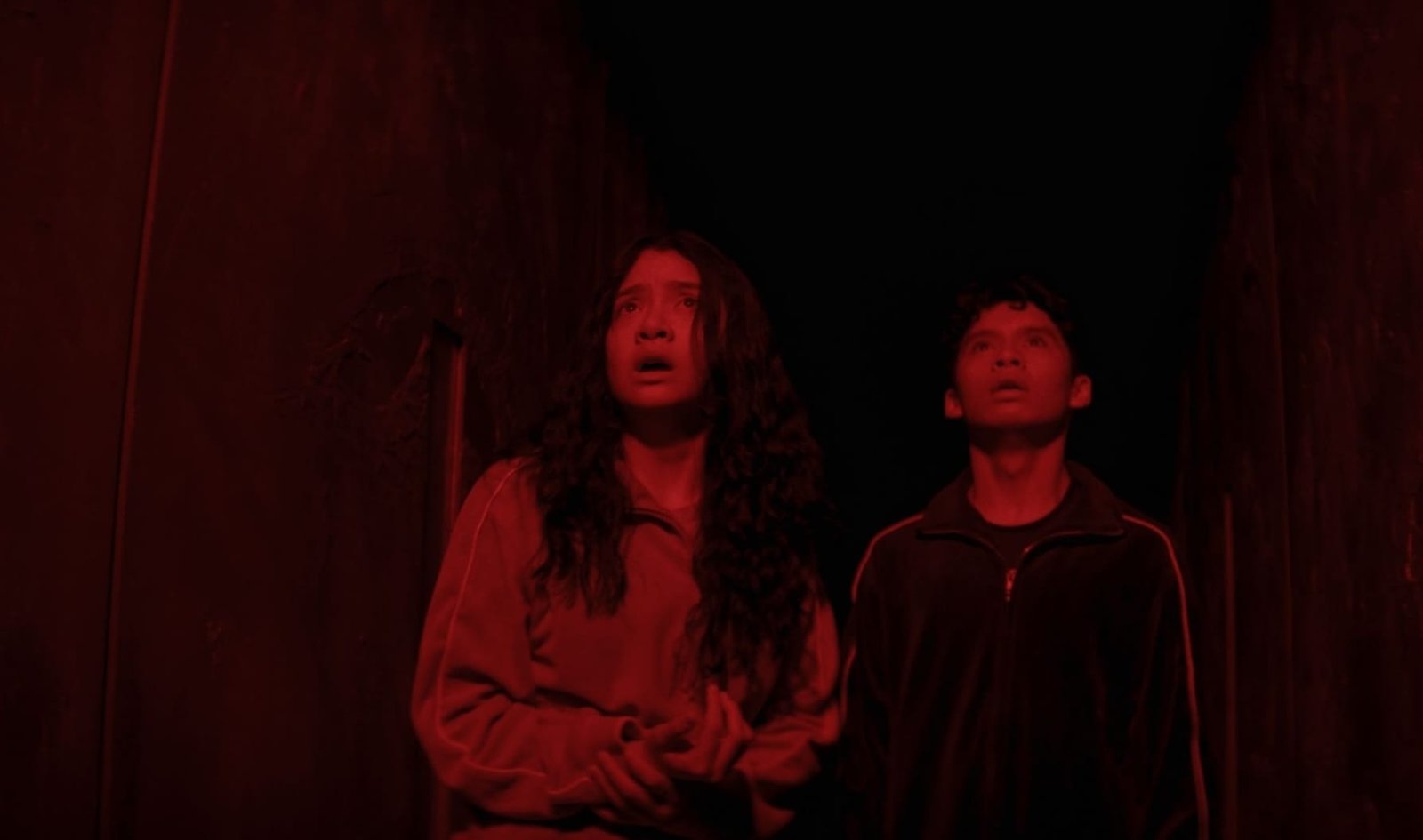
We first see ‘Red’ and ‘Blue’ (twins Emma and Ian Ho) as babies; these two children, now in their early teens or thereabouts, seem to have spent their entire lives in a spacious, but rather dark and dated-looking home, with only each other for company. However, this isn’t Megalomaniac (2022); the kids seem contented, they are clean, comfortably dressed, verbal (so someone has been teaching them), with access to food and drink. Minus the apparently-absent caregivers, things are – by most parameters – pretty normal.
When we look closer, though, things begin to look a little different. Firstly, these two get engrossed in games and activities which feel far too young for them. There is some kind of presence which watches over them – known to Red and Blue as ‘Papa’ – but it’s an unseen presence, offering only brief answers and messages in response to their as-yet very simple requests. But when the children accidentally break a window during one of their interminable games of catch, Red notices a beam of light and what we know as a keyhole, though she doesn’t know anything about keys. Still, it’s enough to prompt the girl to feel a little curious, for the first time, about the world outside – whatever that may be.
Perhaps as a distraction, or even as a punishment, the children soon find themselves waking up on what Papa refers to as their ‘forty-second’ Noel, a classic Christmas morning with tree and gifts. Here’s our first clue that time and space may not be running to the expected parameters here, or that perhaps Red and Blue are living to a curtailed clock, so that the excitement of Christmas comes around more than yearly. But there’s something else: an unexpected present. There’s a person under the tree, and at first Red and Blue, who are used to complete isolation, are barely able to recognise it as such. They’re petrified, but Papa assures them that all will be well. They have a new responsibility: to look after their new pal. No further details are given to them.
It’s a big ask; this young person, whom they decide to name ‘Pal’ (Ess Hödlmoser) is mute, passive and yet, surprisingly sinister with those traits, operating – whether they are aware of it, or mean to do it – as a disruptive force, especially for the more childlike and accepting Blue, whose scarred hand speaks to an unnamed past transgression and a real fear of change as a result. Red is more accommodating, desperate to fulfil Papa’s edict to look after their new friend, but via the wordless Pal, this soon means exposure to evidence of a far more disturbing world out there somewhere. The twins begin to grow apart, but Blue does find a way to reassert himself in his own way, soon enough – with all the repercussions this brings.
Whilst not a film which tasks itself with much in the way of on-screen violence, and even when nothing outwardly alarming is taking place, Home Bodies feels like a film with sinister bones. Its framework – real, but unreal – is communicated to audiences via its superb production and sound design, together with excellent performances from all of the lead actors (and we can’t overlook Ess Hödlmoser in this, as their presence on-screen is impressive, even though they remain silent). It all unfolds in a well-realised immersive environment, and it’s an interesting experience as a viewer, because we experience the film through concurrent shots and exposure to more of the setting than either child can experience in quite the same way in that moment, but we are trapped on their level, too, subject to the same, hovering, unsettling questions as them. This description of a closed environment with a seemingly indifferent overseer does have precedents, both on-screen and in literature. There’s a little of Vivarium (2019) in here: ostensible comfort; a home-like set-up; an observer or system which excludes the unwitting objects of focus from what the hell is going on (see also: Silo), something which feels even crueller when it involves two people as young and as vulnerable as Red and Blue. But perhaps most of all, director Casey Walker (In a Violent Nature, The Void) and his writing team (Adrian Murray and Marcus Sullivan) seem to have created a film which has significant overlap with the fantastic 1995 novel, I Who Have Never Known Men by Jacqueline Harpman, a supremely compelling story about a similar kind of prison – yes, we can call it that – operating under a similar array of large-scale questions.
All of these potential inspirations or precedents, whether incidental or acknowledged, suggest bigger-picture ideas about ethics and self determination, and Home Bodies makes compelling use of these throughout. It’s visually rich and smart enough to work well as a metaphor, of two children being tasked with the formidable, barely-understood responsibility of growing up, gaining independence. But it works on its own terms too as a subtle and enthralling piece of science fiction, brave enough to hint, not tell. Home Bodies is an unsettling, but mesmerising piece of world-building.
Home Bodies (2026) received its world premiere at the Fantasia International Film Festival. For more details, please click here.