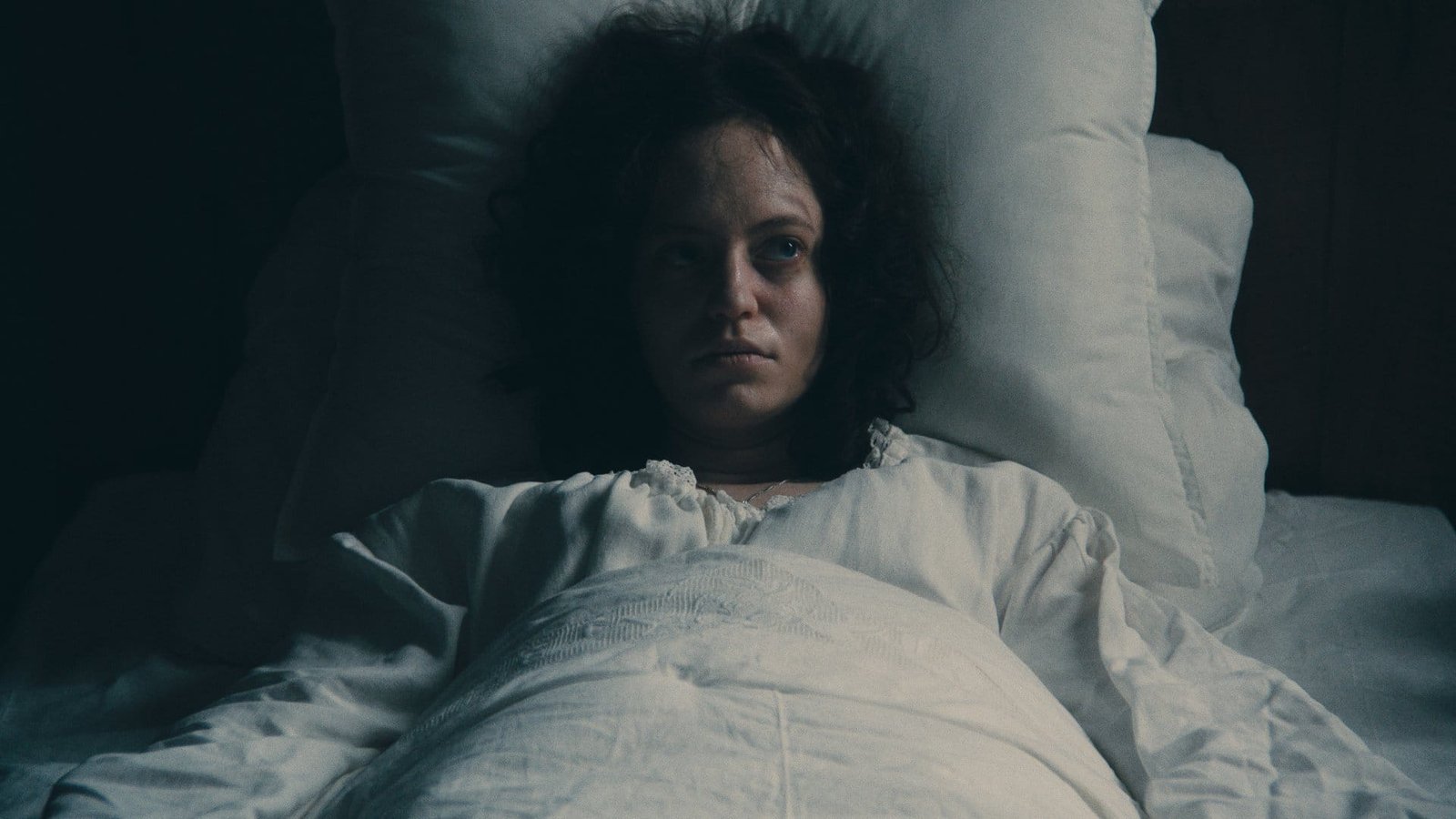
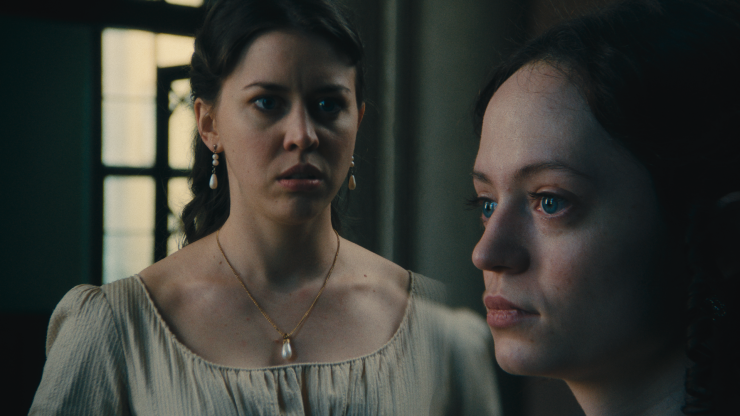
Austria, the early 19th Century: in an evocative opening scene, a young woman kisses her hand to the gravestone of ‘Seraphine’, her late sister. The young woman, Florentine (Alina Schaller) is about to be married to Bruno (Daniel Holzberg), a minister who has just come into his living. Their lives should be happy, but Florentine is melancholy in ways which seem to surpass grief for her sister – and father, whom she has also recently lost. When Bruno pleads with her to be candid with him about her mystifying sadness, she promises she will explain everything at dinner that night.
As promised, Florentine explains that, some months previously, she read a ‘dreadful letter’ which had been vouchsafed to her by her father, only to be opened under a certain circumstance: her impending wedding. This prompts her to talk about Seraphine (Fanny Altenburger), her much-missed sister and a sensitive, brilliant soul that we’d now consider ‘a psychic’; it was understood somewhat differently in this time period, and often intertwined with ideas about religious faith, as it is with Seraphine – who tells Florentine that ‘an angel’ whispers to her things she could not otherwise know. But Seraphine begins to change: she seems able to bilocate (an idea which was gaining prominence through emergent Spiritualism in this era,, but had also long been treated by Catholicism as something miraculous). She loses track of time, becomes reclusive and unwell (though we could probably guess that last part) and, finally, tells her sister of an encounter with a frightening apparition, which whispers to her the ‘fates’ of all of her beloved family members, as well as herself.
The Fated Hour is based on an 1810 story titled The Relationship with the Spirit World (Die Verwandschaft mit der Geisterwelt) by Friedrich Laun, and it’s such a great candidate for an adaptation (it has also been translated into English on several occasions since its first publication, once by the fantastic short story author Marjorie Bowen in the 20th Century, and the film shares its title with hers). It’s such a rich story; there’s so much in here, and none of it needs (nor does it get) oversimplified or overdone in the script, though the changes made by writer and director Peter Hengl do, to an extent, streamline the story, centring it more on the family history aspect, given Bruno’s impending family connection. Family, legacy and fate are incredibly important here, as are newer ideas about ‘disordered’ minds, which in the early 19th Century existed at an intersection between gender roles, religion, modernisation and incipient belief systems, like changing ideas about the spirit world.
Other self-evident truths cast their shadows over The Fated Hour, too: the great precariousness of life and death – in a period in history where disease and premature death were still all-too common – is an accepted part of the tale, but then so is a certainty of some kind of afterlife, even when contact with it could be terrifying. The tale-within-a-tale used here (with an accompanying voiceover) is a popular motif in supernatural fiction – offering a double-remove from events, both to obscure the incredible and also to emphasise it – and it’s brought to life here subtly and effectively, with a simple but effective soundtrack, visuals, camerawork and edits.
Period literary adaptations like this always bring to mind – well, if you’re British, maybe – A Ghost Story for Christmas, and there’s certainly a shared lineage and some shared visual elements, but The Fated Hour is still very much its own beast. In terms of some of its aesthetics, it perhaps resembles The Vourdalak – another literary adaptation. The Fated Hour is wonderfully uncluttered, with lots of soft light and painterly visuals. And yet for all that beauty, for all those lovely costumes and locations, it’s still a quietly creepy and profound piece of horror. This is after all a story of inescapable destiny, which is bound to be as affecting and weighty now as then, explored here in an atmospheric and economical thirty-minute film.
The Fated Hour (2026) received its world premiere at the Fantasia International Film Festival. For more information, please click here.