By Adam Page
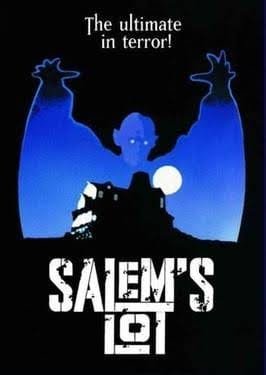
There is something about Stephen King that, I think, he himself would probably concede after a few coffees and the right provocation: he can’t always see the wood for the trees. There is no question that he is one of the most instinctive and devastating horror writers of the twentieth century, an author whose best work operates like a scalpel and sledgehammer at the same time. But his great strength; a compulsive and almost evangelical need to tell us everything, with every room furnished, every street populated and every secret excavated, is at times his greatest liability. ‘Salem’s Lot, published in 1975, is an incredible achievement in atmospheric dread, taking the creaky Dracula mythology and firmly planting it in the rocky and resentful soil of small-town Maine with real conviction.
But, and there is always a but…
Tobe Hooper’s 1979 CBS miniseries adaptation, working in the smaller space of network television and constrained by budget and broadcast standards, arrived in living rooms instead of cinema screens. And this version doesn’t just translate King; in several crucial, structural, and philosophically interesting ways, it surpasses him. I know, this sounds like sacrilege, but stay with me.
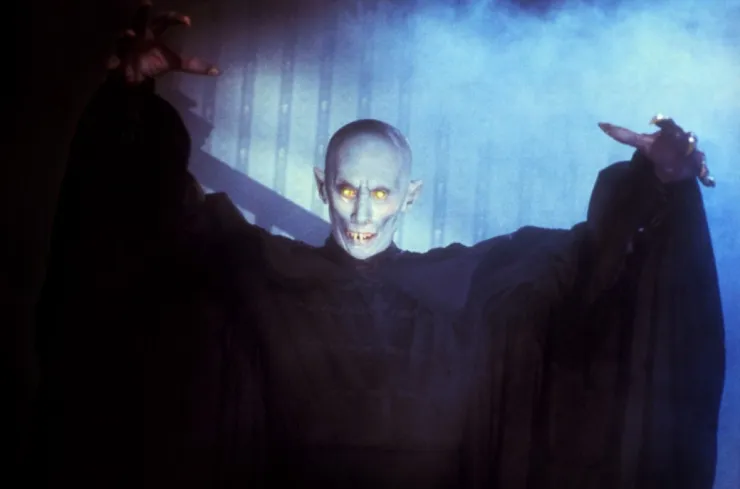
The first and most important argument is the one that sounds a little trite until you stop and think about it. Barlow’s muteness is more frightening than his eloquence. In King’s novel, Kurt Barlow speaks. At considerable length. He is theatrical and articulate, almost Miltonic in his grandiosity. But that’s where the problem lies; as a consequence, he becomes explicable. When you give your monster a vocabulary, you also give it a psychology, and when you do that, you’ve given the reader a handhold, something to grab onto. You’ve given them a way of situating the horror in a comprehensible system of desire and motivation. King’s Barlow is eloquent in the same manner as some other literary vampires; he belongs in the same tradition as Bram Stoker’s Count, Anne Rice’s Lestat, those monsters who speak because speaking itself is an assertion of power and civilisation over the mere animal. And in those terms, it works. On the page, his long speeches and declarations carry a certain grandeur. But it turns out that grandeur is exactly the wrong register for what Salem’s Lot is actually about.
What it’s really about, and what the story is concerned with at its core, is the collapse of the ordinary, the contamination of the banal, and the discovery that your teacher or child, or your wife, has been changed into something wearing their face but no longer them. It’s a story about the uncanny valley in its most literal and frightening sense: the home becomes unhomely, and the familiar reveals itself as deeply alien. To tell that story, you don’t need eloquence at the centre, you need its absence. You need something that looks at you and doesn’t explain itself, doesn’t engage with you on equal terms or grant you the consolation of rhetoric. In other words, you need exactly what Hooper and makeup artist Jack H. Young gave us in Reggie Nalder: a white-faced, rat-eared, yellow-eyed thing floating across the screen like a remembered nightmare and saying exactly nothing.
Nalder’s Barlow, and this is a position I will continue to defend, is one of the most honestly frightening creations in horror cinema. He isn’t frightening despite his limitations, but because of them. He’s frightening because he isn’t a character; instead he’s a condition. He’s what happens when humanity is entirely ripped away. He doesn’t want to engage with you, or explain his philosophy or contempt for the merely mortal. He wants to feed. That blankness, the terrible vacancy behind those yellow eyes is more disturbing than any grand speech King could have written. Hooper knew something that horror moviemakers occasionally forget, then rediscover: the void is scarier than the explicable. Jaws frightens us because for the longest time, we don’t see the shark. Halloween’s Michael Myers is frightening because he is a silent shape behind a blank mask. In Hooper’s rendering, Barlow belongs in that lineage and he elevates it.
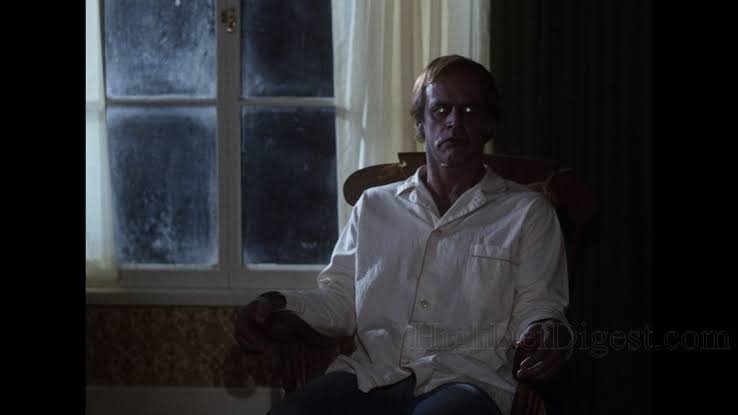
Now, I want to make a case that may seem counterintuitive given that we’re talking about a horror series and horror, culturally speaking, is generally understood to be interested in not actually dying: the episodic structure of the series lets the town’s population breathe, and then be mourned. This is really quite a big thing.
It’s an irony of King’s novel that despite its meticulous and near sociological mapping of Jerusalem’s Lot: all the backstories and grudges, the secret shames and adulteries, the parking lot fights that nobody has forgotten; the sheer density of that information can work against emotional investment. We get so much that processing any loss becomes difficult. The deaths build, but they build as data points in an overwhelmed system. By the time the town is being ravaged in earnest, the novel has worked up something closer to a tally than a tragedy.
In contrast, the miniseries works in time differently. There are two substantial episodes, with nearly three hours of television, and in that structure, Hooper and screenwriter Paul Monash make choices that may seem like compromises, but on reflection are acts of intelligent creative selection. Yes, characters are consolidated and some subplots are trimmed, but what the episodic structure adds – and this is crucial – is the rhythm of serialised television, which is the rhythm of ordinary life. You meet people and spend time with them across an episode. You go away and come back. And when they’re gone, you feel their absence in the same way you feel the absence of people you’ve spent time with, not just learned information about.
Think about the Glick brothers: lost, kidnapped and eventually both turned into vampires. Or Mike Ryerson, just working in a cemetery and falling victim to the newly turned Danny Glick. Constable Parkins Gillespie, watching his town fall while being powerless to stop it. Or Mark Petrie, watching his parents murdered. In a literary sense, these aren’t complicated characters, but Hooper gives them space. Actual screen time, and the texture of existing in a world before the horror arrives. It’s that space which creates the conditions for real grief. The genuine horror of Salem’s Lot isn’t Barlow gliding through the night, it’s that the town of Jerusalem’s Lot is depopulated. A community, maybe flawed and squabbling but alive, is systematically destroyed. For horror like that to work properly, we need to have known the community. We need to have spent time in the diners and shops, the schools and motels. The miniseries gives us that time while, paradoxically, the novel gives us more information about the town while giving us less sense of it.
But there is something else I need to talk about, because it seems to me essential to any real account of what Hooper’s Salem’s Lot actually is and what it actually does. There is an argument, and it’s a serious, considered one, that this miniseries worked better on the small screen than on any other medium. And I think this is inseparable from the amazing, generationally definitive trauma it inflicted on the children who first encountered it.
Horror on television in 1979 was operating under constraints that seemed to be purely limiting: no explicit violence, no blood, no real transgression of broadcast standards. Hooper found in these constraints something like discipline. Without being able to show explicit gore, unable to overwhelm the audience with spectacle, he had to generate dread through suggestion and atmosphere, through the slow accumulation of wrongness. And in that discipline, he found a register that is uniquely suited to domestic horror. And let’s not forget, that’s what Salem’s Lot fundamentally is.
Because you watched it at home. In your living room, or if you were one of the countless children who probably shouldn’t have been watching it but did anyway, in your bedroom, or sneaking downstairs after you’d been told to go to bed. You watched it in the same house you lived and slept in, the same town where you lived, and the patient insistence of the camera on the ordinary architecture of domestic life wasn’t just atmospheric, it was accusatory. It was the screen telling you to look at your window and look at what might be on the other side of it. The TV set, the warm and familiar communal domestic object became the delivery mechanism for a horror that was specifically about domestic vulnerability. The message and the medium were perfectly and terrifyingly aligned.
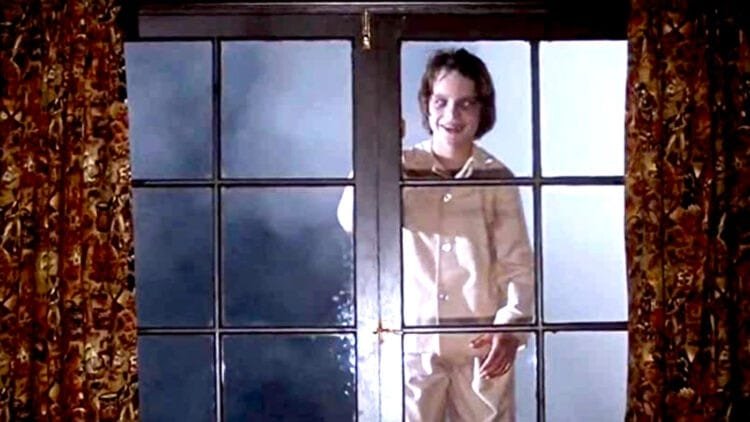
And then, of course, there is the Glick boy at the window. Danny Glick, poor, dead Danny Glick, pale and floating in the misty night air, scratching at the glass. If you know, you know. If you came across this image at the age of 9 or 10, like I did after seeing it on VHS, you know with absolute physiological certainty what I’m talking about, because your body still remembers. This isn’t hyperbole or the warm exaggeration of nostalgic horror fandom. This is a real, measurable and multigenerational phenomenon; an entire group of people for whom the words Salem’s Lot will produce an immediate, involuntary recollection of a floating dead boy at the bedroom window, and a bodily response that no amount of adult rationalism has completely dissolved. The image works because it takes the window, your window, the one you can see right now, and turns it into a threshold between the living and the dead. And it works because that dead boy isn’t snarling or roaring, he’s drifting and scratching. He’s looking, with those terrible eyes, at his former friend, and something about the mix of the familiar face and the totally alien presence behind it is nearly unbearable. Hooper understood with real clarity that the horror of vampirism isn’t mainly the violence; it’s the persistence of the face, after the person has gone.
And that brings me to what I think is the most intellectually generative frame for understanding what Hooper achieved: Salem’s Lot is a case study in productive fidelity; the art of honouring the spirit of a source text while transforming its letter with confidence and creative intelligence. This is rarer and much more difficult than it sounds. The history of horror adaptations is cluttered with versions that chose between two equally unsatisfying options. Either they were slavish reproductions, capturing everything on the surface and missing what made the original vital, or they’re wholesale departures that use the source material just as a brand. Hooper and Monash did something genuinely harder; they read King’s novel, understood what it was actually for, and made decisions – some quite radical – in service of those underlying purposes, rather than in spite of them.
The decision to relocate Barlow’s power and antiquity into a visual and not verbal register is the best example of this, but it isn’t the only one. The decision to let James Mason’s sinister and beautifully mannered Richard Straker carry the burden of the villain’s eloquence and menace is a piece of adaption thinking that needs more recognition than it usually receives. In his role, Mason gives us everything King gives us in Barlow’s speeches; that sense of ancient, cultivated malevolence which has watched centuries pass with contemptuous amusement. Splitting the novel’s vampiric force across the silent ambiguity of Barlow and Straker’s verbose and courtly manipulation, Hooper creates something that’s arguably more complex than the version in the novel: a vampiric operation with a face and a voice, a bestial centre and civilised interface, and this maps pretty exactly onto the way corruption tends to work in small communities. The charming newcomer arrives, opening the right business in the right building, with the darker thing he’s invited in behind him.
How Hooper treats the Marsten House is also instructive. King’s novel gives us the house as a sustained presence, a dark accumulation of local mythology and menace. Hooper uses it more sparingly, sitting on that hill and watching, with Hooper returning to it the way the town does in its imagination, as an inescapable fact. Less, here, is clearly more. The restraint creates something which King’s comprehensive treatment can’t quite achieve: real mystery. In the miniseries, the house stays strange because it’s never fully explained. It has the quality of a recurring dream, in that you return to it, but you can’t quite resolve it.
Writing all this, I don’t mean to say that King’s novel is without its extraordinary qualities; saying that would be dishonest and wrong. Its treatment of Ben Mears’s psychology, and the specifically American mythology of the failed return and corrupted pastoral, of small-town denial and complicity, are things the miniseries can’t quite capture – and doesn’t try to. King’s gift, his radar for the moral weather of a community and his ability to make you feel the weight of decades of local resentment and compromise is there in the novel in ways that a three-hour miniseries could never fully replicate.
But in exchange for what the format required him to leave behind, Hooper gave us something rarer in the history of horror on screen: a version that knew the emotional and thematic centre of its source well enough to serve it more faithfully than the source itself sometimes did. He kept its soul and found new forms for it. He tore away the eloquence and discovered the silence that eloquence had been covering, and gave the town enough room to exist so that its loss would mean something. And he brought all this into the living rooms of an audience that was utterly and brilliantly unprepared for it. An audience now in its fifties and sixties and still, still, checks the window before turning off the light at night.
That is what great horror adaptation does, and that is what Tobe Hooper did. Four and a half decades later, it remains one of the most intelligent, most frightening, and most underrated achievements in horror history.