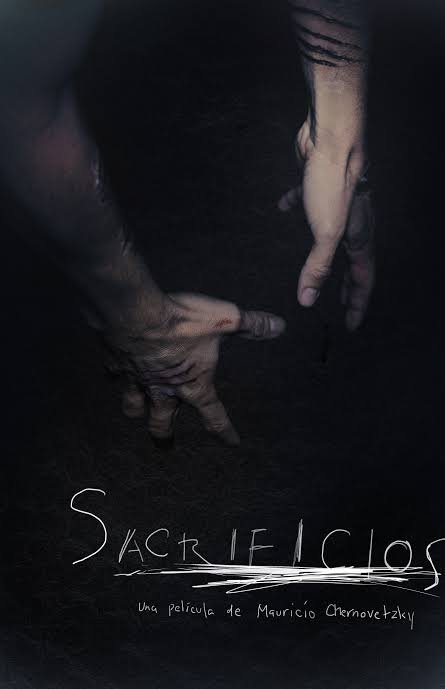
Mictlantecuhtli, the Aztec God of the Dead and page upon page of Aztec art depicting his historical ritual appeasement dominate the first minutes of Mexican director Mauricio Chernovetzky’s Sacrificios (2025), a study of Mexican religion, grief, fatherhood and guilt. After lingering across various drawings and sculpture, the camera pulls back to reveal a small boy, Andres (Siddhartha Tonalli), turning the pages, glancing at the images of savage bloodletting and human sacrifice, eventually stopping at a photograph of a terrifying wooden figurine of the skeletal-limbed, skull-faced, crouching God of the Dead, staring out of the page with a manic intensity. The book is swiftly removed by his concerned professor mother Alma (Frida Astrid), but perhaps, too late. This last disturbing image of Mictlantecuhtli remains in the young boy’s mind and is to trigger a sequence of events that will lead us to Mictlantecuhtli’s chthonic realm.
Alma leaves their oceanside home to give a lecture in comparative Aztec and Christian religion (pay attention to this) and leaves Andres, fresh from a bath, in bed and in the care of his father, Juan (Jorge A. Jimenez). Juan is supposed to be working too, but uses his time alone in his office to slack off and consume pornography. With his earbuds in, absorbed in masturbation and distracted by odd, blood-tinged visual disturbances in the video, he doesn’t hear what happens next. Andres, troubled with lingering, nightmarish images of Mictlantecuhtli, has left his bed to seek the comfort of his favourite toy shark, left on a high shelf in the bathroom. Andres climbs up to retrieve his toy, and suffers a fatal accident, falling and drowning in the undrained tub. Alma returns, after a lecture marred by disruptive electrical storms, to find Juan catatonic, cradling his dead, bloodied son in his arms.
A post-funeral, grief-stricken Juan takes to the sea by his home in a plastic kayak, ostensibly to fish, perhaps to end himself. He’s distracted from both of these goals by the appearance of Andres’ toy shark, stuck to a huge floating hunk of seaweed. Pulled aboard and pulled apart, in a sequence that jumps straight into magical realism, the seaweed reveals what Juan has been yearning and wishing for – a living, breathing Andres.
From the deadly tub of bathwater, to the shark who must keep swimming to survive, to the grey, leaden expanse of sea he finds Andres in, water in this film is a transformative, liminal medium allowing the passage from the realm of the living to the dead and perhaps to places, well, in between. Andres is certainly transformed. He refuses food and demands blood. Juan self-harms, Aztec-style, to provide. Father and son descend to a dank cave on an island overseen from a distance by a triad of slightly sinister military figures, with whom Juan bargains for food. The tiny kayak amid the vast ocean and the strange island itself may be understood as the isolating quality of grief; an emotion most will eventually experience, but for each individual consumed by it, feels like nobody can truly share.
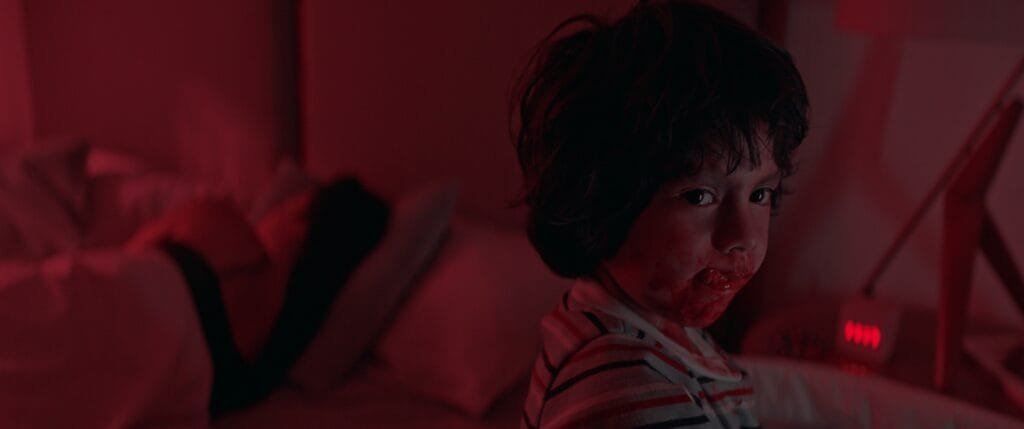
The deep, dark cave may be a stark metaphor for Juan’s unconscious, where his grief, guilt and impossible desire to resurrect Andres torment him, as well as representing Mictlantecuhtli’s natural underworld abode, where the dead must pass challenging tests to finally rest. The film shifts fully into a surrealist, magical realm, where an unsettling muddle of Catholic and Aztec religious imagery and frightening hallucination allow Juan to painfully process his grief, his love and his deep guilt over Andres’ fate. The soldiers overseeing the island taunt Juan that the place contains nothing but ghosts, perhaps acting as crude spiritual guides in this underworld realm, perhaps being projections of Juan’s last link to reality. Eventually Juan must make a decision about whether to continue to sacrifice his lifeblood for and to cling to Andres, who has by increments transformed into a sinister, blood-fixated creature utterly unlike his real son. Siddhartha Tonalli is unsettlingly good for one so young in this dead-eyed, bloody-mouthed, vampiric iteration of Andres.
Despite some very gory, disturbing and occasionally flagrantly sexual imagery, Sacrificios is a quietly lyrical piece of horror filmmaking. Chernovetsky extracts deep emotion from the actors’ carefully restrained performances and Grzegorz Bartoszewicz has created a beautifully stark cinematography of bleak, dark ocean and shadowy, firelit cave. Jorge A. Jiminez’s performance is a masterclass in showing profound emotion through small expressions, showing us a man choking on grief to the point his mind quietly unhinges from reality and slips entirely into an realm filled with cultural and ancestral religious iconography originally designed to place guardrails on, and provide a pathway through, the trials of bereavement.
Chernovetsky provides no easy final explanations as to what exactly has happened to Andres or Juan, nor easy, happy solutions to the stark real-world horrors of losing a child. The trials Juan goes through to reclaim his base sanity and confront his grief perhaps parallel the tests Mictlantecuhtli puts dead souls through, or mimic the mortification of the flesh as a form of repentance for one’s sins in old Catholicism. To the modern mind uncoupled from deep religion, Mictlantecuhtli’s terrifying aspect and underworld mythology may ultimately less represent simple evil than reflect the human terror of death and the profound pain of grief that must be processed for normal psychological function and active living to finally be restored. This promises a path made of self-confrontation and pain, but as the film suggests, everything has a price.
Sacrificios (2025) will feature as part of this year’s Raindance Film Festival (European Premiere). For more information on screenings and tickets, please click here.